Subject – Refrigeration & Air Conditioning
Topic – A.C. DUCT
Presented By :- Dhruv Shah
Functions of Duct
 The function of duct is to transmit the air
from air handling unit to the space to be air
conditioned.
 The conditioned air must be properly
distributed to provide comfort zone
conditions.
 Duct systems are also used to bring cooled or
warm air to the proper distribution points
where several rooms are to be conditioned.
Classification of ducts
 According to the velocity of duct : Low velocity and
higher velocity duct. When velocity of air is upto 750
m/min and more than 750 m/min.
 According to pressure : Low pressure, high pressure
and medium pressure. When static pressure is less
than 50 mm of water, 50-150 mm of water and 150-
250 mm of water.
 According to type of air : Supply air duct, return air
duct and Fresh air duct.
General rules for duct design
1. Air should be conveyed as directly as possible to save
space, power and material
2. Sudden changes in directions should be avoided.
When not possible to avoid sudden changes, turning
vanes should be used to reduce pressure loss
3. Diverging sections should be gradual. Angle of
divergence ≤ 20 degree.
4. Aspect ratio should be as close to 1.0 as possible.
Normally, it should not exceed 4
5. Air velocities should be within permissible limits to
reduce noise and vibration
6. Duct material should be as smooth as possible to
reduce frictional losses
Factors affecting design of duct
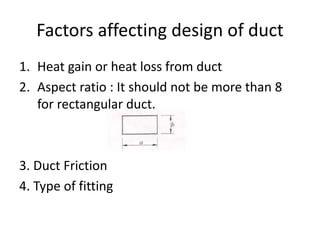
1. Heat gain or heat loss from duct
2. Aspect ratio : It should not be more than 8
for rectangular duct.
3. Duct Friction
4. Type of fitting
Duct Materials
 GI Sheet
 Aluminium
 Stainless steel
 Fibre glass, GFRP
What is dynamic losses in duct?
 Whenever there is a change in direction or
velocity in the flow through the duct is known
as dynamic loss.
 It is due to:
1. Change in direction of flow through bends,
elbows
2. Sudden change in area due to enlargement,
contraction etc.
Duct design methods
 Velocity reduction methods
 Equal pressure loss (Friction loss) methods
Velocity reduction method
 In this method, velocities in the ducts are assumed
that they decreases as the flow proceeds.
 The pressure drops are calculated for these velocities
for respective branches from main duct.
 The pressure at the outlet is adjusted by dampers.
 This is easiest method and velocities can be adjusted
to avoid noise.
 In this method, considerable experience is required for
selection of velocities.
Equal pressure drop method
 In this method, the size of duct is decided to
give equal pressure drop per meter length in
all ducts.
 If layout of duct is symmetrical and same
length then this method gives equal pressure
drop and no damper is required.
 In case run at different lengths then shortest
will give minimum pressure drop and require
heavy damper at outlet.
A.C. Duct

A.C. Duct

  • 1.
    Subject – Refrigeration& Air Conditioning Topic – A.C. DUCT Presented By :- Dhruv Shah
  • 2.
    Functions of Duct The function of duct is to transmit the air from air handling unit to the space to be air conditioned.  The conditioned air must be properly distributed to provide comfort zone conditions.  Duct systems are also used to bring cooled or warm air to the proper distribution points where several rooms are to be conditioned.
  • 3.
    Classification of ducts According to the velocity of duct : Low velocity and higher velocity duct. When velocity of air is upto 750 m/min and more than 750 m/min.  According to pressure : Low pressure, high pressure and medium pressure. When static pressure is less than 50 mm of water, 50-150 mm of water and 150- 250 mm of water.  According to type of air : Supply air duct, return air duct and Fresh air duct.
  • 4.
    General rules forduct design 1. Air should be conveyed as directly as possible to save space, power and material 2. Sudden changes in directions should be avoided. When not possible to avoid sudden changes, turning vanes should be used to reduce pressure loss 3. Diverging sections should be gradual. Angle of divergence ≤ 20 degree. 4. Aspect ratio should be as close to 1.0 as possible. Normally, it should not exceed 4 5. Air velocities should be within permissible limits to reduce noise and vibration 6. Duct material should be as smooth as possible to reduce frictional losses
  • 5.
    Factors affecting designof duct 1. Heat gain or heat loss from duct 2. Aspect ratio : It should not be more than 8 for rectangular duct. 3. Duct Friction 4. Type of fitting
  • 6.
    Duct Materials  GISheet  Aluminium  Stainless steel  Fibre glass, GFRP
  • 7.
    What is dynamiclosses in duct?  Whenever there is a change in direction or velocity in the flow through the duct is known as dynamic loss.  It is due to: 1. Change in direction of flow through bends, elbows 2. Sudden change in area due to enlargement, contraction etc.
  • 8.
    Duct design methods Velocity reduction methods  Equal pressure loss (Friction loss) methods
  • 9.
    Velocity reduction method In this method, velocities in the ducts are assumed that they decreases as the flow proceeds.  The pressure drops are calculated for these velocities for respective branches from main duct.  The pressure at the outlet is adjusted by dampers.  This is easiest method and velocities can be adjusted to avoid noise.  In this method, considerable experience is required for selection of velocities.
  • 10.
    Equal pressure dropmethod  In this method, the size of duct is decided to give equal pressure drop per meter length in all ducts.  If layout of duct is symmetrical and same length then this method gives equal pressure drop and no damper is required.  In case run at different lengths then shortest will give minimum pressure drop and require heavy damper at outlet.