To transform something is to change it. In
geometry, there are specific ways to describe
how a figure is changed. The transformations
you will learn about include:
•Translation
•Rotation
•Reflection
•Dilation
Renaming Transformations
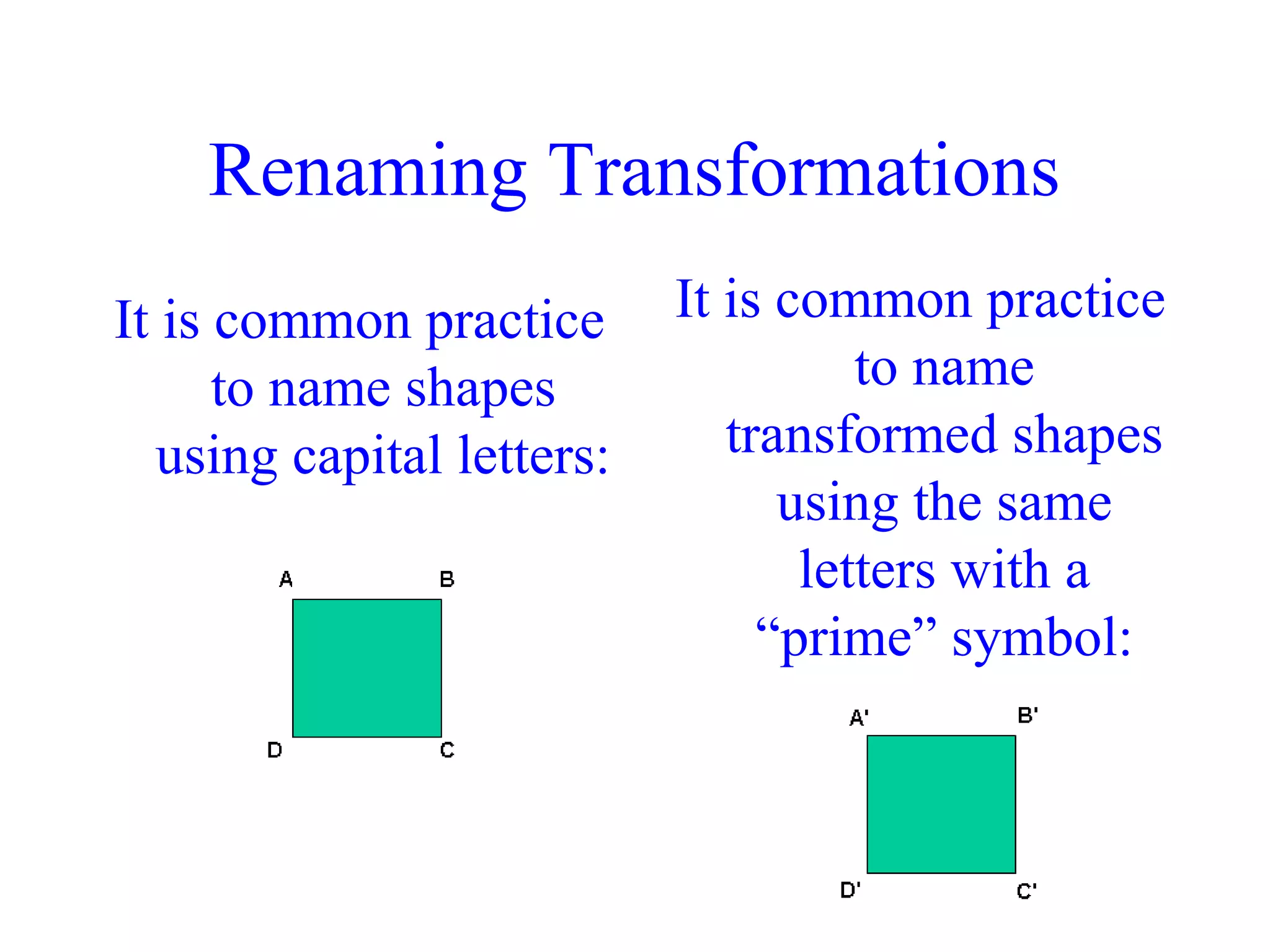
It is common practice
to name shapes
using capital letters:
It is common practice
to name
transformed shapes
using the same
letters with a
“prime” symbol:
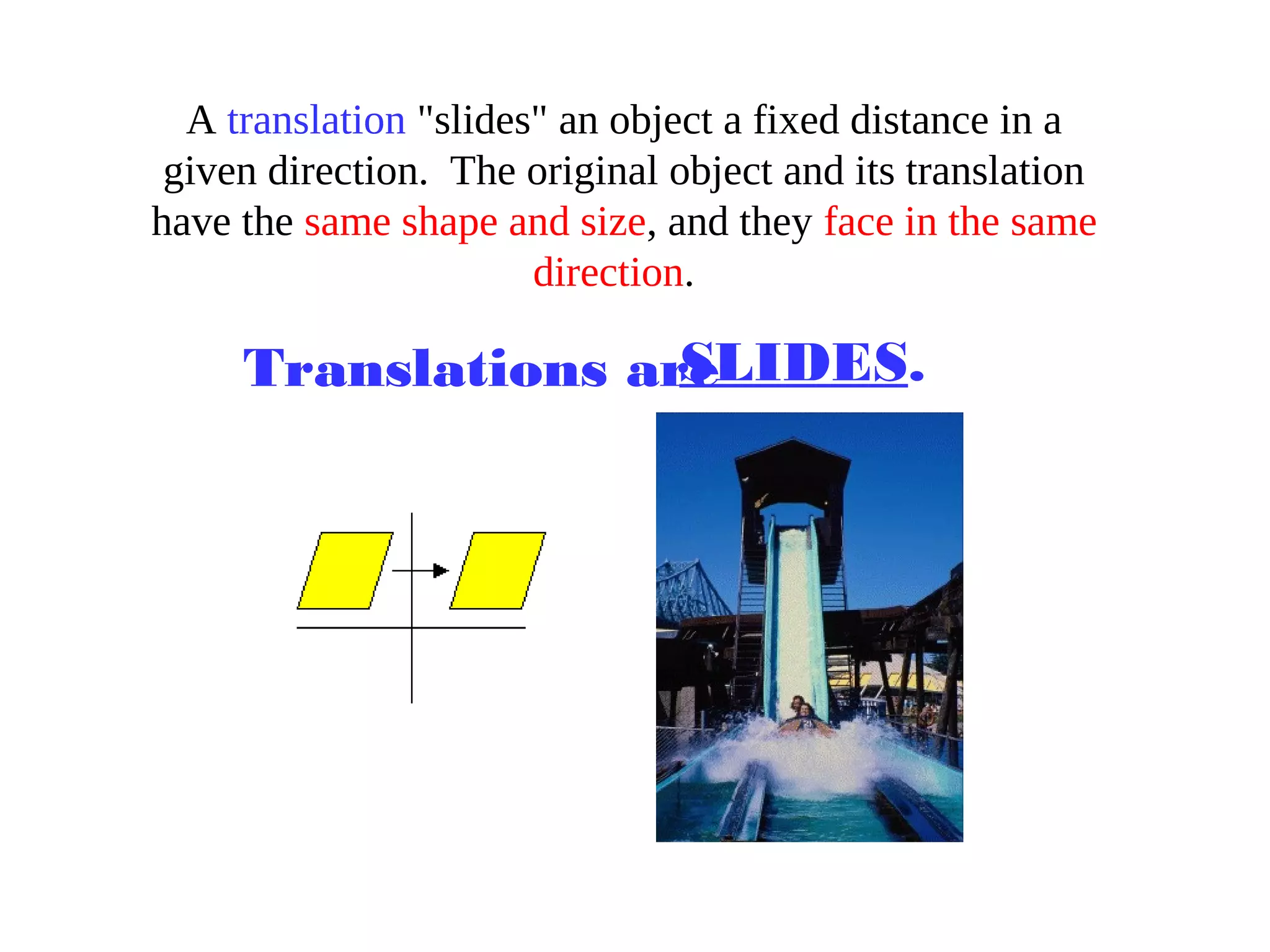
A translation "slides" an object a fixed distance in a
given direction. The original object and its translation
have the same shape and size, and they face in the same
direction.
Translations areSLIDES.
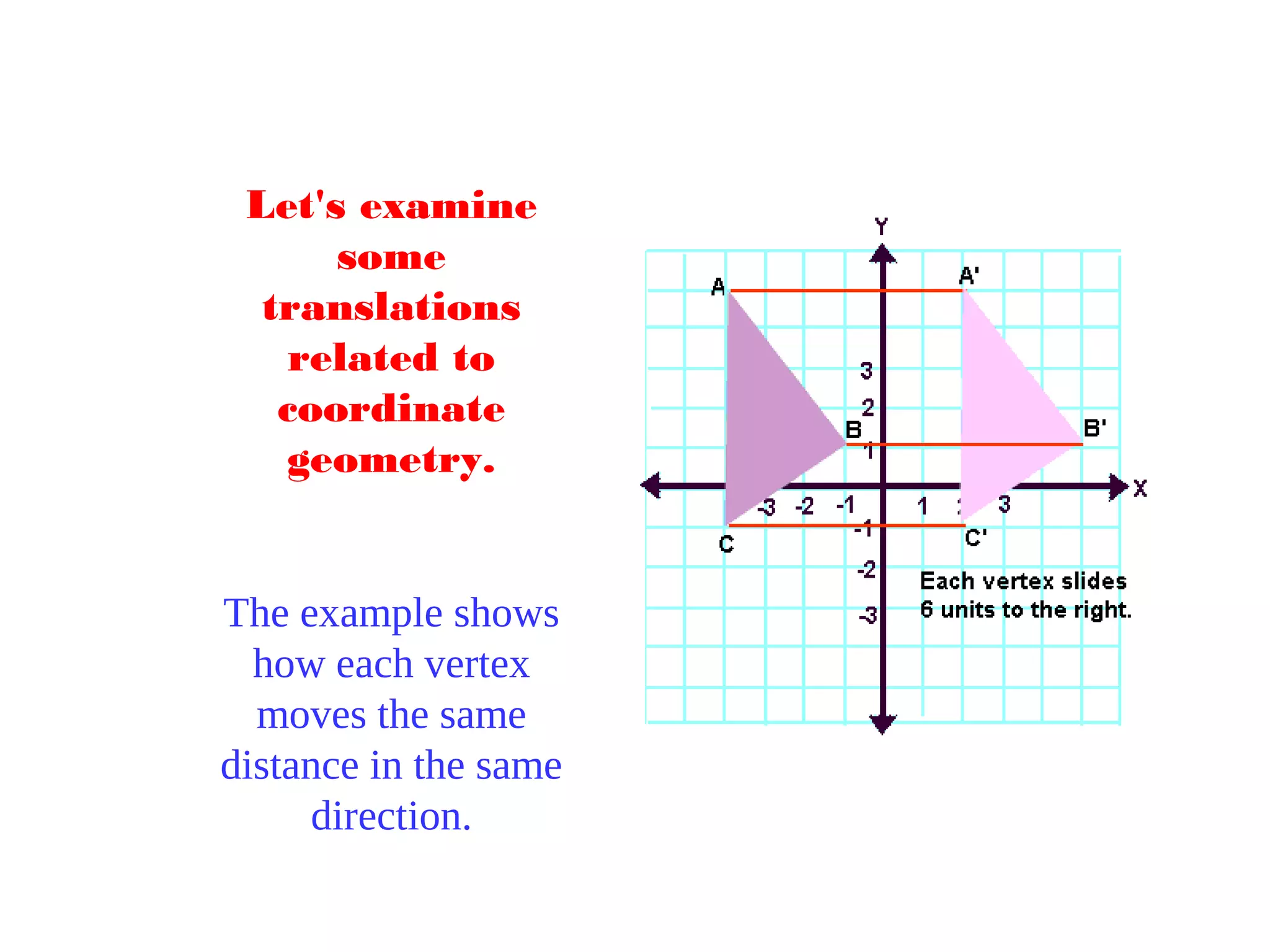
Let's examine
some
translations
related to
coordinate
geometry.
The example shows
how each vertex
moves the same
distance in the same
direction.
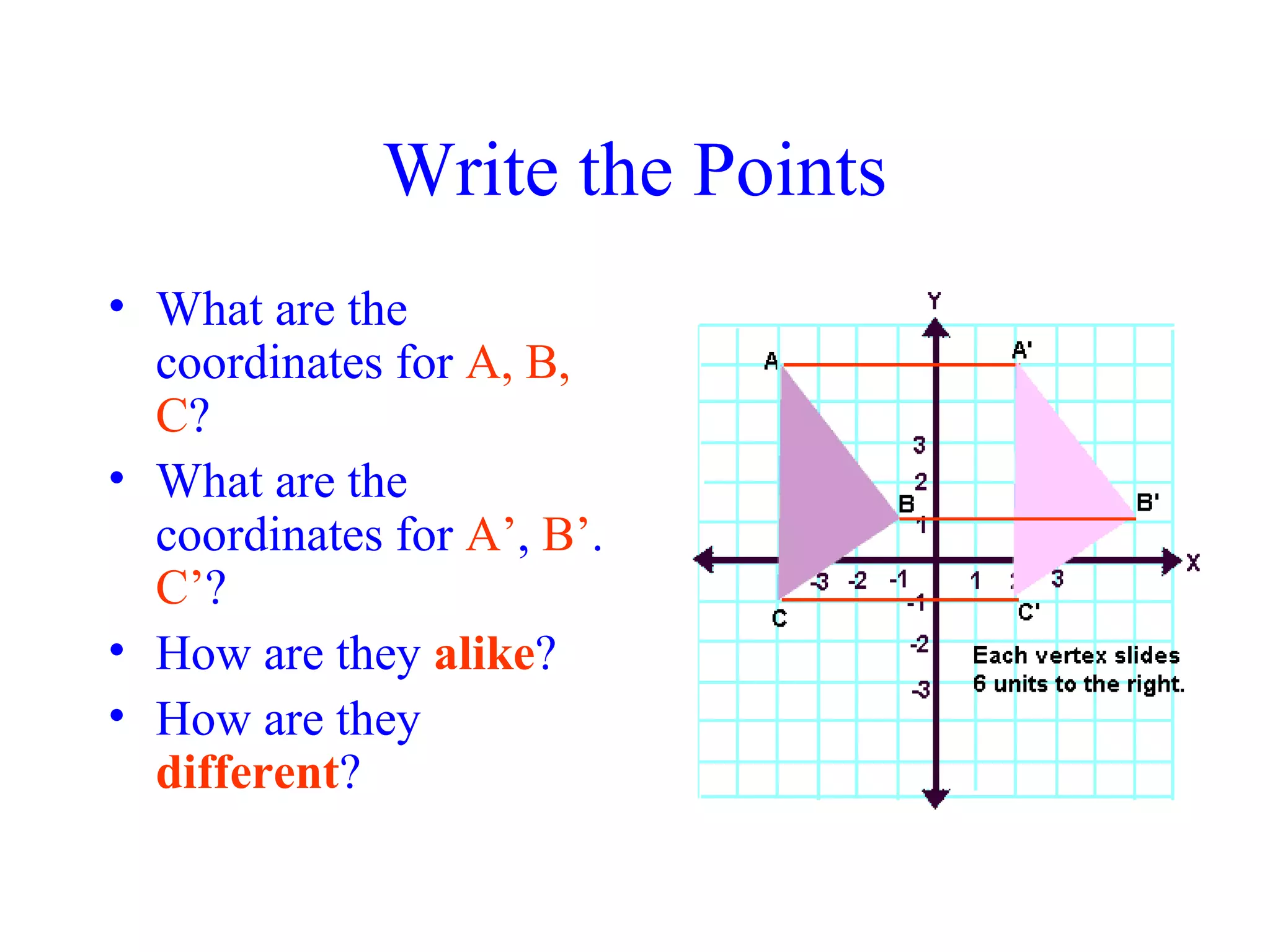
Write the Points
• What are the
coordinates for A, B,
C?
• What are the
coordinates for A’, B’.
C’?
• How are they alike?
• How are they
different?
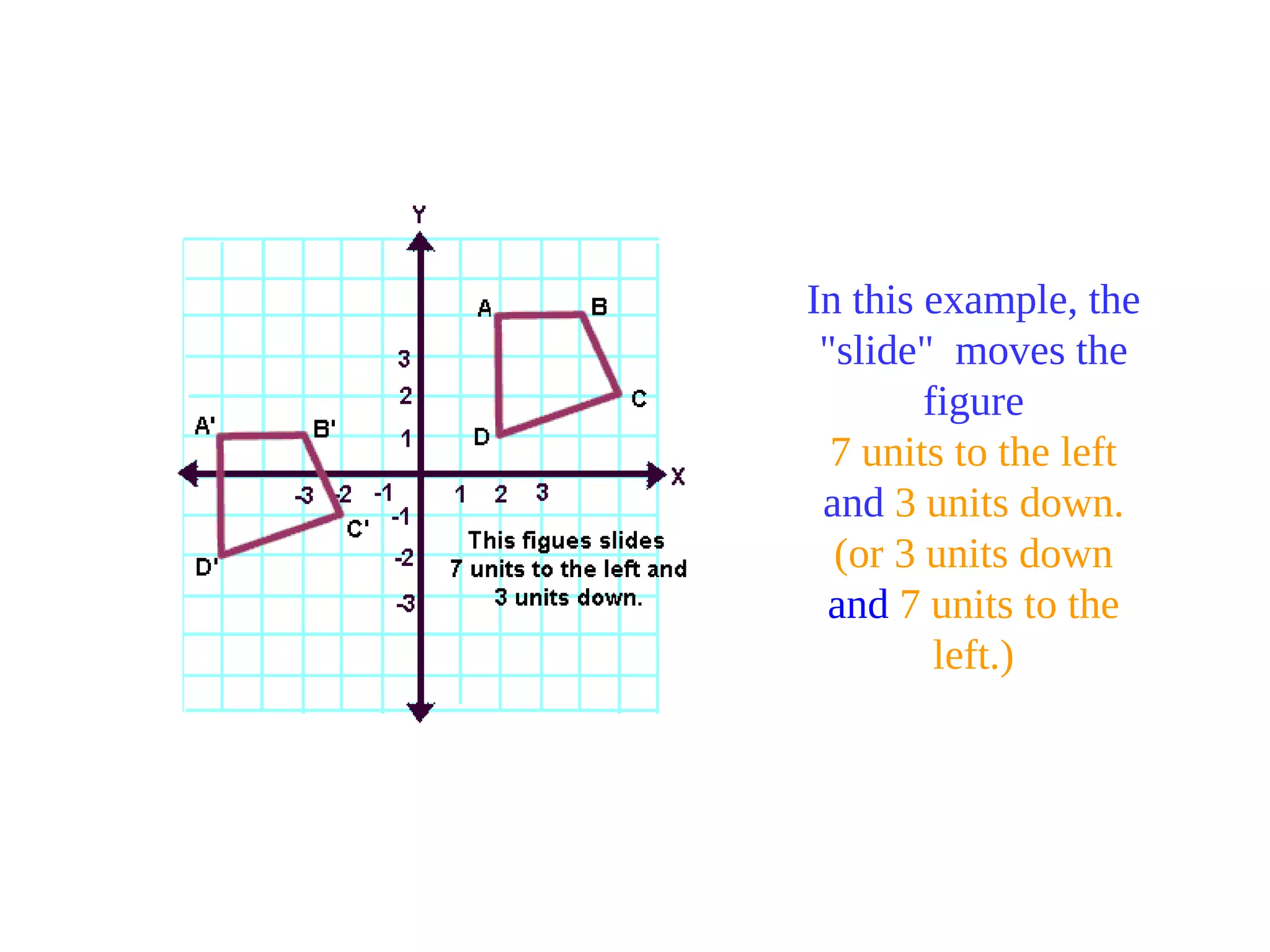
In this example, the
"slide" moves the
figure
7 units to the left
and 3 units down.
(or 3 units down
and 7 units to the
left.)
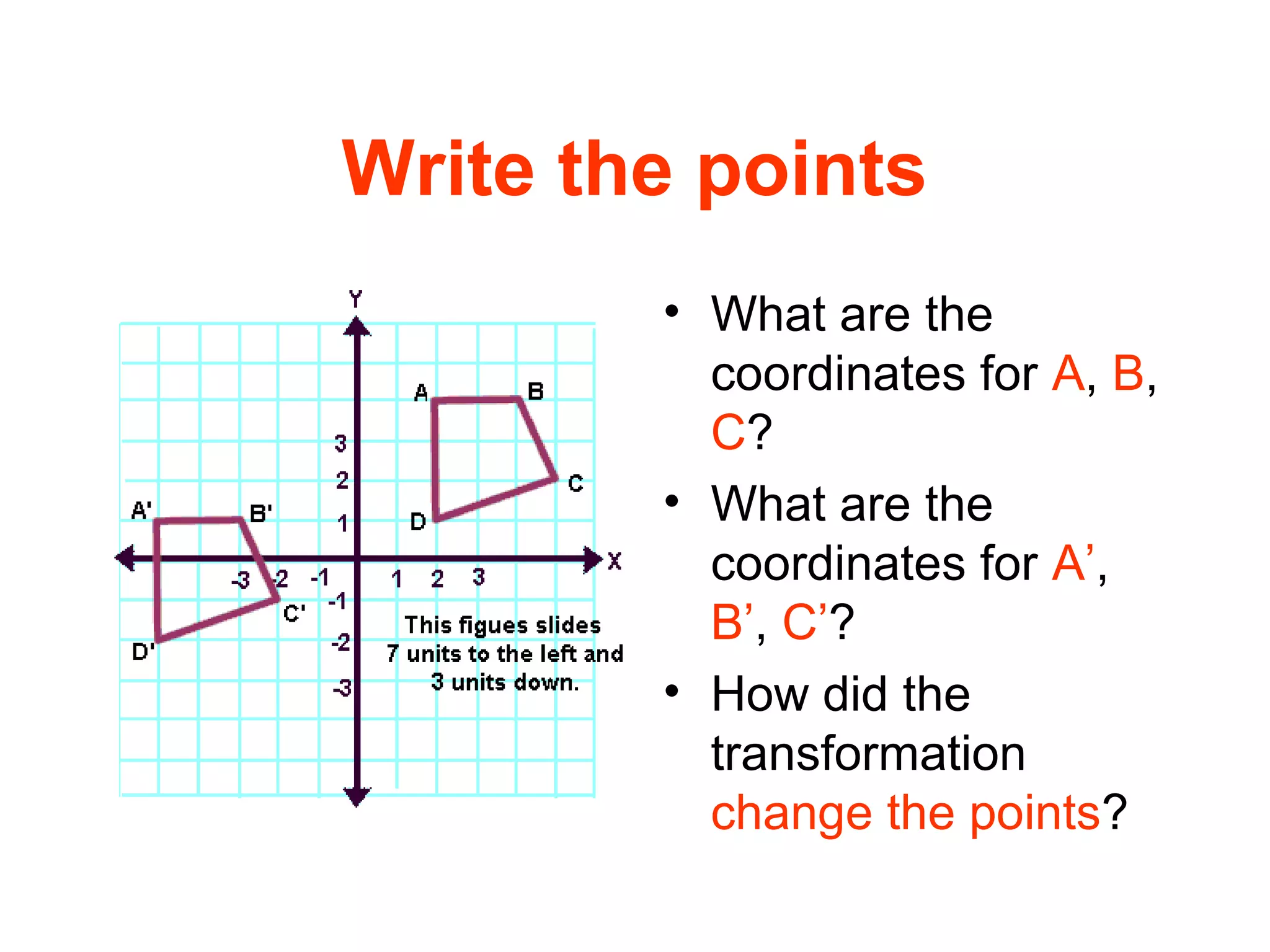
Write the points
• What are the
coordinates for A, B,
C?
• What are the
coordinates for A’,
B’, C’?
• How did the
transformation
change the points?
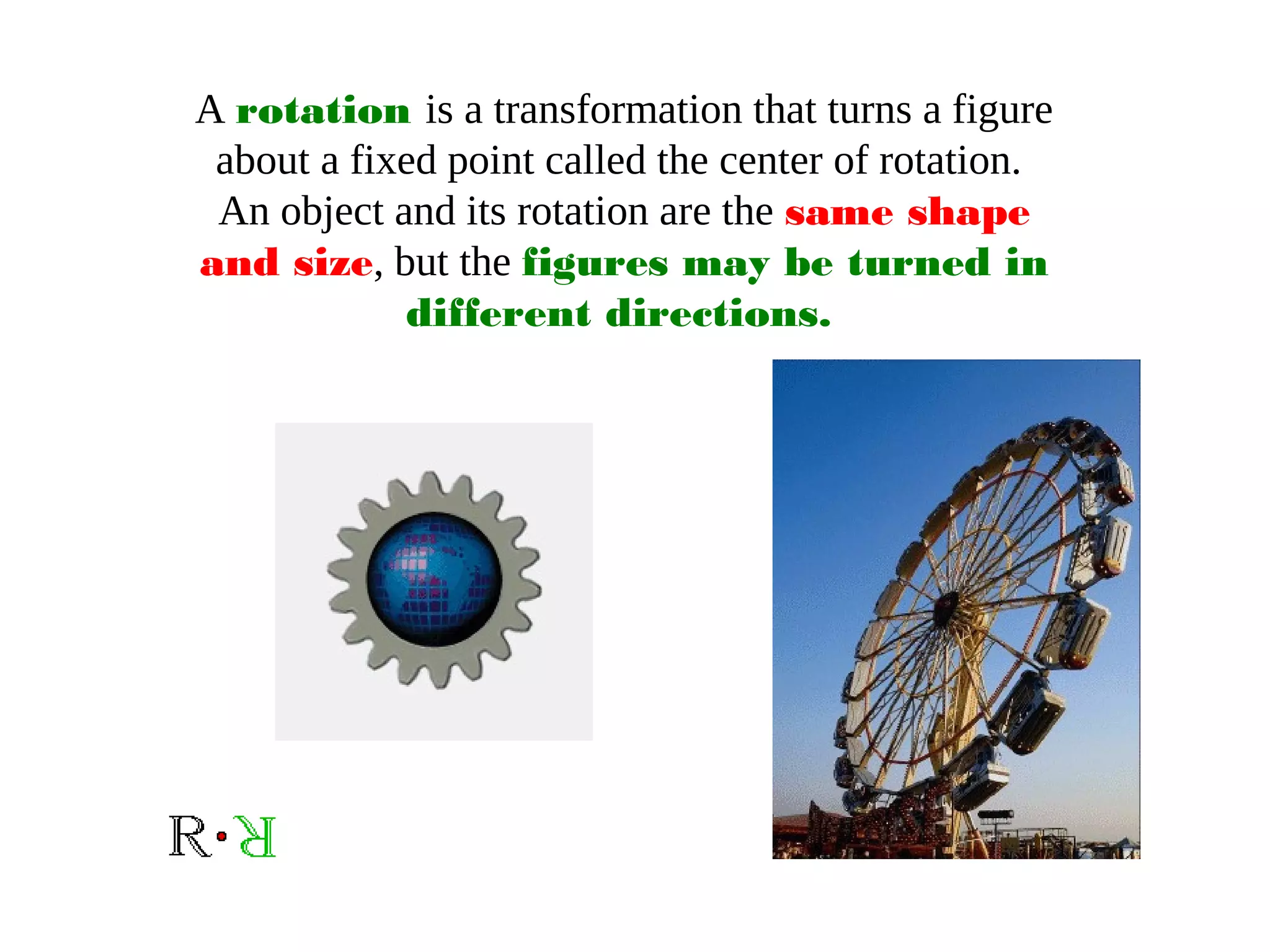
A rotation is a transformation that turns a figure
about a fixed point called the center of rotation.
An object and its rotation are the same shape
and size, but the figures may be turned in
different directions.
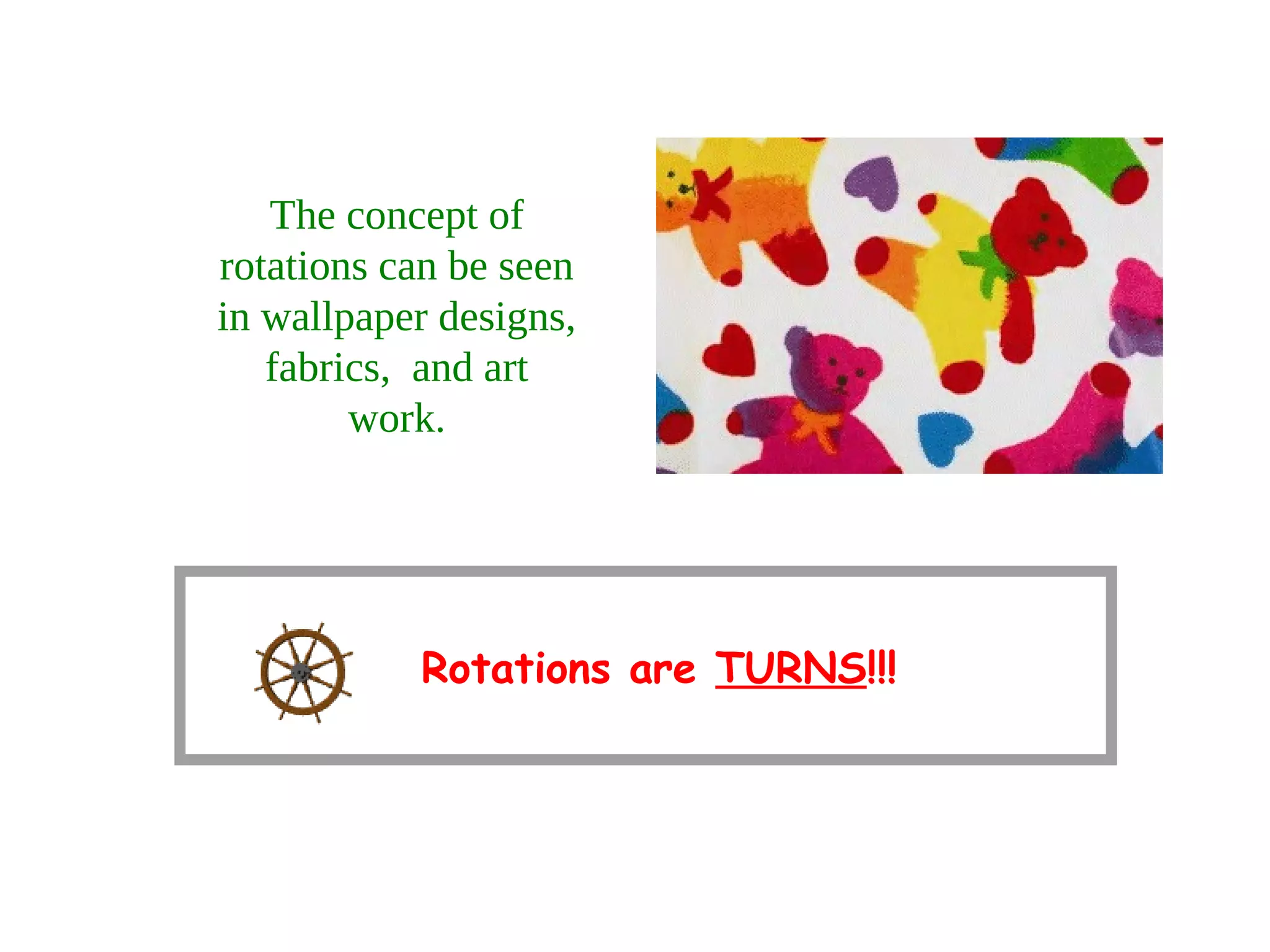
The concept of
rotations can be seen
in wallpaper designs,
fabrics, and art
work.
Rotations are TURNS!!!
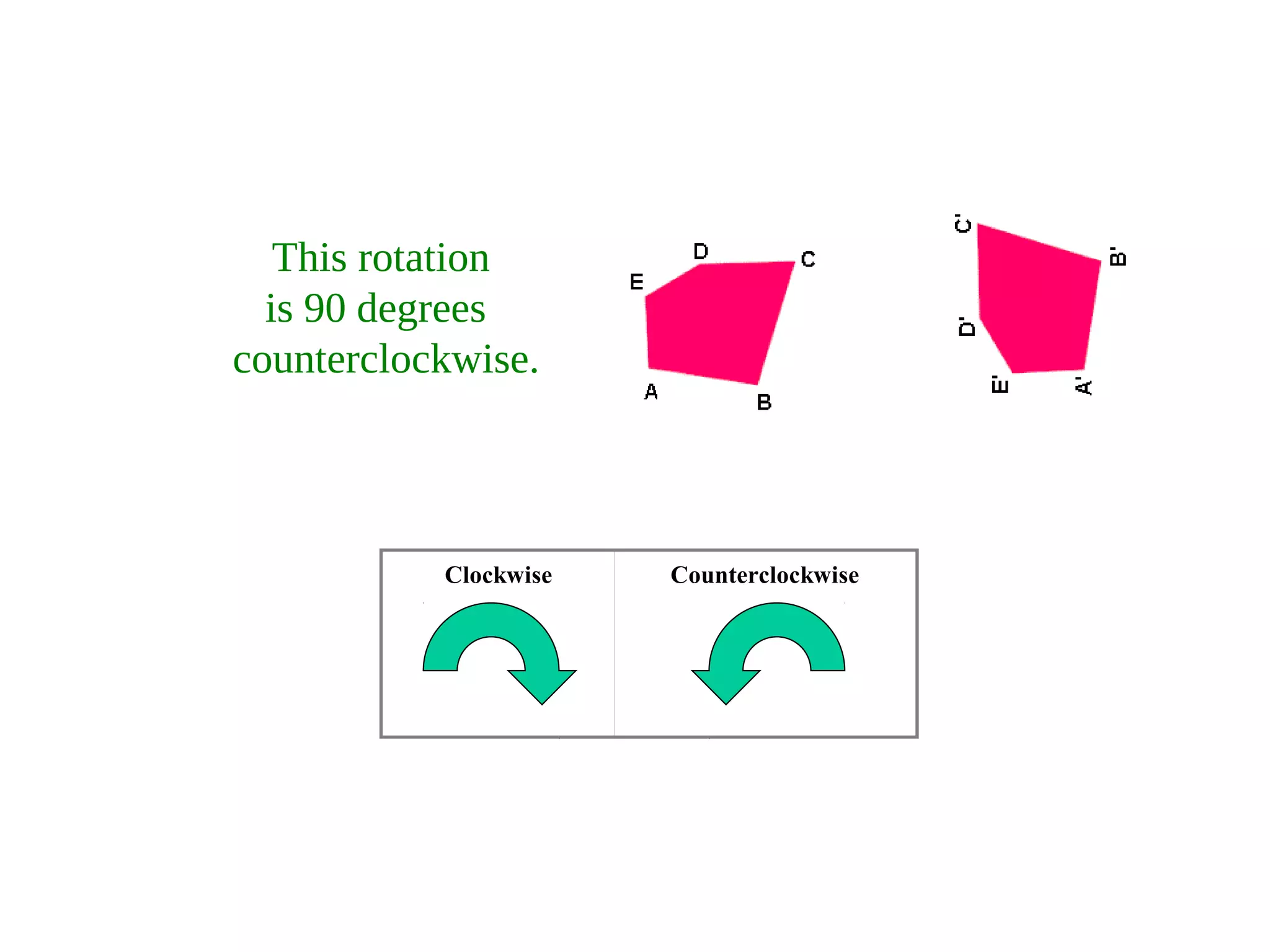
This rotation
is 90 degrees
counterclockwise.
Clockwise Counterclockwise
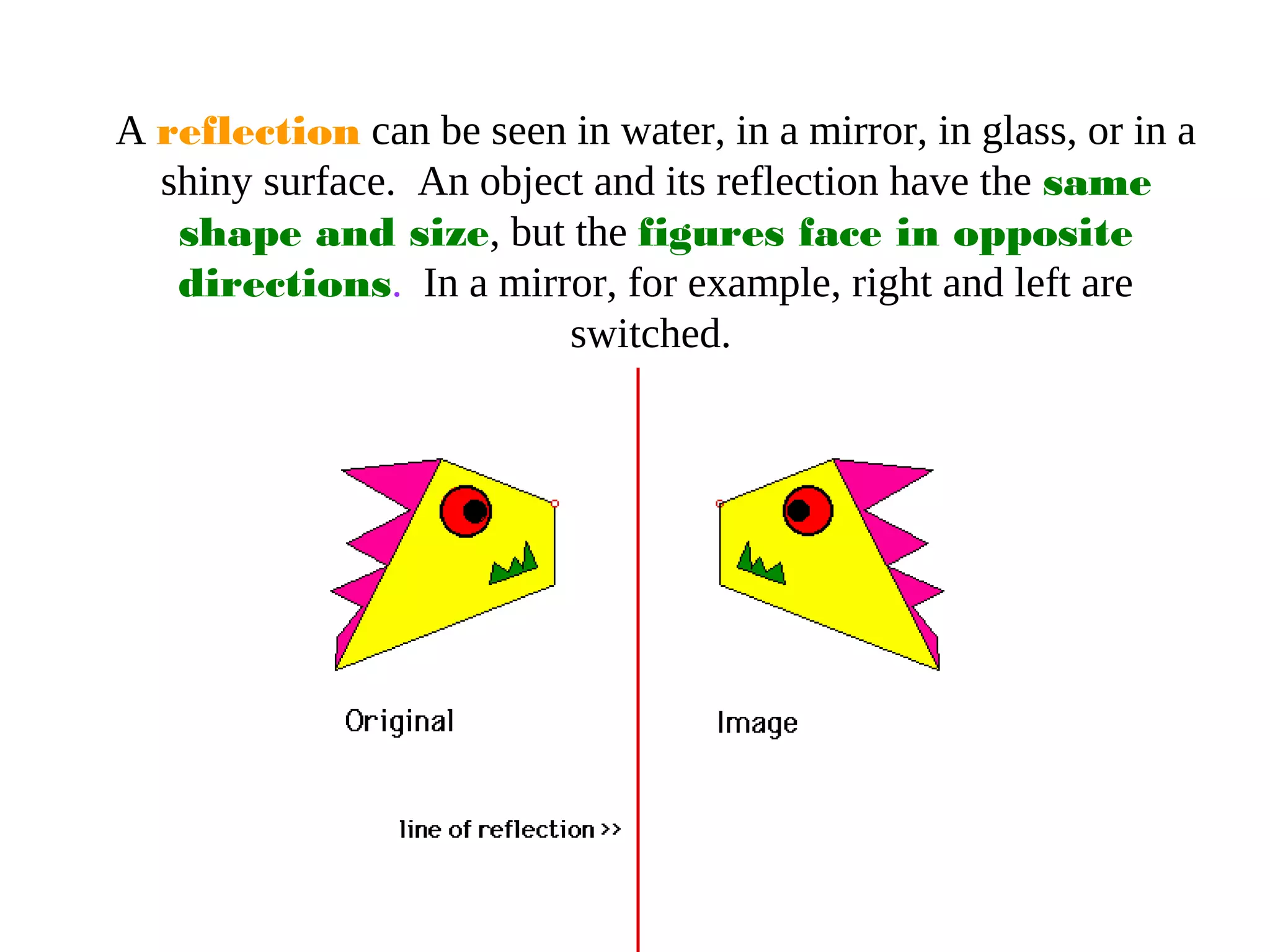
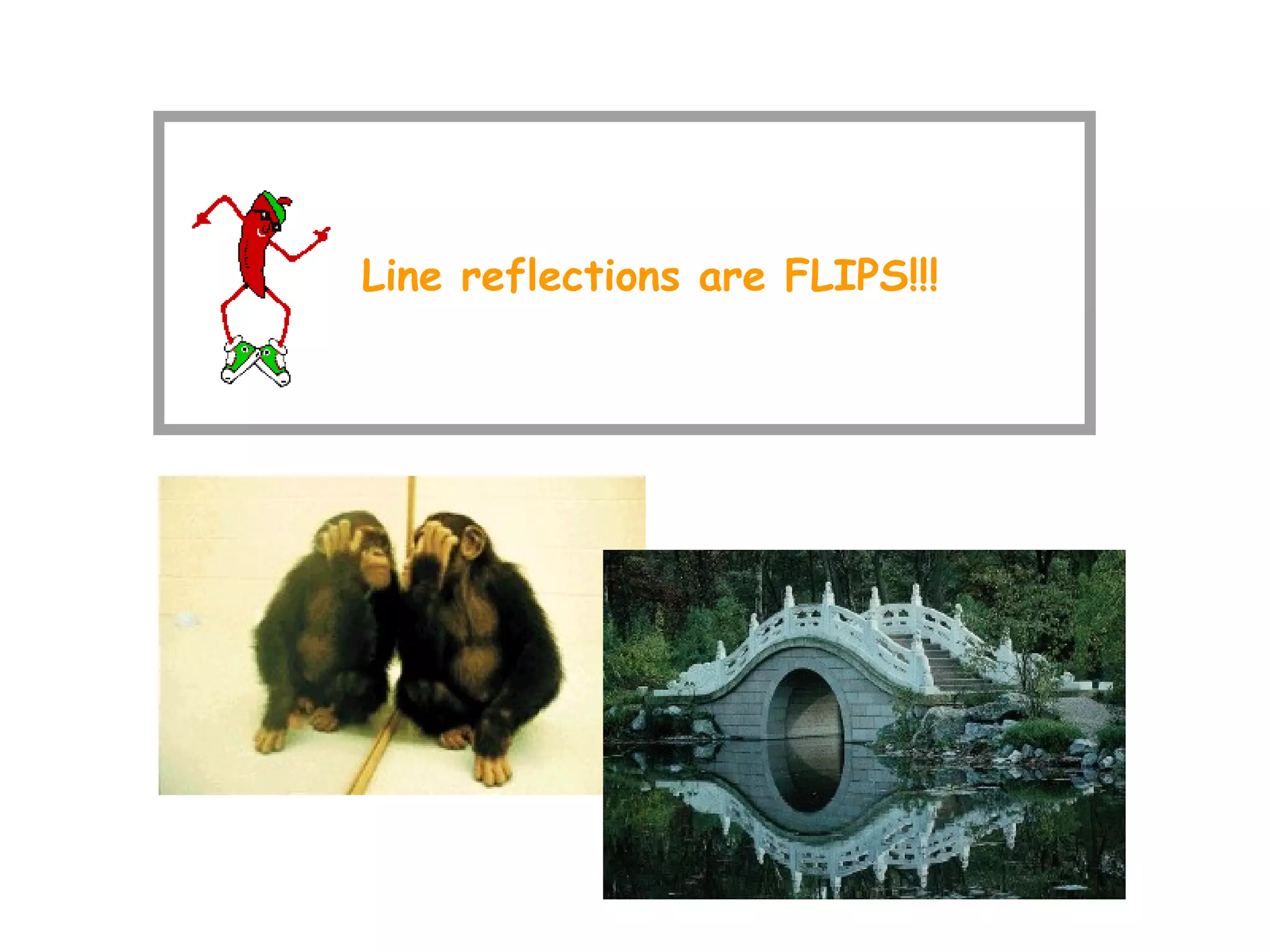
A reflection can be seen in water, in a mirror, in glass, or in a
shiny surface. An object and its reflection have the same
shape and size, but the figures face in opposite
directions. In a mirror, for example, right and left are
switched.
Line reflections are FLIPS!!!
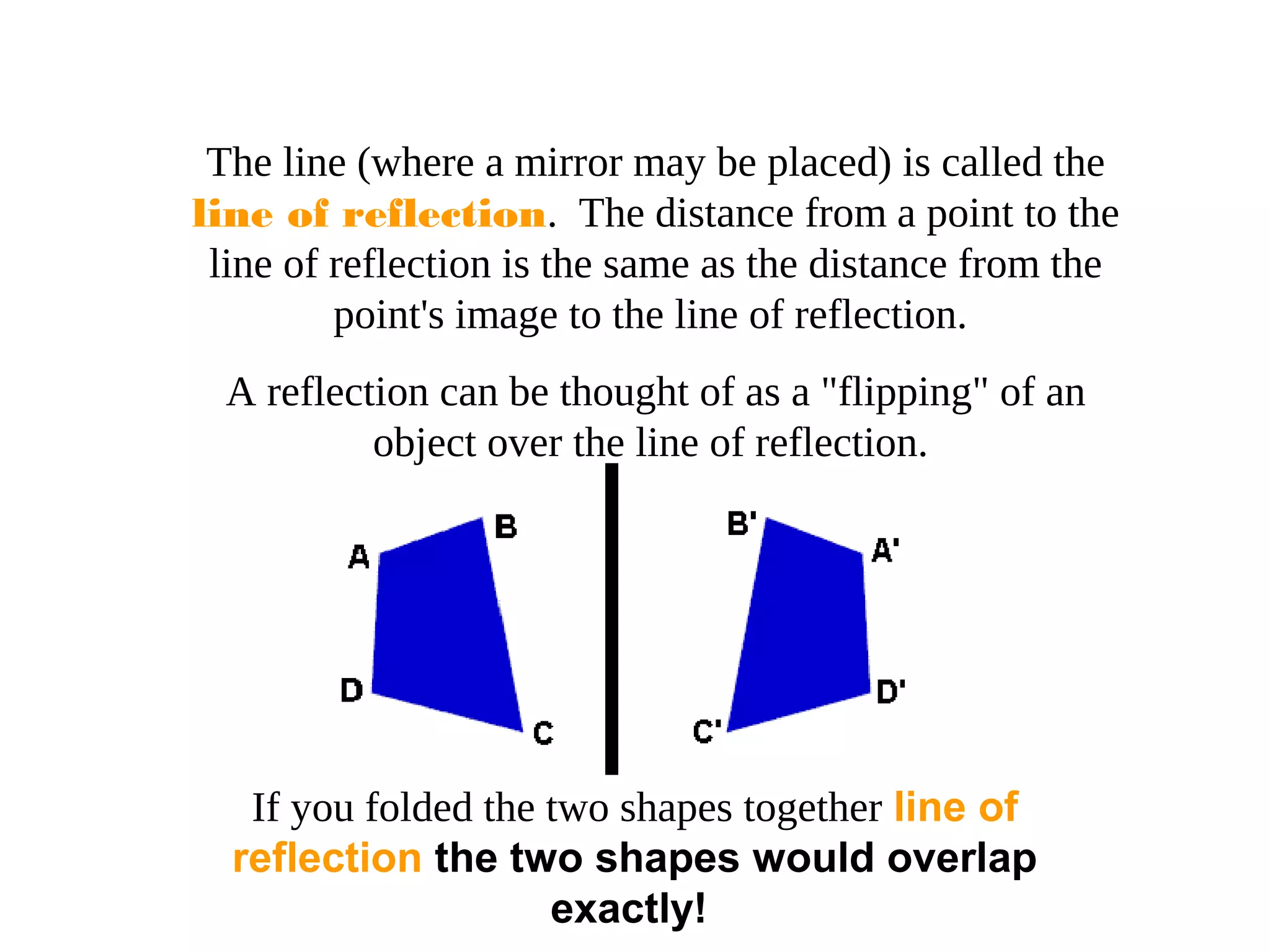
The line (where a mirror may be placed) is called the
line of reflection. The distance from a point to the
line of reflection is the same as the distance from the
point's image to the line of reflection.
A reflection can be thought of as a "flipping" of an
object over the line of reflection.
If you folded the two shapes together line of
reflection the two shapes would overlap
exactly!
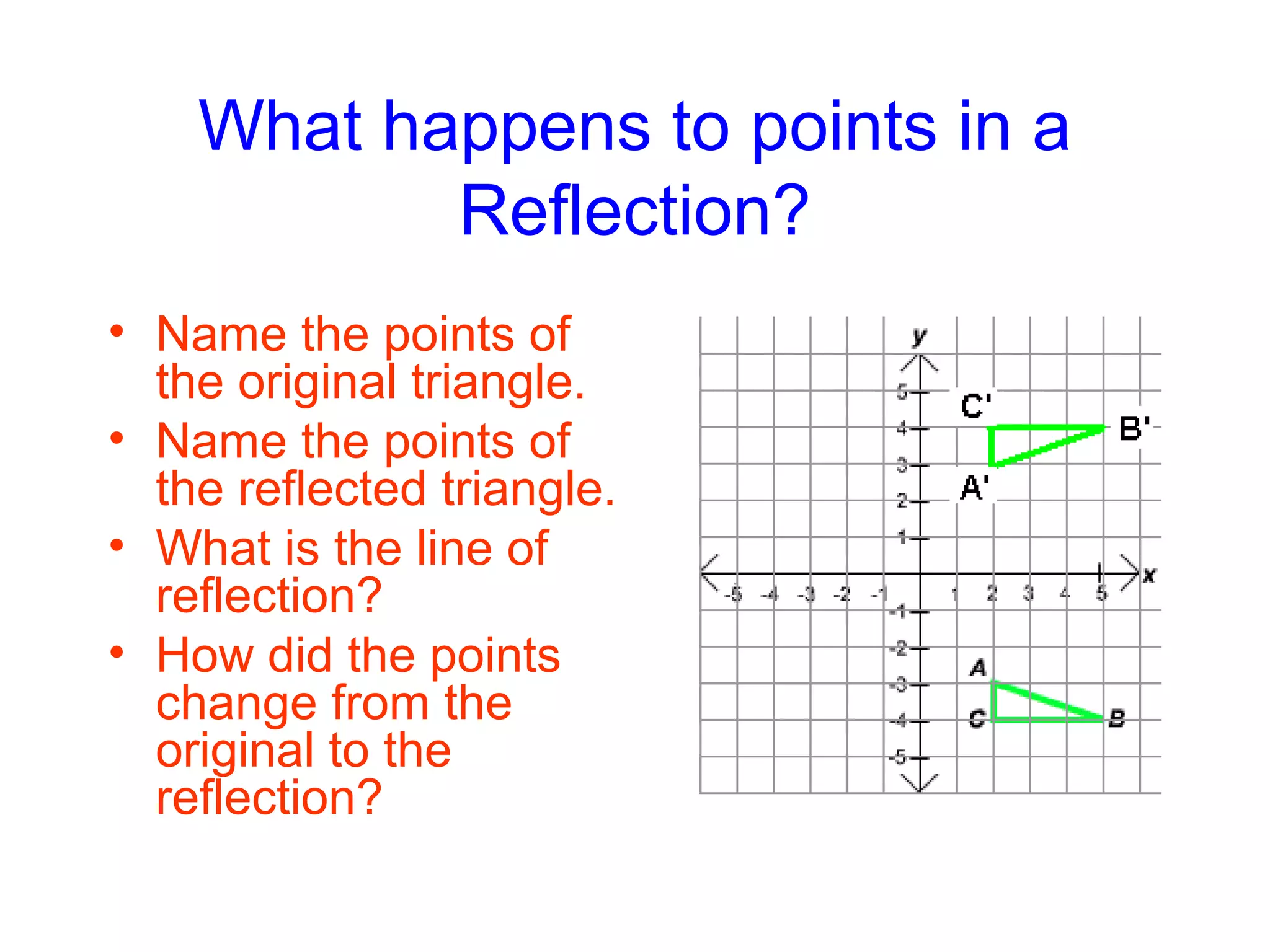
What happens to points in a
Reflection?
• Name the points of
the original triangle.
• Name the points of
the reflected triangle.
• What is the line of
reflection?
• How did the points
change from the
original to the
reflection?
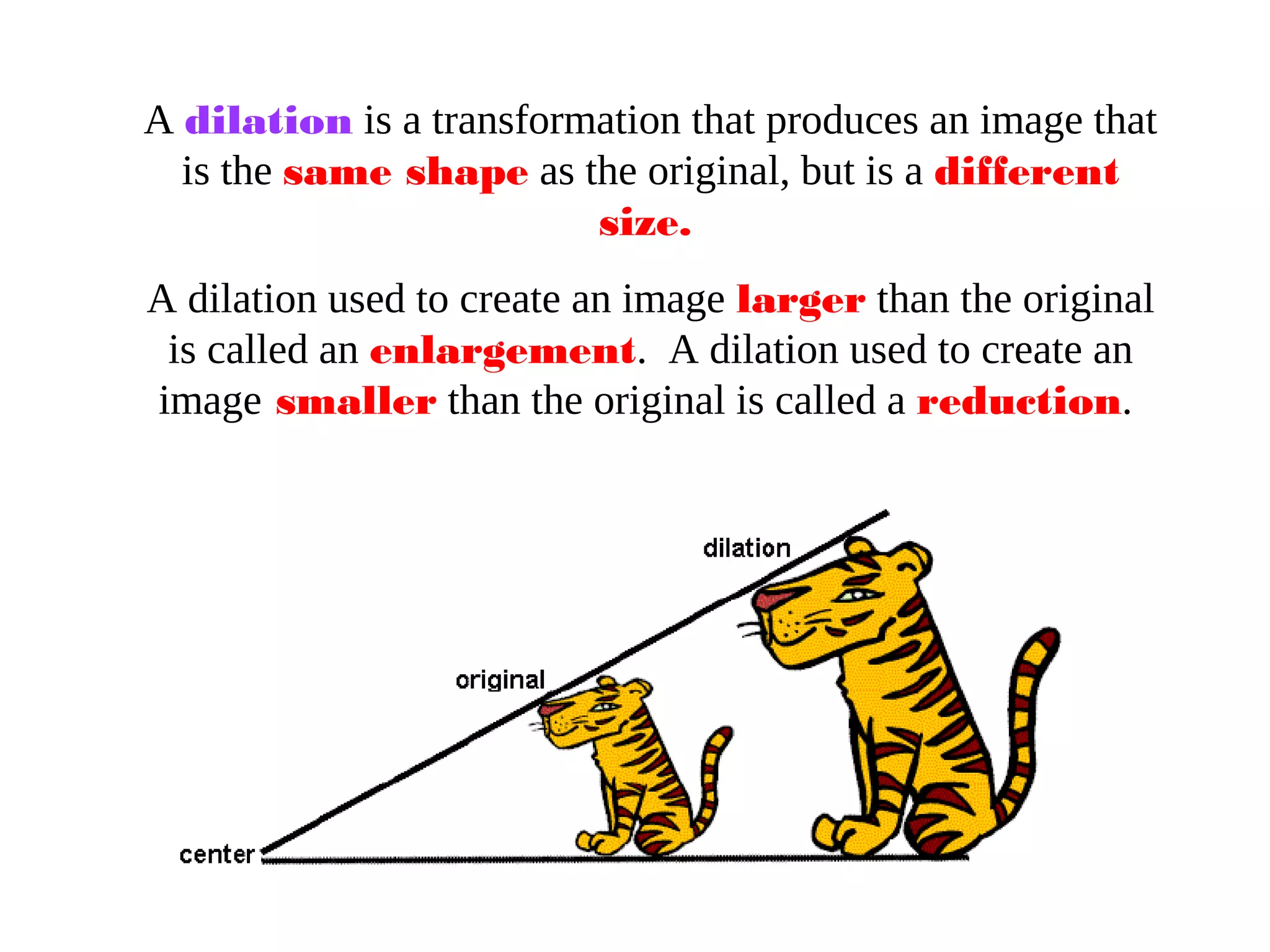
A dilation is a transformation that produces an image that
is the same shape as the original, but is a different
size.
A dilation used to create an image larger than the original
is called an enlargement. A dilation used to create an
image smaller than the original is called a reduction.
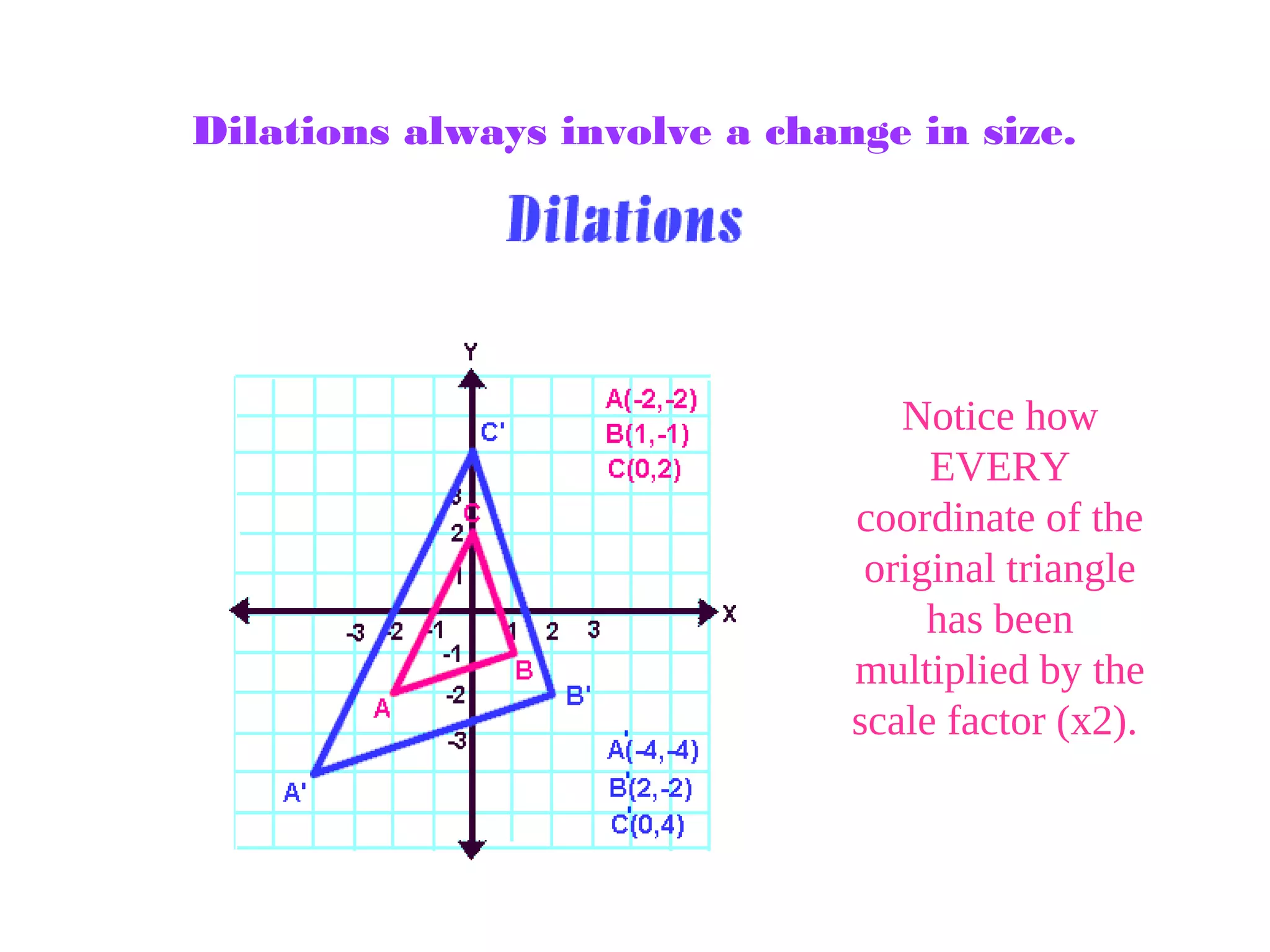
Dilations always involve a change in size.
Notice how
EVERY
coordinate of the
original triangle
has been
multiplied by the
scale factor (x2).
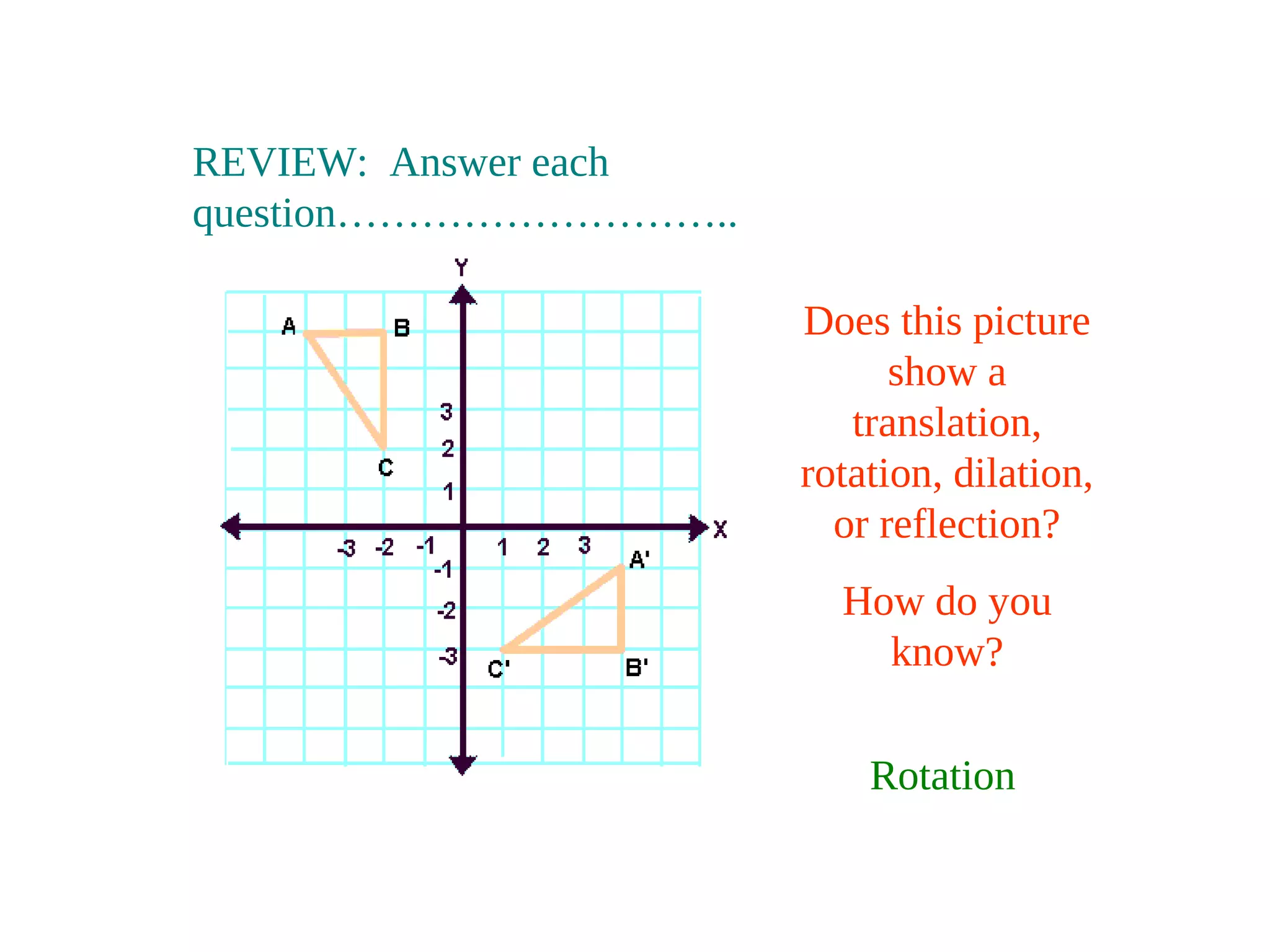
REVIEW: Answer each
question………………………..
Does this picture
show a
translation,
rotation, dilation,
or reflection?
How do you
know?
Rotation
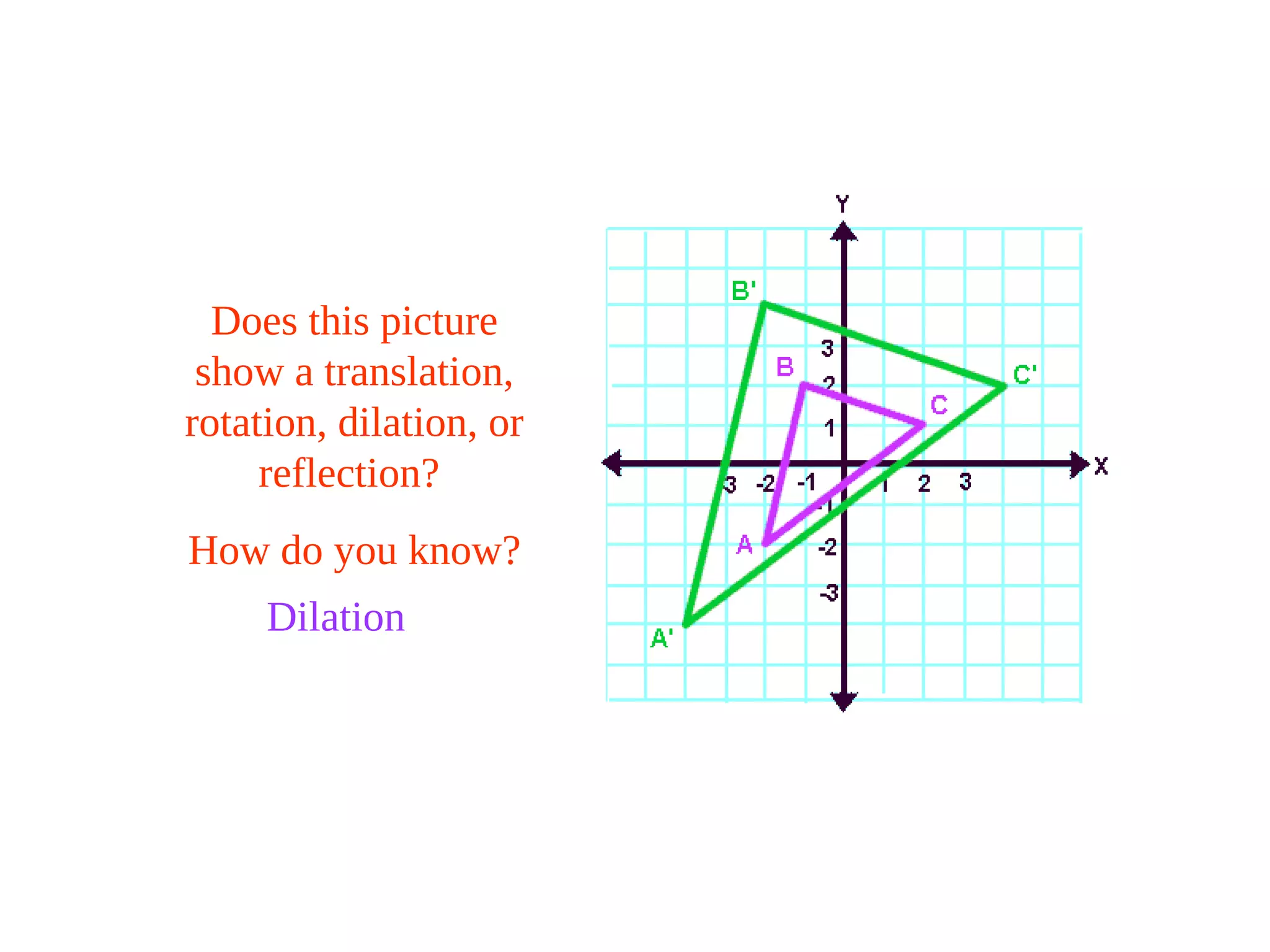
Does this picture
show a translation,
rotation, dilation, or
reflection?
How do you know?
Dilation
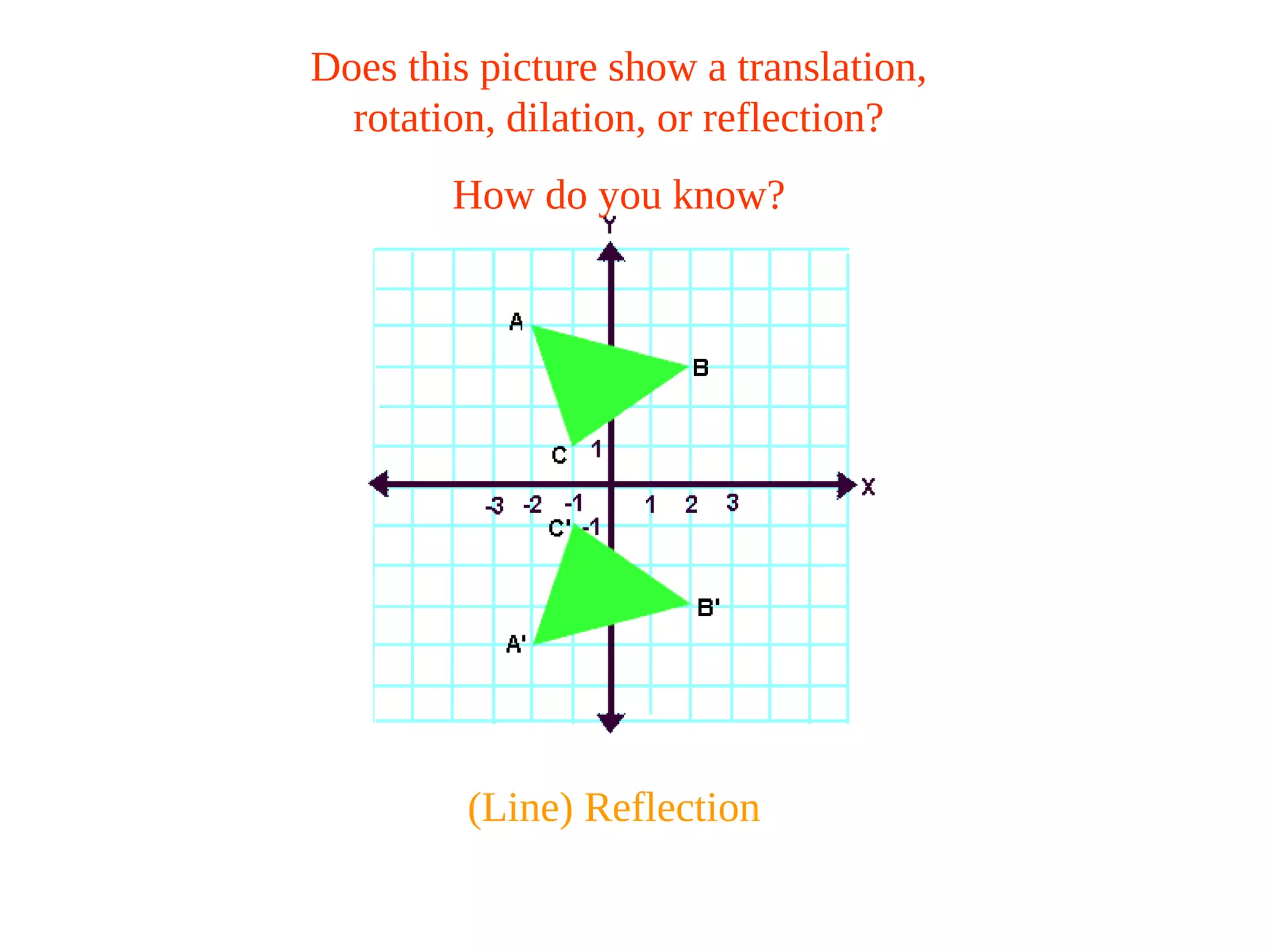
Does this picture show a translation,
rotation, dilation, or reflection?
How do you know?
(Line) Reflection
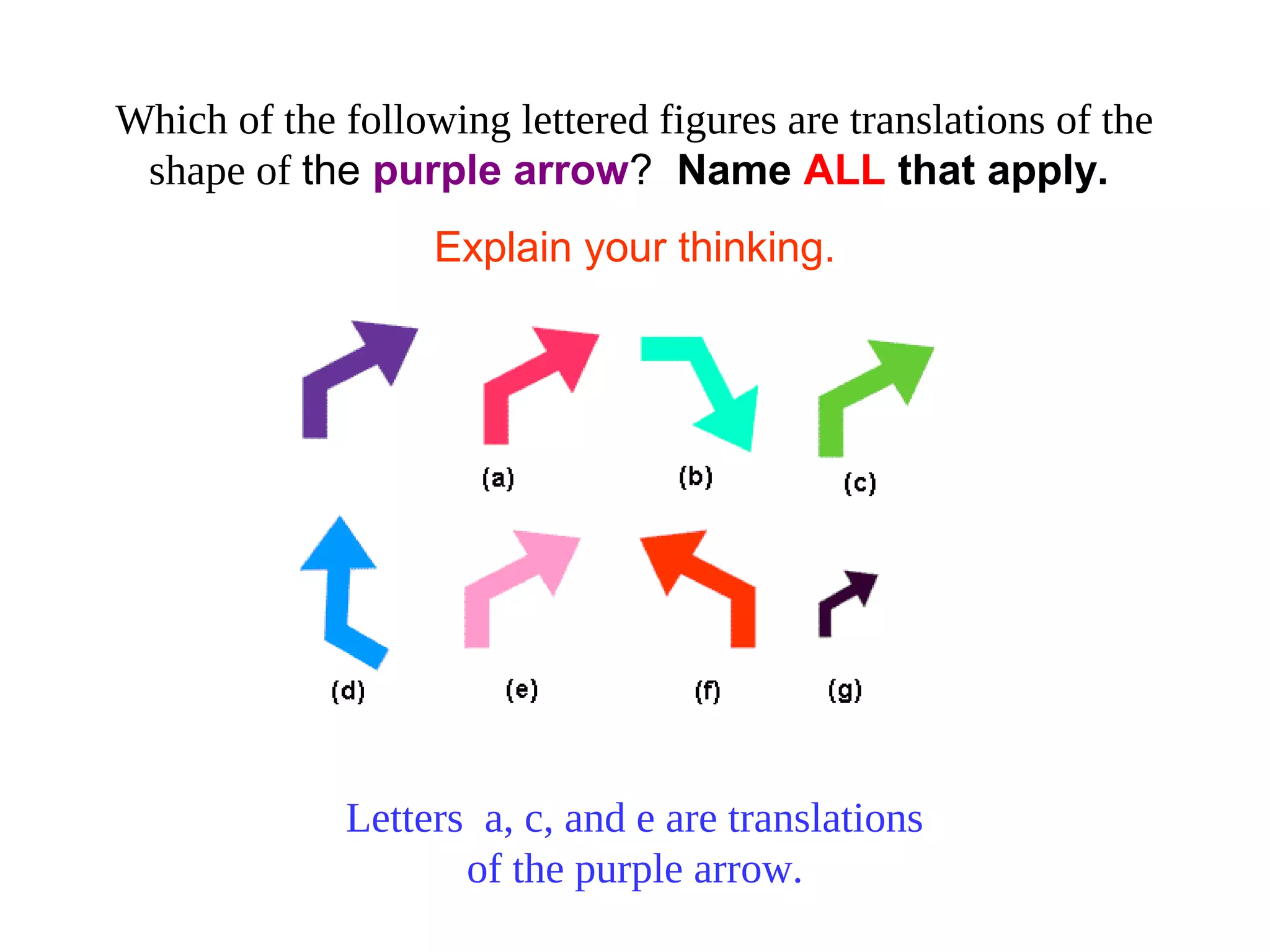
Which of the following lettered figures are translations of the
shape of the purple arrow? Name ALL that apply.
Explain your thinking.
Letters a, c, and e are translations
of the purple arrow.
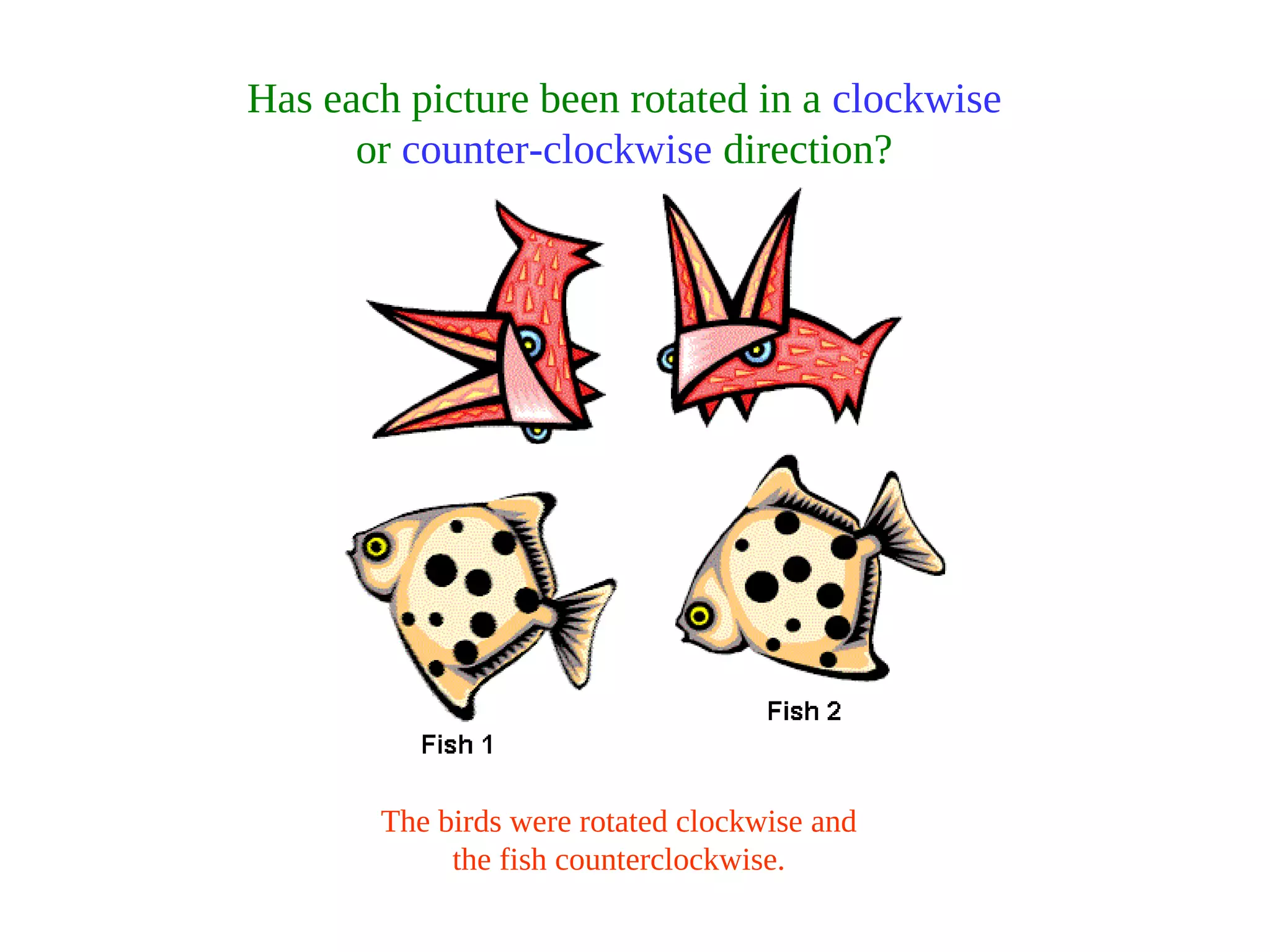
Has each picture been rotated in a clockwise
or counter-clockwise direction?
The birds were rotated clockwise and
the fish counterclockwise.
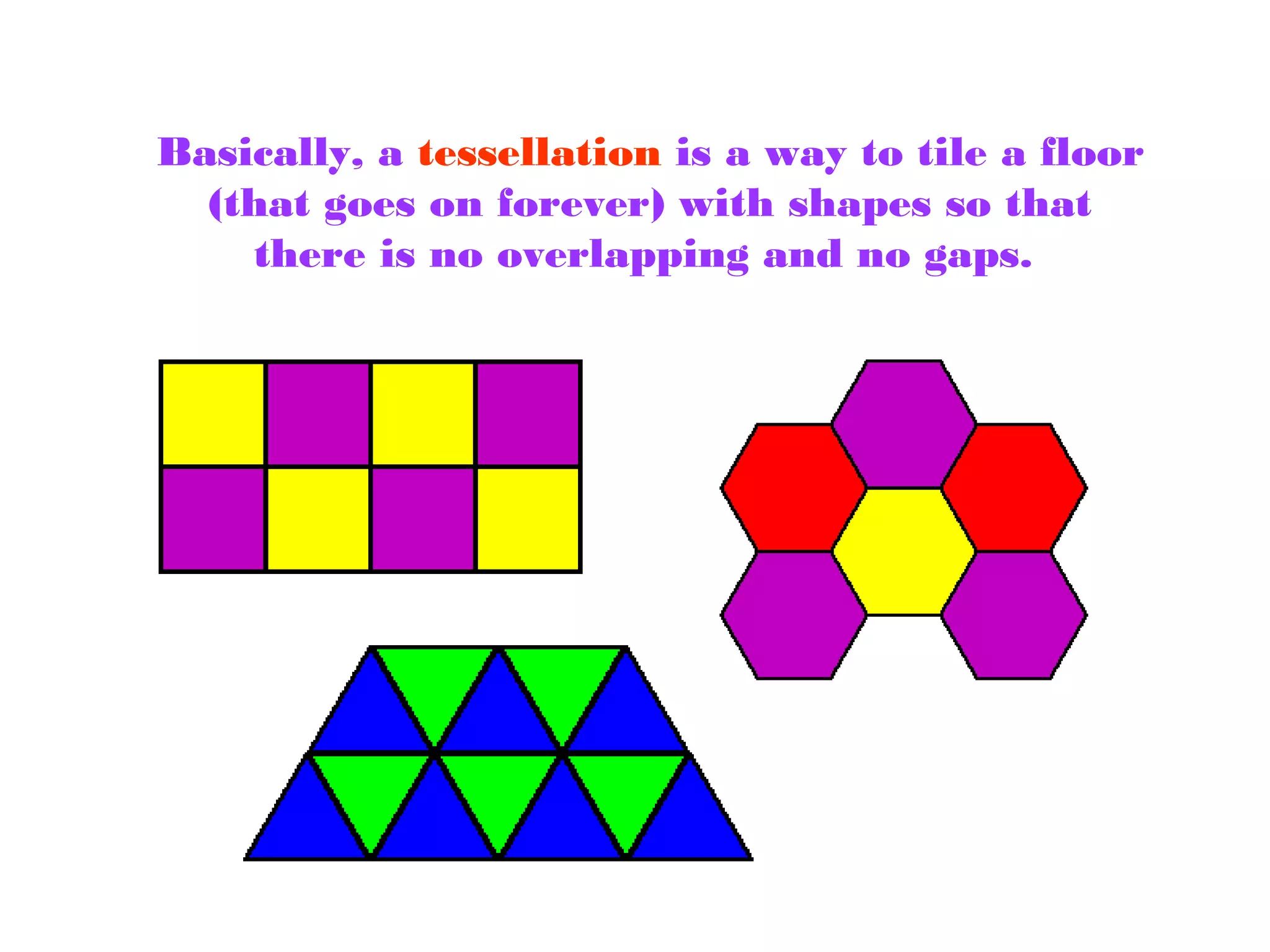
Basically, a tessellation is a way to tile a floor
(that goes on forever) with shapes so that
there is no overlapping and no gaps.
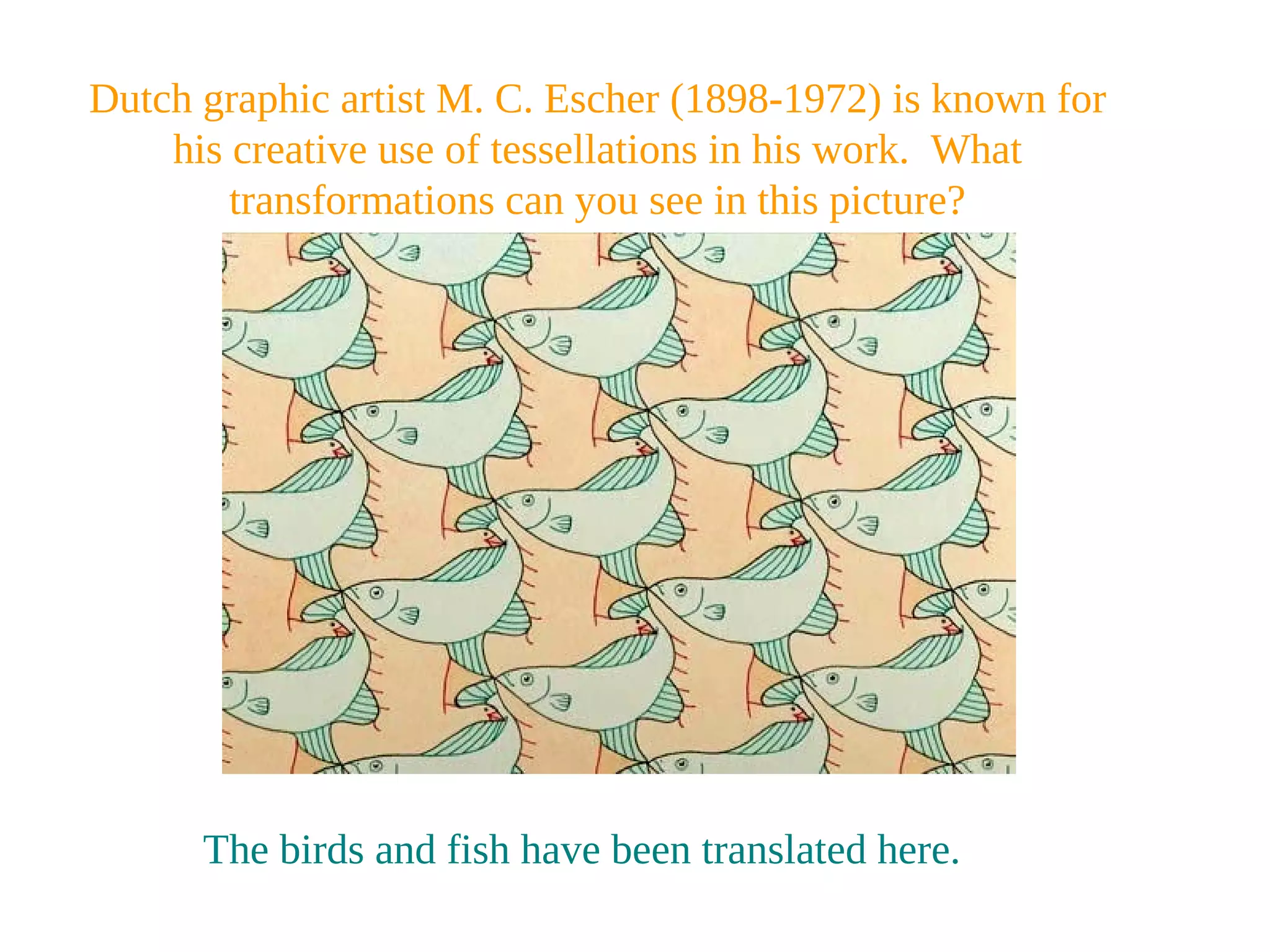
Dutch graphic artist M. C. Escher (1898-1972) is known for
his creative use of tessellations in his work. What
transformations can you see in this picture?
The birds and fish have been translated here.
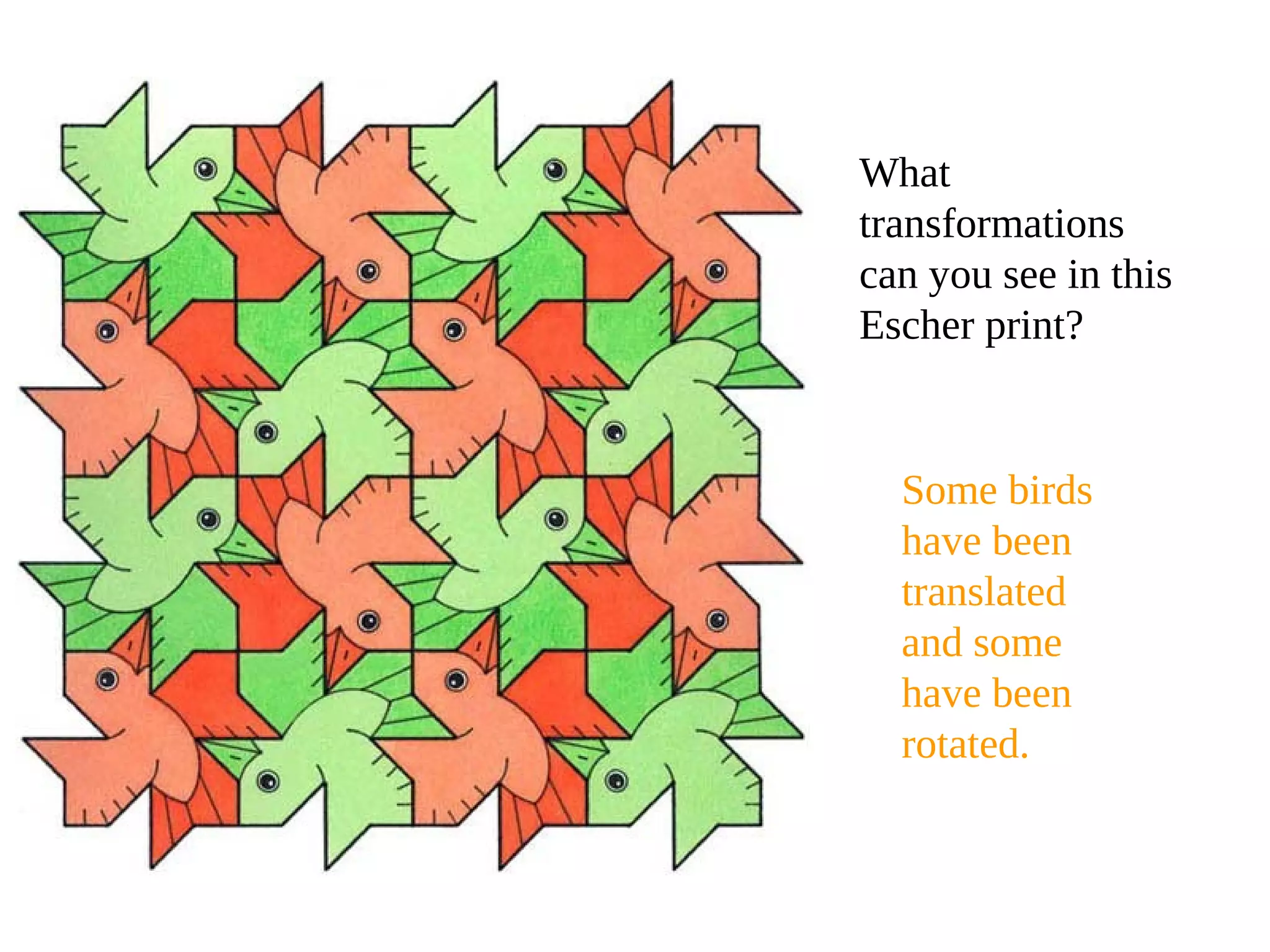
What
transformations
can you see in this
Escher print?
Some birds
have been
translated
and some
have been
rotated.
Can you name examples in real life of each
transformation?
•Translation
•Rotation
•Reflection
•Dilation
Check out these sites:
http://www.farraguttn.com/fhs/math/nctm/index.htm
http://www.mathsnet.net/transformations/index.html
http://www.mcescher.com/

CST 504 Transformations ppt

  • 2.
    To transform somethingis to change it. In geometry, there are specific ways to describe how a figure is changed. The transformations you will learn about include: •Translation •Rotation •Reflection •Dilation
  • 3.
    Renaming Transformations It iscommon practice to name shapes using capital letters: It is common practice to name transformed shapes using the same letters with a “prime” symbol:
  • 4.
    A translation "slides"an object a fixed distance in a given direction. The original object and its translation have the same shape and size, and they face in the same direction. Translations areSLIDES.
  • 5.
    Let's examine some translations related to coordinate geometry. Theexample shows how each vertex moves the same distance in the same direction.
  • 6.
    Write the Points •What are the coordinates for A, B, C? • What are the coordinates for A’, B’. C’? • How are they alike? • How are they different?
  • 7.
    In this example,the "slide" moves the figure 7 units to the left and 3 units down. (or 3 units down and 7 units to the left.)
  • 8.
    Write the points •What are the coordinates for A, B, C? • What are the coordinates for A’, B’, C’? • How did the transformation change the points?
  • 9.
    A rotation isa transformation that turns a figure about a fixed point called the center of rotation. An object and its rotation are the same shape and size, but the figures may be turned in different directions.
  • 10.
    The concept of rotationscan be seen in wallpaper designs, fabrics, and art work. Rotations are TURNS!!!
  • 11.
    This rotation is 90degrees counterclockwise. Clockwise Counterclockwise
  • 12.
    A reflection canbe seen in water, in a mirror, in glass, or in a shiny surface. An object and its reflection have the same shape and size, but the figures face in opposite directions. In a mirror, for example, right and left are switched.
  • 13.
  • 14.
    The line (wherea mirror may be placed) is called the line of reflection. The distance from a point to the line of reflection is the same as the distance from the point's image to the line of reflection. A reflection can be thought of as a "flipping" of an object over the line of reflection. If you folded the two shapes together line of reflection the two shapes would overlap exactly!
  • 15.
    What happens topoints in a Reflection? • Name the points of the original triangle. • Name the points of the reflected triangle. • What is the line of reflection? • How did the points change from the original to the reflection?
  • 16.
    A dilation isa transformation that produces an image that is the same shape as the original, but is a different size. A dilation used to create an image larger than the original is called an enlargement. A dilation used to create an image smaller than the original is called a reduction.
  • 17.
    Dilations always involvea change in size. Notice how EVERY coordinate of the original triangle has been multiplied by the scale factor (x2).
  • 18.
    REVIEW: Answer each question……………………….. Doesthis picture show a translation, rotation, dilation, or reflection? How do you know? Rotation
  • 19.
    Does this picture showa translation, rotation, dilation, or reflection? How do you know? Dilation
  • 20.
    Does this pictureshow a translation, rotation, dilation, or reflection? How do you know? (Line) Reflection
  • 21.
    Which of thefollowing lettered figures are translations of the shape of the purple arrow? Name ALL that apply. Explain your thinking. Letters a, c, and e are translations of the purple arrow.
  • 22.
    Has each picturebeen rotated in a clockwise or counter-clockwise direction? The birds were rotated clockwise and the fish counterclockwise.
  • 23.
    Basically, a tessellationis a way to tile a floor (that goes on forever) with shapes so that there is no overlapping and no gaps.
  • 24.
    Dutch graphic artistM. C. Escher (1898-1972) is known for his creative use of tessellations in his work. What transformations can you see in this picture? The birds and fish have been translated here.
  • 25.
    What transformations can you seein this Escher print? Some birds have been translated and some have been rotated.
  • 26.
    Can you nameexamples in real life of each transformation? •Translation •Rotation •Reflection •Dilation
  • 27.
    Check out thesesites: http://www.farraguttn.com/fhs/math/nctm/index.htm http://www.mathsnet.net/transformations/index.html http://www.mcescher.com/