CAD / CAM
NURBS and APPLICATIONS
Introduction
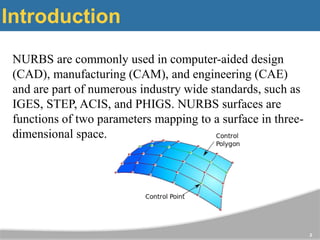
NURBS are commonly used in computer-aided design
(CAD), manufacturing (CAM), and engineering (CAE)
and are part of numerous industry wide standards, such as
IGES, STEP, ACIS, and PHIGS. NURBS surfaces are
functions of two parameters mapping to a surface in three-
dimensional space.
2
Difference between NURBS and POLYGONS
NURBS are patch-based objects comprised of curved
surfaces. Polygons are made up of straight
edges. Polygons are easier to model with, but create
smoother surfaces. And that's because NURBS is a
patch-based modeling system…so it's composed of
curves rather than straight lines.
3
NURBS Modelling
Non-uniform rational basis spline (NURBS) is a
mathematical model commonly used in computer
graphics for generating and representing curves and
surfaces. NURBS surfaces are functions of two
parameters mapping to a surface in three-dimensional
space. The shape of the surface is determined by
control points.
4
NURBS in Rhino
NURBS, Non-Uniform Rational B-Splines, are mathematical
representations of 3-D geometry that can accurately describe any
shape from a simple 2-D line, circle, arc, or curve to the most
complex 3-D organic free-form surface or solid.
5
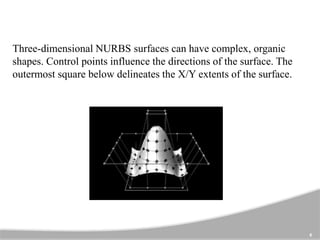
Three-dimensional NURBS surfaces can have complex, organic
shapes. Control points influence the directions of the surface. The
outermost square below delineates the X/Y extents of the surface.
6
Technical Specifications of NURBS
A NURBS curve is defined by its order, a set of weighted control points, and a
knot vector. NURBS curves and surfaces are generalizations of both B-
splines and Bezier curves and surfaces, the primary difference being the weighting
of the control points, which makes NURBS curves rational.
NURBS curves and surfaces are useful for a number of reasons:-
• They offer one common mathematical form for both standard analytical shapes
(e.g., conics) and free-form shapes.
• They provide the flexibility to design a large variety of shapes.
• They reduce the memory consumption when storing shapes (compared to simpler
methods).
• They can be evaluated reasonably quickly by numerically stable and
accurate algorithms.
• In the next sections, NURBS is discussed in one dimension (curves). All of it can be
generalized to two or even more dimensions.
7
Control Points
8
The control points determine the shape of the curve. Typically, each
point of the curve is computed by taking a weighted sum of a
number of control points. The weight of each point varies according
to the governing parameter. For a curve of degree d, the weight of
any control point is only nonzero in d+1 intervals of the parameter
space. Within those intervals, the weight changes according to a
polynomial function (basis functions) of degree d. At the boundaries
of the intervals, the basis functions go smoothly to zero, the
smoothness being determined by the degree of the polynomial.
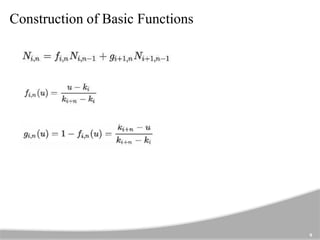
Construction of Basic Functions
9
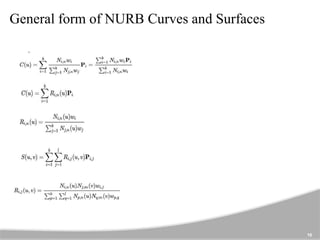
General form of NURB Curves and Surfaces
10
Manipulating NURB objects
11
A number of transformations can be applied to a NURBS object. For
instance, if some curve is defined using a certain degree and N
control points, the same curve can be expressed using the same
degree and N+1 control points. In the process a number of control
points change position and a knot is inserted in the knot vector.
These manipulations are used extensively during interactive design.
When adding a control point, the shape of the curve should stay the
same, forming the starting point for further adjustments. A number
of these operations are discussed below.
Knot removal
12
Knot removal is the reverse of knot insertion. Its purpose is to
remove knots and the associated control points in order to get a
more compact representation. Obviously, this is not always possible
while retaining the exact shape of the curve. In practice, a tolerance
in the accuracy is used to determine whether a knot can be removed.
The process is used to clean up after an interactive session in which
control points may have been added manually, or after importing a
curve from a different representation, where a straightforward
conversion process leads to redundant control points.
Degree Elevation
13
A NURBS curve of a particular degree can always be represented by
a NURBS curve of higher degree. This is frequently used when
combining separate NURBS curves, e.g., when creating a NURBS
surface interpolating between a set of NURBS curves or when
unifying adjacent curves. In the process, the different curves should
be brought to the same degree, usually the maximum degree of the
set of curves. The process is known as degree elevation.
Applications
• In CAD – Ability in representation of sculptured
surfaces.
• In CAM – Reduction of NC data and time for data
transfer, smooth surface and high efficiency.
• In CAE – Used in FEM foe good approximation and
design oriented simulation.
14
15

CAD / CAM NURBS

  • 1.
    CAD / CAM NURBSand APPLICATIONS
  • 2.
    Introduction NURBS are commonlyused in computer-aided design (CAD), manufacturing (CAM), and engineering (CAE) and are part of numerous industry wide standards, such as IGES, STEP, ACIS, and PHIGS. NURBS surfaces are functions of two parameters mapping to a surface in three- dimensional space. 2
  • 3.
    Difference between NURBSand POLYGONS NURBS are patch-based objects comprised of curved surfaces. Polygons are made up of straight edges. Polygons are easier to model with, but create smoother surfaces. And that's because NURBS is a patch-based modeling system…so it's composed of curves rather than straight lines. 3
  • 4.
    NURBS Modelling Non-uniform rationalbasis spline (NURBS) is a mathematical model commonly used in computer graphics for generating and representing curves and surfaces. NURBS surfaces are functions of two parameters mapping to a surface in three-dimensional space. The shape of the surface is determined by control points. 4
  • 5.
    NURBS in Rhino NURBS,Non-Uniform Rational B-Splines, are mathematical representations of 3-D geometry that can accurately describe any shape from a simple 2-D line, circle, arc, or curve to the most complex 3-D organic free-form surface or solid. 5
  • 6.
    Three-dimensional NURBS surfacescan have complex, organic shapes. Control points influence the directions of the surface. The outermost square below delineates the X/Y extents of the surface. 6
  • 7.
    Technical Specifications ofNURBS A NURBS curve is defined by its order, a set of weighted control points, and a knot vector. NURBS curves and surfaces are generalizations of both B- splines and Bezier curves and surfaces, the primary difference being the weighting of the control points, which makes NURBS curves rational. NURBS curves and surfaces are useful for a number of reasons:- • They offer one common mathematical form for both standard analytical shapes (e.g., conics) and free-form shapes. • They provide the flexibility to design a large variety of shapes. • They reduce the memory consumption when storing shapes (compared to simpler methods). • They can be evaluated reasonably quickly by numerically stable and accurate algorithms. • In the next sections, NURBS is discussed in one dimension (curves). All of it can be generalized to two or even more dimensions. 7
  • 8.
    Control Points 8 The controlpoints determine the shape of the curve. Typically, each point of the curve is computed by taking a weighted sum of a number of control points. The weight of each point varies according to the governing parameter. For a curve of degree d, the weight of any control point is only nonzero in d+1 intervals of the parameter space. Within those intervals, the weight changes according to a polynomial function (basis functions) of degree d. At the boundaries of the intervals, the basis functions go smoothly to zero, the smoothness being determined by the degree of the polynomial.
  • 9.
  • 10.
    General form ofNURB Curves and Surfaces 10
  • 11.
    Manipulating NURB objects 11 Anumber of transformations can be applied to a NURBS object. For instance, if some curve is defined using a certain degree and N control points, the same curve can be expressed using the same degree and N+1 control points. In the process a number of control points change position and a knot is inserted in the knot vector. These manipulations are used extensively during interactive design. When adding a control point, the shape of the curve should stay the same, forming the starting point for further adjustments. A number of these operations are discussed below.
  • 12.
    Knot removal 12 Knot removalis the reverse of knot insertion. Its purpose is to remove knots and the associated control points in order to get a more compact representation. Obviously, this is not always possible while retaining the exact shape of the curve. In practice, a tolerance in the accuracy is used to determine whether a knot can be removed. The process is used to clean up after an interactive session in which control points may have been added manually, or after importing a curve from a different representation, where a straightforward conversion process leads to redundant control points.
  • 13.
    Degree Elevation 13 A NURBScurve of a particular degree can always be represented by a NURBS curve of higher degree. This is frequently used when combining separate NURBS curves, e.g., when creating a NURBS surface interpolating between a set of NURBS curves or when unifying adjacent curves. In the process, the different curves should be brought to the same degree, usually the maximum degree of the set of curves. The process is known as degree elevation.
  • 14.
    Applications • In CAD– Ability in representation of sculptured surfaces. • In CAM – Reduction of NC data and time for data transfer, smooth surface and high efficiency. • In CAE – Used in FEM foe good approximation and design oriented simulation. 14
  • 15.