FLUID POWER ENGINEERING
Presented By : Dhruv
Shah
TOPIC : AIR LIFT PUMP
Air Lift Pump
 Introduction
 Function
 Construction
 Working
 Application
 Pros & Cons
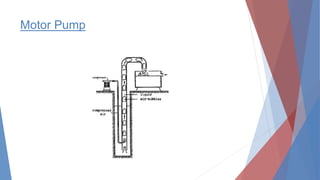
Motor Pump
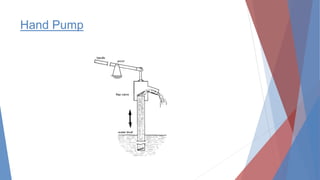
Hand Pump
Function
 Its main function is to lift water from a deep well or sump by
using compressed air.
 By buoyancy the air, which has a lower density than the liquid,
rises quickly.
 By fluid pressure, the liquid is taken in the ascendant air flow
and moves in the same direction as the air
Construction
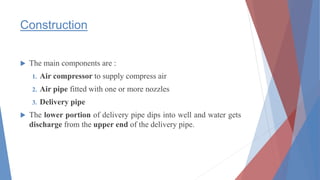
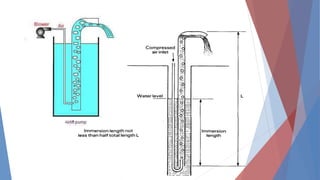
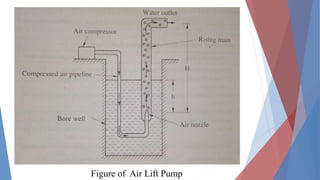
 The main components are :
1. Air compressor to supply compress air
2. Air pipe fitted with one or more nozzles
3. Delivery pipe
 The lower portion of delivery pipe dips into well and water gets
discharge from the upper end of the delivery pipe.
Working
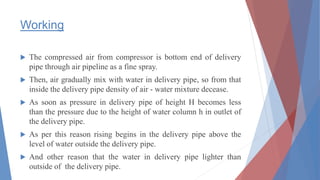
 The compressed air from compressor is bottom end of delivery
pipe through air pipeline as a fine spray.
 Then, air gradually mix with water in delivery pipe, so from that
inside the delivery pipe density of air - water mixture decease.
 As soon as pressure in delivery pipe of height H becomes less
than the pressure due to the height of water column h in outlet of
the delivery pipe.
 As per this reason rising begins in the delivery pipe above the
level of water outside the delivery pipe.
 And other reason that the water in delivery pipe lighter than
outside of the delivery pipe.
Figure of Air Lift Pump
Advantages
 The air lift pump is not having any moving parts below water
level and hence there are no chances of suspended solid particles
damaging the pump.
 This pump can raise water through a bore hole of given diameter
than any other pump.
 This pump is very suitable where decompressed air is available.
Disadvantages
 Conventional airlift pumps have a flow rate that is very limited.
 Very low efficiency, only 20 to 40% energy available in form of
useful water horse-power.
 It can not lift water when the level of water in deep well goes
down below limit.
 The suction is limited.
Application
 Airlift pumps are often used in deep dirty wells where sand would
quickly abrade mechanical parts.
 Airlifts are used to collect fauna samples from sediment.
 It is also sometimes used in part of the process on a wastewater
treatment plant if a small head is required (typically around 1
foot head).
Thank You !!!!!!

Air lift pump

  • 1.
    FLUID POWER ENGINEERING PresentedBy : Dhruv Shah TOPIC : AIR LIFT PUMP
  • 2.
    Air Lift Pump Introduction  Function  Construction  Working  Application  Pros & Cons
  • 3.
  • 4.
  • 5.
    Function  Its mainfunction is to lift water from a deep well or sump by using compressed air.  By buoyancy the air, which has a lower density than the liquid, rises quickly.  By fluid pressure, the liquid is taken in the ascendant air flow and moves in the same direction as the air
  • 6.
    Construction  The maincomponents are : 1. Air compressor to supply compress air 2. Air pipe fitted with one or more nozzles 3. Delivery pipe  The lower portion of delivery pipe dips into well and water gets discharge from the upper end of the delivery pipe.
  • 7.
    Working  The compressedair from compressor is bottom end of delivery pipe through air pipeline as a fine spray.  Then, air gradually mix with water in delivery pipe, so from that inside the delivery pipe density of air - water mixture decease.  As soon as pressure in delivery pipe of height H becomes less than the pressure due to the height of water column h in outlet of the delivery pipe.  As per this reason rising begins in the delivery pipe above the level of water outside the delivery pipe.  And other reason that the water in delivery pipe lighter than outside of the delivery pipe.
  • 9.
    Figure of AirLift Pump
  • 10.
    Advantages  The airlift pump is not having any moving parts below water level and hence there are no chances of suspended solid particles damaging the pump.  This pump can raise water through a bore hole of given diameter than any other pump.  This pump is very suitable where decompressed air is available.
  • 11.
    Disadvantages  Conventional airliftpumps have a flow rate that is very limited.  Very low efficiency, only 20 to 40% energy available in form of useful water horse-power.  It can not lift water when the level of water in deep well goes down below limit.  The suction is limited.
  • 12.
    Application  Airlift pumpsare often used in deep dirty wells where sand would quickly abrade mechanical parts.  Airlifts are used to collect fauna samples from sediment.  It is also sometimes used in part of the process on a wastewater treatment plant if a small head is required (typically around 1 foot head).
  • 14.