GENE TRANSFER
BY-
DR. CHANDRANI GOSWAMI
2015-VMK-72
DEPTT. OF VETERINARY
PUBLIC HEALTH
GENE TRANSFER
• It is defined simply as a technique to efficiently
and stably introduce foreign genes into the
genome of target cells.
• The insertion of unrelated, therapeutic genetic
information in the form of DNA into target cells.
INTRODUCTION
Gene transfer in which bacteria genotype can be
changed by transfer of genetic material from
one bacterium to another.
In such instances, the transferred DNA either:
a) Recombine with genome of the recipient
bacterium or
b) Is on the plasmid capable of replication in the
recipient bacterium without recombination.
Genetic recombination it occurs when sequence
of DNA from two separate sources are
integrated.
The directed desirable gene transfer from one
organism to another and the subsequent stable
integration & expression of foreign gene into the
genome is referred as genetic transformation.
The transferred gene is known as transgene and
the organism that develop after a successful gene
transfer is known as transgenic.
MECHANISM OF GENE TRANSFER
There are four mechanisms of gene transfer and
recombination between bacteria cells.
1. Conjugation
2. Transformation
3. Transduction
4. Cell- cell fusion
DNA TRANSFER BY ARTIFICIAL
METHODS
Physical methods
1. Microinjection
2. Biolistics transformation
Chemical methods
1. DNA transfer by calcium phosphate method
2. Liposome mediated transfer
Electrical methods
1. Electroporation
CONJUGATION
 Bacteria conjugation in E.coli was discovered by
Lederberg and Tatum in 1946, when they
observed sex like exchange between two mutants
strains of E.coli called K12.
 Conjugation involves the transfer of plasmid
from a donor( bacteria contain F plasmid) to the
recipient(bacteria lacking F plasmid).
 Conjugation is more common in gram negative
between strain of same species or closely related
species.
 Some plasmid like F plasmid(fertility factor or
sex factor) they carry tra gene that mediate their
own transfer through sex pilus.
 Bacteria that have a F plasmid are referred to as
as F+ or male. Those that do not have an F
plasmid are F- of female.
 The F plasmid consists of 25 genes that mostly
code for production of sex pilli.
Conjugation are of different types:
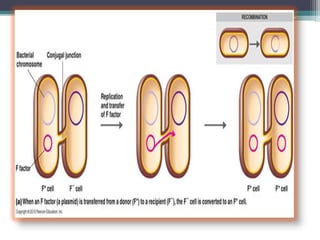
1) F+ conjugation- During conjugation the F+ bacteria
synthesise a modified pilus (sex pilus) through which
genetic material transfer, the result is two male cells.
• This attached pilus is a temporary cytoplasmic bridge
through which a replicating F plasmid is transferred
from the male to the female.
• Conjugation in gram positive does not depend on sex
pili, the donor cells form a protein adhesin on the
surface that causes donor and recipient cells to
aggregate. Eg. Bacillus subtillis, Streptocoocus lactis,
Enterococcus fecaelis
2) Resistant plasmid conjugation- Some gram negative
bacteria(eg. E.coli, shigella) contain plasmids that
contain antibiotic resistance gene called R factor. The R
factor has two component-
i) RTF( resistance transfer factor) that codes for sex
transfer like F factor.
ii) r determinant that codes for antibiotic resistance.
Sometimes RTF may dissociated from the r
determinants and the two component may exist as
separate entities. Under such condition, although the
host cell remains drug resistant, the drug resistance is
not transferable.
3) High frequency recombinant (Hfr) conjugation-
When the F+ plasmid is integrated within the bacterial
chromosome, the cell is called an Hfr cell
Plasmid that are capable of integrating into the
chromosome is called episome.
HFR cells are able to transfer chromosomal gene to
recipient with high frequency.
The recipient F- cell usually remain F- after conjugation
because only part of the F plasmid from the donor Hfr
cell to the recipient have been transferred.
4) Sexduction- When F- factor reverts to free state
from the integrated state, it may sometimes carry with
it some genetic material from the host cell adjacent to
the integration site of the F plasmid. Such type of
hybrid molecule and F factor plasmid incorporating
some host chromosomal gene is called F prime (F’)
factor. When F’ cell mates with a recipient(F-) cell the
recipient bacterium become F’. This process of gene
transfer is termed as sexduction.
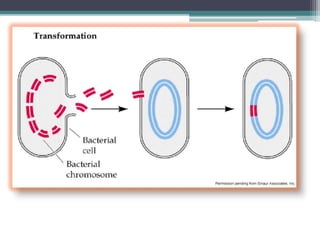
TRANSFORMATION• Involves the uptake of free or naked DNA via a
recipient released by the donor.
• Transformation, originally discovered in
pneumococcus by Griffith(1928) known as Griffith’s
experiment, has also observed in Bacillus, Neisseria,
Haemophilus bacteria.
• Griffith’s experiment in Pneumococcus
Type I strain(smooth strain) injected to mice it dies
Type II strain (rough strain) injected to mice it survives
• Heat killed capsulated type I injected to mice it
survives.
• Mixed culture(heat killed capsulated type I and type II
strain) injected to mice it dies,he discovered life
smooth strain from the blood collected from mice.
• In 1944 Avery, Mcleod and Mc Carty found that the
factor that transform other strain was found to be
DNA.
• Transformation occurs naturally in some species of
bacteria , but it can also be effected by artificial
treatment in other species.
TRANSDUCTION
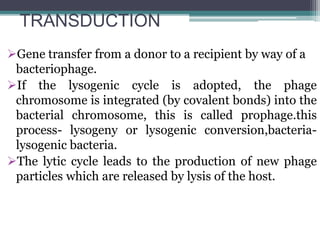
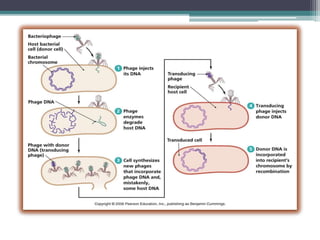
Gene transfer from a donor to a recipient by way of a
bacteriophage.
If the lysogenic cycle is adopted, the phage
chromosome is integrated (by covalent bonds) into the
bacterial chromosome, this is called prophage.this
process- lysogeny or lysogenic conversion,bacteria-
lysogenic bacteria.
The lytic cycle leads to the production of new phage
particles which are released by lysis of the host.
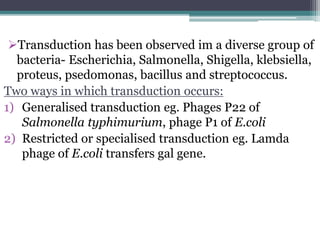
Transduction has been observed im a diverse group of
bacteria- Escherichia, Salmonella, Shigella, klebsiella,
proteus, psedomonas, bacillus and streptococcus.
Two ways in which transduction occurs:
1) Generalised transduction eg. Phages P22 of
Salmonella typhimurium, phage P1 of E.coli
2) Restricted or specialised transduction eg. Lamda
phage of E.coli transfers gal gene.
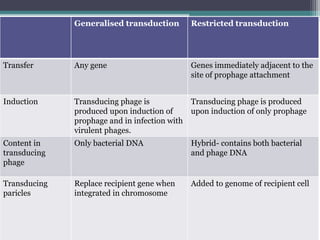
Generalised transduction Restricted transduction
Transfer Any gene Genes immediately adjacent to the
site of prophage attachment
Induction Transducing phage is
produced upon induction of
prophage and in infection with
virulent phages.
Transducing phage is produced
upon induction of only prophage
Content in
transducing
phage
Only bacterial DNA Hybrid- contains both bacterial
and phage DNA
Transducing
paricles
Replace recipient gene when
integrated in chromosome
Added to genome of recipient cell
Cell to cell fusion(protoplast fusion)
• In gram positive bacteria???
• Cell membrane of participating cells are joined
together in protoplast fusion which inturn generates
cytoplasmic bridge between the cells resulting in
mixing of their cytoplasm and exchange of genetic
material.
• Protoplast fusion is an artificial method of gene
transfer.
SCREENING OF TRANSGENE
• The presence of transgene or gene of interest is
detected by several methods:
• A selectable marker gene
• Southern blot techniques
• Northern bolt technique
• Western blot technique
APPLICATION
• Clinical gene transfer applications
• Vaccine Development
• Production of transgenic animals
• Treatment of Cancer, AIDS
• Gene Discovery
• Gene Therapy
• Enhancing the resistance of plants
• GMO
Gene transfer

Gene transfer

  • 1.
    GENE TRANSFER BY- DR. CHANDRANIGOSWAMI 2015-VMK-72 DEPTT. OF VETERINARY PUBLIC HEALTH
  • 2.
    GENE TRANSFER • Itis defined simply as a technique to efficiently and stably introduce foreign genes into the genome of target cells. • The insertion of unrelated, therapeutic genetic information in the form of DNA into target cells.
  • 3.
    INTRODUCTION Gene transfer inwhich bacteria genotype can be changed by transfer of genetic material from one bacterium to another. In such instances, the transferred DNA either: a) Recombine with genome of the recipient bacterium or b) Is on the plasmid capable of replication in the recipient bacterium without recombination.
  • 4.
    Genetic recombination itoccurs when sequence of DNA from two separate sources are integrated. The directed desirable gene transfer from one organism to another and the subsequent stable integration & expression of foreign gene into the genome is referred as genetic transformation. The transferred gene is known as transgene and the organism that develop after a successful gene transfer is known as transgenic.
  • 5.
    MECHANISM OF GENETRANSFER There are four mechanisms of gene transfer and recombination between bacteria cells. 1. Conjugation 2. Transformation 3. Transduction 4. Cell- cell fusion
  • 6.
    DNA TRANSFER BYARTIFICIAL METHODS Physical methods 1. Microinjection 2. Biolistics transformation Chemical methods 1. DNA transfer by calcium phosphate method 2. Liposome mediated transfer Electrical methods 1. Electroporation
  • 7.
    CONJUGATION  Bacteria conjugationin E.coli was discovered by Lederberg and Tatum in 1946, when they observed sex like exchange between two mutants strains of E.coli called K12.  Conjugation involves the transfer of plasmid from a donor( bacteria contain F plasmid) to the recipient(bacteria lacking F plasmid).
  • 8.
     Conjugation ismore common in gram negative between strain of same species or closely related species.  Some plasmid like F plasmid(fertility factor or sex factor) they carry tra gene that mediate their own transfer through sex pilus.  Bacteria that have a F plasmid are referred to as as F+ or male. Those that do not have an F plasmid are F- of female.  The F plasmid consists of 25 genes that mostly code for production of sex pilli.
  • 9.
    Conjugation are ofdifferent types: 1) F+ conjugation- During conjugation the F+ bacteria synthesise a modified pilus (sex pilus) through which genetic material transfer, the result is two male cells. • This attached pilus is a temporary cytoplasmic bridge through which a replicating F plasmid is transferred from the male to the female. • Conjugation in gram positive does not depend on sex pili, the donor cells form a protein adhesin on the surface that causes donor and recipient cells to aggregate. Eg. Bacillus subtillis, Streptocoocus lactis, Enterococcus fecaelis
  • 11.
    2) Resistant plasmidconjugation- Some gram negative bacteria(eg. E.coli, shigella) contain plasmids that contain antibiotic resistance gene called R factor. The R factor has two component- i) RTF( resistance transfer factor) that codes for sex transfer like F factor. ii) r determinant that codes for antibiotic resistance. Sometimes RTF may dissociated from the r determinants and the two component may exist as separate entities. Under such condition, although the host cell remains drug resistant, the drug resistance is not transferable.
  • 12.
    3) High frequencyrecombinant (Hfr) conjugation- When the F+ plasmid is integrated within the bacterial chromosome, the cell is called an Hfr cell Plasmid that are capable of integrating into the chromosome is called episome. HFR cells are able to transfer chromosomal gene to recipient with high frequency. The recipient F- cell usually remain F- after conjugation because only part of the F plasmid from the donor Hfr cell to the recipient have been transferred.
  • 13.
    4) Sexduction- WhenF- factor reverts to free state from the integrated state, it may sometimes carry with it some genetic material from the host cell adjacent to the integration site of the F plasmid. Such type of hybrid molecule and F factor plasmid incorporating some host chromosomal gene is called F prime (F’) factor. When F’ cell mates with a recipient(F-) cell the recipient bacterium become F’. This process of gene transfer is termed as sexduction.
  • 14.
    TRANSFORMATION• Involves theuptake of free or naked DNA via a recipient released by the donor. • Transformation, originally discovered in pneumococcus by Griffith(1928) known as Griffith’s experiment, has also observed in Bacillus, Neisseria, Haemophilus bacteria. • Griffith’s experiment in Pneumococcus Type I strain(smooth strain) injected to mice it dies Type II strain (rough strain) injected to mice it survives
  • 15.
    • Heat killedcapsulated type I injected to mice it survives. • Mixed culture(heat killed capsulated type I and type II strain) injected to mice it dies,he discovered life smooth strain from the blood collected from mice. • In 1944 Avery, Mcleod and Mc Carty found that the factor that transform other strain was found to be DNA. • Transformation occurs naturally in some species of bacteria , but it can also be effected by artificial treatment in other species.
  • 17.
    TRANSDUCTION Gene transfer froma donor to a recipient by way of a bacteriophage. If the lysogenic cycle is adopted, the phage chromosome is integrated (by covalent bonds) into the bacterial chromosome, this is called prophage.this process- lysogeny or lysogenic conversion,bacteria- lysogenic bacteria. The lytic cycle leads to the production of new phage particles which are released by lysis of the host.
  • 19.
    Transduction has beenobserved im a diverse group of bacteria- Escherichia, Salmonella, Shigella, klebsiella, proteus, psedomonas, bacillus and streptococcus. Two ways in which transduction occurs: 1) Generalised transduction eg. Phages P22 of Salmonella typhimurium, phage P1 of E.coli 2) Restricted or specialised transduction eg. Lamda phage of E.coli transfers gal gene.
  • 20.
    Generalised transduction Restrictedtransduction Transfer Any gene Genes immediately adjacent to the site of prophage attachment Induction Transducing phage is produced upon induction of prophage and in infection with virulent phages. Transducing phage is produced upon induction of only prophage Content in transducing phage Only bacterial DNA Hybrid- contains both bacterial and phage DNA Transducing paricles Replace recipient gene when integrated in chromosome Added to genome of recipient cell
  • 21.
    Cell to cellfusion(protoplast fusion) • In gram positive bacteria??? • Cell membrane of participating cells are joined together in protoplast fusion which inturn generates cytoplasmic bridge between the cells resulting in mixing of their cytoplasm and exchange of genetic material. • Protoplast fusion is an artificial method of gene transfer.
  • 22.
    SCREENING OF TRANSGENE •The presence of transgene or gene of interest is detected by several methods: • A selectable marker gene • Southern blot techniques • Northern bolt technique • Western blot technique
  • 23.
    APPLICATION • Clinical genetransfer applications • Vaccine Development • Production of transgenic animals • Treatment of Cancer, AIDS • Gene Discovery • Gene Therapy • Enhancing the resistance of plants • GMO