MANTOUX TEST 
PBL 3 
BY:AZIZAH BINTI 
MOHAMED HALEEM
THE MANTOUX TEST 
 The Mantoux test is the standard method of 
determining whether a person is infected 
with Mycobacterium tuberculosis. 
 The local skin reaction to Tuberculin Purified 
Protein Derivative (PPD) injected into the skin is 
used to assess the individual’s sensitivity to 
tuberculin protein.
MANTOUX TEST 
The mantoux test is given to : 
• Children aged 3 months to 6 years living at 
high risk environments. 
• Infants and children under six years of age 
with a history of residence or prolonged stay 
(more than three months) in a country of high 
endemic.
• There is a history of TB in a household contact 
in the last five years. 
• Those who have had close contact with a 
person with known TB.
Administering the Mantoux test 
Tuberculin PPD RT 23 SSI, 2 T.U./0.1 ml, 
solution for injection: 
• 1 dose = 0.1 ml contains 0.04 microgram 
Tuberculin PPD. 
• Store at 2°C -8°C, protected from light 
1ml graduated syringe fitted with a short 
bevel 26G (0.45x10mm) needle
Injection site 
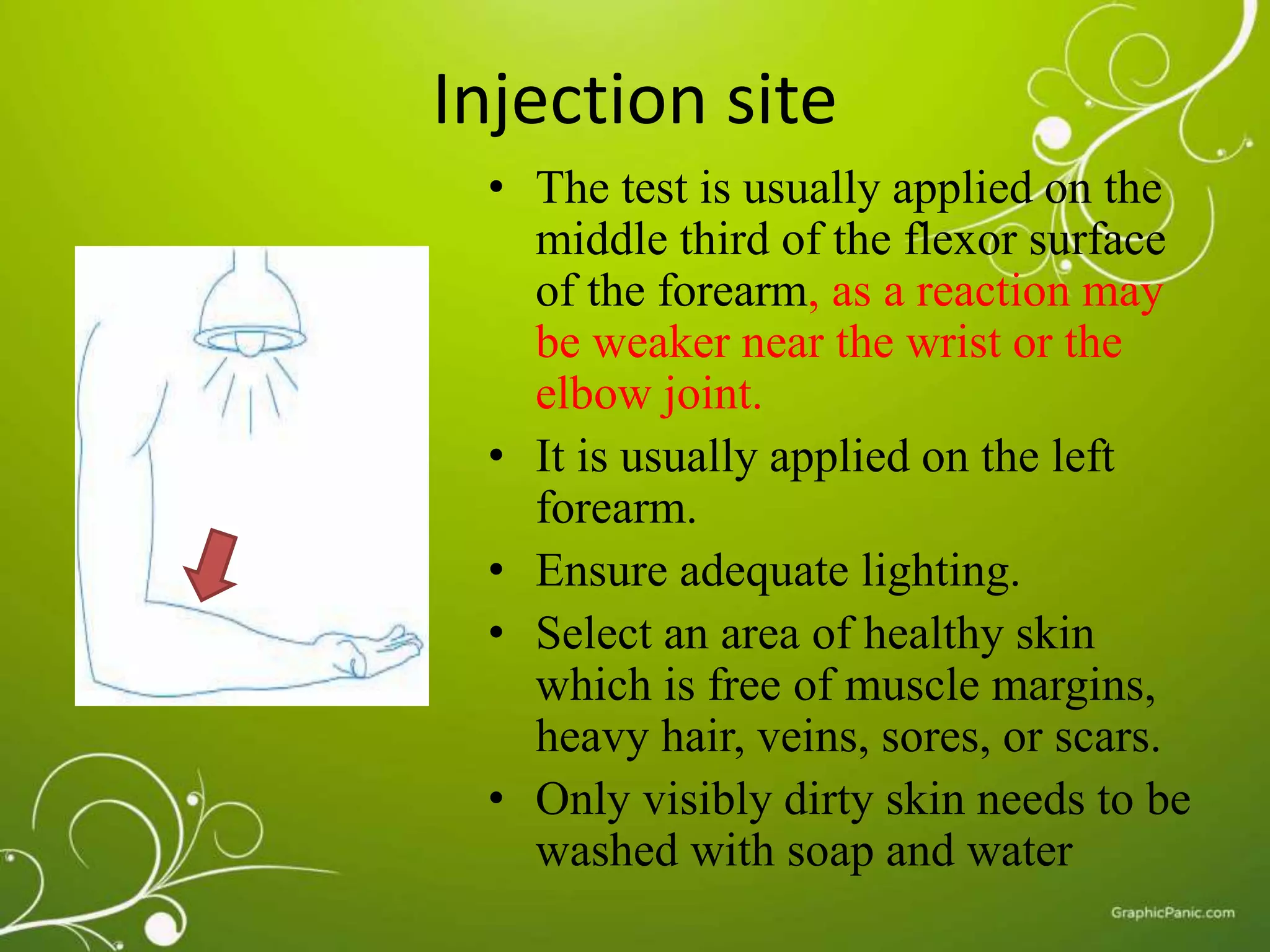
• The test is usually applied on the 
middle third of the flexor surface 
of the forearm, as a reaction may 
be weaker near the wrist or the 
elbow joint. 
• It is usually applied on the left 
forearm. 
• Ensure adequate lighting. 
• Select an area of healthy skin 
which is free of muscle margins, 
heavy hair, veins, sores, or scars. 
• Only visibly dirty skin needs to be 
washed with soap and water
Procedure 
1)Use a 1mL syringe to 
aspirate out 0.1 mL 
of PPD RT 23. 
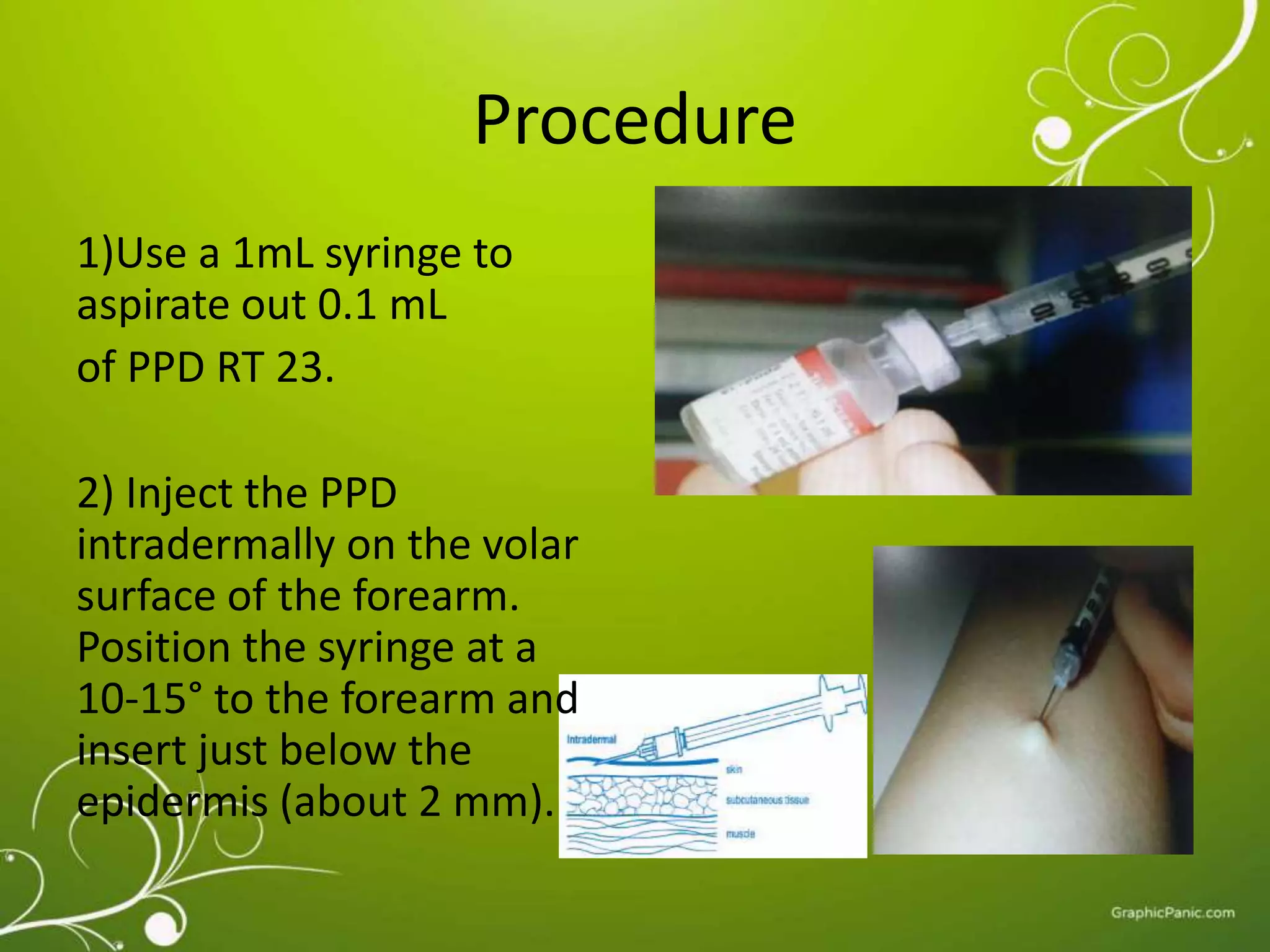
2) Inject the PPD 
intradermally on the volar 
surface of the forearm. 
Position the syringe at a 
10-15° to the forearm and 
insert just below the 
epidermis (about 2 mm).
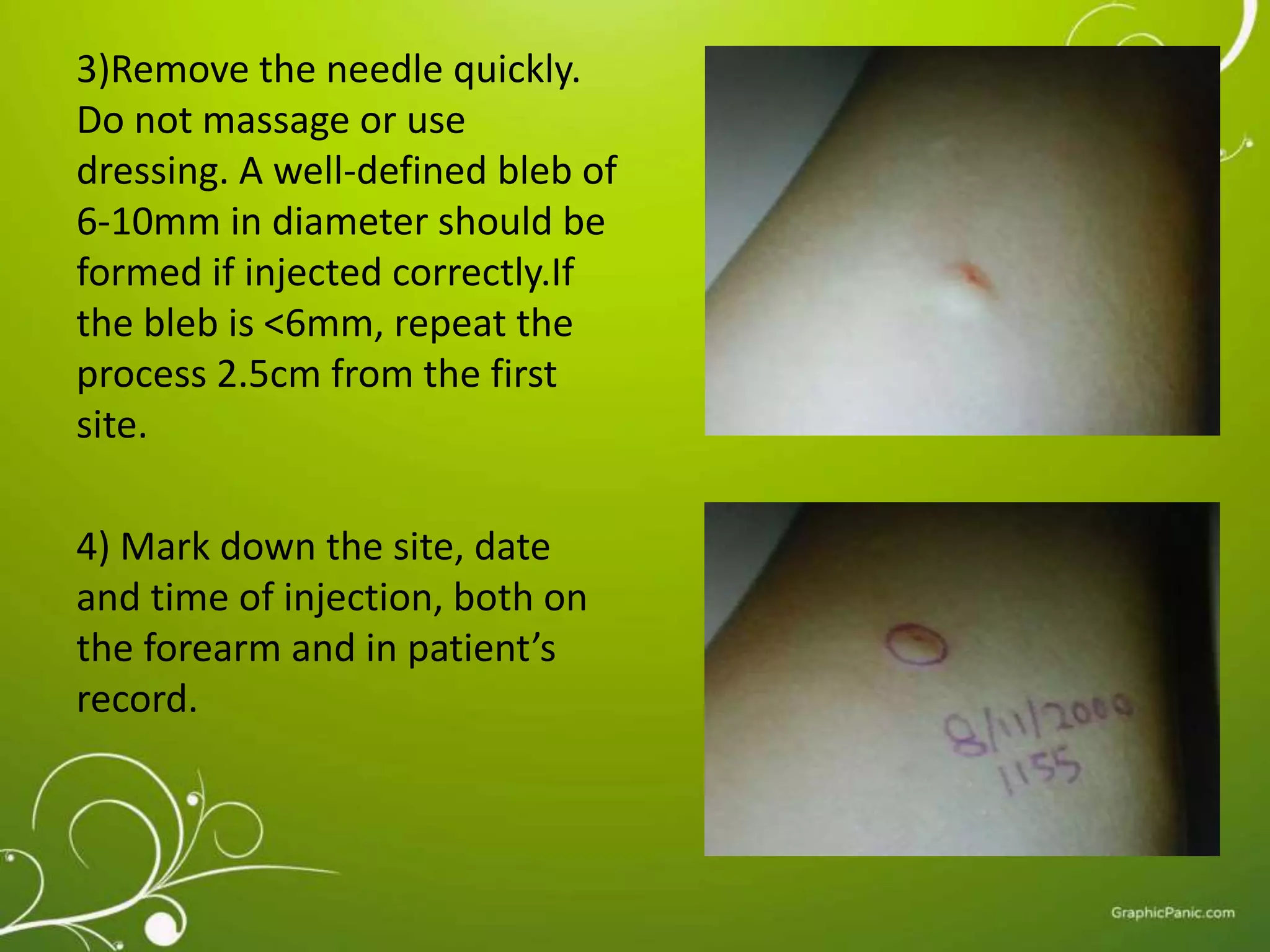
3)Remove the needle quickly. 
Do not massage or use 
dressing. A well-defined bleb of 
6-10mm in diameter should be 
formed if injected correctly.If 
the bleb is <6mm, repeat the 
process 2.5cm from the first 
site. 
4) Mark down the site, date 
and time of injection, both on 
the forearm and in patient’s 
record.
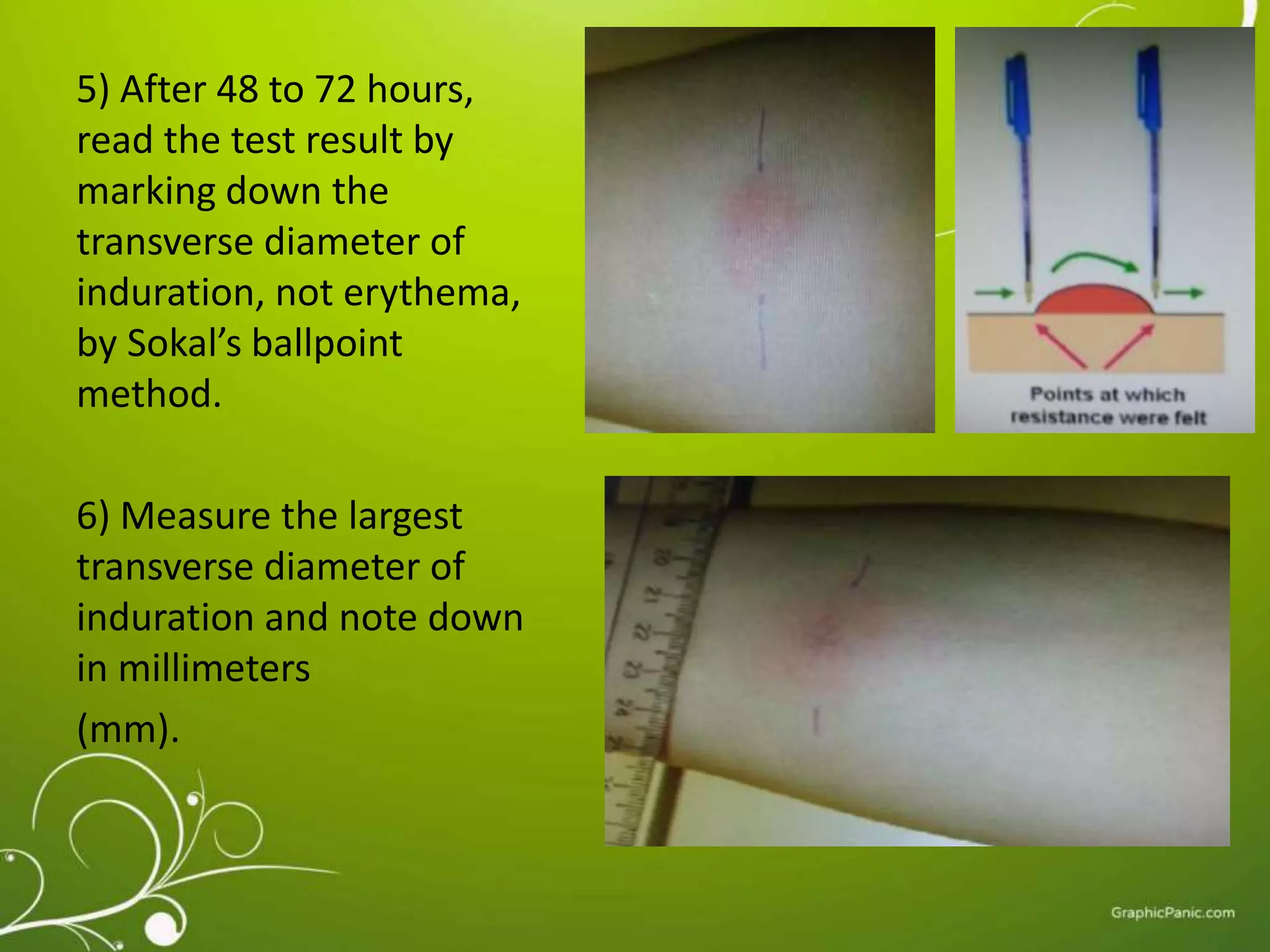
5) After 48 to 72 hours, 
read the test result by 
marking down the 
transverse diameter of 
induration, not erythema, 
by Sokal’s ballpoint 
method. 
6) Measure the largest 
transverse diameter of 
induration and note down 
in millimeters 
(mm).
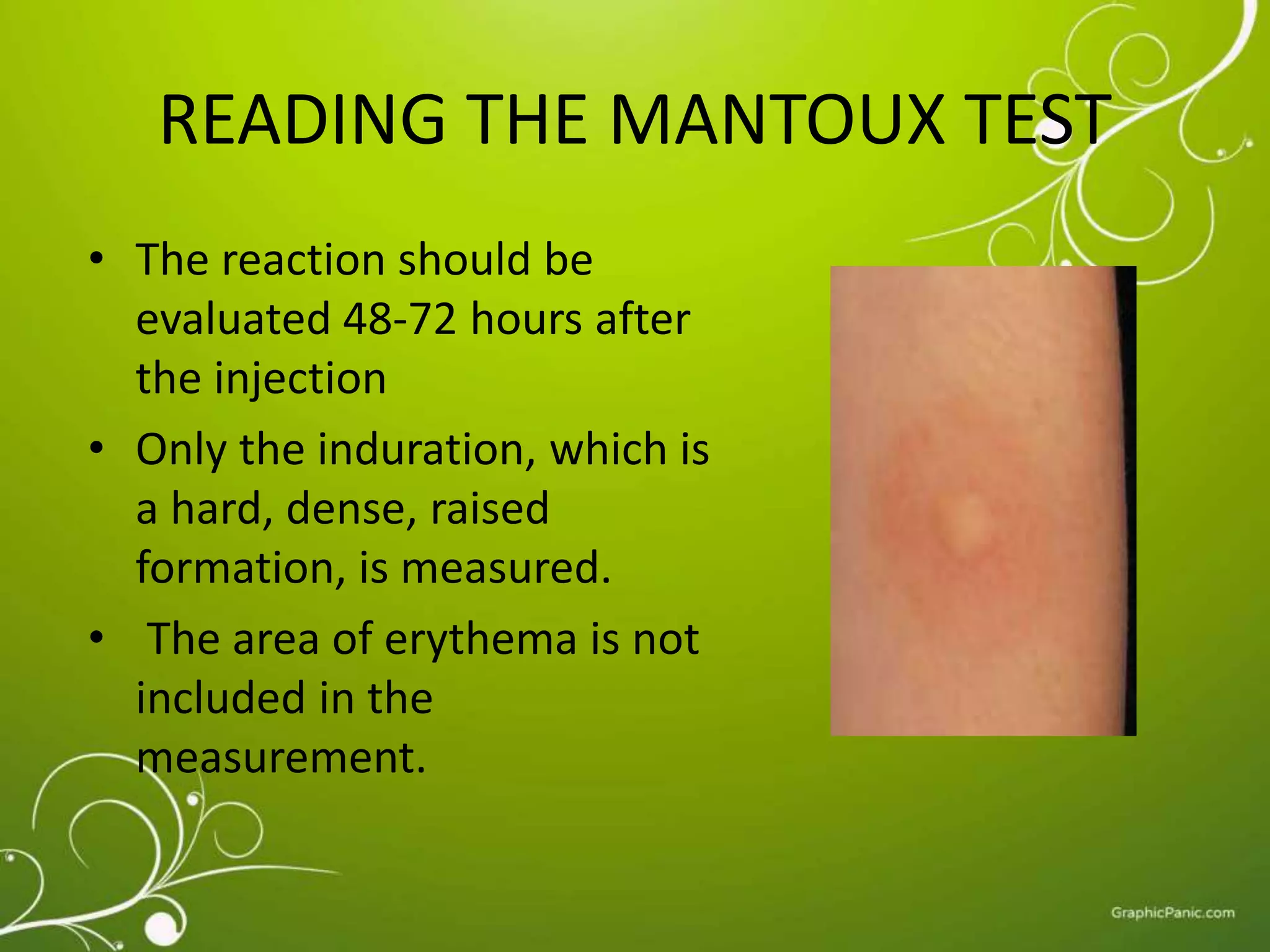
READING THE MANTOUX TEST 
• The reaction should be 
evaluated 48-72 hours after 
the injection 
• Only the induration, which is 
a hard, dense, raised 
formation, is measured. 
• The area of erythema is not 
included in the 
measurement.
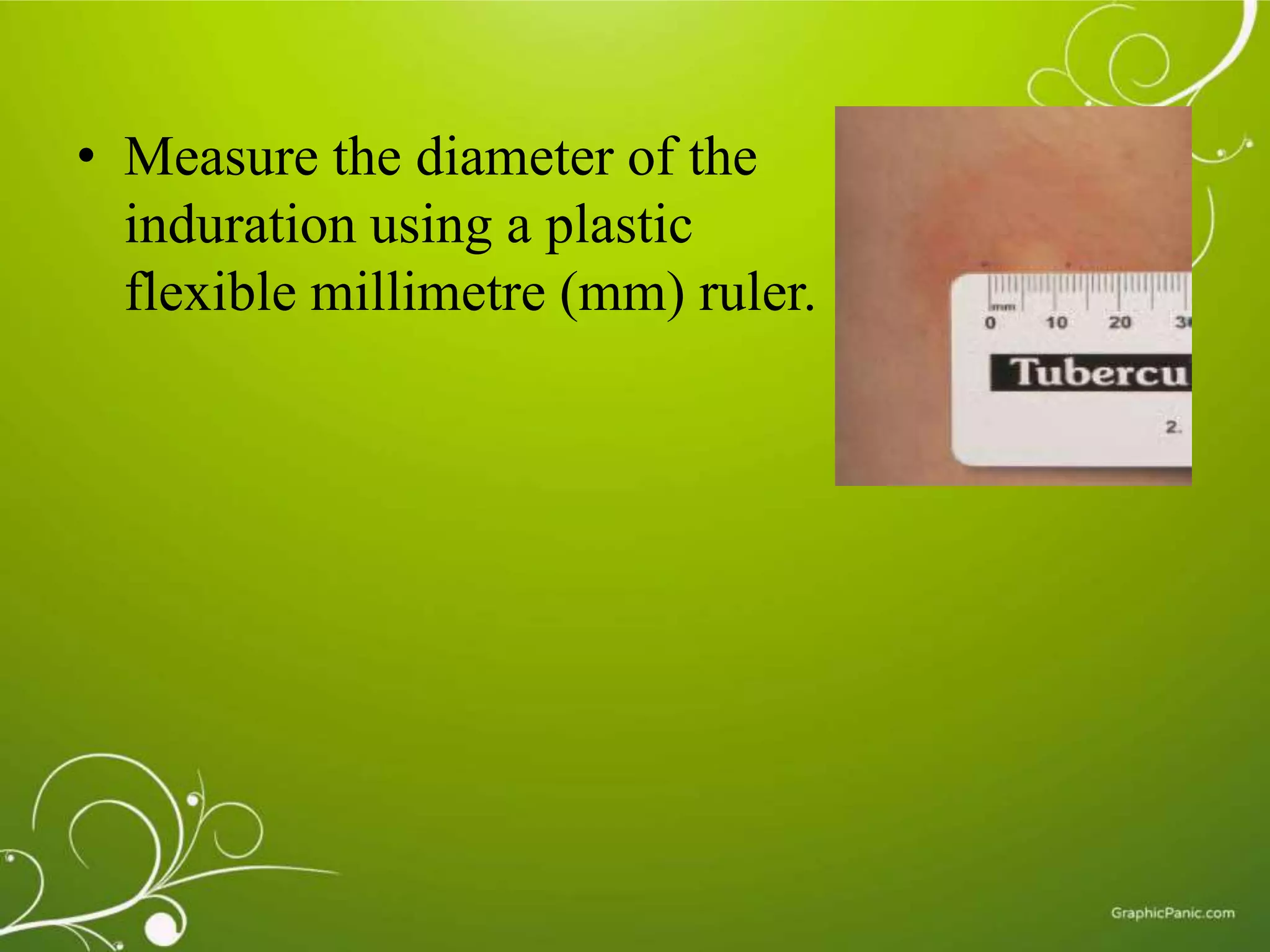
• Measure the diameter of the 
induration using a plastic 
flexible millimetre (mm) ruler.
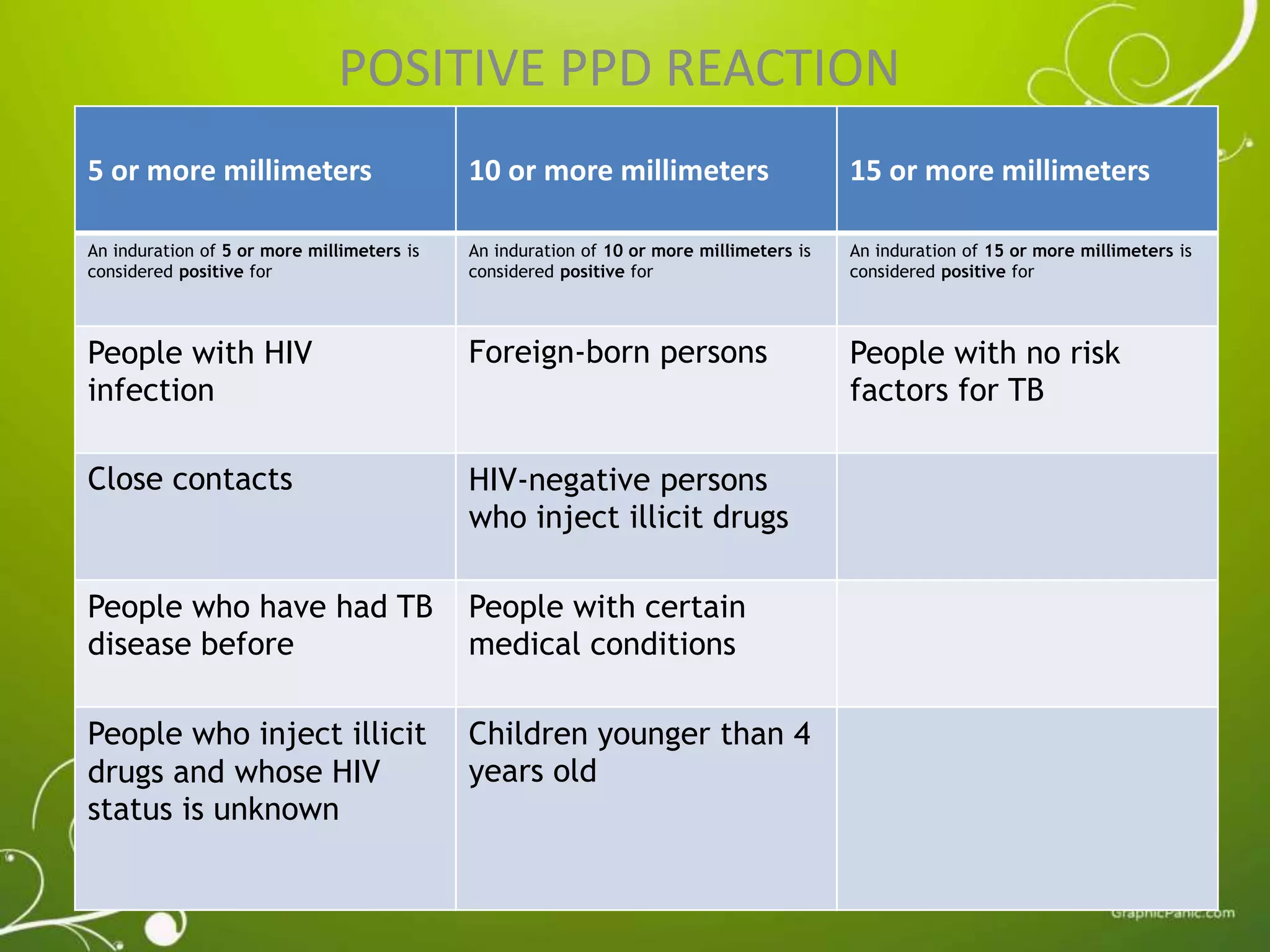
POSITIVE PPD REACTION 
5 or more millimeters 10 or more millimeters 15 or more millimeters 
An induration of 5 or more millimeters is 
considered positive for 
An induration of 10 or more millimeters is 
considered positive for 
An induration of 15 or more millimeters is 
considered positive for 
People with HIV 
infection 
Foreign-born persons People with no risk 
factors for TB 
Close contacts HIV-negative persons 
who inject illicit drugs 
People who have had TB 
disease before 
People with certain 
medical conditions 
People who inject illicit 
drugs and whose HIV 
status is unknown 
Children younger than 4 
years old
• A healthy person whose immune system is 
normal, induration greater than or equal to 15 
mm is considered a positive skin test. 
• In most cases,people who have a very small 
reaction or no reaction probably do not have 
TB infection. 
• Induration of less than 2 mm, without 
blistering, is considered a negative skin test.
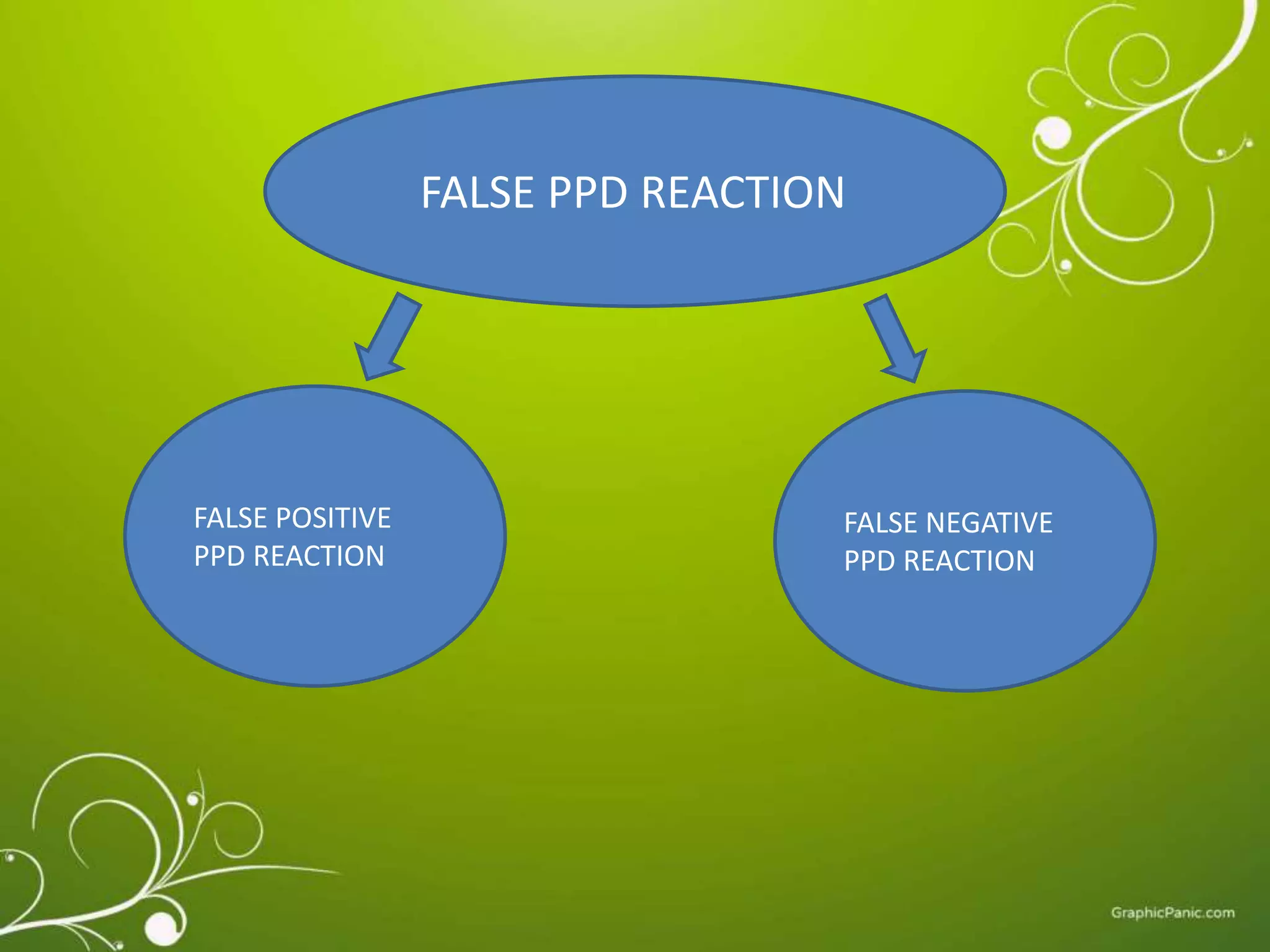
FALSE PPD REACTION 
FALSE POSITIVE 
PPD REACTION 
FALSE NEGATIVE 
PPD REACTION
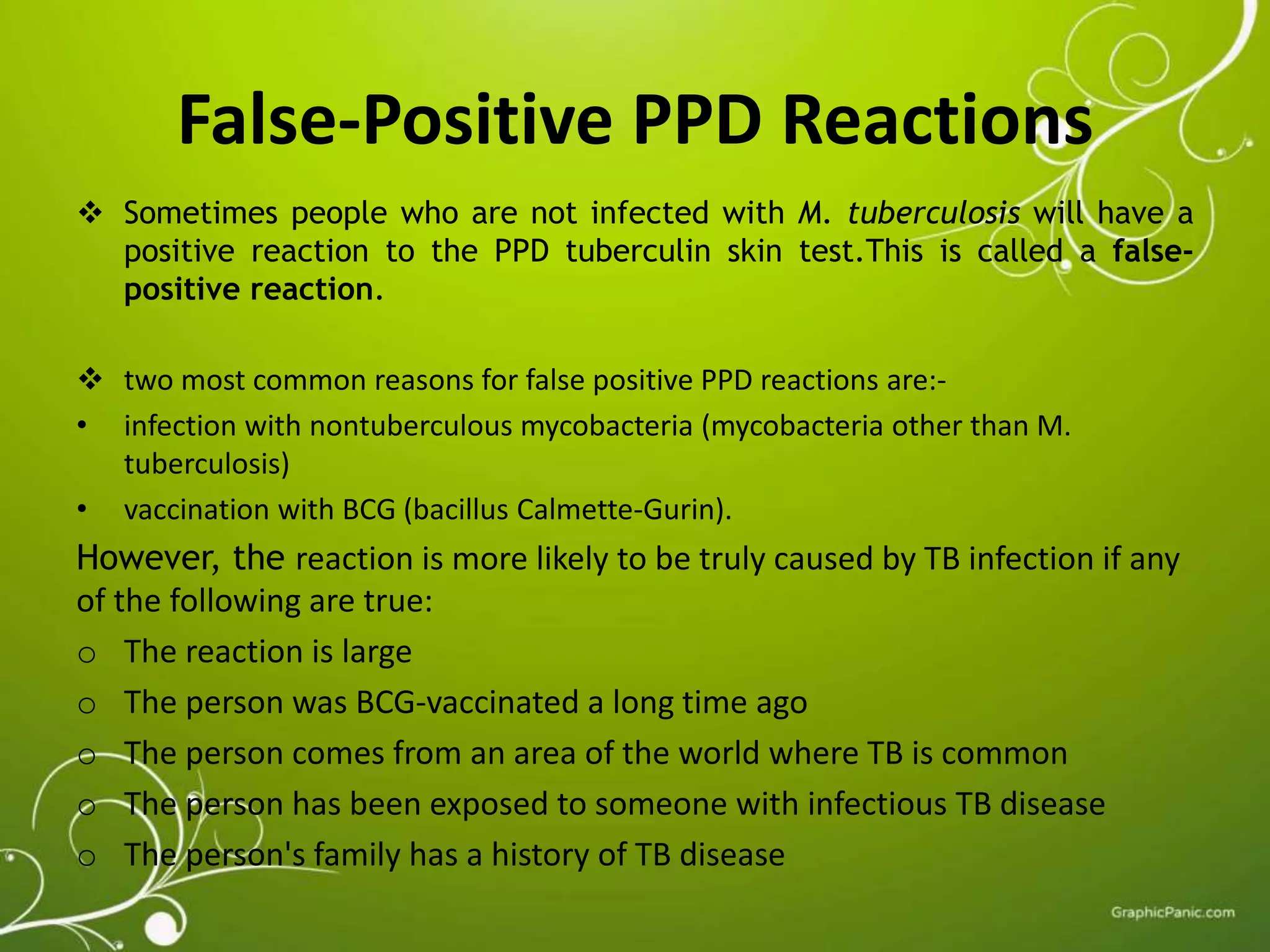
False-Positive PPD Reactions 
 Sometimes people who are not infected with M. tuberculosis will have a 
positive reaction to the PPD tuberculin skin test.This is called a false-positive 
reaction. 
 two most common reasons for false positive PPD reactions are:- 
• infection with nontuberculous mycobacteria (mycobacteria other than M. 
tuberculosis) 
• vaccination with BCG (bacillus Calmette-Gurin). 
However, the reaction is more likely to be truly caused by TB infection if any 
of the following are true: 
o The reaction is large 
o The person was BCG-vaccinated a long time ago 
o The person comes from an area of the world where TB is common 
o The person has been exposed to someone with infectious TB disease 
o The person's family has a history of TB disease
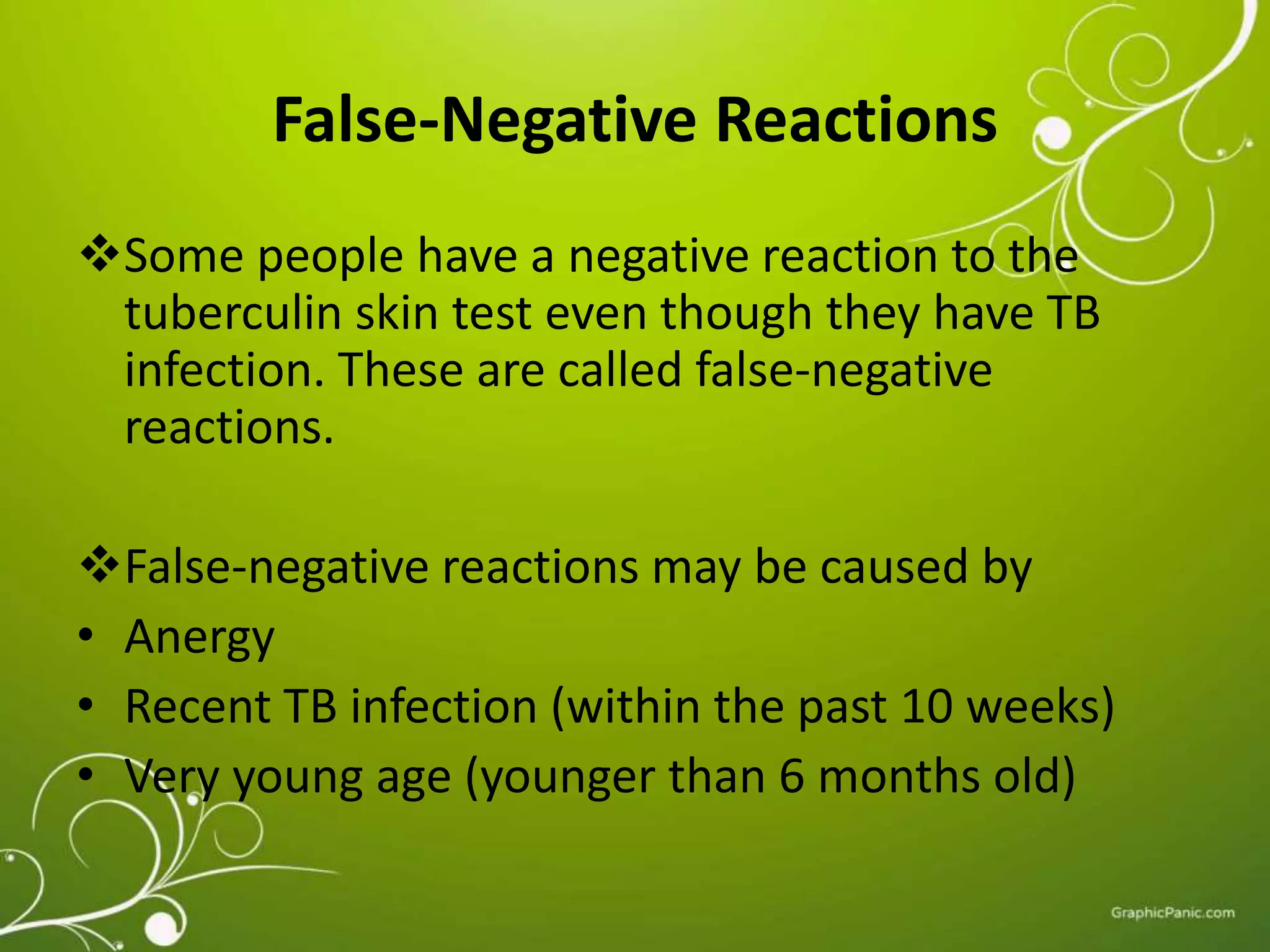
False-Negative Reactions 
Some people have a negative reaction to the 
tuberculin skin test even though they have TB 
infection. These are called false-negative 
reactions. 
False-negative reactions may be caused by 
• Anergy 
• Recent TB infection (within the past 10 weeks) 
• Very young age (younger than 6 months old)
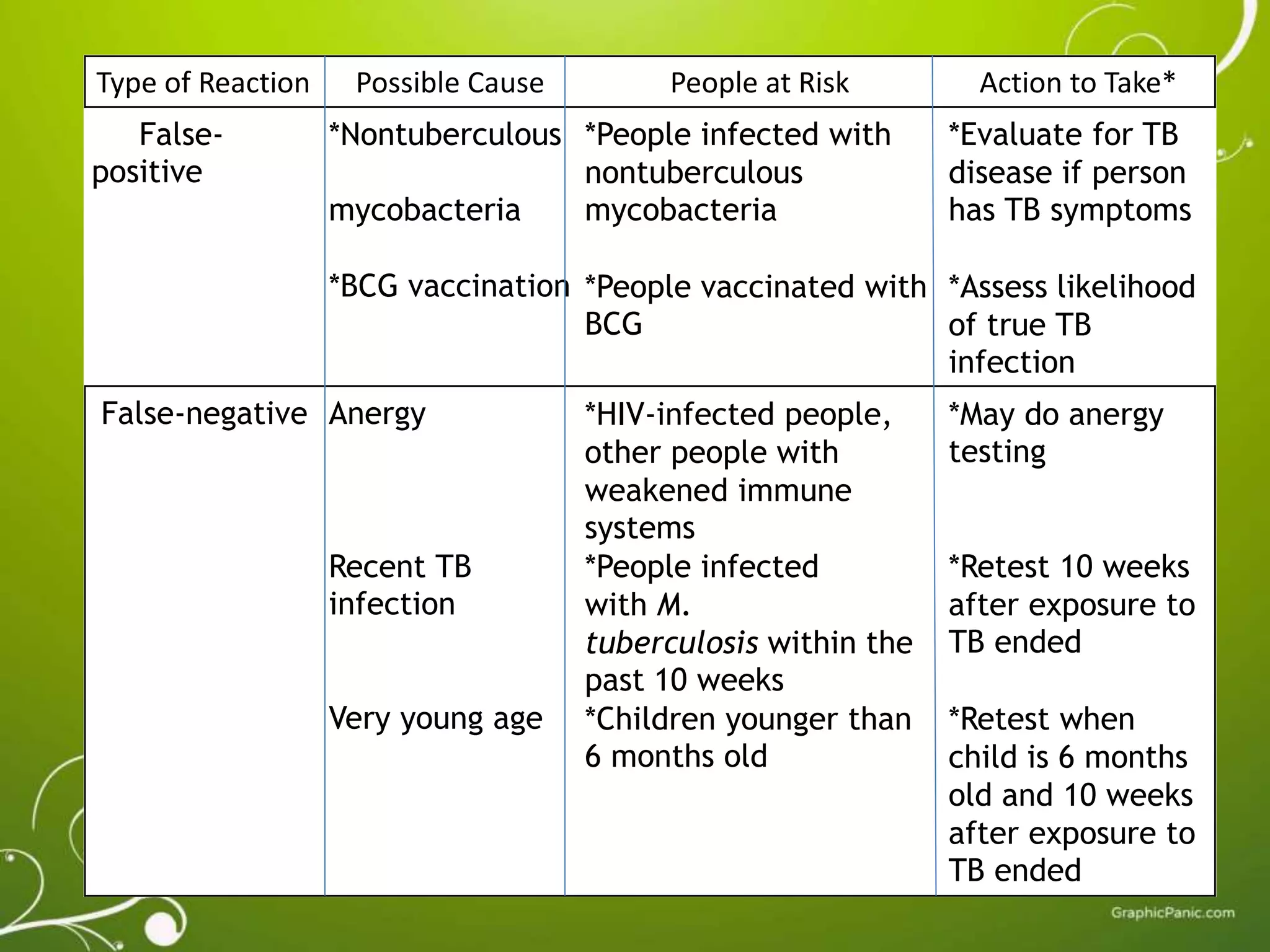
Type of Reaction Possible Cause People at Risk Action to Take* 
False-positive 
*Nontuberculous 
mycobacteria 
*BCG vaccination 
*People infected with 
nontuberculous 
mycobacteria 
*People vaccinated with 
BCG 
*Evaluate for TB 
disease if person 
has TB symptoms 
*Assess likelihood 
of true TB 
infection 
False-negative Anergy 
Recent TB 
infection 
Very young age 
*HIV-infected people, 
other people with 
weakened immune 
systems 
*People infected 
with M. 
tuberculosis within the 
past 10 weeks 
*Children younger than 
6 months old 
*May do anergy 
testing 
*Retest 10 weeks 
after exposure to 
TB ended 
*Retest when 
child is 6 months 
old and 10 weeks 
after exposure to 
TB ended
ADVERSE EFFECT 
• anaphylactic reaction and foreign body 
reaction 
• Slight risk of having a severe reaction to the 
test including swelling and redness of the arm, 
particularly in people who have had TB or 
been infected previously and in those who 
have previously had the BCG vaccine 
• Local reactions such as regional lymphangitis 
and adenitis may also occur on rare occasions.
CONTRAINDICATION 
• severe reaction (e.g:necrosis, blistering, 
anaphylactic shock, or ulcerations) to a 
previous TST.
reference 
• http://www.immunisation.ie 
• http://www.hkucoi.hku.hk/TST.pdf 
• http://www.cdc.gov/tb/publications/factsheet 
s/testing/skintesting.htm 
• http://www.ncbi.nlm.nih.gov/ 
• Medical Microbiology and 
Immunology,Warren Levinson,McGraw Hill
The mantoux test

The mantoux test

  • 1.
    MANTOUX TEST PBL3 BY:AZIZAH BINTI MOHAMED HALEEM
  • 2.
    THE MANTOUX TEST  The Mantoux test is the standard method of determining whether a person is infected with Mycobacterium tuberculosis.  The local skin reaction to Tuberculin Purified Protein Derivative (PPD) injected into the skin is used to assess the individual’s sensitivity to tuberculin protein.
  • 3.
    MANTOUX TEST Themantoux test is given to : • Children aged 3 months to 6 years living at high risk environments. • Infants and children under six years of age with a history of residence or prolonged stay (more than three months) in a country of high endemic.
  • 4.
    • There isa history of TB in a household contact in the last five years. • Those who have had close contact with a person with known TB.
  • 5.
    Administering the Mantouxtest Tuberculin PPD RT 23 SSI, 2 T.U./0.1 ml, solution for injection: • 1 dose = 0.1 ml contains 0.04 microgram Tuberculin PPD. • Store at 2°C -8°C, protected from light 1ml graduated syringe fitted with a short bevel 26G (0.45x10mm) needle
  • 6.
    Injection site •The test is usually applied on the middle third of the flexor surface of the forearm, as a reaction may be weaker near the wrist or the elbow joint. • It is usually applied on the left forearm. • Ensure adequate lighting. • Select an area of healthy skin which is free of muscle margins, heavy hair, veins, sores, or scars. • Only visibly dirty skin needs to be washed with soap and water
  • 7.
    Procedure 1)Use a1mL syringe to aspirate out 0.1 mL of PPD RT 23. 2) Inject the PPD intradermally on the volar surface of the forearm. Position the syringe at a 10-15° to the forearm and insert just below the epidermis (about 2 mm).
  • 8.
    3)Remove the needlequickly. Do not massage or use dressing. A well-defined bleb of 6-10mm in diameter should be formed if injected correctly.If the bleb is <6mm, repeat the process 2.5cm from the first site. 4) Mark down the site, date and time of injection, both on the forearm and in patient’s record.
  • 9.
    5) After 48to 72 hours, read the test result by marking down the transverse diameter of induration, not erythema, by Sokal’s ballpoint method. 6) Measure the largest transverse diameter of induration and note down in millimeters (mm).
  • 10.
    READING THE MANTOUXTEST • The reaction should be evaluated 48-72 hours after the injection • Only the induration, which is a hard, dense, raised formation, is measured. • The area of erythema is not included in the measurement.
  • 11.
    • Measure thediameter of the induration using a plastic flexible millimetre (mm) ruler.
  • 12.
    POSITIVE PPD REACTION 5 or more millimeters 10 or more millimeters 15 or more millimeters An induration of 5 or more millimeters is considered positive for An induration of 10 or more millimeters is considered positive for An induration of 15 or more millimeters is considered positive for People with HIV infection Foreign-born persons People with no risk factors for TB Close contacts HIV-negative persons who inject illicit drugs People who have had TB disease before People with certain medical conditions People who inject illicit drugs and whose HIV status is unknown Children younger than 4 years old
  • 13.
    • A healthyperson whose immune system is normal, induration greater than or equal to 15 mm is considered a positive skin test. • In most cases,people who have a very small reaction or no reaction probably do not have TB infection. • Induration of less than 2 mm, without blistering, is considered a negative skin test.
  • 14.
    FALSE PPD REACTION FALSE POSITIVE PPD REACTION FALSE NEGATIVE PPD REACTION
  • 15.
    False-Positive PPD Reactions  Sometimes people who are not infected with M. tuberculosis will have a positive reaction to the PPD tuberculin skin test.This is called a false-positive reaction.  two most common reasons for false positive PPD reactions are:- • infection with nontuberculous mycobacteria (mycobacteria other than M. tuberculosis) • vaccination with BCG (bacillus Calmette-Gurin). However, the reaction is more likely to be truly caused by TB infection if any of the following are true: o The reaction is large o The person was BCG-vaccinated a long time ago o The person comes from an area of the world where TB is common o The person has been exposed to someone with infectious TB disease o The person's family has a history of TB disease
  • 16.
    False-Negative Reactions Somepeople have a negative reaction to the tuberculin skin test even though they have TB infection. These are called false-negative reactions. False-negative reactions may be caused by • Anergy • Recent TB infection (within the past 10 weeks) • Very young age (younger than 6 months old)
  • 17.
    Type of ReactionPossible Cause People at Risk Action to Take* False-positive *Nontuberculous mycobacteria *BCG vaccination *People infected with nontuberculous mycobacteria *People vaccinated with BCG *Evaluate for TB disease if person has TB symptoms *Assess likelihood of true TB infection False-negative Anergy Recent TB infection Very young age *HIV-infected people, other people with weakened immune systems *People infected with M. tuberculosis within the past 10 weeks *Children younger than 6 months old *May do anergy testing *Retest 10 weeks after exposure to TB ended *Retest when child is 6 months old and 10 weeks after exposure to TB ended
  • 18.
    ADVERSE EFFECT •anaphylactic reaction and foreign body reaction • Slight risk of having a severe reaction to the test including swelling and redness of the arm, particularly in people who have had TB or been infected previously and in those who have previously had the BCG vaccine • Local reactions such as regional lymphangitis and adenitis may also occur on rare occasions.
  • 19.
    CONTRAINDICATION • severereaction (e.g:necrosis, blistering, anaphylactic shock, or ulcerations) to a previous TST.
  • 20.
    reference • http://www.immunisation.ie • http://www.hkucoi.hku.hk/TST.pdf • http://www.cdc.gov/tb/publications/factsheet s/testing/skintesting.htm • http://www.ncbi.nlm.nih.gov/ • Medical Microbiology and Immunology,Warren Levinson,McGraw Hill