BRIG ANWAR UL HAQ
00923018513303
Otitis Media
With
Effusion
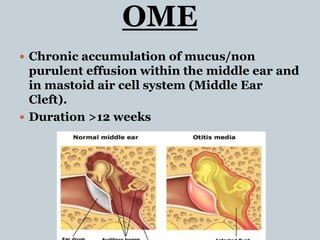
OME
 Chronic accumulation of mucus/non
purulent effusion within the middle ear and
in mastoid air cell system (Middle Ear
Cleft).
 Duration >12 weeks
Synonyms
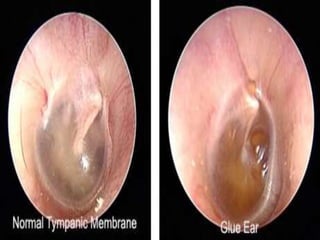
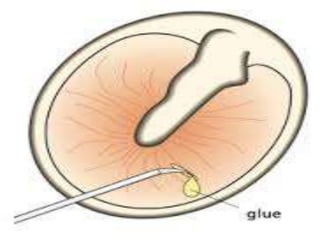
 Glue ear
 Serous otitis media
 Chronic nonpurulent otitis media
Etio-Pathology
 Preceded by an episode of AOM with
 Otalgia and fever.
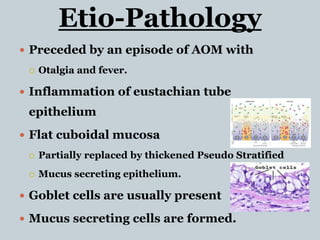
 Inflammation of eustachian tube
epithelium
 Flat cuboidal mucosa
 Partially replaced by thickened Pseudo Stratified
 Mucus secreting epithelium.
 Goblet cells are usually present
 Mucus secreting cells are formed.
Etio-Pathology
Characteristics of effusion
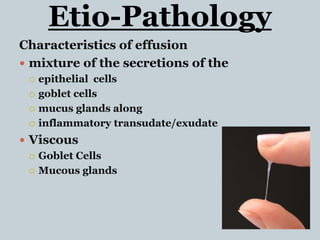
 mixture of the secretions of the
 epithelial cells
 goblet cells
 mucus glands along
 inflammatory transudate/exudate
 Viscous
 Goblet Cells
 Mucous glands
Etio-Pathology
Bacteriology
 Streptococcus Pneumonia
 Haemophilus Influenzae
 Branhamella Catarrhalis
 The incidence of pathogens was higher in
the younger children
Etio-Pathology
Eustachian tube dysfunction
 Viral upper respiratory tract infection,
 allergic reaction,
 Pollutents
 Cigarette smoke.
 Adenoids
 GERD
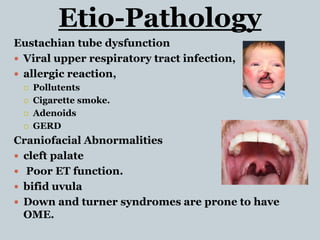
Craniofacial Abnormalities
 cleft palate
 Poor ET function.
 bifid uvula
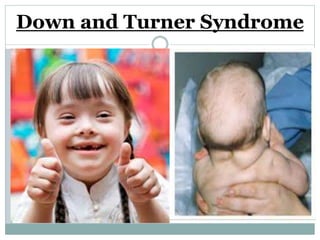
 Down and turner syndromes are prone to have
OME.
Down and Turner Syndrome
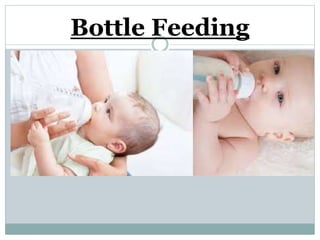
Bottle Feeding
Etio-Pathology
Allergy
 Allergy – Swelling - Infection
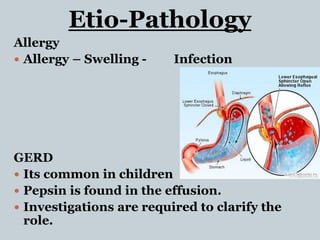
GERD
 Its common in children
 Pepsin is found in the effusion.
 Investigations are required to clarify the
role.
Etio-Pathology
Prevalance
 Age
 Bimodal - infancy
 - primary school
 Peak - one year of age.
 Season
 Winter>Summer
 Respiratory Tract Infections
 Ear Infections
Etio-Pathology
AOM Episode
 Largest single factor
 Antibiotics - No effects
 Contact with other children
Hereditability
 Greater concordance
 monozygotic - Higher
Incidence
 dizygotic - Lesser Incidence
Etio-Pathology
Race
 Prevalence is different in different races
Gender
 No difference in male or females
Smoking
 No effect of parenteral smoking detected.
Symptoms
 No symptoms
 Deafness
 Tinnitus
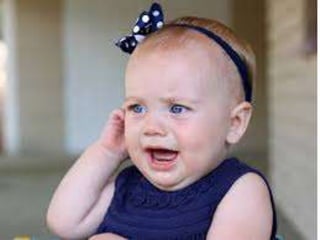
 Pain Ear
Symptoms
 Associated Symptoms
Nasal Blockage
Nasal Discharge
Pain Throat
Fever
Examination
 GPE
 Systemic Examination
 Repiratoty System
 ENT Examination
 Nose
 Nasopharynx
 Ears
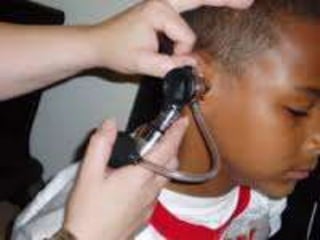
Pneumatic Otoscopy
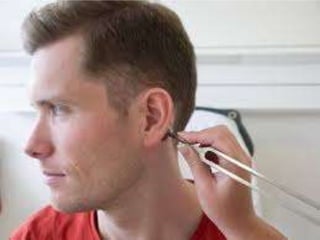
Tunning Fork Tests
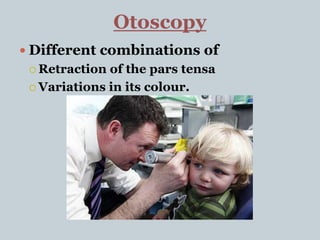
Otoscopy
 Different combinations of
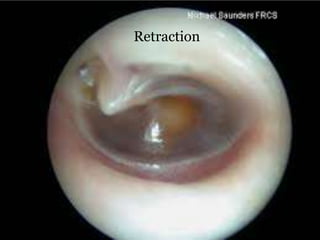
 Retraction of the pars tensa
 Variations in its colour.
Otoscopy
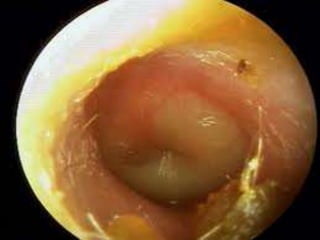
 Colour
 yellow
 Blue
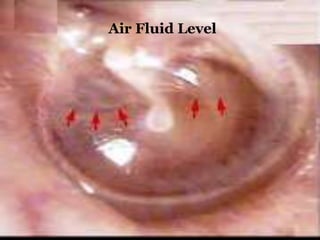
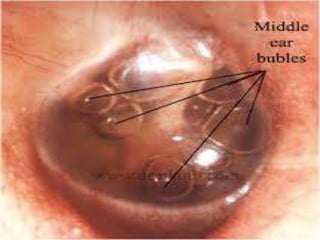
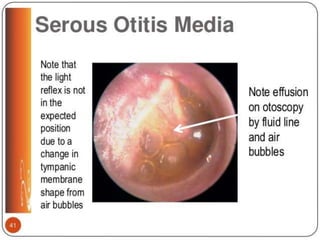
 fluid levels
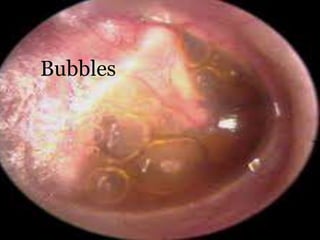
 air bubbles
 Position
 Retracted
 Full
 Mobility
 Reduced
Retraction
Bubbles
Air Fluid Level
Bulging
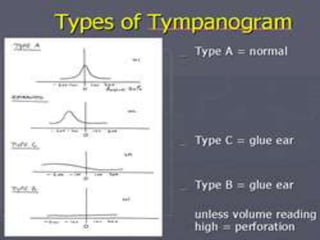
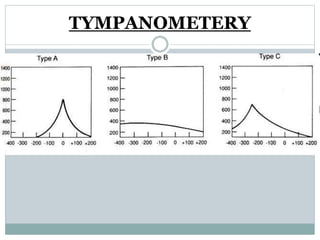
TYMPANOMETERY
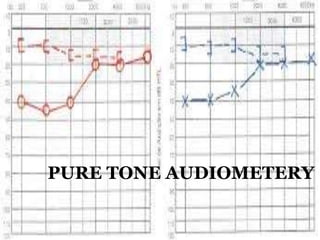
PURE TONE AUDIOMETERY
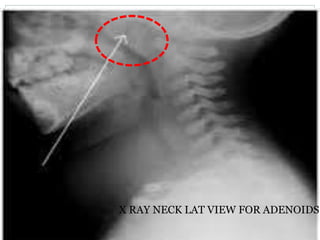
X RAY NECK LAT VIEW FOR ADENOIDS
Treatment
 No Treatment
 Spontaneous Recovery
Medical Management-AIMS
Speed up the resolution
 Antibiotics
 Benefits in first two weeks
 long term (>6 weeks) - not recommended
 Nasal Decongestants
 No Significant effect.
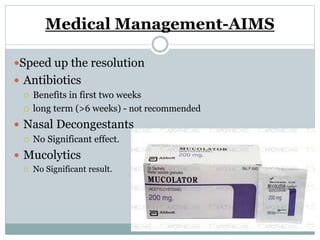
 Mucolytics
 No Significant result.
Medical Management-AIMS
Speed up the resolution
 Antibiotics
 Benefits in first two weeks
 long term (>6 weeks) - not recommended
 Nasal Decongestants
 No Significant effect.
 Mucolytics
 No Significant result.
Management
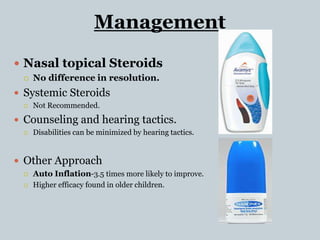
 Nasal topical Steroids
 No difference in resolution.
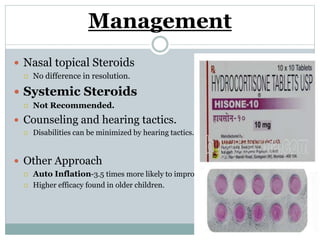
 Systemic Steroids
 Not Recommended.
 Counseling and hearing tactics.
 Disabilities can be minimized by hearing tactics.
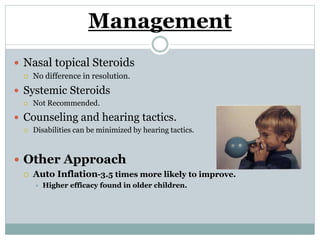
 Other Approach
 Auto Inflation-3.5 times more likely to improve.
 Higher efficacy found in older children.
Management
 Nasal topical Steroids
 No difference in resolution.
 Systemic Steroids
 Not Recommended.
 Counseling and hearing tactics.
 Disabilities can be minimized by hearing tactics.
 Other Approach
 Auto Inflation-3.5 times more likely to improve.
 Higher efficacy found in older children.
Management
 Nasal topical Steroids
 No difference in resolution.
 Systemic Steroids
 Not Recommended.
 Counseling and hearing tactics.
 Disabilities can be minimized by hearing tactics.
 Other Approach
 Auto Inflation-3.5 times more likely to improve.
 Higher efficacy found in older children.
Management
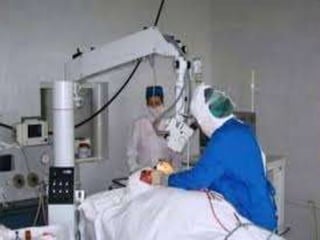
Surgical Management.
 Ventilation Tubes Insertion.
 Posterosuperior insertion is not recommended –damages the Ossicular Chain
 No difference in radial or circumferential inscion or anterosuperior and
anteroinferior position.
 To maximize the duration-insertion in anteroinferior is recommended .
 Made with Teflon,Silicone,Titanium,Gold.
 Aspirate as much of the middle ear fluid as possible through the myringotomy
before inserting VT, there is no evidence that is required.
 Topical preparations are used to prevent tube block with blood or infection.
 Myringotomy with aspiration.
 Not shown to be effective.
Ventilation tubes
Management
Ventilation Tubes
Synonyms
 Myringotomy tube,
 Tympanostomy tube
 Pressure equalization (PE) tube.
Types
1. Grommets (dumbbell shaped)
 Short stay tubes that gets extruded within 6 months
 Shephard’s grommet
 Armstrong’s grommet
 Donaldson’s grommet
 Shah’s grommet
2. T-tube (‘T’ shaped)
 For long term purposes that stays at least 1-2 years.
Management
Adenoidectomy
 Mechanism in -Unclear.
 Removes a chronic source of infection
Nasopharynx.
 E:PRESENTATIONSAnimationsEARGlue
Ear.flv
Outcomes
Hearing
 VT alone - 12 dB.
 Adenoidectomy - additional 3-4dB.
Complications
 Displacement of tube to middle ear
 Perforation of TM.
 Scarring and weakening of the TM.
 Early extrusion or blockage.
 Cholesteatoma formation.
Otitis Media with Effusion

Otitis Media with Effusion

  • 1.
    BRIG ANWAR ULHAQ 00923018513303 Otitis Media With Effusion
  • 2.
    OME  Chronic accumulationof mucus/non purulent effusion within the middle ear and in mastoid air cell system (Middle Ear Cleft).  Duration >12 weeks
  • 3.
    Synonyms  Glue ear Serous otitis media  Chronic nonpurulent otitis media
  • 4.
    Etio-Pathology  Preceded byan episode of AOM with  Otalgia and fever.  Inflammation of eustachian tube epithelium  Flat cuboidal mucosa  Partially replaced by thickened Pseudo Stratified  Mucus secreting epithelium.  Goblet cells are usually present  Mucus secreting cells are formed.
  • 5.
    Etio-Pathology Characteristics of effusion mixture of the secretions of the  epithelial cells  goblet cells  mucus glands along  inflammatory transudate/exudate  Viscous  Goblet Cells  Mucous glands
  • 6.
    Etio-Pathology Bacteriology  Streptococcus Pneumonia Haemophilus Influenzae  Branhamella Catarrhalis  The incidence of pathogens was higher in the younger children
  • 7.
    Etio-Pathology Eustachian tube dysfunction Viral upper respiratory tract infection,  allergic reaction,  Pollutents  Cigarette smoke.  Adenoids  GERD Craniofacial Abnormalities  cleft palate  Poor ET function.  bifid uvula  Down and turner syndromes are prone to have OME.
  • 8.
  • 9.
  • 10.
    Etio-Pathology Allergy  Allergy –Swelling - Infection GERD  Its common in children  Pepsin is found in the effusion.  Investigations are required to clarify the role.
  • 12.
    Etio-Pathology Prevalance  Age  Bimodal- infancy  - primary school  Peak - one year of age.  Season  Winter>Summer  Respiratory Tract Infections  Ear Infections
  • 13.
    Etio-Pathology AOM Episode  Largestsingle factor  Antibiotics - No effects  Contact with other children Hereditability  Greater concordance  monozygotic - Higher Incidence  dizygotic - Lesser Incidence
  • 14.
    Etio-Pathology Race  Prevalence isdifferent in different races Gender  No difference in male or females Smoking  No effect of parenteral smoking detected.
  • 15.
    Symptoms  No symptoms Deafness  Tinnitus  Pain Ear
  • 17.
    Symptoms  Associated Symptoms NasalBlockage Nasal Discharge Pain Throat Fever
  • 18.
    Examination  GPE  SystemicExamination  Repiratoty System  ENT Examination  Nose  Nasopharynx  Ears Pneumatic Otoscopy Tunning Fork Tests
  • 19.
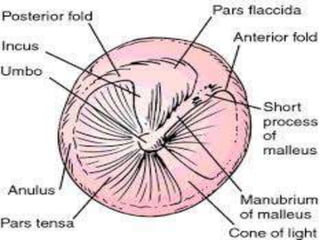
    Otoscopy  Different combinationsof  Retraction of the pars tensa  Variations in its colour.
  • 20.
    Otoscopy  Colour  yellow Blue  fluid levels  air bubbles  Position  Retracted  Full  Mobility  Reduced
  • 22.
  • 23.
  • 24.
  • 28.
  • 35.
  • 36.
  • 37.
    X RAY NECKLAT VIEW FOR ADENOIDS
  • 38.
    Treatment  No Treatment Spontaneous Recovery
  • 39.
    Medical Management-AIMS Speed upthe resolution  Antibiotics  Benefits in first two weeks  long term (>6 weeks) - not recommended  Nasal Decongestants  No Significant effect.  Mucolytics  No Significant result.
  • 40.
    Medical Management-AIMS Speed upthe resolution  Antibiotics  Benefits in first two weeks  long term (>6 weeks) - not recommended  Nasal Decongestants  No Significant effect.  Mucolytics  No Significant result.
  • 41.
    Management  Nasal topicalSteroids  No difference in resolution.  Systemic Steroids  Not Recommended.  Counseling and hearing tactics.  Disabilities can be minimized by hearing tactics.  Other Approach  Auto Inflation-3.5 times more likely to improve.  Higher efficacy found in older children.
  • 42.
    Management  Nasal topicalSteroids  No difference in resolution.  Systemic Steroids  Not Recommended.  Counseling and hearing tactics.  Disabilities can be minimized by hearing tactics.  Other Approach  Auto Inflation-3.5 times more likely to improve.  Higher efficacy found in older children.
  • 43.
    Management  Nasal topicalSteroids  No difference in resolution.  Systemic Steroids  Not Recommended.  Counseling and hearing tactics.  Disabilities can be minimized by hearing tactics.  Other Approach  Auto Inflation-3.5 times more likely to improve.  Higher efficacy found in older children.
  • 49.
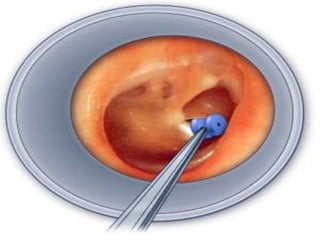
    Management Surgical Management.  VentilationTubes Insertion.  Posterosuperior insertion is not recommended –damages the Ossicular Chain  No difference in radial or circumferential inscion or anterosuperior and anteroinferior position.  To maximize the duration-insertion in anteroinferior is recommended .  Made with Teflon,Silicone,Titanium,Gold.  Aspirate as much of the middle ear fluid as possible through the myringotomy before inserting VT, there is no evidence that is required.  Topical preparations are used to prevent tube block with blood or infection.  Myringotomy with aspiration.  Not shown to be effective.
  • 50.
  • 51.
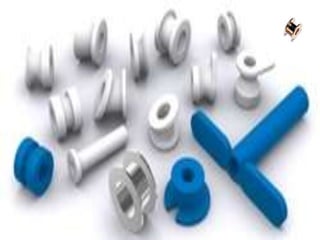
    Management Ventilation Tubes Synonyms  Myringotomytube,  Tympanostomy tube  Pressure equalization (PE) tube. Types 1. Grommets (dumbbell shaped)  Short stay tubes that gets extruded within 6 months  Shephard’s grommet  Armstrong’s grommet  Donaldson’s grommet  Shah’s grommet 2. T-tube (‘T’ shaped)  For long term purposes that stays at least 1-2 years.
  • 52.
    Management Adenoidectomy  Mechanism in-Unclear.  Removes a chronic source of infection Nasopharynx.
  • 53.
  • 54.
    Outcomes Hearing  VT alone- 12 dB.  Adenoidectomy - additional 3-4dB.
  • 55.
    Complications  Displacement oftube to middle ear  Perforation of TM.  Scarring and weakening of the TM.  Early extrusion or blockage.  Cholesteatoma formation.