Objectives
 Acoustic Neuroma:
definition,
histopathology
 Etiopathogenesis
 Classification
 Clinical Features
 Management
WHAT WILL
I
LEARN TODAY ?
FAQ’s in RGUHS
• Acoustic Neuroma
• Clinical features of acoustic neuroma
• Hitzelberger’s sign
Acoustic Neuroma
• Definition:
Tumour of eighth cranial Nerve.
• Eponyms:
Vestibular Schwannoma
Neurilemmoma
• Incidence:
80% of Cerebellopontine angle tumours
10% of all brain tumours
Pathology
• Gross:
Benign, Encapsulated,
Slow-growing
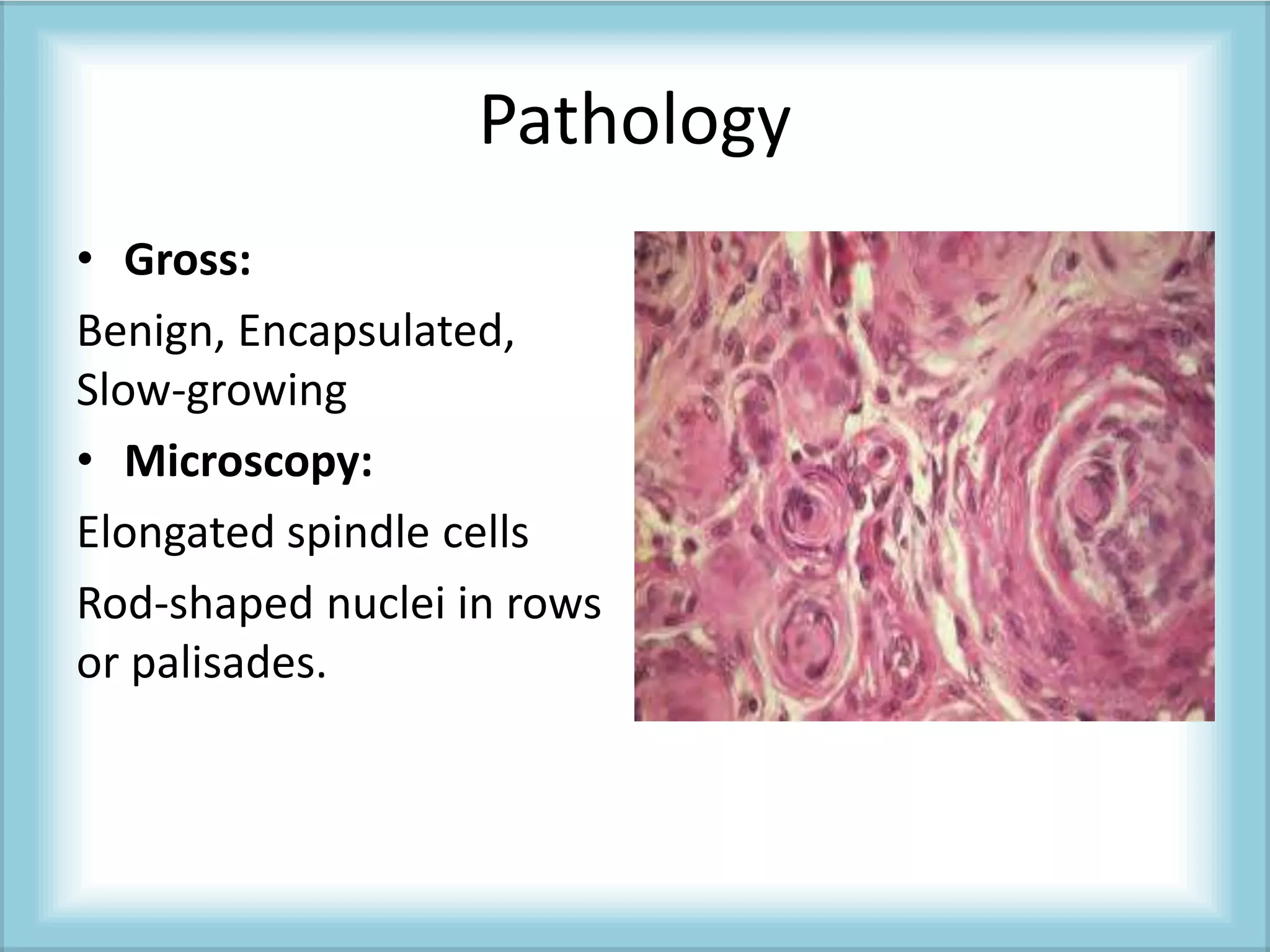
• Microscopy:
Elongated spindle cells
Rod-shaped nuclei in rows
or palisades.
Origin & Growth
• Origin:
Schwann Cells of Vestibular Nerve, rarely from
cochlear nerve
• Growth: (slow)
 Causes widening and erosion of the canal and
appears in the CP angle
 Anterosuperior growth: 5th
 Inferior: 9th , 10th & 11th
 Later stages: displacement of brainstem, pressure on
cerebellum and raised intracranial tension
Origin & Growth
Classification
Acoustic
Neuroma
Intracellular
Small Size
<1.5cm
Medium size
1.5-4cm
Large Size
> 4cm
Clinical Features
• Age : 40-60 years
• Sex: M=F
• Symptoms:
1. Progressive unilateral SNHL
2. Tinnitus
3. Marked difficulty in understanding speech
4. Imbalance/ Unsteadiness
5. Vertigo
6. Sudden Hearing loss
7. Fullness in the ear
Cranial Nerve Involvement
1. 5th nerve: EARLIEST
Reduced cornea sensitivity, paraesthesia of face
Involvement indicates : tumour size = 2.5cm &
occupies CP angle
2. 9th & 10th : dysphagia & hoarseness due to
palatal, pharyngeal, laryngeal paralysis
3. Other cranial nerves: affected only when tumour
size is very large
Cranial Nerve Involvement
Facial nerve:
• Sensory fibres are affected early.
• Hitzelberger’s sign : Hypoaesthesia of
posterior meatal wall
• Loss of taste ( Electrogustometry)
• Schirmer test : Reduced lacrimation
• Motor fibres: Affected late
• Delayed blink reflex
Brainstem Involvement
• Ataxia
• Weakness & Numbness of arms
and legs
• Exaggerated tendon reflexes
Raised Intra-cranial tension
Headache, nausea, vomiting, diplopia(6th) &
papillo-edema with blurring of vision.
Cerebellar involvement
• Pressure symptoms on cerebellum are seen in
large tumors
• Revealed by
 Finger-nose test
 Knee-heel test
 Dysdiadochokinesia
 Ataxic gait
 Inability to walk along a straight line (tendency to
fall on the affected side)
Investigations
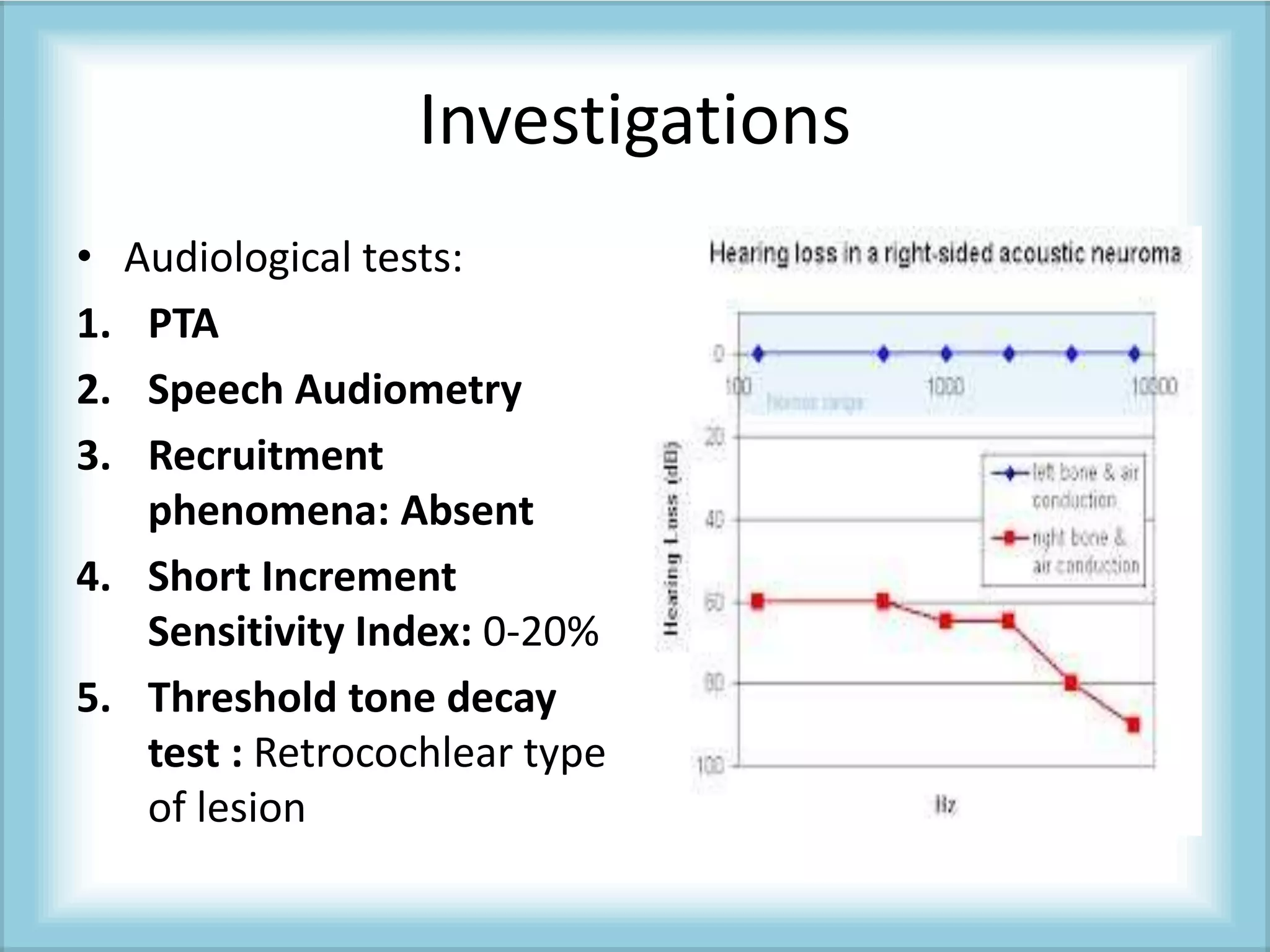
• Audiological tests:
1. PTA
2. Speech Audiometry
3. Recruitment
phenomena: Absent
4. Short Increment
Sensitivity Index: 0-20%
5. Threshold tone decay
test : Retrocochlear type
of lesion
Vestibular Tests
• Caloric test:
Diminished or absent
response in 96% of
patients
May be normal when
tumour is small
Neurological Tests
Complete examination of:
• Cranial nerves
• Cerebellar functions
• Brainstem signs of pyramidal & sensory tracts
• Fundus
Radiological tests
1. Plain X-ray:
• Positive in 80% of patients
• Different views:
1. Transorbital
2. Stenver’s
3. Towne’s
4. Submentovertical
2. Vertebral angiography:
• Helps in differentiating AN from other tumours
Radiological Test
3. CT scan:
• More sensitive than X-ray
• Can detect even intra-meatal and
posterior fossa tumors
4. MRI with Gadolinium contrast:
• GOLD Standard
• Can detect even intracanalicular
tumours of few mm
Stapedial reflex Decay Test
Other tests
• BERA:
A delay of >0.2ms in
wave V between 2 ears in
case of 8th nerve tumour
• CSF Examination:
Protie level raised, Lumbar
puncture should be
avoided
Investigations
Important tests for AN work-up:
• PTA
• Speech discrimination score
• Roll-over curve
• Stapedial reflex decay
• BERA
• MRI with gadolinium contrast
Differential Diagnosis
• Meniere’s Disease
• Tumours of CPangle:
1. Meningioma
2. Epidermoid
3. Arachnoid Cyst
4. Schwannoma of other cranial nerves
5. Aneurysm
6. Glomus tumour
7. Metastasis
Treatment
Treatment
Surgical Radiotherapy
Surgical
• Treatment of Choice
Approaches
Middle Cranial
Fossa
Translabyrinthine Suboccipital
Combined
translabyrinthine-
suboccipital
Radiotherapy
1. Conventional Radiotherapy
2. X-knife/ɣ-knife surgery
3. Cyber knife
X-knife/ɣ-knife surgery
• Stereotactic radiotherapy
• Advantages:
1. Minimal radiological effect
2. Causes reduction in tumour size &
growth.
3. Can be used in patients where surgery is
not feasible.
• Procedure : linear accelerator
ɣ-knife through cobalt-60
Radiotherapy
Conventional:
• Not prefered now due to low
tolerance of CNS to radiation
Cyber knife:
• Modified X-knife
• More accurate & frameless
• Method: real-time image
guidance technology through
computer controlled robotics.
Acoustic neuroma

Acoustic neuroma

  • 2.
    Objectives  Acoustic Neuroma: definition, histopathology Etiopathogenesis  Classification  Clinical Features  Management WHAT WILL I LEARN TODAY ?
  • 3.
    FAQ’s in RGUHS •Acoustic Neuroma • Clinical features of acoustic neuroma • Hitzelberger’s sign
  • 4.
    Acoustic Neuroma • Definition: Tumourof eighth cranial Nerve. • Eponyms: Vestibular Schwannoma Neurilemmoma • Incidence: 80% of Cerebellopontine angle tumours 10% of all brain tumours
  • 5.
    Pathology • Gross: Benign, Encapsulated, Slow-growing •Microscopy: Elongated spindle cells Rod-shaped nuclei in rows or palisades.
  • 6.
    Origin & Growth •Origin: Schwann Cells of Vestibular Nerve, rarely from cochlear nerve • Growth: (slow)  Causes widening and erosion of the canal and appears in the CP angle  Anterosuperior growth: 5th  Inferior: 9th , 10th & 11th  Later stages: displacement of brainstem, pressure on cerebellum and raised intracranial tension
  • 7.
  • 8.
  • 9.
    Clinical Features • Age: 40-60 years • Sex: M=F • Symptoms: 1. Progressive unilateral SNHL 2. Tinnitus 3. Marked difficulty in understanding speech 4. Imbalance/ Unsteadiness 5. Vertigo 6. Sudden Hearing loss 7. Fullness in the ear
  • 10.
    Cranial Nerve Involvement 1.5th nerve: EARLIEST Reduced cornea sensitivity, paraesthesia of face Involvement indicates : tumour size = 2.5cm & occupies CP angle 2. 9th & 10th : dysphagia & hoarseness due to palatal, pharyngeal, laryngeal paralysis 3. Other cranial nerves: affected only when tumour size is very large
  • 11.
    Cranial Nerve Involvement Facialnerve: • Sensory fibres are affected early. • Hitzelberger’s sign : Hypoaesthesia of posterior meatal wall • Loss of taste ( Electrogustometry) • Schirmer test : Reduced lacrimation • Motor fibres: Affected late • Delayed blink reflex
  • 12.
    Brainstem Involvement • Ataxia •Weakness & Numbness of arms and legs • Exaggerated tendon reflexes Raised Intra-cranial tension Headache, nausea, vomiting, diplopia(6th) & papillo-edema with blurring of vision.
  • 13.
    Cerebellar involvement • Pressuresymptoms on cerebellum are seen in large tumors • Revealed by  Finger-nose test  Knee-heel test  Dysdiadochokinesia  Ataxic gait  Inability to walk along a straight line (tendency to fall on the affected side)
  • 14.
    Investigations • Audiological tests: 1.PTA 2. Speech Audiometry 3. Recruitment phenomena: Absent 4. Short Increment Sensitivity Index: 0-20% 5. Threshold tone decay test : Retrocochlear type of lesion
  • 15.
    Vestibular Tests • Calorictest: Diminished or absent response in 96% of patients May be normal when tumour is small
  • 16.
    Neurological Tests Complete examinationof: • Cranial nerves • Cerebellar functions • Brainstem signs of pyramidal & sensory tracts • Fundus
  • 17.
    Radiological tests 1. PlainX-ray: • Positive in 80% of patients • Different views: 1. Transorbital 2. Stenver’s 3. Towne’s 4. Submentovertical 2. Vertebral angiography: • Helps in differentiating AN from other tumours
  • 18.
    Radiological Test 3. CTscan: • More sensitive than X-ray • Can detect even intra-meatal and posterior fossa tumors 4. MRI with Gadolinium contrast: • GOLD Standard • Can detect even intracanalicular tumours of few mm
  • 19.
  • 20.
    Other tests • BERA: Adelay of >0.2ms in wave V between 2 ears in case of 8th nerve tumour • CSF Examination: Protie level raised, Lumbar puncture should be avoided
  • 21.
    Investigations Important tests forAN work-up: • PTA • Speech discrimination score • Roll-over curve • Stapedial reflex decay • BERA • MRI with gadolinium contrast
  • 22.
    Differential Diagnosis • Meniere’sDisease • Tumours of CPangle: 1. Meningioma 2. Epidermoid 3. Arachnoid Cyst 4. Schwannoma of other cranial nerves 5. Aneurysm 6. Glomus tumour 7. Metastasis
  • 23.
  • 24.
    Surgical • Treatment ofChoice Approaches Middle Cranial Fossa Translabyrinthine Suboccipital Combined translabyrinthine- suboccipital
  • 25.
    Radiotherapy 1. Conventional Radiotherapy 2.X-knife/ɣ-knife surgery 3. Cyber knife
  • 26.
    X-knife/ɣ-knife surgery • Stereotacticradiotherapy • Advantages: 1. Minimal radiological effect 2. Causes reduction in tumour size & growth. 3. Can be used in patients where surgery is not feasible. • Procedure : linear accelerator ɣ-knife through cobalt-60
  • 27.
    Radiotherapy Conventional: • Not preferednow due to low tolerance of CNS to radiation Cyber knife: • Modified X-knife • More accurate & frameless • Method: real-time image guidance technology through computer controlled robotics.