TRACHEOSTOMYTRACHEOSTOMY
BRIG ANWAR UL HAQBRIG ANWAR UL HAQ
ENT SPECIALISTENT SPECIALIST
CMH LAHORECMH LAHORE
TRACHEOSTOMYTRACHEOSTOMY
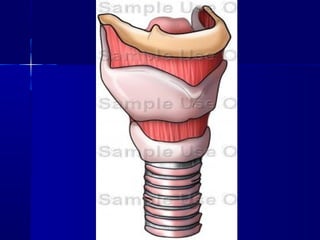
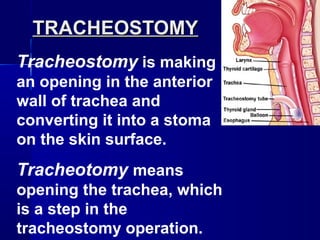
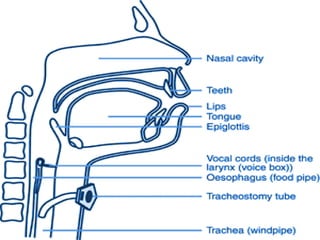
Tracheostomy is making
an opening in the anterior
wall of trachea and
converting it into a stoma
on the skin surface.
Tracheotomy means
opening the trachea, which
is a step in the
tracheostomy operation.
HISTORY OF TRACHEOSTOMYHISTORY OF TRACHEOSTOMY
 Five periodsFive periods
 Period of legendPeriod of legend
 2000 BC __1546 AD2000 BC __1546 AD
 Period of fearPeriod of fear
 1546 AD __1833 AD1546 AD __1833 AD
 Period of dramaPeriod of drama
 1833 AD__1932 AD1833 AD__1932 AD
 Period of enthusiasmPeriod of enthusiasm
 1932 AD__1965 AD1932 AD__1965 AD
 Period of rationalizationPeriod of rationalization
 1965 AD__ till date1965 AD__ till date
TYPES OF TRACHEOSTOMYTYPES OF TRACHEOSTOMY
 Emergency tracheostomyEmergency tracheostomy
 Elective tracheostomyElective tracheostomy
 Permanent tracheostomyPermanent tracheostomy
EMEREGENCY TRACHEOSTOMYEMEREGENCY TRACHEOSTOMY
 Complete / Near Complete airwayComplete / Near Complete airway
obstructionobstruction
 Intubations or laryngotomy (notIntubations or laryngotomy (not
feasible)feasible)
ELECTIVE TRACHEOSTOMYELECTIVE TRACHEOSTOMY
 Planned, unhurried processPlanned, unhurried process
 Surgical facilitiesSurgical facilities
 ETTETT
 Local anaesthesia / GALocal anaesthesia / GA
TYPES OF ELECTIVE TRACHEOSTOMYTYPES OF ELECTIVE TRACHEOSTOMY
 TherapeuticTherapeutic
 Respiratory obstructionRespiratory obstruction
 Tracheobronchial secretionsTracheobronchial secretions
 Assisted ventilationAssisted ventilation
 ProphylacticProphylactic
 Guard againstGuard against
–Anticipated respiratoryAnticipated respiratory
obstructionobstruction
–Aspiration of bloodAspiration of blood
–Pharyngeal secretionsPharyngeal secretions
PERMANENT TRACHEOSTOMYPERMANENT TRACHEOSTOMY
 Bilateral abductor paralysisBilateral abductor paralysis
 LaryngectomyLaryngectomy
 LaryngopharyngectomyLaryngopharyngectomy
TYPES OF PERMANENT TRACHEOSTOMYTYPES OF PERMANENT TRACHEOSTOMY
 High tracheostomyHigh tracheostomy
 Ca larynxCa larynx
 Perichondritis of cricoid cartilagePerichondritis of cricoid cartilage
 Above level of isthmusAbove level of isthmus
 Mid tracheostomyMid tracheostomy
 22ndnd
& 3& 3rdrd
ringring
 At level of isthmusAt level of isthmus
 Low tracheostomyLow tracheostomy
 Below level of isthmusBelow level of isthmus
 Trachea deepTrachea deep
 Impinges on suprasternal notchImpinges on suprasternal notch
FUNCTION OF TRACHEOSTOMYFUNCTION OF TRACHEOSTOMY
 Alternative pathway for breathingAlternative pathway for breathing
 Obstruction in upper airwayObstruction in upper airway
 Improves alveolar ventilationImproves alveolar ventilation
 Decreasing the dead space 30-50%Decreasing the dead space 30-50%
 Reducing the resistance to airflowReducing the resistance to airflow
 Protects the airwaysProtects the airways
 Cuffed tubeCuffed tube
 Pharyngeal secretionsPharyngeal secretions
 BloodBlood
 Removal of tracheobronchial secretionsRemoval of tracheobronchial secretions
– Unable to coughUnable to cough
– Painful coughPainful cough
– Repeated suctionRepeated suction
– Avoid repeated bronchoscopyAvoid repeated bronchoscopy
 Intermittent positive pressure ventilationIntermittent positive pressure ventilation
– More then 72 hrsMore then 72 hrs
 To administer anaesthesiaTo administer anaesthesia
– ETT difficult or impossibleETT difficult or impossible
– Laryngopharyngeal growths or trismusLaryngopharyngeal growths or trismus
FUNCTION OF TRACHEOSTOMYFUNCTION OF TRACHEOSTOMY
INDICATIONS OF TRACHEOSTOMYINDICATIONS OF TRACHEOSTOMY
 Respiratory obstruction.Respiratory obstruction.
 Retained secretions.Retained secretions.
 Respiratory insufficiencyRespiratory insufficiency
RESPIRATORY OBSTRUCTIONRESPIRATORY OBSTRUCTION
Infections
 Acute laryngo-tracheo-bronchitis
 Acute epiglotitis
 Diphtheria
 Ludwig’s angina
 Abscess
 Peritonsillar abscess
 Retropharyngeal abscess
 Parapharyngeal abscess
 Tongue abscess
RESPIRATORY OBSTRUCTIONRESPIRATORY OBSTRUCTION
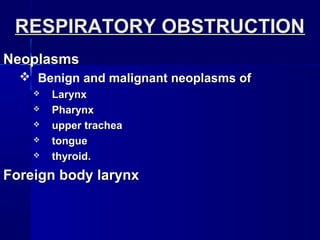
NeoplasmsNeoplasms
 Benign and malignant neoplasms ofand malignant neoplasms of
 LarynxLarynx
 PharynxPharynx
 upper tracheaupper trachea
 tonguetongue
 thyroid.thyroid.
Foreign body larynxForeign body larynx
RESPIRATORY OBSTRUCTIONRESPIRATORY OBSTRUCTION
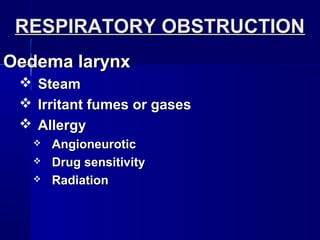
Oedema larynxOedema larynx
 SteamSteam
 Irritant fumes or gasesIrritant fumes or gases
 AllergyAllergy
 AngioneuroticAngioneurotic
 Drug sensitivityDrug sensitivity
 RadiationRadiation
RESPIRATORY OBSTRUCTIONRESPIRATORY OBSTRUCTION
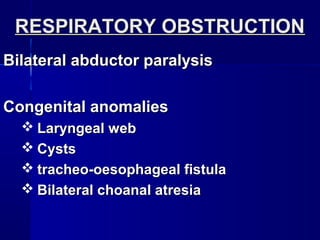
Bilateral abductor paralysisBilateral abductor paralysis
Congenital anomaliesCongenital anomalies
 Laryngeal webLaryngeal web
 CystsCysts
 tracheo-oesophageal fistulatracheo-oesophageal fistula
 Bilateral choanal atresiaBilateral choanal atresia
RETAINED SECRETIONSRETAINED SECRETIONS
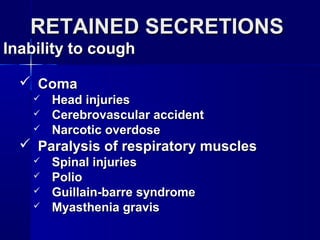
Inability to coughInability to cough
 ComaComa
 Head injuriesHead injuries
 Cerebrovascular accidentCerebrovascular accident
 Narcotic overdoseNarcotic overdose
 Paralysis of respiratory musclesParalysis of respiratory muscles
 Spinal injuriesSpinal injuries
 PolioPolio
 Guillain-barre syndromeGuillain-barre syndrome
 Myasthenia gravisMyasthenia gravis
RETAINED SECRETIONSRETAINED SECRETIONS
Inability to coughInability to cough
 Spasm of respiratory musclesSpasm of respiratory muscles
 TetanusTetanus
 EclampsiaEclampsia
 Strychnine poisoningStrychnine poisoning
RETAINED SECRETIONSRETAINED SECRETIONS
2.2. Painful coughPainful cough
 Chest injuriesChest injuries
 multiple rib fracturesmultiple rib fractures
 pneumoniapneumonia
3.3. Aspiration of pharyngeal secretionsAspiration of pharyngeal secretions
► Bulbar polioBulbar polio
► PolyneuritisPolyneuritis
► bilateral laryngeal paralysisbilateral laryngeal paralysis
RESPIRATORY INSUFFICIENCYRESPIRATORY INSUFFICIENCY
 Chronic lung conditionsChronic lung conditions
– Emphysema, chronic bronchitis,Emphysema, chronic bronchitis,
bronchiectasis, atelectasisbronchiectasis, atelectasis
 ConditionsConditions
– Respiratory obstructionRespiratory obstruction
– Retained SecretionsRetained Secretions
COMMON INDICATIONS OFCOMMON INDICATIONS OF
TRACHEOSTOMY IN INFANTS ANDTRACHEOSTOMY IN INFANTS AND
CHILDRENCHILDREN
 Infants below 1 yearInfants below 1 year
(Mostly congenital lesions)(Mostly congenital lesions)
 Subglottic haemangiomaSubglottic haemangioma
Subglottic stenosisSubglottic stenosis
Laryngeal cystLaryngeal cyst
Glottic webGlottic web
Bilateral vocal cord paralysisBilateral vocal cord paralysis
COMMON INDICATIONS OFCOMMON INDICATIONS OF
TRACHEOSTOMY IN INFANTS ANDTRACHEOSTOMY IN INFANTS AND
CHILDRENCHILDREN
 ChildrenChildren(inflammatory or traumatic lesions)(inflammatory or traumatic lesions)
 Acute laryngotracheobronchitisAcute laryngotracheobronchitis
 EpiglottitisEpiglottitis
 DiphtheriaDiphtheria
 Laryngeal oedemaLaryngeal oedema
(chemical/thermal injury)(chemical/thermal injury)
 External laryngeal traumaExternal laryngeal trauma
 Prolonged intubationProlonged intubation
 Juvenile laryngeal papillomatosisJuvenile laryngeal papillomatosis
TracheostomyTracheostomy
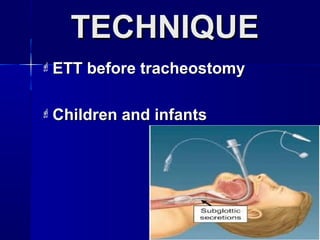
TECHNIQUETECHNIQUE
 ETT before tracheostomyETT before tracheostomy
 Children and infantsChildren and infants
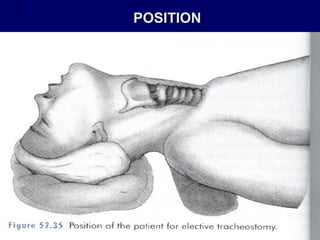
POSITIONPOSITION
ANAESTHESIAANAESTHESIA
 No AnaesthesiaNo Anaesthesia
 UncoUnconsciousnscious
 EmergencyEmergency
 Local AnaesthesiaLocal Anaesthesia
 1-2% lignocaine with epinephrine1-2% lignocaine with epinephrine
 General AnaesthesiaGeneral Anaesthesia
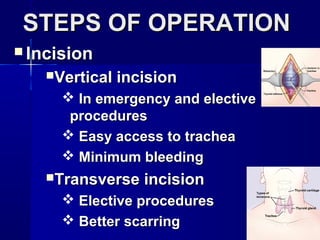
STEPS OF OPERATIONSTEPS OF OPERATION
 IncisionIncision
Vertical incisionVertical incision
 In emergency and electiveIn emergency and elective
proceduresprocedures
 Easy access to tracheaEasy access to trachea
 Minimum bleedingMinimum bleeding
Transverse incisionTransverse incision
 Elective proceduresElective procedures
 Better scarringBetter scarring
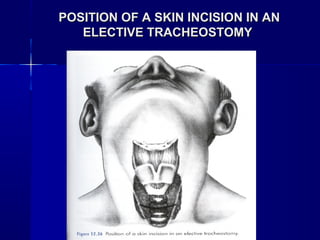
POSITION OF A SKIN INCISION IN ANPOSITION OF A SKIN INCISION IN AN
ELECTIVE TRACHEOSTOMYELECTIVE TRACHEOSTOMY
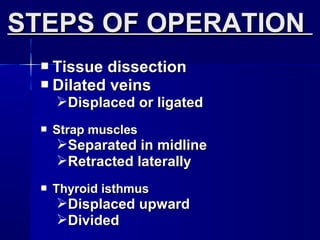
 Tissue dissectionTissue dissection
 Dilated veinsDilated veins
Displaced or ligatedDisplaced or ligated
 Strap musclesStrap muscles
Separated in midlineSeparated in midline
Retracted laterallyRetracted laterally
 Thyroid isthmusThyroid isthmus
Displaced upwardDisplaced upward
DividedDivided
STEPS OF OPERATIONSTEPS OF OPERATION
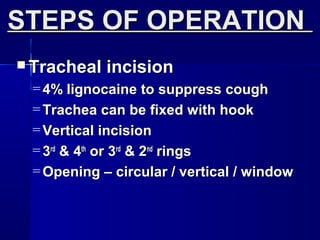
 Tracheal incisionTracheal incision
= 4% lignocaine to suppress cough4% lignocaine to suppress cough
= Trachea can be fixed with hookTrachea can be fixed with hook
= Vertical incisionVertical incision
= 33rdrd
& 4& 4thth
or 3or 3rdrd
& 2& 2ndnd
ringsrings
= Opening – circular / vertical / windowOpening – circular / vertical / window
STEPS OF OPERATIONSTEPS OF OPERATION
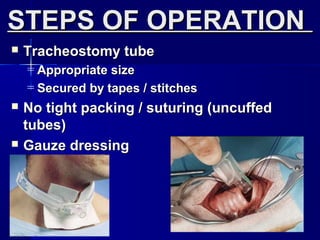
 Tracheostomy tubeTracheostomy tube
= Appropriate sizeAppropriate size
= Secured by tapes / stitchesSecured by tapes / stitches
 No tight packing / suturing (uncuffedNo tight packing / suturing (uncuffed
tubes)tubes)
 Gauze dressingGauze dressing
STEPS OF OPERATIONSTEPS OF OPERATION
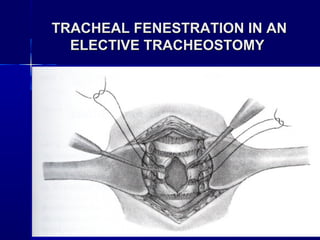
TRACHEAL FENESTRATION IN ANTRACHEAL FENESTRATION IN AN
ELECTIVE TRACHEOSTOMYELECTIVE TRACHEOSTOMY
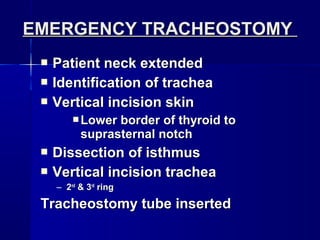
 Patient neck extendedPatient neck extended
 Identification of tracheaIdentification of trachea
 Vertical incision skinVertical incision skin
 Lower border of thyroid toLower border of thyroid to
suprasternal notchsuprasternal notch
 Dissection of isthmusDissection of isthmus
 Vertical incision tracheaVertical incision trachea
– 22ndnd
& 3& 3rdrd
ringring
Tracheostomy tube insertedTracheostomy tube inserted
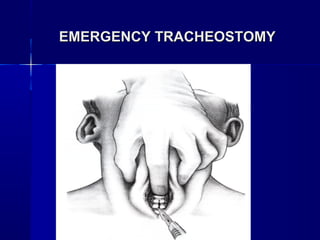
EMERGENCY TRACHEOSTOMYEMERGENCY TRACHEOSTOMY
COMPLICATIONSCOMPLICATIONS
 EARLYEARLY
 INTERMEDIATEINTERMEDIATE
 LATELATE
EARLYEARLY
COMPLICATIONSCOMPLICATIONS
 Haemorrhage.Haemorrhage.
 ApnoeaApnoea
– Sudden washing out of CO2 whichSudden washing out of CO2 which
– TreatmentTreatment
 5% CO2 in oxygen or assisted ventilation.5% CO2 in oxygen or assisted ventilation.
 PneumothoraxPneumothorax
 Injury to recurrent laryngealInjury to recurrent laryngeal
nervesnerves
EARLYEARLY
COMPLICATIONSCOMPLICATIONS
 Aspiration of blood.Aspiration of blood.
 Injury to oesophagus.Injury to oesophagus.
 Tracheo-oesophageal fistulaTracheo-oesophageal fistula
 Aspiration of bloodAspiration of blood
INTERMEDIATEINTERMEDIATE
COMPLICATIONSCOMPLICATIONS
 BleedingBleeding
–ReactionaryReactionary
–SecondarySecondary
 Displacement of tubeDisplacement of tube
 Blocking of tubeBlocking of tube
 Subcutaneous emphysema.Subcutaneous emphysema.
INTERMEDIATEINTERMEDIATE
COMPLICATIONSCOMPLICATIONS
 TracheitisTracheitis
 TracheobronchitisTracheobronchitis
–Crusting inCrusting in trachea.trachea.
 AtelectasAtelectas
 Lung abscess.Lung abscess.
 Local wound infectionLocal wound infection
LateLate (with prolonged use of tube for weeks and(with prolonged use of tube for weeks and
months)months)
 HaemorrhageHaemorrhage
– erosion of major vesselerosion of major vessel
 Laryngeal stenosisLaryngeal stenosis
– perichondritis of cricoid cartilage.perichondritis of cricoid cartilage.
 Tracheal stenosisTracheal stenosis
– tracheal ulceration and infectiontracheal ulceration and infection
 4. Tracheo-oesophageal fistula4. Tracheo-oesophageal fistula
– prolonged use of cuffed tube orprolonged use of cuffed tube or
erosion of trachea by the tip oferosion of trachea by the tip of
tracheostomytube.tracheostomytube.
LateLate (with prolonged use of tube for weeks and(with prolonged use of tube for weeks and
months)months)
 Problems of decannulationProblems of decannulation
– commonly in infants and children.commonly in infants and children.
 Persistent tracheocutaneous fistula.Persistent tracheocutaneous fistula.
 Problems of tracheostomy scar.Problems of tracheostomy scar.
– Keloid or unsightly scar.Keloid or unsightly scar.
 Corrosion of tracheostomy tubeCorrosion of tracheostomy tube
– aspiration of its fragmentsaspiration of its fragments
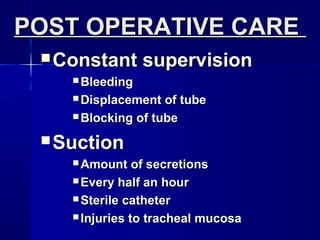
POST OPERATIVE CAREPOST OPERATIVE CARE
 Constant supervisionConstant supervision
 BleedingBleeding
 Displacement of tubeDisplacement of tube
 Blocking of tubeBlocking of tube
 SuctionSuction
 Amount of secretionsAmount of secretions
 Every half an hourEvery half an hour
 Sterile catheterSterile catheter
 Injuries to tracheal mucosaInjuries to tracheal mucosa
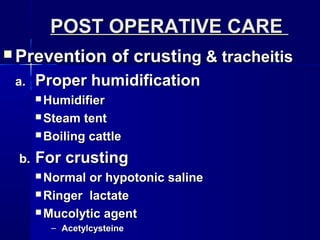
 Prevention of crustiPrevention of crusting & tracheitisng & tracheitis
a.a. Proper humidificationProper humidification
 HumidifierHumidifier
 Steam tentSteam tent
 Boiling cattleBoiling cattle
b.b. For crustingFor crusting
 Normal or hypotonic salineNormal or hypotonic saline
 Ringer lactateRinger lactate
 Mucolytic agentMucolytic agent
– AcetylcysteineAcetylcysteine
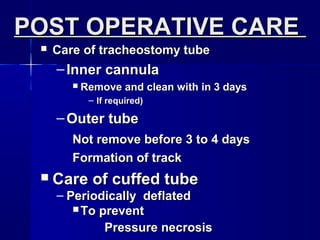
POST OPERATIVE CAREPOST OPERATIVE CARE
 Care of tracheostomy tubeCare of tracheostomy tube
– Inner cannulaInner cannula
 Remove and clean with in 3 daysRemove and clean with in 3 days
– If required)If required)
– Outer tubeOuter tube
Not remove before 3 to 4 daysNot remove before 3 to 4 days
Formation of trackFormation of track
 Care of cuffed tubeCare of cuffed tube
– Periodically deflatedPeriodically deflated
 To preventTo prevent
Pressure necrosisPressure necrosis
POST OPERATIVE CAREPOST OPERATIVE CARE
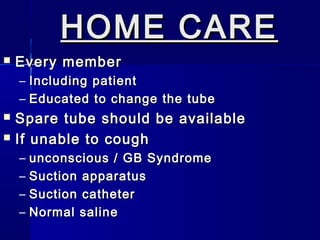
HOME CAREHOME CARE
 Every memberEvery member
– Including patientIncluding patient
– Educated to change the tubeEducated to change the tube
 Spare tube should be availableSpare tube should be available
 If unable to coughIf unable to cough
– unconscious / GB Syndromeunconscious / GB Syndrome
– Suction apparatusSuction apparatus
– Suction catheterSuction catheter
– Normal salineNormal saline
DECANNULATIONDECANNULATION
 Not kept longer than necessaryNot kept longer than necessary
 Plugging of tracheostomy tubePlugging of tracheostomy tube
Observed for 24 hrsObserved for 24 hrs
 Removal of tubeRemoval of tube
 Wound taped airtightWound taped airtight
 Healing of woundHealing of wound
Few days or a weekFew days or a week
 Secondary closure of woundSecondary closure of wound
– Non healing tracheo-cutaneous fistulaNon healing tracheo-cutaneous fistula
 In operation theatreIn operation theatre
 Equipment for re-intubationEquipment for re-intubation
 LaryngoscopeLaryngoscope
 Endotracheal tubesEndotracheal tubes
 Tracheostomy trayTracheostomy tray
 Tracheal dilatorTracheal dilator
 Close observationClose observation
 Respiratory distressRespiratory distress
 TachycardiaTachycardia
 ColourColour
DECANNULATIONDECANNULATION
INFANTS & CHILDRENINFANTS & CHILDREN
Other Ways to MaintainOther Ways to Maintain
AirwayAirway
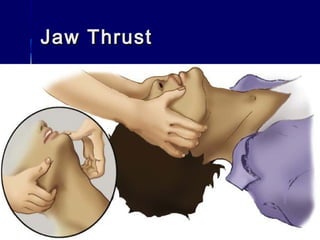
 Jaw ThrustJaw Thrust
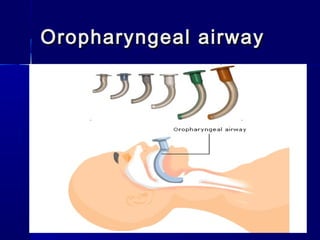
 Oropharyngeal AirwayOropharyngeal Airway
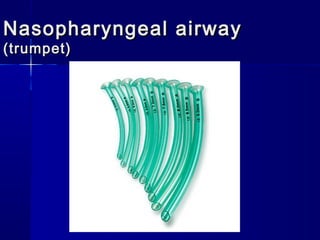
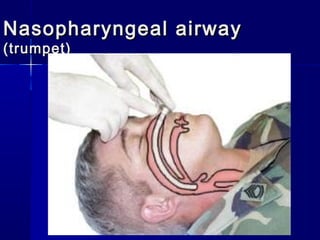
 Nasopharyngeal AirwayNasopharyngeal Airway
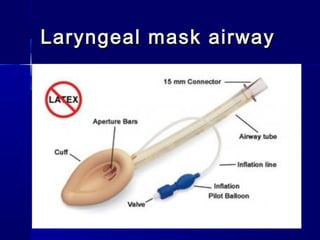
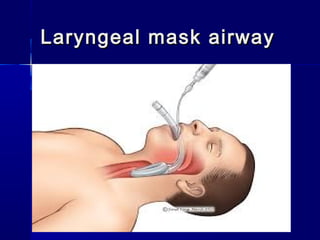
 Laryngeal Mask AirwayLaryngeal Mask Airway
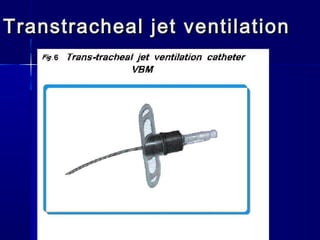
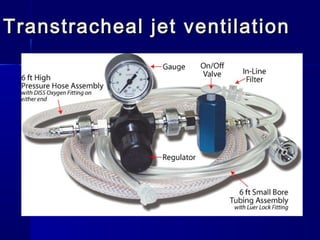
 Tracheal Jet VentilationTracheal Jet Ventilation
 CricothyroidotomyCricothyroidotomy
 Endotracheaal IntubationEndotracheaal Intubation
Jaw ThrustJaw Thrust
Oropharyngeal airwayOropharyngeal airway
 .It disp laces the tongue anteriorly and.It disp laces the tongue anteriorly and
relieves soft tissue obstruction.relieves soft tissue obstruction.
VentilationVentilation
 Can be used with face maskCan be used with face mask
Oropharyngeal airwayOropharyngeal airway
Nasopharyngeal airwayNasopharyngeal airway
(trumpet)(trumpet)
Nasopharyngeal airwayNasopharyngeal airway
(trumpet)(trumpet)
Laryngeal mask airwayLaryngeal mask airway
Transtracheal jet ventilationTranstracheal jet ventilation
Endotracheal IntubationEndotracheal Intubation
Cricothyrotomy orCricothyrotomy or
laryngotomylaryngotomy
 Procedure for opening the airway through theProcedure for opening the airway through the
cricothyroid membrane.cricothyroid membrane.
Cricothyrotomy orCricothyrotomy or
laryngotomylaryngotomy
 Lower border of thyroid cartilageLower border of thyroid cartilage
 Cricoid ring are identified.Cricoid ring are identified.
 Skin is incised verticallySkin is incised vertically
 Cricothyroid membraneCricothyroid membrane
– Transverse incisionTransverse incision
 Small tracheostomy tube passedSmall tracheostomy tube passed
 Tracheostomy as soon as possibleTracheostomy as soon as possible
– PerichondritisPerichondritis
– Subglottic oedemaSubglottic oedema
– Laryngeal stenosisLaryngeal stenosis
MinitracheostomyMinitracheostomy
Needle CricothyroidotomyNeedle Cricothyroidotomy
CONCLUSIONCONCLUSION
 Every member of the medicalEvery member of the medical
team should be aware of theteam should be aware of the
importance of the airway andimportance of the airway and
tracheostomy care.tracheostomy care.
 Although doing tracheostomyAlthough doing tracheostomy
should be rational but whenshould be rational but when
somebody is in doubt one mustsomebody is in doubt one must
do it.do it.
??
Tracheostomy

Tracheostomy

  • 1.
    TRACHEOSTOMYTRACHEOSTOMY BRIG ANWAR ULHAQBRIG ANWAR UL HAQ ENT SPECIALISTENT SPECIALIST CMH LAHORECMH LAHORE
  • 3.
  • 5.
    TRACHEOSTOMYTRACHEOSTOMY Tracheostomy is making anopening in the anterior wall of trachea and converting it into a stoma on the skin surface. Tracheotomy means opening the trachea, which is a step in the tracheostomy operation.
  • 6.
    HISTORY OF TRACHEOSTOMYHISTORYOF TRACHEOSTOMY  Five periodsFive periods  Period of legendPeriod of legend  2000 BC __1546 AD2000 BC __1546 AD  Period of fearPeriod of fear  1546 AD __1833 AD1546 AD __1833 AD  Period of dramaPeriod of drama  1833 AD__1932 AD1833 AD__1932 AD  Period of enthusiasmPeriod of enthusiasm  1932 AD__1965 AD1932 AD__1965 AD  Period of rationalizationPeriod of rationalization  1965 AD__ till date1965 AD__ till date
  • 7.
    TYPES OF TRACHEOSTOMYTYPESOF TRACHEOSTOMY  Emergency tracheostomyEmergency tracheostomy  Elective tracheostomyElective tracheostomy  Permanent tracheostomyPermanent tracheostomy
  • 8.
    EMEREGENCY TRACHEOSTOMYEMEREGENCY TRACHEOSTOMY Complete / Near Complete airwayComplete / Near Complete airway obstructionobstruction  Intubations or laryngotomy (notIntubations or laryngotomy (not feasible)feasible)
  • 9.
    ELECTIVE TRACHEOSTOMYELECTIVE TRACHEOSTOMY Planned, unhurried processPlanned, unhurried process  Surgical facilitiesSurgical facilities  ETTETT  Local anaesthesia / GALocal anaesthesia / GA
  • 10.
    TYPES OF ELECTIVETRACHEOSTOMYTYPES OF ELECTIVE TRACHEOSTOMY  TherapeuticTherapeutic  Respiratory obstructionRespiratory obstruction  Tracheobronchial secretionsTracheobronchial secretions  Assisted ventilationAssisted ventilation  ProphylacticProphylactic  Guard againstGuard against –Anticipated respiratoryAnticipated respiratory obstructionobstruction –Aspiration of bloodAspiration of blood –Pharyngeal secretionsPharyngeal secretions
  • 11.
    PERMANENT TRACHEOSTOMYPERMANENT TRACHEOSTOMY Bilateral abductor paralysisBilateral abductor paralysis  LaryngectomyLaryngectomy  LaryngopharyngectomyLaryngopharyngectomy
  • 12.
    TYPES OF PERMANENTTRACHEOSTOMYTYPES OF PERMANENT TRACHEOSTOMY  High tracheostomyHigh tracheostomy  Ca larynxCa larynx  Perichondritis of cricoid cartilagePerichondritis of cricoid cartilage  Above level of isthmusAbove level of isthmus  Mid tracheostomyMid tracheostomy  22ndnd & 3& 3rdrd ringring  At level of isthmusAt level of isthmus  Low tracheostomyLow tracheostomy  Below level of isthmusBelow level of isthmus  Trachea deepTrachea deep  Impinges on suprasternal notchImpinges on suprasternal notch
  • 13.
    FUNCTION OF TRACHEOSTOMYFUNCTIONOF TRACHEOSTOMY  Alternative pathway for breathingAlternative pathway for breathing  Obstruction in upper airwayObstruction in upper airway  Improves alveolar ventilationImproves alveolar ventilation  Decreasing the dead space 30-50%Decreasing the dead space 30-50%  Reducing the resistance to airflowReducing the resistance to airflow  Protects the airwaysProtects the airways  Cuffed tubeCuffed tube  Pharyngeal secretionsPharyngeal secretions  BloodBlood
  • 14.
     Removal oftracheobronchial secretionsRemoval of tracheobronchial secretions – Unable to coughUnable to cough – Painful coughPainful cough – Repeated suctionRepeated suction – Avoid repeated bronchoscopyAvoid repeated bronchoscopy  Intermittent positive pressure ventilationIntermittent positive pressure ventilation – More then 72 hrsMore then 72 hrs  To administer anaesthesiaTo administer anaesthesia – ETT difficult or impossibleETT difficult or impossible – Laryngopharyngeal growths or trismusLaryngopharyngeal growths or trismus FUNCTION OF TRACHEOSTOMYFUNCTION OF TRACHEOSTOMY
  • 15.
    INDICATIONS OF TRACHEOSTOMYINDICATIONSOF TRACHEOSTOMY  Respiratory obstruction.Respiratory obstruction.  Retained secretions.Retained secretions.  Respiratory insufficiencyRespiratory insufficiency
  • 16.
    RESPIRATORY OBSTRUCTIONRESPIRATORY OBSTRUCTION Infections Acute laryngo-tracheo-bronchitis  Acute epiglotitis  Diphtheria  Ludwig’s angina  Abscess  Peritonsillar abscess  Retropharyngeal abscess  Parapharyngeal abscess  Tongue abscess
  • 17.
    RESPIRATORY OBSTRUCTIONRESPIRATORY OBSTRUCTION NeoplasmsNeoplasms Benign and malignant neoplasms ofand malignant neoplasms of  LarynxLarynx  PharynxPharynx  upper tracheaupper trachea  tonguetongue  thyroid.thyroid. Foreign body larynxForeign body larynx
  • 18.
    RESPIRATORY OBSTRUCTIONRESPIRATORY OBSTRUCTION OedemalarynxOedema larynx  SteamSteam  Irritant fumes or gasesIrritant fumes or gases  AllergyAllergy  AngioneuroticAngioneurotic  Drug sensitivityDrug sensitivity  RadiationRadiation
  • 19.
    RESPIRATORY OBSTRUCTIONRESPIRATORY OBSTRUCTION Bilateralabductor paralysisBilateral abductor paralysis Congenital anomaliesCongenital anomalies  Laryngeal webLaryngeal web  CystsCysts  tracheo-oesophageal fistulatracheo-oesophageal fistula  Bilateral choanal atresiaBilateral choanal atresia
  • 20.
    RETAINED SECRETIONSRETAINED SECRETIONS Inabilityto coughInability to cough  ComaComa  Head injuriesHead injuries  Cerebrovascular accidentCerebrovascular accident  Narcotic overdoseNarcotic overdose  Paralysis of respiratory musclesParalysis of respiratory muscles  Spinal injuriesSpinal injuries  PolioPolio  Guillain-barre syndromeGuillain-barre syndrome  Myasthenia gravisMyasthenia gravis
  • 21.
    RETAINED SECRETIONSRETAINED SECRETIONS Inabilityto coughInability to cough  Spasm of respiratory musclesSpasm of respiratory muscles  TetanusTetanus  EclampsiaEclampsia  Strychnine poisoningStrychnine poisoning
  • 22.
    RETAINED SECRETIONSRETAINED SECRETIONS 2.2.Painful coughPainful cough  Chest injuriesChest injuries  multiple rib fracturesmultiple rib fractures  pneumoniapneumonia 3.3. Aspiration of pharyngeal secretionsAspiration of pharyngeal secretions ► Bulbar polioBulbar polio ► PolyneuritisPolyneuritis ► bilateral laryngeal paralysisbilateral laryngeal paralysis
  • 23.
    RESPIRATORY INSUFFICIENCYRESPIRATORY INSUFFICIENCY Chronic lung conditionsChronic lung conditions – Emphysema, chronic bronchitis,Emphysema, chronic bronchitis, bronchiectasis, atelectasisbronchiectasis, atelectasis  ConditionsConditions – Respiratory obstructionRespiratory obstruction – Retained SecretionsRetained Secretions
  • 24.
    COMMON INDICATIONS OFCOMMONINDICATIONS OF TRACHEOSTOMY IN INFANTS ANDTRACHEOSTOMY IN INFANTS AND CHILDRENCHILDREN  Infants below 1 yearInfants below 1 year (Mostly congenital lesions)(Mostly congenital lesions)  Subglottic haemangiomaSubglottic haemangioma Subglottic stenosisSubglottic stenosis Laryngeal cystLaryngeal cyst Glottic webGlottic web Bilateral vocal cord paralysisBilateral vocal cord paralysis
  • 25.
    COMMON INDICATIONS OFCOMMONINDICATIONS OF TRACHEOSTOMY IN INFANTS ANDTRACHEOSTOMY IN INFANTS AND CHILDRENCHILDREN  ChildrenChildren(inflammatory or traumatic lesions)(inflammatory or traumatic lesions)  Acute laryngotracheobronchitisAcute laryngotracheobronchitis  EpiglottitisEpiglottitis  DiphtheriaDiphtheria  Laryngeal oedemaLaryngeal oedema (chemical/thermal injury)(chemical/thermal injury)  External laryngeal traumaExternal laryngeal trauma  Prolonged intubationProlonged intubation  Juvenile laryngeal papillomatosisJuvenile laryngeal papillomatosis
  • 26.
  • 27.
    TECHNIQUETECHNIQUE  ETT beforetracheostomyETT before tracheostomy  Children and infantsChildren and infants
  • 28.
  • 29.
    ANAESTHESIAANAESTHESIA  No AnaesthesiaNoAnaesthesia  UncoUnconsciousnscious  EmergencyEmergency  Local AnaesthesiaLocal Anaesthesia  1-2% lignocaine with epinephrine1-2% lignocaine with epinephrine  General AnaesthesiaGeneral Anaesthesia
  • 30.
    STEPS OF OPERATIONSTEPSOF OPERATION  IncisionIncision Vertical incisionVertical incision  In emergency and electiveIn emergency and elective proceduresprocedures  Easy access to tracheaEasy access to trachea  Minimum bleedingMinimum bleeding Transverse incisionTransverse incision  Elective proceduresElective procedures  Better scarringBetter scarring
  • 32.
    POSITION OF ASKIN INCISION IN ANPOSITION OF A SKIN INCISION IN AN ELECTIVE TRACHEOSTOMYELECTIVE TRACHEOSTOMY
  • 33.
     Tissue dissectionTissuedissection  Dilated veinsDilated veins Displaced or ligatedDisplaced or ligated  Strap musclesStrap muscles Separated in midlineSeparated in midline Retracted laterallyRetracted laterally  Thyroid isthmusThyroid isthmus Displaced upwardDisplaced upward DividedDivided STEPS OF OPERATIONSTEPS OF OPERATION
  • 34.
     Tracheal incisionTrachealincision = 4% lignocaine to suppress cough4% lignocaine to suppress cough = Trachea can be fixed with hookTrachea can be fixed with hook = Vertical incisionVertical incision = 33rdrd & 4& 4thth or 3or 3rdrd & 2& 2ndnd ringsrings = Opening – circular / vertical / windowOpening – circular / vertical / window STEPS OF OPERATIONSTEPS OF OPERATION
  • 35.
     Tracheostomy tubeTracheostomytube = Appropriate sizeAppropriate size = Secured by tapes / stitchesSecured by tapes / stitches  No tight packing / suturing (uncuffedNo tight packing / suturing (uncuffed tubes)tubes)  Gauze dressingGauze dressing STEPS OF OPERATIONSTEPS OF OPERATION
  • 36.
    TRACHEAL FENESTRATION INANTRACHEAL FENESTRATION IN AN ELECTIVE TRACHEOSTOMYELECTIVE TRACHEOSTOMY
  • 38.
     Patient neckextendedPatient neck extended  Identification of tracheaIdentification of trachea  Vertical incision skinVertical incision skin  Lower border of thyroid toLower border of thyroid to suprasternal notchsuprasternal notch  Dissection of isthmusDissection of isthmus  Vertical incision tracheaVertical incision trachea – 22ndnd & 3& 3rdrd ringring Tracheostomy tube insertedTracheostomy tube inserted EMERGENCY TRACHEOSTOMYEMERGENCY TRACHEOSTOMY
  • 39.
  • 40.
  • 41.
    EARLYEARLY COMPLICATIONSCOMPLICATIONS  Haemorrhage.Haemorrhage.  ApnoeaApnoea –Sudden washing out of CO2 whichSudden washing out of CO2 which – TreatmentTreatment  5% CO2 in oxygen or assisted ventilation.5% CO2 in oxygen or assisted ventilation.  PneumothoraxPneumothorax  Injury to recurrent laryngealInjury to recurrent laryngeal nervesnerves
  • 42.
    EARLYEARLY COMPLICATIONSCOMPLICATIONS  Aspiration ofblood.Aspiration of blood.  Injury to oesophagus.Injury to oesophagus.  Tracheo-oesophageal fistulaTracheo-oesophageal fistula  Aspiration of bloodAspiration of blood
  • 43.
    INTERMEDIATEINTERMEDIATE COMPLICATIONSCOMPLICATIONS  BleedingBleeding –ReactionaryReactionary –SecondarySecondary  Displacementof tubeDisplacement of tube  Blocking of tubeBlocking of tube  Subcutaneous emphysema.Subcutaneous emphysema.
  • 44.
    INTERMEDIATEINTERMEDIATE COMPLICATIONSCOMPLICATIONS  TracheitisTracheitis  TracheobronchitisTracheobronchitis –CrustinginCrusting in trachea.trachea.  AtelectasAtelectas  Lung abscess.Lung abscess.  Local wound infectionLocal wound infection
  • 45.
    LateLate (with prolongeduse of tube for weeks and(with prolonged use of tube for weeks and months)months)  HaemorrhageHaemorrhage – erosion of major vesselerosion of major vessel  Laryngeal stenosisLaryngeal stenosis – perichondritis of cricoid cartilage.perichondritis of cricoid cartilage.  Tracheal stenosisTracheal stenosis – tracheal ulceration and infectiontracheal ulceration and infection  4. Tracheo-oesophageal fistula4. Tracheo-oesophageal fistula – prolonged use of cuffed tube orprolonged use of cuffed tube or erosion of trachea by the tip oferosion of trachea by the tip of tracheostomytube.tracheostomytube.
  • 46.
    LateLate (with prolongeduse of tube for weeks and(with prolonged use of tube for weeks and months)months)  Problems of decannulationProblems of decannulation – commonly in infants and children.commonly in infants and children.  Persistent tracheocutaneous fistula.Persistent tracheocutaneous fistula.  Problems of tracheostomy scar.Problems of tracheostomy scar. – Keloid or unsightly scar.Keloid or unsightly scar.  Corrosion of tracheostomy tubeCorrosion of tracheostomy tube – aspiration of its fragmentsaspiration of its fragments
  • 51.
    POST OPERATIVE CAREPOSTOPERATIVE CARE  Constant supervisionConstant supervision  BleedingBleeding  Displacement of tubeDisplacement of tube  Blocking of tubeBlocking of tube  SuctionSuction  Amount of secretionsAmount of secretions  Every half an hourEvery half an hour  Sterile catheterSterile catheter  Injuries to tracheal mucosaInjuries to tracheal mucosa
  • 52.
     Prevention ofcrustiPrevention of crusting & tracheitisng & tracheitis a.a. Proper humidificationProper humidification  HumidifierHumidifier  Steam tentSteam tent  Boiling cattleBoiling cattle b.b. For crustingFor crusting  Normal or hypotonic salineNormal or hypotonic saline  Ringer lactateRinger lactate  Mucolytic agentMucolytic agent – AcetylcysteineAcetylcysteine POST OPERATIVE CAREPOST OPERATIVE CARE
  • 53.
     Care oftracheostomy tubeCare of tracheostomy tube – Inner cannulaInner cannula  Remove and clean with in 3 daysRemove and clean with in 3 days – If required)If required) – Outer tubeOuter tube Not remove before 3 to 4 daysNot remove before 3 to 4 days Formation of trackFormation of track  Care of cuffed tubeCare of cuffed tube – Periodically deflatedPeriodically deflated  To preventTo prevent Pressure necrosisPressure necrosis POST OPERATIVE CAREPOST OPERATIVE CARE
  • 54.
    HOME CAREHOME CARE Every memberEvery member – Including patientIncluding patient – Educated to change the tubeEducated to change the tube  Spare tube should be availableSpare tube should be available  If unable to coughIf unable to cough – unconscious / GB Syndromeunconscious / GB Syndrome – Suction apparatusSuction apparatus – Suction catheterSuction catheter – Normal salineNormal saline
  • 55.
    DECANNULATIONDECANNULATION  Not keptlonger than necessaryNot kept longer than necessary  Plugging of tracheostomy tubePlugging of tracheostomy tube Observed for 24 hrsObserved for 24 hrs  Removal of tubeRemoval of tube  Wound taped airtightWound taped airtight  Healing of woundHealing of wound Few days or a weekFew days or a week  Secondary closure of woundSecondary closure of wound – Non healing tracheo-cutaneous fistulaNon healing tracheo-cutaneous fistula
  • 56.
     In operationtheatreIn operation theatre  Equipment for re-intubationEquipment for re-intubation  LaryngoscopeLaryngoscope  Endotracheal tubesEndotracheal tubes  Tracheostomy trayTracheostomy tray  Tracheal dilatorTracheal dilator  Close observationClose observation  Respiratory distressRespiratory distress  TachycardiaTachycardia  ColourColour DECANNULATIONDECANNULATION INFANTS & CHILDRENINFANTS & CHILDREN
  • 57.
    Other Ways toMaintainOther Ways to Maintain AirwayAirway  Jaw ThrustJaw Thrust  Oropharyngeal AirwayOropharyngeal Airway  Nasopharyngeal AirwayNasopharyngeal Airway  Laryngeal Mask AirwayLaryngeal Mask Airway  Tracheal Jet VentilationTracheal Jet Ventilation  CricothyroidotomyCricothyroidotomy  Endotracheaal IntubationEndotracheaal Intubation
  • 58.
  • 59.
  • 60.
    Oropharyngeal airwayOropharyngeal airway .It disp laces the tongue anteriorly and.It disp laces the tongue anteriorly and relieves soft tissue obstruction.relieves soft tissue obstruction. VentilationVentilation  Can be used with face maskCan be used with face mask
  • 61.
  • 62.
  • 63.
  • 64.
  • 65.
  • 66.
  • 67.
  • 68.
  • 69.
    Cricothyrotomy orCricothyrotomy or laryngotomylaryngotomy Procedure for opening the airway through theProcedure for opening the airway through the cricothyroid membrane.cricothyroid membrane.
  • 70.
    Cricothyrotomy orCricothyrotomy or laryngotomylaryngotomy Lower border of thyroid cartilageLower border of thyroid cartilage  Cricoid ring are identified.Cricoid ring are identified.  Skin is incised verticallySkin is incised vertically  Cricothyroid membraneCricothyroid membrane – Transverse incisionTransverse incision  Small tracheostomy tube passedSmall tracheostomy tube passed  Tracheostomy as soon as possibleTracheostomy as soon as possible – PerichondritisPerichondritis – Subglottic oedemaSubglottic oedema – Laryngeal stenosisLaryngeal stenosis
  • 71.
  • 72.
  • 73.
    CONCLUSIONCONCLUSION  Every memberof the medicalEvery member of the medical team should be aware of theteam should be aware of the importance of the airway andimportance of the airway and tracheostomy care.tracheostomy care.  Although doing tracheostomyAlthough doing tracheostomy should be rational but whenshould be rational but when somebody is in doubt one mustsomebody is in doubt one must do it.do it.
  • 74.