ORBITAL CELLULITIS
Presented By
Dr. Ankush D
ORBITAL CELLULITIS
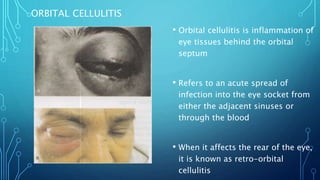
• Orbital cellulitis is inflammation of
eye tissues behind the orbital

septum
• Refers to an acute spread of
infection into the eye socket from
either the adjacent sinuses or
through the blood
• When it affects the rear of the eye,
it is known as retro-orbital
cellulitis
INTRODUCTIO
N
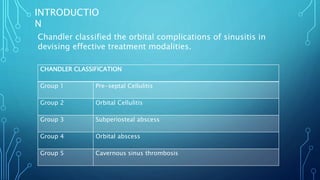
CHANDLER CLASSIFICATION
Group 1 Pre-septal Cellulitis
Group 2 Orbital Cellulitis
Group 3 Subperiosteal abscess
Group 4 Orbital abscess
Group 5 Cavernous sinus thrombosis
Chandler classified the orbital complications of sinusitis in
devising effective treatment modalities.
Group I- Preseptal Cellulitis
 This is an inflammatory oedema anterior to the orbital
septum
 Causes eye lid to swell
 It’s due to restricted venous drainage
 Though swollen, eye lids are non tender
 No chemosis, extra ocular muscle movement
limitations and visual impairment
Group II – Orbital Cellulitis
 Pronounced oedema and inflammation of
orbital contents without abscess formation
 It is imperative to look for signs of proptosis
and reduced ocular mobility as these are
reliable signs of orbital cellulitis
 Chemosis is usually present in this group
 Loss of vision is very rare in this group, but
vision should be constantly monitored
Group III - Subperiosteal abscess
 Abscess develops in the space between the bone and
periosteum
 Orbital contents may be displaced in an inferolateral
direction due to the mass effect of accumulating pus
 Chemosis and proptosis are usually present
 Decreased ocular mobility and loss of vision is rare
in this group
Group IV - Orbital Abscess
 Orbital abscess usually involves collection of
purulent material within the orbital contents
 This could be caused due to relentless
progression of orbital cellulitis or rupture of
orbital abscess
 Severe proptosis, complete ophthalmoplegia, and
loss of vision are commonly seen in this group of
patients
Group V - Cavernous sinus thrombosis
 Development of bilateral ocular signs is the
classic feature of patients belonging to this
group
 Manifest with fever, headache, photophobia,
proptosis, ophthalmoplegia and loss of vision
 Cranial nerve palsies involving III, IV, V1, V2
and VI are common
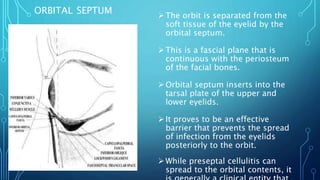
ORBITAL SEPTUM The orbit is separated from the
soft tissue of the eyelid by the
orbital septum.
This is a fascial plane that is
continuous with the periosteum
of the facial bones.
Orbital septum inserts into the
tarsal plate of the upper and
lower eyelids.
It proves to be an effective
barrier that prevents the spread
of infection from the eyelids
posteriorly to the orbit.
While preseptal cellulitis can
spread to the orbital contents, it
ETIOLOGY
• Extension from neighbouring structures : Parasnasal sinuses, Teeth,
Face, Lids, Intracranial cavity, Intraorbital structures
This is the commonest mode of infection
• Exogenous Infection : Foreign body, Penetrating injury, Evisceration,
Enucleation, Dacryocystectomy, Orbitotomy
• Endogenous infection : Puerperal sepsis, Thrombophlebitis of leg,
Septicemia, rarely as metastasis from Ca Breast
• Predisposing factors like Diabetes mellitus and Immunocompromised
state also increases risk of infection.
AGENTS
BACTERIA
•Childrens- Staph aureus, Strep pneumoniae and anaerobics
•Adults- Staph aureus, Strep pneumoniae, E.coli,mixed flora
FUNGUS
•Diabetics and Immunocompromised
•Aspergillus, Mucor species
PARASITE
•Ecchinococcus Granulosus
•Taenia solium
•Trichinella spiralis
•Toxoplasma gondii
PATHOLOGY
FACTORS
Absent
Lymphatics
Thrombophlebitis
and Extensive
necrosis
Tight
Compartments
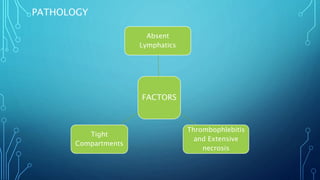
Pathological features of orbital cellulitis are similar to suppurative
inflammations of the body in general, except that
 Due to the absence of a lymphatic system the protective agents
are limited to local phagocytic elements provided by the orbital
reticular tissue
 Due to tight compartments, the intraorbital pressure is raised
which augments the virulence of infection causing early and
extensive necrotic sloughing of the tissues
 As in most cases the infection spreads as thrombophlebitis from
the surrounding structures, a rapid spread with extensiv
enecrosis is the rule
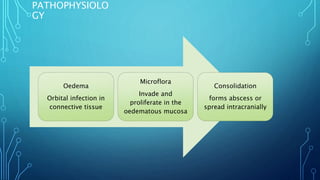
PATHOPHYSIOLO
GY
Oedema
Orbital infection in
connective tissue
Microflora
Invade and
proliferate in the
oedematous mucosa
Consolidation
forms abscess or
spread intracranially
SYMPTOM
S
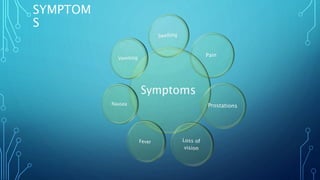
 Fever, generally 102 degree F or greater
 Painful swelling of upper and lower lids
 Eyelid appears shiny and is red or purple in color
 Infant or child is acutely ill or toxic
 Eye pain especially with movement
 Decreased vision
 Eye bulging
 Swelling of the eyelids
 General malaise
 Restricted or painful eye movements
SIGNS
SIGNS
Lid Oedema
Chemosis
Proptosis
Restricted
Ocular
motility
Visual
impairment
Raised IOP
 A marked swelling of the lids characterised by woody
hardness and redness
 A marked chemosis of conjunctiva, which may
protrude and become desiccated or necrotic
 The eyeball is proptosed axially
 Frequently, there is mild to severe restriction of the
ocular movements
 Fundus examination may show congestion of retinal
veins and signs of papillitis or papilloedem
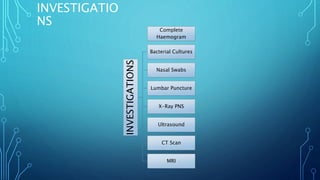
INVESTIGATIO
NS
INVESTIGATIONS
Complete
Haemogram
Bacterial Cultures
Nasal Swabs
Lumbar Puncture
X-Ray PNS
Ultrasound
CT Scan
MRI
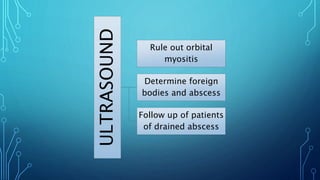
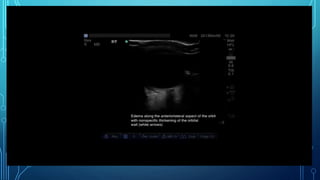
ULTRASOUND
Rule out orbital
myositis
Determine foreign
bodies and abscess
Follow up of patients
of drained abscess
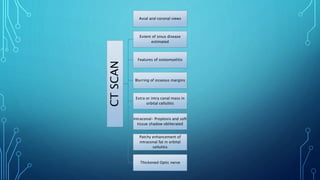
CTSCAN
Axial and coronal views
Extent of sinus disease
estimated
Features of osteomyelitis
Blurring of osseous margins
Extra or intra conal mass in
orbital cellulitis
Intraconal- Proptosis and soft
tissue shadow obliterated
Patchy enhancement of
intraconal fat in orbital
cellulitis
Thickened Optic nerve
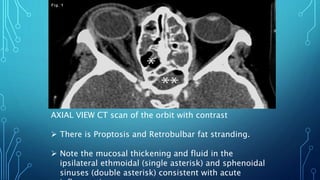
AXIAL VIEW CT scan of the orbit with contrast
 There is Proptosis and Retrobulbar fat stranding.
 Note the mucosal thickening and fluid in the
ipsilateral ethmoidal (single asterisk) and sphenoidal
sinuses (double asterisk) consistent with acute
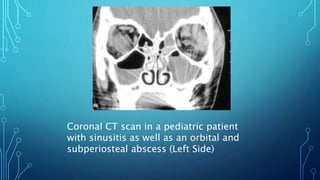
Coronal CT scan in a pediatric patient
with sinusitis as well as an orbital and
subperiosteal abscess (Left Side)
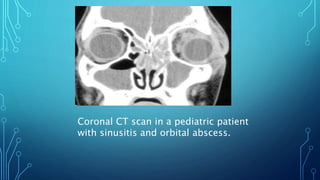
Coronal CT scan in a pediatric patient
with sinusitis and orbital abscess.
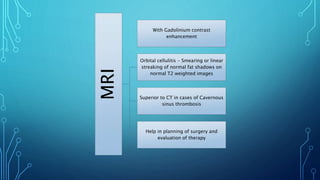
MRI
With Gadolinium contrast
enhancement
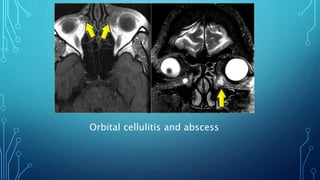
Orbital cellulitis - Smearing or linear
streaking of normal fat shadows on
normal T2 weighted images
Superior to CT in cases of Cavernous
sinus thrombosis
Help in planning of surgery and
evaluation of therapy
Orbital cellulitis and abscess
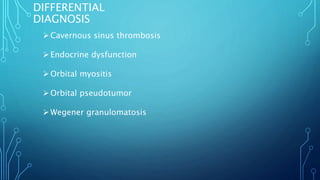
DIFFERENTIAL
DIAGNOSIS
Cavernous sinus thrombosis
Endocrine dysfunction
Orbital myositis
Orbital pseudotumor
Wegener granulomatosis
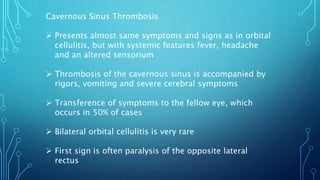
Cavernous Sinus Thrombosis
 Presents almost same symptoms and signs as in orbital
cellulitis, but with systemic features fever, headache
and an altered sensorium
 Thrombosis of the cavernous sinus is accompanied by
rigors, vomiting and severe cerebral symptoms
 Transference of symptoms to the fellow eye, which
occurs in 50% of cases
 Bilateral orbital cellulitis is very rare
 First sign is often paralysis of the opposite lateral
rectus
Thyroid associated ophthmopathy(TAO) or Grave’s
orbitopathy
 Symptoms are gritty sensations, photophobia, lacrimation,
discomfort,dysfunctional eye motility or diminution of vision
 Lid retraction
 Lid lag of the upper eyelid on downward gaze
 Axial proptosis (most common cause)
 Exposure keratitis
 Compressive optic neuropathy
Pseudotumor/Idiopathic orbital inflammatory disease/
Non-specific orbital inflammatory disease
 Presents as proptosis,pain, diplopia, lid swelling and
redness
 Usually unilateral but occasionally bilateral.
 Ultrasonography ofthe orbit shows a diffuse infiltration
of heterogeneous Consistency
 CT scan shows diffuse thickening of the extraocular
muscles including their tendinous insertion, which is
useful in differentiating this from thyroid eye disease
where the muscle enlargement is confined to the
belly and spares the terminal tendinous portion
Orbital Myositis
 It’s an inflammatory process that primarily involves the
extraocular muscles.
 The classic appearance of EOM myositis includes a unilateral
thickening of one or two EOMs, often also involving the
surrounding fat, tendon, and myotendinous junction
 Presents as orbital and periorbital pain, ocular movement
impairment, diplopia, proptosis, swollen eyelids, and
conjunctival hyperemia
 Orbital cellulitis, which is commonly accompanied by fever,
leukocytosis, and a clinical history of head and neck
infection
Wegener’s granulomatosis
 It’s a chronic disease affecting the upper respiratory tract,
lungs and kidneys and characterized bywide spread
distribution of necrotizing angiitis with surrounding
granuloma formation
 Symptoms include pain in the paranasal sinuses,
discoloured or bloody nasal discharge and, occasionally,
nasal ulcerations
 Persistent rhinorrhea
 Ocular manifestations occur secondary to an adjacent
granulomatous sinusitis or as a result of focal vasculitis
 The nasolacrimal duct may be obstructed and there may
be episcleritis, scleritis, proptosis and extraocular muscle
TREATMEN
T Intensive
Antibiotic
therapy
Analgesics
Anti
inflammatory
Surgical
Interventation
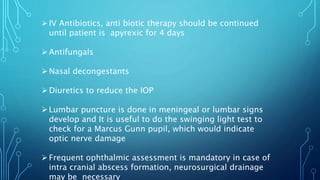
IV Antibiotics, anti biotic therapy should be continued
until patient is apyrexic for 4 days
Antifungals
Nasal decongestants
Diuretics to reduce the IOP
Lumbar puncture is done in meningeal or lumbar signs
develop and It is useful to do the swinging light test to
check for a Marcus Gunn pupil, which would indicate
optic nerve damage
Frequent ophthalmic assessment is mandatory in case of
intra cranial abscess formation, neurosurgical drainage
may be necessary
INDICATIONS OF SURGICAL
INTERVENTATIONS
Surgical
Interventio
n
Suspicion of
orbital
abscess or
foreign body
Progression
of visual loss
Extraocular
motility
defect
Worsening
of proptosis
Non
reduction of
size of
abscess on
CT after anti
biotic
therapy
TIMING OF SURGERY
Cellulitis
without
abscess with
VA < 6/12 with
appropriate
medical
treatment and
orbital
exploration
If VA > 6/12
expectantly
and frequently
conservative
management
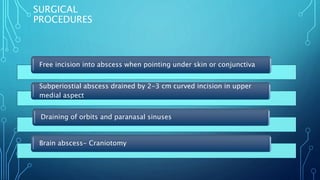
SURGICAL
PROCEDURES
Free incision into abscess when pointing under skin or conjunctiva
Subperiostial abscess drained by 2-3 cm curved incision in upper
medial aspect
Draining of orbits and paranasal sinuses
Brain abscess- Craniotomy
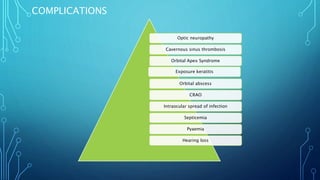
COMPLICATIONS
Optic neuropathy
Cavernous sinus thrombosis
Orbital Apex Syndrome
Exposure keratitis
Orbital abscess
CRAO
Intraocular spread of infection
Septicemia
Pyaemia
Hearing loss
References
 Principles and Practice of Opthalmology- Albert &
Jakobiec
 Orbit, Eyelids, and Lacrimal System - AAO 2014-
2015
 Parson’s Diseases of the Eye – 22nd Edn
 Comprehensive Ophthalmology – Khurana
 Ophthalmology – Myron Yanoff and Jay S. Duker
Orbital cellulitis

Orbital cellulitis

  • 1.
  • 2.
    ORBITAL CELLULITIS • Orbitalcellulitis is inflammation of eye tissues behind the orbital septum • Refers to an acute spread of infection into the eye socket from either the adjacent sinuses or through the blood • When it affects the rear of the eye, it is known as retro-orbital cellulitis
  • 3.
    INTRODUCTIO N CHANDLER CLASSIFICATION Group 1Pre-septal Cellulitis Group 2 Orbital Cellulitis Group 3 Subperiosteal abscess Group 4 Orbital abscess Group 5 Cavernous sinus thrombosis Chandler classified the orbital complications of sinusitis in devising effective treatment modalities.
  • 4.
    Group I- PreseptalCellulitis  This is an inflammatory oedema anterior to the orbital septum  Causes eye lid to swell  It’s due to restricted venous drainage  Though swollen, eye lids are non tender  No chemosis, extra ocular muscle movement limitations and visual impairment
  • 5.
    Group II –Orbital Cellulitis  Pronounced oedema and inflammation of orbital contents without abscess formation  It is imperative to look for signs of proptosis and reduced ocular mobility as these are reliable signs of orbital cellulitis  Chemosis is usually present in this group  Loss of vision is very rare in this group, but vision should be constantly monitored
  • 6.
    Group III -Subperiosteal abscess  Abscess develops in the space between the bone and periosteum  Orbital contents may be displaced in an inferolateral direction due to the mass effect of accumulating pus  Chemosis and proptosis are usually present  Decreased ocular mobility and loss of vision is rare in this group
  • 7.
    Group IV -Orbital Abscess  Orbital abscess usually involves collection of purulent material within the orbital contents  This could be caused due to relentless progression of orbital cellulitis or rupture of orbital abscess  Severe proptosis, complete ophthalmoplegia, and loss of vision are commonly seen in this group of patients
  • 8.
    Group V -Cavernous sinus thrombosis  Development of bilateral ocular signs is the classic feature of patients belonging to this group  Manifest with fever, headache, photophobia, proptosis, ophthalmoplegia and loss of vision  Cranial nerve palsies involving III, IV, V1, V2 and VI are common
  • 9.
    ORBITAL SEPTUM Theorbit is separated from the soft tissue of the eyelid by the orbital septum. This is a fascial plane that is continuous with the periosteum of the facial bones. Orbital septum inserts into the tarsal plate of the upper and lower eyelids. It proves to be an effective barrier that prevents the spread of infection from the eyelids posteriorly to the orbit. While preseptal cellulitis can spread to the orbital contents, it
  • 10.
    ETIOLOGY • Extension fromneighbouring structures : Parasnasal sinuses, Teeth, Face, Lids, Intracranial cavity, Intraorbital structures This is the commonest mode of infection • Exogenous Infection : Foreign body, Penetrating injury, Evisceration, Enucleation, Dacryocystectomy, Orbitotomy • Endogenous infection : Puerperal sepsis, Thrombophlebitis of leg, Septicemia, rarely as metastasis from Ca Breast • Predisposing factors like Diabetes mellitus and Immunocompromised state also increases risk of infection.
  • 11.
    AGENTS BACTERIA •Childrens- Staph aureus,Strep pneumoniae and anaerobics •Adults- Staph aureus, Strep pneumoniae, E.coli,mixed flora FUNGUS •Diabetics and Immunocompromised •Aspergillus, Mucor species PARASITE •Ecchinococcus Granulosus •Taenia solium •Trichinella spiralis •Toxoplasma gondii
  • 12.
  • 13.
    Pathological features oforbital cellulitis are similar to suppurative inflammations of the body in general, except that  Due to the absence of a lymphatic system the protective agents are limited to local phagocytic elements provided by the orbital reticular tissue  Due to tight compartments, the intraorbital pressure is raised which augments the virulence of infection causing early and extensive necrotic sloughing of the tissues  As in most cases the infection spreads as thrombophlebitis from the surrounding structures, a rapid spread with extensiv enecrosis is the rule
  • 14.
    PATHOPHYSIOLO GY Oedema Orbital infection in connectivetissue Microflora Invade and proliferate in the oedematous mucosa Consolidation forms abscess or spread intracranially
  • 15.
  • 16.
     Fever, generally102 degree F or greater  Painful swelling of upper and lower lids  Eyelid appears shiny and is red or purple in color  Infant or child is acutely ill or toxic  Eye pain especially with movement  Decreased vision  Eye bulging  Swelling of the eyelids  General malaise  Restricted or painful eye movements
  • 17.
  • 18.
     A markedswelling of the lids characterised by woody hardness and redness  A marked chemosis of conjunctiva, which may protrude and become desiccated or necrotic  The eyeball is proptosed axially  Frequently, there is mild to severe restriction of the ocular movements  Fundus examination may show congestion of retinal veins and signs of papillitis or papilloedem
  • 19.
  • 20.
    ULTRASOUND Rule out orbital myositis Determineforeign bodies and abscess Follow up of patients of drained abscess
  • 22.
    CTSCAN Axial and coronalviews Extent of sinus disease estimated Features of osteomyelitis Blurring of osseous margins Extra or intra conal mass in orbital cellulitis Intraconal- Proptosis and soft tissue shadow obliterated Patchy enhancement of intraconal fat in orbital cellulitis Thickened Optic nerve
  • 23.
    AXIAL VIEW CTscan of the orbit with contrast  There is Proptosis and Retrobulbar fat stranding.  Note the mucosal thickening and fluid in the ipsilateral ethmoidal (single asterisk) and sphenoidal sinuses (double asterisk) consistent with acute
  • 24.
    Coronal CT scanin a pediatric patient with sinusitis as well as an orbital and subperiosteal abscess (Left Side)
  • 25.
    Coronal CT scanin a pediatric patient with sinusitis and orbital abscess.
  • 26.
    MRI With Gadolinium contrast enhancement Orbitalcellulitis - Smearing or linear streaking of normal fat shadows on normal T2 weighted images Superior to CT in cases of Cavernous sinus thrombosis Help in planning of surgery and evaluation of therapy
  • 27.
  • 28.
    DIFFERENTIAL DIAGNOSIS Cavernous sinus thrombosis Endocrinedysfunction Orbital myositis Orbital pseudotumor Wegener granulomatosis
  • 29.
    Cavernous Sinus Thrombosis Presents almost same symptoms and signs as in orbital cellulitis, but with systemic features fever, headache and an altered sensorium  Thrombosis of the cavernous sinus is accompanied by rigors, vomiting and severe cerebral symptoms  Transference of symptoms to the fellow eye, which occurs in 50% of cases  Bilateral orbital cellulitis is very rare  First sign is often paralysis of the opposite lateral rectus
  • 30.
    Thyroid associated ophthmopathy(TAO)or Grave’s orbitopathy  Symptoms are gritty sensations, photophobia, lacrimation, discomfort,dysfunctional eye motility or diminution of vision  Lid retraction  Lid lag of the upper eyelid on downward gaze  Axial proptosis (most common cause)  Exposure keratitis  Compressive optic neuropathy
  • 31.
    Pseudotumor/Idiopathic orbital inflammatorydisease/ Non-specific orbital inflammatory disease  Presents as proptosis,pain, diplopia, lid swelling and redness  Usually unilateral but occasionally bilateral.  Ultrasonography ofthe orbit shows a diffuse infiltration of heterogeneous Consistency  CT scan shows diffuse thickening of the extraocular muscles including their tendinous insertion, which is useful in differentiating this from thyroid eye disease where the muscle enlargement is confined to the belly and spares the terminal tendinous portion
  • 32.
    Orbital Myositis  It’san inflammatory process that primarily involves the extraocular muscles.  The classic appearance of EOM myositis includes a unilateral thickening of one or two EOMs, often also involving the surrounding fat, tendon, and myotendinous junction  Presents as orbital and periorbital pain, ocular movement impairment, diplopia, proptosis, swollen eyelids, and conjunctival hyperemia  Orbital cellulitis, which is commonly accompanied by fever, leukocytosis, and a clinical history of head and neck infection
  • 33.
    Wegener’s granulomatosis  It’sa chronic disease affecting the upper respiratory tract, lungs and kidneys and characterized bywide spread distribution of necrotizing angiitis with surrounding granuloma formation  Symptoms include pain in the paranasal sinuses, discoloured or bloody nasal discharge and, occasionally, nasal ulcerations  Persistent rhinorrhea  Ocular manifestations occur secondary to an adjacent granulomatous sinusitis or as a result of focal vasculitis  The nasolacrimal duct may be obstructed and there may be episcleritis, scleritis, proptosis and extraocular muscle
  • 34.
  • 35.
    IV Antibiotics, antibiotic therapy should be continued until patient is apyrexic for 4 days Antifungals Nasal decongestants Diuretics to reduce the IOP Lumbar puncture is done in meningeal or lumbar signs develop and It is useful to do the swinging light test to check for a Marcus Gunn pupil, which would indicate optic nerve damage Frequent ophthalmic assessment is mandatory in case of intra cranial abscess formation, neurosurgical drainage may be necessary
  • 36.
    INDICATIONS OF SURGICAL INTERVENTATIONS Surgical Interventio n Suspicionof orbital abscess or foreign body Progression of visual loss Extraocular motility defect Worsening of proptosis Non reduction of size of abscess on CT after anti biotic therapy
  • 37.
    TIMING OF SURGERY Cellulitis without abscesswith VA < 6/12 with appropriate medical treatment and orbital exploration If VA > 6/12 expectantly and frequently conservative management
  • 38.
    SURGICAL PROCEDURES Free incision intoabscess when pointing under skin or conjunctiva Subperiostial abscess drained by 2-3 cm curved incision in upper medial aspect Draining of orbits and paranasal sinuses Brain abscess- Craniotomy
  • 39.
    COMPLICATIONS Optic neuropathy Cavernous sinusthrombosis Orbital Apex Syndrome Exposure keratitis Orbital abscess CRAO Intraocular spread of infection Septicemia Pyaemia Hearing loss
  • 40.
    References  Principles andPractice of Opthalmology- Albert & Jakobiec  Orbit, Eyelids, and Lacrimal System - AAO 2014- 2015  Parson’s Diseases of the Eye – 22nd Edn  Comprehensive Ophthalmology – Khurana  Ophthalmology – Myron Yanoff and Jay S. Duker