Thyroid Eye Disease Dr Bijay Vaidya Dept of Endocrinology, Royal Devon & Exeter Hospital,  Exeter
Thyroid Eye Disease Is an autoimmune disorder 25-50% Graves’ disease 3-5% severe disease Can present before, with or after thyrotoxicosis Rarely in euthyroid or hypothyroid patients
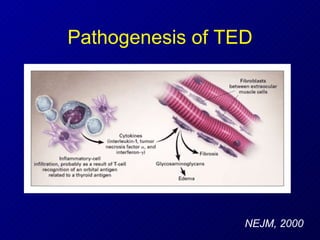
Pathogenesis of TED NEJM, 2000
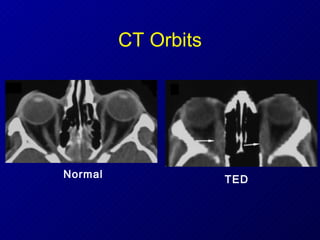
CT Orbits TED Normal
The Case 65/F Recurrent Graves’ thyrotoxicosis Smoker TSH 0.03 mu/L, FT4 34 pmol/L Red eyes, excessive watering, squint & double vision
How to Assess TED?
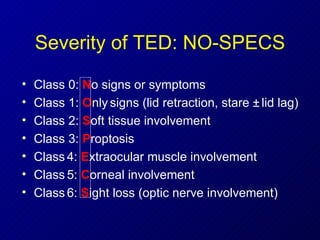
Severity of TED: NO-SPECS Class 0:  N o signs or symptoms  Class 1:  O nly   signs (lid retraction, stare  ±   lid lag)  Class 2:  S oft tissue involvement Class 3:  P roptosis  Class   4:  E xtraocular muscle involvement  Class   5:  C orneal involvement  Class   6:  S ight loss (optic nerve involvement)
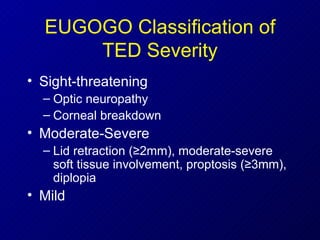
EUGOGO Classification of TED Severity Sight-threatening Optic neuropathy Corneal breakdown Moderate-Severe Lid retraction ( ≥ 2mm), moderate-severe soft tissue involvement, proptosis ( ≥ 3mm), diplopia Mild
Identification of Sight-threatening TED Deterioration of vision  Colour desaturation Relative afferent pupillary defect (RAPD) Papilloedema Visual field, VEP, MRI Corneal opacity Cornea visible on closing eyelids
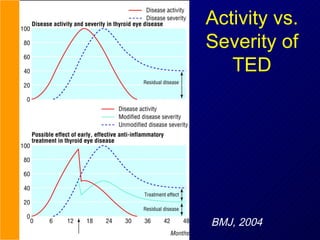
Activity vs. Severity of TED BMJ, 2004
Predictive Indicators of TED Activity Short duration of eye disease Increasing severity High clinical activity score High titres of TBII antibodies Positive octreoscans Oedematous extra-ocular muscles on USG or MRI
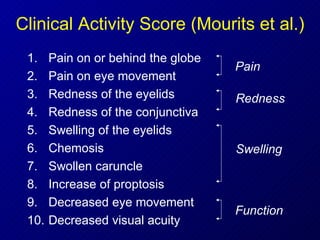
Clinical Activity Score (Mourits et al.) Pain on or behind the globe Pain on eye movement Redness of the eyelids Redness of the conjunctiva Swelling of the eyelids Chemosis Swollen caruncle Increase of proptosis Decreased eye movement Decreased visual acuity Pain Redness Swelling Function
How to Manage Thyrotoxicosis in a patient with TED?
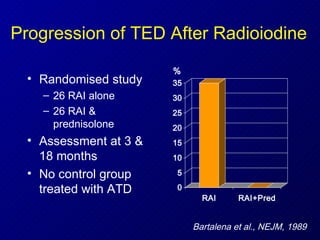
Progression of TED After Radioiodine Randomised study 26 RAI alone 26 RAI & prednisolone Assessment at 3 & 18 months No control group treated with ATD % Bartalena et al., NEJM, 1989
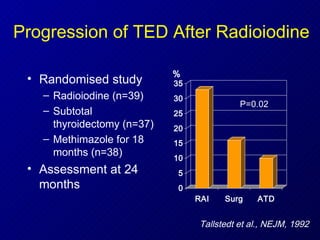
Progression of TED After Radioiodine Randomised study Radioiodine (n=39) Subtotal thyroidectomy (n=37) Methimazole for 18 months (n=38) Assessment at 24 months % P=0.02 Tallstedt et al., NEJM, 1992
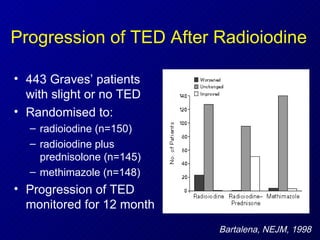
Progression of TED After Radioiodine 443 Graves’ patients with slight or no TED  Randomised to:  radioiodine (n=150) radioiodine plus prednisolone (n=145) methimazole (n=148) Progression of TED monitored for 12 month Bartalena, NEJM, 1998
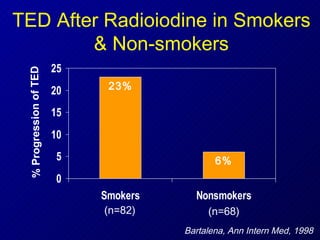
TED After Radioiodine in Smokers & Non-smokers Bartalena, Ann Intern Med, 1998 % Progression of TED (n=82) (n=68) 23% 6%
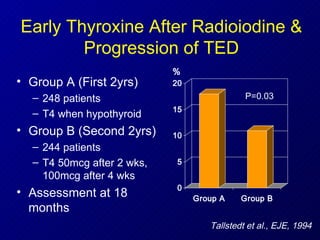
Early Thyroxine After Radioiodine & Progression of TED Group A (First 2yrs) 248 patients T4 when hypothyroid Group B (Second 2yrs)  244 patients T4 50mcg after 2 wks, 100mcg after 4 wks Assessment at 18 months % P=0.03 Tallstedt et al., EJE, 1994
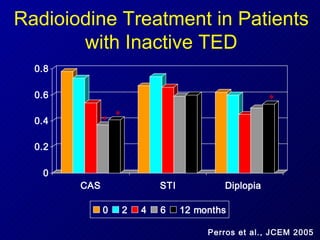
Radioiodine Treatment in Patients with Inactive TED * * * Perros et al., JCEM 2005
Radioiodine & TED In patients with active TED, defer radioiodine or use with steroids In patients with inactive TED, radioiodine may be considered without steroids Avoid hypothyroidism & advise against smoking
How to Treat?
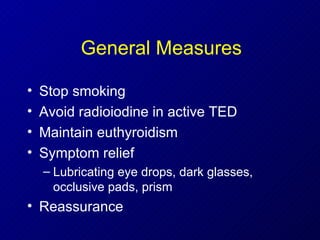
General Measures Stop smoking Avoid radioiodine in active TED Maintain euthyroidism Symptom relief Lubricating eye drops, dark glasses, occlusive pads, prism Reassurance
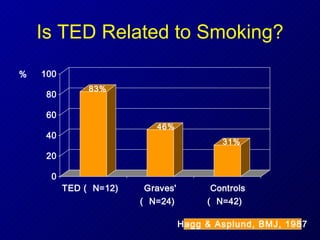
Is TED Related to Smoking? % Hagg & Asplund, BMJ, 1987 83% 46% 31%
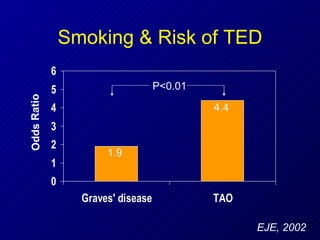
Smoking & Risk of TED Odds Ratio P<0.01 1.9 4.4 EJE, 2002
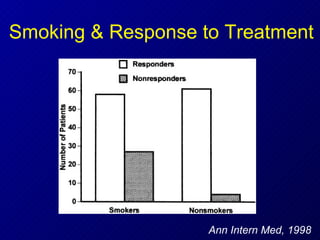
Smoking & Response to Treatment Ann Intern Med, 1998
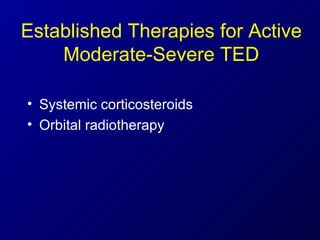
Established Therapies for Active Moderate-Severe TED Systemic corticosteroids Orbital radiotherapy
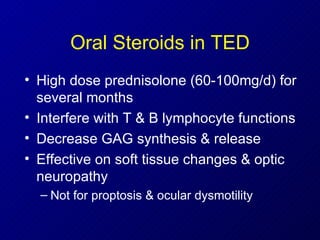
Oral Steroids in TED High dose prednisolone (60-100mg/d) for several months Interfere with T & B lymphocyte functions Decrease GAG synthesis & release Effective on soft tissue changes & optic neuropathy  Not for proptosis & ocular dysmotility
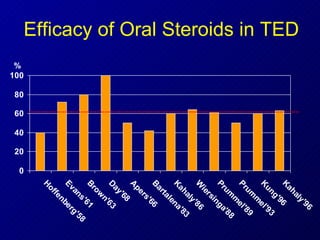
Efficacy of Oral Steroids in TED %
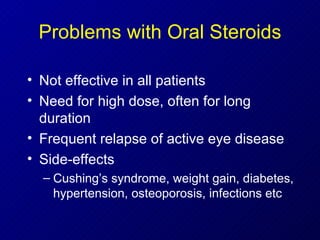
Problems with Oral Steroids Not effective in all patients Need for high dose, often for long duration Frequent relapse of active eye disease Side-effects Cushing’s syndrome, weight gain, diabetes, hypertension, osteoporosis, infections etc
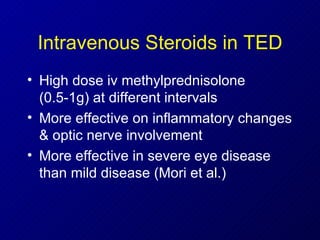
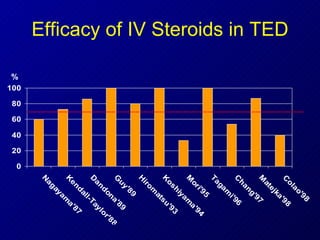
Intravenous Steroids in TED High dose iv methylprednisolone (0.5-1g) at different intervals More effective on inflammatory changes & optic nerve involvement More effective in severe eye disease than mild disease (Mori et al.)
Efficacy of IV Steroids in TED %
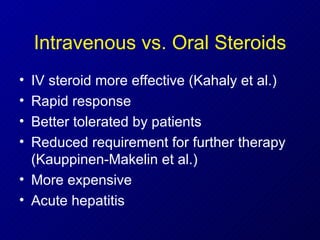
Intravenous vs. Oral Steroids IV steroid more effective (Kahaly et al.) Rapid response Better tolerated by patients Reduced requirement for further therapy (Kauppinen-Makelin et al.) More expensive Acute hepatitis
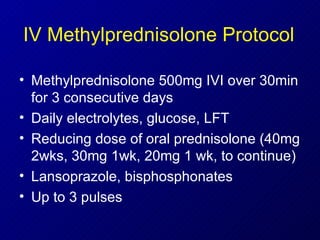
IV Methylprednisolone Protocol Methylprednisolone 500mg IVI over 30min for 3 consecutive days Daily electrolytes, glucose, LFT Reducing dose of oral prednisolone (40mg 2wks, 30mg 1wk, 20mg 1 wk, to continue) Lansoprazole, bisphosphonates Up to 3 pulses
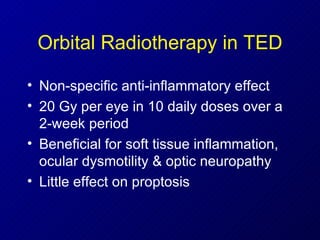
Orbital Radiotherapy in TED Non-specific anti-inflammatory effect  20 Gy per eye in 10 daily doses over a 2-week period Beneficial for soft tissue inflammation, ocular dysmotility & optic neuropathy Little effect on proptosis
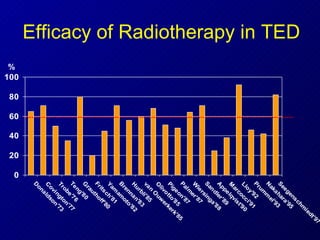
Efficacy of Radiotherapy in TED %
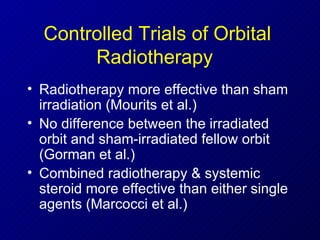
Controlled Trials of Orbital Radiotherapy  Radiotherapy more effective than sham irradiation (Mourits et al.) No difference between the irradiated orbit and sham-irradiated fellow orbit (Gorman et al.) Combined radiotherapy & systemic steroid more effective than either single agents (Marcocci et al.)
Complications of Radiotherapy Transient exacerbation of orbital oedema, conjunctival injection, chemosis Radiation-induced retinopathy (C/I: diabetes & hypertension) Cataract Theoretical risk of tumour induction (not used in patients <35yr)
Other Medical Treatments Azathioprine Methotrexate  Cyclophosphamide  Plasmapheresis IV immunoglobulins Pentoxifylline  Bromocriptine Anti-cytokines (Etanercept) & monoclonal antibodies (Rituximab)
Somatostatin Analogues Receptors on immune cells & fibroblasts in the eyes Uptake on octreotide scan in active TED Small uncontrolled studies shown beneficial effects
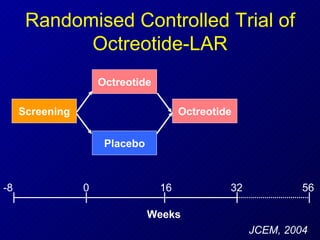
Randomised Controlled Trial of Octreotide-LAR JCEM, 2004 -8 Octreotide Placebo Octreotide Screening 0 16 32 Weeks 56
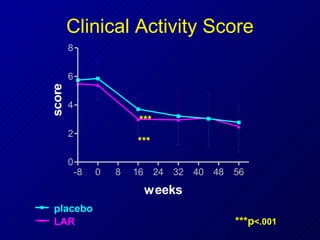
Clinical Activity Score placebo LAR *** *** ***p <.001
Management of Sight-threatening Active TED Immediate treatment Optic Neuropathy IV Methylprednisolone Orbital decompression Corneal breakdown Hourly topical lubricant Temporary eye closure Botulinum toxin injections
Role of Rehabilitative Surgery
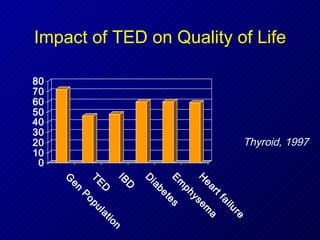
Impact of TED on Quality of Life Thyroid, 1997
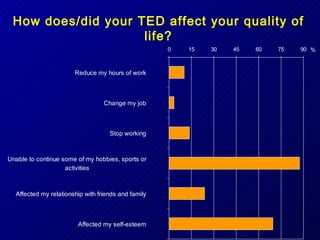
% How does/did your TED affect your quality of life?
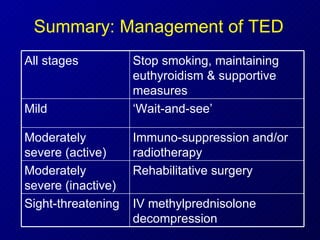
Summary: Management of TED Stop smoking, maintaining euthyroidism & supportive measures All stages IV methylprednisolone decompression Sight-threatening  Rehabilitative surgery Moderately severe (inactive) Immuno-suppression and/or radiotherapy Moderately severe (active) ‘ Wait-and-see’ Mild
Who to Refer to Specialist TED Clinic?
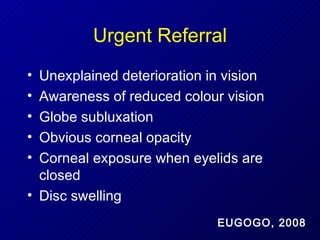
Urgent Referral Unexplained deterioration in vision Awareness of reduced colour vision Globe subluxation Obvious corneal opacity Corneal exposure when eyelids are closed Disc swelling EUGOGO, 2008
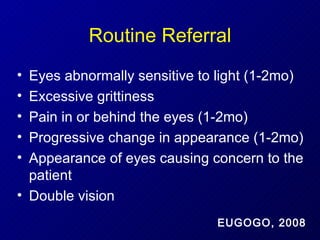
Routine Referral Eyes abnormally sensitive to light (1-2mo) Excessive grittiness Pain in or behind the eyes (1-2mo) Progressive change in appearance (1-2mo) Appearance of eyes causing concern to the patient Double vision EUGOGO, 2008
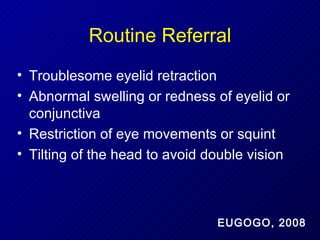
Routine Referral Troublesome eyelid retraction Abnormal swelling or redness of eyelid or conjunctiva Restriction of eye movements or squint Tilting of the head to avoid double vision EUGOGO, 2008
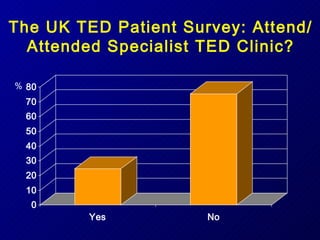
The UK TED Patient Survey: Attend/Attended Specialist TED Clinic? %
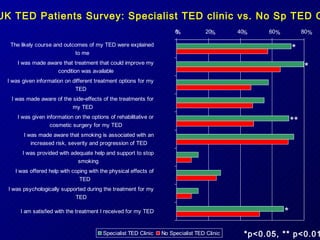
*p<0.05, ** p<0.01 The UK TED Patients Survey: Specialist TED clinic vs. No Sp TED Clinic % % % % % ** * * *
Further Reading: Consensus statement of the European group on Graves' orbitopathy (EUGOGO) on management of Graves' orbitopathy. Eur J Endocrinol. 2008 Mar;158(3):273-85.

Thyroid Eye Disease

  • 1.
    Thyroid Eye DiseaseDr Bijay Vaidya Dept of Endocrinology, Royal Devon & Exeter Hospital, Exeter
  • 2.
    Thyroid Eye DiseaseIs an autoimmune disorder 25-50% Graves’ disease 3-5% severe disease Can present before, with or after thyrotoxicosis Rarely in euthyroid or hypothyroid patients
  • 3.
  • 4.
  • 5.
    The Case 65/FRecurrent Graves’ thyrotoxicosis Smoker TSH 0.03 mu/L, FT4 34 pmol/L Red eyes, excessive watering, squint & double vision
  • 6.
  • 7.
    Severity of TED:NO-SPECS Class 0: N o signs or symptoms Class 1: O nly signs (lid retraction, stare ± lid lag) Class 2: S oft tissue involvement Class 3: P roptosis Class 4: E xtraocular muscle involvement Class 5: C orneal involvement Class 6: S ight loss (optic nerve involvement)
  • 8.
    EUGOGO Classification ofTED Severity Sight-threatening Optic neuropathy Corneal breakdown Moderate-Severe Lid retraction ( ≥ 2mm), moderate-severe soft tissue involvement, proptosis ( ≥ 3mm), diplopia Mild
  • 9.
    Identification of Sight-threateningTED Deterioration of vision Colour desaturation Relative afferent pupillary defect (RAPD) Papilloedema Visual field, VEP, MRI Corneal opacity Cornea visible on closing eyelids
  • 10.
    Activity vs. Severityof TED BMJ, 2004
  • 11.
    Predictive Indicators ofTED Activity Short duration of eye disease Increasing severity High clinical activity score High titres of TBII antibodies Positive octreoscans Oedematous extra-ocular muscles on USG or MRI
  • 12.
    Clinical Activity Score(Mourits et al.) Pain on or behind the globe Pain on eye movement Redness of the eyelids Redness of the conjunctiva Swelling of the eyelids Chemosis Swollen caruncle Increase of proptosis Decreased eye movement Decreased visual acuity Pain Redness Swelling Function
  • 13.
    How to ManageThyrotoxicosis in a patient with TED?
  • 14.
    Progression of TEDAfter Radioiodine Randomised study 26 RAI alone 26 RAI & prednisolone Assessment at 3 & 18 months No control group treated with ATD % Bartalena et al., NEJM, 1989
  • 15.
    Progression of TEDAfter Radioiodine Randomised study Radioiodine (n=39) Subtotal thyroidectomy (n=37) Methimazole for 18 months (n=38) Assessment at 24 months % P=0.02 Tallstedt et al., NEJM, 1992
  • 16.
    Progression of TEDAfter Radioiodine 443 Graves’ patients with slight or no TED Randomised to: radioiodine (n=150) radioiodine plus prednisolone (n=145) methimazole (n=148) Progression of TED monitored for 12 month Bartalena, NEJM, 1998
  • 17.
    TED After Radioiodinein Smokers & Non-smokers Bartalena, Ann Intern Med, 1998 % Progression of TED (n=82) (n=68) 23% 6%
  • 18.
    Early Thyroxine AfterRadioiodine & Progression of TED Group A (First 2yrs) 248 patients T4 when hypothyroid Group B (Second 2yrs) 244 patients T4 50mcg after 2 wks, 100mcg after 4 wks Assessment at 18 months % P=0.03 Tallstedt et al., EJE, 1994
  • 19.
    Radioiodine Treatment inPatients with Inactive TED * * * Perros et al., JCEM 2005
  • 20.
    Radioiodine & TEDIn patients with active TED, defer radioiodine or use with steroids In patients with inactive TED, radioiodine may be considered without steroids Avoid hypothyroidism & advise against smoking
  • 21.
  • 22.
    General Measures Stopsmoking Avoid radioiodine in active TED Maintain euthyroidism Symptom relief Lubricating eye drops, dark glasses, occlusive pads, prism Reassurance
  • 23.
    Is TED Relatedto Smoking? % Hagg & Asplund, BMJ, 1987 83% 46% 31%
  • 24.
    Smoking & Riskof TED Odds Ratio P<0.01 1.9 4.4 EJE, 2002
  • 25.
    Smoking & Responseto Treatment Ann Intern Med, 1998
  • 26.
    Established Therapies forActive Moderate-Severe TED Systemic corticosteroids Orbital radiotherapy
  • 27.
    Oral Steroids inTED High dose prednisolone (60-100mg/d) for several months Interfere with T & B lymphocyte functions Decrease GAG synthesis & release Effective on soft tissue changes & optic neuropathy Not for proptosis & ocular dysmotility
  • 28.
    Efficacy of OralSteroids in TED %
  • 29.
    Problems with OralSteroids Not effective in all patients Need for high dose, often for long duration Frequent relapse of active eye disease Side-effects Cushing’s syndrome, weight gain, diabetes, hypertension, osteoporosis, infections etc
  • 30.
    Intravenous Steroids inTED High dose iv methylprednisolone (0.5-1g) at different intervals More effective on inflammatory changes & optic nerve involvement More effective in severe eye disease than mild disease (Mori et al.)
  • 31.
    Efficacy of IVSteroids in TED %
  • 32.
    Intravenous vs. OralSteroids IV steroid more effective (Kahaly et al.) Rapid response Better tolerated by patients Reduced requirement for further therapy (Kauppinen-Makelin et al.) More expensive Acute hepatitis
  • 33.
    IV Methylprednisolone ProtocolMethylprednisolone 500mg IVI over 30min for 3 consecutive days Daily electrolytes, glucose, LFT Reducing dose of oral prednisolone (40mg 2wks, 30mg 1wk, 20mg 1 wk, to continue) Lansoprazole, bisphosphonates Up to 3 pulses
  • 34.
    Orbital Radiotherapy inTED Non-specific anti-inflammatory effect 20 Gy per eye in 10 daily doses over a 2-week period Beneficial for soft tissue inflammation, ocular dysmotility & optic neuropathy Little effect on proptosis
  • 35.
  • 36.
    Controlled Trials ofOrbital Radiotherapy Radiotherapy more effective than sham irradiation (Mourits et al.) No difference between the irradiated orbit and sham-irradiated fellow orbit (Gorman et al.) Combined radiotherapy & systemic steroid more effective than either single agents (Marcocci et al.)
  • 37.
    Complications of RadiotherapyTransient exacerbation of orbital oedema, conjunctival injection, chemosis Radiation-induced retinopathy (C/I: diabetes & hypertension) Cataract Theoretical risk of tumour induction (not used in patients <35yr)
  • 38.
    Other Medical TreatmentsAzathioprine Methotrexate Cyclophosphamide Plasmapheresis IV immunoglobulins Pentoxifylline Bromocriptine Anti-cytokines (Etanercept) & monoclonal antibodies (Rituximab)
  • 39.
    Somatostatin Analogues Receptorson immune cells & fibroblasts in the eyes Uptake on octreotide scan in active TED Small uncontrolled studies shown beneficial effects
  • 40.
    Randomised Controlled Trialof Octreotide-LAR JCEM, 2004 -8 Octreotide Placebo Octreotide Screening 0 16 32 Weeks 56
  • 41.
    Clinical Activity Scoreplacebo LAR *** *** ***p <.001
  • 42.
    Management of Sight-threateningActive TED Immediate treatment Optic Neuropathy IV Methylprednisolone Orbital decompression Corneal breakdown Hourly topical lubricant Temporary eye closure Botulinum toxin injections
  • 43.
  • 44.
    Impact of TEDon Quality of Life Thyroid, 1997
  • 45.
    % How does/didyour TED affect your quality of life?
  • 46.
    Summary: Management ofTED Stop smoking, maintaining euthyroidism & supportive measures All stages IV methylprednisolone decompression Sight-threatening Rehabilitative surgery Moderately severe (inactive) Immuno-suppression and/or radiotherapy Moderately severe (active) ‘ Wait-and-see’ Mild
  • 47.
    Who to Referto Specialist TED Clinic?
  • 48.
    Urgent Referral Unexplaineddeterioration in vision Awareness of reduced colour vision Globe subluxation Obvious corneal opacity Corneal exposure when eyelids are closed Disc swelling EUGOGO, 2008
  • 49.
    Routine Referral Eyesabnormally sensitive to light (1-2mo) Excessive grittiness Pain in or behind the eyes (1-2mo) Progressive change in appearance (1-2mo) Appearance of eyes causing concern to the patient Double vision EUGOGO, 2008
  • 50.
    Routine Referral Troublesomeeyelid retraction Abnormal swelling or redness of eyelid or conjunctiva Restriction of eye movements or squint Tilting of the head to avoid double vision EUGOGO, 2008
  • 51.
    The UK TEDPatient Survey: Attend/Attended Specialist TED Clinic? %
  • 52.
    *p<0.05, ** p<0.01The UK TED Patients Survey: Specialist TED clinic vs. No Sp TED Clinic % % % % % ** * * *
  • 53.
    Further Reading: Consensusstatement of the European group on Graves' orbitopathy (EUGOGO) on management of Graves' orbitopathy. Eur J Endocrinol. 2008 Mar;158(3):273-85.