M.Pharm 1st Semester Seminar
Subject :Biostatistics
Topic : Poisson Distribution
By:
Anindya Jana
M.Pharm 1st Year (Pharmaceutics)
Regd. No. : 1661611006
What Is Poisson Distribution?
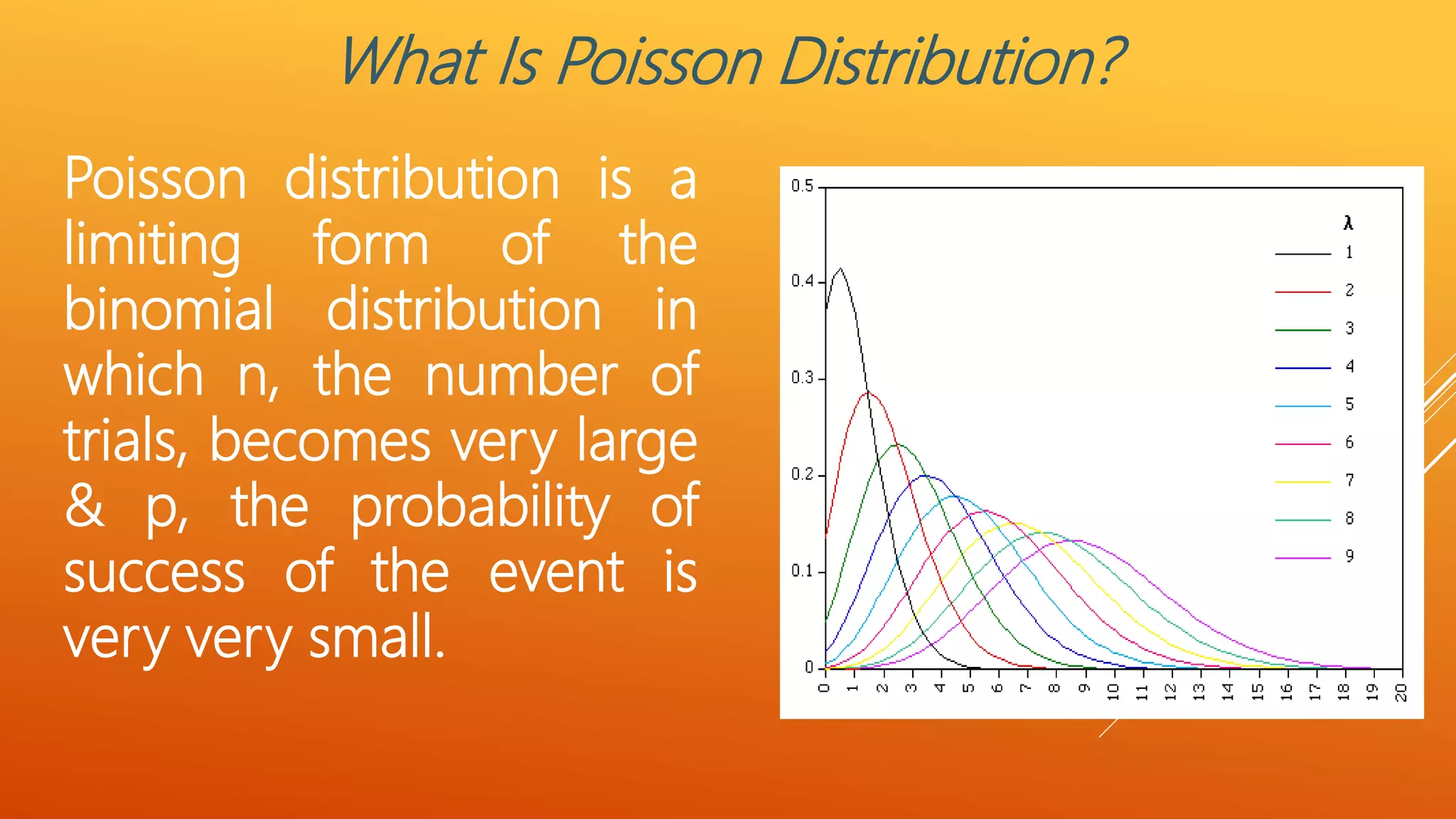
Poisson distribution is a
limiting form of the
binomial distribution in
which n, the number of
trials, becomes very large
& p, the probability of
success of the event is
very very small.
History
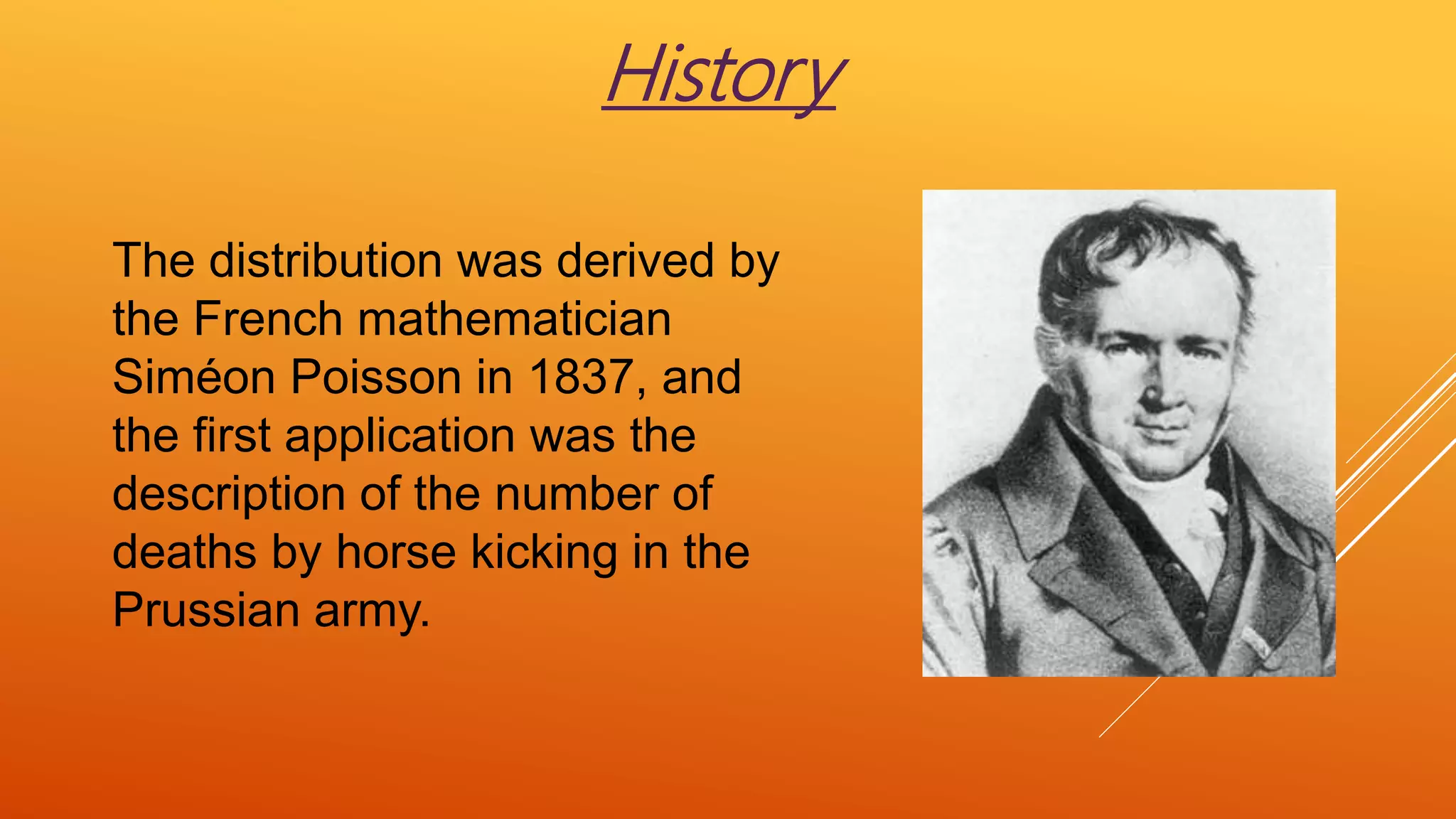
The distribution was derived by
the French mathematician
Siméon Poisson in 1837, and
the first application was the
description of the number of
deaths by horse kicking in the
Prussian army.
Poisson distribution used in cases where the chance of any individual
event being a success is very small. The distribution is used to
describe the behaviour of rare events.
Examples;
The number of defective screws per box of 5000 screws.
The number of printing mistakes in each page of the first proof of
book.
The number of air accidents in India in one year.
Occurrence of number of scratches on a sheet of glass.
Why we need Poisson Distribution!!
Use of Poisson Distribution In Pharmaceutical
 Control limits for numbers of tablets rejected from an online
Metal Detector during tablet compression cycle.
 Microbial counts in raw materials, products, and water for
pharmaceutical use.
 Control limits for numbers of containers rejected from visual
inspection of sterile production batches.
 Alert limits for microbial levels in cleanroom environment.
 Release limits for microbial counts in nonsterile products.
The Poisson Distribution
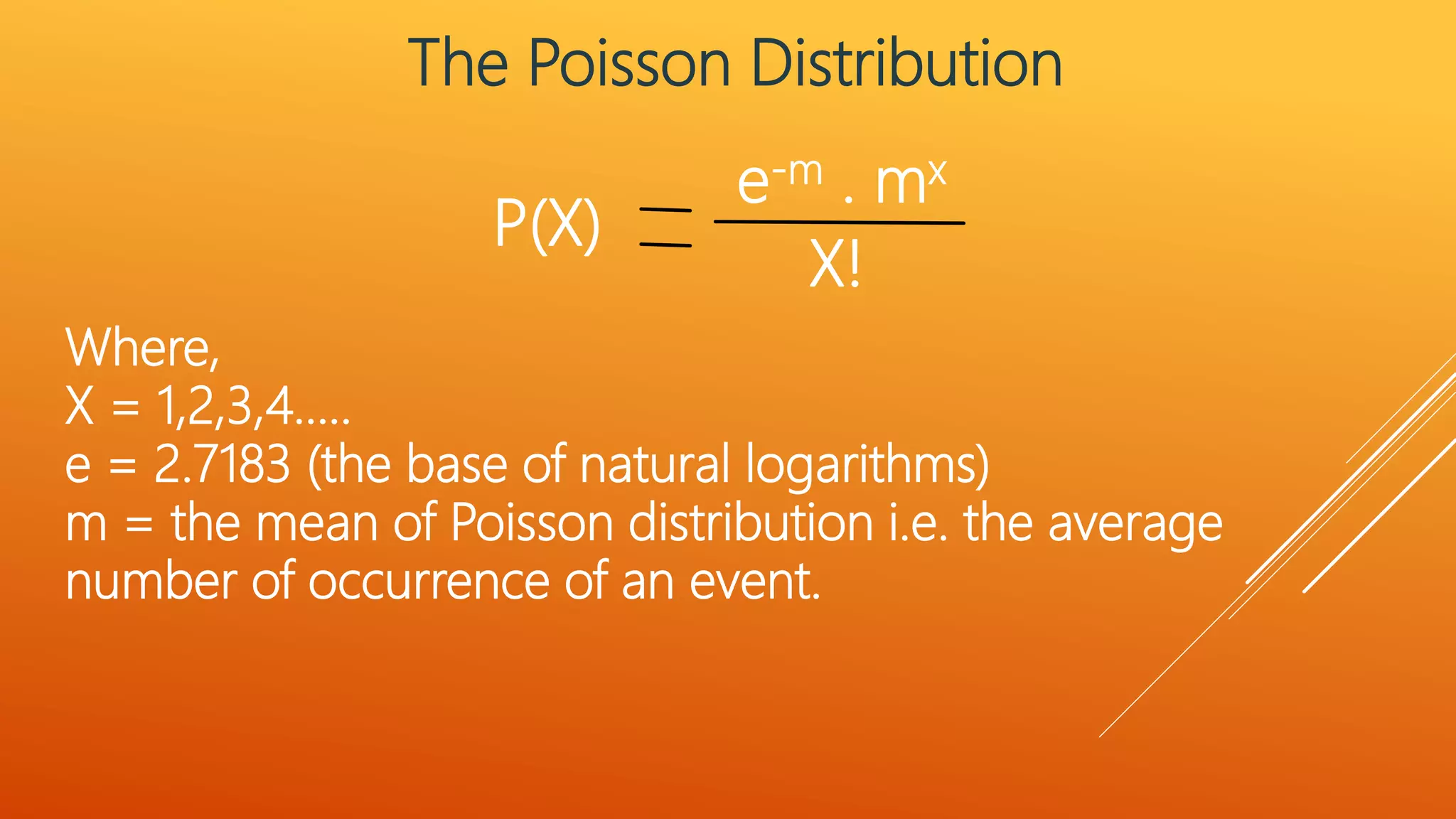
e-m . mx
Where,
X = 1,2,3,4…..
e = 2.7183 (the base of natural logarithms)
m = the mean of Poisson distribution i.e. the average
number of occurrence of an event.
X!
P(X)
Condition Under Which Poisson Distribution is Used
 The random variable X should be discrete.
 A dichotomy exists, i.e. happening of the event must be of two
alternatives such as success & failure.
 Applicable is those cases where the number of trials n is very large
and the probability of success p is very small but the mean np = m
is finite.
 Statistical independence is assumed.
Characteristics of Poisson Distribution
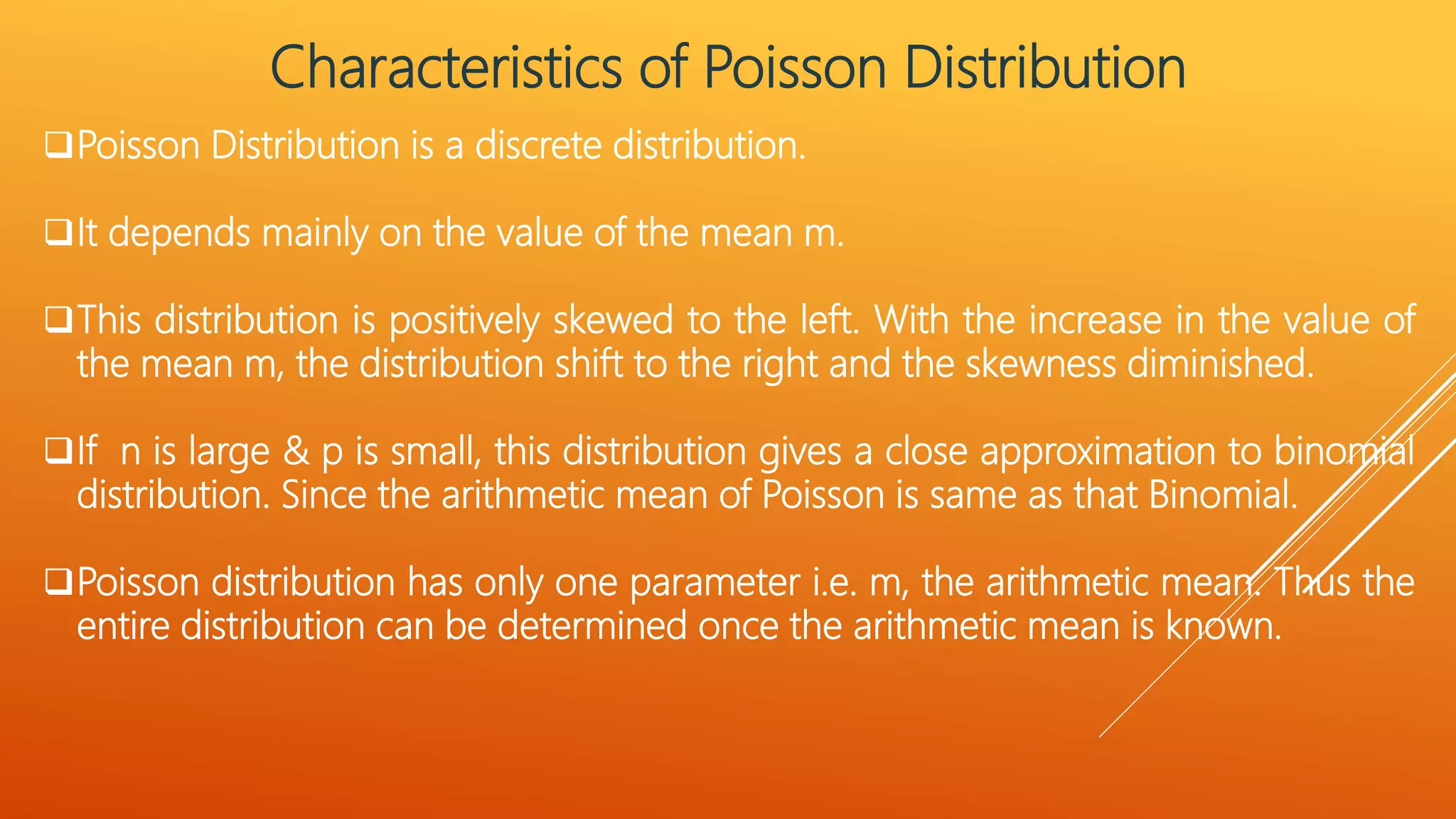
Poisson Distribution is a discrete distribution.
It depends mainly on the value of the mean m.
This distribution is positively skewed to the left. With the increase in the value of
the mean m, the distribution shift to the right and the skewness diminished.
If n is large & p is small, this distribution gives a close approximation to binomial
distribution. Since the arithmetic mean of Poisson is same as that Binomial.
Poisson distribution has only one parameter i.e. m, the arithmetic mean. Thus the
entire distribution can be determined once the arithmetic mean is known.
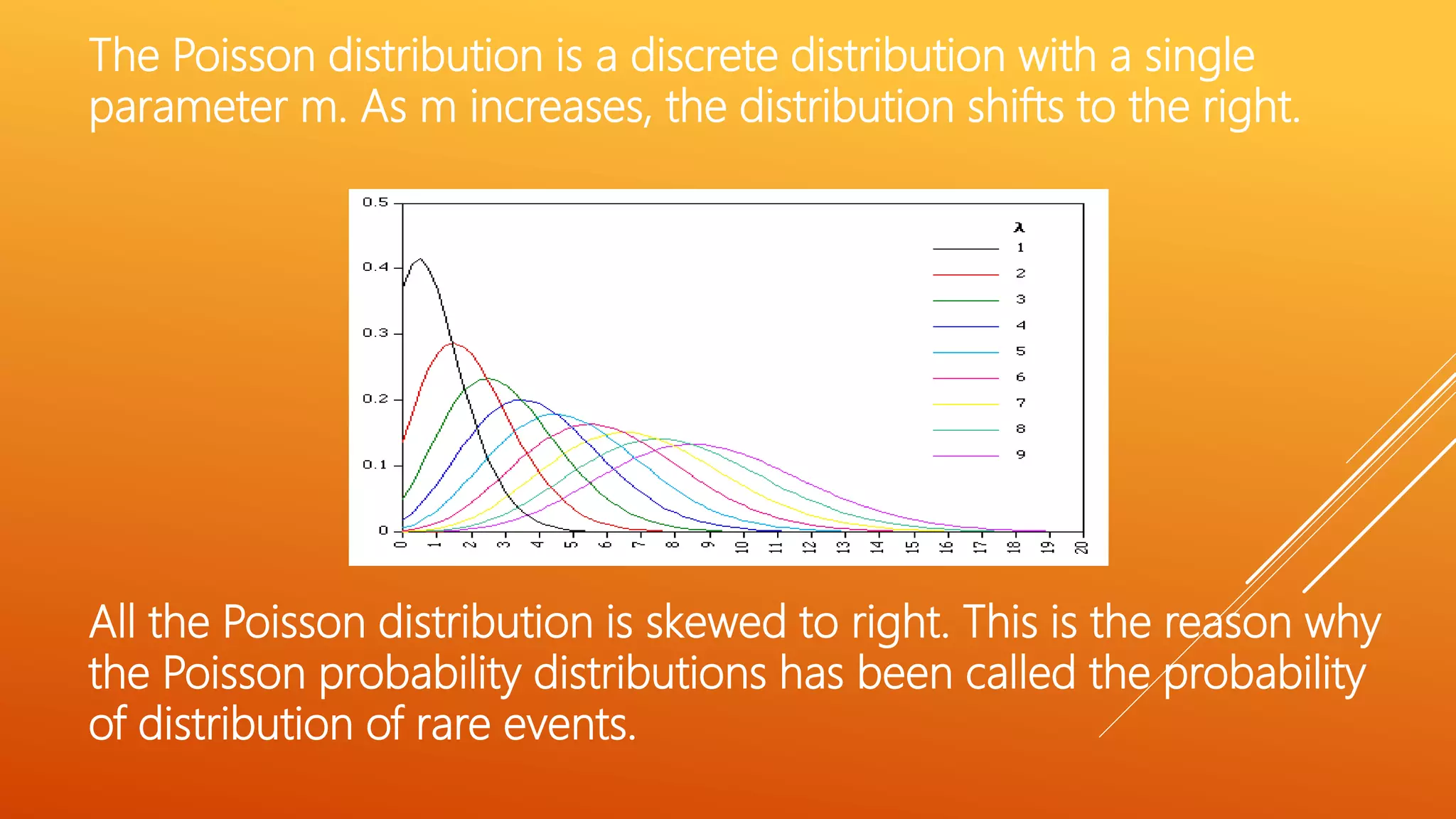
The Poisson distribution is a discrete distribution with a single
parameter m. As m increases, the distribution shifts to the right.
All the Poisson distribution is skewed to right. This is the reason why
the Poisson probability distributions has been called the probability
of distribution of rare events.
Problem
Q- The average number of accidents at a particular intersection every year is 18.
(a) Calculate the probability that there are exactly 2 accidents there this month.
There are 12 months in a year, so l =
12
18
= 1.5 accidents per month
P(X = 2) =
!x
e x
ll
!2
5.1 25.1

e
= 0.2510
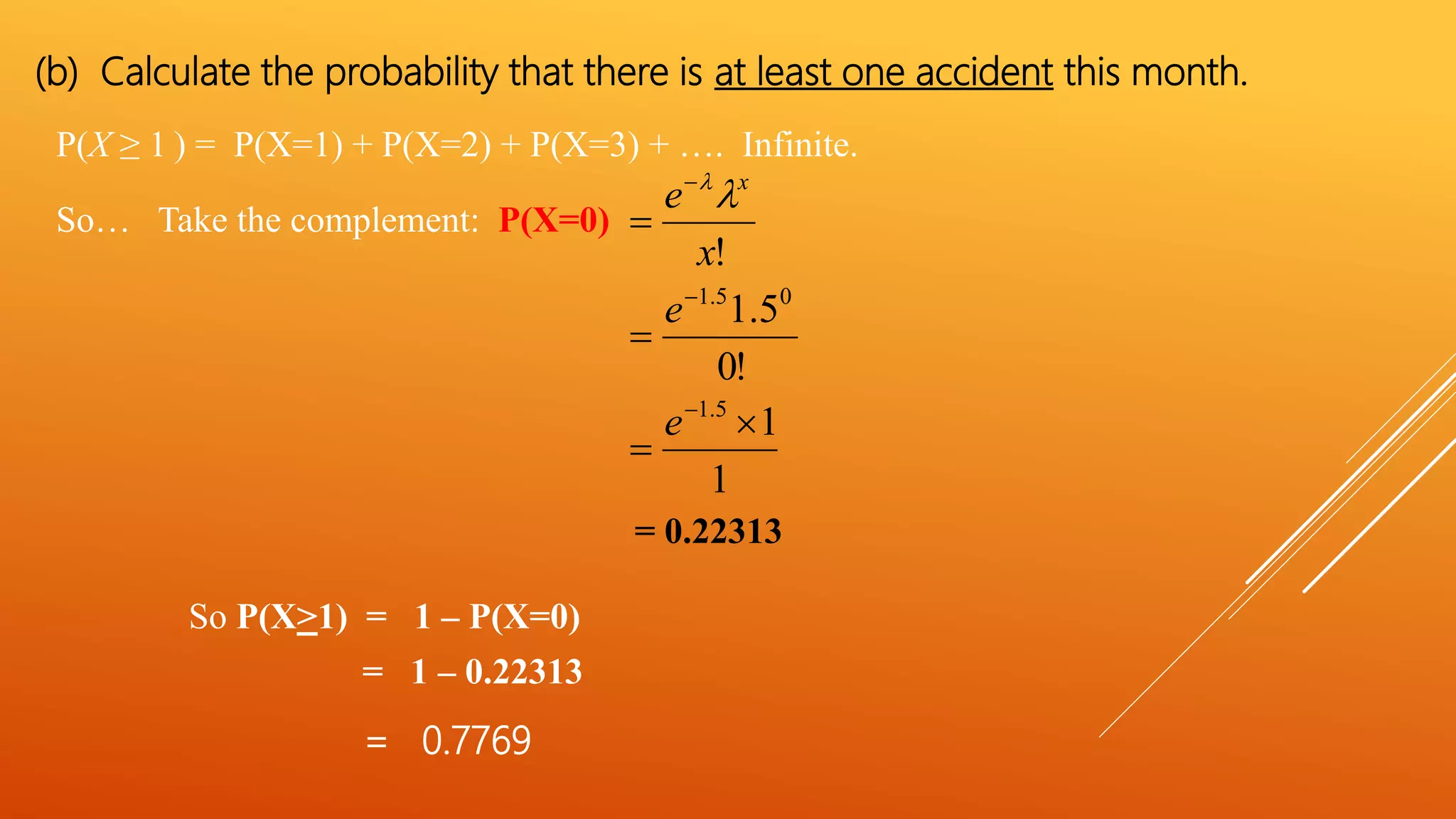
(b) Calculate the probability that there is at least one accident this month.
P(X ≥ 1 ) = P(X=1) + P(X=2) + P(X=3) + …. Infinite.
So… Take the complement: P(X=0)
!x
e x
ll

!0
5.1 05.1

e
1
15.1



e
= 0.22313
So P(X>1) = 1 – P(X=0)
= 1 – 0.22313
= 0.7769
c What is the probability that there are more than 2 accidents in a particular
month
b P(X > 2 ) = 1 – P(X < 2)
There are an infinite number of
cases so instead consider X < 2
= 1 – [ P(X =0) + P(X=1) + P(X=2)]
= 1 – [ 0.2231 + 0.3347 + 0.2510]
= 1 – 0.8088
= 0.1912
Fitting a Poisson Distribution
The process of fitting of a
Poisson distribution is very
simple. We have just to
obtain value of m i.e. the
average occurrence, and
calculate the frequency of 0
success. The other
frequencies can be very
easily calculated as follows:
P0 = Ne-m
P1 = P0 . m/1
P2 = P1 . m/2
P3 = P2 . m/3 etc.
Q) The following mistakes were observed in a book: [e0.44 = 0.6443]
X f fX
0 211 0
1 90 90
2 19 38
3 5 15
4 0 0
N = 325 ΣfX = 143
X f
0 211
1 90
2 19
3 5
4 0
Solution:
X = ΣfX/N
= 143/325 = 0.44
Mean of the distribution or m = 0.44
P0 = Ne-m
= 325 . 0.6443
= 209.40
P1 = P0 . m/1
= 209.40 . 0.44
= 92.14
P2 = P1 . m/2
= 92.14 . 0.44/2
= 20.27
P3 = P2 . m/3
= 20.27 . 0.44/3
= 2.97
P4 = P3 . m/4
= 2.97 . 0.44/4
= 0.33
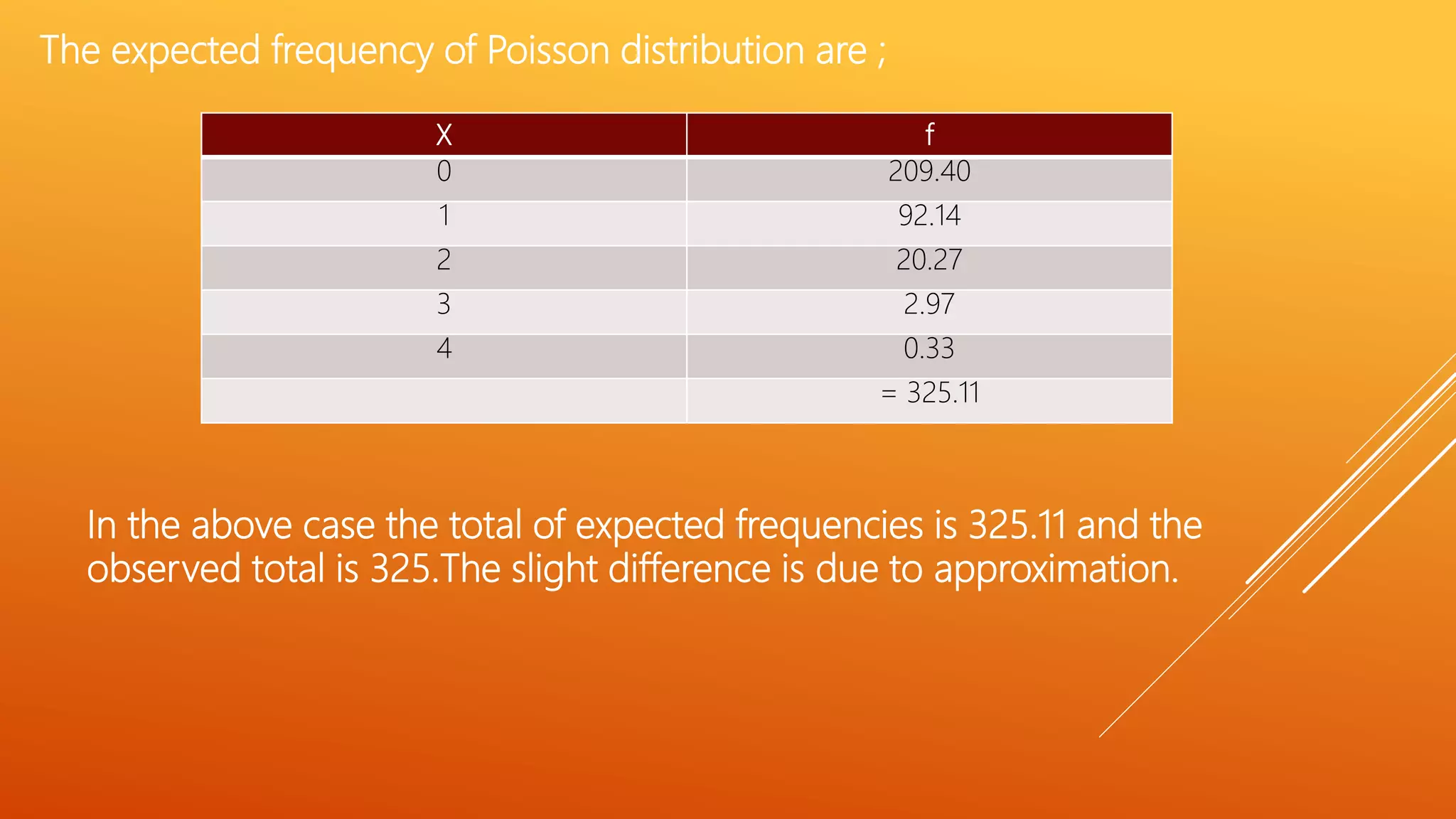
The expected frequency of Poisson distribution are ;
X f
0 209.40
1 92.14
2 20.27
3 2.97
4 0.33
= 325.11
In the above case the total of expected frequencies is 325.11 and the
observed total is 325.The slight difference is due to approximation.
References :
 S C Gupta; Statistical Method; Sultan Chand & Sons Educational
Publishers New Delhi; 2010; P 826 – 833.
 P N Arora, S Arora, S Arora; Comprehensive Statistical Method; S
Chand & Company LTD; 2012; P 13.34 - 13.37.
 P Cholayudth; Application of Poisson Distribution In Stabilising
Control Limit For Discrete Quality Attributes; Journal of Validation
Technology; Vol 13; 2007; P 196 – 205.
Thank You

Poisson distribution

  • 1.
    M.Pharm 1st SemesterSeminar Subject :Biostatistics Topic : Poisson Distribution By: Anindya Jana M.Pharm 1st Year (Pharmaceutics) Regd. No. : 1661611006
  • 2.
    What Is PoissonDistribution? Poisson distribution is a limiting form of the binomial distribution in which n, the number of trials, becomes very large & p, the probability of success of the event is very very small.
  • 3.
    History The distribution wasderived by the French mathematician Siméon Poisson in 1837, and the first application was the description of the number of deaths by horse kicking in the Prussian army.
  • 4.
    Poisson distribution usedin cases where the chance of any individual event being a success is very small. The distribution is used to describe the behaviour of rare events. Examples; The number of defective screws per box of 5000 screws. The number of printing mistakes in each page of the first proof of book. The number of air accidents in India in one year. Occurrence of number of scratches on a sheet of glass. Why we need Poisson Distribution!!
  • 5.
    Use of PoissonDistribution In Pharmaceutical  Control limits for numbers of tablets rejected from an online Metal Detector during tablet compression cycle.  Microbial counts in raw materials, products, and water for pharmaceutical use.  Control limits for numbers of containers rejected from visual inspection of sterile production batches.  Alert limits for microbial levels in cleanroom environment.  Release limits for microbial counts in nonsterile products.
  • 6.
    The Poisson Distribution e-m. mx Where, X = 1,2,3,4….. e = 2.7183 (the base of natural logarithms) m = the mean of Poisson distribution i.e. the average number of occurrence of an event. X! P(X)
  • 7.
    Condition Under WhichPoisson Distribution is Used  The random variable X should be discrete.  A dichotomy exists, i.e. happening of the event must be of two alternatives such as success & failure.  Applicable is those cases where the number of trials n is very large and the probability of success p is very small but the mean np = m is finite.  Statistical independence is assumed.
  • 8.
    Characteristics of PoissonDistribution Poisson Distribution is a discrete distribution. It depends mainly on the value of the mean m. This distribution is positively skewed to the left. With the increase in the value of the mean m, the distribution shift to the right and the skewness diminished. If n is large & p is small, this distribution gives a close approximation to binomial distribution. Since the arithmetic mean of Poisson is same as that Binomial. Poisson distribution has only one parameter i.e. m, the arithmetic mean. Thus the entire distribution can be determined once the arithmetic mean is known.
  • 9.
    The Poisson distributionis a discrete distribution with a single parameter m. As m increases, the distribution shifts to the right. All the Poisson distribution is skewed to right. This is the reason why the Poisson probability distributions has been called the probability of distribution of rare events.
  • 10.
    Problem Q- The averagenumber of accidents at a particular intersection every year is 18. (a) Calculate the probability that there are exactly 2 accidents there this month. There are 12 months in a year, so l = 12 18 = 1.5 accidents per month P(X = 2) = !x e x ll !2 5.1 25.1  e = 0.2510
  • 11.
    (b) Calculate theprobability that there is at least one accident this month. P(X ≥ 1 ) = P(X=1) + P(X=2) + P(X=3) + …. Infinite. So… Take the complement: P(X=0) !x e x ll  !0 5.1 05.1  e 1 15.1    e = 0.22313 So P(X>1) = 1 – P(X=0) = 1 – 0.22313 = 0.7769
  • 12.
    c What isthe probability that there are more than 2 accidents in a particular month b P(X > 2 ) = 1 – P(X < 2) There are an infinite number of cases so instead consider X < 2 = 1 – [ P(X =0) + P(X=1) + P(X=2)] = 1 – [ 0.2231 + 0.3347 + 0.2510] = 1 – 0.8088 = 0.1912
  • 13.
    Fitting a PoissonDistribution The process of fitting of a Poisson distribution is very simple. We have just to obtain value of m i.e. the average occurrence, and calculate the frequency of 0 success. The other frequencies can be very easily calculated as follows: P0 = Ne-m P1 = P0 . m/1 P2 = P1 . m/2 P3 = P2 . m/3 etc.
  • 14.
    Q) The followingmistakes were observed in a book: [e0.44 = 0.6443] X f fX 0 211 0 1 90 90 2 19 38 3 5 15 4 0 0 N = 325 ΣfX = 143 X f 0 211 1 90 2 19 3 5 4 0 Solution:
  • 15.
    X = ΣfX/N =143/325 = 0.44 Mean of the distribution or m = 0.44 P0 = Ne-m = 325 . 0.6443 = 209.40 P1 = P0 . m/1 = 209.40 . 0.44 = 92.14 P2 = P1 . m/2 = 92.14 . 0.44/2 = 20.27 P3 = P2 . m/3 = 20.27 . 0.44/3 = 2.97 P4 = P3 . m/4 = 2.97 . 0.44/4 = 0.33
  • 16.
    The expected frequencyof Poisson distribution are ; X f 0 209.40 1 92.14 2 20.27 3 2.97 4 0.33 = 325.11 In the above case the total of expected frequencies is 325.11 and the observed total is 325.The slight difference is due to approximation.
  • 17.
    References :  SC Gupta; Statistical Method; Sultan Chand & Sons Educational Publishers New Delhi; 2010; P 826 – 833.  P N Arora, S Arora, S Arora; Comprehensive Statistical Method; S Chand & Company LTD; 2012; P 13.34 - 13.37.  P Cholayudth; Application of Poisson Distribution In Stabilising Control Limit For Discrete Quality Attributes; Journal of Validation Technology; Vol 13; 2007; P 196 – 205.
  • 18.