Presentation
on
Poisson Distribution-Assumption , Mean &
Variance
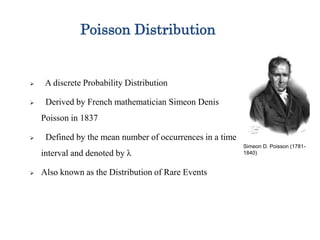
 A discrete Probability Distribution
 Derived by French mathematician Simeon Denis
Poisson in 1837
 Defined by the mean number of occurrences in a time
interval and denoted by λ
 Also known as the Distribution of Rare Events
Poisson Distribution
Simeon D. Poisson (1781-
1840)
Works when binomial calculation becomes impractical (No. of
trials>probability of success),
 Applied where random events in space or time are expected to occur.
 Deviation indicates some degree of non-randomness in the events
Example: Number of earthquakes per year.
Cont’d…
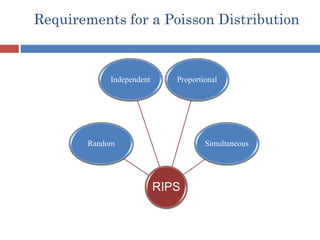
Requirements for a Poisson Distribution
RIPS
Random
Proportional
Simultaneous
Independent
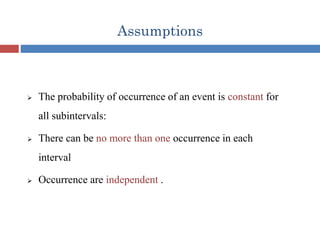
Assumptions
 The probability of occurrence of an event is constant for
all subintervals:
 There can be no more than one occurrence in each
interval
 Occurrence are independent .
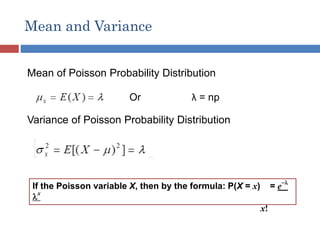
If the Poisson variable X, then by the formula: P(X = x) = e-l
lx
x!
Mean and Variance
Mean of Poisson Probability Distribution
Variance of Poisson Probability Distribution
Or λ = np
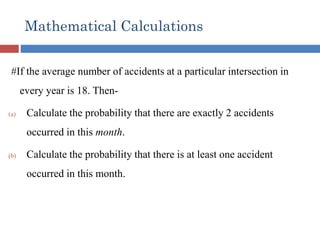
Mathematical Calculations
#If the average number of accidents at a particular intersection in
every year is 18. Then-
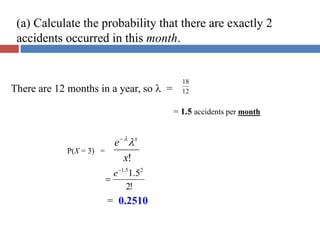
(a) Calculate the probability that there are exactly 2 accidents
occurred in this month.
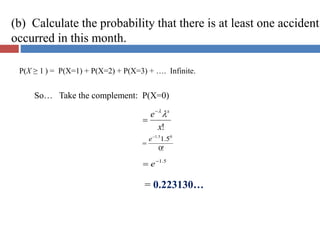
(b) Calculate the probability that there is at least one accident
occurred in this month.
There are 12 months in a year, so l = 12
18
= 1.5 accidents per month
P(X = 3) =
!
x
e x
l
l
-
!
2
5
.
1 2
5
.
1
-

e
= 0.2510
(a) Calculate the probability that there are exactly 2
accidents occurred in this month.
(b) Calculate the probability that there is at least one accident
occurred in this month.
P(X ≥ 1 ) = P(X=1) + P(X=2) + P(X=3) + …. Infinite.
So… Take the complement: P(X=0)
!
x
e x
l
l
-

!
0
5
.
1 0
5
.
1
-

e
5
.
1
-
 e
= 0.223130…

Arya_verman_052_Poisson_distribution_variance_mean.pptx

  • 1.
  • 2.
     A discreteProbability Distribution  Derived by French mathematician Simeon Denis Poisson in 1837  Defined by the mean number of occurrences in a time interval and denoted by λ  Also known as the Distribution of Rare Events Poisson Distribution Simeon D. Poisson (1781- 1840)
  • 3.
    Works when binomialcalculation becomes impractical (No. of trials>probability of success),  Applied where random events in space or time are expected to occur.  Deviation indicates some degree of non-randomness in the events Example: Number of earthquakes per year. Cont’d…
  • 4.
    Requirements for aPoisson Distribution RIPS Random Proportional Simultaneous Independent
  • 5.
    Assumptions  The probabilityof occurrence of an event is constant for all subintervals:  There can be no more than one occurrence in each interval  Occurrence are independent .
  • 6.
    If the Poissonvariable X, then by the formula: P(X = x) = e-l lx x! Mean and Variance Mean of Poisson Probability Distribution Variance of Poisson Probability Distribution Or λ = np
  • 7.
    Mathematical Calculations #If theaverage number of accidents at a particular intersection in every year is 18. Then- (a) Calculate the probability that there are exactly 2 accidents occurred in this month. (b) Calculate the probability that there is at least one accident occurred in this month.
  • 8.
    There are 12months in a year, so l = 12 18 = 1.5 accidents per month P(X = 3) = ! x e x l l - ! 2 5 . 1 2 5 . 1 -  e = 0.2510 (a) Calculate the probability that there are exactly 2 accidents occurred in this month.
  • 9.
    (b) Calculate theprobability that there is at least one accident occurred in this month. P(X ≥ 1 ) = P(X=1) + P(X=2) + P(X=3) + …. Infinite. So… Take the complement: P(X=0) ! x e x l l -  ! 0 5 . 1 0 5 . 1 -  e 5 . 1 -  e = 0.223130…