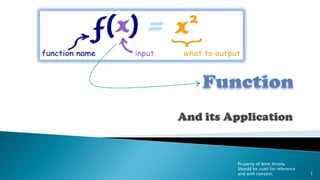
And its Application
Property of Amit Amola.
Should be used for reference
and with consent. 1
In mathematics, a function is a relation
between a set of inputs and a set of
permissible outputs with the property that
each input is related to exactly one output.
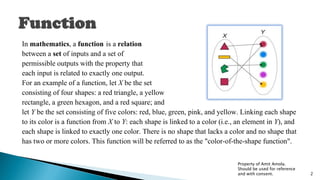
For an example of a function, let X be the set
consisting of four shapes: a red triangle, a yellow
rectangle, a green hexagon, and a red square; and
let Y be the set consisting of five colors: red, blue, green, pink, and yellow. Linking each shape
to its color is a function from X to Y: each shape is linked to a color (i.e., an element in Y), and
each shape is linked to exactly one color. There is no shape that lacks a color and no shape that
has two or more colors. This function will be referred to as the "color-of-the-shape function".
Property of Amit Amola.
Should be used for reference
and with consent. 2
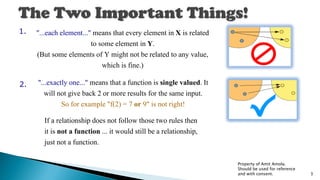
1. "...each element..." means that every element in X is related
to some element in Y.
(But some elements of Y might not be related to any value,
which is fine.)
2. "...exactly one..." means that a function is single valued. It
will not give back 2 or more results for the same input.
So for example "f(2) = 7 or 9" is not right!
If a relationship does not follow those two rules then
it is not a function ... it would still be a relationship,
just not a function.
Property of Amit Amola.
Should be used for reference
and with consent. 3
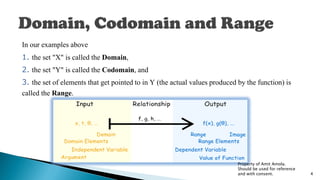
In our examples above
1. the set "X" is called the Domain,
2. the set "Y" is called the Codomain, and
3. the set of elements that get pointed to in Y (the actual values produced by the function) is
called the Range.
Property of Amit Amola.
Should be used for reference
and with consent. 4
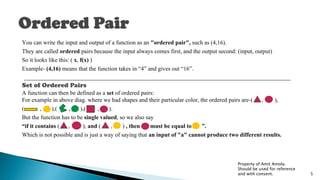
You can write the input and output of a function as an "ordered pair", such as (4,16).
They are called ordered pairs because the input always comes first, and the output second: (input, output)
So it looks like this: ( x, f(x) )
Example- (4,16) means that the function takes in “4” and gives out “16”.
Set of Ordered Pairs
A function can then be defined as a set of ordered pairs:
For example in above diag. where we had shapes and their particular color, the ordered pairs are-( , ),
( , ),( , ),( , ).
But the function has to be single valued, so we also say
“if it contains ( , ), and ( , ) , then must be equal to ”.
Which is not possible and is just a way of saying that an input of "a" cannot produce two different results.
Property of Amit Amola.
Should be used for reference
and with consent. 5
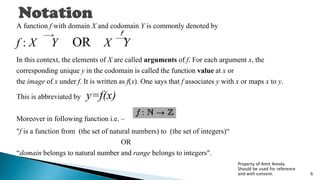
A function f with domain X and codomain Y is commonly denoted by
f : X Y OR X Y
In this context, the elements of X are called arguments of f. For each argument x, the
corresponding unique y in the codomain is called the function value at x or
the image of x under f. It is written as f(x). One says that f associates y with x or maps x to y.
This is abbreviated by y=f(x)
Moreover in following function i.e. –
"f is a function from (the set of natural numbers) to (the set of integers)“
OR
“domain belongs to natural number and range belongs to integers".
f
Property of Amit Amola.
Should be used for reference
and with consent. 6
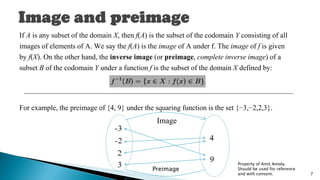
If A is any subset of the domain X, then f(A) is the subset of the codomain Y consisting of all
images of elements of A. We say the f(A) is the image of A under f. The image of f is given
by f(X). On the other hand, the inverse image (or preimage, complete inverse image) of a
subset B of the codomain Y under a function f is the subset of the domain X defined by:
For example, the preimage of {4, 9} under the squaring function is the set {−3,−2,2,3}.
Image
Property of Amit Amola.
Should be used for reference
and with consent. 7
Preimage
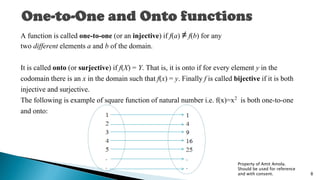
A function is called one-to-one (or an injective) if f(a) ≠ f(b) for any
two different elements a and b of the domain.
It is called onto (or surjective) if f(X) = Y. That is, it is onto if for every element y in the
codomain there is an x in the domain such that f(x) = y. Finally f is called bijective if it is both
injective and surjective.
The following is example of square function of natural number i.e. f(x)=x2 is both one-to-one
and onto:
Property of Amit Amola.
Should be used for reference
and with consent. 8
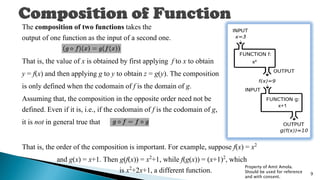
The composition of two functions takes the
output of one function as the input of a second one.
That is, the value of x is obtained by first applying f to x to obtain
y = f(x) and then applying g to y to obtain z = g(y). The composition
is only defined when the codomain of f is the domain of g.
Assuming that, the composition in the opposite order need not be
defined. Even if it is, i.e., if the codomain of f is the codomain of g,
it is not in general true that
That is, the order of the composition is important. For example, suppose f(x) = x2
and g(x) = x+1. Then g(f(x)) = x2+1, while f(g(x)) = (x+1)2, which
is x2+2x+1, a different function. Property of Amit Amola.
Should be used for reference
and with consent.
9
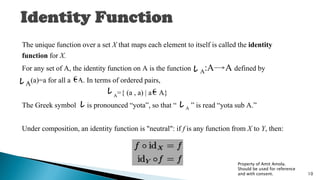
The unique function over a set X that maps each element to itself is called the identity
function for X.
For any set of A, the identity function on A is the function A:A A defined by
A(a)=a for all a A. In terms of ordered pairs,
A={ (a , a) | a A}
The Greek symbol is pronounced “yota”, so that “ A ” is read “yota sub A.”
Under composition, an identity function is "neutral": if f is any function from X to Y, then:
Property of Amit Amola.
Should be used for reference
and with consent. 10
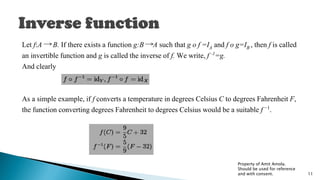
Let f:A B. If there exists a function g:B A such that g o f =IA and f o g=IB , then f is called
an invertible function and g is called the inverse of f. We write, f -1=g.
And clearly
As a simple example, if f converts a temperature in degrees Celsius C to degrees Fahrenheit F,
the function converting degrees Fahrenheit to degrees Celsius would be a suitable f −1.
Property of Amit Amola.
Should be used for reference
and with consent. 11
A real-valued function f is one whose codomain is the set of real numbers or a subset thereof.
If, in addition, the domain is also a subset of the real number, f is a real valued function of a real
variable. The study of such functions is called real analysis.
Example:
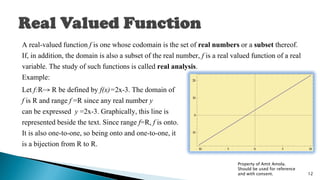
Let f:R R be defined by f(x)=2x-3. The domain of
f is R and range f =R since any real number y
can be expressed y =2x-3. Graphically, this line is
represented beside the text. Since range f=R, f is onto.
It is also one-to-one, so being onto and one-to-one, it
is a bijection from R to R. 10 5 0 5 10
10
0
10
20
Property of Amit Amola.
Should be used for reference
and with consent. 12
• differentiable, integrable
• polynomial, rational
• algebraic, transcendental
• odd or even
• convex, monotonic
• holomorphic, meromorphic, entire
• vector-valued
• computable
Property of Amit Amola.
Should be used for reference
and with consent. 13
Property of Amit Amola.
Should be used for reference
and with consent. 14
When the ATM card is inserted to the
machine, the program inside is performing a
function to map the number stored in the card
to your current or saving account. This is
basically a one-to-one mapping, i.e., function.
This is probably the most widely and popular
use of function.
Property of Amit Amola.
Should be used for reference
and with consent. 15
Money as a function of time. You never
have more than one amount of money at any
time because you can always add everything
to give one total amount. By understanding
how your money changes over time, you
can plan to spend your money sensibly.
Businessmen find it very useful to plot the
graph of their money over time so that they
can see when they are spending too much.
Property of Amit Amola.
Should be used for reference
and with consent. 16
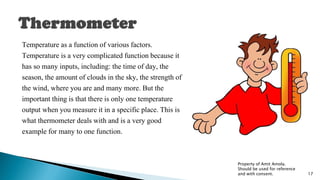
Temperature as a function of various factors.
Temperature is a very complicated function because it
has so many inputs, including: the time of day, the
season, the amount of clouds in the sky, the strength of
the wind, where you are and many more. But the
important thing is that there is only one temperature
output when you measure it in a specific place. This is
what thermometer deals with and is a very good
example for many to one function.
Property of Amit Amola.
Should be used for reference
and with consent. 17
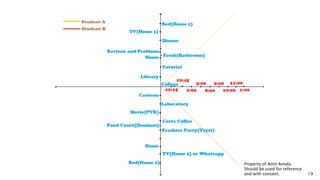
Location as a function of time. You can never be in two places at the same time. If you were to
plot the graphs of where two people are as a function of time, the place where the lines cross
means that the two people meet each other at that time. This idea is used in logistics, an area of
mathematics that tries to plan where people and items are for businesses.
Property of Amit Amola.
Should be used for reference
and with consent. 18
Property of Amit Amola.
Should be used for reference
and with consent. 19

Functions and its Applications in Mathematics

  • 1.
    And its Application Propertyof Amit Amola. Should be used for reference and with consent. 1
  • 2.
    In mathematics, afunction is a relation between a set of inputs and a set of permissible outputs with the property that each input is related to exactly one output. For an example of a function, let X be the set consisting of four shapes: a red triangle, a yellow rectangle, a green hexagon, and a red square; and let Y be the set consisting of five colors: red, blue, green, pink, and yellow. Linking each shape to its color is a function from X to Y: each shape is linked to a color (i.e., an element in Y), and each shape is linked to exactly one color. There is no shape that lacks a color and no shape that has two or more colors. This function will be referred to as the "color-of-the-shape function". Property of Amit Amola. Should be used for reference and with consent. 2
  • 3.
    1. "...each element..."means that every element in X is related to some element in Y. (But some elements of Y might not be related to any value, which is fine.) 2. "...exactly one..." means that a function is single valued. It will not give back 2 or more results for the same input. So for example "f(2) = 7 or 9" is not right! If a relationship does not follow those two rules then it is not a function ... it would still be a relationship, just not a function. Property of Amit Amola. Should be used for reference and with consent. 3
  • 4.
    In our examplesabove 1. the set "X" is called the Domain, 2. the set "Y" is called the Codomain, and 3. the set of elements that get pointed to in Y (the actual values produced by the function) is called the Range. Property of Amit Amola. Should be used for reference and with consent. 4
  • 5.
    You can writethe input and output of a function as an "ordered pair", such as (4,16). They are called ordered pairs because the input always comes first, and the output second: (input, output) So it looks like this: ( x, f(x) ) Example- (4,16) means that the function takes in “4” and gives out “16”. Set of Ordered Pairs A function can then be defined as a set of ordered pairs: For example in above diag. where we had shapes and their particular color, the ordered pairs are-( , ), ( , ),( , ),( , ). But the function has to be single valued, so we also say “if it contains ( , ), and ( , ) , then must be equal to ”. Which is not possible and is just a way of saying that an input of "a" cannot produce two different results. Property of Amit Amola. Should be used for reference and with consent. 5
  • 6.
    A function fwith domain X and codomain Y is commonly denoted by f : X Y OR X Y In this context, the elements of X are called arguments of f. For each argument x, the corresponding unique y in the codomain is called the function value at x or the image of x under f. It is written as f(x). One says that f associates y with x or maps x to y. This is abbreviated by y=f(x) Moreover in following function i.e. – "f is a function from (the set of natural numbers) to (the set of integers)“ OR “domain belongs to natural number and range belongs to integers". f Property of Amit Amola. Should be used for reference and with consent. 6
  • 7.
    If A isany subset of the domain X, then f(A) is the subset of the codomain Y consisting of all images of elements of A. We say the f(A) is the image of A under f. The image of f is given by f(X). On the other hand, the inverse image (or preimage, complete inverse image) of a subset B of the codomain Y under a function f is the subset of the domain X defined by: For example, the preimage of {4, 9} under the squaring function is the set {−3,−2,2,3}. Image Property of Amit Amola. Should be used for reference and with consent. 7 Preimage
  • 8.
    A function iscalled one-to-one (or an injective) if f(a) ≠ f(b) for any two different elements a and b of the domain. It is called onto (or surjective) if f(X) = Y. That is, it is onto if for every element y in the codomain there is an x in the domain such that f(x) = y. Finally f is called bijective if it is both injective and surjective. The following is example of square function of natural number i.e. f(x)=x2 is both one-to-one and onto: Property of Amit Amola. Should be used for reference and with consent. 8
  • 9.
    The composition oftwo functions takes the output of one function as the input of a second one. That is, the value of x is obtained by first applying f to x to obtain y = f(x) and then applying g to y to obtain z = g(y). The composition is only defined when the codomain of f is the domain of g. Assuming that, the composition in the opposite order need not be defined. Even if it is, i.e., if the codomain of f is the codomain of g, it is not in general true that That is, the order of the composition is important. For example, suppose f(x) = x2 and g(x) = x+1. Then g(f(x)) = x2+1, while f(g(x)) = (x+1)2, which is x2+2x+1, a different function. Property of Amit Amola. Should be used for reference and with consent. 9
  • 10.
    The unique functionover a set X that maps each element to itself is called the identity function for X. For any set of A, the identity function on A is the function A:A A defined by A(a)=a for all a A. In terms of ordered pairs, A={ (a , a) | a A} The Greek symbol is pronounced “yota”, so that “ A ” is read “yota sub A.” Under composition, an identity function is "neutral": if f is any function from X to Y, then: Property of Amit Amola. Should be used for reference and with consent. 10
  • 11.
    Let f:A B.If there exists a function g:B A such that g o f =IA and f o g=IB , then f is called an invertible function and g is called the inverse of f. We write, f -1=g. And clearly As a simple example, if f converts a temperature in degrees Celsius C to degrees Fahrenheit F, the function converting degrees Fahrenheit to degrees Celsius would be a suitable f −1. Property of Amit Amola. Should be used for reference and with consent. 11
  • 12.
    A real-valued functionf is one whose codomain is the set of real numbers or a subset thereof. If, in addition, the domain is also a subset of the real number, f is a real valued function of a real variable. The study of such functions is called real analysis. Example: Let f:R R be defined by f(x)=2x-3. The domain of f is R and range f =R since any real number y can be expressed y =2x-3. Graphically, this line is represented beside the text. Since range f=R, f is onto. It is also one-to-one, so being onto and one-to-one, it is a bijection from R to R. 10 5 0 5 10 10 0 10 20 Property of Amit Amola. Should be used for reference and with consent. 12
  • 13.
    • differentiable, integrable •polynomial, rational • algebraic, transcendental • odd or even • convex, monotonic • holomorphic, meromorphic, entire • vector-valued • computable Property of Amit Amola. Should be used for reference and with consent. 13
  • 14.
    Property of AmitAmola. Should be used for reference and with consent. 14
  • 15.
    When the ATMcard is inserted to the machine, the program inside is performing a function to map the number stored in the card to your current or saving account. This is basically a one-to-one mapping, i.e., function. This is probably the most widely and popular use of function. Property of Amit Amola. Should be used for reference and with consent. 15
  • 16.
    Money as afunction of time. You never have more than one amount of money at any time because you can always add everything to give one total amount. By understanding how your money changes over time, you can plan to spend your money sensibly. Businessmen find it very useful to plot the graph of their money over time so that they can see when they are spending too much. Property of Amit Amola. Should be used for reference and with consent. 16
  • 17.
    Temperature as afunction of various factors. Temperature is a very complicated function because it has so many inputs, including: the time of day, the season, the amount of clouds in the sky, the strength of the wind, where you are and many more. But the important thing is that there is only one temperature output when you measure it in a specific place. This is what thermometer deals with and is a very good example for many to one function. Property of Amit Amola. Should be used for reference and with consent. 17
  • 18.
    Location as afunction of time. You can never be in two places at the same time. If you were to plot the graphs of where two people are as a function of time, the place where the lines cross means that the two people meet each other at that time. This idea is used in logistics, an area of mathematics that tries to plan where people and items are for businesses. Property of Amit Amola. Should be used for reference and with consent. 18
  • 19.
    Property of AmitAmola. Should be used for reference and with consent. 19