Functions
Functions vs. Relations
• A "relation" is just a relationship between sets of
information.
• A “function” is a well-behaved relation, that is,
given a starting point we know exactly where to
go.
• A function is a special kind of relation where
every input goes to exactly one output
– It’s PREDICTABLE!
Definition
Let X and Y be two nonempty sets.
A function from X into Y is a relation that
associates with each element of X exactly one element
of Y.
Given any sets A, B, a function (or
“mapping”) f from A to B (f:A→B) is an
assignment of exactly one element f(x)B to
each element x  A.
• Not every relation is a function(many to one allowed,
but one to many not allowed, i.e., not a function.
• Every function is a relation.
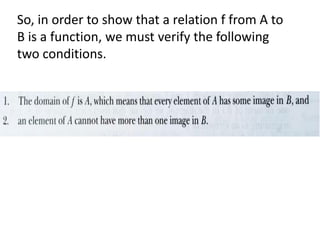
So, in order to show that a relation f from A to
B is a function, we must verify the following
two conditions.
Representations of Functions
• Verbally
• Numerically, i.e. by a table
• Visually, i.e. by a graph/arrow diagram
• Algebraically, i.e. by an explicit formula
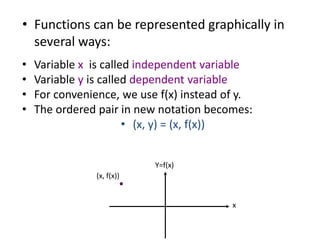
• Functions can be represented graphically in
several ways:
• Variable x is called independent variable
• Variable y is called dependent variable
• For convenience, we use f(x) instead of y.
• The ordered pair in new notation becomes:
• (x, y) = (x, f(x))
Y=f(x)
x
(x, f(x))
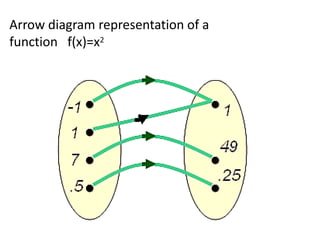
Arrow diagram representation of a
function f(x)=x2
Domain and Range
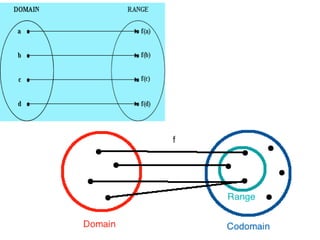
• Suppose, we are given a function from X into Y.
• Recall, for each element x in X there is exactly one corresponding element y=f(x)
in Y.
• This element y=f(x) in Y we call the image of x.
• The domain of a function is the set X. That is a collection of all possible x-values.
• The range of a function is the set of all images as x varies throughout the
domain.
• Y is the codomain.
• Domain- All inputs and Range- All outputs
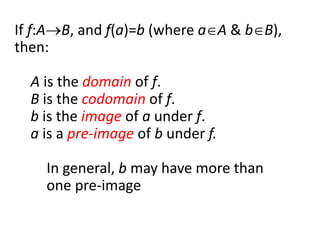
If f:A→B, and f(a)=b (where aA & bB),
then:
A is the domain of f.
B is the codomain of f.
b is the image of a under f.
a is a pre-image of b under f.
In general, b may have more than
one pre-image
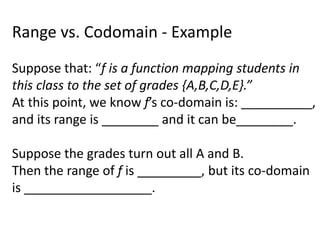
Range vs. Codomain - Example
Suppose that: “f is a function mapping students in
this class to the set of grades {A,B,C,D,E}.”
At this point, we know f’s co-domain is: __________,
and its range is ________ and it can be________.
Suppose the grades turn out all A and B.
Then the range of f is _________, but its co-domain
is __________________.
Special functions
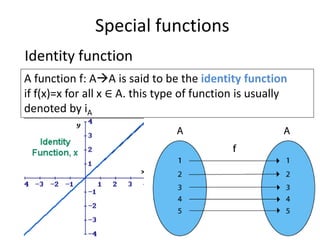
Identity function
A function f: A→A is said to be the identity function
if f(x)=x for all x ∈ A. this type of function is usually
denoted by iA
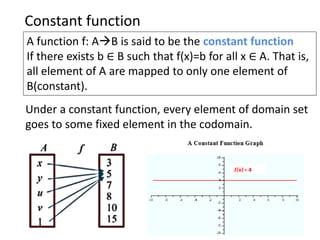
Constant function
A function f: A→B is said to be the constant function
If there exists b ∈ B such that f(x)=b for all x ∈ A. That is,
all element of A are mapped to only one element of
B(constant).
Under a constant function, every element of domain set
goes to some fixed element in the codomain.
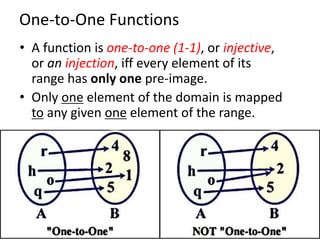
One-to-One Functions
• A function is one-to-one (1-1), or injective,
or an injection, iff every element of its
range has only one pre-image.
• Only one element of the domain is mapped
to any given one element of the range.
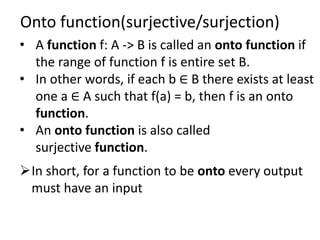
• A function f: A -> B is called an onto function if
the range of function f is entire set B.
• In other words, if each b ∈ B there exists at least
one a ∈ A such that f(a) = b, then f is an onto
function.
• An onto function is also called
surjective function.
Onto function(surjective/surjection)
➢In short, for a function to be onto every output
must have an input
Your task!!
• Domain?
• Range?
• Function?
• One to one?
• Onto?
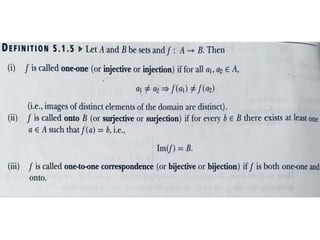
A function f is a one-to-one correspondence,
or a bijection, or reversible, or invertible, iff it
is both one-to-one and onto.
Bijective/bijection function
Your task
Determine whether following relations from set X to
set Y are functions or not?
1.
3.
2.
4.
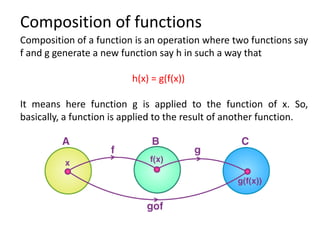
Composition of functions
Composition of a function is an operation where two functions say
f and g generate a new function say h in such a way that
h(x) = g(f(x))
It means here function g is applied to the function of x. So,
basically, a function is applied to the result of another function.
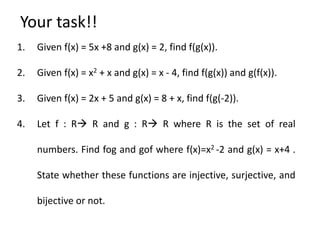
1. Given f(x) = 5x +8 and g(x) = 2, find f(g(x)).
2. Given f(x) = x2 + x and g(x) = x - 4, find f(g(x)) and g(f(x)).
3. Given f(x) = 2x + 5 and g(x) = 8 + x, find f(g(-2)).
4. Let f : R→ R and g : R→ R where R is the set of real
numbers. Find fog and gof where f(x)=x2 -2 and g(x) = x+4 .
State whether these functions are injective, surjective, and
bijective or not.
Your task!!
Your task!!
5. Let X={1,2,3} and f,g,h,s be functions from X to X given by
f = {<1,2>,<2,3>, <3,1>}
g = {<1,2>,<2,1>, <3,3>}
h = {<1,1>,<2,2>, <3,1>}
s = {<1,1>, <2,2>, <3,3>}
Find fog ,gof, fohog, sog, gos, sos.
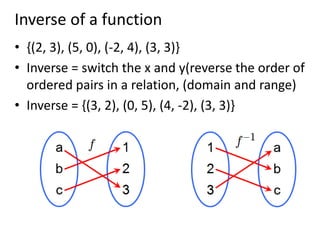
Inverse of a function
• Quick review of inverse of a relation.
• {(2, 3), (5, 0), (-2, 4), (3, 3)}
• Domain & Range = ?
• Inverse = ?
• D = {2, 5, -2, 3}
• R = {3, 0, 4}
• {(2, 3), (5, 0), (-2, 4), (3, 3)}
• Inverse = switch the x and y(reverse the order of
ordered pairs in a relation, (domain and range)
• Inverse = {(3, 2), (0, 5), (4, -2), (3, 3)}
Inverse of a function
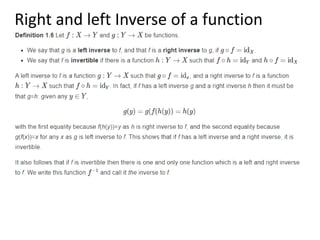
Right and left Inverse of a function
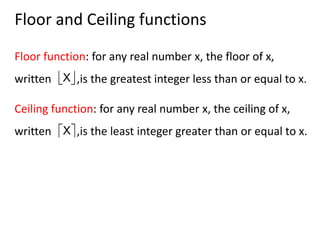
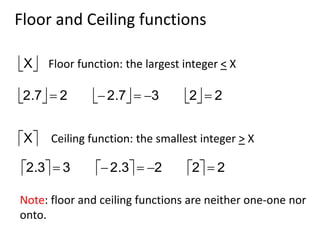
Floor and Ceiling functions
Floor function: for any real number x, the floor of x,
written ,is the greatest integer less than or equal to x.
 
X
Ceiling function: for any real number x, the ceiling of x,
written ,is the least integer greater than or equal to x.
 
X
 
X
 
X
Floor function: the largest integer < X
Ceiling function: the smallest integer > X
      2
2
3
2.7
2
2.7 =
−
=
−
=
      2
2
2
2.3
3
2.3 =
−
=
−
=
Floor and Ceiling functions
Note: floor and ceiling functions are neither one-one nor
onto.
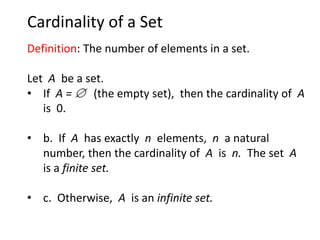
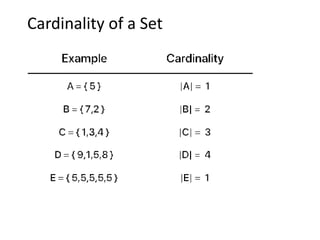
Cardinality of a Set
Definition: The number of elements in a set.
Let A be a set.
• If A =  (the empty set), then the cardinality of A
is 0.
• b. If A has exactly n elements, n a natural
number, then the cardinality of A is n. The set A
is a finite set.
• c. Otherwise, A is an infinite set.
Notation
The cardinality of a set A is denoted by | A |.
• If A =  , then | A |= 0.
• If A has exactly n elements, then | A | = n.
• c. If A is an infinite set, then | A | = .
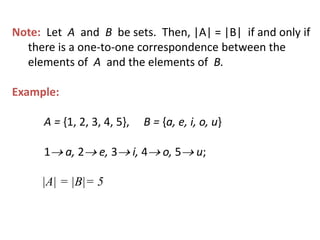
Cardinality of a Set
Note: Let A and B be sets. Then, |A| = |B| if and only if
there is a one-to-one correspondence between the
elements of A and the elements of B.
Example:
A = {1, 2, 3, 4, 5}, B = {a, e, i, o, u}
1→ a, 2→ e, 3→ i, 4→ o, 5→ u;
|A| = |B|= 5

functions-1.pdf

  • 1.
  • 2.
    Functions vs. Relations •A "relation" is just a relationship between sets of information. • A “function” is a well-behaved relation, that is, given a starting point we know exactly where to go. • A function is a special kind of relation where every input goes to exactly one output – It’s PREDICTABLE!
  • 3.
    Definition Let X andY be two nonempty sets. A function from X into Y is a relation that associates with each element of X exactly one element of Y. Given any sets A, B, a function (or “mapping”) f from A to B (f:A→B) is an assignment of exactly one element f(x)B to each element x  A. • Not every relation is a function(many to one allowed, but one to many not allowed, i.e., not a function. • Every function is a relation.
  • 4.
    So, in orderto show that a relation f from A to B is a function, we must verify the following two conditions.
  • 5.
    Representations of Functions •Verbally • Numerically, i.e. by a table • Visually, i.e. by a graph/arrow diagram • Algebraically, i.e. by an explicit formula
  • 6.
    • Functions canbe represented graphically in several ways: • Variable x is called independent variable • Variable y is called dependent variable • For convenience, we use f(x) instead of y. • The ordered pair in new notation becomes: • (x, y) = (x, f(x)) Y=f(x) x (x, f(x))
  • 7.
    Arrow diagram representationof a function f(x)=x2
  • 8.
    Domain and Range •Suppose, we are given a function from X into Y. • Recall, for each element x in X there is exactly one corresponding element y=f(x) in Y. • This element y=f(x) in Y we call the image of x. • The domain of a function is the set X. That is a collection of all possible x-values. • The range of a function is the set of all images as x varies throughout the domain. • Y is the codomain. • Domain- All inputs and Range- All outputs
  • 9.
    If f:A→B, andf(a)=b (where aA & bB), then: A is the domain of f. B is the codomain of f. b is the image of a under f. a is a pre-image of b under f. In general, b may have more than one pre-image
  • 10.
    Range vs. Codomain- Example Suppose that: “f is a function mapping students in this class to the set of grades {A,B,C,D,E}.” At this point, we know f’s co-domain is: __________, and its range is ________ and it can be________. Suppose the grades turn out all A and B. Then the range of f is _________, but its co-domain is __________________.
  • 12.
    Special functions Identity function Afunction f: A→A is said to be the identity function if f(x)=x for all x ∈ A. this type of function is usually denoted by iA
  • 13.
    Constant function A functionf: A→B is said to be the constant function If there exists b ∈ B such that f(x)=b for all x ∈ A. That is, all element of A are mapped to only one element of B(constant). Under a constant function, every element of domain set goes to some fixed element in the codomain.
  • 14.
    One-to-One Functions • Afunction is one-to-one (1-1), or injective, or an injection, iff every element of its range has only one pre-image. • Only one element of the domain is mapped to any given one element of the range.
  • 15.
    • A functionf: A -> B is called an onto function if the range of function f is entire set B. • In other words, if each b ∈ B there exists at least one a ∈ A such that f(a) = b, then f is an onto function. • An onto function is also called surjective function. Onto function(surjective/surjection) ➢In short, for a function to be onto every output must have an input
  • 17.
    Your task!! • Domain? •Range? • Function? • One to one? • Onto?
  • 18.
    A function fis a one-to-one correspondence, or a bijection, or reversible, or invertible, iff it is both one-to-one and onto. Bijective/bijection function
  • 20.
    Your task Determine whetherfollowing relations from set X to set Y are functions or not? 1. 3. 2. 4.
  • 21.
    Composition of functions Compositionof a function is an operation where two functions say f and g generate a new function say h in such a way that h(x) = g(f(x)) It means here function g is applied to the function of x. So, basically, a function is applied to the result of another function.
  • 22.
    1. Given f(x)= 5x +8 and g(x) = 2, find f(g(x)). 2. Given f(x) = x2 + x and g(x) = x - 4, find f(g(x)) and g(f(x)). 3. Given f(x) = 2x + 5 and g(x) = 8 + x, find f(g(-2)). 4. Let f : R→ R and g : R→ R where R is the set of real numbers. Find fog and gof where f(x)=x2 -2 and g(x) = x+4 . State whether these functions are injective, surjective, and bijective or not. Your task!!
  • 23.
    Your task!! 5. LetX={1,2,3} and f,g,h,s be functions from X to X given by f = {<1,2>,<2,3>, <3,1>} g = {<1,2>,<2,1>, <3,3>} h = {<1,1>,<2,2>, <3,1>} s = {<1,1>, <2,2>, <3,3>} Find fog ,gof, fohog, sog, gos, sos.
  • 24.
    Inverse of afunction • Quick review of inverse of a relation. • {(2, 3), (5, 0), (-2, 4), (3, 3)} • Domain & Range = ? • Inverse = ? • D = {2, 5, -2, 3} • R = {3, 0, 4}
  • 25.
    • {(2, 3),(5, 0), (-2, 4), (3, 3)} • Inverse = switch the x and y(reverse the order of ordered pairs in a relation, (domain and range) • Inverse = {(3, 2), (0, 5), (4, -2), (3, 3)} Inverse of a function
  • 26.
    Right and leftInverse of a function
  • 27.
    Floor and Ceilingfunctions Floor function: for any real number x, the floor of x, written ,is the greatest integer less than or equal to x.   X Ceiling function: for any real number x, the ceiling of x, written ,is the least integer greater than or equal to x.   X
  • 28.
      X   X Floorfunction: the largest integer < X Ceiling function: the smallest integer > X       2 2 3 2.7 2 2.7 = − = − =       2 2 2 2.3 3 2.3 = − = − = Floor and Ceiling functions Note: floor and ceiling functions are neither one-one nor onto.
  • 29.
    Cardinality of aSet Definition: The number of elements in a set. Let A be a set. • If A =  (the empty set), then the cardinality of A is 0. • b. If A has exactly n elements, n a natural number, then the cardinality of A is n. The set A is a finite set. • c. Otherwise, A is an infinite set.
  • 30.
    Notation The cardinality ofa set A is denoted by | A |. • If A =  , then | A |= 0. • If A has exactly n elements, then | A | = n. • c. If A is an infinite set, then | A | = .
  • 31.
  • 32.
    Note: Let Aand B be sets. Then, |A| = |B| if and only if there is a one-to-one correspondence between the elements of A and the elements of B. Example: A = {1, 2, 3, 4, 5}, B = {a, e, i, o, u} 1→ a, 2→ e, 3→ i, 4→ o, 5→ u; |A| = |B|= 5