1
Functions
Rosen 6th ed., §2.3
2
Definition of Functions
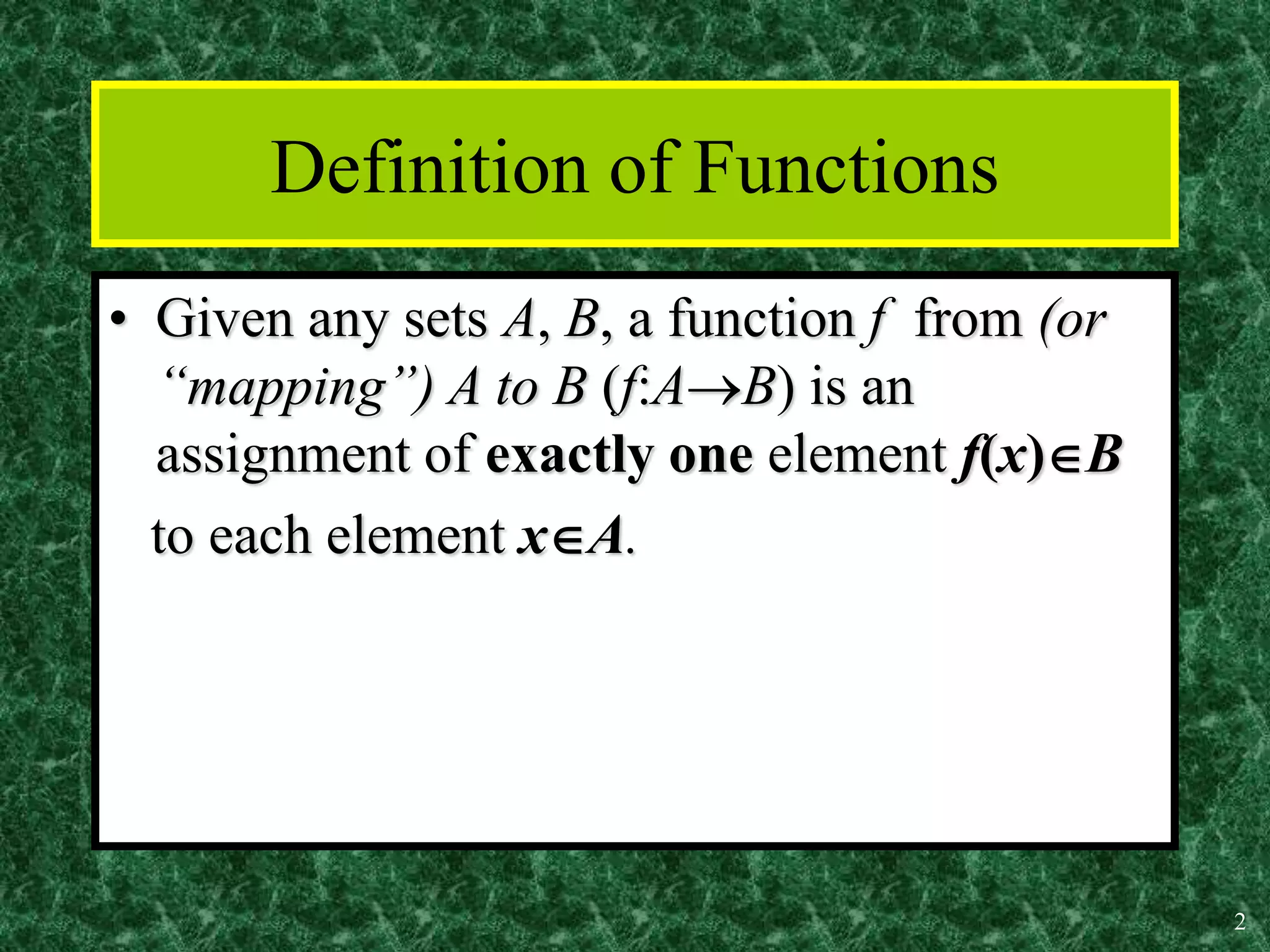
• Given any sets A, B, a function f from (or
“mapping”) A to B (f:AB) is an
assignment of exactly one element f(x)B
to each element xA.
3
Graphical Representations
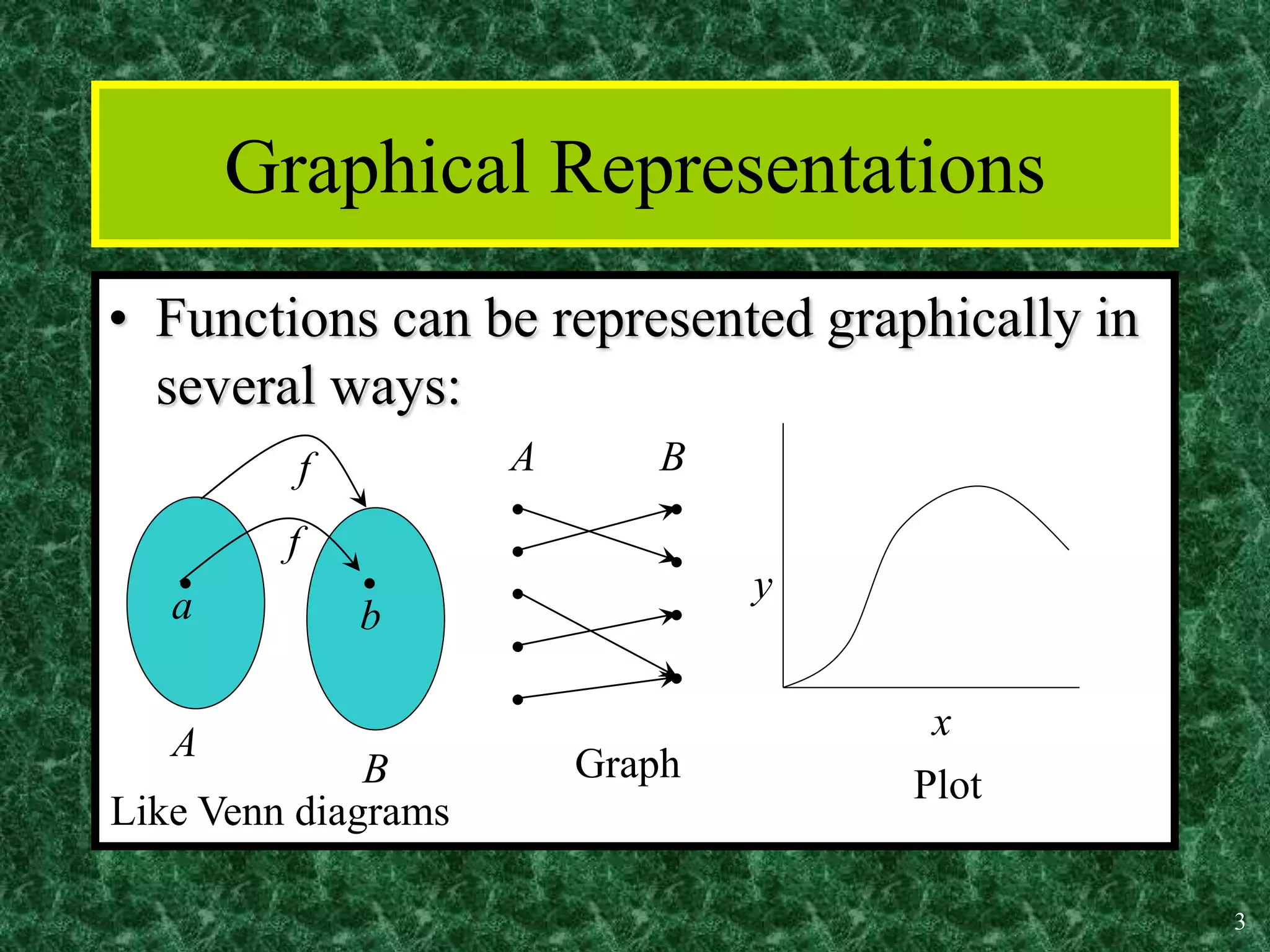
• Functions can be represented graphically in
several ways:
• •
A
B
a b
f
f
•
•
•
•
•
•
•
•
• x
y
Plot
Graph
Like Venn diagrams
A B
4
Definition of Functions (cont’d)
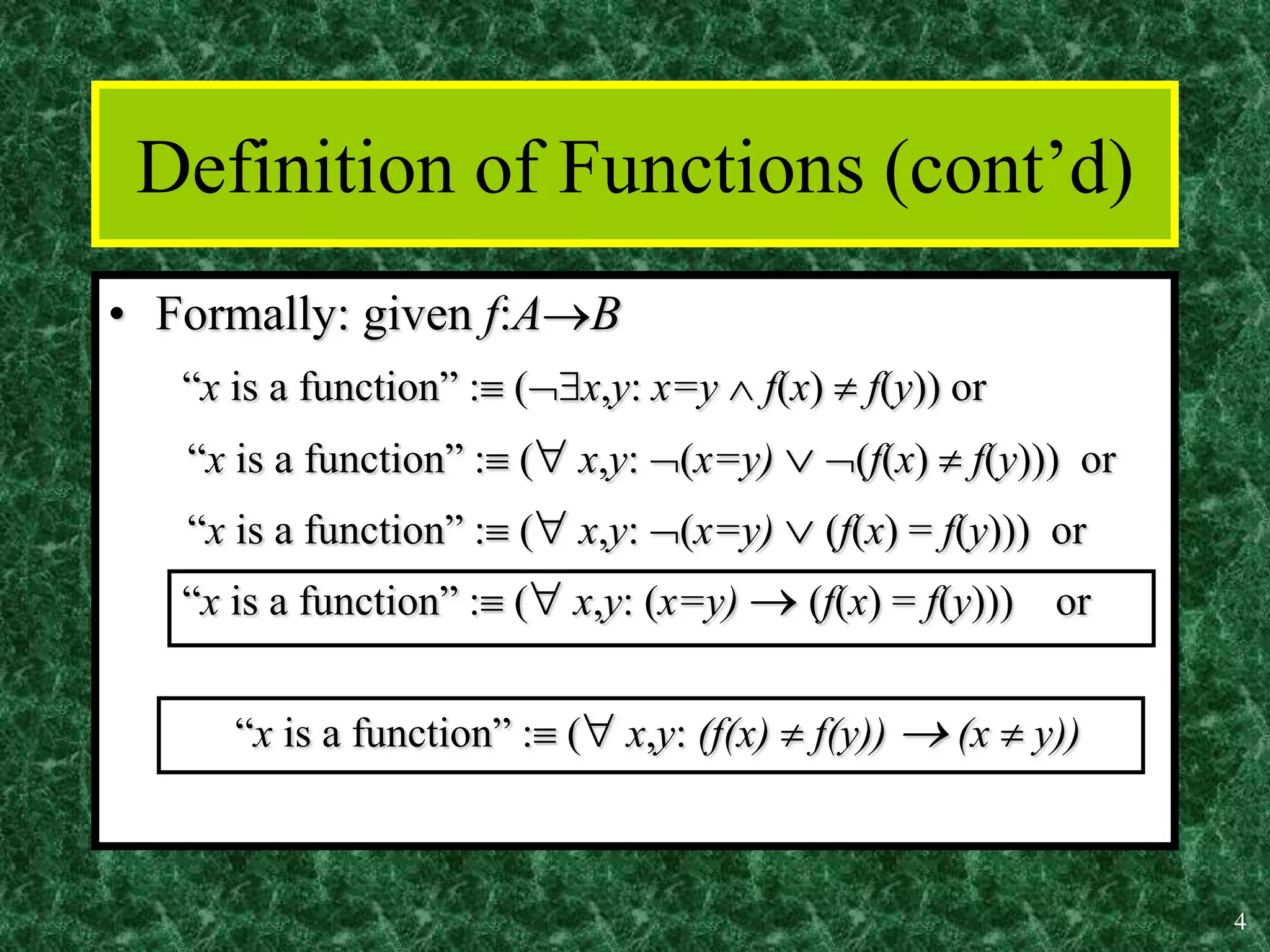
• Formally: given f:AB
“x is a function” : (x,y: x=y  f(x)  f(y)) or
“x is a function” : ( x,y: (x=y)  (f(x)  f(y))) or
“x is a function” : ( x,y: (x=y)  (f(x) = f(y))) or
“x is a function” : ( x,y: (x=y)  (f(x) = f(y))) or
“x is a function” : ( x,y: (f(x)  f(y))  (x  y))
5
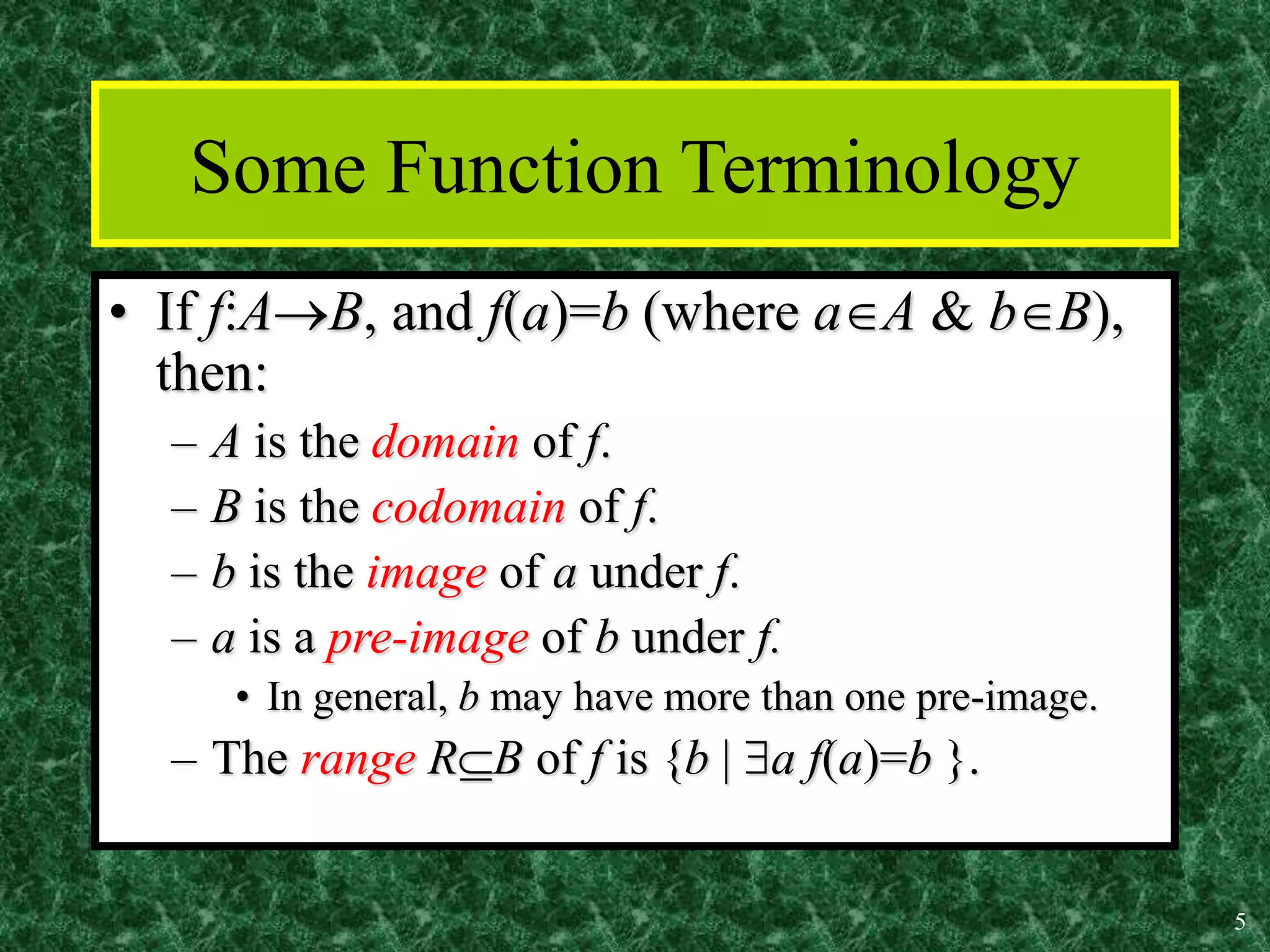
Some Function Terminology
• If f:AB, and f(a)=b (where aA & bB),
then:
– A is the domain of f.
– B is the codomain of f.
– b is the image of a under f.
– a is a pre-image of b under f.
• In general, b may have more than one pre-image.
– The range RB of f is {b | a f(a)=b }.
6
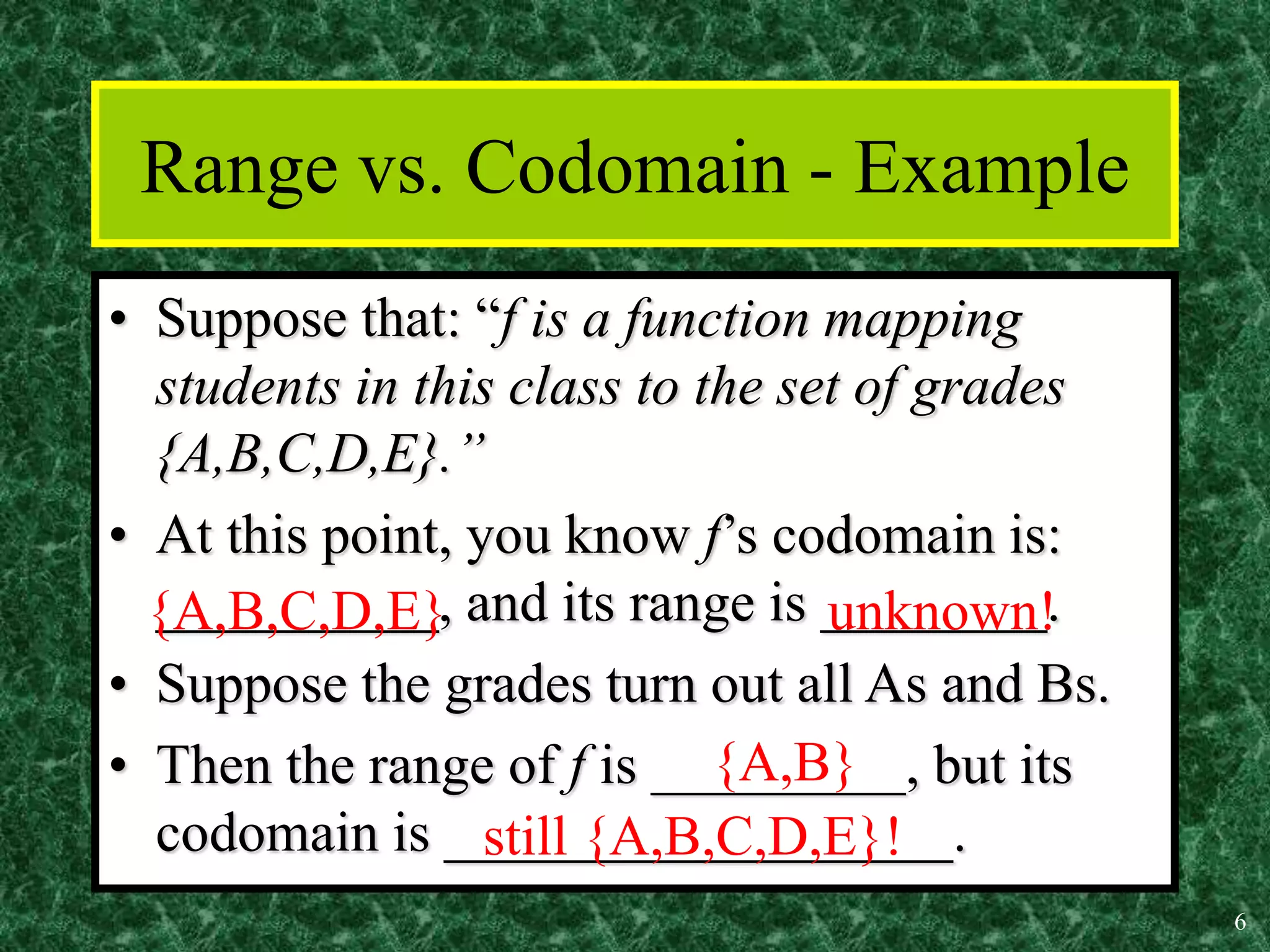
Range vs. Codomain - Example
• Suppose that: “f is a function mapping
students in this class to the set of grades
{A,B,C,D,E}.”
• At this point, you know f’s codomain is:
__________, and its range is ________.
• Suppose the grades turn out all As and Bs.
• Then the range of f is _________, but its
codomain is __________________.
{A,B,C,D,E} unknown!
{A,B}
still {A,B,C,D,E}!
7
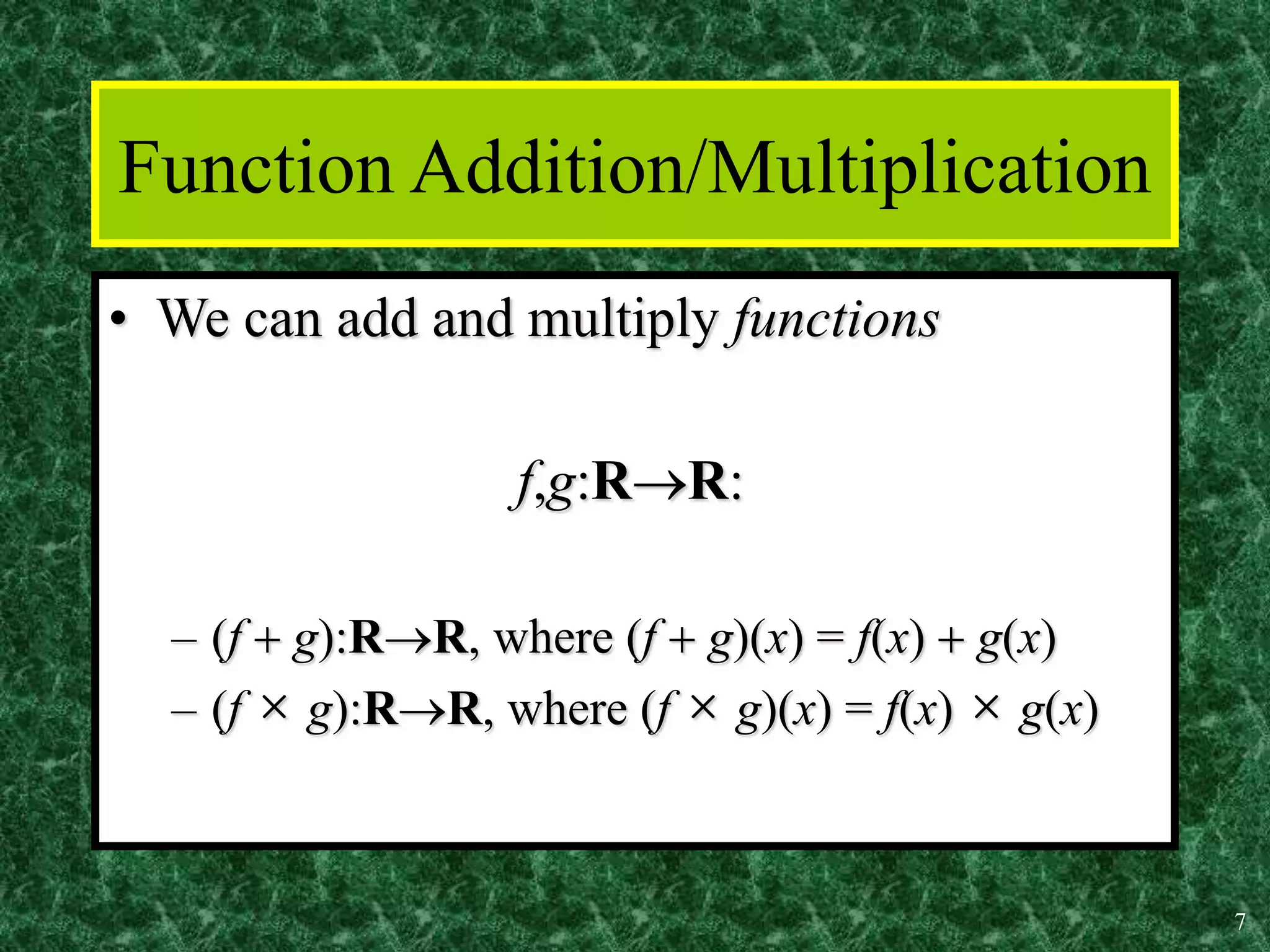
Function Addition/Multiplication
• We can add and multiply functions
f,g:RR:
– (f  g):RR, where (f  g)(x) = f(x)  g(x)
– (f × g):RR, where (f × g)(x) = f(x) × g(x)
8
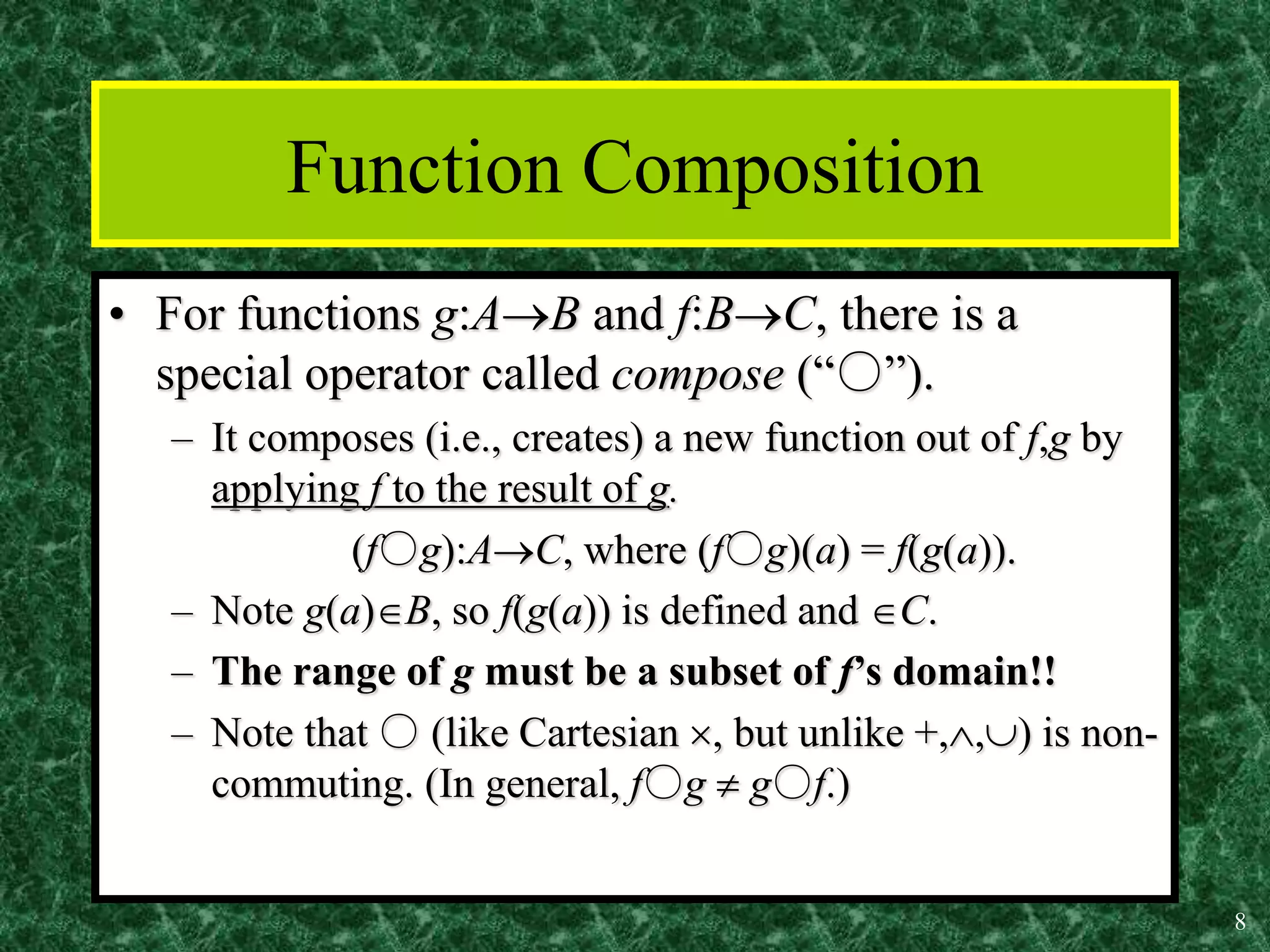
Function Composition
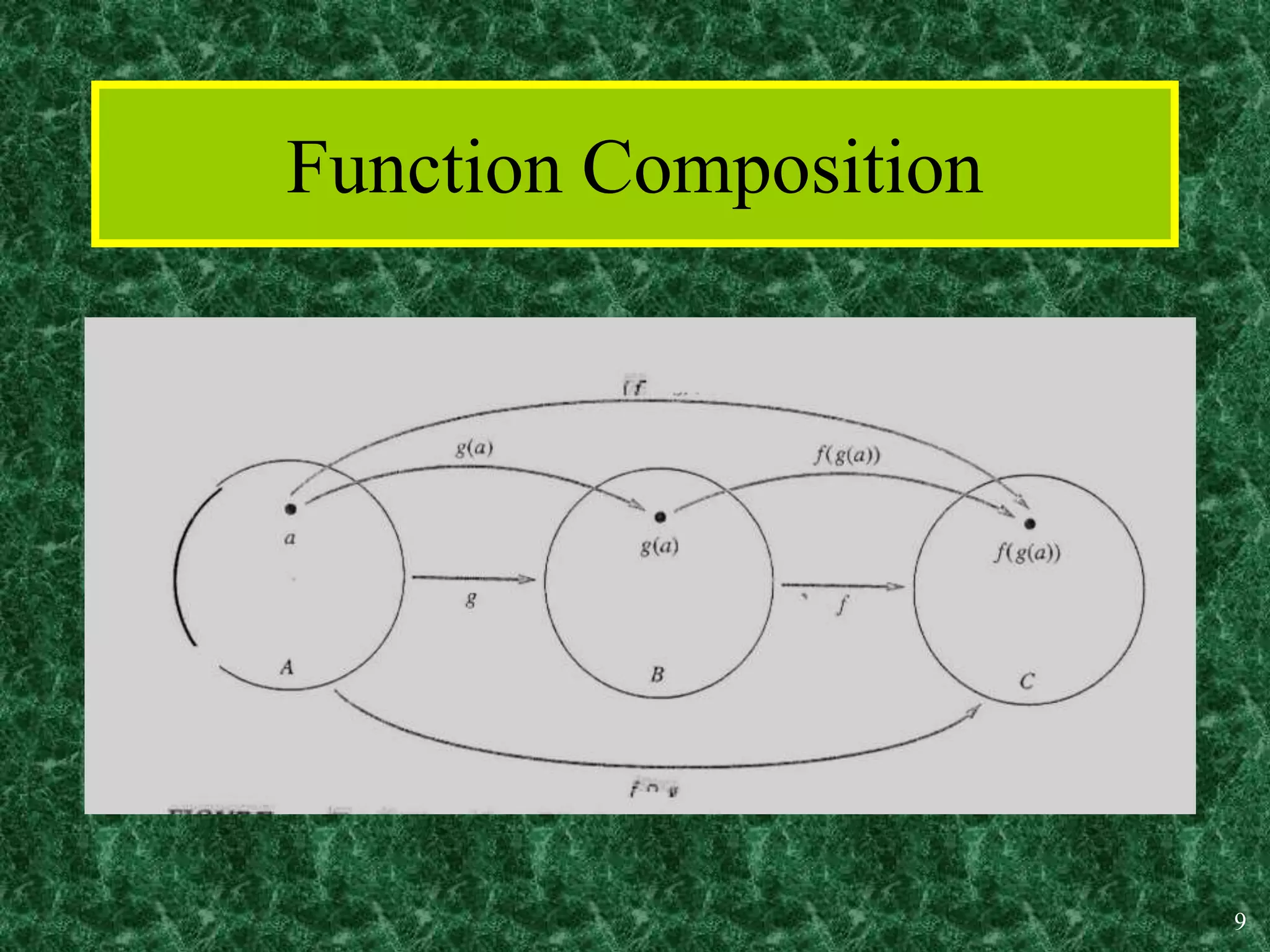
• For functions g:AB and f:BC, there is a
special operator called compose (“○”).
– It composes (i.e., creates) a new function out of f,g by
applying f to the result of g.
(f○g):AC, where (f○g)(a) = f(g(a)).
– Note g(a)B, so f(g(a)) is defined and C.
– The range of g must be a subset of f’s domain!!
– Note that ○ (like Cartesian , but unlike +,,) is non-
commuting. (In general, f○g  g○f.)
9
Function Composition
10
Images of Sets under Functions
• Given f:AB, and SA,
• The image of S under f is simply the set of
all images (under f) of the elements of S.
f(S) : {f(s) | sS}
: {b |  sS: f(s)=b}.
• Note the range of f can be defined as simply
the image (under f) of f’s domain!
11
One-to-One Functions
• A function is one-to-one (1-1), or injective,
or an injection, iff every element of its
range has only one pre-image.
• Only one element of the domain is mapped
to any given one element of the range.
– Domain & range have same cardinality. What
about codomain?
12
One-to-One Functions (cont’d)
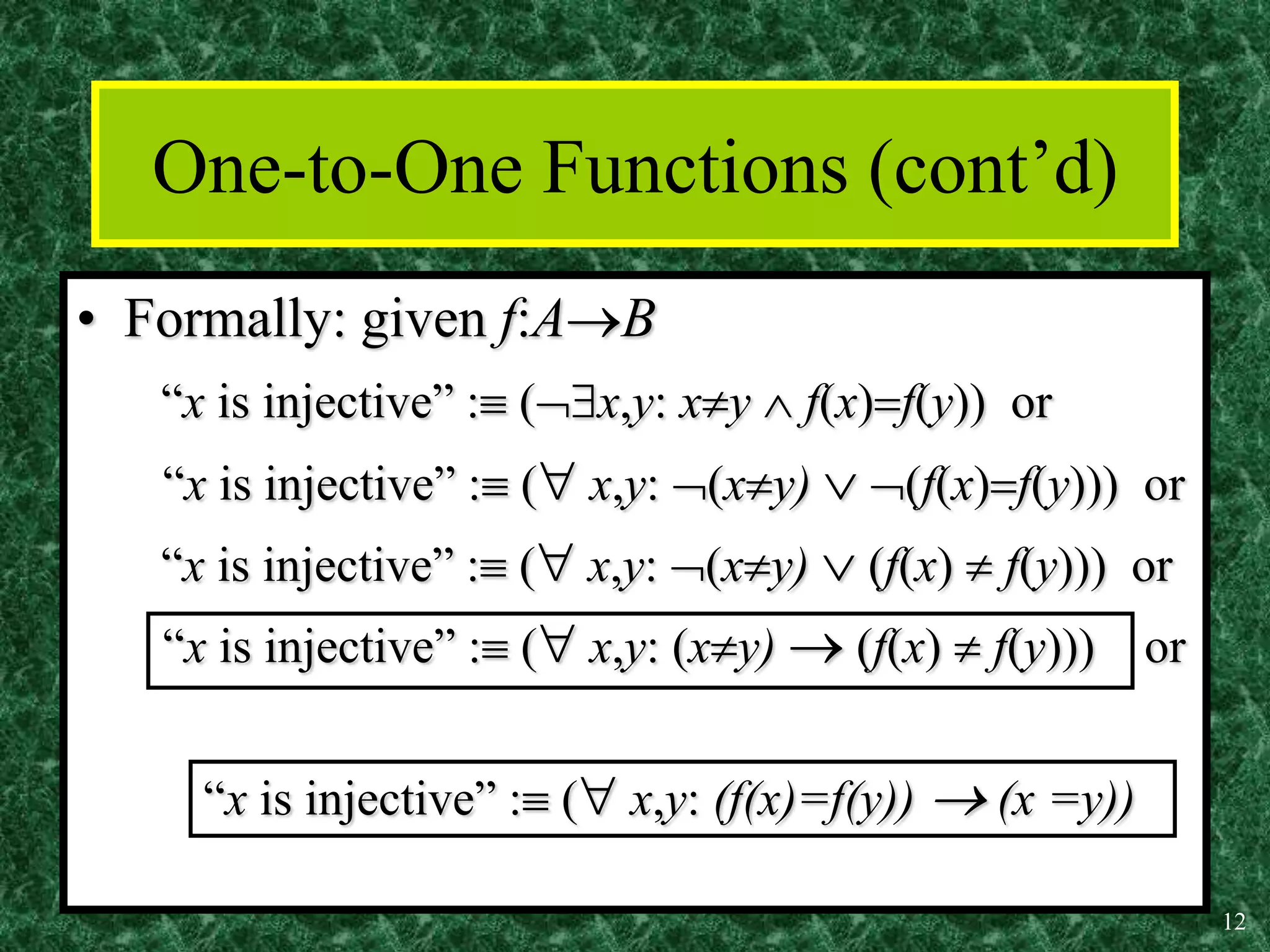
• Formally: given f:AB
“x is injective” : (x,y: xy  f(x)f(y)) or
“x is injective” : ( x,y: (xy)  (f(x)f(y))) or
“x is injective” : ( x,y: (xy)  (f(x)  f(y))) or
“x is injective” : ( x,y: (xy)  (f(x)  f(y))) or
“x is injective” : ( x,y: (f(x)=f(y))  (x =y))
13
One-to-One Illustration
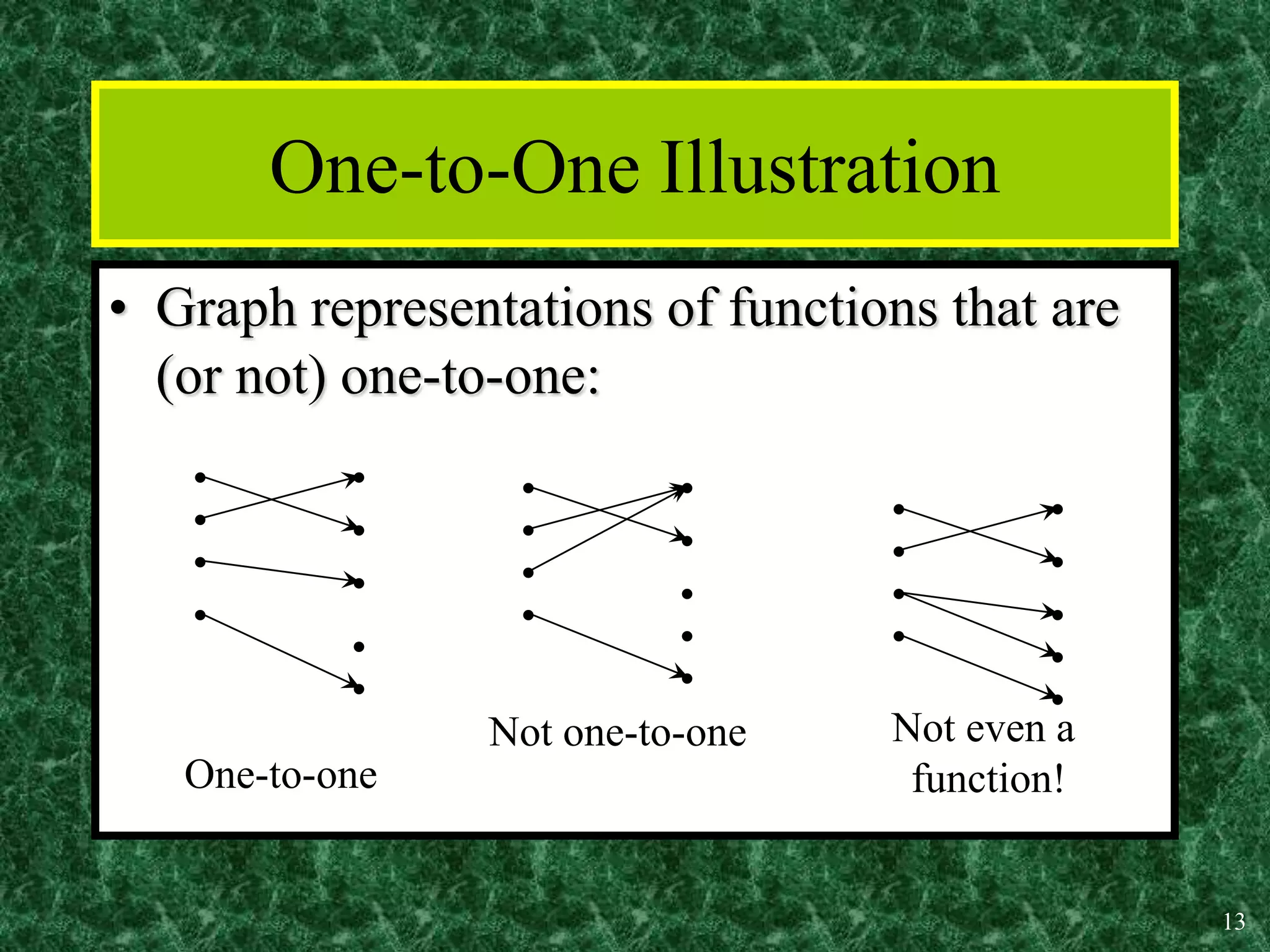
• Graph representations of functions that are
(or not) one-to-one:
•
•
•
•
•
•
•
•
•
One-to-one
•
•
•
•
•
•
•
•
•
Not one-to-one
•
•
•
•
•
•
•
•
•
Not even a
function!
14
Sufficient Conditions for 1-1ness
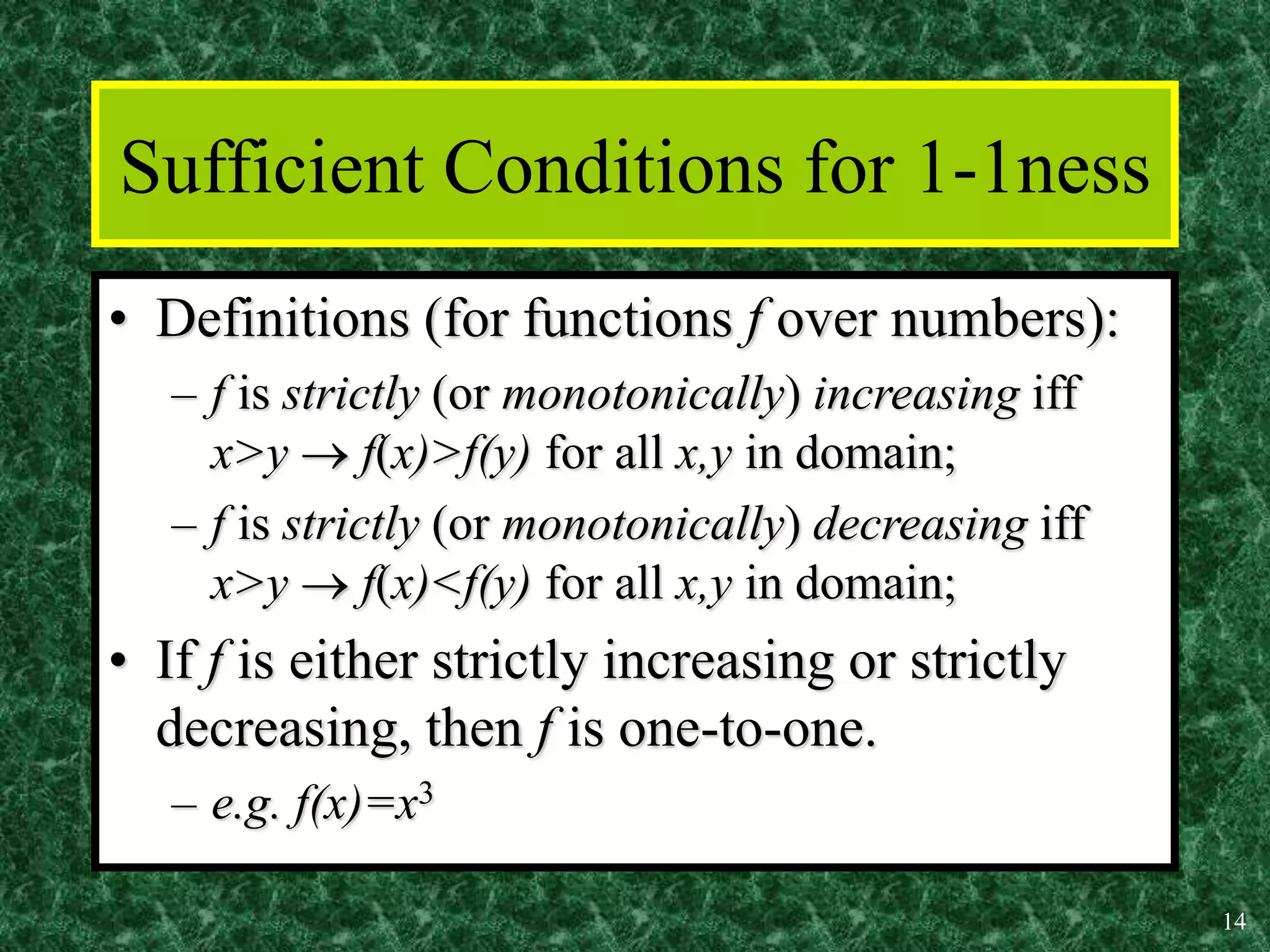
• Definitions (for functions f over numbers):
– f is strictly (or monotonically) increasing iff
x>y  f(x)>f(y) for all x,y in domain;
– f is strictly (or monotonically) decreasing iff
x>y  f(x)<f(y) for all x,y in domain;
• If f is either strictly increasing or strictly
decreasing, then f is one-to-one.
– e.g. f(x)=x3
15
Onto (Surjective) Functions
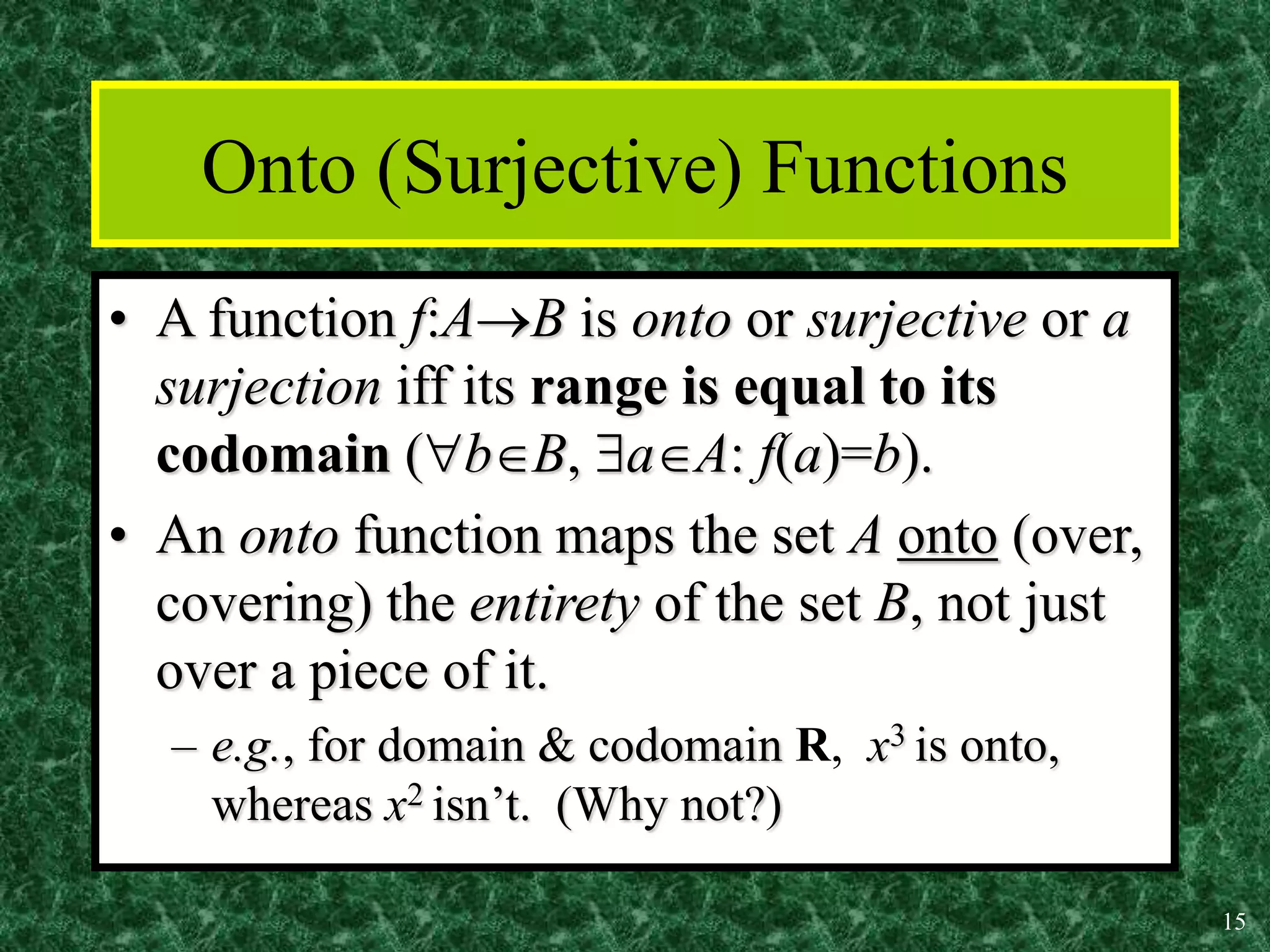
• A function f:AB is onto or surjective or a
surjection iff its range is equal to its
codomain (bB, aA: f(a)=b).
• An onto function maps the set A onto (over,
covering) the entirety of the set B, not just
over a piece of it.
– e.g., for domain & codomain R, x3 is onto,
whereas x2 isn’t. (Why not?)
16
Illustration of Onto
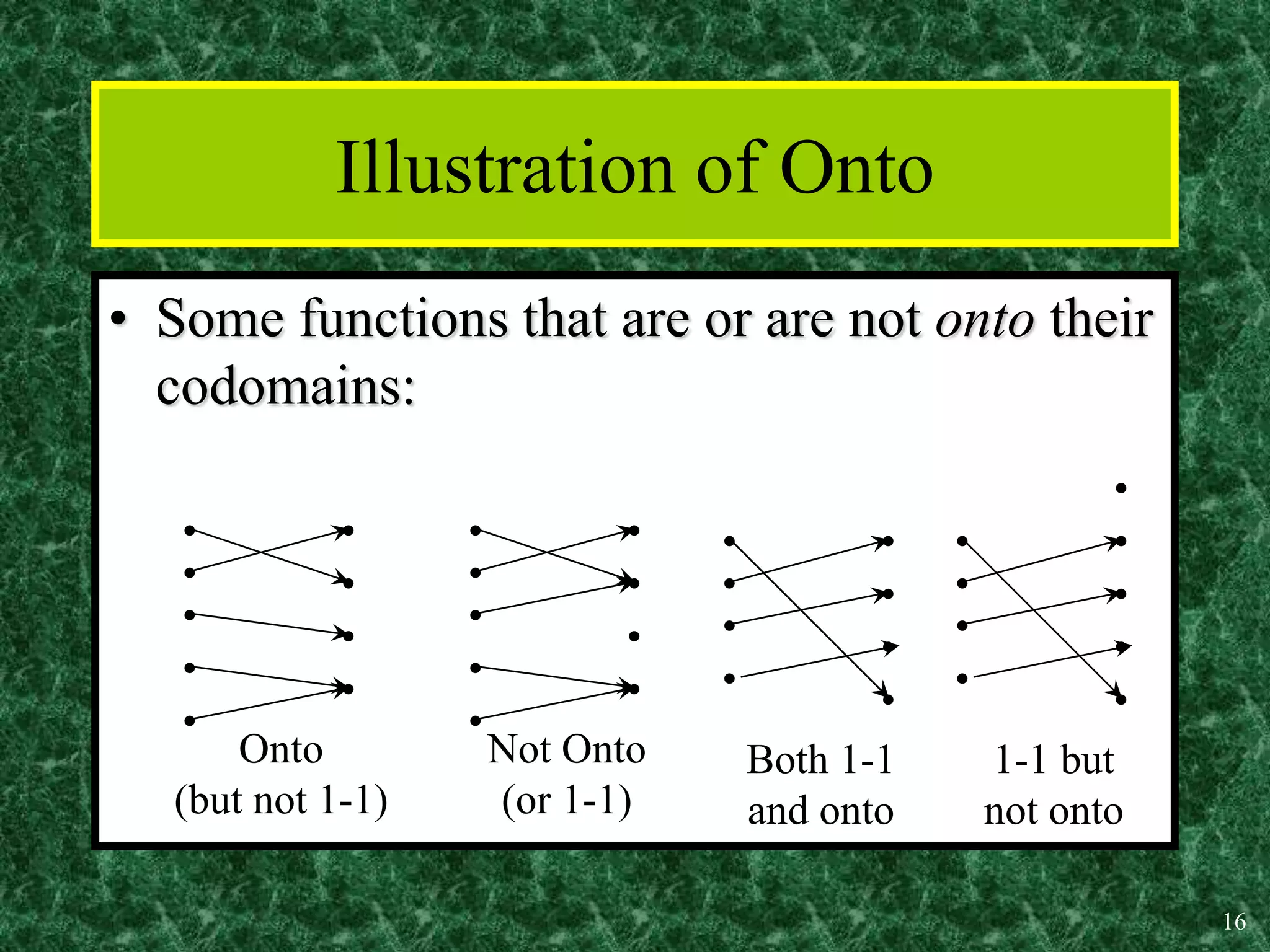
• Some functions that are or are not onto their
codomains:
Onto
(but not 1-1)
•
•
•
•
•
•
•
•
•
Not Onto
(or 1-1)
•
•
•
•
•
•
•
•
•
Both 1-1
and onto
•
•
•
•
•
•
•
•
1-1 but
not onto
•
•
•
•
•
•
•
•
•
17
Bijections
• A function f is a one-to-one
correspondence, or a bijection, or
reversible, or invertible, iff it is both one-
to-one and onto.
18
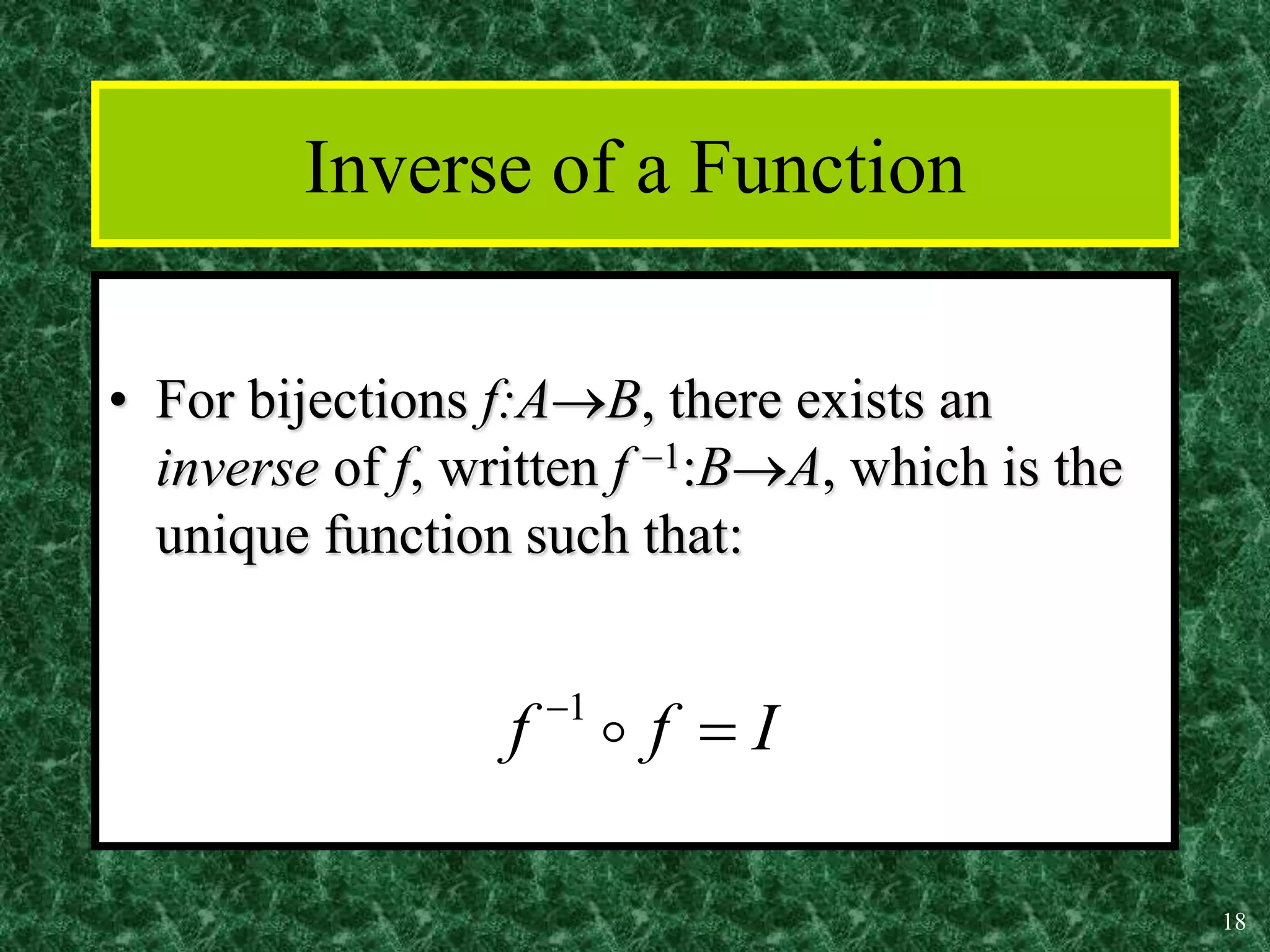
Inverse of a Function
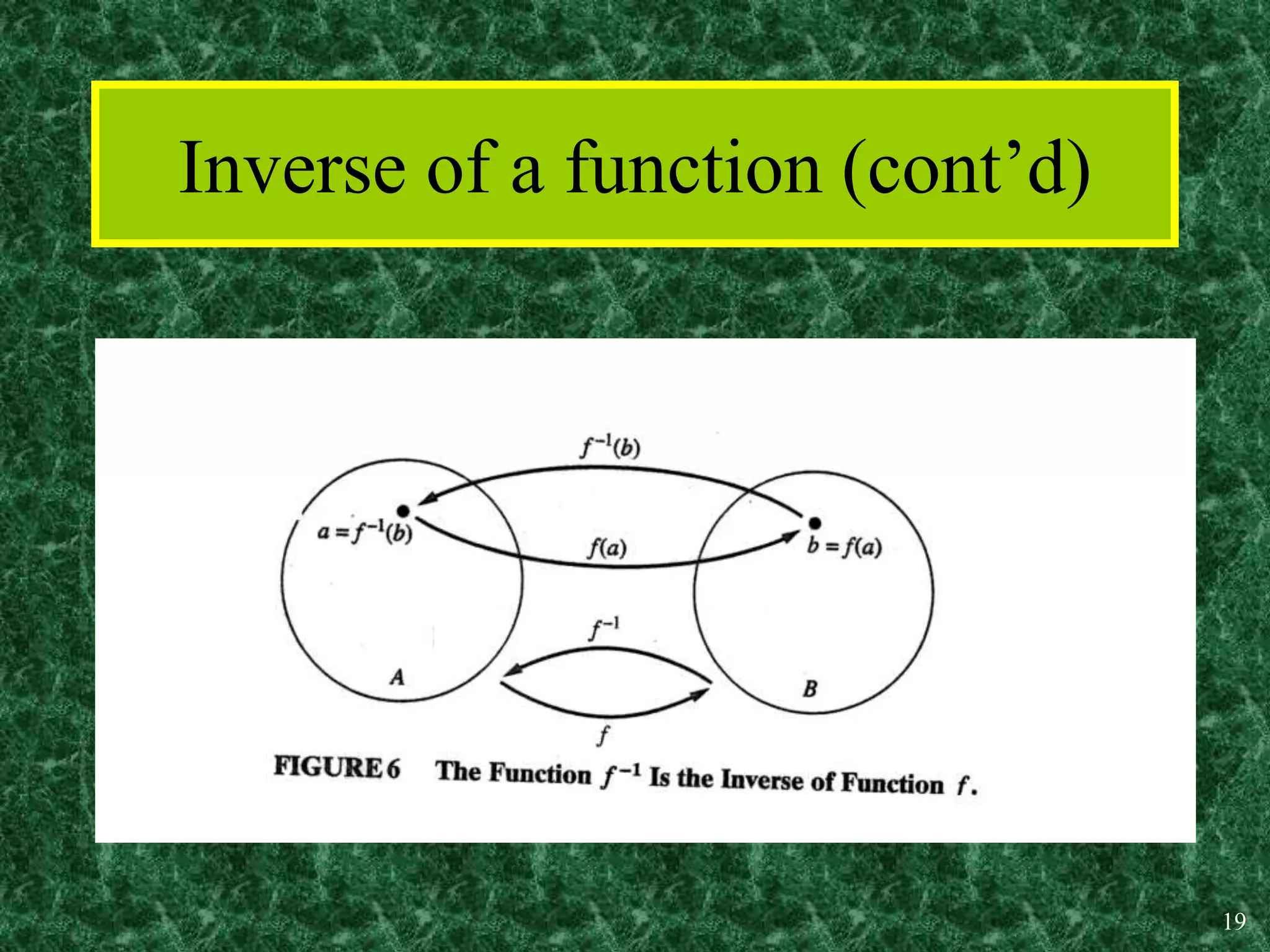
• For bijections f:AB, there exists an
inverse of f, written f 1:BA, which is the
unique function such that:
I
f
f 


1
19
Inverse of a function (cont’d)
20
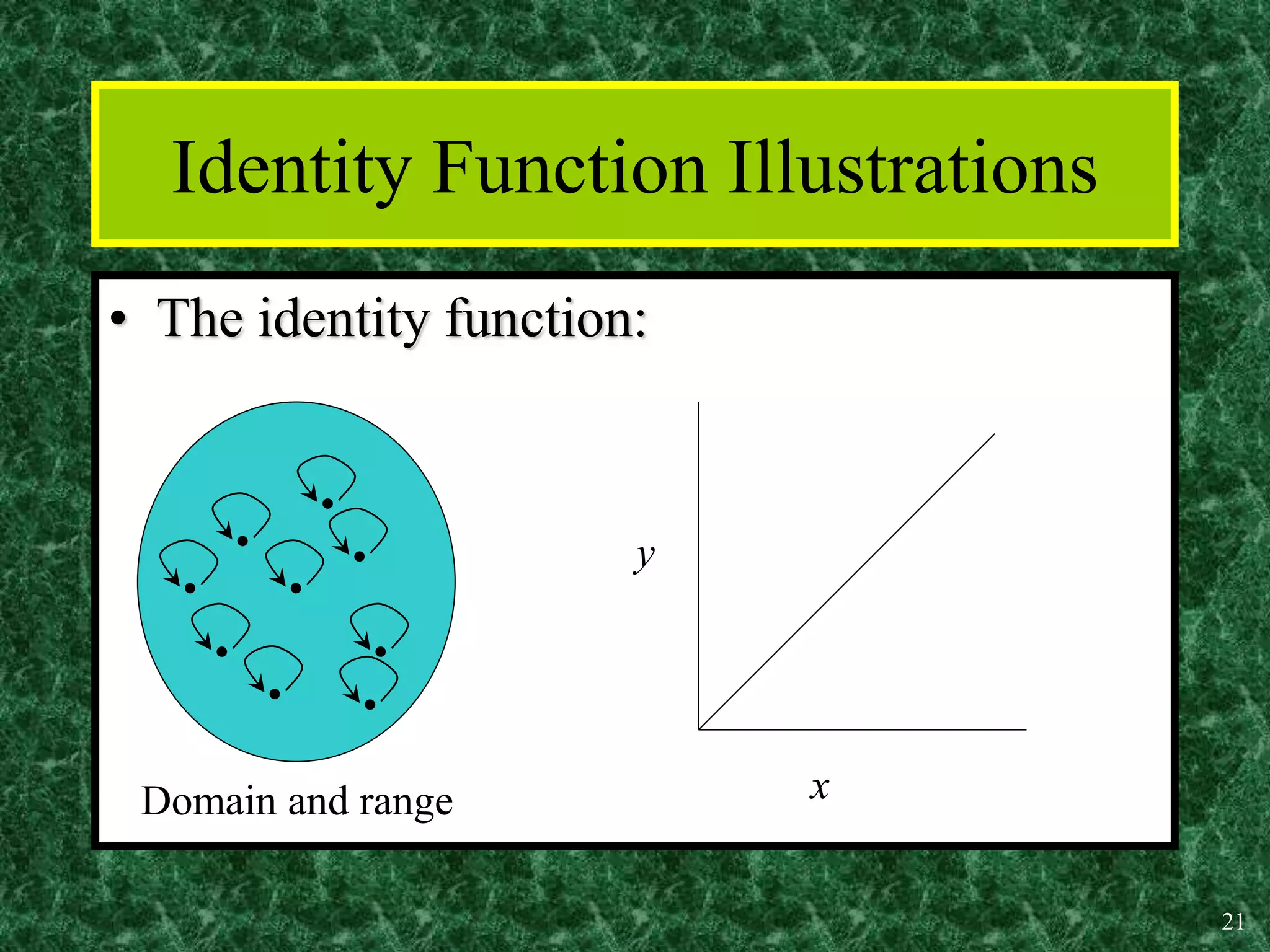
The Identity Function
• For any domain A, the identity function
I:AA (variously written, IA, 1, 1A) is the
unique function such that aA: I(a)=a.
• Some identity functions you’ve seen:
– ing with T, ing with F, ing with , ing
with U.
• Note that the identity function is both one-
to-one and onto (bijective).
21
• The identity function:
Identity Function Illustrations
•
•
•
•
•
•
•
•
•
Domain and range x
y
22
Graphs of Functions
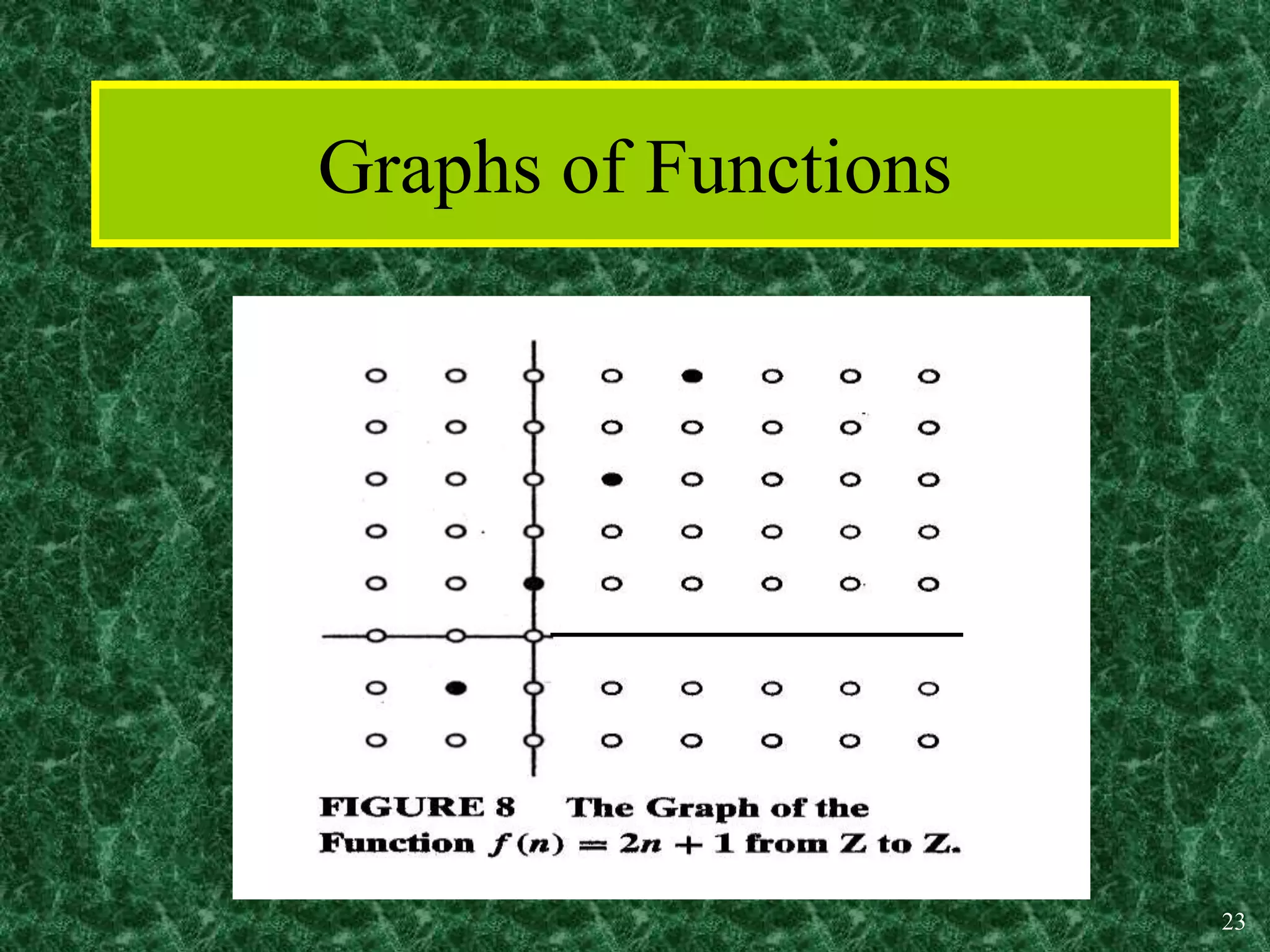
• We can represent a function f:AB as a set
of ordered pairs {(a,f(a)) | aA}.
• Note that a, there is only one pair (a, f(a)).
• For functions over numbers, we can
represent an ordered pair (x,y) as a point on
a plane. A function is then drawn as a curve
(set of points) with only one y for each x.
23
Graphs of Functions
24
A Couple of Key Functions
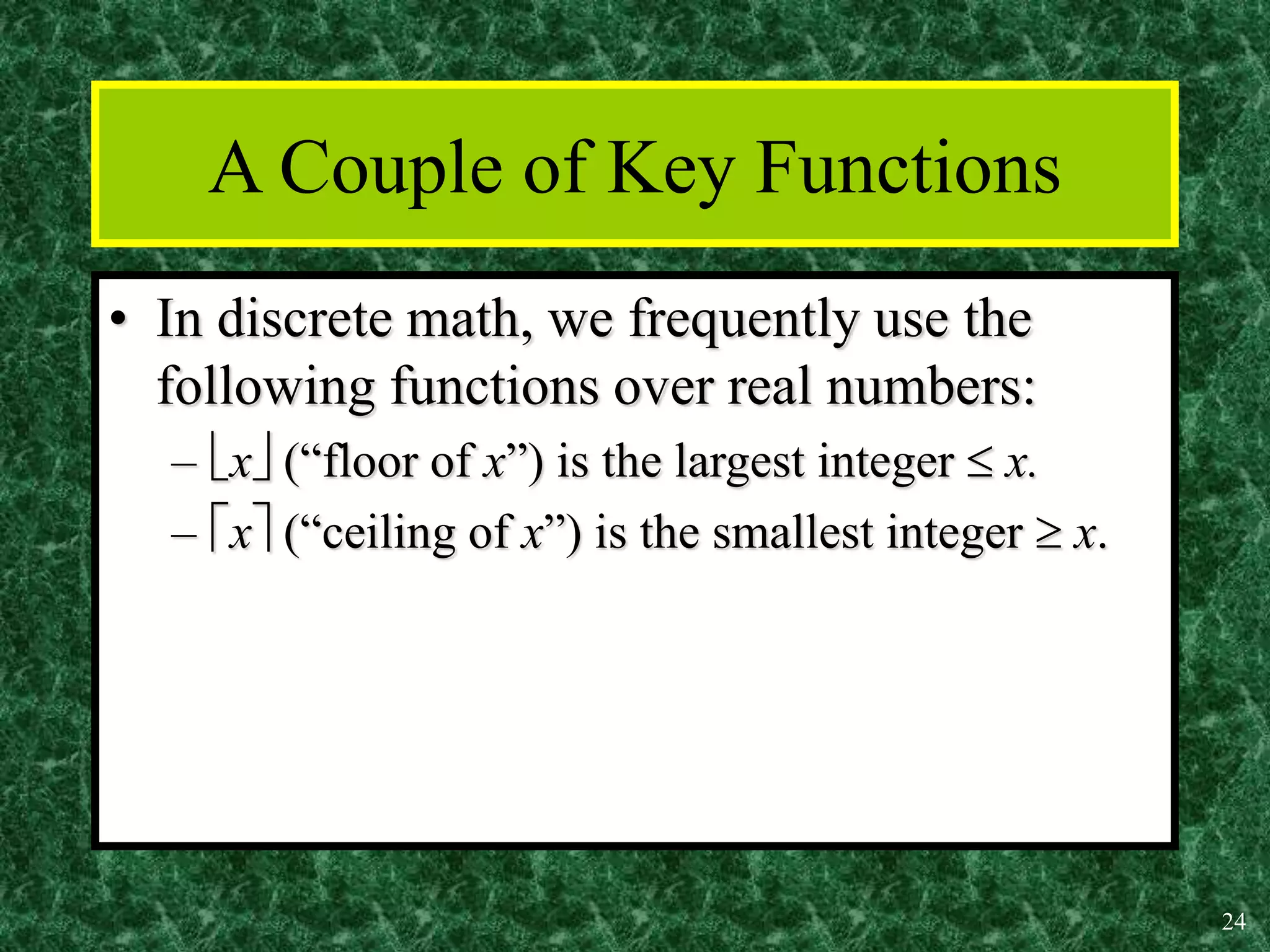
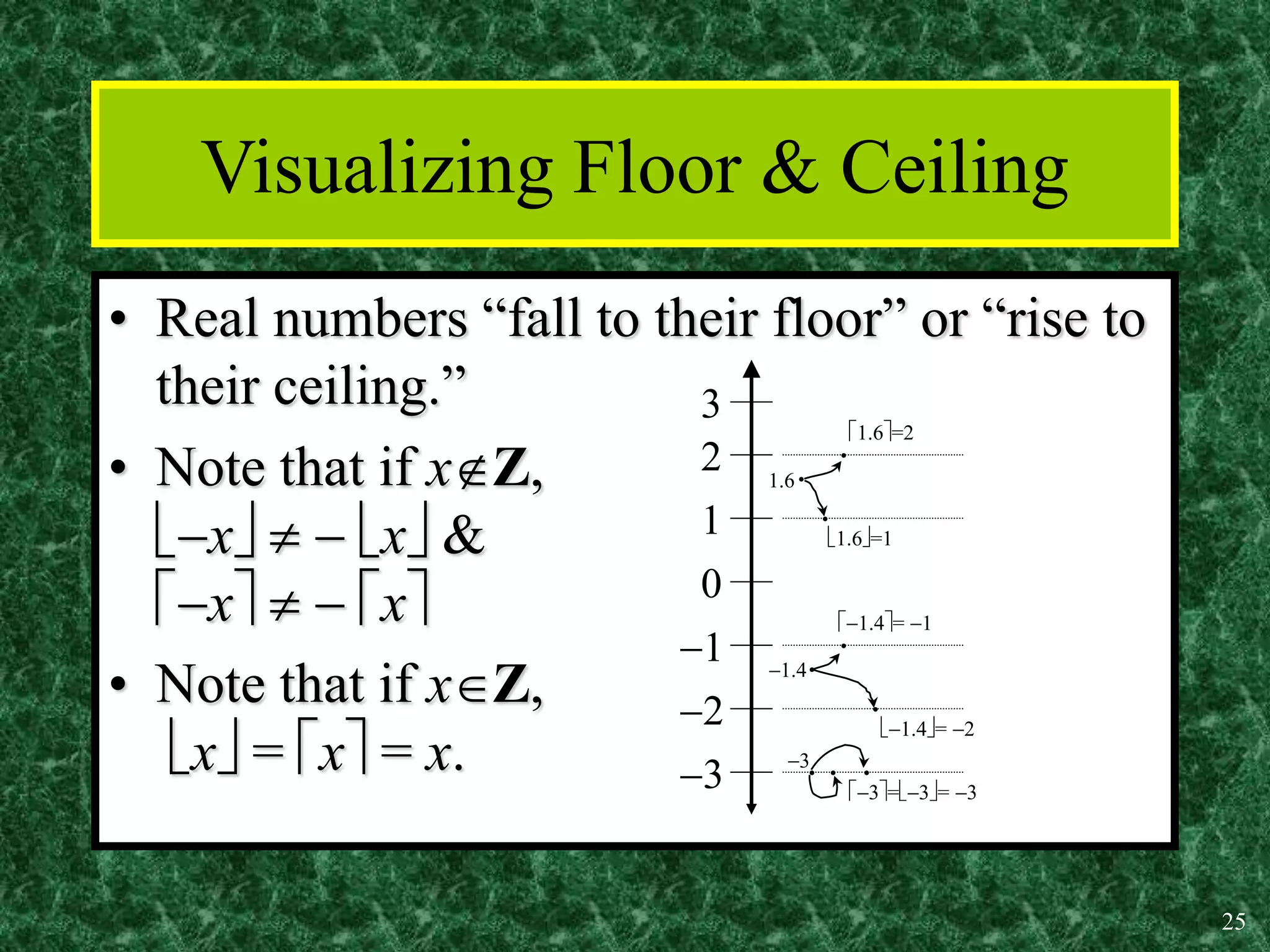
• In discrete math, we frequently use the
following functions over real numbers:
– x (“floor of x”) is the largest integer  x.
– x (“ceiling of x”) is the smallest integer  x.
25
Visualizing Floor & Ceiling
• Real numbers “fall to their floor” or “rise to
their ceiling.”
• Note that if xZ,
x   x &
x   x
• Note that if xZ,
x = x = x.
0
1
1
2
3
2
3
.
.
.
.
.
.
. . .
1.6
1.6=2
1.4= 2
1.4
1.4= 1
1.6=1
3
3=3= 3
26
Plots with floor/ceiling: Example
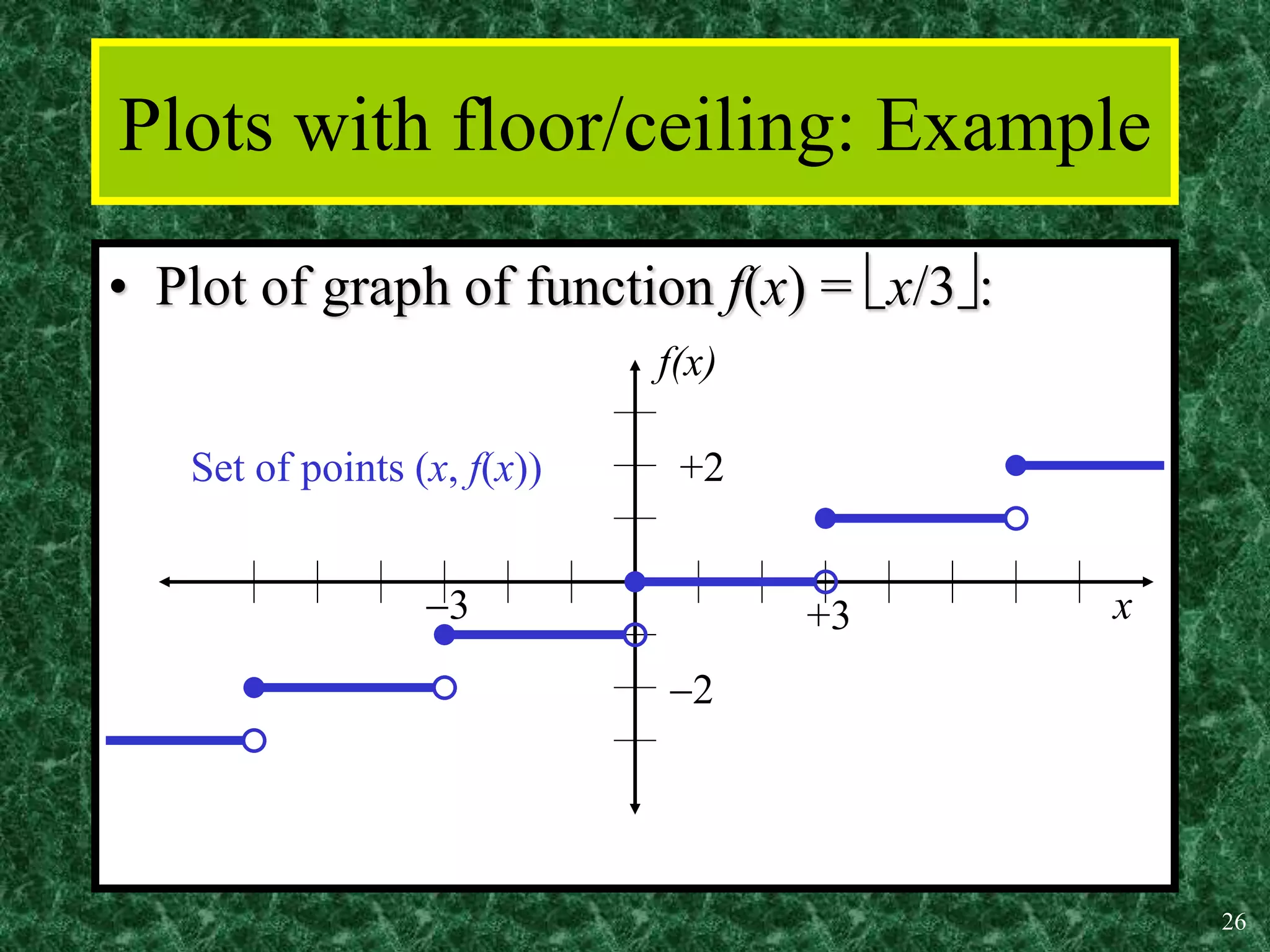
• Plot of graph of function f(x) = x/3:
x
f(x)
Set of points (x, f(x))
+3
2
+2
3

Functions.ppt

  • 1.
  • 2.
    2 Definition of Functions •Given any sets A, B, a function f from (or “mapping”) A to B (f:AB) is an assignment of exactly one element f(x)B to each element xA.
  • 3.
    3 Graphical Representations • Functionscan be represented graphically in several ways: • • A B a b f f • • • • • • • • • x y Plot Graph Like Venn diagrams A B
  • 4.
    4 Definition of Functions(cont’d) • Formally: given f:AB “x is a function” : (x,y: x=y  f(x)  f(y)) or “x is a function” : ( x,y: (x=y)  (f(x)  f(y))) or “x is a function” : ( x,y: (x=y)  (f(x) = f(y))) or “x is a function” : ( x,y: (x=y)  (f(x) = f(y))) or “x is a function” : ( x,y: (f(x)  f(y))  (x  y))
  • 5.
    5 Some Function Terminology •If f:AB, and f(a)=b (where aA & bB), then: – A is the domain of f. – B is the codomain of f. – b is the image of a under f. – a is a pre-image of b under f. • In general, b may have more than one pre-image. – The range RB of f is {b | a f(a)=b }.
  • 6.
    6 Range vs. Codomain- Example • Suppose that: “f is a function mapping students in this class to the set of grades {A,B,C,D,E}.” • At this point, you know f’s codomain is: __________, and its range is ________. • Suppose the grades turn out all As and Bs. • Then the range of f is _________, but its codomain is __________________. {A,B,C,D,E} unknown! {A,B} still {A,B,C,D,E}!
  • 7.
    7 Function Addition/Multiplication • Wecan add and multiply functions f,g:RR: – (f  g):RR, where (f  g)(x) = f(x)  g(x) – (f × g):RR, where (f × g)(x) = f(x) × g(x)
  • 8.
    8 Function Composition • Forfunctions g:AB and f:BC, there is a special operator called compose (“○”). – It composes (i.e., creates) a new function out of f,g by applying f to the result of g. (f○g):AC, where (f○g)(a) = f(g(a)). – Note g(a)B, so f(g(a)) is defined and C. – The range of g must be a subset of f’s domain!! – Note that ○ (like Cartesian , but unlike +,,) is non- commuting. (In general, f○g  g○f.)
  • 9.
  • 10.
    10 Images of Setsunder Functions • Given f:AB, and SA, • The image of S under f is simply the set of all images (under f) of the elements of S. f(S) : {f(s) | sS} : {b |  sS: f(s)=b}. • Note the range of f can be defined as simply the image (under f) of f’s domain!
  • 11.
    11 One-to-One Functions • Afunction is one-to-one (1-1), or injective, or an injection, iff every element of its range has only one pre-image. • Only one element of the domain is mapped to any given one element of the range. – Domain & range have same cardinality. What about codomain?
  • 12.
    12 One-to-One Functions (cont’d) •Formally: given f:AB “x is injective” : (x,y: xy  f(x)f(y)) or “x is injective” : ( x,y: (xy)  (f(x)f(y))) or “x is injective” : ( x,y: (xy)  (f(x)  f(y))) or “x is injective” : ( x,y: (xy)  (f(x)  f(y))) or “x is injective” : ( x,y: (f(x)=f(y))  (x =y))
  • 13.
    13 One-to-One Illustration • Graphrepresentations of functions that are (or not) one-to-one: • • • • • • • • • One-to-one • • • • • • • • • Not one-to-one • • • • • • • • • Not even a function!
  • 14.
    14 Sufficient Conditions for1-1ness • Definitions (for functions f over numbers): – f is strictly (or monotonically) increasing iff x>y  f(x)>f(y) for all x,y in domain; – f is strictly (or monotonically) decreasing iff x>y  f(x)<f(y) for all x,y in domain; • If f is either strictly increasing or strictly decreasing, then f is one-to-one. – e.g. f(x)=x3
  • 15.
    15 Onto (Surjective) Functions •A function f:AB is onto or surjective or a surjection iff its range is equal to its codomain (bB, aA: f(a)=b). • An onto function maps the set A onto (over, covering) the entirety of the set B, not just over a piece of it. – e.g., for domain & codomain R, x3 is onto, whereas x2 isn’t. (Why not?)
  • 16.
    16 Illustration of Onto •Some functions that are or are not onto their codomains: Onto (but not 1-1) • • • • • • • • • Not Onto (or 1-1) • • • • • • • • • Both 1-1 and onto • • • • • • • • 1-1 but not onto • • • • • • • • •
  • 17.
    17 Bijections • A functionf is a one-to-one correspondence, or a bijection, or reversible, or invertible, iff it is both one- to-one and onto.
  • 18.
    18 Inverse of aFunction • For bijections f:AB, there exists an inverse of f, written f 1:BA, which is the unique function such that: I f f    1
  • 19.
    19 Inverse of afunction (cont’d)
  • 20.
    20 The Identity Function •For any domain A, the identity function I:AA (variously written, IA, 1, 1A) is the unique function such that aA: I(a)=a. • Some identity functions you’ve seen: – ing with T, ing with F, ing with , ing with U. • Note that the identity function is both one- to-one and onto (bijective).
  • 21.
    21 • The identityfunction: Identity Function Illustrations • • • • • • • • • Domain and range x y
  • 22.
    22 Graphs of Functions •We can represent a function f:AB as a set of ordered pairs {(a,f(a)) | aA}. • Note that a, there is only one pair (a, f(a)). • For functions over numbers, we can represent an ordered pair (x,y) as a point on a plane. A function is then drawn as a curve (set of points) with only one y for each x.
  • 23.
  • 24.
    24 A Couple ofKey Functions • In discrete math, we frequently use the following functions over real numbers: – x (“floor of x”) is the largest integer  x. – x (“ceiling of x”) is the smallest integer  x.
  • 25.
    25 Visualizing Floor &Ceiling • Real numbers “fall to their floor” or “rise to their ceiling.” • Note that if xZ, x   x & x   x • Note that if xZ, x = x = x. 0 1 1 2 3 2 3 . . . . . . . . . 1.6 1.6=2 1.4= 2 1.4 1.4= 1 1.6=1 3 3=3= 3
  • 26.
    26 Plots with floor/ceiling:Example • Plot of graph of function f(x) = x/3: x f(x) Set of points (x, f(x)) +3 2 +2 3