Chapter One
Topic 02
TYPES OF FUNCTION
BY SANAULLAH MEMON
6/9/2020 1
• Types of functions
• Even odd functions
• Inverse function
• Algebra of function
• Composite function
6/9/2020
2
Types of Functions
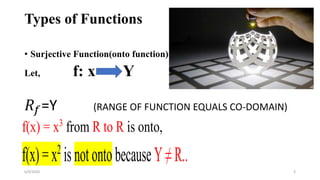
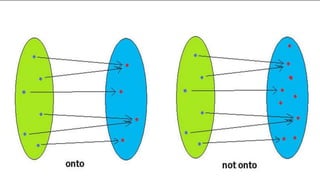
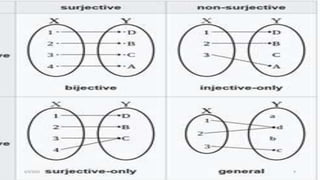
• Surjective Function(onto function)
Let, f: x Y
𝑅𝑓=Y (RANGE OF FUNCTION EQUALS CO-DOMAIN)
f(x) = x3
from R to R is onto,
f(x)=x2
isnotontobecauseY≠R..
6/9/2020 3
6/9/2020 4
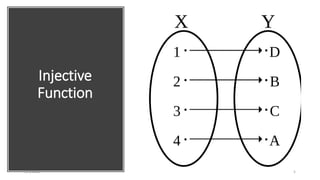
Injective
Function
6/9/2020 5
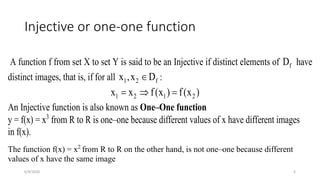
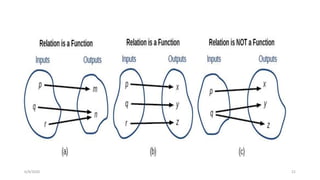
Injective or one-one function
A function f from set X to set Y is said to be an Injective if distinct elements of fD have
distinct images, that is, if for all 1 2 fx ,x D :
1 2 1 2x x f(x ) f(x )  
An Injective function is also known as One–One function
y = f(x) = x3
from R to R is one–one because different values of x have different images
in f(x).
The function f(x) = x2
from R to R on the other hand, is not one–one because different
values of x have the same image
6/9/2020 6
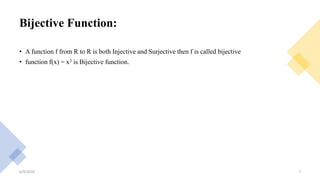
Bijective Function:
• A function f from R to R is both Injective and Surjective then f is called bijective
• function f(x) = x3 is Bijective function.
6/9/2020 7
6/9/2020 8
6/9/2020 9
Even and Odd Functions
• y = f(x) Even f(-x) = f(x) odd f(-x) = - f(x).
If a function does not satisfy these conditions, it is said to be neither
even nor odd function
For example, the function f(x) = x2
+ 1 is even function, for
f(-x) = (-x)2
+ 1 = x2
+ 1 = f(x)
The function f(x) = x3
+ x is odd function because
f(-x) = (-x)3
+ (-x) = - x3
– x = - (x3
+ x) = - f(x).
The function f(x) = x3
– x is neither even nor odd function.
6/9/2020 10
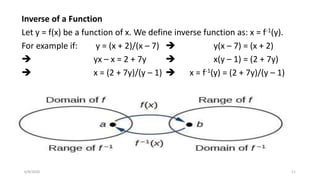
Inverse of a Function
Let y = f(x) be a function of x. We define inverse function as: x = f-1(y).
For example if: y = (x + 2)/(x – 7)  y(x – 7) = (x + 2)
 yx – x = 2 + 7y  x(y – 1) = (2 + 7y)
 x = (2 + 7y)/(y – 1)  x = f-1(y) = (2 + 7y)/(y – 1)
6/9/2020 11
6/9/2020 12
6/9/2020 13
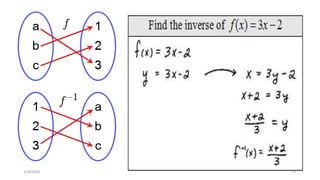
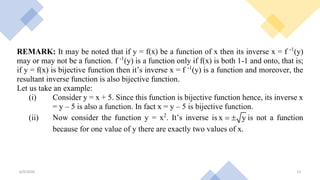
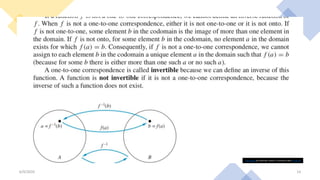
REMARK: It may be noted that if y = f(x) be a function of x then its inverse x = f -1
(y)
may or may not be a function. f -1
(y) is a function only if f(x) is both 1-1 and onto, that is;
if y = f(x) is bijective function then it’s inverse x = f -1
(y) is a function and moreover, the
resultant inverse function is also bijective function.
Let us take an example:
(i) Consider y = x + 5. Since this function is bijective function hence, its inverse x
= y – 5 is also a function. In fact x = y – 5 is bijective function.
(ii) Now consider the function y = x2
. It’s inverse is x y  is not a function
because for one value of y there are exactly two values of x.
6/9/2020 14
This Photo by Unknown Author is licensed under CC BY-SA
6/9/2020 15
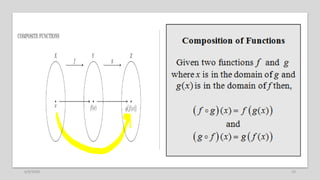
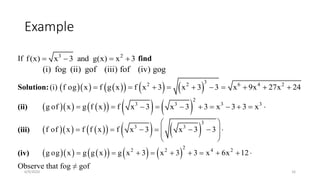
Example
If 3 2
f(x) x 3 and g(x) x 3    find
(i) fog (ii) gof (iii) fof (iv) gog
Solution:          
3
2 2 6 4 2
(i) f g x f g x f x 3 x 3 3 x 9x 27x 24         o
(ii)          
2
3 3 3 3
g f x g f x f x 3 x 3 3 x 3 3 x          o
(iii)          
3
3 3
f f x f f x f x 3 x 3 3
 
       
 
 
o
(iv)          
2
2 2 4 2
g g x g g x g x 3 x 3 3 x 6x 12         o
Observe that fog ≠ gof
6/9/2020 16
6/9/2020 17
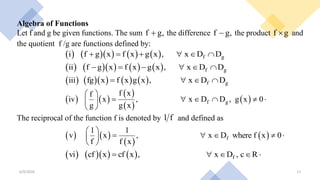
Algebra of Functions
Let f and g be given functions. The sum f g, the difference f g, the product f g and
the quotient f /g are functions defined by:
         f gi f g x f x g x , x D D     
         f gii f g x f x g x , x D D     
         f giii fg x f x g x , x D D   
   
 
 
 f g
f xf
iv x , x D D , g x 0
g g x
 
      
 
The reciprocal of the function f is denoted by 1 f and defined as
   
 
 f
1 1
v x , x D where f x 0
f f x
 
     
 
       fvi cf x cf x , x D , c R    
6/9/2020 18
If f(x) = 2x – 1 and g(x) = x2 + 1 where x R, find
(i) (f + g) (ii) (f – g) (iii) fg (iv) 1/f
(v) f/g (vi) -3f (vii) f(x + 2) (viii) g(x – 3)
Solution:
(i)       f g x f x g x   2 2
2x 1 x 1 x 2x x(x 2) x R         
(ii)           2 2
f g x f x g x 2x 1 x 1 x 2x 2 x R            
(iii)          2 3 2
fg x f x g x 2x 1 x 1 2x x 2x 1 x R          
(iv)  
 
1 1 1
x x R,x 1/ 2
f f x 2x 1
 
     
 
(v)  
 
  2
f xf 2x 1
x , x R
g g x x 1
  
    
 
(vi) (-3f)(x) = - 3f(x) = -3(2x -1) = -6x + 3, x R 
(vii) f(x 2) 2(x 2) 1 2x 3      x R 
2 2 2
(viii) g(x 3) (x 3) 1 x 6x 9 1 x 6x 10           x R 
6/9/2020 19
This Photo by Unknown Author is licensed under CC BY-SA-NC
This Photo by Unknown Author is licensed under CC BY-NC
6/9/2020 20
6/9/2020 21
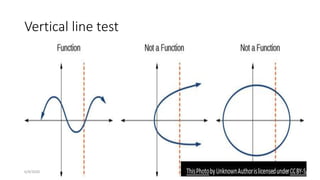
Vertical line test
6/9/2020 22
The end
23 6/9/2020
This Photo by Unknown Author is licensed under CC BY-SA-NC

Types of function

  • 1.
    Chapter One Topic 02 TYPESOF FUNCTION BY SANAULLAH MEMON 6/9/2020 1
  • 2.
    • Types offunctions • Even odd functions • Inverse function • Algebra of function • Composite function 6/9/2020 2
  • 3.
    Types of Functions •Surjective Function(onto function) Let, f: x Y 𝑅𝑓=Y (RANGE OF FUNCTION EQUALS CO-DOMAIN) f(x) = x3 from R to R is onto, f(x)=x2 isnotontobecauseY≠R.. 6/9/2020 3
  • 4.
  • 5.
  • 6.
    Injective or one-onefunction A function f from set X to set Y is said to be an Injective if distinct elements of fD have distinct images, that is, if for all 1 2 fx ,x D : 1 2 1 2x x f(x ) f(x )   An Injective function is also known as One–One function y = f(x) = x3 from R to R is one–one because different values of x have different images in f(x). The function f(x) = x2 from R to R on the other hand, is not one–one because different values of x have the same image 6/9/2020 6
  • 7.
    Bijective Function: • Afunction f from R to R is both Injective and Surjective then f is called bijective • function f(x) = x3 is Bijective function. 6/9/2020 7
  • 8.
  • 9.
  • 10.
    Even and OddFunctions • y = f(x) Even f(-x) = f(x) odd f(-x) = - f(x). If a function does not satisfy these conditions, it is said to be neither even nor odd function For example, the function f(x) = x2 + 1 is even function, for f(-x) = (-x)2 + 1 = x2 + 1 = f(x) The function f(x) = x3 + x is odd function because f(-x) = (-x)3 + (-x) = - x3 – x = - (x3 + x) = - f(x). The function f(x) = x3 – x is neither even nor odd function. 6/9/2020 10
  • 11.
    Inverse of aFunction Let y = f(x) be a function of x. We define inverse function as: x = f-1(y). For example if: y = (x + 2)/(x – 7)  y(x – 7) = (x + 2)  yx – x = 2 + 7y  x(y – 1) = (2 + 7y)  x = (2 + 7y)/(y – 1)  x = f-1(y) = (2 + 7y)/(y – 1) 6/9/2020 11
  • 12.
  • 13.
    6/9/2020 13 REMARK: Itmay be noted that if y = f(x) be a function of x then its inverse x = f -1 (y) may or may not be a function. f -1 (y) is a function only if f(x) is both 1-1 and onto, that is; if y = f(x) is bijective function then it’s inverse x = f -1 (y) is a function and moreover, the resultant inverse function is also bijective function. Let us take an example: (i) Consider y = x + 5. Since this function is bijective function hence, its inverse x = y – 5 is also a function. In fact x = y – 5 is bijective function. (ii) Now consider the function y = x2 . It’s inverse is x y  is not a function because for one value of y there are exactly two values of x.
  • 14.
    6/9/2020 14 This Photoby Unknown Author is licensed under CC BY-SA
  • 15.
  • 16.
    Example If 3 2 f(x)x 3 and g(x) x 3    find (i) fog (ii) gof (iii) fof (iv) gog Solution:           3 2 2 6 4 2 (i) f g x f g x f x 3 x 3 3 x 9x 27x 24         o (ii)           2 3 3 3 3 g f x g f x f x 3 x 3 3 x 3 3 x          o (iii)           3 3 3 f f x f f x f x 3 x 3 3               o (iv)           2 2 2 4 2 g g x g g x g x 3 x 3 3 x 6x 12         o Observe that fog ≠ gof 6/9/2020 16
  • 17.
    6/9/2020 17 Algebra ofFunctions Let f and g be given functions. The sum f g, the difference f g, the product f g and the quotient f /g are functions defined by:          f gi f g x f x g x , x D D               f gii f g x f x g x , x D D               f giii fg x f x g x , x D D             f g f xf iv x , x D D , g x 0 g g x            The reciprocal of the function f is denoted by 1 f and defined as        f 1 1 v x , x D where f x 0 f f x                  fvi cf x cf x , x D , c R    
  • 18.
    6/9/2020 18 If f(x)= 2x – 1 and g(x) = x2 + 1 where x R, find (i) (f + g) (ii) (f – g) (iii) fg (iv) 1/f (v) f/g (vi) -3f (vii) f(x + 2) (viii) g(x – 3) Solution: (i)       f g x f x g x   2 2 2x 1 x 1 x 2x x(x 2) x R          (ii)           2 2 f g x f x g x 2x 1 x 1 x 2x 2 x R             (iii)          2 3 2 fg x f x g x 2x 1 x 1 2x x 2x 1 x R           (iv)     1 1 1 x x R,x 1/ 2 f f x 2x 1           (v)       2 f xf 2x 1 x , x R g g x x 1           (vi) (-3f)(x) = - 3f(x) = -3(2x -1) = -6x + 3, x R  (vii) f(x 2) 2(x 2) 1 2x 3      x R  2 2 2 (viii) g(x 3) (x 3) 1 x 6x 9 1 x 6x 10           x R 
  • 19.
  • 20.
    This Photo byUnknown Author is licensed under CC BY-SA-NC This Photo by Unknown Author is licensed under CC BY-NC 6/9/2020 20
  • 21.
  • 22.
  • 23.
    The end 23 6/9/2020 ThisPhoto by Unknown Author is licensed under CC BY-SA-NC