Discrete Mathematics
Lecture 03
Rubya Afrin
Lecturer
Northern University of Business and Technology
Functions
2
Functions
A function f from a set A to a set B is an assignment of
exactly one element of B to each element of A.
We write
f(a) = b
if b is the unique element of B assigned by the function
f to the element a of A.
If f is a function from A to B, we write
f: AB
(note: Here, ““ has nothing to do with if… then)
3
Functions
If f:AB, we say that A is the domain of f and B is
the codomain of f.
If f(a) = b, we say that b is the image of a and a is
the pre-image of b.
The range of f:AB is the set of all images of
elements of A.
We say that f:AB maps A to B.
4
Functions
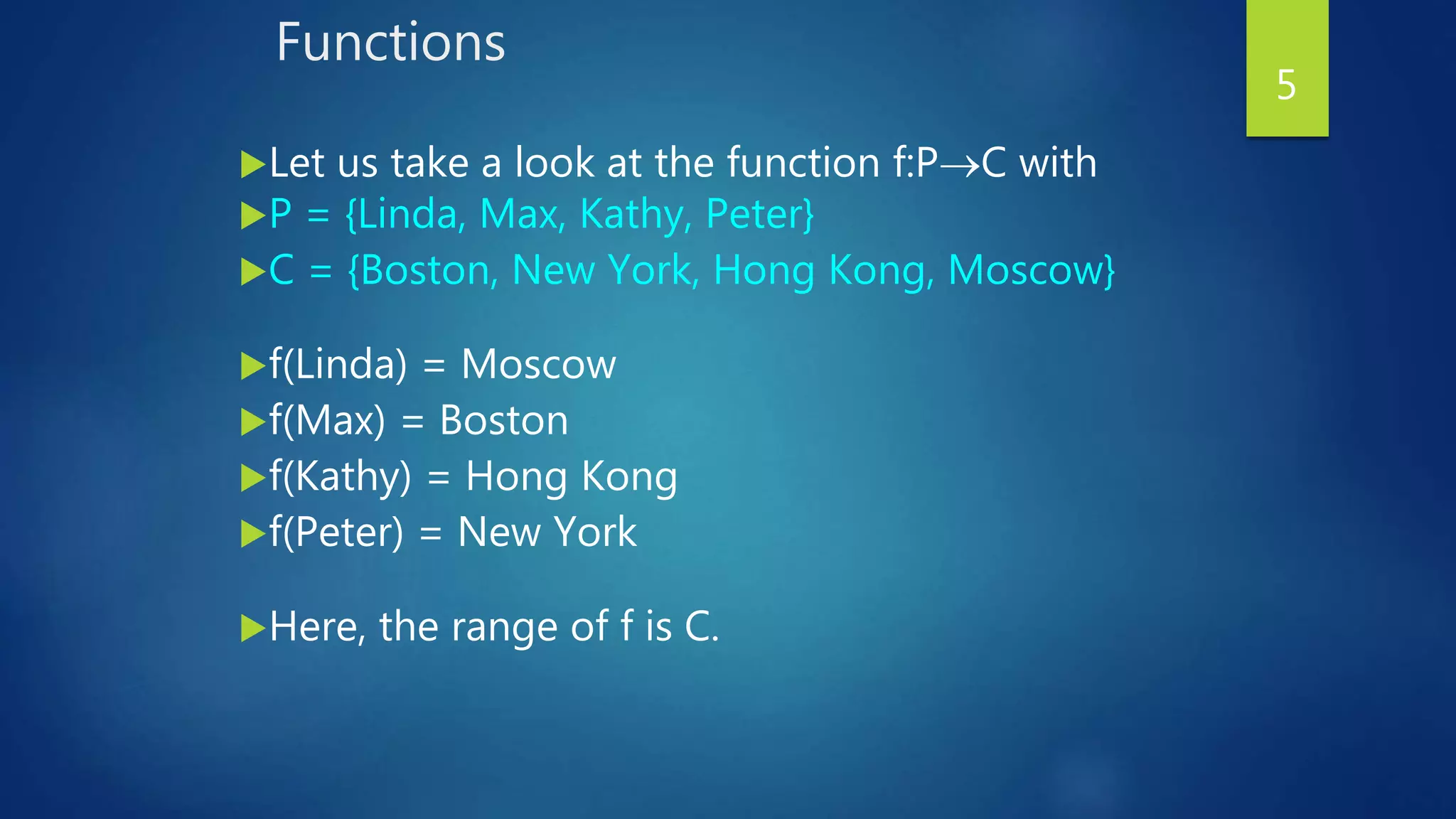
Let us take a look at the function f:PC with
P = {Linda, Max, Kathy, Peter}
C = {Boston, New York, Hong Kong, Moscow}
f(Linda) = Moscow
f(Max) = Boston
f(Kathy) = Hong Kong
f(Peter) = New York
Here, the range of f is C.
5
Functions
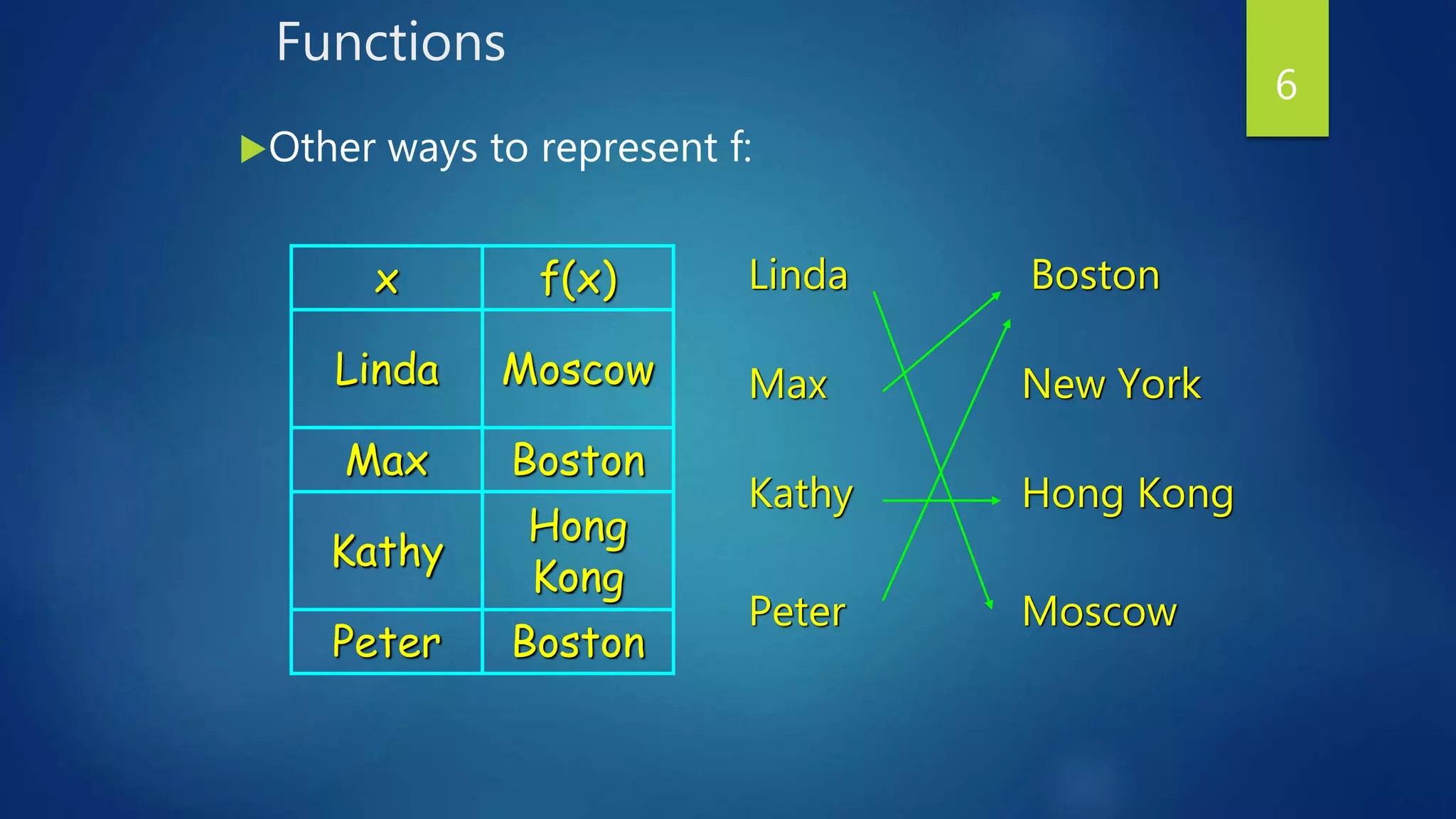
Other ways to represent f:
6
BostonPeter
Hong
Kong
Kathy
BostonMax
MoscowLinda
f(x)x Linda
Max
Kathy
Peter
Boston
New York
Hong Kong
Moscow
Functions
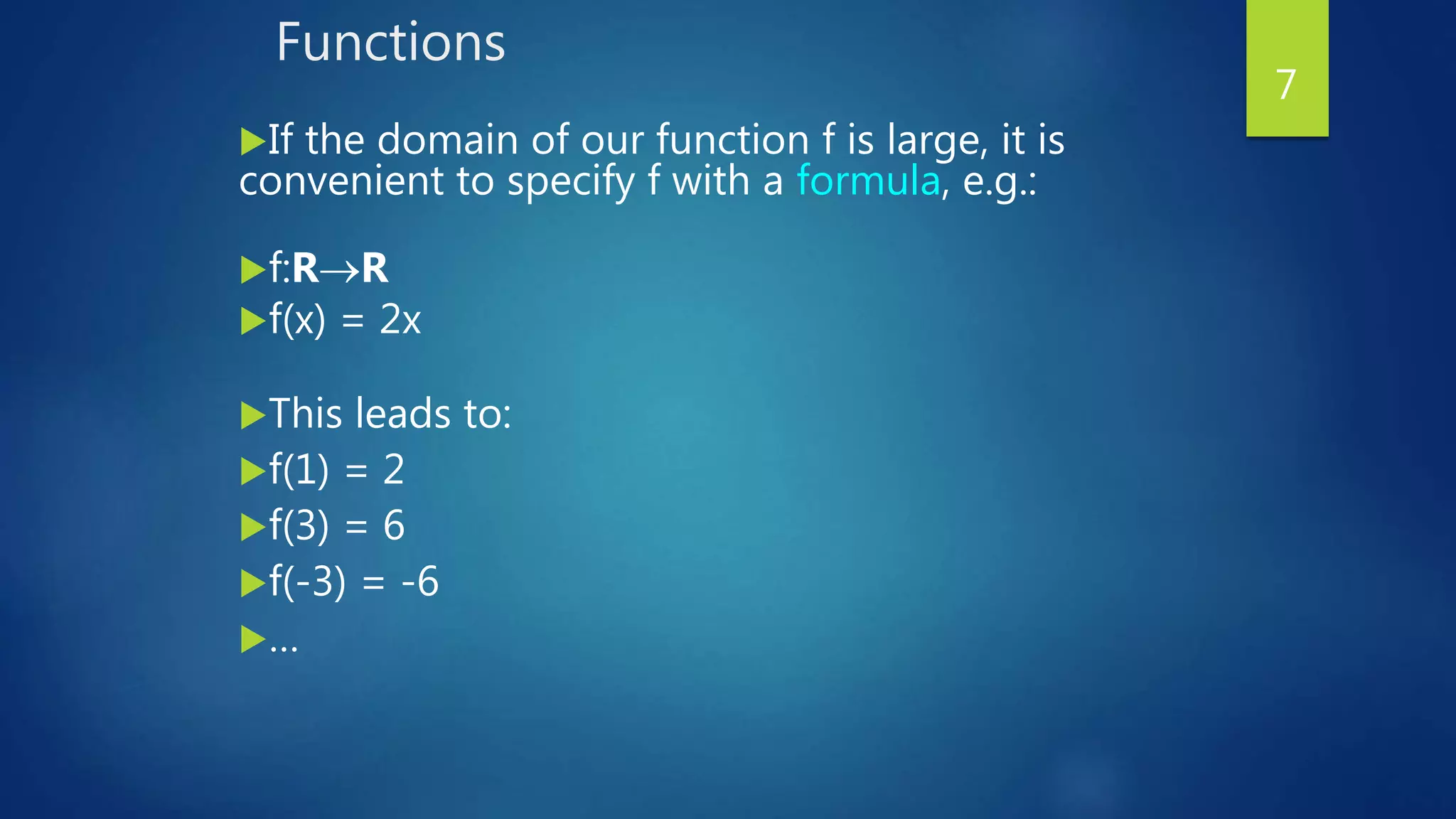
If the domain of our function f is large, it is
convenient to specify f with a formula, e.g.:
f:RR
f(x) = 2x
This leads to:
f(1) = 2
f(3) = 6
f(-3) = -6
…
7
Functions
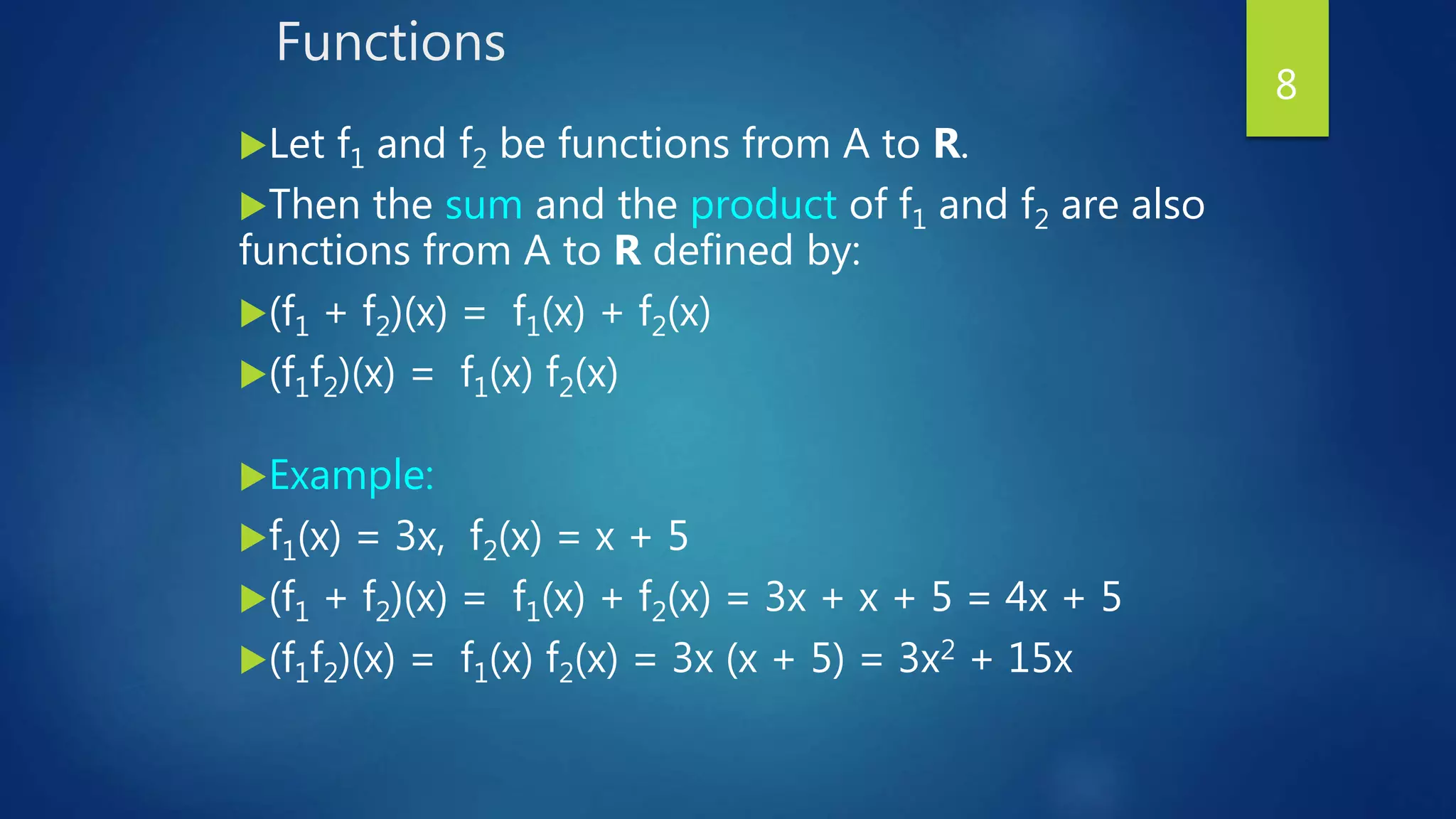
Let f1 and f2 be functions from A to R.
Then the sum and the product of f1 and f2 are also
functions from A to R defined by:
(f1 + f2)(x) = f1(x) + f2(x)
(f1f2)(x) = f1(x) f2(x)
Example:
f1(x) = 3x, f2(x) = x + 5
(f1 + f2)(x) = f1(x) + f2(x) = 3x + x + 5 = 4x + 5
(f1f2)(x) = f1(x) f2(x) = 3x (x + 5) = 3x2 + 15x
8
Functions
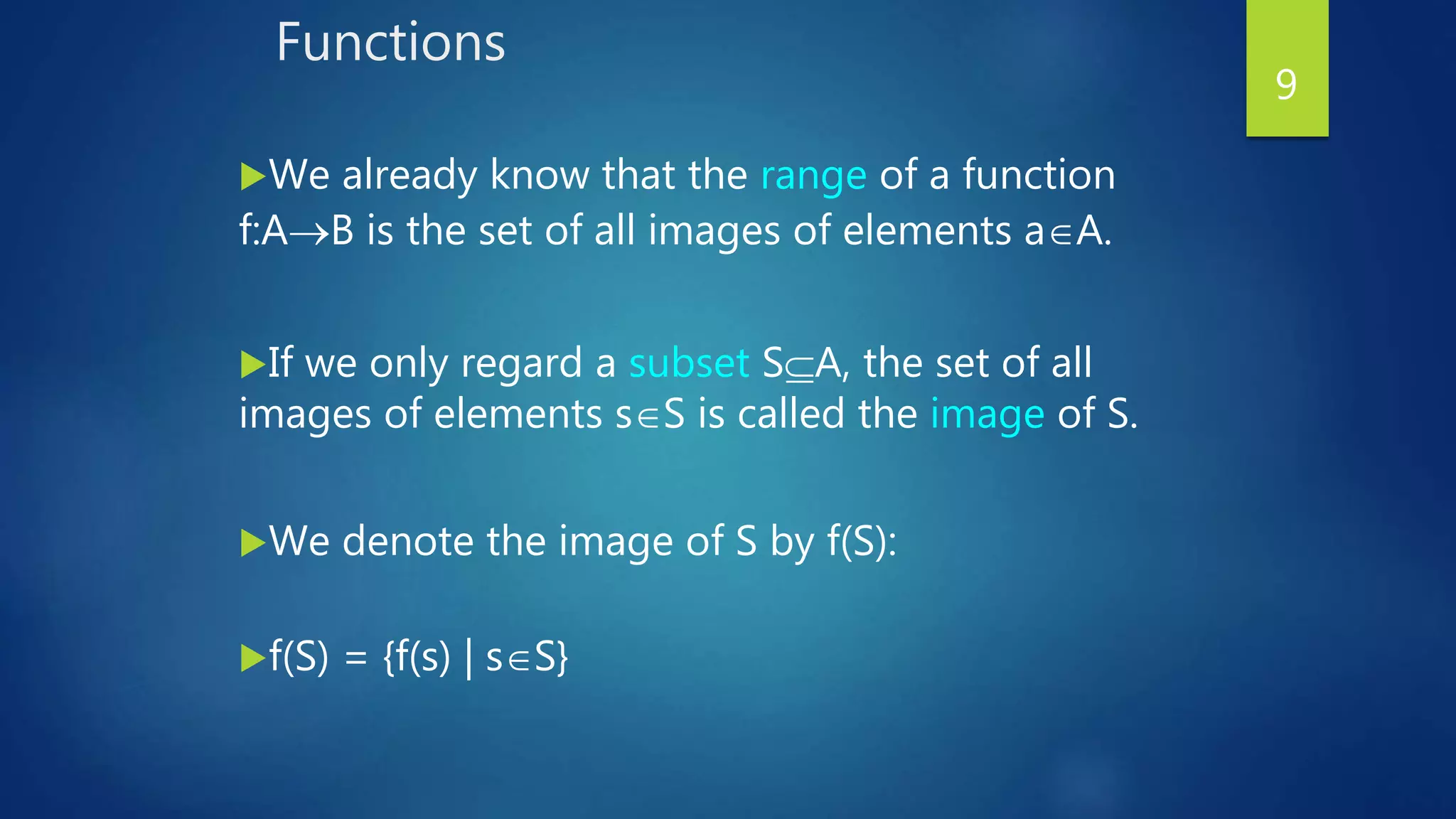
We already know that the range of a function
f:AB is the set of all images of elements aA.
If we only regard a subset SA, the set of all
images of elements sS is called the image of S.
We denote the image of S by f(S):
f(S) = {f(s) | sS}
9
Functions
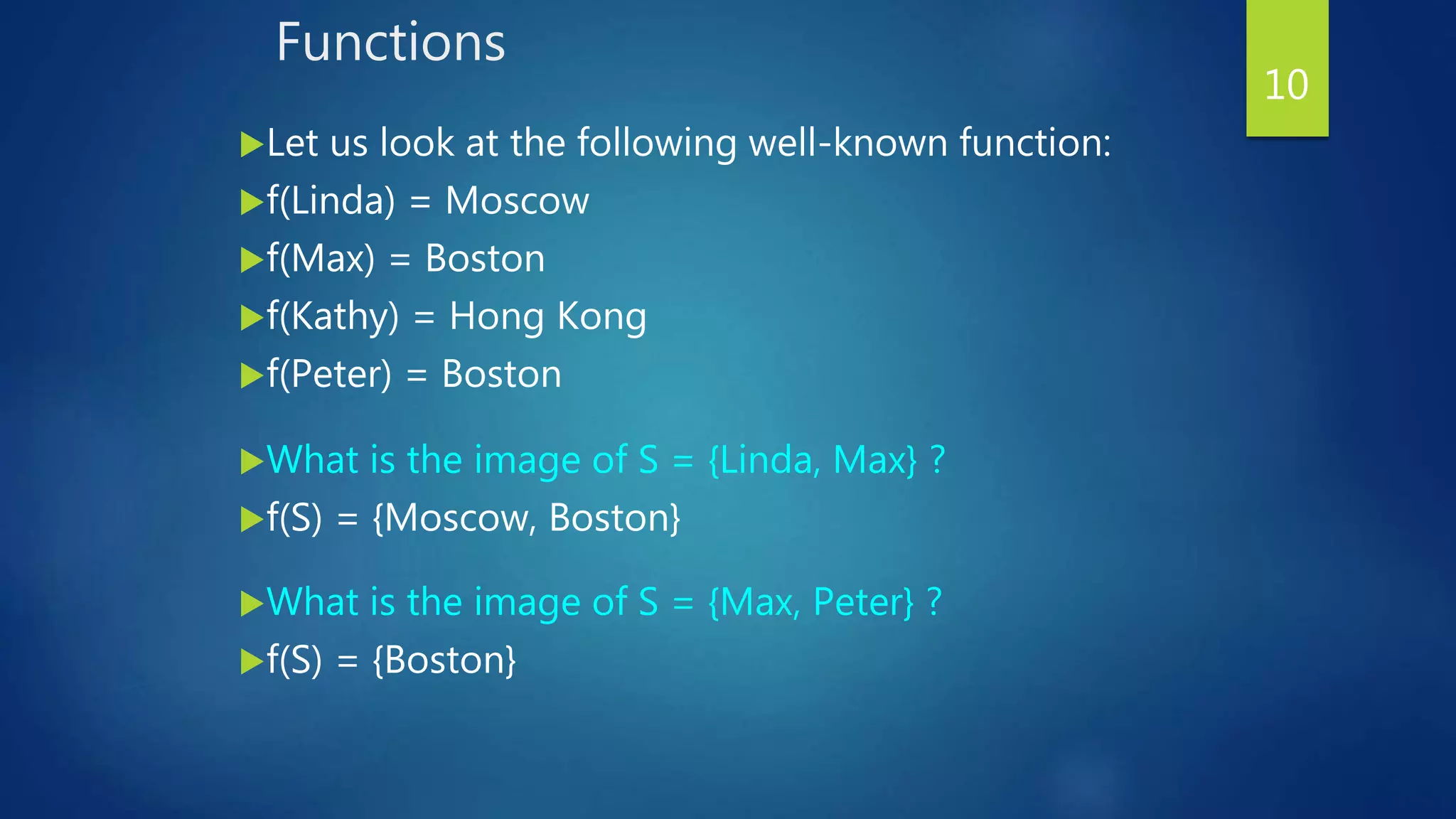
Let us look at the following well-known function:
f(Linda) = Moscow
f(Max) = Boston
f(Kathy) = Hong Kong
f(Peter) = Boston
What is the image of S = {Linda, Max} ?
f(S) = {Moscow, Boston}
What is the image of S = {Max, Peter} ?
f(S) = {Boston}
10
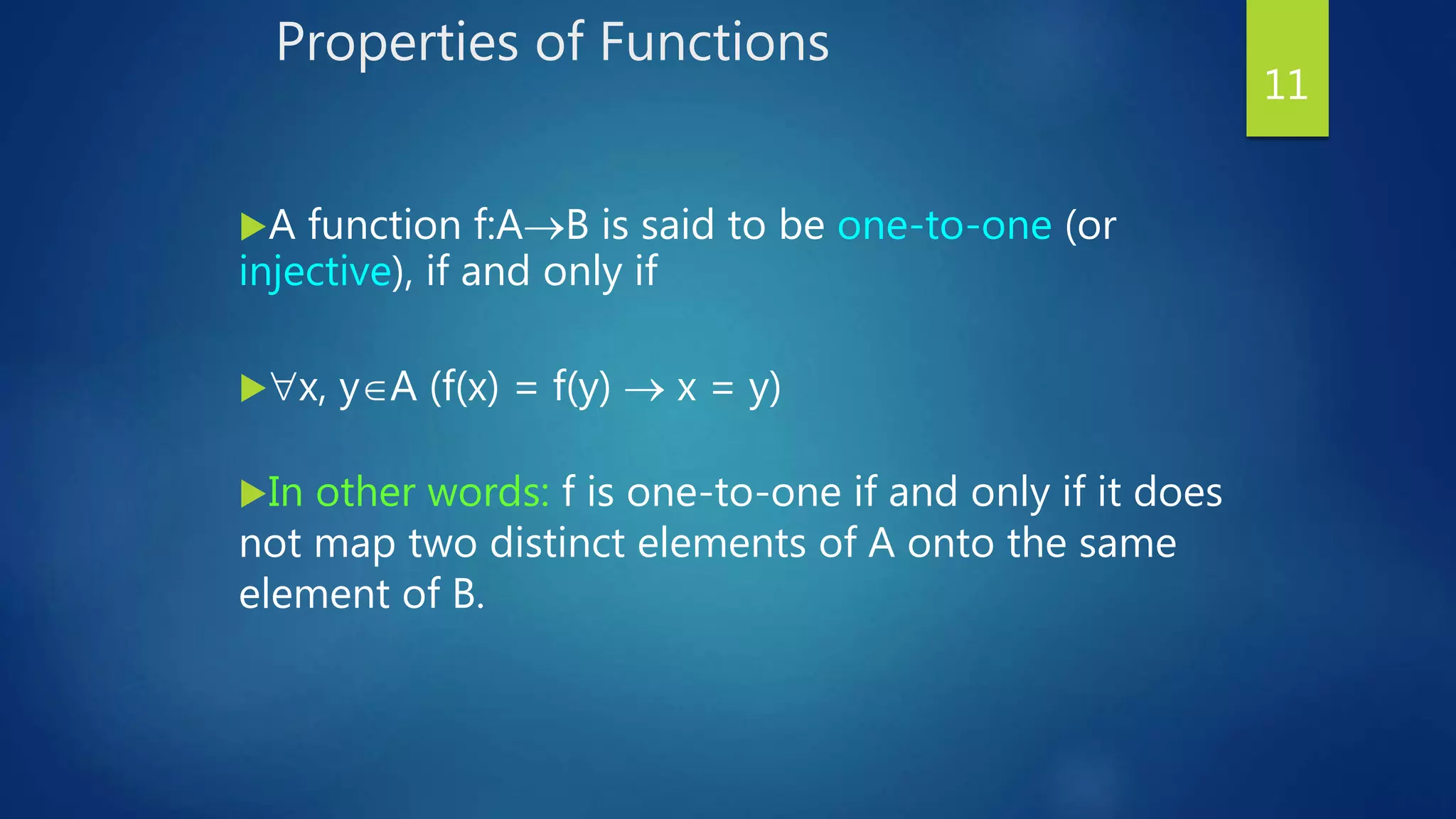
Properties of Functions
A function f:AB is said to be one-to-one (or
injective), if and only if
x, yA (f(x) = f(y)  x = y)
In other words: f is one-to-one if and only if it does
not map two distinct elements of A onto the same
element of B.
11
Properties of Functions
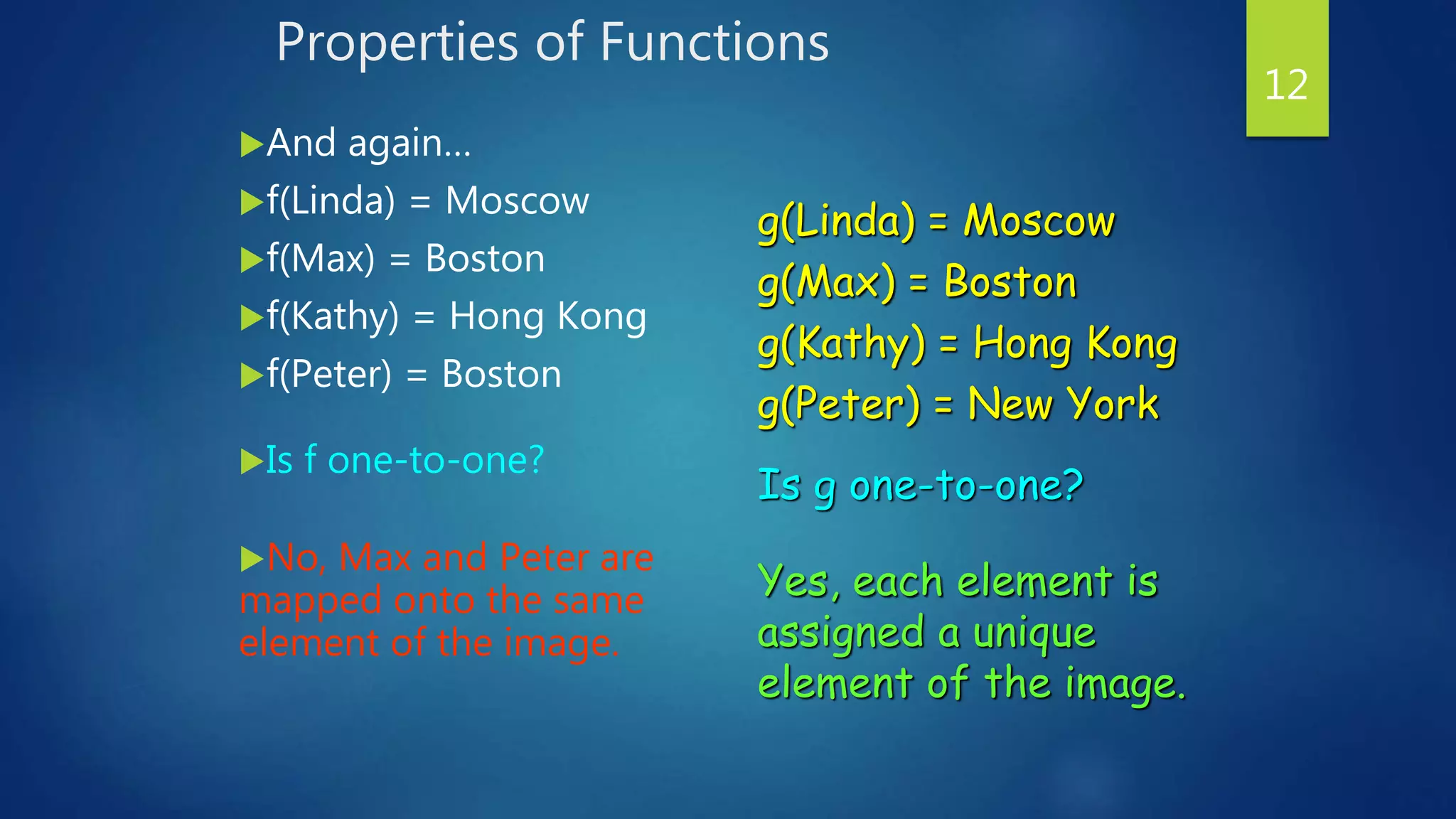
And again…
f(Linda) = Moscow
f(Max) = Boston
f(Kathy) = Hong Kong
f(Peter) = Boston
Is f one-to-one?
No, Max and Peter are
mapped onto the same
element of the image.
12
g(Linda) = Moscow
g(Max) = Boston
g(Kathy) = Hong Kong
g(Peter) = New York
Is g one-to-one?
Yes, each element is
assigned a unique
element of the image.
Properties of Functions
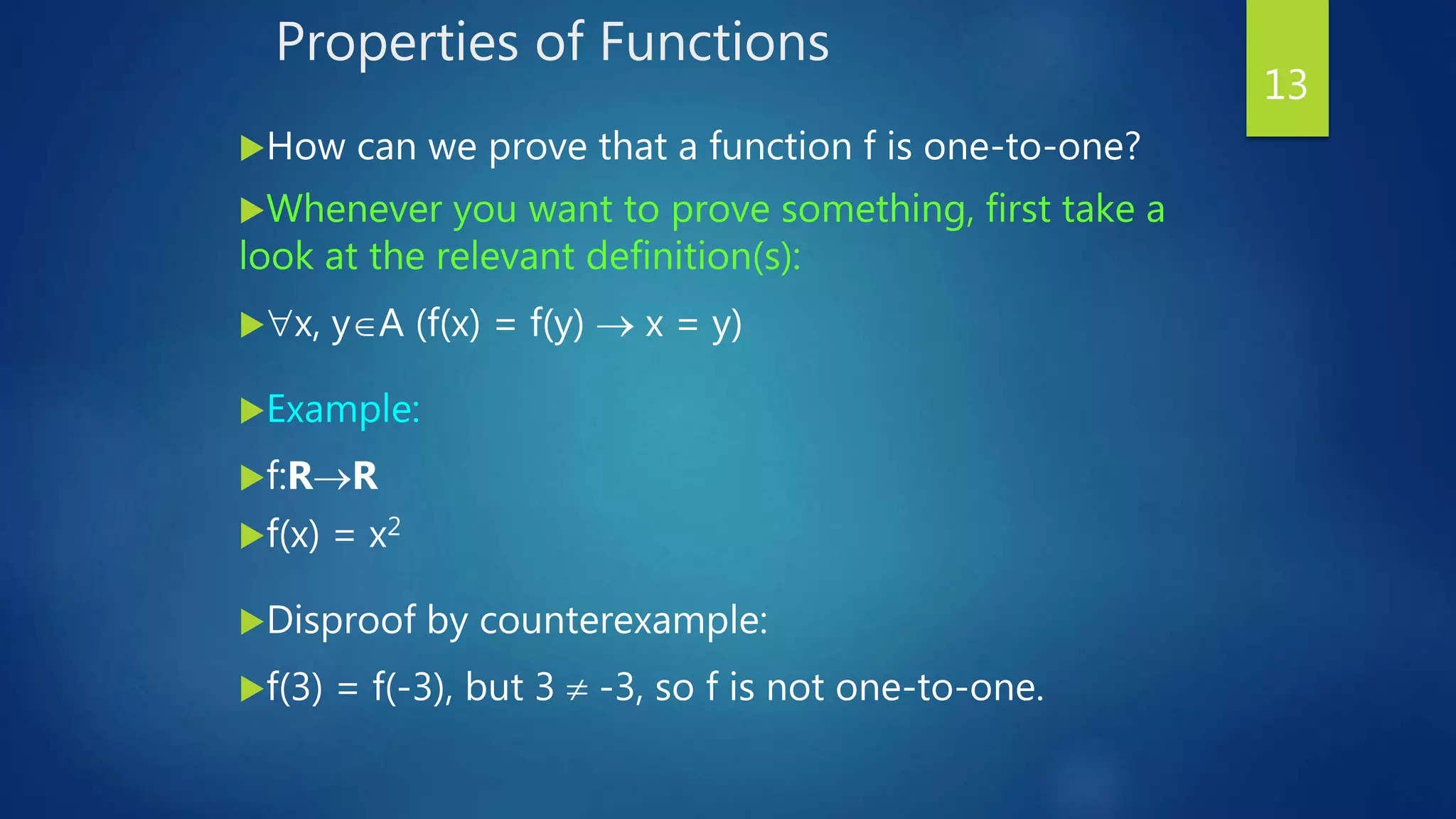
How can we prove that a function f is one-to-one?
Whenever you want to prove something, first take a
look at the relevant definition(s):
x, yA (f(x) = f(y)  x = y)
Example:
f:RR
f(x) = x2
Disproof by counterexample:
f(3) = f(-3), but 3  -3, so f is not one-to-one.
13
Properties of Functions
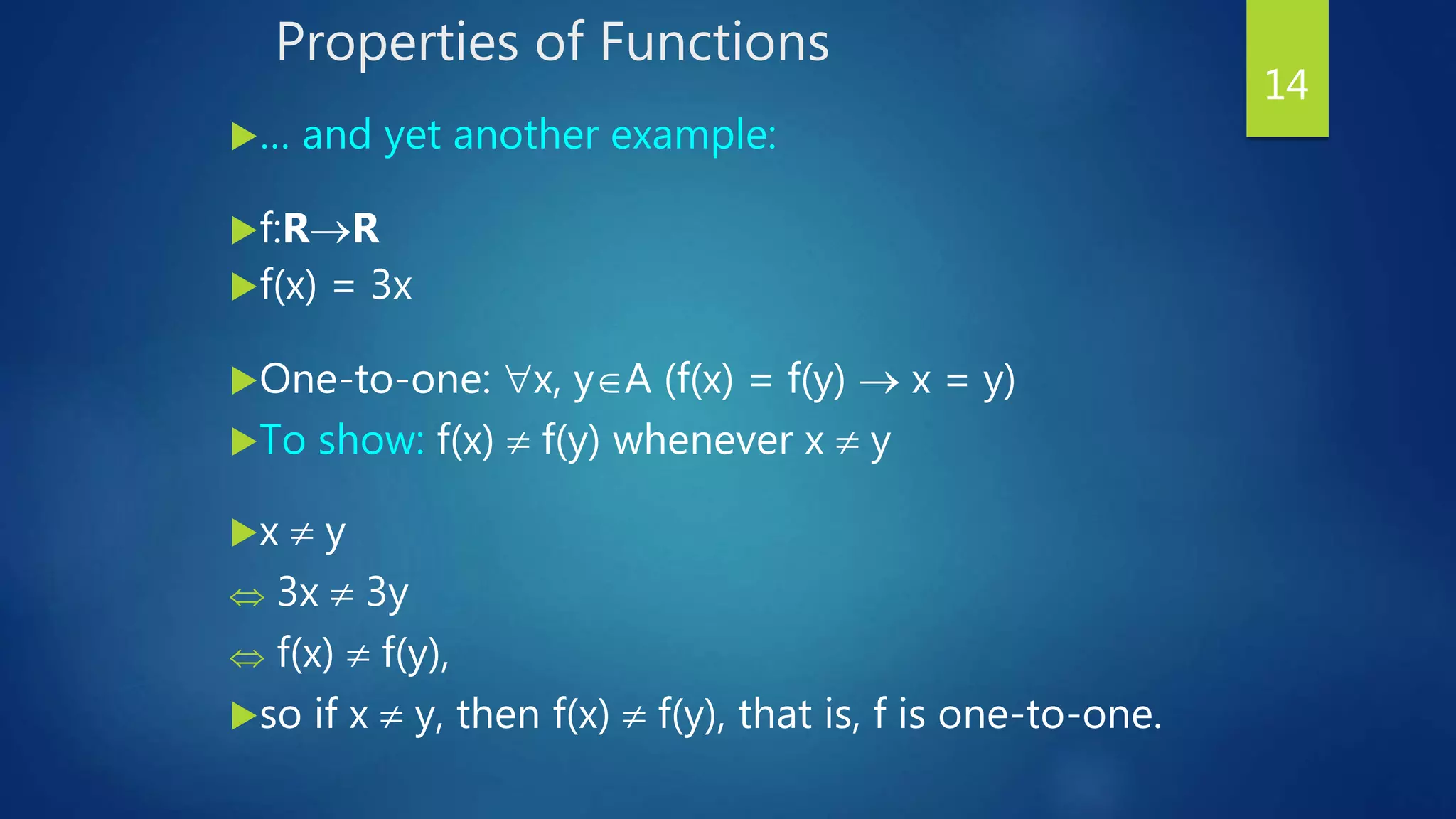
… and yet another example:
f:RR
f(x) = 3x
One-to-one: x, yA (f(x) = f(y)  x = y)
To show: f(x)  f(y) whenever x  y
x  y
 3x  3y
 f(x)  f(y),
so if x  y, then f(x)  f(y), that is, f is one-to-one.
14
Properties of Functions
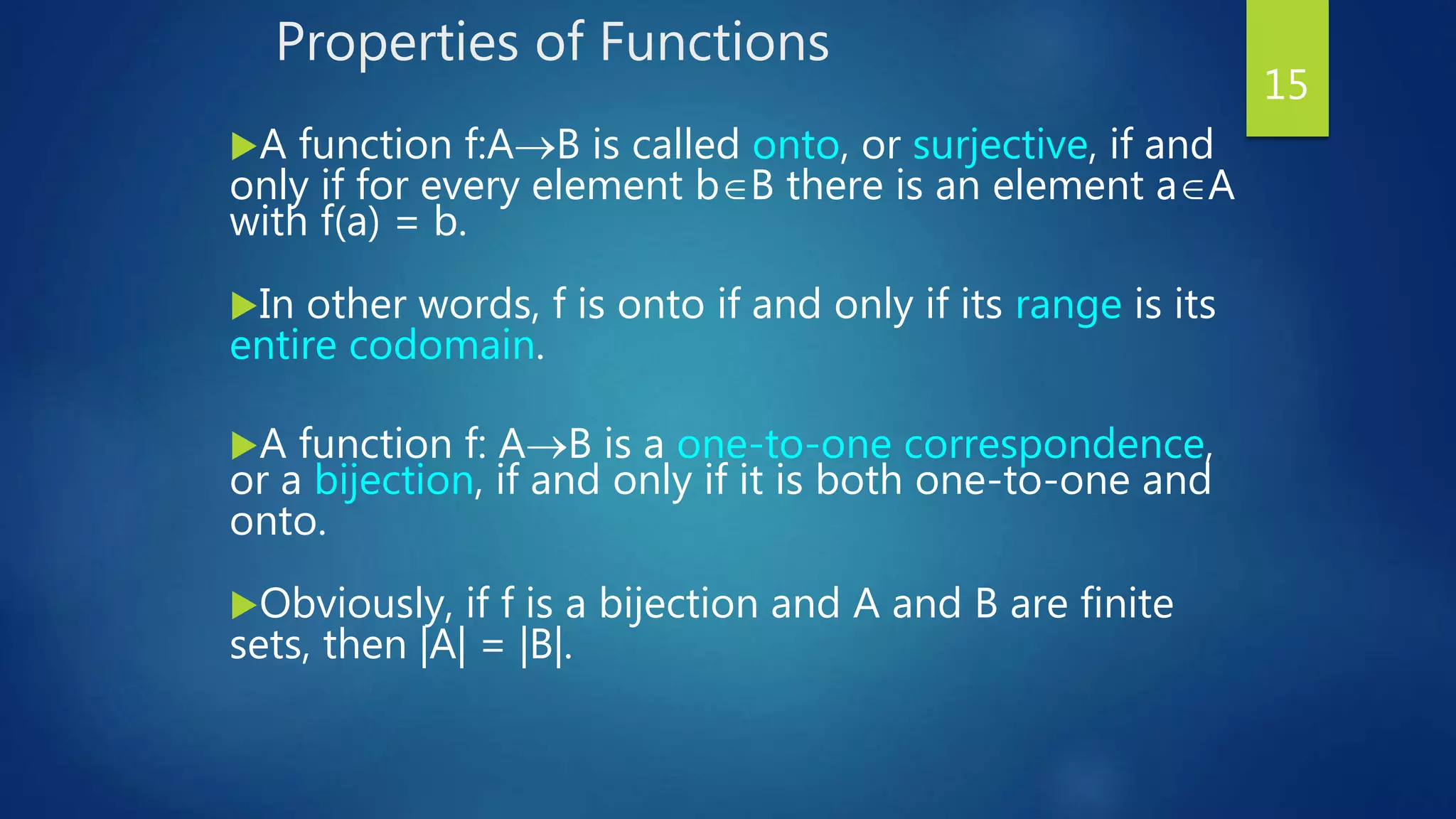
A function f:AB is called onto, or surjective, if and
only if for every element bB there is an element aA
with f(a) = b.
In other words, f is onto if and only if its range is its
entire codomain.
A function f: AB is a one-to-one correspondence,
or a bijection, if and only if it is both one-to-one and
onto.
Obviously, if f is a bijection and A and B are finite
sets, then |A| = |B|.
15
Properties of Functions
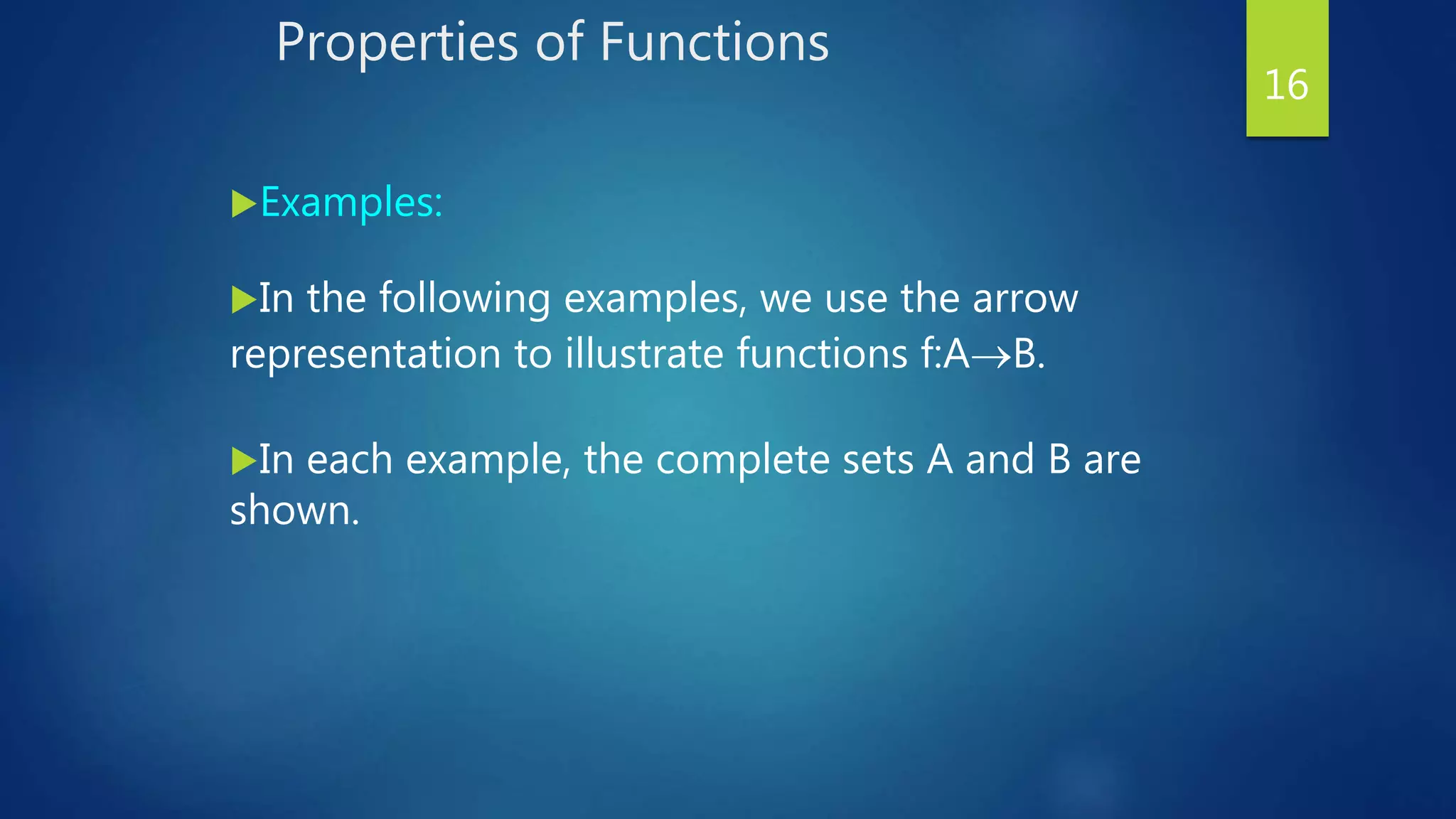
Examples:
In the following examples, we use the arrow
representation to illustrate functions f:AB.
In each example, the complete sets A and B are
shown.
16
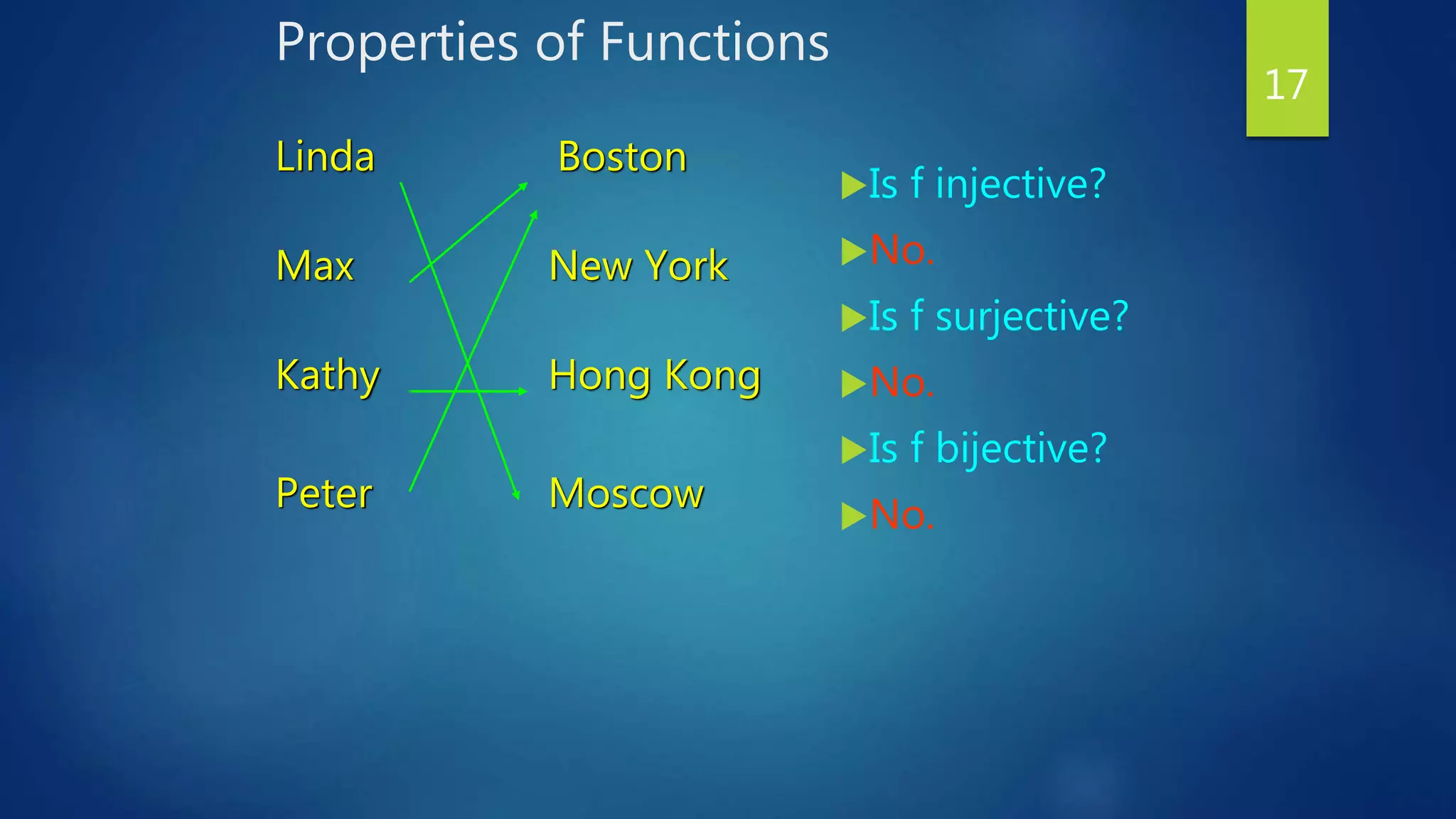
Properties of Functions
Is f injective?
No.
Is f surjective?
No.
Is f bijective?
No.
17
Linda
Max
Kathy
Peter
Boston
New York
Hong Kong
Moscow
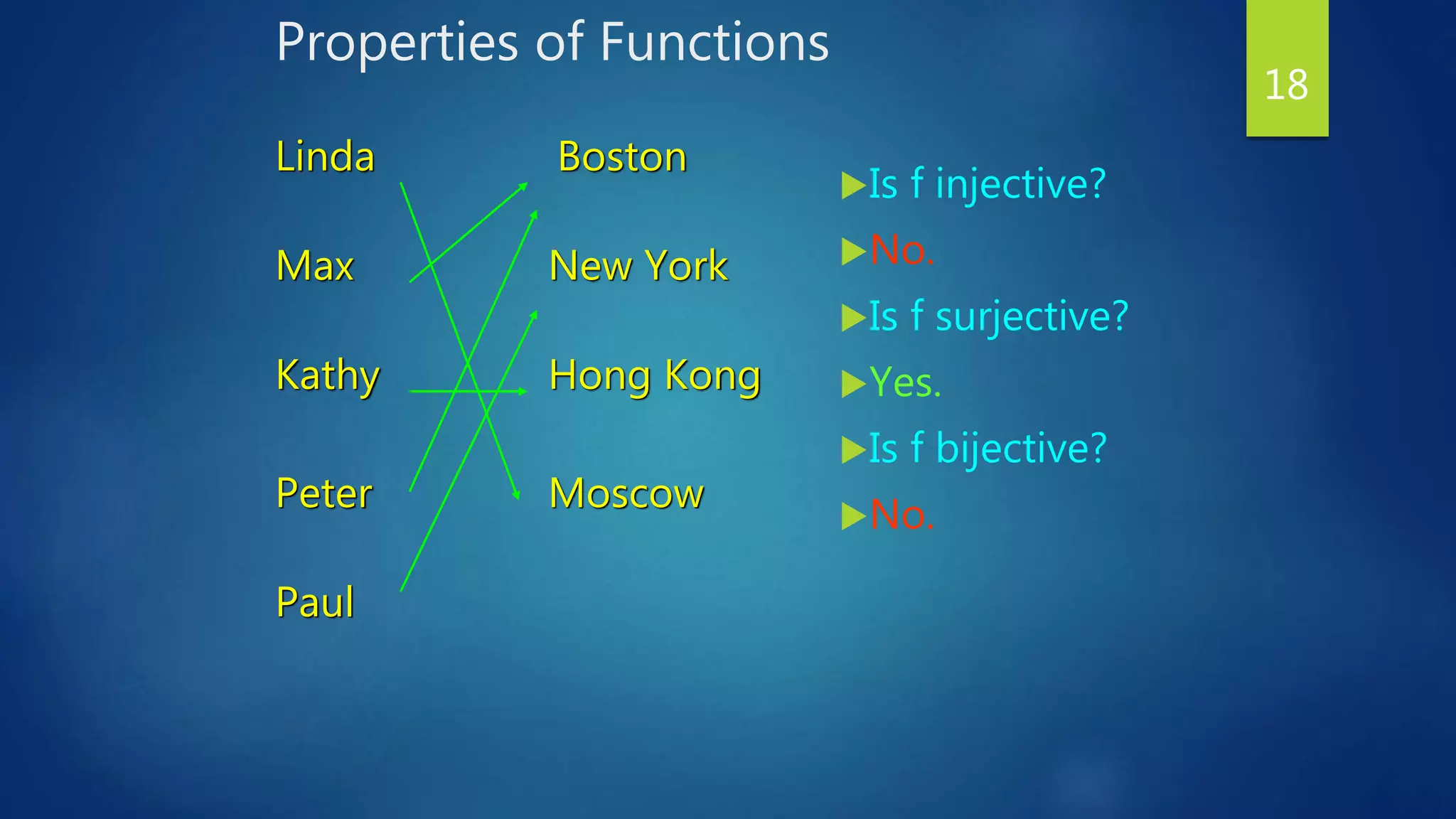
Properties of Functions
Is f injective?
No.
Is f surjective?
Yes.
Is f bijective?
No.
18
Linda
Max
Kathy
Peter
Boston
New York
Hong Kong
Moscow
Paul
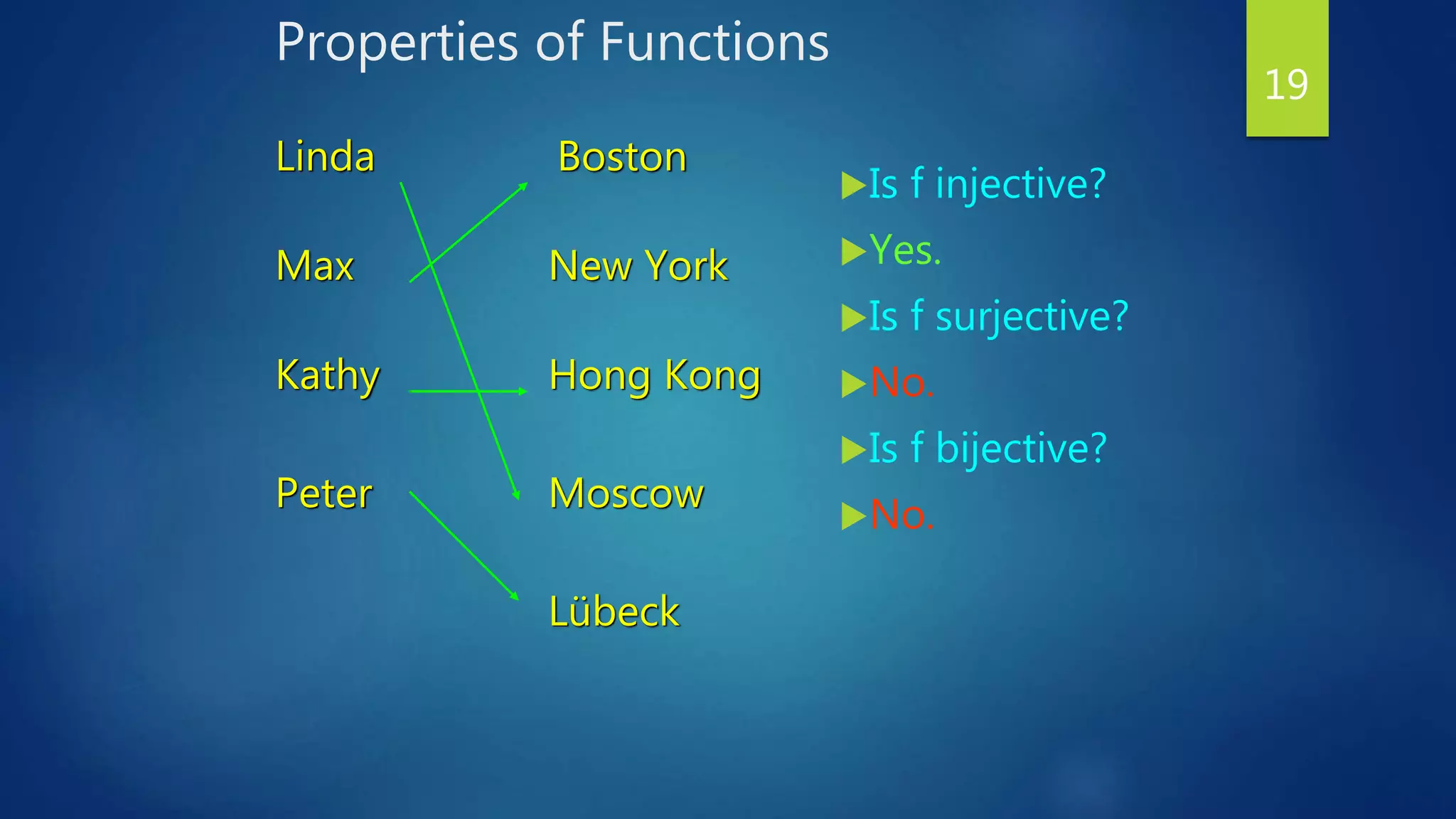
Properties of Functions
Is f injective?
Yes.
Is f surjective?
No.
Is f bijective?
No.
19
Linda
Max
Kathy
Peter
Boston
New York
Hong Kong
Moscow
Lübeck
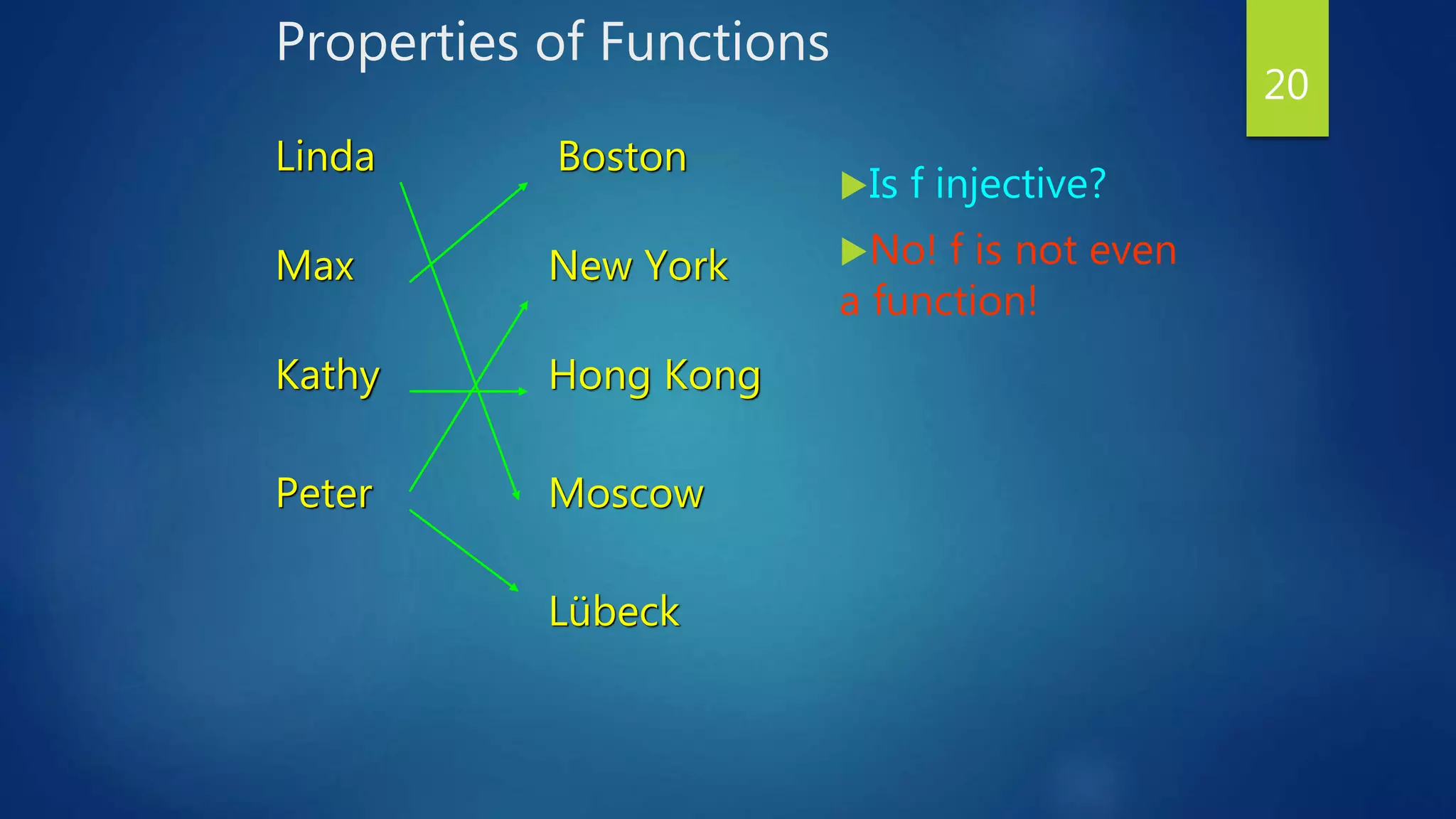
Properties of Functions
Is f injective?
No! f is not even
a function!
20
Linda
Max
Kathy
Peter
Boston
New York
Hong Kong
Moscow
Lübeck
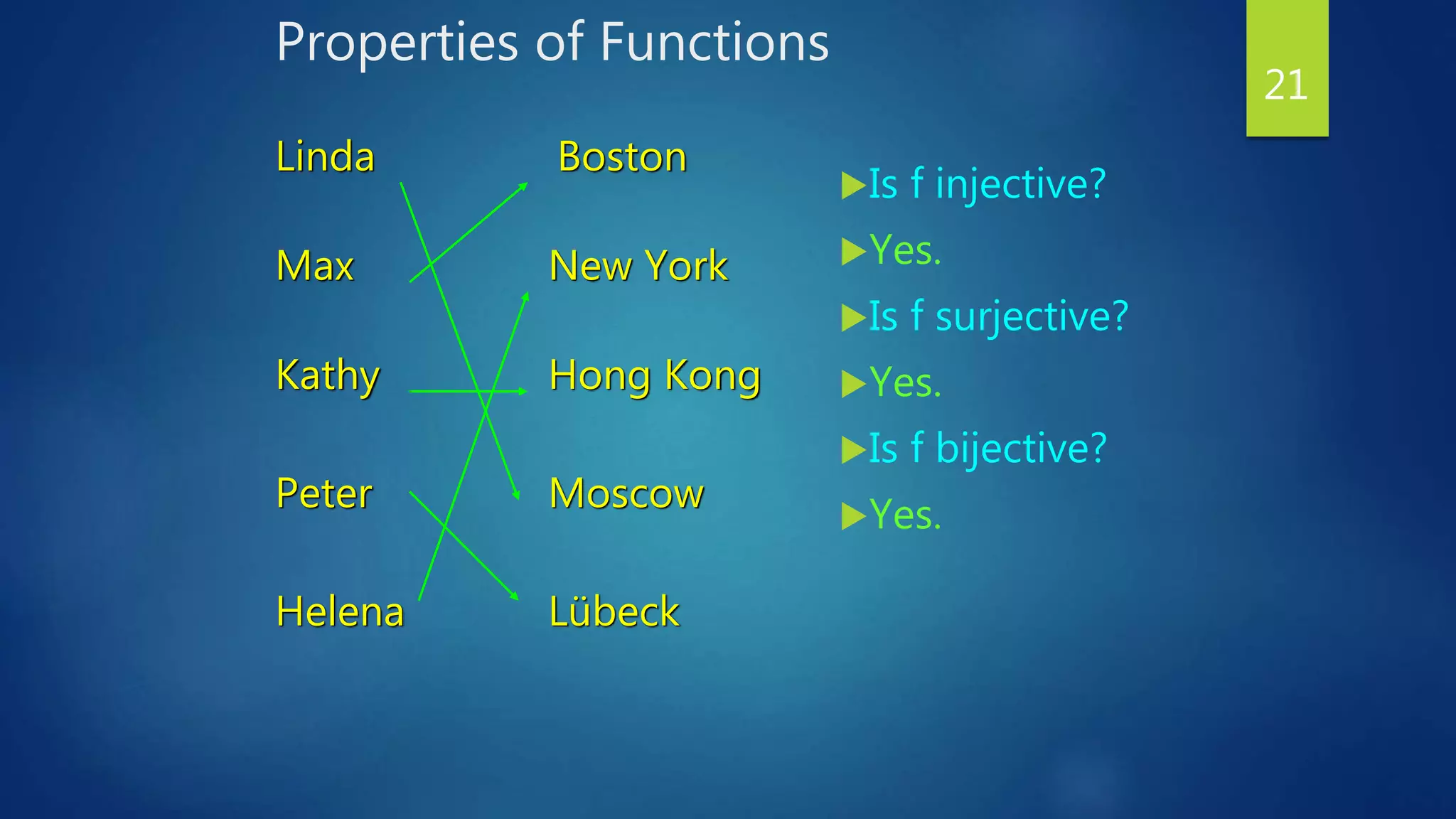
Properties of Functions
Is f injective?
Yes.
Is f surjective?
Yes.
Is f bijective?
Yes.
21
Linda
Max
Kathy
Peter
Boston
New York
Hong Kong
Moscow
LübeckHelena
Inversion
An interesting property of bijections is that they
have an inverse function.
The inverse function of the bijection f:AB is
the function f-1:BA with
f-1(b) = a whenever f(a) = b.
22
Inversion
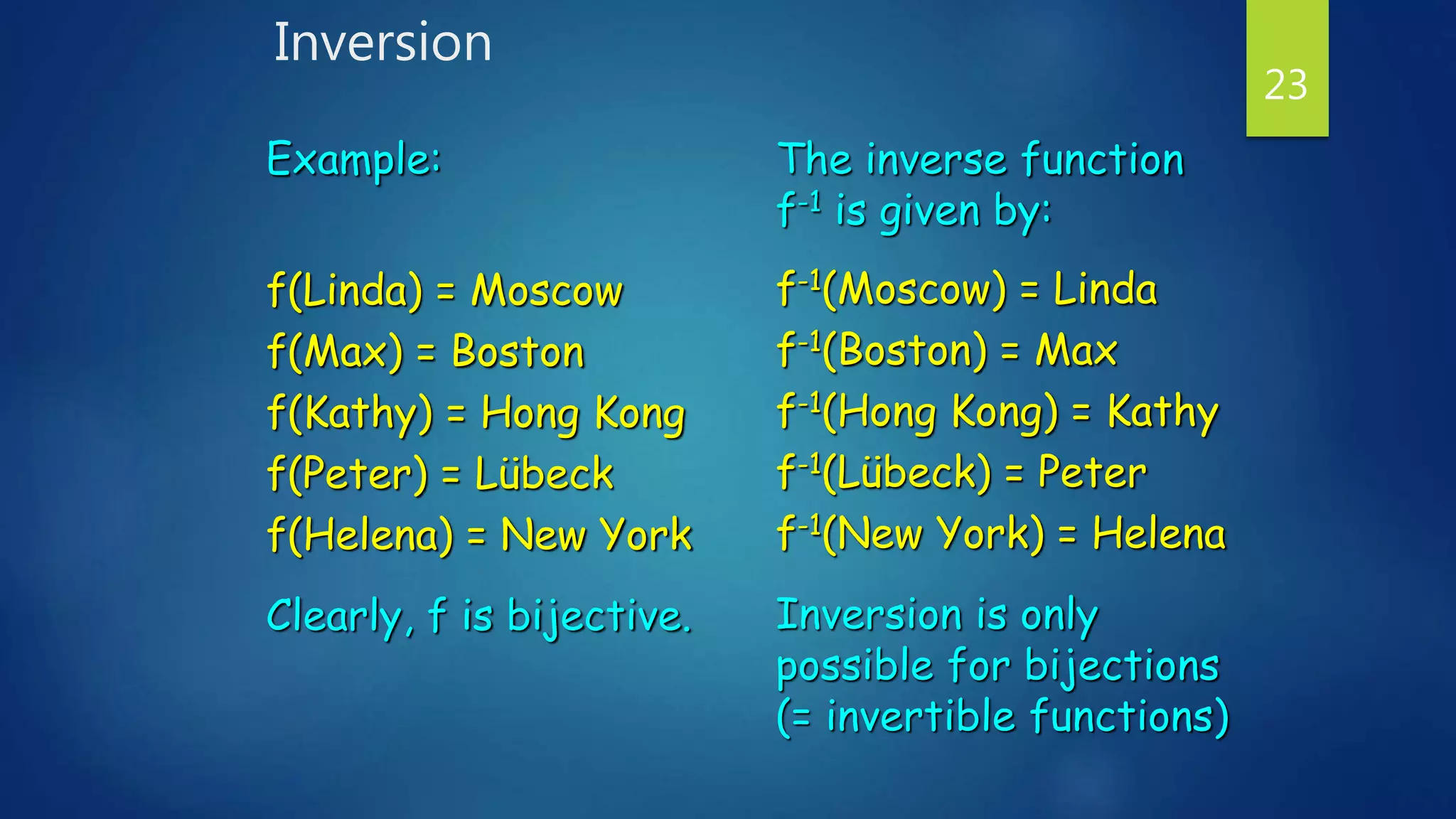
23
Example:
f(Linda) = Moscow
f(Max) = Boston
f(Kathy) = Hong Kong
f(Peter) = Lübeck
f(Helena) = New York
Clearly, f is bijective.
The inverse function
f-1 is given by:
f-1(Moscow) = Linda
f-1(Boston) = Max
f-1(Hong Kong) = Kathy
f-1(Lübeck) = Peter
f-1(New York) = Helena
Inversion is only
possible for bijections
(= invertible functions)
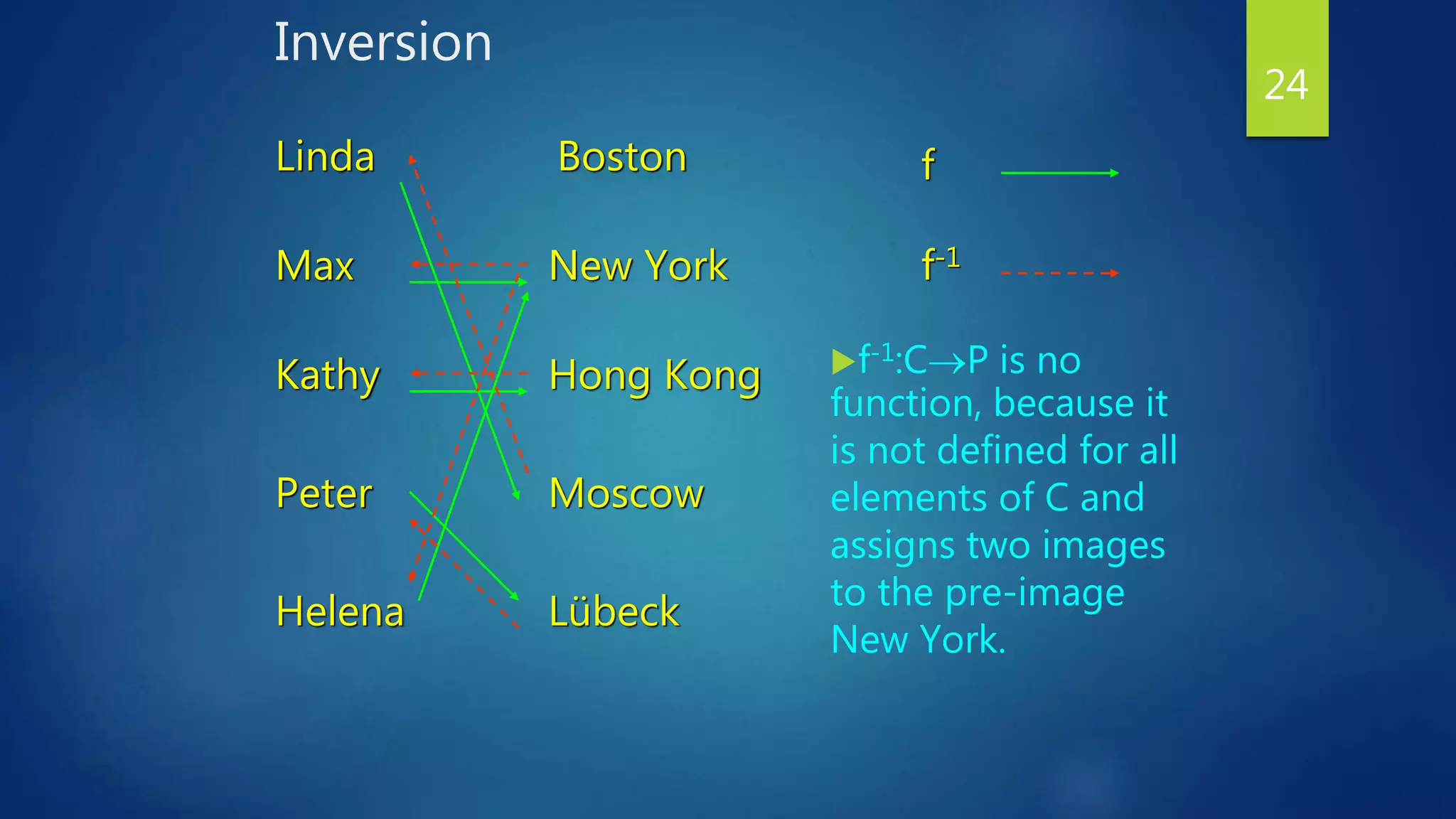
Inversion
f-1:CP is no
function, because it
is not defined for all
elements of C and
assigns two images
to the pre-image
New York.
24
Linda
Max
Kathy
Peter
Boston
New York
Hong Kong
Moscow
LübeckHelena
f
f-1
Composition
The composition of two functions g:AB and
f:BC, denoted by fg, is defined by
(fg)(a) = f(g(a))
This means that
• first, function g is applied to element aA,
mapping it onto an element of B,
• then, function f is applied to this element of B,
mapping it onto an element of C.
• Therefore, the composite function maps
from A to C.
25
Composition
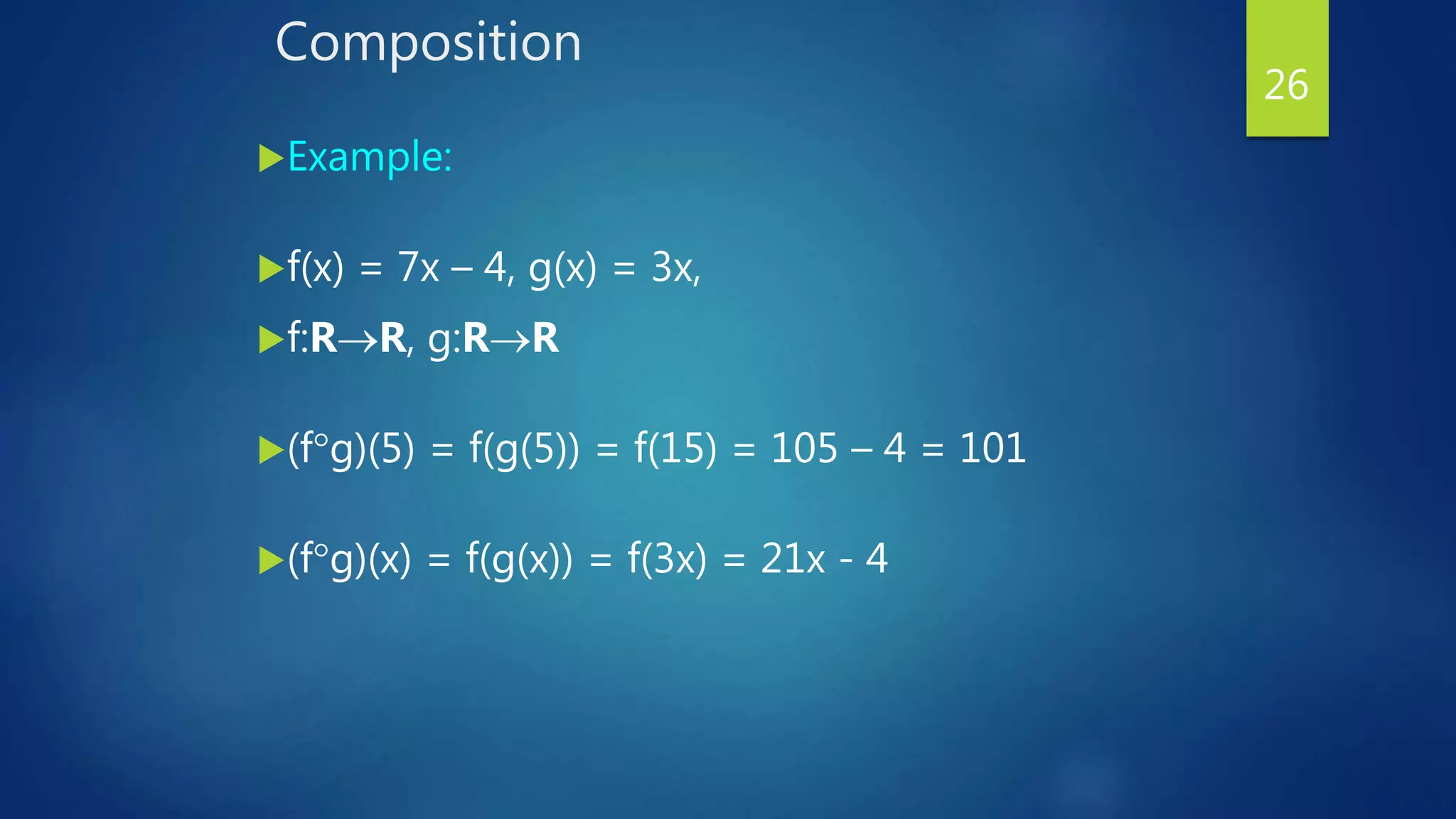
Example:
f(x) = 7x – 4, g(x) = 3x,
f:RR, g:RR
(fg)(5) = f(g(5)) = f(15) = 105 – 4 = 101
(fg)(x) = f(g(x)) = f(3x) = 21x - 4
26
Composition
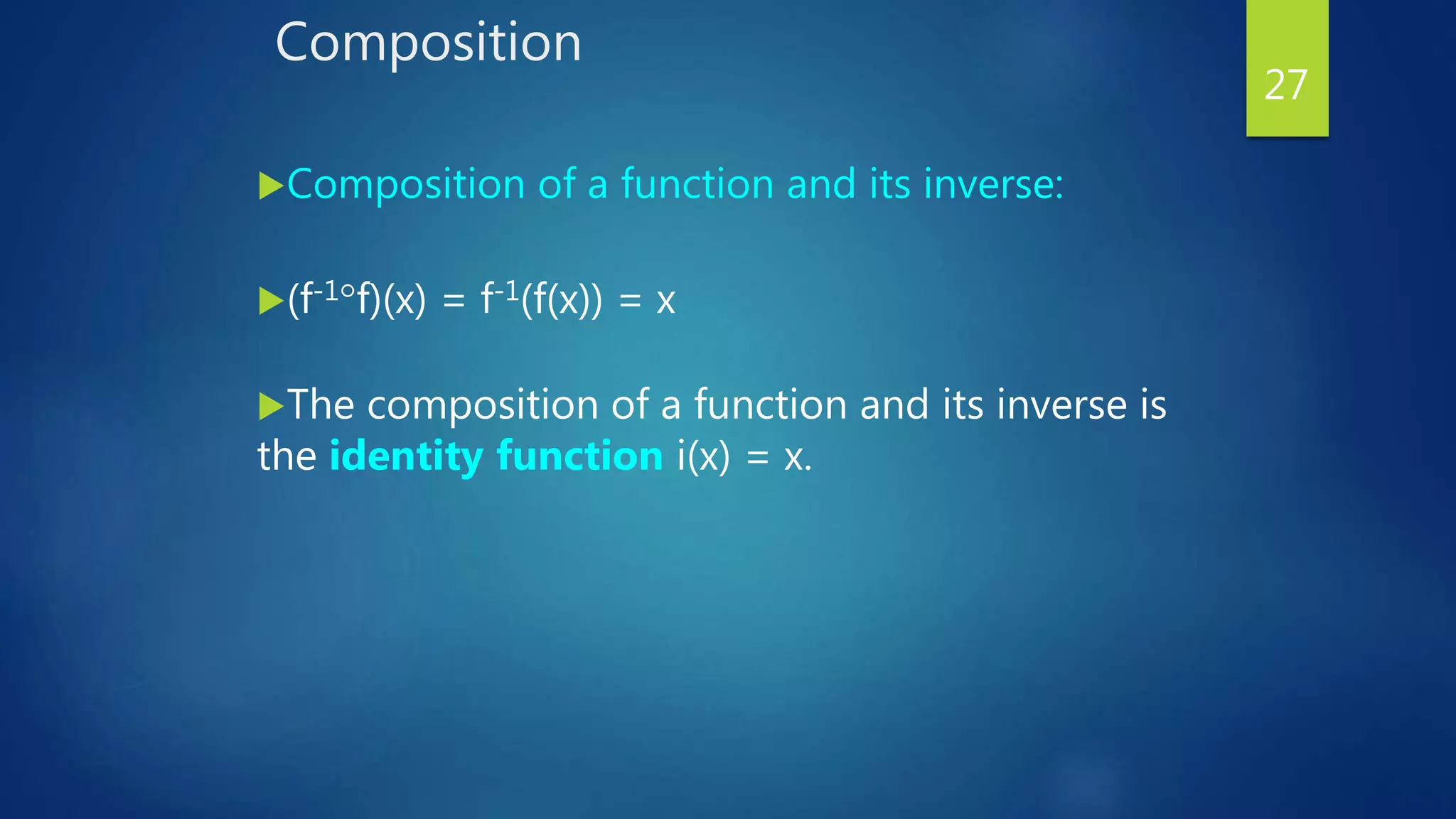
Composition of a function and its inverse:
(f-1f)(x) = f-1(f(x)) = x
The composition of a function and its inverse is
the identity function i(x) = x.
27
Graphs
The graph of a function f:AB is the set of
ordered pairs {(a, b) | aA and f(a) = b}.
The graph is a subset of AB that can be used
to visualize f in a two-dimensional coordinate
system.
28
Floor and Ceiling Functions
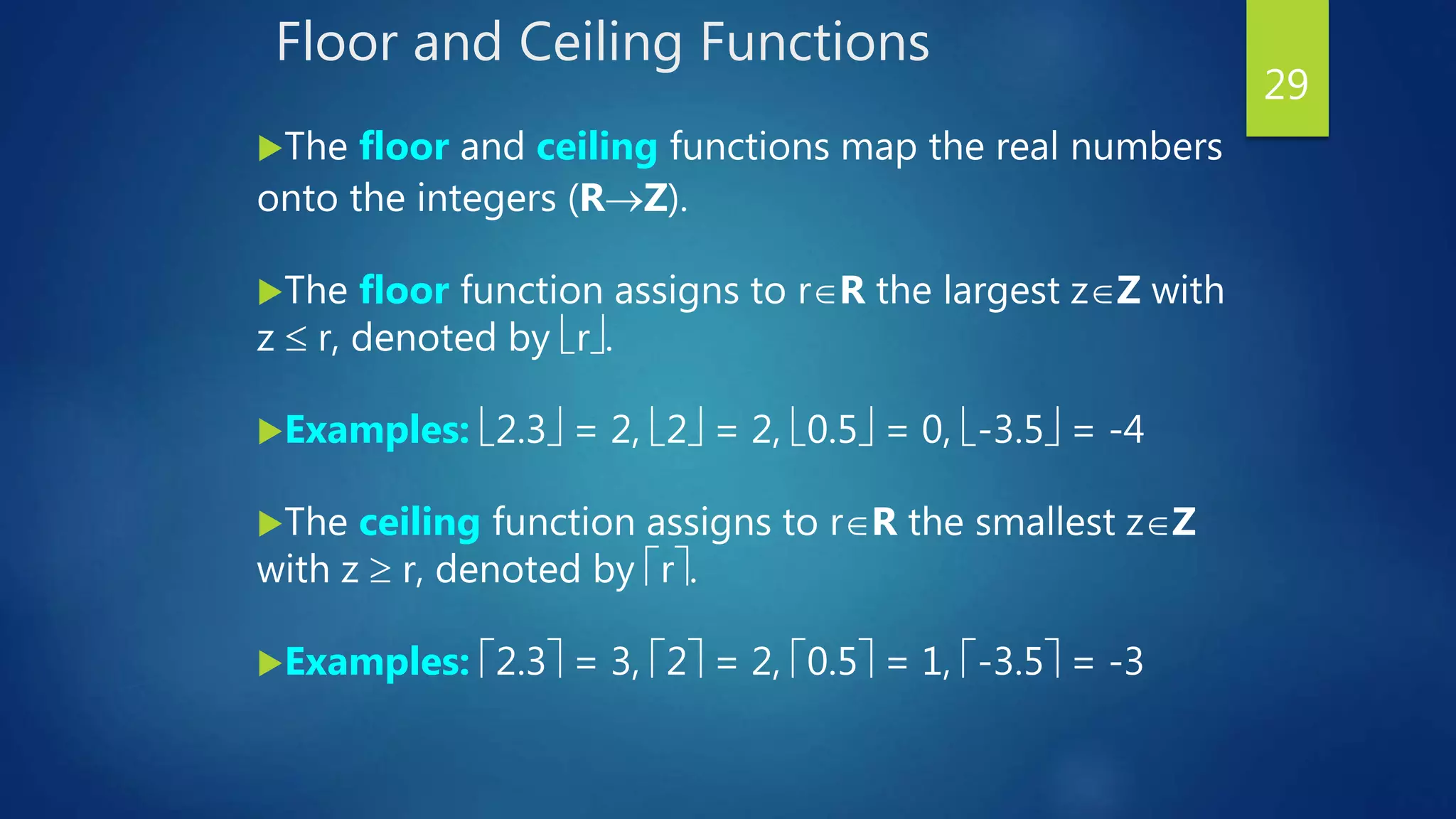
The floor and ceiling functions map the real numbers
onto the integers (RZ).
The floor function assigns to rR the largest zZ with
z  r, denoted by r.
Examples: 2.3 = 2, 2 = 2, 0.5 = 0, -3.5 = -4
The ceiling function assigns to rR the smallest zZ
with z  r, denoted by r.
Examples: 2.3 = 3, 2 = 2, 0.5 = 1, -3.5 = -3
29
Thank you…

Function of DM

  • 1.
    Discrete Mathematics Lecture 03 RubyaAfrin Lecturer Northern University of Business and Technology
  • 2.
  • 3.
    Functions A function ffrom a set A to a set B is an assignment of exactly one element of B to each element of A. We write f(a) = b if b is the unique element of B assigned by the function f to the element a of A. If f is a function from A to B, we write f: AB (note: Here, ““ has nothing to do with if… then) 3
  • 4.
    Functions If f:AB, wesay that A is the domain of f and B is the codomain of f. If f(a) = b, we say that b is the image of a and a is the pre-image of b. The range of f:AB is the set of all images of elements of A. We say that f:AB maps A to B. 4
  • 5.
    Functions Let us takea look at the function f:PC with P = {Linda, Max, Kathy, Peter} C = {Boston, New York, Hong Kong, Moscow} f(Linda) = Moscow f(Max) = Boston f(Kathy) = Hong Kong f(Peter) = New York Here, the range of f is C. 5
  • 6.
    Functions Other ways torepresent f: 6 BostonPeter Hong Kong Kathy BostonMax MoscowLinda f(x)x Linda Max Kathy Peter Boston New York Hong Kong Moscow
  • 7.
    Functions If the domainof our function f is large, it is convenient to specify f with a formula, e.g.: f:RR f(x) = 2x This leads to: f(1) = 2 f(3) = 6 f(-3) = -6 … 7
  • 8.
    Functions Let f1 andf2 be functions from A to R. Then the sum and the product of f1 and f2 are also functions from A to R defined by: (f1 + f2)(x) = f1(x) + f2(x) (f1f2)(x) = f1(x) f2(x) Example: f1(x) = 3x, f2(x) = x + 5 (f1 + f2)(x) = f1(x) + f2(x) = 3x + x + 5 = 4x + 5 (f1f2)(x) = f1(x) f2(x) = 3x (x + 5) = 3x2 + 15x 8
  • 9.
    Functions We already knowthat the range of a function f:AB is the set of all images of elements aA. If we only regard a subset SA, the set of all images of elements sS is called the image of S. We denote the image of S by f(S): f(S) = {f(s) | sS} 9
  • 10.
    Functions Let us lookat the following well-known function: f(Linda) = Moscow f(Max) = Boston f(Kathy) = Hong Kong f(Peter) = Boston What is the image of S = {Linda, Max} ? f(S) = {Moscow, Boston} What is the image of S = {Max, Peter} ? f(S) = {Boston} 10
  • 11.
    Properties of Functions Afunction f:AB is said to be one-to-one (or injective), if and only if x, yA (f(x) = f(y)  x = y) In other words: f is one-to-one if and only if it does not map two distinct elements of A onto the same element of B. 11
  • 12.
    Properties of Functions Andagain… f(Linda) = Moscow f(Max) = Boston f(Kathy) = Hong Kong f(Peter) = Boston Is f one-to-one? No, Max and Peter are mapped onto the same element of the image. 12 g(Linda) = Moscow g(Max) = Boston g(Kathy) = Hong Kong g(Peter) = New York Is g one-to-one? Yes, each element is assigned a unique element of the image.
  • 13.
    Properties of Functions Howcan we prove that a function f is one-to-one? Whenever you want to prove something, first take a look at the relevant definition(s): x, yA (f(x) = f(y)  x = y) Example: f:RR f(x) = x2 Disproof by counterexample: f(3) = f(-3), but 3  -3, so f is not one-to-one. 13
  • 14.
    Properties of Functions …and yet another example: f:RR f(x) = 3x One-to-one: x, yA (f(x) = f(y)  x = y) To show: f(x)  f(y) whenever x  y x  y  3x  3y  f(x)  f(y), so if x  y, then f(x)  f(y), that is, f is one-to-one. 14
  • 15.
    Properties of Functions Afunction f:AB is called onto, or surjective, if and only if for every element bB there is an element aA with f(a) = b. In other words, f is onto if and only if its range is its entire codomain. A function f: AB is a one-to-one correspondence, or a bijection, if and only if it is both one-to-one and onto. Obviously, if f is a bijection and A and B are finite sets, then |A| = |B|. 15
  • 16.
    Properties of Functions Examples: Inthe following examples, we use the arrow representation to illustrate functions f:AB. In each example, the complete sets A and B are shown. 16
  • 17.
    Properties of Functions Isf injective? No. Is f surjective? No. Is f bijective? No. 17 Linda Max Kathy Peter Boston New York Hong Kong Moscow
  • 18.
    Properties of Functions Isf injective? No. Is f surjective? Yes. Is f bijective? No. 18 Linda Max Kathy Peter Boston New York Hong Kong Moscow Paul
  • 19.
    Properties of Functions Isf injective? Yes. Is f surjective? No. Is f bijective? No. 19 Linda Max Kathy Peter Boston New York Hong Kong Moscow Lübeck
  • 20.
    Properties of Functions Isf injective? No! f is not even a function! 20 Linda Max Kathy Peter Boston New York Hong Kong Moscow Lübeck
  • 21.
    Properties of Functions Isf injective? Yes. Is f surjective? Yes. Is f bijective? Yes. 21 Linda Max Kathy Peter Boston New York Hong Kong Moscow LübeckHelena
  • 22.
    Inversion An interesting propertyof bijections is that they have an inverse function. The inverse function of the bijection f:AB is the function f-1:BA with f-1(b) = a whenever f(a) = b. 22
  • 23.
    Inversion 23 Example: f(Linda) = Moscow f(Max)= Boston f(Kathy) = Hong Kong f(Peter) = Lübeck f(Helena) = New York Clearly, f is bijective. The inverse function f-1 is given by: f-1(Moscow) = Linda f-1(Boston) = Max f-1(Hong Kong) = Kathy f-1(Lübeck) = Peter f-1(New York) = Helena Inversion is only possible for bijections (= invertible functions)
  • 24.
    Inversion f-1:CP is no function,because it is not defined for all elements of C and assigns two images to the pre-image New York. 24 Linda Max Kathy Peter Boston New York Hong Kong Moscow LübeckHelena f f-1
  • 25.
    Composition The composition oftwo functions g:AB and f:BC, denoted by fg, is defined by (fg)(a) = f(g(a)) This means that • first, function g is applied to element aA, mapping it onto an element of B, • then, function f is applied to this element of B, mapping it onto an element of C. • Therefore, the composite function maps from A to C. 25
  • 26.
    Composition Example: f(x) = 7x– 4, g(x) = 3x, f:RR, g:RR (fg)(5) = f(g(5)) = f(15) = 105 – 4 = 101 (fg)(x) = f(g(x)) = f(3x) = 21x - 4 26
  • 27.
    Composition Composition of afunction and its inverse: (f-1f)(x) = f-1(f(x)) = x The composition of a function and its inverse is the identity function i(x) = x. 27
  • 28.
    Graphs The graph ofa function f:AB is the set of ordered pairs {(a, b) | aA and f(a) = b}. The graph is a subset of AB that can be used to visualize f in a two-dimensional coordinate system. 28
  • 29.
    Floor and CeilingFunctions The floor and ceiling functions map the real numbers onto the integers (RZ). The floor function assigns to rR the largest zZ with z  r, denoted by r. Examples: 2.3 = 2, 2 = 2, 0.5 = 0, -3.5 = -4 The ceiling function assigns to rR the smallest zZ with z  r, denoted by r. Examples: 2.3 = 3, 2 = 2, 0.5 = 1, -3.5 = -3 29
  • 30.