Impact of money supplyOnInflation and gdp
INFLATION AND MONEY SUPPLYMETHODOLOGY ADOPTED:Understanding the type and causes of inflation in India.Understanding monetary policy tools which are being used by RBI.Taking the data of money supply (M3), consumer price indices and   wholesale price indices.Through regression calculating that how much change in inflation in CPI & WPI is explained by the changes in money supply.Study the past scenario and trend through various articles and earlier selected data.Studying latest developments in monetary policy by RBI taking inflation into consideration.
Inflation in India:Inflation is at an acceptable level and remains much lower than in many other developing countries.Demand pull inflation:aggregate demand >  aggregate supply. Cost push inflation:when there is a supply shockE.g. oil shock in 1970s
RBI and its role in Inflation ControlObjective of monetary and credit policy: maintain price stability ensure adequate flow of credit to the productive sectors of the economy. Stability for the national currency and growth in employment and income are also considered.Control MeasuresOpen Market Operations (OMO)Reserve RequirementsCRR is the portion of deposits (as cash) which banks have to keep/maintain with the RBI.SLR is the portion of their deposits banks are required to invest in government securities.Between December 2006 and July 2007, RBI has raised CRR by 2 percentage points to 7%   which sucked out Rs. 56000 crore rupees from money in supply from financial system Bank Rate or Discount rate(rate at which the RBI makes very short term loans to banks)        Indian bank rate is at 6 per cent down from 10 per cent in 1981 and 12 per cent in 1991Repo rate (rate at which the RBI borrows short term money from the market)
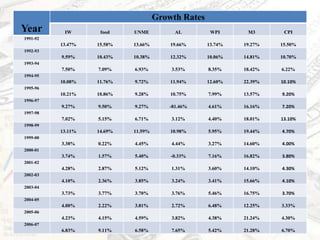
R2taking Money Supply as independent factor:
Wholesale Price Index (WPI) to below 3 per cent recentlyInflation based on wholesale prices during the period January 1998 - January 1999 was 4.6 percent, one of the lowest in the world. Does it show that that tight monetary policies have been effective in bringing down inflation to within RBI's comfort zone?A closer look:Consumer prices continue to show a rising trend. Large purchases of foreign exchange by the RBI have raised money supply growth.       Further, there is empirical evidence of a link between money supply and consumer prices. Bringing consumer inflation under control will require shifting away from the policy of preventing an appreciation of the rupee/dollar rate.
Sharp spike in 1998 when for a brief period consumer prices rose at near 20 percent
The rate has moved down from above 5 per cent in the 1990s to below 5 per cent after 2000 and is seen to be rising again
In recent months, the trend values show money supply growth of above 20 per cent and CPI based inflation of above 7 per cent.
Declining trend till 2002
Rupee appreciation  in mid 2002
Increase in money supply against rupee appreciation.  In 2007, trend money supply growth has accelerated and CPI inflation has  accelerated. This negates claims that are now being made about monetary policy being tightened and keeping inflation under control.
Why are the CPI and WPI telling two different stories about inflation? Both the appreciation of the rupee and the failure of the government to raise oil prices has resulted in the WPI growing very slowlyThe WPI consists of a large component of tradables like chemicals, intermediate goods, commodities and various manufactured goods, whose prices have come down after the rupee appreciated.The prices of these goods are essentially determined by local demand and supply conditions. The prices of these goods are likely to be highly correlated with changes in money supply growth. Consumer Price Indices are the best inflation measure in a country, as they measure prices of a basket of goods consumed by a certain sample of households.The prices of these goods are essentially determined by local demand and supply conditions. The prices of these goods are likely to be highly correlated with changes in money supply growth.
Causes for increase in money supply:In preceding decades, India had an inflation problem because monetary policy used to support large fiscal deficits by printing money. That problem was solved by politicians who realized that higher inflation reduces political support more than what is gained by higher fiscal spending. Now inflation is caused by large purchases of dollars by the RBI in the foreign exchange market in an attempt to prevent the rupee getting stronger.
Recent developments in monetary policies:       The approach of cautious optimism. It revised its GDP growth projection to 8.5% 9% from 8% earlier.      RBI has focused on rising inflation and inflationary expectations in its review. Though RBI finds the 5% - 5.5% inflation tolerable, it has decided to moderate the growth at 5% in the medium term. To curtail both monetary and credit growth, the central bank has taken following steps:Made money available at its repo window costlier by 25 bps to 7.5%. Increased in the provisioning requirement for standard assets for the real estate sector (excluding residential housing loans), outstanding credit card receivables, loans and advances qualifying as the capital market exposure and personal loans to 2% from 1%. It has increased the provisioning requirement for the banks` exposures to the non-deposit non-banking financial companies (NBFCs) to 2% from 0.4%Reduction in the interest rate ceiling on NRE deposits from 100 bps to 50 bps above LIBOR/SWAP rates for US Dollar of corresponding maturity. This move will result in a contraction of money supply in the economy, which would further help in checking inflation.
GDP and MONEY SUPPLYWhat is GDP?Its relevance.Real and nominal GDP.What is money?Its uses.Medium of exchange.Store of value.Standard of deferred payments.Speculatory purposes.
GDP and MONEY SUPPLYComponents of money supplyCurrency in circulationCash with banksCurrency with public‘Other’ deposit with RBIBankers deposit with RBIThree major components of GDPTrade, hotels, transport & communicationFinancing, insurance, real estate & business servicesCommunity, social& personal services
IMPACT OF MONEY SUPPLY ON GDP At constant priceIMPACT OF MONEY SUPPLY ON GDPAt current price
The process of money creation in an economy-India(1990-91)
Summary of logic of how Banks create moneyCRR=( reserve money/new deposits)*100  deposits
State of Final system equilibrium- desired state- state of economic boom & prosperity
deposits at the original bank= reserve money
Money supply multiplier= amount of new money created / change in reservesIn 1990-91,                  1824604.76/358720     =     5.086      =  1/CRR   =1/.1966   = 5.086
Scenario-56 years  data- considered
Sum of each component in all years founded
 proportion of each in that year w.r.t to all 56 yrs. Sum of that comp.
For each yr. value of total money supply = sum of all components taken  in that yr.
all three rise slowly  from 1950-51 to 1980-81
From 1981-82, 3 rise with high acceleration
 value of (broad money component> narrow money component> reserve money component)
Rising speed  broad money>>> narrow money > reserve                comp.                             comp.       Money       comp.Corr(R,N)=0.997143, corr(R,B)=0.994253corr(B,N)=0.9984
Inference In India,RBI monetary policies- directed towards high amount of time deposits and savings

Prez moneysupplycycle

  • 1.
    Impact of moneysupplyOnInflation and gdp
  • 2.
    INFLATION AND MONEYSUPPLYMETHODOLOGY ADOPTED:Understanding the type and causes of inflation in India.Understanding monetary policy tools which are being used by RBI.Taking the data of money supply (M3), consumer price indices and wholesale price indices.Through regression calculating that how much change in inflation in CPI & WPI is explained by the changes in money supply.Study the past scenario and trend through various articles and earlier selected data.Studying latest developments in monetary policy by RBI taking inflation into consideration.
  • 3.
    Inflation in India:Inflationis at an acceptable level and remains much lower than in many other developing countries.Demand pull inflation:aggregate demand > aggregate supply. Cost push inflation:when there is a supply shockE.g. oil shock in 1970s
  • 4.
    RBI and itsrole in Inflation ControlObjective of monetary and credit policy: maintain price stability ensure adequate flow of credit to the productive sectors of the economy. Stability for the national currency and growth in employment and income are also considered.Control MeasuresOpen Market Operations (OMO)Reserve RequirementsCRR is the portion of deposits (as cash) which banks have to keep/maintain with the RBI.SLR is the portion of their deposits banks are required to invest in government securities.Between December 2006 and July 2007, RBI has raised CRR by 2 percentage points to 7% which sucked out Rs. 56000 crore rupees from money in supply from financial system Bank Rate or Discount rate(rate at which the RBI makes very short term loans to banks) Indian bank rate is at 6 per cent down from 10 per cent in 1981 and 12 per cent in 1991Repo rate (rate at which the RBI borrows short term money from the market)
  • 6.
    R2taking Money Supplyas independent factor:
  • 7.
    Wholesale Price Index(WPI) to below 3 per cent recentlyInflation based on wholesale prices during the period January 1998 - January 1999 was 4.6 percent, one of the lowest in the world. Does it show that that tight monetary policies have been effective in bringing down inflation to within RBI's comfort zone?A closer look:Consumer prices continue to show a rising trend. Large purchases of foreign exchange by the RBI have raised money supply growth. Further, there is empirical evidence of a link between money supply and consumer prices. Bringing consumer inflation under control will require shifting away from the policy of preventing an appreciation of the rupee/dollar rate.
  • 8.
    Sharp spike in1998 when for a brief period consumer prices rose at near 20 percent
  • 9.
    The rate hasmoved down from above 5 per cent in the 1990s to below 5 per cent after 2000 and is seen to be rising again
  • 10.
    In recent months,the trend values show money supply growth of above 20 per cent and CPI based inflation of above 7 per cent.
  • 11.
  • 12.
  • 13.
    Increase in moneysupply against rupee appreciation. In 2007, trend money supply growth has accelerated and CPI inflation has accelerated. This negates claims that are now being made about monetary policy being tightened and keeping inflation under control.
  • 14.
    Why are theCPI and WPI telling two different stories about inflation? Both the appreciation of the rupee and the failure of the government to raise oil prices has resulted in the WPI growing very slowlyThe WPI consists of a large component of tradables like chemicals, intermediate goods, commodities and various manufactured goods, whose prices have come down after the rupee appreciated.The prices of these goods are essentially determined by local demand and supply conditions. The prices of these goods are likely to be highly correlated with changes in money supply growth. Consumer Price Indices are the best inflation measure in a country, as they measure prices of a basket of goods consumed by a certain sample of households.The prices of these goods are essentially determined by local demand and supply conditions. The prices of these goods are likely to be highly correlated with changes in money supply growth.
  • 15.
    Causes for increasein money supply:In preceding decades, India had an inflation problem because monetary policy used to support large fiscal deficits by printing money. That problem was solved by politicians who realized that higher inflation reduces political support more than what is gained by higher fiscal spending. Now inflation is caused by large purchases of dollars by the RBI in the foreign exchange market in an attempt to prevent the rupee getting stronger.
  • 16.
    Recent developments inmonetary policies: The approach of cautious optimism. It revised its GDP growth projection to 8.5% 9% from 8% earlier. RBI has focused on rising inflation and inflationary expectations in its review. Though RBI finds the 5% - 5.5% inflation tolerable, it has decided to moderate the growth at 5% in the medium term. To curtail both monetary and credit growth, the central bank has taken following steps:Made money available at its repo window costlier by 25 bps to 7.5%. Increased in the provisioning requirement for standard assets for the real estate sector (excluding residential housing loans), outstanding credit card receivables, loans and advances qualifying as the capital market exposure and personal loans to 2% from 1%. It has increased the provisioning requirement for the banks` exposures to the non-deposit non-banking financial companies (NBFCs) to 2% from 0.4%Reduction in the interest rate ceiling on NRE deposits from 100 bps to 50 bps above LIBOR/SWAP rates for US Dollar of corresponding maturity. This move will result in a contraction of money supply in the economy, which would further help in checking inflation.
  • 17.
    GDP and MONEYSUPPLYWhat is GDP?Its relevance.Real and nominal GDP.What is money?Its uses.Medium of exchange.Store of value.Standard of deferred payments.Speculatory purposes.
  • 18.
    GDP and MONEYSUPPLYComponents of money supplyCurrency in circulationCash with banksCurrency with public‘Other’ deposit with RBIBankers deposit with RBIThree major components of GDPTrade, hotels, transport & communicationFinancing, insurance, real estate & business servicesCommunity, social& personal services
  • 19.
    IMPACT OF MONEYSUPPLY ON GDP At constant priceIMPACT OF MONEY SUPPLY ON GDPAt current price
  • 20.
    The process ofmoney creation in an economy-India(1990-91)
  • 21.
    Summary of logicof how Banks create moneyCRR=( reserve money/new deposits)*100 deposits
  • 22.
    State of Finalsystem equilibrium- desired state- state of economic boom & prosperity
  • 23.
    deposits at theoriginal bank= reserve money
  • 24.
    Money supply multiplier=amount of new money created / change in reservesIn 1990-91, 1824604.76/358720 = 5.086 = 1/CRR =1/.1966 = 5.086
  • 25.
    Scenario-56 years data- considered
  • 26.
    Sum of eachcomponent in all years founded
  • 27.
    proportion ofeach in that year w.r.t to all 56 yrs. Sum of that comp.
  • 28.
    For each yr.value of total money supply = sum of all components taken in that yr.
  • 29.
    all three riseslowly from 1950-51 to 1980-81
  • 30.
    From 1981-82, 3rise with high acceleration
  • 31.
    value of(broad money component> narrow money component> reserve money component)
  • 32.
    Rising speed broad money>>> narrow money > reserve comp. comp. Money comp.Corr(R,N)=0.997143, corr(R,B)=0.994253corr(B,N)=0.9984
  • 33.
    Inference In India,RBImonetary policies- directed towards high amount of time deposits and savings