Lecture #3
Functions
What is a Function?
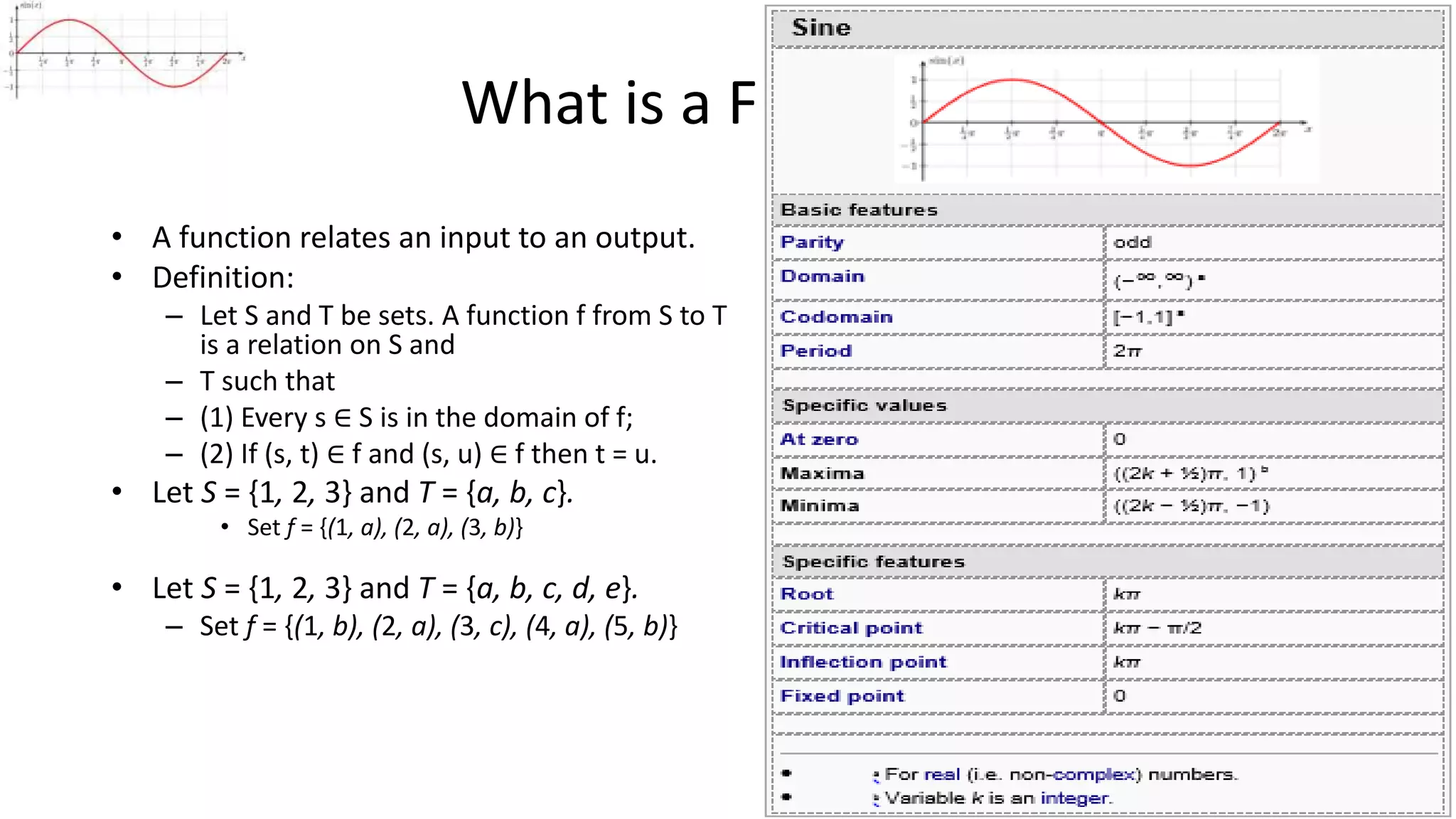
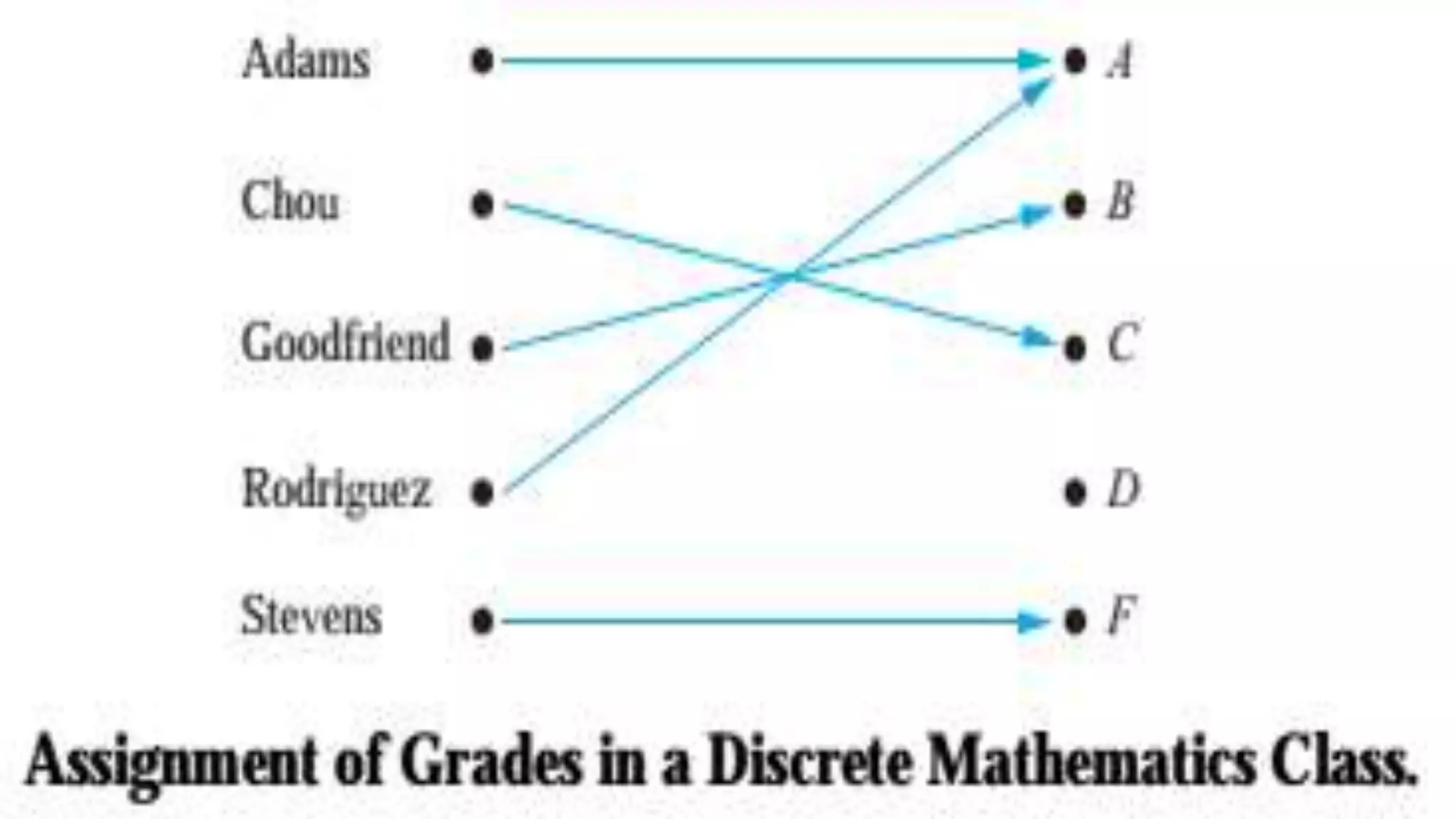
• A function relates an input to an output.
• Definition:
– Let S and T be sets. A function f from S to T
is a relation on S and
– T such that
– (1) Every s ∈ S is in the domain of f;
– (2) If (s, t) ∈ f and (s, u) ∈ f then t = u.
• Let S = {1, 2, 3} and T = {a, b, c}.
• Set f = {(1, a), (2, a), (3, b)}
• Let S = {1, 2, 3} and T = {a, b, c, d, e}.
– Set f = {(1, b), (2, a), (3, c), (4, a), (5, b)}
What is not a function
• Vertical Line Test
– Given the graph of a relation, if you can draw a vertical line that
crosses the graph in more than one place, then the relation is not a
function.
Basic Terminology
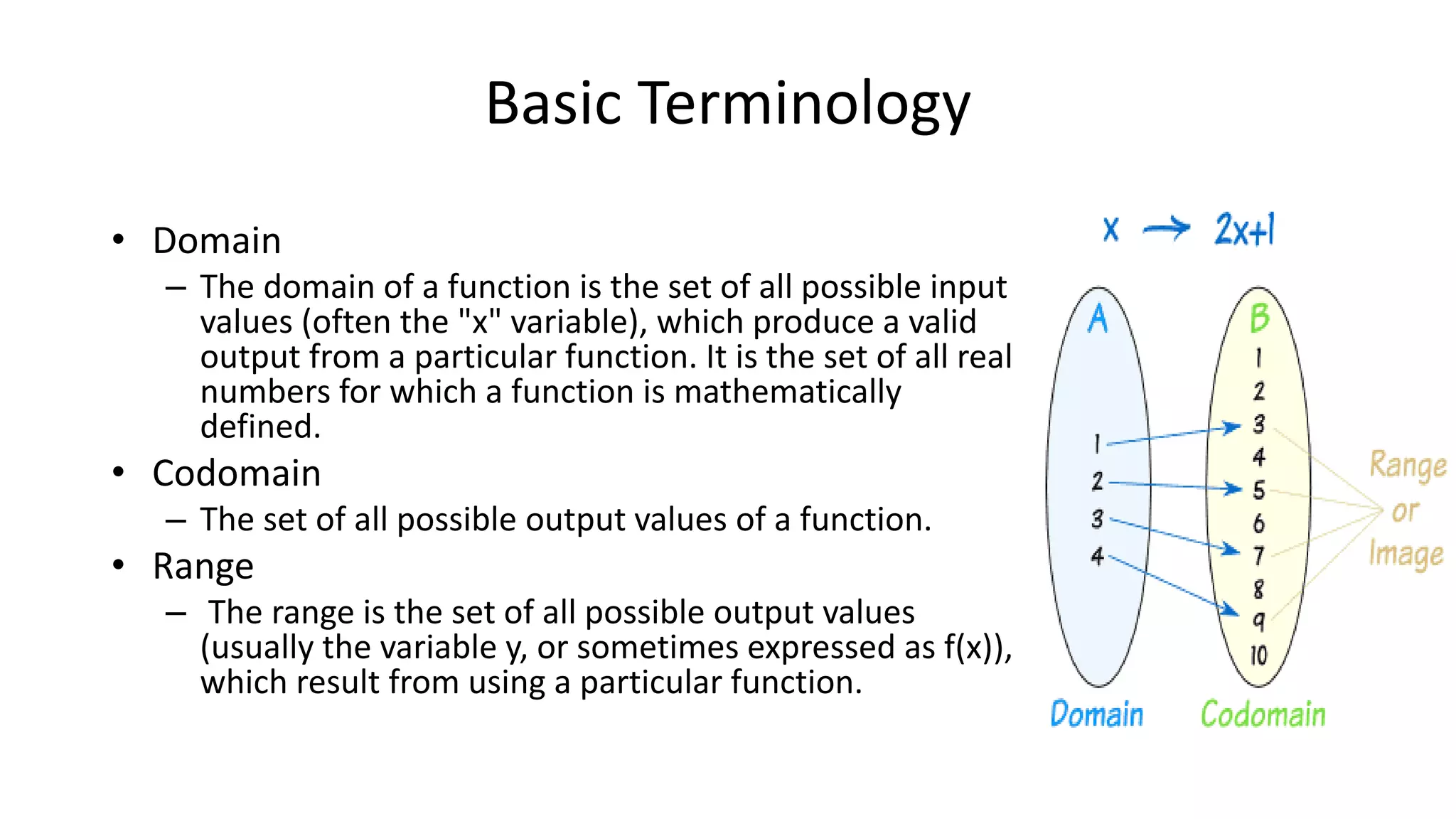
• Domain
– The domain of a function is the set of all possible input
values (often the "x" variable), which produce a valid
output from a particular function. It is the set of all real
numbers for which a function is mathematically
defined.
• Codomain
– The set of all possible output values of a function.
• Range
– The range is the set of all possible output values
(usually the variable y, or sometimes expressed as f(x)),
which result from using a particular function.
Symbolic Notation
• let f denote a function from A into B. Then we write
– f: A → B
• Which is read:
– “f is a function from A into B,”
– “f takes (or maps) A into B.”
•
Types of Functions
• One-to-One Functions
• Onto Functions
• Inverse Functions
One-to-One Function
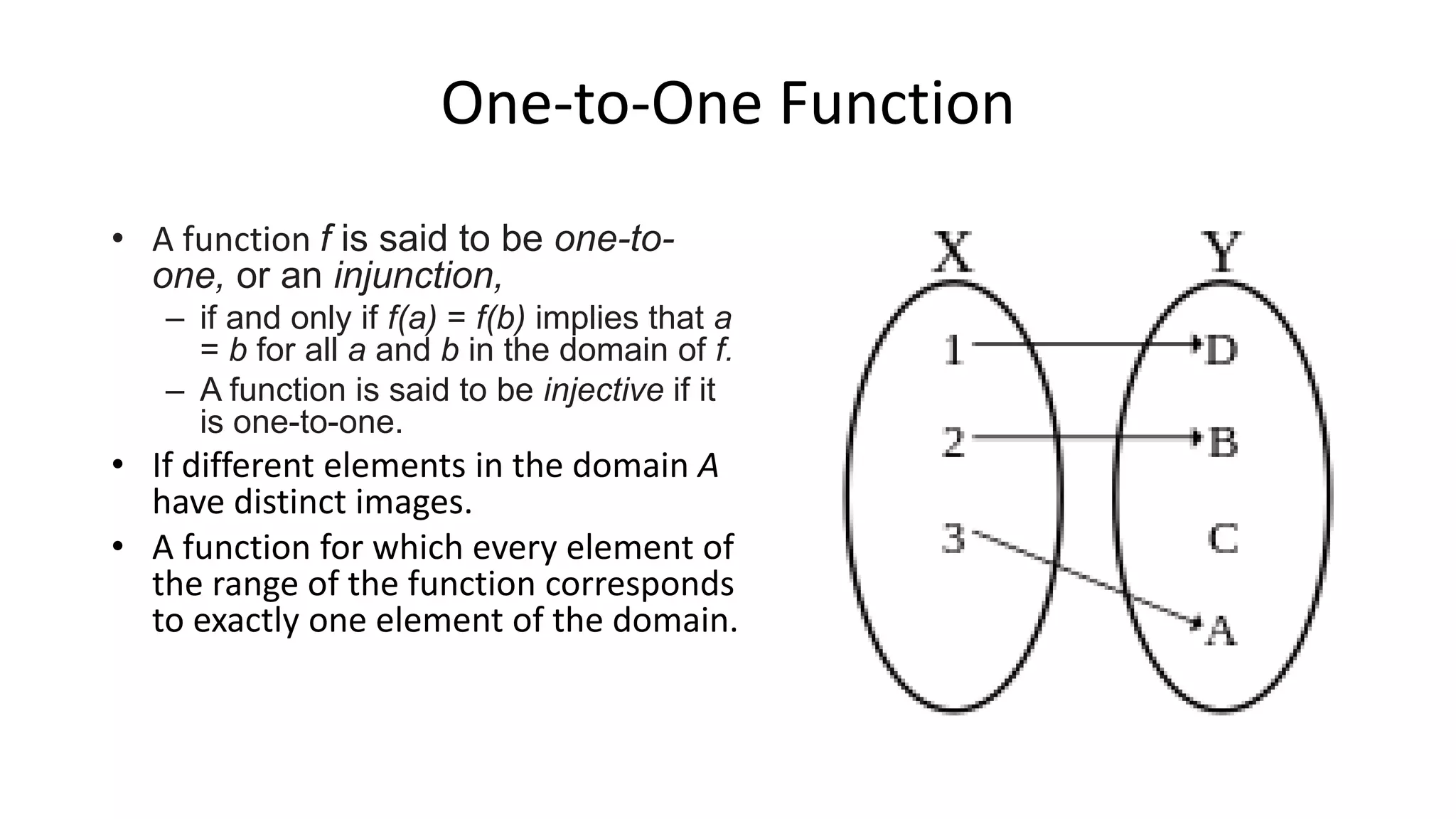
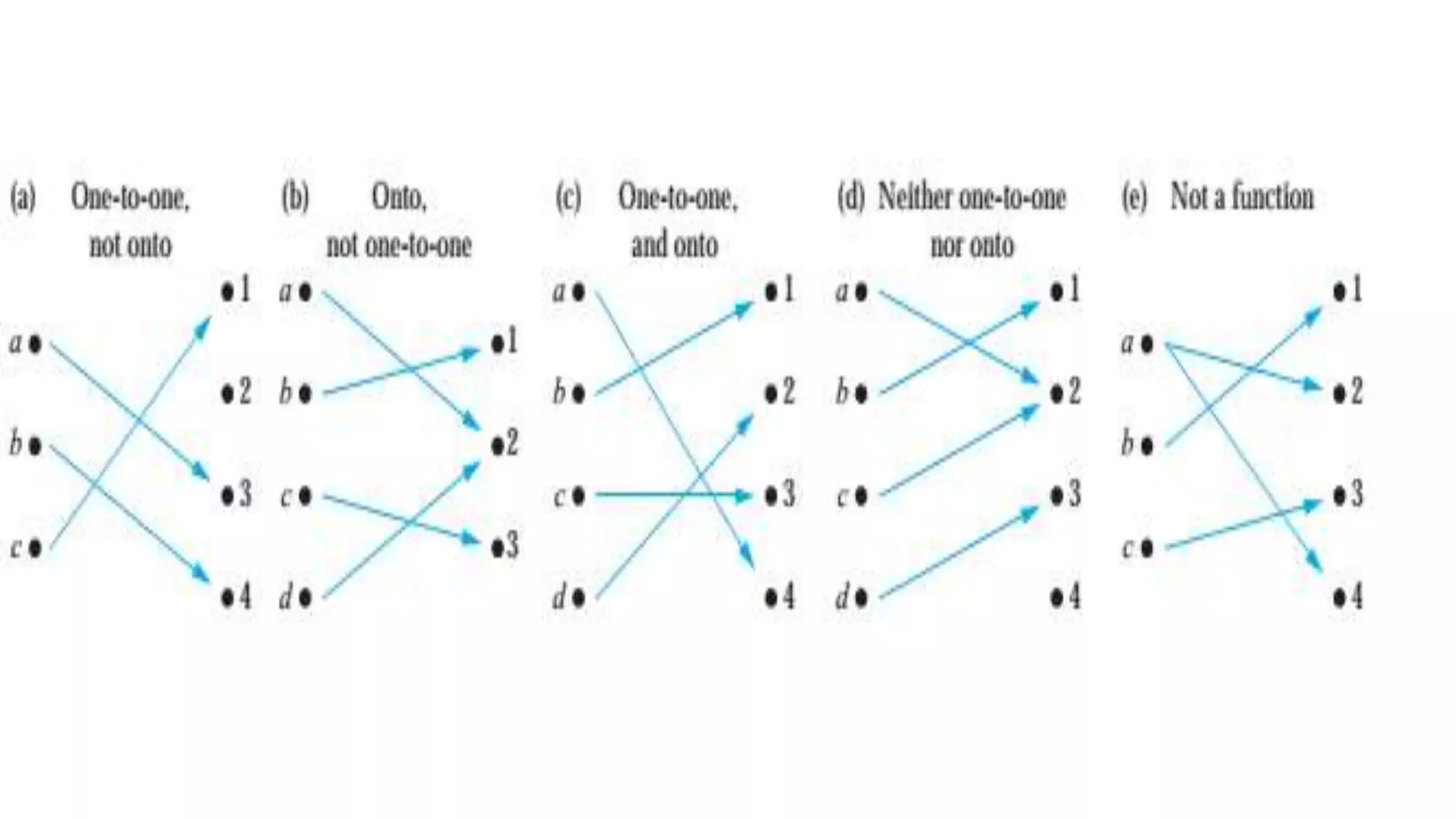
• A function f is said to be one-to-
one, or an injunction,
– if and only if f(a) = f(b) implies that a
= b for all a and b in the domain of f.
– A function is said to be injective if it
is one-to-one.
• If different elements in the domain A
have distinct images.
• A function for which every element of
the range of the function corresponds
to exactly one element of the domain.
Onto Function
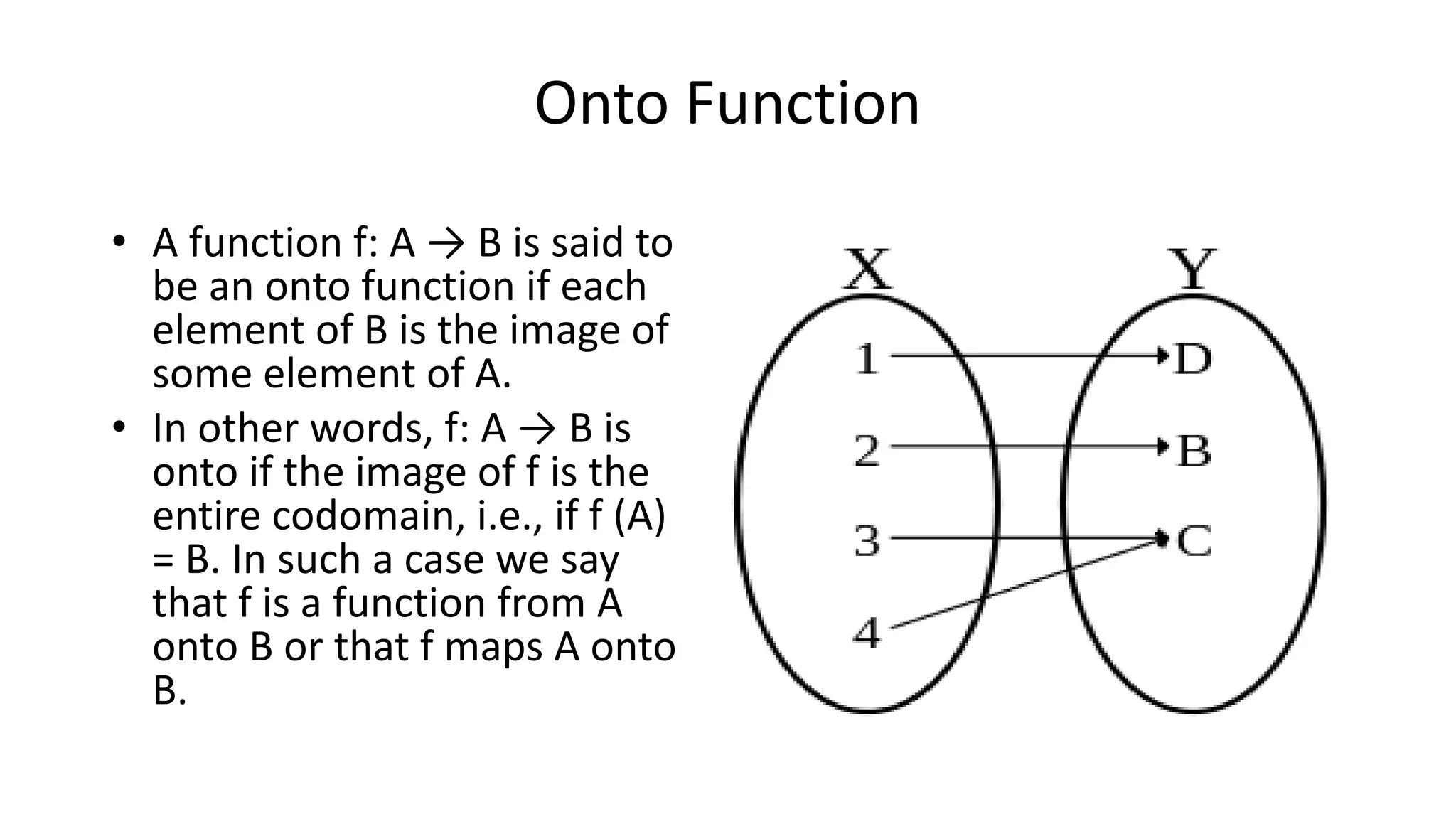
• A function f: A → B is said to
be an onto function if each
element of B is the image of
some element of A.
• In other words, f: A → B is
onto if the image of f is the
entire codomain, i.e., if f (A)
= B. In such a case we say
that f is a function from A
onto B or that f maps A onto
B.
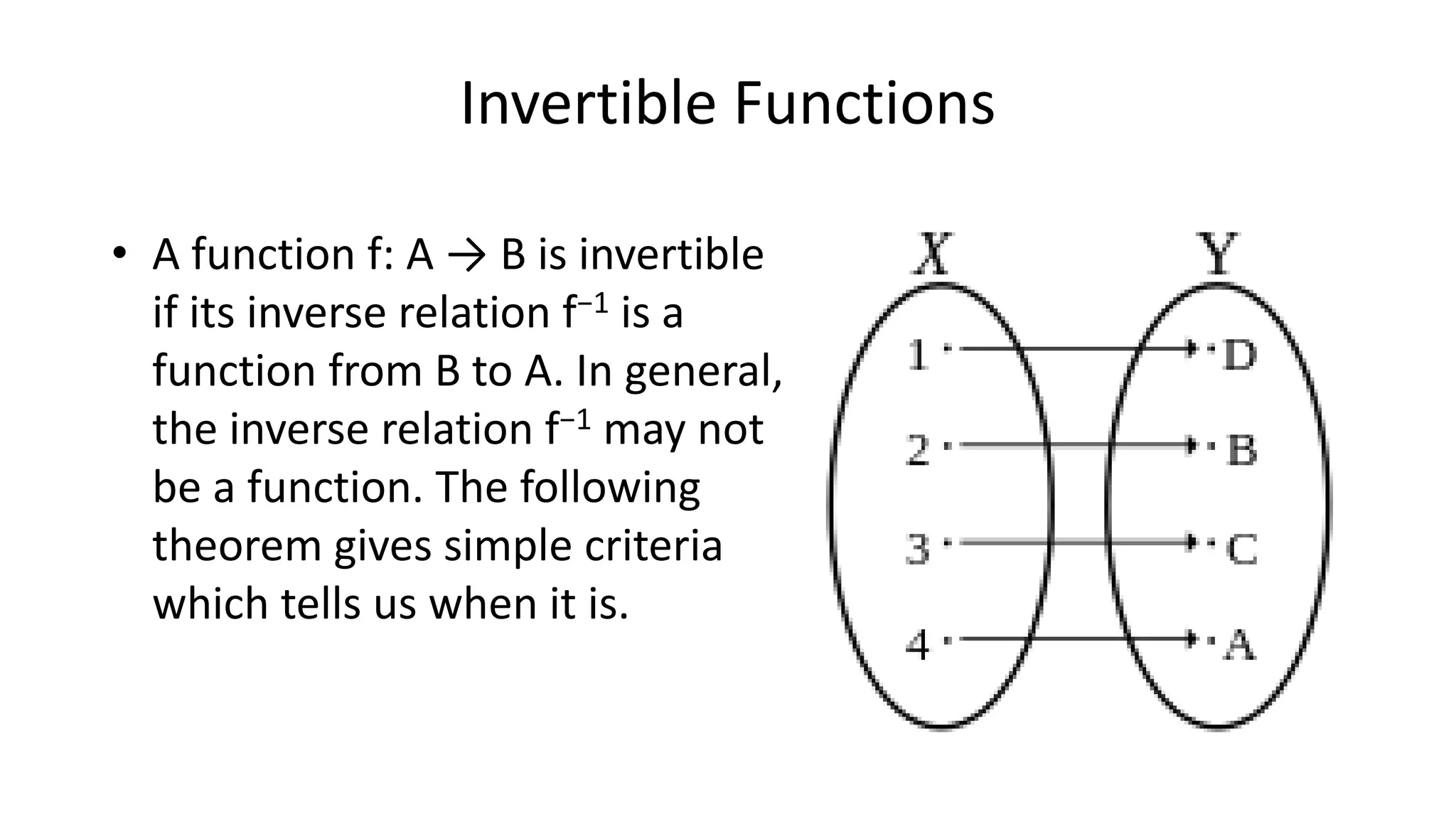
Invertible Functions
• A function f: A → B is invertible
if its inverse relation f−1 is a
function from B to A. In general,
the inverse relation f−1 may not
be a function. The following
theorem gives simple criteria
which tells us when it is.
Example of Types of Functions
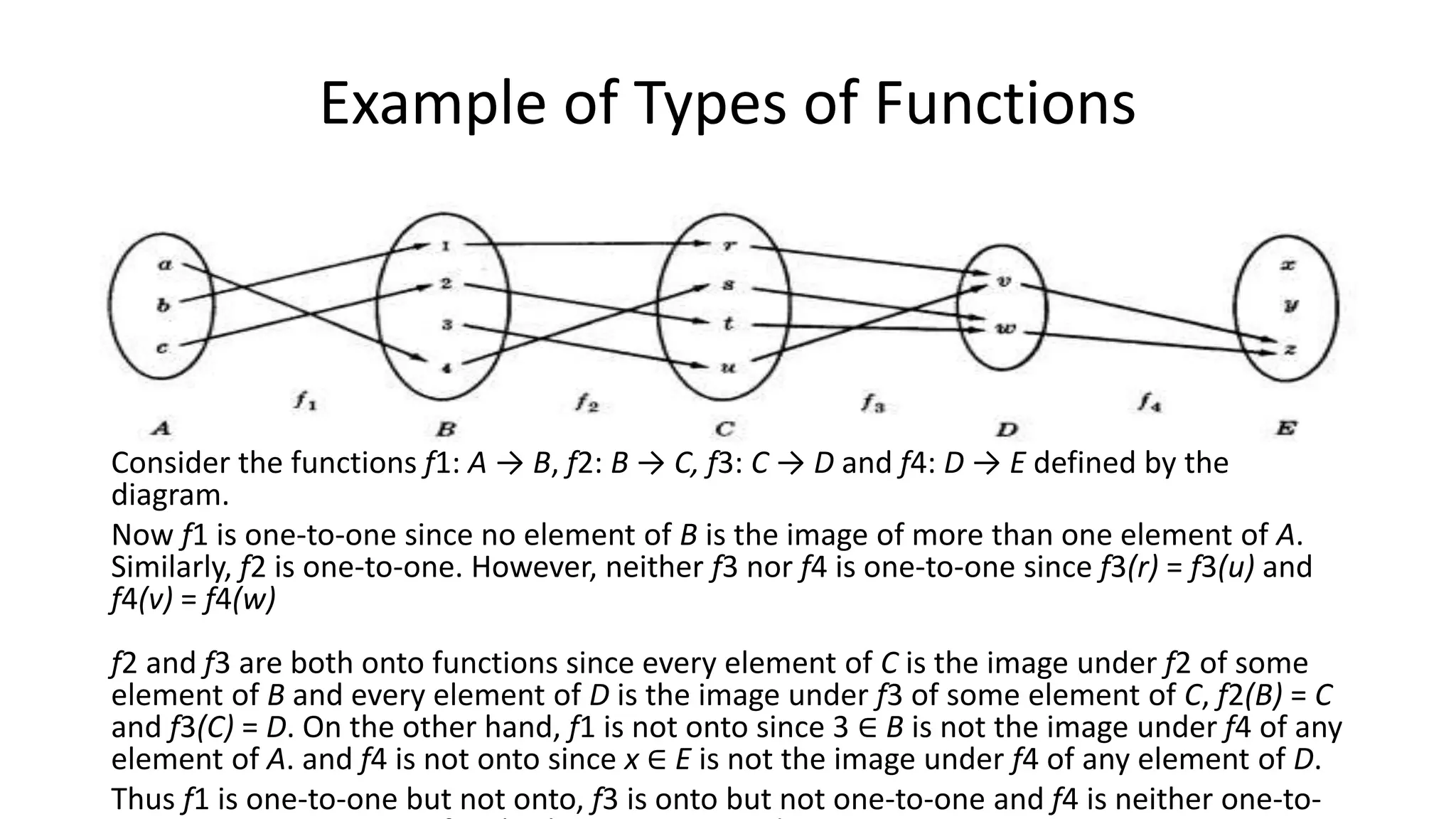
Consider the functions f1: A → B, f2: B → C, f3: C → D and f4: D → E defined by the
diagram.
Now f1 is one-to-one since no element of B is the image of more than one element of A.
Similarly, f2 is one-to-one. However, neither f3 nor f4 is one-to-one since f3(r) = f3(u) and
f4(v) = f4(w)
f2 and f3 are both onto functions since every element of C is the image under f2 of some
element of B and every element of D is the image under f3 of some element of C, f2(B) = C
and f3(C) = D. On the other hand, f1 is not onto since 3 ∈ B is not the image under f4 of any
element of A. and f4 is not onto since x ∈ E is not the image under f4 of any element of D.
Thus f1 is one-to-one but not onto, f3 is onto but not one-to-one and f4 is neither one-to-
A B
a
b
c
d
X
Y
Z
W
V
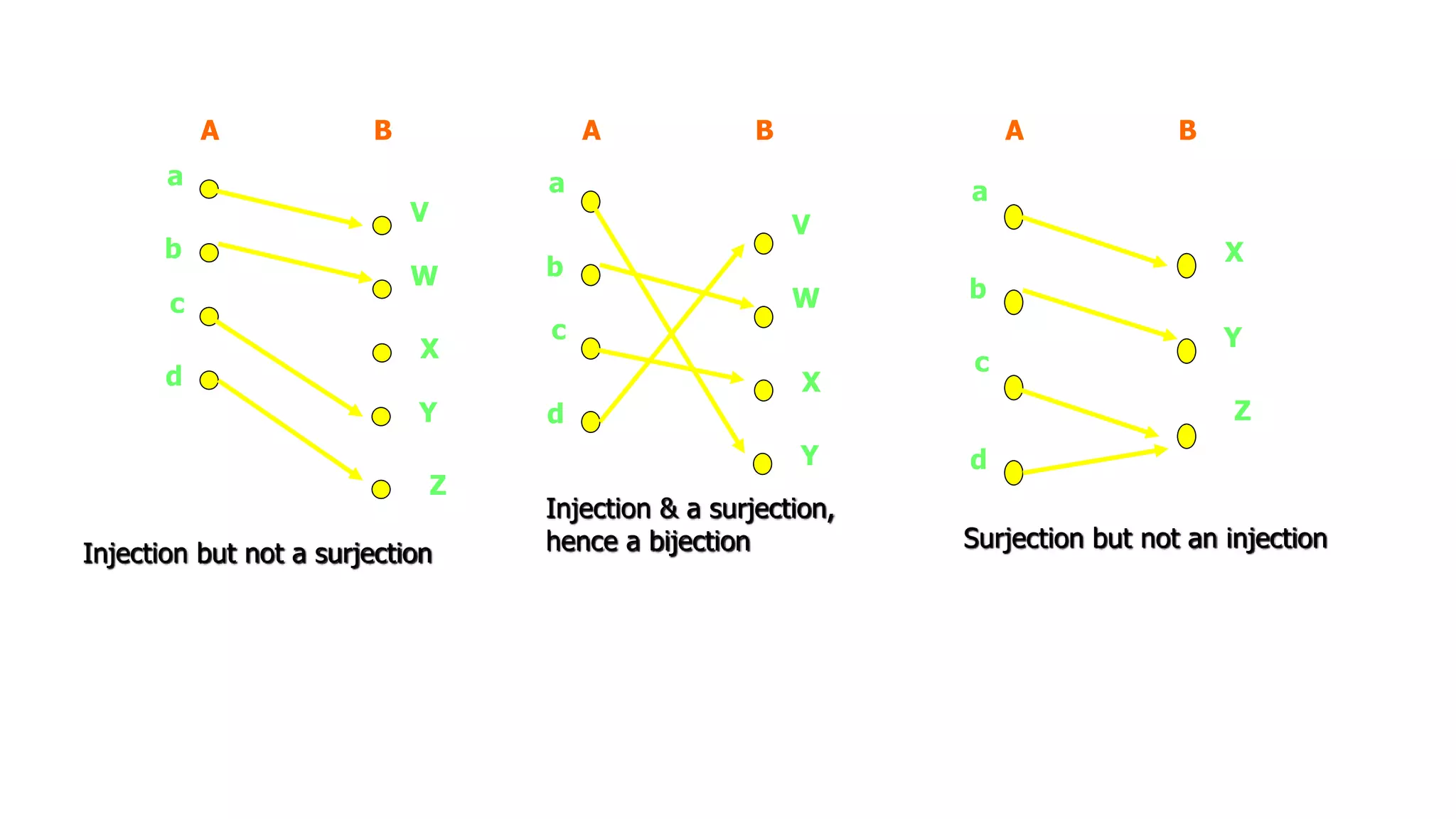
Injection but not a surjection
A B
a
b
c
d
X
Y
W
V
Injection & a surjection,
hence a bijection
A B
a
b
c
d
X
Y
Z
Surjection but not an injection
MATHEMATICAL FUNCTIONS, EXPONENTIAL AND
LOGARITHMIC FUNCTIONS
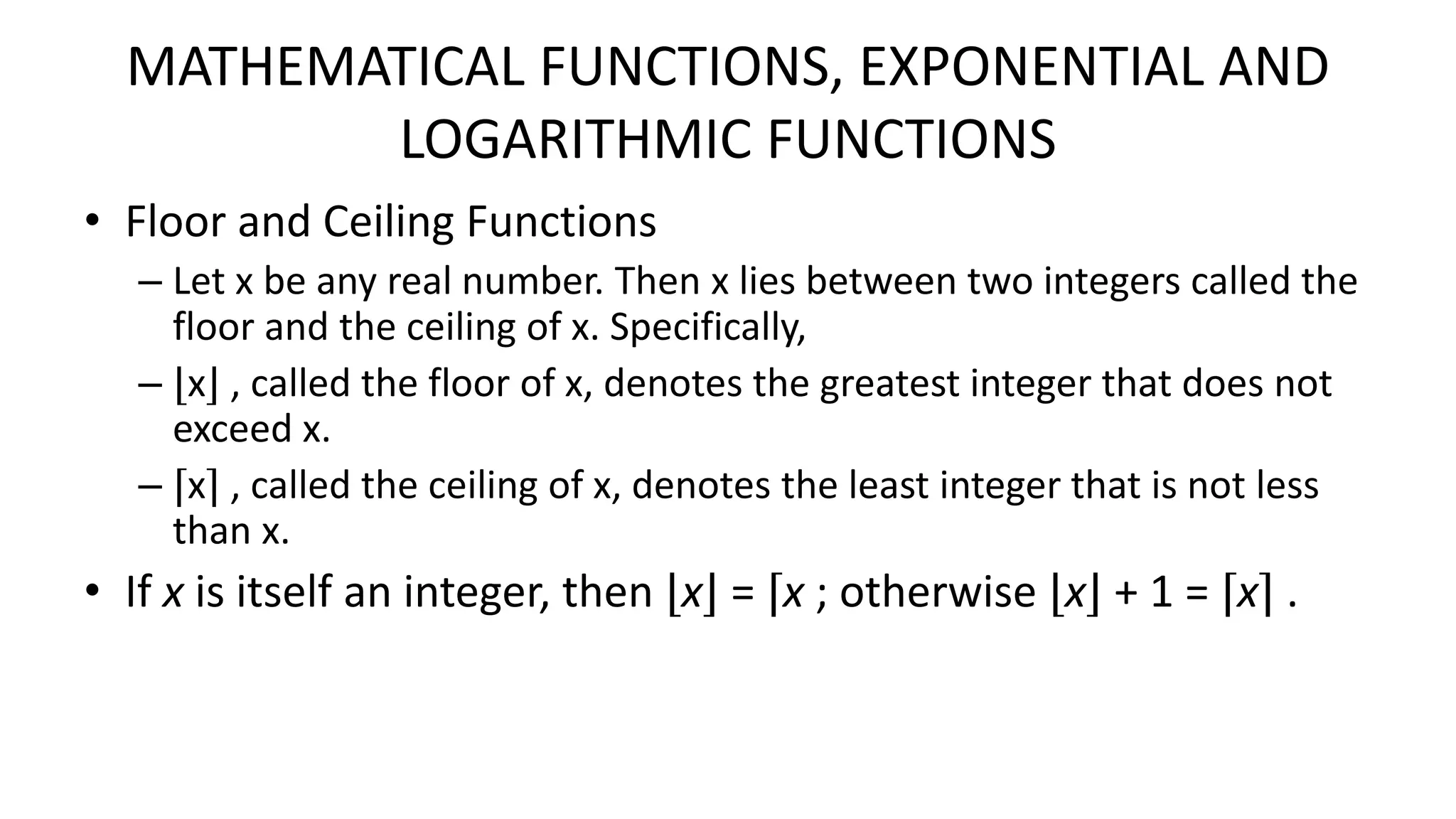
• Floor and Ceiling Functions
– Let x be any real number. Then x lies between two integers called the
floor and the ceiling of x. Specifically,
– ⌊x⌋ , called the floor of x, denotes the greatest integer that does not
exceed x.
– ⌈x⌉ , called the ceiling of x, denotes the least integer that is not less
than x.
• If x is itself an integer, then ⌊x⌋ = ⌈x ; otherwise ⌊x⌋ + 1 = ⌈x⌉ .
MATHEMATICAL FUNCTIONS, EXPONENTIAL AND
LOGARITHMIC FUNCTIONS
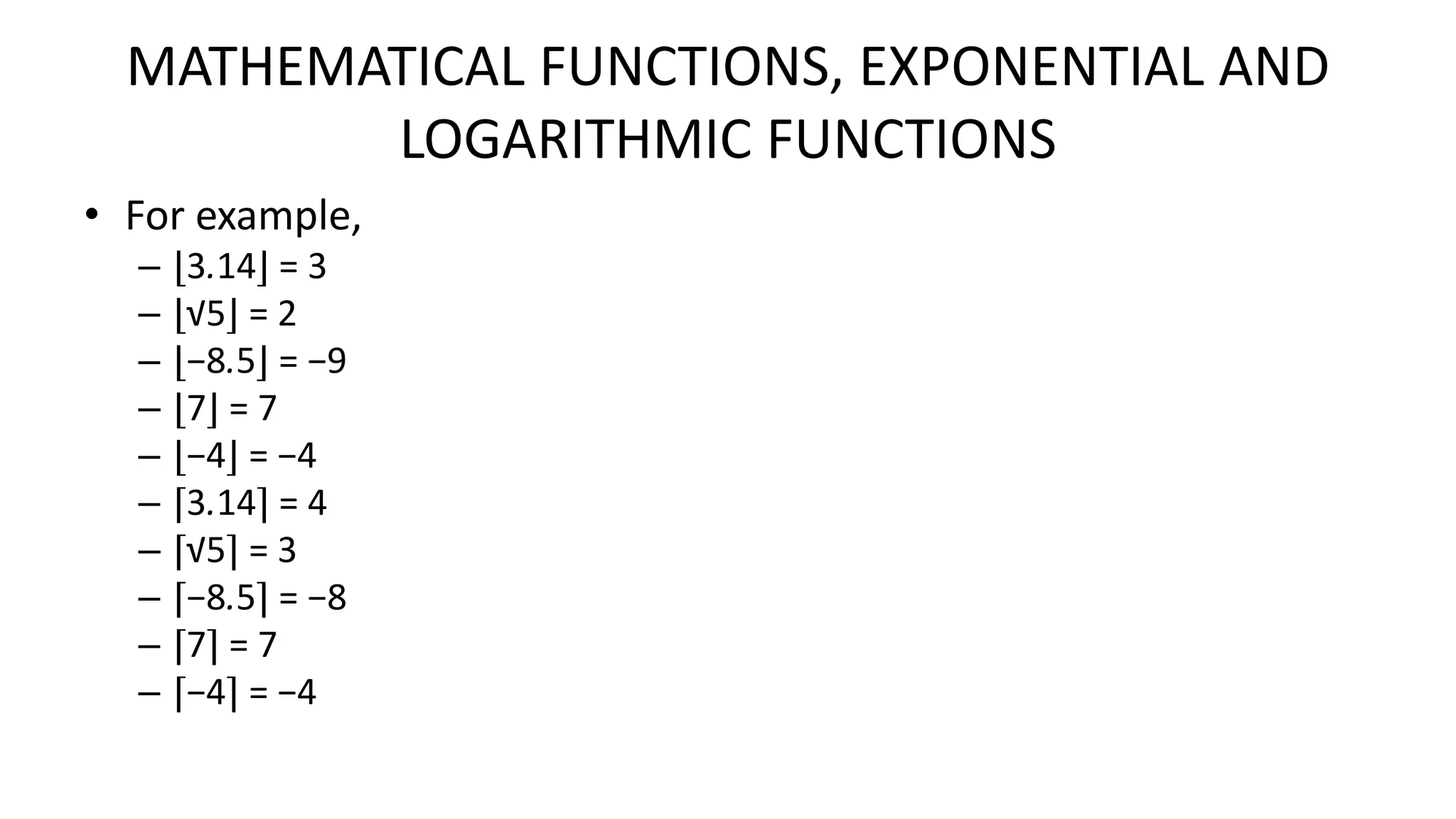
• For example,
– ⌊3.14⌋ = 3
– ⌊√5⌋ = 2
– ⌊−8.5⌋ = −9
– ⌊7⌋ = 7
– ⌊−4⌋ = −4
– ⌈3.14⌉ = 4
– ⌈√5⌉ = 3
– ⌈−8.5⌉ = −8
– ⌈7⌉ = 7
– ⌈−4⌉ = −4
Integer and Absolute Value Functions
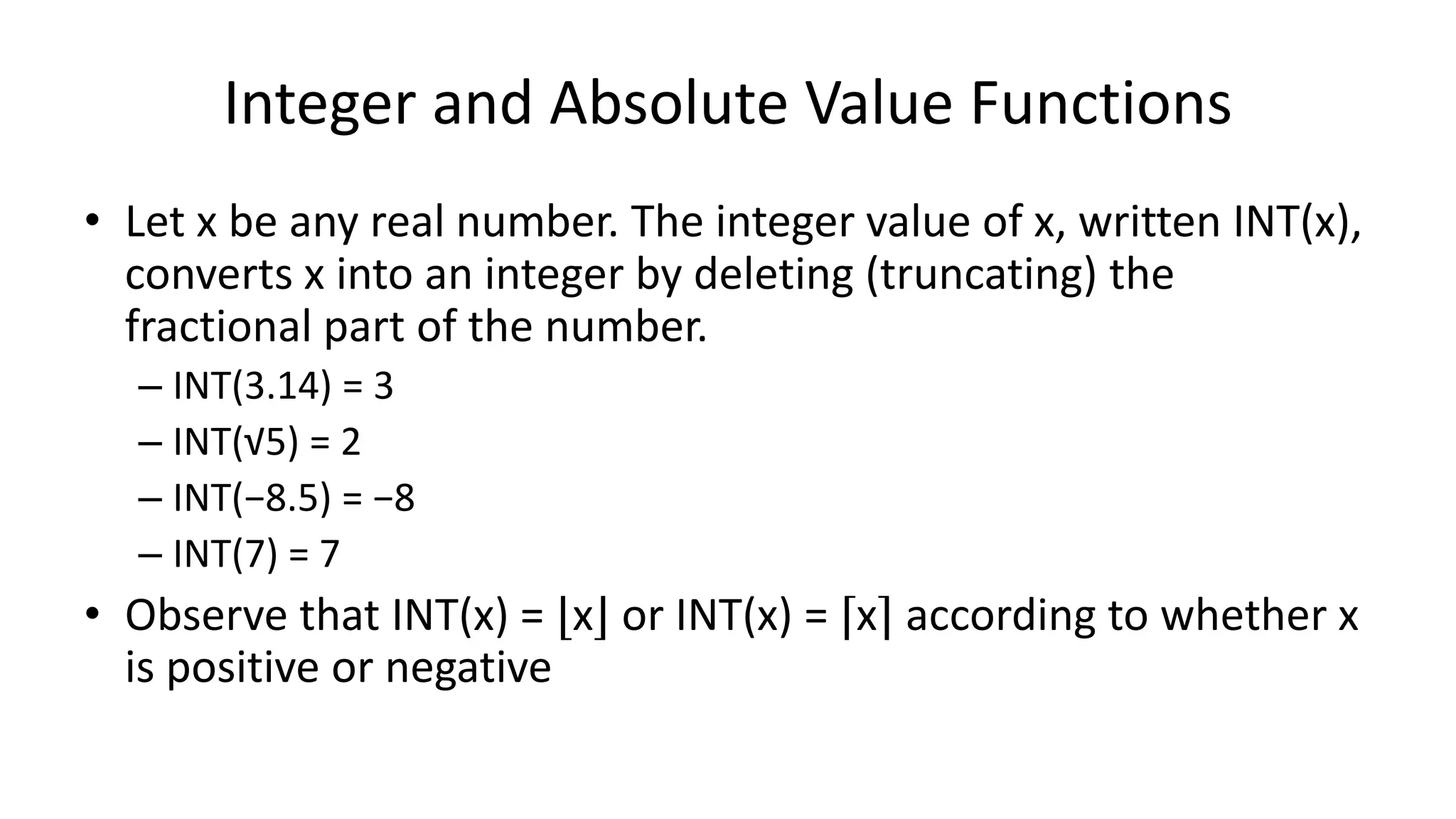
• Let x be any real number. The integer value of x, written INT(x),
converts x into an integer by deleting (truncating) the
fractional part of the number.
– INT(3.14) = 3
– INT(√5) = 2
– INT(−8.5) = −8
– INT(7) = 7
• Observe that INT(x) = ⌊x⌋ or INT(x) = ⌈x⌉ according to whether x
is positive or negative
Integer and Absolute Value Functions
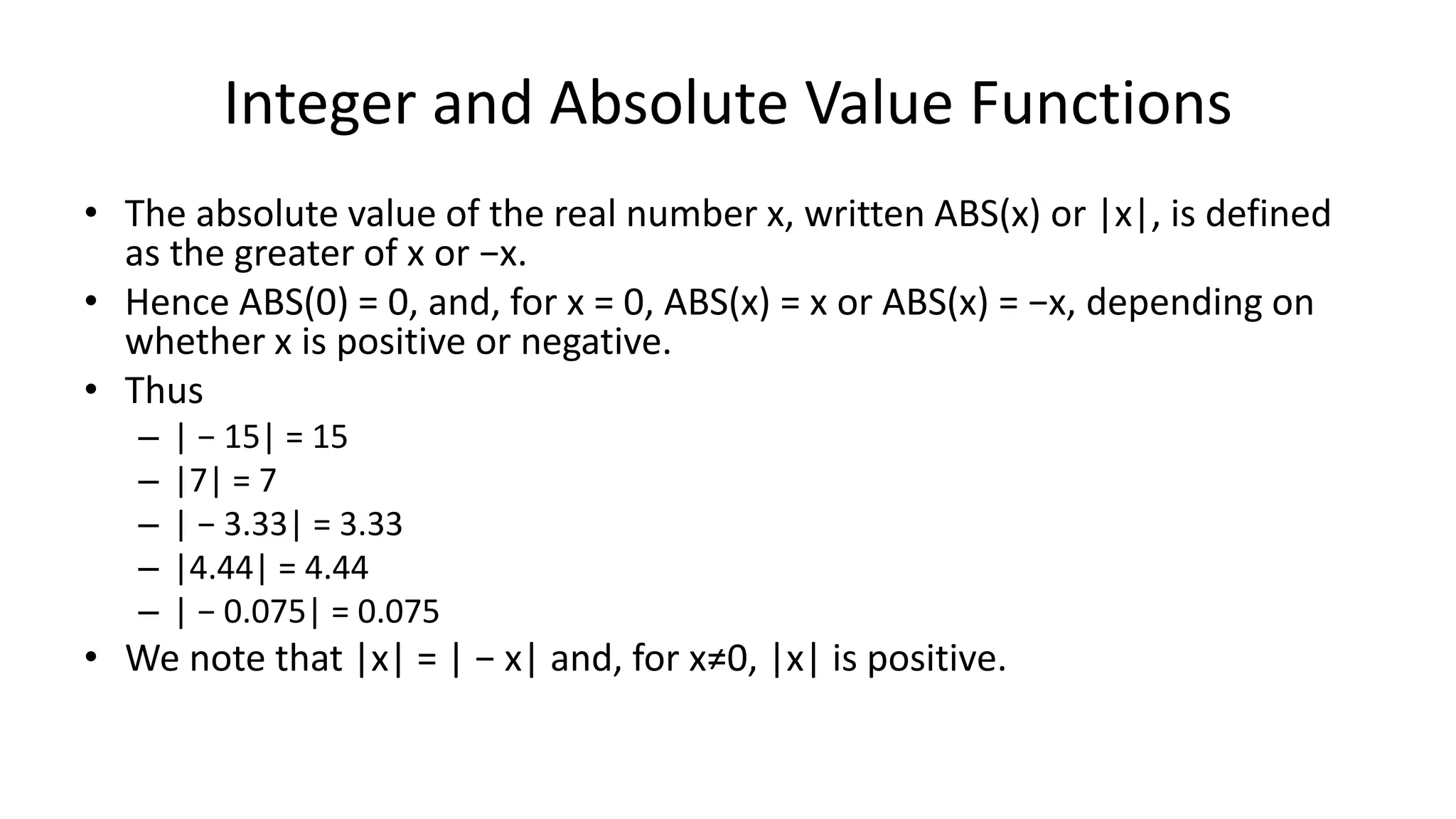
• The absolute value of the real number x, written ABS(x) or |x|, is defined
as the greater of x or −x.
• Hence ABS(0) = 0, and, for x = 0, ABS(x) = x or ABS(x) = −x, depending on
whether x is positive or negative.
• Thus
– | − 15| = 15
– |7| = 7
– | − 3.33| = 3.33
– |4.44| = 4.44
– | − 0.075| = 0.075
• We note that |x| = | − x| and, for x≠0, |x| is positive.

Functions

  • 1.
  • 2.
    What is aFunction? • A function relates an input to an output. • Definition: – Let S and T be sets. A function f from S to T is a relation on S and – T such that – (1) Every s ∈ S is in the domain of f; – (2) If (s, t) ∈ f and (s, u) ∈ f then t = u. • Let S = {1, 2, 3} and T = {a, b, c}. • Set f = {(1, a), (2, a), (3, b)} • Let S = {1, 2, 3} and T = {a, b, c, d, e}. – Set f = {(1, b), (2, a), (3, c), (4, a), (5, b)}
  • 4.
    What is nota function • Vertical Line Test – Given the graph of a relation, if you can draw a vertical line that crosses the graph in more than one place, then the relation is not a function.
  • 5.
    Basic Terminology • Domain –The domain of a function is the set of all possible input values (often the "x" variable), which produce a valid output from a particular function. It is the set of all real numbers for which a function is mathematically defined. • Codomain – The set of all possible output values of a function. • Range – The range is the set of all possible output values (usually the variable y, or sometimes expressed as f(x)), which result from using a particular function.
  • 6.
    Symbolic Notation • letf denote a function from A into B. Then we write – f: A → B • Which is read: – “f is a function from A into B,” – “f takes (or maps) A into B.” •
  • 7.
    Types of Functions •One-to-One Functions • Onto Functions • Inverse Functions
  • 8.
    One-to-One Function • Afunction f is said to be one-to- one, or an injunction, – if and only if f(a) = f(b) implies that a = b for all a and b in the domain of f. – A function is said to be injective if it is one-to-one. • If different elements in the domain A have distinct images. • A function for which every element of the range of the function corresponds to exactly one element of the domain.
  • 9.
    Onto Function • Afunction f: A → B is said to be an onto function if each element of B is the image of some element of A. • In other words, f: A → B is onto if the image of f is the entire codomain, i.e., if f (A) = B. In such a case we say that f is a function from A onto B or that f maps A onto B.
  • 10.
    Invertible Functions • Afunction f: A → B is invertible if its inverse relation f−1 is a function from B to A. In general, the inverse relation f−1 may not be a function. The following theorem gives simple criteria which tells us when it is.
  • 11.
    Example of Typesof Functions Consider the functions f1: A → B, f2: B → C, f3: C → D and f4: D → E defined by the diagram. Now f1 is one-to-one since no element of B is the image of more than one element of A. Similarly, f2 is one-to-one. However, neither f3 nor f4 is one-to-one since f3(r) = f3(u) and f4(v) = f4(w) f2 and f3 are both onto functions since every element of C is the image under f2 of some element of B and every element of D is the image under f3 of some element of C, f2(B) = C and f3(C) = D. On the other hand, f1 is not onto since 3 ∈ B is not the image under f4 of any element of A. and f4 is not onto since x ∈ E is not the image under f4 of any element of D. Thus f1 is one-to-one but not onto, f3 is onto but not one-to-one and f4 is neither one-to-
  • 13.
    A B a b c d X Y Z W V Injection butnot a surjection A B a b c d X Y W V Injection & a surjection, hence a bijection A B a b c d X Y Z Surjection but not an injection
  • 14.
    MATHEMATICAL FUNCTIONS, EXPONENTIALAND LOGARITHMIC FUNCTIONS • Floor and Ceiling Functions – Let x be any real number. Then x lies between two integers called the floor and the ceiling of x. Specifically, – ⌊x⌋ , called the floor of x, denotes the greatest integer that does not exceed x. – ⌈x⌉ , called the ceiling of x, denotes the least integer that is not less than x. • If x is itself an integer, then ⌊x⌋ = ⌈x ; otherwise ⌊x⌋ + 1 = ⌈x⌉ .
  • 15.
    MATHEMATICAL FUNCTIONS, EXPONENTIALAND LOGARITHMIC FUNCTIONS • For example, – ⌊3.14⌋ = 3 – ⌊√5⌋ = 2 – ⌊−8.5⌋ = −9 – ⌊7⌋ = 7 – ⌊−4⌋ = −4 – ⌈3.14⌉ = 4 – ⌈√5⌉ = 3 – ⌈−8.5⌉ = −8 – ⌈7⌉ = 7 – ⌈−4⌉ = −4
  • 16.
    Integer and AbsoluteValue Functions • Let x be any real number. The integer value of x, written INT(x), converts x into an integer by deleting (truncating) the fractional part of the number. – INT(3.14) = 3 – INT(√5) = 2 – INT(−8.5) = −8 – INT(7) = 7 • Observe that INT(x) = ⌊x⌋ or INT(x) = ⌈x⌉ according to whether x is positive or negative
  • 17.
    Integer and AbsoluteValue Functions • The absolute value of the real number x, written ABS(x) or |x|, is defined as the greater of x or −x. • Hence ABS(0) = 0, and, for x = 0, ABS(x) = x or ABS(x) = −x, depending on whether x is positive or negative. • Thus – | − 15| = 15 – |7| = 7 – | − 3.33| = 3.33 – |4.44| = 4.44 – | − 0.075| = 0.075 • We note that |x| = | − x| and, for x≠0, |x| is positive.