Chapter 14 
Banking and the Money Supply
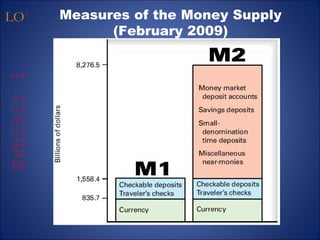
Narrow Definition of Money: M1 
• M1: the most narrowly defined MS 
– Measures purchasing power 
– M1= currency held by the nonbanking public + 
checkable deposits + traveler’s checks 
– What are checkable deposits? 
• Bank deposits that allow the account owner to write 
checks to third parties. 
– Is currency in bank vaults included? 
• NO!!! It is not being used as a medium of exchange
Broader Definition of Money: M2 
• M2: adding near monies to M1 
– M2= M1 +near monies 
• Near monies are easy to convert into currency or 
checkable deposits 
– Savings deposits 
– Time deposits (CDs- certificates of deposit) 
– Money market mutual fund accounts
LO1 Measures of the Money Supply 
(February 2009) 
Exhibit 1
Credit Cards and Debit Cards: What’s 
the Difference 
• What do credit cards offer? 
– They offer an easy way to get a loan from the card 
issuer. 
• What do debit cards offer? 
– They reduce the balance of your checking 
account; thus, they are part of M1. 
– It combines the functions of an ATM card and a 
check.
Banks Are Financial Intermediaries 
• By bringing together both sides of the money 
market, banks serve as financial 
intermediaries (go-betweens).
Coping with Asymmetric Information 
• What borrowers do banks want? 
– Willing to pay interest and are able to repay the 
loan. 
• Asymmetric information: an inequality in 
what’s known by each party to the 
transaction. 
– The borrower knows more about their credit 
history.
Reducing Risk Through Diversification 
• They develop a diversified portfolio to reduce 
the risk to each individual saver.
Starting a Bank 
• First, they must apply to the state banking 
authority in the case of a state bank or the U.S. 
Comptroller of the Currency for a national bank. 
– A charter 
• The authority will decide to or not to approve the 
charter. 
• If approved they are established. 
• Net Worth= Owners’ Equity 
– Shares of Stock in the bank
Balance Sheet 
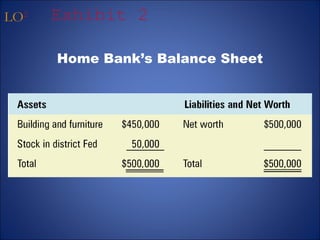
• The balance sheet shows a balance between 
the two sides of the bank’s account. 
• Left-hand side= Assets 
– Any physical property or financial claim owned by 
the bank 
– Building and equipment 
– Stocks in the district Fed 
• Right-hand side= Liabilities and Net Worth 
– An amount the bank owes
What if all excess reserves are gone?
LO2 
Exhibit 2 
Home Bank’s Balance Sheet
Reserve Accounts 
• Now what?? 
– They are required to hold a certain percentage of 
the checkable deposits. 
– This amount is the required reserve, the dollar 
amount that must be held as reserves. 
– The required reserve ratio dictates the minimum 
proportion of deposits the bank must hold in 
reserve.
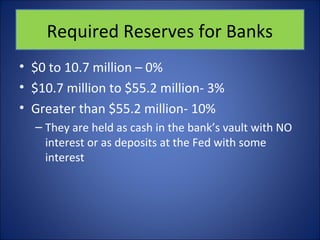
Required Reserves for Banks 
• $0 to 10.7 million – 0% 
• $10.7 million to $55.2 million- 3% 
• Greater than $55.2 million- 10% 
– They are held as cash in the bank’s vault with NO 
interest or as deposits at the Fed with some 
interest
Excess Reserves 
• Excess Reserves: The amount of checkable 
deposits the bank holds over the required rate 
the Fed mandates 
– Starting in 2008, the Fed now gives interest on 
excess reserves. 
– What can they do with them? 
• Make loans 
• Buy government securities ( by law limited to this)
Liquidity vs. Profitability 
• Liquidity is the ease with which an asset can 
be converted into cash without a significant 
loss of value. 
– Selling government bonds 
• The objectives of liquidity and profitability are 
at odds.
Federal funds market 
• The federal funds market provides for day-to-day 
lending and borrowing among banks of 
excess reserves on account at the Fed. 
• They don’t leave the Fed, they shift among 
accounts. 
• Federal funds rate: the interest rate banks 
charge one another for overnight borrowing-banks 
loaning to banks
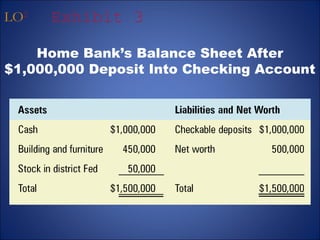
LO2 Exhibit 3 
Home Bank’s Balance Sheet After 
$1,000,000 Deposit Into Checking Account
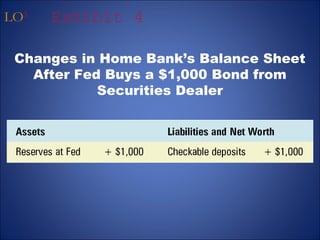
LO3 Exhibit 4 
Changes in Home Bank’s Balance Sheet 
After Fed Buys a $1,000 Bond from 
Securities Dealer
How Banks Create Money 
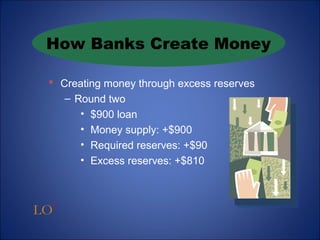
 Creating money through excess reserves 
LO3 
– Round two 
• $900 loan 
• Money supply: +$900 
• Required reserves: +$90 
• Excess reserves: +$810
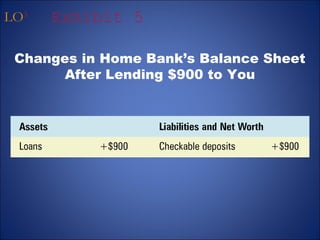
LO3 Exhibit 5 
Changes in Home Bank’s Balance Sheet 
After Lending $900 to You
How Banks Create Money 
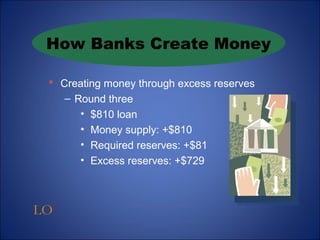
 Creating money through excess reserves 
LO3 
– Round three 
• $810 loan 
• Money supply: +$810 
• Required reserves: +$81 
• Excess reserves: +$729
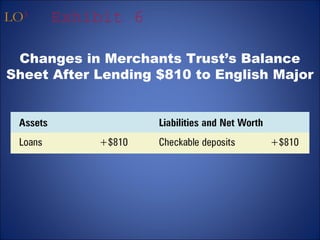
LO3 Exhibit 6 
Changes in Merchants Trust’s Balance 
Sheet After Lending $810 to English Major
How Banks Create Money 
 Creating money through excess reserves 
LO3 
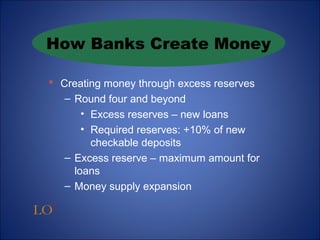
– Round four and beyond 
• Excess reserves – new loans 
• Required reserves: +10% of new 
checkable deposits 
– Excess reserve – maximum amount for 
loans 
– Money supply expansion
How Banks Create Money 
 Creating money through excess reserves 
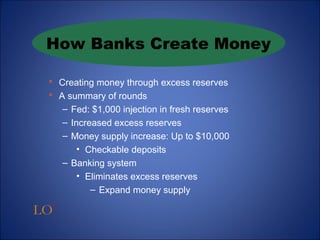
 A summary of rounds 
LO3 
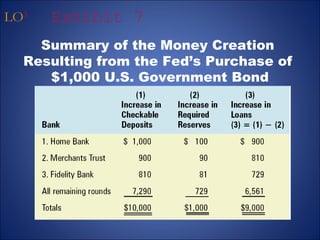
– Fed: $1,000 injection in fresh reserves 
– Increased excess reserves 
– Money supply increase: Up to $10,000 
• Checkable deposits 
– Banking system 
• Eliminates excess reserves 
– Expand money supply
LO3 Exhibit 7 
Summary of the Money Creation 
Resulting from the Fed’s Purchase of 
$1,000 U.S. Government Bond
Reserve Requirements and Money 
Expansion 
• The multiple by which the money supply 
increases as a result of an increase in the 
banking system’s reserves is called the money 
multiplier.
The Money Multiplier 
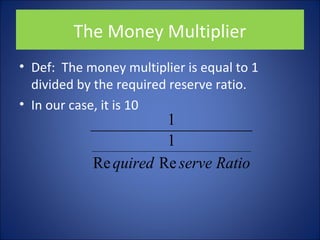
• Def: The money multiplier is equal to 1 
divided by the required reserve ratio. 
• In our case, it is 10 
1 1 
Re quired Re serve Ratio
The Real-World Money Multiplier 
• It is much smaller than MM 
• It must be observed over time 
• What happens to it? 
– Leakage 
• Banks could let excess reserves sit idle 
• Borrowers do something with the money 
• People may not choose to increase their cash holdings
The Fed’s Tools of Monetary Control 
• Open-Market Operations and the Federal 
Funds Rate 
• The Discount Rate 
• Reserve Requirements 
• Coping with Financial Crises 
• The Fed is a money machine
Open Market Operations and the 
Federal Funds Rate 
• Buying and selling of U.S. Government bonds 
• FOMC meet every six weeks and during 
emergencies to make these decisions. 
• To increase MS- the Fed directs the NY Fed to 
buy U.S. bonds (open-market purchase). 
• To decrease MS- the Fed directs the NY Fed to 
sell U.S. bonds (open-market sale).
Open Market Operations and the 
Federal Funds Rate 
• The Federal Funds Rate is the interest rate 
banks charge one another for borrowing 
excess reserves at the Fed, typically just for a 
day or two. 
• If the Fed is buying bonds the federal funds 
rate is lower because less demand for federal 
funds market. 
• The lower federal funds rate prompt banks to 
lower short-term interest rates in general.
The Discount Rate 
• The Discount Rate: the interest rate the Fed 
charges for loans it makes to banks. 
• Two discount rates: 
– The primary discount rate is usually one 
percentage point about the federal funds rate. 
– The secondary discount rate is usually about one-half 
a percentage point higher than the primary 
discount rate. 
• Banks that are less sound
Reserve Requirement 
• The minimum amount of reserves that banks 
must hold to back up deposits. 
• If the Fed increase the reserve requirement, 
then banks have less excess reserves to lend 
out 
– This reduces the banking system’s ability to create 
money.
Coping with Financial Crises 
• In 2001- the Fed bought all the government 
securities offered for sale, purchasing a record 
$150 billion worth in two days. 
• In 2008- The Fed lowered the discount rate to 
nearly zero and encourage banks improve 
their balance sheets and a few other policies
The Fed is a money machine 
• The Fed injected more that a trillion dollars of 
liquidity into the banking system in response 
to the 2008 meltdown. 
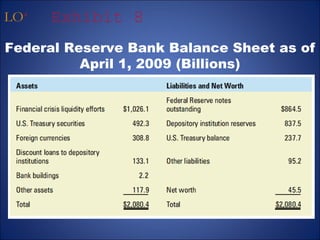
• April 2009- 24% of Fed assets were U.S. 
government bonds, but in more normal times 
about 90% of assets.
LO4 Exhibit 8 
Federal Reserve Bank Balance Sheet as of 
April 1, 2009 (Billions)

Chapter 14 money-and-the money supply

  • 1.
    Chapter 14 Bankingand the Money Supply
  • 2.
    Narrow Definition ofMoney: M1 • M1: the most narrowly defined MS – Measures purchasing power – M1= currency held by the nonbanking public + checkable deposits + traveler’s checks – What are checkable deposits? • Bank deposits that allow the account owner to write checks to third parties. – Is currency in bank vaults included? • NO!!! It is not being used as a medium of exchange
  • 3.
    Broader Definition ofMoney: M2 • M2: adding near monies to M1 – M2= M1 +near monies • Near monies are easy to convert into currency or checkable deposits – Savings deposits – Time deposits (CDs- certificates of deposit) – Money market mutual fund accounts
  • 4.
    LO1 Measures ofthe Money Supply (February 2009) Exhibit 1
  • 5.
    Credit Cards andDebit Cards: What’s the Difference • What do credit cards offer? – They offer an easy way to get a loan from the card issuer. • What do debit cards offer? – They reduce the balance of your checking account; thus, they are part of M1. – It combines the functions of an ATM card and a check.
  • 6.
    Banks Are FinancialIntermediaries • By bringing together both sides of the money market, banks serve as financial intermediaries (go-betweens).
  • 7.
    Coping with AsymmetricInformation • What borrowers do banks want? – Willing to pay interest and are able to repay the loan. • Asymmetric information: an inequality in what’s known by each party to the transaction. – The borrower knows more about their credit history.
  • 8.
    Reducing Risk ThroughDiversification • They develop a diversified portfolio to reduce the risk to each individual saver.
  • 9.
    Starting a Bank • First, they must apply to the state banking authority in the case of a state bank or the U.S. Comptroller of the Currency for a national bank. – A charter • The authority will decide to or not to approve the charter. • If approved they are established. • Net Worth= Owners’ Equity – Shares of Stock in the bank
  • 10.
    Balance Sheet •The balance sheet shows a balance between the two sides of the bank’s account. • Left-hand side= Assets – Any physical property or financial claim owned by the bank – Building and equipment – Stocks in the district Fed • Right-hand side= Liabilities and Net Worth – An amount the bank owes
  • 11.
    What if allexcess reserves are gone?
  • 12.
    LO2 Exhibit 2 Home Bank’s Balance Sheet
  • 13.
    Reserve Accounts •Now what?? – They are required to hold a certain percentage of the checkable deposits. – This amount is the required reserve, the dollar amount that must be held as reserves. – The required reserve ratio dictates the minimum proportion of deposits the bank must hold in reserve.
  • 14.
    Required Reserves forBanks • $0 to 10.7 million – 0% • $10.7 million to $55.2 million- 3% • Greater than $55.2 million- 10% – They are held as cash in the bank’s vault with NO interest or as deposits at the Fed with some interest
  • 15.
    Excess Reserves •Excess Reserves: The amount of checkable deposits the bank holds over the required rate the Fed mandates – Starting in 2008, the Fed now gives interest on excess reserves. – What can they do with them? • Make loans • Buy government securities ( by law limited to this)
  • 16.
    Liquidity vs. Profitability • Liquidity is the ease with which an asset can be converted into cash without a significant loss of value. – Selling government bonds • The objectives of liquidity and profitability are at odds.
  • 17.
    Federal funds market • The federal funds market provides for day-to-day lending and borrowing among banks of excess reserves on account at the Fed. • They don’t leave the Fed, they shift among accounts. • Federal funds rate: the interest rate banks charge one another for overnight borrowing-banks loaning to banks
  • 18.
    LO2 Exhibit 3 Home Bank’s Balance Sheet After $1,000,000 Deposit Into Checking Account
  • 19.
    LO3 Exhibit 4 Changes in Home Bank’s Balance Sheet After Fed Buys a $1,000 Bond from Securities Dealer
  • 20.
    How Banks CreateMoney  Creating money through excess reserves LO3 – Round two • $900 loan • Money supply: +$900 • Required reserves: +$90 • Excess reserves: +$810
  • 21.
    LO3 Exhibit 5 Changes in Home Bank’s Balance Sheet After Lending $900 to You
  • 22.
    How Banks CreateMoney  Creating money through excess reserves LO3 – Round three • $810 loan • Money supply: +$810 • Required reserves: +$81 • Excess reserves: +$729
  • 23.
    LO3 Exhibit 6 Changes in Merchants Trust’s Balance Sheet After Lending $810 to English Major
  • 24.
    How Banks CreateMoney  Creating money through excess reserves LO3 – Round four and beyond • Excess reserves – new loans • Required reserves: +10% of new checkable deposits – Excess reserve – maximum amount for loans – Money supply expansion
  • 25.
    How Banks CreateMoney  Creating money through excess reserves  A summary of rounds LO3 – Fed: $1,000 injection in fresh reserves – Increased excess reserves – Money supply increase: Up to $10,000 • Checkable deposits – Banking system • Eliminates excess reserves – Expand money supply
  • 26.
    LO3 Exhibit 7 Summary of the Money Creation Resulting from the Fed’s Purchase of $1,000 U.S. Government Bond
  • 27.
    Reserve Requirements andMoney Expansion • The multiple by which the money supply increases as a result of an increase in the banking system’s reserves is called the money multiplier.
  • 28.
    The Money Multiplier • Def: The money multiplier is equal to 1 divided by the required reserve ratio. • In our case, it is 10 1 1 Re quired Re serve Ratio
  • 29.
    The Real-World MoneyMultiplier • It is much smaller than MM • It must be observed over time • What happens to it? – Leakage • Banks could let excess reserves sit idle • Borrowers do something with the money • People may not choose to increase their cash holdings
  • 30.
    The Fed’s Toolsof Monetary Control • Open-Market Operations and the Federal Funds Rate • The Discount Rate • Reserve Requirements • Coping with Financial Crises • The Fed is a money machine
  • 31.
    Open Market Operationsand the Federal Funds Rate • Buying and selling of U.S. Government bonds • FOMC meet every six weeks and during emergencies to make these decisions. • To increase MS- the Fed directs the NY Fed to buy U.S. bonds (open-market purchase). • To decrease MS- the Fed directs the NY Fed to sell U.S. bonds (open-market sale).
  • 32.
    Open Market Operationsand the Federal Funds Rate • The Federal Funds Rate is the interest rate banks charge one another for borrowing excess reserves at the Fed, typically just for a day or two. • If the Fed is buying bonds the federal funds rate is lower because less demand for federal funds market. • The lower federal funds rate prompt banks to lower short-term interest rates in general.
  • 33.
    The Discount Rate • The Discount Rate: the interest rate the Fed charges for loans it makes to banks. • Two discount rates: – The primary discount rate is usually one percentage point about the federal funds rate. – The secondary discount rate is usually about one-half a percentage point higher than the primary discount rate. • Banks that are less sound
  • 34.
    Reserve Requirement •The minimum amount of reserves that banks must hold to back up deposits. • If the Fed increase the reserve requirement, then banks have less excess reserves to lend out – This reduces the banking system’s ability to create money.
  • 35.
    Coping with FinancialCrises • In 2001- the Fed bought all the government securities offered for sale, purchasing a record $150 billion worth in two days. • In 2008- The Fed lowered the discount rate to nearly zero and encourage banks improve their balance sheets and a few other policies
  • 36.
    The Fed isa money machine • The Fed injected more that a trillion dollars of liquidity into the banking system in response to the 2008 meltdown. • April 2009- 24% of Fed assets were U.S. government bonds, but in more normal times about 90% of assets.
  • 37.
    LO4 Exhibit 8 Federal Reserve Bank Balance Sheet as of April 1, 2009 (Billions)

Editor's Notes

  • #10 They will exchange the $500,000 for shares of stock in the bank. They will then take part of the shares of stock and buy shares in their district Fed. Reserve, they are now members of the Fed.
  • #19 Because the amount of $1 million is a promise to repay the client, it is a liabilities- the bank owes that customer $1 million.
  • #34 This is used more as a signal to financial markets about its monetary policy than as a tool for increasing and decreasing the MS.
  • #35 This is changed by a simple majority vote