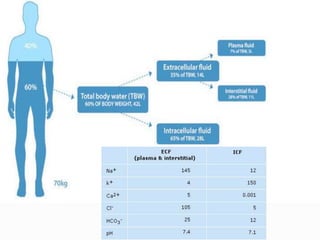
ANGAN KARMAKAR
(JUNIOR RESIDENT)
CHAIRPERSON: PROF. A.K. SAHA
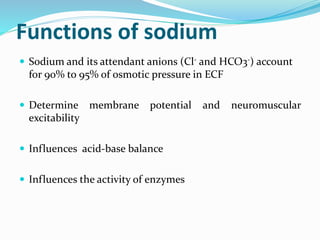
Functions of sodium
 Sodium and its attendant anions (Cl- and HCO3-) account
for 90% to 95% of osmotic pressure in ECF
 Determine membrane potential and neuromuscular
excitability
 Influences acid-base balance
 Influences the activity of enzymes
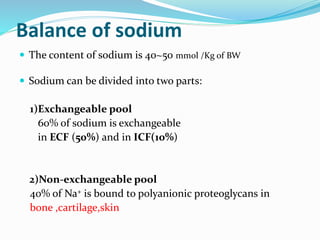
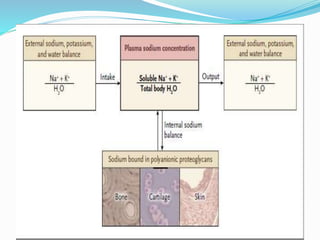
Balance of sodium
 The content of sodium is 40~50 mmol /Kg of BW
 Sodium can be divided into two parts:
1)Exchangeable pool
60% of sodium is exchangeable
in ECF (50%) and in ICF(10%)
2)Non-exchangeable pool
40% of Na+ is bound to polyanionic proteoglycans in
bone ,cartilage,skin
NORMAL SODIUM METABOLISM
Sodium absorption
Via two mechanisms
1.freely permeable across the interstitial cell
2. symport with glucose and aminoacids
Sodium excretion
 Major determinant of balance
 Kidneys : extremely efficient
eliminates more if the intake of sodium is more and vice-
versa
does not eliminate sodium if there is no intake
 Gastrointestinal tract : second way
≤10% of the sodium intake is lost in feces
Sodium handling by kidney
 Absorbed at 3 main regions in the nephron
1.PCT– 2/3 of Na+ reabsorbed
2.TALH– 25-30% is reabsorbed via apical Na+ K+ 2Cl-
transporter
3.DCT– 5% by thiazide sensitive Na+ Cl- cotransporter
Finally Na+ reabsorption also occurs in cortical and
medullary collecting ducts via ENaC
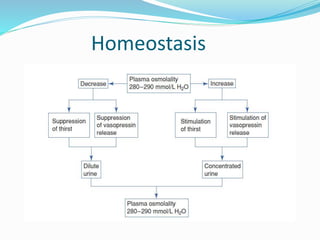
Regulation of water and sodium
metabolism
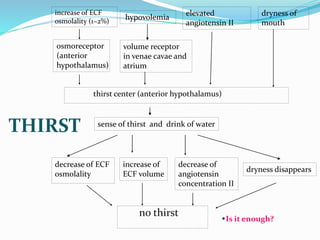
 Thirst neural regulation
 Antidiuretic hormone
hormonal
 Aldosterone regulation
 Atrial natriuretic peptide
no thirst
increase of ECF
osmolality (1~2%)
hypovolemia
elevated
angiotensin II
dryness of
mouth
osmoreceptor
(anterior
hypothalamus)
volume receptor
in venae cavae and
atrium
thirst center (anterior hypothalamus)
sense of thirst and drink of water
decrease of ECF
osmolality
increase of
ECF volume
decrease of
angiotensin
concentration II
dryness disappears
Is it enough?
THIRST
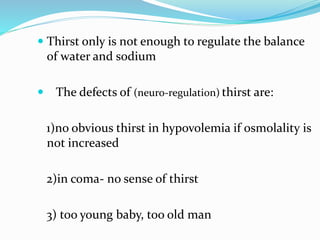
 Thirst only is not enough to regulate the balance
of water and sodium
 The defects of (neuro-regulation) thirst are:
1)no obvious thirst in hypovolemia if osmolality is
not increased
2)in coma- no sense of thirst
3) too young baby, too old man
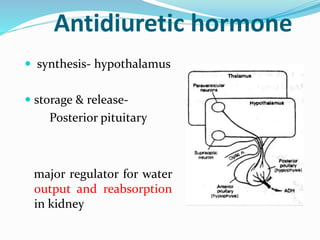
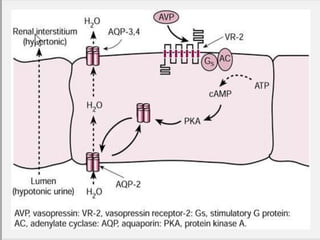
Antidiuretic hormone
 synthesis- hypothalamus
 storage & release-
Posterior pituitary
major regulator for water
output and reabsorption
in kidney
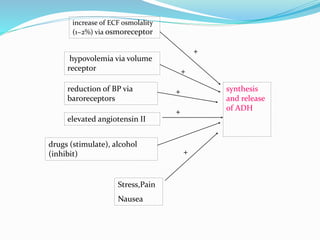
increase of ECF osmolality
(1~2%) via osmoreceptor
hypovolemia via volume
receptor
reduction of BP via
baroreceptors
synthesis
and release
of ADH
drugs (stimulate), alcohol
(inhibit)
Stress,Pain
Nausea
elevated angiotensin II
+
+
+
+
+
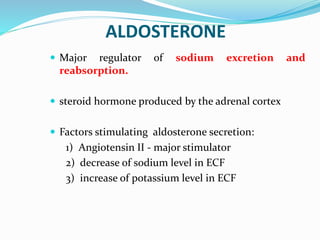
ALDOSTERONE
 Major regulator of sodium excretion and
reabsorption.
 steroid hormone produced by the adrenal cortex
 Factors stimulating aldosterone secretion:
1) Angiotensin II - major stimulator
2) decrease of sodium level in ECF
3) increase of potassium level in ECF
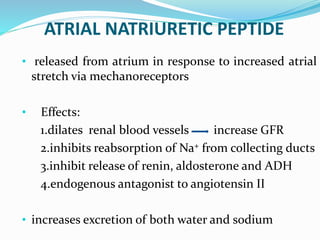
ATRIAL NATRIURETIC PEPTIDE
• released from atrium in response to increased atrial
stretch via mechanoreceptors
• Effects:
1.dilates renal blood vessels increase GFR
2.inhibits reabsorption of Na+ from collecting ducts
3.inhibit release of renin, aldosterone and ADH
4.endogenous antagonist to angiotensin II
• increases excretion of both water and sodium
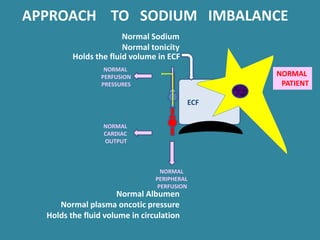
Homeostasis
ECF
NORMAL
PERIPHERAL
PERFUSION
NORMAL
PERFUSION
PRESSURES
Normal Albumen
Normal plasma oncotic pressure
NORMAL
CARDIAC
OUTPUT
Normal Sodium
Normal tonicity
Holds the fluid volume in circulation
Holds the fluid volume in ECF
NORMAL
PATIENT
APPROACH TO SODIUM IMBALANCE
ECF
NORMAL
PERIPHERAL
PERFUSION
NORMAL
PERFUSION
PRESSURES
NORMAL
CARDIAC
OUTPUT
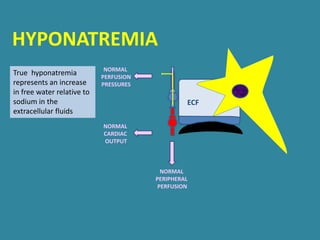
True hyponatremia
represents an increase
in free water relative to
sodium in the
extracellular fluids
HYPONATREMIA
ECF
NORMAL
PERIPHERAL
PERFUSION
NORMAL
PERFUSION
PRESSURES
NORMAL
CARDIAC
OUTPUT
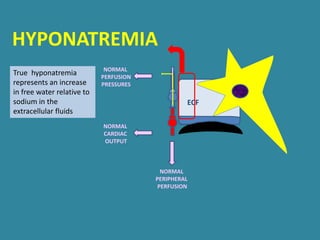
True hyponatremia
represents an increase
in free water relative to
sodium in the
extracellular fluids
HYPONATREMIA
ECF
NORMAL
PERIPHERAL
PERFUSION
NORMAL
PERFUSION
PRESSURES
NORMAL
CARDIAC
OUTPUT
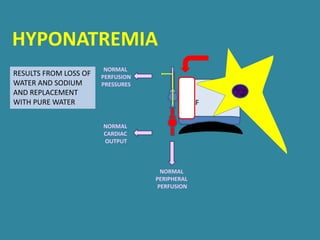
RESULTS FROM LOSS OF
WATER AND SODIUM
AND REPLACEMENT
WITH PURE WATER
HYPONATREMIA
ECF
PERIPHERAL
PERFUSION
PERFUSION
PRESSURES
CARDIAC
OUTPUT
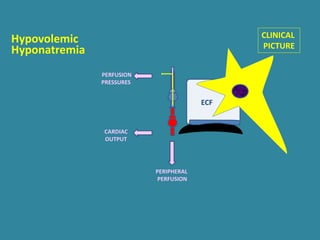
Hyponatremia
CLINICAL
PICTURE
Hypovolemic
ECF
PERIPHERAL
PERFUSION
PERFUSION
PRESSURES
CARDIAC
OUTPUT
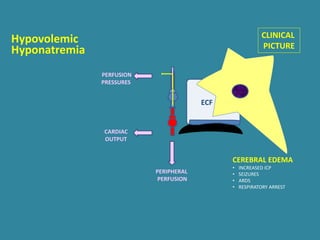
Hyponatremia
CLINICAL
PICTURE
Hypovolemic
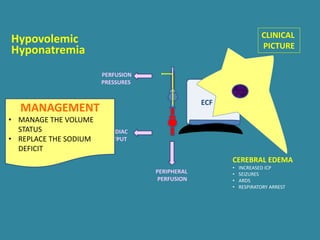
CEREBRAL EDEMA
• INCREASED ICP
• SEIZURES
• ARDS
• RESPIRATORY ARREST
ECF
PERIPHERAL
PERFUSION
PERFUSION
PRESSURES
CARDIAC
OUTPUT
Hyponatremia
CLINICAL
PICTURE
Hypovolemic
CEREBRAL EDEMA
• INCREASED ICP
• SEIZURES
• ARDS
• RESPIRATORY ARREST
MANAGEMENT
• MANAGE THE VOLUME
STATUS
• REPLACE THE SODIUM
DEFICIT
ECF
Hyponatremia
CLINICAL
PICTURE
Hypovolemic
CEREBRAL EDEMA
• INCREASED ICP
• SEIZURES
• ARDS
• RESPIRATORY ARREST
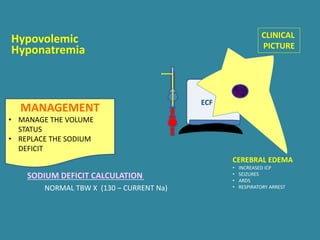
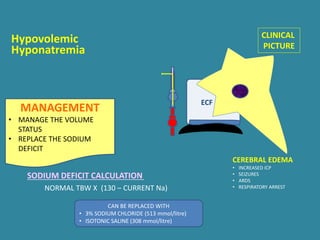
SODIUM DEFICIT CALCULATION
NORMAL TBW X (130 – CURRENT Na)
MANAGEMENT
• MANAGE THE VOLUME
STATUS
• REPLACE THE SODIUM
DEFICIT
ECF
Hyponatremia
CLINICAL
PICTURE
Hypovolemic
CEREBRAL EDEMA
• INCREASED ICP
• SEIZURES
• ARDS
• RESPIRATORY ARREST
SODIUM DEFICIT CALCULATION
NORMAL TBW X (130 – CURRENT Na)
CAN BE REPLACED WITH
• 3% SODIUM CHLORIDE (513 mmol/litre)
• ISOTONIC SALINE (308 mmol/litre)
MANAGEMENT
• MANAGE THE VOLUME
STATUS
• REPLACE THE SODIUM
DEFICIT
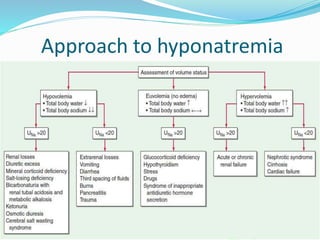
Approach to hyponatremia
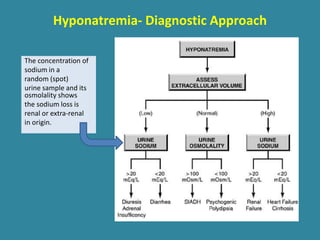
Hyponatremia- Diagnostic Approach
The concentration of
sodium in a
random (spot)
urine sample and its
osmolality shows
the sodium loss is
renal or extra-renal
in origin.
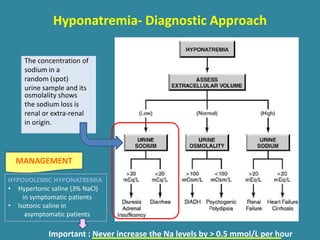
MANAGEMENT
Hyponatremia- Diagnostic Approach
HYPOVOLEMIC HYPONATREMIA
• Hypertonic saline (3% NaCl)
in symptomatic patients
• Isotonic saline in
asymptomatic patients
Important : Never increase the Na levels by > 0.5 mmol/L per hour
The concentration of
sodium in a
random (spot)
urine sample and its
osmolality shows
the sodium loss is
renal or extra-renal
in origin.
Hyponatremia- Diagnostic Approach
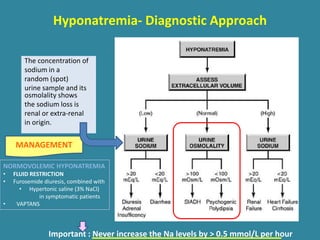
NORMOVOLEMIC HYPONATREMIA
• FLUID RESTRICTION
• Furosemide diuresis, combined with
• Hypertonic saline (3% NaCl)
in symptomatic patients
• VAPTANS
MANAGEMENT
The concentration of
sodium in a
random (spot)
urine sample and its
osmolality shows
the sodium loss is
renal or extra-renal
in origin.
Important : Never increase the Na levels by > 0.5 mmol/L per hour
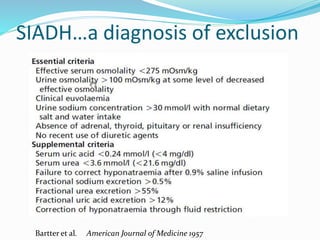
SIADH…a diagnosis of exclusion
Bartter et al. American Journal of Medicine 1957
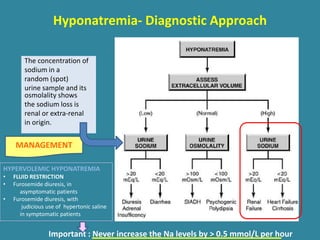
Hyponatremia- Diagnostic Approach
HYPERVOLEMIC HYPONATREMIA
• FLUID RESTRICTION
• Furosemide diuresis, in
asymptomatic patients
• Furosemide diuresis, with
judicious use of hypertonic saline
in symptomatic patients
MANAGEMENT
The concentration of
sodium in a
random (spot)
urine sample and its
osmolality shows
the sodium loss is
renal or extra-renal
in origin.
Important : Never increase the Na levels by > 0.5 mmol/L per hour
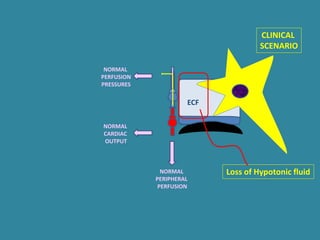
ECF
Loss of Hypotonic fluidNORMAL
PERIPHERAL
PERFUSION
NORMAL
PERFUSION
PRESSURES
NORMAL
CARDIAC
OUTPUT
CLINICAL
SCENARIO
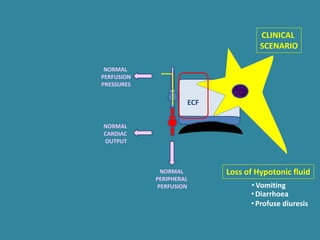
ECF
Loss of Hypotonic fluidNORMAL
PERIPHERAL
PERFUSION
NORMAL
PERFUSION
PRESSURES
NORMAL
CARDIAC
OUTPUT
CLINICAL
SCENARIO
•Vomiting
•Diarrhoea
•Profuse diuresis
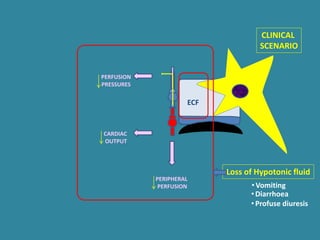
ECF
Loss of Hypotonic fluid
PERIPHERAL
PERFUSION
PERFUSION
PRESSURES
CARDIAC
OUTPUT
CLINICAL
SCENARIO
•Vomiting
•Diarrhoea
•Profuse diuresis
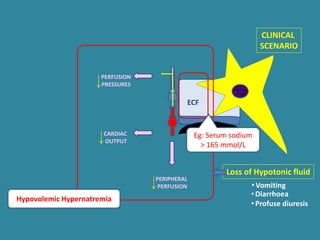
ECF
Loss of Hypotonic fluid
PERIPHERAL
PERFUSION
PERFUSION
PRESSURES
CARDIAC
OUTPUT
CLINICAL
SCENARIO
•Vomiting
•Diarrhoea
•Profuse diuresis
Eg: Serum sodium
> 165 mmol/L
Hypovolemic Hypernatremia
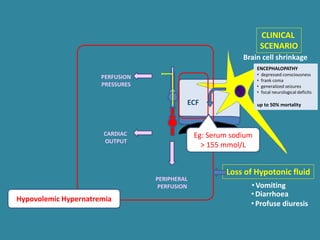
ECF
Loss of Hypotonic fluid
PERIPHERAL
PERFUSION
PERFUSION
PRESSURES
CARDIAC
OUTPUT
CLINICAL
SCENARIO
•Vomiting
•Diarrhoea
•Profuse diuresis
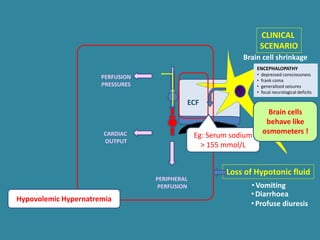
Brain cell shrinkage
Eg: Serum sodium
> 155 mmol/L
ENCEPHALOPATHY
• depressed consciousness
• frank coma
• generalized seizures
• focal neurological deficits
up to 50% mortality
Hypovolemic Hypernatremia
ECF
Loss of Hypotonic fluid
PERIPHERAL
PERFUSION
PERFUSION
PRESSURES
CARDIAC
OUTPUT
CLINICAL
SCENARIO
•Vomiting
•Diarrhoea
•Profuse diuresis
Brain cell shrinkage
Eg: Serum sodium
> 155 mmol/L
ENCEPHALOPATHY
• depressed consciousness
• frank coma
• generalized seizures
• focal neurological deficits
Brain cells
behave like
osmometers !
Hypovolemic Hypernatremia
ECF
Loss of Hypotonic fluid
PERIPHERAL
PERFUSION
PERFUSION
PRESSURES
CARDIAC
OUTPUT
CLINICAL
SCENARIO
•Vomiting
•Diarrhoea
•Profuse diuresis
Brain cell shrinkage
Eg: Serum sodium
> 155 mmol/L
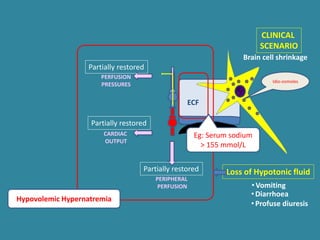
Idio-osmoles
Partially restored
Partially restored
Partially restored
Hypovolemic Hypernatremia
ECF
Loss of Hypotonic fluid
PERIPHERAL
PERFUSION
PERFUSION
PRESSURES
CARDIAC
OUTPUT
CLINICAL
SCENARIO
•Vomiting
•Diarrhoea
•Profuse diuresis
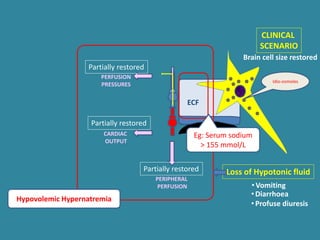
Brain cell size restored
Eg: Serum sodium
> 155 mmol/L
Idio-osmoles
Partially restored
Partially restored
Partially restored
Hypovolemic Hypernatremia
ECF
Loss of Hypotonic fluid
PERIPHERAL
PERFUSION
PERFUSION
PRESSURES
CARDIAC
OUTPUT
CLINICAL
SCENARIO
•Vomiting
•Diarrhoea
•Profuse diuresis
Brain cell size restored
Eg: Serum sodium
> 155 mmol/L
Idio-osmoles
Partially restored
Partially restored
Partially restored
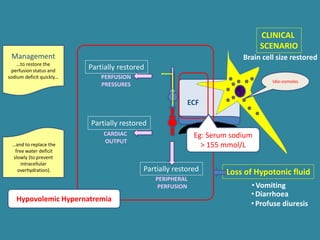
Management
…to restore the
perfusion status and
sodium deficit quickly…
…and to replace the
free water deficit
slowly (to prevent
intracellular
overhydration).
Hypovolemic Hypernatremia
ECF
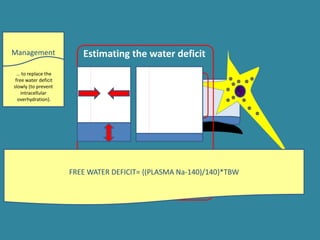
Management
… to replace the
free water deficit
slowly (to prevent
intracellular
overhydration).
FREE WATER DEFICIT= {(PLASMA Na-140)/140}*TBW
Estimating the water deficit
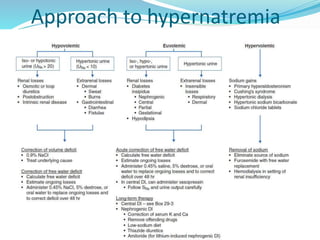
Approach to hypernatremia
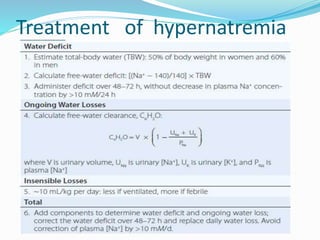
Treatment of hypernatremia
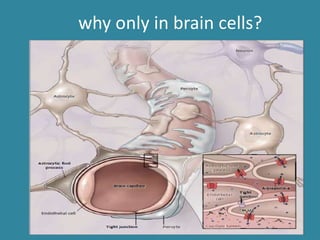
why only in brain cells?
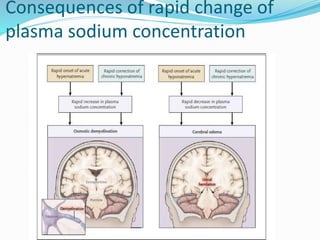
Consequences of rapid change of
plasma sodium concentration
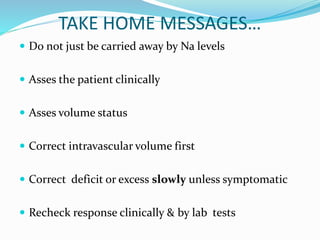
TAKE HOME MESSAGES…
 Do not just be carried away by Na levels
 Asses the patient clinically
 Asses volume status
 Correct intravascular volume first
 Correct deficit or excess slowly unless symptomatic
 Recheck response clinically & by lab tests
THANK YOU FOR LISTENING

Sodium homeostasis

  • 1.
  • 3.
    Functions of sodium Sodium and its attendant anions (Cl- and HCO3-) account for 90% to 95% of osmotic pressure in ECF  Determine membrane potential and neuromuscular excitability  Influences acid-base balance  Influences the activity of enzymes
  • 4.
    Balance of sodium The content of sodium is 40~50 mmol /Kg of BW  Sodium can be divided into two parts: 1)Exchangeable pool 60% of sodium is exchangeable in ECF (50%) and in ICF(10%) 2)Non-exchangeable pool 40% of Na+ is bound to polyanionic proteoglycans in bone ,cartilage,skin
  • 6.
    NORMAL SODIUM METABOLISM Sodiumabsorption Via two mechanisms 1.freely permeable across the interstitial cell 2. symport with glucose and aminoacids
  • 7.
    Sodium excretion  Majordeterminant of balance  Kidneys : extremely efficient eliminates more if the intake of sodium is more and vice- versa does not eliminate sodium if there is no intake  Gastrointestinal tract : second way ≤10% of the sodium intake is lost in feces
  • 8.
    Sodium handling bykidney  Absorbed at 3 main regions in the nephron 1.PCT– 2/3 of Na+ reabsorbed 2.TALH– 25-30% is reabsorbed via apical Na+ K+ 2Cl- transporter 3.DCT– 5% by thiazide sensitive Na+ Cl- cotransporter Finally Na+ reabsorption also occurs in cortical and medullary collecting ducts via ENaC
  • 9.
    Regulation of waterand sodium metabolism  Thirst neural regulation  Antidiuretic hormone hormonal  Aldosterone regulation  Atrial natriuretic peptide
  • 10.
    no thirst increase ofECF osmolality (1~2%) hypovolemia elevated angiotensin II dryness of mouth osmoreceptor (anterior hypothalamus) volume receptor in venae cavae and atrium thirst center (anterior hypothalamus) sense of thirst and drink of water decrease of ECF osmolality increase of ECF volume decrease of angiotensin concentration II dryness disappears Is it enough? THIRST
  • 11.
     Thirst onlyis not enough to regulate the balance of water and sodium  The defects of (neuro-regulation) thirst are: 1)no obvious thirst in hypovolemia if osmolality is not increased 2)in coma- no sense of thirst 3) too young baby, too old man
  • 12.
    Antidiuretic hormone  synthesis-hypothalamus  storage & release- Posterior pituitary major regulator for water output and reabsorption in kidney
  • 13.
    increase of ECFosmolality (1~2%) via osmoreceptor hypovolemia via volume receptor reduction of BP via baroreceptors synthesis and release of ADH drugs (stimulate), alcohol (inhibit) Stress,Pain Nausea elevated angiotensin II + + + + +
  • 15.
    ALDOSTERONE  Major regulatorof sodium excretion and reabsorption.  steroid hormone produced by the adrenal cortex  Factors stimulating aldosterone secretion: 1) Angiotensin II - major stimulator 2) decrease of sodium level in ECF 3) increase of potassium level in ECF
  • 16.
    ATRIAL NATRIURETIC PEPTIDE •released from atrium in response to increased atrial stretch via mechanoreceptors • Effects: 1.dilates renal blood vessels increase GFR 2.inhibits reabsorption of Na+ from collecting ducts 3.inhibit release of renin, aldosterone and ADH 4.endogenous antagonist to angiotensin II • increases excretion of both water and sodium
  • 17.
  • 18.
    ECF NORMAL PERIPHERAL PERFUSION NORMAL PERFUSION PRESSURES Normal Albumen Normal plasmaoncotic pressure NORMAL CARDIAC OUTPUT Normal Sodium Normal tonicity Holds the fluid volume in circulation Holds the fluid volume in ECF NORMAL PATIENT APPROACH TO SODIUM IMBALANCE
  • 19.
    ECF NORMAL PERIPHERAL PERFUSION NORMAL PERFUSION PRESSURES NORMAL CARDIAC OUTPUT True hyponatremia represents anincrease in free water relative to sodium in the extracellular fluids HYPONATREMIA
  • 20.
    ECF NORMAL PERIPHERAL PERFUSION NORMAL PERFUSION PRESSURES NORMAL CARDIAC OUTPUT True hyponatremia represents anincrease in free water relative to sodium in the extracellular fluids HYPONATREMIA
  • 21.
  • 22.
  • 23.
  • 24.
    ECF PERIPHERAL PERFUSION PERFUSION PRESSURES CARDIAC OUTPUT Hyponatremia CLINICAL PICTURE Hypovolemic CEREBRAL EDEMA • INCREASEDICP • SEIZURES • ARDS • RESPIRATORY ARREST MANAGEMENT • MANAGE THE VOLUME STATUS • REPLACE THE SODIUM DEFICIT
  • 25.
    ECF Hyponatremia CLINICAL PICTURE Hypovolemic CEREBRAL EDEMA • INCREASEDICP • SEIZURES • ARDS • RESPIRATORY ARREST SODIUM DEFICIT CALCULATION NORMAL TBW X (130 – CURRENT Na) MANAGEMENT • MANAGE THE VOLUME STATUS • REPLACE THE SODIUM DEFICIT
  • 26.
    ECF Hyponatremia CLINICAL PICTURE Hypovolemic CEREBRAL EDEMA • INCREASEDICP • SEIZURES • ARDS • RESPIRATORY ARREST SODIUM DEFICIT CALCULATION NORMAL TBW X (130 – CURRENT Na) CAN BE REPLACED WITH • 3% SODIUM CHLORIDE (513 mmol/litre) • ISOTONIC SALINE (308 mmol/litre) MANAGEMENT • MANAGE THE VOLUME STATUS • REPLACE THE SODIUM DEFICIT
  • 27.
  • 28.
    Hyponatremia- Diagnostic Approach Theconcentration of sodium in a random (spot) urine sample and its osmolality shows the sodium loss is renal or extra-renal in origin.
  • 29.
    MANAGEMENT Hyponatremia- Diagnostic Approach HYPOVOLEMICHYPONATREMIA • Hypertonic saline (3% NaCl) in symptomatic patients • Isotonic saline in asymptomatic patients Important : Never increase the Na levels by > 0.5 mmol/L per hour The concentration of sodium in a random (spot) urine sample and its osmolality shows the sodium loss is renal or extra-renal in origin.
  • 30.
    Hyponatremia- Diagnostic Approach NORMOVOLEMICHYPONATREMIA • FLUID RESTRICTION • Furosemide diuresis, combined with • Hypertonic saline (3% NaCl) in symptomatic patients • VAPTANS MANAGEMENT The concentration of sodium in a random (spot) urine sample and its osmolality shows the sodium loss is renal or extra-renal in origin. Important : Never increase the Na levels by > 0.5 mmol/L per hour
  • 31.
    SIADH…a diagnosis ofexclusion Bartter et al. American Journal of Medicine 1957
  • 32.
    Hyponatremia- Diagnostic Approach HYPERVOLEMICHYPONATREMIA • FLUID RESTRICTION • Furosemide diuresis, in asymptomatic patients • Furosemide diuresis, with judicious use of hypertonic saline in symptomatic patients MANAGEMENT The concentration of sodium in a random (spot) urine sample and its osmolality shows the sodium loss is renal or extra-renal in origin. Important : Never increase the Na levels by > 0.5 mmol/L per hour
  • 34.
    ECF Loss of HypotonicfluidNORMAL PERIPHERAL PERFUSION NORMAL PERFUSION PRESSURES NORMAL CARDIAC OUTPUT CLINICAL SCENARIO
  • 35.
    ECF Loss of HypotonicfluidNORMAL PERIPHERAL PERFUSION NORMAL PERFUSION PRESSURES NORMAL CARDIAC OUTPUT CLINICAL SCENARIO •Vomiting •Diarrhoea •Profuse diuresis
  • 36.
    ECF Loss of Hypotonicfluid PERIPHERAL PERFUSION PERFUSION PRESSURES CARDIAC OUTPUT CLINICAL SCENARIO •Vomiting •Diarrhoea •Profuse diuresis
  • 37.
    ECF Loss of Hypotonicfluid PERIPHERAL PERFUSION PERFUSION PRESSURES CARDIAC OUTPUT CLINICAL SCENARIO •Vomiting •Diarrhoea •Profuse diuresis Eg: Serum sodium > 165 mmol/L Hypovolemic Hypernatremia
  • 38.
    ECF Loss of Hypotonicfluid PERIPHERAL PERFUSION PERFUSION PRESSURES CARDIAC OUTPUT CLINICAL SCENARIO •Vomiting •Diarrhoea •Profuse diuresis Brain cell shrinkage Eg: Serum sodium > 155 mmol/L ENCEPHALOPATHY • depressed consciousness • frank coma • generalized seizures • focal neurological deficits up to 50% mortality Hypovolemic Hypernatremia
  • 39.
    ECF Loss of Hypotonicfluid PERIPHERAL PERFUSION PERFUSION PRESSURES CARDIAC OUTPUT CLINICAL SCENARIO •Vomiting •Diarrhoea •Profuse diuresis Brain cell shrinkage Eg: Serum sodium > 155 mmol/L ENCEPHALOPATHY • depressed consciousness • frank coma • generalized seizures • focal neurological deficits Brain cells behave like osmometers ! Hypovolemic Hypernatremia
  • 40.
    ECF Loss of Hypotonicfluid PERIPHERAL PERFUSION PERFUSION PRESSURES CARDIAC OUTPUT CLINICAL SCENARIO •Vomiting •Diarrhoea •Profuse diuresis Brain cell shrinkage Eg: Serum sodium > 155 mmol/L Idio-osmoles Partially restored Partially restored Partially restored Hypovolemic Hypernatremia
  • 41.
    ECF Loss of Hypotonicfluid PERIPHERAL PERFUSION PERFUSION PRESSURES CARDIAC OUTPUT CLINICAL SCENARIO •Vomiting •Diarrhoea •Profuse diuresis Brain cell size restored Eg: Serum sodium > 155 mmol/L Idio-osmoles Partially restored Partially restored Partially restored Hypovolemic Hypernatremia
  • 42.
    ECF Loss of Hypotonicfluid PERIPHERAL PERFUSION PERFUSION PRESSURES CARDIAC OUTPUT CLINICAL SCENARIO •Vomiting •Diarrhoea •Profuse diuresis Brain cell size restored Eg: Serum sodium > 155 mmol/L Idio-osmoles Partially restored Partially restored Partially restored Management …to restore the perfusion status and sodium deficit quickly… …and to replace the free water deficit slowly (to prevent intracellular overhydration). Hypovolemic Hypernatremia
  • 43.
    ECF Management … to replacethe free water deficit slowly (to prevent intracellular overhydration). FREE WATER DEFICIT= {(PLASMA Na-140)/140}*TBW Estimating the water deficit
  • 44.
  • 45.
  • 46.
    why only inbrain cells?
  • 47.
    Consequences of rapidchange of plasma sodium concentration
  • 48.
    TAKE HOME MESSAGES… Do not just be carried away by Na levels  Asses the patient clinically  Asses volume status  Correct intravascular volume first  Correct deficit or excess slowly unless symptomatic  Recheck response clinically & by lab tests
  • 49.
    THANK YOU FORLISTENING