Dr. Simon Prince, FACP, FASN Assistant Professor of Medicine NYU School of Medicine North Shore Nephrology Hyponatremia
Sodium  The problems with sodium has little to do with direct effects of the ion.   Disregulation of sodium causes changes in cell volume.                    WATER PROBLEM
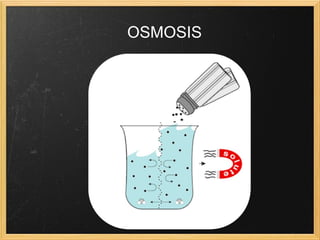
OSMOSIS
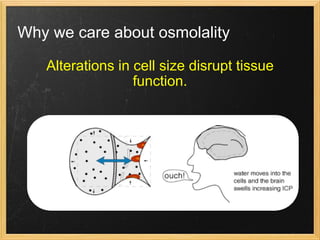
Why we care about osmolality Alterations in cell size disrupt tissue function.
Sodium is an indicator of osmolality The clinically important variable is       tonicity .
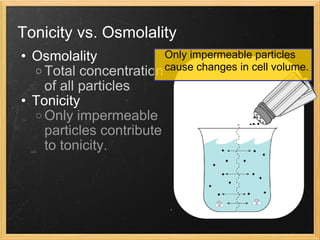
Tonicity vs. Osmolality Osmolality Total concentration of all particles Tonicity Only impermeable particles contribute to tonicity. Only impermeable particles cause changes in cell volume.
Why are we interested in TONICITY?   When elevated, water leaves the cells causing cell  shrinkage  and dysfunction. When decreased water moves into the cells causing cellular  swelling  and dysfunction.   We are interested in  sodium  because it usually tells us the plasma  tonicity .
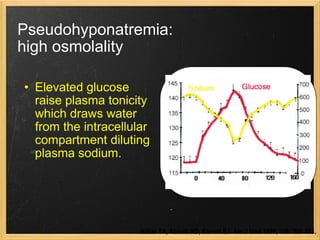
Pseudohyponatremia:  high osmolality Elevated glucose  raise plasma tonicity which draws water from the intracellular compartment diluting plasma sodium. Hillier TA, Abbott RD, Barrett EJ. Am J Med 1999; 106: 399-403.
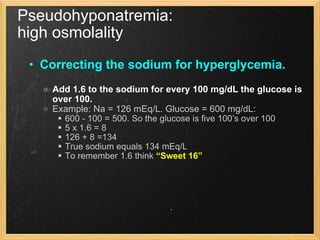
Pseudohyponatremia:  high osmolality Correcting the sodium for hyperglycemia.   Add 1.6 to the sodium for every 100 mg/dL the glucose is over 100. Example: Na = 126 mEq/L. Glucose = 600 mg/dL: 600 - 100 = 500. So the glucose is five 100’s over 100 5 x 1.6 = 8 126 + 8 =134 True sodium equals 134 mEq/L To remember 1.6 think  “Sweet 16”
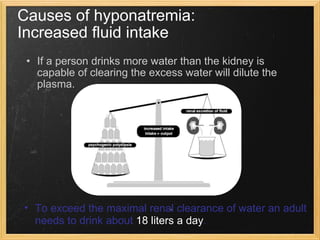
If a person drinks more water than the kidney is capable of clearing the excess water will dilute the plasma. Causes of hyponatremia:  Increased fluid intake To exceed the maximal renal clearance of water an adult needs to drink about  18 liters a day .
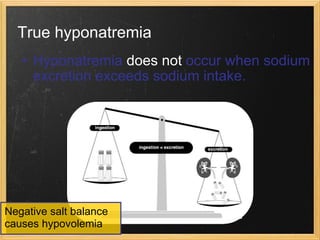
True hyponatremia Hyponatremia  does not  occur when sodium excretion exceeds sodium intake. Negative salt balance  causes hypovolemia
Causes of Hyponatremia: Defect in Free H2O clearance  
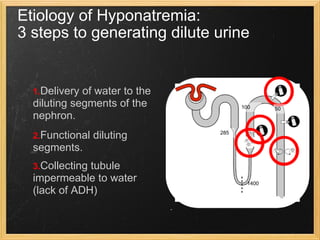
Etiology of Hyponatremia:  3 steps to generating dilute urine 1. Delivery of water to the diluting segments of the nephron. 2. Functional diluting segments. 3. Collecting tubule impermeable to water (lack of ADH) 1400 285 100 50
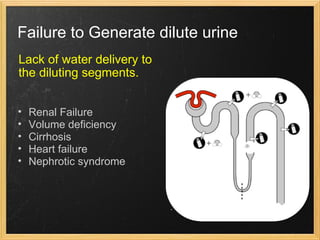
Failure to Generate dilute urine Lack of water delivery to the diluting segments. Renal Failure Volume deficiency Cirrhosis Heart failure Nephrotic syndrome
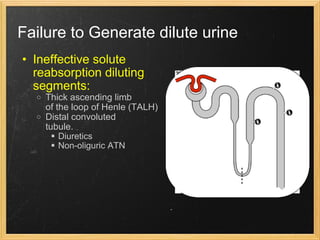
Failure to Generate dilute urine Ineffective solute reabsorption diluting segments: Thick ascending limb of the loop of Henle (TALH) Distal convoluted  tubule. Diuretics Non-oliguric ATN
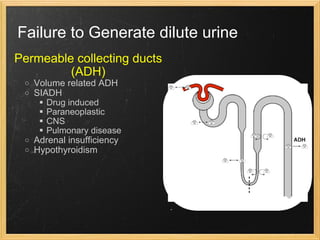
Failure to Generate dilute urine Permeable collecting ducts (ADH) Volume related ADH SIADH Drug induced Paraneoplastic CNS Pulmonary disease Adrenal insufficiency Hypothyroidism
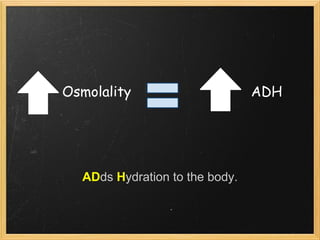
      AD ds  H ydration to the body. ADH Osmolality
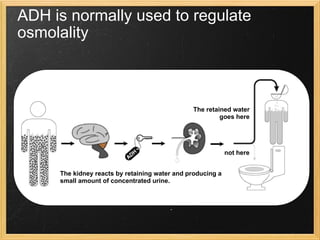
ADH is normally used to regulate osmolality We start with an increase in the plasma osmolality This is detected by the brain The brain releases ADH ADH acts on the kidney The kidney reacts by retaining water and producing a small amount of concentrated urine. The retained water goes here not here
Clinical Approach  
What Studies Are Needed?  
Tests to send... UA, Urine: Na and Osmolality BMP Serum osmolality, TSH, uric acid, BNP, cortisol CXR Head CT
What is the Volume Status? Hypovolemic Euvolemic Hypervolemic
Hypovolemic Hyponatremia      Volume expansion with SALINE
Hypervolemic Hyponatremia Fluid restrict Diurese
EUVOLEMIC HYPONATREMIA Excess intake in Free Water Defect in Free Water Clearance ADH problem
ADH Should  NOT  Be Present When... Euvolemic / Hypervolemic states Serum Osmolality is low - normal range If ADH is elevated... that would be  INAPPROPRIATE
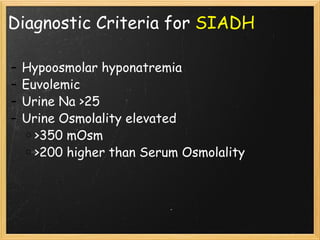
Diagnostic Criteria for  SIADH Hypoosmolar hyponatremia Euvolemic Urine Na >25 Urine Osmolality elevated  >350 mOsm >200 higher than Serum Osmolality
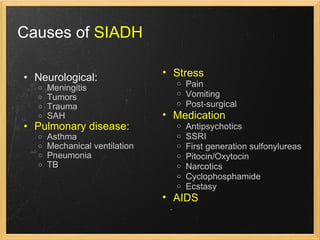
Causes of  SIADH Neurological: Meningitis Tumors Trauma SAH Pulmonary disease: Asthma Mechanical ventilation Pneumonia TB Stress Pain Vomiting Post-surgical Medication Antipsychotics SSRI First generation sulfonylureas Pitocin/Oxytocin Narcotics Cyclophosphamide Ecstasy   AIDS
TREATMENT      Conservative vs. Aggressive Who should get treated and why?
Symptomatic Hyponatremia Mental status changes Nausea Vomitting Head ache Movement abnormalities Seizures Hypoxia / respiratory failure
Symptomatic vs. Asymptomatic Symptomatic      HYPERTONIC SALINE Asymptomatic      Conservative approach is best
Acute symptomatic hyponatremia In patients with neurologic symptoms due to hyponatremia: 3%. Increase sodium until symptoms abate or 6 mmol/L, which ever comes first. Increase Na < 24 mEq/L in the first 24 hours. Goal is not more than 0.5 mEq/L/hour

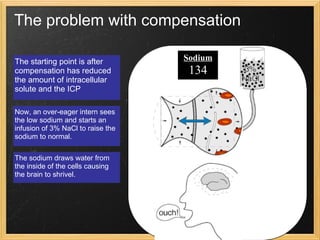
The problem with compensation The starting point is after compensation has reduced the amount of intracellular solute and the ICP Now, an over-eager intern sees the low sodium and starts an infusion of 3% NaCl to raise the sodium to normal. Sodium 108 Sodium 134 The sodium draws water from the inside of the cells causing the brain to shrivel.
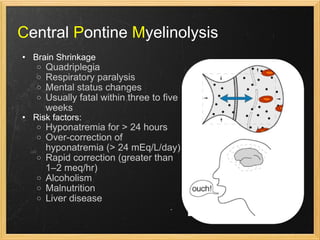
C entral  P ontine  M yelinolysis Brain Shrinkage  Quadriplegia Respiratory paralysis Mental status changes Usually fatal within three to five weeks Risk factors: Hyponatremia for > 24 hours Over-correction of hyponatremia (> 24 mEq/L/day) Rapid correction (greater than 1–2 meq/hr) Alcoholism Malnutrition Liver disease
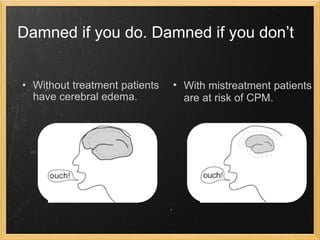
Damned if you do. Damned if you don’t Without treatment patients have cerebral edema. With mistreatment patients are at risk of CPM.
TAKE HOME POINTS Hyponatremia is a WATER problem, not sodium problem In general best strategy in ER if not symptomatic...  DO NOTHING  (Primum non nocere) ... including holding NS unless dehydrated Repeat blood tests to confirm and watch for psuedohyponatremia, send off urine studies Careful hypertonic saline (3%) if symptomatic rule of thumb start hourly rate @0.5 LBM (kg)
CASE REPORTS  

Hyponatremia

  • 1.
    Dr. Simon Prince,FACP, FASN Assistant Professor of Medicine NYU School of Medicine North Shore Nephrology Hyponatremia
  • 2.
    Sodium Theproblems with sodium has little to do with direct effects of the ion.   Disregulation of sodium causes changes in cell volume.                   WATER PROBLEM
  • 3.
  • 4.
    Why we careabout osmolality Alterations in cell size disrupt tissue function.
  • 5.
    Sodium is anindicator of osmolality The clinically important variable is       tonicity .
  • 6.
    Tonicity vs. OsmolalityOsmolality Total concentration of all particles Tonicity Only impermeable particles contribute to tonicity. Only impermeable particles cause changes in cell volume.
  • 7.
    Why are weinterested in TONICITY?   When elevated, water leaves the cells causing cell shrinkage and dysfunction. When decreased water moves into the cells causing cellular swelling and dysfunction.   We are interested in sodium because it usually tells us the plasma tonicity .
  • 8.
    Pseudohyponatremia: highosmolality Elevated glucose  raise plasma tonicity which draws water from the intracellular compartment diluting plasma sodium. Hillier TA, Abbott RD, Barrett EJ. Am J Med 1999; 106: 399-403.
  • 9.
    Pseudohyponatremia: highosmolality Correcting the sodium for hyperglycemia.   Add 1.6 to the sodium for every 100 mg/dL the glucose is over 100. Example: Na = 126 mEq/L. Glucose = 600 mg/dL: 600 - 100 = 500. So the glucose is five 100’s over 100 5 x 1.6 = 8 126 + 8 =134 True sodium equals 134 mEq/L To remember 1.6 think “Sweet 16”
  • 10.
    If a persondrinks more water than the kidney is capable of clearing the excess water will dilute the plasma. Causes of hyponatremia:  Increased fluid intake To exceed the maximal renal clearance of water an adult needs to drink about 18 liters a day .
  • 11.
    True hyponatremia Hyponatremia does not occur when sodium excretion exceeds sodium intake. Negative salt balance causes hypovolemia
  • 12.
    Causes of Hyponatremia:Defect in Free H2O clearance  
  • 13.
    Etiology of Hyponatremia: 3 steps to generating dilute urine 1. Delivery of water to the diluting segments of the nephron. 2. Functional diluting segments. 3. Collecting tubule impermeable to water (lack of ADH) 1400 285 100 50
  • 14.
    Failure to Generatedilute urine Lack of water delivery to the diluting segments. Renal Failure Volume deficiency Cirrhosis Heart failure Nephrotic syndrome
  • 15.
    Failure to Generatedilute urine Ineffective solute reabsorption diluting segments: Thick ascending limb of the loop of Henle (TALH) Distal convoluted tubule. Diuretics Non-oliguric ATN
  • 16.
    Failure to Generatedilute urine Permeable collecting ducts (ADH) Volume related ADH SIADH Drug induced Paraneoplastic CNS Pulmonary disease Adrenal insufficiency Hypothyroidism
  • 17.
         AD ds H ydration to the body. ADH Osmolality
  • 18.
    ADH is normallyused to regulate osmolality We start with an increase in the plasma osmolality This is detected by the brain The brain releases ADH ADH acts on the kidney The kidney reacts by retaining water and producing a small amount of concentrated urine. The retained water goes here not here
  • 19.
  • 20.
    What Studies AreNeeded?  
  • 21.
    Tests to send...UA, Urine: Na and Osmolality BMP Serum osmolality, TSH, uric acid, BNP, cortisol CXR Head CT
  • 22.
    What is theVolume Status? Hypovolemic Euvolemic Hypervolemic
  • 23.
    Hypovolemic Hyponatremia     Volume expansion with SALINE
  • 24.
  • 25.
    EUVOLEMIC HYPONATREMIA Excessintake in Free Water Defect in Free Water Clearance ADH problem
  • 26.
    ADH Should NOT Be Present When... Euvolemic / Hypervolemic states Serum Osmolality is low - normal range If ADH is elevated... that would be INAPPROPRIATE
  • 27.
    Diagnostic Criteria for SIADH Hypoosmolar hyponatremia Euvolemic Urine Na >25 Urine Osmolality elevated  >350 mOsm >200 higher than Serum Osmolality
  • 28.
    Causes of SIADH Neurological: Meningitis Tumors Trauma SAH Pulmonary disease: Asthma Mechanical ventilation Pneumonia TB Stress Pain Vomiting Post-surgical Medication Antipsychotics SSRI First generation sulfonylureas Pitocin/Oxytocin Narcotics Cyclophosphamide Ecstasy  AIDS
  • 29.
    TREATMENT     Conservative vs. Aggressive Who should get treated and why?
  • 30.
    Symptomatic Hyponatremia Mentalstatus changes Nausea Vomitting Head ache Movement abnormalities Seizures Hypoxia / respiratory failure
  • 31.
    Symptomatic vs. AsymptomaticSymptomatic     HYPERTONIC SALINE Asymptomatic     Conservative approach is best
  • 32.
    Acute symptomatic hyponatremiaIn patients with neurologic symptoms due to hyponatremia: 3%. Increase sodium until symptoms abate or 6 mmol/L, which ever comes first. Increase Na < 24 mEq/L in the first 24 hours. Goal is not more than 0.5 mEq/L/hour
  • 33.
    The problem withcompensation The starting point is after compensation has reduced the amount of intracellular solute and the ICP Now, an over-eager intern sees the low sodium and starts an infusion of 3% NaCl to raise the sodium to normal. Sodium 108 Sodium 134 The sodium draws water from the inside of the cells causing the brain to shrivel.
  • 34.
    C entral P ontine M yelinolysis Brain Shrinkage Quadriplegia Respiratory paralysis Mental status changes Usually fatal within three to five weeks Risk factors: Hyponatremia for > 24 hours Over-correction of hyponatremia (> 24 mEq/L/day) Rapid correction (greater than 1–2 meq/hr) Alcoholism Malnutrition Liver disease
  • 35.
    Damned if youdo. Damned if you don’t Without treatment patients have cerebral edema. With mistreatment patients are at risk of CPM.
  • 36.
    TAKE HOME POINTSHyponatremia is a WATER problem, not sodium problem In general best strategy in ER if not symptomatic... DO NOTHING (Primum non nocere) ... including holding NS unless dehydrated Repeat blood tests to confirm and watch for psuedohyponatremia, send off urine studies Careful hypertonic saline (3%) if symptomatic rule of thumb start hourly rate @0.5 LBM (kg)
  • 37.