Dr. Saroj K. Suwal
MO, Oncosurgery Department,
Bhaktapur Cancer Hospital
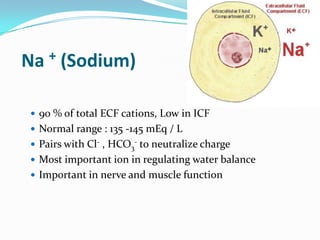
Na + (Sodium)
 90 % of total ECF cations, Low in ICF
 Normal range : 135 -145 mEq / L
 Pairs with Cl- , HCO3
- to neutralize charge
 Most important ion in regulating water balance
 Important in nerve and muscle function
Hyponatremia
 Defined as sodium concentration < 135
mEq/L
 Generally considered with disorder of water
as opposed to disorder of salt
 Results from increased water retention
Types of Hyponatremia
depletional and dilutional
 Depletional Hyponatremia
Na+ loss:
 diuretics, chronic vomiting
 Chronic diarrhea
 Decreased aldosterone
 Decreased Na+ intake
4
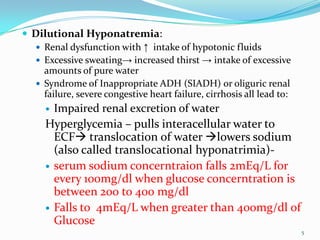
 Dilutional Hyponatremia:
 Renal dysfunction with ↑ intake of hypotonic fluids
 Excessive sweating→ increased thirst → intake of excessive
amounts of pure water
 Syndrome of Inappropriate ADH (SIADH) or oliguric renal
failure, severe congestive heart failure, cirrhosis all lead to:
 Impaired renal excretion of water
Hyperglycemia – pulls interacellular water to
ECF translocation of water lowers sodium
(also called translocational hyponatrimia)-
 serum sodium concerntraion falls 2mEq/L for
every 100mg/dl when glucose concerntration is
between 200 to 400 mg/dl
 Falls to 4mEq/L when greater than 400mg/dl of
Glucose
5
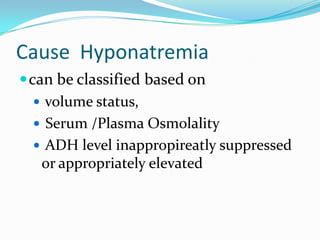
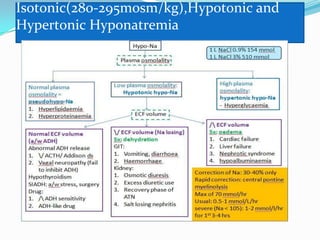
Cause Hyponatremia
can be classified based on
 volume status,
 Serum /Plasma Osmolality
 ADH level inappropireatly suppressed
or appropriately elevated
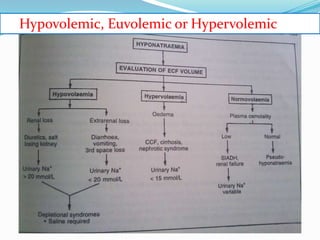
Hypovolemic, Euvolemic or Hypervolemic
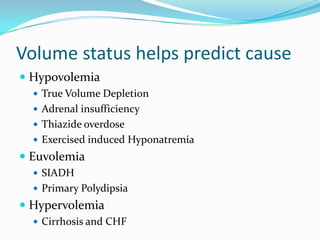
Volume status helps predict cause
 Hypovolemia
 True Volume Depletion
 Adrenal insufficiency
 Thiazide overdose
 Exercised induced Hyponatremia
 Euvolemia
 SIADH
 Primary Polydipsia
 Hypervolemia
 Cirrhosis and CHF
Isotonic(280-295mosm/kg),Hypotonic and
Hypertonic Hyponatremia
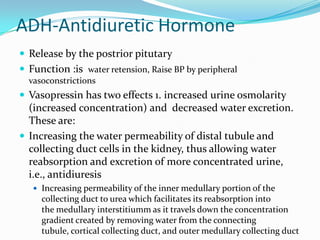
ADH-Antidiuretic Hormone
 Release by the postrior pitutary
 Function :is water retension, Raise BP by peripheral
vasoconstrictions
 Vasopressin has two effects 1. increased urine osmolarity
(increased concentration) and decreased water excretion.
These are:
 Increasing the water permeability of distal tubule and
collecting duct cells in the kidney, thus allowing water
reabsorption and excretion of more concentrated urine,
i.e., antidiuresis
 Increasing permeability of the inner medullary portion of the
collecting duct to urea which facilitates its reabsorption into
the medullary interstitiumm as it travels down the concentration
gradient created by removing water from the connecting
tubule, cortical collecting duct, and outer medullary collecting duct
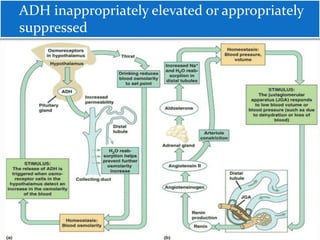
ADH inappropriately elevated or appropriately
suppressed
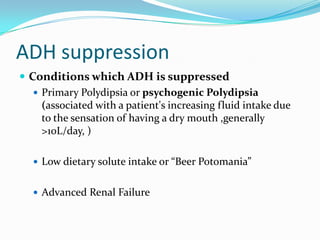
ADH suppression
 Conditions which ADH is suppressed
 Primary Polydipsia or psychogenic Polydipsia
(associated with a patient's increasing fluid intake due
to the sensation of having a dry mouth ,generally
>10L/day, )
 Low dietary solute intake or “Beer Potomania”
 Advanced Renal Failure
ADH elevation
 Conditions which ADH is elevated
 Volume Depletion
 True volume depletion (i.e. bleeding)
 Effective circulating volume depletion (i.e. heart failure and
cirrhosis)
 Exercised induced Hyponatremia
 Thiazide Diuretics
 Adrenal insufficiency
 SIADH
Causes
 Psuedohyponatremia –, Serum Sodium Level
falsely depressed due to Hyper lipidemia or protein
level (multiple myeloma). In this Serum
Osmolality is Normal as protien and lipid doesn’t
alter serum osmolatiyalso called isotonic
hyponatrimia
 High blood sugar (esp. DKA) Hypertonic
hypernatrimia
Symptoms of Hyponatremia
 Neurological symptoms
 Lethargy, headache, confusion, apprehension, depressed
reflexes, seizures and coma
Muscle symptoms
 Cramps, weakness, fatigue
 Gastrointestinal symptoms
 Nausea, vomiting, abdominal cramps, and diarrhea
Workups For Hyponatremia
 3 mandatory lab tests
 Serum Osmolality- solute concerntration
 Urine Osmolality
 Urine Sodium Concentration
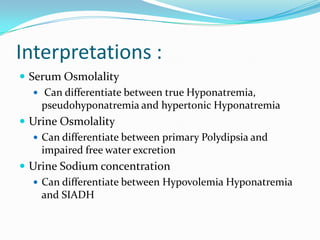
Interpretations :
 Serum Osmolality
 Can differentiate between true Hyponatremia,
pseudohyponatremia and hypertonic Hyponatremia
 Urine Osmolality
 Can differentiate between primary Polydipsia and
impaired free water excretion
 Urine Sodium concentration
 Can differentiate between Hypovolemia Hyponatremia
and SIADH
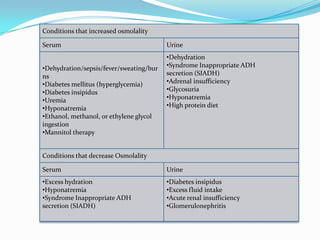
Conditions that increased osmolality3
Serum Urine
•Dehydration/sepsis/fever/sweating/bur
ns
•Diabetes mellitus (hyperglycemia)
•Diabetes insipidus
•Uremia
•Hyponatremia
•Ethanol, methanol, or ethylene glycol
ingestion
•Mannitol therapy
•Dehydration
•Syndrome Inappropriate ADH
secretion (SIADH)
•Adrenal insufficiency
•Glycosuria
•Hyponatremia
•High protein diet
Conditions that decrease Osmolality
Serum Urine
•Excess hydration
•Hyponatremia
•Syndrome Inappropriate ADH
secretion (SIADH)
•Diabetes insipidus
•Excess fluid intake
•Acute renal insufficiency
•Glomerulonephritis
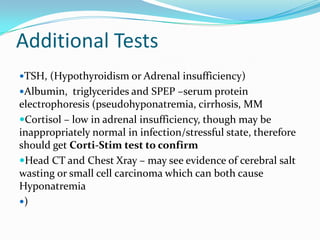
Additional Tests
TSH, (Hypothyroidism or Adrenal insufficiency)
Albumin, triglycerides and SPEP –serum protein
electrophoresis (pseudohyponatremia, cirrhosis, MM
Cortisol – low in adrenal insufficiency, though may be
inappropriately normal in infection/stressful state, therefore
should get Corti-Stim test to confirm
Head CT and Chest Xray – may see evidence of cerebral salt
wasting or small cell carcinoma which can both cause
Hyponatremia
)
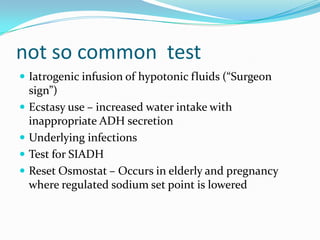
not so common test
 Iatrogenic infusion of hypotonic fluids (“Surgeon
sign”)
 Ecstasy use – increased water intake with
inappropriate ADH secretion
 Underlying infections
 Test for SIADH
 Reset Osmostat – Occurs in elderly and pregnancy
where regulated sodium set point is lowered
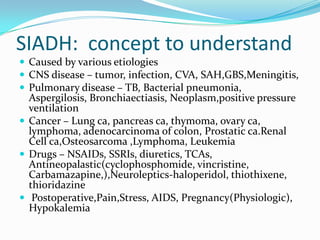
SIADH: concept to understand
 Caused by various etiologies
 CNS disease – tumor, infection, CVA, SAH,GBS,Meningitis,
 Pulmonary disease – TB, Bacterial pneumonia,
Aspergilosis, Bronchiaectiasis, Neoplasm,positive pressure
ventilation
 Cancer – Lung ca, pancreas ca, thymoma, ovary ca,
lymphoma, adenocarcinoma of colon, Prostatic ca.Renal
Cell ca,Osteosarcoma ,Lymphoma, Leukemia
 Drugs – NSAIDs, SSRIs, diuretics, TCAs,
Antineopalastic(cyclophosphomide, vincristine,
Carbamazapine,),Neuroleptics-haloperidol, thiothixene,
thioridazine
 Postoperative,Pain,Stress, AIDS, Pregnancy(Physiologic),
Hypokalemia
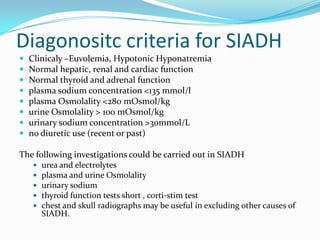
Diagonositc criteria for SIADH
 Clinicaly –Euvolemia, Hypotonic Hyponatremia
 Normal hepatic, renal and cardiac function
 Normal thyroid and adrenal function
 plasma sodium concentration <135 mmol/l
 plasma Osmolality <280 mOsmol/kg
 urine Osmolality > 100 mOsmol/kg
 urinary sodium concentration >30mmol/L
 no diuretic use (recent or past)
The following investigations could be carried out in SIADH
 urea and electrolytes
 plasma and urine Osmolality
 urinary sodium
 thyroid function tests short , corti-stim test
 chest and skull radiographs may be useful in excluding other causes of
SIADH.
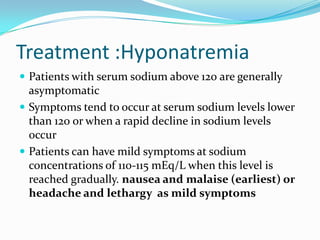
Treatment :Hyponatremia
 Patients with serum sodium above 120 are generally
asymptomatic
 Symptoms tend to occur at serum sodium levels lower
than 120 or when a rapid decline in sodium levels
occur
 Patients can have mild symptoms at sodium
concentrations of 110-115 mEq/L when this level is
reached gradually. nausea and malaise (earliest) or
headache and lethargy as mild symptoms
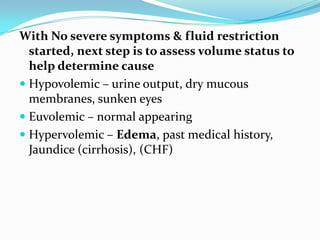
With No severe symptoms & fluid restriction
started, next step is to assess volume status to
help determine cause
 Hypovolemic – urine output, dry mucous
membranes, sunken eyes
 Euvolemic – normal appearing
 Hypervolemic – Edema, past medical history,
Jaundice (cirrhosis), (CHF)
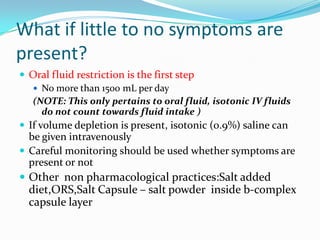
What if little to no symptoms are
present?
 Oral fluid restriction is the first step
 No more than 1500 mL per day
(NOTE: This only pertains to oral fluid, isotonic IV fluids
do not count towards fluid intake )
 If volume depletion is present, isotonic (0.9%) saline can
be given intravenously
 Careful monitoring should be used whether symptoms are
present or not
 Other non pharmacological practices:Salt added
diet,ORS,Salt Capsule – salt powder inside b-complex
capsule layer
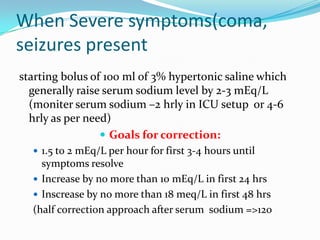
When Severe symptoms(coma,
seizures present
starting bolus of 100 ml of 3% hypertonic saline which
generally raise serum sodium level by 2-3 mEq/L
(moniter serum sodium –2 hrly in ICU setup or 4-6
hrly as per need)
 Goals for correction:
 1.5 to 2 mEq/L per hour for first 3-4 hours until
symptoms resolve
 Increase by no more than 10 mEq/L in first 24 hrs
 Inscrease by no more than 18 meq/L in first 48 hrs
(half correction approach after serum sodium =>120
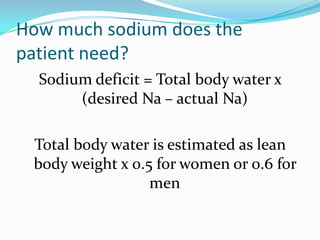
How much sodium does the
patient need?
Sodium deficit = Total body water x
(desired Na – actual Na)
Total body water is estimated as lean
body weight x 0.5 for women or 0.6 for
men
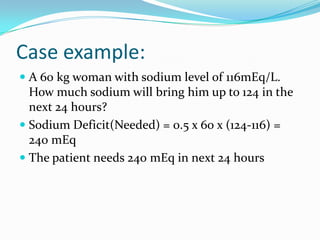
Case example:
 A 60 kg woman with sodium level of 116mEq/L.
How much sodium will bring him up to 124 in the
next 24 hours?
 Sodium Deficit(Needed) = 0.5 x 60 x (124-116) =
240 mEq
 The patient needs 240 mEq in next 24 hours
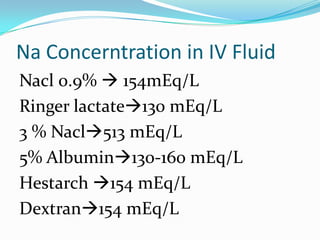
Na Concerntration in IV Fluid
Nacl 0.9%  154mEq/L
Ringer lactate130 mEq/L
3 % Nacl513 mEq/L
5% Albumin130-160 mEq/L
Hestarch 154 mEq/L
Dextran154 mEq/L
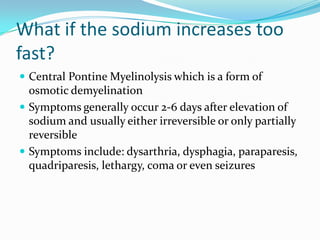
What if the sodium increases too
fast?
 Central Pontine Myelinolysis which is a form of
osmotic demyelination
 Symptoms generally occur 2-6 days after elevation of
sodium and usually either irreversible or only partially
reversible
 Symptoms include: dysarthria, dysphagia, paraparesis,
quadriparesis, lethargy, coma or even seizures
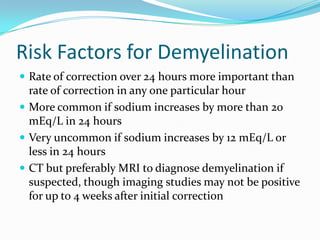
Risk Factors for Demyelination
 Rate of correction over 24 hours more important than
rate of correction in any one particular hour
 More common if sodium increases by more than 20
mEq/L in 24 hours
 Very uncommon if sodium increases by 12 mEq/L or
less in 24 hours
 CT but preferably MRI to diagnose demyelination if
suspected, though imaging studies may not be positive
for up to 4 weeks after initial correction
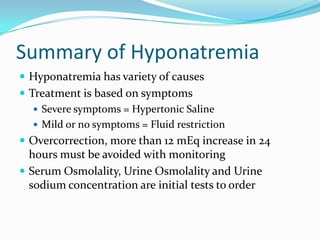
Summary of Hyponatremia
 Hyponatremia has variety of causes
 Treatment is based on symptoms
 Severe symptoms = Hypertonic Saline
 Mild or no symptoms = Fluid restriction
 Overcorrection, more than 12 mEq increase in 24
hours must be avoided with monitoring
 Serum Osmolality, Urine Osmolality and Urine
sodium concentration are initial tests to order
Hypernatremia
Serum Na >145 mEq/L [deficit of (TBW)
relative to Na]
 Incidence >1% in hospitalized patients.
 Can have normal,hypo and hyperosmolality
 Generally hypovolumic due to free water
loss , also hypervolumic is seen as itragenic
treatment with free accesses of water in
hospitals
Causes
 Insensible and sweat losses
 GI losses
 Diabetes Insipidus (both central and nephrogenic)
 Osmotic Diuresis – DKA
 Hypothalamic lesions which affect thirst function
– Causes include tumors, granulomatous diseases
or vascular disease
 Sodium Overload – Infusion of Hypertonic sodium
bicarbonate for metabolic acidosis
Symptoms of Hypernatremia
 Initial symptoms include lethargy, weakness and
irritability Can progress to twitching, seizures,or
coma
 Resulting decrease in brain volume can lead to rupture
of cerebral veins leading to hemorrhage
 Severe symptoms usually occur with rapid increase to
sodium concentration of 158 mEq or more..
(hyperthermia, delirium , sizure and coma)
 Sodium concentration greater than 180 mEq are
associated with high mortality
Lab findings
 Urine Osmolaity >400 mosm/kg
 Renal losssevere hyperglacemiatranslocatinal hyponatrimia
progressive volume depletion from glucosuria lead to
Hypernatrimia
 Non Rneal LossFluid Loss from excessive sweating, respirator
tract or bowel movements. Lactulose cause osmotic diarrohea with
loss of free water
Urine Osmolaity <250 msom/kg
 Hypernatrimia with dilue urine is charactersitc of DI.
 Central DI results from Inadequate ADH release
 Nephrogenic DI results from renal insensitivity to ADH
 If urine Osmolality is lower than serum Osmolality
then DI is present
 Administration of DDAVP(desmopressin) will
differentiate
 Urine Osmolality will increase in central DI, no response in
nephrogenic DI
DDAVGreatly enhanced ADH activity. Less vasopressor
activity. Longer DOA. (Synthetic analog of vasopressin-
posterior pituitary hormone).
Treatment of Hypernatremia
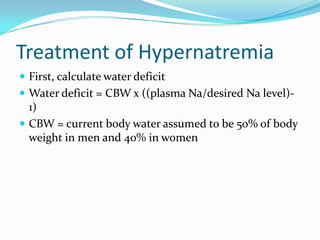
 First, calculate water deficit
 Water deficit = CBW x ((plasma Na/desired Na level)-
1)
 CBW = current body water assumed to be 50% of body
weight in men and 40% in women
•60 kg woman with 168 mEq/L
•How much water will it take to
reduce her sodium to 140 mEq/L
sample calculation:
Water deficit =
0.4 x 60 ([168/140]-1) = 4.8 L
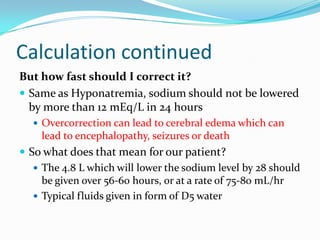
Calculation continued
But how fast should I correct it?
 Same as Hyponatremia, sodium should not be lowered
by more than 12 mEq/L in 24 hours
 Overcorrection can lead to cerebral edema which can
lead to encephalopathy, seizures or death
 So what does that mean for our patient?
 The 4.8 L which will lower the sodium level by 28 should
be given over 56-60 hours, or at a rate of 75-80 mL/hr
 Typical fluids given in form of D5 water
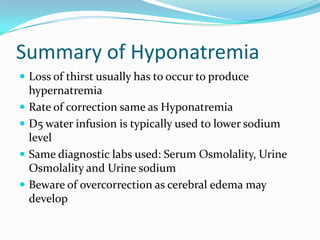
Summary of Hyponatremia
 Loss of thirst usually has to occur to produce
hypernatremia
 Rate of correction same as Hyponatremia
 D5 water infusion is typically used to lower sodium
level
 Same diagnostic labs used: Serum Osmolality, Urine
Osmolality and Urine sodium
 Beware of overcorrection as cerebral edema may
develop
Thank you .

Hypo &hpernatrimia

  • 1.
    Dr. Saroj K.Suwal MO, Oncosurgery Department, Bhaktapur Cancer Hospital
  • 2.
    Na + (Sodium) 90 % of total ECF cations, Low in ICF  Normal range : 135 -145 mEq / L  Pairs with Cl- , HCO3 - to neutralize charge  Most important ion in regulating water balance  Important in nerve and muscle function
  • 3.
    Hyponatremia  Defined assodium concentration < 135 mEq/L  Generally considered with disorder of water as opposed to disorder of salt  Results from increased water retention
  • 4.
    Types of Hyponatremia depletionaland dilutional  Depletional Hyponatremia Na+ loss:  diuretics, chronic vomiting  Chronic diarrhea  Decreased aldosterone  Decreased Na+ intake 4
  • 5.
     Dilutional Hyponatremia: Renal dysfunction with ↑ intake of hypotonic fluids  Excessive sweating→ increased thirst → intake of excessive amounts of pure water  Syndrome of Inappropriate ADH (SIADH) or oliguric renal failure, severe congestive heart failure, cirrhosis all lead to:  Impaired renal excretion of water Hyperglycemia – pulls interacellular water to ECF translocation of water lowers sodium (also called translocational hyponatrimia)-  serum sodium concerntraion falls 2mEq/L for every 100mg/dl when glucose concerntration is between 200 to 400 mg/dl  Falls to 4mEq/L when greater than 400mg/dl of Glucose 5
  • 6.
    Cause Hyponatremia can beclassified based on  volume status,  Serum /Plasma Osmolality  ADH level inappropireatly suppressed or appropriately elevated
  • 7.
  • 8.
    Volume status helpspredict cause  Hypovolemia  True Volume Depletion  Adrenal insufficiency  Thiazide overdose  Exercised induced Hyponatremia  Euvolemia  SIADH  Primary Polydipsia  Hypervolemia  Cirrhosis and CHF
  • 9.
  • 10.
    ADH-Antidiuretic Hormone  Releaseby the postrior pitutary  Function :is water retension, Raise BP by peripheral vasoconstrictions  Vasopressin has two effects 1. increased urine osmolarity (increased concentration) and decreased water excretion. These are:  Increasing the water permeability of distal tubule and collecting duct cells in the kidney, thus allowing water reabsorption and excretion of more concentrated urine, i.e., antidiuresis  Increasing permeability of the inner medullary portion of the collecting duct to urea which facilitates its reabsorption into the medullary interstitiumm as it travels down the concentration gradient created by removing water from the connecting tubule, cortical collecting duct, and outer medullary collecting duct
  • 11.
    ADH inappropriately elevatedor appropriately suppressed
  • 12.
    ADH suppression  Conditionswhich ADH is suppressed  Primary Polydipsia or psychogenic Polydipsia (associated with a patient's increasing fluid intake due to the sensation of having a dry mouth ,generally >10L/day, )  Low dietary solute intake or “Beer Potomania”  Advanced Renal Failure
  • 13.
    ADH elevation  Conditionswhich ADH is elevated  Volume Depletion  True volume depletion (i.e. bleeding)  Effective circulating volume depletion (i.e. heart failure and cirrhosis)  Exercised induced Hyponatremia  Thiazide Diuretics  Adrenal insufficiency  SIADH
  • 14.
    Causes  Psuedohyponatremia –,Serum Sodium Level falsely depressed due to Hyper lipidemia or protein level (multiple myeloma). In this Serum Osmolality is Normal as protien and lipid doesn’t alter serum osmolatiyalso called isotonic hyponatrimia  High blood sugar (esp. DKA) Hypertonic hypernatrimia
  • 15.
    Symptoms of Hyponatremia Neurological symptoms  Lethargy, headache, confusion, apprehension, depressed reflexes, seizures and coma Muscle symptoms  Cramps, weakness, fatigue  Gastrointestinal symptoms  Nausea, vomiting, abdominal cramps, and diarrhea
  • 16.
    Workups For Hyponatremia 3 mandatory lab tests  Serum Osmolality- solute concerntration  Urine Osmolality  Urine Sodium Concentration
  • 17.
    Interpretations :  SerumOsmolality  Can differentiate between true Hyponatremia, pseudohyponatremia and hypertonic Hyponatremia  Urine Osmolality  Can differentiate between primary Polydipsia and impaired free water excretion  Urine Sodium concentration  Can differentiate between Hypovolemia Hyponatremia and SIADH
  • 18.
    Conditions that increasedosmolality3 Serum Urine •Dehydration/sepsis/fever/sweating/bur ns •Diabetes mellitus (hyperglycemia) •Diabetes insipidus •Uremia •Hyponatremia •Ethanol, methanol, or ethylene glycol ingestion •Mannitol therapy •Dehydration •Syndrome Inappropriate ADH secretion (SIADH) •Adrenal insufficiency •Glycosuria •Hyponatremia •High protein diet Conditions that decrease Osmolality Serum Urine •Excess hydration •Hyponatremia •Syndrome Inappropriate ADH secretion (SIADH) •Diabetes insipidus •Excess fluid intake •Acute renal insufficiency •Glomerulonephritis
  • 19.
    Additional Tests TSH, (Hypothyroidismor Adrenal insufficiency) Albumin, triglycerides and SPEP –serum protein electrophoresis (pseudohyponatremia, cirrhosis, MM Cortisol – low in adrenal insufficiency, though may be inappropriately normal in infection/stressful state, therefore should get Corti-Stim test to confirm Head CT and Chest Xray – may see evidence of cerebral salt wasting or small cell carcinoma which can both cause Hyponatremia )
  • 20.
    not so commontest  Iatrogenic infusion of hypotonic fluids (“Surgeon sign”)  Ecstasy use – increased water intake with inappropriate ADH secretion  Underlying infections  Test for SIADH  Reset Osmostat – Occurs in elderly and pregnancy where regulated sodium set point is lowered
  • 21.
    SIADH: concept tounderstand  Caused by various etiologies  CNS disease – tumor, infection, CVA, SAH,GBS,Meningitis,  Pulmonary disease – TB, Bacterial pneumonia, Aspergilosis, Bronchiaectiasis, Neoplasm,positive pressure ventilation  Cancer – Lung ca, pancreas ca, thymoma, ovary ca, lymphoma, adenocarcinoma of colon, Prostatic ca.Renal Cell ca,Osteosarcoma ,Lymphoma, Leukemia  Drugs – NSAIDs, SSRIs, diuretics, TCAs, Antineopalastic(cyclophosphomide, vincristine, Carbamazapine,),Neuroleptics-haloperidol, thiothixene, thioridazine  Postoperative,Pain,Stress, AIDS, Pregnancy(Physiologic), Hypokalemia
  • 22.
    Diagonositc criteria forSIADH  Clinicaly –Euvolemia, Hypotonic Hyponatremia  Normal hepatic, renal and cardiac function  Normal thyroid and adrenal function  plasma sodium concentration <135 mmol/l  plasma Osmolality <280 mOsmol/kg  urine Osmolality > 100 mOsmol/kg  urinary sodium concentration >30mmol/L  no diuretic use (recent or past) The following investigations could be carried out in SIADH  urea and electrolytes  plasma and urine Osmolality  urinary sodium  thyroid function tests short , corti-stim test  chest and skull radiographs may be useful in excluding other causes of SIADH.
  • 23.
    Treatment :Hyponatremia  Patientswith serum sodium above 120 are generally asymptomatic  Symptoms tend to occur at serum sodium levels lower than 120 or when a rapid decline in sodium levels occur  Patients can have mild symptoms at sodium concentrations of 110-115 mEq/L when this level is reached gradually. nausea and malaise (earliest) or headache and lethargy as mild symptoms
  • 24.
    With No severesymptoms & fluid restriction started, next step is to assess volume status to help determine cause  Hypovolemic – urine output, dry mucous membranes, sunken eyes  Euvolemic – normal appearing  Hypervolemic – Edema, past medical history, Jaundice (cirrhosis), (CHF)
  • 25.
    What if littleto no symptoms are present?  Oral fluid restriction is the first step  No more than 1500 mL per day (NOTE: This only pertains to oral fluid, isotonic IV fluids do not count towards fluid intake )  If volume depletion is present, isotonic (0.9%) saline can be given intravenously  Careful monitoring should be used whether symptoms are present or not  Other non pharmacological practices:Salt added diet,ORS,Salt Capsule – salt powder inside b-complex capsule layer
  • 26.
    When Severe symptoms(coma, seizurespresent starting bolus of 100 ml of 3% hypertonic saline which generally raise serum sodium level by 2-3 mEq/L (moniter serum sodium –2 hrly in ICU setup or 4-6 hrly as per need)  Goals for correction:  1.5 to 2 mEq/L per hour for first 3-4 hours until symptoms resolve  Increase by no more than 10 mEq/L in first 24 hrs  Inscrease by no more than 18 meq/L in first 48 hrs (half correction approach after serum sodium =>120
  • 27.
    How much sodiumdoes the patient need? Sodium deficit = Total body water x (desired Na – actual Na) Total body water is estimated as lean body weight x 0.5 for women or 0.6 for men
  • 28.
    Case example:  A60 kg woman with sodium level of 116mEq/L. How much sodium will bring him up to 124 in the next 24 hours?  Sodium Deficit(Needed) = 0.5 x 60 x (124-116) = 240 mEq  The patient needs 240 mEq in next 24 hours
  • 29.
    Na Concerntration inIV Fluid Nacl 0.9%  154mEq/L Ringer lactate130 mEq/L 3 % Nacl513 mEq/L 5% Albumin130-160 mEq/L Hestarch 154 mEq/L Dextran154 mEq/L
  • 30.
    What if thesodium increases too fast?  Central Pontine Myelinolysis which is a form of osmotic demyelination  Symptoms generally occur 2-6 days after elevation of sodium and usually either irreversible or only partially reversible  Symptoms include: dysarthria, dysphagia, paraparesis, quadriparesis, lethargy, coma or even seizures
  • 31.
    Risk Factors forDemyelination  Rate of correction over 24 hours more important than rate of correction in any one particular hour  More common if sodium increases by more than 20 mEq/L in 24 hours  Very uncommon if sodium increases by 12 mEq/L or less in 24 hours  CT but preferably MRI to diagnose demyelination if suspected, though imaging studies may not be positive for up to 4 weeks after initial correction
  • 32.
    Summary of Hyponatremia Hyponatremia has variety of causes  Treatment is based on symptoms  Severe symptoms = Hypertonic Saline  Mild or no symptoms = Fluid restriction  Overcorrection, more than 12 mEq increase in 24 hours must be avoided with monitoring  Serum Osmolality, Urine Osmolality and Urine sodium concentration are initial tests to order
  • 33.
    Hypernatremia Serum Na >145mEq/L [deficit of (TBW) relative to Na]  Incidence >1% in hospitalized patients.  Can have normal,hypo and hyperosmolality  Generally hypovolumic due to free water loss , also hypervolumic is seen as itragenic treatment with free accesses of water in hospitals
  • 34.
    Causes  Insensible andsweat losses  GI losses  Diabetes Insipidus (both central and nephrogenic)  Osmotic Diuresis – DKA  Hypothalamic lesions which affect thirst function – Causes include tumors, granulomatous diseases or vascular disease  Sodium Overload – Infusion of Hypertonic sodium bicarbonate for metabolic acidosis
  • 35.
    Symptoms of Hypernatremia Initial symptoms include lethargy, weakness and irritability Can progress to twitching, seizures,or coma  Resulting decrease in brain volume can lead to rupture of cerebral veins leading to hemorrhage  Severe symptoms usually occur with rapid increase to sodium concentration of 158 mEq or more.. (hyperthermia, delirium , sizure and coma)  Sodium concentration greater than 180 mEq are associated with high mortality
  • 36.
    Lab findings  UrineOsmolaity >400 mosm/kg  Renal losssevere hyperglacemiatranslocatinal hyponatrimia progressive volume depletion from glucosuria lead to Hypernatrimia  Non Rneal LossFluid Loss from excessive sweating, respirator tract or bowel movements. Lactulose cause osmotic diarrohea with loss of free water Urine Osmolaity <250 msom/kg  Hypernatrimia with dilue urine is charactersitc of DI.  Central DI results from Inadequate ADH release  Nephrogenic DI results from renal insensitivity to ADH
  • 37.
     If urineOsmolality is lower than serum Osmolality then DI is present  Administration of DDAVP(desmopressin) will differentiate  Urine Osmolality will increase in central DI, no response in nephrogenic DI DDAVGreatly enhanced ADH activity. Less vasopressor activity. Longer DOA. (Synthetic analog of vasopressin- posterior pituitary hormone).
  • 38.
    Treatment of Hypernatremia First, calculate water deficit  Water deficit = CBW x ((plasma Na/desired Na level)- 1)  CBW = current body water assumed to be 50% of body weight in men and 40% in women
  • 39.
    •60 kg womanwith 168 mEq/L •How much water will it take to reduce her sodium to 140 mEq/L sample calculation: Water deficit = 0.4 x 60 ([168/140]-1) = 4.8 L
  • 40.
    Calculation continued But howfast should I correct it?  Same as Hyponatremia, sodium should not be lowered by more than 12 mEq/L in 24 hours  Overcorrection can lead to cerebral edema which can lead to encephalopathy, seizures or death  So what does that mean for our patient?  The 4.8 L which will lower the sodium level by 28 should be given over 56-60 hours, or at a rate of 75-80 mL/hr  Typical fluids given in form of D5 water
  • 41.
    Summary of Hyponatremia Loss of thirst usually has to occur to produce hypernatremia  Rate of correction same as Hyponatremia  D5 water infusion is typically used to lower sodium level  Same diagnostic labs used: Serum Osmolality, Urine Osmolality and Urine sodium  Beware of overcorrection as cerebral edema may develop
  • 42.

Editor's Notes

  • #12 ADH-secreted in posterior pitutary, retension of water , vasoconstriction
  • #13 Hyponatremia is due to a large consumption of beer (which has a poor salt content) together with a minimal intake of ordinary food. Three facts contribute to beer potomania:Beer contains a lot of free water with very little salt and protein (one liter of beer contains only 30 mg of sodium).The amount of free water we excrete depends upon number of osmoles that need to be excreted.The kidneys can dilute urine to a maximum of 50 mosm/L
  • #15 ADH pathway……… photo
  • #17 Solute concerntration is measured by osmolaity. Osmole per kg of water is osmolaity. Osmole per liter is osmolaity. Tonicity refers to osmolytes that are impermeable to cell members . Difference in osmolytes concentration across cell membranes lead to osmosis and fluid shifts, stimulation of thirst and secretion of antidiuretic hormone(ADH). Substances than teasiy permaeate cell membranes eg urea ,ethanol are ineffectice osmoles that don’t cause fluid shift across fluid compartments
  • #20 Corti stimulation test -The health care provider will measure the cortical in your blood before and 60 minutes after an ACTH injection.A blood sample is needed. For information on how this is done, see: VenipunctureOnce the blood has been collected, the health care provider will use a needle to inject cosyntropin. Other timed specimens are also collected.Along with the blood tests, sometimes you may also have a urinary free cortical test or urinary 17-ketosteroidstest in which the urine is collected over a 24-hour period.
  • #21 SIADH diagonisitc test – syndrome of inappropriate antidiuretic Hormone Secretion(under normal circumstances Hypovolemia and hyperosmolaity stimulate ADH secretion