Wind Energy Potential
Working principle
Offshore wind Potential
 Presented by
OSHIN CHATTA
16MRE009
M. Tech. (Renewable Energy)
Department of Energy Management
SHRI MATA VAISHNO DEVI UNIVERSITY , KAKRYAL, KATRA , J&K
Introduction to Wind
 Wind – Atmospheric air in motion.
 It has become an energy source.
 Sun produces 4 x 1026 joules of electromagnetic radiation every
second that is radiated into space.
 About 2% of the sunlight that falls on the earth is transformed to
wind energy.
 Wind provides around 1% of the world’s electricity
Growth rate
• The worldwide total cumulative installed electricity generation
capacity from wind power amounted to 432,883 MW.
• An increase of 17% compared to the previous year. Global wind
power installations increased by 63,330 MW, 51,447 MW and 35,467 MW in
2015, 2014 and 2013 respectively.
Process of Wind Creation
 Wind is caused by differences in the atmospheric pressure. When a difference
in atmospheric pressure exists, air moves from the higher to the lower pressure
area, resulting in winds of various speeds.
 The two major driving factors of wind patterns are the differential heating
between the equator and the poles (difference in absorption of solar energy )
and the rotation of the planet.
 Each second, the sun releases an enormous amount of radiant energy into the
solar system.
 Some of it reaches the earth:
 strikes the equator directly (giving it the most radiation)
 diffuses along the Northern and Southern Hemisphere
 the poles receive the lowest amount of radiation
Cont…
 The radiation from the sun heats the Earth's surface.
 Heating process creates temperature differences between the Land, Water, Air
due to their different physical properties i.e.
o Density
 Hot air rises, it expands, becomes less dense, and is then replaced by denser,
cooler air.
 Heated air rises from equator.
 Moves north and south in the upper levels of the atmosphere and circulates
above cooler air.
 Wind is formed due to the phenomena called Coriolis Effect “ the tendency for
any moving body on or above the earth's surface to drift sideways from its
course because of the earth's rotation”.
Wind formation
Coriolis Effect
Wind Turbines
• Rotating machines that can be used to generate electricity from the kinetic
power of the wind.
• Alike aircraft propeller, turn in moving air, power the electric generator, supply
electric current.
• For fan
• For turbines
• Wind rotates the turbine blades
o spins a shaft connected to a generator
o The spinning of the shaft in the generator makes electricity
• Efficiency depends on number of blades in windmill.
Efficiency as Blades .
Electricity Wind
Wind Electricity
↑ ↑
Blades
One
• Rotor must move more rapidly
.
• Gearbox ratio reduced.
• Higher speed means more
noise and other impacts.
• Captures 10% less energy than
2 blades design.
• Ultimately provide no cost
savings.
Two
• Rotor must move more
rapidly.
• Higher speed means more
noise and other impacts.
• Needs shock absorber
because of gyroscopic
imbalances.
• Captures 5% less energy
than three blades design.
• Balances of gyroscopic
forces.
• Slower rotation
• Increases gearbox and
transmission cost
• More aesthetic, less
noise , fewer bird strikes.
Three
Turbines: Sizes & Application
Small Turbines (<1kW)
- Homes(grid-connected)
-Farms
-Remote applications
Intermediate wind turbines(10-
500kW)
-Village power
-Hybrid systems
-Distributed power
-
Large wind turbines (500kW -5MW)
-Central station wind farms
-Distributed power
-Off-shore wind
Types of Wind Turbines
Vertical axis Horizontal axis
Vertical axis
• Rotating axis of the wind turbine is vertical
or perpendicular to the ground
• Primarily used in small wind projects and
residential applications
• Powered by wind coming from all 360
degrees, no yaw mechanism
• Ideal for installations where wind conditions
are not consistent, or due to public
ordinances the turbine cannot be placed high
enough to benefit from steady wind
Horizontal axis
• Rotating axis of the wind turbine is
horizontal or parallel to the ground
• Primarily used in big wind application
• Able to produce more electricity
from a given amount of wind
• Disadvantage of horizontal axis however
is that it is generally heavier and it does
not produce well in turbulent winds
• Yaw mechanism
Comparison
Working Principle
Principle:
The energy in the wind turns two or threee blades around a rotor. The
rotor is connected to the main shaft, which spins a generator to create
electricity. Wind turbines convert the kinetic energy in the wind into
mechanical power.
Parts of Wind Turbine system:
i. Blades
ii. Rotor
iii. Pitch system
iv. Low speed shaft
v. Brake
vi. Gear box
vii. High speed shaft
viii.Generator
ix. Controller
x. Anemometer
xi. Wind vane
xii. Yaw drive
BLADES
ROTOR
TURBINE
Cont…
 Anemometer: Measures the wind speed and transmits wind speed data to the controller.
 Blades: Lifts and rotates when wind is blown over them, causing the rotor to spin.
 Brake: Stops the rotor mechanically, electrically, or hydraulically, in emergencies.
 Controller: Starts up the machine at wind speeds of about 8 to 16 miles per hour (mph) and
shuts off the machine at about 55 mph.
 Gear box: Connects the low-speed shaft to the high-speed shaft and increases the rotational
speeds from about 30-60 rotations per minute (rpm), to about 1,000-1,800 rpm;
this is the rotational speed required by most generators to produce electricity.
 Generator: Produces 60-cycle AC electricity; it is usually an off-the-shelf induction generator.
 High-speed shaft: Drives the generator.
 Low-speed shaft: Turns the low-speed shaft at about 30-60 rpm.
 Nacelle: Sits atop the tower and contains the gear box, low- and high-speed shafts, generator,
controller, and brake.
Cont….
• Pitch: Turns blades out of the wind to control the rotor speed, and to keep the rotor from turning
• in winds that are too high or too low to produce electricity.
• Rotor: Blades and hub together form the rotor.
• Tower: Made from tubular steel (shown here), concrete, or steel lattice. Supports the structure of
• the turbine.
• Wind direction: Determines the design of the turbine. Upwind turbines—like the one shown
• here-face into the wind while downwind turbines face away.
• Wind vane: Measures wind direction and communicates with the yaw drive to orient the turbine
properly with respect to the wind.
• Yaw drive: Orients upwind turbines to keep them facing the wind when the direction changes.
Downwind turbines don't require a yaw drive because the wind manually blows the
rotor away from it.
• Yaw motor: Powers the yaw drive.
Working of Wind Turbine
 Wind blows toward the turbine's rotor blades.
 The rotors spin around, capturing some of the kinetic energy from the wind,
and turning the central drive shaft that supports them.
 In most large modern turbines, the rotor blades can swivel on the hub at the
front so they meet the wind at the best angle (or "pitch") for harvesting
energy. This is called the pitch control mechanism.
 Inside the nacelle, the gearbox converts the low-speed rotation of the drive
shaft into high-speed rotation fast enough to drive the generator efficiently.
 The entire top part of the turbine (the rotors and nacelle) can be rotated by a
yaw motor, mounted between the nacelle and the tower, so it faces directly
into the oncoming wind and captures the maximum amount of energy.
Cont…
• If it's too windy or turbulent, brakes are applied to stop the rotors from
turning (for safety reasons).
• The electric current produced by the generator flows through a cable
running down through the inside of the turbine tower.
• A step-up transformer converts the electricity to about 50 times higher
voltage so it can be transmitted efficiently to the power grid (or to nearby
buildings or communities). If the electricity is flowing to the grid, it's
converted to an even higher voltage (130,000 volts or more) by a
substation nearby, which services many turbines.
• Homes enjoy clean, green energy: the turbine has produced no
greenhouse gas emissions or pollution as it operates.
Setup types
 Stand-alone
o not connected to a power grid
o power created is directly channeled into powered site
 Utility power grid
o Stores energy
o connection must be available
 Combined w/ a photovoltaic (solar cell) system
o has solar cells mounted on it.
o Solar cells - thin wafers of silicon which, when exposed to sunlight,
produce electric current.
Harvesting Maximum Energy
• The longer the rotor blades, the more energy they can capture from the wind.
The giant blades (typically 70m or 230 feet in diameter, which is about 30 times
the wingspan of an eagle) multiply the wind's force , so a gentle breeze is often
enough to make the blades turn around.
• Put a turbine's rotor blades high in the air, they capture considerably more wind
energy than they would lower down.
• More hub height from the ground empowers the rotor to practice high velocity of
air
• Typical wind turbines stand idle about 14 percent of the time, and most of the
time they don't generate maximum power. This is not a drawback, however, but
a deliberate feature of their design that allows them to work very efficiently in
ever-changing winds.
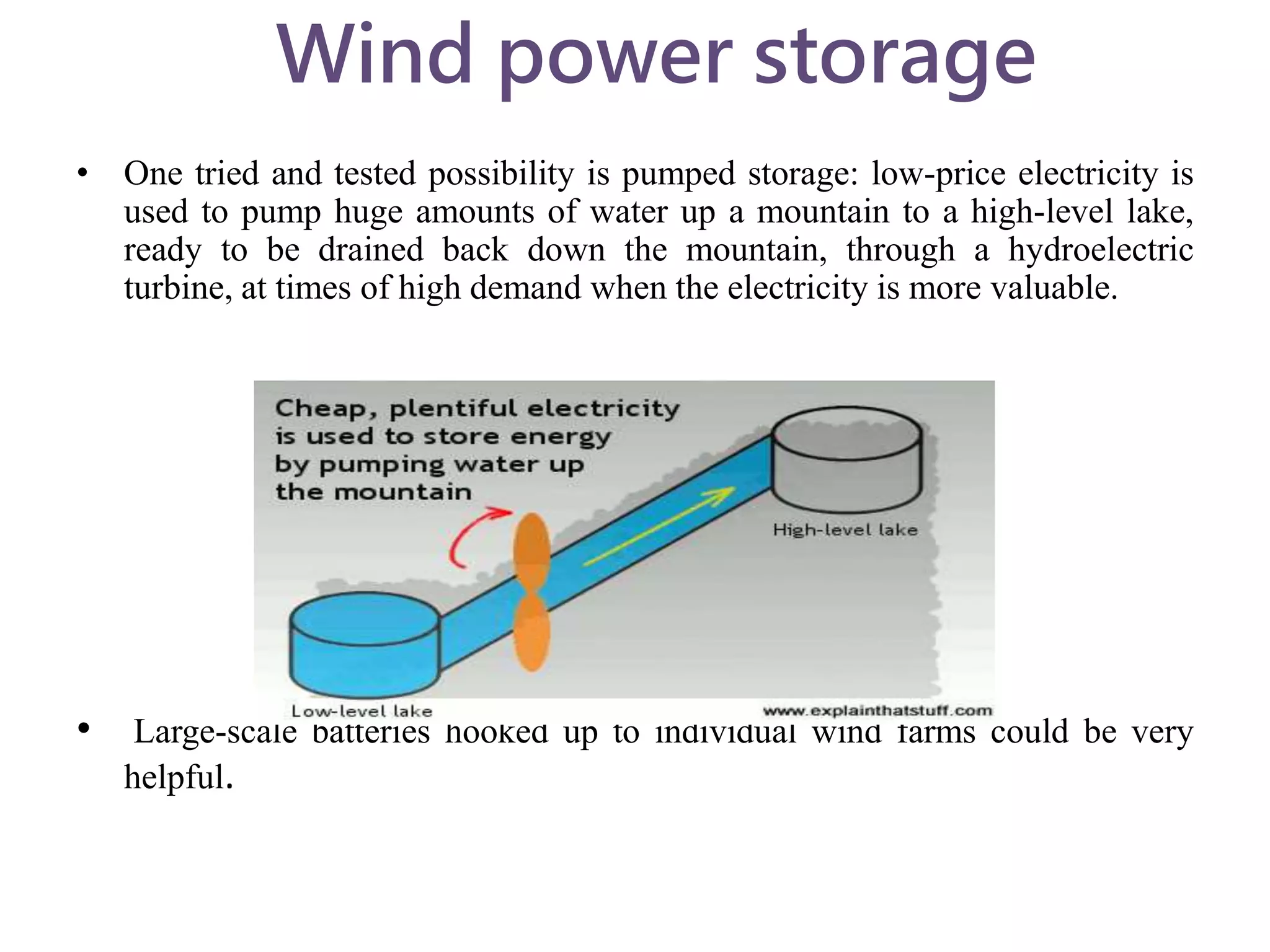
Wind power storage
• One tried and tested possibility is pumped storage: low-price electricity is
used to pump huge amounts of water up a mountain to a high-level lake,
ready to be drained back down the mountain, through a hydroelectric
turbine, at times of high demand when the electricity is more valuable.
• Large-scale batteries hooked up to individual wind farms could be very
helpful.
Advantages
• Very low carbon dioxide emissions (effectively zero once constructed).
• No air or water pollution.
• No environmental impacts from mining or drilling.
• Completely sustainable—unlike fossil fuels, wind will never run out.
• Turbines work almost anywhere in the world where it's reliably windy,
unlike fossil-fuel deposits that are concentrated only in certain regions.
• Unlike fossil-fueled power, wind energy operating costs are predictable years
in advance.
• Freedom from energy prices and political volatility of oil and gas supplies
from other countries.
• New jobs in construction, operation, and manufacture of turbines.
Disadvantages
• High up-front cost .
• Extra cost and complexity of balancing variable wind power with other forms
of power.
• Extra cost of upgrading the power grid and transmission lines, though the
whole system often benefits.
• Damage local wildlife
• Large overall land take—though at least 95 percent of wind farm land can still
be used for farming, and offshore turbines can be built at sea.
• Can't supply 100 percent of a country's power all year round, the way fossil
fuels, nuclear, hydroelectric, and biomass power can.
• Loss of jobs for people working in mining and drilling.
Wind power in India
• The development of wind power in India began in the 1986 with first wind
farms being set up in coastal areas of Maharashtra (Ratnagiri), Gujarat (Okha)
and Tamil Nadu (Tuticorin) with 55 kW Vestas wind turbines.
• These demonstration projects were supported by the Ministry of New and
Renewable Energy (MNRE).
• As of 31 July 2016 the installed capacity of wind power in India was 27,441.15
MW with south, west and north area including the major part.
• The wind power generation capacity in India is 49,130 MW as per the official
estimations in the Indian Wind Atlas (2010) by NIWE.
Cont….
 India at this time is known as the world's fourth largest producer of wind power having
surpassed Spain in 2015 and there are no wind power grid connections in East and North
east regions as of March, 2015 end.
 No offshore wind farm consuming traditional fixed-bottom wind turbine technologies in
shallow sea areas or floating wind turbine technologies in deep sea areas are under
implementation.
 MNRE has made target of producing capacity at 60000 MW till 2022.
 National Institute of Wind Energy (NIWE) has been established in Chennai in the year
1998, as an autonomous R&D institution by the Ministry of New and Renewable Energy
(MNRE), Government of India.
Cont….
 It is a knowledge-based institution of high quality and dedication, offers services and
seeks to find complete solutions for the kinds of difficulties and improvements in the
entire spectrum of the wind energy sector by carrying out further research.
 As measured by NIWE, there are 54 locations near shore wind beside coast.
 Introductory studies by NIWE and Indian National Centre for Ocean Information
Services (INCOIS) Hyderabad endorse potential sideways Tamil Nadu, Gujarat and
Maharashtra coasts.
• Tamil Nadu Renewable Energy Development Academy (TEDA) has developed an
integrated solar and wind energy as an example of grid system
Wind pattern in India
Installed Capacity
INDIAN RENEWABLE ENERGY
SCENARIO
Wind Power
65%
Small Hydro Power
11%
Biomass Power
11%
Solar Energy
13%
Waste to Energy
0%
0nshore
• Onshore wind refers to turbines located on land.
• Power generation capacity is 49,130MW (C-WET).
• At higher hub heights, the potential of 49,130 MW at
50 meter level
• Presumed at 80 meter standard hub height, the expected
wind potential using the same land availability will be
of the order of 1,02,788 MW.
Capacity
State Total Capacity (MW)
Tamil Nadu 7,684.31
Maharashtra 4,664.08
Gujarat 4,227.31
Rajasthan 4,123.35
Karnataka 3,082.45
Madhya Pradesh 2,288.60
Andhra Pradesh 1,866.35
Telangana 98.70
Kerala 43.50
Others 4.30
Total 28,082.95
State wise scenario in India
0
10000
20000
30000
40000
50000
60000
70000
80000
90000
WIND POTENTIAL UTILIZED BY STATE IN %
2016 operational cumulative wind power installed capacity (MW)
At 100m above ground level total wind potential
Wind power potential utlizied percentage
5.4
7.1
17.3
8.4
19.4
6.4
1.1 0.6
3.3
0
5
10
15
20
25
DEMONSTRATION PROJECTS (MW)
State/Union Territories Number of Monitoring
Stations operating
Total Wind Monitoring
Stations Formed
Stations with the Annual
Average WPD > 200 W/m2
at a height of 50 m
Andaman & Nicobar 1 14 2
Arunachal Pradesh - 9 -
Andhra Pradesh 4 67 35
Assam 1 9 -
Bihar 3 3 -
Chhattisgarh 4 7 -
Goa 2 3 -
Gujarat 7 68 41
Haryana 1 8 -
Himachal Pradesh - 10 -
Jammu & Kashmir 2 11 1
Jharkhand 2 4 -
Karnataka
KPCL Stations:
MNES Stations:
-
13
19
55
16
22
Kerala - 27 17
Lakshadweep - 11 6
Madhya Pradesh 7 42 7
Mizoram - 5 -
Manipur 3 8 -
Maharashtra 30 119 32
Meghalaya 2 2 -
Nagaland 4 4 -
Orissa - 11 6
Pondichery - 4 -
Punjab 2 13 -
Rajasthan 1 39 8
Sikkim - 3 -
Tripura 2 5 -
Tamil Nadu 7 74 47
Uttar Pradesh 5 12 -
Uttarakhand - 11 1
West Bengal - 10 1
Total 104 687 234
TARGET: 60 GW by 2022
• Utility Scale On-shore Wind: 58000 MW
• Offshore Wind: 1500 MW
• Distributed Power: 500 MW
Need an additional 37 GW in next 7 years
National Wind Energy
Mission
OFFSHORE
• India’s coastline of 7600 KM and Exclusive Economic Zone of over
2.3 million sq. km provides good potential for offshore wind power
development.
• Off-shore Wind Energy Steering Committee (OWESC) was constituted
in 2012 to suggest policy frame work and inter-agency coordination.
• National Consultation to discuss draft policy and its provisions with
investors, manufacturers, PSUs and related Ministries & Agencies from
Union and State Governments organized by MNRE on 14th August 2013.
• Ministry of New & Renewable Energy (MNRE) has prepared and
issued draft National Offshore Wind Energy Policy.
• National Institute of Wind Energy (NIWE)- single window agency.
• NIWE to coordinate with CERC and SERCs for tariff setting and regulatory
issues.
• EIA study of proposed offshore wind farms regarding aquatic life, fisheries,
avian life, archaeological remains, etc. to be conducted by the developer.
• Oceanographic studies to determine construction costs for special foundations,
special vessels for construction .
• Sea Bed Lease Arrangements.
Main Features
• Fiscal and Financial Incentives
• Tentative sites identified in coastal states – Gujarat and Tamil Nadu for
possible offshore wind power projects.
• A 100 m level wind monitoring station installed and commissioned at
Dhanuskodi in Tamil Nadu by NIWE in September, 2013.
• To explore and promote deployment of wind energy farms in the exclusive
economic zones of the country.
• To promote indigenization in the offshore wind sector
• To create skilled manpower and employment in offshore wind energy sector.
Cont….
CONT…..
Comparison
• Moderate speed wind
turbines
• Damages to human life
• Bad visual impact
• Low erosion
• Low capital cost
• Low maintenance cost
• Convenient accessibility
• High speed wind turbine
• No damages to human
life
• Zero visual impact
• High erosion
• High capital cost
• High maintenance cost
• Inconvenient accessibility
Onshore Offshore
RE Incentives
TAX NON TAX
 Investment Tax Credits
 InvestmentAllowances
 Accelerated Depreciation
 Tax Holidays
 Exemptions/Deductions
 Feed in Tariff
 Capital Grants
 Production Linked
Incentives
 R&D Funding Support
 Rebates on Equipment
 Land Facilitation
 Low Cost Financing
Potential (at 80 m) :
Total Achievement :
1,02,788 MW
23,444 MW
India ranks 5th globally after China, US, Germany and
Spain
Period Target (MW) Achievement(MW)
11th Plan 9,000 10,260
12th Plan 15,000 6,091 (3yrs/5)
2012-13 3,000 1,700
2013-14 2,500 2,079
2014-15 2,000 2,312
Wind Power –
Development
Jaisalmer wind farm, the largest in India, crossed 1,000
MW
Conclusion
 Energy demand across world, including developing countries like India, has led to
depletion of fossil fuel which, although, provides energy in enormous quantity but
effect the environment.
 Hence, to protect the environment from hazards, other sources including wind energy
is used. It has proved to compensate for energy very well.
 The future looks bright for wind energy because technology is becoming more
advanced and windmills are becoming more effective.
 Wind energy is rapidly increasing with the passage of time. Government as well as
world is putting effort to understand its importance and bringing best out of it.
 Government is implementing policies to harness it to recompense the hike in energy
demand.
Wind energy

Wind energy

  • 1.
    Wind Energy Potential Workingprinciple Offshore wind Potential  Presented by OSHIN CHATTA 16MRE009 M. Tech. (Renewable Energy) Department of Energy Management SHRI MATA VAISHNO DEVI UNIVERSITY , KAKRYAL, KATRA , J&K
  • 2.
    Introduction to Wind Wind – Atmospheric air in motion.  It has become an energy source.  Sun produces 4 x 1026 joules of electromagnetic radiation every second that is radiated into space.  About 2% of the sunlight that falls on the earth is transformed to wind energy.  Wind provides around 1% of the world’s electricity
  • 3.
    Growth rate • Theworldwide total cumulative installed electricity generation capacity from wind power amounted to 432,883 MW. • An increase of 17% compared to the previous year. Global wind power installations increased by 63,330 MW, 51,447 MW and 35,467 MW in 2015, 2014 and 2013 respectively.
  • 4.
    Process of WindCreation  Wind is caused by differences in the atmospheric pressure. When a difference in atmospheric pressure exists, air moves from the higher to the lower pressure area, resulting in winds of various speeds.  The two major driving factors of wind patterns are the differential heating between the equator and the poles (difference in absorption of solar energy ) and the rotation of the planet.  Each second, the sun releases an enormous amount of radiant energy into the solar system.  Some of it reaches the earth:  strikes the equator directly (giving it the most radiation)  diffuses along the Northern and Southern Hemisphere  the poles receive the lowest amount of radiation
  • 5.
    Cont…  The radiationfrom the sun heats the Earth's surface.  Heating process creates temperature differences between the Land, Water, Air due to their different physical properties i.e. o Density  Hot air rises, it expands, becomes less dense, and is then replaced by denser, cooler air.  Heated air rises from equator.  Moves north and south in the upper levels of the atmosphere and circulates above cooler air.  Wind is formed due to the phenomena called Coriolis Effect “ the tendency for any moving body on or above the earth's surface to drift sideways from its course because of the earth's rotation”.
  • 6.
  • 7.
  • 8.
    Wind Turbines • Rotatingmachines that can be used to generate electricity from the kinetic power of the wind. • Alike aircraft propeller, turn in moving air, power the electric generator, supply electric current. • For fan • For turbines • Wind rotates the turbine blades o spins a shaft connected to a generator o The spinning of the shaft in the generator makes electricity • Efficiency depends on number of blades in windmill. Efficiency as Blades . Electricity Wind Wind Electricity ↑ ↑
  • 9.
    Blades One • Rotor mustmove more rapidly . • Gearbox ratio reduced. • Higher speed means more noise and other impacts. • Captures 10% less energy than 2 blades design. • Ultimately provide no cost savings. Two • Rotor must move more rapidly. • Higher speed means more noise and other impacts. • Needs shock absorber because of gyroscopic imbalances. • Captures 5% less energy than three blades design. • Balances of gyroscopic forces. • Slower rotation • Increases gearbox and transmission cost • More aesthetic, less noise , fewer bird strikes. Three
  • 10.
    Turbines: Sizes &Application Small Turbines (<1kW) - Homes(grid-connected) -Farms -Remote applications Intermediate wind turbines(10- 500kW) -Village power -Hybrid systems -Distributed power - Large wind turbines (500kW -5MW) -Central station wind farms -Distributed power -Off-shore wind
  • 11.
    Types of WindTurbines Vertical axis Horizontal axis
  • 12.
    Vertical axis • Rotatingaxis of the wind turbine is vertical or perpendicular to the ground • Primarily used in small wind projects and residential applications • Powered by wind coming from all 360 degrees, no yaw mechanism • Ideal for installations where wind conditions are not consistent, or due to public ordinances the turbine cannot be placed high enough to benefit from steady wind Horizontal axis • Rotating axis of the wind turbine is horizontal or parallel to the ground • Primarily used in big wind application • Able to produce more electricity from a given amount of wind • Disadvantage of horizontal axis however is that it is generally heavier and it does not produce well in turbulent winds • Yaw mechanism
  • 13.
  • 14.
    Working Principle Principle: The energyin the wind turns two or threee blades around a rotor. The rotor is connected to the main shaft, which spins a generator to create electricity. Wind turbines convert the kinetic energy in the wind into mechanical power.
  • 15.
    Parts of WindTurbine system: i. Blades ii. Rotor iii. Pitch system iv. Low speed shaft v. Brake vi. Gear box vii. High speed shaft viii.Generator ix. Controller x. Anemometer xi. Wind vane xii. Yaw drive BLADES ROTOR TURBINE
  • 16.
    Cont…  Anemometer: Measuresthe wind speed and transmits wind speed data to the controller.  Blades: Lifts and rotates when wind is blown over them, causing the rotor to spin.  Brake: Stops the rotor mechanically, electrically, or hydraulically, in emergencies.  Controller: Starts up the machine at wind speeds of about 8 to 16 miles per hour (mph) and shuts off the machine at about 55 mph.  Gear box: Connects the low-speed shaft to the high-speed shaft and increases the rotational speeds from about 30-60 rotations per minute (rpm), to about 1,000-1,800 rpm; this is the rotational speed required by most generators to produce electricity.  Generator: Produces 60-cycle AC electricity; it is usually an off-the-shelf induction generator.  High-speed shaft: Drives the generator.  Low-speed shaft: Turns the low-speed shaft at about 30-60 rpm.  Nacelle: Sits atop the tower and contains the gear box, low- and high-speed shafts, generator, controller, and brake.
  • 17.
    Cont…. • Pitch: Turnsblades out of the wind to control the rotor speed, and to keep the rotor from turning • in winds that are too high or too low to produce electricity. • Rotor: Blades and hub together form the rotor. • Tower: Made from tubular steel (shown here), concrete, or steel lattice. Supports the structure of • the turbine. • Wind direction: Determines the design of the turbine. Upwind turbines—like the one shown • here-face into the wind while downwind turbines face away. • Wind vane: Measures wind direction and communicates with the yaw drive to orient the turbine properly with respect to the wind. • Yaw drive: Orients upwind turbines to keep them facing the wind when the direction changes. Downwind turbines don't require a yaw drive because the wind manually blows the rotor away from it. • Yaw motor: Powers the yaw drive.
  • 18.
    Working of WindTurbine  Wind blows toward the turbine's rotor blades.  The rotors spin around, capturing some of the kinetic energy from the wind, and turning the central drive shaft that supports them.  In most large modern turbines, the rotor blades can swivel on the hub at the front so they meet the wind at the best angle (or "pitch") for harvesting energy. This is called the pitch control mechanism.  Inside the nacelle, the gearbox converts the low-speed rotation of the drive shaft into high-speed rotation fast enough to drive the generator efficiently.  The entire top part of the turbine (the rotors and nacelle) can be rotated by a yaw motor, mounted between the nacelle and the tower, so it faces directly into the oncoming wind and captures the maximum amount of energy.
  • 19.
    Cont… • If it'stoo windy or turbulent, brakes are applied to stop the rotors from turning (for safety reasons). • The electric current produced by the generator flows through a cable running down through the inside of the turbine tower. • A step-up transformer converts the electricity to about 50 times higher voltage so it can be transmitted efficiently to the power grid (or to nearby buildings or communities). If the electricity is flowing to the grid, it's converted to an even higher voltage (130,000 volts or more) by a substation nearby, which services many turbines. • Homes enjoy clean, green energy: the turbine has produced no greenhouse gas emissions or pollution as it operates.
  • 20.
    Setup types  Stand-alone onot connected to a power grid o power created is directly channeled into powered site  Utility power grid o Stores energy o connection must be available  Combined w/ a photovoltaic (solar cell) system o has solar cells mounted on it. o Solar cells - thin wafers of silicon which, when exposed to sunlight, produce electric current.
  • 21.
    Harvesting Maximum Energy •The longer the rotor blades, the more energy they can capture from the wind. The giant blades (typically 70m or 230 feet in diameter, which is about 30 times the wingspan of an eagle) multiply the wind's force , so a gentle breeze is often enough to make the blades turn around. • Put a turbine's rotor blades high in the air, they capture considerably more wind energy than they would lower down. • More hub height from the ground empowers the rotor to practice high velocity of air • Typical wind turbines stand idle about 14 percent of the time, and most of the time they don't generate maximum power. This is not a drawback, however, but a deliberate feature of their design that allows them to work very efficiently in ever-changing winds.
  • 23.
    Wind power storage •One tried and tested possibility is pumped storage: low-price electricity is used to pump huge amounts of water up a mountain to a high-level lake, ready to be drained back down the mountain, through a hydroelectric turbine, at times of high demand when the electricity is more valuable. • Large-scale batteries hooked up to individual wind farms could be very helpful.
  • 24.
    Advantages • Very lowcarbon dioxide emissions (effectively zero once constructed). • No air or water pollution. • No environmental impacts from mining or drilling. • Completely sustainable—unlike fossil fuels, wind will never run out. • Turbines work almost anywhere in the world where it's reliably windy, unlike fossil-fuel deposits that are concentrated only in certain regions. • Unlike fossil-fueled power, wind energy operating costs are predictable years in advance. • Freedom from energy prices and political volatility of oil and gas supplies from other countries. • New jobs in construction, operation, and manufacture of turbines.
  • 25.
    Disadvantages • High up-frontcost . • Extra cost and complexity of balancing variable wind power with other forms of power. • Extra cost of upgrading the power grid and transmission lines, though the whole system often benefits. • Damage local wildlife • Large overall land take—though at least 95 percent of wind farm land can still be used for farming, and offshore turbines can be built at sea. • Can't supply 100 percent of a country's power all year round, the way fossil fuels, nuclear, hydroelectric, and biomass power can. • Loss of jobs for people working in mining and drilling.
  • 26.
    Wind power inIndia • The development of wind power in India began in the 1986 with first wind farms being set up in coastal areas of Maharashtra (Ratnagiri), Gujarat (Okha) and Tamil Nadu (Tuticorin) with 55 kW Vestas wind turbines. • These demonstration projects were supported by the Ministry of New and Renewable Energy (MNRE). • As of 31 July 2016 the installed capacity of wind power in India was 27,441.15 MW with south, west and north area including the major part. • The wind power generation capacity in India is 49,130 MW as per the official estimations in the Indian Wind Atlas (2010) by NIWE.
  • 27.
    Cont….  India atthis time is known as the world's fourth largest producer of wind power having surpassed Spain in 2015 and there are no wind power grid connections in East and North east regions as of March, 2015 end.  No offshore wind farm consuming traditional fixed-bottom wind turbine technologies in shallow sea areas or floating wind turbine technologies in deep sea areas are under implementation.  MNRE has made target of producing capacity at 60000 MW till 2022.  National Institute of Wind Energy (NIWE) has been established in Chennai in the year 1998, as an autonomous R&D institution by the Ministry of New and Renewable Energy (MNRE), Government of India.
  • 28.
    Cont….  It isa knowledge-based institution of high quality and dedication, offers services and seeks to find complete solutions for the kinds of difficulties and improvements in the entire spectrum of the wind energy sector by carrying out further research.  As measured by NIWE, there are 54 locations near shore wind beside coast.  Introductory studies by NIWE and Indian National Centre for Ocean Information Services (INCOIS) Hyderabad endorse potential sideways Tamil Nadu, Gujarat and Maharashtra coasts. • Tamil Nadu Renewable Energy Development Academy (TEDA) has developed an integrated solar and wind energy as an example of grid system
  • 29.
  • 30.
  • 31.
    INDIAN RENEWABLE ENERGY SCENARIO WindPower 65% Small Hydro Power 11% Biomass Power 11% Solar Energy 13% Waste to Energy 0%
  • 32.
    0nshore • Onshore windrefers to turbines located on land. • Power generation capacity is 49,130MW (C-WET). • At higher hub heights, the potential of 49,130 MW at 50 meter level • Presumed at 80 meter standard hub height, the expected wind potential using the same land availability will be of the order of 1,02,788 MW.
  • 34.
    Capacity State Total Capacity(MW) Tamil Nadu 7,684.31 Maharashtra 4,664.08 Gujarat 4,227.31 Rajasthan 4,123.35 Karnataka 3,082.45 Madhya Pradesh 2,288.60 Andhra Pradesh 1,866.35 Telangana 98.70 Kerala 43.50 Others 4.30 Total 28,082.95
  • 35.
    State wise scenarioin India 0 10000 20000 30000 40000 50000 60000 70000 80000 90000 WIND POTENTIAL UTILIZED BY STATE IN % 2016 operational cumulative wind power installed capacity (MW) At 100m above ground level total wind potential Wind power potential utlizied percentage 5.4 7.1 17.3 8.4 19.4 6.4 1.1 0.6 3.3 0 5 10 15 20 25 DEMONSTRATION PROJECTS (MW)
  • 36.
    State/Union Territories Numberof Monitoring Stations operating Total Wind Monitoring Stations Formed Stations with the Annual Average WPD > 200 W/m2 at a height of 50 m Andaman & Nicobar 1 14 2 Arunachal Pradesh - 9 - Andhra Pradesh 4 67 35 Assam 1 9 - Bihar 3 3 - Chhattisgarh 4 7 - Goa 2 3 - Gujarat 7 68 41 Haryana 1 8 - Himachal Pradesh - 10 - Jammu & Kashmir 2 11 1 Jharkhand 2 4 - Karnataka KPCL Stations: MNES Stations: - 13 19 55 16 22 Kerala - 27 17 Lakshadweep - 11 6
  • 37.
    Madhya Pradesh 742 7 Mizoram - 5 - Manipur 3 8 - Maharashtra 30 119 32 Meghalaya 2 2 - Nagaland 4 4 - Orissa - 11 6 Pondichery - 4 - Punjab 2 13 - Rajasthan 1 39 8 Sikkim - 3 - Tripura 2 5 - Tamil Nadu 7 74 47 Uttar Pradesh 5 12 - Uttarakhand - 11 1 West Bengal - 10 1 Total 104 687 234
  • 38.
    TARGET: 60 GWby 2022 • Utility Scale On-shore Wind: 58000 MW • Offshore Wind: 1500 MW • Distributed Power: 500 MW Need an additional 37 GW in next 7 years National Wind Energy Mission
  • 39.
    OFFSHORE • India’s coastlineof 7600 KM and Exclusive Economic Zone of over 2.3 million sq. km provides good potential for offshore wind power development. • Off-shore Wind Energy Steering Committee (OWESC) was constituted in 2012 to suggest policy frame work and inter-agency coordination. • National Consultation to discuss draft policy and its provisions with investors, manufacturers, PSUs and related Ministries & Agencies from Union and State Governments organized by MNRE on 14th August 2013. • Ministry of New & Renewable Energy (MNRE) has prepared and issued draft National Offshore Wind Energy Policy.
  • 40.
    • National Instituteof Wind Energy (NIWE)- single window agency. • NIWE to coordinate with CERC and SERCs for tariff setting and regulatory issues. • EIA study of proposed offshore wind farms regarding aquatic life, fisheries, avian life, archaeological remains, etc. to be conducted by the developer. • Oceanographic studies to determine construction costs for special foundations, special vessels for construction . • Sea Bed Lease Arrangements. Main Features
  • 41.
    • Fiscal andFinancial Incentives • Tentative sites identified in coastal states – Gujarat and Tamil Nadu for possible offshore wind power projects. • A 100 m level wind monitoring station installed and commissioned at Dhanuskodi in Tamil Nadu by NIWE in September, 2013. • To explore and promote deployment of wind energy farms in the exclusive economic zones of the country. • To promote indigenization in the offshore wind sector • To create skilled manpower and employment in offshore wind energy sector. Cont….
  • 43.
  • 44.
    Comparison • Moderate speedwind turbines • Damages to human life • Bad visual impact • Low erosion • Low capital cost • Low maintenance cost • Convenient accessibility • High speed wind turbine • No damages to human life • Zero visual impact • High erosion • High capital cost • High maintenance cost • Inconvenient accessibility Onshore Offshore
  • 45.
    RE Incentives TAX NONTAX  Investment Tax Credits  InvestmentAllowances  Accelerated Depreciation  Tax Holidays  Exemptions/Deductions  Feed in Tariff  Capital Grants  Production Linked Incentives  R&D Funding Support  Rebates on Equipment  Land Facilitation  Low Cost Financing
  • 46.
    Potential (at 80m) : Total Achievement : 1,02,788 MW 23,444 MW India ranks 5th globally after China, US, Germany and Spain Period Target (MW) Achievement(MW) 11th Plan 9,000 10,260 12th Plan 15,000 6,091 (3yrs/5) 2012-13 3,000 1,700 2013-14 2,500 2,079 2014-15 2,000 2,312 Wind Power – Development Jaisalmer wind farm, the largest in India, crossed 1,000 MW
  • 47.
    Conclusion  Energy demandacross world, including developing countries like India, has led to depletion of fossil fuel which, although, provides energy in enormous quantity but effect the environment.  Hence, to protect the environment from hazards, other sources including wind energy is used. It has proved to compensate for energy very well.  The future looks bright for wind energy because technology is becoming more advanced and windmills are becoming more effective.  Wind energy is rapidly increasing with the passage of time. Government as well as world is putting effort to understand its importance and bringing best out of it.  Government is implementing policies to harness it to recompense the hike in energy demand.