Wind Energy
Dr. Bimal Das
WIND ENERGY
Introduction:
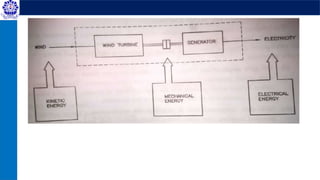
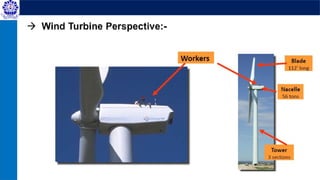
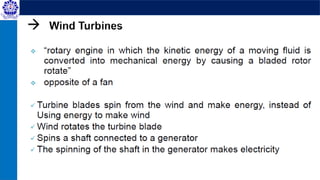
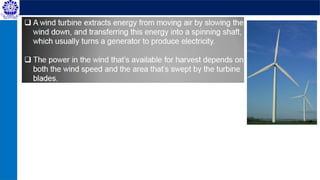
• The wind turbine captures the wind’s kinetic energy in a rotor
consisting of two or more
• blades mechanically coupled to an electrical generator. The turbine is
mounted on a tall
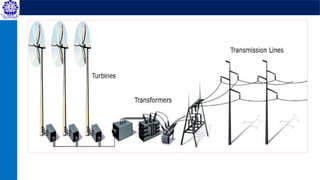
• tower to enhance the energy capture. Numerous wind turbines are
installed at one site to
• build a wind farm of the desired power generation capacity. Obviously,
sites with steady
• high wind produce more energy over the year.
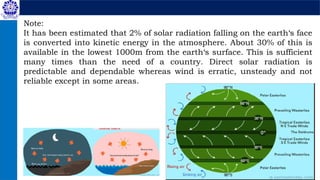
wind is generated by
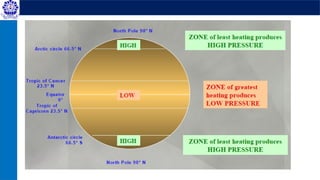
 Differential solar heating of locations at the equator and poles
 Coriolis force due to earth‘s rotation
 Friction between earth‘s surface and the wind
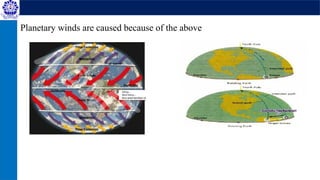
Planetary winds are caused because of the above
Local winds:
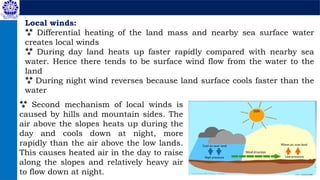
 Differential heating of the land mass and nearby sea surface water
creates local winds
 During day land heats up faster rapidly compared with nearby sea
water. Hence there tends to be surface wind flow from the water to the
land
 During night wind reverses because land surface cools faster than the
water
 Second mechanism of local winds is
caused by hills and mountain sides. The
air above the slopes heats up during the
day and cools down at night, more
rapidly than the air above the low lands.
This causes heated air in the day to raise
along the slopes and relatively heavy air
to flow down at night.
Note:
It has been estimated that 2% of solar radiation falling on the earth‘s face
is converted into kinetic energy in the atmosphere. About 30% of this is
available in the lowest 1000m from the earth‘s surface. This is sufficient
many times than the need of a country. Direct solar radiation is
predictable and dependable whereas wind is erratic, unsteady and not
reliable except in some areas.
WIND ENERGY:
Energy of wind can be economically used for the generation of electricity.
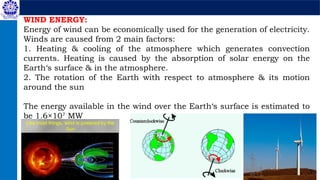
Winds are caused from 2 main factors:
1. Heating & cooling of the atmosphere which generates convection
currents. Heating is caused by the absorption of solar energy on the
Earth‘s surface & in the atmosphere.
2. The rotation of the Earth with respect to atmosphere & its motion
around the sun
The energy available in the wind over the Earth‘s surface is estimated to
be 1.6×10⁷
MW
In India, high wind speeds are obtainable in coastal areas of
Saurashtra, Western Rajasthan & some parts of Central India.
Wind energy which is an indirect source of solar energy conversion can
be utilized to run wind mill, which in turn drives a generator to
produce electricity.
The combination of wind turbine & generator is sometimes referred as
an AERO-GENERATOR.
A step up transmission is usually required to match the relatively slow
speed of the wind rotor to the higher speed of an electric generator.
Data quoted by some scientists that for India wind speed value lies
between 5 Km/hr to 15-20 Km/hr
Wind forms are operating successfully & have already fed over 150 lakh
units of electricity to the respective state grids.
Wind speed increases with height.
The power in wind:
Wind possesses energy by virtue of its motion. There are 3 factors
determine the output from a wind energy converter, 1] the wind speed, 2]
The cross section of wind swept by rotor & 3] The overall conversion
efficiency of the rotor, transmission system & generator or pump.
 Only 1/3rd amount of air is decelerating by the rotors & 60% of the
available energy in wind into mechanical energy.
 Well designed blades will typically extract 70% of the theoretical max,
but losses incurred in the gear box, transmission system & generator or
pump could decrease overall wind turbine efficiency to 35% or loss.
 The power in the wind can be computed by using the concept of
kinetics. The wind mill works on the principle of converting kinetic energy
of the wind to mechanical energy.
Kinetic energy = k.E= ½ mv2 But m = ρAv
Available wind Power =Pa = 1/8 ρπD2
V3
........... Watts
Major factors that have lead to accelerated development of the wind
power are as follows:
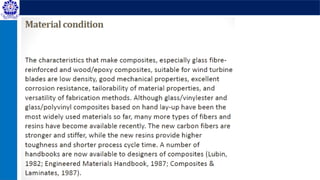
 Availability of high strength fiber composites for constructing large
low-cost rotor blades.
 Falling prices of power electronics
 Variable speed operation of electrical generators to capture maximum
energy
 Improved plant operation, pushing the availability up to 95%
Economy of scale, as the turbines & plants are getting larger in size.
Accumulated field experience (the learning curve effect) improving the
capacity factor.
 Short energy payback ( or energy recovery) period of about year,
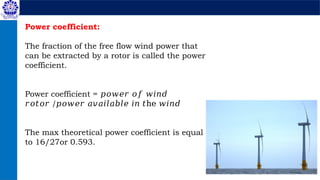
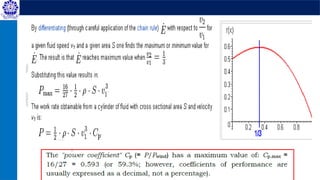
Power coefficient:
The fraction of the free flow wind power that
can be extracted by a rotor is called the power
coefficient.
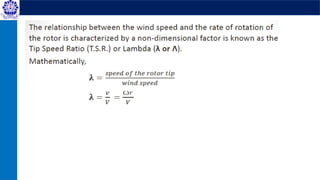
Power coefficient = 𝑝𝑜𝑤𝑒𝑟 𝑜𝑓 𝑤𝑖𝑛𝑑
𝑟𝑜𝑡𝑜𝑟 /𝑝𝑜𝑤𝑒𝑟 𝑎𝑣𝑎𝑖𝑙𝑎𝑏𝑙𝑒 𝑖𝑛 𝑡he 𝑤𝑖𝑛𝑑
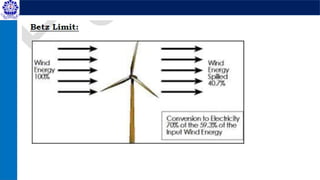
The max theoretical power coefficient is equal
to 16/27or 0.593.
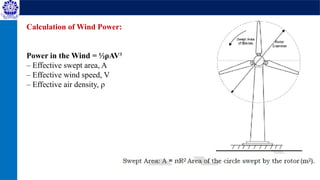
Calculation of Wind Power:
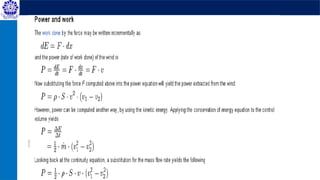
Power in the Wind = ½ρAV3
– Effective swept area, A
– Effective wind speed, V
– Effective air density, ρ
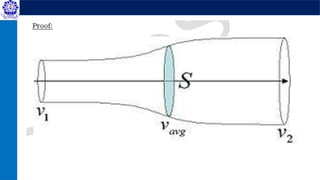
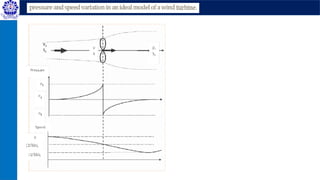
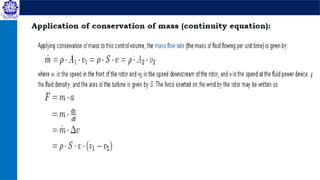
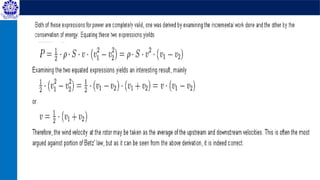
Intuitively, the speed ratio of [V2/V1 = 0.333] between outgoing and incoming wind,
leaving at about a third of the speed it came in, would imply higher losses of kinetic
energy. But since a larger area is needed for slower-moving air, energy is conserved.
All energy entering the system is taken into consideration, and local "radial" kinetic
energy can have no effect on the outcome, which is the final energy state of the air
leaving the system, at a slower speed, larger area and accordingly its lower energy can
be calculated.
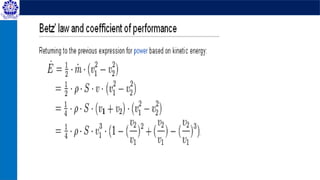
The last step in calculating the Betz efficiency Cp is to divide the calculated power
extracted from the flow by a reference power value. The Betz analysis uses for its power
reference, reasonably, the power of air upstream moving at V1 contained in a cylinder
with the cross-sectional area S of the rotor.
Understanding the Betz results
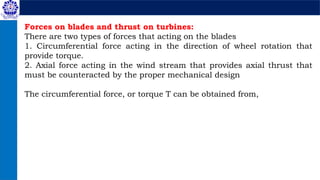
Forces on blades and thrust on turbines:
There are two types of forces that acting on the blades
1. Circumferential force acting in the direction of wheel rotation that
provide torque.
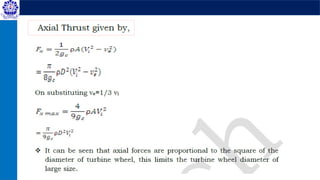
2. Axial force acting in the wind stream that provides axial thrust that
must be counteracted by the proper mechanical design
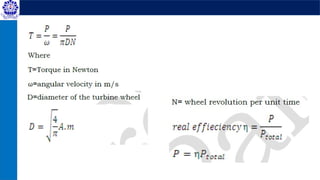
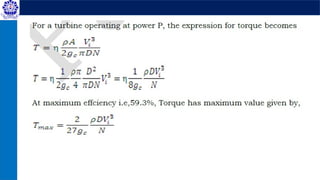
The circumferential force, or torque T can be obtained from,
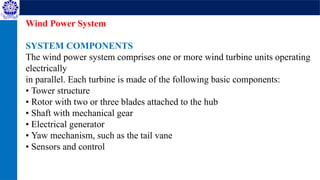
Wind Power System
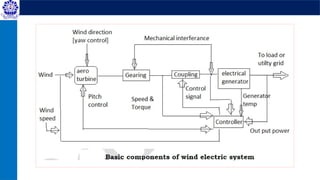
SYSTEM COMPONENTS
The wind power system comprises one or more wind turbine units operating
electrically
in parallel. Each turbine is made of the following basic components:
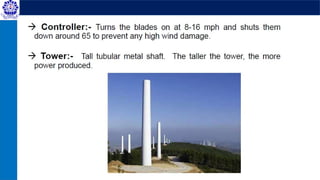
• Tower structure
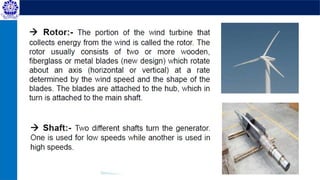
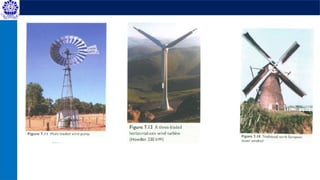
• Rotor with two or three blades attached to the hub
• Shaft with mechanical gear
• Electrical generator
• Yaw mechanism, such as the tail vane
• Sensors and control
Because of the large moment of inertia of the rotor, design challenges include starting,
speed control during the power-producing operation, and stopping the turbine when
required. The eddy current or another type of brake is used to halt the turbine when
needed for emergency or for routine maintenance.
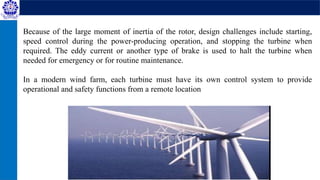
In a modern wind farm, each turbine must have its own control system to provide
operational and safety functions from a remote location
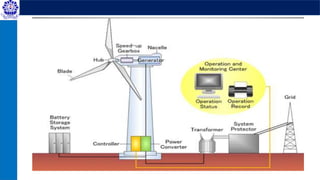
It also must have one or more of the following additional components:
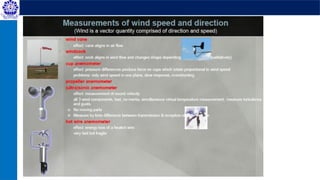
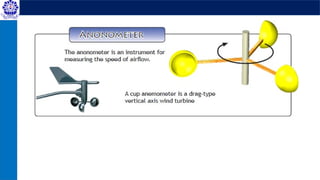
• Anemometers, which measure the wind speed and transmit the data to the controller.
• Numerous sensors to monitor and regulate various mechanical and electrical parameters.
A 1-MW turbine may have several hundred sensors.
• Stall controller, which starts the machine at set wind speeds of 8 to 15 mph and shuts off
at 50 to 70 mph to protect the blades from overstressing and the generator from
overheating.
• Power electronics to convert and condition power to the required standards.
• Control electronics, usually incorporating a computer.
• Battery for improving load availability in a stand-alone plant.
• Transmission link for connecting the plant to the area grid.
The following are commonly used terms and terminology in the wind power industry:
Low-speed shaft: The rotor turns the low-speed shaft at 30 to 60 rotations per minute
(rpm).
High-speed shaft: It drives the generator via a speed step-up gear.
Brake: A disc brake, which stops the rotor in emergencies. It can be applied mechanically,
electrically, or hydraulically.
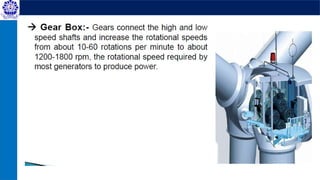
Gearbox: Gears connect the low-speed shaft to the high-speed shaft and increase the
turbine speed from 30 to 60 rpm to the 1200 to 1800 rpm required by most generators to
produce electricity in an efficient manner.
Because the gearbox is a costly and heavy part, design engineers are exploring slowspeed,
direct-drive generators that need no gearbox.
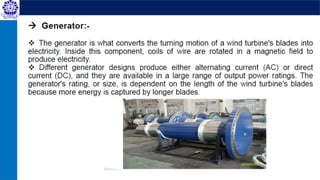
Generator: It is usually an off-the-shelf induction generator that produces 50- or 60-Hz
AC power.
Nacelle: The rotor attaches to the nacelle, which sits atop the tower and includes a
gearbox, low- and high-speed shafts, generator, controller, and a brake. A cover protects
the components inside the nacelle. Some nacelles are large enough for technicians to stand
inside while working.
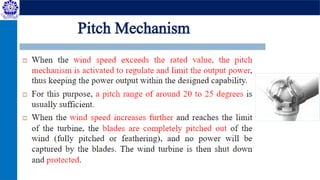
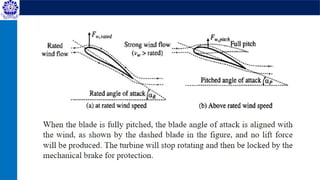
Pitch: Blades are turned, or pitched, out of the wind to keep the rotor from turning in
winds that have speeds too high or too low to produce electricity.
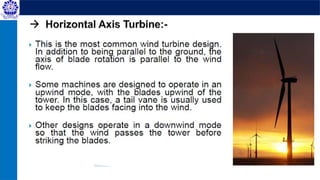
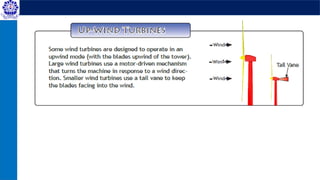
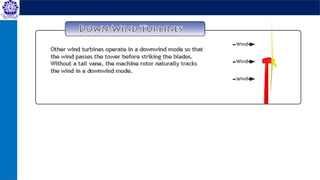
Upwind and downwind: The upwind turbine operates facing into the wind in front of the
tower, whereas the downwind runs facing away from the wind after the tower.
Vane: It measures the wind direction and communicates with the yaw drive to orient the
turbine properly with respect to the wind.
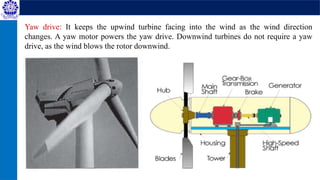
Yaw drive: It keeps the upwind turbine facing into the wind as the wind direction
changes. A yaw motor powers the yaw drive. Downwind turbines do not require a yaw
drive, as the wind blows the rotor downwind.
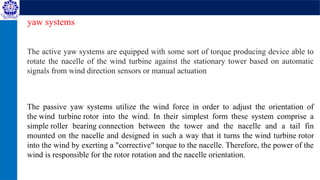
The active yaw systems are equipped with some sort of torque producing device able to
rotate the nacelle of the wind turbine against the stationary tower based on automatic
signals from wind direction sensors or manual actuation
The passive yaw systems utilize the wind force in order to adjust the orientation of
the wind turbine rotor into the wind. In their simplest form these system comprise a
simple roller bearing connection between the tower and the nacelle and a tail fin
mounted on the nacelle and designed in such a way that it turns the wind turbine rotor
into the wind by exerting a "corrective" torque to the nacelle. Therefore, the power of the
wind is responsible for the rotor rotation and the nacelle orientation.
yaw systems
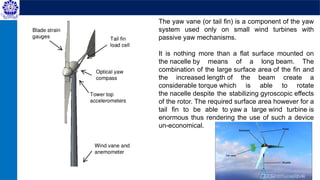
The yaw vane (or tail fin) is a component of the yaw
system used only on small wind turbines with
passive yaw mechanisms.
It is nothing more than a flat surface mounted on
the nacelle by means of a long beam. The
combination of the large surface area of the fin and
the increased length of the beam create a
considerable torque which is able to rotate
the nacelle despite the stabilizing gyroscopic effects
of the rotor. The required surface area however for a
tail fin to be able to yaw a large wind turbine is
enormous thus rendering the use of such a device
un-economical.
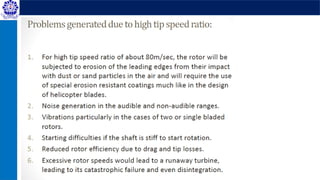
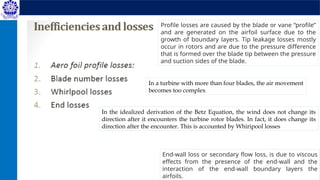
Profile losses are caused by the blade or vane “profile”
and are generated on the airfoil surface due to the
growth of boundary layers. Tip leakage losses mostly
occur in rotors and are due to the pressure difference
that is formed over the blade tip between the pressure
and suction sides of the blade.
End-wall loss or secondary flow loss, is due to viscous
effects from the presence of the end-wall and the
interaction of the end-wall boundary layers the
airfoils.
In the idealized derivation of the Betz Equation, the wind does not change its
direction after it encounters the turbine rotor blades. In fact, it does change its
direction after the encounter. This is accounted by Whiripool losses
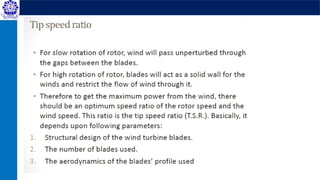
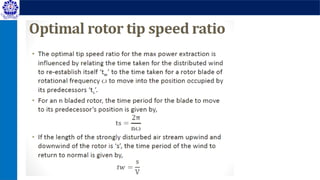
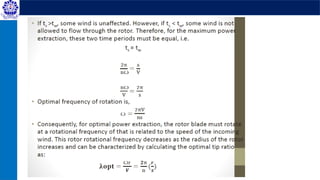
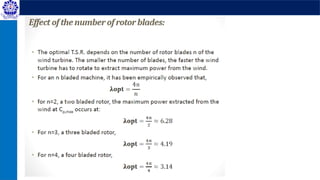
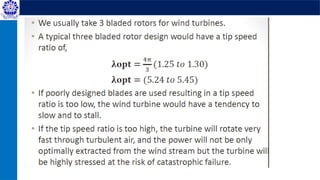
In a turbine with more than four blades, the air movement
becomes too complex
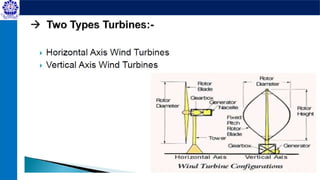
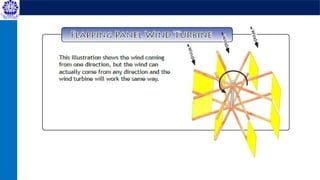
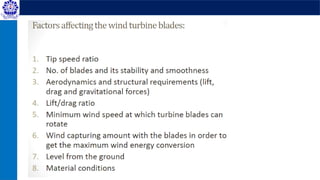
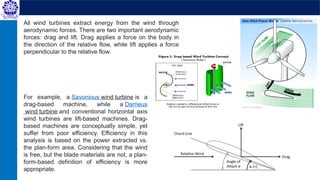
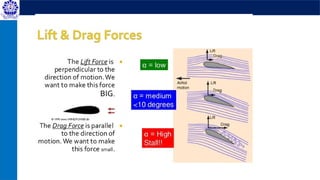
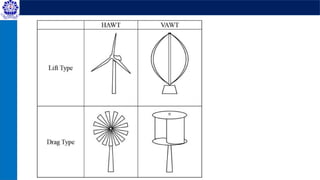
All wind turbines extract energy from the wind through
aerodynamic forces. There are two important aerodynamic
forces: drag and lift. Drag applies a force on the body in
the direction of the relative flow, while lift applies a force
perpendicular to the relative flow.
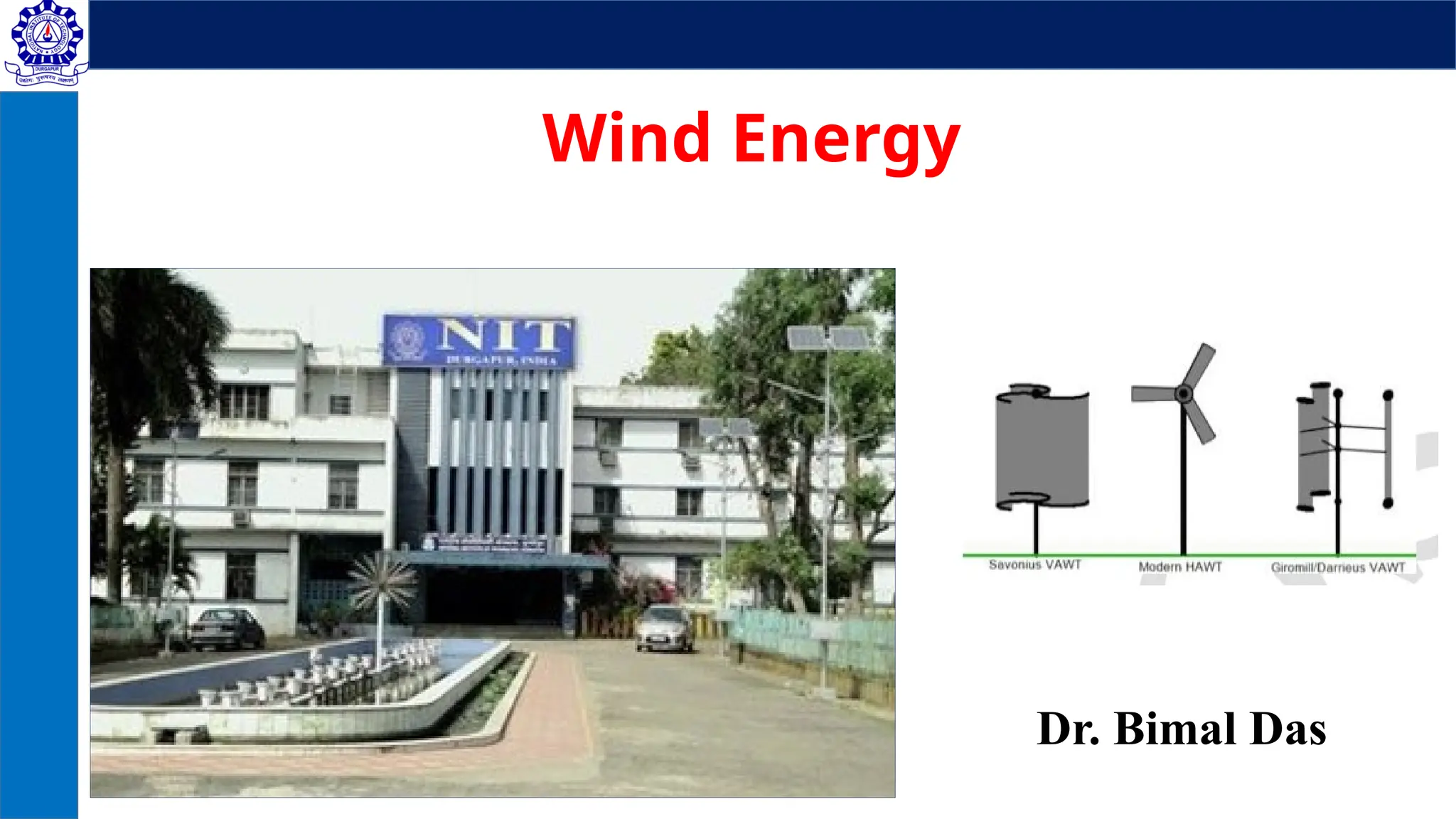
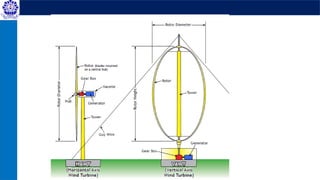
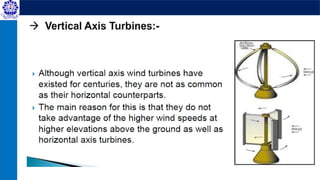
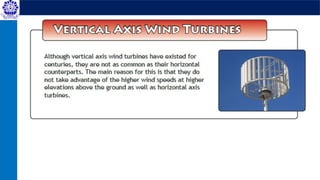
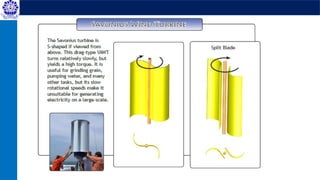
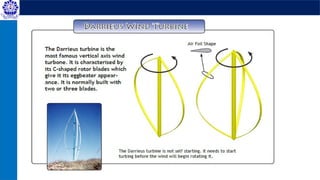
For example, a Savonious wind turbine is a
drag-based machine, while a Darrieus
wind turbine and conventional horizontal axis
wind turbines are lift-based machines. Drag-
based machines are conceptually simple, yet
suffer from poor efficiency. Efficiency in this
analysis is based on the power extracted vs.
the plan-form area. Considering that the wind
is free, but the blade materials are not, a plan-
form-based definition of efficiency is more
appropriate.
Non-Conventional Energy Engineering_2_Wind Energy.pptx

Non-Conventional Energy Engineering_2_Wind Energy.pptx

  • 1.
  • 2.
    WIND ENERGY Introduction: • Thewind turbine captures the wind’s kinetic energy in a rotor consisting of two or more • blades mechanically coupled to an electrical generator. The turbine is mounted on a tall • tower to enhance the energy capture. Numerous wind turbines are installed at one site to • build a wind farm of the desired power generation capacity. Obviously, sites with steady • high wind produce more energy over the year. wind is generated by  Differential solar heating of locations at the equator and poles  Coriolis force due to earth‘s rotation  Friction between earth‘s surface and the wind
  • 3.
    Planetary winds arecaused because of the above
  • 4.
    Local winds:  Differentialheating of the land mass and nearby sea surface water creates local winds  During day land heats up faster rapidly compared with nearby sea water. Hence there tends to be surface wind flow from the water to the land  During night wind reverses because land surface cools faster than the water  Second mechanism of local winds is caused by hills and mountain sides. The air above the slopes heats up during the day and cools down at night, more rapidly than the air above the low lands. This causes heated air in the day to raise along the slopes and relatively heavy air to flow down at night.
  • 5.
    Note: It has beenestimated that 2% of solar radiation falling on the earth‘s face is converted into kinetic energy in the atmosphere. About 30% of this is available in the lowest 1000m from the earth‘s surface. This is sufficient many times than the need of a country. Direct solar radiation is predictable and dependable whereas wind is erratic, unsteady and not reliable except in some areas.
  • 8.
    WIND ENERGY: Energy ofwind can be economically used for the generation of electricity. Winds are caused from 2 main factors: 1. Heating & cooling of the atmosphere which generates convection currents. Heating is caused by the absorption of solar energy on the Earth‘s surface & in the atmosphere. 2. The rotation of the Earth with respect to atmosphere & its motion around the sun The energy available in the wind over the Earth‘s surface is estimated to be 1.6×10⁷ MW
  • 9.
    In India, highwind speeds are obtainable in coastal areas of Saurashtra, Western Rajasthan & some parts of Central India. Wind energy which is an indirect source of solar energy conversion can be utilized to run wind mill, which in turn drives a generator to produce electricity. The combination of wind turbine & generator is sometimes referred as an AERO-GENERATOR. A step up transmission is usually required to match the relatively slow speed of the wind rotor to the higher speed of an electric generator. Data quoted by some scientists that for India wind speed value lies between 5 Km/hr to 15-20 Km/hr Wind forms are operating successfully & have already fed over 150 lakh units of electricity to the respective state grids. Wind speed increases with height.
  • 10.
    The power inwind: Wind possesses energy by virtue of its motion. There are 3 factors determine the output from a wind energy converter, 1] the wind speed, 2] The cross section of wind swept by rotor & 3] The overall conversion efficiency of the rotor, transmission system & generator or pump.  Only 1/3rd amount of air is decelerating by the rotors & 60% of the available energy in wind into mechanical energy.  Well designed blades will typically extract 70% of the theoretical max, but losses incurred in the gear box, transmission system & generator or pump could decrease overall wind turbine efficiency to 35% or loss.  The power in the wind can be computed by using the concept of kinetics. The wind mill works on the principle of converting kinetic energy of the wind to mechanical energy. Kinetic energy = k.E= ½ mv2 But m = ρAv Available wind Power =Pa = 1/8 ρπD2 V3 ........... Watts
  • 11.
    Major factors thathave lead to accelerated development of the wind power are as follows:  Availability of high strength fiber composites for constructing large low-cost rotor blades.  Falling prices of power electronics  Variable speed operation of electrical generators to capture maximum energy  Improved plant operation, pushing the availability up to 95% Economy of scale, as the turbines & plants are getting larger in size. Accumulated field experience (the learning curve effect) improving the capacity factor.  Short energy payback ( or energy recovery) period of about year,
  • 12.
    Power coefficient: The fractionof the free flow wind power that can be extracted by a rotor is called the power coefficient. Power coefficient = 𝑝𝑜𝑤𝑒𝑟 𝑜𝑓 𝑤𝑖𝑛𝑑 𝑟𝑜𝑡𝑜𝑟 /𝑝𝑜𝑤𝑒𝑟 𝑎𝑣𝑎𝑖𝑙𝑎𝑏𝑙𝑒 𝑖𝑛 𝑡he 𝑤𝑖𝑛𝑑 The max theoretical power coefficient is equal to 16/27or 0.593.
  • 13.
    Calculation of WindPower: Power in the Wind = ½ρAV3 – Effective swept area, A – Effective wind speed, V – Effective air density, ρ
  • 23.
    Intuitively, the speedratio of [V2/V1 = 0.333] between outgoing and incoming wind, leaving at about a third of the speed it came in, would imply higher losses of kinetic energy. But since a larger area is needed for slower-moving air, energy is conserved. All energy entering the system is taken into consideration, and local "radial" kinetic energy can have no effect on the outcome, which is the final energy state of the air leaving the system, at a slower speed, larger area and accordingly its lower energy can be calculated. The last step in calculating the Betz efficiency Cp is to divide the calculated power extracted from the flow by a reference power value. The Betz analysis uses for its power reference, reasonably, the power of air upstream moving at V1 contained in a cylinder with the cross-sectional area S of the rotor. Understanding the Betz results
  • 24.
    Forces on bladesand thrust on turbines: There are two types of forces that acting on the blades 1. Circumferential force acting in the direction of wheel rotation that provide torque. 2. Axial force acting in the wind stream that provides axial thrust that must be counteracted by the proper mechanical design The circumferential force, or torque T can be obtained from,
  • 28.
    Wind Power System SYSTEMCOMPONENTS The wind power system comprises one or more wind turbine units operating electrically in parallel. Each turbine is made of the following basic components: • Tower structure • Rotor with two or three blades attached to the hub • Shaft with mechanical gear • Electrical generator • Yaw mechanism, such as the tail vane • Sensors and control
  • 29.
    Because of thelarge moment of inertia of the rotor, design challenges include starting, speed control during the power-producing operation, and stopping the turbine when required. The eddy current or another type of brake is used to halt the turbine when needed for emergency or for routine maintenance. In a modern wind farm, each turbine must have its own control system to provide operational and safety functions from a remote location
  • 30.
    It also musthave one or more of the following additional components: • Anemometers, which measure the wind speed and transmit the data to the controller. • Numerous sensors to monitor and regulate various mechanical and electrical parameters. A 1-MW turbine may have several hundred sensors. • Stall controller, which starts the machine at set wind speeds of 8 to 15 mph and shuts off at 50 to 70 mph to protect the blades from overstressing and the generator from overheating. • Power electronics to convert and condition power to the required standards. • Control electronics, usually incorporating a computer. • Battery for improving load availability in a stand-alone plant. • Transmission link for connecting the plant to the area grid.
  • 35.
    The following arecommonly used terms and terminology in the wind power industry: Low-speed shaft: The rotor turns the low-speed shaft at 30 to 60 rotations per minute (rpm). High-speed shaft: It drives the generator via a speed step-up gear. Brake: A disc brake, which stops the rotor in emergencies. It can be applied mechanically, electrically, or hydraulically. Gearbox: Gears connect the low-speed shaft to the high-speed shaft and increase the turbine speed from 30 to 60 rpm to the 1200 to 1800 rpm required by most generators to produce electricity in an efficient manner. Because the gearbox is a costly and heavy part, design engineers are exploring slowspeed, direct-drive generators that need no gearbox.
  • 36.
    Generator: It isusually an off-the-shelf induction generator that produces 50- or 60-Hz AC power. Nacelle: The rotor attaches to the nacelle, which sits atop the tower and includes a gearbox, low- and high-speed shafts, generator, controller, and a brake. A cover protects the components inside the nacelle. Some nacelles are large enough for technicians to stand inside while working. Pitch: Blades are turned, or pitched, out of the wind to keep the rotor from turning in winds that have speeds too high or too low to produce electricity. Upwind and downwind: The upwind turbine operates facing into the wind in front of the tower, whereas the downwind runs facing away from the wind after the tower. Vane: It measures the wind direction and communicates with the yaw drive to orient the turbine properly with respect to the wind.
  • 37.
    Yaw drive: Itkeeps the upwind turbine facing into the wind as the wind direction changes. A yaw motor powers the yaw drive. Downwind turbines do not require a yaw drive, as the wind blows the rotor downwind.
  • 53.
    The active yawsystems are equipped with some sort of torque producing device able to rotate the nacelle of the wind turbine against the stationary tower based on automatic signals from wind direction sensors or manual actuation The passive yaw systems utilize the wind force in order to adjust the orientation of the wind turbine rotor into the wind. In their simplest form these system comprise a simple roller bearing connection between the tower and the nacelle and a tail fin mounted on the nacelle and designed in such a way that it turns the wind turbine rotor into the wind by exerting a "corrective" torque to the nacelle. Therefore, the power of the wind is responsible for the rotor rotation and the nacelle orientation. yaw systems
  • 54.
    The yaw vane(or tail fin) is a component of the yaw system used only on small wind turbines with passive yaw mechanisms. It is nothing more than a flat surface mounted on the nacelle by means of a long beam. The combination of the large surface area of the fin and the increased length of the beam create a considerable torque which is able to rotate the nacelle despite the stabilizing gyroscopic effects of the rotor. The required surface area however for a tail fin to be able to yaw a large wind turbine is enormous thus rendering the use of such a device un-economical.
  • 80.
    Profile losses arecaused by the blade or vane “profile” and are generated on the airfoil surface due to the growth of boundary layers. Tip leakage losses mostly occur in rotors and are due to the pressure difference that is formed over the blade tip between the pressure and suction sides of the blade. End-wall loss or secondary flow loss, is due to viscous effects from the presence of the end-wall and the interaction of the end-wall boundary layers the airfoils. In the idealized derivation of the Betz Equation, the wind does not change its direction after it encounters the turbine rotor blades. In fact, it does change its direction after the encounter. This is accounted by Whiripool losses In a turbine with more than four blades, the air movement becomes too complex
  • 85.
    All wind turbinesextract energy from the wind through aerodynamic forces. There are two important aerodynamic forces: drag and lift. Drag applies a force on the body in the direction of the relative flow, while lift applies a force perpendicular to the relative flow. For example, a Savonious wind turbine is a drag-based machine, while a Darrieus wind turbine and conventional horizontal axis wind turbines are lift-based machines. Drag- based machines are conceptually simple, yet suffer from poor efficiency. Efficiency in this analysis is based on the power extracted vs. the plan-form area. Considering that the wind is free, but the blade materials are not, a plan- form-based definition of efficiency is more appropriate.