SOLAR ENERGY STORAGE
By
Prof. Ashish Bandewar
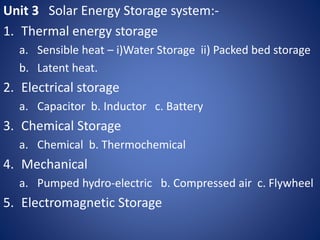
Unit 3 Solar Energy Storage system:-
1. Thermal energy storage
a. Sensible heat – i)Water Storage ii) Packed bed storage
b. Latent heat.
2. Electrical storage
a. Capacitor b. Inductor c. Battery
3. Chemical Storage
a. Chemical b. Thermochemical
4. Mechanical
a. Pumped hydro-electric b. Compressed air c. Flywheel
5. Electromagnetic Storage
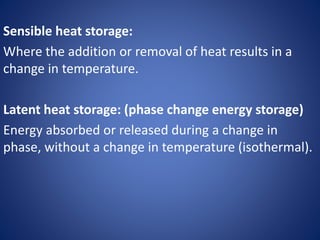
Sensible heat storage:
Where the addition or removal of heat results in a
change in temperature.
Latent heat storage: (phase change energy storage)
Energy absorbed or released during a change in
phase, without a change in temperature (isothermal).
Sensible Storage - Water Storage
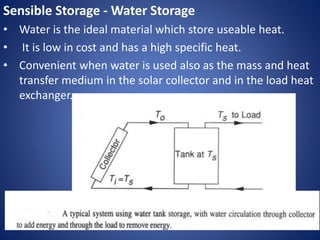
• Water is the ideal material which store useable heat.
• It is low in cost and has a high specific heat.
• Convenient when water is used also as the mass and heat
transfer medium in the solar collector and in the load heat
exchanger.
Sensible storage - Packed Bed Storage
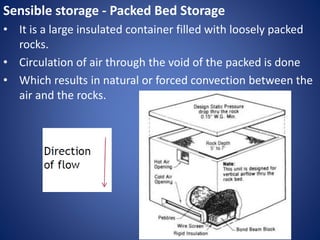
• It is a large insulated container filled with loosely packed
rocks.
• Circulation of air through the void of the packed is done
• Which results in natural or forced convection between the
air and the rocks.
Few points for Bed Storage :-
• Rock is more easily contained than water
• Rock acts as its own heat exchanger
• For storage more than 1000C it can be used, as
water cannot be used.
• Heat transfer coefficient between air and solid is
high
• Low cost storage
• Conductivity of bed is depend on air flow/air
velocity
• Can be used in solar houses or hot air collector
system.
Latent heat Storage
• Heat is stored in material when it melts and
extracted from the material when it freezes.
• Material that undergo phase change in suitable
temp range is useful in energy storage if following
criteria satisfied for phase change :-
• Must be accompanied by high latent heat effect
• Must be reversible without degradation
• Must occur with limited super cooling
• Material must be available in large quantities
• Material must be harmless (non toxic, non
inflammable)
• Must have high thermal conductivity in both phase
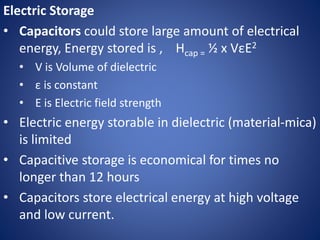
Electric Storage
• Capacitors could store large amount of electrical
energy, Energy stored is , Hcap = ½ x VεE2
• V is Volume of dielectric
• ε is constant
• E is Electric field strength
• Electric energy storable in dielectric (material-mica)
is limited
• Capacitive storage is economical for times no
longer than 12 hours
• Capacitors store electrical energy at high voltage
and low current.
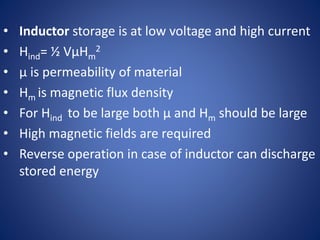
• Inductor storage is at low voltage and high current
• Hind= ½ VµHm
2
• µ is permeability of material
• Hm is magnetic flux density
• For Hind to be large both µ and Hm should be large
• High magnetic fields are required
• Reverse operation in case of inductor can discharge
stored energy
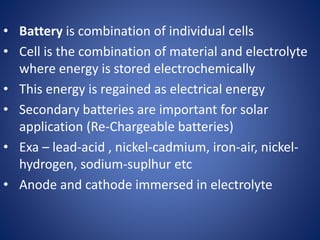
• Battery is combination of individual cells
• Cell is the combination of material and electrolyte
where energy is stored electrochemically
• This energy is regained as electrical energy
• Secondary batteries are important for solar
application (Re-Chargeable batteries)
• Exa – lead-acid , nickel-cadmium, iron-air, nickel-
hydrogen, sodium-suplhur etc
• Anode and cathode immersed in electrolyte
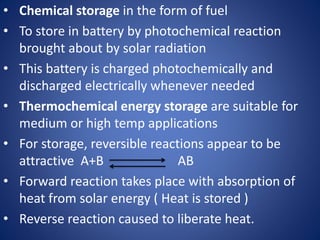
• Chemical storage in the form of fuel
• To store in battery by photochemical reaction
brought about by solar radiation
• This battery is charged photochemically and
discharged electrically whenever needed
• Thermochemical energy storage are suitable for
medium or high temp applications
• For storage, reversible reactions appear to be
attractive A+B AB
• Forward reaction takes place with absorption of
heat from solar energy ( Heat is stored )
• Reverse reaction caused to liberate heat.
Mechanical energy storage
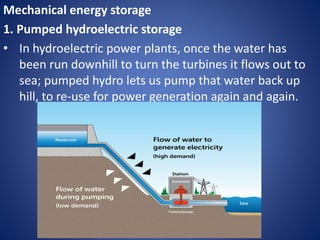
1. Pumped hydroelectric storage
• In hydroelectric power plants, once the water has
been run downhill to turn the turbines it flows out to
sea; pumped hydro lets us pump that water back up
hill, to re-use for power generation again and again.
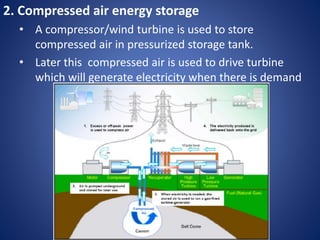
2. Compressed air energy storage
• A compressor/wind turbine is used to store
compressed air in pressurized storage tank.
• Later this compressed air is used to drive turbine
which will generate electricity when there is demand
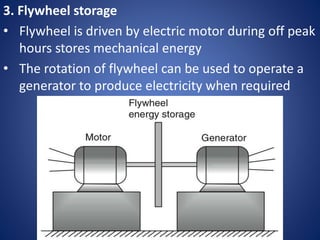
3. Flywheel storage
• Flywheel is driven by electric motor during off peak
hours stores mechanical energy
• The rotation of flywheel can be used to operate a
generator to produce electricity when required
Electromagnetic energy storage/ Superconducting
magnetic energy storage (SMES)
• SMES material suddenly loose all resistance to the
flow of electricity when cooled below very low
temp
• If maintained below this can carry strong electric
currents
• Superconducting materials like niobium titanium
alloy at temp – 263oC
• Electromagnetic field produced by an electric
current flowing through wire coil can store energy.

Solar energy storage

  • 1.
  • 2.
    Unit 3 SolarEnergy Storage system:- 1. Thermal energy storage a. Sensible heat – i)Water Storage ii) Packed bed storage b. Latent heat. 2. Electrical storage a. Capacitor b. Inductor c. Battery 3. Chemical Storage a. Chemical b. Thermochemical 4. Mechanical a. Pumped hydro-electric b. Compressed air c. Flywheel 5. Electromagnetic Storage
  • 3.
    Sensible heat storage: Wherethe addition or removal of heat results in a change in temperature. Latent heat storage: (phase change energy storage) Energy absorbed or released during a change in phase, without a change in temperature (isothermal).
  • 4.
    Sensible Storage -Water Storage • Water is the ideal material which store useable heat. • It is low in cost and has a high specific heat. • Convenient when water is used also as the mass and heat transfer medium in the solar collector and in the load heat exchanger.
  • 5.
    Sensible storage -Packed Bed Storage • It is a large insulated container filled with loosely packed rocks. • Circulation of air through the void of the packed is done • Which results in natural or forced convection between the air and the rocks.
  • 6.
    Few points forBed Storage :- • Rock is more easily contained than water • Rock acts as its own heat exchanger • For storage more than 1000C it can be used, as water cannot be used. • Heat transfer coefficient between air and solid is high • Low cost storage • Conductivity of bed is depend on air flow/air velocity • Can be used in solar houses or hot air collector system.
  • 7.
    Latent heat Storage •Heat is stored in material when it melts and extracted from the material when it freezes. • Material that undergo phase change in suitable temp range is useful in energy storage if following criteria satisfied for phase change :- • Must be accompanied by high latent heat effect • Must be reversible without degradation • Must occur with limited super cooling • Material must be available in large quantities • Material must be harmless (non toxic, non inflammable) • Must have high thermal conductivity in both phase
  • 8.
    Electric Storage • Capacitorscould store large amount of electrical energy, Energy stored is , Hcap = ½ x VεE2 • V is Volume of dielectric • ε is constant • E is Electric field strength • Electric energy storable in dielectric (material-mica) is limited • Capacitive storage is economical for times no longer than 12 hours • Capacitors store electrical energy at high voltage and low current.
  • 9.
    • Inductor storageis at low voltage and high current • Hind= ½ VµHm 2 • µ is permeability of material • Hm is magnetic flux density • For Hind to be large both µ and Hm should be large • High magnetic fields are required • Reverse operation in case of inductor can discharge stored energy
  • 10.
    • Battery iscombination of individual cells • Cell is the combination of material and electrolyte where energy is stored electrochemically • This energy is regained as electrical energy • Secondary batteries are important for solar application (Re-Chargeable batteries) • Exa – lead-acid , nickel-cadmium, iron-air, nickel- hydrogen, sodium-suplhur etc • Anode and cathode immersed in electrolyte
  • 11.
    • Chemical storagein the form of fuel • To store in battery by photochemical reaction brought about by solar radiation • This battery is charged photochemically and discharged electrically whenever needed • Thermochemical energy storage are suitable for medium or high temp applications • For storage, reversible reactions appear to be attractive A+B AB • Forward reaction takes place with absorption of heat from solar energy ( Heat is stored ) • Reverse reaction caused to liberate heat.
  • 12.
    Mechanical energy storage 1.Pumped hydroelectric storage • In hydroelectric power plants, once the water has been run downhill to turn the turbines it flows out to sea; pumped hydro lets us pump that water back up hill, to re-use for power generation again and again.
  • 13.
    2. Compressed airenergy storage • A compressor/wind turbine is used to store compressed air in pressurized storage tank. • Later this compressed air is used to drive turbine which will generate electricity when there is demand
  • 14.
    3. Flywheel storage •Flywheel is driven by electric motor during off peak hours stores mechanical energy • The rotation of flywheel can be used to operate a generator to produce electricity when required
  • 15.
    Electromagnetic energy storage/Superconducting magnetic energy storage (SMES) • SMES material suddenly loose all resistance to the flow of electricity when cooled below very low temp • If maintained below this can carry strong electric currents • Superconducting materials like niobium titanium alloy at temp – 263oC • Electromagnetic field produced by an electric current flowing through wire coil can store energy.