Rohil Kumar
17M713
Assignment I
Abstract
 In this presentation I described about HAWT, its components & their
operations, HAWT technological evolution with time and global wind
capacity.
Index
 Components
 Rotor
 Hub
 Nacelle
 Generator & Controller
 Yaw system
 Tower & Foundation
 HAWT Technological Evolution
 Global Wind Capacity
 References
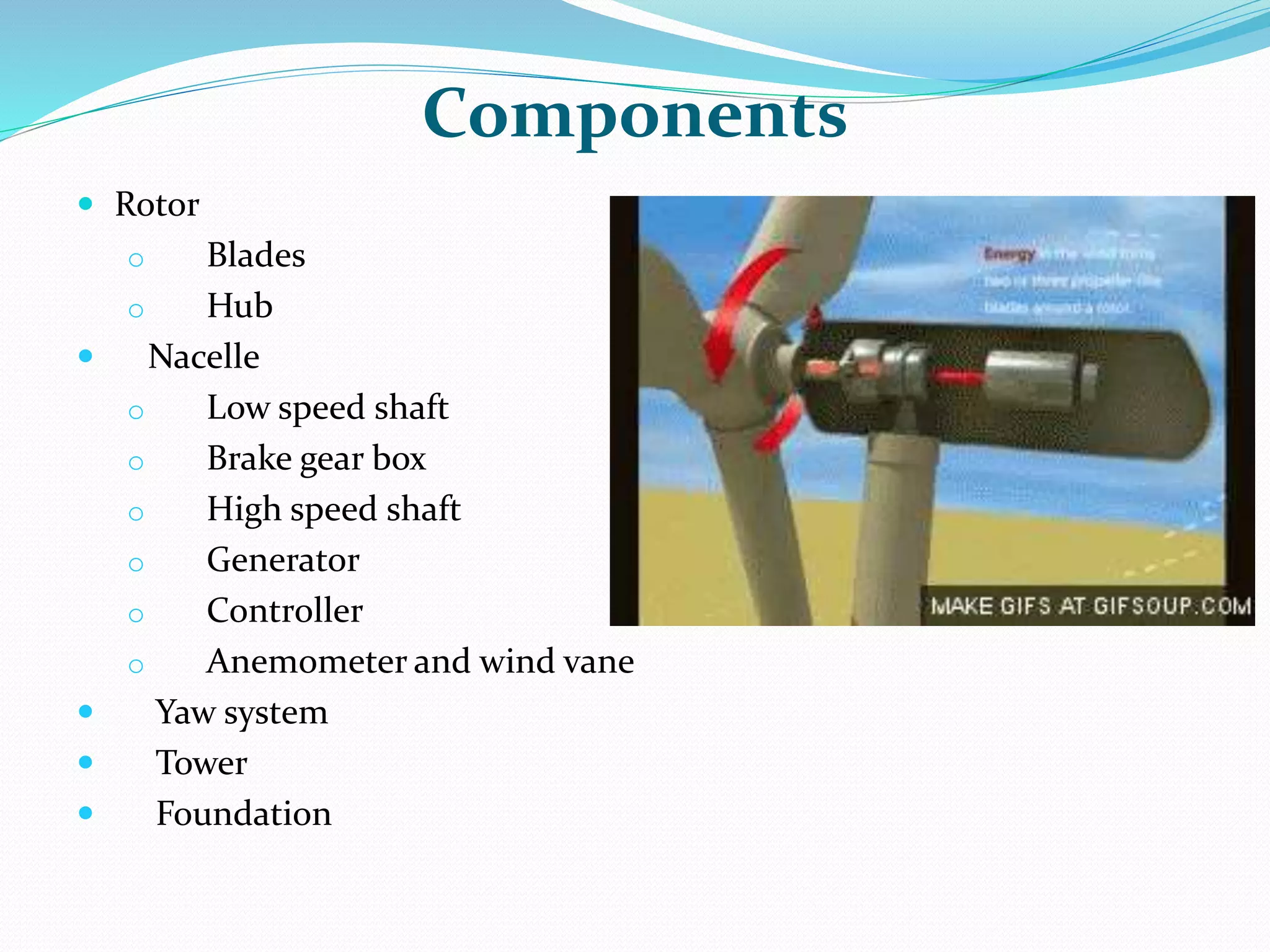
Components
 Rotor
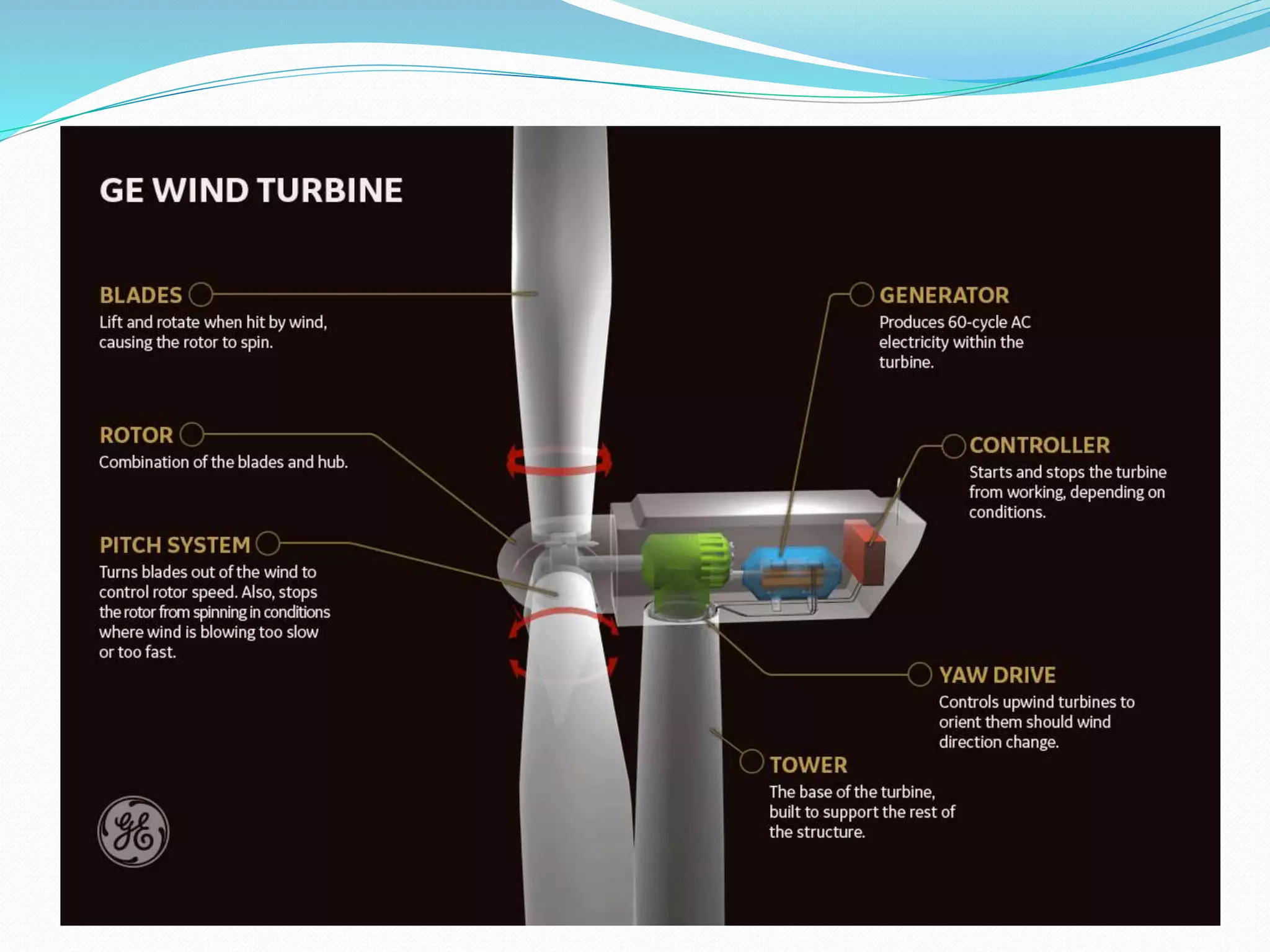
o Blades
o Hub
 Nacelle
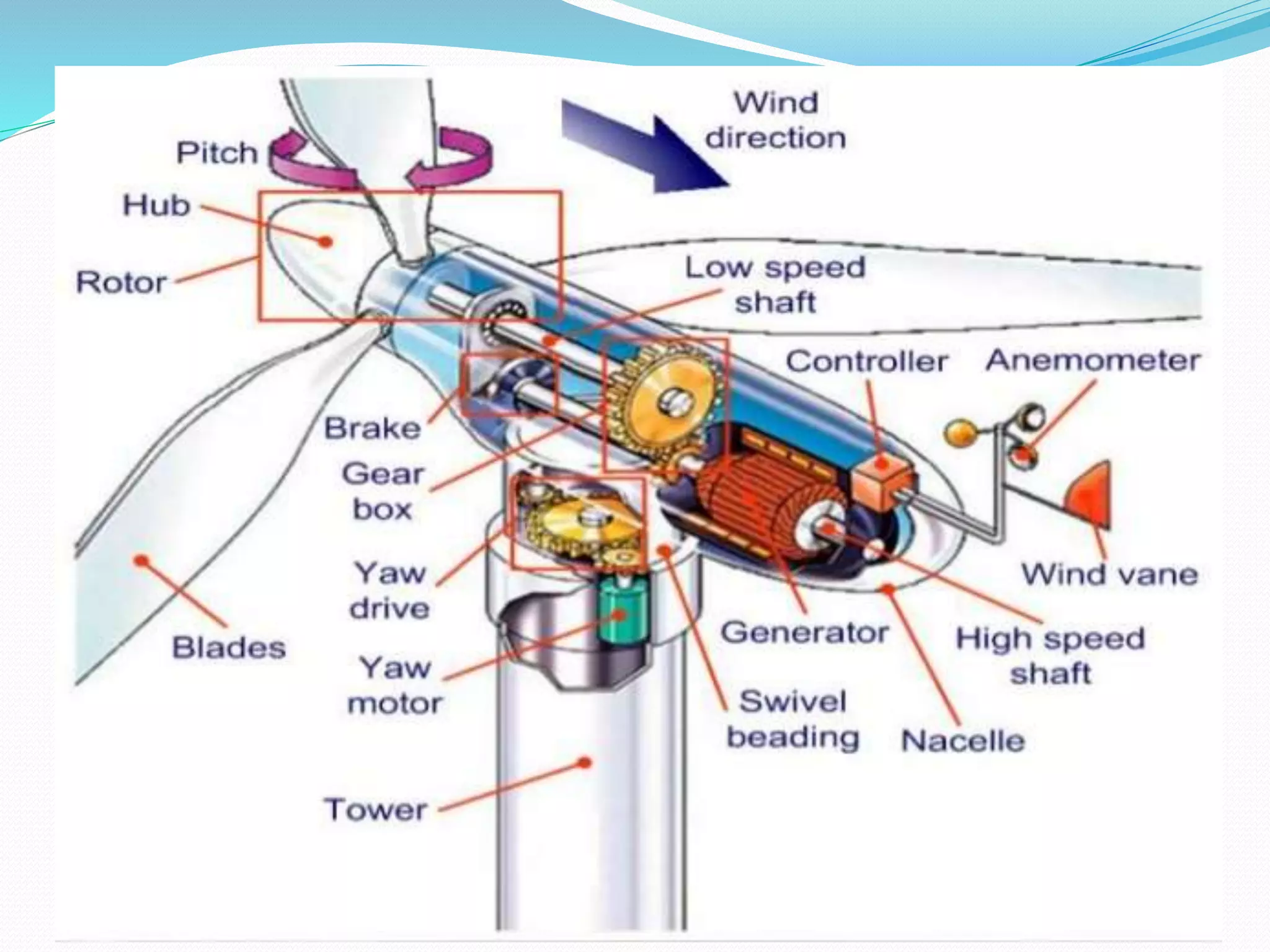
o Low speed shaft
o Brake gear box
o High speed shaft
o Generator
o Controller
o Anemometer and wind vane
 Yaw system
 Tower
 Foundation
Rotor
 Blade
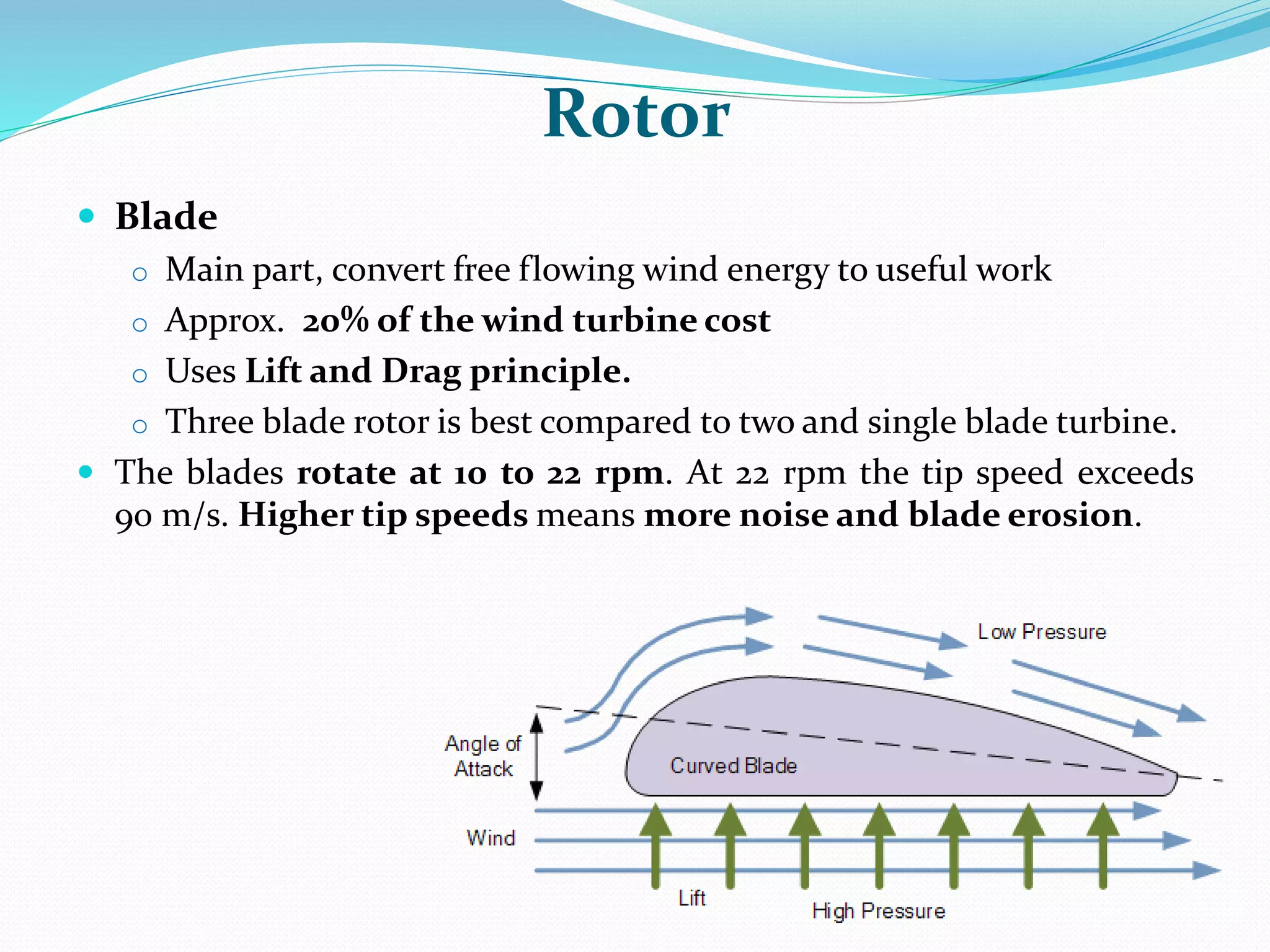
o Main part, convert free flowing wind energy to useful work
o Approx. 20% of the wind turbine cost
o Uses Lift and Drag principle.
o Three blade rotor is best compared to two and single blade turbine.
 The blades rotate at 10 to 22 rpm. At 22 rpm the tip speed exceeds
90 m/s. Higher tip speeds means more noise and blade erosion.
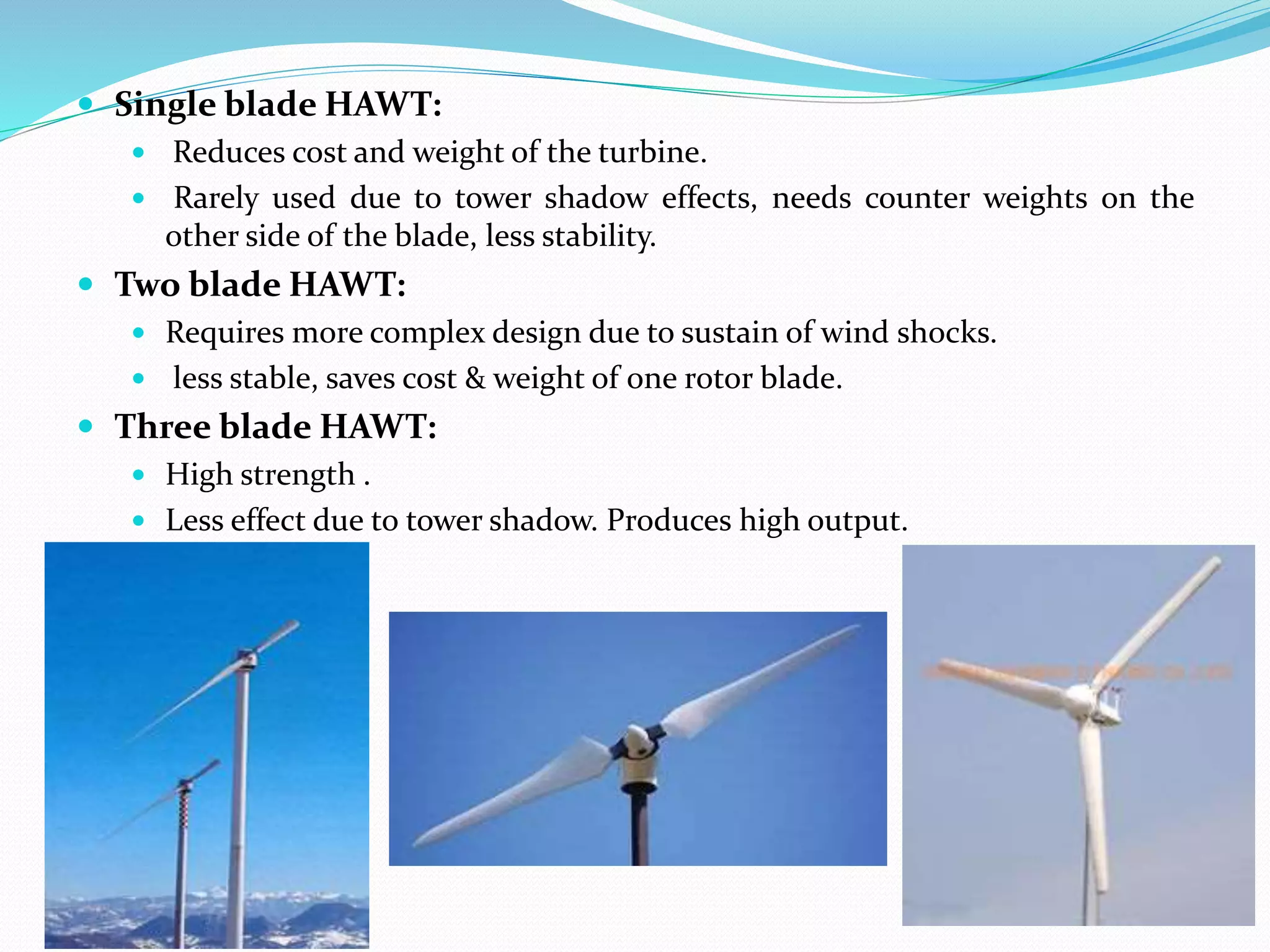
 Single blade HAWT:
 Reduces cost and weight of the turbine.
 Rarely used due to tower shadow effects, needs counter weights on the
other side of the blade, less stability.
 Two blade HAWT:
 Requires more complex design due to sustain of wind shocks.
 less stable, saves cost & weight of one rotor blade.
 Three blade HAWT:
 High strength .
 Less effect due to tower shadow. Produces high output.
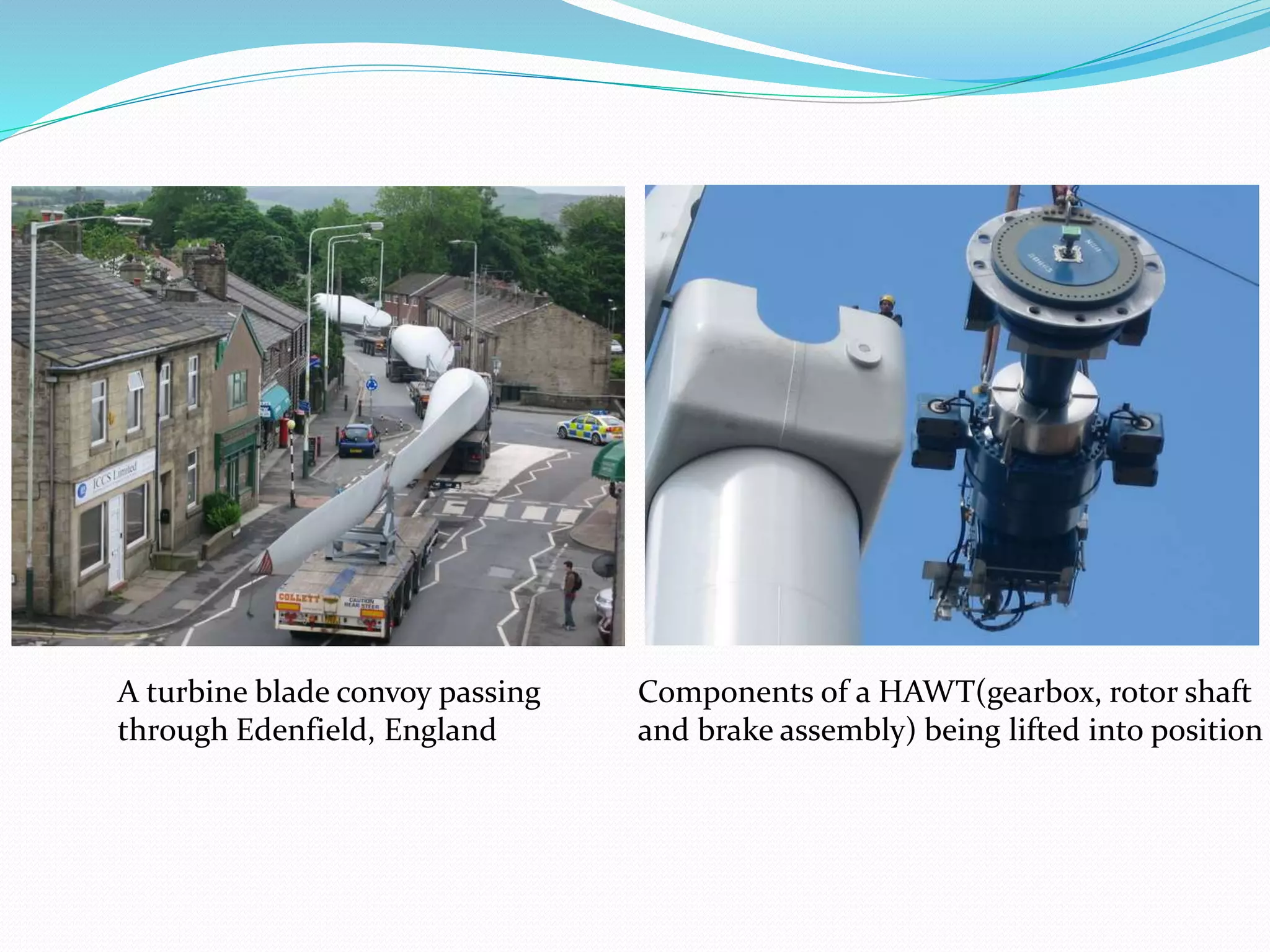
A turbine blade convoy passing
through Edenfield, England
Components of a HAWT(gearbox, rotor shaft
and brake assembly) being lifted into position
Hub
 In simple designs, blades are directly bolted to hub.
 In sophisticated designs they are bolted to the pitch mechanism,
which adjust their angle of attack according to their wind speed.
 The hub is fixed to the rotor shaft which derives the generator
through a gear box.
Nacelle
 Low speed shaft
o The shaft from the hub to the gear box
o Speed is typically between 40 to 400 rpm
o Generator typically rotated at 1200 rpm to 1800 rpm
 Brake Gear box
o Gear box increases the speed of the shaft
o Meet the requirement of the generator
 High speed shaft
o Gear box shaft is followed by the high speed shaft
o Connects to generator
 Braking mechanism
o A mechanical drum brake is used to stop turbine in emergency
situation.
o This brake is also used to hold at rest for maintenance.
Main shaft
Generator
 Converts mechanical energy to electrical energy. which is approx. 34%
of the wind turbine cost.
 generate electricity through asynchronous machines that are directly
connected with the electricity grid.
 One end attached to the wind turbine, other end connected to the
electrical grid.
 Require cooling system to prevent overheating.
Controller
 Starts when the machine at wind speed of about 4 m/s and shuts off
the machines at about 25m/s , may damage wind turbine.
 It gets wind speed data from the anemometer and accordingly.
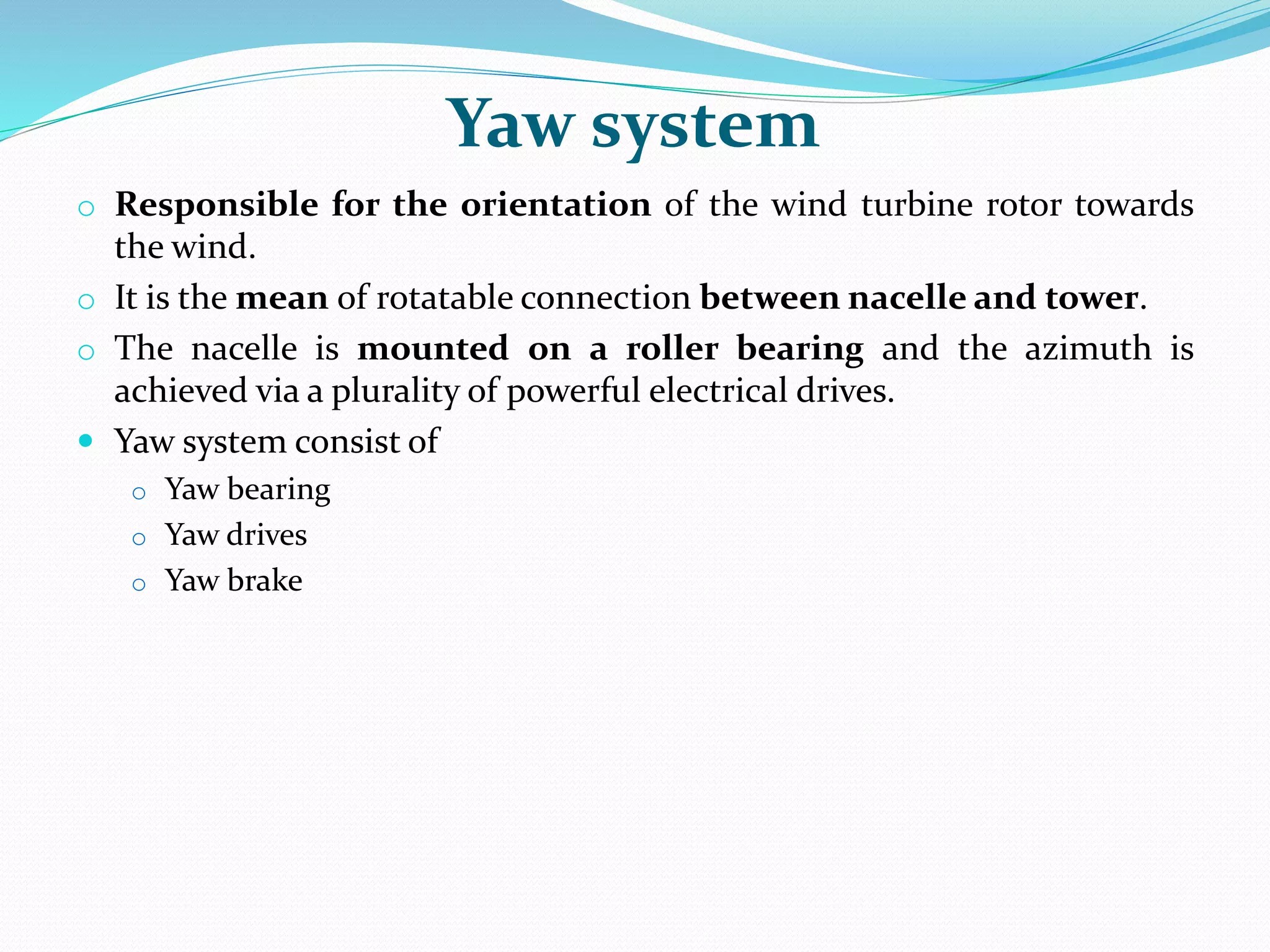
Yaw system
o Responsible for the orientation of the wind turbine rotor towards
the wind.
o It is the mean of rotatable connection between nacelle and tower.
o The nacelle is mounted on a roller bearing and the azimuth is
achieved via a plurality of powerful electrical drives.
 Yaw system consist of
o Yaw bearing
o Yaw drives
o Yaw brake
Yaw System
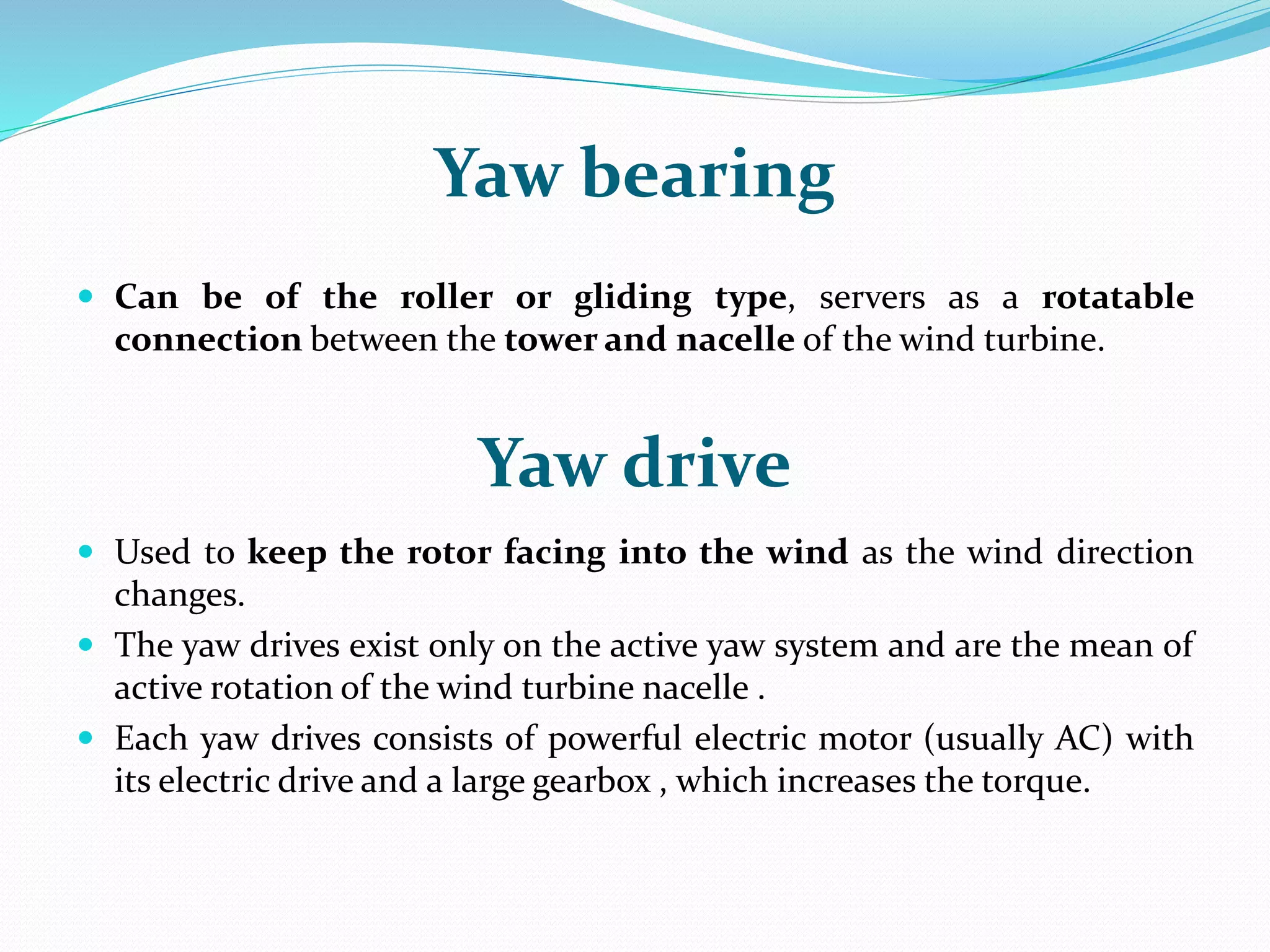
Yaw bearing
 Can be of the roller or gliding type, servers as a rotatable
connection between the tower and nacelle of the wind turbine.
Yaw drive
 Used to keep the rotor facing into the wind as the wind direction
changes.
 The yaw drives exist only on the active yaw system and are the mean of
active rotation of the wind turbine nacelle .
 Each yaw drives consists of powerful electric motor (usually AC) with
its electric drive and a large gearbox , which increases the torque.
Yaw brakes
 In order to stabilize the yaw bearing against rotation a mean of
braking is necessary.
 One of the simplest ways to realize the task is to apply a constant
small counter torque at the yaw drives.
 This operation however greatly reduces the reliability of the electric
yaw drives, therefore the most common solution is the
implementation of a hydraulically actuated disk brake.
Tower
 Typically, 2 types of towers exist
o Floating towers
o Land based tower
 Floating towers can be seen in offshore wind farms where the
towers are float on water.
 Land based towers can be seen in the onshore wind farm where the
tower are situated on the land.
 For HAWTs, tower heights approx. 2 to 3 times the blade length
have been found to balance material costs of the tower against better
utilization of the expensive active components.
 At the bottom level of the tower there will be step up transformers for
the connection for the connection to the grid.
Wind Turbine Tower Size
Guyed
Lattice
Tilt up
Tubular
Different types
of land based
tower
Foundation
 A very good foundation is required to support the tower and various
parts of a wind turbine which weighs in tonnes.
 The structural support component, which is approxi. 15% of the
wind turbine cost, includes the tower & rotor yaw mechanism.
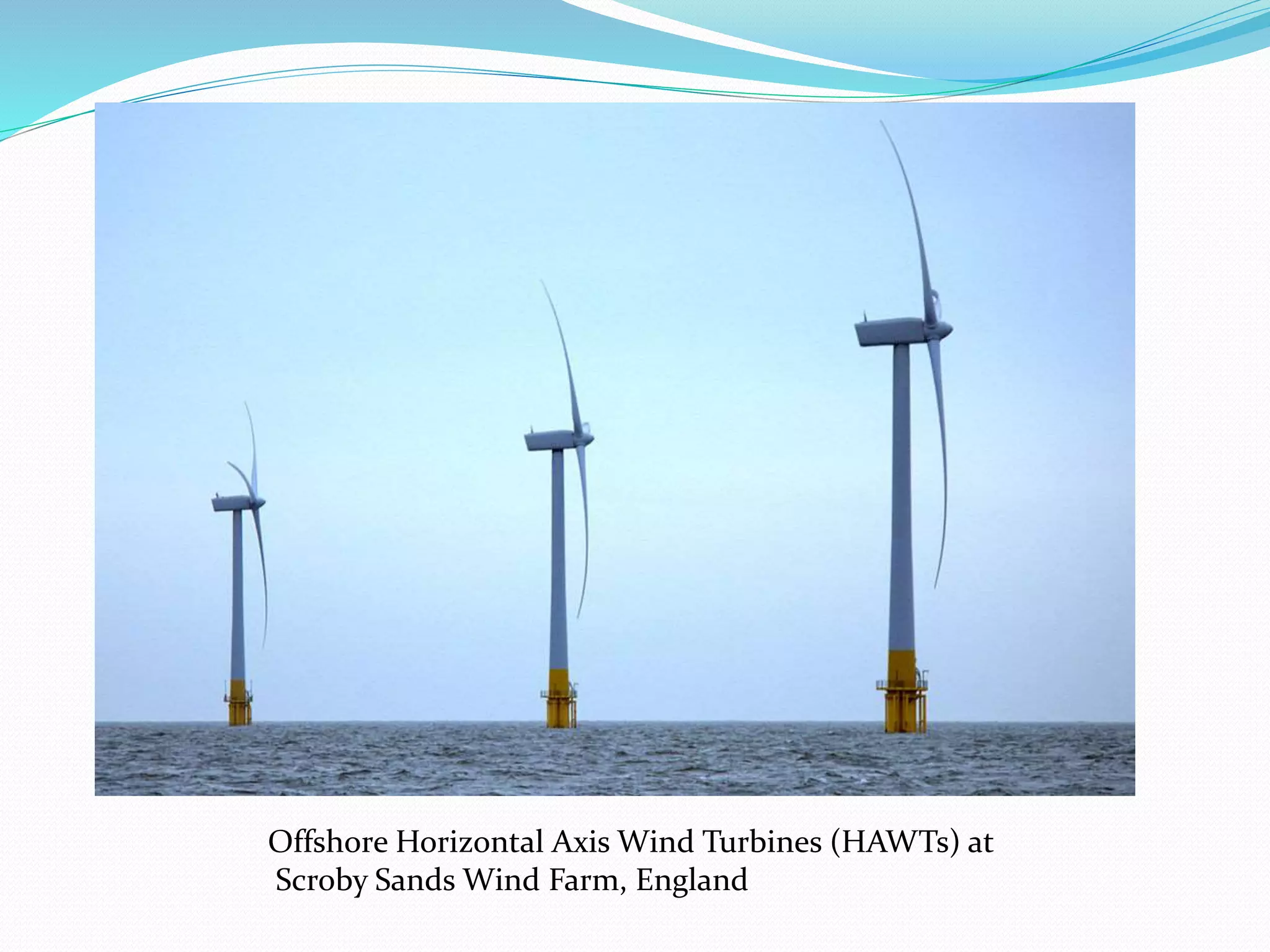
Offshore Horizontal Axis Wind Turbines (HAWTs) at
Scroby Sands Wind Farm, England
Onshore Horizontal Axis Wind Turbines in Zhangjiakou, China
Alta Wind Energy Centre, US
Denmark aims to run 100% on wind energy by 2050
HAWT Technological Evolution
 Useful wind speeds. There is a range of wind speeds within which the
rotor can move and function properly.
 Lower limit - “Cut-in” = 4 m/s (approx. 14 km/h). With wind
speeds below this value, it is not possible to activate the rotation of
the blades and the rotor remains stationary.
 Upper limit - “Cut-off” ~ 25 m/s (approx. 90 km/h). Above this
speed, the rotor is stopped to avoid serious structural problems.
 Wind limit value - “Survival Speed”, representing the maximum
design wind speed which the structure of turbine & blades can
withstand without incurring damage. This value varies depending
on the type of wind turbine and generally is approx. 60m/s,
(approx. 216 km/h).
Conversion efficiency :
 Conversion of kinetic energy into electricity of modern-day wind
machines is around 25%.
 The maximum theoretical efficiency of a wind turbine system is
defined by Betz’s law, which identifies the so-called “Betz limit”
corresponding to a maximum efficiency of 59%.
Capacity factor:
 Equivalent number of hours of operation (at the maximum rated
system power) throughout the year.(8760 hours).
 Capacity Factor values vary from 20% (1750 hours/ year at full power) to
40% (3500 hours/year at full power);
 In certain exceptional cases it is possible to reach values close to 50%
(4400 hours/year at full power).
 In Italy the current Capacity Factor of the entire national wind farm is
25%, corresponding to approx. 2,200 hours per year of system
operation at nominal power.
Dimensions and electricity generated
 Systems marketed in the nineties:
 Heights - approx. 50 m
 Rotor dia. - 40 m
 Modern systems:
 On-shore Systems
o Heights - 130 m in (higher than a 40-floor building)
o Blade dia. – 100 to 130 m
o Length of blades – 50 to 65 m
 Off-shore Systems
 Heights - 220 m (approx. 75 floors)
 Blade dia. > 154 metres
 The power produced by each turbine has increased exponentially in
recent years.
 Nineties power generated (individual machine) - 600 to 900 kW
 Now , On-shore installations - 2 MW & 5 MW,
 Of-shore installations - 7 MW.
Technological evolution: a forecast of the nominal power compared to the rotor
diameter (Credits: Sandia 2014 – Wind Turbine Blade Workshop – Zayas).
Global Wind Capacity
World Record
 Currently the record for the biggest wind turbine in the world is held
by the Vestas V164 (Vestas Wind Systems A/S is a Danish
manufacturer) -
 rotor diameter of 164 m
 tower height of 205 m
 nominal output of 8 MW
 the prototype of which was installed in January 2014 in Denmark
 while the first wind farm is in operation since April 2016 in England.
Vestas V164
References
 https://en.wikipedia.org/wiki/Wind_turbine
 https://www.dolcera.com/wiki/index.php?title=Different_Types_and_
Parts_of_a_Horizontal_Axis_Wind_Turbines
 http://www.eniscuola.net/en/2016/05/31/horizontal-axis-wind-
turbine-technological-evolution/
 http://css.umich.edu/factsheets/wind-energy-factsheet

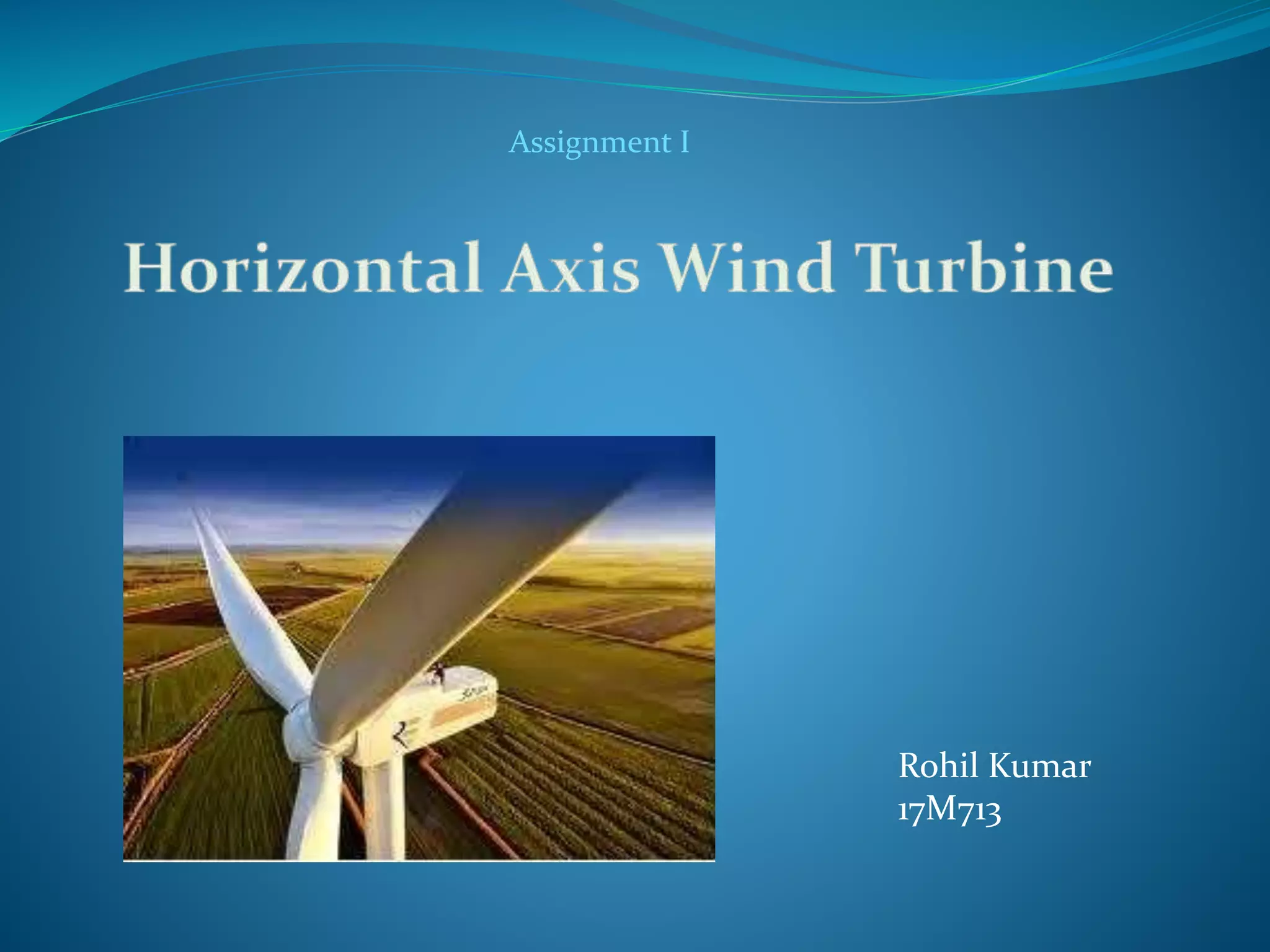
Horizontal axis wind turbine

  • 1.
  • 2.
    Abstract  In thispresentation I described about HAWT, its components & their operations, HAWT technological evolution with time and global wind capacity.
  • 3.
    Index  Components  Rotor Hub  Nacelle  Generator & Controller  Yaw system  Tower & Foundation  HAWT Technological Evolution  Global Wind Capacity  References
  • 4.
    Components  Rotor o Blades oHub  Nacelle o Low speed shaft o Brake gear box o High speed shaft o Generator o Controller o Anemometer and wind vane  Yaw system  Tower  Foundation
  • 6.
    Rotor  Blade o Mainpart, convert free flowing wind energy to useful work o Approx. 20% of the wind turbine cost o Uses Lift and Drag principle. o Three blade rotor is best compared to two and single blade turbine.  The blades rotate at 10 to 22 rpm. At 22 rpm the tip speed exceeds 90 m/s. Higher tip speeds means more noise and blade erosion.
  • 7.
     Single bladeHAWT:  Reduces cost and weight of the turbine.  Rarely used due to tower shadow effects, needs counter weights on the other side of the blade, less stability.  Two blade HAWT:  Requires more complex design due to sustain of wind shocks.  less stable, saves cost & weight of one rotor blade.  Three blade HAWT:  High strength .  Less effect due to tower shadow. Produces high output.
  • 8.
    A turbine bladeconvoy passing through Edenfield, England Components of a HAWT(gearbox, rotor shaft and brake assembly) being lifted into position
  • 9.
    Hub  In simpledesigns, blades are directly bolted to hub.  In sophisticated designs they are bolted to the pitch mechanism, which adjust their angle of attack according to their wind speed.  The hub is fixed to the rotor shaft which derives the generator through a gear box.
  • 11.
    Nacelle  Low speedshaft o The shaft from the hub to the gear box o Speed is typically between 40 to 400 rpm o Generator typically rotated at 1200 rpm to 1800 rpm  Brake Gear box o Gear box increases the speed of the shaft o Meet the requirement of the generator  High speed shaft o Gear box shaft is followed by the high speed shaft o Connects to generator
  • 12.
     Braking mechanism oA mechanical drum brake is used to stop turbine in emergency situation. o This brake is also used to hold at rest for maintenance. Main shaft
  • 13.
    Generator  Converts mechanicalenergy to electrical energy. which is approx. 34% of the wind turbine cost.  generate electricity through asynchronous machines that are directly connected with the electricity grid.  One end attached to the wind turbine, other end connected to the electrical grid.  Require cooling system to prevent overheating. Controller  Starts when the machine at wind speed of about 4 m/s and shuts off the machines at about 25m/s , may damage wind turbine.  It gets wind speed data from the anemometer and accordingly.
  • 14.
    Yaw system o Responsiblefor the orientation of the wind turbine rotor towards the wind. o It is the mean of rotatable connection between nacelle and tower. o The nacelle is mounted on a roller bearing and the azimuth is achieved via a plurality of powerful electrical drives.  Yaw system consist of o Yaw bearing o Yaw drives o Yaw brake
  • 15.
  • 16.
    Yaw bearing  Canbe of the roller or gliding type, servers as a rotatable connection between the tower and nacelle of the wind turbine. Yaw drive  Used to keep the rotor facing into the wind as the wind direction changes.  The yaw drives exist only on the active yaw system and are the mean of active rotation of the wind turbine nacelle .  Each yaw drives consists of powerful electric motor (usually AC) with its electric drive and a large gearbox , which increases the torque.
  • 17.
    Yaw brakes  Inorder to stabilize the yaw bearing against rotation a mean of braking is necessary.  One of the simplest ways to realize the task is to apply a constant small counter torque at the yaw drives.  This operation however greatly reduces the reliability of the electric yaw drives, therefore the most common solution is the implementation of a hydraulically actuated disk brake.
  • 18.
    Tower  Typically, 2types of towers exist o Floating towers o Land based tower  Floating towers can be seen in offshore wind farms where the towers are float on water.  Land based towers can be seen in the onshore wind farm where the tower are situated on the land.  For HAWTs, tower heights approx. 2 to 3 times the blade length have been found to balance material costs of the tower against better utilization of the expensive active components.  At the bottom level of the tower there will be step up transformers for the connection for the connection to the grid.
  • 19.
  • 20.
  • 21.
    Foundation  A verygood foundation is required to support the tower and various parts of a wind turbine which weighs in tonnes.  The structural support component, which is approxi. 15% of the wind turbine cost, includes the tower & rotor yaw mechanism.
  • 22.
    Offshore Horizontal AxisWind Turbines (HAWTs) at Scroby Sands Wind Farm, England
  • 23.
    Onshore Horizontal AxisWind Turbines in Zhangjiakou, China
  • 24.
    Alta Wind EnergyCentre, US
  • 25.
    Denmark aims torun 100% on wind energy by 2050
  • 26.
    HAWT Technological Evolution Useful wind speeds. There is a range of wind speeds within which the rotor can move and function properly.  Lower limit - “Cut-in” = 4 m/s (approx. 14 km/h). With wind speeds below this value, it is not possible to activate the rotation of the blades and the rotor remains stationary.  Upper limit - “Cut-off” ~ 25 m/s (approx. 90 km/h). Above this speed, the rotor is stopped to avoid serious structural problems.  Wind limit value - “Survival Speed”, representing the maximum design wind speed which the structure of turbine & blades can withstand without incurring damage. This value varies depending on the type of wind turbine and generally is approx. 60m/s, (approx. 216 km/h).
  • 27.
    Conversion efficiency : Conversion of kinetic energy into electricity of modern-day wind machines is around 25%.  The maximum theoretical efficiency of a wind turbine system is defined by Betz’s law, which identifies the so-called “Betz limit” corresponding to a maximum efficiency of 59%. Capacity factor:  Equivalent number of hours of operation (at the maximum rated system power) throughout the year.(8760 hours).  Capacity Factor values vary from 20% (1750 hours/ year at full power) to 40% (3500 hours/year at full power);  In certain exceptional cases it is possible to reach values close to 50% (4400 hours/year at full power).  In Italy the current Capacity Factor of the entire national wind farm is 25%, corresponding to approx. 2,200 hours per year of system operation at nominal power.
  • 28.
    Dimensions and electricitygenerated  Systems marketed in the nineties:  Heights - approx. 50 m  Rotor dia. - 40 m  Modern systems:  On-shore Systems o Heights - 130 m in (higher than a 40-floor building) o Blade dia. – 100 to 130 m o Length of blades – 50 to 65 m  Off-shore Systems  Heights - 220 m (approx. 75 floors)  Blade dia. > 154 metres  The power produced by each turbine has increased exponentially in recent years.  Nineties power generated (individual machine) - 600 to 900 kW  Now , On-shore installations - 2 MW & 5 MW,  Of-shore installations - 7 MW.
  • 29.
    Technological evolution: aforecast of the nominal power compared to the rotor diameter (Credits: Sandia 2014 – Wind Turbine Blade Workshop – Zayas).
  • 30.
  • 31.
    World Record  Currentlythe record for the biggest wind turbine in the world is held by the Vestas V164 (Vestas Wind Systems A/S is a Danish manufacturer) -  rotor diameter of 164 m  tower height of 205 m  nominal output of 8 MW  the prototype of which was installed in January 2014 in Denmark  while the first wind farm is in operation since April 2016 in England.
  • 32.
  • 33.
    References  https://en.wikipedia.org/wiki/Wind_turbine  https://www.dolcera.com/wiki/index.php?title=Different_Types_and_ Parts_of_a_Horizontal_Axis_Wind_Turbines http://www.eniscuola.net/en/2016/05/31/horizontal-axis-wind- turbine-technological-evolution/  http://css.umich.edu/factsheets/wind-energy-factsheet