Data Analysis Course
Descriptive Statistics(Version-1)
Venkat Reddy
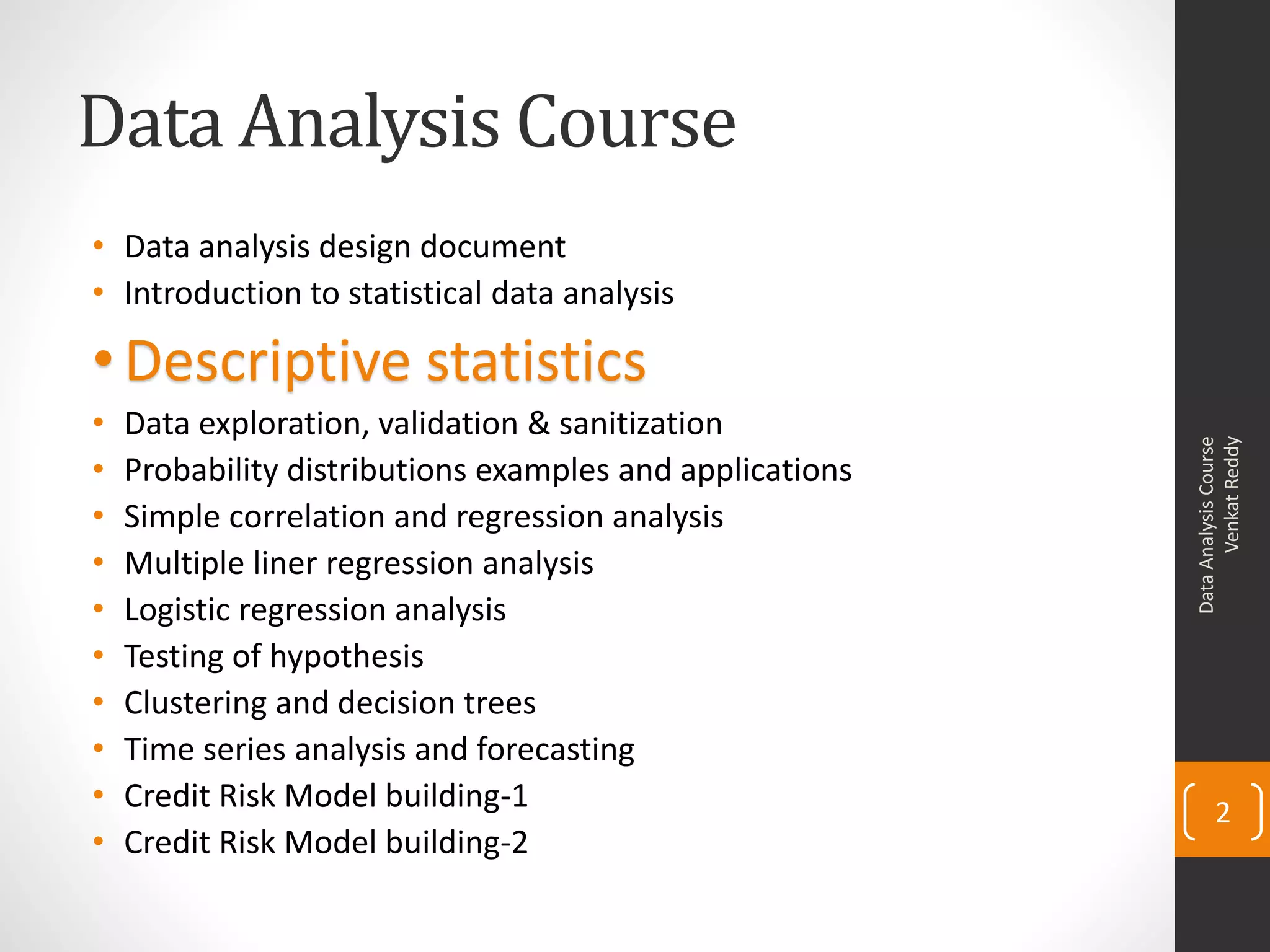
Data Analysis Course
• Data analysis design document
• Introduction to statistical data analysis

• Descriptive statistics
•   Data exploration, validation & sanitization


                                                                Venkat Reddy
                                                          Data Analysis Course
•   Probability distributions examples and applications
•   Simple correlation and regression analysis
•   Multiple liner regression analysis
•   Logistic regression analysis
•   Testing of hypothesis
•   Clustering and decision trees
•   Time series analysis and forecasting
•   Credit Risk Model building-1                                 2
•   Credit Risk Model building-2
Note
• This presentation is just class notes. The course notes for Data
  Analysis Training is by written by me, as an aid for myself.
• The best way to treat this is as a high-level summary; the
  actual session went more in depth and contained other


                                                                           Venkat Reddy
                                                                     Data Analysis Course
  information.
• Most of this material was written as informal notes, not
  intended for publication
• Please send questions/comments/corrections to
  venkat@trenwiseanalytics.com or 21.venkat@gmail.com
• Please check my website for latest version of this document
                                         -Venkat Reddy                      3
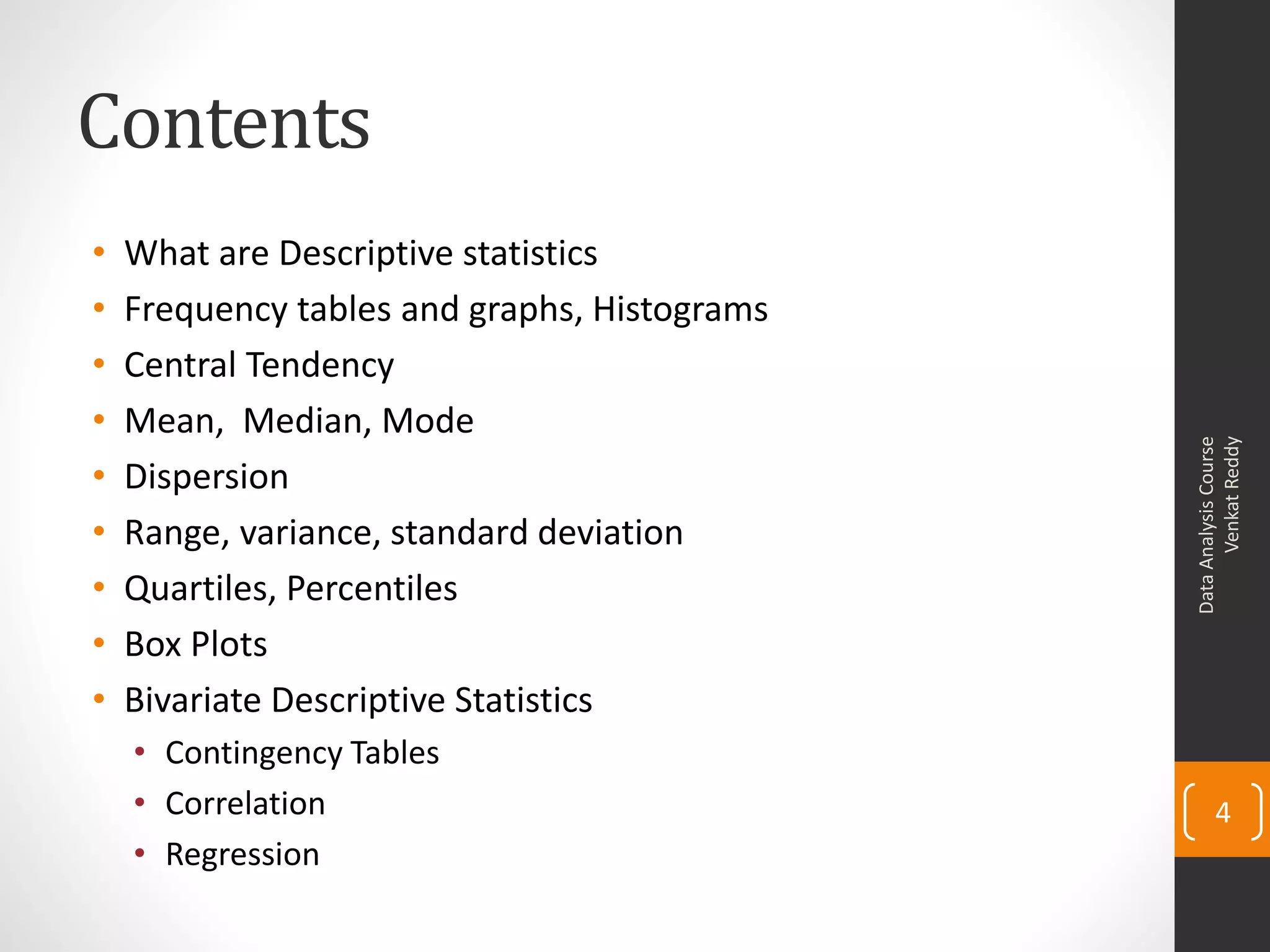
Contents
•   What are Descriptive statistics
•   Frequency tables and graphs, Histograms
•   Central Tendency
•   Mean, Median, Mode


                                                    Venkat Reddy
                                              Data Analysis Course
•   Dispersion
•   Range, variance, standard deviation
•   Quartiles, Percentiles
•   Box Plots
•   Bivariate Descriptive Statistics
    • Contingency Tables
    • Correlation                                    4
    • Regression
Why Descriptive statistics?
• Who is a better ODI batsmen - Sachin or Muralidharan?
   • Batting average?
• Who is the reliable- Dhoni or Afridi?
   • Score variance
• A triangular series among Aus, Eng & Newziland ; Who will win?
   • Most number of wins - Mode


                                                                                  Venkat Reddy
                                                                            Data Analysis Course
• I am going to buy shoes. Which brand has verity- Power or Adidas?
   • Price range - Range

• We used Average, Variance, Mode, Range to make some inferences.
  These are nothing but descriptive statistics
• Descriptive statistics tell us what happened in the past.
• Descriptive statistics avoid inferences but, they help us to get a feel
  of the data.
• Some times they are good enough to make an inference.                            5
Descriptive Statistics
• A statistic or a measure that describes the data
  • Average salary of employees
• Describing data with tables and graphs (quantitative or
  categorical variables)


                                                                          Venkat Reddy
                                                                    Data Analysis Course
• Numerical descriptions
  • Center – Give some example measures of center of the data
  • Variability– Give some example measures of variability of the
    data
• Bivariate descriptions (In practice, most studies have several
  variables)
  • Dependency measures(Correlation)
                                                                           6
Simple Descriptive Statistics
•   N
•   Sum
•   Min
•   Max


                                                                       Venkat Reddy
                                                                 Data Analysis Course
•   Average
•   Frequency of each level
•   Variance
•   Standard deviation

These simple descriptive statistics will be use in inferential
statistics later.                                                       7
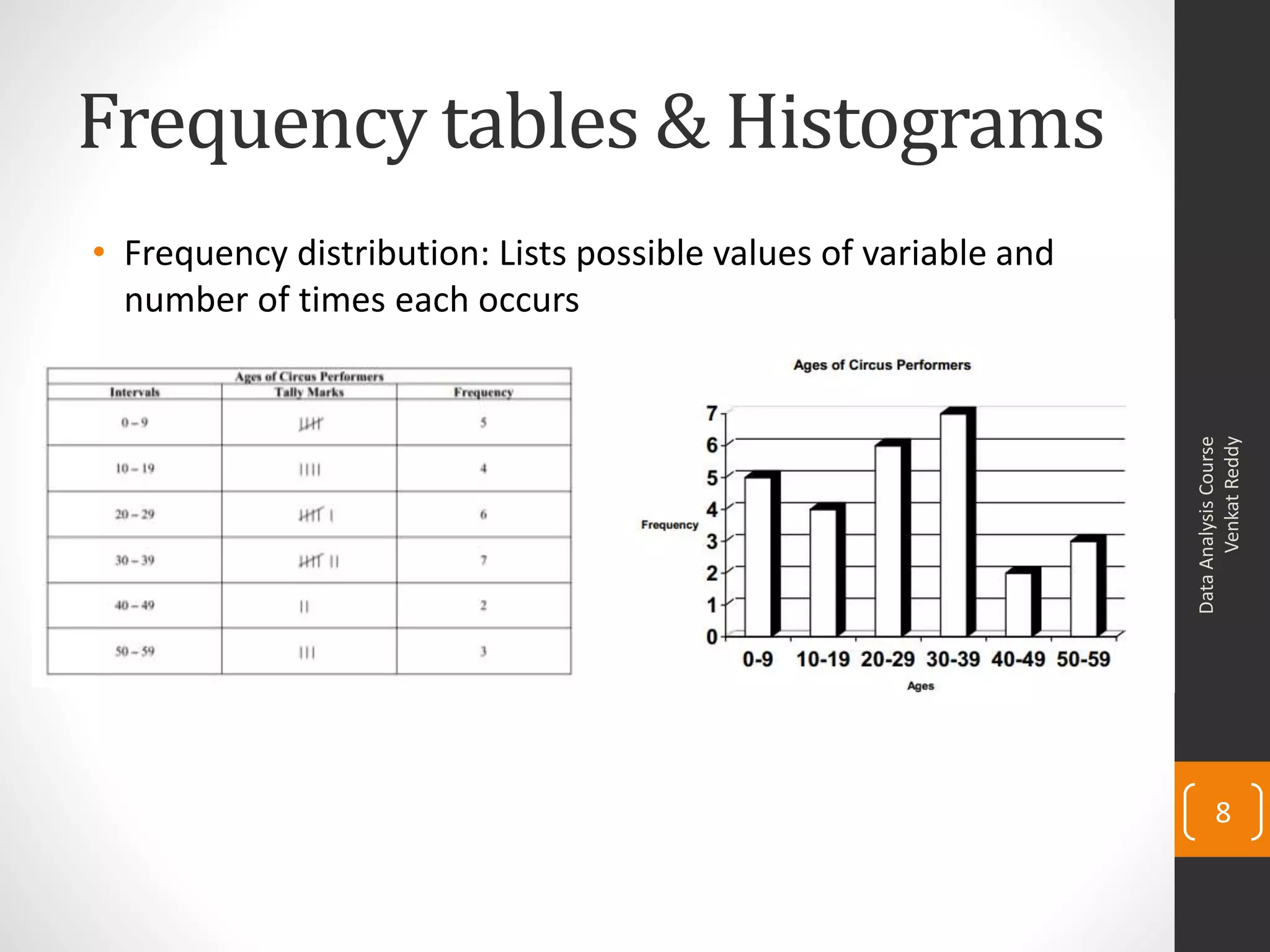
Frequency tables & Histograms
• Frequency distribution: Lists possible values of variable and
  number of times each occurs


                                                                        Venkat Reddy
                                                                  Data Analysis Course
                                                                         8
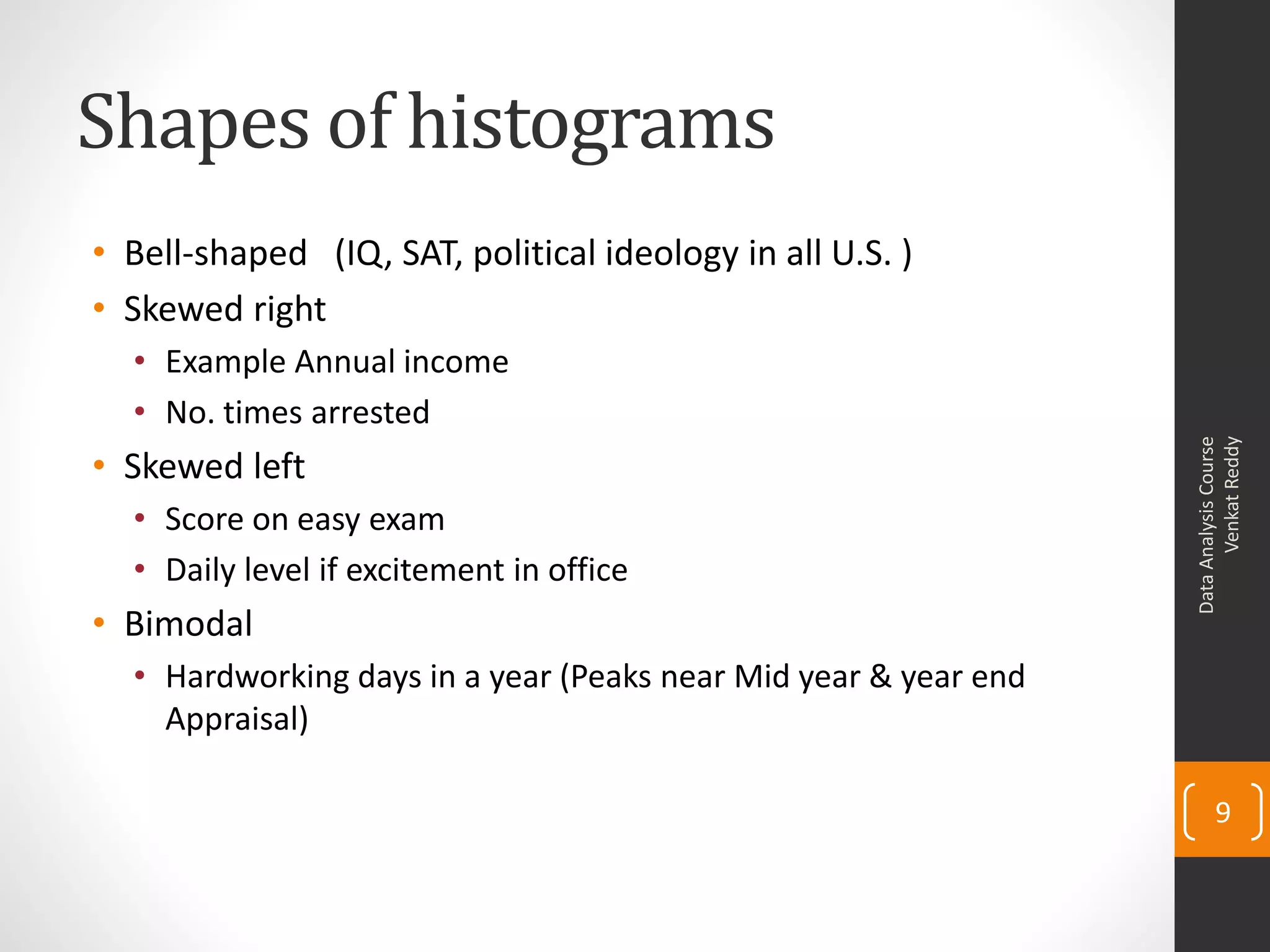
Shapes of histograms
• Bell-shaped (IQ, SAT, political ideology in all U.S. )
• Skewed right
  • Example Annual income
  • No. times arrested


                                                                       Venkat Reddy
                                                                 Data Analysis Course
• Skewed left
  • Score on easy exam
  • Daily level if excitement in office
• Bimodal
  • Hardworking days in a year (Peaks near Mid year & year end
    Appraisal)

                                                                        9
Lab : Histogram
• Create a histogram on variable ‘actual’ in prdsale data
  • How many modes?
  • What is the skewness?
  • What is its kurtosis?
• Create a histogram on variable ‘msrp’ in cars data


                                                                  Venkat Reddy
                                                            Data Analysis Course
  • How many modes?
  • What is the skewness?
  • What is its kurtosis?
• Create a histogram on variable ‘weight’ in cars data
  • How many modes?
  • What is the skewness?
  • What is its kurtosis?

                                                                10
Compare the above three histograms.
Central tendency
• What is the flight fare from Bangalore to Delhi? 3500–Exact or
  average?
• What is central tendency? - Average
• Three types of Averages


                                                                         Venkat Reddy
                                                                   Data Analysis Course
  • Mean
  • Median
  • Mode


                                                                       11
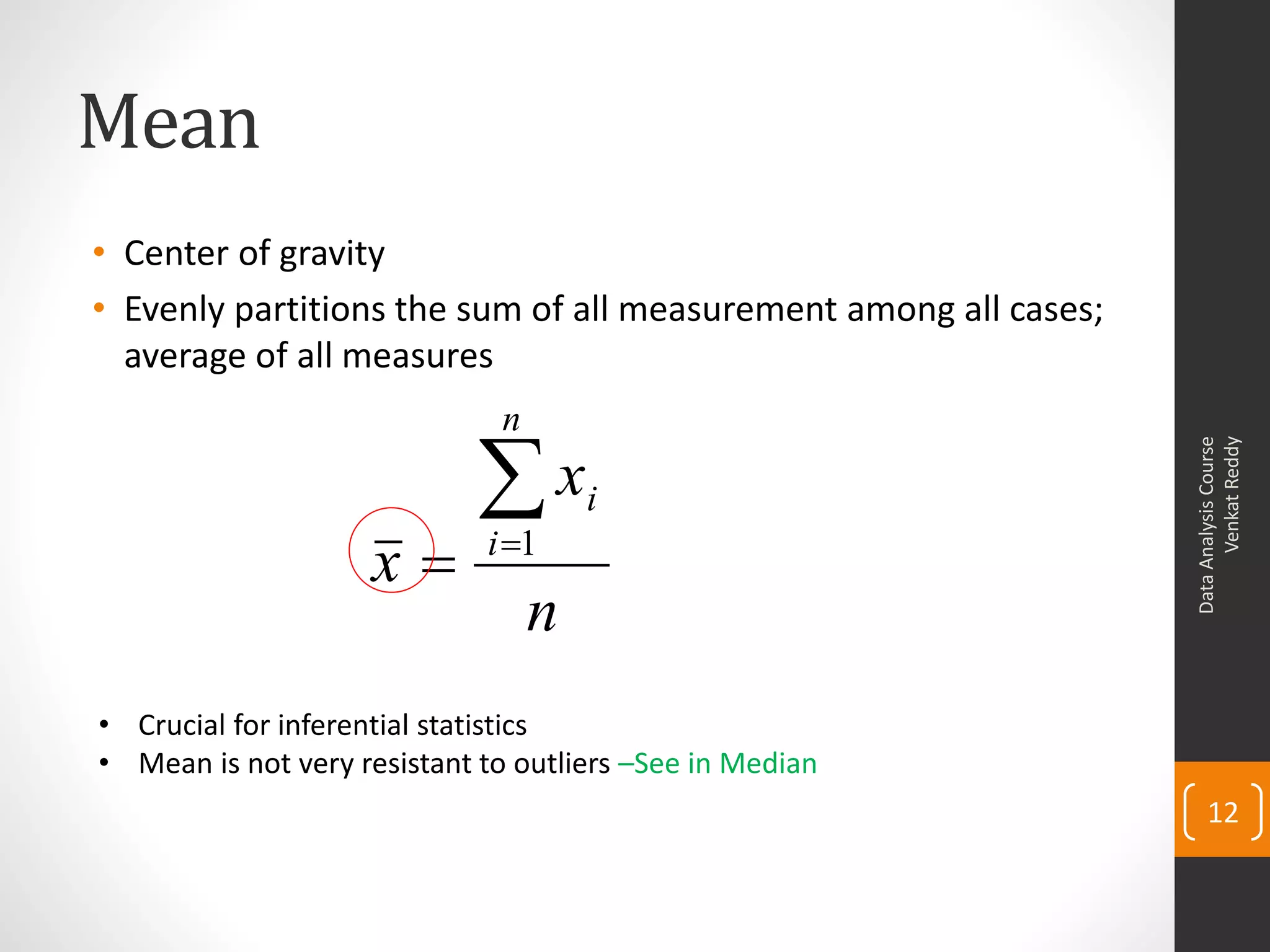
Mean
• Center of gravity
• Evenly partitions the sum of all measurement among all cases;
  average of all measures
                              n

                            x


                                                                        Venkat Reddy
                                                                  Data Analysis Course
                                      i
                    x       i 1

                                  n
• Crucial for inferential statistics
• Mean is not very resistant to outliers –See in Median
                                                                      12
Median
• What is the mean of [0.1     0.8    0.4    0.3     0.1
      0.4      9.0    0.1      0.9    0.3    1.0     0.3
      0.1]
• Guess without calculation – Around 0.5?
• Now calculate the mean


                                                                      Venkat Reddy
                                                                Data Analysis Course
• Median is exactly in the middle. Isn’t mean exactly in the
  middle
• Order the observations in ascending or descending order and
  pick the middle observation
• less useful for inferential purposes
                                                                    13
• More resistant to effects of outliers…
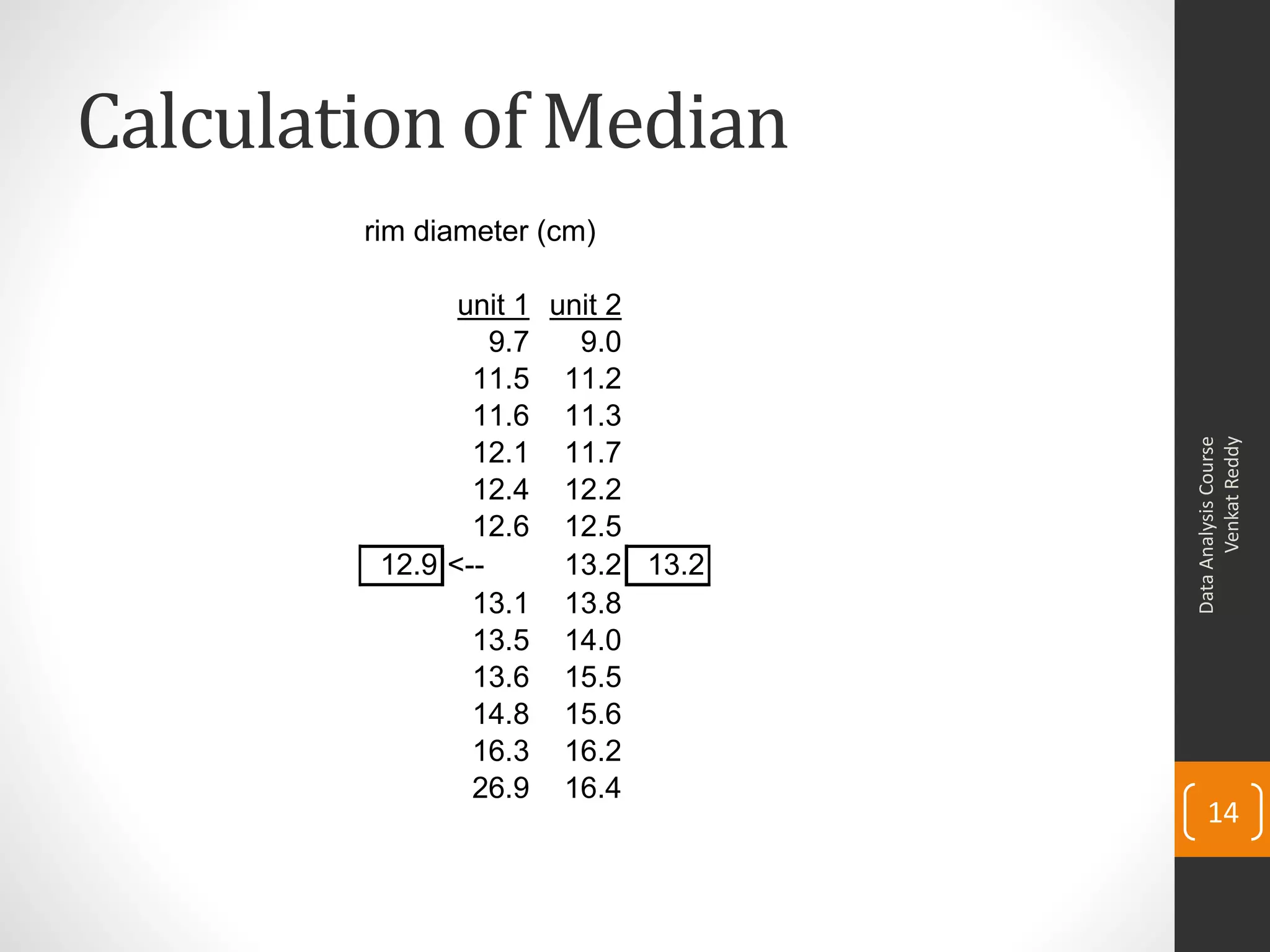
Calculation of Median
        rim diameter (cm)

               unit 1 unit 2
                  9.7   9.0
                11.5 11.2
                11.6 11.3


                                         Venkat Reddy
                                   Data Analysis Course
                12.1 11.7
                12.4 12.2
                12.6 12.5
         12.9 <--      13.2 13.2
                13.1 13.8
                13.5 14.0
                13.6 15.5
                14.8 15.6
                16.3 16.2
                26.9 16.4
                                       14
Mode
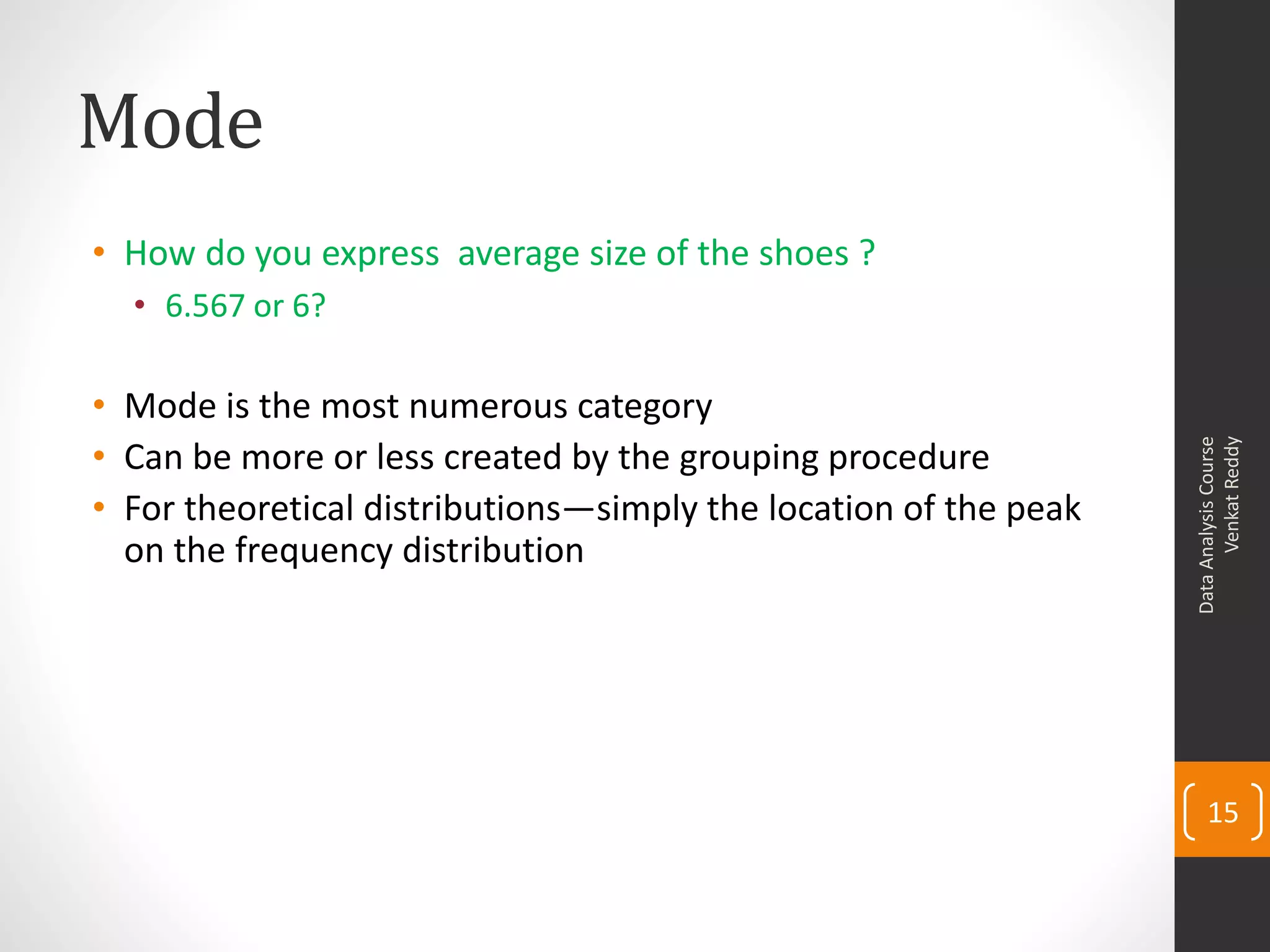
• How do you express average size of the shoes ?
  • 6.567 or 6?

• Mode is the most numerous category
• Can be more or less created by the grouping procedure


                                                                        Venkat Reddy
                                                                  Data Analysis Course
• For theoretical distributions—simply the location of the peak
  on the frequency distribution


                                                                      15
Lab
•   Run Proc means data product data
•   What is the mean of ‘msrp’ in cars data?
•   Is it reflecting the average value of price?
•   What is median of ‘msrp’ in cars data?


                                                                       Venkat Reddy
                                                                 Data Analysis Course
•   Is it reflecting the average value of price?
•   Run Proc Univariate on weight varaibale in cars data. Find
    mean, Median & Mode.


                                                                     16
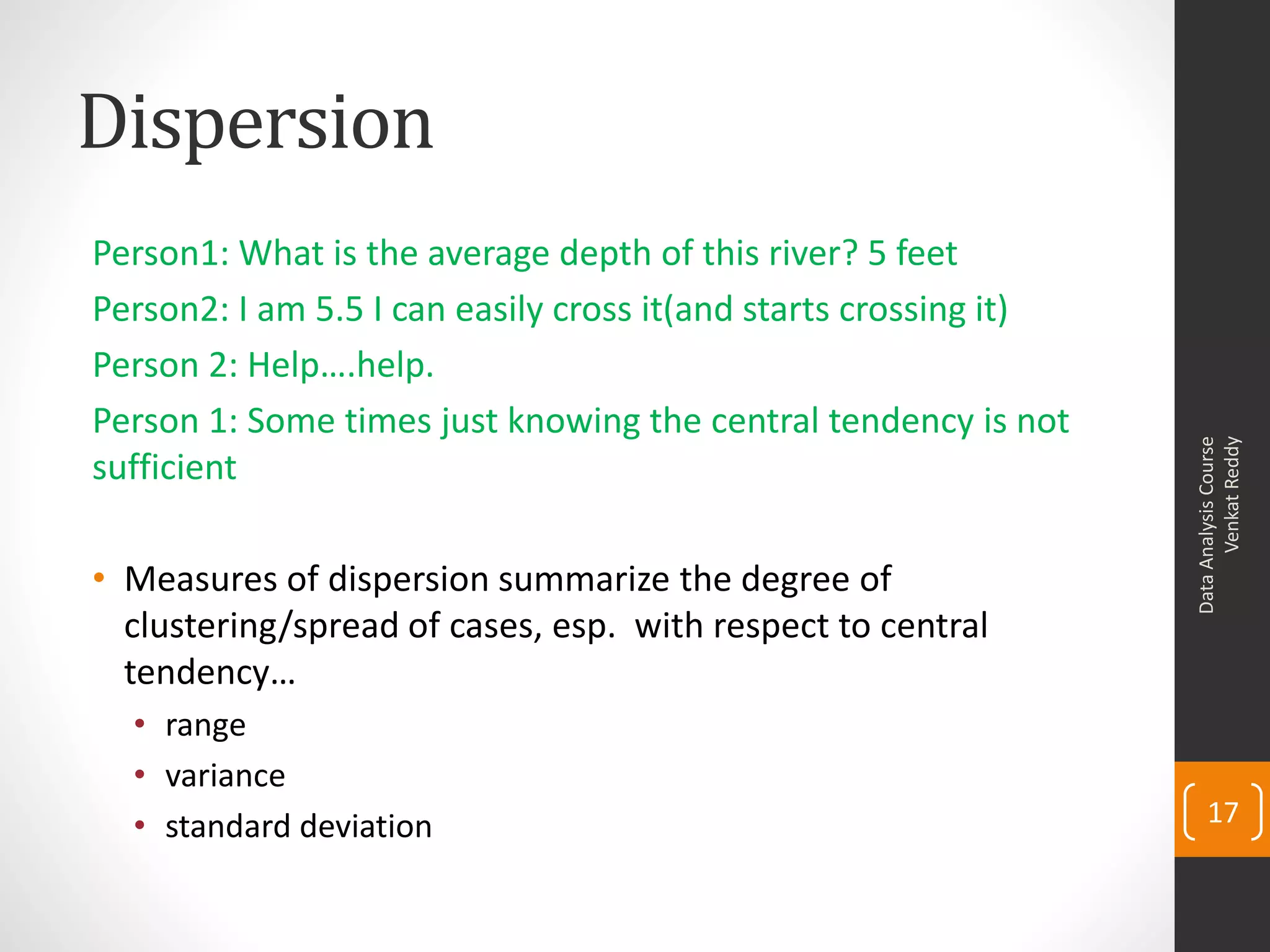
Dispersion
Person1: What is the average depth of this river? 5 feet
Person2: I am 5.5 I can easily cross it(and starts crossing it)
Person 2: Help….help.
Person 1: Some times just knowing the central tendency is not


                                                                        Venkat Reddy
                                                                  Data Analysis Course
sufficient

• Measures of dispersion summarize the degree of
  clustering/spread of cases, esp. with respect to central
  tendency…
  • range
  • variance
  • standard deviation                                                17
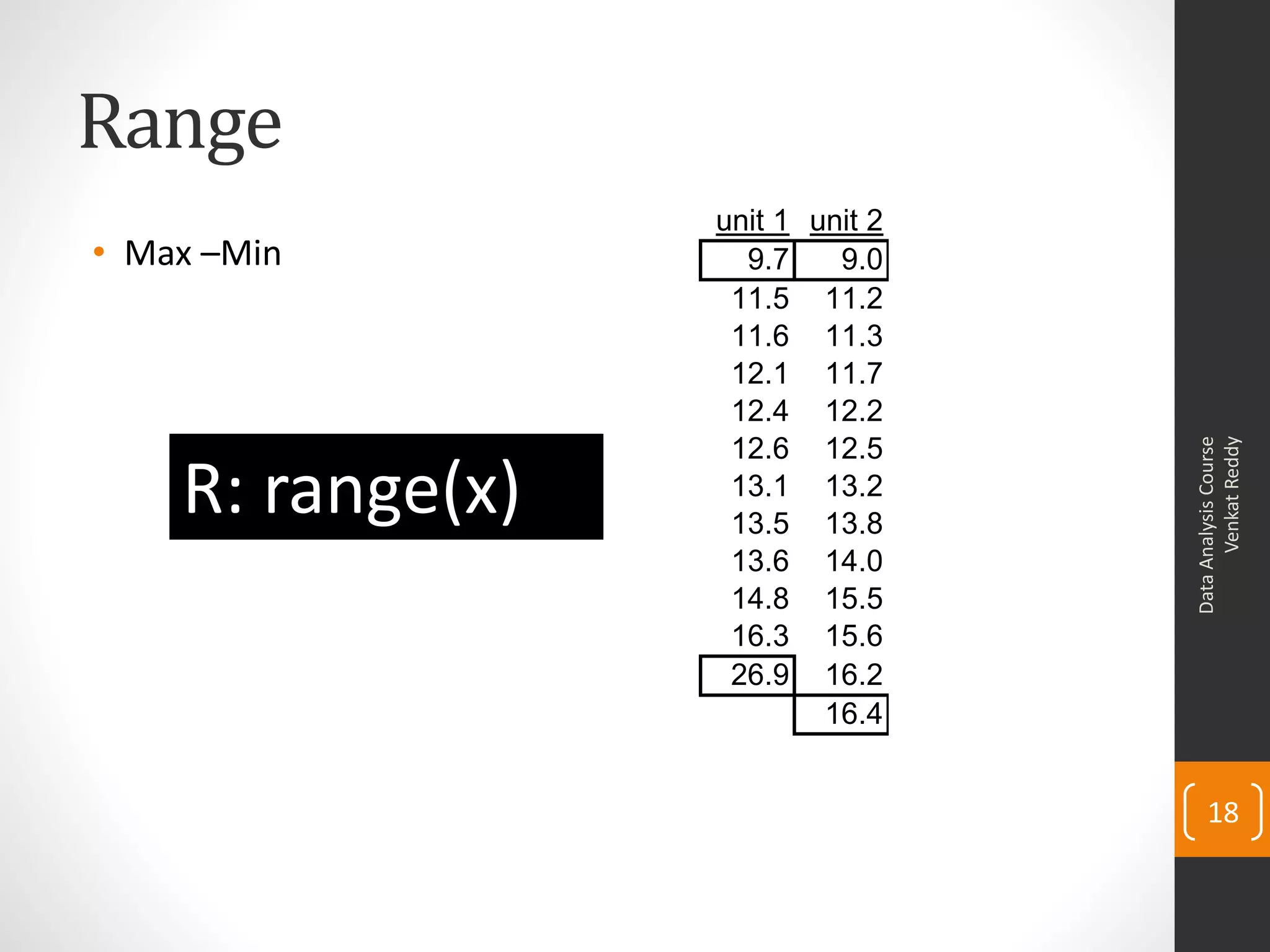
Range
                  unit 1 unit 2
• Max –Min          9.7    9.0
                   11.5 11.2
                   11.6 11.3
                   12.1 11.7
                   12.4 12.2


                                        Venkat Reddy
                                  Data Analysis Course
                   12.6 12.5
    R: range(x)    13.1 13.2
                   13.5 13.8
                   13.6 14.0
                   14.8 15.5
                   16.3 15.6
                   26.9 16.2
                          16.4


                                      18
Variance
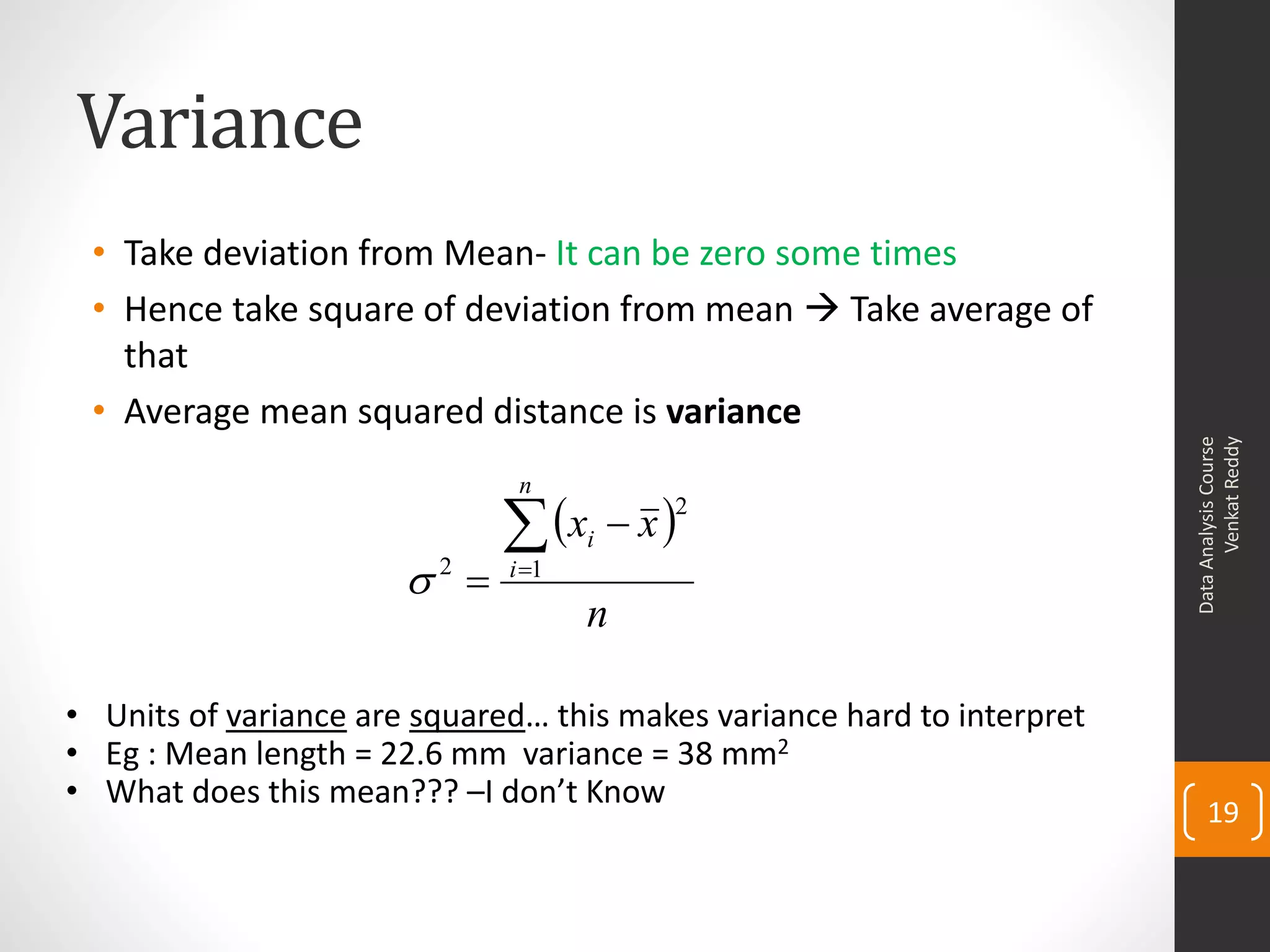
 • Take deviation from Mean- It can be zero some times
 • Hence take square of deviation from mean  Take average of
   that
 • Average mean squared distance is variance


                                                                               Venkat Reddy
                                                                         Data Analysis Course
                               n

                               x  x 
                                         2
                                     i
                       2    i 1
                                     n

• Units of variance are squared… this makes variance hard to interpret
• Eg : Mean length = 22.6 mm variance = 38 mm2
• What does this mean??? –I don’t Know
                                                                             19
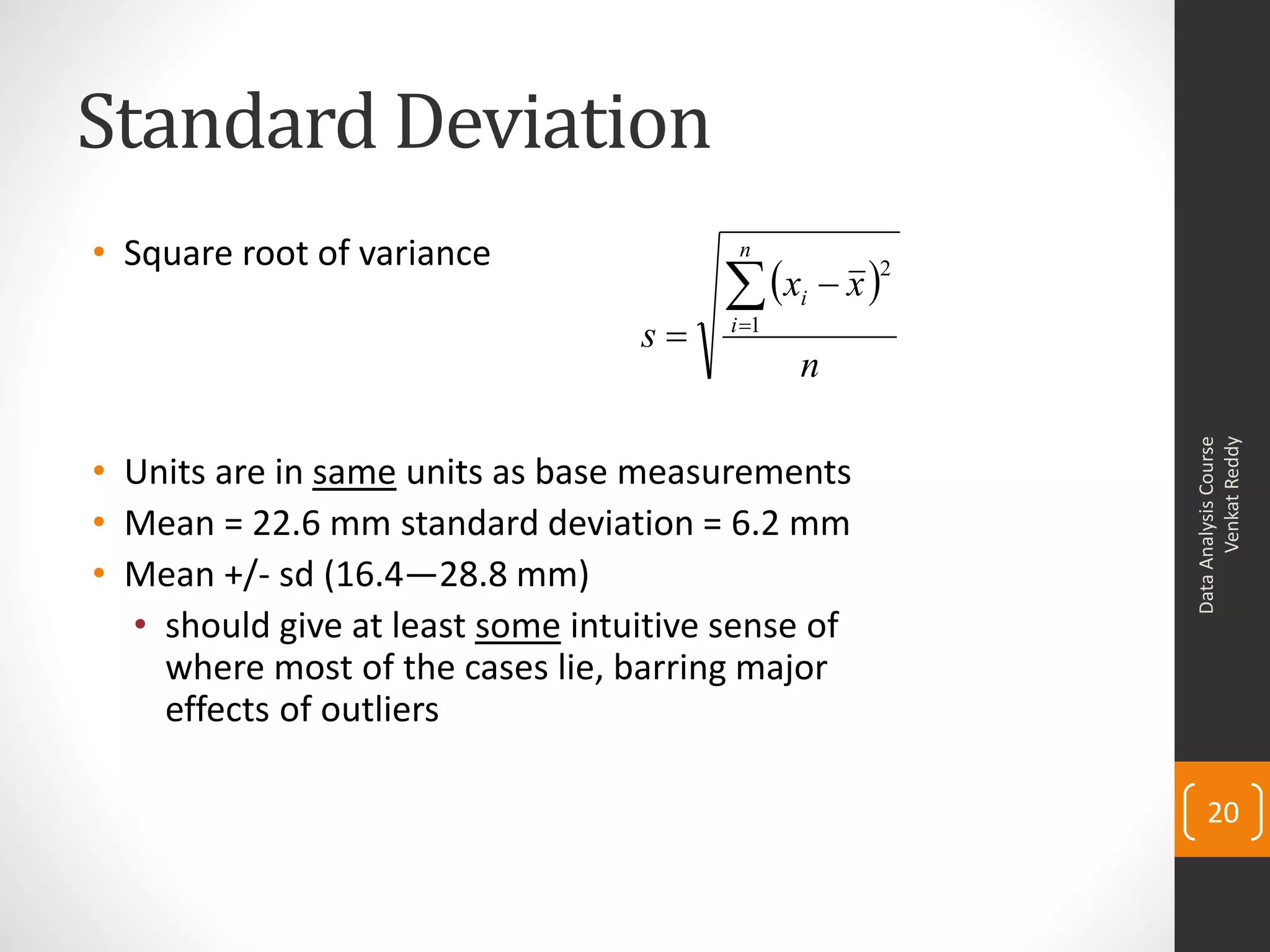
Standard Deviation
• Square root of variance                n

                                        xi  x 2
                                  s    i 1
                                               n


                                                            Venkat Reddy
                                                      Data Analysis Course
• Units are in same units as base measurements
• Mean = 22.6 mm standard deviation = 6.2 mm
• Mean +/- sd (16.4—28.8 mm)
  • should give at least some intuitive sense of
    where most of the cases lie, barring major
    effects of outliers

                                                          20
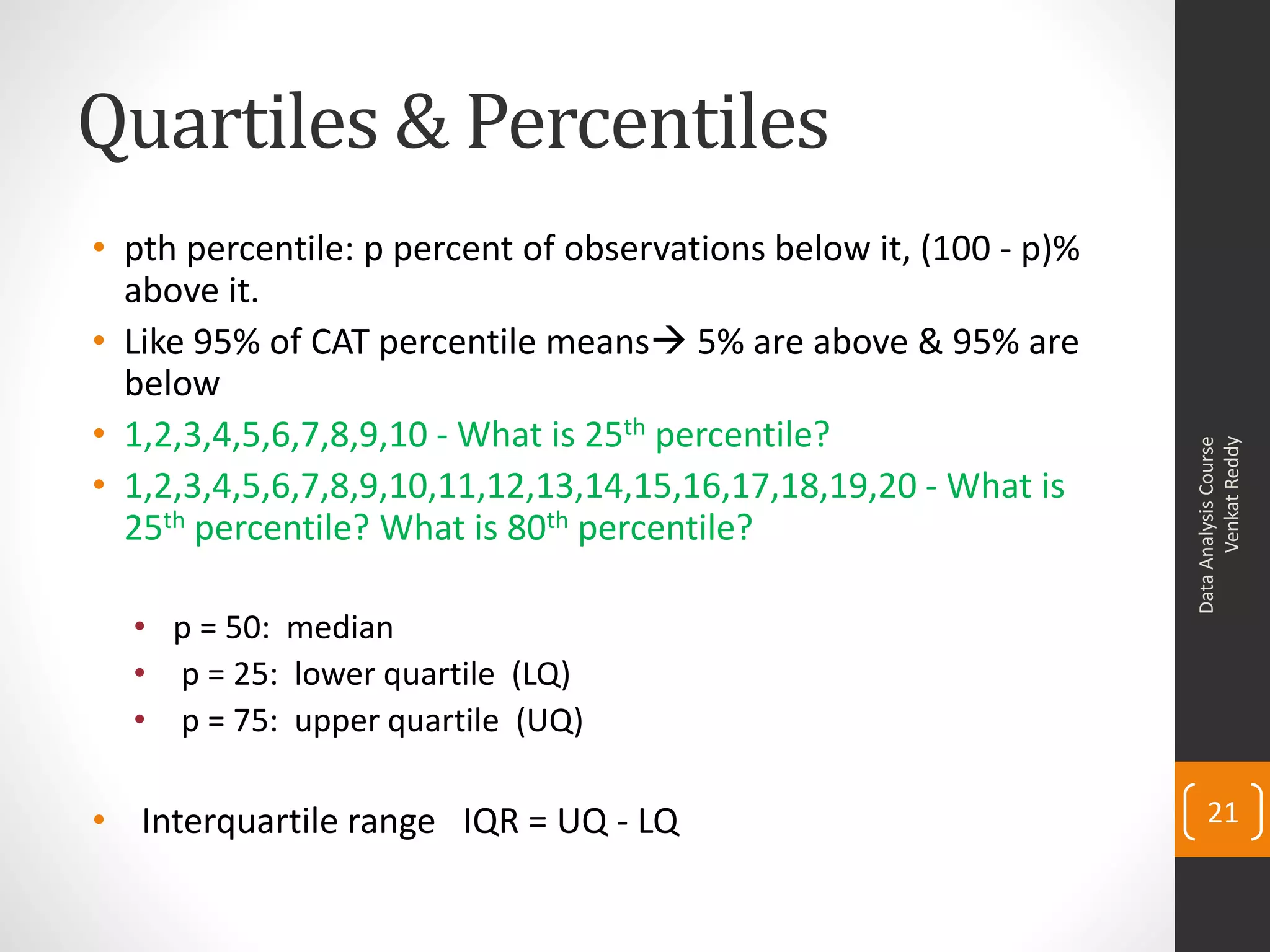
Quartiles & Percentiles
• pth percentile: p percent of observations below it, (100 - p)%
  above it.
• Like 95% of CAT percentile means 5% are above & 95% are
  below
• 1,2,3,4,5,6,7,8,9,10 - What is 25th percentile?


                                                                         Venkat Reddy
                                                                   Data Analysis Course
• 1,2,3,4,5,6,7,8,9,10,11,12,13,14,15,16,17,18,19,20 - What is
  25th percentile? What is 80th percentile?

  • p = 50: median
  • p = 25: lower quartile (LQ)
  • p = 75: upper quartile (UQ)

• Interquartile range IQR = UQ - LQ                                    21
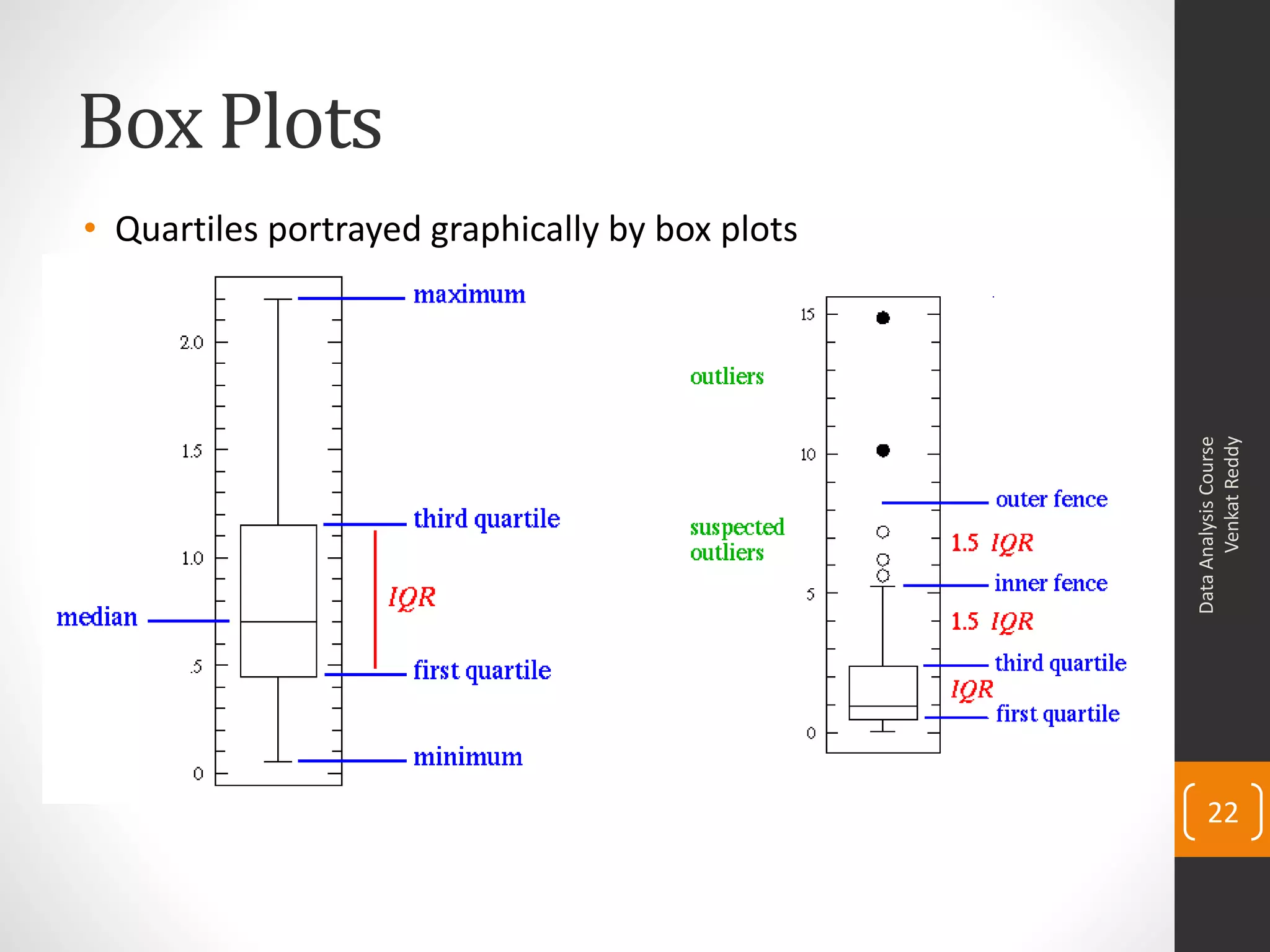
Box Plots
• Quartiles portrayed graphically by box plots


                                                       Venkat Reddy
                                                 Data Analysis Course
                                                     22
Box Plots


                                                         Venkat Reddy
                                                   Data Analysis Course
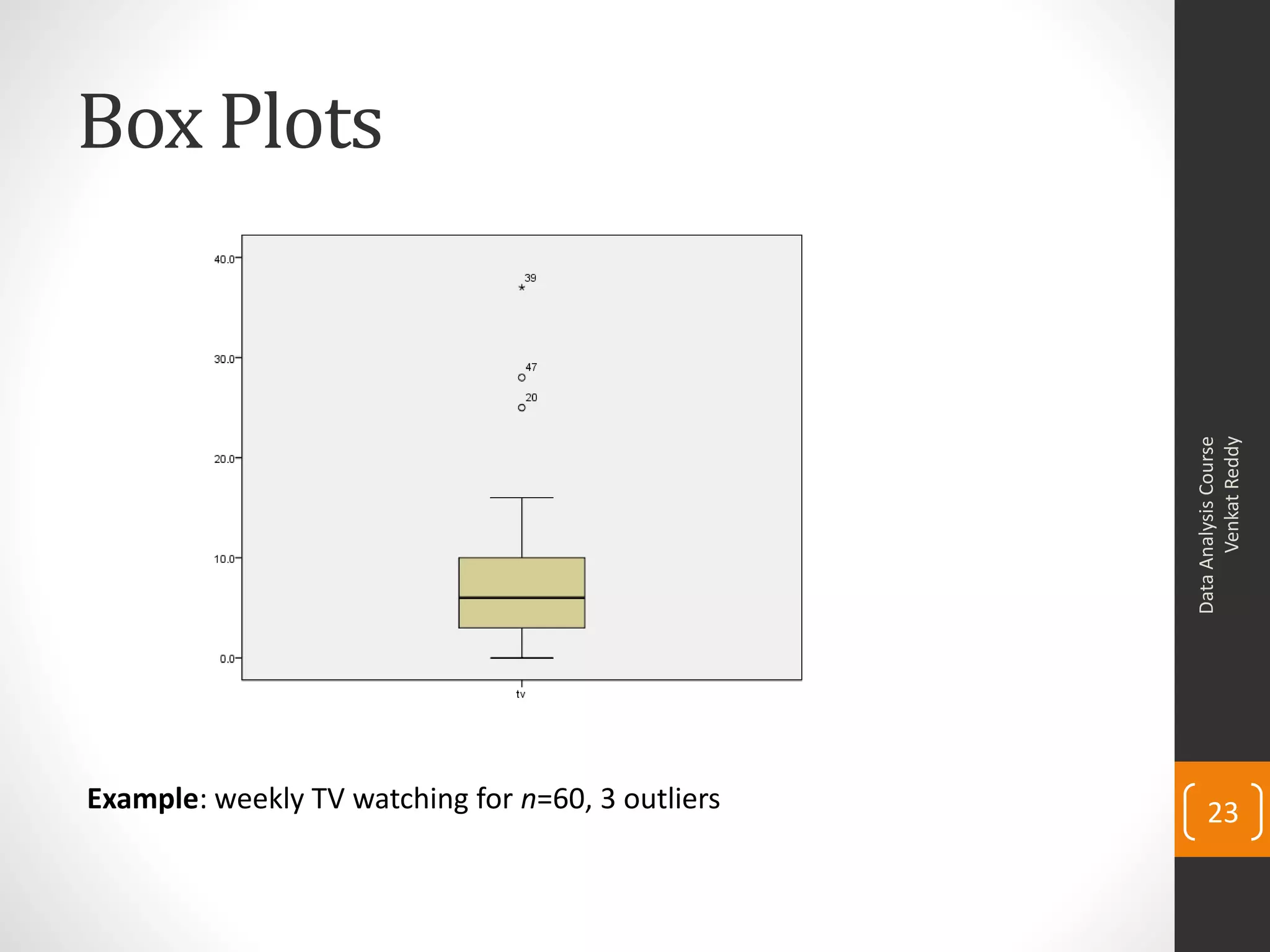
Example: weekly TV watching for n=60, 3 outliers       23
Box Plots Interpretation
• Box plots have box from LQ to UQ, with median marked. They
  portray a five-number summary of the data: Minimum, LQ,
  Median, UQ, Maximum
• Except for outliers identified separately
• Outlier = observation falling


                                                                       Venkat Reddy
                                                                 Data Analysis Course
          below LQ – 1.5(IQR) or above UQ + 1.5(IQR)
• Ex. If LQ = 2, UQ = 10, then IQR = 8 and outliers above 10 +
  1.5(8) = 22


                                                                     24
Lab
• Run proc univariate on a variable from sample data in sas
  default library(prd sale / cars)
• Run proc means on actual & predicted variables from product
  sales data
• What are the values of Range, Variance, SD


                                                                      Venkat Reddy
                                                                Data Analysis Course
• What are 1,2,3 & 4 quartile values
• What is 95th percentile?
• Use “all” option to display the box plots


                                                                    25
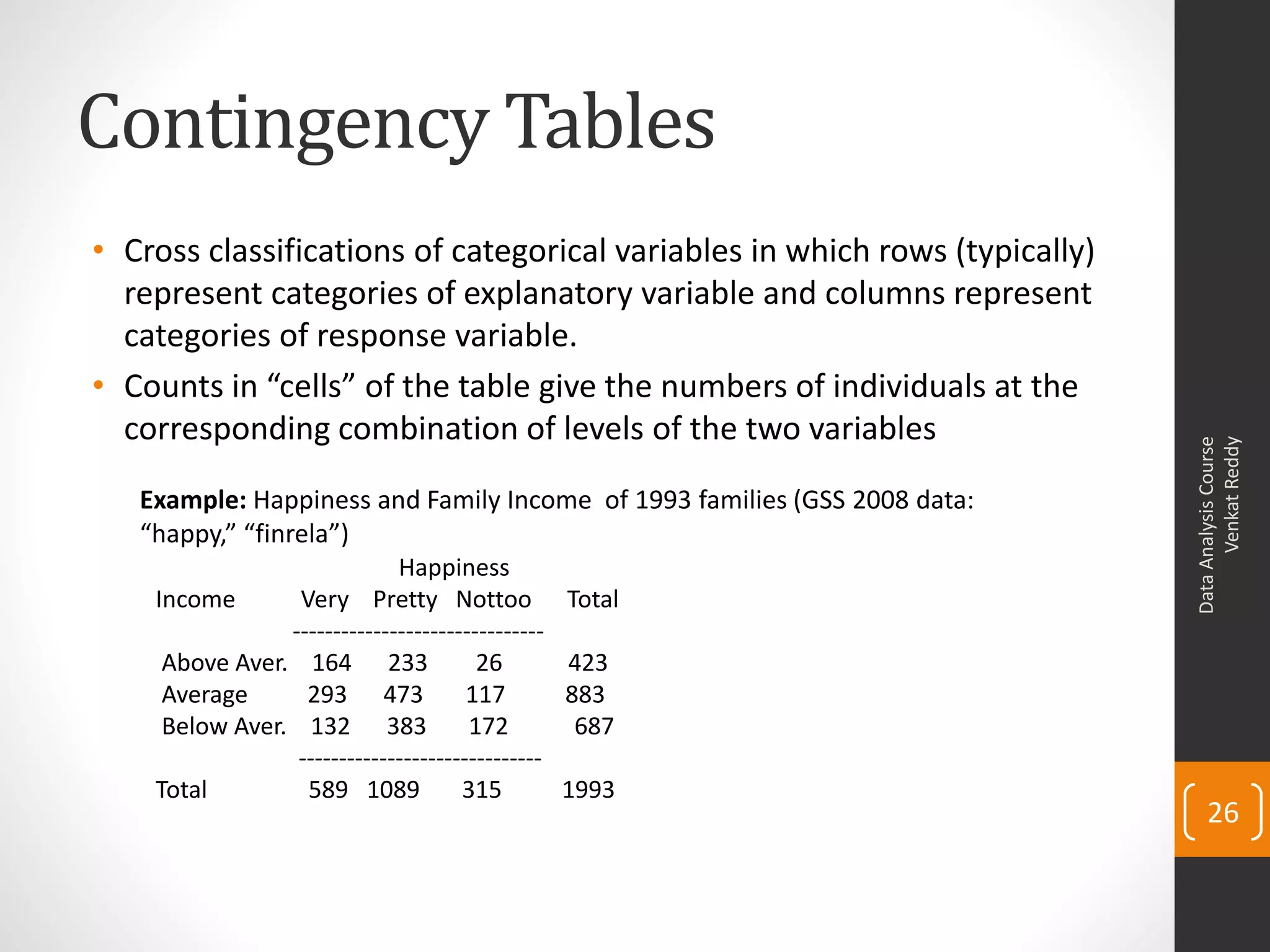
Contingency Tables
• Cross classifications of categorical variables in which rows (typically)
  represent categories of explanatory variable and columns represent
  categories of response variable.
• Counts in “cells” of the table give the numbers of individuals at the
  corresponding combination of levels of the two variables


                                                                                   Venkat Reddy
                                                                             Data Analysis Course
   Example: Happiness and Family Income of 1993 families (GSS 2008 data:
   “happy,” “finrela”)
                             Happiness
    Income       Very Pretty Nottoo               Total
                -------------------------------
     Above Aver. 164 233               26         423
     Average      293 473             117         883
     Below Aver. 132 383              172          687
                 ------------------------------
    Total         589 1089           315          1993
                                                                                 26
Contingency tables
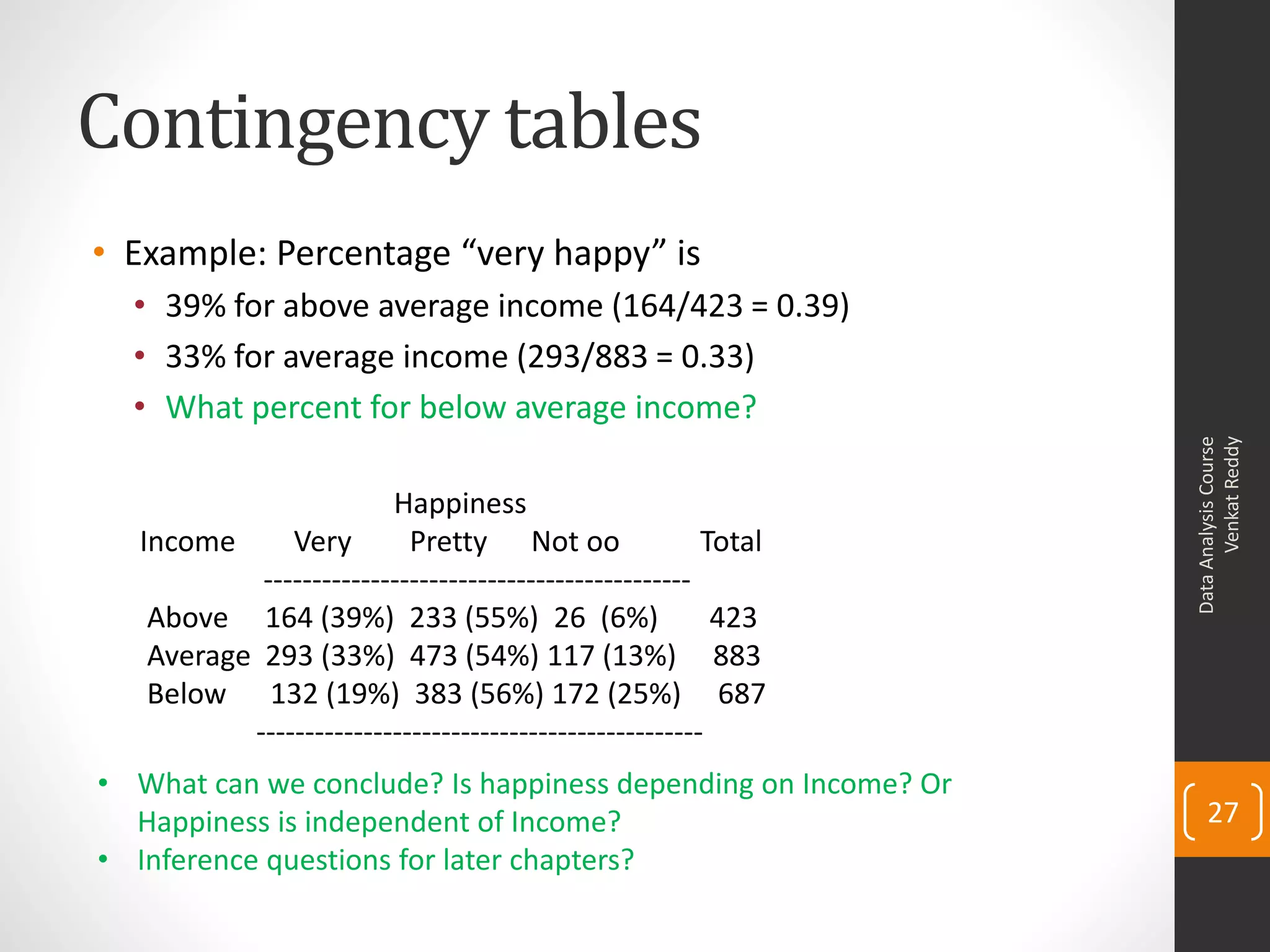
• Example: Percentage “very happy” is
  • 39% for above average income (164/423 = 0.39)
  • 33% for average income (293/883 = 0.33)
  • What percent for below average income?


                                                                      Venkat Reddy
                                                                Data Analysis Course
                        Happiness
  Income      Very        Pretty Not oo                 Total
           --------------------------------------------
   Above 164 (39%) 233 (55%) 26 (6%)                     423
   Average 293 (33%) 473 (54%) 117 (13%) 883
   Below 132 (19%) 383 (56%) 172 (25%) 687
          ----------------------------------------------
• What can we conclude? Is happiness depending on Income? Or
  Happiness is independent of Income?                               27
• Inference questions for later chapters?
Correlation
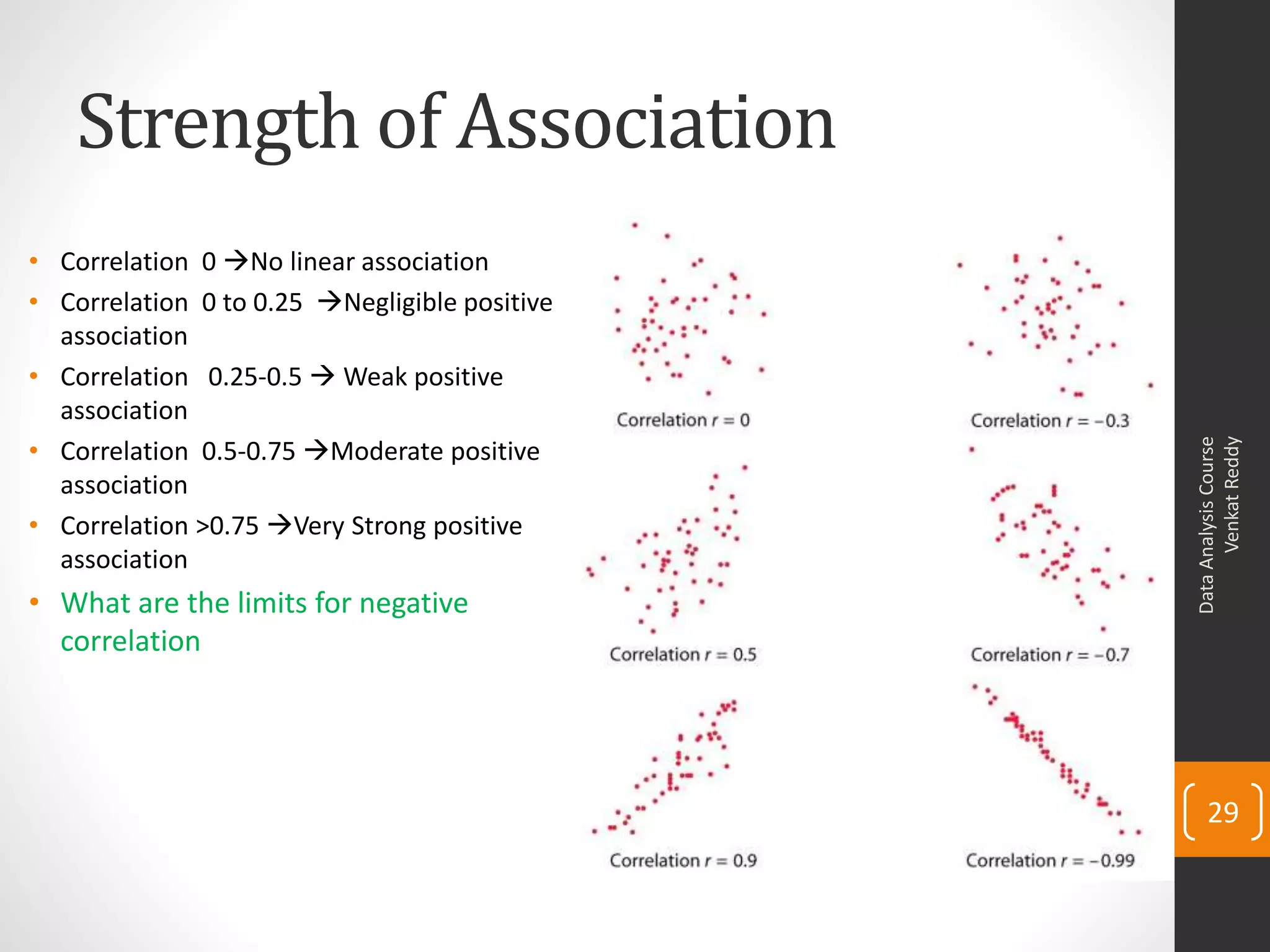
• Correlation describes strength of association between
  two variables
• Falls between -1 and +1, with sign indicating direction of
  association (formula & other details later )


                                                                     Venkat Reddy
                                                               Data Analysis Course
• The larger the correlation in absolute value, the stronger
  the association (in terms of a straight line trend)
• Examples: (positive or negative, how strong?)
  • Mental impairment and life events, correlation =
  • GDP and fertility, correlation =
  • GDP and percent using Internet, correlation =
                                                                   28
Strength of Association
• Correlation 0 No linear association
• Correlation 0 to 0.25 Negligible positive
  association
• Correlation 0.25-0.5  Weak positive
  association
• Correlation 0.5-0.75 Moderate positive


                                                     Venkat Reddy
                                               Data Analysis Course
  association
• Correlation >0.75 Very Strong positive
  association
• What are the limits for negative
  correlation


                                                   29
Regression
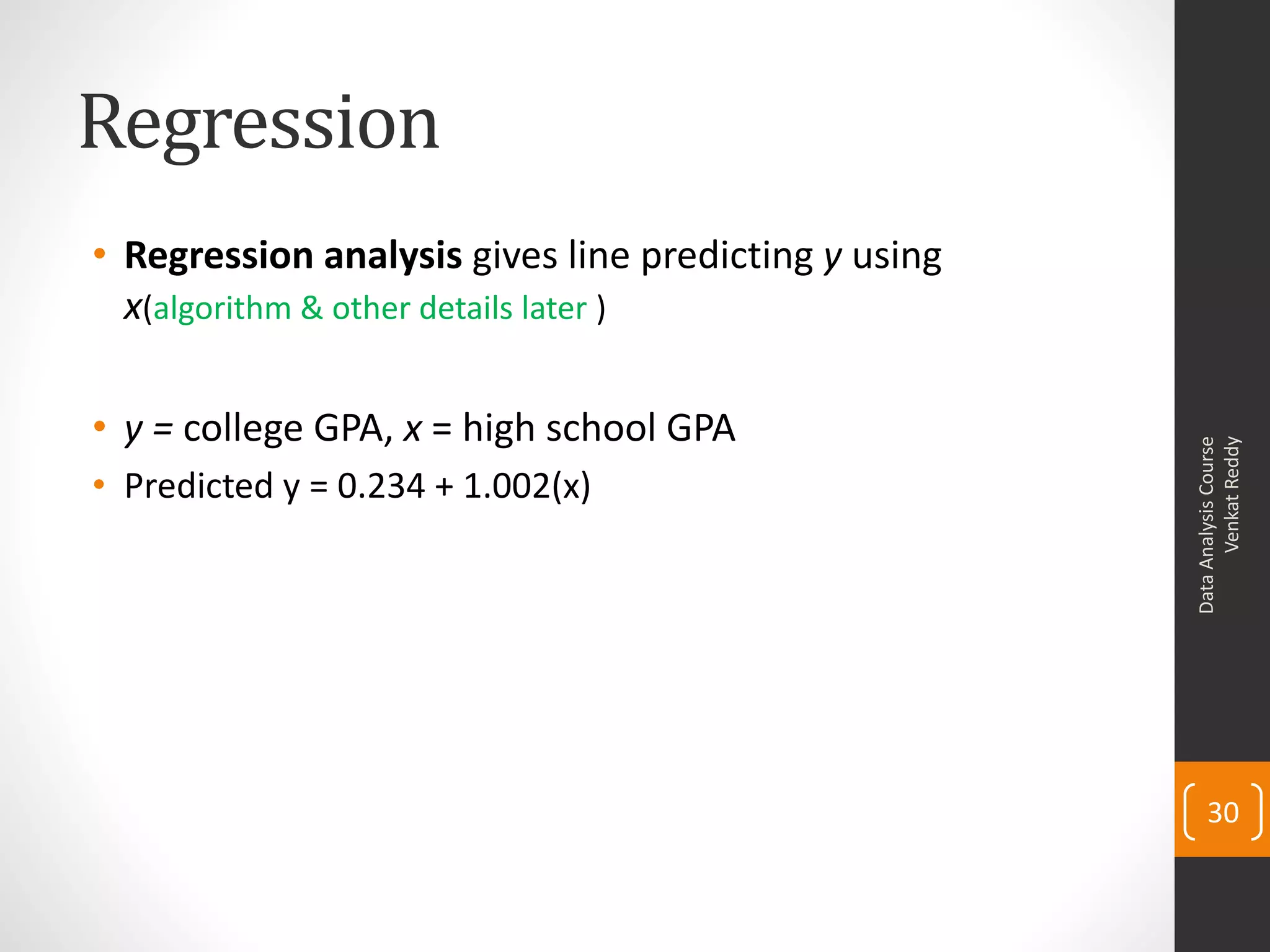
• Regression analysis gives line predicting y using
  x(algorithm & other details later )

• y = college GPA, x = high school GPA


                                                            Venkat Reddy
                                                      Data Analysis Course
• Predicted y = 0.234 + 1.002(x)


                                                          30
Lab
• Create a contingency table for product sales data
• Find contingency tables for
  • Region by product type
  • Division by Product type


                                                                         Venkat Reddy
                                                                   Data Analysis Course
• Find the correlation between actual sales and predicted sales.
• Find the correlation between weight & msrp in cars data


                                                                       31
Venkat Reddy Konasani
Manager at Trendwise Analytics
venkat@TrendwiseAnalytics.com
21.venkat@gmail.com


                                          Venkat Reddy
                                    Data Analysis Course
+91 9886 768879
www.TrendwiseAnalytics.com/venkat


                                        32

Descriptive statistics

  • 1.
    Data Analysis Course DescriptiveStatistics(Version-1) Venkat Reddy
  • 2.
    Data Analysis Course •Data analysis design document • Introduction to statistical data analysis • Descriptive statistics • Data exploration, validation & sanitization Venkat Reddy Data Analysis Course • Probability distributions examples and applications • Simple correlation and regression analysis • Multiple liner regression analysis • Logistic regression analysis • Testing of hypothesis • Clustering and decision trees • Time series analysis and forecasting • Credit Risk Model building-1 2 • Credit Risk Model building-2
  • 3.
    Note • This presentationis just class notes. The course notes for Data Analysis Training is by written by me, as an aid for myself. • The best way to treat this is as a high-level summary; the actual session went more in depth and contained other Venkat Reddy Data Analysis Course information. • Most of this material was written as informal notes, not intended for publication • Please send questions/comments/corrections to venkat@trenwiseanalytics.com or 21.venkat@gmail.com • Please check my website for latest version of this document -Venkat Reddy 3
  • 4.
    Contents • What are Descriptive statistics • Frequency tables and graphs, Histograms • Central Tendency • Mean, Median, Mode Venkat Reddy Data Analysis Course • Dispersion • Range, variance, standard deviation • Quartiles, Percentiles • Box Plots • Bivariate Descriptive Statistics • Contingency Tables • Correlation 4 • Regression
  • 5.
    Why Descriptive statistics? •Who is a better ODI batsmen - Sachin or Muralidharan? • Batting average? • Who is the reliable- Dhoni or Afridi? • Score variance • A triangular series among Aus, Eng & Newziland ; Who will win? • Most number of wins - Mode Venkat Reddy Data Analysis Course • I am going to buy shoes. Which brand has verity- Power or Adidas? • Price range - Range • We used Average, Variance, Mode, Range to make some inferences. These are nothing but descriptive statistics • Descriptive statistics tell us what happened in the past. • Descriptive statistics avoid inferences but, they help us to get a feel of the data. • Some times they are good enough to make an inference. 5
  • 6.
    Descriptive Statistics • Astatistic or a measure that describes the data • Average salary of employees • Describing data with tables and graphs (quantitative or categorical variables) Venkat Reddy Data Analysis Course • Numerical descriptions • Center – Give some example measures of center of the data • Variability– Give some example measures of variability of the data • Bivariate descriptions (In practice, most studies have several variables) • Dependency measures(Correlation) 6
  • 7.
    Simple Descriptive Statistics • N • Sum • Min • Max Venkat Reddy Data Analysis Course • Average • Frequency of each level • Variance • Standard deviation These simple descriptive statistics will be use in inferential statistics later. 7
  • 8.
    Frequency tables &Histograms • Frequency distribution: Lists possible values of variable and number of times each occurs Venkat Reddy Data Analysis Course 8
  • 9.
    Shapes of histograms •Bell-shaped (IQ, SAT, political ideology in all U.S. ) • Skewed right • Example Annual income • No. times arrested Venkat Reddy Data Analysis Course • Skewed left • Score on easy exam • Daily level if excitement in office • Bimodal • Hardworking days in a year (Peaks near Mid year & year end Appraisal) 9
  • 10.
    Lab : Histogram •Create a histogram on variable ‘actual’ in prdsale data • How many modes? • What is the skewness? • What is its kurtosis? • Create a histogram on variable ‘msrp’ in cars data Venkat Reddy Data Analysis Course • How many modes? • What is the skewness? • What is its kurtosis? • Create a histogram on variable ‘weight’ in cars data • How many modes? • What is the skewness? • What is its kurtosis? 10 Compare the above three histograms.
  • 11.
    Central tendency • Whatis the flight fare from Bangalore to Delhi? 3500–Exact or average? • What is central tendency? - Average • Three types of Averages Venkat Reddy Data Analysis Course • Mean • Median • Mode 11
  • 12.
    Mean • Center ofgravity • Evenly partitions the sum of all measurement among all cases; average of all measures n x Venkat Reddy Data Analysis Course i x i 1 n • Crucial for inferential statistics • Mean is not very resistant to outliers –See in Median 12
  • 13.
    Median • What isthe mean of [0.1 0.8 0.4 0.3 0.1 0.4 9.0 0.1 0.9 0.3 1.0 0.3 0.1] • Guess without calculation – Around 0.5? • Now calculate the mean Venkat Reddy Data Analysis Course • Median is exactly in the middle. Isn’t mean exactly in the middle • Order the observations in ascending or descending order and pick the middle observation • less useful for inferential purposes 13 • More resistant to effects of outliers…
  • 14.
    Calculation of Median rim diameter (cm) unit 1 unit 2 9.7 9.0 11.5 11.2 11.6 11.3 Venkat Reddy Data Analysis Course 12.1 11.7 12.4 12.2 12.6 12.5 12.9 <-- 13.2 13.2 13.1 13.8 13.5 14.0 13.6 15.5 14.8 15.6 16.3 16.2 26.9 16.4 14
  • 15.
    Mode • How doyou express average size of the shoes ? • 6.567 or 6? • Mode is the most numerous category • Can be more or less created by the grouping procedure Venkat Reddy Data Analysis Course • For theoretical distributions—simply the location of the peak on the frequency distribution 15
  • 16.
    Lab • Run Proc means data product data • What is the mean of ‘msrp’ in cars data? • Is it reflecting the average value of price? • What is median of ‘msrp’ in cars data? Venkat Reddy Data Analysis Course • Is it reflecting the average value of price? • Run Proc Univariate on weight varaibale in cars data. Find mean, Median & Mode. 16
  • 17.
    Dispersion Person1: What isthe average depth of this river? 5 feet Person2: I am 5.5 I can easily cross it(and starts crossing it) Person 2: Help….help. Person 1: Some times just knowing the central tendency is not Venkat Reddy Data Analysis Course sufficient • Measures of dispersion summarize the degree of clustering/spread of cases, esp. with respect to central tendency… • range • variance • standard deviation 17
  • 18.
    Range unit 1 unit 2 • Max –Min 9.7 9.0 11.5 11.2 11.6 11.3 12.1 11.7 12.4 12.2 Venkat Reddy Data Analysis Course 12.6 12.5 R: range(x) 13.1 13.2 13.5 13.8 13.6 14.0 14.8 15.5 16.3 15.6 26.9 16.2 16.4 18
  • 19.
    Variance • Takedeviation from Mean- It can be zero some times • Hence take square of deviation from mean  Take average of that • Average mean squared distance is variance Venkat Reddy Data Analysis Course n  x  x  2 i 2  i 1 n • Units of variance are squared… this makes variance hard to interpret • Eg : Mean length = 22.6 mm variance = 38 mm2 • What does this mean??? –I don’t Know 19
  • 20.
    Standard Deviation • Squareroot of variance n  xi  x 2 s i 1 n Venkat Reddy Data Analysis Course • Units are in same units as base measurements • Mean = 22.6 mm standard deviation = 6.2 mm • Mean +/- sd (16.4—28.8 mm) • should give at least some intuitive sense of where most of the cases lie, barring major effects of outliers 20
  • 21.
    Quartiles & Percentiles •pth percentile: p percent of observations below it, (100 - p)% above it. • Like 95% of CAT percentile means 5% are above & 95% are below • 1,2,3,4,5,6,7,8,9,10 - What is 25th percentile? Venkat Reddy Data Analysis Course • 1,2,3,4,5,6,7,8,9,10,11,12,13,14,15,16,17,18,19,20 - What is 25th percentile? What is 80th percentile? • p = 50: median • p = 25: lower quartile (LQ) • p = 75: upper quartile (UQ) • Interquartile range IQR = UQ - LQ 21
  • 22.
    Box Plots • Quartilesportrayed graphically by box plots Venkat Reddy Data Analysis Course 22
  • 23.
    Box Plots Venkat Reddy Data Analysis Course Example: weekly TV watching for n=60, 3 outliers 23
  • 24.
    Box Plots Interpretation •Box plots have box from LQ to UQ, with median marked. They portray a five-number summary of the data: Minimum, LQ, Median, UQ, Maximum • Except for outliers identified separately • Outlier = observation falling Venkat Reddy Data Analysis Course below LQ – 1.5(IQR) or above UQ + 1.5(IQR) • Ex. If LQ = 2, UQ = 10, then IQR = 8 and outliers above 10 + 1.5(8) = 22 24
  • 25.
    Lab • Run procunivariate on a variable from sample data in sas default library(prd sale / cars) • Run proc means on actual & predicted variables from product sales data • What are the values of Range, Variance, SD Venkat Reddy Data Analysis Course • What are 1,2,3 & 4 quartile values • What is 95th percentile? • Use “all” option to display the box plots 25
  • 26.
    Contingency Tables • Crossclassifications of categorical variables in which rows (typically) represent categories of explanatory variable and columns represent categories of response variable. • Counts in “cells” of the table give the numbers of individuals at the corresponding combination of levels of the two variables Venkat Reddy Data Analysis Course Example: Happiness and Family Income of 1993 families (GSS 2008 data: “happy,” “finrela”) Happiness Income Very Pretty Nottoo Total ------------------------------- Above Aver. 164 233 26 423 Average 293 473 117 883 Below Aver. 132 383 172 687 ------------------------------ Total 589 1089 315 1993 26
  • 27.
    Contingency tables • Example:Percentage “very happy” is • 39% for above average income (164/423 = 0.39) • 33% for average income (293/883 = 0.33) • What percent for below average income? Venkat Reddy Data Analysis Course Happiness Income Very Pretty Not oo Total -------------------------------------------- Above 164 (39%) 233 (55%) 26 (6%) 423 Average 293 (33%) 473 (54%) 117 (13%) 883 Below 132 (19%) 383 (56%) 172 (25%) 687 ---------------------------------------------- • What can we conclude? Is happiness depending on Income? Or Happiness is independent of Income? 27 • Inference questions for later chapters?
  • 28.
    Correlation • Correlation describesstrength of association between two variables • Falls between -1 and +1, with sign indicating direction of association (formula & other details later ) Venkat Reddy Data Analysis Course • The larger the correlation in absolute value, the stronger the association (in terms of a straight line trend) • Examples: (positive or negative, how strong?) • Mental impairment and life events, correlation = • GDP and fertility, correlation = • GDP and percent using Internet, correlation = 28
  • 29.
    Strength of Association •Correlation 0 No linear association • Correlation 0 to 0.25 Negligible positive association • Correlation 0.25-0.5  Weak positive association • Correlation 0.5-0.75 Moderate positive Venkat Reddy Data Analysis Course association • Correlation >0.75 Very Strong positive association • What are the limits for negative correlation 29
  • 30.
    Regression • Regression analysisgives line predicting y using x(algorithm & other details later ) • y = college GPA, x = high school GPA Venkat Reddy Data Analysis Course • Predicted y = 0.234 + 1.002(x) 30
  • 31.
    Lab • Create acontingency table for product sales data • Find contingency tables for • Region by product type • Division by Product type Venkat Reddy Data Analysis Course • Find the correlation between actual sales and predicted sales. • Find the correlation between weight & msrp in cars data 31
  • 32.
    Venkat Reddy Konasani Managerat Trendwise Analytics venkat@TrendwiseAnalytics.com 21.venkat@gmail.com Venkat Reddy Data Analysis Course +91 9886 768879 www.TrendwiseAnalytics.com/venkat 32