Two-day workshop on Frontier areas in
Symbolic Computing and Cloud Computing

A TRAINING PROGRAMME ON SOFTWARE
PACKAGES FOR STATISTICAL ANALYSIS (SPSS)
Day 1 – Session 2
By

B. Anand
Network Engineer
Bharathidasan University
What is SPSS?
•SPSS is an acronym of Statistical Package for
Social Sciences
•One of the most popular statistical packages
which can perform highly complex data
manipulation and analysis with simple
instructions
What is SPSS?
•SPSS is an acronym of Statistical Package for
Social Sciences
•One of the most popular statistical packages
which can perform highly complex data
manipulation and analysis with simple
instructions
Variable
Variable is the name of the field in the
dataset.

Data

Data is the value given to the field.

Measuring the Variables
Ordinal - region, zip code, or religious affiliation
Nominal - Levels of service satisfaction from highly dissatisfied
to highly satisfied
Scale -

age in years and income in thousands of dollars
The Four Windows:
• Data editor
• Output viewer
• Syntax editor
• Script window
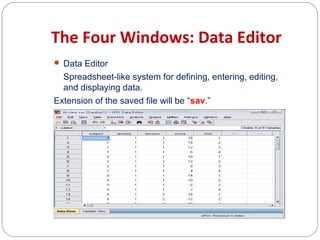
The Four Windows: Data Editor
 Data Editor

Spreadsheet-like system for defining, entering, editing,
and displaying data.
Extension of the saved file will be “sav.”
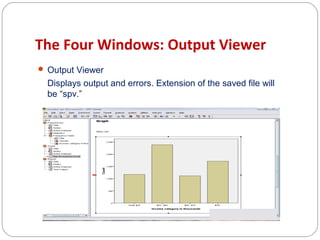
The Four Windows: Output Viewer
 Output Viewer

Displays output and errors. Extension of the saved file will
be “spv.”
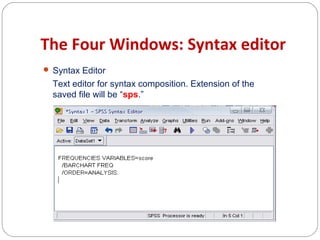
The Four Windows: Syntax editor
 Syntax Editor

Text editor for syntax composition. Extension of the
saved file will be “sps.”
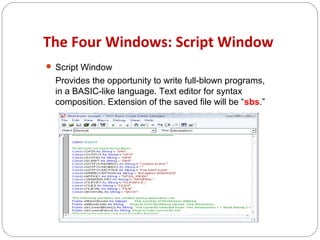
The Four Windows: Script Window
 Script Window

Provides the opportunity to write full-blown programs,
in a BASIC-like language. Text editor for syntax
composition. Extension of the saved file will be “sbs.”
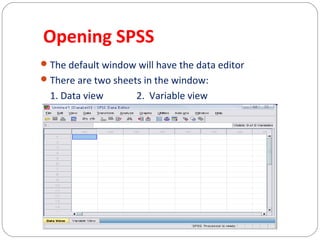
Opening SPSS
 The default window will have the data editor
 There are two sheets in the window:

1. Data view

2. Variable view
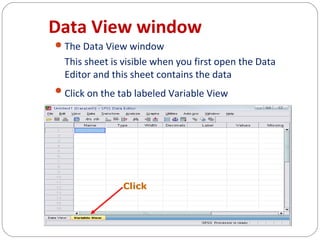
Data View window
 The Data View window

This sheet is visible when you first open the Data
Editor and this sheet contains the data
 Click on the tab labeled Variable View

Click
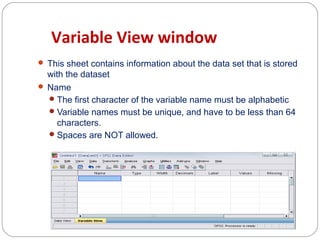
Variable View window
 This sheet contains information about the data set that is stored

with the dataset
 Name
 The first character of the variable name must be alphabetic
 Variable names must be unique, and have to be less than 64
characters.
 Spaces are NOT allowed.
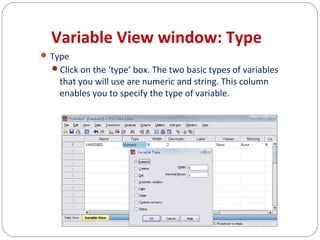
Variable View window: Type
 Type
Click on the ‘type’ box. The two basic types of variables
that you will use are numeric and string. This column
enables you to specify the type of variable.
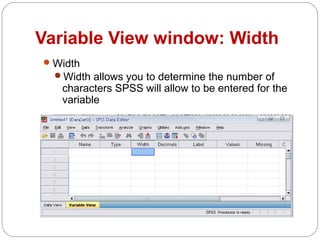
Variable View window: Width
 Width
Width allows you to determine the number of

characters SPSS will allow to be entered for the
variable
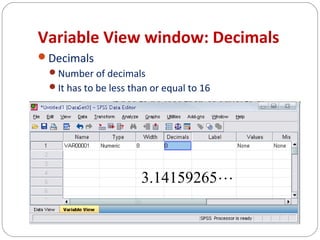
Variable View window: Decimals
Decimals
Number of decimals
It has to be less than or equal to 16

3.14159265
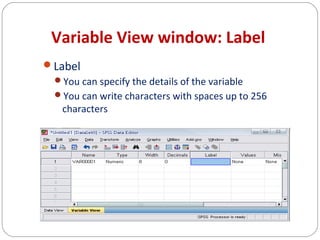
Variable View window: Label
Label
You can specify the details of the variable
You can write characters with spaces up to 256

characters
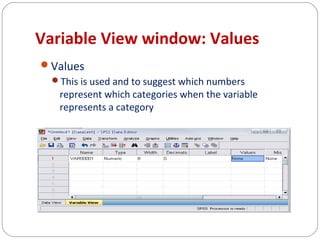
Variable View window: Values
Values
This is used and to suggest which numbers

represent which categories when the variable
represents a category
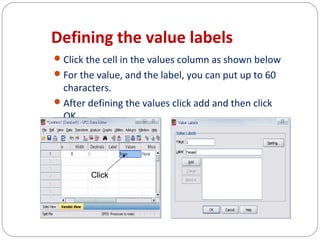
Defining the value labels
 Click the cell in the values column as shown below
 For the value, and the label, you can put up to 60

characters.
 After defining the values click add and then click
OK.

Click
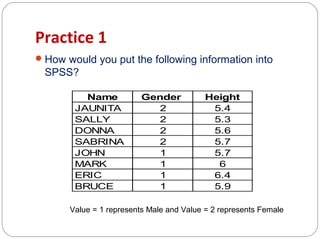
Practice 1
 How would you put the following information into

SPSS?
Name
JAUNITA
SALLY
DONNA
SABRINA
JOHN
MARK
ERIC
BRUCE

Gender
2
2
2
2
1
1
1
1

Height
5.4
5.3
5.6
5.7
5.7
6
6.4
5.9

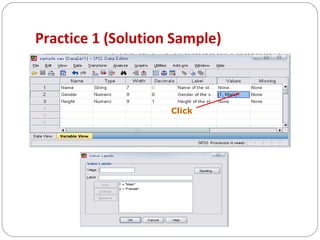
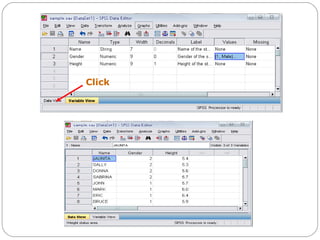
Value = 1 represents Male and Value = 2 represents Female
Practice 1 (Solution Sample)

Click
Click
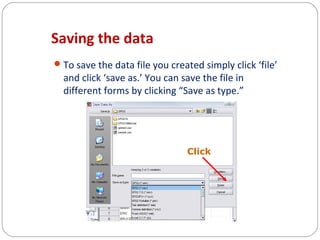
Saving the data
 To save the data file you created simply click ‘file’

and click ‘save as.’ You can save the file in
different forms by clicking “Save as type.”

Click
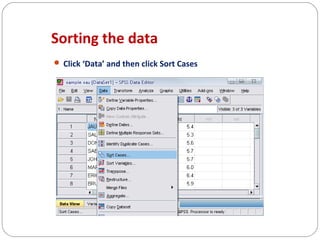
Sorting the data
 Click ‘Data’ and then click Sort Cases
Sorting the data (cont’d)
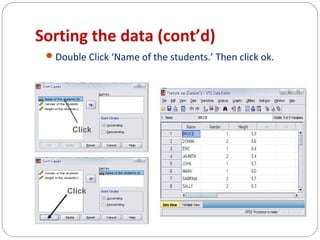
 Double Click ‘Name of the students.’ Then click ok.

Click

Click
Practice 2
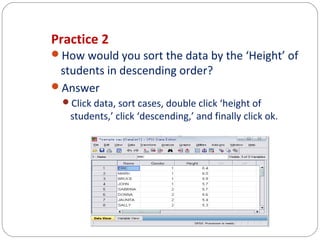
How would you sort the data by the ‘Height’ of

students in descending order?
Answer

Click data, sort cases, double click ‘height of

students,’ click ‘descending,’ and finally click ok.
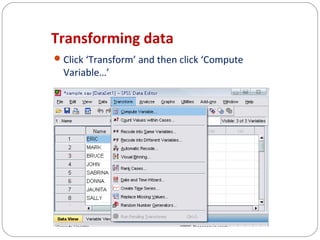
Transforming data
 Click ‘Transform’ and then click ‘Compute

Variable…’
Transforming data (cont’d)
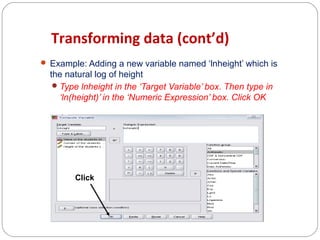
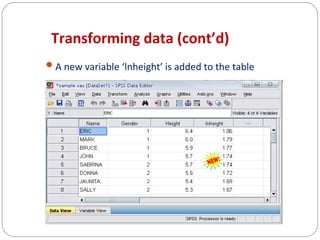
 Example: Adding a new variable named ‘lnheight’ which is

the natural log of height
 Type lnheight in the ‘Target Variable’ box. Then type in
‘ln(height)’ in the ‘Numeric Expression’ box. Click OK

Click
Transforming data (cont’d)
 A new variable ‘lnheight’ is added to the table
Practice 3
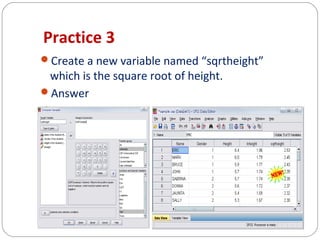
Create a new variable named “sqrtheight”

which is the square root of height.
Answer
The basic analysis
The basic analysis of SPSS that will be
introduced in this chapter
Frequencies
This analysis
produces frequency tables showing
frequency counts and percentages of the values of
individual variables.
Descriptives
This analysis shows the maximum, minimum, mean,
and standard deviation of the variables
Linear regression analysis
Linear Regression estimates the coefficients of the
linear equation
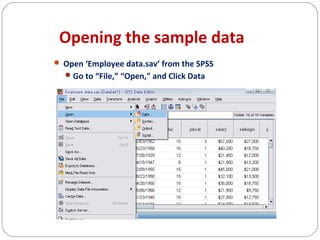
Opening the sample data
 Open ‘Employee data.sav’ from the SPSS
 Go to “File,” “Open,” and Click Data
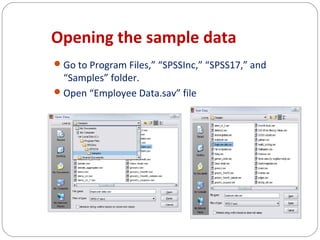
Opening the sample data
 Go to Program Files,” “SPSSInc,” “SPSS17,” and

“Samples” folder.
 Open “Employee Data.sav” file
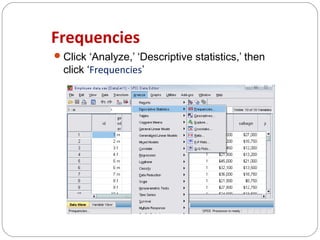
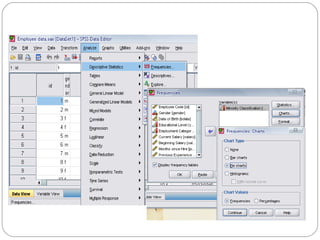
Frequencies
 Click ‘Analyze,’ ‘Descriptive statistics,’ then

click ‘Frequencies’
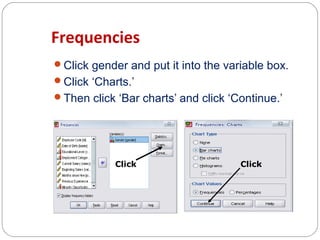
Frequencies
Click gender and put it into the variable box.
Click ‘Charts.’
Then click ‘Bar charts’ and click ‘Continue.’

Click

Click
Frequencies
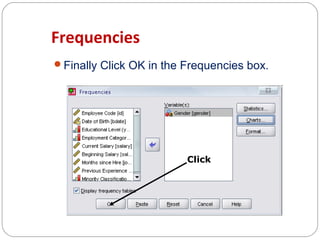
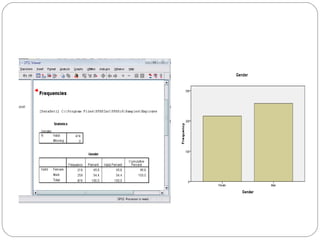
Finally Click OK in the Frequencies box.

Click
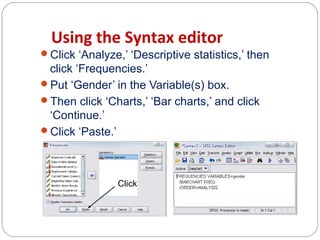
Using the Syntax editor
Click ‘Analyze,’ ‘Descriptive statistics,’ then

click ‘Frequencies.’
Put ‘Gender’ in the Variable(s) box.
Then click ‘Charts,’ ‘Bar charts,’ and click
‘Continue.’
Click ‘Paste.’

Click
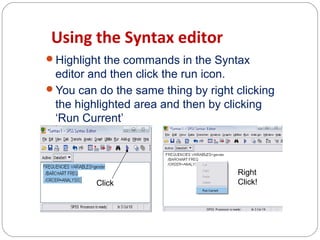
Using the Syntax editor
Highlight the commands in the Syntax

editor and then click the run icon.
You can do the same thing by right clicking
the highlighted area and then by clicking
‘Run Current’

Click

Right
Click!
Practice 4
Do a frequency analysis on the variable

“minority”
Create pie charts for it
Do the same analysis using the syntax editor
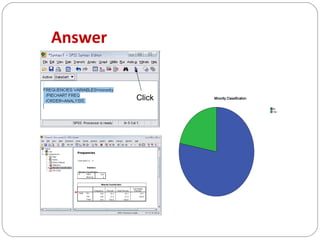
Answer

Click
Descriptives
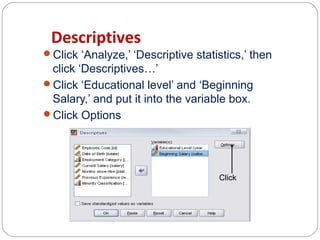
Click ‘Analyze,’ ‘Descriptive statistics,’ then

click ‘Descriptives…’
Click ‘Educational level’ and ‘Beginning
Salary,’ and put it into the variable box.
Click Options

Click
Descriptives
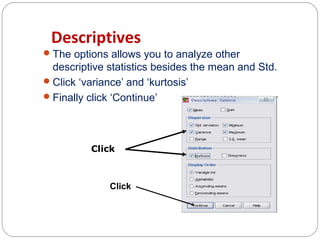
 The options allows you to analyze other

descriptive statistics besides the mean and Std.
 Click ‘variance’ and ‘kurtosis’
 Finally click ‘Continue’

Click

Click
Descriptives
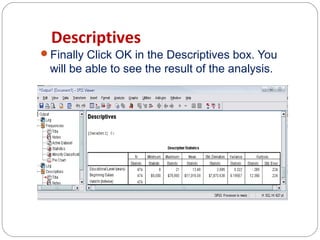
Finally Click OK in the Descriptives box. You

will be able to see the result of the analysis.
Regression Analysis
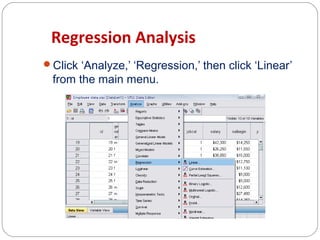
Click ‘Analyze,’ ‘Regression,’ then click ‘Linear’

from the main menu.
Regression Analysis
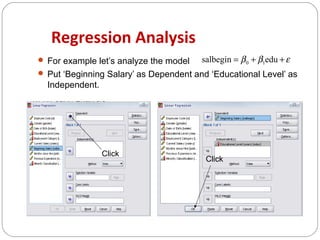
 For example let’s analyze the model

salbegin = β 0 + β1edu + ε

 Put ‘Beginning Salary’ as Dependent and ‘Educational Level’ as

Independent.

Click

Click
Regression Analysis
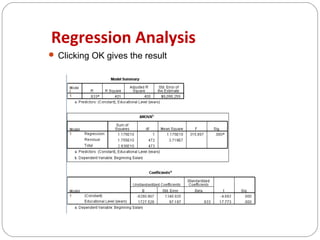
 Clicking OK gives the result
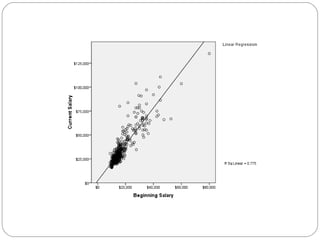
Plotting the regression line
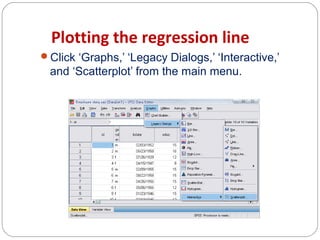
Click ‘Graphs,’ ‘Legacy Dialogs,’ ‘Interactive,’

and ‘Scatterplot’ from the main menu.
Plotting the regression line
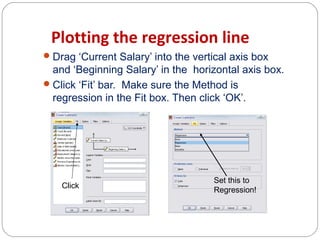
 Drag ‘Current Salary’ into the vertical axis box

and ‘Beginning Salary’ in the horizontal axis box.
 Click ‘Fit’ bar. Make sure the Method is
regression in the Fit box. Then click ‘OK’.

Click

Set this to
Regression!
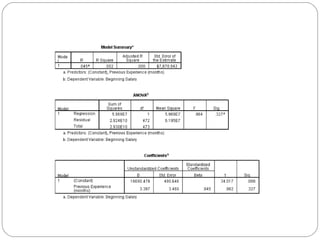
Practice 5
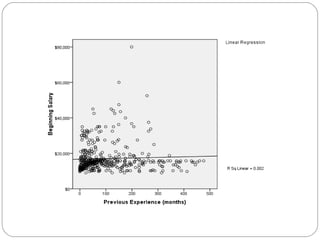
Find out whether or not the previous experience

of workers has any affect on their beginning
salary?
Take the variable “salbegin,” and “prevexp” as dependent and

independent variables respectively.
Plot the regression line for the above analysis

using the “scatter plot” menu.
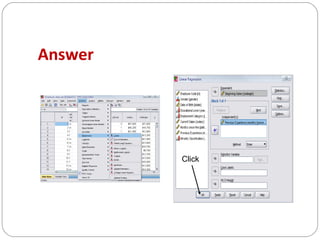
Answer

Click
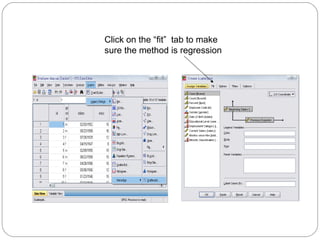
Click on the “fit” tab to make
sure the method is regression
Software packages for statistical analysis - SPSS

Software packages for statistical analysis - SPSS

  • 1.
    Two-day workshop onFrontier areas in Symbolic Computing and Cloud Computing A TRAINING PROGRAMME ON SOFTWARE PACKAGES FOR STATISTICAL ANALYSIS (SPSS) Day 1 – Session 2 By B. Anand Network Engineer Bharathidasan University
  • 2.
    What is SPSS? •SPSSis an acronym of Statistical Package for Social Sciences •One of the most popular statistical packages which can perform highly complex data manipulation and analysis with simple instructions
  • 3.
    What is SPSS? •SPSSis an acronym of Statistical Package for Social Sciences •One of the most popular statistical packages which can perform highly complex data manipulation and analysis with simple instructions
  • 4.
    Variable Variable is thename of the field in the dataset. Data Data is the value given to the field. Measuring the Variables Ordinal - region, zip code, or religious affiliation Nominal - Levels of service satisfaction from highly dissatisfied to highly satisfied Scale - age in years and income in thousands of dollars
  • 5.
    The Four Windows: •Data editor • Output viewer • Syntax editor • Script window
  • 6.
    The Four Windows:Data Editor  Data Editor Spreadsheet-like system for defining, entering, editing, and displaying data. Extension of the saved file will be “sav.”
  • 7.
    The Four Windows:Output Viewer  Output Viewer Displays output and errors. Extension of the saved file will be “spv.”
  • 8.
    The Four Windows:Syntax editor  Syntax Editor Text editor for syntax composition. Extension of the saved file will be “sps.”
  • 9.
    The Four Windows:Script Window  Script Window Provides the opportunity to write full-blown programs, in a BASIC-like language. Text editor for syntax composition. Extension of the saved file will be “sbs.”
  • 10.
    Opening SPSS  Thedefault window will have the data editor  There are two sheets in the window: 1. Data view 2. Variable view
  • 11.
    Data View window The Data View window This sheet is visible when you first open the Data Editor and this sheet contains the data  Click on the tab labeled Variable View Click
  • 12.
    Variable View window This sheet contains information about the data set that is stored with the dataset  Name  The first character of the variable name must be alphabetic  Variable names must be unique, and have to be less than 64 characters.  Spaces are NOT allowed.
  • 13.
    Variable View window:Type  Type Click on the ‘type’ box. The two basic types of variables that you will use are numeric and string. This column enables you to specify the type of variable.
  • 14.
    Variable View window:Width  Width Width allows you to determine the number of characters SPSS will allow to be entered for the variable
  • 15.
    Variable View window:Decimals Decimals Number of decimals It has to be less than or equal to 16 3.14159265
  • 16.
    Variable View window:Label Label You can specify the details of the variable You can write characters with spaces up to 256 characters
  • 17.
    Variable View window:Values Values This is used and to suggest which numbers represent which categories when the variable represents a category
  • 18.
    Defining the valuelabels  Click the cell in the values column as shown below  For the value, and the label, you can put up to 60 characters.  After defining the values click add and then click OK. Click
  • 19.
    Practice 1  Howwould you put the following information into SPSS? Name JAUNITA SALLY DONNA SABRINA JOHN MARK ERIC BRUCE Gender 2 2 2 2 1 1 1 1 Height 5.4 5.3 5.6 5.7 5.7 6 6.4 5.9 Value = 1 represents Male and Value = 2 represents Female
  • 20.
    Practice 1 (SolutionSample) Click
  • 21.
  • 22.
    Saving the data To save the data file you created simply click ‘file’ and click ‘save as.’ You can save the file in different forms by clicking “Save as type.” Click
  • 23.
    Sorting the data Click ‘Data’ and then click Sort Cases
  • 24.
    Sorting the data(cont’d)  Double Click ‘Name of the students.’ Then click ok. Click Click
  • 25.
    Practice 2 How wouldyou sort the data by the ‘Height’ of students in descending order? Answer Click data, sort cases, double click ‘height of students,’ click ‘descending,’ and finally click ok.
  • 26.
    Transforming data  Click‘Transform’ and then click ‘Compute Variable…’
  • 27.
    Transforming data (cont’d) Example: Adding a new variable named ‘lnheight’ which is the natural log of height  Type lnheight in the ‘Target Variable’ box. Then type in ‘ln(height)’ in the ‘Numeric Expression’ box. Click OK Click
  • 28.
    Transforming data (cont’d) A new variable ‘lnheight’ is added to the table
  • 29.
    Practice 3 Create anew variable named “sqrtheight” which is the square root of height. Answer
  • 30.
  • 31.
    The basic analysisof SPSS that will be introduced in this chapter Frequencies This analysis produces frequency tables showing frequency counts and percentages of the values of individual variables. Descriptives This analysis shows the maximum, minimum, mean, and standard deviation of the variables Linear regression analysis Linear Regression estimates the coefficients of the linear equation
  • 32.
    Opening the sampledata  Open ‘Employee data.sav’ from the SPSS  Go to “File,” “Open,” and Click Data
  • 33.
    Opening the sampledata  Go to Program Files,” “SPSSInc,” “SPSS17,” and “Samples” folder.  Open “Employee Data.sav” file
  • 34.
    Frequencies  Click ‘Analyze,’‘Descriptive statistics,’ then click ‘Frequencies’
  • 35.
    Frequencies Click gender andput it into the variable box. Click ‘Charts.’ Then click ‘Bar charts’ and click ‘Continue.’ Click Click
  • 36.
    Frequencies Finally Click OKin the Frequencies box. Click
  • 38.
    Using the Syntaxeditor Click ‘Analyze,’ ‘Descriptive statistics,’ then click ‘Frequencies.’ Put ‘Gender’ in the Variable(s) box. Then click ‘Charts,’ ‘Bar charts,’ and click ‘Continue.’ Click ‘Paste.’ Click
  • 39.
    Using the Syntaxeditor Highlight the commands in the Syntax editor and then click the run icon. You can do the same thing by right clicking the highlighted area and then by clicking ‘Run Current’ Click Right Click!
  • 40.
    Practice 4 Do afrequency analysis on the variable “minority” Create pie charts for it Do the same analysis using the syntax editor
  • 42.
  • 43.
    Descriptives Click ‘Analyze,’ ‘Descriptivestatistics,’ then click ‘Descriptives…’ Click ‘Educational level’ and ‘Beginning Salary,’ and put it into the variable box. Click Options Click
  • 44.
    Descriptives  The optionsallows you to analyze other descriptive statistics besides the mean and Std.  Click ‘variance’ and ‘kurtosis’  Finally click ‘Continue’ Click Click
  • 45.
    Descriptives Finally Click OKin the Descriptives box. You will be able to see the result of the analysis.
  • 46.
    Regression Analysis Click ‘Analyze,’‘Regression,’ then click ‘Linear’ from the main menu.
  • 47.
    Regression Analysis  Forexample let’s analyze the model salbegin = β 0 + β1edu + ε  Put ‘Beginning Salary’ as Dependent and ‘Educational Level’ as Independent. Click Click
  • 48.
  • 49.
    Plotting the regressionline Click ‘Graphs,’ ‘Legacy Dialogs,’ ‘Interactive,’ and ‘Scatterplot’ from the main menu.
  • 50.
    Plotting the regressionline  Drag ‘Current Salary’ into the vertical axis box and ‘Beginning Salary’ in the horizontal axis box.  Click ‘Fit’ bar. Make sure the Method is regression in the Fit box. Then click ‘OK’. Click Set this to Regression!
  • 52.
    Practice 5 Find outwhether or not the previous experience of workers has any affect on their beginning salary? Take the variable “salbegin,” and “prevexp” as dependent and independent variables respectively. Plot the regression line for the above analysis using the “scatter plot” menu.
  • 53.
  • 55.
    Click on the“fit” tab to make sure the method is regression