Collection of data
Rosario N. Evangelista
What is a Data?
Plural form for datum, collection of numbers,
quantities, facts, or records used as bases for
drawing conclusions or making inferences.
(Good, p.155)
What is a Data?
• What research is searching for and which are
subjected to analysis, statistical procedures, and
interpretation so that inferences, principles or
generalization are drawn.
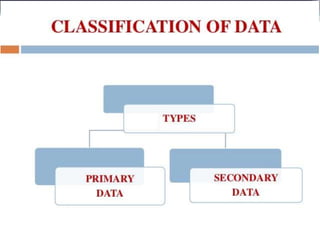
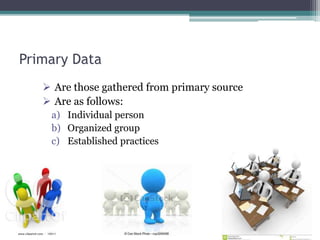
Primary Data
 Are those gathered from primary source
 Are as follows:
a) Individual person
b) Organized group
c) Established practices
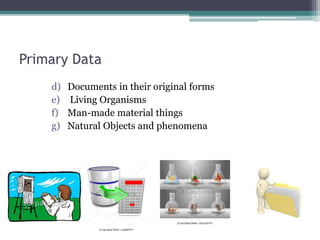
Primary Data
d) Documents in their original forms
e) Living Organisms
f) Man-made material things
g) Natural Objects and phenomena
Secondary Data
are those gathered from second sources
Are as follows:
a) Books
b) Articles published
c) Unpublished master’s degree
d) Monographs, manuscripts, etc.
e) All other second hand sources.
Advantages of Primary Data over
Secondary Data
1. The primary data frequently give detailed
definition of terms and statistical units used in
the survey.
Advantages of Primary Data over
Secondary Data
2. The secondary data have usually little or no
explanatory notes which often arises from
transcriptions of the figures from the original
primary source.
Advantages of Primary Data over Secondary Data
3. The primary data usually includes a copy of the
schedule and a description of the procedure used
in the selection of the type of sample and in
collecting the data. This gives the user and ideas of
accuracy, applicability, and limitation of the
survey result.
Advantages of Primary Data over Secondary
Data
4. The primary data are usually broken down into
finer classifications. The secondary data often
omit past of combining categories, such as
showing barrios instead of sitios, or municipalities
instead of barrios.
Advantages of Secondary Data
1. Secondary Data are more convenient to use
because they are already condensed and
organized.
2. Analysis and interpretation are done more
easily.
3.Libraries make secondary data are more easily
accessible.
Respondents
▫ Are those individual who are asked or requested
by a researcher to supply data or information
about his research problem.
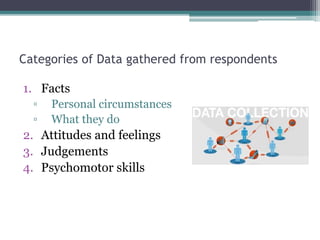
Categories of Data gathered from respondents
1. Facts
▫ Personal circumstances
▫ What they do
2. Attitudes and feelings
3. Judgements
4. Psychomotor skills
Categories of Data gathered from respondents
5) Results of test and experiments
6) All other data gathered from the primary and
secondary data.
(Research Instruments or Tools)
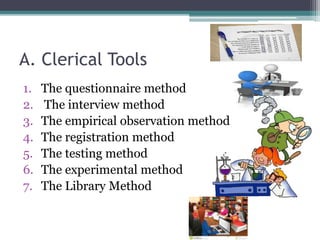
A. Clerical Tools
1. The questionnaire method
2. The interview method
3. The empirical observation method
4. The registration method
5. The testing method
6. The experimental method
7. The Library Method
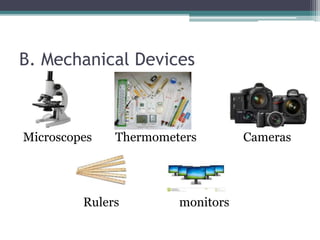
B. Mechanical Devices
Microscopes Thermometers Cameras
Rulers monitors
1. The instrument of must be valid and reliable
2. It must be based upon the conceptual
frameworks or what the researcher wants to
find data
3. It must be gather data suitable for and relevant
to the research topic.
4. It should be from all kinds of bins.
5. It must gather data that would test the
hypothesis or answer the questions under
investigation.
6. It must contain only questions or items that are
unequivocal
7. It must contain clear and definite directions to
accomplish it.
8. If the instrument is mechanical device, it must
be of the best or latest model.
9. It must be accompanied by a good cover letter.
10. It must be accompanied, if possible, by a letter
of recommendation from a sponsor.
Collection of data
Collection of data

Collection of data

  • 1.
  • 3.
    What is aData? Plural form for datum, collection of numbers, quantities, facts, or records used as bases for drawing conclusions or making inferences. (Good, p.155)
  • 4.
    What is aData? • What research is searching for and which are subjected to analysis, statistical procedures, and interpretation so that inferences, principles or generalization are drawn.
  • 6.
    Primary Data  Arethose gathered from primary source  Are as follows: a) Individual person b) Organized group c) Established practices
  • 7.
    Primary Data d) Documentsin their original forms e) Living Organisms f) Man-made material things g) Natural Objects and phenomena
  • 8.
    Secondary Data are thosegathered from second sources Are as follows: a) Books b) Articles published c) Unpublished master’s degree d) Monographs, manuscripts, etc. e) All other second hand sources.
  • 10.
    Advantages of PrimaryData over Secondary Data 1. The primary data frequently give detailed definition of terms and statistical units used in the survey.
  • 11.
    Advantages of PrimaryData over Secondary Data 2. The secondary data have usually little or no explanatory notes which often arises from transcriptions of the figures from the original primary source.
  • 12.
    Advantages of PrimaryData over Secondary Data 3. The primary data usually includes a copy of the schedule and a description of the procedure used in the selection of the type of sample and in collecting the data. This gives the user and ideas of accuracy, applicability, and limitation of the survey result.
  • 13.
    Advantages of PrimaryData over Secondary Data 4. The primary data are usually broken down into finer classifications. The secondary data often omit past of combining categories, such as showing barrios instead of sitios, or municipalities instead of barrios.
  • 14.
    Advantages of SecondaryData 1. Secondary Data are more convenient to use because they are already condensed and organized. 2. Analysis and interpretation are done more easily. 3.Libraries make secondary data are more easily accessible.
  • 16.
    Respondents ▫ Are thoseindividual who are asked or requested by a researcher to supply data or information about his research problem.
  • 17.
    Categories of Datagathered from respondents 1. Facts ▫ Personal circumstances ▫ What they do 2. Attitudes and feelings 3. Judgements 4. Psychomotor skills
  • 18.
    Categories of Datagathered from respondents 5) Results of test and experiments 6) All other data gathered from the primary and secondary data.
  • 19.
  • 20.
    A. Clerical Tools 1.The questionnaire method 2. The interview method 3. The empirical observation method 4. The registration method 5. The testing method 6. The experimental method 7. The Library Method
  • 21.
    B. Mechanical Devices MicroscopesThermometers Cameras Rulers monitors
  • 23.
    1. The instrumentof must be valid and reliable 2. It must be based upon the conceptual frameworks or what the researcher wants to find data 3. It must be gather data suitable for and relevant to the research topic. 4. It should be from all kinds of bins.
  • 24.
    5. It mustgather data that would test the hypothesis or answer the questions under investigation. 6. It must contain only questions or items that are unequivocal 7. It must contain clear and definite directions to accomplish it.
  • 25.
    8. If theinstrument is mechanical device, it must be of the best or latest model. 9. It must be accompanied by a good cover letter. 10. It must be accompanied, if possible, by a letter of recommendation from a sponsor.