Back to the basics, Part2
Data exploration:
representing and testing data properties
Spyros Veronikis
Electrical and Electronics Engineer
Dept. of Archives and Library Sciences
Ionian University
spver@ionio.gr
http://dlib.ionio.gr/~spver/seminars/statistics/


                                                   More information
Seminar Content
   Basic statistics concepts
   Data exploration
   Correlation
   Comparing two means
   Comparing several means (ANOVA)
   Non-parametric test
   Nominal data


                                      2
Today's Content
   Statistical significance
   Parametric Data
   Histograms and Boxplots
   Descriptive statistics
   Correcting problems in the data
   Exploring groups of data
   Testing whether a distribution is normal
   Testing for homogeneity of variance
   Summary
                                               3
Statistical significance
      Ronald Fisher and Muriel Bristol, The Lady tasting
       tea
     Given 6 cups of tea and milk (in 3 of which the tea was placed first and 3 had the
     milk added first)
      “What is the probability that lady Bristol finds all 3 cups where tea was placed
        first?”            (Answer: 1/20= 0.05 ή 5%)
     Fisher suggested that only when we are at least 95% certain that a result is
     genuine (not a chance finding) should we accept it as true, and therefore
     statistically significant.
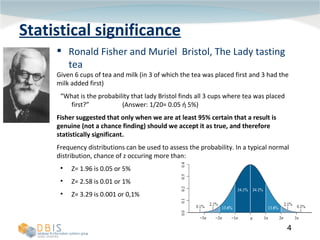
     Frequency distributions can be used to assess the probability. In a typical normal
     distribution, chance of z occuring more than:
      
          Z= 1.96 is 0.05 or 5%
      
          Z= 2.58 is 0.01 or 1%
      
          Z= 3.29 is 0.001 or 0,1%


                                                                                         4
Parametric data
 Assumptions of parametric tests:
     1. Normally distributed data:
           
               Checked with histograms and Kolmogorov-Smirnov or Shapiro-Wilk criterion
     2. Homogeneity of variance
           
               In several groups: data in samples come from populations of same variance
           
               In correlational designs: variance of one variable remains stable across all levels of
               other variable(s)
     3. Interval data
           
               Arithmetic values, equal differences among successive points in measurement scale
     4. Independence
           
               Data come from different participants who don't influence each other.


Only requirements 1 and 2 are tested by objective criteria (tests). Requirements 3 and 4 are
    tested by common sense.


                                                                                                 5
Graphing and screening data
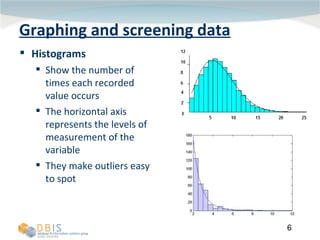
 Histograms
   Show the number of
    times each recorded
    value occurs
   The horizontal axis
    represents the levels of
    measurement of the
    variable
   They make outliers easy
    to spot


                               6
Outliers
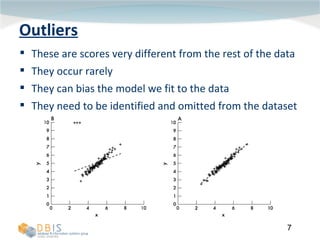
 These are scores very different from the rest of the data
 They occur rarely
 They can bias the model we fit to the data
 They need to be identified and omitted from the dataset


                                                         7
Graphing and screening data
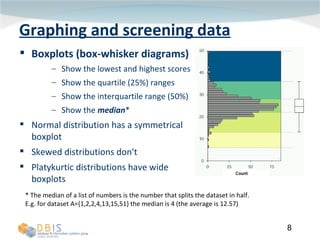
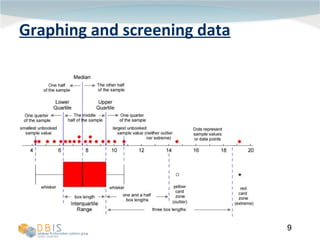
 Boxplots (box-whisker diagrams)
          – Show the lowest and highest scores
          – Show the quartile (25%) ranges
          – Show the interquartile range (50%)
          – Show the median*
 Normal distribution has a symmetrical
  boxplot
 Skewed distributions don't
 Platykurtic distributions have wide
  boxplots
 * The median of a list of numbers is the number that splits the dataset in half.
 E.g. for dataset A={1,2,2,4,13,15,51} the median is 4 (the average is 12.57)


                                                                                    8
Graphing and screening data


                              9
Descriptive statistics
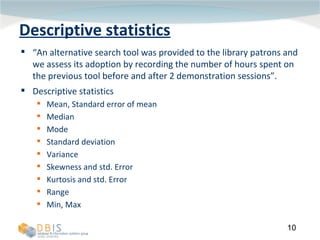
 “An alternative search tool was provided to the library patrons and
  we assess its adoption by recording the number of hours spent on
  the previous tool before and after 2 demonstration sessions”.
 Descriptive statistics
       Mean, Standard error of mean
       Median
       Mode
       Standard deviation
       Variance
       Skewness and std. Error
       Kurtosis and std. Error
       Range
       Min, Max

                                                                  10
Descriptive statistics


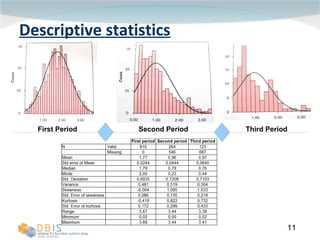
  First Period   Second Period   Third Period


                                            11
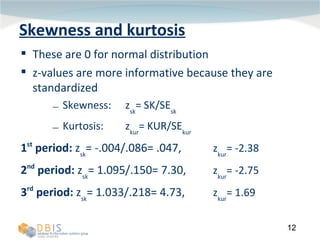
Skewness and kurtosis
 These are 0 for normal distribution
 z-values are more informative because they are
  standardized
      – Skewness:     zsk= SK/SEsk
      – Kurtosis:     zkur= KUR/SEkur
1st period: zsk= -.004/.086= .047,      zkur= -2.38
2nd period: zsk= 1.095/.150= 7.30,      zkur= -2.75
3rd period: zsk= 1.033/.218= 4.73,      zkur= 1.69

                                                      12
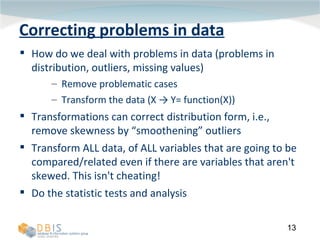
Correcting problems in data
 How do we deal with problems in data (problems in
  distribution, outliers, missing values)
      – Remove problematic cases
      – Transform the data (X → Y= function(X))
 Transformations can correct distribution form, i.e.,
  remove skewness by “smoothening” outliers
 Transform ALL data, of ALL variables that are going to be
  compared/related even if there are variables that aren't
  skewed. This isn't cheating!
 Do the statistic tests and analysis

                                                        13
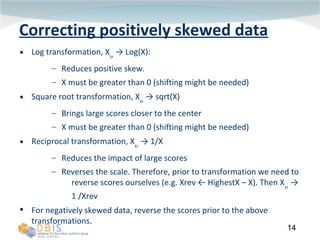
Correcting positively skewed data
 Log transformation, Xtr → Log(X):
        – Reduces positive skew.
        – X must be greater than 0 (shifting might be needed)
 Square root transformation, Xtr → sqrt(X)
        – Brings large scores closer to the center
        – X must be greater than 0 (shifting might be needed)
 Reciprocal transformation, Xtr → 1/X
        – Reduces the impact of large scores
        – Reverses the scale. Therefore, prior to transformation we need to
            reverse scores ourselves (e.g. Xrev ← HighestX – X). Then X tr →
              1 /Xrev
 For negatively skewed data, reverse the scores prior to the above
  transformations.
                                                                        14
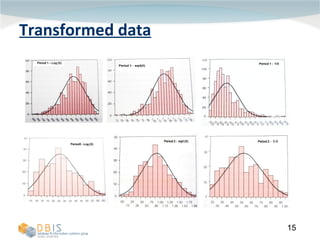
Transformed data


                   15
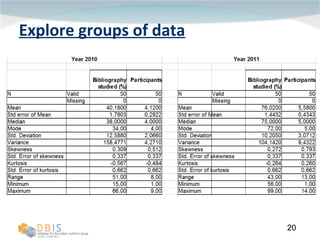
Explore groups of data
  Example:
 A professor is recording the score of a project report delivered by
  his students. He also takes a note to:
        – The percentage of the given bibliography studied (biblio)
       – Their attendaces in the lectures (lectures)
       – The number of student collaborated to deliver the report
           (participants).
 He collects the same data a year later (from the students of the
  new class) and looks for differences in performance.


        Score= function(biblio, lectures, participants, year)


                                                                  16
Explore groups of data
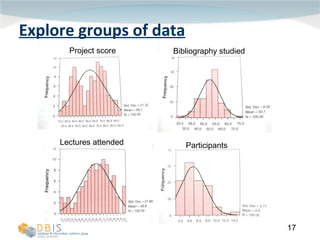
       Project score     Bibliography studied


     Lectures attended      Participants


                                                17
Explore groups of data


                         18
Explore groups of data
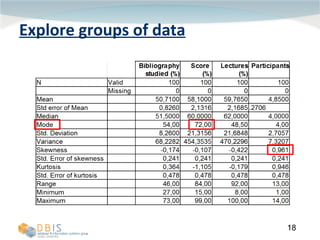
  Comments on overall descriptives (previous table):
 The distribution of score for both years seems bimodal (could be a
  difference in performance by year)
 We can compare scores of two years (because each one comes
  from a normal distribution), but we can compare the whole dataset
  of scores to another similar dataset.
 The participants' distribution might also be due to different
  collaborations among years.


 We ask for descriptives per year


                                                                19
Explore groups of data


                         20
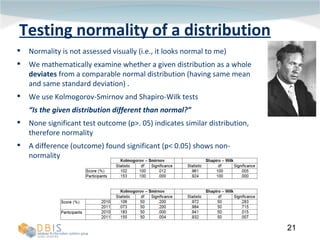
Testing normality of a distribution
   Normality is not assessed visually (i.e., it looks normal to me)
   We mathematically examine whether a given distribution as a whole
    deviates from a comparable normal distribution (having same mean
    and same standard deviation) .
   We use Kolmogorov-Smirnov and Shapiro-Wilk tests
    “Is the given distribution different than normal?”
   None significant test outcome (p>. 05) indicates similar distribution,
    therefore normality
   A difference (outcome) found significant (p< 0.05) shows non-
    normality


                                                                             21
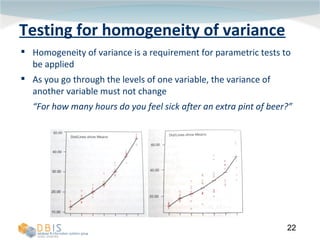
Testing for homogeneity of variance
 Homogeneity of variance is a requirement for parametric tests to
  be applied
 As you go through the levels of one variable, the variance of
  another variable must not change
   “For how many hours do you feel sick after an extra pint of beer?”


                                                                   22
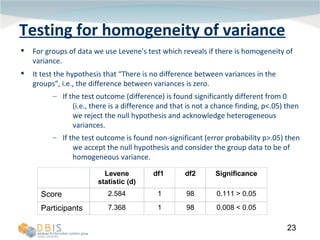
Testing for homogeneity of variance
   For groups of data we use Levene's test which reveals if there is homogeneity of
    variance.
   It test the hypothesis that “There is no difference between variances in the
    groups”, i.e., the difference between variances is zero.
          – If the test outcome (difference) is found significantly different from 0
                (i.e., there is a difference and that is not a chance finding, p<.05) then
                we reject the null hypothesis and acknowledge heterogeneous
                variances.
          – If the test outcome is found non-significant (error probability p>.05) then
                we accept the null hypothesis and consider the group data to be of
                homogeneous variance.

                          Levene          df1        df2      Significance
                        statistic (d)
      Score                2.584            1        98        0.111 > 0.05

      Participants         7.368            1        98        0.008 < 0.05

                                                                                      23
Summary
 What we 've seen
   Examine data properly before proceeding to
    analysis
   Look at the data distribution
   Spot any problems (e.g. outliers)
   In case of non-normality try to transform data
   When comparing data from different groups look
    at distributions within each group
   Also test for homogeneity of variance

                                                24
References
 Field, A. (2005). Discovering Statistics Using SPSS,
  2nd ed., Sage Publications.
 Statsoft, Inc. (2011). Electronic Statistics Textbook.
  Tulsa, OK: Statsoft. WEB:
  http://www.statsoft.com/textbook/


                                                       25

Back to the basics-Part2: Data exploration: representing and testing data properties

  • 1.
    Back to thebasics, Part2 Data exploration: representing and testing data properties Spyros Veronikis Electrical and Electronics Engineer Dept. of Archives and Library Sciences Ionian University spver@ionio.gr http://dlib.ionio.gr/~spver/seminars/statistics/ More information
  • 2.
    Seminar Content  Basic statistics concepts  Data exploration  Correlation  Comparing two means  Comparing several means (ANOVA)  Non-parametric test  Nominal data 2
  • 3.
    Today's Content  Statistical significance  Parametric Data  Histograms and Boxplots  Descriptive statistics  Correcting problems in the data  Exploring groups of data  Testing whether a distribution is normal  Testing for homogeneity of variance  Summary 3
  • 4.
    Statistical significance  Ronald Fisher and Muriel Bristol, The Lady tasting tea Given 6 cups of tea and milk (in 3 of which the tea was placed first and 3 had the milk added first) “What is the probability that lady Bristol finds all 3 cups where tea was placed first?” (Answer: 1/20= 0.05 ή 5%) Fisher suggested that only when we are at least 95% certain that a result is genuine (not a chance finding) should we accept it as true, and therefore statistically significant. Frequency distributions can be used to assess the probability. In a typical normal distribution, chance of z occuring more than:  Z= 1.96 is 0.05 or 5%  Z= 2.58 is 0.01 or 1%  Z= 3.29 is 0.001 or 0,1% 4
  • 5.
    Parametric data  Assumptionsof parametric tests: 1. Normally distributed data:  Checked with histograms and Kolmogorov-Smirnov or Shapiro-Wilk criterion 2. Homogeneity of variance  In several groups: data in samples come from populations of same variance  In correlational designs: variance of one variable remains stable across all levels of other variable(s) 3. Interval data  Arithmetic values, equal differences among successive points in measurement scale 4. Independence  Data come from different participants who don't influence each other. Only requirements 1 and 2 are tested by objective criteria (tests). Requirements 3 and 4 are tested by common sense. 5
  • 6.
    Graphing and screeningdata  Histograms  Show the number of times each recorded value occurs  The horizontal axis represents the levels of measurement of the variable  They make outliers easy to spot 6
  • 7.
    Outliers  These arescores very different from the rest of the data  They occur rarely  They can bias the model we fit to the data  They need to be identified and omitted from the dataset 7
  • 8.
    Graphing and screeningdata  Boxplots (box-whisker diagrams) – Show the lowest and highest scores – Show the quartile (25%) ranges – Show the interquartile range (50%) – Show the median*  Normal distribution has a symmetrical boxplot  Skewed distributions don't  Platykurtic distributions have wide boxplots * The median of a list of numbers is the number that splits the dataset in half. E.g. for dataset A={1,2,2,4,13,15,51} the median is 4 (the average is 12.57) 8
  • 9.
  • 10.
    Descriptive statistics  “Analternative search tool was provided to the library patrons and we assess its adoption by recording the number of hours spent on the previous tool before and after 2 demonstration sessions”.  Descriptive statistics  Mean, Standard error of mean  Median  Mode  Standard deviation  Variance  Skewness and std. Error  Kurtosis and std. Error  Range  Min, Max 10
  • 11.
    Descriptive statistics First Period Second Period Third Period 11
  • 12.
    Skewness and kurtosis These are 0 for normal distribution  z-values are more informative because they are standardized – Skewness: zsk= SK/SEsk – Kurtosis: zkur= KUR/SEkur 1st period: zsk= -.004/.086= .047, zkur= -2.38 2nd period: zsk= 1.095/.150= 7.30, zkur= -2.75 3rd period: zsk= 1.033/.218= 4.73, zkur= 1.69 12
  • 13.
    Correcting problems indata  How do we deal with problems in data (problems in distribution, outliers, missing values) – Remove problematic cases – Transform the data (X → Y= function(X))  Transformations can correct distribution form, i.e., remove skewness by “smoothening” outliers  Transform ALL data, of ALL variables that are going to be compared/related even if there are variables that aren't skewed. This isn't cheating!  Do the statistic tests and analysis 13
  • 14.
    Correcting positively skeweddata  Log transformation, Xtr → Log(X): – Reduces positive skew. – X must be greater than 0 (shifting might be needed)  Square root transformation, Xtr → sqrt(X) – Brings large scores closer to the center – X must be greater than 0 (shifting might be needed)  Reciprocal transformation, Xtr → 1/X – Reduces the impact of large scores – Reverses the scale. Therefore, prior to transformation we need to reverse scores ourselves (e.g. Xrev ← HighestX – X). Then X tr → 1 /Xrev  For negatively skewed data, reverse the scores prior to the above transformations. 14
  • 15.
  • 16.
    Explore groups ofdata Example:  A professor is recording the score of a project report delivered by his students. He also takes a note to: – The percentage of the given bibliography studied (biblio) – Their attendaces in the lectures (lectures) – The number of student collaborated to deliver the report (participants).  He collects the same data a year later (from the students of the new class) and looks for differences in performance.  Score= function(biblio, lectures, participants, year) 16
  • 17.
    Explore groups ofdata Project score Bibliography studied Lectures attended Participants 17
  • 18.
  • 19.
    Explore groups ofdata Comments on overall descriptives (previous table):  The distribution of score for both years seems bimodal (could be a difference in performance by year)  We can compare scores of two years (because each one comes from a normal distribution), but we can compare the whole dataset of scores to another similar dataset.  The participants' distribution might also be due to different collaborations among years.  We ask for descriptives per year 19
  • 20.
  • 21.
    Testing normality ofa distribution  Normality is not assessed visually (i.e., it looks normal to me)  We mathematically examine whether a given distribution as a whole deviates from a comparable normal distribution (having same mean and same standard deviation) .  We use Kolmogorov-Smirnov and Shapiro-Wilk tests “Is the given distribution different than normal?”  None significant test outcome (p>. 05) indicates similar distribution, therefore normality  A difference (outcome) found significant (p< 0.05) shows non- normality 21
  • 22.
    Testing for homogeneityof variance  Homogeneity of variance is a requirement for parametric tests to be applied  As you go through the levels of one variable, the variance of another variable must not change “For how many hours do you feel sick after an extra pint of beer?” 22
  • 23.
    Testing for homogeneityof variance  For groups of data we use Levene's test which reveals if there is homogeneity of variance.  It test the hypothesis that “There is no difference between variances in the groups”, i.e., the difference between variances is zero. – If the test outcome (difference) is found significantly different from 0 (i.e., there is a difference and that is not a chance finding, p<.05) then we reject the null hypothesis and acknowledge heterogeneous variances. – If the test outcome is found non-significant (error probability p>.05) then we accept the null hypothesis and consider the group data to be of homogeneous variance. Levene df1 df2 Significance statistic (d) Score 2.584 1 98 0.111 > 0.05 Participants 7.368 1 98 0.008 < 0.05 23
  • 24.
    Summary  What we've seen  Examine data properly before proceeding to analysis  Look at the data distribution  Spot any problems (e.g. outliers)  In case of non-normality try to transform data  When comparing data from different groups look at distributions within each group  Also test for homogeneity of variance 24
  • 25.
    References  Field, A.(2005). Discovering Statistics Using SPSS, 2nd ed., Sage Publications.  Statsoft, Inc. (2011). Electronic Statistics Textbook. Tulsa, OK: Statsoft. WEB: http://www.statsoft.com/textbook/ 25