.
          Introduction to Common Spatial Pattern Filters for EEG
                        Motor Imagery Classification
   .


                                  Tatsuya Yokota


                          Tokyo Institute of Technology

                                  July 17, 2012


July 17, 2012                                                      1/33
Outline


  .
  1    Introduction
         Motor Imagery
         Electroencephalogram:EEG
         Main scheme


  .
  2    Common Spatial Pattern Filters
         Standard CSP Algorithm
         CSSP Algorithm
         CSSSP Algorithm
         SBCSP Algorithm


  .
  3    Conclusion


July 17, 2012                           2/33
Motor Imagery [Hema et al., 2009] I


   Motor Imagery is a mental process of a motor action. It includes preparation for movement,
   passive observations of action and mental operations of motor representations implicitly or
   explicitly. The ability of an individual to control his EEG through imaginary mental tasks enables
   him to control devices through a brain machine interface (BMI) or a brain computer interface
   (BCI).
   The BMI/BCI is a direct communication pathway between the brain and an external device.
   BMI/BCIs are often aimed at assisting, augmenting, or repairing human cognitive or
   sensory-motor functions. BMI/BCIs are used to rehabilitate people suffering from neuromuscular
   disorders as a means of communication or control.
   The methodologies of BMI/BCIs can be separated into two approaches:
           Invasive (or partially-invasive) BMI/BCIs (ECoG),
           Non-invasive BMI/BCIs (EEG, MEG, MRI, fMRI etc).
   Invasive and partially-invasive BCIs are accurate. However there are risks of the infection and the
   damage. Furthermore, it requires the operation to set the electrodes in the head.
   On the other hand, non-invasive BCIs are inferior than invasive BCIs in accuracy, but costs and
   risks are very low. Especially, EEG approach is the most studied potential non-invasive interface,
   mainly due to its fine temporal resolution, ease of use, portability and low set-up cost.


July 17, 2012                                                                                       3/33
Electroencephalogram:EEG
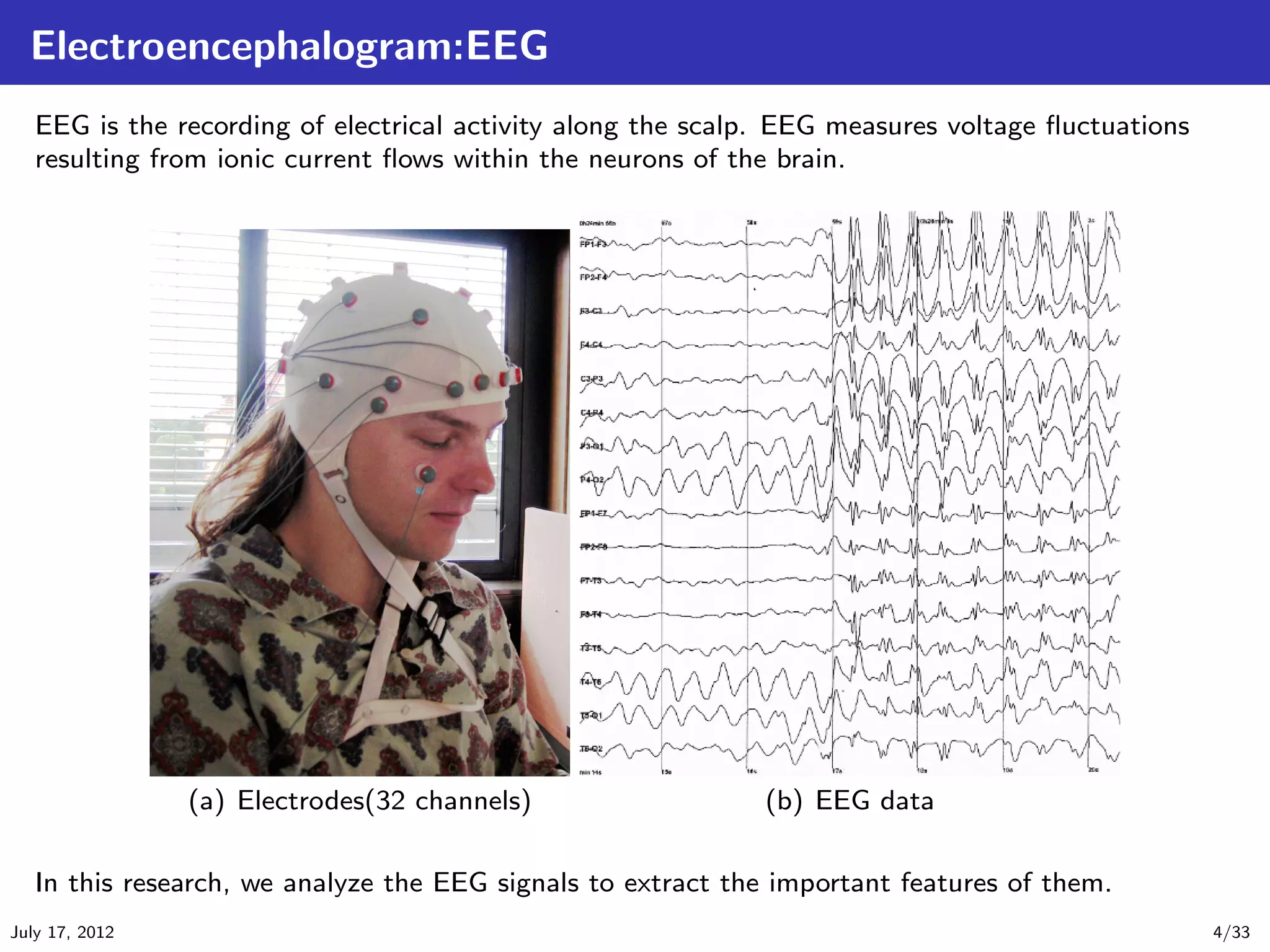
   EEG is the recording of electrical activity along the scalp. EEG measures voltage fluctuations
   resulting from ionic current flows within the neurons of the brain.


                (a) Electrodes(32 channels)                  (b) EEG data

   In this research, we analyze the EEG signals to extract the important features of them.
July 17, 2012                                                                                      4/33
EEG Motor Imagery Classification


           Here, we consider the EEG motor imagery classification problem by BCI competition III
           [Blankertz et al., 2006].
           Number of subjects is 5 (aa,al,av,aw,ay).
           118 channels of electrodes were used.
           The problem is to classify the given EEG signal to right hand or right foot.
           They recorded their EEG signals for 3.5 seconds with 100 Hz sampling rates for each trial.
           For each subject they conducted 280 (hand 140 / foot 140) trials.
July 17, 2012                                                                                      5/33
Problem Formalization


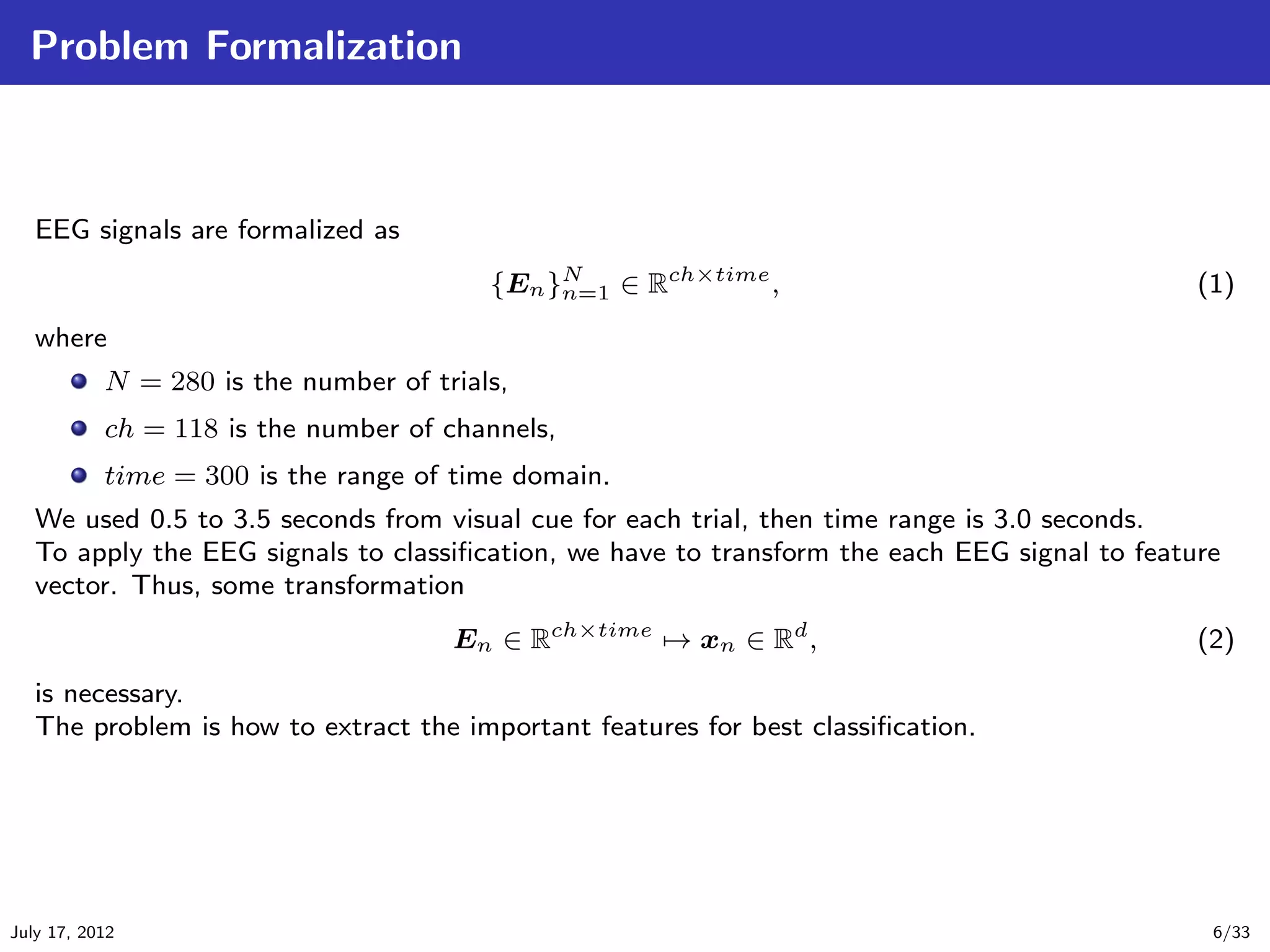
   EEG signals are formalized as
                                         {En }N ∈ Rch×time ,
                                              n=1                                              (1)
   where
           N = 280 is the number of trials,
           ch = 118 is the number of channels,
           time = 300 is the range of time domain.
   We used 0.5 to 3.5 seconds from visual cue for each trial, then time range is 3.0 seconds.
   To apply the EEG signals to classification, we have to transform the each EEG signal to feature
   vector. Thus, some transformation
                                      En ∈ Rch×time → xn ∈ Rd ,                                (2)
   is necessary.
   The problem is how to extract the important features for best classification.


July 17, 2012                                                                                   6/33
Feature Extraction Scheme

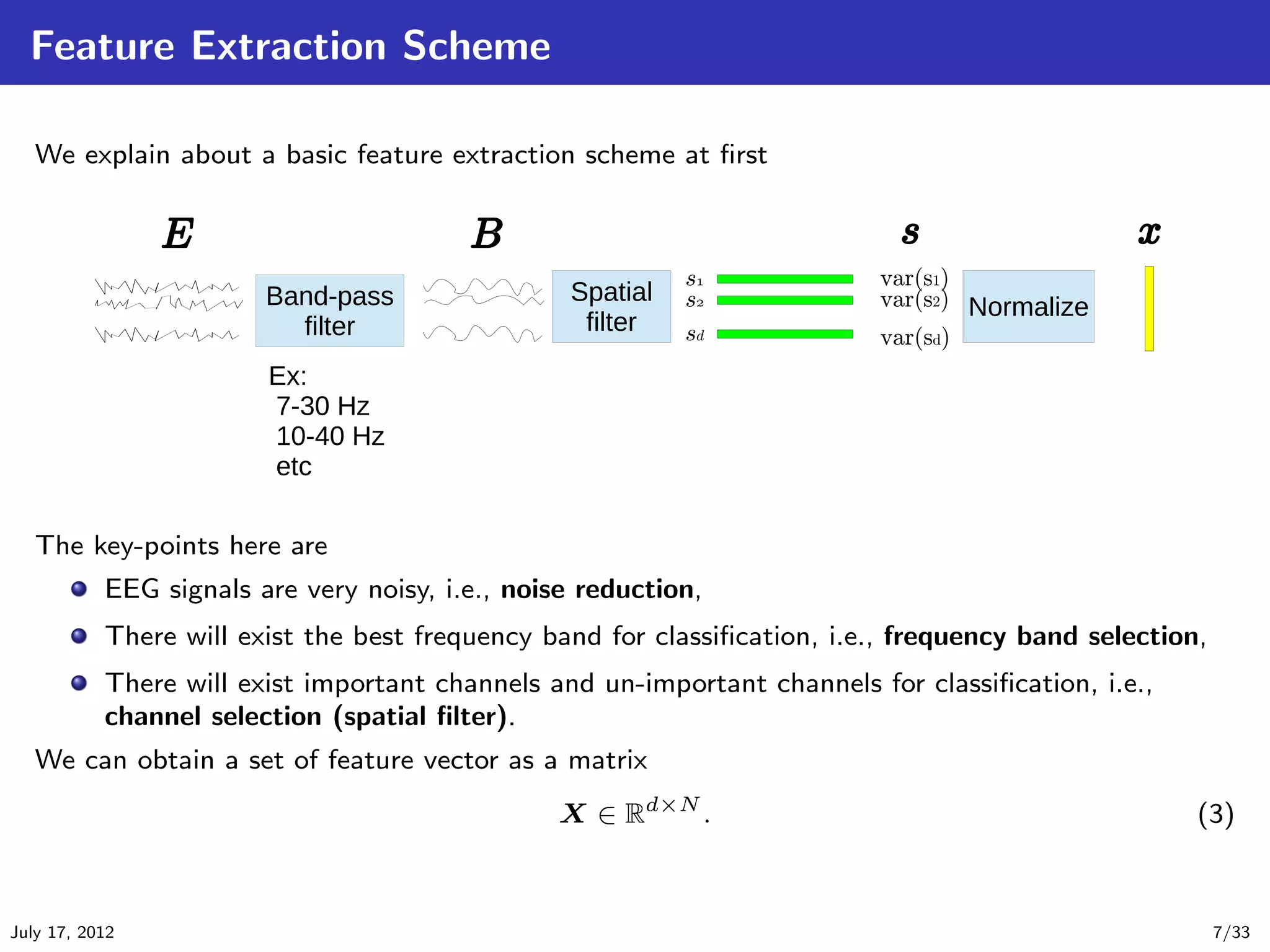
   We explain about a basic feature extraction scheme at first


   The key-points here are
           EEG signals are very noisy, i.e., noise reduction,
           There will exist the best frequency band for classification, i.e., frequency band selection,
           There will exist important channels and un-important channels for classification, i.e.,
           channel selection (spatial filter).
   We can obtain a set of feature vector as a matrix
                                                X ∈ Rd×N .                                           (3)


July 17, 2012                                                                                            7/33
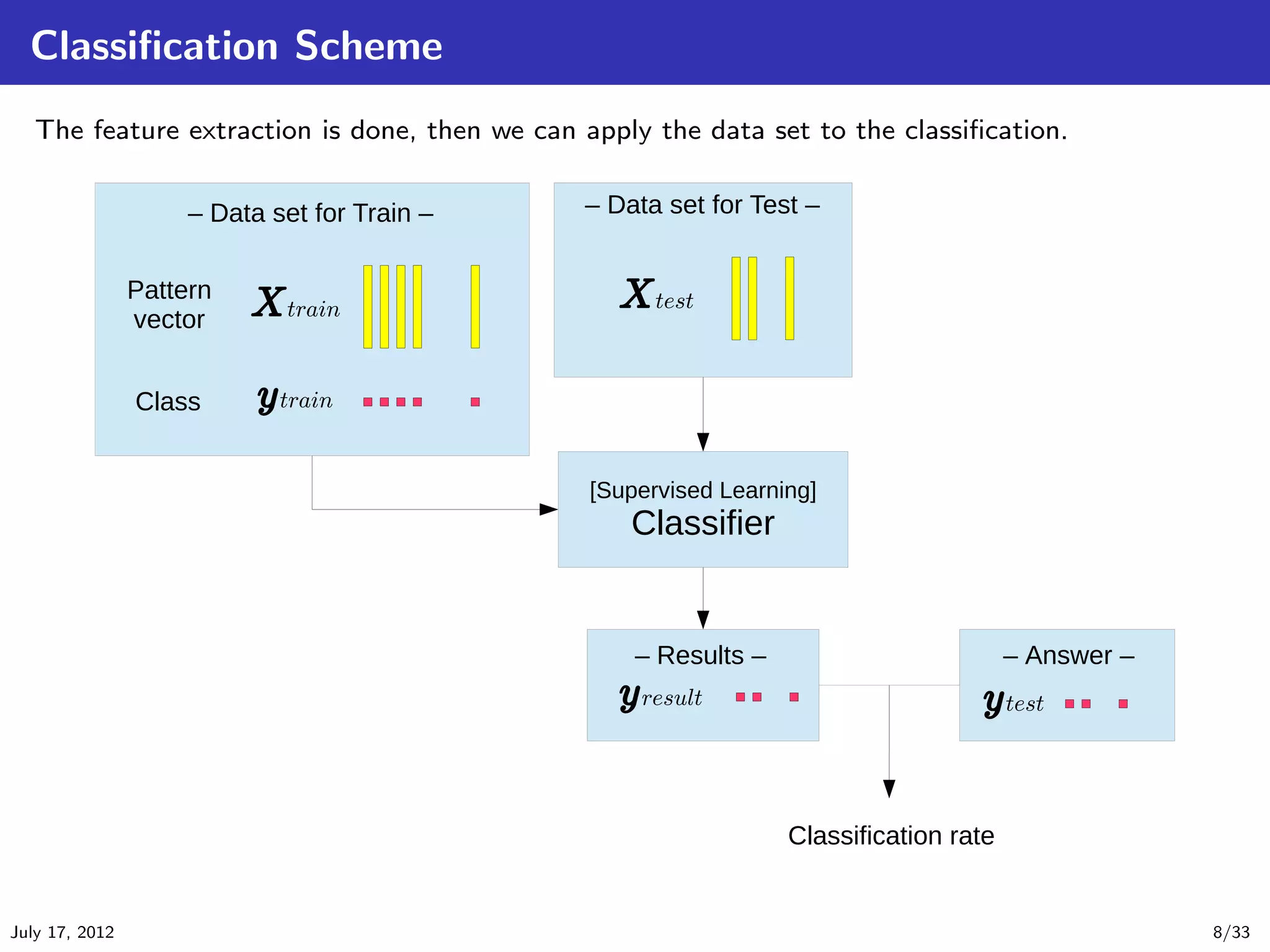
Classification Scheme
   The feature extraction is done, then we can apply the data set to the classification.


July 17, 2012                                                                             8/33
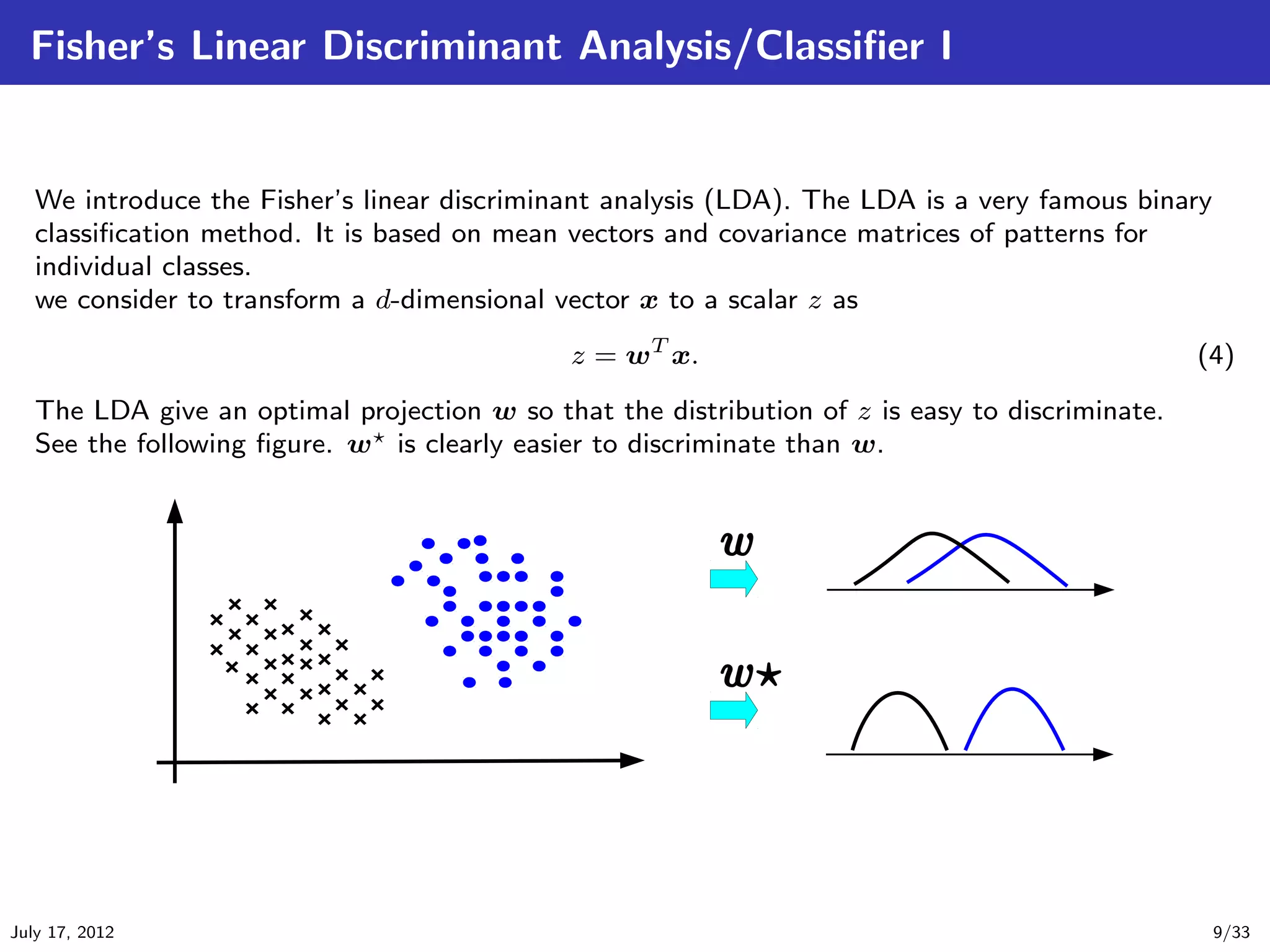
Fisher’s Linear Discriminant Analysis/Classifier I


   We introduce the Fisher’s linear discriminant analysis (LDA). The LDA is a very famous binary
   classification method. It is based on mean vectors and covariance matrices of patterns for
   individual classes.
   we consider to transform a d-dimensional vector x to a scalar z as
                                              z = wT x.                                          (4)
   The LDA give an optimal projection w so that the distribution of z is easy to discriminate.
   See the following figure. w is clearly easier to discriminate than w.


July 17, 2012                                                                                      9/33
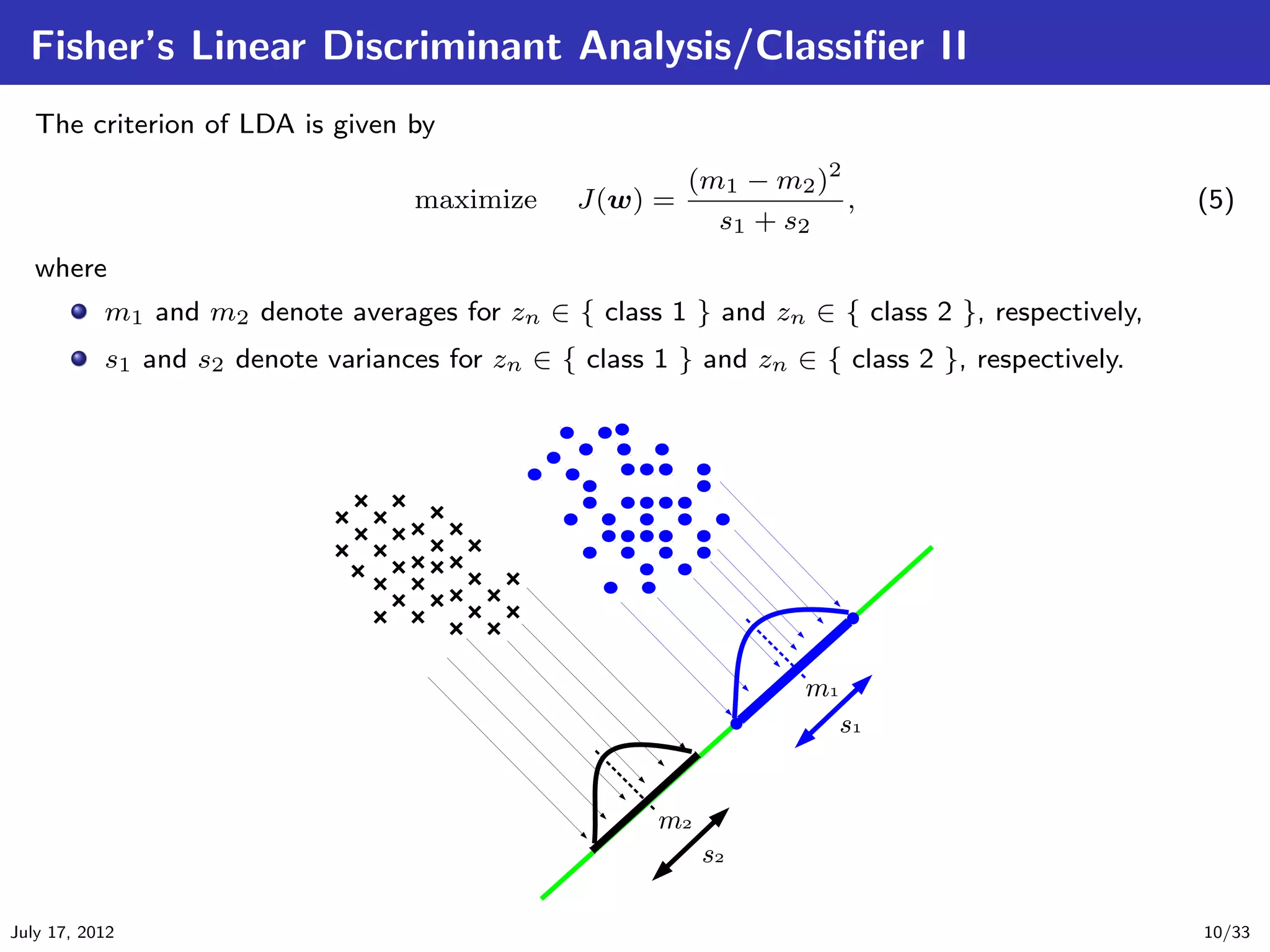
Fisher’s Linear Discriminant Analysis/Classifier II
   The criterion of LDA is given by
                                                          (m1 − m2 )2
                                    maximize     J(w) =               ,                          (5)
                                                            s1 + s2
   where
           m1 and m2 denote averages for zn ∈ { class 1 } and zn ∈ { class 2 }, respectively,
           s1 and s2 denote variances for zn ∈ { class 1 } and zn ∈ { class 2 }, respectively.


July 17, 2012                                                                                    10/33
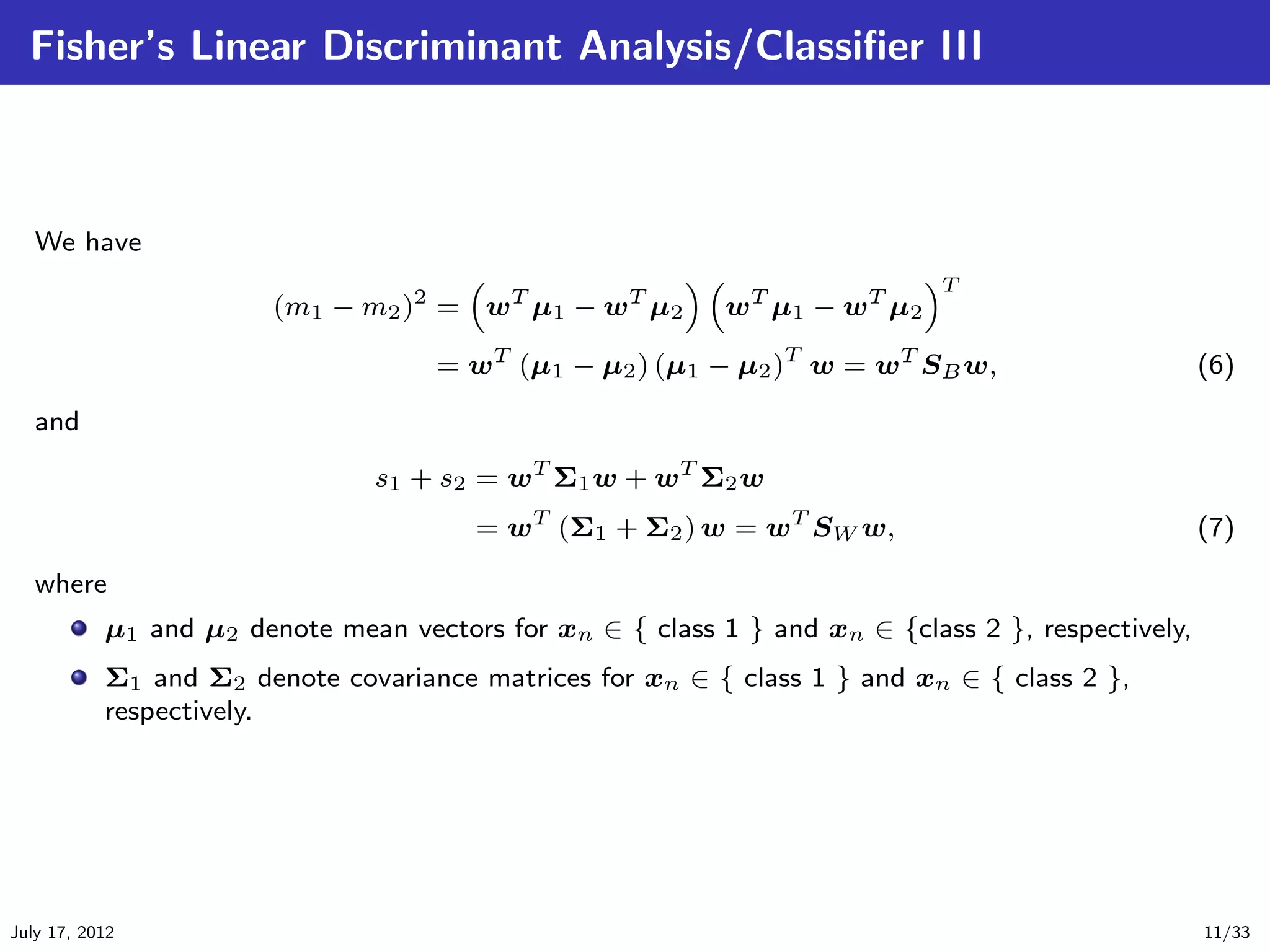
Fisher’s Linear Discriminant Analysis/Classifier III


   We have
                                                                             T
                        (m1 − m2 )2 = wT µ1 − wT µ2        w T µ1 − w T µ2

                                    = wT (µ1 − µ2 ) (µ1 − µ2 )T w = wT SB w,                       (6)

   and

                                s1 + s2 = wT Σ1 w + wT Σ2 w
                                        = wT (Σ1 + Σ2 ) w = wT SW w,                               (7)

   where
           µ1 and µ2 denote mean vectors for xn ∈ { class 1 } and xn ∈ {class 2 }, respectively,
           Σ1 and Σ2 denote covariance matrices for xn ∈ { class 1 } and xn ∈ { class 2 },
           respectively.


July 17, 2012                                                                                      11/33
Fisher’s Linear Discriminant Analysis/Classifier IV


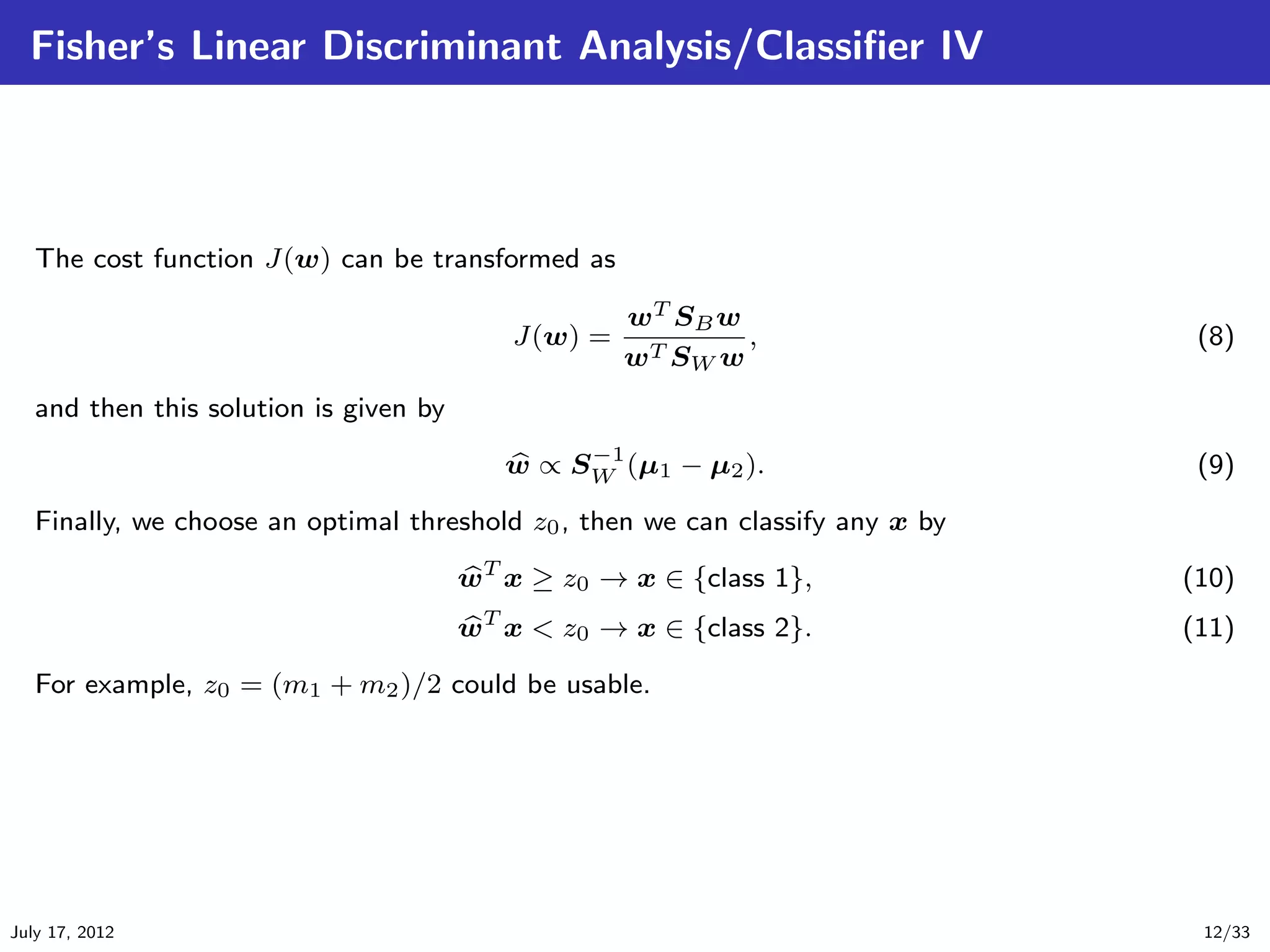
   The cost function J(w) can be transformed as

                                                      wT SB w
                                             J(w) =            ,                 (8)
                                                      w T SW w
   and then this solution is given by
                                                  −1
                                             w ∝ SW (µ1 − µ2 ).                  (9)

   Finally, we choose an optimal threshold z0 , then we can classify any x by

                                        wT x ≥ z0 → x ∈ {class 1},              (10)
                                        w x < z0 → x ∈ {class 2}.
                                         T
                                                                                (11)

   For example, z0 = (m1 + m2 )/2 could be usable.


July 17, 2012                                                                    12/33
An Example
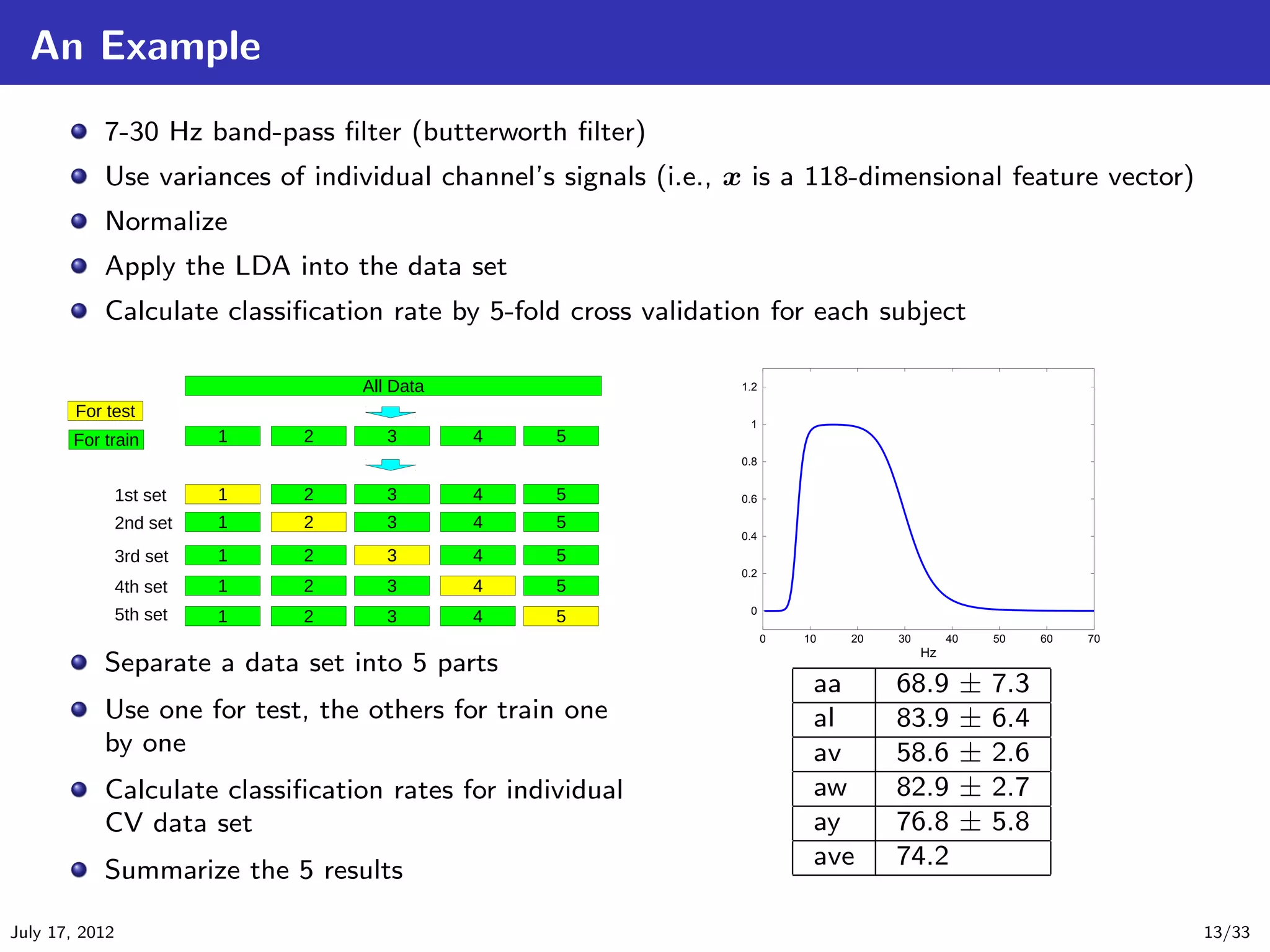
           7-30 Hz band-pass filter (butterworth filter)
           Use variances of individual channel’s signals (i.e., x is a 118-dimensional feature vector)
           Normalize
           Apply the LDA into the data set
           Calculate classification rate by 5-fold cross validation for each subject

                                                                1.2


                                                                 1


                                                                0.8


                                                                0.6


                                                                0.4


                                                                0.2


                                                                 0

                                                                      0   10   20   30        40       50    60   70
                                                                                         Hz
           Separate a data set into 5 parts
                                                                           aa       68.9           ±   7.3
           Use one for test, the others for train one                      al       83.9           ±   6.4
           by one                                                          av       58.6           ±   2.6
           Calculate classification rates for individual                    aw       82.9           ±   2.7
           CV data set                                                     ay       76.8           ±   5.8
                                                                           ave      74.2
           Summarize the 5 results

July 17, 2012                                                                                                          13/33
Common Spatial Pattern Filter I
   In previous example, we do not use a spatial filter. The proper spatial filter would provide signals
   so that easy to classify. The goal of this study is to design spatial filters that lead to optimal
   variances for the discrimination of two populations of EEG related to right hand and right foot
   motor imagery. We call this method the “Common Spatial Pattern” (CSP) algorithm
   [Muller-Gerking et al., 1999].
   We denote the CSP filter by
                                   S = W T E or s(t) = W T e(t),                                (12)

   where W ∈ Rd×ch is spatial filter matrix, S ∈ Rd×time is filtered signal matrix.
   The criterion of CSP is given by
                                 maximize      trW T Σ1 W ,                                     (13)
                                subject to     W T (Σ1 + Σ2 )W = I,                             (14)
   where
                                                              En EnT
                                     Σ1 =        Exp                T
                                                                      ,                         (15)
                                             En ∈{class 1}   trEn En
                                                              En EnT
                                     Σ2 =        Exp                T
                                                                      .                         (16)
                                             En ∈{class 2}   trEn En

   This problem can be solved by generalized eigen value problem. However, we can also solve it
   by two times of standard eigen value problem.
July 17, 2012                                                                                     14/33
Common Spatial Pattern Filter II


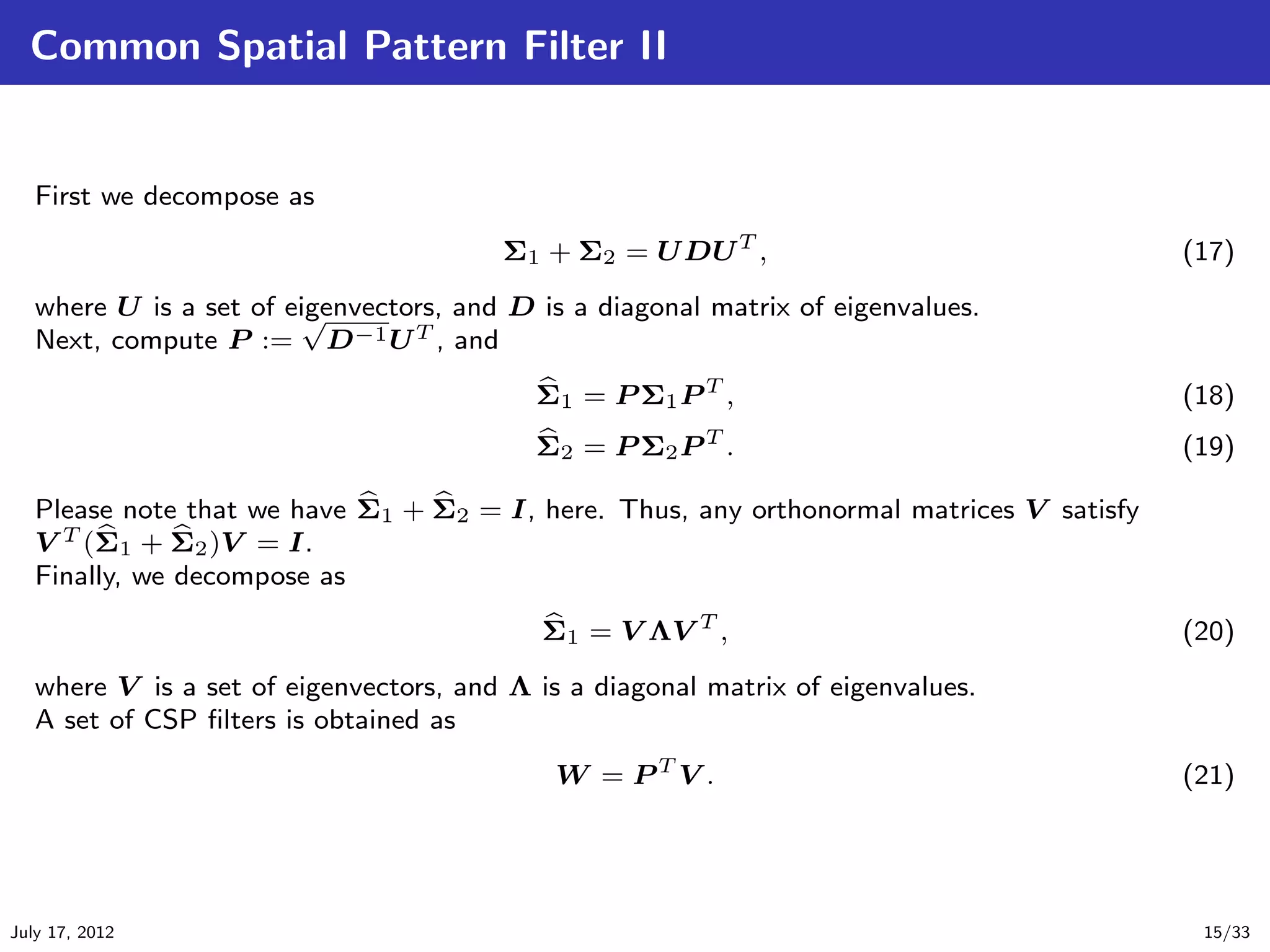
   First we decompose as
                                        Σ1 + Σ2 = U DU T ,                                (17)
   where U is a set of eigenvectors, and D is a diagonal matrix of eigenvalues.
                        √
   Next, compute P := D −1 U T , and
                                           Σ1 = P Σ1 P T ,                                (18)
                                                         T
                                           Σ2 = P Σ2 P .                                  (19)

   Please note that we have Σ1 + Σ2 = I, here. Thus, any orthonormal matrices V satisfy
   V T (Σ1 + Σ2 )V = I.
   Finally, we decompose as
                                           Σ1 = V ΛV T ,                                  (20)
   where V is a set of eigenvectors, and Λ is a diagonal matrix of eigenvalues.
   A set of CSP filters is obtained as
                                             W = PTV .                                    (21)


July 17, 2012                                                                              15/33
Common Spatial Pattern Filter III
   We have
                                                                         
                                          λ1
                               T                         ..              
                            W Σ1 W = Λ =                      .          ,                          (22)
                                                                   λch
                                                                                                
                                                1 − λ1
                                                                      ..                        
                            W T Σ2 W = I − Λ =                             .                    ,   (23)
                                                                                  1 − λch
   where λ1 ≥ λ2 ≥ · · · ≥ λch . Therefore, first CSP filter w1 provides maximum variance of class
   1, and last CSP filter wch provides maximum variance of class 2.
   We select first and last m filters to use as
                    Wcsp = w1         ···    wm     wch−m+1            ···           wch ∈ R2m×ch ,   (24)
   and filtered signal matrix is given by
                                                                                         T
                                        T
                                s(t) = Wcsp e(t) = s1 (t)           ···         sd (t)       ,        (25)
   i.e., d = 2m.
   Feature vector x = (x1 , x2 , . . . , xd )T is calculated by

                                                        var[si (t)]
                                        xi = log       d
                                                                                 .                    (26)
                                                       i=1     var[si (t)]

July 17, 2012                                                                                          16/33
Common Spatial Pattern Filter IV


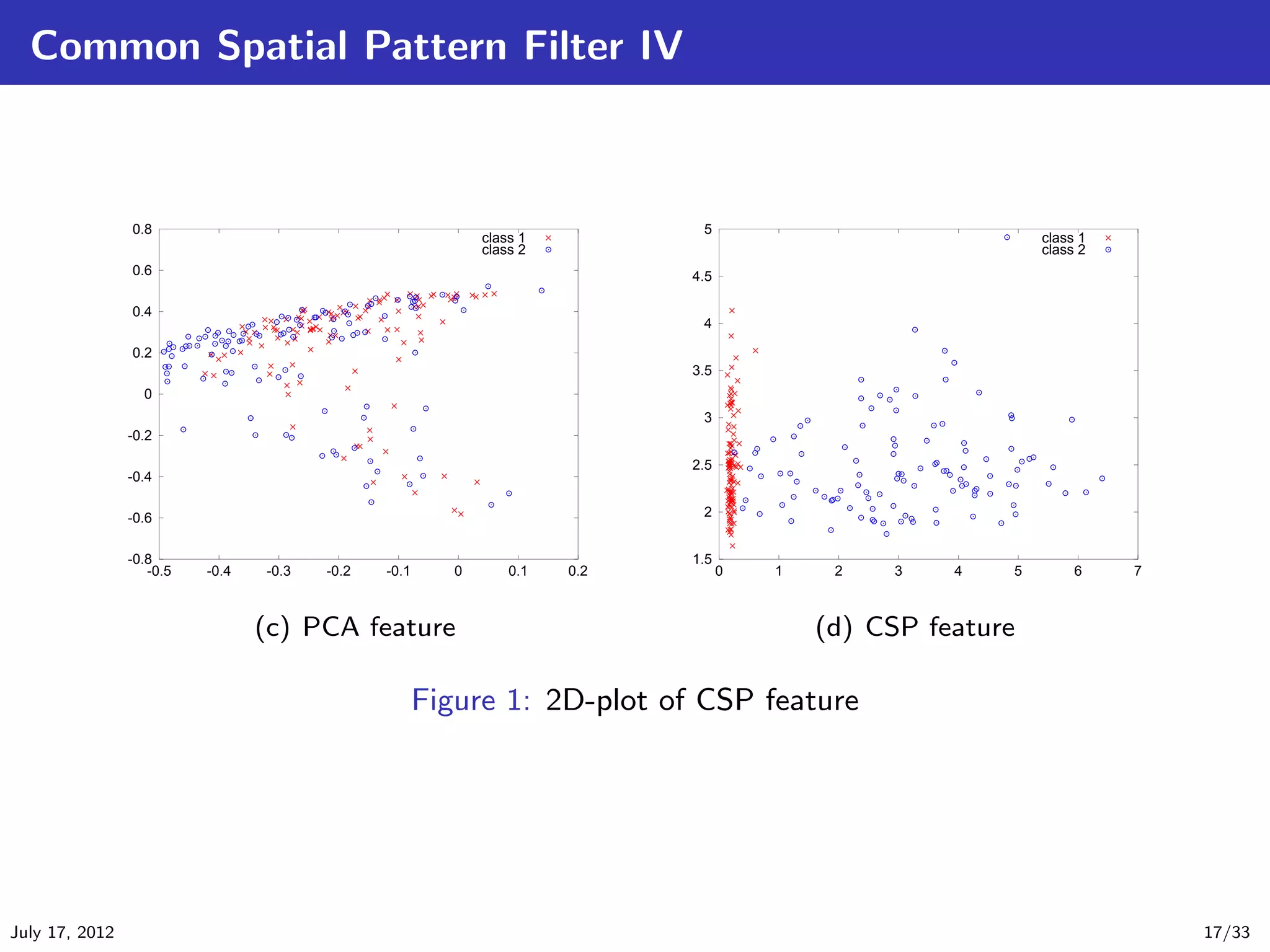
                0.8                                                           5
                                                             class 1                                         class 1
                                                             class 2                                         class 2
                0.6                                                          4.5

                0.4
                                                                              4

                0.2
                                                                             3.5
                  0
                                                                              3
                -0.2

                                                                             2.5
                -0.4

                -0.6                                                          2


                -0.8                                                         1.5
                   -0.5   -0.4   -0.3   -0.2   -0.1      0       0.1   0.2         0   1    2   3    4   5        6    7


                                 (c) PCA feature                                           (d) CSP feature

                                                      Figure 1: 2D-plot of CSP feature


July 17, 2012                                                                                                              17/33
Common Spatial Pattern Filter V


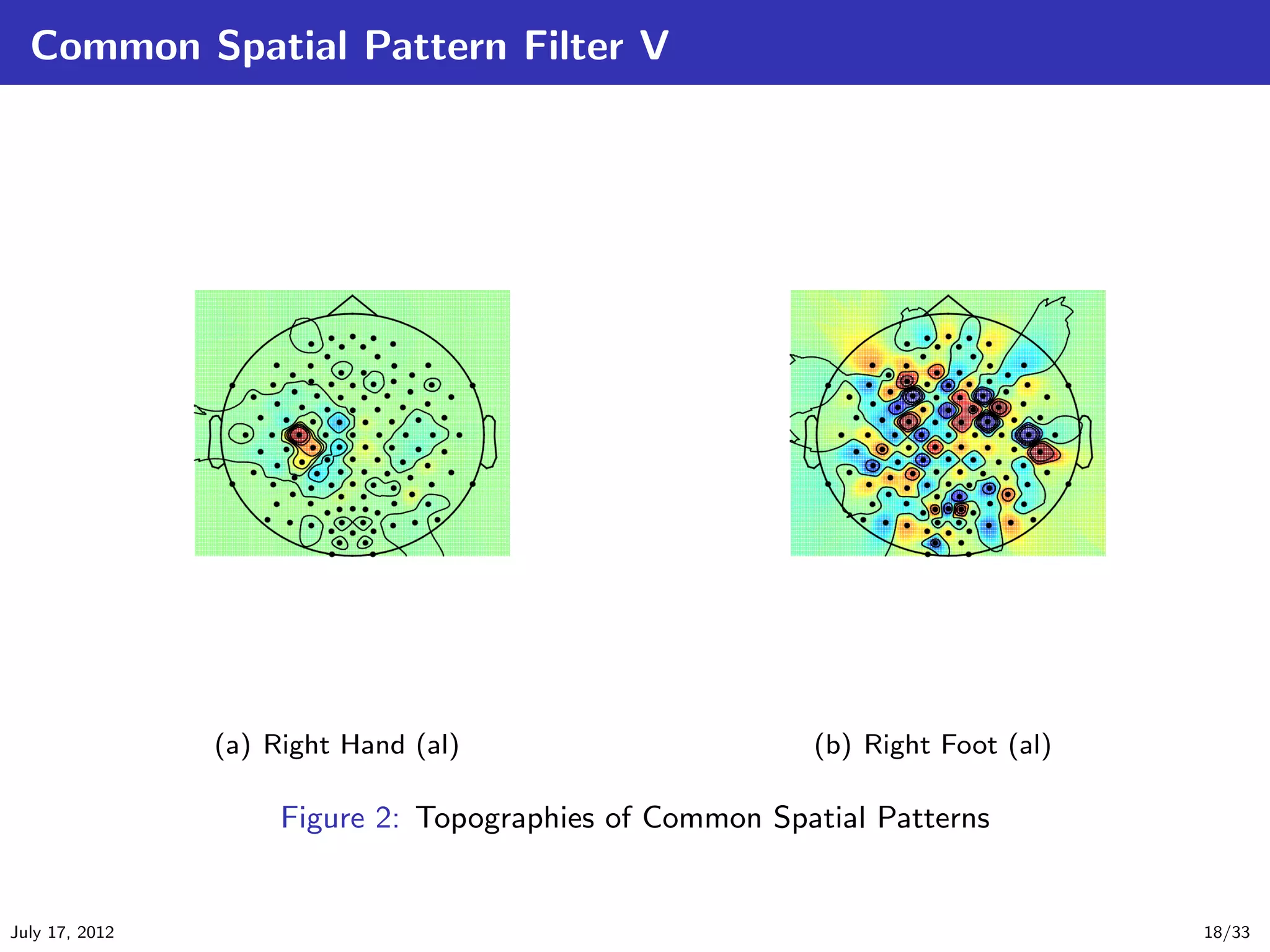
                (a) Right Hand (al)                      (b) Right Foot (al)

                     Figure 2: Topographies of Common Spatial Patterns


July 17, 2012                                                                  18/33
Common Spatial Pattern Filter VI

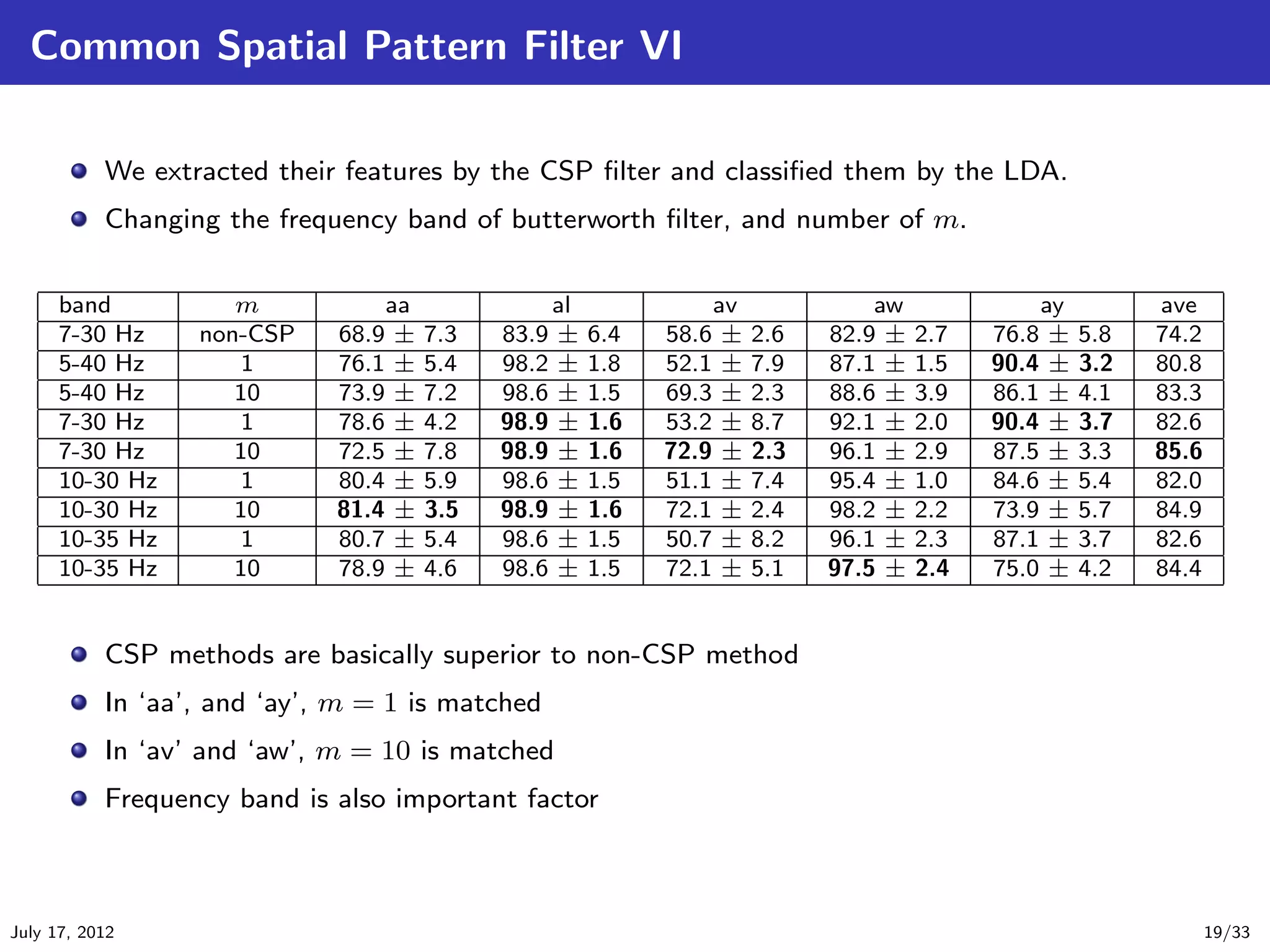
           We extracted their features by the CSP filter and classified them by the LDA.
           Changing the frequency band of butterworth filter, and number of m.


      band           m              aa                al                av             aw                ay         ave
      7-30 Hz     non-CSP    68.9    ±   7.3   83.9   ±    6.4   58.6    ±   2.6   82.9 ±   2.7   76.8    ±   5.8   74.2
      5-40 Hz         1      76.1    ±   5.4   98.2   ±    1.8   52.1    ±   7.9   87.1 ±   1.5   90.4    ±   3.2   80.8
      5-40 Hz        10      73.9    ±   7.2   98.6   ±    1.5   69.3    ±   2.3   88.6 ±   3.9   86.1    ±   4.1   83.3
      7-30 Hz         1      78.6    ±   4.2   98.9   ±    1.6   53.2    ±   8.7   92.1 ±   2.0   90.4    ±   3.7   82.6
      7-30 Hz        10      72.5    ±   7.8   98.9   ±    1.6   72.9    ±   2.3   96.1 ±   2.9   87.5    ±   3.3   85.6
      10-30 Hz        1      80.4    ±   5.9   98.6   ±    1.5   51.1    ±   7.4   95.4 ±   1.0   84.6    ±   5.4   82.0
      10-30 Hz       10      81.4    ±   3.5   98.9   ±    1.6   72.1    ±   2.4   98.2 ±   2.2   73.9    ±   5.7   84.9
      10-35 Hz        1      80.7    ±   5.4   98.6   ±    1.5   50.7    ±   8.2   96.1 ±   2.3   87.1    ±   3.7   82.6
      10-35 Hz       10      78.9    ±   4.6   98.6   ±    1.5   72.1    ±   5.1   97.5 ±   2.4   75.0    ±   4.2   84.4


           CSP methods are basically superior to non-CSP method
           In ‘aa’, and ‘ay’, m = 1 is matched
           In ‘av’ and ‘aw’, m = 10 is matched
           Frequency band is also important factor


July 17, 2012                                                                                                              19/33
Common Spatio-Spectral Pattern Filter I


   The Common Spatio-Spectral Pattern (CSSP) filter is an extension of the CSP filter
   [Lemm et al., 2005]. The CSSP can be regarded as a CSP method with the time delay
   embedding.
   The algorithm is not so different from the standard CSP. In CSP, we consider the following
   transformation
                                  S = W T E or s(t) = W T e(t).                                (27)
   But the CSSP’s transform is given by
                                                      E
                      S = W T E + Wτ Eτ = W T
                                   T
                                                           ,                                   (28)
                                                      Eτ
                                                                    e(t)
                      or s(t) = W T e(t) + Wτ e(t + τ ) = W T
                                            T
                                                                            ,                  (29)
                                                                  e(t + τ )

   where Eτ is a τ -time delayed signal matrix of E, and W T = [W T , Wτ ] is a CSSP matrix. It
                                                                         T

   can be also regarded that the number of channels increase to double. The deference between
   CSP and CSSP is only this point, and then we can apply this method easily in a same way to the
   CSP algorithm. However, τ is a hyper-parameter.


July 17, 2012                                                                                   20/33
Common Spatio-Spectral Pattern Filter II


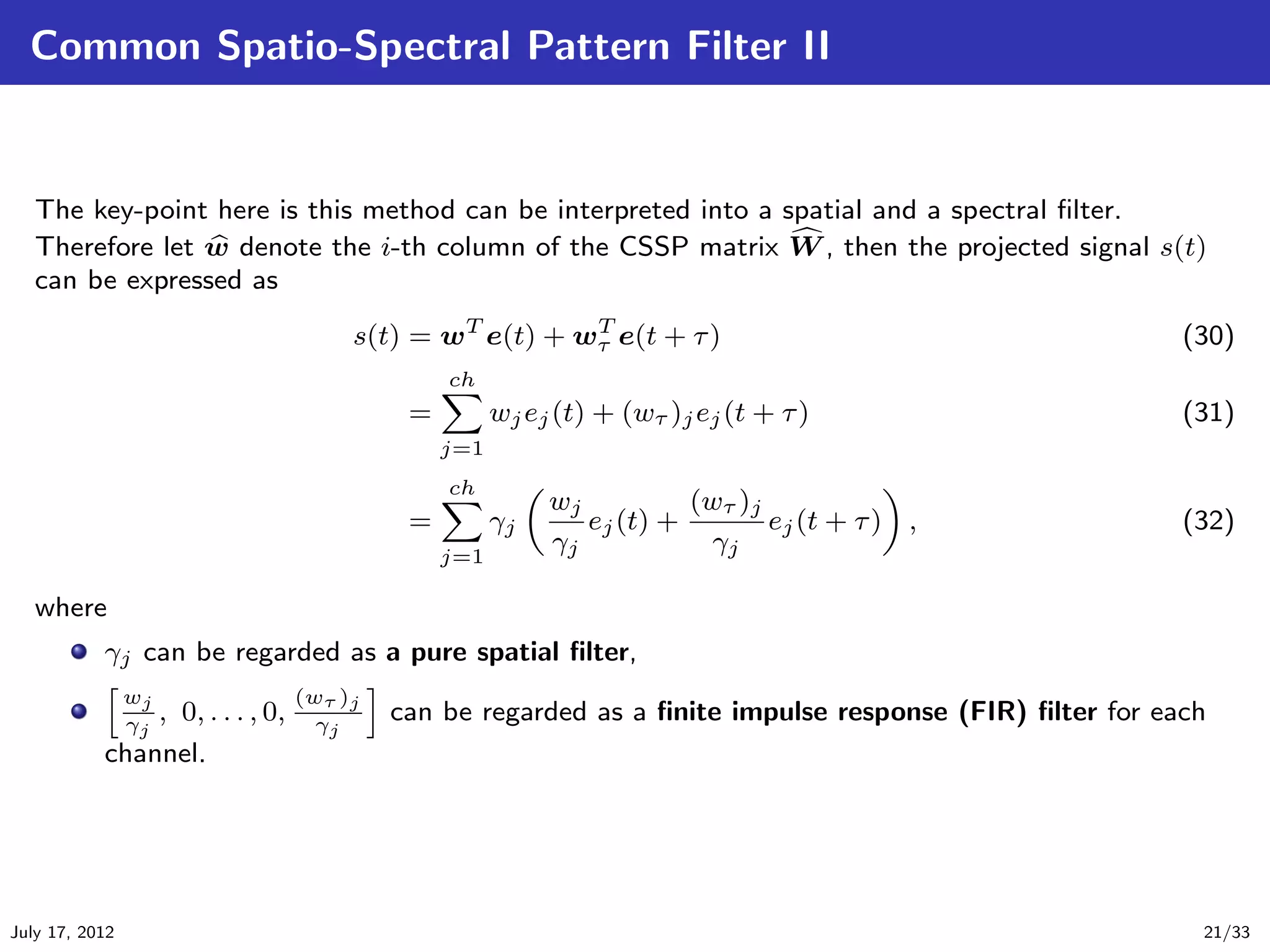
   The key-point here is this method can be interpreted into a spatial and a spectral filter.
   Therefore let w denote the i-th column of the CSSP matrix W , then the projected signal s(t)
   can be expressed as
                                      s(t) = wT e(t) + wτ e(t + τ )
                                                        T
                                                                                                        (30)
                                               ch
                                           =         wj ej (t) + (wτ )j ej (t + τ )                     (31)
                                               j=1
                                               ch
                                                          wj          (wτ )j
                                           =         γj      ej (t) +        ej (t + τ ) ,              (32)
                                               j=1
                                                          γj            γj

   where
           γj can be regarded as a pure spatial filter,
                wj               (wτ )j
               , 0, . . . , 0,
                γj                 γj
                                          can be regarded as a finite impulse response (FIR) filter for each
           channel.


July 17, 2012                                                                                            21/33
Common Spatio-Spectral Pattern Filter III


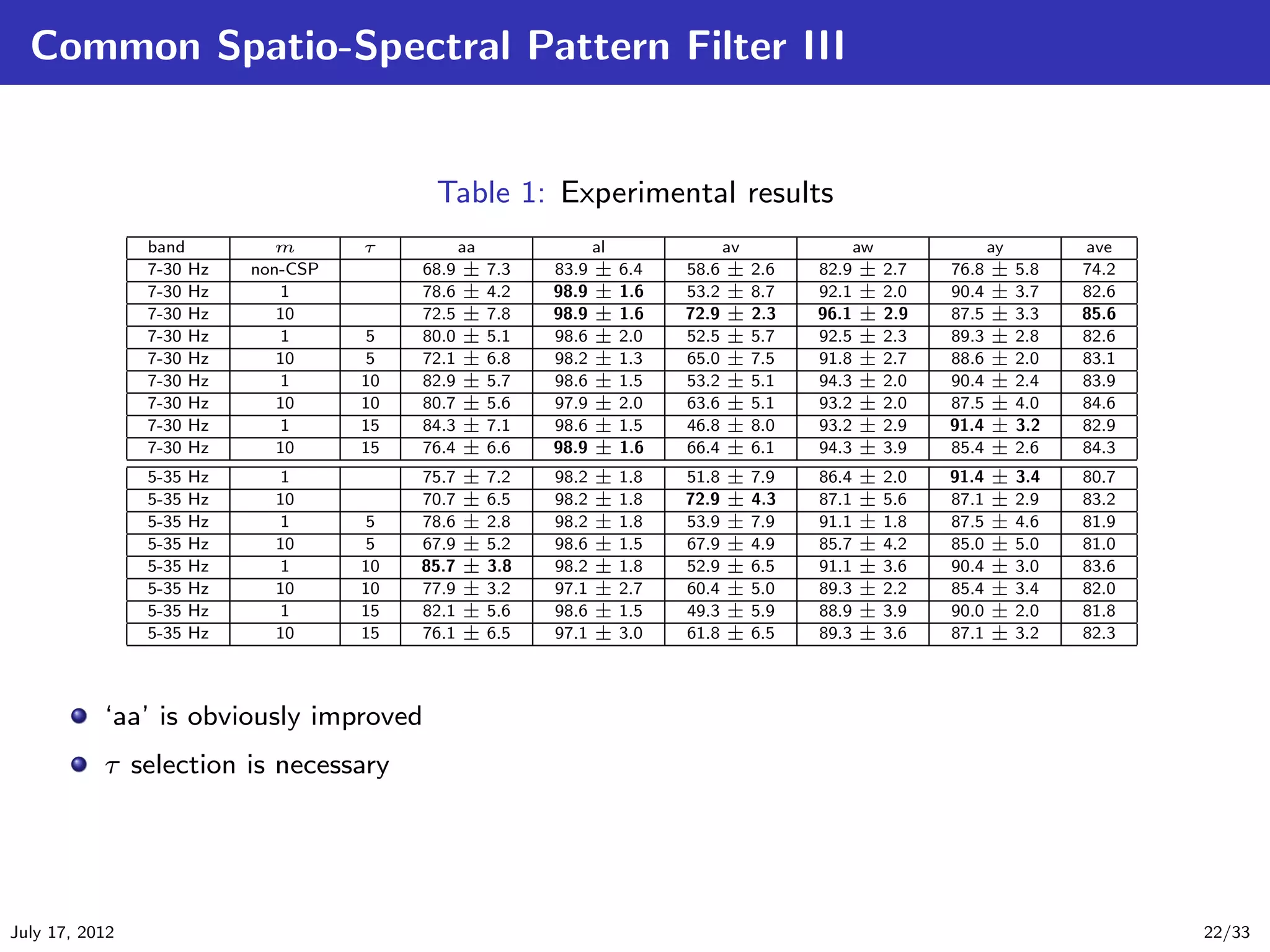
                                            Table 1: Experimental results
                band          m       τ           aa                al                av                aw                ay         ave
                7-30 Hz     non-CSP        68.9   ±    7.3   83.9   ±    6.4   58.6   ±    2.6   82.9    ±   2.7   76.8   ±    5.8   74.2
                7-30 Hz        1           78.6   ±    4.2   98.9   ±    1.6   53.2   ±    8.7   92.1    ±   2.0   90.4   ±    3.7   82.6
                7-30 Hz        10          72.5   ±    7.8   98.9   ±    1.6   72.9   ±    2.3   96.1    ±   2.9   87.5   ±    3.3   85.6
                7-30 Hz        1      5    80.0   ±    5.1   98.6   ±    2.0   52.5   ±    5.7   92.5    ±   2.3   89.3   ±    2.8   82.6
                7-30 Hz        10     5    72.1   ±    6.8   98.2   ±    1.3   65.0   ±    7.5   91.8    ±   2.7   88.6   ±    2.0   83.1
                7-30 Hz        1      10   82.9   ±    5.7   98.6   ±    1.5   53.2   ±    5.1   94.3    ±   2.0   90.4   ±    2.4   83.9
                7-30 Hz        10     10   80.7   ±    5.6   97.9   ±    2.0   63.6   ±    5.1   93.2    ±   2.0   87.5   ±    4.0   84.6
                7-30 Hz        1      15   84.3   ±    7.1   98.6   ±    1.5   46.8   ±    8.0   93.2    ±   2.9   91.4   ±    3.2   82.9
                7-30 Hz        10     15   76.4   ±    6.6   98.9   ±    1.6   66.4   ±    6.1   94.3    ±   3.9   85.4   ±    2.6   84.3
                5-35   Hz     1            75.7   ±    7.2   98.2   ±    1.8   51.8   ±    7.9   86.4   ±    2.0   91.4   ±    3.4   80.7
                5-35   Hz     10           70.7   ±    6.5   98.2   ±    1.8   72.9   ±    4.3   87.1   ±    5.6   87.1   ±    2.9   83.2
                5-35   Hz     1       5    78.6   ±    2.8   98.2   ±    1.8   53.9   ±    7.9   91.1   ±    1.8   87.5   ±    4.6   81.9
                5-35   Hz     10      5    67.9   ±    5.2   98.6   ±    1.5   67.9   ±    4.9   85.7   ±    4.2   85.0   ±    5.0   81.0
                5-35   Hz     1       10   85.7   ±    3.8   98.2   ±    1.8   52.9   ±    6.5   91.1   ±    3.6   90.4   ±    3.0   83.6
                5-35   Hz     10      10   77.9   ±    3.2   97.1   ±    2.7   60.4   ±    5.0   89.3   ±    2.2   85.4   ±    3.4   82.0
                5-35   Hz     1       15   82.1   ±    5.6   98.6   ±    1.5   49.3   ±    5.9   88.9   ±    3.9   90.0   ±    2.0   81.8
                5-35   Hz     10      15   76.1   ±    6.5   97.1   ±    3.0   61.8   ±    6.5   89.3   ±    3.6   87.1   ±    3.2   82.3


           ‘aa’ is obviously improved
           τ selection is necessary


July 17, 2012                                                                                                                               22/33
Common Sparse Spatio Spectral Pattern Filter I


   The Common Sparse Spatio Spectral Pattern (CSSSP) filter is a further extension of the CSSP
   [Dornhege et al., 2005]. In CSSP’s FIR filter consists of only one time delay. The CSSSP’s FIR
   filter is given by
                      f (t|b) = b0 e(t) + b1 e(t + τ ) + b2 + e(t + 2τ ) + · · · + bT e(t + T τ )   (33)
   so that b is sparse spectral filter. Therefore, final signals are given by
                                                            T
                                   s(t) = W T f (t|b) =          bk W T e(t + kτ ).                 (34)
                                                           k=0

   The criterion of CSSSP is given by
                                                                     C
                max max W T Exp1 f (t|b)f (t|b)T              W −      ||b||1 ,                     (35)
                  b     W                                            T
                subject to     W T Exp1 f (t|b)f (t|b)T          + Exp2 f (t|b)f (t|b)T      W =I   (36)

   where
           Exp1 {·} and Exp2 {·} denote the expectations for samples of class 1 and class 2,
           respectively.


July 17, 2012                                                                                        23/33
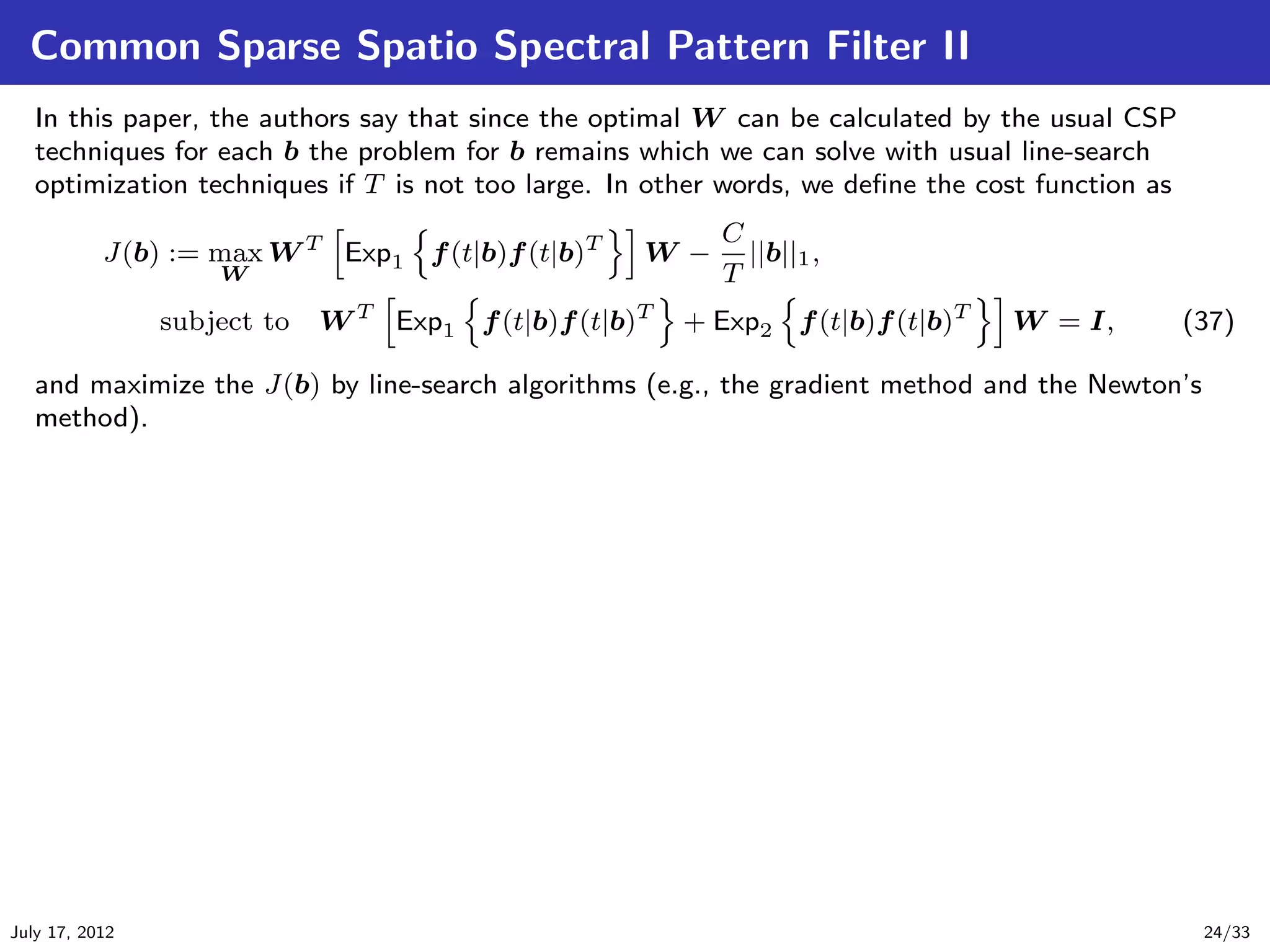
Common Sparse Spatio Spectral Pattern Filter II
   In this paper, the authors say that since the optimal W can be calculated by the usual CSP
   techniques for each b the problem for b remains which we can solve with usual line-search
   optimization techniques if T is not too large. In other words, we define the cost function as
                                                          C
           J(b) := max W T Exp1 f (t|b)f (t|b)T     W −     ||b||1 ,
                    W                                     T
                subject to   W T Exp1 f (t|b)f (t|b)T   + Exp2 f (t|b)f (t|b)T   W = I,           (37)

   and maximize the J(b) by line-search algorithms (e.g., the gradient method and the Newton’s
   method).


July 17, 2012                                                                                      24/33
Common Sparse Spatio Spectral Pattern Filter III


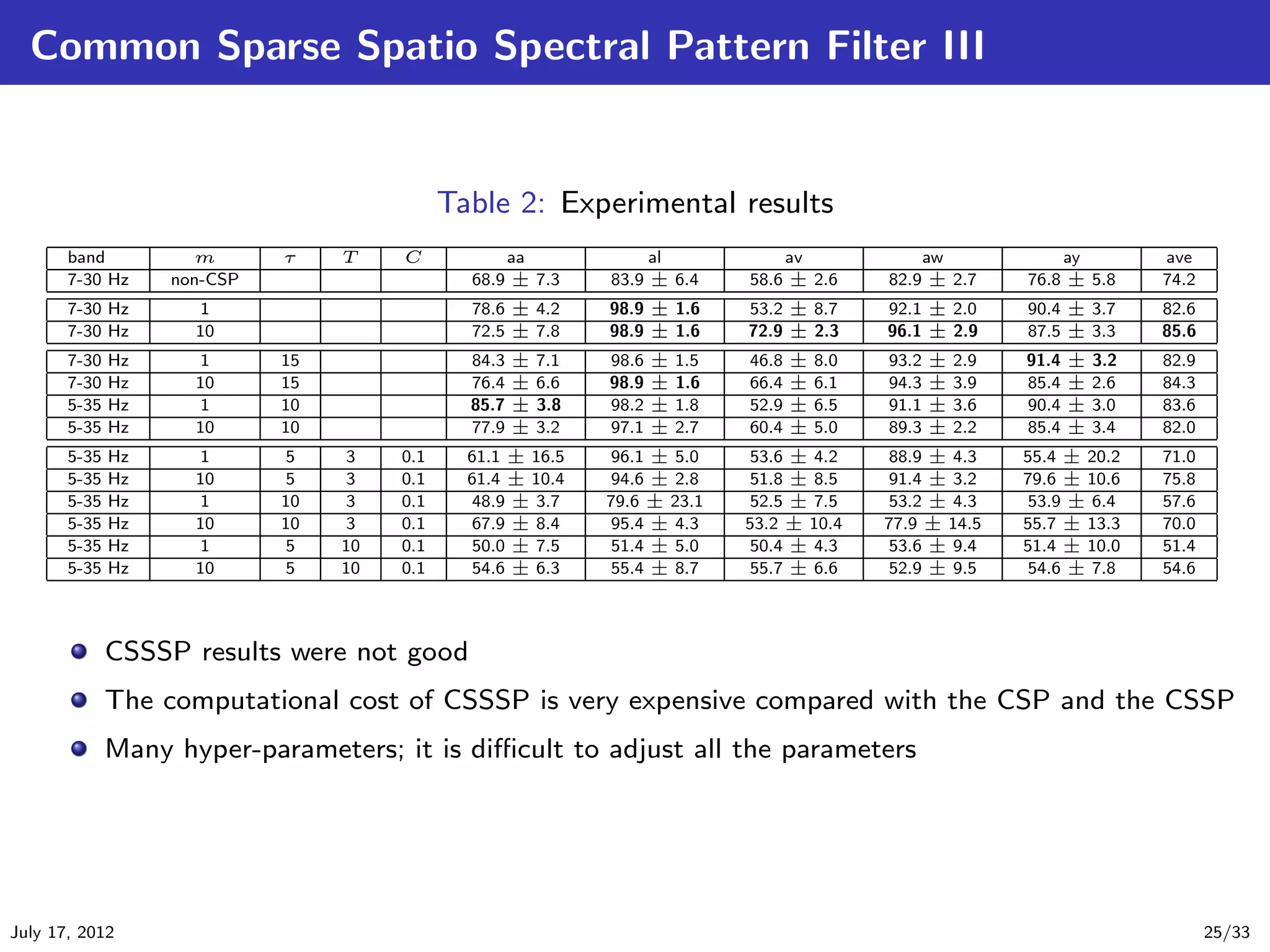
                                             Table 2: Experimental results
       band          m       τ    T    C           aa                al              av               aw               ay           ave
       7-30 Hz     non-CSP                     68.9 ± 7.3       83.9 ± 6.4       58.6 ± 2.6       82.9 ± 2.7       76.8 ± 5.8       74.2
       7-30 Hz       1                         78.6 ± 4.2       98.9 ± 1.6       53.2 ± 8.7       92.1 ± 2.0       90.4 ± 3.7       82.6
       7-30 Hz       10                        72.5 ± 7.8       98.9 ± 1.6       72.9 ± 2.3       96.1 ± 2.9       87.5 ± 3.3       85.6
       7-30   Hz     1       15                84.3   ±   7.1   98.6   ±   1.5   46.8   ±   8.0   93.2   ±   2.9   91.4   ±   3.2   82.9
       7-30   Hz     10      15                76.4   ±   6.6   98.9   ±   1.6   66.4   ±   6.1   94.3   ±   3.9   85.4   ±   2.6   84.3
       5-35   Hz     1       10                85.7   ±   3.8   98.2   ±   1.8   52.9   ±   6.5   91.1   ±   3.6   90.4   ±   3.0   83.6
       5-35   Hz     10      10                77.9   ±   3.2   97.1   ±   2.7   60.4   ±   5.0   89.3   ±   2.2   85.4   ±   3.4   82.0
       5-35   Hz     1       5    3    0.1     61.1 ± 16.5      96.1 ± 5.0       53.6 ± 4.2       88.9 ± 4.3       55.4 ± 20.2      71.0
       5-35   Hz     10      5    3    0.1     61.4 ± 10.4      94.6 ± 2.8       51.8 ± 8.5       91.4 ± 3.2       79.6 ± 10.6      75.8
       5-35   Hz     1       10   3    0.1     48.9 ± 3.7       79.6 ± 23.1      52.5 ± 7.5       53.2 ± 4.3       53.9 ± 6.4       57.6
       5-35   Hz     10      10   3    0.1     67.9 ± 8.4       95.4 ± 4.3       53.2 ± 10.4      77.9 ± 14.5      55.7 ± 13.3      70.0
       5-35   Hz     1       5    10   0.1     50.0 ± 7.5       51.4 ± 5.0       50.4 ± 4.3       53.6 ± 9.4       51.4 ± 10.0      51.4
       5-35   Hz     10      5    10   0.1     54.6 ± 6.3       55.4 ± 8.7       55.7 ± 6.6       52.9 ± 9.5       54.6 ± 7.8       54.6


              CSSSP results were not good
              The computational cost of CSSSP is very expensive compared with the CSP and the CSSP
              Many hyper-parameters; it is difficult to adjust all the parameters


July 17, 2012                                                                                                                              25/33
Sub-band Common Spatial Pattern I

           The CSP, the CSSP need the selection of frequency band to use band-pass filter at first
           The CSSSP solutions are depend greatly on the initial points
   Here, we introduce an alternative method based on Sub-band CSP (SBCSP) method and score
   fusion [Novi et al., 2007].


   Figure 3: System Flowchart of SBCSP: for example frequency bands of individual filters
   are 4-8Hz, 8-12Hz, ... , 36-40Hz.

   The processes until CSP filters are the same as it is. And then we obtain individual CSP feature
   data matrices {F (1) , F (2) , . . . , F (K) }. The process of LDA score is given by follow:

July 17, 2012                                                                                      26/33
Sub-band Common Spatial Pattern II

           Calculate the LDA projection vector w(k) for each data matrices F (k) .
           LDA score vector is given by
                                                          (1) 
                                                   w(1)T fn
                                                  w(2)T f (2) 
                                                         n    
                                            sn = 
                                                      .       .
                                                                                          (38)
                                                      .
                                                       .       
                                                           (K)
                                                  w(K)T fn

   There are two approaches of score fusion method.
           Recursive Band Elimination (RBE)
           Meta-Classifier (MC)
   In RBE, first we set a RBE-order that is a integer number r ∈ [1, K]. The first data set is
   X = [s1 , ..., sN ] ∈ RK×N . In this method, we remove K − r rows from X by SVM feature
   selection. The algorithm is follow
       .
      1 Train w by SVM

       . Remove the row of X with the smallest w2
       2
                                                   k
       .
       3 If number of rows of X is r algorithm is finished, else back to 1.


July 17, 2012                                                                                  27/33
Sub-band Common Spatial Pattern III
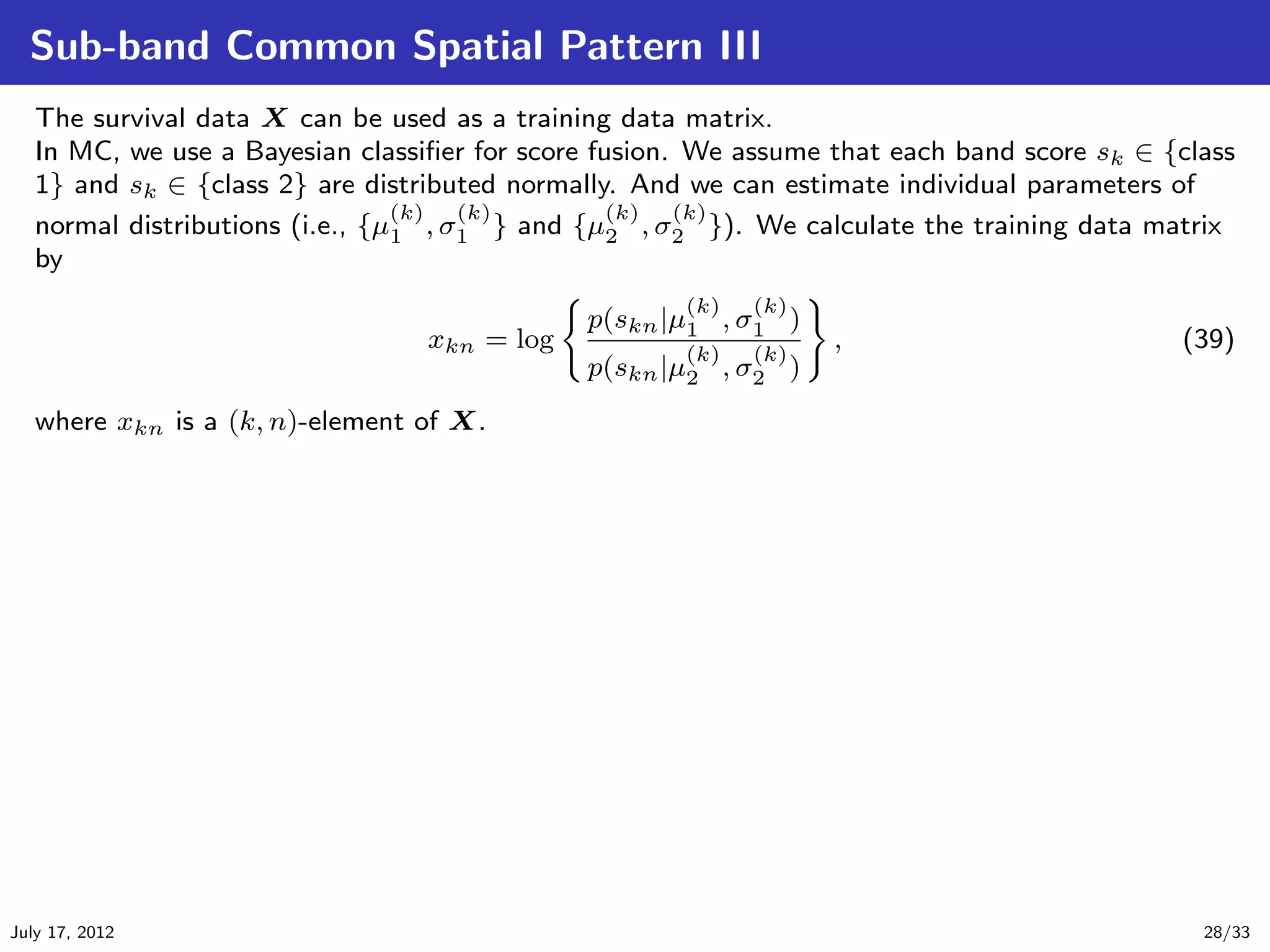
   The survival data X can be used as a training data matrix.
   In MC, we use a Bayesian classifier for score fusion. We assume that each band score sk ∈ {class
   1} and sk ∈ {class 2} are distributed normally. And we can estimate individual parameters of
                                 (k)  (k)         (k)  (k)
   normal distributions (i.e., {µ1 , σ1 } and {µ2 , σ2 }). We calculate the training data matrix
   by
                                                      (k)   (k)
                                              p(skn |µ1 , σ1 )
                                  xkn = log           (k)  (k)
                                                                  ,                          (39)
                                              p(skn |µ2 , σ2 )
   where xkn is a (k, n)-element of X.


July 17, 2012                                                                                  28/33
Sub-band Common Spatial Pattern IV

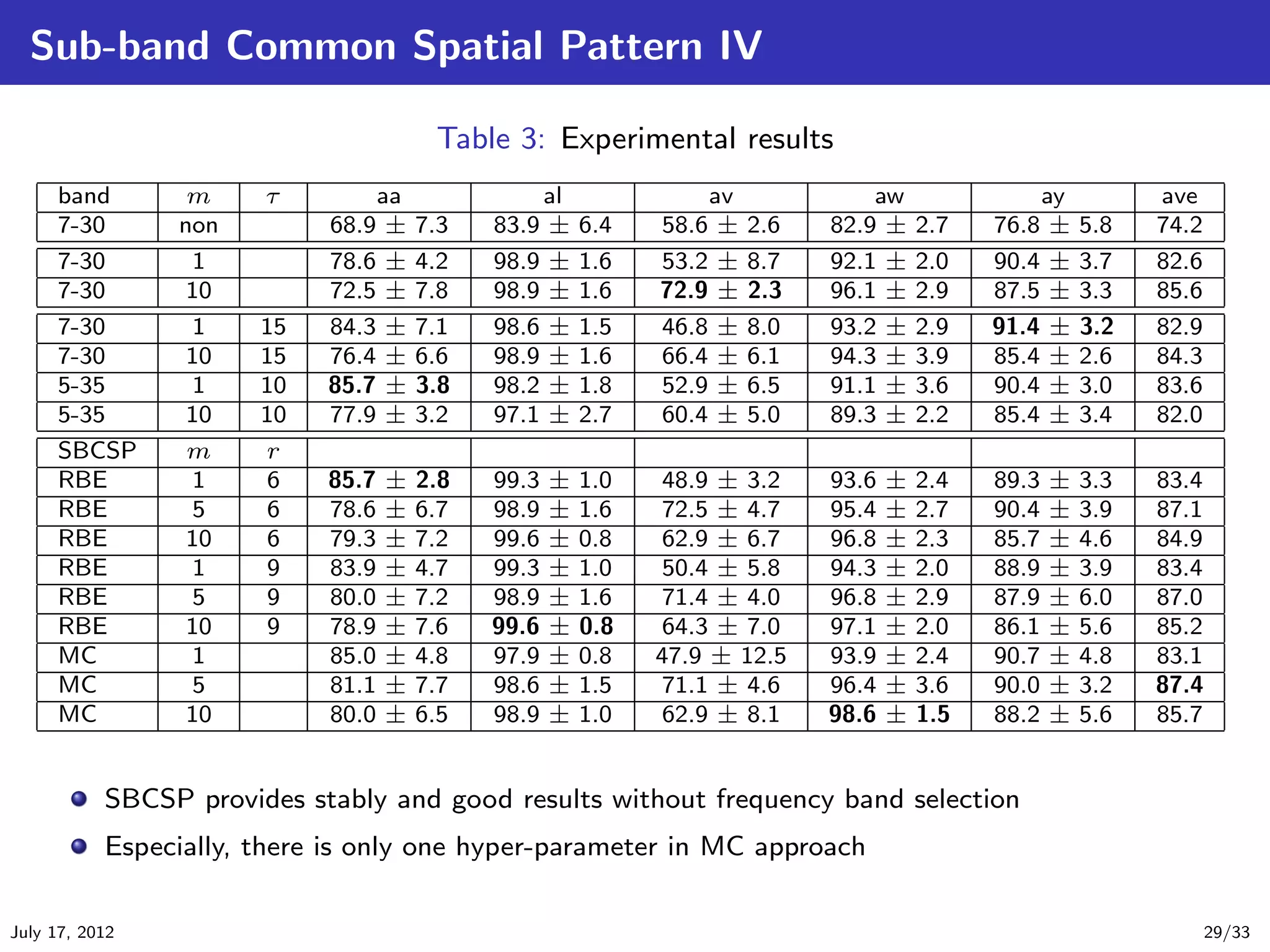
                                         Table 3: Experimental results
     band        m     τ           aa                al                av             aw                  ay         ave
     7-30       non         68.9    ±   7.3   83.9   ±    6.4   58.6    ±   2.6   82.9 ±     2.7   76.8    ±   5.8   74.2
     7-30        1          78.6    ±   4.2   98.9   ±    1.6   53.2    ±   8.7   92.1 ±     2.0   90.4    ±   3.7   82.6
     7-30        10         72.5    ±   7.8   98.9   ±    1.6   72.9    ±   2.3   96.1 ±     2.9   87.5    ±   3.3   85.6
     7-30        1     15   84.3    ±   7.1   98.6   ±    1.5   46.8    ±   8.0   93.2 ±     2.9   91.4    ±   3.2   82.9
     7-30        10    15   76.4    ±   6.6   98.9   ±    1.6   66.4    ±   6.1   94.3 ±     3.9   85.4    ±   2.6   84.3
     5-35        1     10   85.7    ±   3.8   98.2   ±    1.8   52.9    ±   6.5   91.1 ±     3.6   90.4    ±   3.0   83.6
     5-35        10    10   77.9    ±   3.2   97.1   ±    2.7   60.4    ±   5.0   89.3 ±     2.2   85.4    ±   3.4   82.0
     SBCSP       m     r
     RBE         1     6    85.7   ±    2.8   99.3   ±    1.0   48.9 ± 3.2        93.6   ±   2.4   89.3   ±    3.3   83.4
     RBE         5     6    78.6   ±    6.7   98.9   ±    1.6   72.5 ± 4.7        95.4   ±   2.7   90.4   ±    3.9   87.1
     RBE         10    6    79.3   ±    7.2   99.6   ±    0.8   62.9 ± 6.7        96.8   ±   2.3   85.7   ±    4.6   84.9
     RBE         1     9    83.9   ±    4.7   99.3   ±    1.0   50.4 ± 5.8        94.3   ±   2.0   88.9   ±    3.9   83.4
     RBE         5     9    80.0   ±    7.2   98.9   ±    1.6   71.4 ± 4.0        96.8   ±   2.9   87.9   ±    6.0   87.0
     RBE         10    9    78.9   ±    7.6   99.6   ±    0.8   64.3 ± 7.0        97.1   ±   2.0   86.1   ±    5.6   85.2
     MC          1          85.0   ±    4.8   97.9   ±    0.8   47.9 ± 12.5       93.9   ±   2.4   90.7   ±    4.8   83.1
     MC          5          81.1   ±    7.7   98.6   ±    1.5   71.1 ± 4.6        96.4   ±   3.6   90.0   ±    3.2   87.4
     MC          10         80.0   ±    6.5   98.9   ±    1.0   62.9 ± 8.1        98.6   ±   1.5   88.2   ±    5.6   85.7


           SBCSP provides stably and good results without frequency band selection
           Especially, there is only one hyper-parameter in MC approach

July 17, 2012                                                                                                               29/33
Summary


   .
   Summary
   .
           The CSP filters is an effective method of feature extraction for EEG motor imagery
           classification.
           Frequency band selection is very important to obtain good classification in CSP.
           To overcome it, the CSSP, the CSSSP, and the SBCSP methods are proposed.
           In CSSP, there is a little improvement, but we still need to select a frequency band and τ .
           In CSSSP, hyper-parameters are too much, and it is difficult to adjust, and computational
           cost is also too much.
           In SBCSP, it provides a successful result that we do not need to select a frequency band,
   .       and hyper-parameter is only one or two.


July 17, 2012                                                                                        30/33
Bibliography I

   [Blankertz et al., 2006] Blankertz, B., Muller, K.-R., Krusienski, D., Schalk, G., Wolpaw, J. R.,
      Schlogl, A., Pfurtscheller, G., del R. Millan, J., Schr¨der, M., and Birbaumer, N. (2006).
                                                             o
      The bci competition iii: Validating alternative approaches to actual bci problems.
      IEEE Trans. Neural Systems and Rihabilitation Engineering, 14:153–159.

   [Dornhege et al., 2005] Dornhege, G., Blankertz, B., Krauledat, M., Losch, F., Curio, G., and
      robert Muller, K. (2005).
      Optimizing spatio-temporal filters for improving brain-computer interfacing.
      In in Advances in Neural Inf. Proc. Systems (NIPS 05, pages 315–322. MIT Press.

   [Hema et al., 2009] Hema, C., Paulraj, M., Yaacob, S., Adom, A., and Nagarajan, R. (2009).
      Eeg motor imagery classification of hand movements for a brain machine interface.
      Biomedical Soft Computing and Human Sciences, 14(2):49–56.

   [Lemm et al., 2005] Lemm, S., Blankertz, B., Curio, G., and Muller, K.-R. (2005).
      Spatio-spectral filters for improving the classification of single trial eeg.
      Biomedical Engineering, IEEE Transactions on, 52(9):1541 –1548.

   [Minka et al., 1999] Minka, S., Ratsch, G., Weston, J., Scholkopf, B., and Mullers, K. (1999).
      Fisher discriminant analysis with kernels.
      In Neural Networks for Signal Processing IX, 1999. Proceedings of the 1999 IEEE Signal
      Processing Society Workshop, pages 41 –48.
July 17, 2012                                                                                    31/33
Bibliography II


   [Muller-Gerking et al., 1999] Muller-Gerking, J., Pfurtscheller, G., and Flyvbjerg, H. (1999).
        Designing optimal spatial filters for single-trial eeg classification in a movement task.
        Clinical Neurophysiology, 110(5):787 – 798.

   [Novi et al., 2007] Novi, Q., Guan, C., Dat, T. H., and Xue, P. (2007).
        Sub-band common spatial pattern (sbcsp) for brain-computer interface.
        In Neural Engineering, 2007. CNE ’07. 3rd International IEEE/EMBS Conference on, pages
        204 –207.


July 17, 2012                                                                                       32/33
Thank you for listening


July 17, 2012                33/33

Introduction to Common Spatial Pattern Filters for EEG Motor Imagery Classification

  • 1.
    . Introduction to Common Spatial Pattern Filters for EEG Motor Imagery Classification . Tatsuya Yokota Tokyo Institute of Technology July 17, 2012 July 17, 2012 1/33
  • 2.
    Outline . 1 Introduction Motor Imagery Electroencephalogram:EEG Main scheme . 2 Common Spatial Pattern Filters Standard CSP Algorithm CSSP Algorithm CSSSP Algorithm SBCSP Algorithm . 3 Conclusion July 17, 2012 2/33
  • 3.
    Motor Imagery [Hemaet al., 2009] I Motor Imagery is a mental process of a motor action. It includes preparation for movement, passive observations of action and mental operations of motor representations implicitly or explicitly. The ability of an individual to control his EEG through imaginary mental tasks enables him to control devices through a brain machine interface (BMI) or a brain computer interface (BCI). The BMI/BCI is a direct communication pathway between the brain and an external device. BMI/BCIs are often aimed at assisting, augmenting, or repairing human cognitive or sensory-motor functions. BMI/BCIs are used to rehabilitate people suffering from neuromuscular disorders as a means of communication or control. The methodologies of BMI/BCIs can be separated into two approaches: Invasive (or partially-invasive) BMI/BCIs (ECoG), Non-invasive BMI/BCIs (EEG, MEG, MRI, fMRI etc). Invasive and partially-invasive BCIs are accurate. However there are risks of the infection and the damage. Furthermore, it requires the operation to set the electrodes in the head. On the other hand, non-invasive BCIs are inferior than invasive BCIs in accuracy, but costs and risks are very low. Especially, EEG approach is the most studied potential non-invasive interface, mainly due to its fine temporal resolution, ease of use, portability and low set-up cost. July 17, 2012 3/33
  • 4.
    Electroencephalogram:EEG EEG is the recording of electrical activity along the scalp. EEG measures voltage fluctuations resulting from ionic current flows within the neurons of the brain. (a) Electrodes(32 channels) (b) EEG data In this research, we analyze the EEG signals to extract the important features of them. July 17, 2012 4/33
  • 5.
    EEG Motor ImageryClassification Here, we consider the EEG motor imagery classification problem by BCI competition III [Blankertz et al., 2006]. Number of subjects is 5 (aa,al,av,aw,ay). 118 channels of electrodes were used. The problem is to classify the given EEG signal to right hand or right foot. They recorded their EEG signals for 3.5 seconds with 100 Hz sampling rates for each trial. For each subject they conducted 280 (hand 140 / foot 140) trials. July 17, 2012 5/33
  • 6.
    Problem Formalization EEG signals are formalized as {En }N ∈ Rch×time , n=1 (1) where N = 280 is the number of trials, ch = 118 is the number of channels, time = 300 is the range of time domain. We used 0.5 to 3.5 seconds from visual cue for each trial, then time range is 3.0 seconds. To apply the EEG signals to classification, we have to transform the each EEG signal to feature vector. Thus, some transformation En ∈ Rch×time → xn ∈ Rd , (2) is necessary. The problem is how to extract the important features for best classification. July 17, 2012 6/33
  • 7.
    Feature Extraction Scheme We explain about a basic feature extraction scheme at first The key-points here are EEG signals are very noisy, i.e., noise reduction, There will exist the best frequency band for classification, i.e., frequency band selection, There will exist important channels and un-important channels for classification, i.e., channel selection (spatial filter). We can obtain a set of feature vector as a matrix X ∈ Rd×N . (3) July 17, 2012 7/33
  • 8.
    Classification Scheme The feature extraction is done, then we can apply the data set to the classification. July 17, 2012 8/33
  • 9.
    Fisher’s Linear DiscriminantAnalysis/Classifier I We introduce the Fisher’s linear discriminant analysis (LDA). The LDA is a very famous binary classification method. It is based on mean vectors and covariance matrices of patterns for individual classes. we consider to transform a d-dimensional vector x to a scalar z as z = wT x. (4) The LDA give an optimal projection w so that the distribution of z is easy to discriminate. See the following figure. w is clearly easier to discriminate than w. July 17, 2012 9/33
  • 10.
    Fisher’s Linear DiscriminantAnalysis/Classifier II The criterion of LDA is given by (m1 − m2 )2 maximize J(w) = , (5) s1 + s2 where m1 and m2 denote averages for zn ∈ { class 1 } and zn ∈ { class 2 }, respectively, s1 and s2 denote variances for zn ∈ { class 1 } and zn ∈ { class 2 }, respectively. July 17, 2012 10/33
  • 11.
    Fisher’s Linear DiscriminantAnalysis/Classifier III We have T (m1 − m2 )2 = wT µ1 − wT µ2 w T µ1 − w T µ2 = wT (µ1 − µ2 ) (µ1 − µ2 )T w = wT SB w, (6) and s1 + s2 = wT Σ1 w + wT Σ2 w = wT (Σ1 + Σ2 ) w = wT SW w, (7) where µ1 and µ2 denote mean vectors for xn ∈ { class 1 } and xn ∈ {class 2 }, respectively, Σ1 and Σ2 denote covariance matrices for xn ∈ { class 1 } and xn ∈ { class 2 }, respectively. July 17, 2012 11/33
  • 12.
    Fisher’s Linear DiscriminantAnalysis/Classifier IV The cost function J(w) can be transformed as wT SB w J(w) = , (8) w T SW w and then this solution is given by −1 w ∝ SW (µ1 − µ2 ). (9) Finally, we choose an optimal threshold z0 , then we can classify any x by wT x ≥ z0 → x ∈ {class 1}, (10) w x < z0 → x ∈ {class 2}. T (11) For example, z0 = (m1 + m2 )/2 could be usable. July 17, 2012 12/33
  • 13.
    An Example 7-30 Hz band-pass filter (butterworth filter) Use variances of individual channel’s signals (i.e., x is a 118-dimensional feature vector) Normalize Apply the LDA into the data set Calculate classification rate by 5-fold cross validation for each subject 1.2 1 0.8 0.6 0.4 0.2 0 0 10 20 30 40 50 60 70 Hz Separate a data set into 5 parts aa 68.9 ± 7.3 Use one for test, the others for train one al 83.9 ± 6.4 by one av 58.6 ± 2.6 Calculate classification rates for individual aw 82.9 ± 2.7 CV data set ay 76.8 ± 5.8 ave 74.2 Summarize the 5 results July 17, 2012 13/33
  • 14.
    Common Spatial PatternFilter I In previous example, we do not use a spatial filter. The proper spatial filter would provide signals so that easy to classify. The goal of this study is to design spatial filters that lead to optimal variances for the discrimination of two populations of EEG related to right hand and right foot motor imagery. We call this method the “Common Spatial Pattern” (CSP) algorithm [Muller-Gerking et al., 1999]. We denote the CSP filter by S = W T E or s(t) = W T e(t), (12) where W ∈ Rd×ch is spatial filter matrix, S ∈ Rd×time is filtered signal matrix. The criterion of CSP is given by maximize trW T Σ1 W , (13) subject to W T (Σ1 + Σ2 )W = I, (14) where En EnT Σ1 = Exp T , (15) En ∈{class 1} trEn En En EnT Σ2 = Exp T . (16) En ∈{class 2} trEn En This problem can be solved by generalized eigen value problem. However, we can also solve it by two times of standard eigen value problem. July 17, 2012 14/33
  • 15.
    Common Spatial PatternFilter II First we decompose as Σ1 + Σ2 = U DU T , (17) where U is a set of eigenvectors, and D is a diagonal matrix of eigenvalues. √ Next, compute P := D −1 U T , and Σ1 = P Σ1 P T , (18) T Σ2 = P Σ2 P . (19) Please note that we have Σ1 + Σ2 = I, here. Thus, any orthonormal matrices V satisfy V T (Σ1 + Σ2 )V = I. Finally, we decompose as Σ1 = V ΛV T , (20) where V is a set of eigenvectors, and Λ is a diagonal matrix of eigenvalues. A set of CSP filters is obtained as W = PTV . (21) July 17, 2012 15/33
  • 16.
    Common Spatial PatternFilter III We have   λ1 T  ..  W Σ1 W = Λ =  . , (22) λch   1 − λ1  ..  W T Σ2 W = I − Λ =  . , (23) 1 − λch where λ1 ≥ λ2 ≥ · · · ≥ λch . Therefore, first CSP filter w1 provides maximum variance of class 1, and last CSP filter wch provides maximum variance of class 2. We select first and last m filters to use as Wcsp = w1 ··· wm wch−m+1 ··· wch ∈ R2m×ch , (24) and filtered signal matrix is given by T T s(t) = Wcsp e(t) = s1 (t) ··· sd (t) , (25) i.e., d = 2m. Feature vector x = (x1 , x2 , . . . , xd )T is calculated by var[si (t)] xi = log d . (26) i=1 var[si (t)] July 17, 2012 16/33
  • 17.
    Common Spatial PatternFilter IV 0.8 5 class 1 class 1 class 2 class 2 0.6 4.5 0.4 4 0.2 3.5 0 3 -0.2 2.5 -0.4 -0.6 2 -0.8 1.5 -0.5 -0.4 -0.3 -0.2 -0.1 0 0.1 0.2 0 1 2 3 4 5 6 7 (c) PCA feature (d) CSP feature Figure 1: 2D-plot of CSP feature July 17, 2012 17/33
  • 18.
    Common Spatial PatternFilter V (a) Right Hand (al) (b) Right Foot (al) Figure 2: Topographies of Common Spatial Patterns July 17, 2012 18/33
  • 19.
    Common Spatial PatternFilter VI We extracted their features by the CSP filter and classified them by the LDA. Changing the frequency band of butterworth filter, and number of m. band m aa al av aw ay ave 7-30 Hz non-CSP 68.9 ± 7.3 83.9 ± 6.4 58.6 ± 2.6 82.9 ± 2.7 76.8 ± 5.8 74.2 5-40 Hz 1 76.1 ± 5.4 98.2 ± 1.8 52.1 ± 7.9 87.1 ± 1.5 90.4 ± 3.2 80.8 5-40 Hz 10 73.9 ± 7.2 98.6 ± 1.5 69.3 ± 2.3 88.6 ± 3.9 86.1 ± 4.1 83.3 7-30 Hz 1 78.6 ± 4.2 98.9 ± 1.6 53.2 ± 8.7 92.1 ± 2.0 90.4 ± 3.7 82.6 7-30 Hz 10 72.5 ± 7.8 98.9 ± 1.6 72.9 ± 2.3 96.1 ± 2.9 87.5 ± 3.3 85.6 10-30 Hz 1 80.4 ± 5.9 98.6 ± 1.5 51.1 ± 7.4 95.4 ± 1.0 84.6 ± 5.4 82.0 10-30 Hz 10 81.4 ± 3.5 98.9 ± 1.6 72.1 ± 2.4 98.2 ± 2.2 73.9 ± 5.7 84.9 10-35 Hz 1 80.7 ± 5.4 98.6 ± 1.5 50.7 ± 8.2 96.1 ± 2.3 87.1 ± 3.7 82.6 10-35 Hz 10 78.9 ± 4.6 98.6 ± 1.5 72.1 ± 5.1 97.5 ± 2.4 75.0 ± 4.2 84.4 CSP methods are basically superior to non-CSP method In ‘aa’, and ‘ay’, m = 1 is matched In ‘av’ and ‘aw’, m = 10 is matched Frequency band is also important factor July 17, 2012 19/33
  • 20.
    Common Spatio-Spectral PatternFilter I The Common Spatio-Spectral Pattern (CSSP) filter is an extension of the CSP filter [Lemm et al., 2005]. The CSSP can be regarded as a CSP method with the time delay embedding. The algorithm is not so different from the standard CSP. In CSP, we consider the following transformation S = W T E or s(t) = W T e(t). (27) But the CSSP’s transform is given by E S = W T E + Wτ Eτ = W T T , (28) Eτ e(t) or s(t) = W T e(t) + Wτ e(t + τ ) = W T T , (29) e(t + τ ) where Eτ is a τ -time delayed signal matrix of E, and W T = [W T , Wτ ] is a CSSP matrix. It T can be also regarded that the number of channels increase to double. The deference between CSP and CSSP is only this point, and then we can apply this method easily in a same way to the CSP algorithm. However, τ is a hyper-parameter. July 17, 2012 20/33
  • 21.
    Common Spatio-Spectral PatternFilter II The key-point here is this method can be interpreted into a spatial and a spectral filter. Therefore let w denote the i-th column of the CSSP matrix W , then the projected signal s(t) can be expressed as s(t) = wT e(t) + wτ e(t + τ ) T (30) ch = wj ej (t) + (wτ )j ej (t + τ ) (31) j=1 ch wj (wτ )j = γj ej (t) + ej (t + τ ) , (32) j=1 γj γj where γj can be regarded as a pure spatial filter, wj (wτ )j , 0, . . . , 0, γj γj can be regarded as a finite impulse response (FIR) filter for each channel. July 17, 2012 21/33
  • 22.
    Common Spatio-Spectral PatternFilter III Table 1: Experimental results band m τ aa al av aw ay ave 7-30 Hz non-CSP 68.9 ± 7.3 83.9 ± 6.4 58.6 ± 2.6 82.9 ± 2.7 76.8 ± 5.8 74.2 7-30 Hz 1 78.6 ± 4.2 98.9 ± 1.6 53.2 ± 8.7 92.1 ± 2.0 90.4 ± 3.7 82.6 7-30 Hz 10 72.5 ± 7.8 98.9 ± 1.6 72.9 ± 2.3 96.1 ± 2.9 87.5 ± 3.3 85.6 7-30 Hz 1 5 80.0 ± 5.1 98.6 ± 2.0 52.5 ± 5.7 92.5 ± 2.3 89.3 ± 2.8 82.6 7-30 Hz 10 5 72.1 ± 6.8 98.2 ± 1.3 65.0 ± 7.5 91.8 ± 2.7 88.6 ± 2.0 83.1 7-30 Hz 1 10 82.9 ± 5.7 98.6 ± 1.5 53.2 ± 5.1 94.3 ± 2.0 90.4 ± 2.4 83.9 7-30 Hz 10 10 80.7 ± 5.6 97.9 ± 2.0 63.6 ± 5.1 93.2 ± 2.0 87.5 ± 4.0 84.6 7-30 Hz 1 15 84.3 ± 7.1 98.6 ± 1.5 46.8 ± 8.0 93.2 ± 2.9 91.4 ± 3.2 82.9 7-30 Hz 10 15 76.4 ± 6.6 98.9 ± 1.6 66.4 ± 6.1 94.3 ± 3.9 85.4 ± 2.6 84.3 5-35 Hz 1 75.7 ± 7.2 98.2 ± 1.8 51.8 ± 7.9 86.4 ± 2.0 91.4 ± 3.4 80.7 5-35 Hz 10 70.7 ± 6.5 98.2 ± 1.8 72.9 ± 4.3 87.1 ± 5.6 87.1 ± 2.9 83.2 5-35 Hz 1 5 78.6 ± 2.8 98.2 ± 1.8 53.9 ± 7.9 91.1 ± 1.8 87.5 ± 4.6 81.9 5-35 Hz 10 5 67.9 ± 5.2 98.6 ± 1.5 67.9 ± 4.9 85.7 ± 4.2 85.0 ± 5.0 81.0 5-35 Hz 1 10 85.7 ± 3.8 98.2 ± 1.8 52.9 ± 6.5 91.1 ± 3.6 90.4 ± 3.0 83.6 5-35 Hz 10 10 77.9 ± 3.2 97.1 ± 2.7 60.4 ± 5.0 89.3 ± 2.2 85.4 ± 3.4 82.0 5-35 Hz 1 15 82.1 ± 5.6 98.6 ± 1.5 49.3 ± 5.9 88.9 ± 3.9 90.0 ± 2.0 81.8 5-35 Hz 10 15 76.1 ± 6.5 97.1 ± 3.0 61.8 ± 6.5 89.3 ± 3.6 87.1 ± 3.2 82.3 ‘aa’ is obviously improved τ selection is necessary July 17, 2012 22/33
  • 23.
    Common Sparse SpatioSpectral Pattern Filter I The Common Sparse Spatio Spectral Pattern (CSSSP) filter is a further extension of the CSSP [Dornhege et al., 2005]. In CSSP’s FIR filter consists of only one time delay. The CSSSP’s FIR filter is given by f (t|b) = b0 e(t) + b1 e(t + τ ) + b2 + e(t + 2τ ) + · · · + bT e(t + T τ ) (33) so that b is sparse spectral filter. Therefore, final signals are given by T s(t) = W T f (t|b) = bk W T e(t + kτ ). (34) k=0 The criterion of CSSSP is given by C max max W T Exp1 f (t|b)f (t|b)T W − ||b||1 , (35) b W T subject to W T Exp1 f (t|b)f (t|b)T + Exp2 f (t|b)f (t|b)T W =I (36) where Exp1 {·} and Exp2 {·} denote the expectations for samples of class 1 and class 2, respectively. July 17, 2012 23/33
  • 24.
    Common Sparse SpatioSpectral Pattern Filter II In this paper, the authors say that since the optimal W can be calculated by the usual CSP techniques for each b the problem for b remains which we can solve with usual line-search optimization techniques if T is not too large. In other words, we define the cost function as C J(b) := max W T Exp1 f (t|b)f (t|b)T W − ||b||1 , W T subject to W T Exp1 f (t|b)f (t|b)T + Exp2 f (t|b)f (t|b)T W = I, (37) and maximize the J(b) by line-search algorithms (e.g., the gradient method and the Newton’s method). July 17, 2012 24/33
  • 25.
    Common Sparse SpatioSpectral Pattern Filter III Table 2: Experimental results band m τ T C aa al av aw ay ave 7-30 Hz non-CSP 68.9 ± 7.3 83.9 ± 6.4 58.6 ± 2.6 82.9 ± 2.7 76.8 ± 5.8 74.2 7-30 Hz 1 78.6 ± 4.2 98.9 ± 1.6 53.2 ± 8.7 92.1 ± 2.0 90.4 ± 3.7 82.6 7-30 Hz 10 72.5 ± 7.8 98.9 ± 1.6 72.9 ± 2.3 96.1 ± 2.9 87.5 ± 3.3 85.6 7-30 Hz 1 15 84.3 ± 7.1 98.6 ± 1.5 46.8 ± 8.0 93.2 ± 2.9 91.4 ± 3.2 82.9 7-30 Hz 10 15 76.4 ± 6.6 98.9 ± 1.6 66.4 ± 6.1 94.3 ± 3.9 85.4 ± 2.6 84.3 5-35 Hz 1 10 85.7 ± 3.8 98.2 ± 1.8 52.9 ± 6.5 91.1 ± 3.6 90.4 ± 3.0 83.6 5-35 Hz 10 10 77.9 ± 3.2 97.1 ± 2.7 60.4 ± 5.0 89.3 ± 2.2 85.4 ± 3.4 82.0 5-35 Hz 1 5 3 0.1 61.1 ± 16.5 96.1 ± 5.0 53.6 ± 4.2 88.9 ± 4.3 55.4 ± 20.2 71.0 5-35 Hz 10 5 3 0.1 61.4 ± 10.4 94.6 ± 2.8 51.8 ± 8.5 91.4 ± 3.2 79.6 ± 10.6 75.8 5-35 Hz 1 10 3 0.1 48.9 ± 3.7 79.6 ± 23.1 52.5 ± 7.5 53.2 ± 4.3 53.9 ± 6.4 57.6 5-35 Hz 10 10 3 0.1 67.9 ± 8.4 95.4 ± 4.3 53.2 ± 10.4 77.9 ± 14.5 55.7 ± 13.3 70.0 5-35 Hz 1 5 10 0.1 50.0 ± 7.5 51.4 ± 5.0 50.4 ± 4.3 53.6 ± 9.4 51.4 ± 10.0 51.4 5-35 Hz 10 5 10 0.1 54.6 ± 6.3 55.4 ± 8.7 55.7 ± 6.6 52.9 ± 9.5 54.6 ± 7.8 54.6 CSSSP results were not good The computational cost of CSSSP is very expensive compared with the CSP and the CSSP Many hyper-parameters; it is difficult to adjust all the parameters July 17, 2012 25/33
  • 26.
    Sub-band Common SpatialPattern I The CSP, the CSSP need the selection of frequency band to use band-pass filter at first The CSSSP solutions are depend greatly on the initial points Here, we introduce an alternative method based on Sub-band CSP (SBCSP) method and score fusion [Novi et al., 2007]. Figure 3: System Flowchart of SBCSP: for example frequency bands of individual filters are 4-8Hz, 8-12Hz, ... , 36-40Hz. The processes until CSP filters are the same as it is. And then we obtain individual CSP feature data matrices {F (1) , F (2) , . . . , F (K) }. The process of LDA score is given by follow: July 17, 2012 26/33
  • 27.
    Sub-band Common SpatialPattern II Calculate the LDA projection vector w(k) for each data matrices F (k) . LDA score vector is given by  (1)  w(1)T fn  w(2)T f (2)   n  sn =   . .  (38)  . .  (K) w(K)T fn There are two approaches of score fusion method. Recursive Band Elimination (RBE) Meta-Classifier (MC) In RBE, first we set a RBE-order that is a integer number r ∈ [1, K]. The first data set is X = [s1 , ..., sN ] ∈ RK×N . In this method, we remove K − r rows from X by SVM feature selection. The algorithm is follow . 1 Train w by SVM . Remove the row of X with the smallest w2 2 k . 3 If number of rows of X is r algorithm is finished, else back to 1. July 17, 2012 27/33
  • 28.
    Sub-band Common SpatialPattern III The survival data X can be used as a training data matrix. In MC, we use a Bayesian classifier for score fusion. We assume that each band score sk ∈ {class 1} and sk ∈ {class 2} are distributed normally. And we can estimate individual parameters of (k) (k) (k) (k) normal distributions (i.e., {µ1 , σ1 } and {µ2 , σ2 }). We calculate the training data matrix by (k) (k) p(skn |µ1 , σ1 ) xkn = log (k) (k) , (39) p(skn |µ2 , σ2 ) where xkn is a (k, n)-element of X. July 17, 2012 28/33
  • 29.
    Sub-band Common SpatialPattern IV Table 3: Experimental results band m τ aa al av aw ay ave 7-30 non 68.9 ± 7.3 83.9 ± 6.4 58.6 ± 2.6 82.9 ± 2.7 76.8 ± 5.8 74.2 7-30 1 78.6 ± 4.2 98.9 ± 1.6 53.2 ± 8.7 92.1 ± 2.0 90.4 ± 3.7 82.6 7-30 10 72.5 ± 7.8 98.9 ± 1.6 72.9 ± 2.3 96.1 ± 2.9 87.5 ± 3.3 85.6 7-30 1 15 84.3 ± 7.1 98.6 ± 1.5 46.8 ± 8.0 93.2 ± 2.9 91.4 ± 3.2 82.9 7-30 10 15 76.4 ± 6.6 98.9 ± 1.6 66.4 ± 6.1 94.3 ± 3.9 85.4 ± 2.6 84.3 5-35 1 10 85.7 ± 3.8 98.2 ± 1.8 52.9 ± 6.5 91.1 ± 3.6 90.4 ± 3.0 83.6 5-35 10 10 77.9 ± 3.2 97.1 ± 2.7 60.4 ± 5.0 89.3 ± 2.2 85.4 ± 3.4 82.0 SBCSP m r RBE 1 6 85.7 ± 2.8 99.3 ± 1.0 48.9 ± 3.2 93.6 ± 2.4 89.3 ± 3.3 83.4 RBE 5 6 78.6 ± 6.7 98.9 ± 1.6 72.5 ± 4.7 95.4 ± 2.7 90.4 ± 3.9 87.1 RBE 10 6 79.3 ± 7.2 99.6 ± 0.8 62.9 ± 6.7 96.8 ± 2.3 85.7 ± 4.6 84.9 RBE 1 9 83.9 ± 4.7 99.3 ± 1.0 50.4 ± 5.8 94.3 ± 2.0 88.9 ± 3.9 83.4 RBE 5 9 80.0 ± 7.2 98.9 ± 1.6 71.4 ± 4.0 96.8 ± 2.9 87.9 ± 6.0 87.0 RBE 10 9 78.9 ± 7.6 99.6 ± 0.8 64.3 ± 7.0 97.1 ± 2.0 86.1 ± 5.6 85.2 MC 1 85.0 ± 4.8 97.9 ± 0.8 47.9 ± 12.5 93.9 ± 2.4 90.7 ± 4.8 83.1 MC 5 81.1 ± 7.7 98.6 ± 1.5 71.1 ± 4.6 96.4 ± 3.6 90.0 ± 3.2 87.4 MC 10 80.0 ± 6.5 98.9 ± 1.0 62.9 ± 8.1 98.6 ± 1.5 88.2 ± 5.6 85.7 SBCSP provides stably and good results without frequency band selection Especially, there is only one hyper-parameter in MC approach July 17, 2012 29/33
  • 30.
    Summary . Summary . The CSP filters is an effective method of feature extraction for EEG motor imagery classification. Frequency band selection is very important to obtain good classification in CSP. To overcome it, the CSSP, the CSSSP, and the SBCSP methods are proposed. In CSSP, there is a little improvement, but we still need to select a frequency band and τ . In CSSSP, hyper-parameters are too much, and it is difficult to adjust, and computational cost is also too much. In SBCSP, it provides a successful result that we do not need to select a frequency band, . and hyper-parameter is only one or two. July 17, 2012 30/33
  • 31.
    Bibliography I [Blankertz et al., 2006] Blankertz, B., Muller, K.-R., Krusienski, D., Schalk, G., Wolpaw, J. R., Schlogl, A., Pfurtscheller, G., del R. Millan, J., Schr¨der, M., and Birbaumer, N. (2006). o The bci competition iii: Validating alternative approaches to actual bci problems. IEEE Trans. Neural Systems and Rihabilitation Engineering, 14:153–159. [Dornhege et al., 2005] Dornhege, G., Blankertz, B., Krauledat, M., Losch, F., Curio, G., and robert Muller, K. (2005). Optimizing spatio-temporal filters for improving brain-computer interfacing. In in Advances in Neural Inf. Proc. Systems (NIPS 05, pages 315–322. MIT Press. [Hema et al., 2009] Hema, C., Paulraj, M., Yaacob, S., Adom, A., and Nagarajan, R. (2009). Eeg motor imagery classification of hand movements for a brain machine interface. Biomedical Soft Computing and Human Sciences, 14(2):49–56. [Lemm et al., 2005] Lemm, S., Blankertz, B., Curio, G., and Muller, K.-R. (2005). Spatio-spectral filters for improving the classification of single trial eeg. Biomedical Engineering, IEEE Transactions on, 52(9):1541 –1548. [Minka et al., 1999] Minka, S., Ratsch, G., Weston, J., Scholkopf, B., and Mullers, K. (1999). Fisher discriminant analysis with kernels. In Neural Networks for Signal Processing IX, 1999. Proceedings of the 1999 IEEE Signal Processing Society Workshop, pages 41 –48. July 17, 2012 31/33
  • 32.
    Bibliography II [Muller-Gerking et al., 1999] Muller-Gerking, J., Pfurtscheller, G., and Flyvbjerg, H. (1999). Designing optimal spatial filters for single-trial eeg classification in a movement task. Clinical Neurophysiology, 110(5):787 – 798. [Novi et al., 2007] Novi, Q., Guan, C., Dat, T. H., and Xue, P. (2007). Sub-band common spatial pattern (sbcsp) for brain-computer interface. In Neural Engineering, 2007. CNE ’07. 3rd International IEEE/EMBS Conference on, pages 204 –207. July 17, 2012 32/33
  • 33.
    Thank you forlistening July 17, 2012 33/33