The parity bits of linear block codes are linear
combination of the message. Therefore, we can
represent the encoder by a linear system
described by matrices.
Basic Definitions
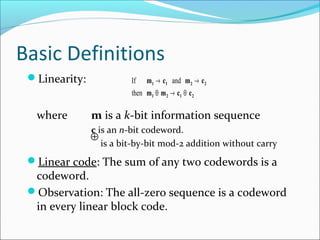
Linearity:
where m is a k-bit information sequence
c is an n-bit codeword.
is a bit-by-bit mod-2 addition without carry
Linear code: The sum of any two codewords is a
codeword.
Observation: The all-zero sequence is a codeword
in every linear block code.
then
andIf
2121
2211
ccmm
cmcm
⊕→⊕
→→
⊕
Basic Definitions (cont’d)
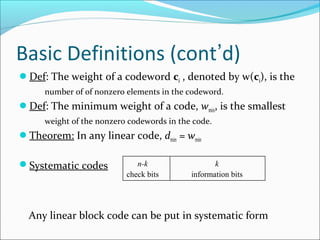
Def: The weight of a codeword ci , denoted by w(ci), is the
number of of nonzero elements in the codeword.
Def: The minimum weight of a code, wmin, is the smallest
weight of the nonzero codewords in the code.
Theorem: In any linear code, dmin = wmin
Systematic codes
Any linear block code can be put in systematic form
n-k
check bits
k
information bits
linear Encoder.
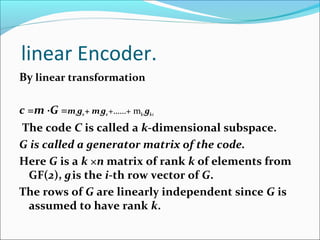
By linear transformation
c =m ⋅G =m0g0+ m1g0+……+ mk-1gk-1
The code C is called a k-dimensional subspace.
G is called a generator matrix of the code.
Here G is a k ×n matrix of rank k of elements from
GF(2), giis the i-th row vector of G.
The rows of G are linearly independent since G is
assumed to have rank k.
Example:
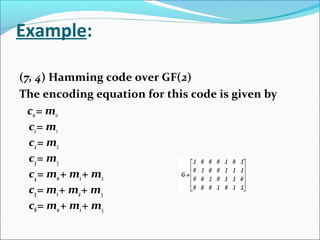
(7, 4) Hamming code over GF(2)
The encoding equation for this code is given by
c0= m0
c1= m1
c2= m2
c3= m3
c4= m0+ m1+ m2
c5= m1+ m2+ m3
c6= m0+ m1+ m3
Linear Systematic Block Code:
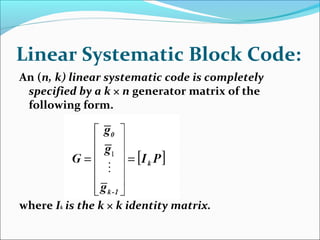
An (n, k) linear systematic code is completely
specified by a k × n generator matrix of the
following form.
where Ik is the k × k identity matrix.
Linear Block Codes
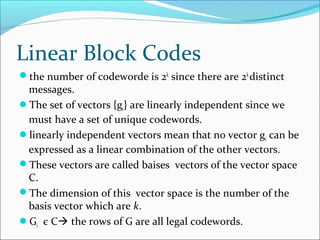
the number of codeworde is 2k
since there are 2k
distinct
messages.
The set of vectors {gi} are linearly independent since we
must have a set of unique codewords.
linearly independent vectors mean that no vector gi can be
expressed as a linear combination of the other vectors.
These vectors are called baises vectors of the vector space
C.
The dimension of this vector space is the number of the
basis vector which are k.
Gi є C the rows of G are all legal codewords.
Hamming Weight
the minimum hamming distance of a linear block code
is equal to the minimum hamming weight of the
nonzero code vectors.
Since each gi єC ,we must have Wh(gi)
≥dminthis a
necessary condition but not sufficient.
Therefore, if the hamming weight of one of the rows of
G is less than dmin, dmin is not correct or G not correct.
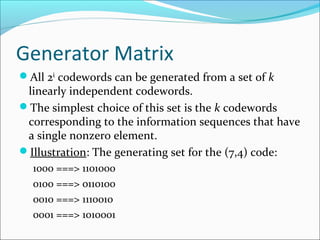
Generator Matrix
All 2k
codewords can be generated from a set of k
linearly independent codewords.
The simplest choice of this set is the k codewords
corresponding to the information sequences that have
a single nonzero element.
Illustration: The generating set for the (7,4) code:
1000 ===> 1101000
0100 ===> 0110100
0010 ===> 1110010
0001 ===> 1010001
Generator Matrix (cont’d)
Every codeword is a linear combination of these 4
codewords.
That is: c = m G, where
Storage requirement reduced from 2k
(n+k) to k(n-k).
[ ]G P | Ik
=
















=
× − ×
1 1 0
0 1 1
1 1 1
1 0 1
1 0 0 0
0 1 0 0
0 0 1 0
0 0 0 1
k n k k k( )
     
Parity-Check Matrix
For G = [ P | Ik], define the matrix H = [In-k | PT
]
(The size of H is (n-k)xn).
It follows that GHT
= 0.
Since c = mG, then cHT
= mGHT
= 0.
H =










1 0 0 1 0 1 1
0 1 0 1 1 1 0
0 0 1 0 1 1 1
Encoding Using H Matrix
[ ]c c c c c c c1 2 3 4 5 6 7
1 0 0
0 1 0
0 0 1
1 1 0
0 1 1
1 1 1
1 0 1
0
0
0
1 6 7
2 5 6
3 6 7
1 6 7
2 5 6
3 6 7














=
+ + =
+ + =
+ + =
⇒
+ +
+ +
+ +
0
c + c c c
c + c c c
c + c c c
c = c c c
c = c c c
c = c c c
4
4
5
4
4
5
information
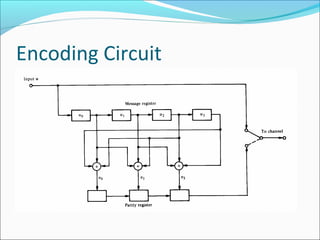
Encoding Circuit
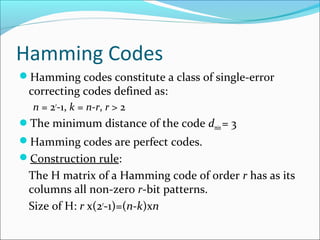
Hamming Codes
Hamming codes constitute a class of single-error
correcting codes defined as:
n = 2r
-1, k = n-r, r > 2
The minimum distance of the code dmin= 3
Hamming codes are perfect codes.
Construction rule:
The H matrix of a Hamming code of order r has as its
columns all non-zero r-bit patterns.
Size of H: r x(2r
-1)=(n-k)xn
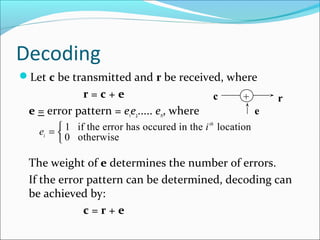
Decoding
Let c be transmitted and r be received, where
r = c + e
e = error pattern = e1e2..... en, where
The weight of e determines the number of errors.
If the error pattern can be determined, decoding can
be achieved by:
c = r + e
e i
i
th
= 


1 if the error has occured in the location
0 otherwise
+c
e
r
Decoding (cont’d)
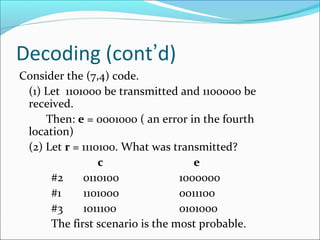
Consider the (7,4) code.
(1) Let 1101000 be transmitted and 1100000 be
received.
Then: e = 0001000 ( an error in the fourth
location)
(2) Let r = 1110100. What was transmitted?
c e
#2 0110100 1000000
#1 1101000 0011100
#3 1011100 0101000
The first scenario is the most probable.
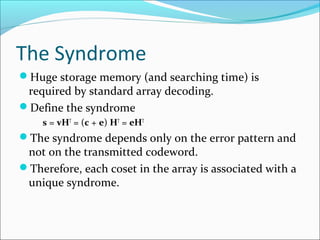
The Syndrome
Huge storage memory (and searching time) is
required by standard array decoding.
Define the syndrome
s = vHT
= (c + e) HT
= eHT
The syndrome depends only on the error pattern and
not on the transmitted codeword.
Therefore, each coset in the array is associated with a
unique syndrome.
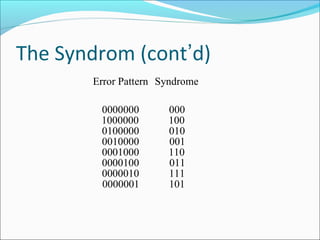
The Syndrom (cont’d)
Error Pattern Syndrome
0000000 000
1000000 100
0100000 010
0010000 001
0001000 110
0000100 011
0000010 111
0000001 101
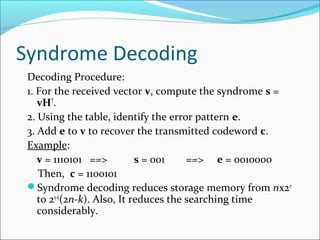
Syndrome Decoding
Decoding Procedure:
1. For the received vector v, compute the syndrome s =
vHT
.
2. Using the table, identify the error pattern e.
3. Add e to v to recover the transmitted codeword c.
Example:
v = 1110101 ==> s = 001 ==> e = 0010000
Then, c = 1100101
Syndrome decoding reduces storage memory from nx2n
to 2n-k
(2n-k). Also, It reduces the searching time
considerably.
Decoding of Hamming Codes
Consider a single-error pattern e(i)
, where i is a
number determining the position of the error.
s = e(i)
HT
= Hi
T
= the transpose of the ith
column of H.
Example:
[ ] [ ]0 1 0 0 0 0 0
1 0 0
0 1 0
0 0 1
1 1 0
0 1 1
1 1 1
1 0 1
0 1 0
















=
Decoding of Hamming Codes
(cont’d)
That is, the (transpose of the) ith
column of H is the
syndrome corresponding to a single error in the ith
position.
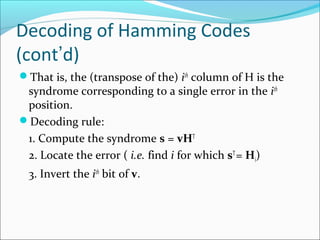
Decoding rule:
1. Compute the syndrome s = vHT
2. Locate the error ( i.e. find i for which sT
= Hi)
3. Invert the ith
bit of v.
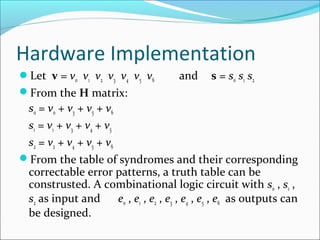
Hardware Implementation
Let v = v0 v1 v2 v3 v4 v5 v6 and s = s0 s1 s2
From the H matrix:
s0 = v0 + v3 + v5 + v6
s1 = v1 + v3 + v4 + v5
s2 = v2 + v4 + v5 + v6
From the table of syndromes and their corresponding
correctable error patterns, a truth table can be
construsted. A combinational logic circuit with s0 , s1 ,
s2 as input and e0 , e1 , e2 , e3 , e4 , e5 , e6 as outputs can
be designed.
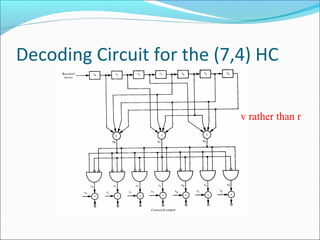
Decoding Circuit for the (7,4) HC
v rather than r

5 linear block codes

  • 1.
    The parity bitsof linear block codes are linear combination of the message. Therefore, we can represent the encoder by a linear system described by matrices.
  • 2.
    Basic Definitions Linearity: where mis a k-bit information sequence c is an n-bit codeword. is a bit-by-bit mod-2 addition without carry Linear code: The sum of any two codewords is a codeword. Observation: The all-zero sequence is a codeword in every linear block code. then andIf 2121 2211 ccmm cmcm ⊕→⊕ →→ ⊕
  • 3.
    Basic Definitions (cont’d) Def:The weight of a codeword ci , denoted by w(ci), is the number of of nonzero elements in the codeword. Def: The minimum weight of a code, wmin, is the smallest weight of the nonzero codewords in the code. Theorem: In any linear code, dmin = wmin Systematic codes Any linear block code can be put in systematic form n-k check bits k information bits
  • 4.
    linear Encoder. By lineartransformation c =m ⋅G =m0g0+ m1g0+……+ mk-1gk-1 The code C is called a k-dimensional subspace. G is called a generator matrix of the code. Here G is a k ×n matrix of rank k of elements from GF(2), giis the i-th row vector of G. The rows of G are linearly independent since G is assumed to have rank k.
  • 5.
    Example: (7, 4) Hammingcode over GF(2) The encoding equation for this code is given by c0= m0 c1= m1 c2= m2 c3= m3 c4= m0+ m1+ m2 c5= m1+ m2+ m3 c6= m0+ m1+ m3
  • 6.
    Linear Systematic BlockCode: An (n, k) linear systematic code is completely specified by a k × n generator matrix of the following form. where Ik is the k × k identity matrix.
  • 7.
    Linear Block Codes thenumber of codeworde is 2k since there are 2k distinct messages. The set of vectors {gi} are linearly independent since we must have a set of unique codewords. linearly independent vectors mean that no vector gi can be expressed as a linear combination of the other vectors. These vectors are called baises vectors of the vector space C. The dimension of this vector space is the number of the basis vector which are k. Gi є C the rows of G are all legal codewords.
  • 8.
    Hamming Weight the minimumhamming distance of a linear block code is equal to the minimum hamming weight of the nonzero code vectors. Since each gi єC ,we must have Wh(gi) ≥dminthis a necessary condition but not sufficient. Therefore, if the hamming weight of one of the rows of G is less than dmin, dmin is not correct or G not correct.
  • 9.
    Generator Matrix All 2k codewordscan be generated from a set of k linearly independent codewords. The simplest choice of this set is the k codewords corresponding to the information sequences that have a single nonzero element. Illustration: The generating set for the (7,4) code: 1000 ===> 1101000 0100 ===> 0110100 0010 ===> 1110010 0001 ===> 1010001
  • 10.
    Generator Matrix (cont’d) Everycodeword is a linear combination of these 4 codewords. That is: c = m G, where Storage requirement reduced from 2k (n+k) to k(n-k). [ ]G P | Ik =                 = × − × 1 1 0 0 1 1 1 1 1 1 0 1 1 0 0 0 0 1 0 0 0 0 1 0 0 0 0 1 k n k k k( )      
  • 11.
    Parity-Check Matrix For G= [ P | Ik], define the matrix H = [In-k | PT ] (The size of H is (n-k)xn). It follows that GHT = 0. Since c = mG, then cHT = mGHT = 0. H =           1 0 0 1 0 1 1 0 1 0 1 1 1 0 0 0 1 0 1 1 1
  • 12.
    Encoding Using HMatrix [ ]c c c c c c c1 2 3 4 5 6 7 1 0 0 0 1 0 0 0 1 1 1 0 0 1 1 1 1 1 1 0 1 0 0 0 1 6 7 2 5 6 3 6 7 1 6 7 2 5 6 3 6 7               = + + = + + = + + = ⇒ + + + + + + 0 c + c c c c + c c c c + c c c c = c c c c = c c c c = c c c 4 4 5 4 4 5 information
  • 13.
  • 14.
    Hamming Codes Hamming codesconstitute a class of single-error correcting codes defined as: n = 2r -1, k = n-r, r > 2 The minimum distance of the code dmin= 3 Hamming codes are perfect codes. Construction rule: The H matrix of a Hamming code of order r has as its columns all non-zero r-bit patterns. Size of H: r x(2r -1)=(n-k)xn
  • 15.
    Decoding Let c betransmitted and r be received, where r = c + e e = error pattern = e1e2..... en, where The weight of e determines the number of errors. If the error pattern can be determined, decoding can be achieved by: c = r + e e i i th =    1 if the error has occured in the location 0 otherwise +c e r
  • 16.
    Decoding (cont’d) Consider the(7,4) code. (1) Let 1101000 be transmitted and 1100000 be received. Then: e = 0001000 ( an error in the fourth location) (2) Let r = 1110100. What was transmitted? c e #2 0110100 1000000 #1 1101000 0011100 #3 1011100 0101000 The first scenario is the most probable.
  • 17.
    The Syndrome Huge storagememory (and searching time) is required by standard array decoding. Define the syndrome s = vHT = (c + e) HT = eHT The syndrome depends only on the error pattern and not on the transmitted codeword. Therefore, each coset in the array is associated with a unique syndrome.
  • 18.
    The Syndrom (cont’d) ErrorPattern Syndrome 0000000 000 1000000 100 0100000 010 0010000 001 0001000 110 0000100 011 0000010 111 0000001 101
  • 19.
    Syndrome Decoding Decoding Procedure: 1.For the received vector v, compute the syndrome s = vHT . 2. Using the table, identify the error pattern e. 3. Add e to v to recover the transmitted codeword c. Example: v = 1110101 ==> s = 001 ==> e = 0010000 Then, c = 1100101 Syndrome decoding reduces storage memory from nx2n to 2n-k (2n-k). Also, It reduces the searching time considerably.
  • 20.
    Decoding of HammingCodes Consider a single-error pattern e(i) , where i is a number determining the position of the error. s = e(i) HT = Hi T = the transpose of the ith column of H. Example: [ ] [ ]0 1 0 0 0 0 0 1 0 0 0 1 0 0 0 1 1 1 0 0 1 1 1 1 1 1 0 1 0 1 0                 =
  • 21.
    Decoding of HammingCodes (cont’d) That is, the (transpose of the) ith column of H is the syndrome corresponding to a single error in the ith position. Decoding rule: 1. Compute the syndrome s = vHT 2. Locate the error ( i.e. find i for which sT = Hi) 3. Invert the ith bit of v.
  • 22.
    Hardware Implementation Let v= v0 v1 v2 v3 v4 v5 v6 and s = s0 s1 s2 From the H matrix: s0 = v0 + v3 + v5 + v6 s1 = v1 + v3 + v4 + v5 s2 = v2 + v4 + v5 + v6 From the table of syndromes and their corresponding correctable error patterns, a truth table can be construsted. A combinational logic circuit with s0 , s1 , s2 as input and e0 , e1 , e2 , e3 , e4 , e5 , e6 as outputs can be designed.
  • 23.
    Decoding Circuit forthe (7,4) HC v rather than r