.
                                                                      .
                Independent Component Analysis for Blind Source
                                 Separation
   .
   ..                                                             .


                                                                      .
                                  Tatsuya Yokota

                            Tokyo Institute of Technology

                                   Jan. 31, 2012


Jan. 31, 2012                                                     1/28
Outline


    .
 . . Blind Source Separation
   1


    .
 . . Independent Component Analysis
   2


    .
 . . Experiments
   3


    .
 . . Summary
   4


Jan. 31, 2012                         2/28
What’s a Blind Source Separation


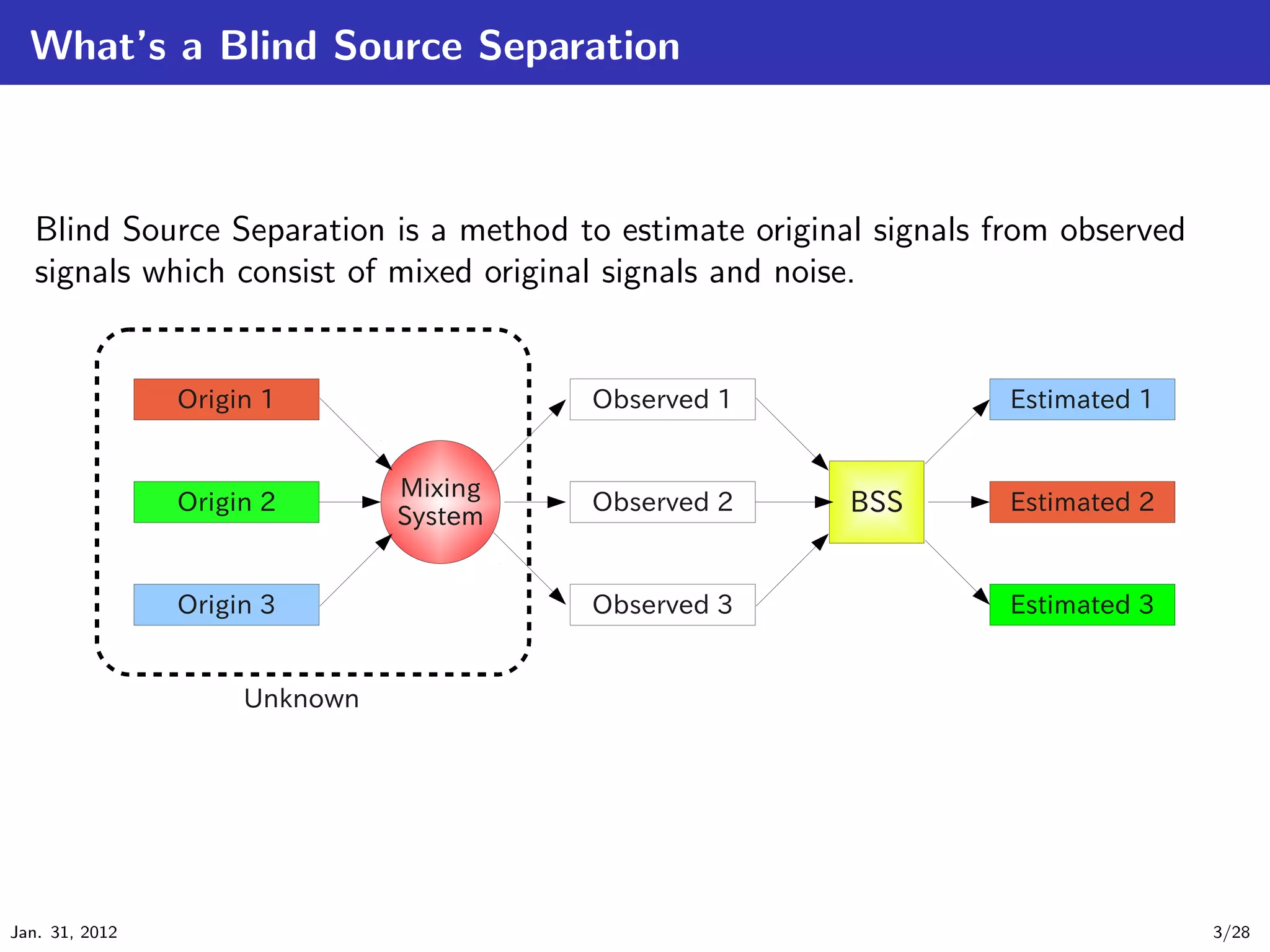
   Blind Source Separation is a method to estimate original signals from observed
   signals which consist of mixed original signals and noise.


Jan. 31, 2012                                                                       3/28
Example of BSS


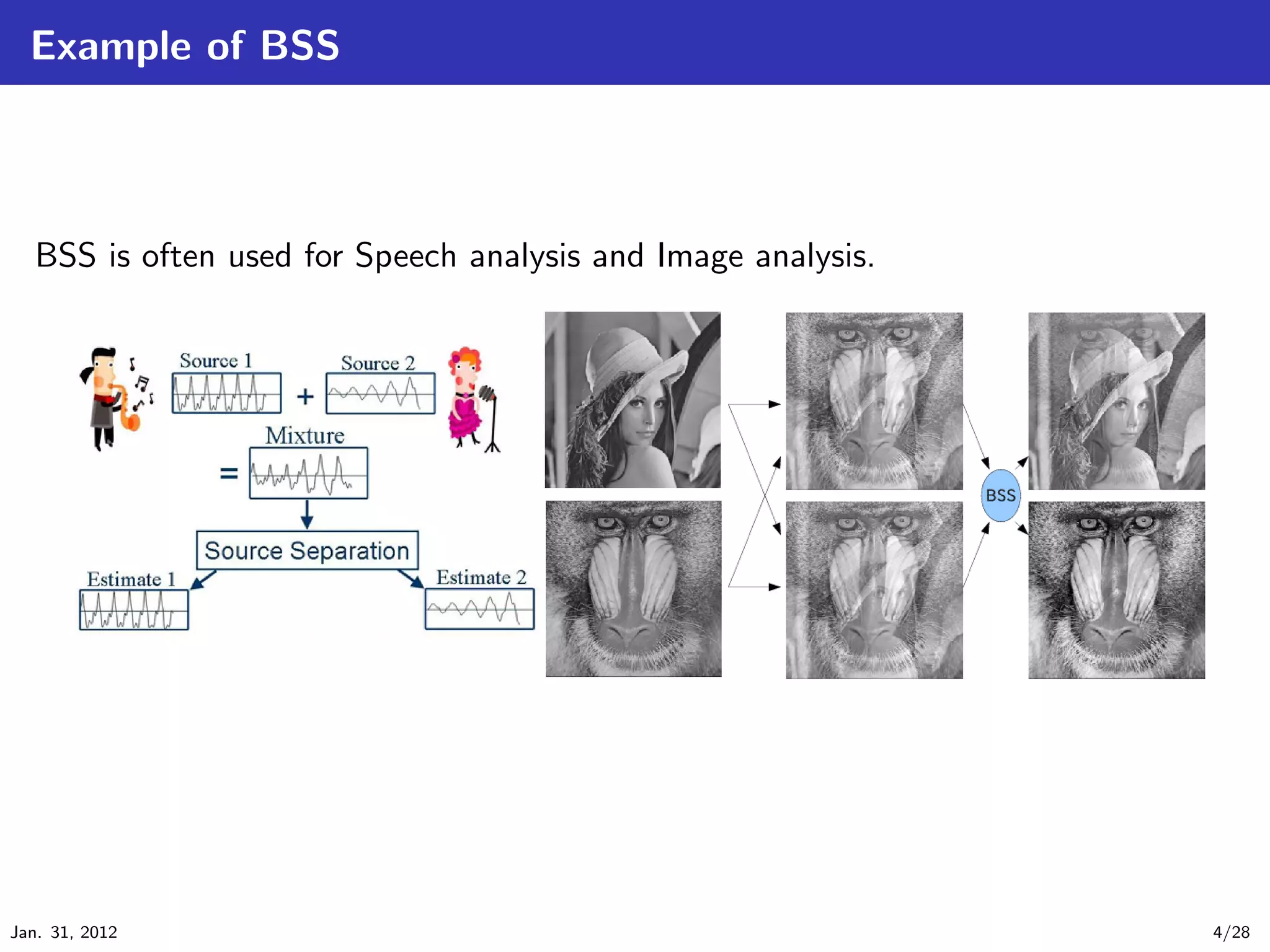
   BSS is often used for Speech analysis and Image analysis.


Jan. 31, 2012                                                  4/28
Example of BSS (cont’d)

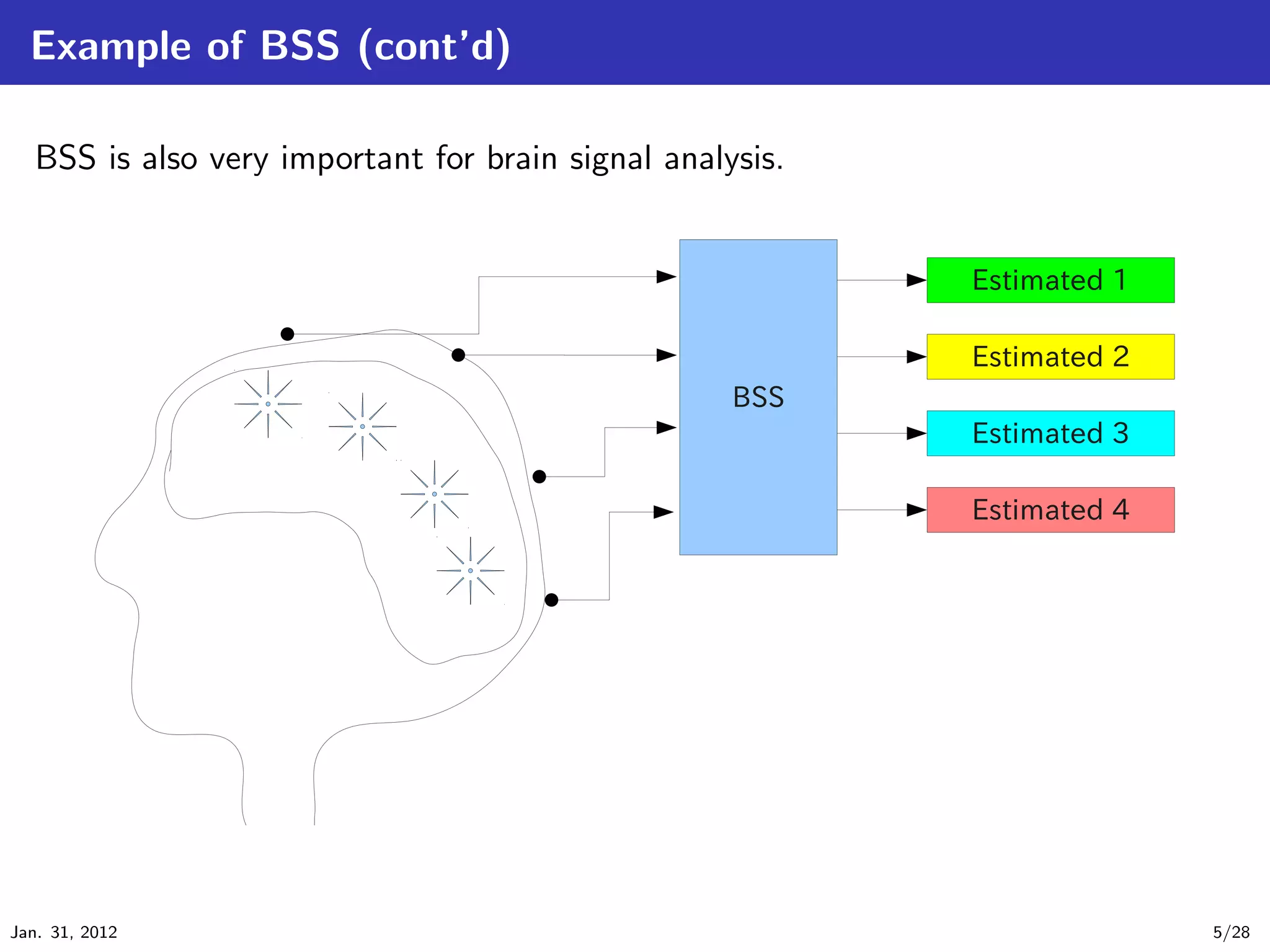
   BSS is also very important for brain signal analysis.


Jan. 31, 2012                                              5/28
Model Formalization
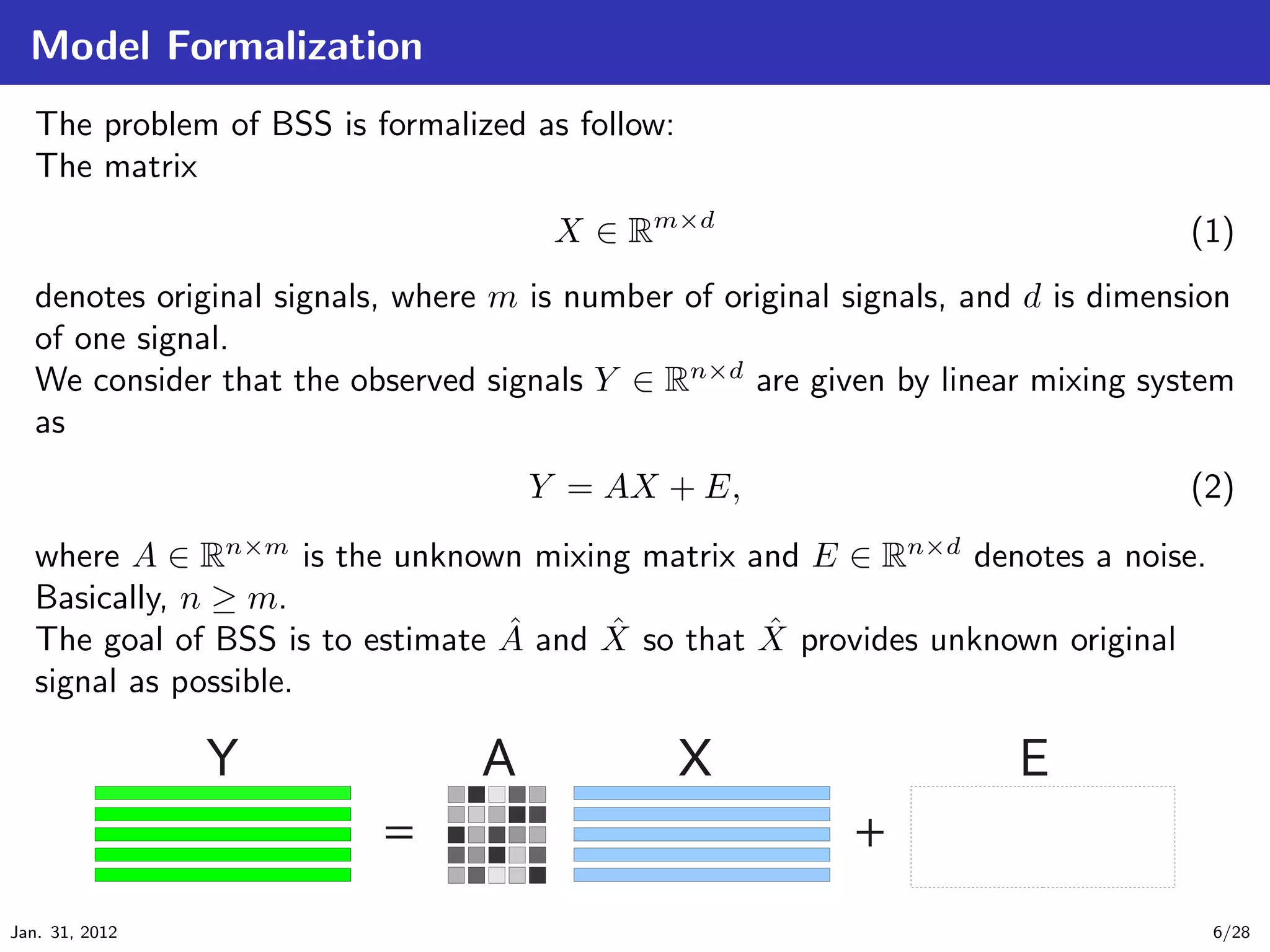
   The problem of BSS is formalized as follow:
   The matrix
                                      X ∈ Rm×d                                    (1)
   denotes original signals, where m is number of original signals, and d is dimension
   of one signal.
   We consider that the observed signals Y ∈ Rn×d are given by linear mixing system
   as
                                     Y = AX + E,                                  (2)
   where A ∈ Rn×m is the unknown mixing matrix and E ∈ Rn×d denotes a noise.
   Basically, n ≥ m.
                                  ˆ     ˆ         ˆ
   The goal of BSS is to estimate A and X so that X provides unknown original
   signal as possible.


Jan. 31, 2012                                                                       6/28
Kinds of BSS Methods


   Actually, degree of freedom of BSS model is very high to estimate A and X.
   Because there are a huge number of combinations (A, X) which satisfy
   Y = AX + E.
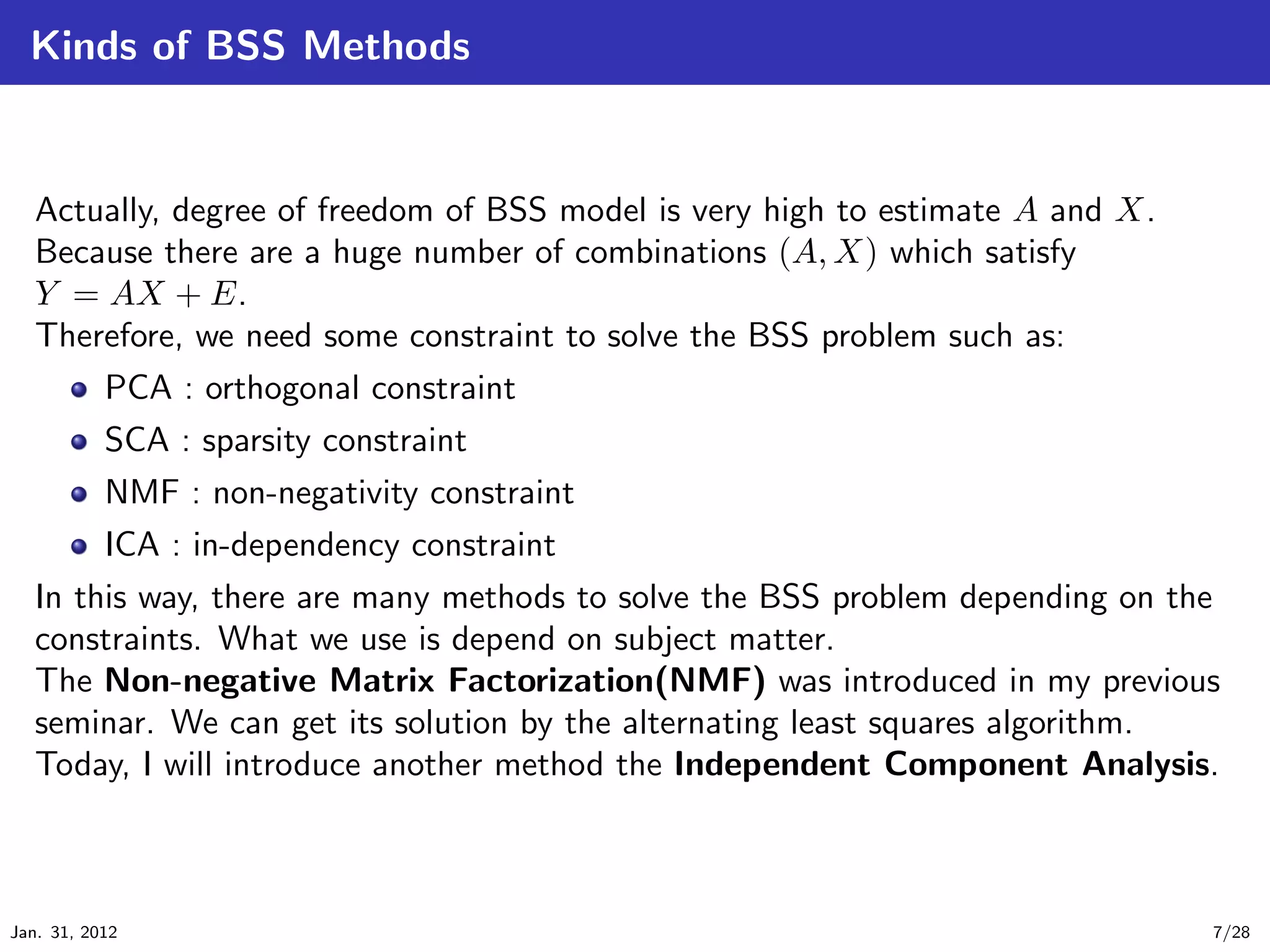
   Therefore, we need some constraint to solve the BSS problem such as:
           PCA : orthogonal constraint
           SCA : sparsity constraint
        NMF : non-negativity constraint
        ICA : in-dependency constraint
   In this way, there are many methods to solve the BSS problem depending on the
   constraints. What we use is depend on subject matter.
   The Non-negative Matrix Factorization(NMF) was introduced in my previous
   seminar. We can get its solution by the alternating least squares algorithm.
   Today, I will introduce another method the Independent Component Analysis.


Jan. 31, 2012                                                                   7/28
Independent Component Analysis

   .
   The Cocktail Party Problem                                                                .
 ..

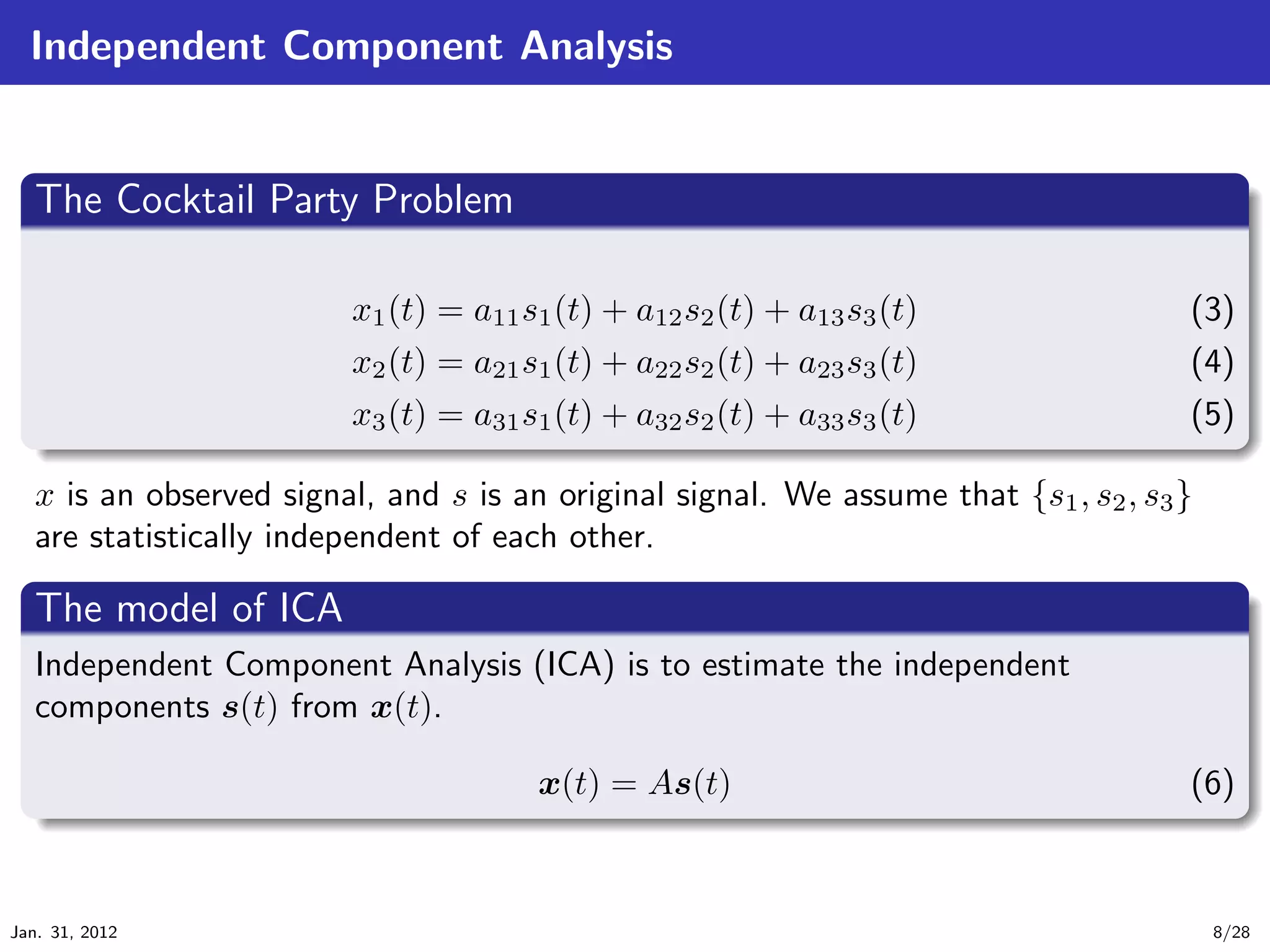
                         x1 (t) = a11 s1 (t) + a12 s2 (t) + a13 s3 (t)                 (3)
                         x2 (t) = a21 s1 (t) + a22 s2 (t) + a23 s3 (t)                 (4)
  .                       x3 (t) = a31 s1 (t) + a32 s2 (t) + a33 s3 (t)               (5)
  ..                                                                                   .


                                                                                             .
  x is an observed signal, and s is an original signal. We assume that {s1 , s2 , s3 }
  are statistically independent of each other.
  .
  The model of ICA                                                                        .
 ..
  Independent Component Analysis (ICA) is to estimate the independent
  components s(t) from x(t).

   .                                   x(t) = As(t)                                    (6)
   ..                                                                                   .


                                                                                             .
Jan. 31, 2012                                                                           8/28
Approach


   .
   Hypothesis of ICA                                                                         .
 ..
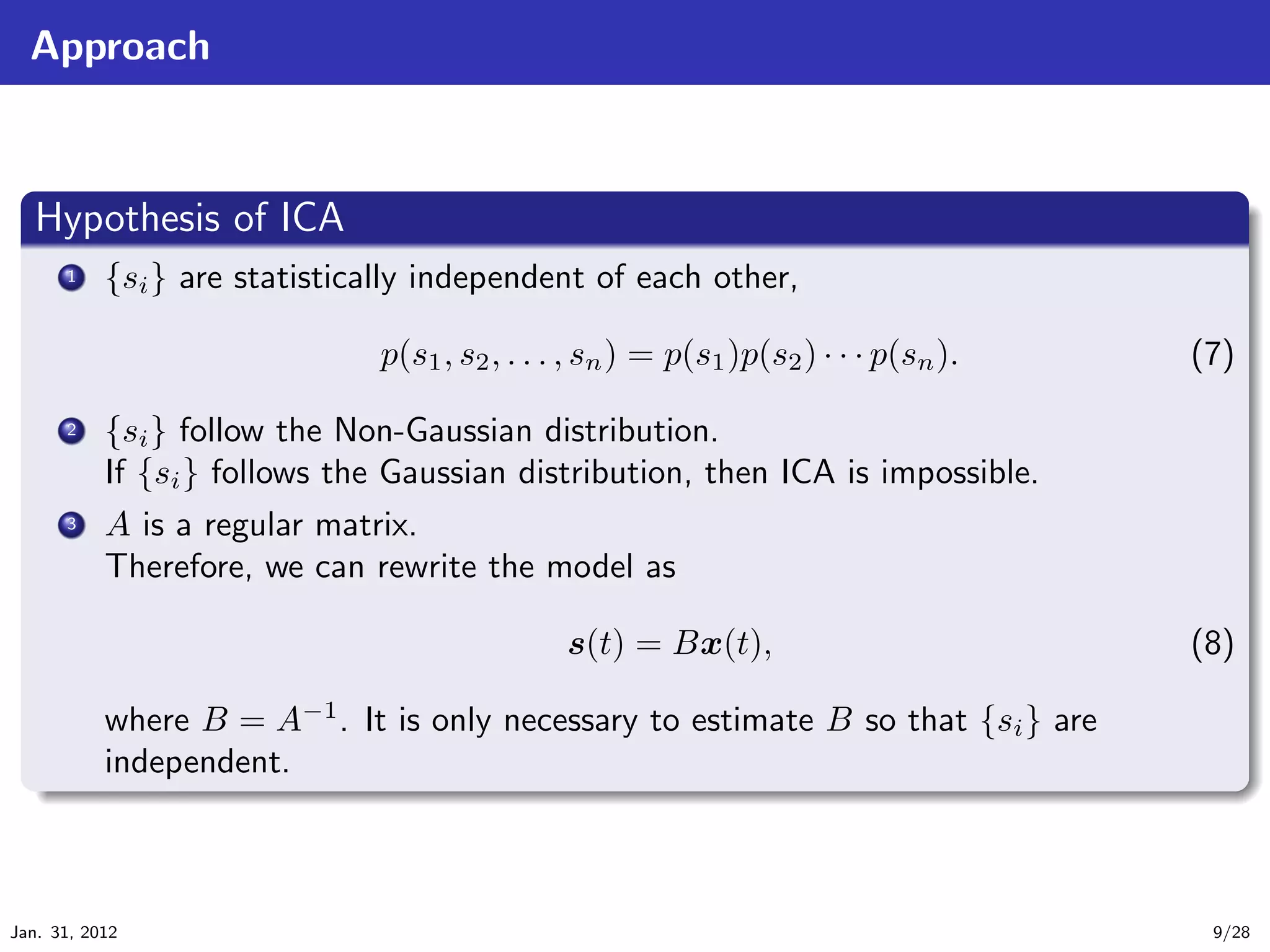
       ... {si } are statistically independent of each other,
        1


                               p(s1 , s2 , . . . , sn ) = p(s1 )p(s2 ) · · · p(sn ).   (7)

       ...
        2  {si } follow the Non-Gaussian distribution.
           If {si } follows the Gaussian distribution, then ICA is impossible.
       ... A is a regular matrix.
        3

           Therefore, we can rewrite the model as

                                                s(t) = Bx(t),                          (8)

             where B = A−1 . It is only necessary to estimate B so that {si } are
   .         independent.
   ..                                                                                   .


                                                                                             .
Jan. 31, 2012                                                                           9/28
Whitening and ICA
   .
   Definition of White signal                                                            .
 ..
  White signals are defined as any z which satisfies conditions of

   .                           E[z] = 0, E[zz T ] = I.                            (9)
   ..                                                                              .


                                                                                        .
   First, we show an example of original independent signals and observed signal as
   follow:


                       (a) source (s1 , s2 )    (b) observed (x1 , x2 )


   Observed signals x(t) are given by x(t) = As(t).
   ICA give us the original signals s(t) by s(t) = Bx(t).
Jan. 31, 2012                                                                     10/28
Whitening and ICA (cont’d)
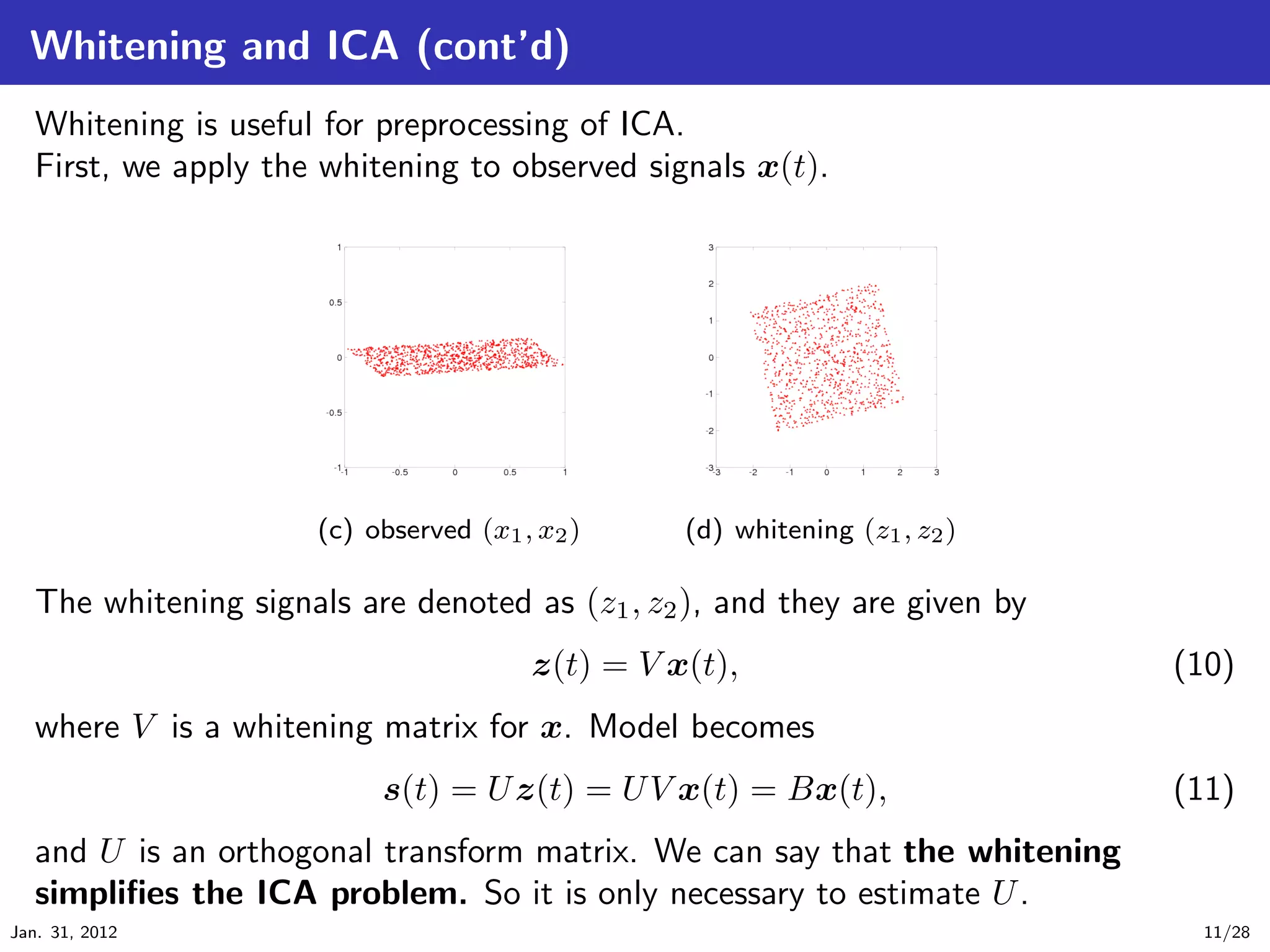
   Whitening is useful for preprocessing of ICA.
   First, we apply the whitening to observed signals x(t).


                      (c) observed (x1 , x2 )     (d) whitening (z1 , z2 )

   The whitening signals are denoted as (z1 , z2 ), and they are given by
                                        z(t) = V x(t),                       (10)
   where V is a whitening matrix for x. Model becomes
                           s(t) = U z(t) = U V x(t) = Bx(t),                 (11)
   and U is an orthogonal transform matrix. We can say that the whitening
   simplifies the ICA problem. So it is only necessary to estimate U .
Jan. 31, 2012                                                                 11/28
Non-Gaussianity and ICA

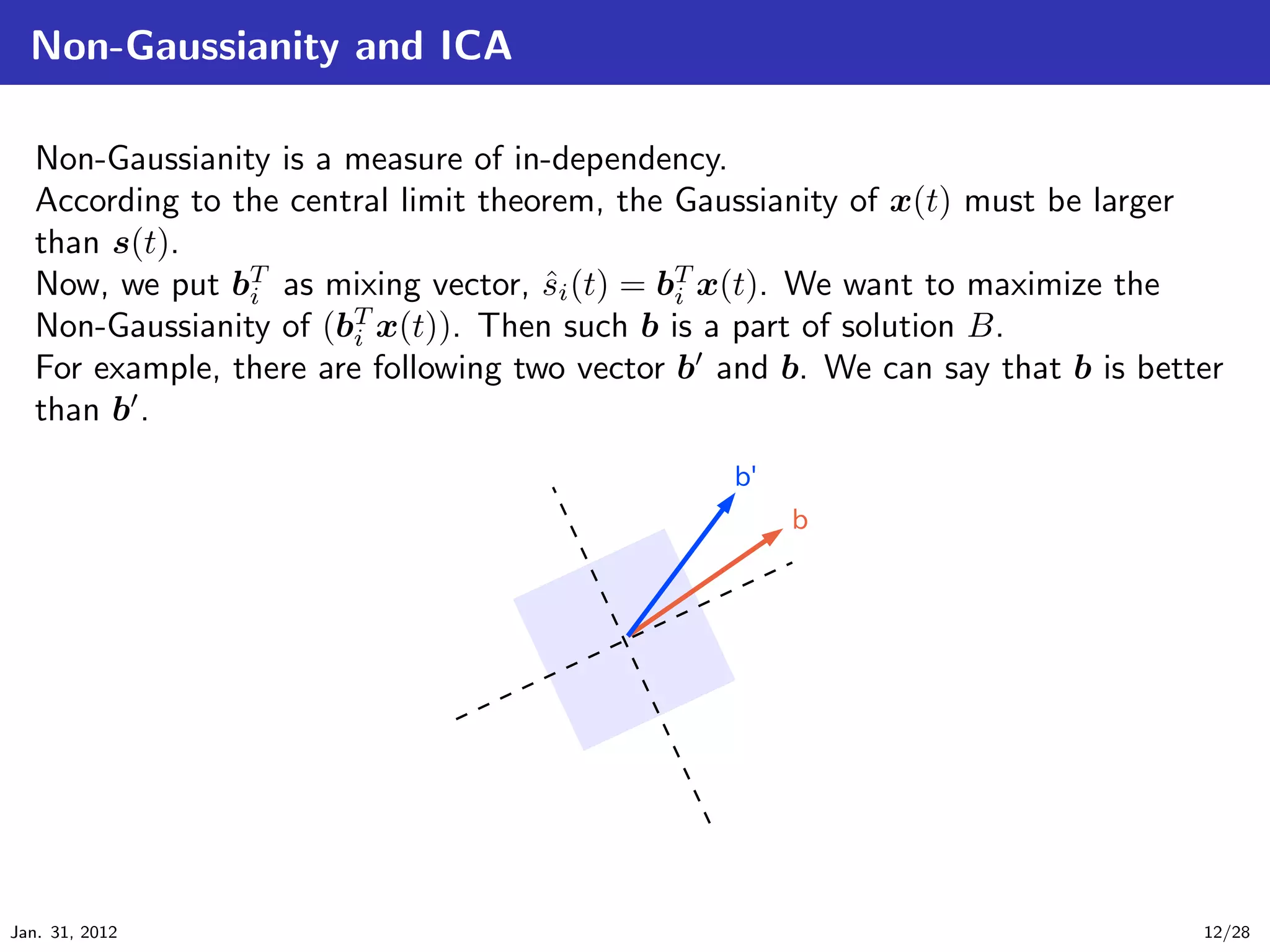
   Non-Gaussianity is a measure of in-dependency.
   According to the central limit theorem, the Gaussianity of x(t) must be larger
   than s(t).
   Now, we put bT as mixing vector, si (t) = bT x(t). We want to maximize the
                 i                    ˆ        i
   Non-Gaussianity of (bT x(t)). Then such b is a part of solution B.
                         i
   For example, there are following two vector b and b. We can say that b is better
   than b .


Jan. 31, 2012                                                                    12/28
Maximization of Kurtosis
   Kurtosis is a measures of Non-Gaussianity. Kurtosis is defined by
                              kurt(y) = E[y 4 ] − 3(E[y 2 ])2 .       (12)
   We assume that y is white (i.e. E[y] = 0, E[y 2 ] = 1 ), then
                                  kurt(y) = E[y 4 ] − 3.              (13)
   We can solve the ICA problem by
                              ˆ
                              b = max |kurt(bT x(t))|.                (14)
                                       b


Jan. 31, 2012                                                          13/28
Fast ICA algorithm based on Kurtosis


   We consider z is a white signal given from x. And we consider to maximize the
   absolute value of kurtosis as

                       maximize     |kurt(wT z)|, s.t. wT w = 1.              (15)

   Differential of |kurt(wT z)| is given by

       ∂|kurt(wT z)|    ∂
                     =      E{(wT z)4 } − 3E{(wT z)2 }2                      (16)
            ∂w         ∂w
                        ∂
                     =      E{(wT z)4 } − 3{||w||2 }2 (because E(zz T ) = I) (17)
                       ∂w
                     = 4sign[kurt(wT z)] E{z(wT z)3 } − 3w||w||2             (18)


Jan. 31, 2012                                                                      14/28
Fast ICA algorithm based on Kurtosis (cont’d)
   According to the gradient method, we can obtain following algorithm:
   .
   Gradient algorithm based on Kurtosis                                         .
 ..

                   w ← w + ∆w,                                            (19)
                         w
                   w←        ,                                            (20)
                       ||w||
  .                  ∆w ∝ sign[kurt(wT z)] E{z(wT z)3 } − 3w .        (21)
  ..                                                                     .


                                                                                 .
  We can see that above algorithm converge when w ∝ ∆w. And w and −w are
  equivalent solution, so we can obtain another algorithm:
  .
  Fast ICA algorithm based on Kurtosis                                     .
 ..

                               w ← E{z(wT z)3 } − 3w,                     (22)
                                     w
                               w←        .                                (23)
   .                               ||w||
   ..                                                                       .


                                                                                 .
   It is well known as a fast convergence algorithm for ICA !!
Jan. 31, 2012                                                              15/28
Example


                3

                                                            4
                2


                                                            2
                1


                0                                           0


                -1
                                                            -2


                -2
                                                            -4

                -3-3   -2   -1   0   1    2   3                  -4      -2   0    2      4


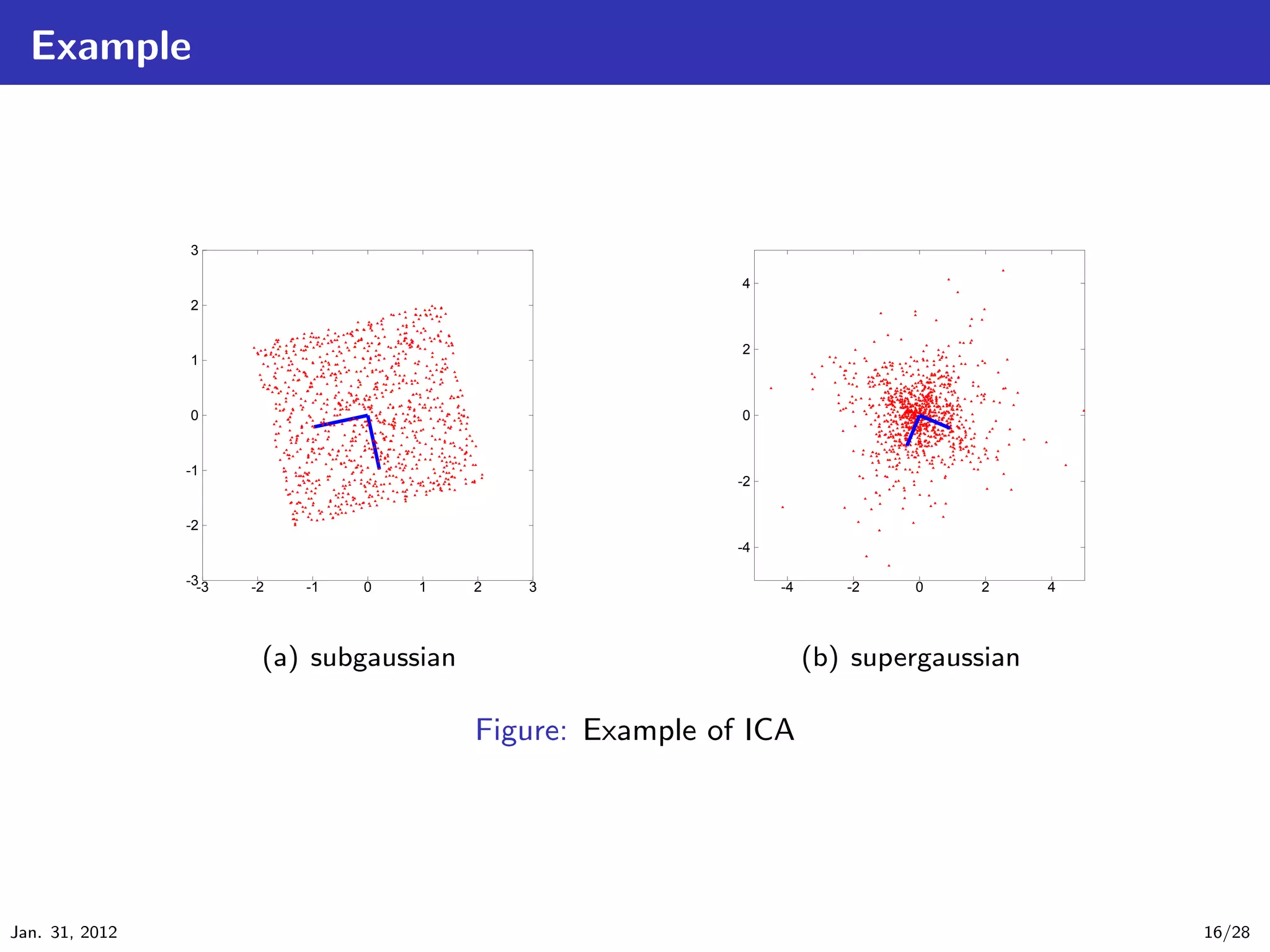
                        (a) subgaussian                               (b) supergaussian

                                          Figure: Example of ICA


Jan. 31, 2012                                                                                 16/28
Issue of Kurtosis

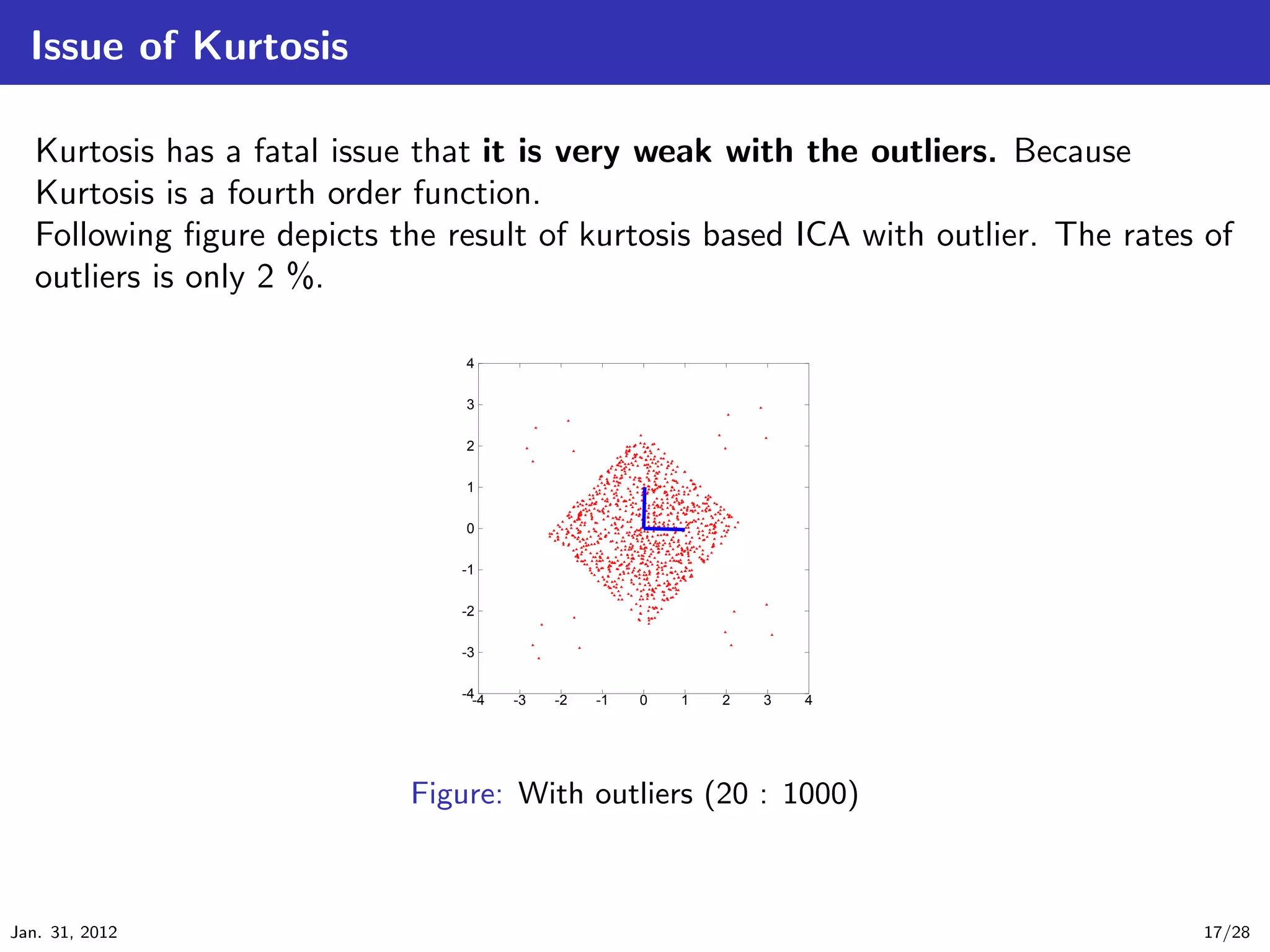
   Kurtosis has a fatal issue that it is very weak with the outliers. Because
   Kurtosis is a fourth order function.
   Following figure depicts the result of kurtosis based ICA with outlier. The rates of
   outliers is only 2 %.

                                 4

                                 3

                                 2

                                 1

                                 0

                                -1

                                -2

                                -3

                                -4-4   -3   -2   -1   0   1   2   3   4


                             Figure: With outliers (20 : 1000)


Jan. 31, 2012                                                                      17/28
Neg-entropy based ICA


   Kurtosis is very weak with outliers.
   Hence, the Neg-entropy is often used for ICA. In strictly, the approximation of
   neg-entropy is often used, because it is robust for outliers.
   Neg-entropy is defined by

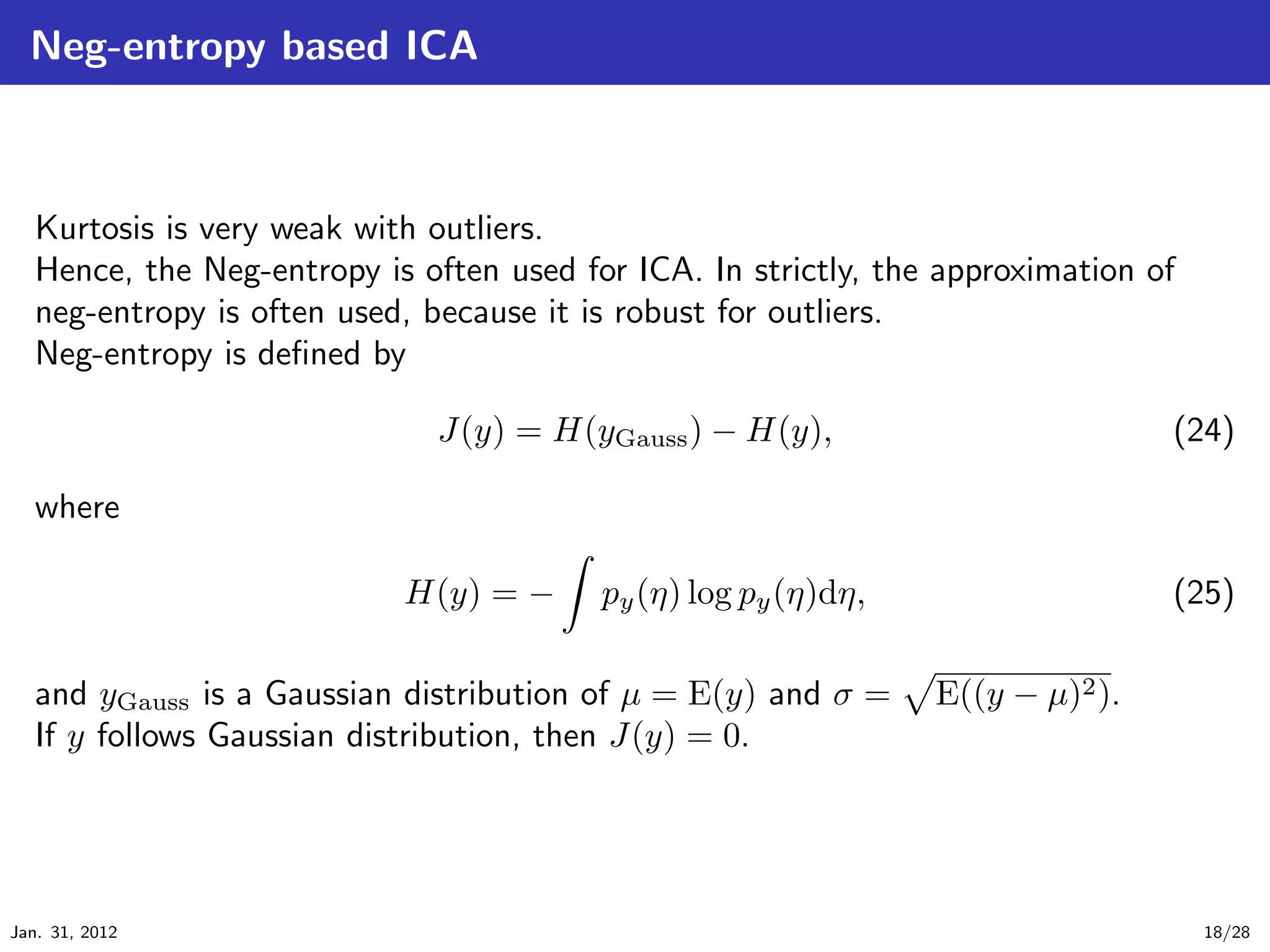
                              J(y) = H(yGauss ) − H(y),                          (24)

   where

                            H(y) = −      py (η) log py (η)dη,                   (25)

   and yGauss is a Gaussian distribution of µ = E(y) and σ =     E((y − µ)2 ).
   If y follows Gaussian distribution, then J(y) = 0.


Jan. 31, 2012                                                                        18/28
Fast ICA algorithm based on Neg-entropy


   The approximation procedure of neg-entropy is complex, then it is omitted here.
   We just introduce the fast ICA algorithm based on neg-entropy:
   .
   Fast ICA algorithm based on Neg-entropy                                               .
 ..

                                 w ← E[zg(wT z)] − E[g (wT z)]w                (26)
                                       w
                                 w←                                            (27)
   .                                 ||w||
   ..                                                                                .


                                                                                         .
   where we can select functions g and g from
      .
      .. g1 (y) = tanh(a1 y) and g1 (y) = a1 (1 − tanh2 (a1 y)),
      1


      .
      .. g2 (y) = y exp(−y 2 /2) and g (y) = (1 − y 2 ) exp(−y 2 /2),
      2
                                           2
      ...
       3    g3 (y) = y 3 and g3 (y) = 3y 2 .
   1 ≤ a1 ≤ 2.
   Please note that (g3 , g3 ) is equivalent to Kurtosis based ICA.


Jan. 31, 2012                                                                    19/28
Examples

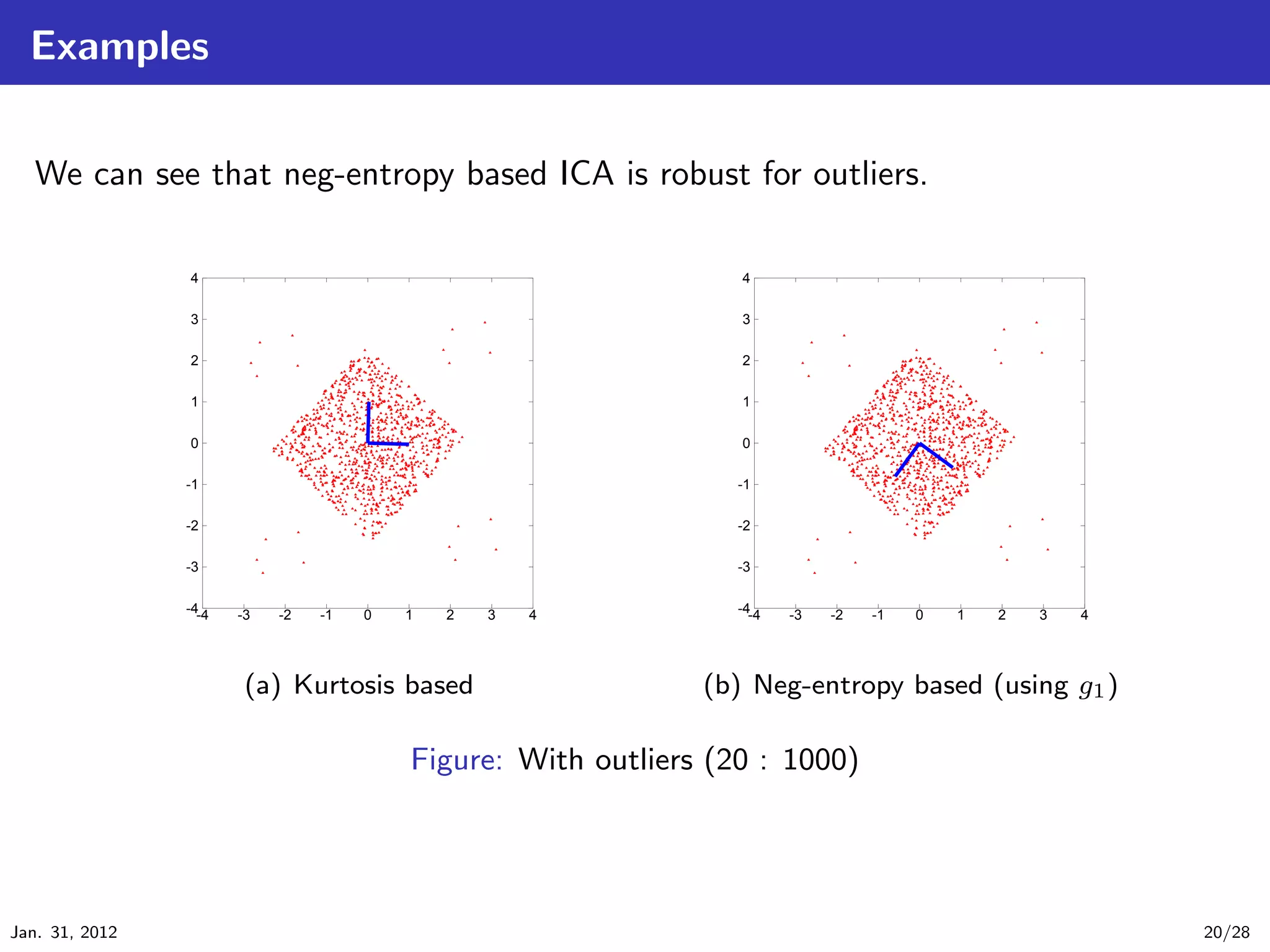
   We can see that neg-entropy based ICA is robust for outliers.

                4                                                 4

                3                                                 3

                2                                                 2

                1                                                 1

                0                                                 0

                -1                                                -1

                -2                                                -2

                -3                                                -3

                -4-4   -3   -2   -1   0   1   2   3   4           -4-4   -3   -2   -1   0   1   2   3   4


                        (a) Kurtosis based                     (b) Neg-entropy based (using g1 )

                                          Figure: With outliers (20 : 1000)


Jan. 31, 2012                                                                                               20/28
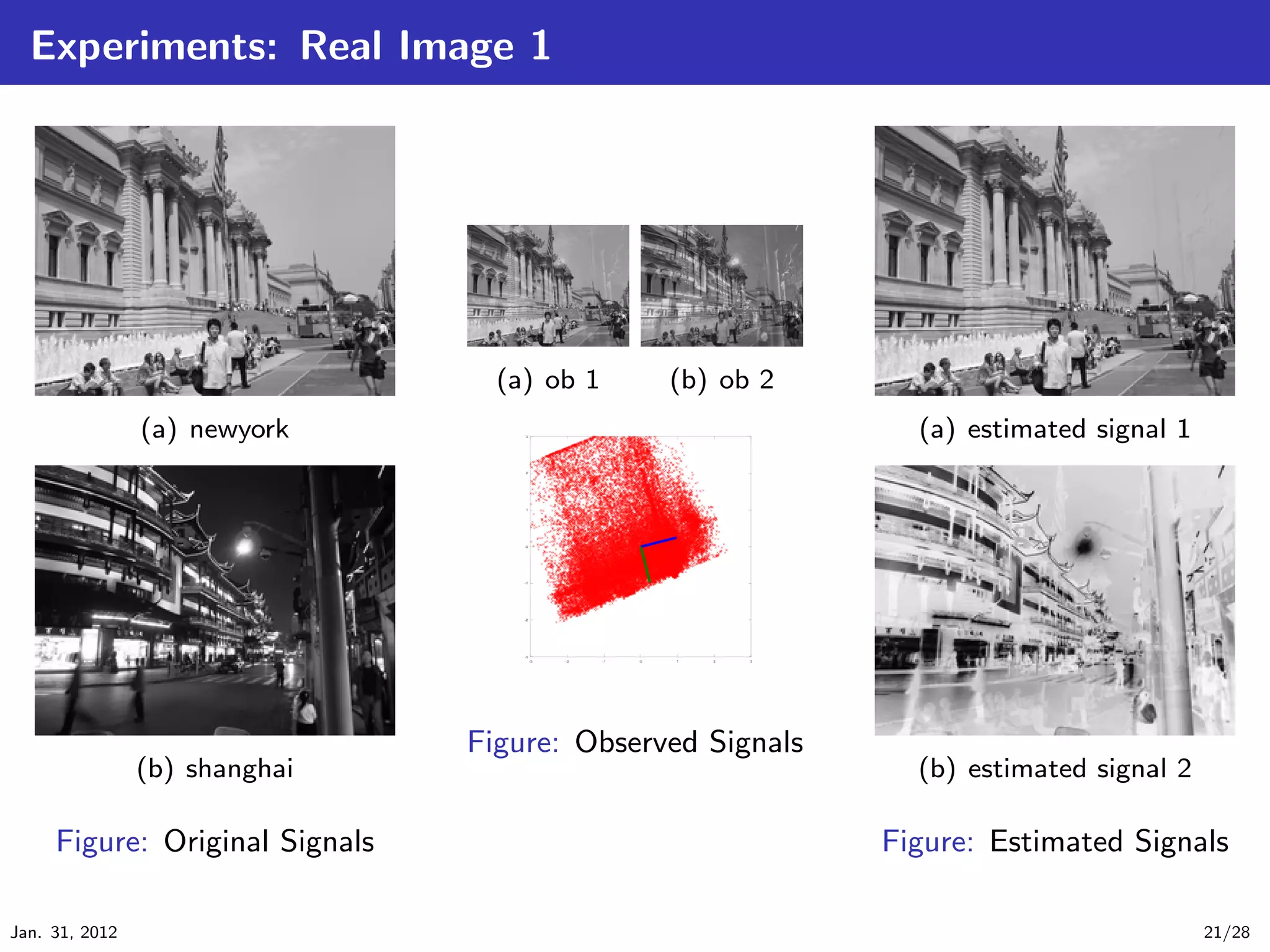
Experiments: Real Image 1


                                  (a) ob 1    (b) ob 2
                (a) newyork                                  (a) estimated signal 1


                                Figure: Observed Signals
                (b) shanghai                                 (b) estimated signal 2

     Figure: Original Signals                              Figure: Estimated Signals

Jan. 31, 2012                                                                         21/28
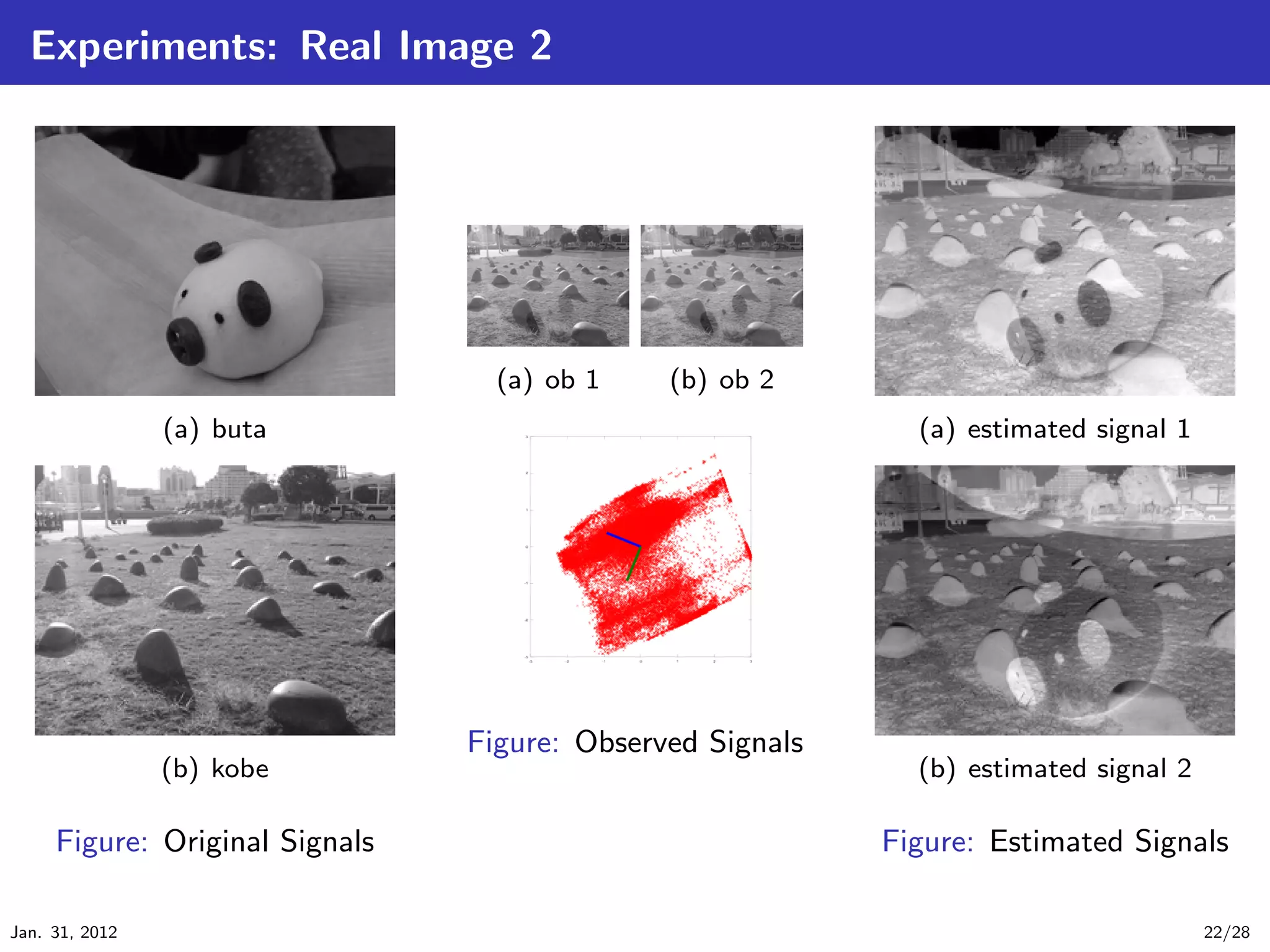
Experiments: Real Image 2


                                  (a) ob 1    (b) ob 2
                (a) buta                                     (a) estimated signal 1


                                Figure: Observed Signals
                (b) kobe                                     (b) estimated signal 2

     Figure: Original Signals                              Figure: Estimated Signals

Jan. 31, 2012                                                                         22/28
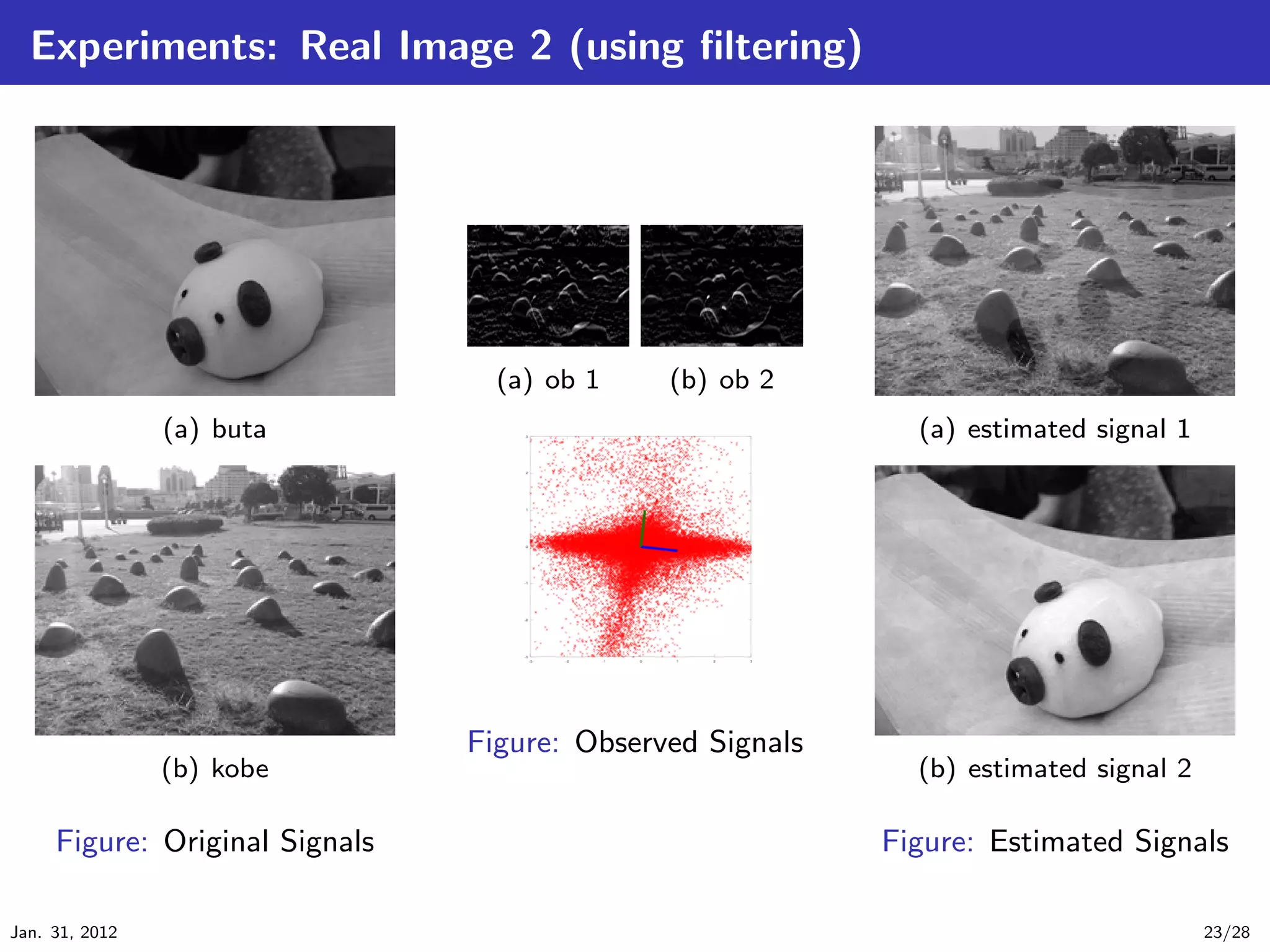
Experiments: Real Image 2 (using filtering)


                                  (a) ob 1    (b) ob 2
                (a) buta                                     (a) estimated signal 1


                                Figure: Observed Signals
                (b) kobe                                     (b) estimated signal 2

     Figure: Original Signals                              Figure: Estimated Signals

Jan. 31, 2012                                                                         23/28
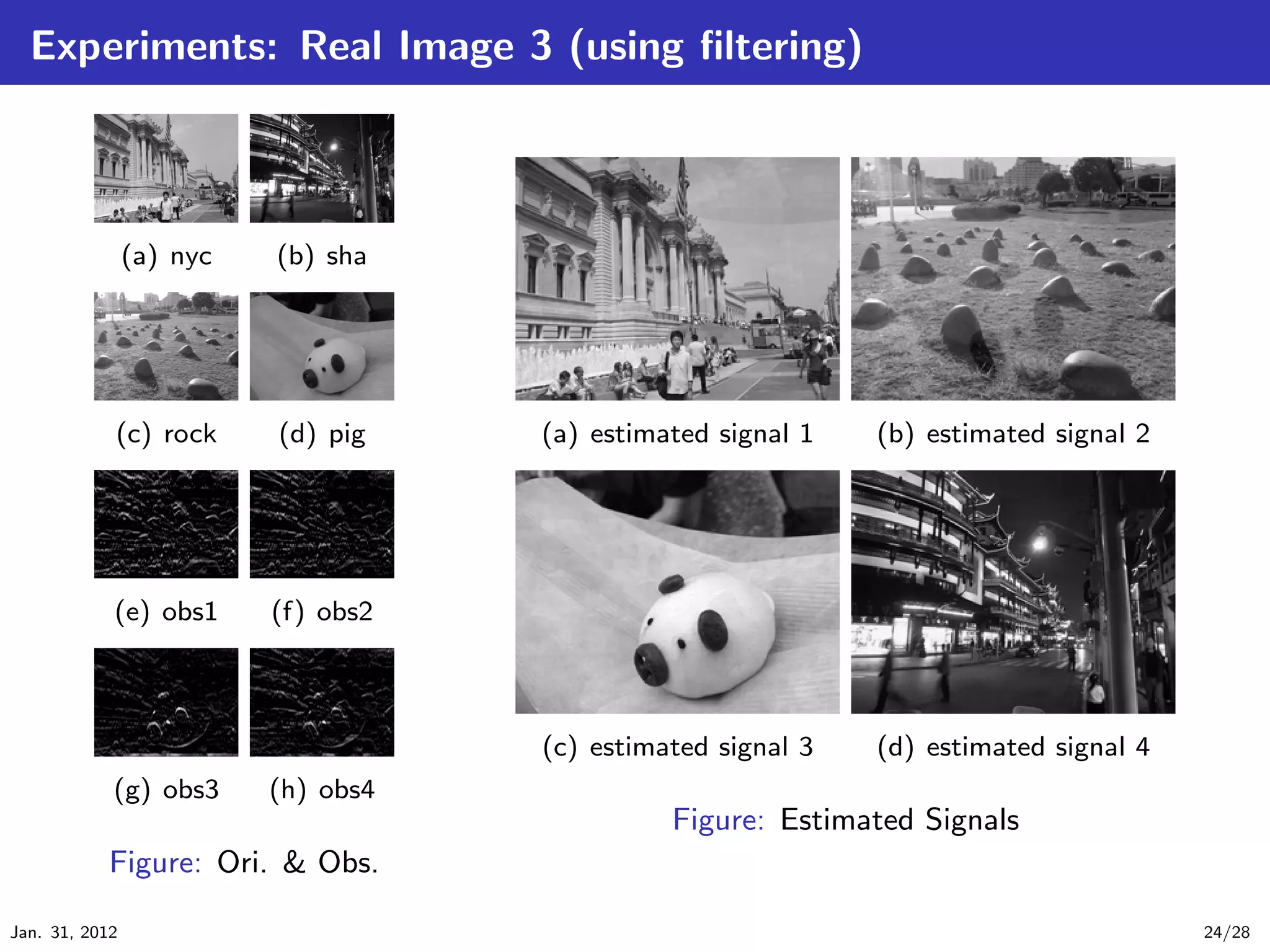
Experiments: Real Image 3 (using filtering)


                (a) nyc   (b) sha


            (c) rock      (d) pig    (a) estimated signal 1   (b) estimated signal 2


            (e) obs1      (f) obs2


                                     (c) estimated signal 3   (d) estimated signal 4
            (g) obs3      (h) obs4
                                               Figure: Estimated Signals
           Figure: Ori. & Obs.

Jan. 31, 2012                                                                          24/28
Approaches of ICA


   In this research area, many method for ICA are studied and proposed as follow:
     .
     .. Criteria of ICA [Hyv¨rinen et al., 2001]
     1                      a
                Non-Gaussianity based ICA*
                     Kurtosis based ICA*
                     Neg-entropy based ICA*
                MLE based ICA
                Mutual information based ICA
                Non-linear ICA
                Tensor ICA
     ...
      2    Solving Algorithm for ICA
                gradient method*
                fast fixed-point algorithm* [Hyv¨rinen and Oja, 1997]
                                               a

                                                                 (‘*’ were introduced today.)


Jan. 31, 2012                                                                             25/28
Summary


           I introduced about BSS problem and basic ICA techniques (Kurtosis,
           Neg-entropy).
           Kurtosis is weak with outliers.
           Neg-entropy is proposed as a robust measure of Non-Gaussianity.
           I conducted experiments of ICA using Image data.
           In some case, worse results are obtained.
           But I solved this issue by using differential filter.
           This technique is proposed in [Hyv¨rinen, 1998].
                                               a
           We knew that the differential filter is very effective for ICA.


Jan. 31, 2012                                                                   26/28
Bibliography I


   [Hyv¨rinen, 1998] Hyv¨rinen, A. (1998).
       a                a
     Independent component analysis for time-dependent stochastic processes.
   [Hyv¨rinen et al., 2001] Hyv¨rinen, A., Karhunen, J., and Oja, E. (2001).
       a                       a
     Independent Component Analysis.
     Wiley.
   [Hyv¨rinen and Oja, 1997] Hyv¨rinen, A. and Oja, E. (1997).
       a                         a
     A fast fixed-point algorithm for independent component analysis.
     Neural Computation, 9:1483–1492.


Jan. 31, 2012                                                                  27/28
Thank you for listening


Jan. 31, 2012                28/28

Independent Component Analysis

  • 1.
    . . Independent Component Analysis for Blind Source Separation . .. . . Tatsuya Yokota Tokyo Institute of Technology Jan. 31, 2012 Jan. 31, 2012 1/28
  • 2.
    Outline . . . Blind Source Separation 1 . . . Independent Component Analysis 2 . . . Experiments 3 . . . Summary 4 Jan. 31, 2012 2/28
  • 3.
    What’s a BlindSource Separation Blind Source Separation is a method to estimate original signals from observed signals which consist of mixed original signals and noise. Jan. 31, 2012 3/28
  • 4.
    Example of BSS BSS is often used for Speech analysis and Image analysis. Jan. 31, 2012 4/28
  • 5.
    Example of BSS(cont’d) BSS is also very important for brain signal analysis. Jan. 31, 2012 5/28
  • 6.
    Model Formalization The problem of BSS is formalized as follow: The matrix X ∈ Rm×d (1) denotes original signals, where m is number of original signals, and d is dimension of one signal. We consider that the observed signals Y ∈ Rn×d are given by linear mixing system as Y = AX + E, (2) where A ∈ Rn×m is the unknown mixing matrix and E ∈ Rn×d denotes a noise. Basically, n ≥ m. ˆ ˆ ˆ The goal of BSS is to estimate A and X so that X provides unknown original signal as possible. Jan. 31, 2012 6/28
  • 7.
    Kinds of BSSMethods Actually, degree of freedom of BSS model is very high to estimate A and X. Because there are a huge number of combinations (A, X) which satisfy Y = AX + E. Therefore, we need some constraint to solve the BSS problem such as: PCA : orthogonal constraint SCA : sparsity constraint NMF : non-negativity constraint ICA : in-dependency constraint In this way, there are many methods to solve the BSS problem depending on the constraints. What we use is depend on subject matter. The Non-negative Matrix Factorization(NMF) was introduced in my previous seminar. We can get its solution by the alternating least squares algorithm. Today, I will introduce another method the Independent Component Analysis. Jan. 31, 2012 7/28
  • 8.
    Independent Component Analysis . The Cocktail Party Problem . .. x1 (t) = a11 s1 (t) + a12 s2 (t) + a13 s3 (t) (3) x2 (t) = a21 s1 (t) + a22 s2 (t) + a23 s3 (t) (4) . x3 (t) = a31 s1 (t) + a32 s2 (t) + a33 s3 (t) (5) .. . . x is an observed signal, and s is an original signal. We assume that {s1 , s2 , s3 } are statistically independent of each other. . The model of ICA . .. Independent Component Analysis (ICA) is to estimate the independent components s(t) from x(t). . x(t) = As(t) (6) .. . . Jan. 31, 2012 8/28
  • 9.
    Approach . Hypothesis of ICA . .. ... {si } are statistically independent of each other, 1 p(s1 , s2 , . . . , sn ) = p(s1 )p(s2 ) · · · p(sn ). (7) ... 2 {si } follow the Non-Gaussian distribution. If {si } follows the Gaussian distribution, then ICA is impossible. ... A is a regular matrix. 3 Therefore, we can rewrite the model as s(t) = Bx(t), (8) where B = A−1 . It is only necessary to estimate B so that {si } are . independent. .. . . Jan. 31, 2012 9/28
  • 10.
    Whitening and ICA . Definition of White signal . .. White signals are defined as any z which satisfies conditions of . E[z] = 0, E[zz T ] = I. (9) .. . . First, we show an example of original independent signals and observed signal as follow: (a) source (s1 , s2 ) (b) observed (x1 , x2 ) Observed signals x(t) are given by x(t) = As(t). ICA give us the original signals s(t) by s(t) = Bx(t). Jan. 31, 2012 10/28
  • 11.
    Whitening and ICA(cont’d) Whitening is useful for preprocessing of ICA. First, we apply the whitening to observed signals x(t). (c) observed (x1 , x2 ) (d) whitening (z1 , z2 ) The whitening signals are denoted as (z1 , z2 ), and they are given by z(t) = V x(t), (10) where V is a whitening matrix for x. Model becomes s(t) = U z(t) = U V x(t) = Bx(t), (11) and U is an orthogonal transform matrix. We can say that the whitening simplifies the ICA problem. So it is only necessary to estimate U . Jan. 31, 2012 11/28
  • 12.
    Non-Gaussianity and ICA Non-Gaussianity is a measure of in-dependency. According to the central limit theorem, the Gaussianity of x(t) must be larger than s(t). Now, we put bT as mixing vector, si (t) = bT x(t). We want to maximize the i ˆ i Non-Gaussianity of (bT x(t)). Then such b is a part of solution B. i For example, there are following two vector b and b. We can say that b is better than b . Jan. 31, 2012 12/28
  • 13.
    Maximization of Kurtosis Kurtosis is a measures of Non-Gaussianity. Kurtosis is defined by kurt(y) = E[y 4 ] − 3(E[y 2 ])2 . (12) We assume that y is white (i.e. E[y] = 0, E[y 2 ] = 1 ), then kurt(y) = E[y 4 ] − 3. (13) We can solve the ICA problem by ˆ b = max |kurt(bT x(t))|. (14) b Jan. 31, 2012 13/28
  • 14.
    Fast ICA algorithmbased on Kurtosis We consider z is a white signal given from x. And we consider to maximize the absolute value of kurtosis as maximize |kurt(wT z)|, s.t. wT w = 1. (15) Differential of |kurt(wT z)| is given by ∂|kurt(wT z)| ∂ = E{(wT z)4 } − 3E{(wT z)2 }2 (16) ∂w ∂w ∂ = E{(wT z)4 } − 3{||w||2 }2 (because E(zz T ) = I) (17) ∂w = 4sign[kurt(wT z)] E{z(wT z)3 } − 3w||w||2 (18) Jan. 31, 2012 14/28
  • 15.
    Fast ICA algorithmbased on Kurtosis (cont’d) According to the gradient method, we can obtain following algorithm: . Gradient algorithm based on Kurtosis . .. w ← w + ∆w, (19) w w← , (20) ||w|| . ∆w ∝ sign[kurt(wT z)] E{z(wT z)3 } − 3w . (21) .. . . We can see that above algorithm converge when w ∝ ∆w. And w and −w are equivalent solution, so we can obtain another algorithm: . Fast ICA algorithm based on Kurtosis . .. w ← E{z(wT z)3 } − 3w, (22) w w← . (23) . ||w|| .. . . It is well known as a fast convergence algorithm for ICA !! Jan. 31, 2012 15/28
  • 16.
    Example 3 4 2 2 1 0 0 -1 -2 -2 -4 -3-3 -2 -1 0 1 2 3 -4 -2 0 2 4 (a) subgaussian (b) supergaussian Figure: Example of ICA Jan. 31, 2012 16/28
  • 17.
    Issue of Kurtosis Kurtosis has a fatal issue that it is very weak with the outliers. Because Kurtosis is a fourth order function. Following figure depicts the result of kurtosis based ICA with outlier. The rates of outliers is only 2 %. 4 3 2 1 0 -1 -2 -3 -4-4 -3 -2 -1 0 1 2 3 4 Figure: With outliers (20 : 1000) Jan. 31, 2012 17/28
  • 18.
    Neg-entropy based ICA Kurtosis is very weak with outliers. Hence, the Neg-entropy is often used for ICA. In strictly, the approximation of neg-entropy is often used, because it is robust for outliers. Neg-entropy is defined by J(y) = H(yGauss ) − H(y), (24) where H(y) = − py (η) log py (η)dη, (25) and yGauss is a Gaussian distribution of µ = E(y) and σ = E((y − µ)2 ). If y follows Gaussian distribution, then J(y) = 0. Jan. 31, 2012 18/28
  • 19.
    Fast ICA algorithmbased on Neg-entropy The approximation procedure of neg-entropy is complex, then it is omitted here. We just introduce the fast ICA algorithm based on neg-entropy: . Fast ICA algorithm based on Neg-entropy . .. w ← E[zg(wT z)] − E[g (wT z)]w (26) w w← (27) . ||w|| .. . . where we can select functions g and g from . .. g1 (y) = tanh(a1 y) and g1 (y) = a1 (1 − tanh2 (a1 y)), 1 . .. g2 (y) = y exp(−y 2 /2) and g (y) = (1 − y 2 ) exp(−y 2 /2), 2 2 ... 3 g3 (y) = y 3 and g3 (y) = 3y 2 . 1 ≤ a1 ≤ 2. Please note that (g3 , g3 ) is equivalent to Kurtosis based ICA. Jan. 31, 2012 19/28
  • 20.
    Examples We can see that neg-entropy based ICA is robust for outliers. 4 4 3 3 2 2 1 1 0 0 -1 -1 -2 -2 -3 -3 -4-4 -3 -2 -1 0 1 2 3 4 -4-4 -3 -2 -1 0 1 2 3 4 (a) Kurtosis based (b) Neg-entropy based (using g1 ) Figure: With outliers (20 : 1000) Jan. 31, 2012 20/28
  • 21.
    Experiments: Real Image1 (a) ob 1 (b) ob 2 (a) newyork (a) estimated signal 1 Figure: Observed Signals (b) shanghai (b) estimated signal 2 Figure: Original Signals Figure: Estimated Signals Jan. 31, 2012 21/28
  • 22.
    Experiments: Real Image2 (a) ob 1 (b) ob 2 (a) buta (a) estimated signal 1 Figure: Observed Signals (b) kobe (b) estimated signal 2 Figure: Original Signals Figure: Estimated Signals Jan. 31, 2012 22/28
  • 23.
    Experiments: Real Image2 (using filtering) (a) ob 1 (b) ob 2 (a) buta (a) estimated signal 1 Figure: Observed Signals (b) kobe (b) estimated signal 2 Figure: Original Signals Figure: Estimated Signals Jan. 31, 2012 23/28
  • 24.
    Experiments: Real Image3 (using filtering) (a) nyc (b) sha (c) rock (d) pig (a) estimated signal 1 (b) estimated signal 2 (e) obs1 (f) obs2 (c) estimated signal 3 (d) estimated signal 4 (g) obs3 (h) obs4 Figure: Estimated Signals Figure: Ori. & Obs. Jan. 31, 2012 24/28
  • 25.
    Approaches of ICA In this research area, many method for ICA are studied and proposed as follow: . .. Criteria of ICA [Hyv¨rinen et al., 2001] 1 a Non-Gaussianity based ICA* Kurtosis based ICA* Neg-entropy based ICA* MLE based ICA Mutual information based ICA Non-linear ICA Tensor ICA ... 2 Solving Algorithm for ICA gradient method* fast fixed-point algorithm* [Hyv¨rinen and Oja, 1997] a (‘*’ were introduced today.) Jan. 31, 2012 25/28
  • 26.
    Summary I introduced about BSS problem and basic ICA techniques (Kurtosis, Neg-entropy). Kurtosis is weak with outliers. Neg-entropy is proposed as a robust measure of Non-Gaussianity. I conducted experiments of ICA using Image data. In some case, worse results are obtained. But I solved this issue by using differential filter. This technique is proposed in [Hyv¨rinen, 1998]. a We knew that the differential filter is very effective for ICA. Jan. 31, 2012 26/28
  • 27.
    Bibliography I [Hyv¨rinen, 1998] Hyv¨rinen, A. (1998). a a Independent component analysis for time-dependent stochastic processes. [Hyv¨rinen et al., 2001] Hyv¨rinen, A., Karhunen, J., and Oja, E. (2001). a a Independent Component Analysis. Wiley. [Hyv¨rinen and Oja, 1997] Hyv¨rinen, A. and Oja, E. (1997). a a A fast fixed-point algorithm for independent component analysis. Neural Computation, 9:1483–1492. Jan. 31, 2012 27/28
  • 28.
    Thank you forlistening Jan. 31, 2012 28/28