Demographic Transition Theory
and
Optimum Population
By- Pranjal Prateek
Avionics,
SC12B104,
Roll-31
Demography
• The general science of studying human population.
• It is the statistics of the population that is subjected to
change in accordance with aging, birth, death, migration etc.
• The demography of any place helps to gather information
about the population, religion, language and ethnicity of
that place.
• Demography can be understood through census. Census
2011 -7th Census operation post India's Independence and
15th in total since; it began in the year 1981
Demographic Transition theory
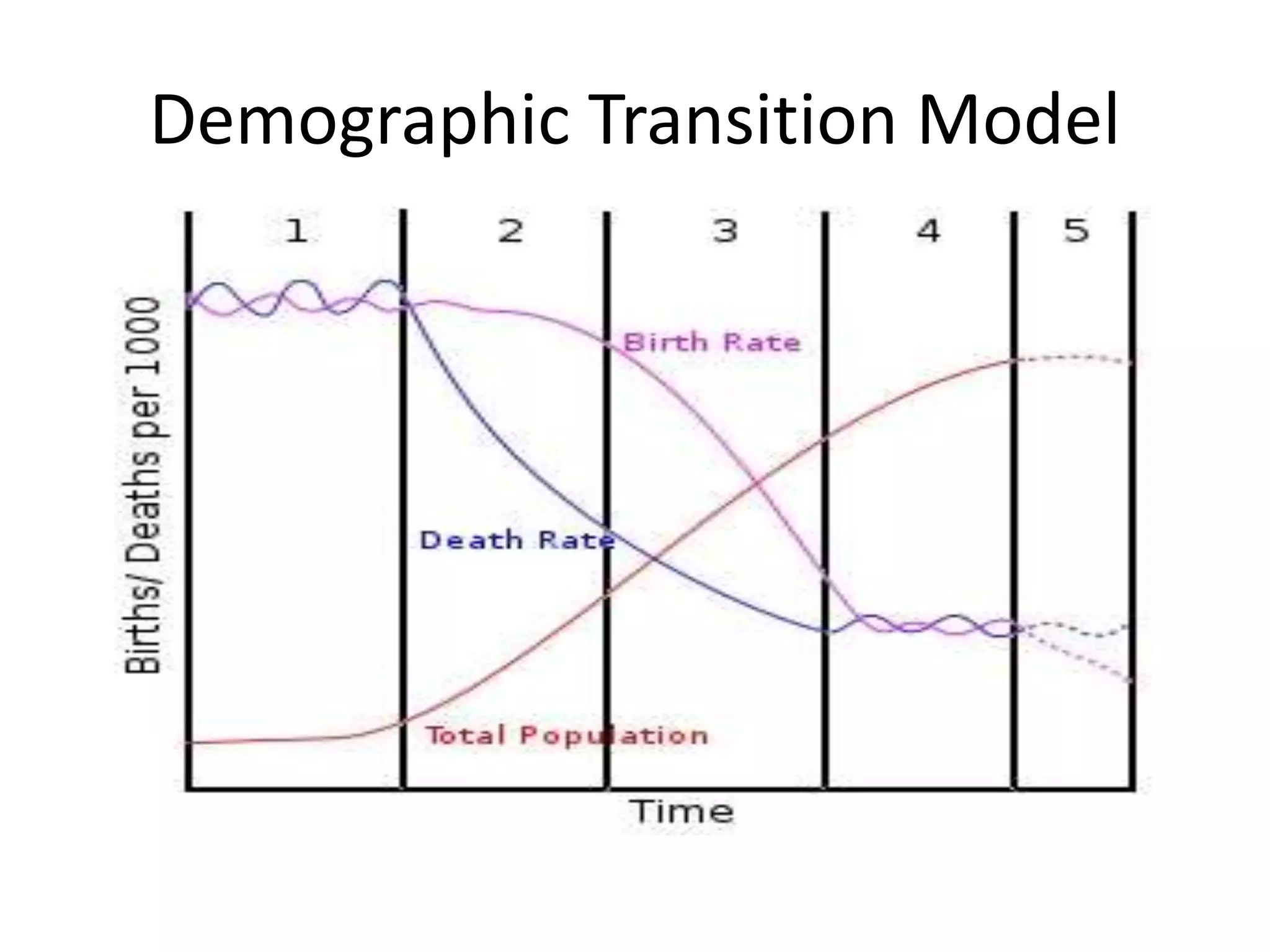
• Demographic transition (DT) refers to the
transition from high birth and death rates to low
birth and death rates as a country develops from
a pre-industrial to an industrialized economic
system.
• This is typically demonstrated through
a demographic transition model (DTM). The
theory is based on an interpretation
of demographic history developed in 1929 by the
American demographer Warren Thompson
(1887–1973).
Demographic Transition Model
India vs China
• China’s population growth is only 0.7% per year (India with
1.6 billion, will surpass China with respect to population
size in 2050).
• India had 66% higher income per capita than China in 1980,
but by the early 1990s China overtook India.
• In 2008, the situation was reversed, with income per capita
in China double that of India.
• This income crossover is due to very different demographic
trajectories of China and India.
• China’s campaign of “later, longer, fewer” and its one-child
policy (beginning in 1979) led to a decline in fertility.
India vs China
Indian Demography
• India’s 65 and over population currently
represents only one-fourth the number of its
adolescents and young adults.
• It will not outnumber the younger group for
nearly four decades.
• Fertility decline and rising longevity will rise the
working-age share creating higher growth rates in
India over the next 30 years
Indian Demography
Nurturing the Demographic dividend
• Policies to meet the education and training needs of India’s
youth can ease the process of caring for growing numbers of
older Indians in the future.
• Behavioural and policy responses to population aging –
including higher labour force participation of women, higher
savings for retirement, and later age of retirement – suggest
that population aging will not necessarily significantly impede
economic growth.
• If India adopts policies that allow the working-age population
to be productively employed, India may receive a demographic
dividend of roughly 1% point growth in GDP, compounded
year by year.
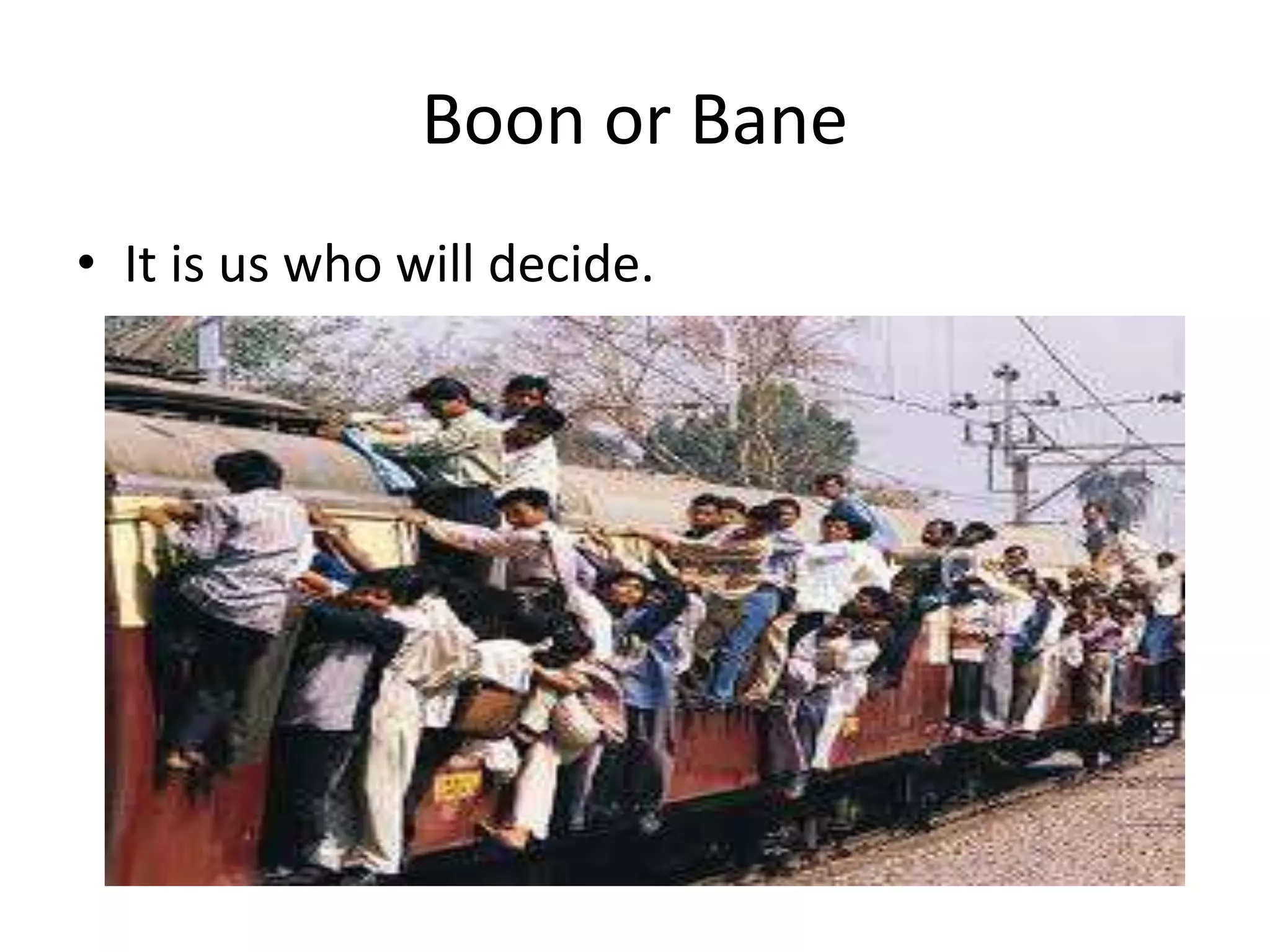
Boon or Bane
• It is us who will decide.
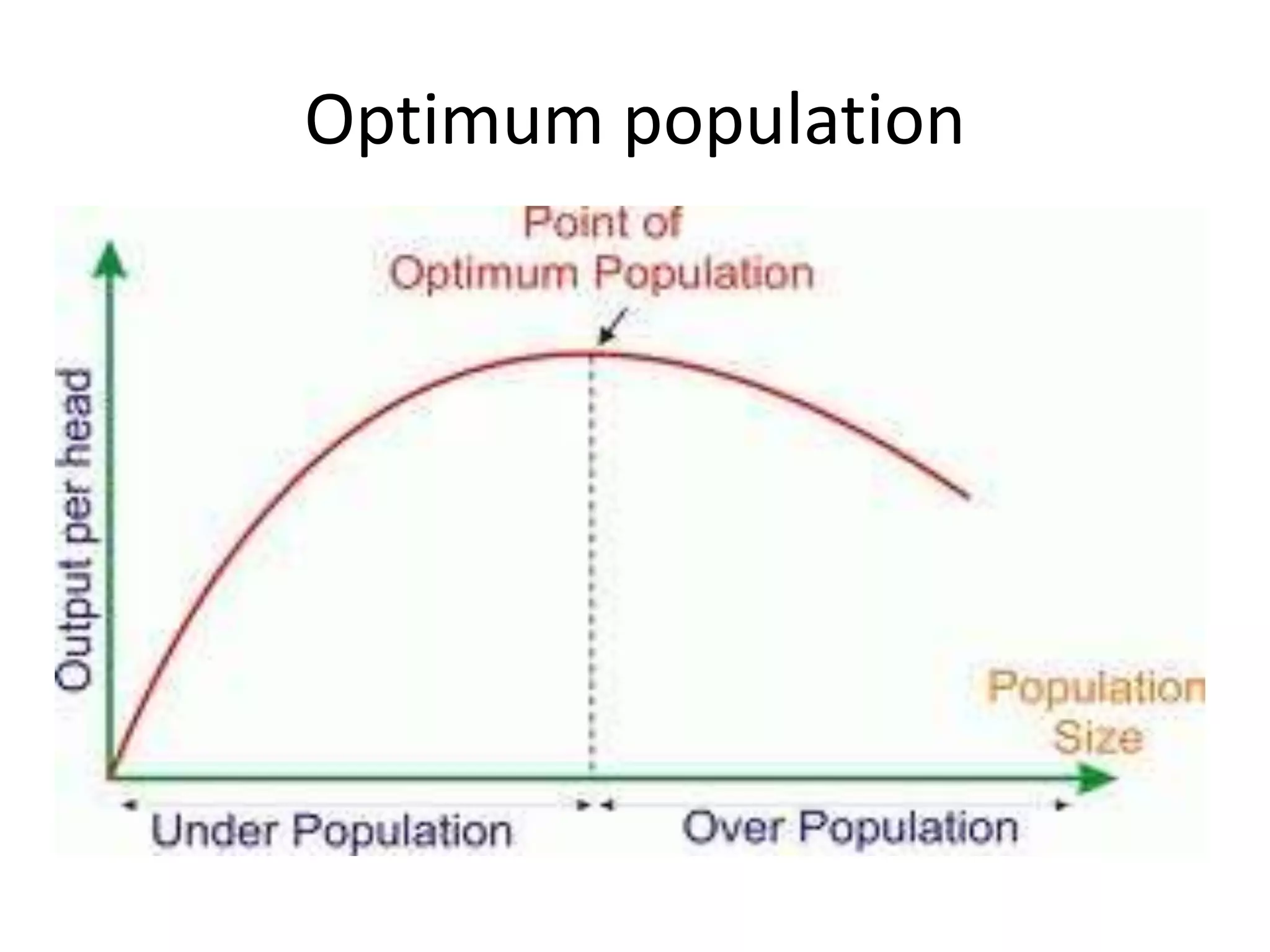
Optimum Population
• The optimum population is the size of
a population that is the best out of several
outcomes.
• Estimations usually take
ecological sustainability and carrying
capacity more or less into account. Also,
optimum population can refer to a specific
area, such as a region or country, but can also
refer to the entire world or universe.
Optimum population
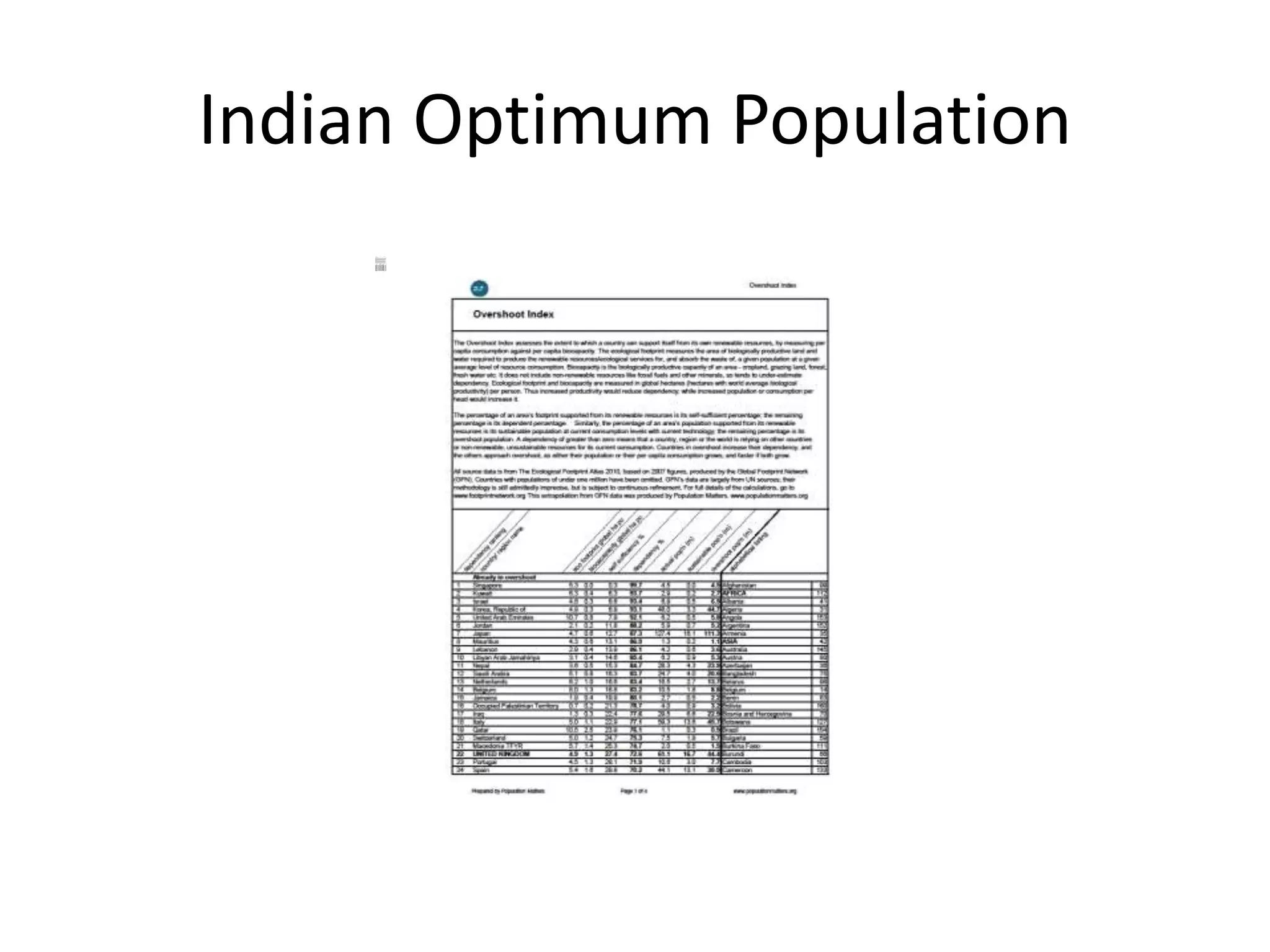
Indian Optimum Population
Hope you enjoyed it…
Thank you for your patient
hearing..

Demographic transition theory and Optimum Population

  • 1.
    Demographic Transition Theory and OptimumPopulation By- Pranjal Prateek Avionics, SC12B104, Roll-31
  • 2.
    Demography • The generalscience of studying human population. • It is the statistics of the population that is subjected to change in accordance with aging, birth, death, migration etc. • The demography of any place helps to gather information about the population, religion, language and ethnicity of that place. • Demography can be understood through census. Census 2011 -7th Census operation post India's Independence and 15th in total since; it began in the year 1981
  • 3.
    Demographic Transition theory •Demographic transition (DT) refers to the transition from high birth and death rates to low birth and death rates as a country develops from a pre-industrial to an industrialized economic system. • This is typically demonstrated through a demographic transition model (DTM). The theory is based on an interpretation of demographic history developed in 1929 by the American demographer Warren Thompson (1887–1973).
  • 4.
  • 5.
    India vs China •China’s population growth is only 0.7% per year (India with 1.6 billion, will surpass China with respect to population size in 2050). • India had 66% higher income per capita than China in 1980, but by the early 1990s China overtook India. • In 2008, the situation was reversed, with income per capita in China double that of India. • This income crossover is due to very different demographic trajectories of China and India. • China’s campaign of “later, longer, fewer” and its one-child policy (beginning in 1979) led to a decline in fertility.
  • 6.
  • 7.
    Indian Demography • India’s65 and over population currently represents only one-fourth the number of its adolescents and young adults. • It will not outnumber the younger group for nearly four decades. • Fertility decline and rising longevity will rise the working-age share creating higher growth rates in India over the next 30 years
  • 8.
  • 9.
    Nurturing the Demographicdividend • Policies to meet the education and training needs of India’s youth can ease the process of caring for growing numbers of older Indians in the future. • Behavioural and policy responses to population aging – including higher labour force participation of women, higher savings for retirement, and later age of retirement – suggest that population aging will not necessarily significantly impede economic growth. • If India adopts policies that allow the working-age population to be productively employed, India may receive a demographic dividend of roughly 1% point growth in GDP, compounded year by year.
  • 10.
    Boon or Bane •It is us who will decide.
  • 11.
    Optimum Population • Theoptimum population is the size of a population that is the best out of several outcomes. • Estimations usually take ecological sustainability and carrying capacity more or less into account. Also, optimum population can refer to a specific area, such as a region or country, but can also refer to the entire world or universe.
  • 12.
  • 13.
  • 14.
    Hope you enjoyedit… Thank you for your patient hearing..