






Welcome
To Our Presentation
Harris-Todaro Migration Model and
it’s Applicability in Bangladesh
Presented To
Nishad Nasrin
Assistant Professor
Economics Discipline
Khulna University
Khulna.
Prepared By…
 Ehsun Newaz (141501)
Mohaiminul Islam (141509)
Background of Harris-Todaro Migration Model
 1960s: Rural-to-urban migration despite high levels of urban unemployment
 Failure of Explanation: General equilibrium model: Lewis Model
 1970:John R.Harris and Michael P. Todaro published their famous paper on rural-
to-urban migration; Unemployment and Development: A Two-Sector Analysis
 Harris-Todaro model try to answer the question “WHY RURAL-URBAN MIGRATION
STILL TAKING PLACE DESPITE HIGH UNEMPLOYMENT IN URBAN AREAS?”
Introduction of The Theory
 Migration; An economic Decision: migrate on the basis of wages and probability of
unemployment
 Migrants calculate (present value of) urban expected income (or its equivalent) and
move if it exceeds average rural income.
 Predicts that expected incomes will be equated across rural and urban sectors
when taking into account informal sector activities .
The Intuition Behind the Model
 The urban minimum wage is set to be higher than the wage rate paid to rural
labour
 This results in a wage differential between the two sectors.
 Rural workers have an incentive to migrate to the urban areas despite of urban
unemployment, because of the potential of higher earnings in the urban sector.
 Such migration will continue as long as there is a possibility for migrants to
increase their income by moving to a city.
The Intuition Behind the Model
 Some migrants will have arranged employment before leaving the countryside.
 Others will begin searching for employment only once they have arrived at their
destination.
 Some will necessarily join the pool of urban unemployed
 Even in that case, the presence of them in the city may increase his chance of
finding urban employment there at a later date.
 This explains why there is a continuous flow of migrants observed in developing
countries despite of the high urban unemployment rates.
Continued…
Applicability Towards Bangladesh
Some key points:
 Urban wage rate is Held higher
 Wage Differential: manufacturing sector and agricultural sector
 Incentive : Higher earning potential
 Overall: they mainly considered pull factors
Applicability Towards Bangladesh…
What we see in Bangladesh:
 Urban wage rate is higher
 Wage differential exists
 Higher earning potential: A good reason
…Applicability Towards Bangladesh
BUT !!!
1. Push factors are also responsible;
Natural calamities(3.5%,2011)(River
erosion ,Flood , Storm);
political harassment
2. Marriage(38.7%)
3. Education (4.9%)
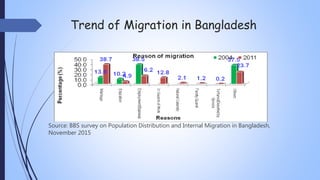
Trend of Migration in Bangladesh
Source: BBS survey on Population Distribution and Internal Migration in Bangladesh,
November 2015
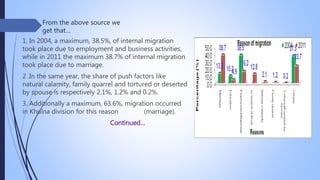
From the above source we
get that…
1. In 2004, a maximum, 38.5%, of internal migration
took place due to employment and business activities,
while in 2011 the maximum 38.7% of internal migration
took place due to marriage.
2 .In the same year, the share of push factors like
natural calamity, family quarrel and tortured or deserted
by spouse is respectively 2.1%, 1.2% and 0.2%.
3. Additionally a maximum, 63.6%, migration occurred
in Khulna division for this reason (marriage).
Continued…
Conclusion
 There is a large portion of migrants do follow Harris-Todaro model who search for
better job in terms of greater income,
 It is not 100% concrete for making migration decision in Bangladesh.
 Thus, although it can be concluded from the above evidence that the Harris-
Todaro model is likely to be applicable to most developing countries including
Bangladesh but it do not explain the migration and unemployment problem
completely.
Thank You
for Your Patience
Harris-Todaro Migration Model and it's Applicability in Bangladesh

Harris-Todaro Migration Model and it's Applicability in Bangladesh

  • 1.
  • 2.
    Harris-Todaro Migration Modeland it’s Applicability in Bangladesh
  • 3.
    Presented To Nishad Nasrin AssistantProfessor Economics Discipline Khulna University Khulna.
  • 4.
    Prepared By…  EhsunNewaz (141501) Mohaiminul Islam (141509)
  • 5.
    Background of Harris-TodaroMigration Model  1960s: Rural-to-urban migration despite high levels of urban unemployment  Failure of Explanation: General equilibrium model: Lewis Model  1970:John R.Harris and Michael P. Todaro published their famous paper on rural- to-urban migration; Unemployment and Development: A Two-Sector Analysis  Harris-Todaro model try to answer the question “WHY RURAL-URBAN MIGRATION STILL TAKING PLACE DESPITE HIGH UNEMPLOYMENT IN URBAN AREAS?”
  • 6.
    Introduction of TheTheory  Migration; An economic Decision: migrate on the basis of wages and probability of unemployment  Migrants calculate (present value of) urban expected income (or its equivalent) and move if it exceeds average rural income.  Predicts that expected incomes will be equated across rural and urban sectors when taking into account informal sector activities .
  • 7.
    The Intuition Behindthe Model  The urban minimum wage is set to be higher than the wage rate paid to rural labour  This results in a wage differential between the two sectors.  Rural workers have an incentive to migrate to the urban areas despite of urban unemployment, because of the potential of higher earnings in the urban sector.  Such migration will continue as long as there is a possibility for migrants to increase their income by moving to a city.
  • 8.
    The Intuition Behindthe Model  Some migrants will have arranged employment before leaving the countryside.  Others will begin searching for employment only once they have arrived at their destination.  Some will necessarily join the pool of urban unemployed  Even in that case, the presence of them in the city may increase his chance of finding urban employment there at a later date.  This explains why there is a continuous flow of migrants observed in developing countries despite of the high urban unemployment rates. Continued…
  • 9.
    Applicability Towards Bangladesh Somekey points:  Urban wage rate is Held higher  Wage Differential: manufacturing sector and agricultural sector  Incentive : Higher earning potential  Overall: they mainly considered pull factors
  • 10.
    Applicability Towards Bangladesh… Whatwe see in Bangladesh:  Urban wage rate is higher  Wage differential exists  Higher earning potential: A good reason
  • 11.
    …Applicability Towards Bangladesh BUT!!! 1. Push factors are also responsible; Natural calamities(3.5%,2011)(River erosion ,Flood , Storm); political harassment 2. Marriage(38.7%) 3. Education (4.9%)
  • 12.
    Trend of Migrationin Bangladesh Source: BBS survey on Population Distribution and Internal Migration in Bangladesh, November 2015
  • 13.
    From the abovesource we get that… 1. In 2004, a maximum, 38.5%, of internal migration took place due to employment and business activities, while in 2011 the maximum 38.7% of internal migration took place due to marriage. 2 .In the same year, the share of push factors like natural calamity, family quarrel and tortured or deserted by spouse is respectively 2.1%, 1.2% and 0.2%. 3. Additionally a maximum, 63.6%, migration occurred in Khulna division for this reason (marriage). Continued…
  • 14.
    Conclusion  There isa large portion of migrants do follow Harris-Todaro model who search for better job in terms of greater income,  It is not 100% concrete for making migration decision in Bangladesh.  Thus, although it can be concluded from the above evidence that the Harris- Todaro model is likely to be applicable to most developing countries including Bangladesh but it do not explain the migration and unemployment problem completely.
  • 15.

Editor's Notes

  • #6 Structural transformation The process of transforming an economy in such a way that the contribution to national income by the manufacturing sector eventually surpasses the contribution by the agricultural sector. More generally, a major alteration in the industrial composition of any economy. Lewis two-sector model A theory of development in which surplus labor from the traditional agricultural sector is transferred to the modern industrial sector, the growth of which absorbs the surplus labor, promotes industrialization, and stimulates sustained development. Surplus labor The excess supply of labor over and above the quantity demanded at the going free-market wage rate. In the Lewis two-sector model of economic development, surplus labor refers to the portion of the rural labor force whose marginal productivity is zero or negative.
  • #15 Though there is a large portion of migrants do follow Harris-Todaro model who search for better job in terms of greater income, it is not 100% concrete for making migration decision in Bangladesh. Thus, although it can be concluded from the above evidence that the Harris Todaro model is likely to be applicable to most developing countries including Bangladesh but it do not explain the migration and unemployment problem completely.