This document provides instructions on how to conduct a valid experiment. It explains that a good experiment tests one variable at a time and is fair and unbiased. It also states that a good experiment is valid by testing the hypothesis and involves repeated trials to reduce errors. It defines the three types of variables - the independent variable that is intentionally changed, the dependent variable that is observed and measured, and the controlled variables that stay the same. It provides examples of experiments and identifies the independent, dependent, and controlled variables.
A Good ExperimentTests one variable at a time. If more than one thing is tested at a time, it won’t be clear which variable caused the end result. Must be fair and unbiased . This means that the experimenter must not allow his or her opinions to influence the experiment. Does not allow any outside factors to affect the outcome of the experiment.
3.
A Good ExperimentIs valid . The experimental procedure must test your hypothesis to see if it is correct. If the procedure does not test your hypothesis, the experiment is not valid and the data will make no sense! Has repeated trials . Repeating the trials in the experiment will reduce the effect of experimental errors and give a more accurate conclusion.
4.
Variables A variableis anything in an experiment that can change or vary. It is any factor that can have an effect on the outcome of the experiment. There are three main types of variables.
5.
3 Kinds ofVariables Independent Variable (IV) – something that is intentionally changed by the scientist What is tested What is manipulated Also called a “Manipulated Variable” You can only change ONE variable in an experiment!!!
6.
3 Kinds ofVariables Independent Variable (IV) To determine the independent variable, ask yourself: “ What is being changed?” Finish this sentence… “ I will change the _____________”
7.
Independent Variable Levelsof the IV These are different ways you will change the independent variable Example: Assume you are testing five brands of popcorn to see which has the most unpopped kernels. The IV would be the different brands of popcorn. The five different brands would be the different levels of the IV.
8.
3 Kinds ofVariables Dependent Variable (DV) – something that might be affected by the change in the independent variable What is observed and measured The data collected during the investigation Also called a “Responding Variable”
9.
3 Kinds ofVariables Dependent Variable (DV) To determine the dependent variable, ask yourself: “ What will I measure and observe?” Finish this sentence… “ I will measure and observe ________________”
10.
Dependent Variable OperationalDefinition: Define exactly how the dependent variable will be measured. Example: Assume your DV in an experiment is “plant growth.” How will you measure this?! It could be… Height (cm), mass (g), # of leaves, etc. Be specific and include all necessary units!
11.
3 Kinds ofVariables Controlled Variable (CV) – a variable that is not changed and kept the same Also called constants Allows for a “fair test” NOT the same as a “control”!! Any given experiment will have many controlled variables
12.
3 Kinds ofVariables Controlled Variable (CV) To determine the controlled variables, ask yourself: “ What should not be allowed to change?” Finish this sentence… “ I will not allow the ______________ to change.”
13.
Control A groupor individual in the experiment that is not tested, but is used for comparison as a reference for what “normal” would be like. Not all experiments have a control (though all experiments have controlled variables). Example: If you tested different pollutants to see their affect on plant growth, the control would only receive water.
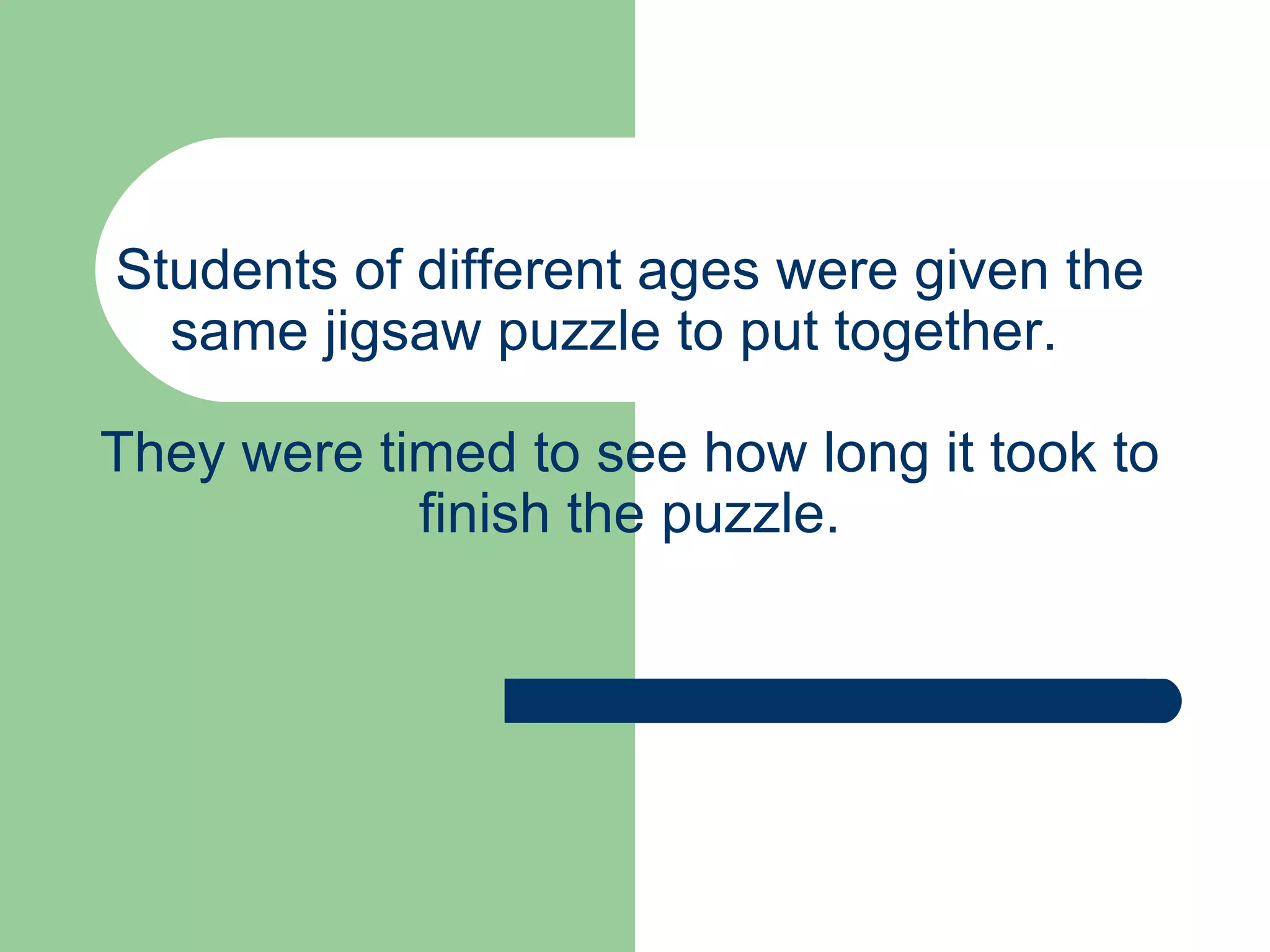
What was theindependent variable? Ages of the students Different ages were tested by the scientist
18.
What was thedependent variable? The time it to put the puzzle together The time was observed and measured by the scientist
19.
What was acontrolled variable? Same puzzle All of the participants were tested with the same puzzle. It would not have been a fair test if some had an easy 30 piece puzzle and some had a harder 500 piece puzzle.
An investigation wasdone with an electromagnetic system made from a battery and wire wrapped around a nail. Different sizes of nails were used. The number of paper clips the electromagnet could pick up was measured.
Independent variable: Sizesof nails These were changed by the scientist. They used different sizes of nails in their experiment to see what effect that would have.
24.
Dependent variable: Numberof paper clips picked up The number of paper clips were observed and counted (measured)
25.
Controlled variables: Battery,wire, type of nail None of these items were changed They had used the same battery, same wire, and same type of nail. Changing any of these things would have made it an unfair test.
Students modified paperairplanes by cutting pieces off, adding tape, or adding paper clips to increase the distance thrown.
31.
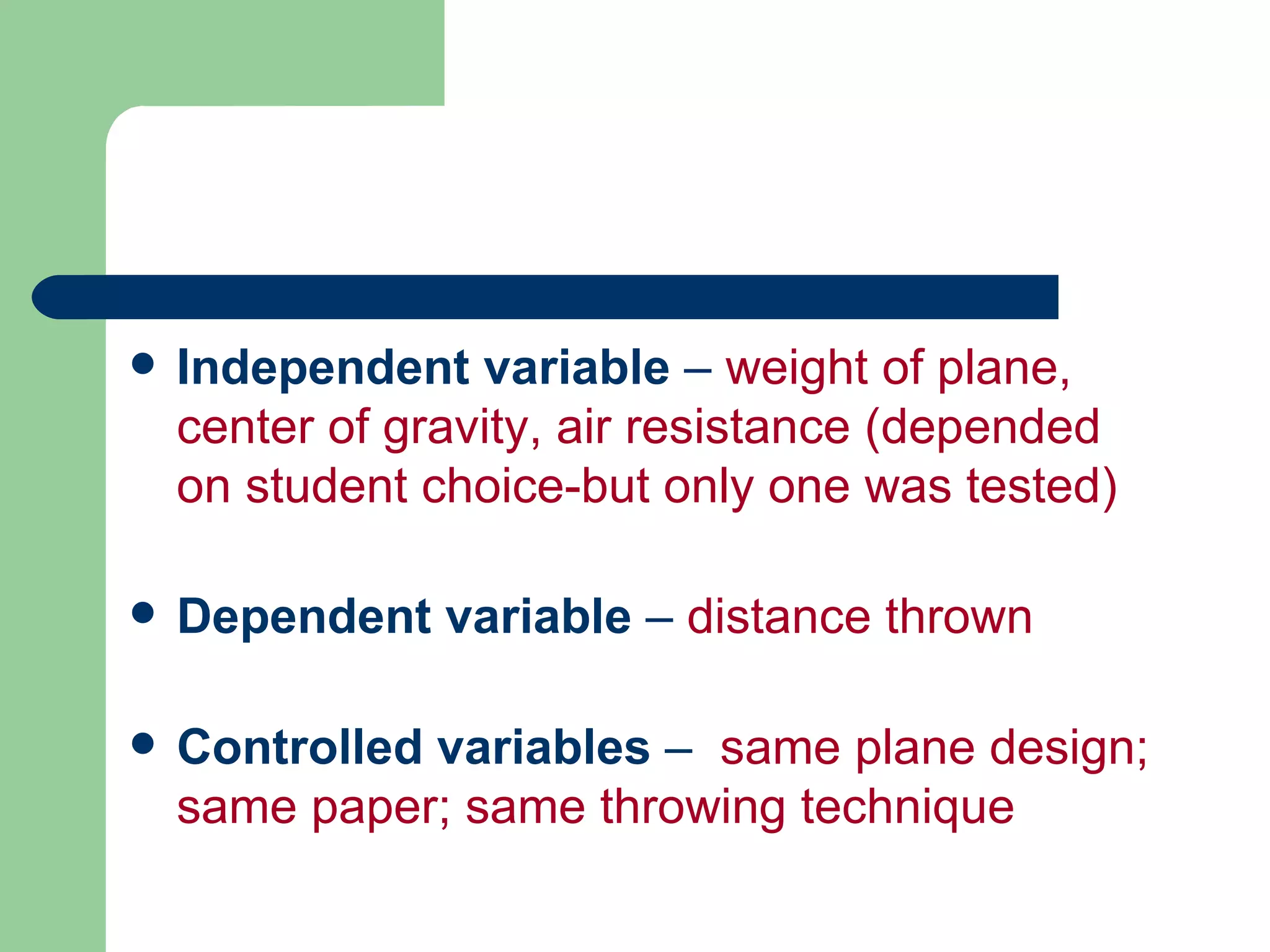
Independent variable – weight of plane, center of gravity, air resistance (depended on student choice-but only one was tested) Dependent variable – distance thrown Controlled variables – same plane design; same paper; same throwing technique
32.
Now let’s takewhat we know about these variables and use them in an experiment!
33.
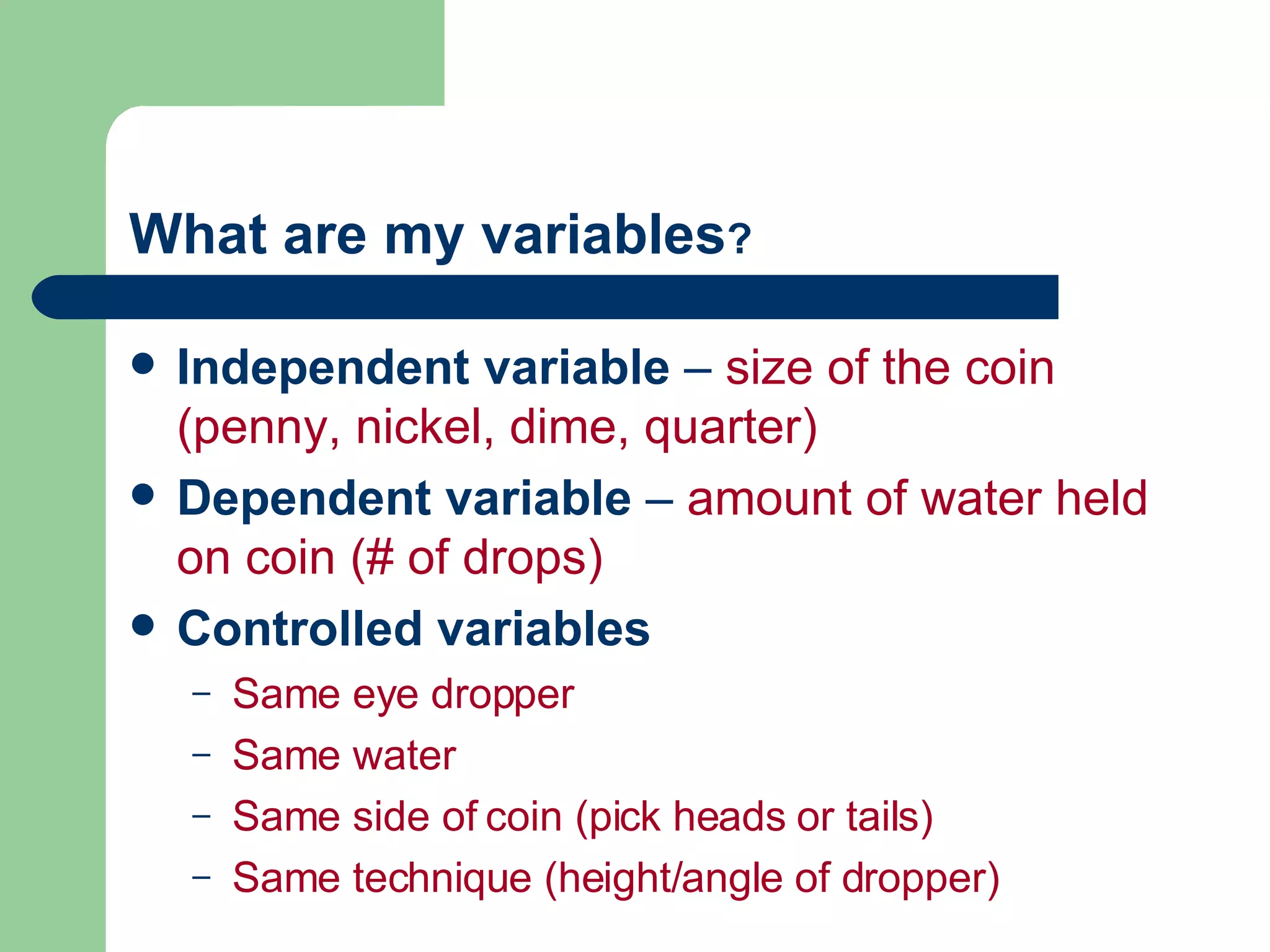
We are goingto test how many drops of water will fit on different sized coins. Let’s think about how we could test this. Identify the variables What exactly will be changed? How will it be changed? What exactly will be measured? How will it be measured?
34.
Independent variable – size of the coin (penny, nickel, dime, quarter) Dependent variable – amount of water held on coin (# of drops) Controlled variables Same eye dropper Same water Same side of coin (pick heads or tails) Same technique (height/angle of dropper) What are my variables ?