SCIENTIFIC
VARIABLES
Variables
•“A variable is any quantity that
varies. Any attribute, phenomenon
or event that can have different
values”
•A variable is simply any collected
information
Variables
•Any piece of information that
varies or takes different values or
form
•A constant is a characteristic with
no variations within a class of
objects (i.e., grade level of ninth
graders).
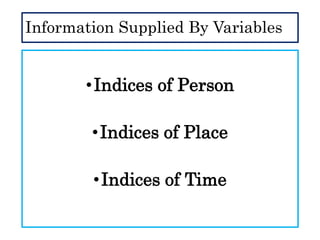
Information Supplied By Variables
•Indices of Person
•Indices of Place
•Indices of Time
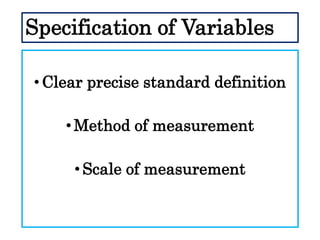
Specification of Variables
•Clear precise standard definition
• Method of measurement
•Scale of measurement
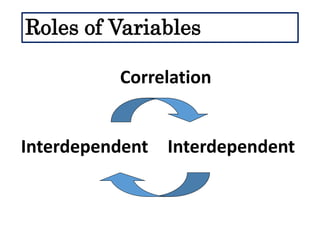
Roles of Variables
Interdependent
Correlation
Interdependent
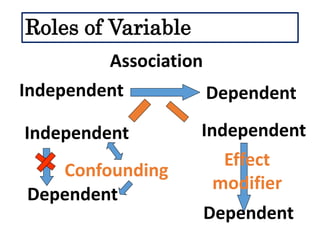
Roles of Variable
Independent Dependent
Independent
Dependent
Confounding
Independent
Dependent
Effect
modifier
Association
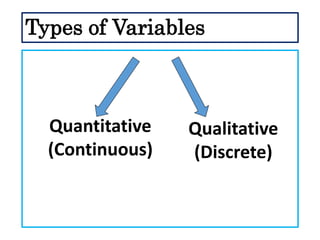
Types of Variables
Quantitative
(Continuous)
Qualitative
(Discrete)
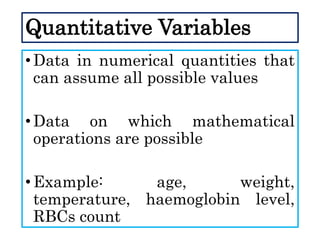
Quantitative Variables
•Data in numerical quantities that
can assume all possible values
•Data on which mathematical
operations are possible
•Example: age, weight,
temperature, haemoglobin level,
RBCs count
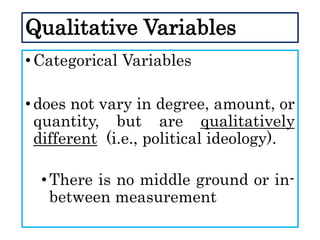
Qualitative Variables
•Categorical Variables
•does not vary in degree, amount, or
quantity, but are qualitatively
different (i.e., political ideology).
•There is no middle ground or in-
between measurement
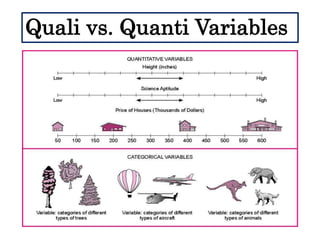
Quali vs. Quanti Variables
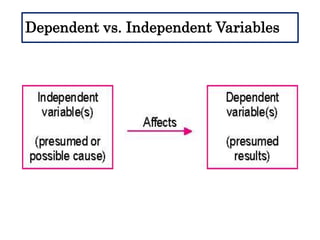
Dependent vs. Independent Variables
• The independent variable is what the
researcher studies to see its
relationship or effects.
• Presumed or possible cause
• The dependent variable is what is
being influenced or affected by the
independent variable
• Presumed results
Independent Variables
•something that is changed by the
scientist
•What is tested
•What is manipulated
Independent Variables
• A manipulated variable is a
changed condition the researcher
creates during a study, also known
as an experimental or treatment
variable
• A selected variable is an
independent variable that already
exists
Constant Variables
•a variable that is not changed
•Also called constants
•Allow for a “fair test”
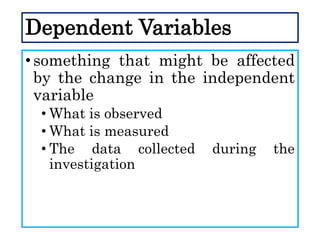
Dependent Variables
•something that might be affected
by the change in the independent
variable
• What is observed
• What is measured
• The data collected during the
investigation
Dependent vs. Independent Variables
For Examples:
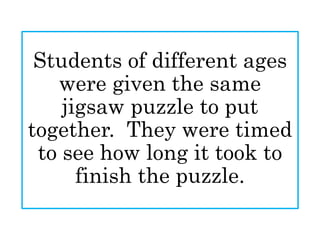
Students of different ages
were given the same
jigsaw puzzle to put
together. They were timed
to see how long it took to
finish the puzzle.
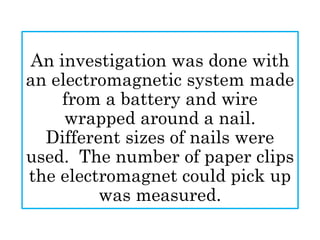
An investigation was done with
an electromagnetic system made
from a battery and wire
wrapped around a nail.
Different sizes of nails were
used. The number of paper clips
the electromagnet could pick up
was measured.
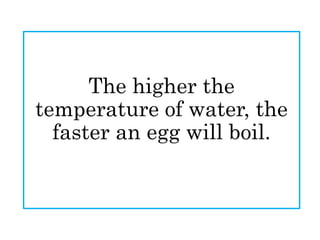
The higher the
temperature of water, the
faster an egg will boil.
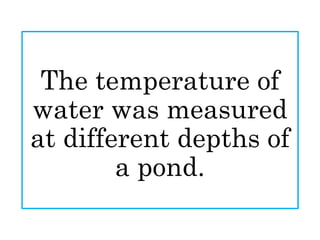
The temperature of
water was measured
at different depths of
a pond.
End of Presentation!

VARIABLES.pptx