Agitation And Mixing
Agitation and Mixing
 Many operations depend upon effective agitation and mixing of
components
 Agitation: induced motion of a material
 Mixing: random distribution of two initially separate phases
 A single homogeneous material such as water in a tank can be agitated but
not mixed until another material is added to tank
Agitation and mixing
 agitation is a means whereby mixing of phases can be accomplished and by
which mass and heat transfer can be enhanced between phases or with
external surfaces
 Mixing is concerned with all combinations of phases of which the most
frequently occurring ones are
1. GASES WITH GASES
2. GASES INTO LIQUIDS: DISPERSION.
3. GASES WITH GRANULAR SOLIDS: FLUIDIZATION, PNEUMATIC
CONVEYING; DRYING
4. LIQUIDS INTO GASES: SPRAYING.
5. LIQUIDS WITH LIQUIDS: DISSOLUTION, EMULSIFICATION, DISPERSION
6. LIQUIDS WITH GRANULAR SOLIDS: SUSPENSION.
7. PASTES WITH EACH OTHER AND WITH SOLIDS.
8. SOLIDS WITH SOLIDS: MIXING OF POWDERS.
Agitation and Mixing
 interaction of gases, liquids, and solids also may take place
 Example: hydrogenation of liquids in the presence of a slurred solid catalyst
where the gas must be dispersed as bubbles and the solid particles must be
kept in suspension
Purpose of Agitation
 Suspending solid particles in a liquid
 Blending miscible liquids e.g. methanol-water
 Dispersing a gas through a liquid in the form of small bubbles
 Dispersing a second liquid, immiscible with first to form an emulsion or
suspension of fine drops
 Promoting heat transfer between liquid and a coil or jacket.
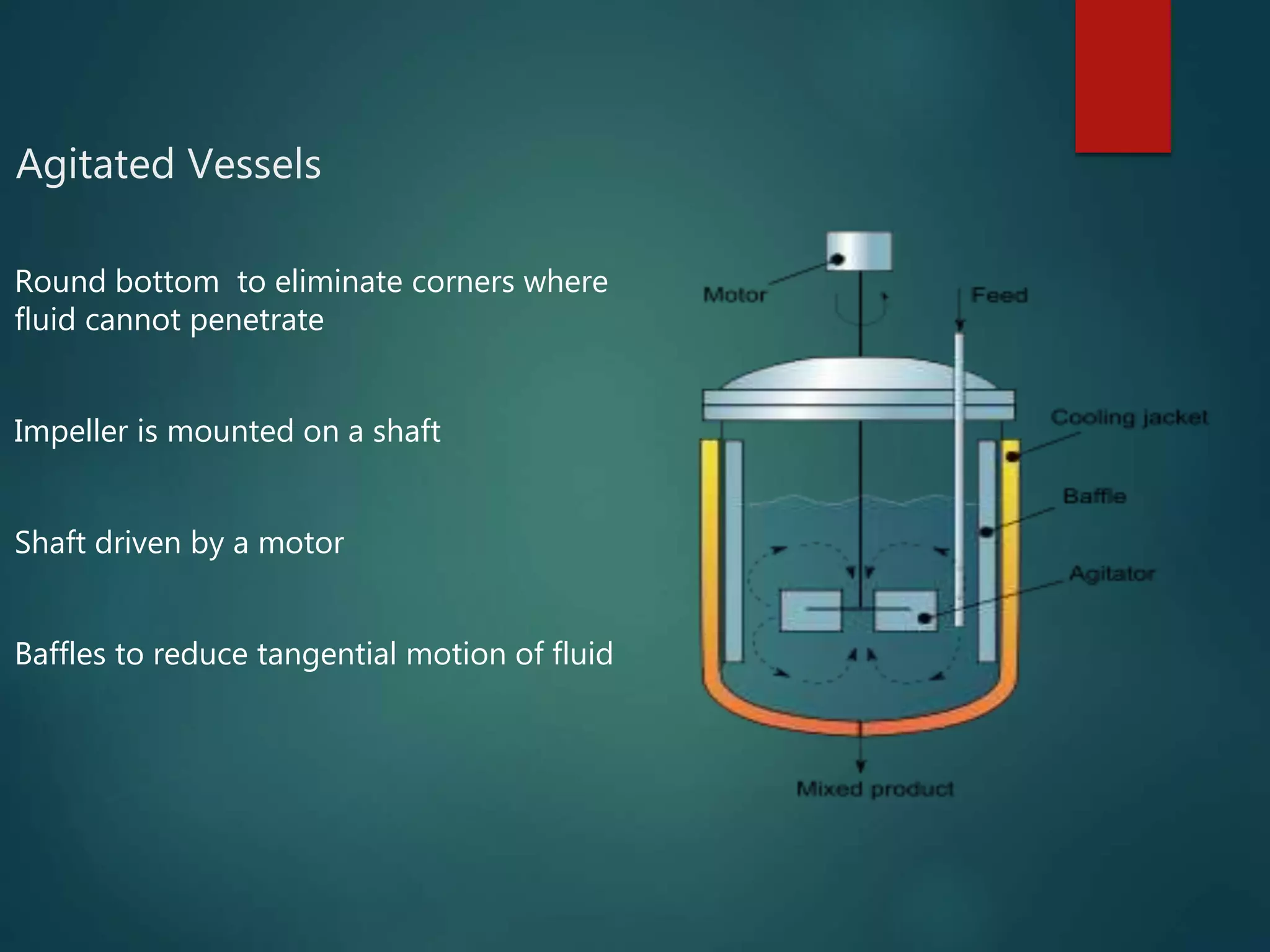
Agitated Vessels
Round bottom to eliminate corners where
fluid cannot penetrate
Impeller is mounted on a shaft
Shaft driven by a motor
Baffles to reduce tangential motion of fluid
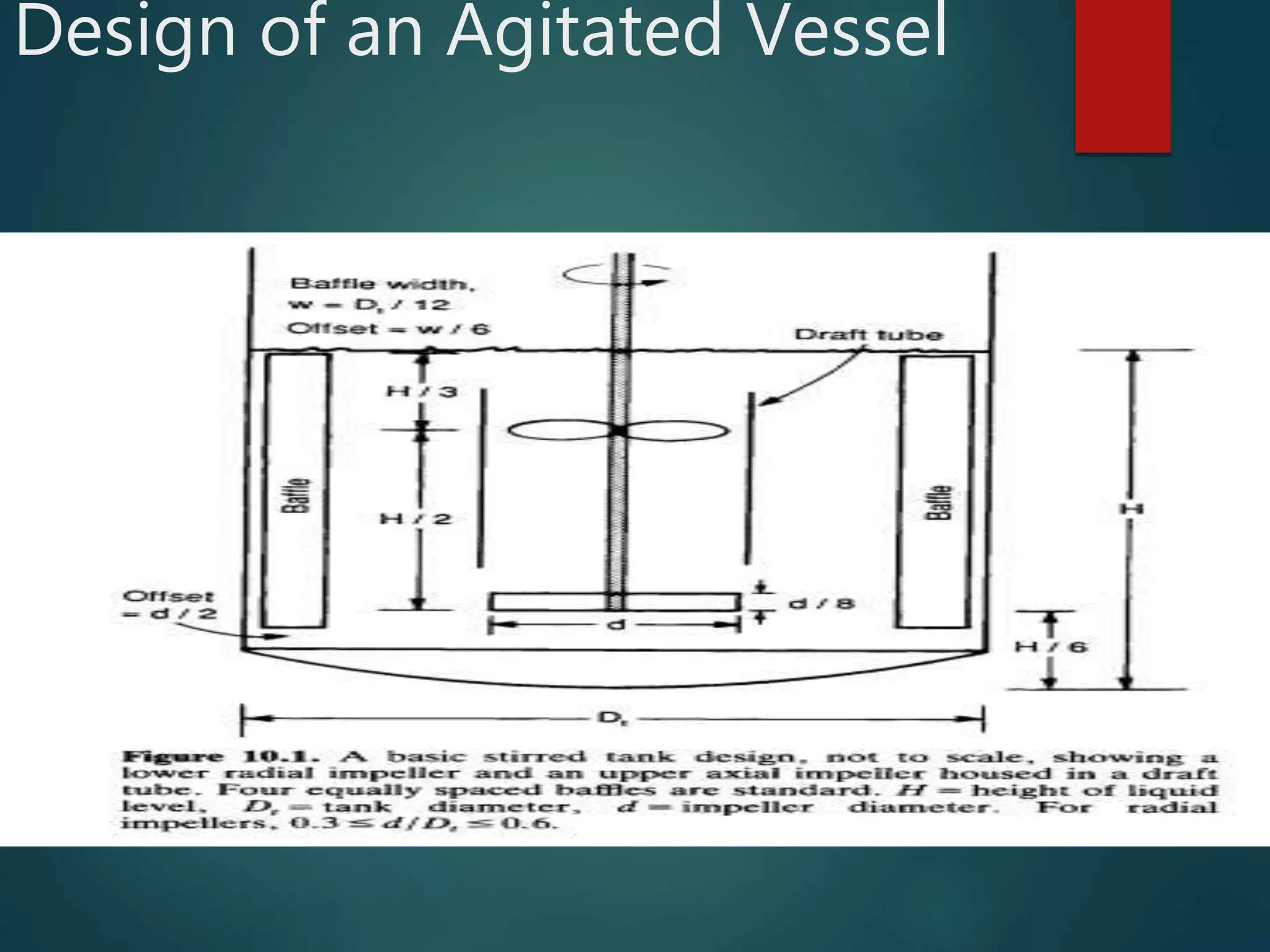
Design of an Agitated Vessel
Impellers
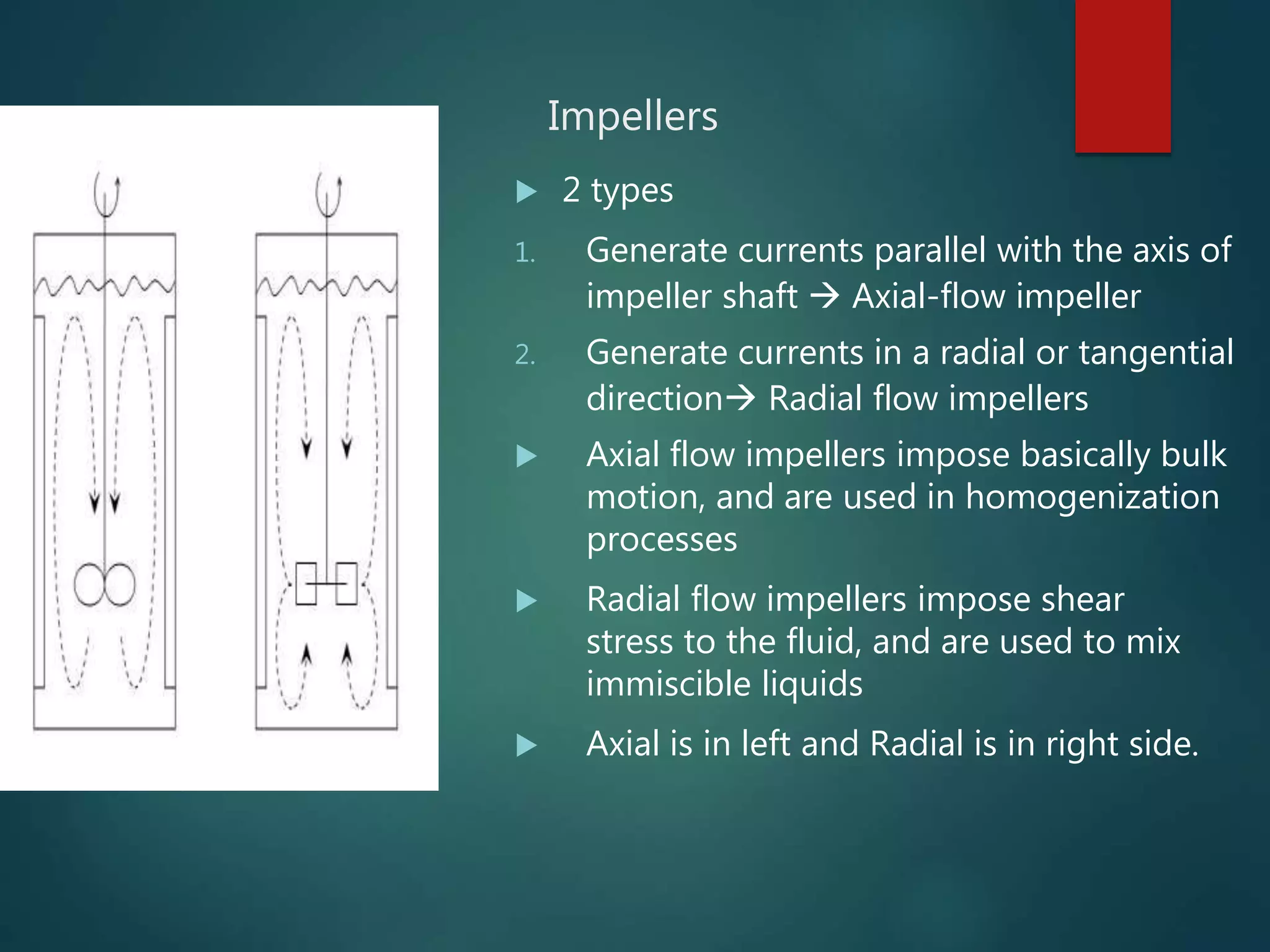
 2 types
1. Generate currents parallel with the axis of
impeller shaft  Axial-flow impeller
2. Generate currents in a radial or tangential
direction Radial flow impellers
 Axial flow impellers impose basically bulk
motion, and are used in homogenization
processes
 Radial flow impellers impose shear
stress to the fluid, and are used to mix
immiscible liquids
 Axial is in left and Radial is in right side.
High Efficiency Impellers
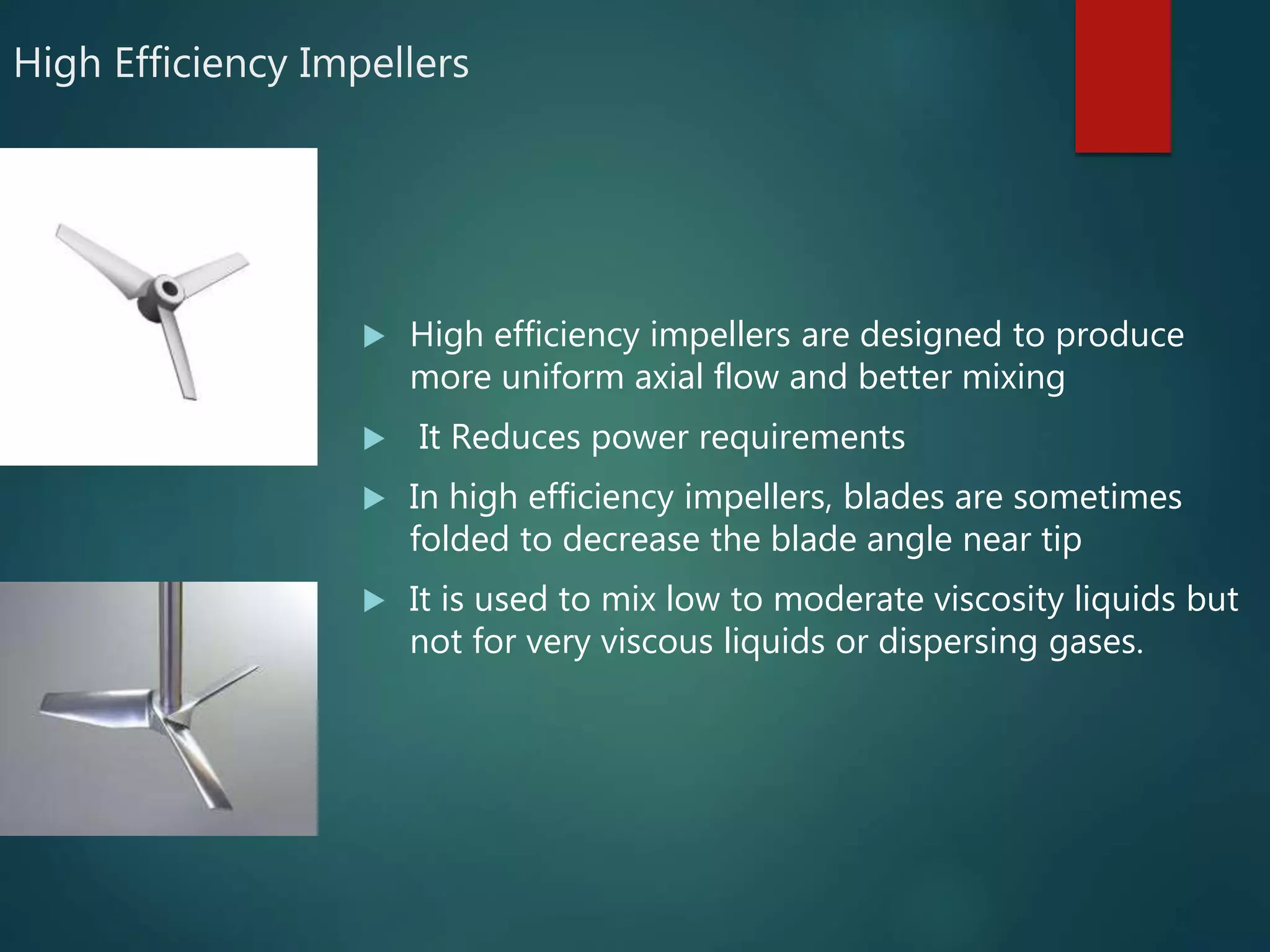
 High efficiency impellers are designed to produce
more uniform axial flow and better mixing
 It Reduces power requirements
 In high efficiency impellers, blades are sometimes
folded to decrease the blade angle near tip
 It is used to mix low to moderate viscosity liquids but
not for very viscous liquids or dispersing gases.
Impellers for highly viscous liquids
 Helical ribbon impeller
 Having diameter almost equal to inside dia of
tank
 Promotes liquid motion all the way to the tank
wall with very viscous liquids
 Anchor Impeller
 Creates no vertical motion
 Less effective than helical
 Promotes better heat transfer
 May have scrapers to remove liquid from tank
wall
Anchor
Helical Ribbon
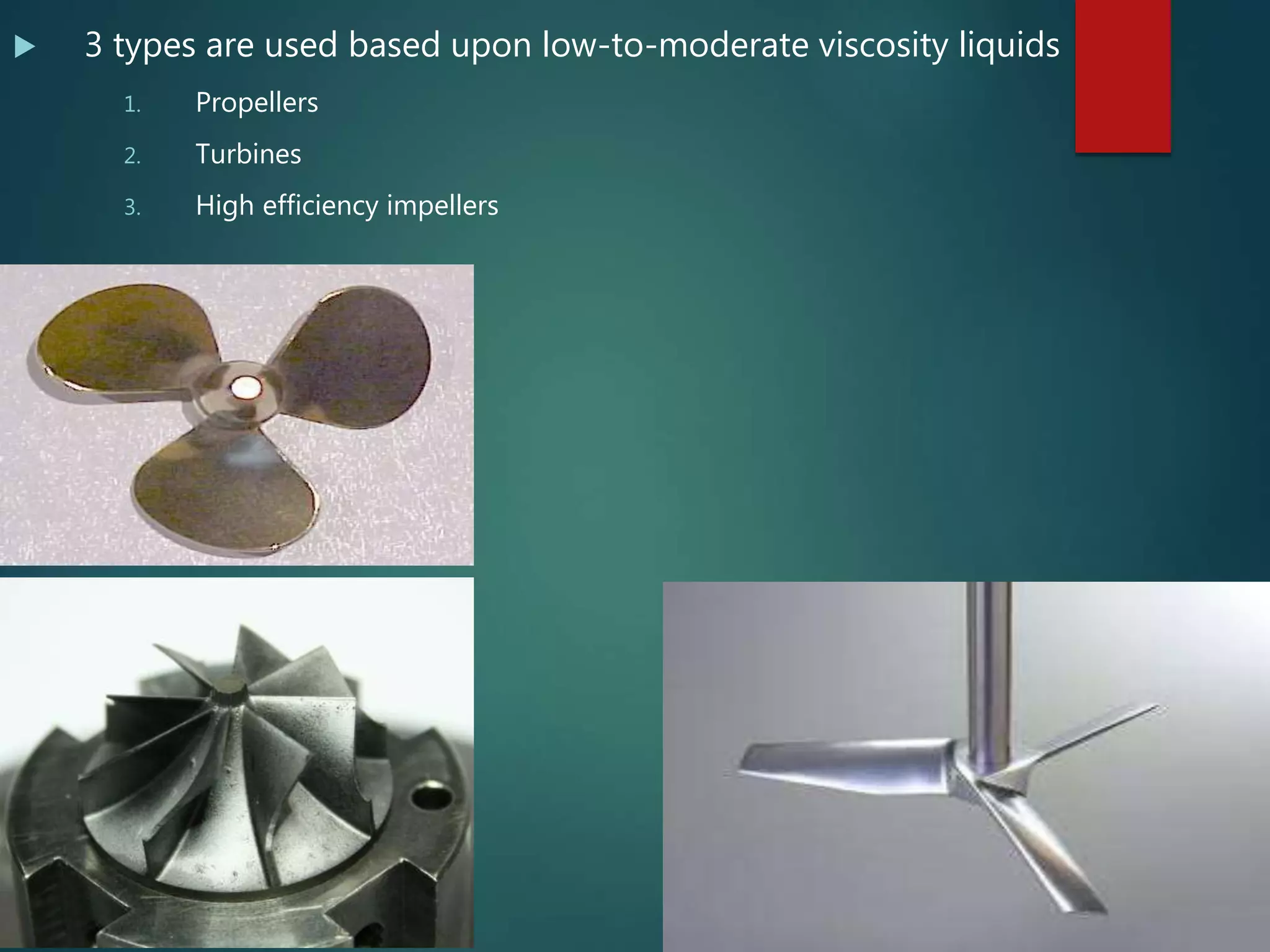
 3 types are used based upon low-to-moderate viscosity liquids
1. Propellers
2. Turbines
3. High efficiency impellers
Propeller
 Axial flow, high speed impeller is used for liquids of low viscosity
 Its rotation forces liquid downward until deflected by the floor vessel
 Propeller blades cut or shear the liquid
 Produces a helix in the fluid
Propeller
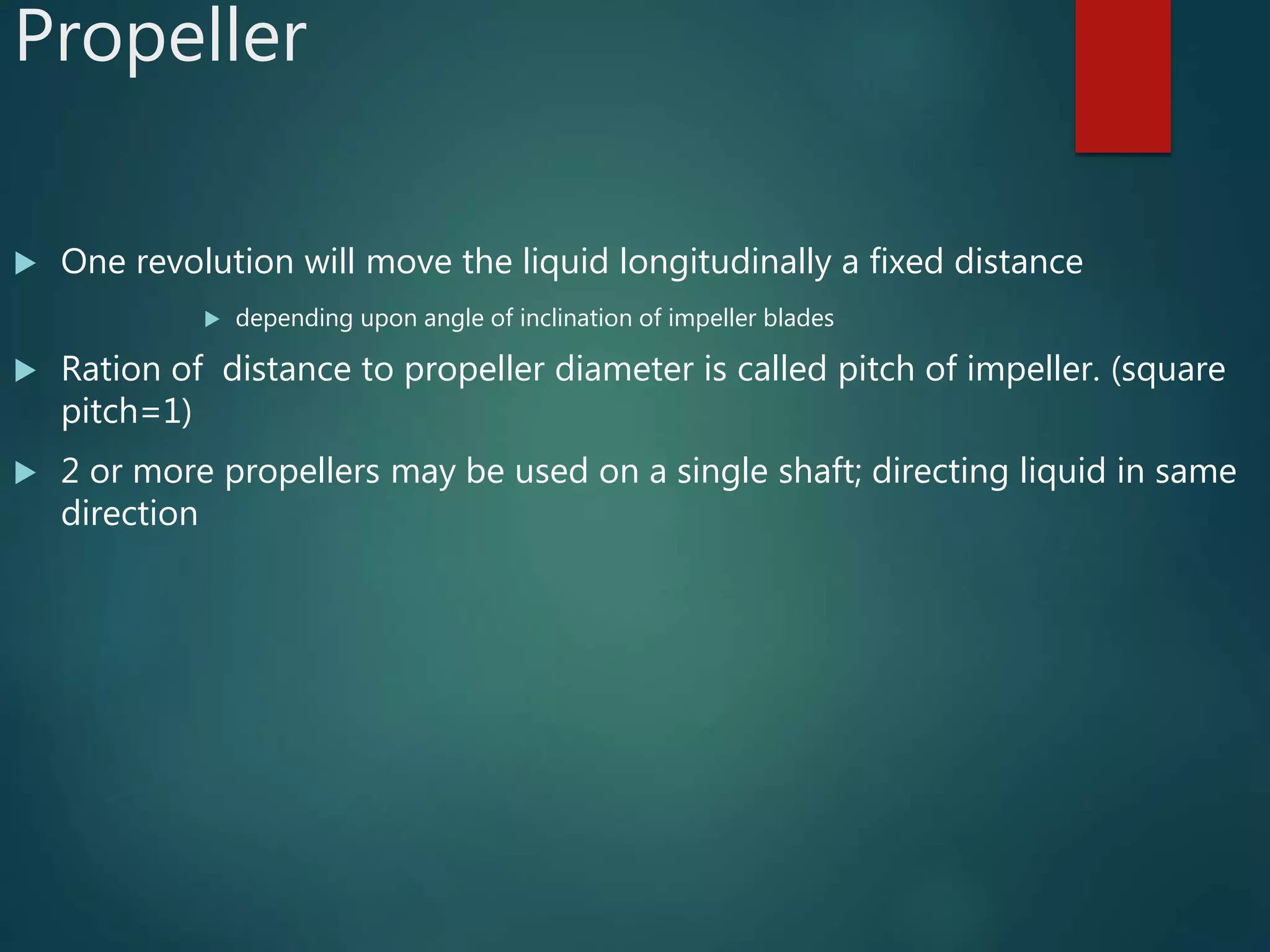
 One revolution will move the liquid longitudinally a fixed distance
 depending upon angle of inclination of impeller blades
 Ration of distance to propeller diameter is called pitch of impeller. (square
pitch=1)
 2 or more propellers may be used on a single shaft; directing liquid in same
direction
Turbines
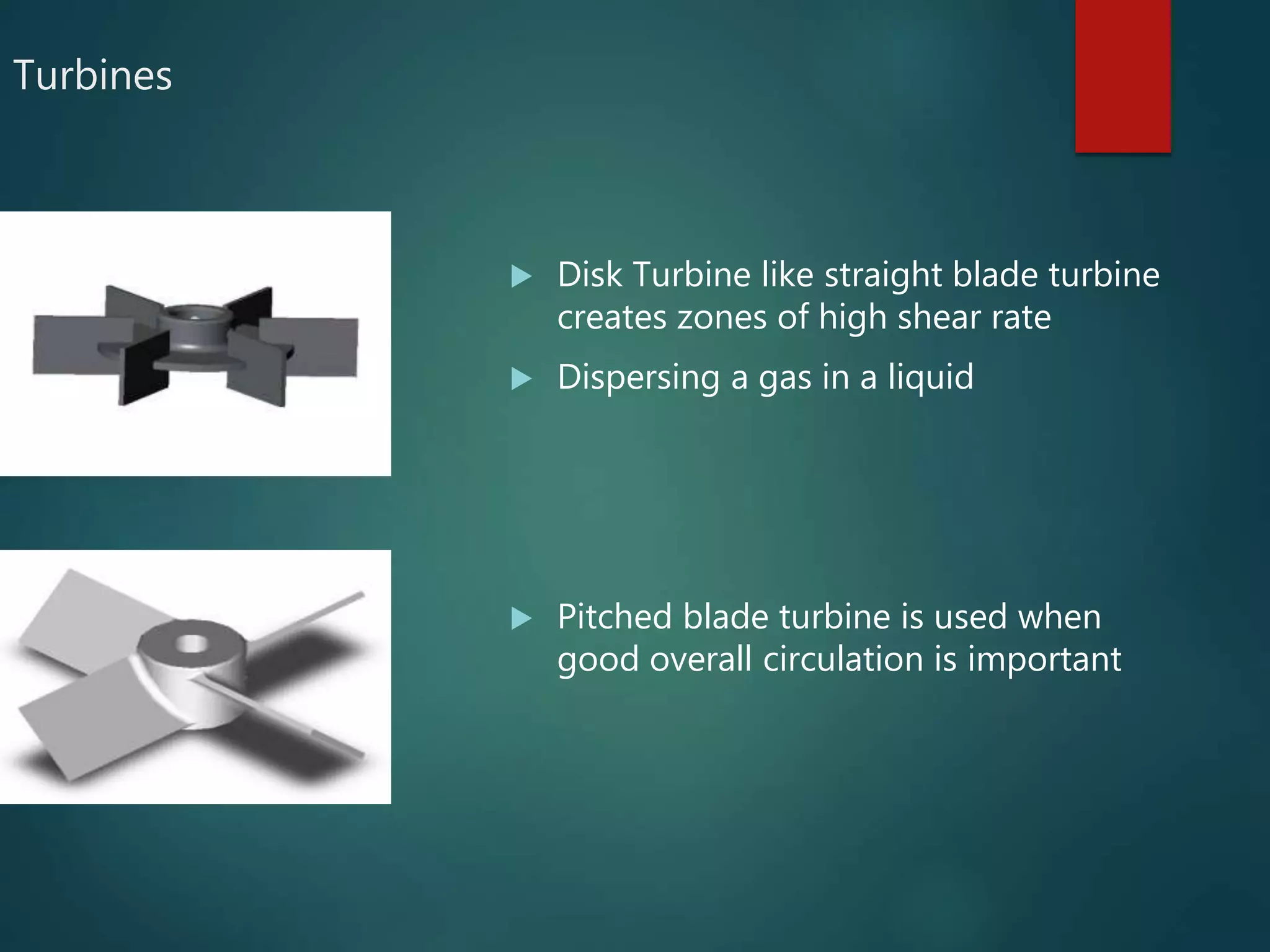
 Disk Turbine like straight blade turbine
creates zones of high shear rate
 Dispersing a gas in a liquid
 Pitched blade turbine is used when
good overall circulation is important
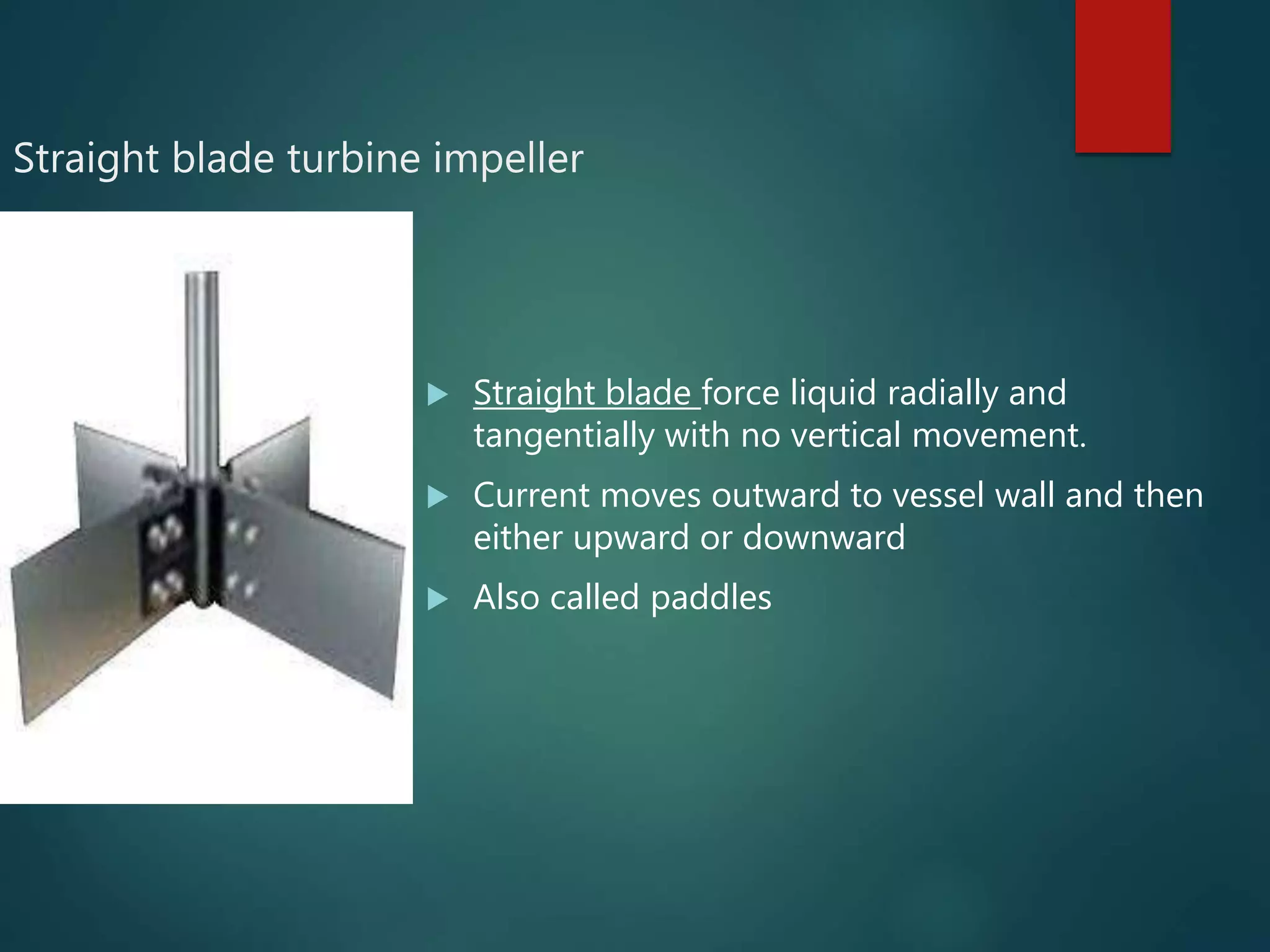
Straight blade turbine impeller
 Straight blade force liquid radially and
tangentially with no vertical movement.
 Current moves outward to vessel wall and then
either upward or downward
 Also called paddles
Flow patterns in Agitated Vessels
Depends upon
 Type of impeller
 Characteristics of the liquid (esp viscosity)
 Size and proportions of the tank, baffles and the impeller
 Liquid velocity at any point has 3 components
1. Radial – perpendicular to the shaft of impeller
2. Longitudinal – parallel with shaft
3. Tangential or rotational – tangent to a circular path around the shaft.
 Radial and longitudinal comp are useful in mixing
 When the shaft is vertical and centrally located; tangential component is
disadvantageous – creates a vortex
3 velocity components
Vortex formation and its disadvantages
 If solid particles are present, they will be
thrown at the outside by centrifugal force;
and move downward and to the centre of
the tank at bottom
 Instead of mixing; (reverse) concentration
occurs
 Relative velocity b/w blades and liquid is
reduced
 Hence power that can be absorbed by the
liquid is limited
Prevention of Swirling (Vortex)
 In small tanks, impeller can be mounted off centre
 In large tanks, agitator may be mounted in the side of
the tank with an angle with the radius
 Installing baffles in large tanks (2,3 or 4)
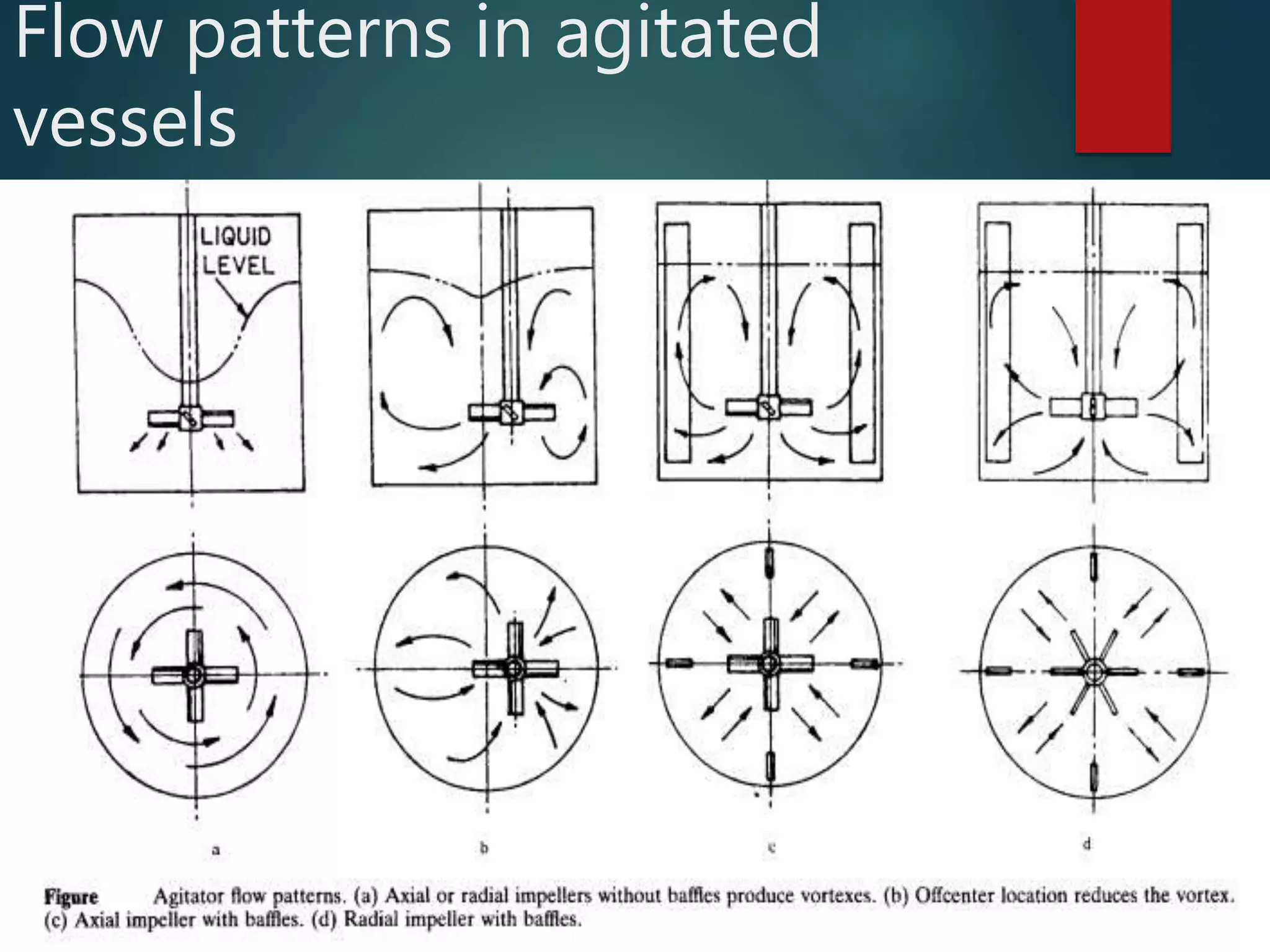
Flow patterns in agitated vessels–
Axial flow impellers
 When swirling or spinning is stopped; flow patterns depends on the type of
impeller
 Propeller agitators drive the liquid down to the bottom of the tank, where
stream spreads radially in all directions toward the wall and flows upward
along the wall and returns to the suction of the propeller from top.
 For keeping solid particles in suspensions
 Axial flow impellers change their flow pattern from axial flow at low liq
viscosity to radial at high viscosity.
Flow patterns in agitated vessels– flat
blade turbines
 Flat blade turbines give good radial flow
 Stream moves at the wall and divides
 One portion flows downward along the wall and back to the center of the
impeller from below
 Another portion flows upward toward the surface and back to impeller from
above
Flow patterns in agitated
vessels
Flow patterns in agitated vessels
 In unbaffled tank there are strong tangential flows and vortex formation at
moderate stirrer speeds
 With baffles, vertical flows are increased and rapid mixing of liquid.
 2 or more impellers can be mounted on single shaft for a long vertical
cylindrical tank
 Lowest impeller is usually a radial flow impeller (straight blade turbine); the
upper is axial flow
 Lowest impeller is about one impeller diameter above the bottom of the
tank.
Mixing and Blending
 mixing is putting things together.
 Blending is the combination of things in a unified smoothed manner
 mixing is the combining of a number of dry ingredients which when
combined with a liquid is blended to achieve a uniform (usually) processed
product
Mixing and Blending
 Mixing is more difficult operation than agitation
 Criteria depends upon the experimenter
 Often good mixing is visual
 Color change of an acid base indicator
 Solid-liquid mixtures
 Rate of decay of concentration or temperature fluctuations; variation in the
analysis of small samples taken from various parts of the mix
Blending of Miscible liquids
 Miscible liquids are blended in small process vessels by propellers, turbines
or high efficiency impellers
 In large storage tank, the agitator may turned on only to blend the stratified
layers of liquid that are formed as the tank is being filled
 Stratified blending is often very slow
Blending in Process Vessels
 Impeller in process vessel produces high velocity stream
 Liquid is well mixed in the region close to impeller because of intense
turbulence
 There is probably little mixing in the direction of flow
 The fluid completes a circulation loop and returns to the eye of the impeller
where vigorous mixing again occurs
 Calculations show that complete mixing (99%) is achieved if contents are
circulated about 5 times
Blending
Rate of Mixing– Circulation rates
 For efficient mixing, volume of fluid circulated by impeller must be great
enough to sweep out the entire vessel in a reasonable time
 The velocity of the stream leaving the impeller must be enough to carry the
currents to the remotest parts of the tank
 Circulation rate is not the only factor; turbulence in moving stream is often
very imp
 Turbulence results properly directed currents and large velocity gradients in
the liquid
Rate of Mixing– Circulation rates
 Circulation and turbulence both consume energy
 Flow rate and power dissipation increase with stirrer speed
 However selection of the type and size of impeller influences the relative
values of flow rate and power dissipation
 Large impellers moving at medium speed promote flow
 Smaller impellers at high speed are used where intense turbulence is
required.

Agitaion and mixing

  • 1.
  • 2.
    Agitation and Mixing Many operations depend upon effective agitation and mixing of components  Agitation: induced motion of a material  Mixing: random distribution of two initially separate phases  A single homogeneous material such as water in a tank can be agitated but not mixed until another material is added to tank
  • 3.
    Agitation and mixing agitation is a means whereby mixing of phases can be accomplished and by which mass and heat transfer can be enhanced between phases or with external surfaces  Mixing is concerned with all combinations of phases of which the most frequently occurring ones are 1. GASES WITH GASES 2. GASES INTO LIQUIDS: DISPERSION. 3. GASES WITH GRANULAR SOLIDS: FLUIDIZATION, PNEUMATIC CONVEYING; DRYING 4. LIQUIDS INTO GASES: SPRAYING. 5. LIQUIDS WITH LIQUIDS: DISSOLUTION, EMULSIFICATION, DISPERSION 6. LIQUIDS WITH GRANULAR SOLIDS: SUSPENSION. 7. PASTES WITH EACH OTHER AND WITH SOLIDS. 8. SOLIDS WITH SOLIDS: MIXING OF POWDERS.
  • 4.
    Agitation and Mixing interaction of gases, liquids, and solids also may take place  Example: hydrogenation of liquids in the presence of a slurred solid catalyst where the gas must be dispersed as bubbles and the solid particles must be kept in suspension
  • 5.
    Purpose of Agitation Suspending solid particles in a liquid  Blending miscible liquids e.g. methanol-water  Dispersing a gas through a liquid in the form of small bubbles  Dispersing a second liquid, immiscible with first to form an emulsion or suspension of fine drops  Promoting heat transfer between liquid and a coil or jacket.
  • 6.
    Agitated Vessels Round bottomto eliminate corners where fluid cannot penetrate Impeller is mounted on a shaft Shaft driven by a motor Baffles to reduce tangential motion of fluid
  • 7.
    Design of anAgitated Vessel
  • 8.
    Impellers  2 types 1.Generate currents parallel with the axis of impeller shaft  Axial-flow impeller 2. Generate currents in a radial or tangential direction Radial flow impellers  Axial flow impellers impose basically bulk motion, and are used in homogenization processes  Radial flow impellers impose shear stress to the fluid, and are used to mix immiscible liquids  Axial is in left and Radial is in right side.
  • 9.
    High Efficiency Impellers High efficiency impellers are designed to produce more uniform axial flow and better mixing  It Reduces power requirements  In high efficiency impellers, blades are sometimes folded to decrease the blade angle near tip  It is used to mix low to moderate viscosity liquids but not for very viscous liquids or dispersing gases.
  • 10.
    Impellers for highlyviscous liquids  Helical ribbon impeller  Having diameter almost equal to inside dia of tank  Promotes liquid motion all the way to the tank wall with very viscous liquids  Anchor Impeller  Creates no vertical motion  Less effective than helical  Promotes better heat transfer  May have scrapers to remove liquid from tank wall Anchor Helical Ribbon
  • 11.
     3 typesare used based upon low-to-moderate viscosity liquids 1. Propellers 2. Turbines 3. High efficiency impellers
  • 12.
    Propeller  Axial flow,high speed impeller is used for liquids of low viscosity  Its rotation forces liquid downward until deflected by the floor vessel  Propeller blades cut or shear the liquid  Produces a helix in the fluid
  • 13.
    Propeller  One revolutionwill move the liquid longitudinally a fixed distance  depending upon angle of inclination of impeller blades  Ration of distance to propeller diameter is called pitch of impeller. (square pitch=1)  2 or more propellers may be used on a single shaft; directing liquid in same direction
  • 14.
    Turbines  Disk Turbinelike straight blade turbine creates zones of high shear rate  Dispersing a gas in a liquid  Pitched blade turbine is used when good overall circulation is important
  • 15.
    Straight blade turbineimpeller  Straight blade force liquid radially and tangentially with no vertical movement.  Current moves outward to vessel wall and then either upward or downward  Also called paddles
  • 16.
    Flow patterns inAgitated Vessels Depends upon  Type of impeller  Characteristics of the liquid (esp viscosity)  Size and proportions of the tank, baffles and the impeller
  • 17.
     Liquid velocityat any point has 3 components 1. Radial – perpendicular to the shaft of impeller 2. Longitudinal – parallel with shaft 3. Tangential or rotational – tangent to a circular path around the shaft.  Radial and longitudinal comp are useful in mixing  When the shaft is vertical and centrally located; tangential component is disadvantageous – creates a vortex 3 velocity components
  • 18.
    Vortex formation andits disadvantages  If solid particles are present, they will be thrown at the outside by centrifugal force; and move downward and to the centre of the tank at bottom  Instead of mixing; (reverse) concentration occurs  Relative velocity b/w blades and liquid is reduced  Hence power that can be absorbed by the liquid is limited
  • 19.
    Prevention of Swirling(Vortex)  In small tanks, impeller can be mounted off centre  In large tanks, agitator may be mounted in the side of the tank with an angle with the radius  Installing baffles in large tanks (2,3 or 4)
  • 20.
    Flow patterns inagitated vessels– Axial flow impellers  When swirling or spinning is stopped; flow patterns depends on the type of impeller  Propeller agitators drive the liquid down to the bottom of the tank, where stream spreads radially in all directions toward the wall and flows upward along the wall and returns to the suction of the propeller from top.  For keeping solid particles in suspensions  Axial flow impellers change their flow pattern from axial flow at low liq viscosity to radial at high viscosity.
  • 21.
    Flow patterns inagitated vessels– flat blade turbines  Flat blade turbines give good radial flow  Stream moves at the wall and divides  One portion flows downward along the wall and back to the center of the impeller from below  Another portion flows upward toward the surface and back to impeller from above
  • 22.
    Flow patterns inagitated vessels
  • 23.
    Flow patterns inagitated vessels  In unbaffled tank there are strong tangential flows and vortex formation at moderate stirrer speeds  With baffles, vertical flows are increased and rapid mixing of liquid.  2 or more impellers can be mounted on single shaft for a long vertical cylindrical tank  Lowest impeller is usually a radial flow impeller (straight blade turbine); the upper is axial flow  Lowest impeller is about one impeller diameter above the bottom of the tank.
  • 24.
    Mixing and Blending mixing is putting things together.  Blending is the combination of things in a unified smoothed manner  mixing is the combining of a number of dry ingredients which when combined with a liquid is blended to achieve a uniform (usually) processed product
  • 25.
    Mixing and Blending Mixing is more difficult operation than agitation  Criteria depends upon the experimenter  Often good mixing is visual  Color change of an acid base indicator  Solid-liquid mixtures  Rate of decay of concentration or temperature fluctuations; variation in the analysis of small samples taken from various parts of the mix
  • 26.
    Blending of Miscibleliquids  Miscible liquids are blended in small process vessels by propellers, turbines or high efficiency impellers  In large storage tank, the agitator may turned on only to blend the stratified layers of liquid that are formed as the tank is being filled  Stratified blending is often very slow
  • 27.
    Blending in ProcessVessels  Impeller in process vessel produces high velocity stream  Liquid is well mixed in the region close to impeller because of intense turbulence  There is probably little mixing in the direction of flow  The fluid completes a circulation loop and returns to the eye of the impeller where vigorous mixing again occurs  Calculations show that complete mixing (99%) is achieved if contents are circulated about 5 times
  • 28.
  • 29.
    Rate of Mixing–Circulation rates  For efficient mixing, volume of fluid circulated by impeller must be great enough to sweep out the entire vessel in a reasonable time  The velocity of the stream leaving the impeller must be enough to carry the currents to the remotest parts of the tank  Circulation rate is not the only factor; turbulence in moving stream is often very imp  Turbulence results properly directed currents and large velocity gradients in the liquid
  • 30.
    Rate of Mixing–Circulation rates  Circulation and turbulence both consume energy  Flow rate and power dissipation increase with stirrer speed  However selection of the type and size of impeller influences the relative values of flow rate and power dissipation  Large impellers moving at medium speed promote flow  Smaller impellers at high speed are used where intense turbulence is required.