Types Of Agitators
Outline:
 Introduction
 Types Of Agitators
 Selection Criteria For Agitators
 Power required For Agitation
 Agitator: An agitator is something which is used to
stir liquid or mixture of liquids.
 It can be used in various operations, in a pharma
industry it can be used in multiple operations like
reactions, drying, filtration, etc.
 Agitation is the process of keeping a mixture that has
been mixed in the proper mixed state required for the
'end' product.
Introduction:
Types of Agitators
 Paddle Agitators
 Anchor Agitators
 Radial Propeller Agitators
 Propeller Agitators
 Turbine Agitators
 Helical Agitators
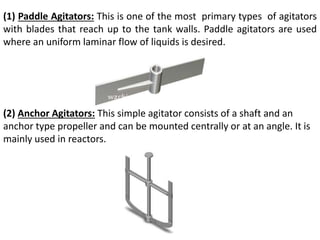
(1) Paddle Agitators: This is one of the most primary types of agitators
with blades that reach up to the tank walls. Paddle agitators are used
where an uniform laminar flow of liquids is desired.
(2) Anchor Agitators: This simple agitator consists of a shaft and an
anchor type propeller and can be mounted centrally or at an angle. It is
mainly used in reactors.
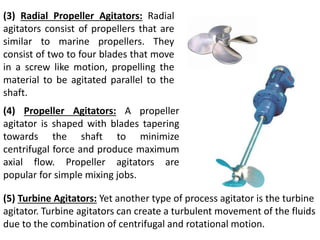
(3) Radial Propeller Agitators: Radial
agitators consist of propellers that are
similar to marine propellers. They
consist of two to four blades that move
in a screw like motion, propelling the
material to be agitated parallel to the
shaft.
(4) Propeller Agitators: A propeller
agitator is shaped with blades tapering
towards the shaft to minimize
centrifugal force and produce maximum
axial flow. Propeller agitators are
popular for simple mixing jobs.
(5) Turbine Agitators: Yet another type of process agitator is the turbine
agitator. Turbine agitators can create a turbulent movement of the fluids
due to the combination of centrifugal and rotational motion.
(6) Helical Agitators: These agitators have blades with a twisted
mechanism, just like the threads of a screw. The curves result in a
vigorous motion of the fluids to be agitated. Helical agitators are most
useful for mixing viscous liquids.
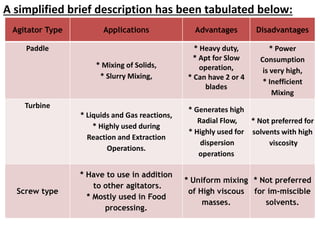
Agitator Type Applications Advantages Disadvantages
Paddle
* Mixing of Solids,
* Slurry Mixing,
* Heavy duty,
* Apt for Slow
operation,
* Can have 2 or 4
blades
* Power
Consumption
is very high,
* Inefficient
Mixing
Turbine
* Liquids and Gas reactions,
* Highly used during
Reaction and Extraction
Operations.
* Generates high
Radial Flow,
* Highly used for
dispersion
operations
* Not preferred for
solvents with high
viscosity
Screw type
* Have to use in addition
to other agitators.
* Mostly used in Food
processing.
* Uniform mixing
of High viscous
masses.
* Not preferred
for im-miscible
solvents.
A simplified brief description has been tabulated below:
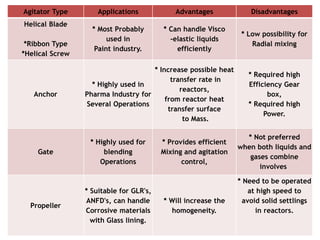
Agitator Type Applications Advantages Disadvantages
Helical Blade
*Ribbon Type
*Helical Screw
* Most Probably
used in
Paint industry.
* Can handle Visco
-elastic liquids
efficiently
* Low possibility for
Radial mixing
Anchor
* Highly used in
Pharma Industry for
Several Operations
* Increase possible heat
transfer rate in
reactors,
from reactor heat
transfer surface
to Mass.
* Required high
Efficiency Gear
box,
* Required high
Power.
Gate
* Highly used for
blending
Operations
* Provides efficient
Mixing and agitation
control,
* Not preferred
when both liquids and
gases combine
involves
Propeller
* Suitable for GLR's,
ANFD's, can handle
Corrosive materials
with Glass lining.
* Will increase the
homogeneity.
* Need to be operated
at high speed to
avoid solid settlings
in reactors.
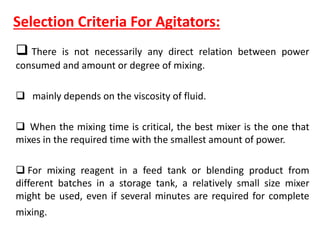
Selection Criteria For Agitators:
 There is not necessarily any direct relation between power
consumed and amount or degree of mixing.
 mainly depends on the viscosity of fluid.
 When the mixing time is critical, the best mixer is the one that
mixes in the required time with the smallest amount of power.
 For mixing reagent in a feed tank or blending product from
different batches in a storage tank, a relatively small size mixer
might be used, even if several minutes are required for complete
mixing.
POWER REQUIRED FOR AGITATION:
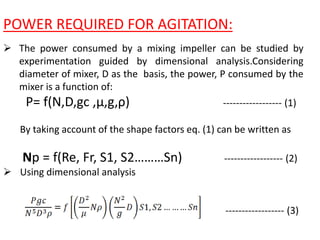
 The power consumed by a mixing impeller can be studied by
experimentation guided by dimensional analysis.Considering
diameter of mixer, D as the basis, the power, P consumed by the
mixer is a function of:
P= f(N,D,gc ,μ,g,ρ) ------------------ (1)
By taking account of the shape factors eq. (1) can be written as
Np = f(Re, Fr, S1, S2………Sn) ------------------ (2)
 Using dimensional analysis
------------------ (3)
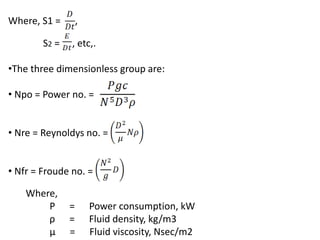
Where, S1 = ,
S2 = , etc,.
•The three dimensionless group are:
• Npo = Power no. =
• Nre = Reynoldys no. =
• Nfr = Froude no. =
Where,
P = Power consumption, kW
ρ = Fluid density, kg/m3
μ = Fluid viscosity, Nsec/m2
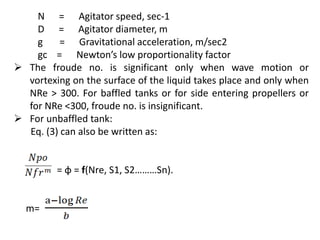
N = Agitator speed, sec-1
D = Agitator diameter, m
g = Gravitational acceleration, m/sec2
gc = Newton’s low proportionality factor
 The froude no. is significant only when wave motion or
vortexing on the surface of the liquid takes place and only when
NRe > 300. For baffled tanks or for side entering propellers or
for NRe <300, froude no. is insignificant.
 For unbaffled tank:
Eq. (3) can also be written as:
= φ = f(Nre, S1, S2………Sn).
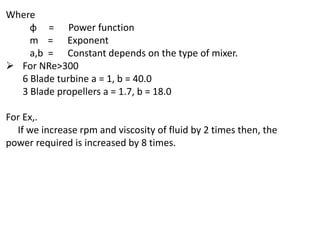
m=
Where
φ = Power function
m = Exponent
a,b = Constant depends on the type of mixer.
 For NRe>300
6 Blade turbine a = 1, b = 40.0
3 Blade propellers a = 1.7, b = 18.0
For Ex,.
If we increase rpm and viscosity of fluid by 2 times then, the
power required is increased by 8 times.
15

Types of agitators

  • 1.
  • 2.
    Outline:  Introduction  TypesOf Agitators  Selection Criteria For Agitators  Power required For Agitation
  • 3.
     Agitator: Anagitator is something which is used to stir liquid or mixture of liquids.  It can be used in various operations, in a pharma industry it can be used in multiple operations like reactions, drying, filtration, etc.  Agitation is the process of keeping a mixture that has been mixed in the proper mixed state required for the 'end' product. Introduction:
  • 4.
    Types of Agitators Paddle Agitators  Anchor Agitators  Radial Propeller Agitators  Propeller Agitators  Turbine Agitators  Helical Agitators
  • 5.
    (1) Paddle Agitators:This is one of the most primary types of agitators with blades that reach up to the tank walls. Paddle agitators are used where an uniform laminar flow of liquids is desired. (2) Anchor Agitators: This simple agitator consists of a shaft and an anchor type propeller and can be mounted centrally or at an angle. It is mainly used in reactors.
  • 6.
    (3) Radial PropellerAgitators: Radial agitators consist of propellers that are similar to marine propellers. They consist of two to four blades that move in a screw like motion, propelling the material to be agitated parallel to the shaft. (4) Propeller Agitators: A propeller agitator is shaped with blades tapering towards the shaft to minimize centrifugal force and produce maximum axial flow. Propeller agitators are popular for simple mixing jobs. (5) Turbine Agitators: Yet another type of process agitator is the turbine agitator. Turbine agitators can create a turbulent movement of the fluids due to the combination of centrifugal and rotational motion.
  • 7.
    (6) Helical Agitators:These agitators have blades with a twisted mechanism, just like the threads of a screw. The curves result in a vigorous motion of the fluids to be agitated. Helical agitators are most useful for mixing viscous liquids.
  • 8.
    Agitator Type ApplicationsAdvantages Disadvantages Paddle * Mixing of Solids, * Slurry Mixing, * Heavy duty, * Apt for Slow operation, * Can have 2 or 4 blades * Power Consumption is very high, * Inefficient Mixing Turbine * Liquids and Gas reactions, * Highly used during Reaction and Extraction Operations. * Generates high Radial Flow, * Highly used for dispersion operations * Not preferred for solvents with high viscosity Screw type * Have to use in addition to other agitators. * Mostly used in Food processing. * Uniform mixing of High viscous masses. * Not preferred for im-miscible solvents. A simplified brief description has been tabulated below:
  • 9.
    Agitator Type ApplicationsAdvantages Disadvantages Helical Blade *Ribbon Type *Helical Screw * Most Probably used in Paint industry. * Can handle Visco -elastic liquids efficiently * Low possibility for Radial mixing Anchor * Highly used in Pharma Industry for Several Operations * Increase possible heat transfer rate in reactors, from reactor heat transfer surface to Mass. * Required high Efficiency Gear box, * Required high Power. Gate * Highly used for blending Operations * Provides efficient Mixing and agitation control, * Not preferred when both liquids and gases combine involves Propeller * Suitable for GLR's, ANFD's, can handle Corrosive materials with Glass lining. * Will increase the homogeneity. * Need to be operated at high speed to avoid solid settlings in reactors.
  • 10.
    Selection Criteria ForAgitators:  There is not necessarily any direct relation between power consumed and amount or degree of mixing.  mainly depends on the viscosity of fluid.  When the mixing time is critical, the best mixer is the one that mixes in the required time with the smallest amount of power.  For mixing reagent in a feed tank or blending product from different batches in a storage tank, a relatively small size mixer might be used, even if several minutes are required for complete mixing.
  • 11.
    POWER REQUIRED FORAGITATION:  The power consumed by a mixing impeller can be studied by experimentation guided by dimensional analysis.Considering diameter of mixer, D as the basis, the power, P consumed by the mixer is a function of: P= f(N,D,gc ,μ,g,ρ) ------------------ (1) By taking account of the shape factors eq. (1) can be written as Np = f(Re, Fr, S1, S2………Sn) ------------------ (2)  Using dimensional analysis ------------------ (3)
  • 12.
    Where, S1 =, S2 = , etc,. •The three dimensionless group are: • Npo = Power no. = • Nre = Reynoldys no. = • Nfr = Froude no. = Where, P = Power consumption, kW ρ = Fluid density, kg/m3 μ = Fluid viscosity, Nsec/m2
  • 13.
    N = Agitatorspeed, sec-1 D = Agitator diameter, m g = Gravitational acceleration, m/sec2 gc = Newton’s low proportionality factor  The froude no. is significant only when wave motion or vortexing on the surface of the liquid takes place and only when NRe > 300. For baffled tanks or for side entering propellers or for NRe <300, froude no. is insignificant.  For unbaffled tank: Eq. (3) can also be written as: = φ = f(Nre, S1, S2………Sn). m=
  • 14.
    Where φ = Powerfunction m = Exponent a,b = Constant depends on the type of mixer.  For NRe>300 6 Blade turbine a = 1, b = 40.0 3 Blade propellers a = 1.7, b = 18.0 For Ex,. If we increase rpm and viscosity of fluid by 2 times then, the power required is increased by 8 times.
  • 15.