Contents:
Introduction
Agitator?
What It can do?
Agitation Vs Mixing
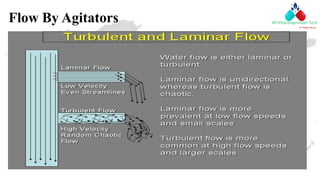
Laminar Vs Turbulent Flow
 Agitators Types & Applications
 Agitators Types & Function
 No. Of Agitators Calculation
Introduction:
 What Agitator Do??
It can be used in various operations like reactions,
work up's, drying, filtration etc.
Agitator??
An agitator is something which is used to stir
liquid or mixture of liquids.
Introduction:
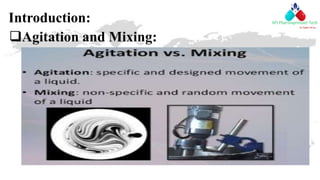
Agitation and Mixing:
Agitation Mixing
Agitation is the process of keeping a
mixture that has been mixed in the proper
mixed state required for the 'end' product.
Mixing refers to the actual stirring of
different liquids and/or materials to blend
them together into an end product or
mixture.
Forcing a fluid by mechanical means to
flow in a circulatory or other pattern in a
vessel.
Blending of 2 or more separated phases,
such as a fluid and a powdered solid, or 2
fluids, and causing them to be randomly
distributed through one another.
E.g. Agitator of reactor / vessel etc. E.g. Circulation of fluids in tank through
pump.
Introduction:
Agitation and Mixing:
Flow By Agitators
Agitator Types
•Two types of Agitators commonly used,
1.Mechanical Agitators,
2.Electronically Controlled Agitators,
Note: We will discussed commonly used Mechanical
Agitators.
Agitator Types:
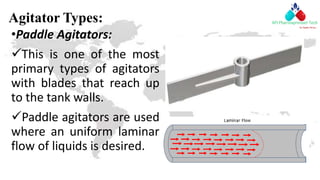
•Paddle Agitators:
This is one of the most
primary types of agitators
with blades that reach up
to the tank walls.
Paddle agitators are used
where an uniform laminar
flow of liquids is desired.
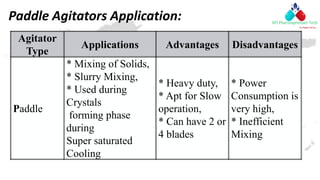
Paddle Agitators Application:
Agitator
Type
Applications Advantages Disadvantages
Paddle
* Mixing of Solids,
* Slurry Mixing,
* Used during
Crystals
forming phase
during
Super saturated
Cooling
* Heavy duty,
* Apt for Slow
operation,
* Can have 2 or
4 blades
* Power
Consumption is
very high,
* Inefficient
Mixing
Agitator Types:
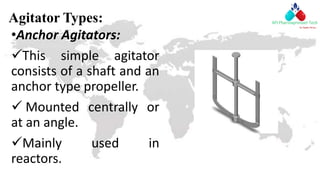
•Anchor Agitators:
This simple agitator
consists of a shaft and an
anchor type propeller.
 Mounted centrally or
at an angle.
Mainly used in
reactors.
Anchor Agitators Application:
Agitator Type Applications Advantages Disadvantages
Anchor
* Highly used
in Pharma
Industry for
Several
Operations
* Increase
possible
heat transfer
rate in reactors,
from reactor
heat transfer
surface to Mass.
* Required high
Efficiency
Gearbox,
* Required high
Power.
Agitator Types:
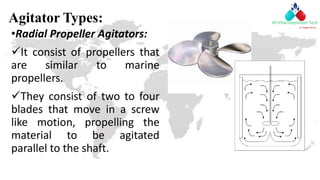
•Radial Propeller Agitators:
It consist of propellers that
are similar to marine
propellers.
They consist of two to four
blades that move in a screw
like motion, propelling the
material to be agitated
parallel to the shaft.
Agitator Types:
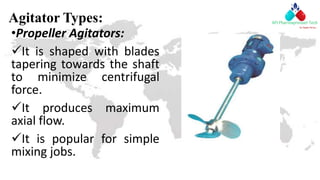
•Propeller Agitators:
It is shaped with blades
tapering towards the shaft
to minimize centrifugal
force.
It produces maximum
axial flow.
It is popular for simple
mixing jobs.
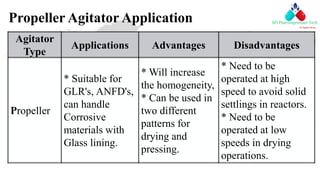
Propeller Agitator Application
Agitator
Type
Applications Advantages Disadvantages
Propeller
* Suitable for
GLR's, ANFD's,
can handle
Corrosive
materials with
Glass lining.
* Will increase
the homogeneity,
* Can be used in
two different
patterns for
drying and
pressing.
* Need to be
operated at high
speed to avoid solid
settlings in reactors.
* Need to be
operated at low
speeds in drying
operations.
Agitator Types:
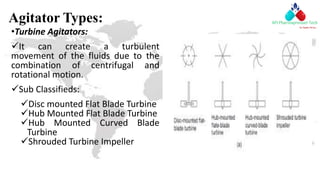
•Turbine Agitators:
It can create a turbulent
movement of the fluids due to the
combination of centrifugal and
rotational motion.
Sub Classifieds:
Disc mounted Flat Blade Turbine
Hub Mounted Flat Blade Turbine
Hub Mounted Curved Blade
Turbine
Shrouded Turbine Impeller
Turbine Agitator Application:
Agitator Type Applications Advantages Disadvantages
Turbine
*Straight Blade
*Pitched Blade
*Curved Blade
*Disk Blade
* Liquids and
Gas reactions,
* Highly used
during Reaction
and Extraction
Operations.
* Generates
high Radial
Flow,
* Highly used
for dispersion
operations
* Not preferred
for solvents
with
high viscosity[
NMT 20 cP]
Agitator Types:
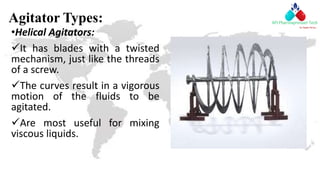
•Helical Agitators:
It has blades with a twisted
mechanism, just like the threads
of a screw.
The curves result in a vigorous
motion of the fluids to be
agitated.
Are most useful for mixing
viscous liquids.
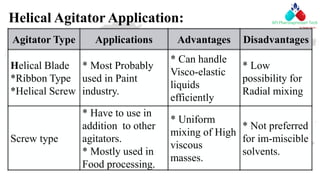
Helical Agitator Application:
Agitator Type Applications Advantages Disadvantages
Helical Blade
*Ribbon Type
*Helical Screw
* Most Probably
used in Paint
industry.
* Can handle
Visco-elastic
liquids
efficiently
* Low
possibility for
Radial mixing
Screw type
* Have to use in
addition to other
agitators.
* Mostly used in
Food processing.
* Uniform
mixing of High
viscous
masses.
* Not preferred
for im-miscible
solvents.
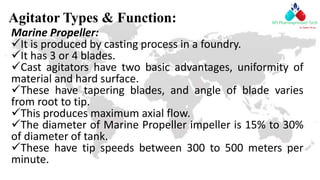
Agitator Types & Function:
Marine Propeller:
It is produced by casting process in a foundry.
It has 3 or 4 blades.
Cast agitators have two basic advantages, uniformity of
material and hard surface.
These have tapering blades, and angle of blade varies
from root to tip.
This produces maximum axial flow.
The diameter of Marine Propeller impeller is 15% to 30%
of diameter of tank.
These have tip speeds between 300 to 500 meters per
minute.
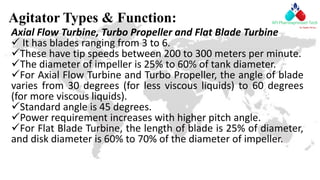
Agitator Types & Function:
Axial Flow Turbine, Turbo Propeller and Flat Blade Turbine
 It has blades ranging from 3 to 6.
These have tip speeds between 200 to 300 meters per minute.
The diameter of impeller is 25% to 60% of tank diameter.
For Axial Flow Turbine and Turbo Propeller, the angle of blade
varies from 30 degrees (for less viscous liquids) to 60 degrees
(for more viscous liquids).
Standard angle is 45 degrees.
Power requirement increases with higher pitch angle.
For Flat Blade Turbine, the length of blade is 25% of diameter,
and disk diameter is 60% to 70% of the diameter of impeller.
Agitator Types & Function:
Paddle, Anchor, or Gate
It has only 2 blades.
These extend close to the tank wall.
It has tip speeds between 80 to 150 meters per
minute.
These push and rotate the liquid in a laminar flow.
 There is no axial or radial mixing.
The width of blade is 1/8th or 1/10th of the agitator
diameter.
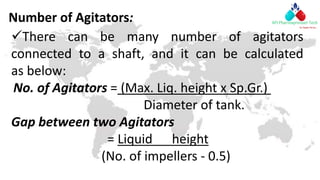
Number of Agitators:
There can be many number of agitators
connected to a shaft, and it can be calculated
as below:
No. of Agitators = (Max. Liq. height x Sp.Gr.)
Diameter of tank.
Gap between two Agitators
= Liquid height
(No. of impellers - 0.5)
Agitator Types & Function:
Paddle, Anchor, or Gate
It has only 2 blades.
These extend close to the tank wall.
It has tip speeds between 80 to 150 meters per
minute.
These push and rotate the liquid in a laminar flow.
 There is no axial or radial mixing.
The width of blade is 1/8th or 1/10th of the agitator
diameter.
Agitator types, application & function,  No. of agitator calculation

Agitator types, application & function, No. of agitator calculation

  • 2.
    Contents: Introduction Agitator? What It cando? Agitation Vs Mixing Laminar Vs Turbulent Flow  Agitators Types & Applications  Agitators Types & Function  No. Of Agitators Calculation
  • 3.
    Introduction:  What AgitatorDo?? It can be used in various operations like reactions, work up's, drying, filtration etc. Agitator?? An agitator is something which is used to stir liquid or mixture of liquids.
  • 4.
    Introduction: Agitation and Mixing: AgitationMixing Agitation is the process of keeping a mixture that has been mixed in the proper mixed state required for the 'end' product. Mixing refers to the actual stirring of different liquids and/or materials to blend them together into an end product or mixture. Forcing a fluid by mechanical means to flow in a circulatory or other pattern in a vessel. Blending of 2 or more separated phases, such as a fluid and a powdered solid, or 2 fluids, and causing them to be randomly distributed through one another. E.g. Agitator of reactor / vessel etc. E.g. Circulation of fluids in tank through pump.
  • 5.
  • 6.
  • 7.
    Agitator Types •Two typesof Agitators commonly used, 1.Mechanical Agitators, 2.Electronically Controlled Agitators, Note: We will discussed commonly used Mechanical Agitators.
  • 8.
    Agitator Types: •Paddle Agitators: Thisis one of the most primary types of agitators with blades that reach up to the tank walls. Paddle agitators are used where an uniform laminar flow of liquids is desired.
  • 9.
    Paddle Agitators Application: Agitator Type ApplicationsAdvantages Disadvantages Paddle * Mixing of Solids, * Slurry Mixing, * Used during Crystals forming phase during Super saturated Cooling * Heavy duty, * Apt for Slow operation, * Can have 2 or 4 blades * Power Consumption is very high, * Inefficient Mixing
  • 10.
    Agitator Types: •Anchor Agitators: Thissimple agitator consists of a shaft and an anchor type propeller.  Mounted centrally or at an angle. Mainly used in reactors.
  • 11.
    Anchor Agitators Application: AgitatorType Applications Advantages Disadvantages Anchor * Highly used in Pharma Industry for Several Operations * Increase possible heat transfer rate in reactors, from reactor heat transfer surface to Mass. * Required high Efficiency Gearbox, * Required high Power.
  • 12.
    Agitator Types: •Radial PropellerAgitators: It consist of propellers that are similar to marine propellers. They consist of two to four blades that move in a screw like motion, propelling the material to be agitated parallel to the shaft.
  • 13.
    Agitator Types: •Propeller Agitators: Itis shaped with blades tapering towards the shaft to minimize centrifugal force. It produces maximum axial flow. It is popular for simple mixing jobs.
  • 14.
    Propeller Agitator Application Agitator Type ApplicationsAdvantages Disadvantages Propeller * Suitable for GLR's, ANFD's, can handle Corrosive materials with Glass lining. * Will increase the homogeneity, * Can be used in two different patterns for drying and pressing. * Need to be operated at high speed to avoid solid settlings in reactors. * Need to be operated at low speeds in drying operations.
  • 15.
    Agitator Types: •Turbine Agitators: Itcan create a turbulent movement of the fluids due to the combination of centrifugal and rotational motion. Sub Classifieds: Disc mounted Flat Blade Turbine Hub Mounted Flat Blade Turbine Hub Mounted Curved Blade Turbine Shrouded Turbine Impeller
  • 16.
    Turbine Agitator Application: AgitatorType Applications Advantages Disadvantages Turbine *Straight Blade *Pitched Blade *Curved Blade *Disk Blade * Liquids and Gas reactions, * Highly used during Reaction and Extraction Operations. * Generates high Radial Flow, * Highly used for dispersion operations * Not preferred for solvents with high viscosity[ NMT 20 cP]
  • 17.
    Agitator Types: •Helical Agitators: Ithas blades with a twisted mechanism, just like the threads of a screw. The curves result in a vigorous motion of the fluids to be agitated. Are most useful for mixing viscous liquids.
  • 18.
    Helical Agitator Application: AgitatorType Applications Advantages Disadvantages Helical Blade *Ribbon Type *Helical Screw * Most Probably used in Paint industry. * Can handle Visco-elastic liquids efficiently * Low possibility for Radial mixing Screw type * Have to use in addition to other agitators. * Mostly used in Food processing. * Uniform mixing of High viscous masses. * Not preferred for im-miscible solvents.
  • 19.
    Agitator Types &Function: Marine Propeller: It is produced by casting process in a foundry. It has 3 or 4 blades. Cast agitators have two basic advantages, uniformity of material and hard surface. These have tapering blades, and angle of blade varies from root to tip. This produces maximum axial flow. The diameter of Marine Propeller impeller is 15% to 30% of diameter of tank. These have tip speeds between 300 to 500 meters per minute.
  • 20.
    Agitator Types &Function: Axial Flow Turbine, Turbo Propeller and Flat Blade Turbine  It has blades ranging from 3 to 6. These have tip speeds between 200 to 300 meters per minute. The diameter of impeller is 25% to 60% of tank diameter. For Axial Flow Turbine and Turbo Propeller, the angle of blade varies from 30 degrees (for less viscous liquids) to 60 degrees (for more viscous liquids). Standard angle is 45 degrees. Power requirement increases with higher pitch angle. For Flat Blade Turbine, the length of blade is 25% of diameter, and disk diameter is 60% to 70% of the diameter of impeller.
  • 21.
    Agitator Types &Function: Paddle, Anchor, or Gate It has only 2 blades. These extend close to the tank wall. It has tip speeds between 80 to 150 meters per minute. These push and rotate the liquid in a laminar flow.  There is no axial or radial mixing. The width of blade is 1/8th or 1/10th of the agitator diameter.
  • 22.
    Number of Agitators: Therecan be many number of agitators connected to a shaft, and it can be calculated as below: No. of Agitators = (Max. Liq. height x Sp.Gr.) Diameter of tank. Gap between two Agitators = Liquid height (No. of impellers - 0.5)
  • 23.
    Agitator Types &Function: Paddle, Anchor, or Gate It has only 2 blades. These extend close to the tank wall. It has tip speeds between 80 to 150 meters per minute. These push and rotate the liquid in a laminar flow.  There is no axial or radial mixing. The width of blade is 1/8th or 1/10th of the agitator diameter.