Hydronic System Piping Design Presented by: Dan Watkins, LEED AP Bornquist, Inc.
Topics to Cover Hydronic System Basics Hydronic System Types Primary – Secondary Variable Flow / Variable Speed Systems Piping Design Examples
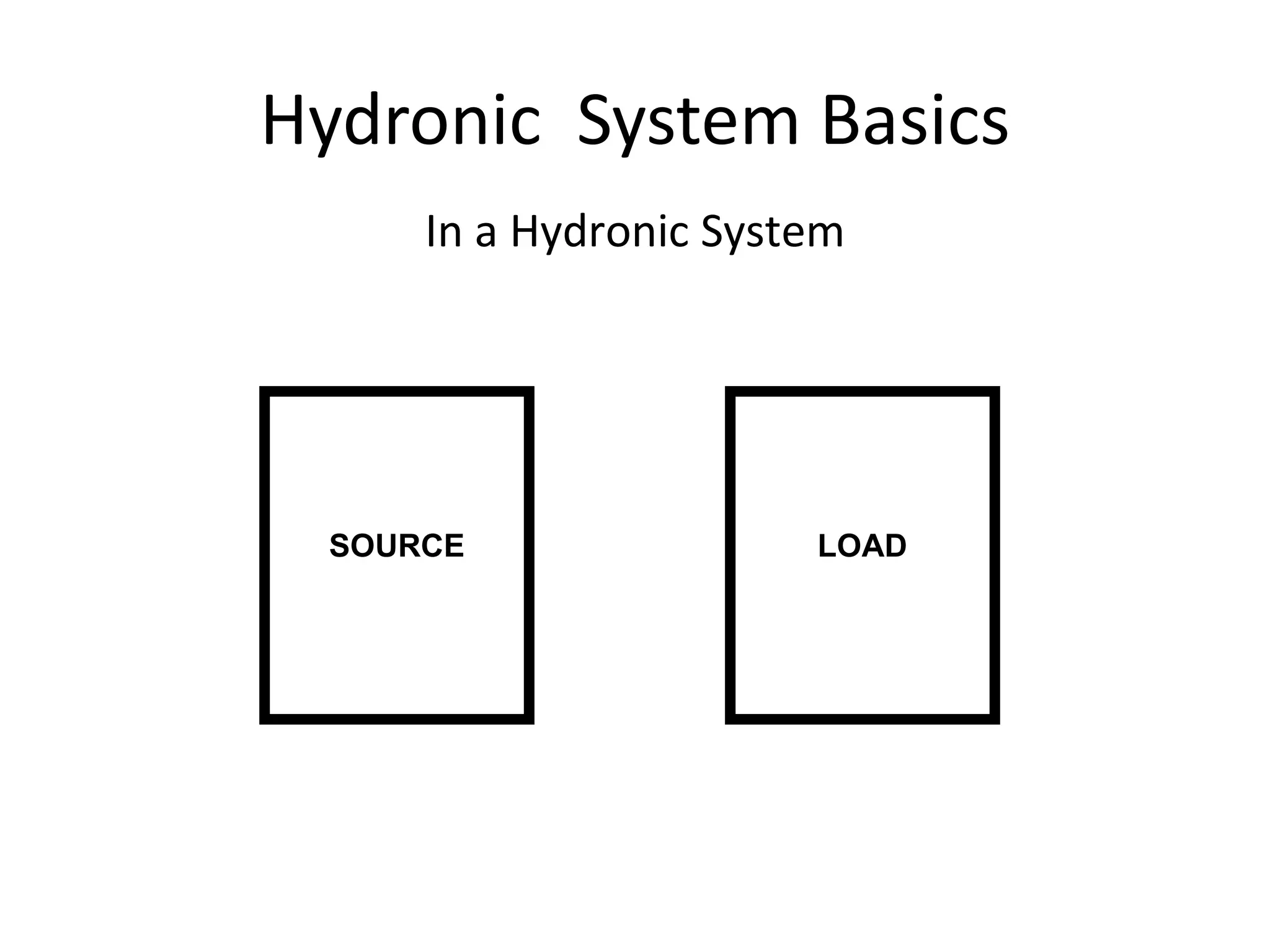
Hydronic  System Basics SOURCE LOAD In a Hydronic System
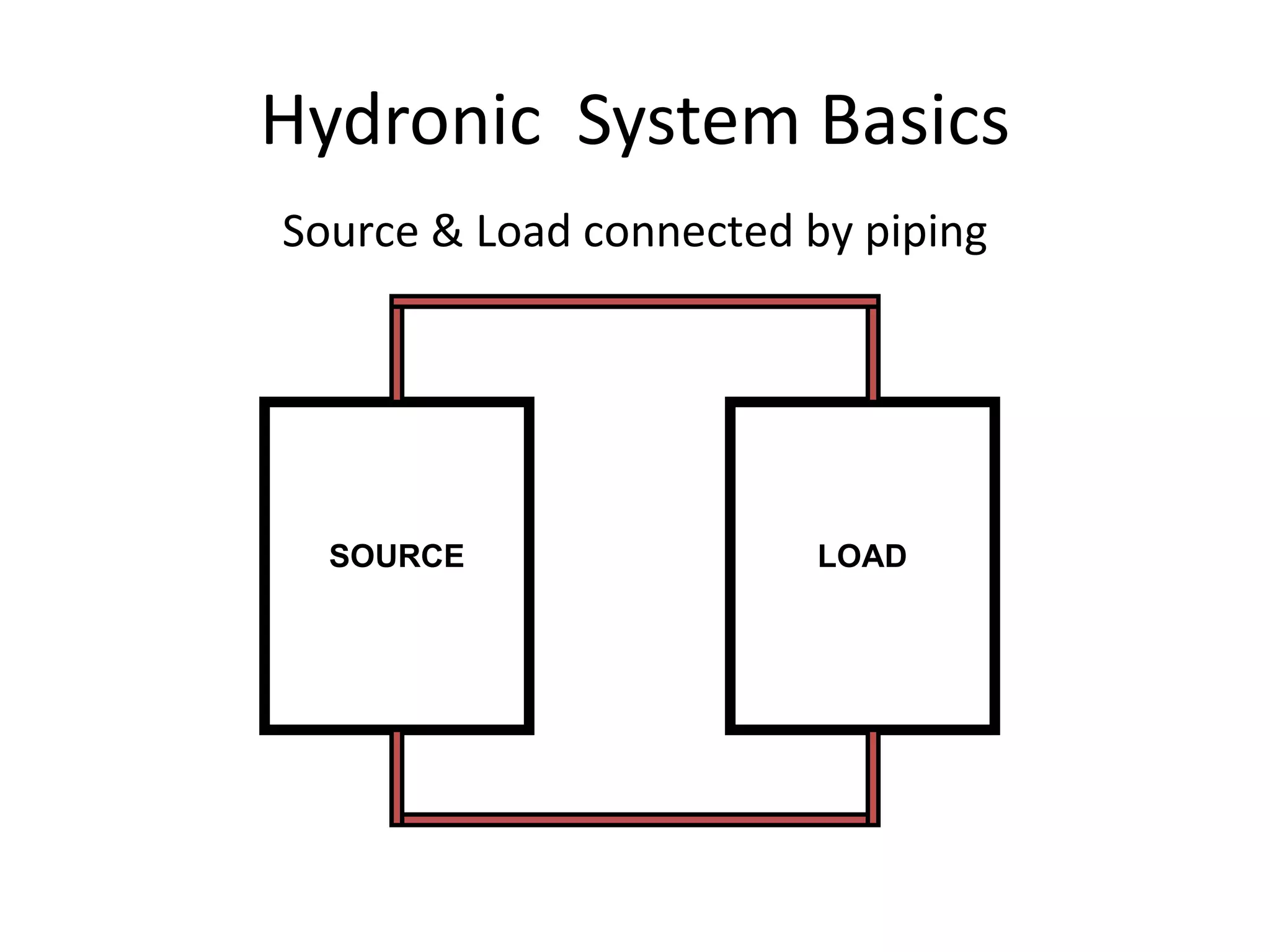
Hydronic  System Basics SOURCE LOAD Source & Load connected by piping
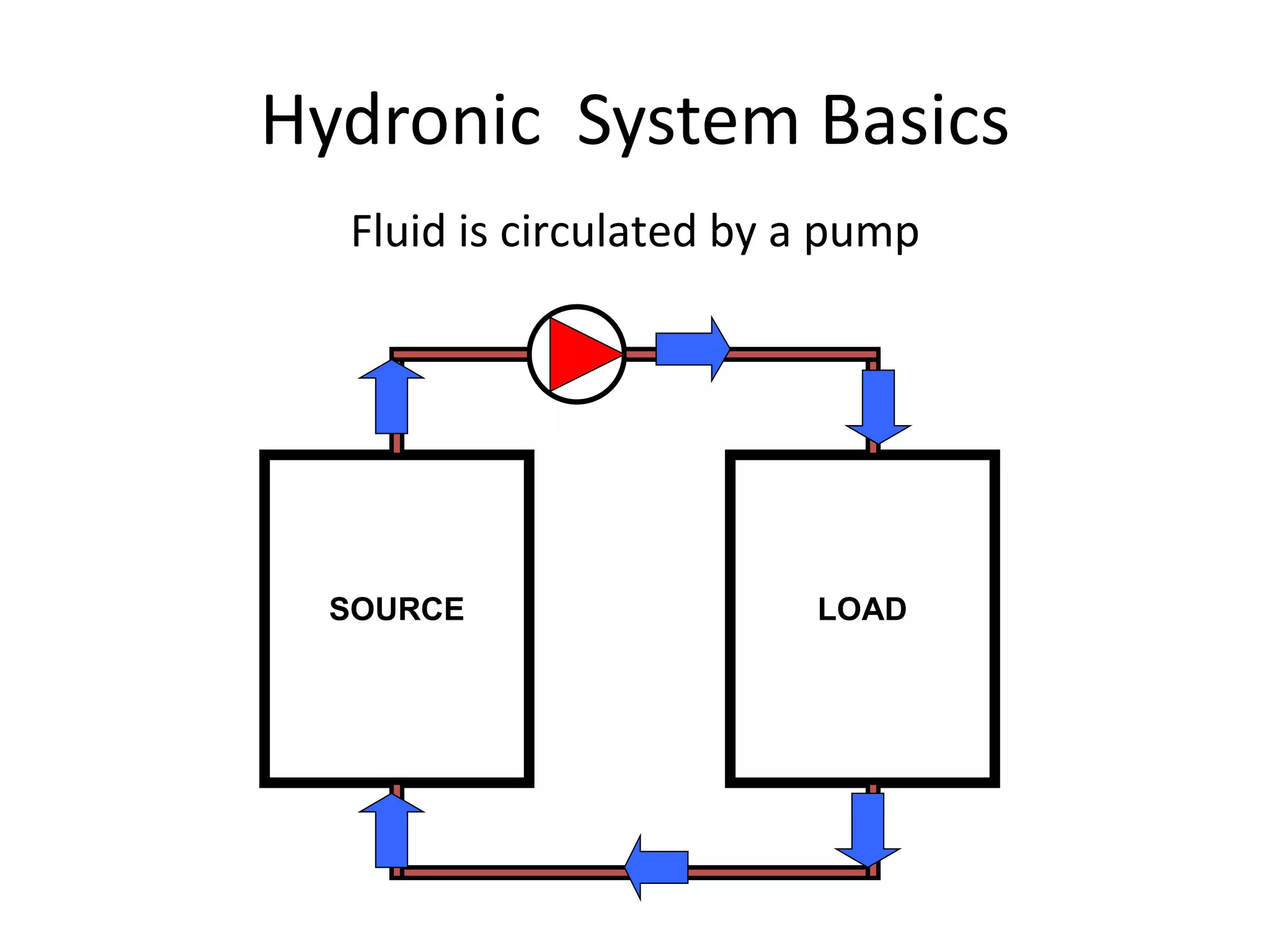
Hydronic  System Basics SOURCE LOAD Fluid is circulated by a pump
Hydronic  System Basics Could it really be this simple? What about different system types? What about multiple zones? Let’s start with how to size a pump.
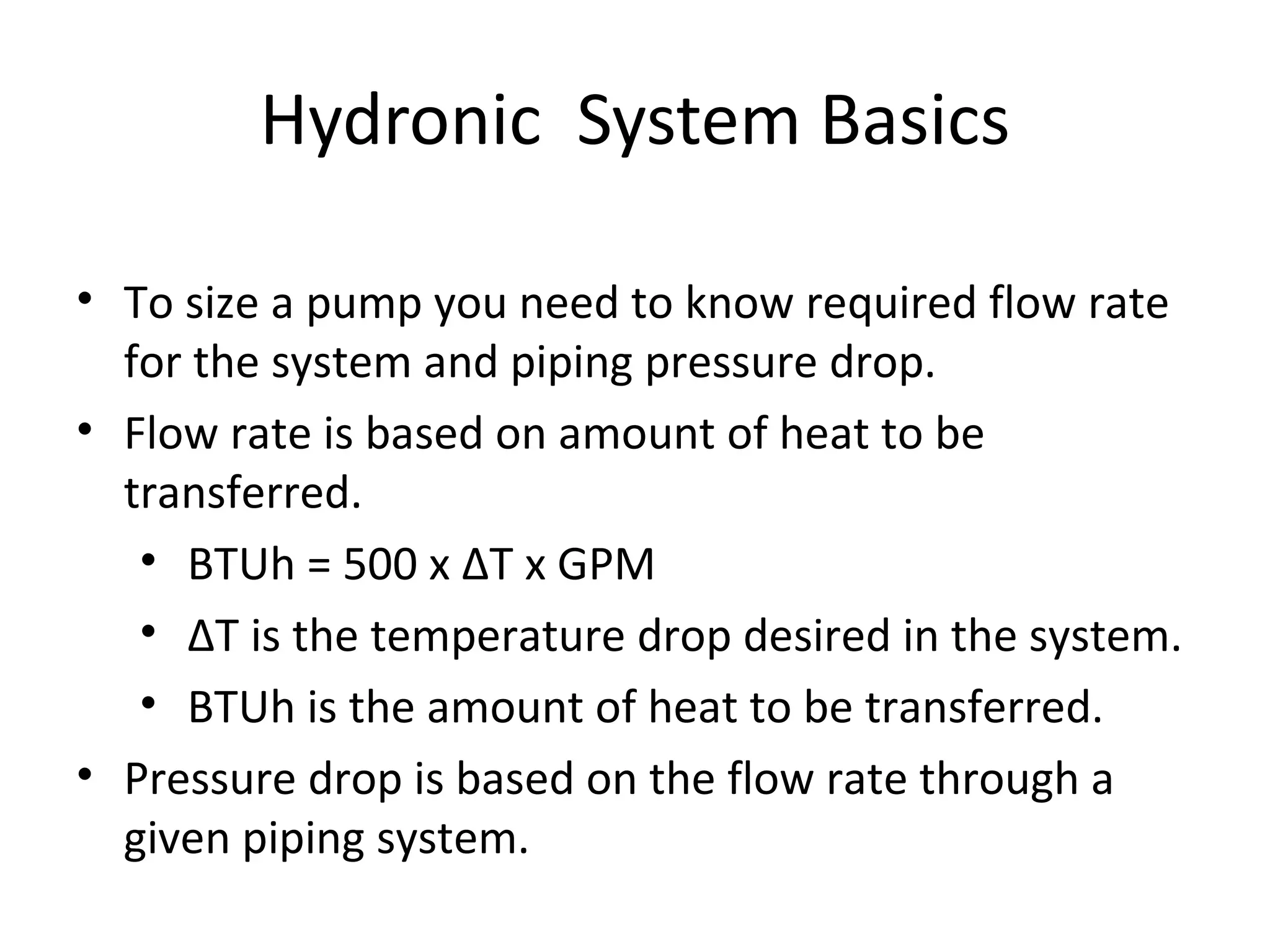
Hydronic  System Basics To size a pump you need to know required flow rate for the system and piping pressure drop. Flow rate is based on amount of heat to be transferred. BTUh = 500 x  Δ T x GPM ΔT is the temperature drop desired in the system. BTUh is the amount of heat to be transferred. Pressure drop is based on the flow rate through a given piping system.
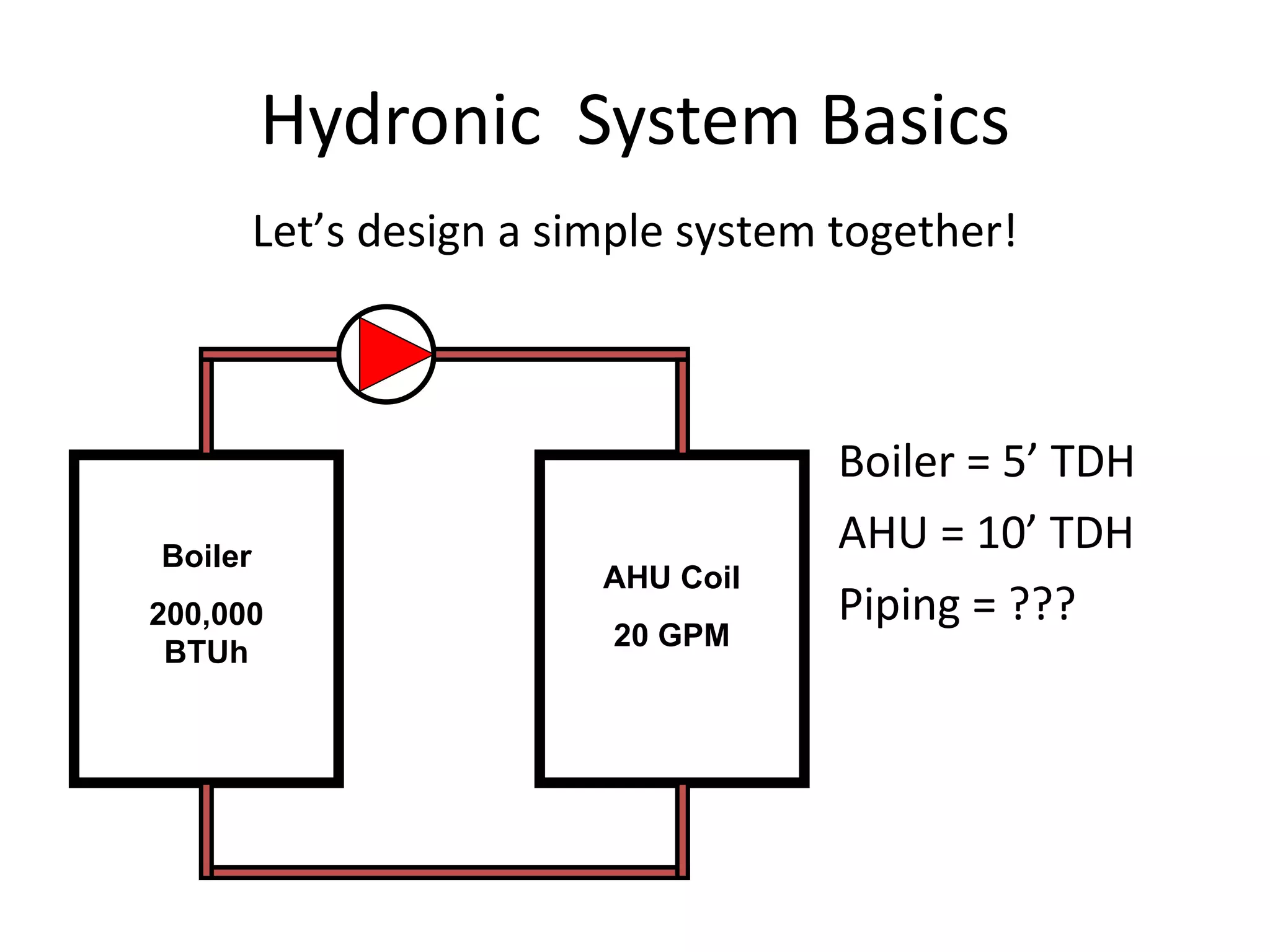
Hydronic  System Basics Let’s design a simple system together! Boiler 200,000 BTUh AHU Coil 20 GPM Boiler = 5’ TDH AHU = 10’ TDH Piping = ???
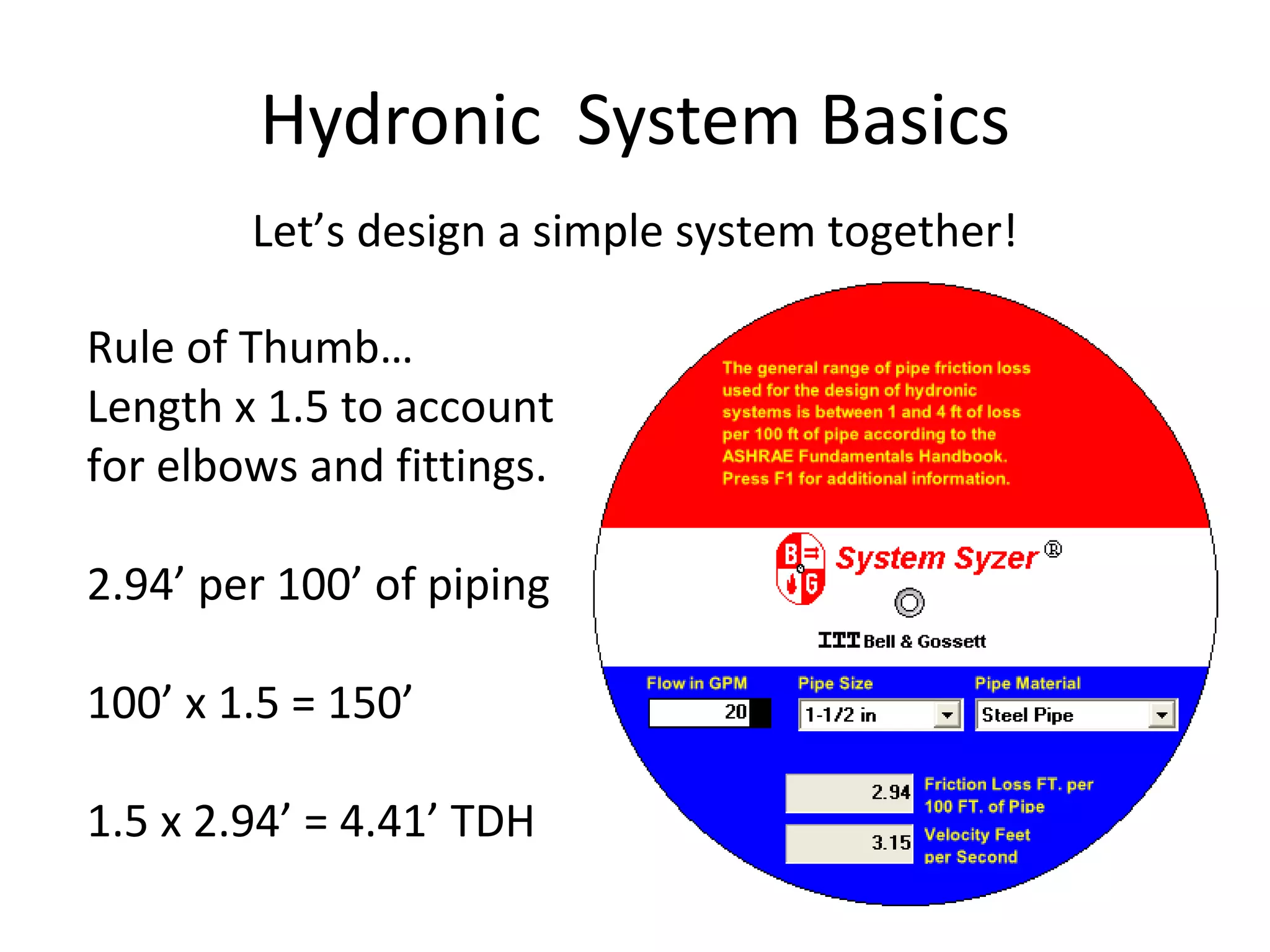
Hydronic  System Basics Let’s design a simple system together! Rule of Thumb… Length x 1.5 to account for elbows and fittings. 2.94’ per 100’ of piping 100’ x 1.5 = 150’ 1.5 x 2.94’ = 4.41’ TDH
Hydronic  System Basics Let’s design a simple system together! Boiler 200,000 BTUh AHU Coil 20 GPM Boiler = 5’ TDH AHU = 10’ TDH Piping = 4.41’ TDH System Capacity: 20 GPM @ 19.41’
Hydronic  System Basics
Hydronic  System Basics GPM 2 GPM 1 HEAD 2 RPM 2 RPM 1 HEAD 1 HP 2 HP 1 RPM 2 RPM 1 RPM 2 RPM 1 HP 2 HP 1 GPM 2 GPM 1 GPM 2 GPM 1 HEAD 2 HEAD 1 Affinity Laws 2 2 3 3 = = = = =
Hydronic  System Basics Point of No Pressure Change – Expansion Tank Location
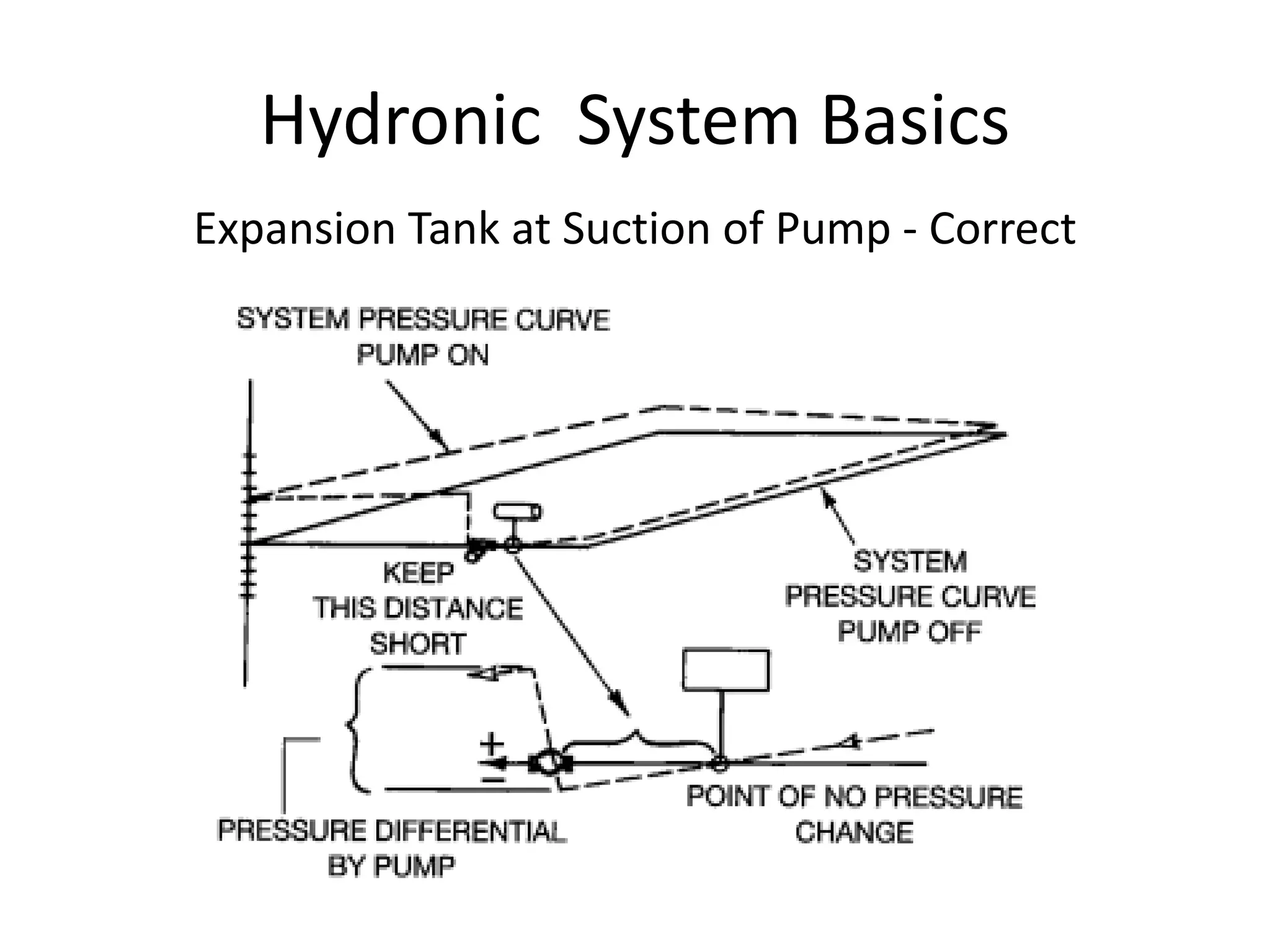
Hydronic  System Basics Expansion Tank at Suction of Pump - Correct
Hydronic  System Basics Expansion Tank at Discharge of Pump - INCORRECT
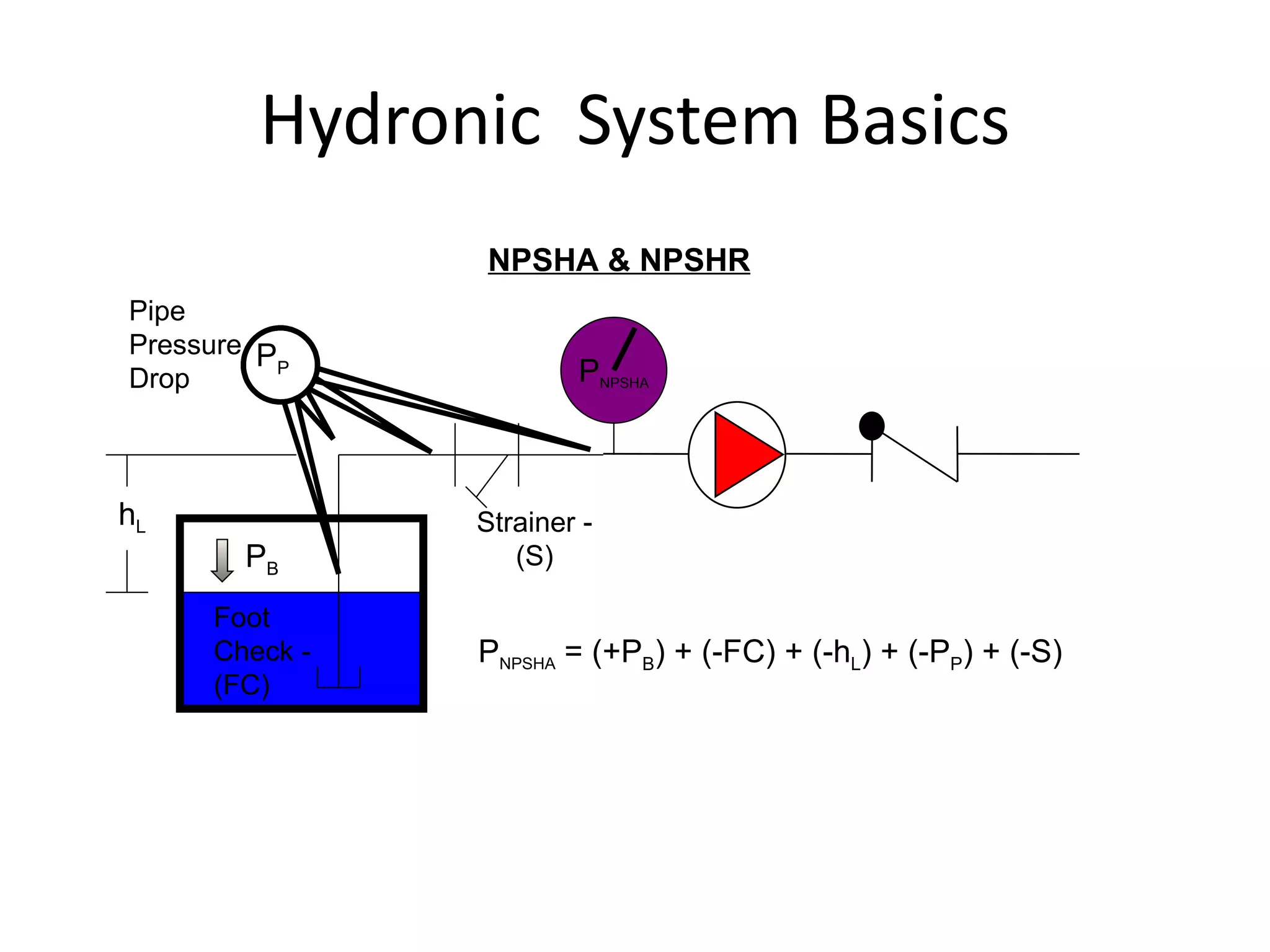
Hydronic  System Basics NPSHA & NPSHR P NPSHA P B Foot Check - (FC) h L Strainer - (S) P P P NPSHA  = (+P B ) + (-FC) + (-h L ) + (-P P ) + (-S)  Pipe Pressure Drop
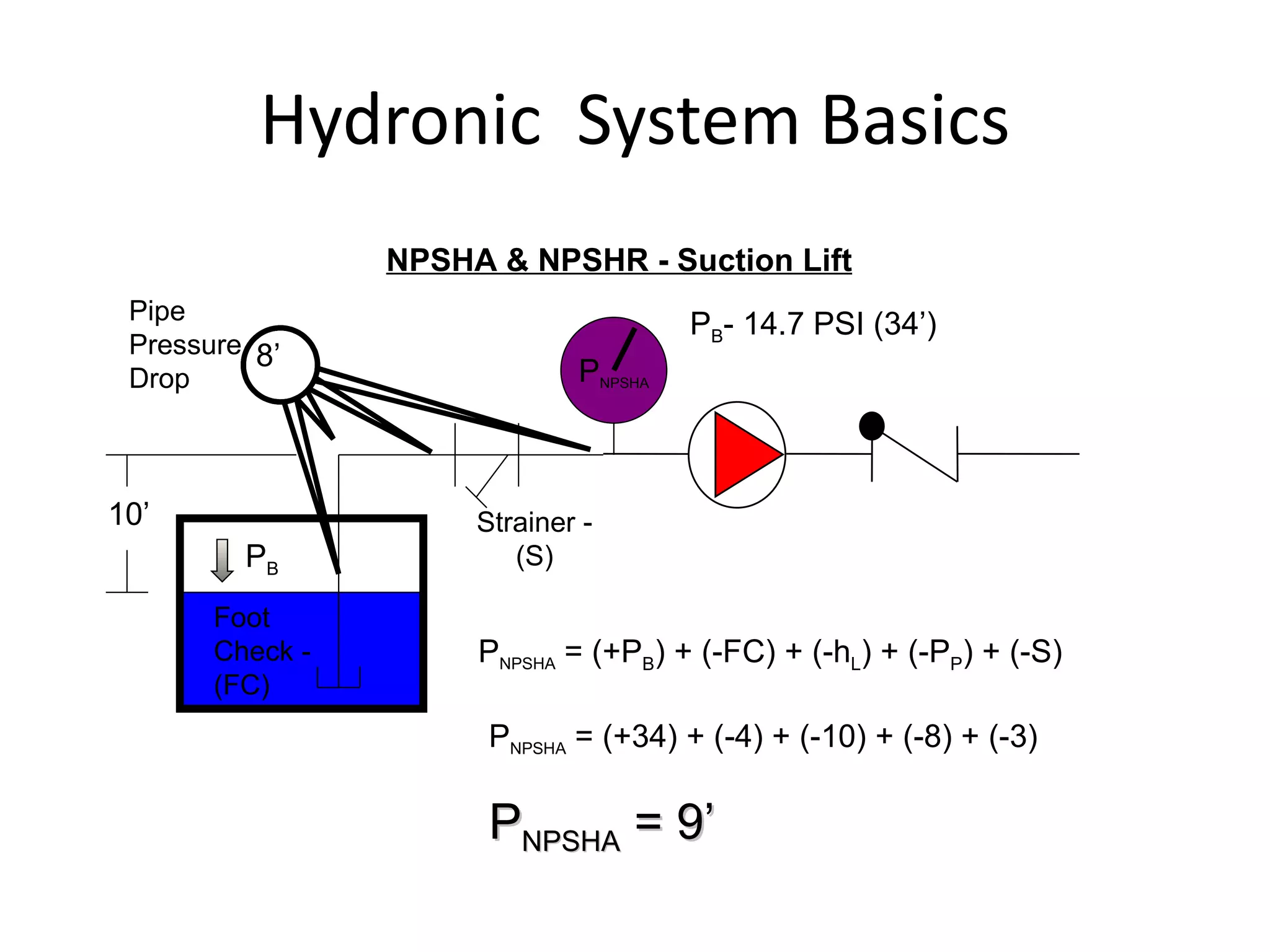
Hydronic  System Basics P NPSHA P B Foot Check - (FC) 10’ Strainer - (S) 8’ P NPSHA  = (+P B ) + (-FC) + (-h L ) + (-P P ) + (-S)  Pipe Pressure Drop P B - 14.7 PSI (34’) P NPSHA  = (+34) + (-4) + (-10) + (-8) + (-3)  P NPSHA  = 9’   NPSHA & NPSHR - Suction Lift
Hydronic  System Basics NPSHA & NPSHR - Flooded Suction P NPSHA 8’ Pipe Pressure Drop P B - 14.7 PSI (34’) Strainer - (S) 10’ P B P NPSHA  = (+P B ) + (-FC) + (-h L ) + (-P P ) + (-S)  P NPSHA  = (+34) + (-4) + (+10) + (-8) + (-3)  P NPSHA  = 29’
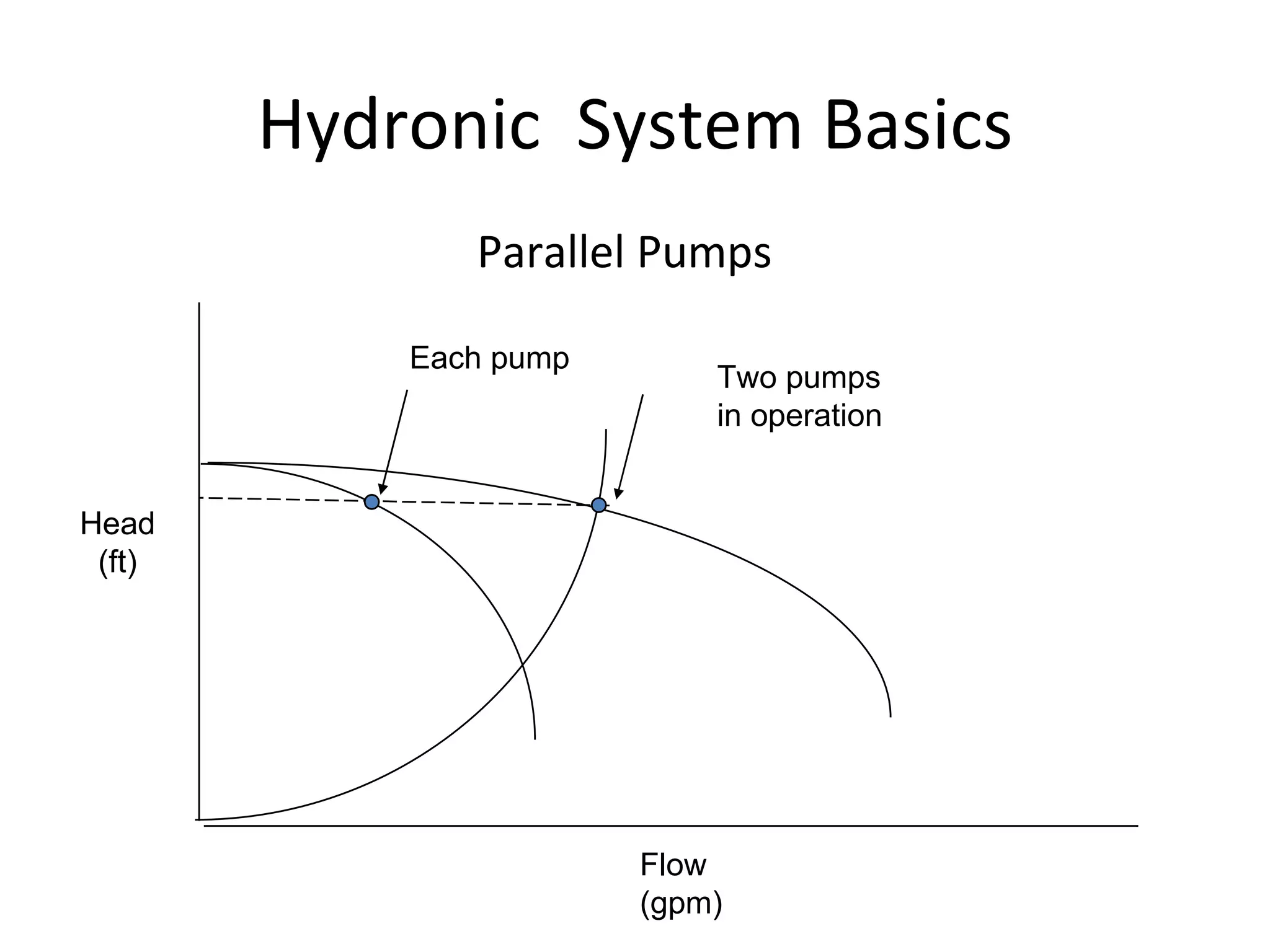
Total system HEAD & FLOW requirements through two parallel pumps Total System Head 1/2 Total Flow 1/2 Total Flow Hydronic  System Basics Parallel Pumps
Two pumps in operation Each pump Head (ft) Flow (gpm) Hydronic  System Basics Parallel Pumps
Total system HEAD & FLOW requirements through two series pumps Total System Flow 1/2 Total Head 1/2 Total Head Hydronic  System Basics Series Pumps
Hydronic  System Design Flow (gpm) Two pumps in operation Each pump Head (ft) Series Pumps
Hydronic  System Types Open Loop System
Hydronic  System Types Closed Loop System
Hydronic  System Types Direct Return System
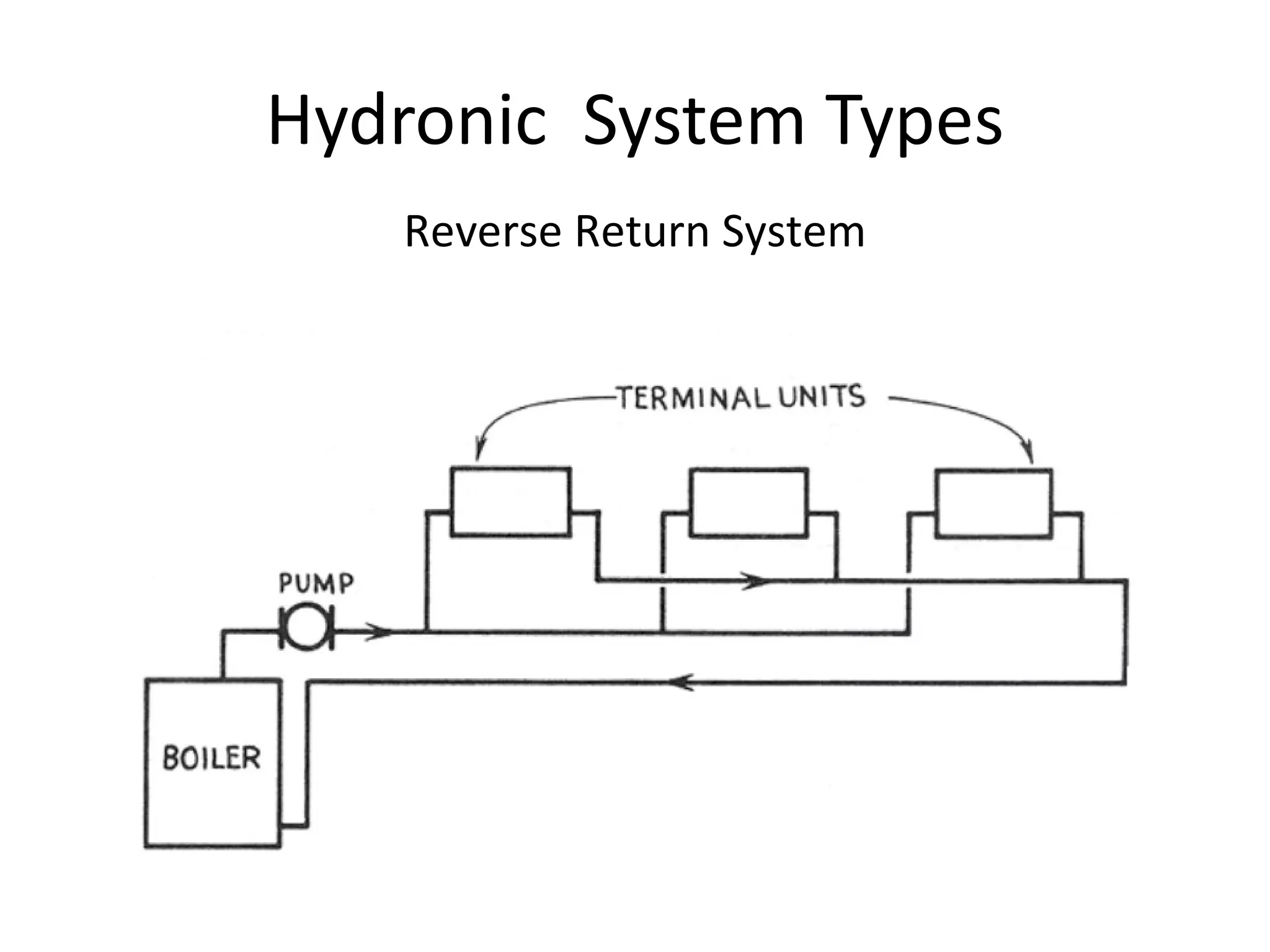
Hydronic  System Types Reverse Return System
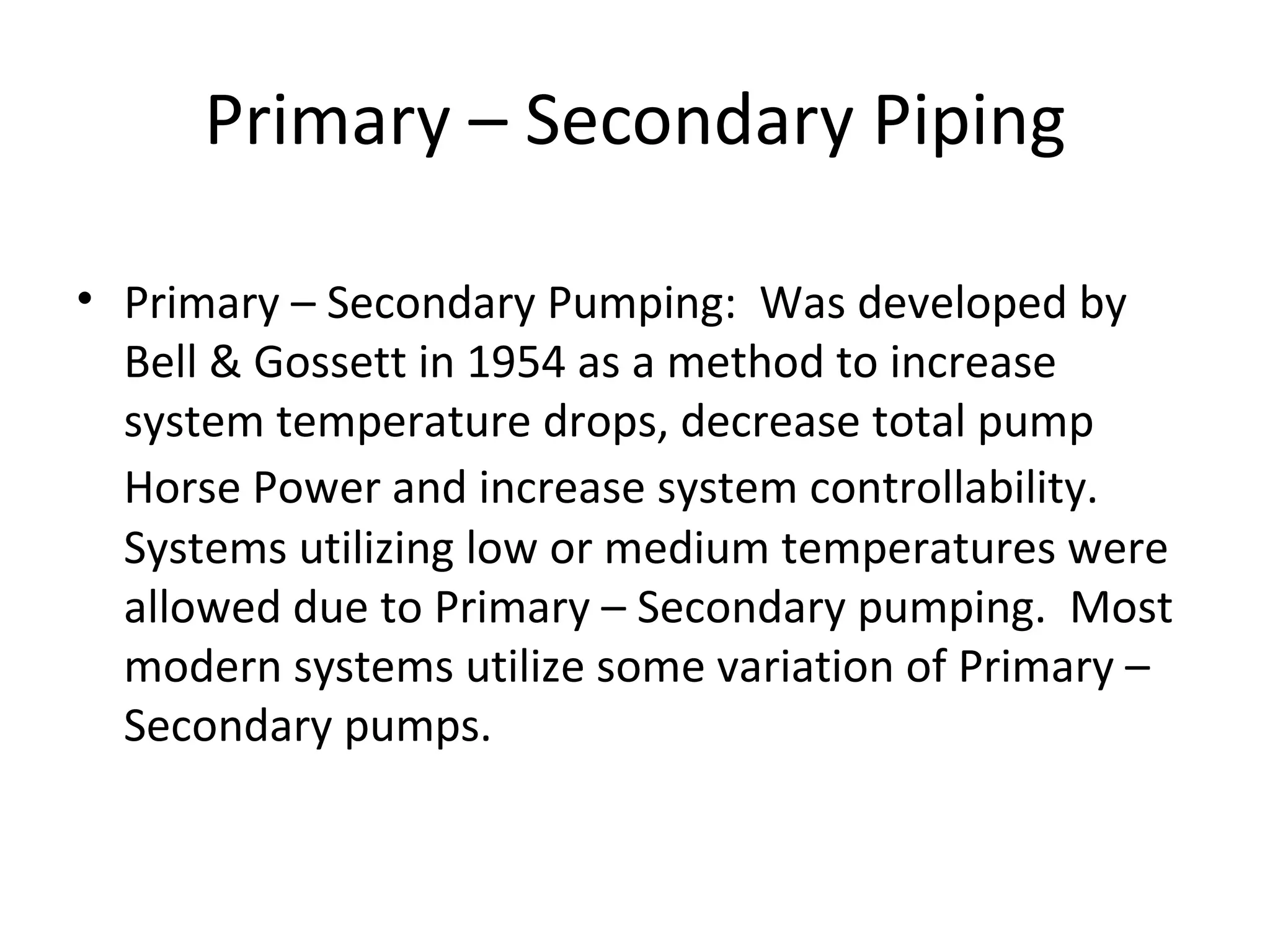
Primary – Secondary Piping Primary – Secondary Pumping:  Was developed by Bell & Gossett in 1954 as a method to increase system temperature drops, decrease total pump Horse Power and increase system controllability.   Systems utilizing low or medium temperatures were allowed due to Primary – Secondary pumping.  Most modern systems utilize some variation of Primary – Secondary pumps.
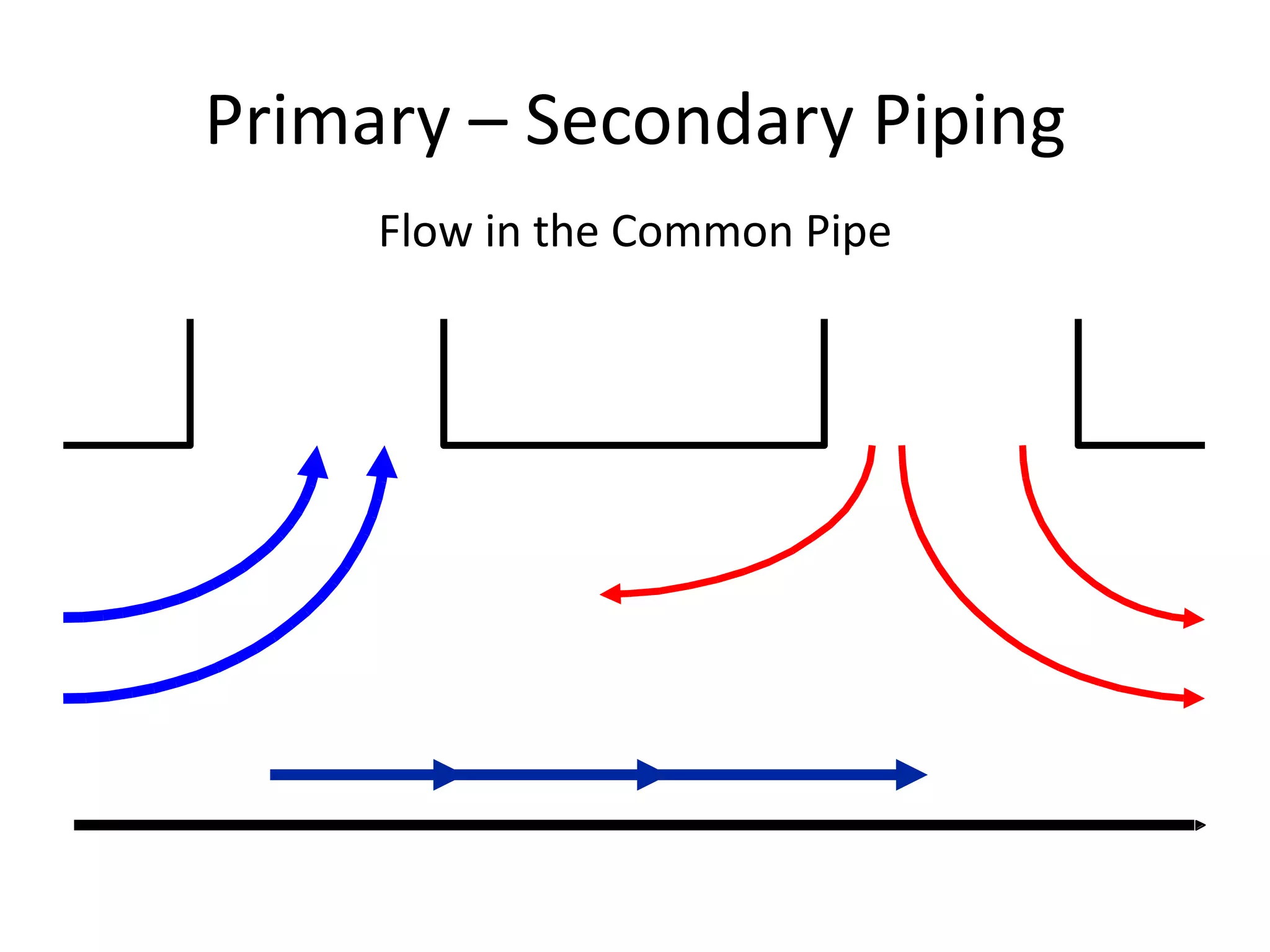
Primary – Secondary Piping “ Common Piping” interconnects the Primary to the Secondary Circuit “ Common Piping” should have minimal to no pressure drop to be designed correctly Hydraulically disconnects the two piping loops Flow in one loop will not cause flow in the other loop
Primary – Secondary Piping Basic Example
Primary – Secondary Piping Flow in the Common Pipe
Primary – Secondary Piping Finite Analysis of Common Piping Primary Return Secondary Return Secondary Supply Primary Supply
Primary – Secondary Piping Law of the Tees
Primary – Secondary Piping Secondary pipe pump sized for pressure drops A-B, B-C, C-D, D-E, E-G, G-H, H-I I-A should have no pressure drop.
Primary – Secondary Piping Cross-over Bridge Piping - Underslung
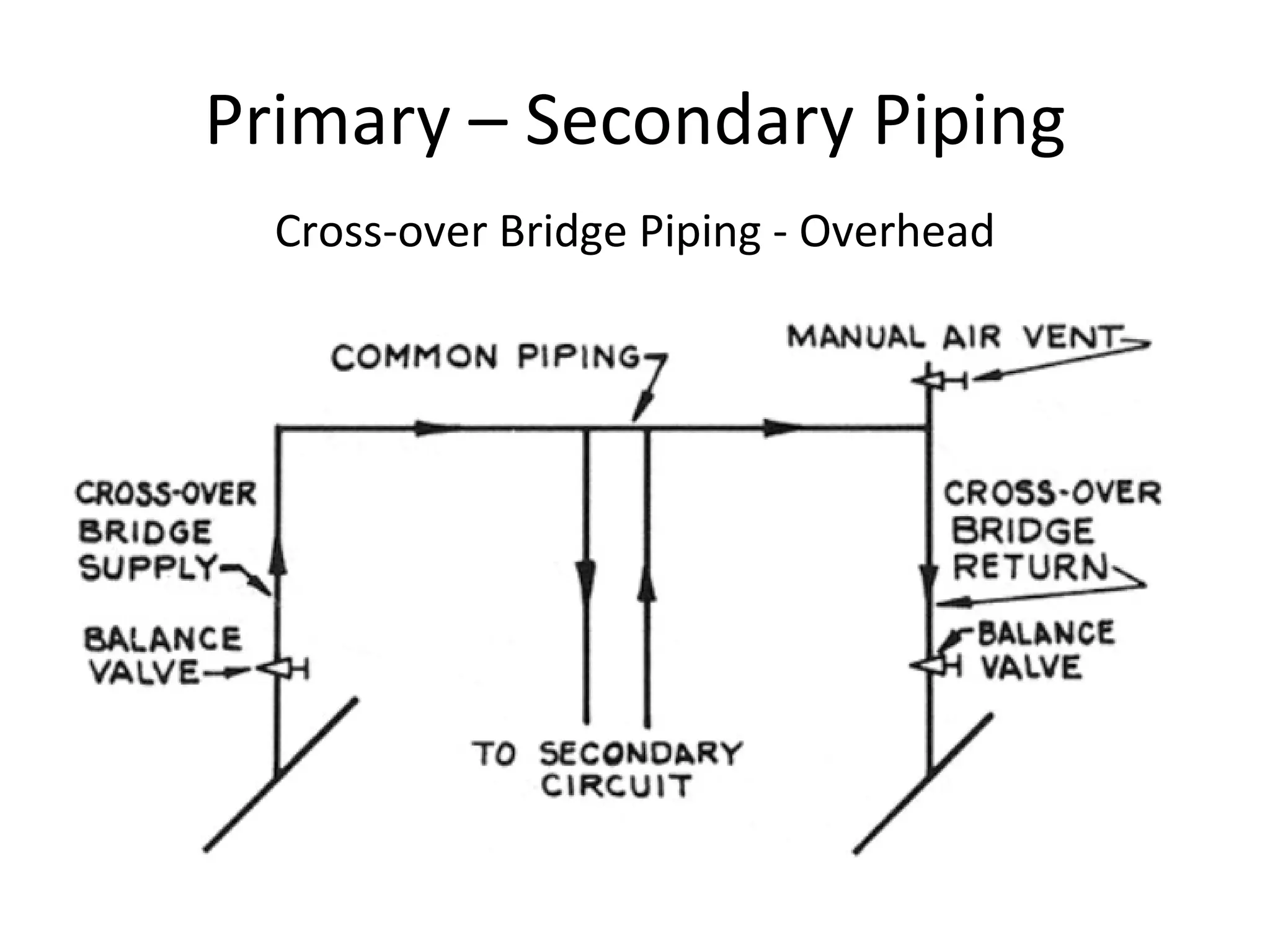
Primary – Secondary Piping Cross-over Bridge Piping - Overhead
Primary – Secondary Piping Correct Pump Location
Primary – Secondary Piping INCORRECT Pump Location
Primary – Secondary Piping What is the Flow Rate in the Common Pipe?
Primary – Secondary Piping Injection Pump Systems
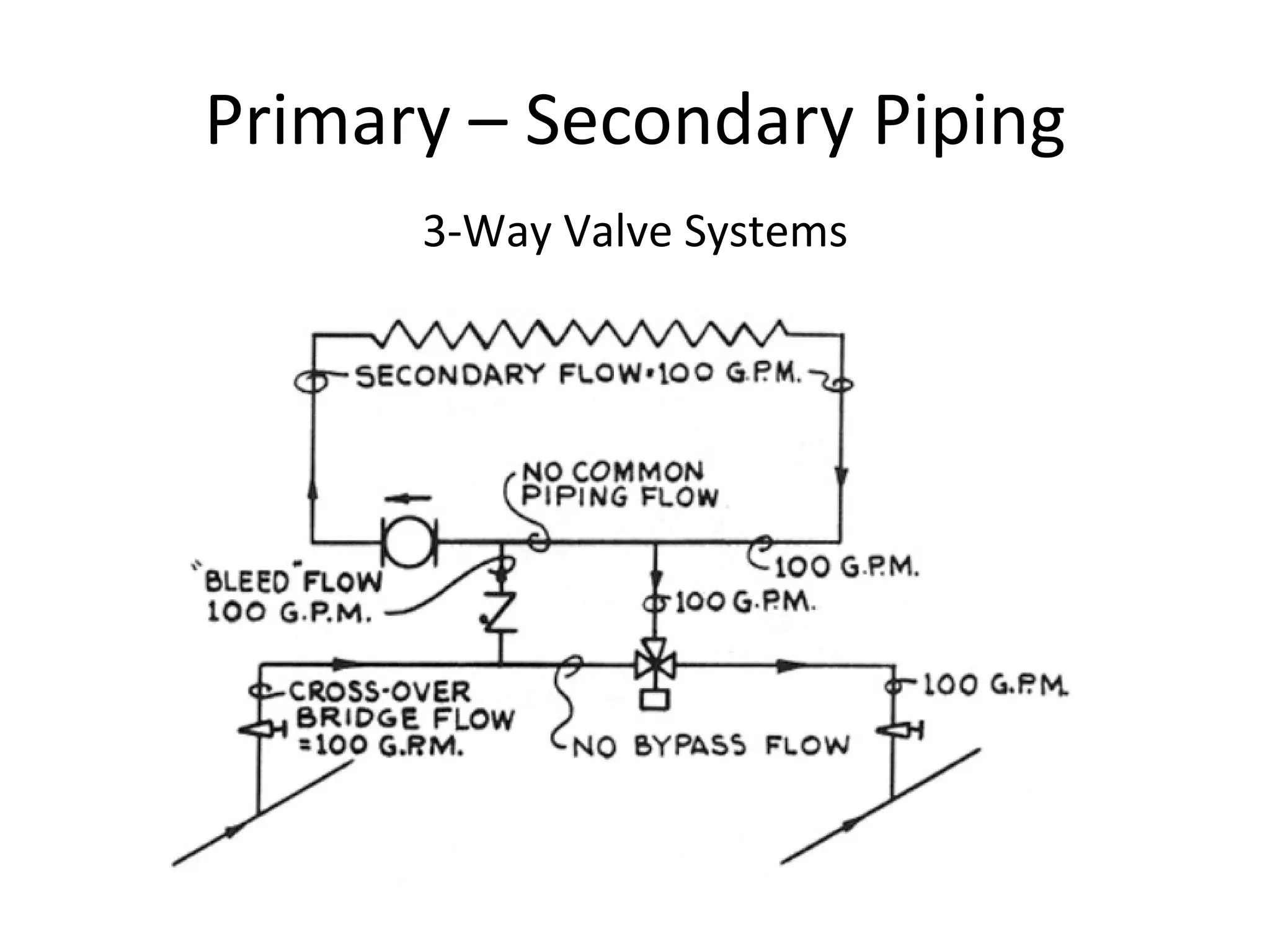
Primary – Secondary Piping 3-Way Valve Systems
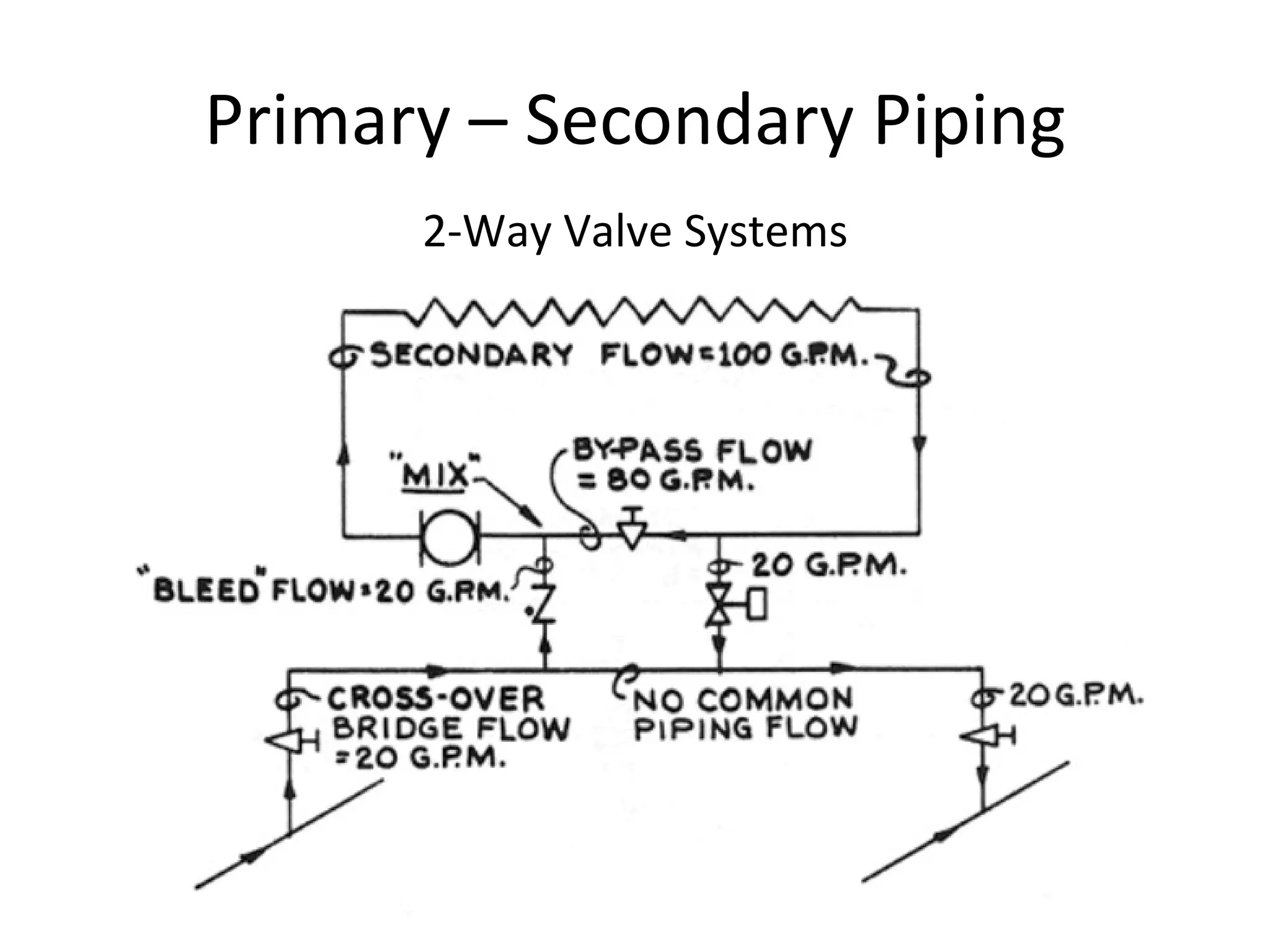
Primary – Secondary Piping 2-Way Valve Systems
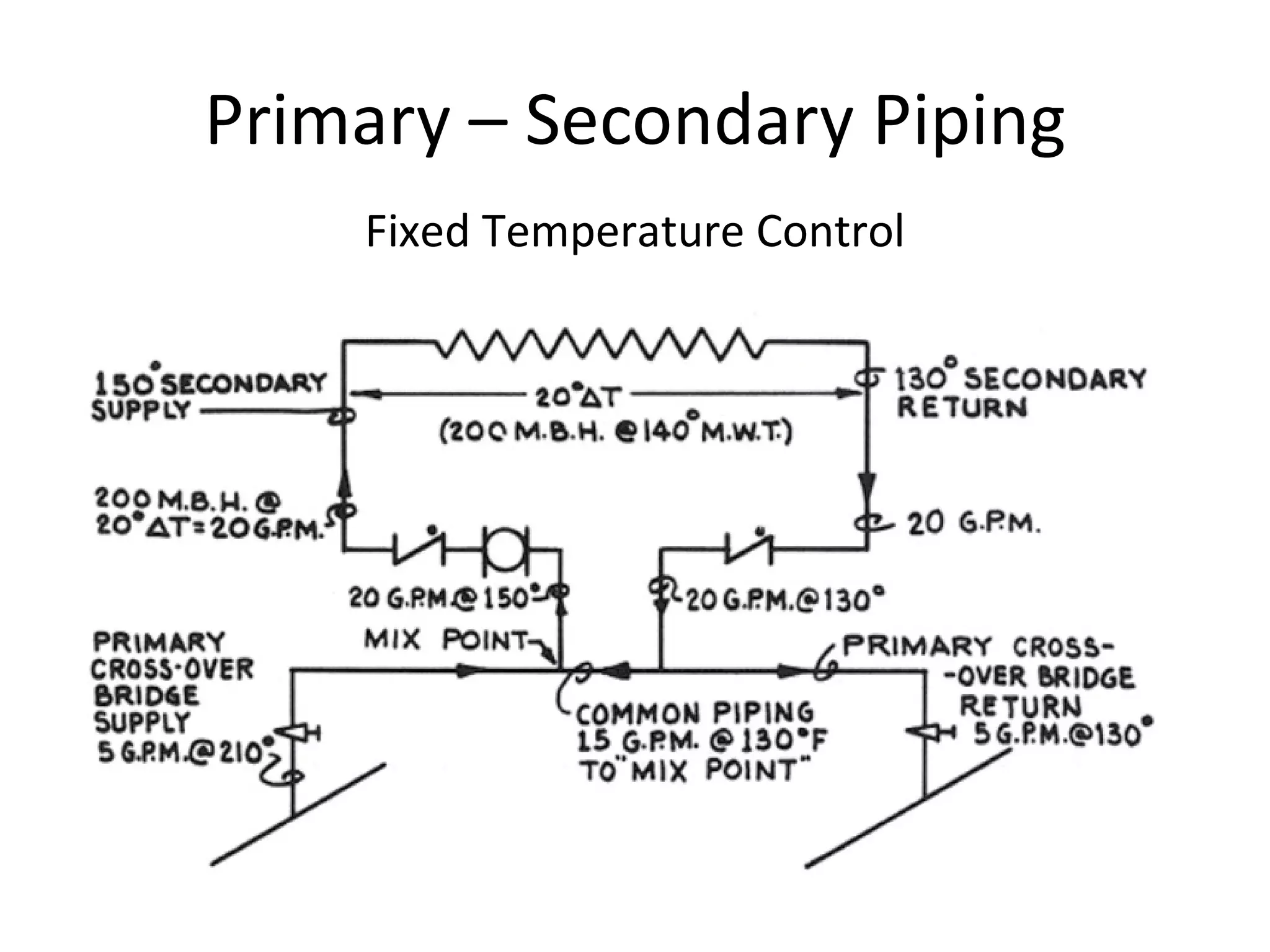
Primary – Secondary Piping Fixed Temperature Control
Primary – Secondary Piping Modulating Temperature Control
Variable Flow / Variable Speed
Variable Flow Systems Constant Speed / Variable Volume Utilizes 2-way valves Pump Energy is reduced Variable Speed / Variable Volume Utilizes 2-way valves Pump Energy is reduced Uses VFDs to reduce pump speed
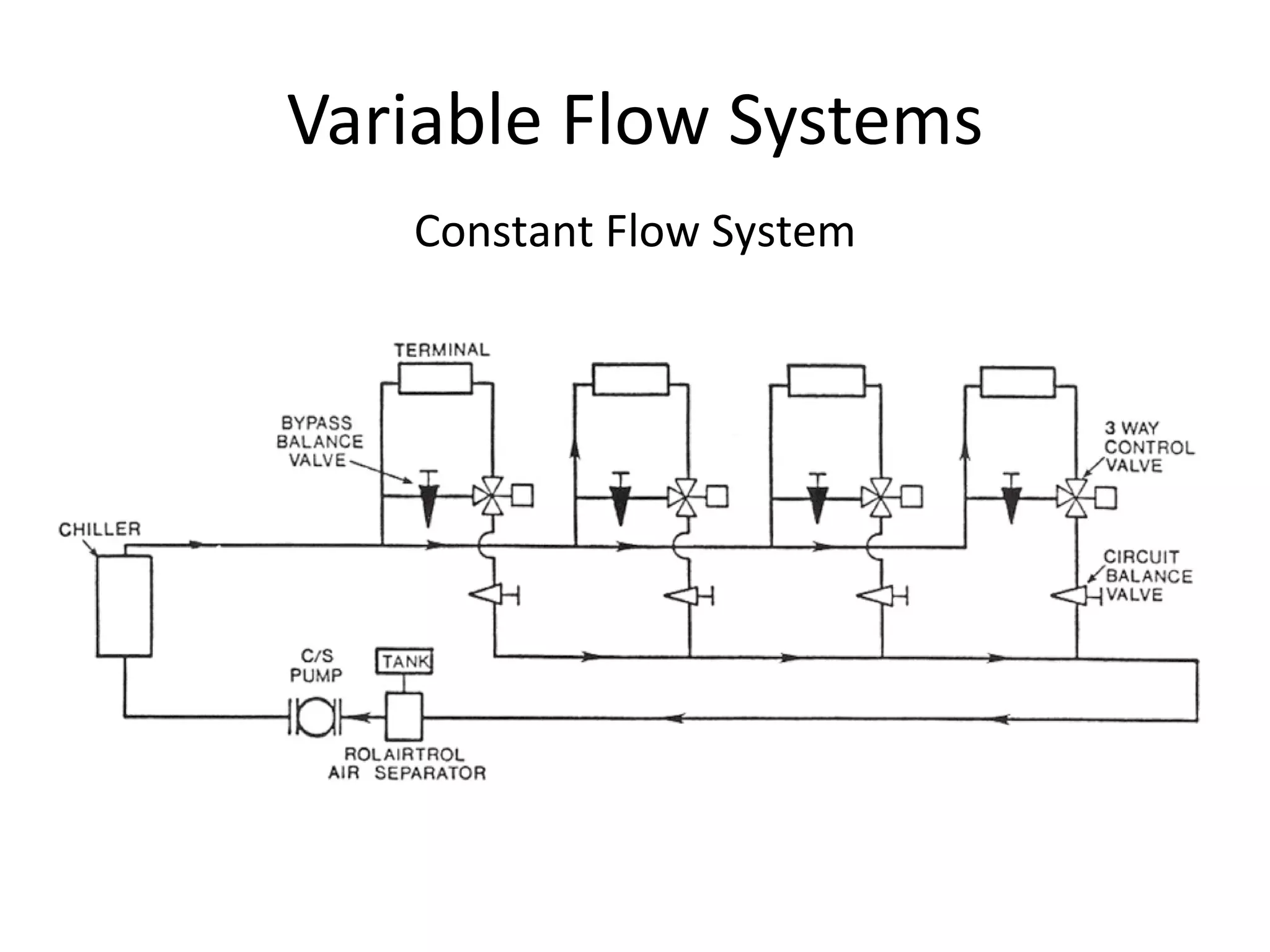
Variable Flow Systems Constant Flow System
Variable Flow Systems Constant Speed - Variable Flow System
Variable Flow Systems Variable Volume System HP
Variable Flow Systems Variable Speed gives reduced HP Variable Speed allows for easy pump balancing Variable Speed also acts as a soft starter Variable Speed drives are getting less costly Variable Speed is not a mystery anymore
Hydronic  System Basics GPM 2 GPM 1 HEAD 2 RPM 2 RPM 1 HEAD 1 HP 2 HP 1 RPM 2 RPM 1 RPM 2 RPM 1 HP 2 HP 1 GPM 2 GPM 1 GPM 2 GPM 1 HEAD 2 HEAD 1 Affinity Laws 2 2 3 3 = = = = =
Variable Flow Systems 12.5HP 1800 RPM 1.6HP 950 RPM HP 2 12.5 = 900 1800 3 HP 1  = 1.6 HP
Variable Flow Systems
Variable Flow Systems SOURCE SOURCE System Criteria 2 - 100 Ton Chillers 2 - 300 GPM @ 100’ Pumps Pumps 2 - 20HP No Standby System Pressure Drop Total of 75’   P Chiller Pressure Drop Total of 25’   P TOTAL INSTALLED HP - 40 HP LIMITED VARIABLE VOLUME -  30% MAX HP REDUCTION
Variable Flow Systems SOURCE SOURCE System Criteria 2 - 100 Ton Chillers 2 - 300 GPM @ 25’ Pumps 2 - 300 GPM @ 80’ Pumps Primary Pumps 2 - 3HP Secondary Pressure Drop Total of 80’   P Primary Pressure Drop Total of 25’   P Secondary Pumps 2 - 10 HP Running Standby TOTAL INSTALLED HP - 26 HP  2 - 10 HP VFDs w/ STAGING REQ’D
Variable Flow Systems DP Sensor Location – Sensor Across Coil Typical Setting Equals Design Pressure Drop Across the Coil, Control Valve, and Circuit Setter.  Coil 10 - 15’ P.D. Control Valve 10 - 15’ P.D. Typical Total P.D. 20 -30’
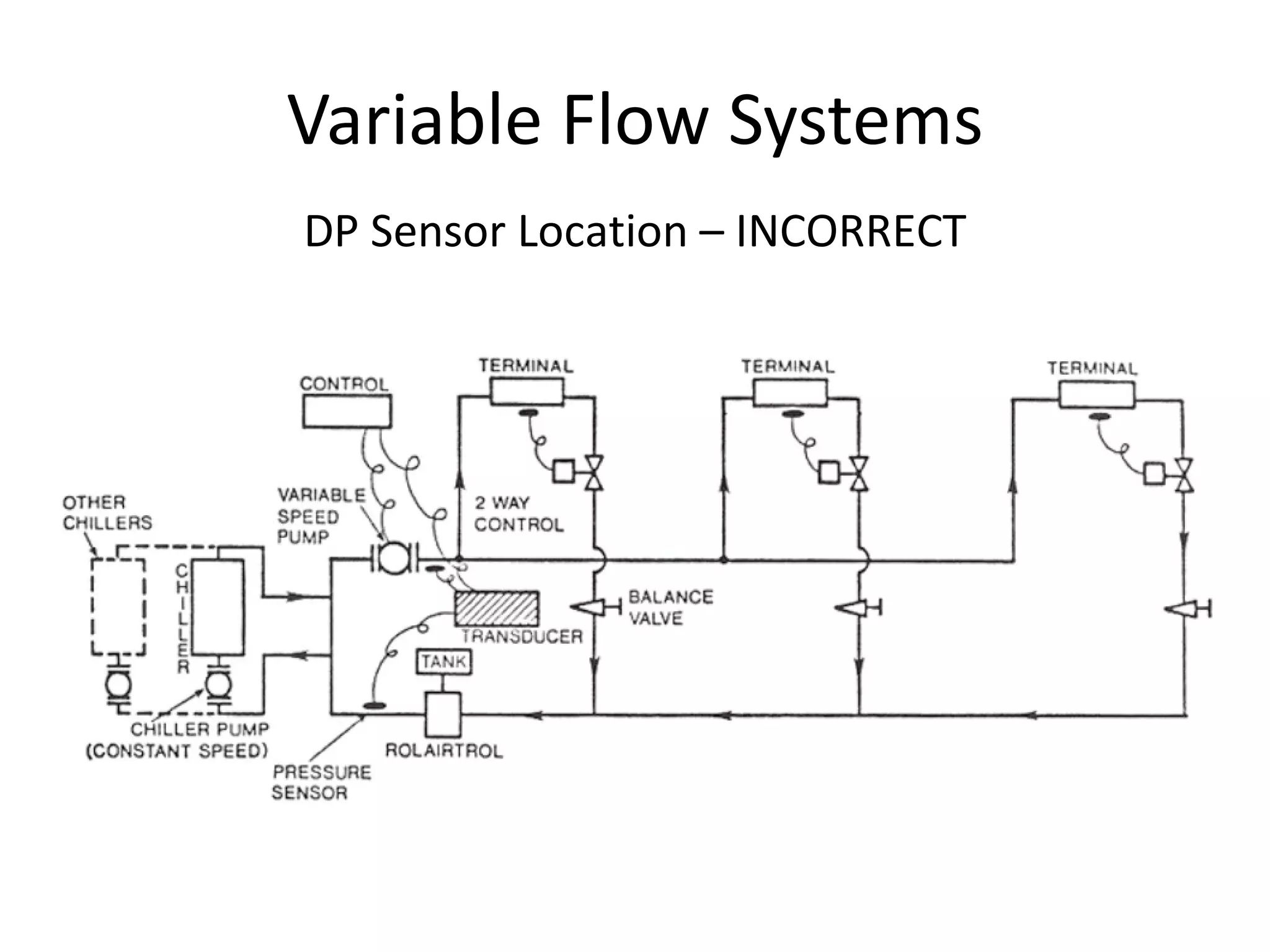
Variable Flow Systems DP Sensor Location – INCORRECT
Variable Flow Systems DP Sensor Location – Correct
System Examples Chilled Water – Direct Return with Variable Speed
System Examples Chilled Water – Reverse Return with Variable Speed
System Examples Boiler Water – Direct Return with Variable Speed
System Examples Boiler Water – Reverse Return with Variable Speed
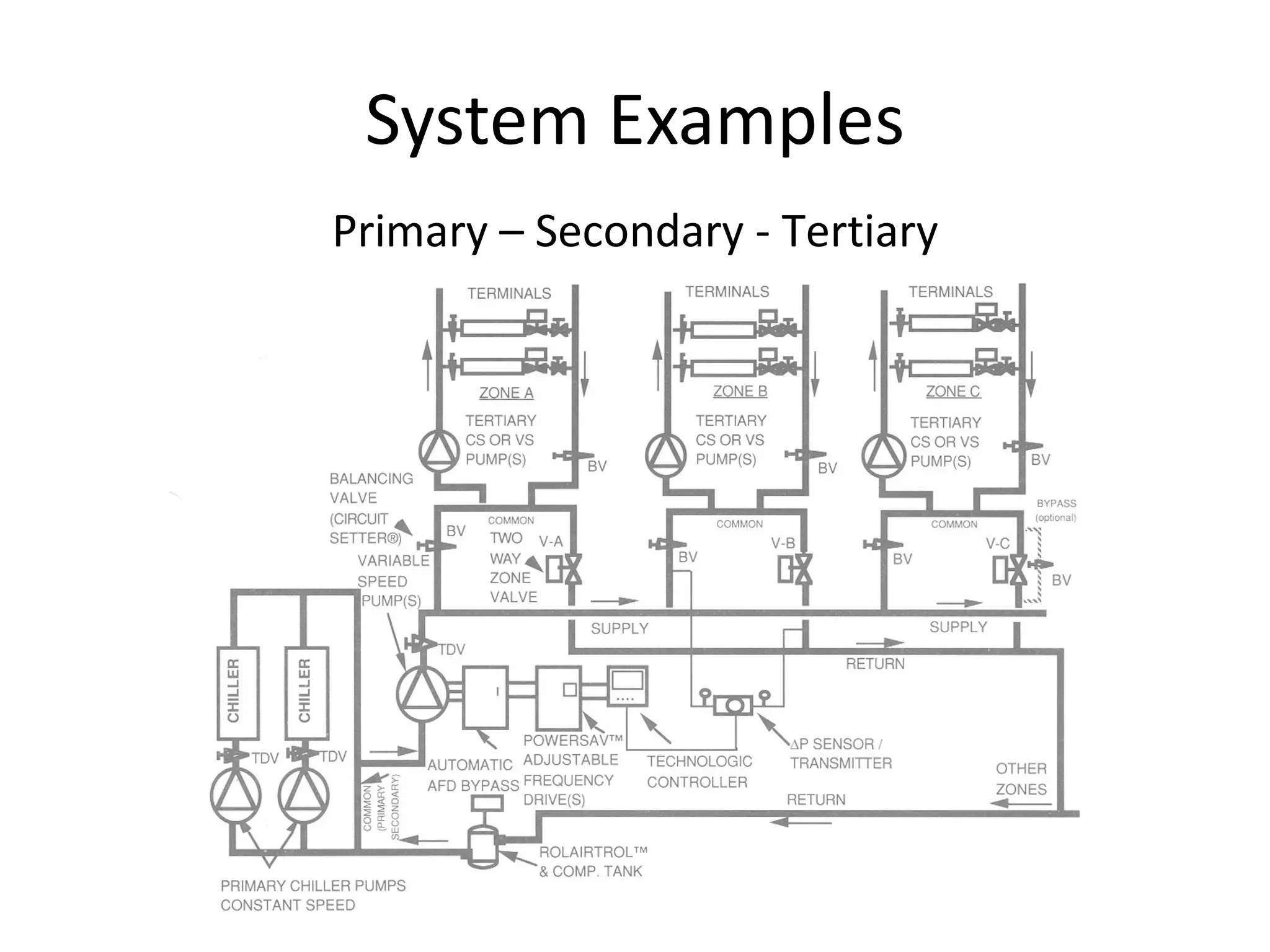
System Examples Primary – Secondary - Tertiary
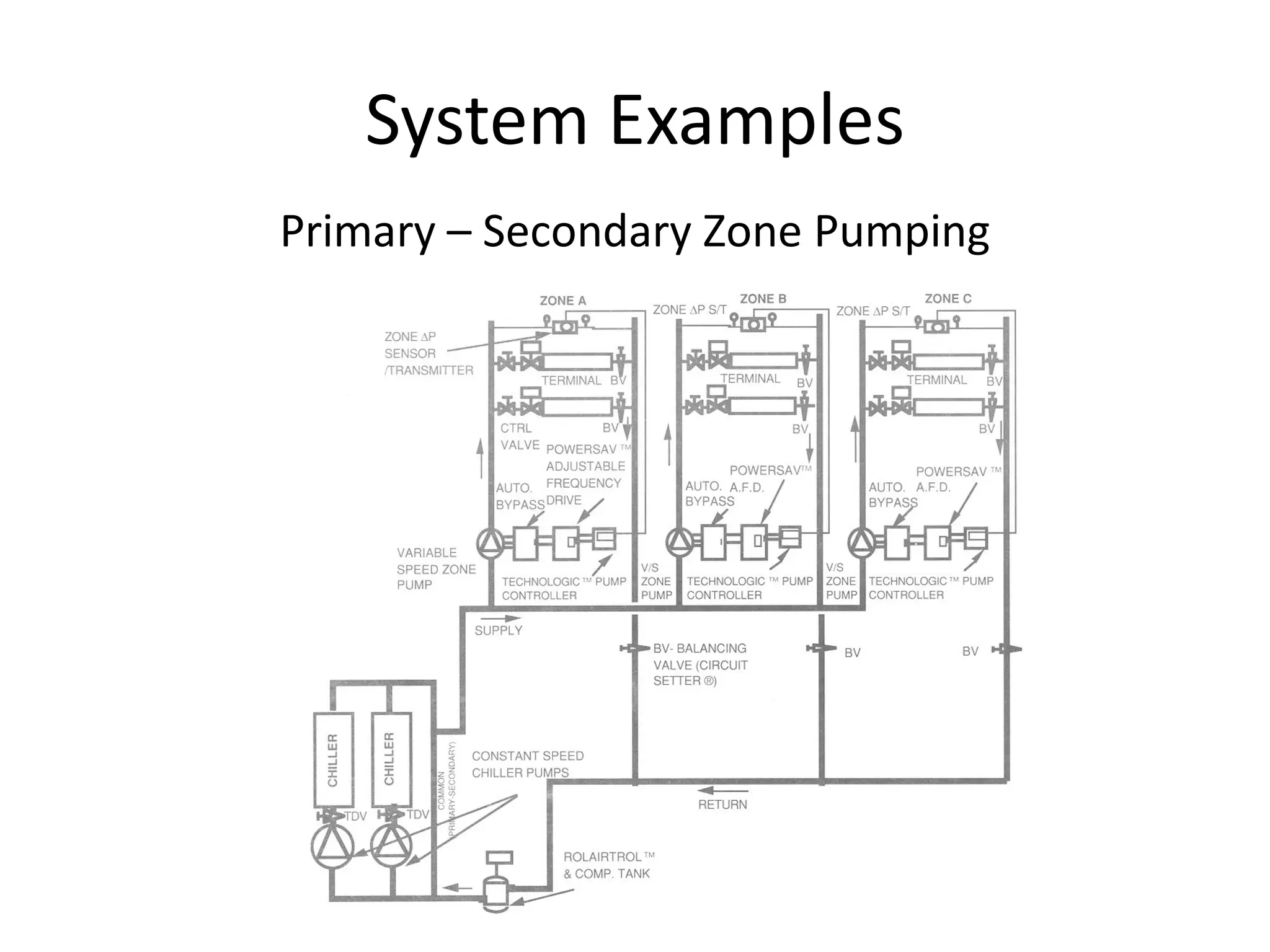
System Examples Primary – Secondary Zone Pumping
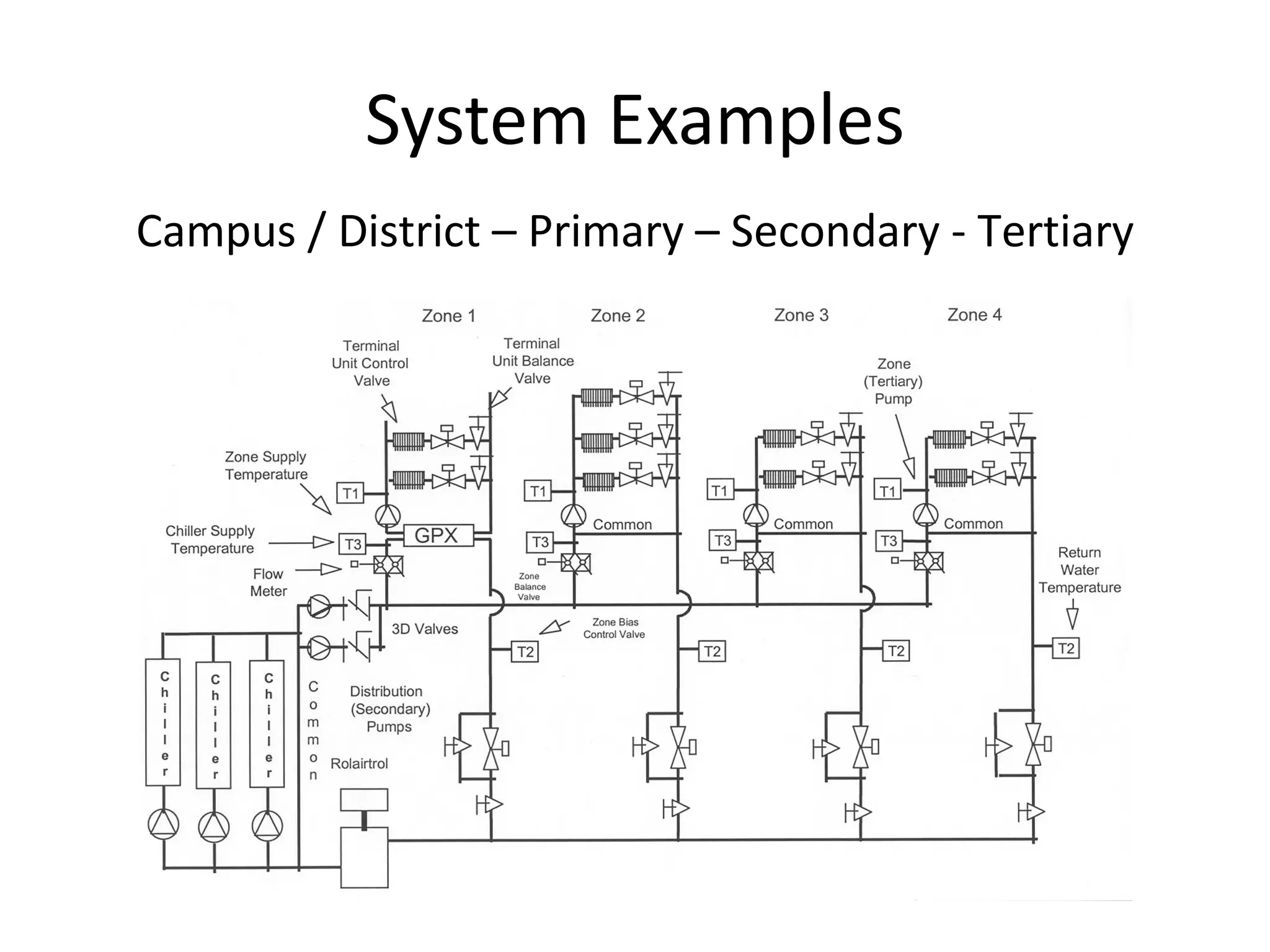
System Examples Campus / District – Primary – Secondary - Tertiary
Special System Piping
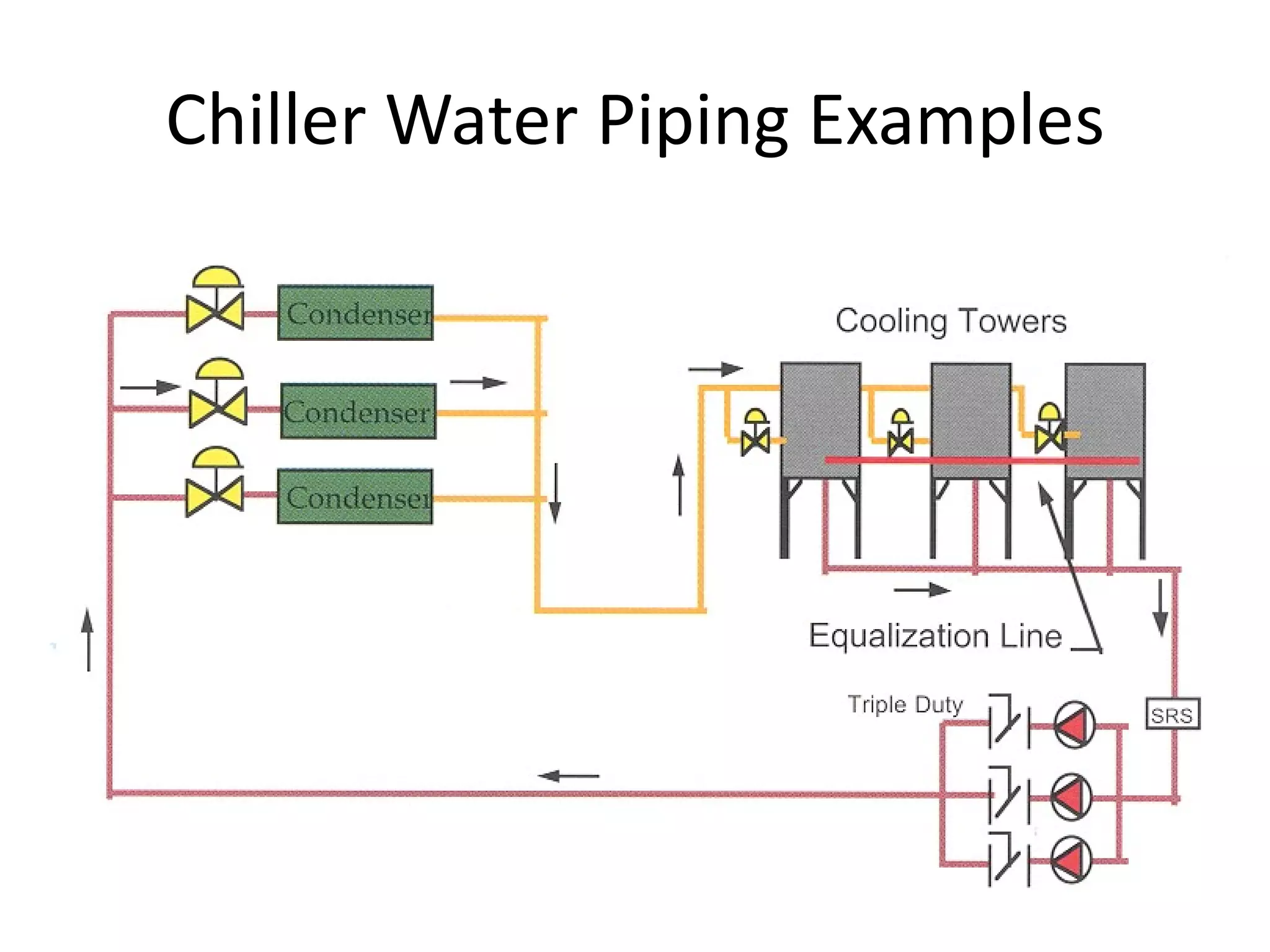
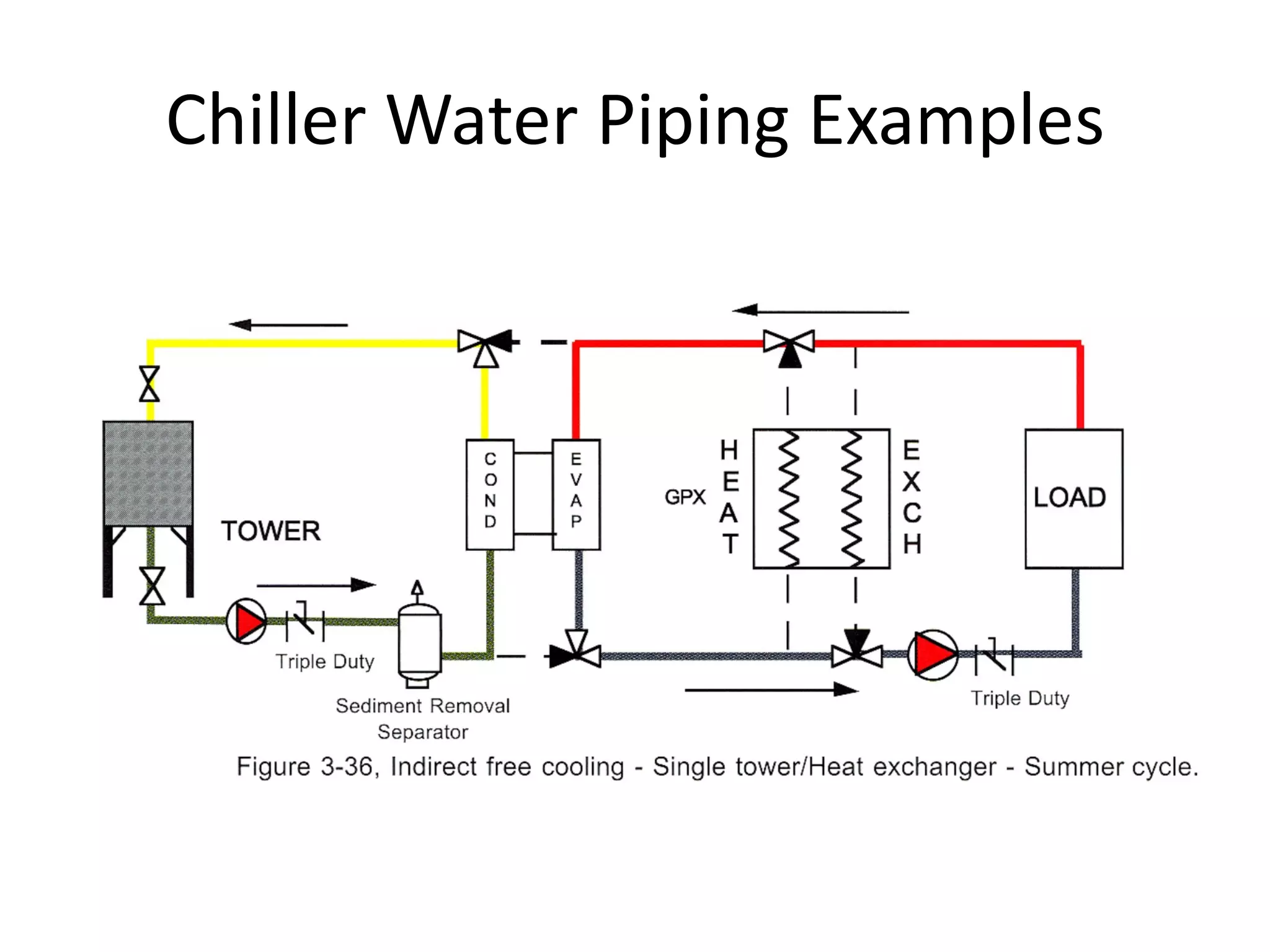
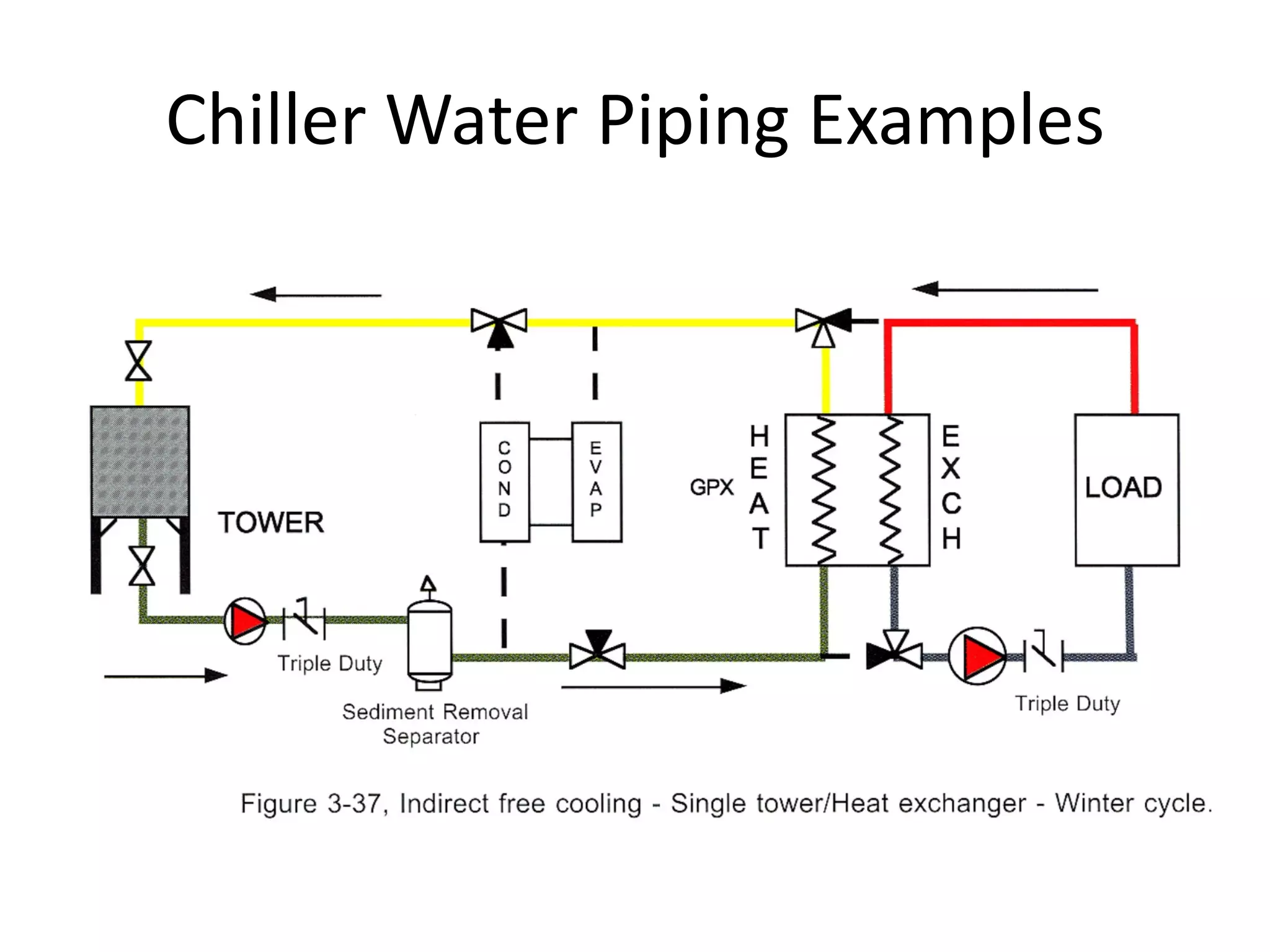
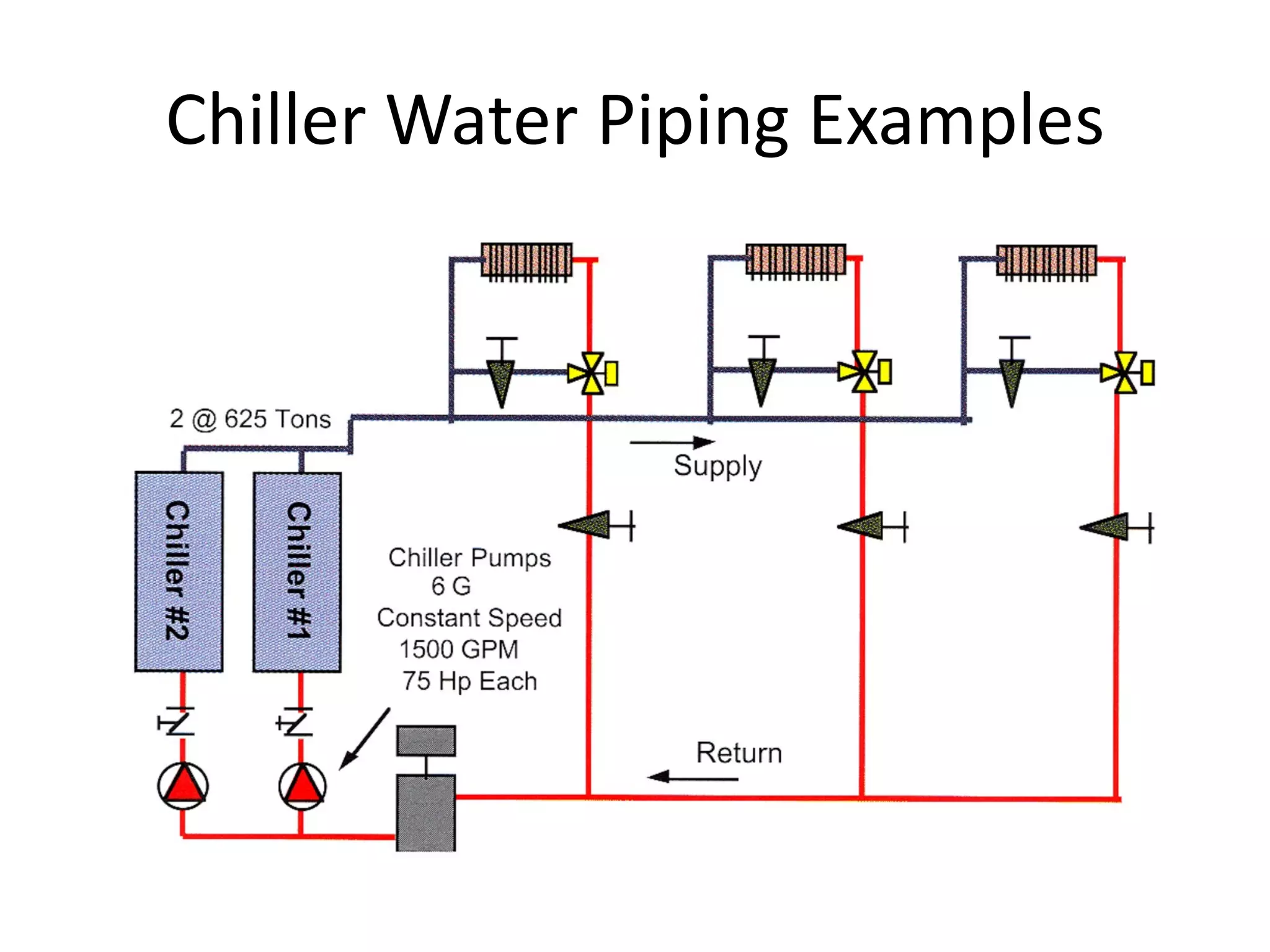
Chilled Water Piping Examples
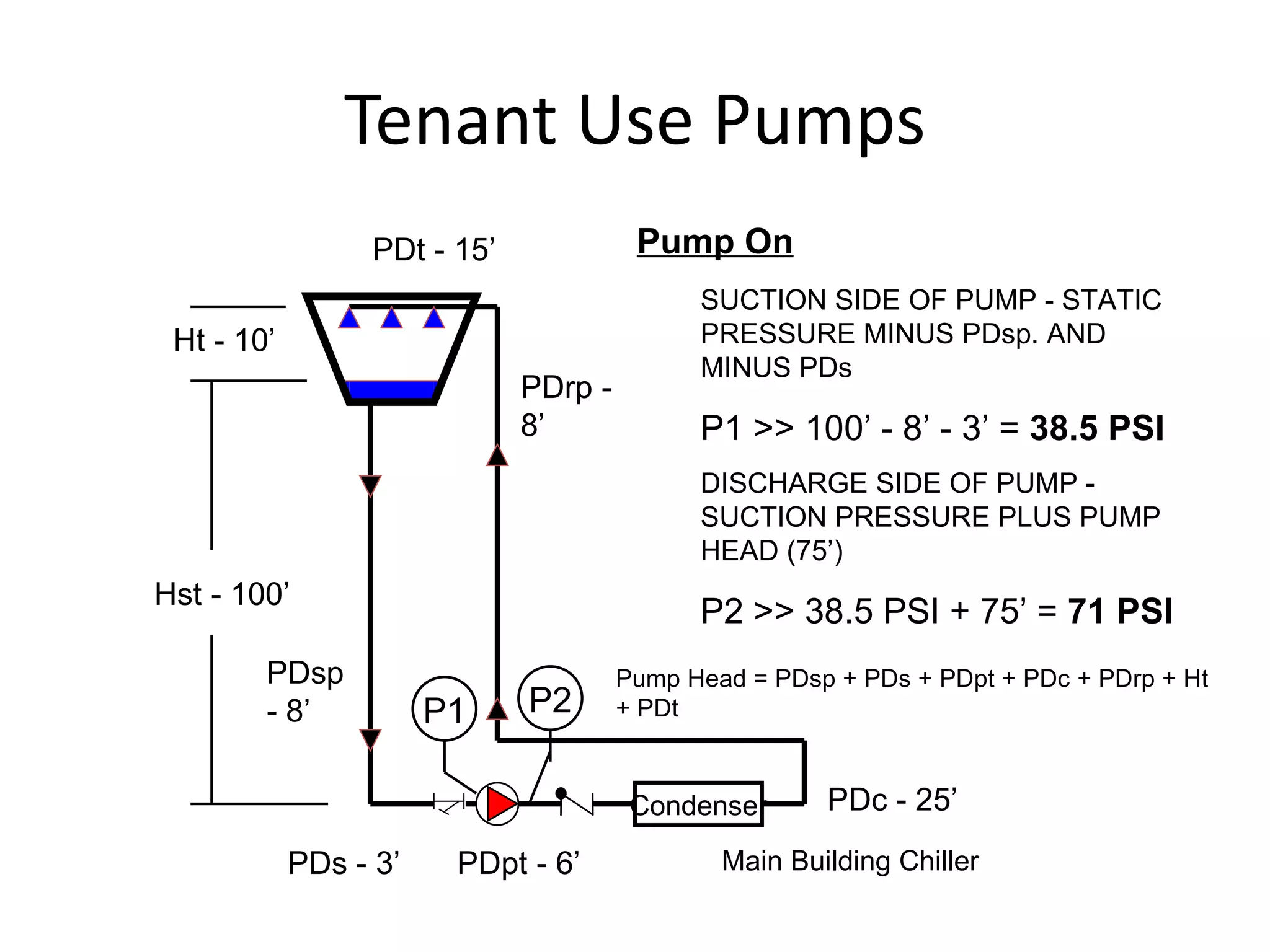
Tenant Use Pumps Tower Condenser Tenant Unit Tenant Unit Main Building Chiller
Tenant Use Pumps PDt Main Building Chiller Hst Ht PDrp PDsp PDs PDpt PDc PDt - Tower Pressure Drop PDsp - Suction Pipe Pressure Drop PDs - Strainer Pressure Drop PDpt - Pump Trim Pressure Drop PDc - Condenser Pressure Drop PDrp - Return Pipe Pressure Drop Ht - Tower Height - Static Lift Hst - Building Static Height Condenser
Tenant Use Pumps PDt - 15’ Main Building Chiller Hst - 100’ Ht - 10’ PDrp - 8’ PDsp - 8’ PDs - 3’ PDpt - 6’ PDc - 25’ ONLY STATIC PRESSURE SEEN AT PRESSURE GAUGE ON SUCTION OF PUMP P1 -  43 PSI   Pump OFF Condenser P1 P2
Tenant Use Pumps PDt - 15’ Main Building Chiller Hst - 100’ Ht - 10’ PDrp - 8’ PDsp - 8’ PDs - 3’ PDpt - 6’ PDc - 25’ SUCTION SIDE OF PUMP - STATIC PRESSURE MINUS PDsp. AND MINUS PDs P1 >> 100’ - 8’ - 3’ =  38.5 PSI  DISCHARGE SIDE OF PUMP - SUCTION PRESSURE PLUS PUMP HEAD (75’) P2 >> 38.5 PSI + 75’ =  71 PSI Pump On Pump Head = PDsp + PDs + PDpt + PDc + PDrp + Ht + PDt Condenser P1 P2
Tenant Use Pumps PDt Main Building Chiller Hst Ht PDrpa PDspa PDs PDpt PDc Ht - Tower Height - Static Lift Hst - Building Static Height PDspb PDrpb Hsta Hstb PDtenant PDt - Tower Pressure Drop PDspa - Suction Pipe Pressure Drop a Length PDspb - Suction Pipe Pressure Drop b Length PDs - Strainer Pressure Drop PDpt - Pump Trim Pressure Drop PDc - Condenser Pressure Drop PDrpa - Return Pipe Pressure Drop a Length PDrp b- Return Pipe Pressure Drop b Length Pdtenant - Tenant Loop Total Pressure Drop Condenser Tenant Unit
Tenant Use Pumps PDt - 15’ Main Building Chiller Hst - 100’ Ht - 10’ Pdrpa - 6’ Pdspa - 6’ PDs - 3’ PDpt - 6’ PDc - 25’ PDspb - 2’ PDrpb - 2’ Hsta - 80’ Hstb - 20’ Pdtenant - 25’ Tenant Pump Off - Main Pump On P3 - STATIC PRESSURE A  MINUS PDspa.  P3 >> 80’ - 6’  =  32 PSI  P4 - DISCHARGE SIDE OF PUMP - SUCTION PRESSURE PLUS PUMP HEAD (75’) MINUS PRESSURE DROPS P4 >> 71PSI - 6’ - 25’ - 20’ - 2’  =  48PSI Difference P3 - P4 = 16 PSI (37’) Condenser Tenant Unit P3 P4
Tenant Use Pumps PDt - 15’ Main Building Chiller Hst - 100’ Ht - 10’ Pdrpa - 6’ Pdspa - 6’ PDs - 3’ PDpt - 6’ PDc - 25’ PDspb - 2’ PDrpb - 2’ Hsta - 80’ Hstb - 20’ Pdtenant - 25’ Tenant Pump Sized for: Piping Pressure Drop Pump Trim Pressure Drop Tenant Unit Pressure Drop P4 - P3 Differential Tennant Pump Head = Pdtenant + 37’ = 25’ + 37’ = 62’ Condenser Tenant Unit P3 P4
Tenant Use Pumps Tenant Use Pumps Must be with the rest of the condenser water pumping system in mind.  Never size a tenant use system, for only the tenant loop pressure drop.   Typical Pump Size   15 GPM @ 100’ TDH Tower Condenser Tenant Unit Tenant Unit Main Building Chiller
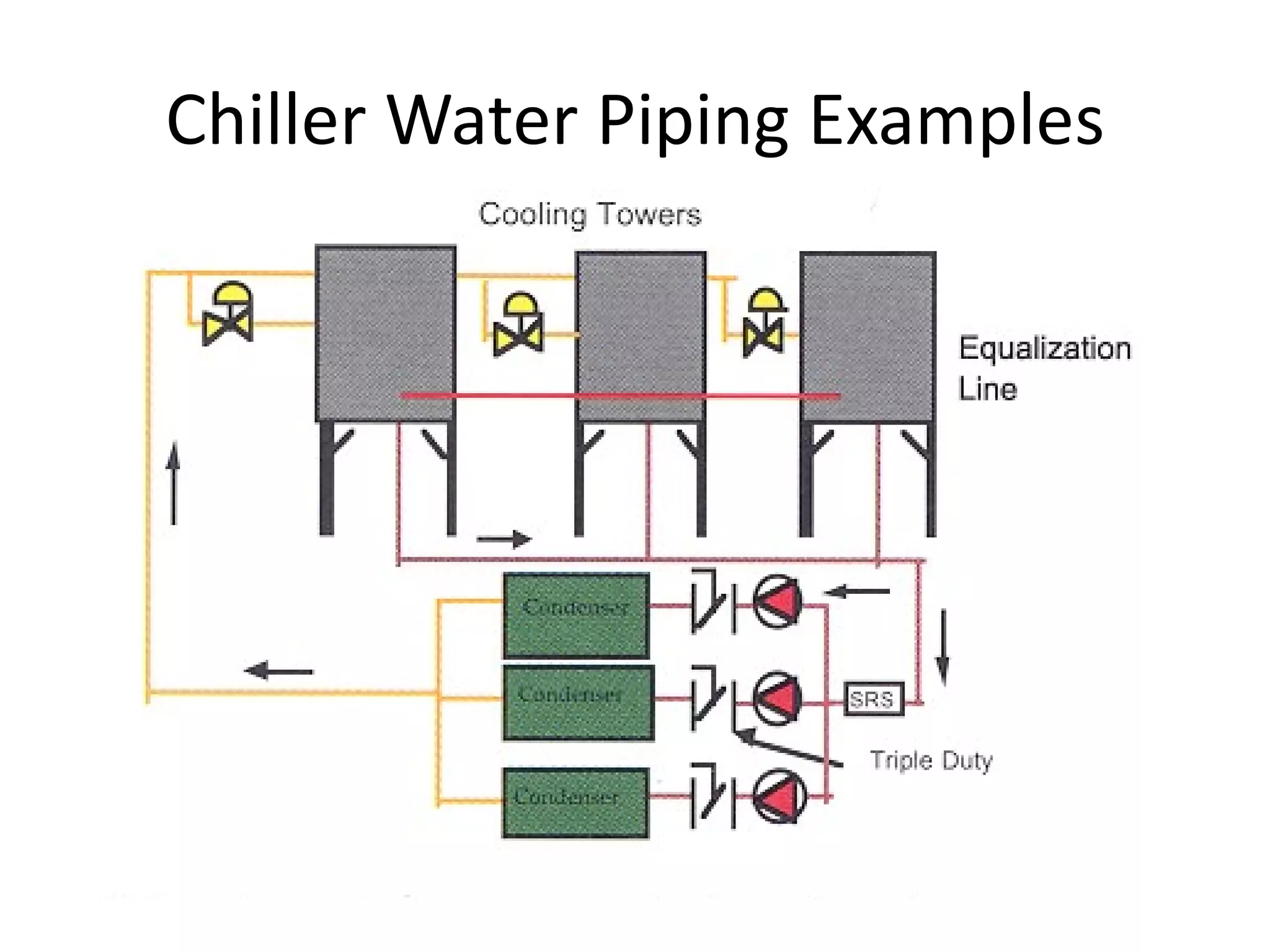
Chiller Water Piping Examples
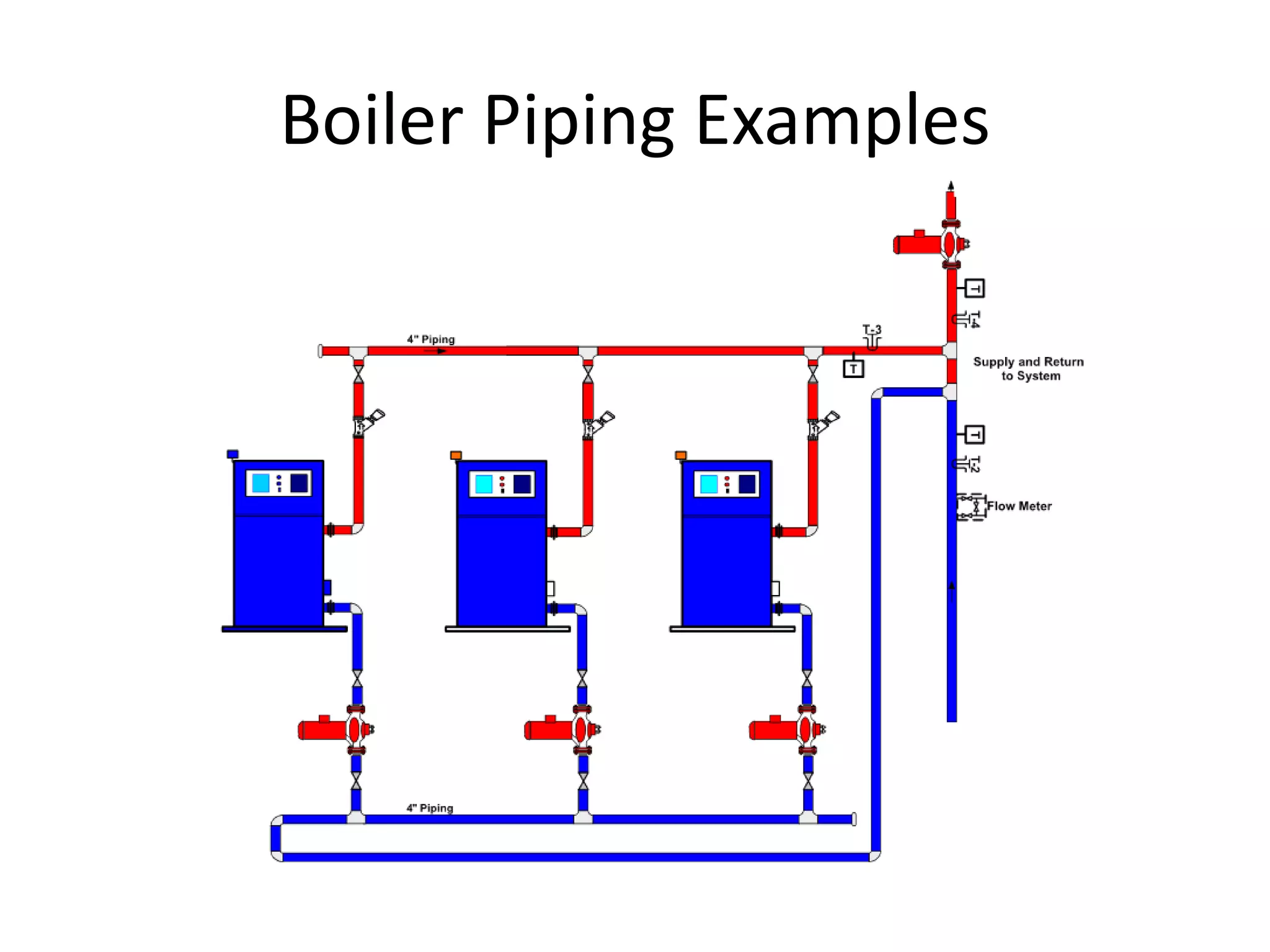
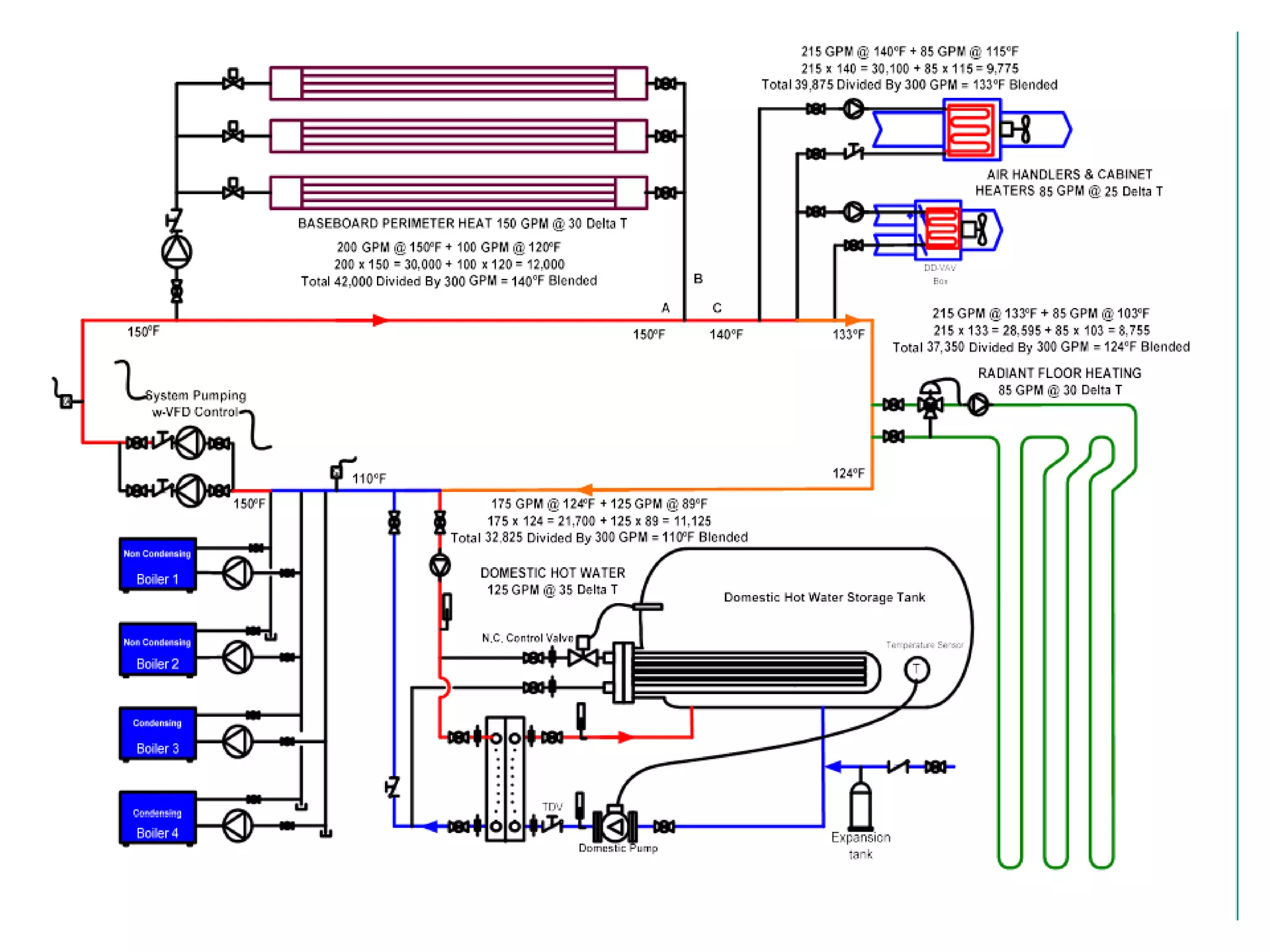
Boiler Piping Examples
 
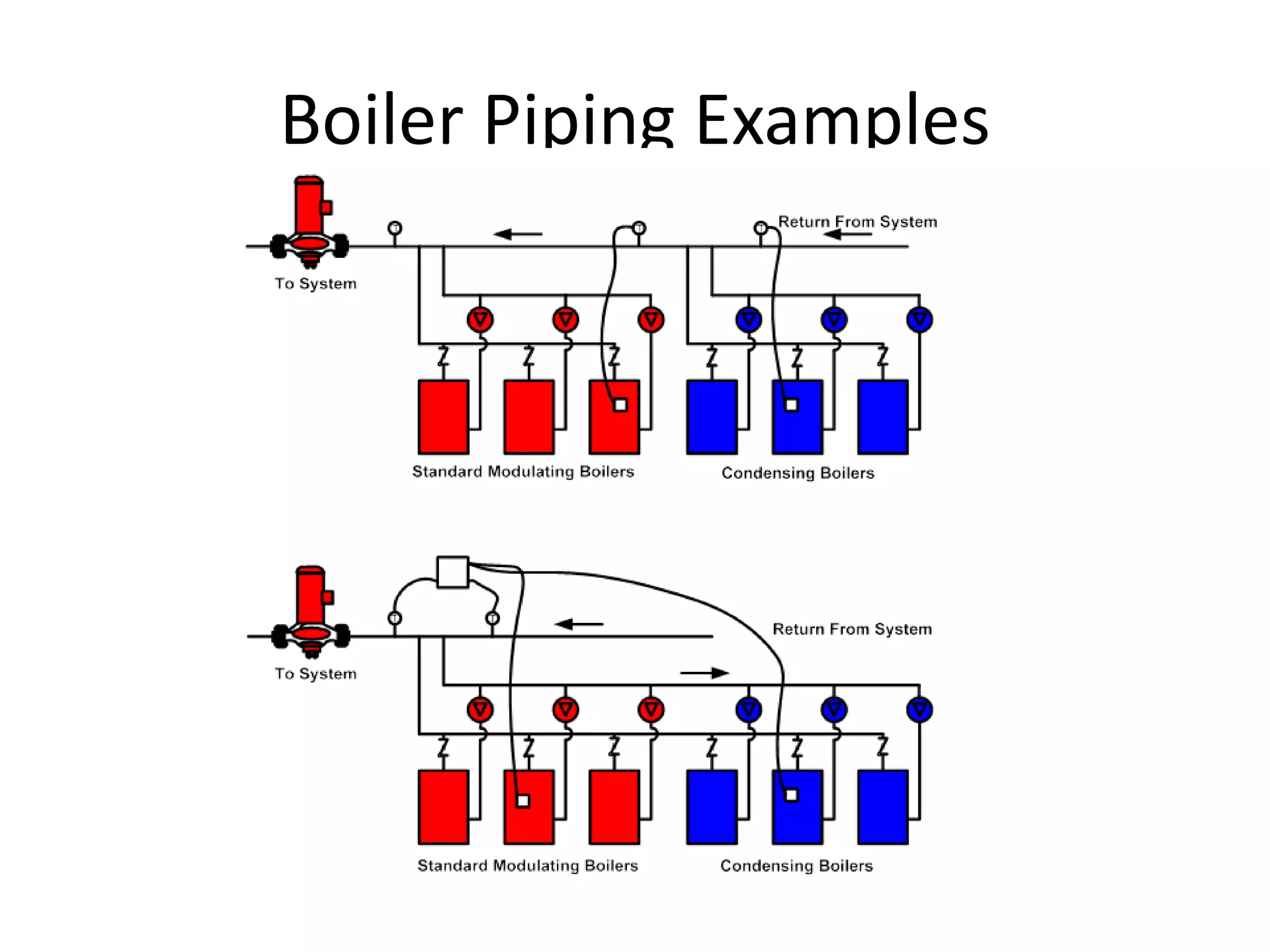
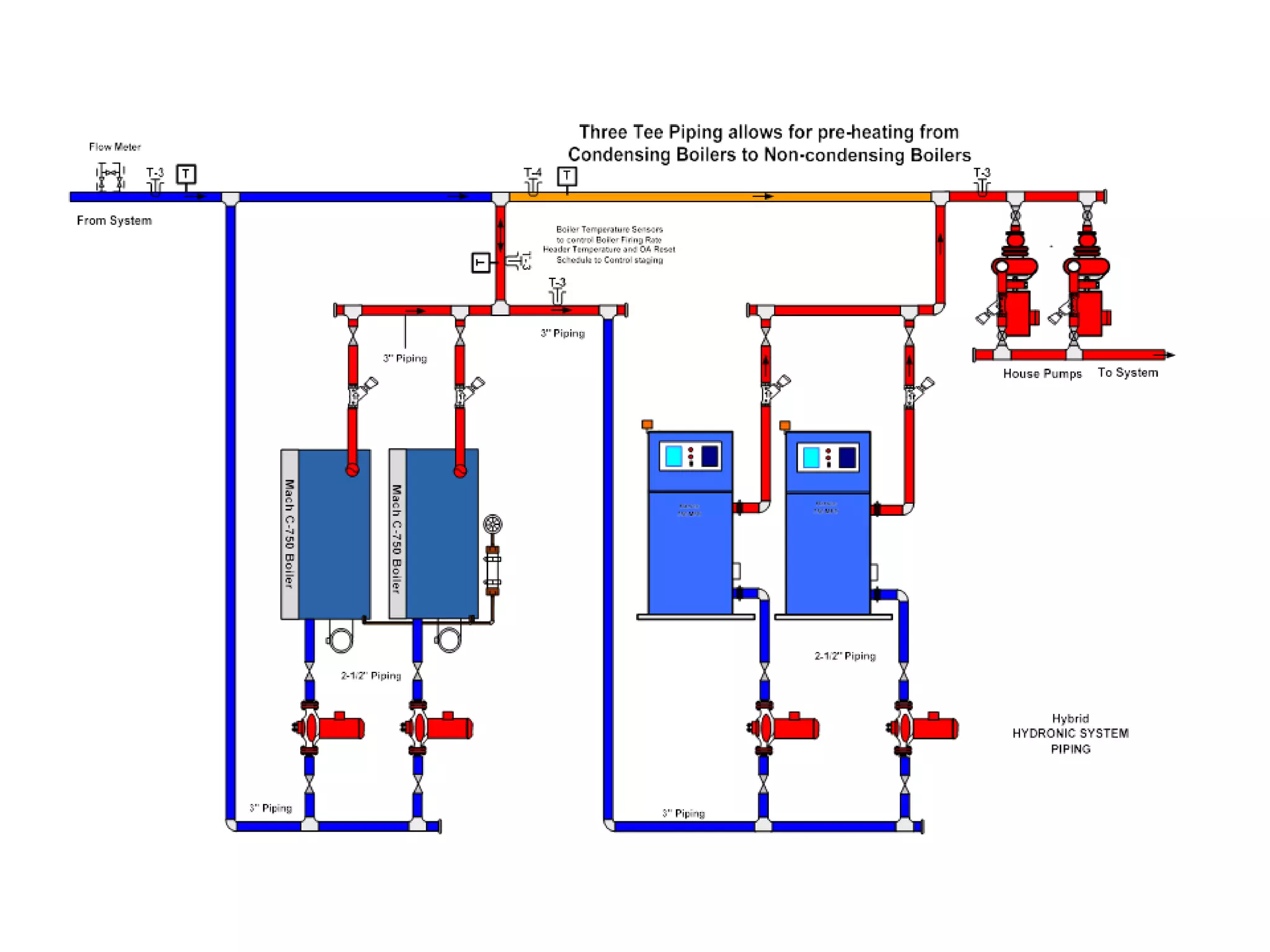
Hybrid Boiler System
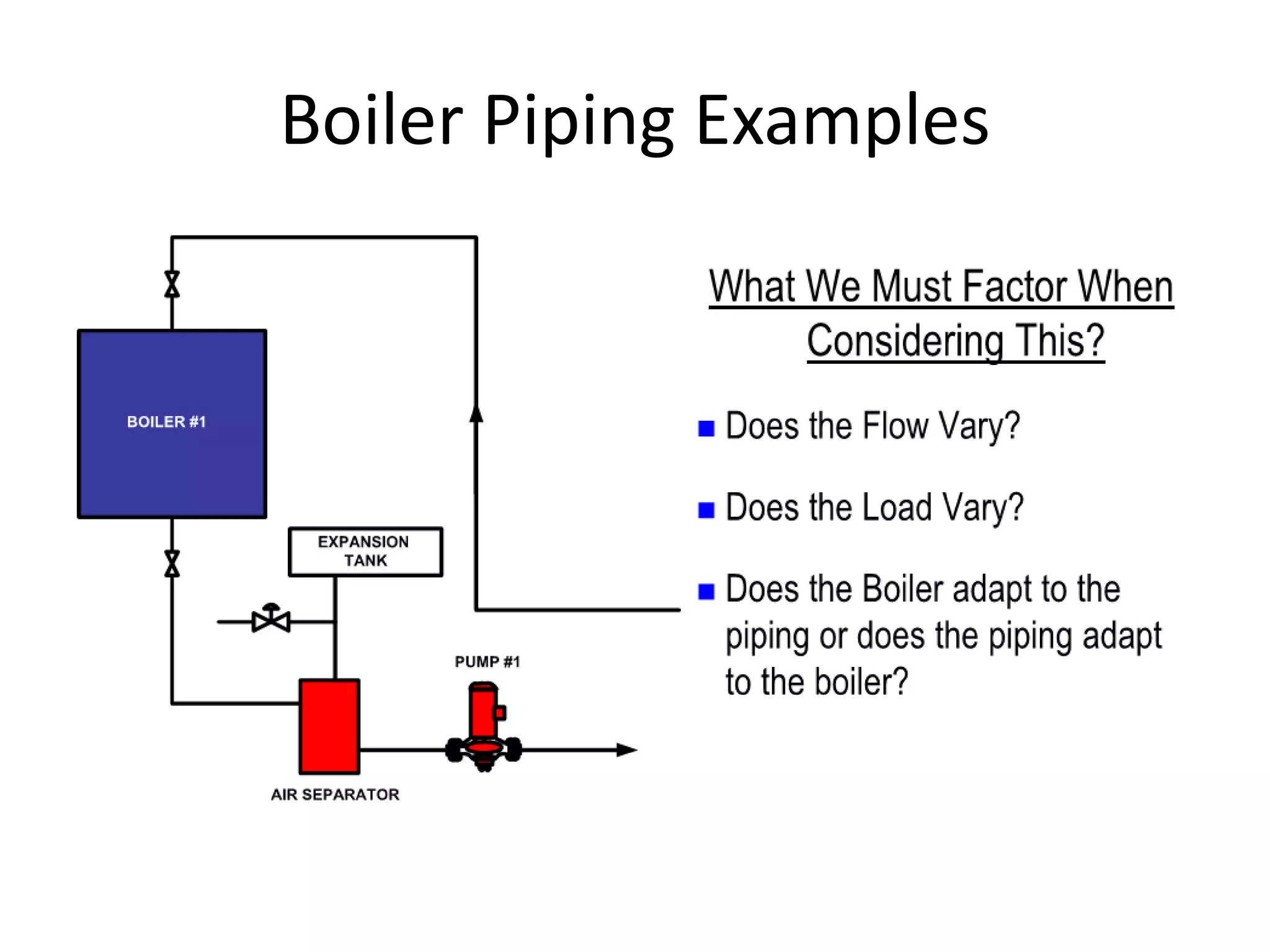
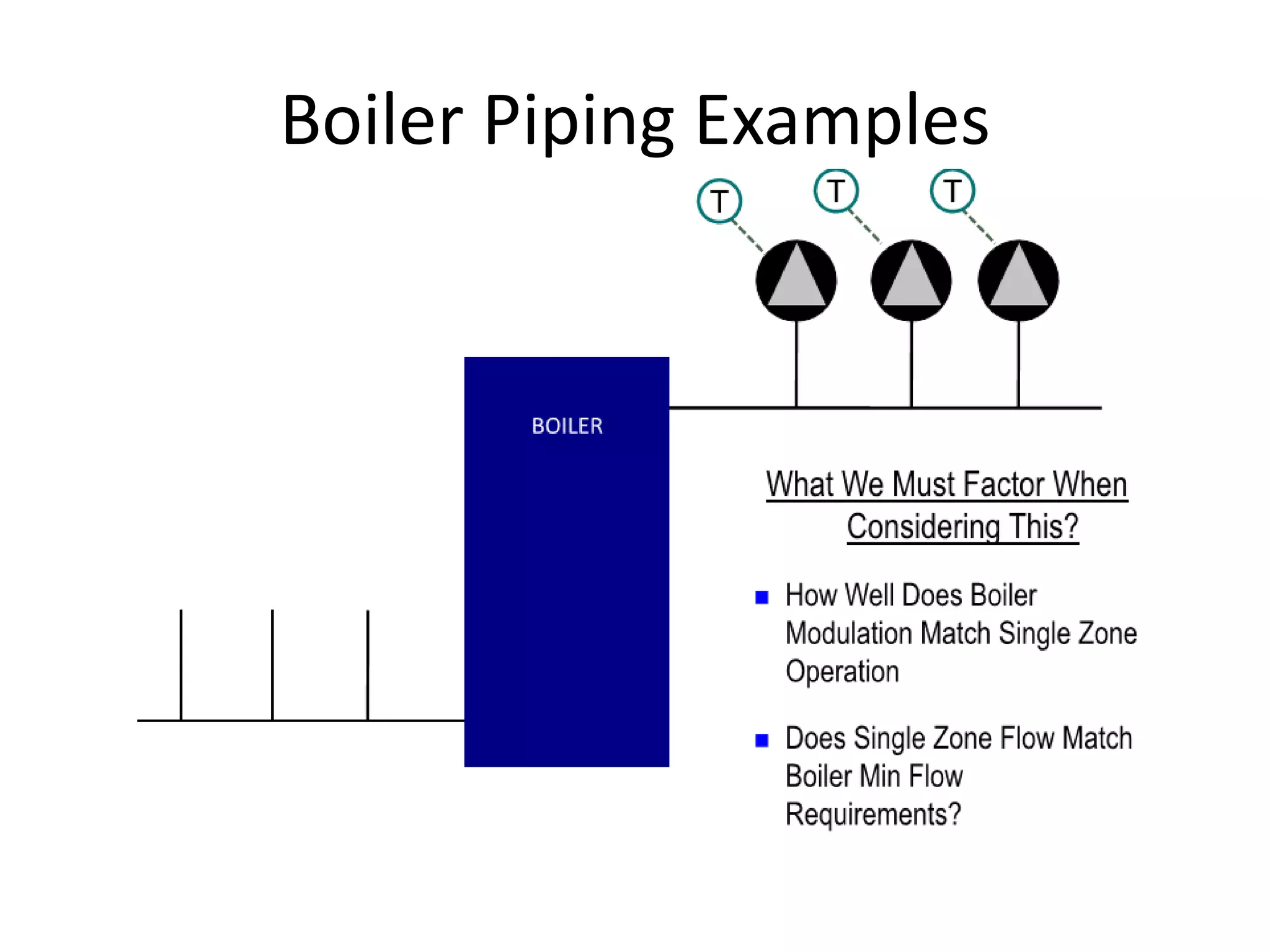
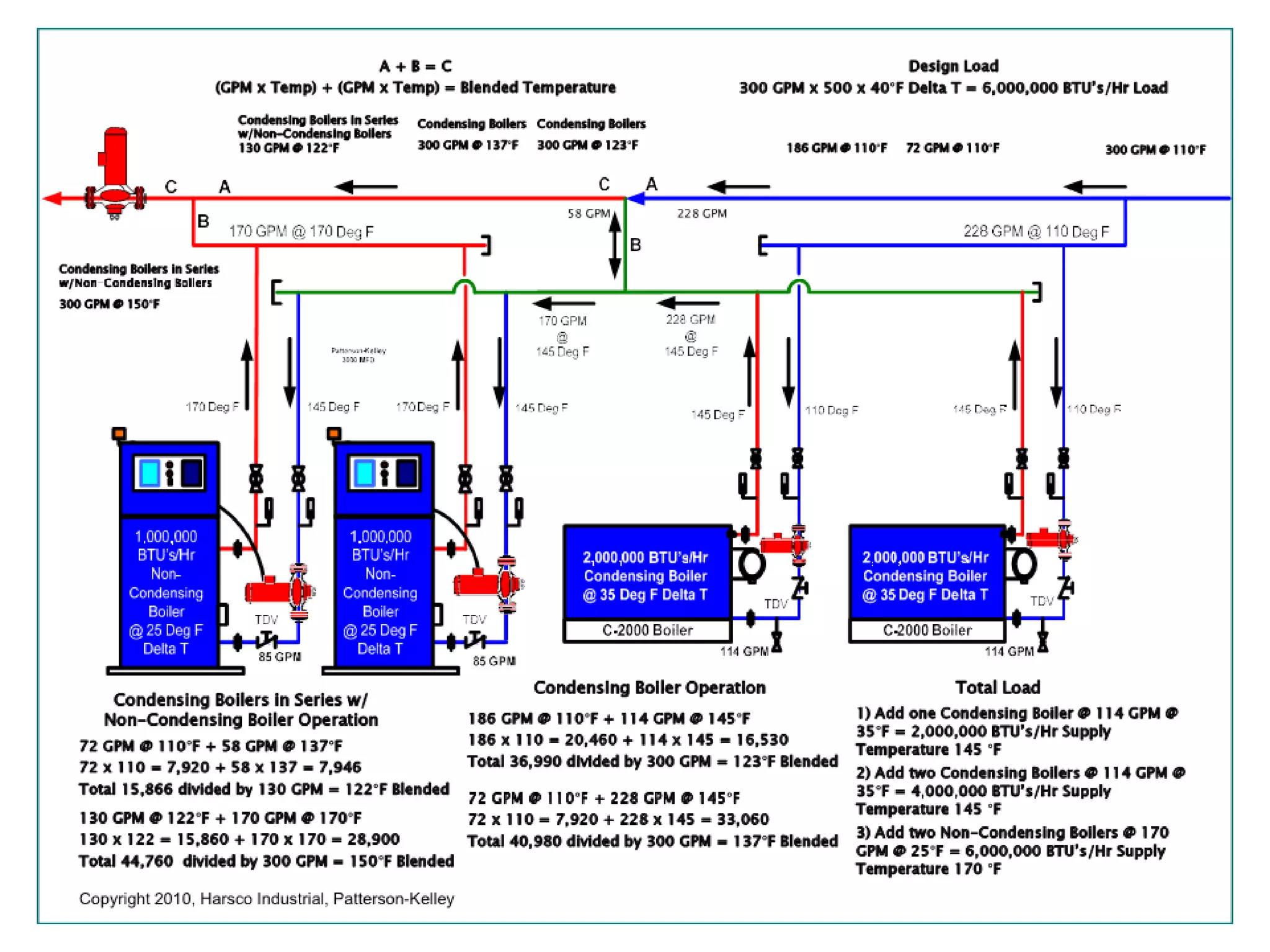
Boiler Piping Examples
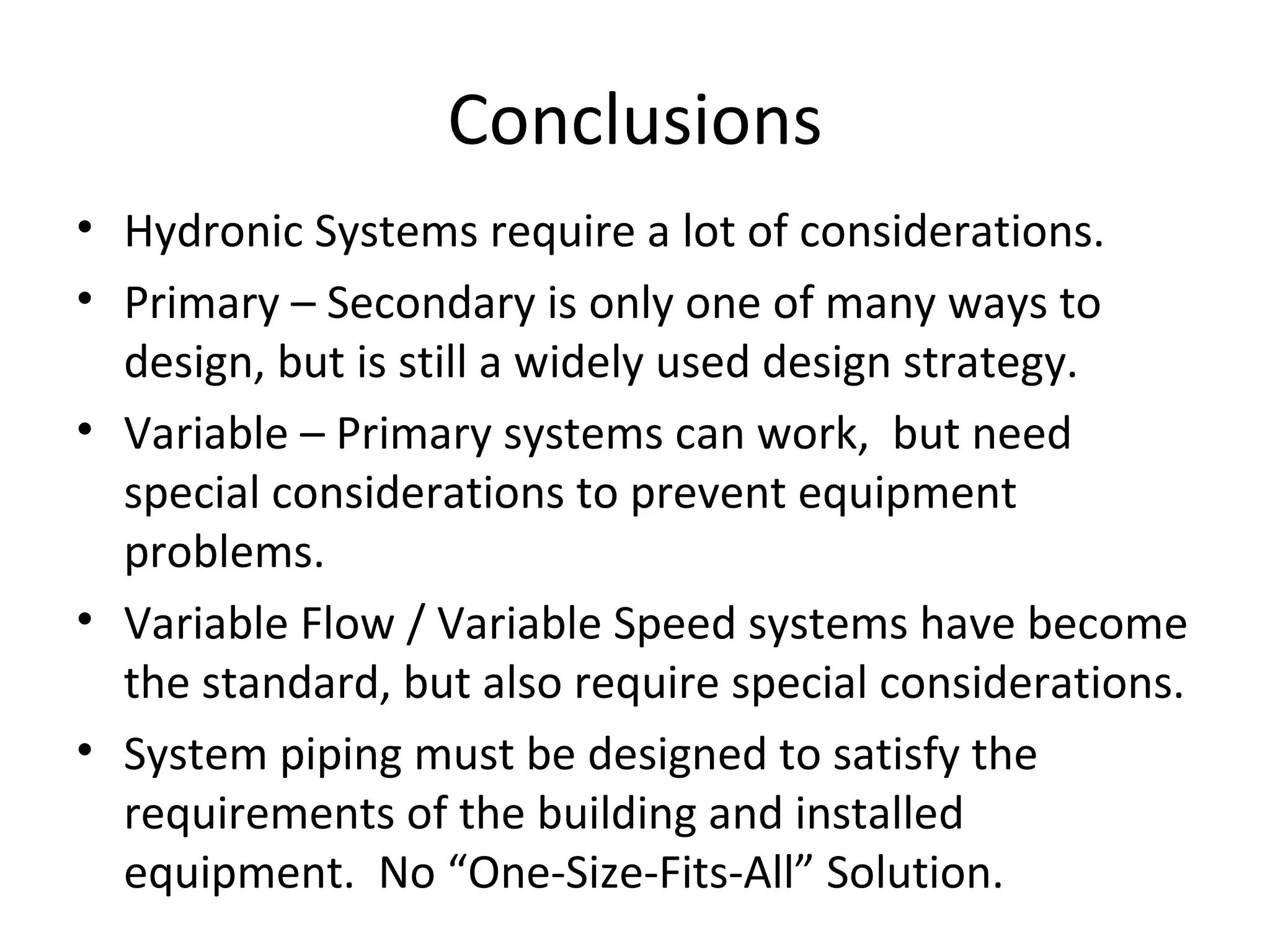
Conclusions Hydronic Systems require a lot of considerations. Primary – Secondary is only one of many ways to design, but is still a widely used design strategy. Variable – Primary systems can work,  but need special considerations to prevent equipment problems. Variable Flow / Variable Speed systems have become the standard, but also require special considerations. System piping must be designed to satisfy the requirements of the building and installed equipment.  No “One-Size-Fits-All” Solution.
Questions???
Thanks!

Hydronic Basics / Primary-Secondary Pumping

  • 1.
    Hydronic System PipingDesign Presented by: Dan Watkins, LEED AP Bornquist, Inc.
  • 2.
    Topics to CoverHydronic System Basics Hydronic System Types Primary – Secondary Variable Flow / Variable Speed Systems Piping Design Examples
  • 3.
    Hydronic SystemBasics SOURCE LOAD In a Hydronic System
  • 4.
    Hydronic SystemBasics SOURCE LOAD Source & Load connected by piping
  • 5.
    Hydronic SystemBasics SOURCE LOAD Fluid is circulated by a pump
  • 6.
    Hydronic SystemBasics Could it really be this simple? What about different system types? What about multiple zones? Let’s start with how to size a pump.
  • 7.
    Hydronic SystemBasics To size a pump you need to know required flow rate for the system and piping pressure drop. Flow rate is based on amount of heat to be transferred. BTUh = 500 x Δ T x GPM ΔT is the temperature drop desired in the system. BTUh is the amount of heat to be transferred. Pressure drop is based on the flow rate through a given piping system.
  • 8.
    Hydronic SystemBasics Let’s design a simple system together! Boiler 200,000 BTUh AHU Coil 20 GPM Boiler = 5’ TDH AHU = 10’ TDH Piping = ???
  • 9.
    Hydronic SystemBasics Let’s design a simple system together! Rule of Thumb… Length x 1.5 to account for elbows and fittings. 2.94’ per 100’ of piping 100’ x 1.5 = 150’ 1.5 x 2.94’ = 4.41’ TDH
  • 10.
    Hydronic SystemBasics Let’s design a simple system together! Boiler 200,000 BTUh AHU Coil 20 GPM Boiler = 5’ TDH AHU = 10’ TDH Piping = 4.41’ TDH System Capacity: 20 GPM @ 19.41’
  • 11.
  • 12.
    Hydronic SystemBasics GPM 2 GPM 1 HEAD 2 RPM 2 RPM 1 HEAD 1 HP 2 HP 1 RPM 2 RPM 1 RPM 2 RPM 1 HP 2 HP 1 GPM 2 GPM 1 GPM 2 GPM 1 HEAD 2 HEAD 1 Affinity Laws 2 2 3 3 = = = = =
  • 13.
    Hydronic SystemBasics Point of No Pressure Change – Expansion Tank Location
  • 14.
    Hydronic SystemBasics Expansion Tank at Suction of Pump - Correct
  • 15.
    Hydronic SystemBasics Expansion Tank at Discharge of Pump - INCORRECT
  • 16.
    Hydronic SystemBasics NPSHA & NPSHR P NPSHA P B Foot Check - (FC) h L Strainer - (S) P P P NPSHA = (+P B ) + (-FC) + (-h L ) + (-P P ) + (-S) Pipe Pressure Drop
  • 17.
    Hydronic SystemBasics P NPSHA P B Foot Check - (FC) 10’ Strainer - (S) 8’ P NPSHA = (+P B ) + (-FC) + (-h L ) + (-P P ) + (-S) Pipe Pressure Drop P B - 14.7 PSI (34’) P NPSHA = (+34) + (-4) + (-10) + (-8) + (-3) P NPSHA = 9’ NPSHA & NPSHR - Suction Lift
  • 18.
    Hydronic SystemBasics NPSHA & NPSHR - Flooded Suction P NPSHA 8’ Pipe Pressure Drop P B - 14.7 PSI (34’) Strainer - (S) 10’ P B P NPSHA = (+P B ) + (-FC) + (-h L ) + (-P P ) + (-S) P NPSHA = (+34) + (-4) + (+10) + (-8) + (-3) P NPSHA = 29’
  • 19.
    Total system HEAD& FLOW requirements through two parallel pumps Total System Head 1/2 Total Flow 1/2 Total Flow Hydronic System Basics Parallel Pumps
  • 20.
    Two pumps inoperation Each pump Head (ft) Flow (gpm) Hydronic System Basics Parallel Pumps
  • 21.
    Total system HEAD& FLOW requirements through two series pumps Total System Flow 1/2 Total Head 1/2 Total Head Hydronic System Basics Series Pumps
  • 22.
    Hydronic SystemDesign Flow (gpm) Two pumps in operation Each pump Head (ft) Series Pumps
  • 23.
    Hydronic SystemTypes Open Loop System
  • 24.
    Hydronic SystemTypes Closed Loop System
  • 25.
    Hydronic SystemTypes Direct Return System
  • 26.
    Hydronic SystemTypes Reverse Return System
  • 27.
    Primary – SecondaryPiping Primary – Secondary Pumping: Was developed by Bell & Gossett in 1954 as a method to increase system temperature drops, decrease total pump Horse Power and increase system controllability. Systems utilizing low or medium temperatures were allowed due to Primary – Secondary pumping. Most modern systems utilize some variation of Primary – Secondary pumps.
  • 28.
    Primary – SecondaryPiping “ Common Piping” interconnects the Primary to the Secondary Circuit “ Common Piping” should have minimal to no pressure drop to be designed correctly Hydraulically disconnects the two piping loops Flow in one loop will not cause flow in the other loop
  • 29.
    Primary – SecondaryPiping Basic Example
  • 30.
    Primary – SecondaryPiping Flow in the Common Pipe
  • 31.
    Primary – SecondaryPiping Finite Analysis of Common Piping Primary Return Secondary Return Secondary Supply Primary Supply
  • 32.
    Primary – SecondaryPiping Law of the Tees
  • 33.
    Primary – SecondaryPiping Secondary pipe pump sized for pressure drops A-B, B-C, C-D, D-E, E-G, G-H, H-I I-A should have no pressure drop.
  • 34.
    Primary – SecondaryPiping Cross-over Bridge Piping - Underslung
  • 35.
    Primary – SecondaryPiping Cross-over Bridge Piping - Overhead
  • 36.
    Primary – SecondaryPiping Correct Pump Location
  • 37.
    Primary – SecondaryPiping INCORRECT Pump Location
  • 38.
    Primary – SecondaryPiping What is the Flow Rate in the Common Pipe?
  • 39.
    Primary – SecondaryPiping What is the Flow Rate in the Common Pipe?
  • 40.
    Primary – SecondaryPiping Injection Pump Systems
  • 41.
    Primary – SecondaryPiping 3-Way Valve Systems
  • 42.
    Primary – SecondaryPiping 2-Way Valve Systems
  • 43.
    Primary – SecondaryPiping Fixed Temperature Control
  • 44.
    Primary – SecondaryPiping Modulating Temperature Control
  • 45.
    Primary – SecondaryPiping Modulating Temperature Control
  • 46.
    Variable Flow /Variable Speed
  • 47.
    Variable Flow SystemsConstant Speed / Variable Volume Utilizes 2-way valves Pump Energy is reduced Variable Speed / Variable Volume Utilizes 2-way valves Pump Energy is reduced Uses VFDs to reduce pump speed
  • 48.
    Variable Flow SystemsConstant Flow System
  • 49.
    Variable Flow SystemsConstant Speed - Variable Flow System
  • 50.
    Variable Flow SystemsVariable Volume System HP
  • 51.
    Variable Flow SystemsVariable Speed gives reduced HP Variable Speed allows for easy pump balancing Variable Speed also acts as a soft starter Variable Speed drives are getting less costly Variable Speed is not a mystery anymore
  • 52.
    Hydronic SystemBasics GPM 2 GPM 1 HEAD 2 RPM 2 RPM 1 HEAD 1 HP 2 HP 1 RPM 2 RPM 1 RPM 2 RPM 1 HP 2 HP 1 GPM 2 GPM 1 GPM 2 GPM 1 HEAD 2 HEAD 1 Affinity Laws 2 2 3 3 = = = = =
  • 53.
    Variable Flow Systems12.5HP 1800 RPM 1.6HP 950 RPM HP 2 12.5 = 900 1800 3 HP 1 = 1.6 HP
  • 54.
  • 55.
  • 56.
    Variable Flow SystemsSOURCE SOURCE System Criteria 2 - 100 Ton Chillers 2 - 300 GPM @ 100’ Pumps Pumps 2 - 20HP No Standby System Pressure Drop Total of 75’  P Chiller Pressure Drop Total of 25’  P TOTAL INSTALLED HP - 40 HP LIMITED VARIABLE VOLUME - 30% MAX HP REDUCTION
  • 57.
    Variable Flow SystemsSOURCE SOURCE System Criteria 2 - 100 Ton Chillers 2 - 300 GPM @ 25’ Pumps 2 - 300 GPM @ 80’ Pumps Primary Pumps 2 - 3HP Secondary Pressure Drop Total of 80’  P Primary Pressure Drop Total of 25’  P Secondary Pumps 2 - 10 HP Running Standby TOTAL INSTALLED HP - 26 HP 2 - 10 HP VFDs w/ STAGING REQ’D
  • 58.
    Variable Flow SystemsDP Sensor Location – Sensor Across Coil Typical Setting Equals Design Pressure Drop Across the Coil, Control Valve, and Circuit Setter. Coil 10 - 15’ P.D. Control Valve 10 - 15’ P.D. Typical Total P.D. 20 -30’
  • 59.
    Variable Flow SystemsDP Sensor Location – INCORRECT
  • 60.
    Variable Flow SystemsDP Sensor Location – INCORRECT
  • 61.
    Variable Flow SystemsDP Sensor Location – Correct
  • 62.
    Variable Flow SystemsDP Sensor Location – Correct
  • 63.
    System Examples ChilledWater – Direct Return with Variable Speed
  • 64.
    System Examples ChilledWater – Reverse Return with Variable Speed
  • 65.
    System Examples BoilerWater – Direct Return with Variable Speed
  • 66.
    System Examples BoilerWater – Reverse Return with Variable Speed
  • 67.
    System Examples Primary– Secondary - Tertiary
  • 68.
    System Examples Primary– Secondary Zone Pumping
  • 69.
    System Examples Campus/ District – Primary – Secondary - Tertiary
  • 70.
  • 71.
  • 72.
    Tenant Use PumpsTower Condenser Tenant Unit Tenant Unit Main Building Chiller
  • 73.
    Tenant Use PumpsPDt Main Building Chiller Hst Ht PDrp PDsp PDs PDpt PDc PDt - Tower Pressure Drop PDsp - Suction Pipe Pressure Drop PDs - Strainer Pressure Drop PDpt - Pump Trim Pressure Drop PDc - Condenser Pressure Drop PDrp - Return Pipe Pressure Drop Ht - Tower Height - Static Lift Hst - Building Static Height Condenser
  • 74.
    Tenant Use PumpsPDt - 15’ Main Building Chiller Hst - 100’ Ht - 10’ PDrp - 8’ PDsp - 8’ PDs - 3’ PDpt - 6’ PDc - 25’ ONLY STATIC PRESSURE SEEN AT PRESSURE GAUGE ON SUCTION OF PUMP P1 - 43 PSI Pump OFF Condenser P1 P2
  • 75.
    Tenant Use PumpsPDt - 15’ Main Building Chiller Hst - 100’ Ht - 10’ PDrp - 8’ PDsp - 8’ PDs - 3’ PDpt - 6’ PDc - 25’ SUCTION SIDE OF PUMP - STATIC PRESSURE MINUS PDsp. AND MINUS PDs P1 >> 100’ - 8’ - 3’ = 38.5 PSI DISCHARGE SIDE OF PUMP - SUCTION PRESSURE PLUS PUMP HEAD (75’) P2 >> 38.5 PSI + 75’ = 71 PSI Pump On Pump Head = PDsp + PDs + PDpt + PDc + PDrp + Ht + PDt Condenser P1 P2
  • 76.
    Tenant Use PumpsPDt Main Building Chiller Hst Ht PDrpa PDspa PDs PDpt PDc Ht - Tower Height - Static Lift Hst - Building Static Height PDspb PDrpb Hsta Hstb PDtenant PDt - Tower Pressure Drop PDspa - Suction Pipe Pressure Drop a Length PDspb - Suction Pipe Pressure Drop b Length PDs - Strainer Pressure Drop PDpt - Pump Trim Pressure Drop PDc - Condenser Pressure Drop PDrpa - Return Pipe Pressure Drop a Length PDrp b- Return Pipe Pressure Drop b Length Pdtenant - Tenant Loop Total Pressure Drop Condenser Tenant Unit
  • 77.
    Tenant Use PumpsPDt - 15’ Main Building Chiller Hst - 100’ Ht - 10’ Pdrpa - 6’ Pdspa - 6’ PDs - 3’ PDpt - 6’ PDc - 25’ PDspb - 2’ PDrpb - 2’ Hsta - 80’ Hstb - 20’ Pdtenant - 25’ Tenant Pump Off - Main Pump On P3 - STATIC PRESSURE A MINUS PDspa. P3 >> 80’ - 6’ = 32 PSI P4 - DISCHARGE SIDE OF PUMP - SUCTION PRESSURE PLUS PUMP HEAD (75’) MINUS PRESSURE DROPS P4 >> 71PSI - 6’ - 25’ - 20’ - 2’ = 48PSI Difference P3 - P4 = 16 PSI (37’) Condenser Tenant Unit P3 P4
  • 78.
    Tenant Use PumpsPDt - 15’ Main Building Chiller Hst - 100’ Ht - 10’ Pdrpa - 6’ Pdspa - 6’ PDs - 3’ PDpt - 6’ PDc - 25’ PDspb - 2’ PDrpb - 2’ Hsta - 80’ Hstb - 20’ Pdtenant - 25’ Tenant Pump Sized for: Piping Pressure Drop Pump Trim Pressure Drop Tenant Unit Pressure Drop P4 - P3 Differential Tennant Pump Head = Pdtenant + 37’ = 25’ + 37’ = 62’ Condenser Tenant Unit P3 P4
  • 79.
    Tenant Use PumpsTenant Use Pumps Must be with the rest of the condenser water pumping system in mind. Never size a tenant use system, for only the tenant loop pressure drop. Typical Pump Size 15 GPM @ 100’ TDH Tower Condenser Tenant Unit Tenant Unit Main Building Chiller
  • 80.
  • 81.
  • 82.
  • 83.
  • 84.
  • 85.
  • 86.
  • 87.
  • 88.
  • 89.
  • 90.
  • 91.
  • 92.
  • 93.
  • 94.
  • 95.
  • 96.
  • 97.
  • 98.
  • 99.
  • 100.
  • 101.
    Conclusions Hydronic Systemsrequire a lot of considerations. Primary – Secondary is only one of many ways to design, but is still a widely used design strategy. Variable – Primary systems can work, but need special considerations to prevent equipment problems. Variable Flow / Variable Speed systems have become the standard, but also require special considerations. System piping must be designed to satisfy the requirements of the building and installed equipment. No “One-Size-Fits-All” Solution.
  • 102.
  • 103.

Editor's Notes