







Presentation to:
Chicago Energy Modeling Conference
         February 14, 2012
Why Building Energy Labeling?
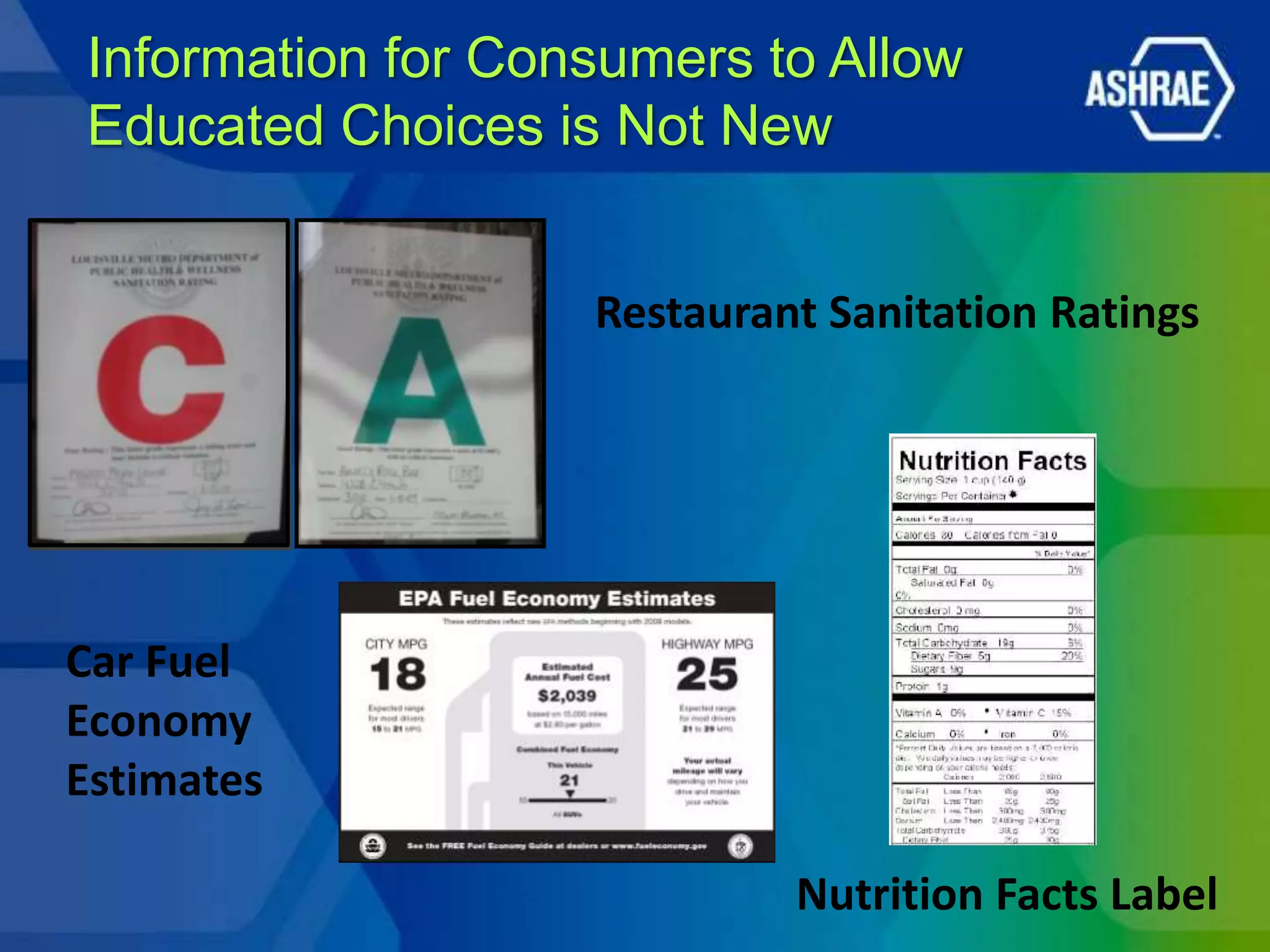
Information for Consumers to Allow
Educated Choices is Not New


                   Restaurant Sanitation Ratings


Car Fuel
Economy
Estimates

                            Nutrition Facts Label
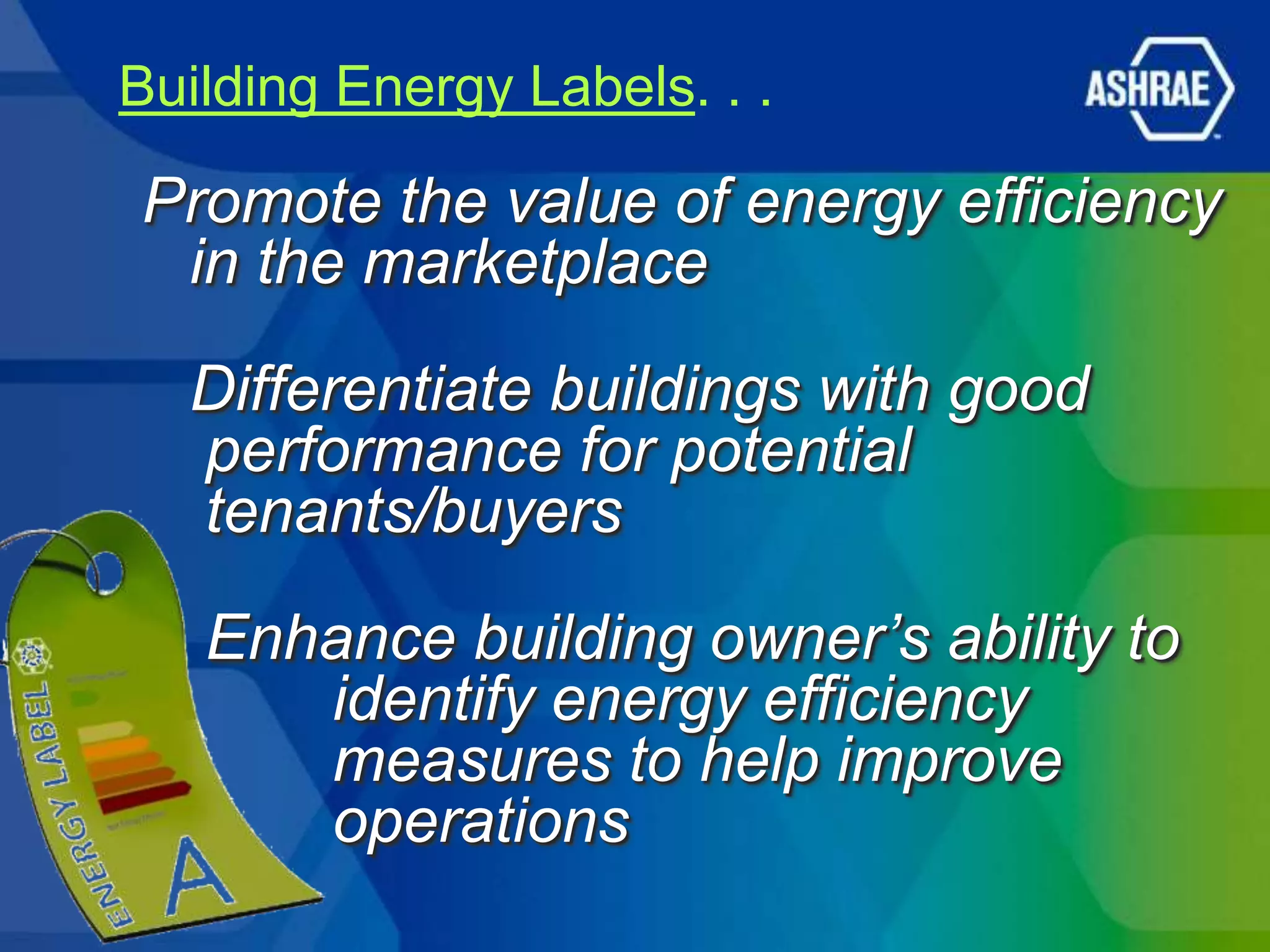
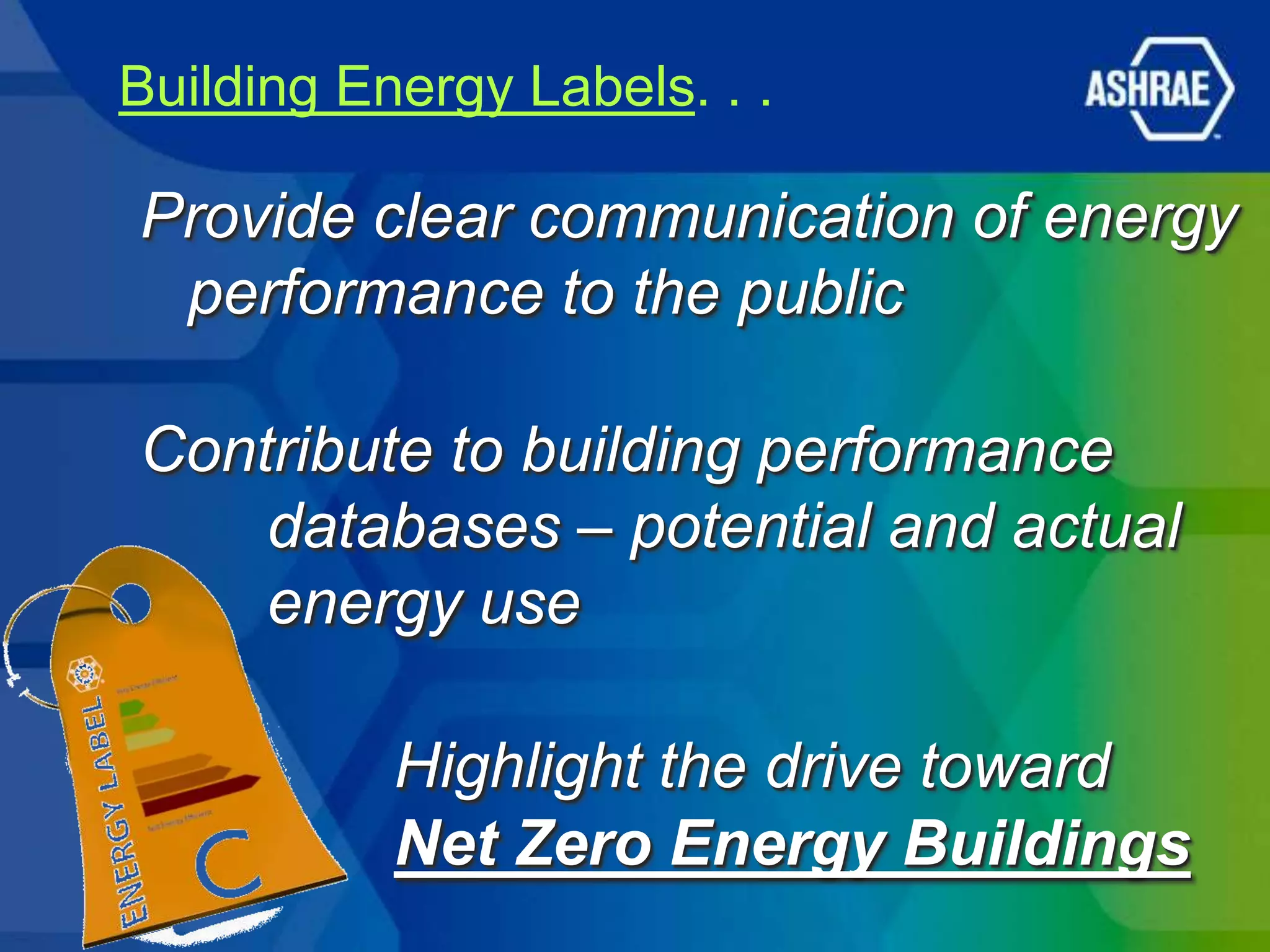
Building Energy Labels. . .

Promote the value of energy efficiency
 in the marketplace

  Differentiate buildings with good
  performance for potential
  tenants/buyers
   Enhance building owner’s ability to
      identify energy efficiency
      measures to help improve
      operations
Building Energy Labels. . .

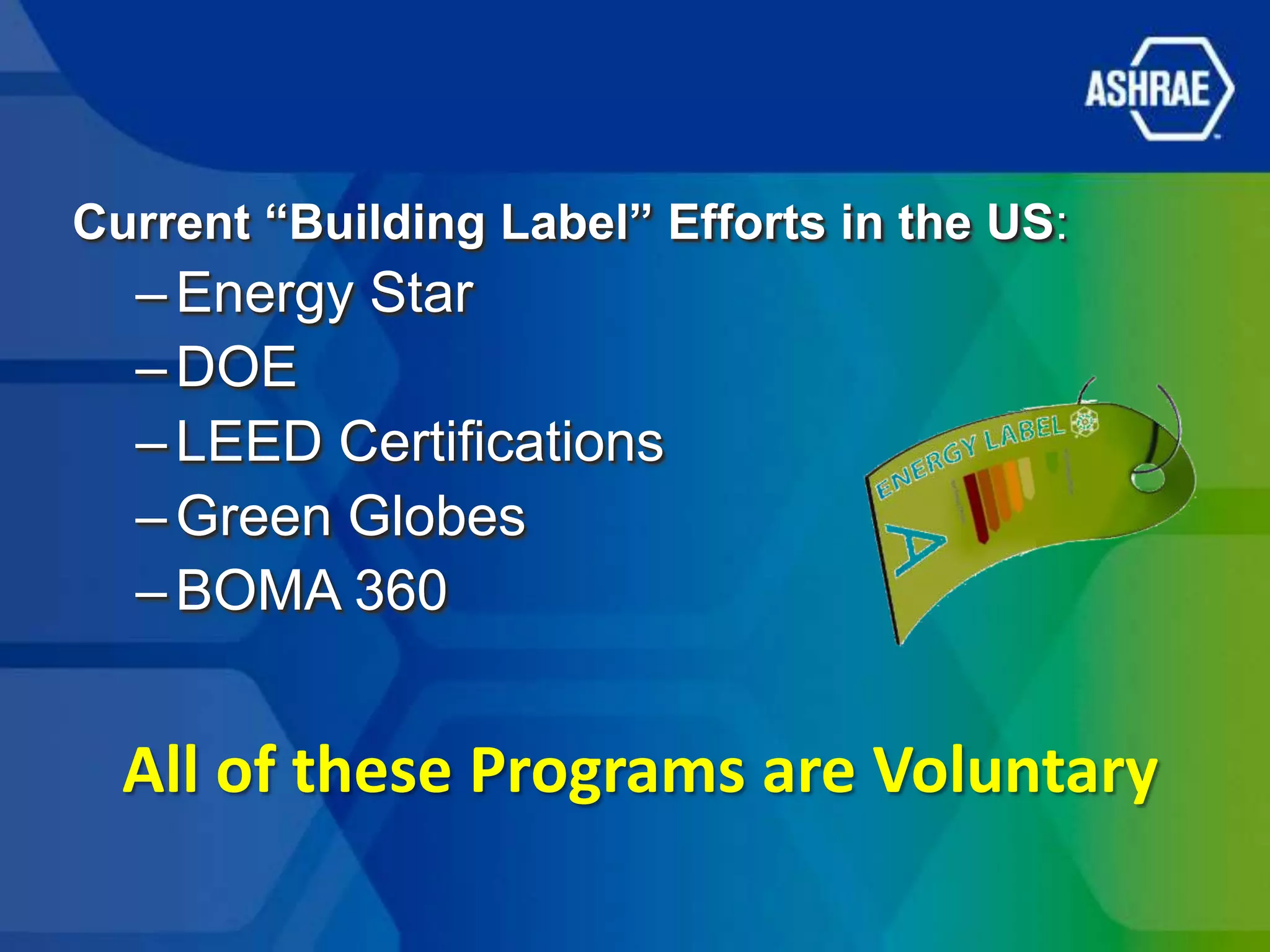
Provide clear communication of energy
 performance to the public

Contribute to building performance
    databases – potential and actual
    energy use

           Highlight the drive toward
           Net Zero Energy Buildings
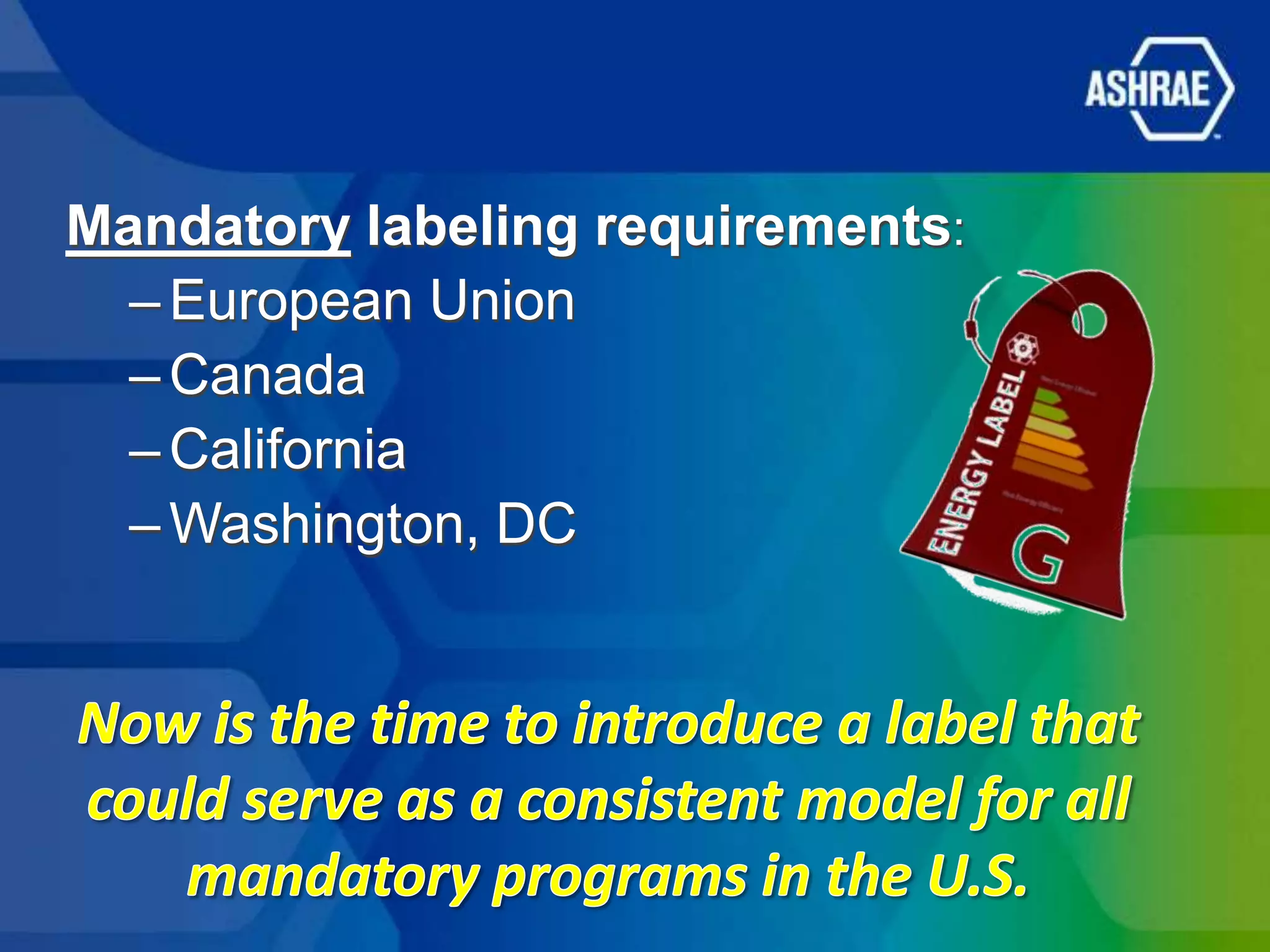
Current “Building Label” Efforts in the US:
  – Energy Star
  – DOE
  – LEED Certifications
  – Green Globes
  – BOMA 360


  All of these Programs are Voluntary
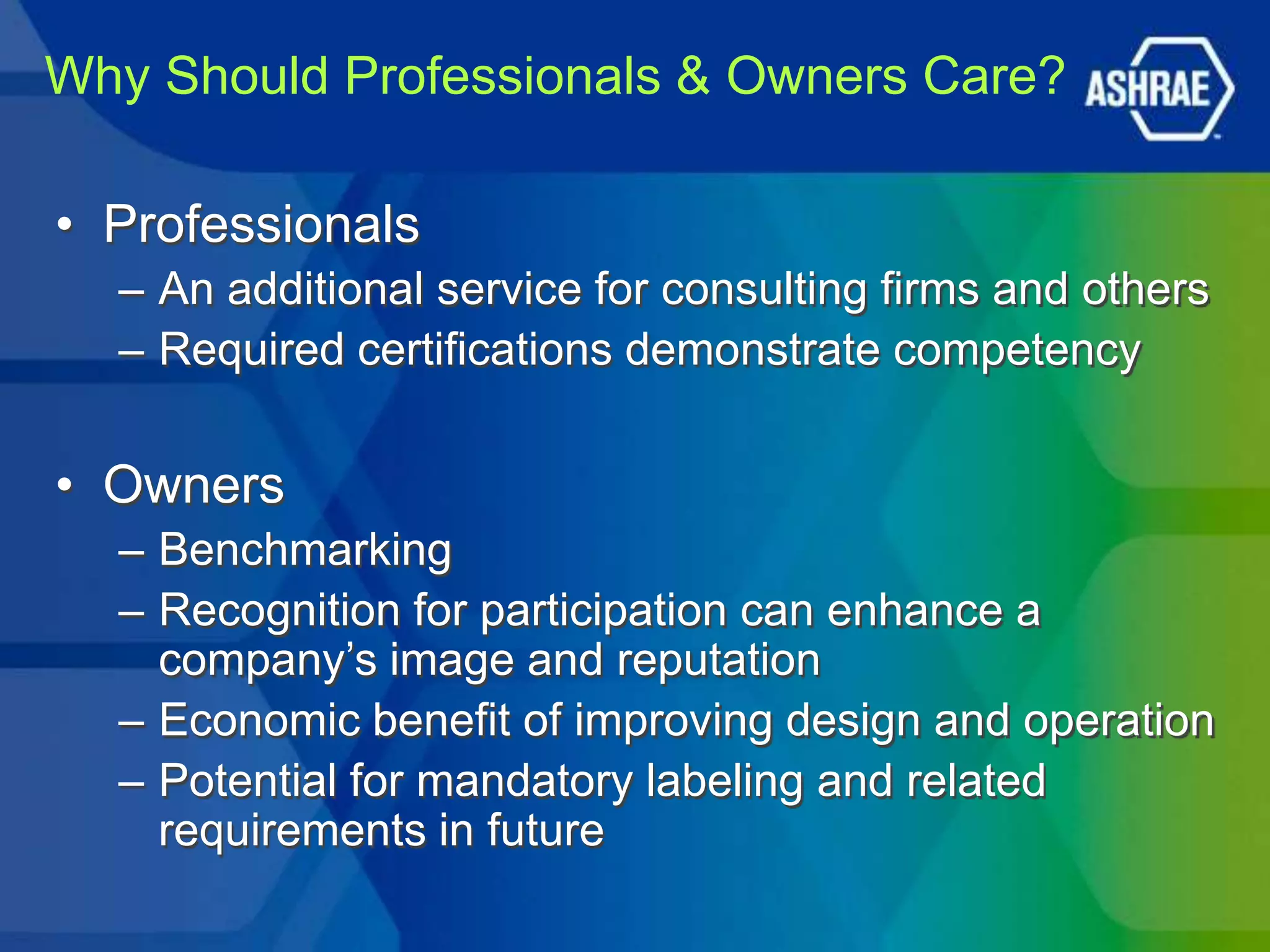
Mandatory labeling requirements:
  – European Union
  – Canada
  – California
  – Washington, DC
Why Should Professionals & Owners Care?

• Professionals
  – An additional service for consulting firms and others
  – Required certifications demonstrate competency


• Owners
  – Benchmarking
  – Recognition for participation can enhance a
    company’s image and reputation
  – Economic benefit of improving design and operation
  – Potential for mandatory labeling and related
    requirements in future
Why ASHRAE?

• Over 100 years of experience in the
  building sciences
• Strong technical expertise across all
  aspects of building design and operation
• Historic focus on developing consensus-
  based, non-commercial documents
• Respect and credibility within the building
  community
• Proven history working with DOE and
  other professional organizations
What is bEQ?

 • A voluntary certification program
 • A technical method that draws on
   successful features of other US and
   European building certifications
 • Complements other green building
   rating systems and energy certification
   programs
 • Can be a tool to stimulate adoption of
   high performance building techniques
Developing bEQ

• bEQ Development Committee
   – International team of experts
   – Representatives from the Energy Star and EU
     labeling programs
   – Building energy modeling experts
   – Representatives from utilities, government,
     and advocacy community
• Technically sound and widely applicable
  program
• Validate and enhance the program using
  ASHRAE’s broad technical resource network
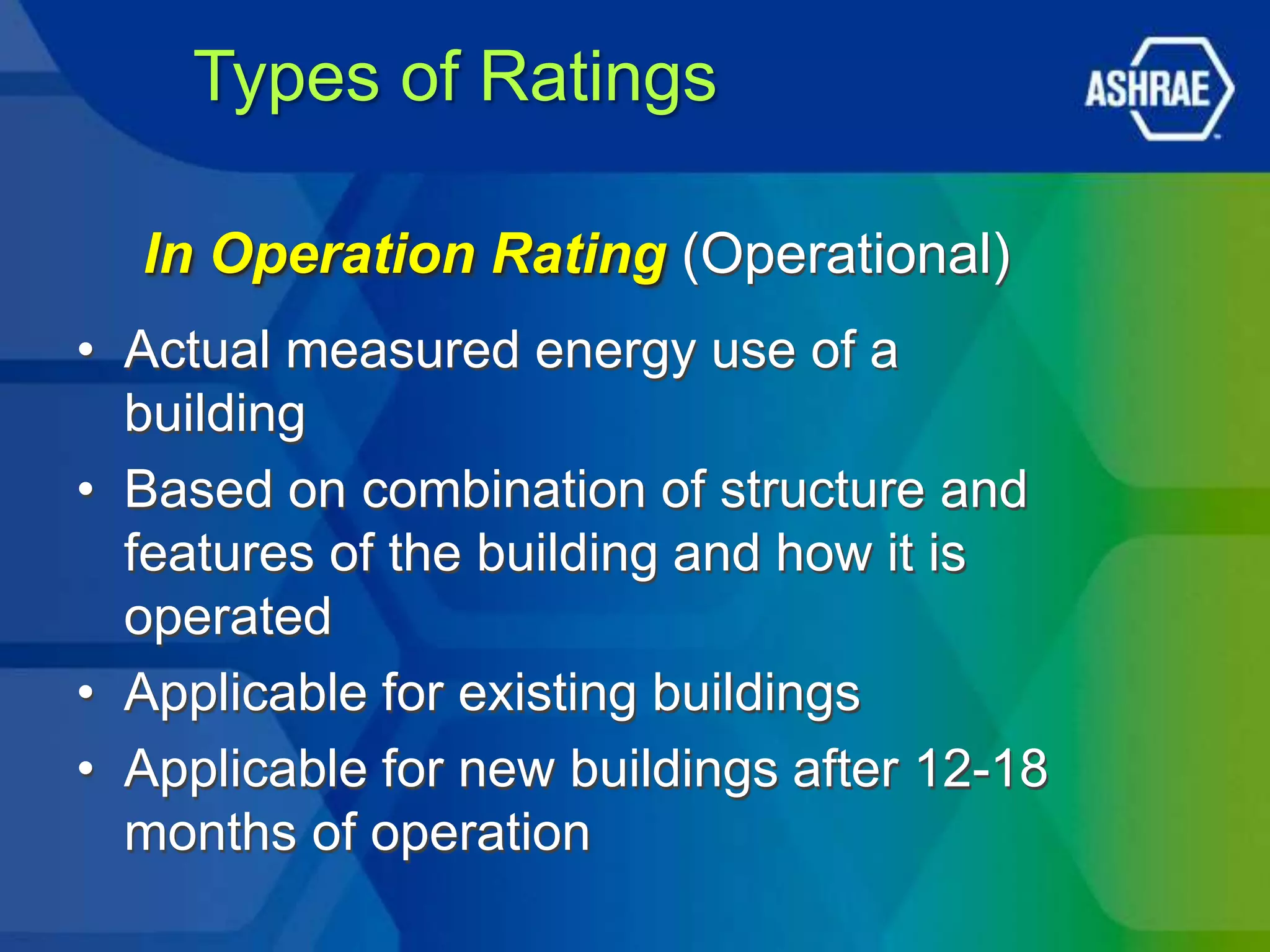
Types of Ratings

  In Operation Rating (Operational)
• Actual measured energy use of a
  building
• Based on combination of structure and
  features of the building and how it is
  operated
• Applicable for existing buildings
• Applicable for new buildings after 12-18
  months of operation
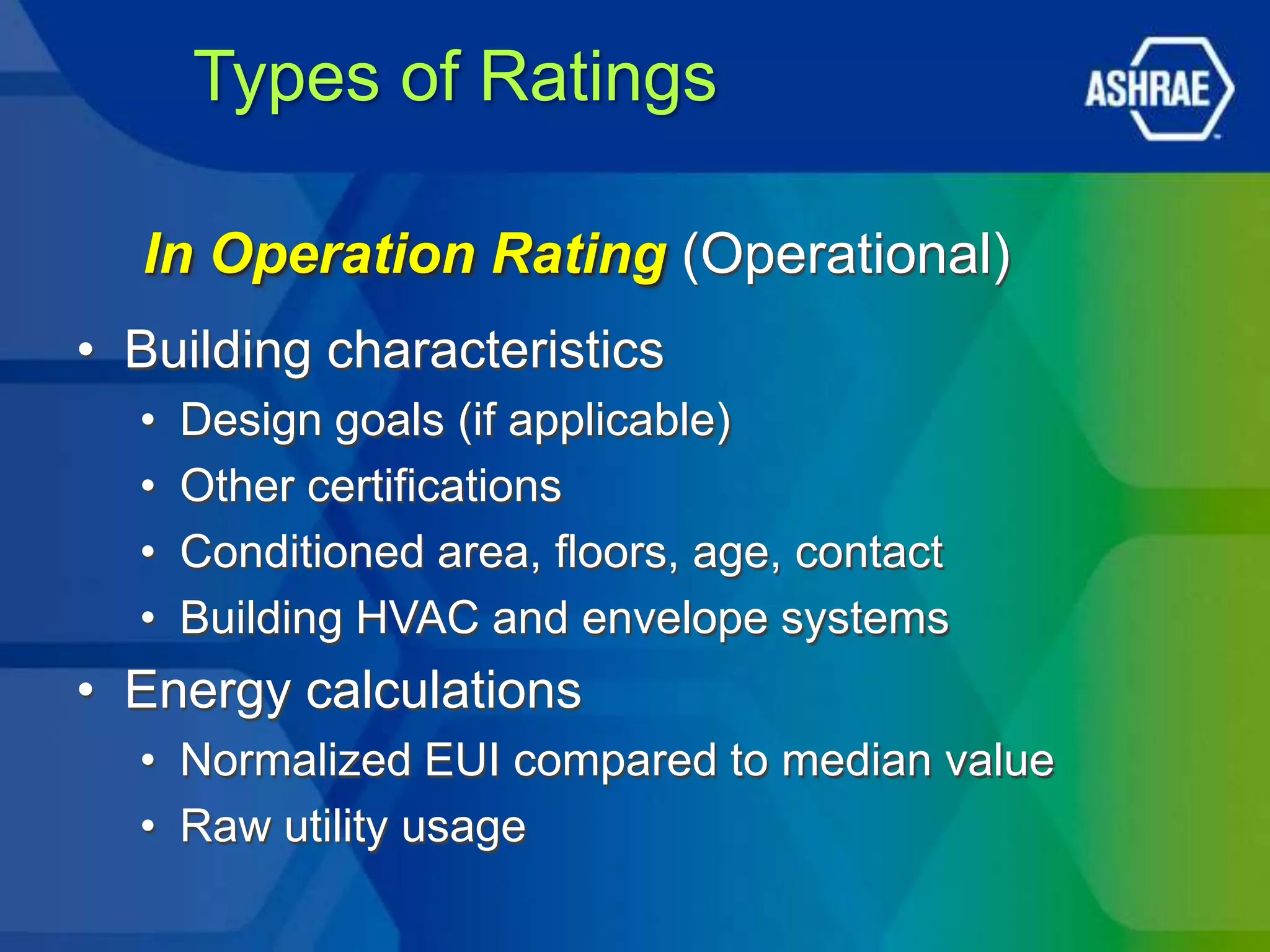
Types of Ratings

  In Operation Rating (Operational)
• Building characteristics
  •   Design goals (if applicable)
  •   Other certifications
  •   Conditioned area, floors, age, contact
  •   Building HVAC and envelope systems
• Energy calculations
  • Normalized EUI compared to median value
  • Raw utility usage
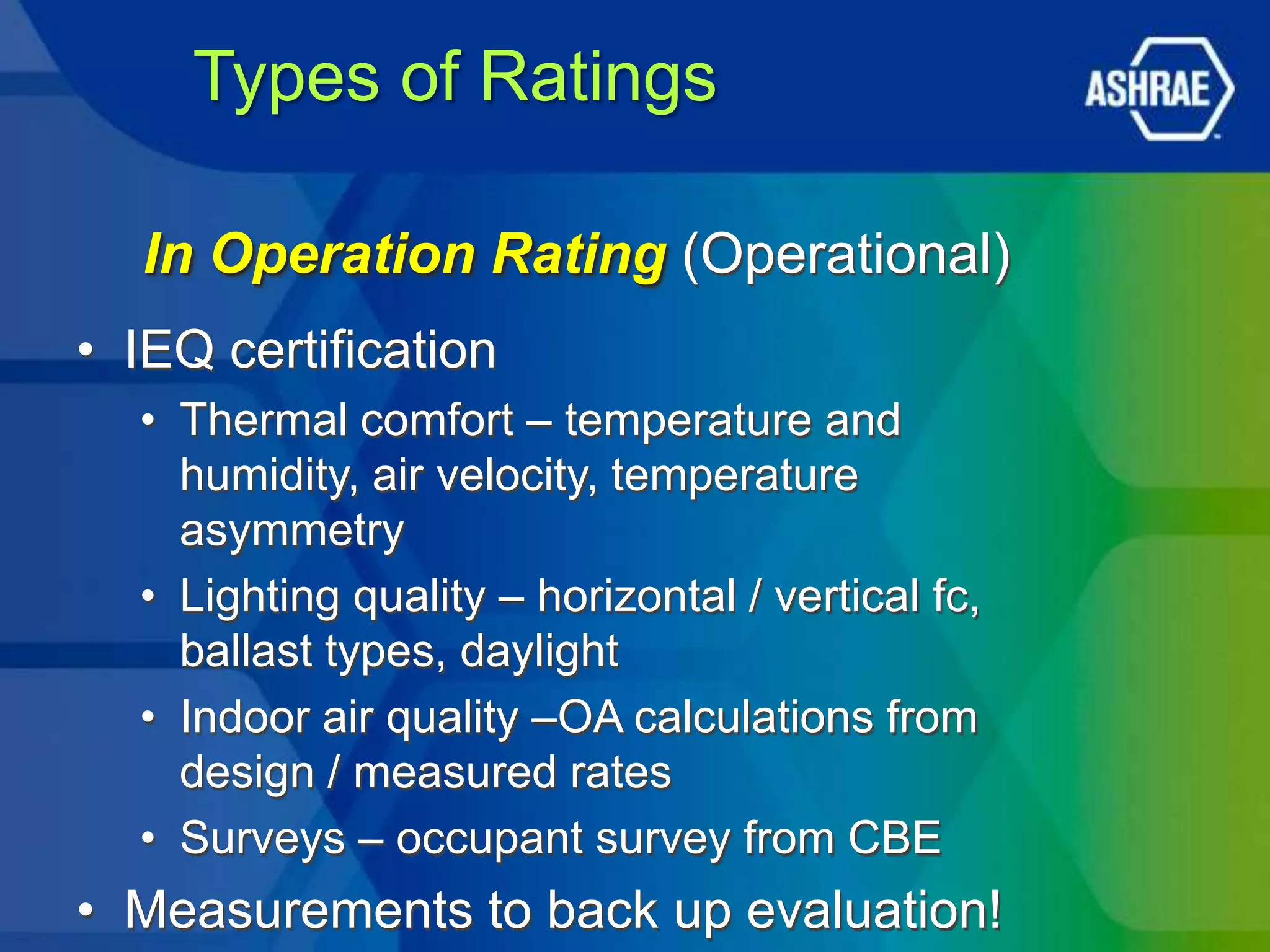
Types of Ratings

   In Operation Rating (Operational)
• IEQ certification
  • Thermal comfort – temperature and
    humidity, air velocity, temperature
    asymmetry
  • Lighting quality – horizontal / vertical fc,
    ballast types, daylight
  • Indoor air quality –OA calculations from
    design / measured rates
  • Surveys – occupant survey from CBE
• Measurements to back up evaluation!
Types of Ratings

  In Operation Rating (Operational)
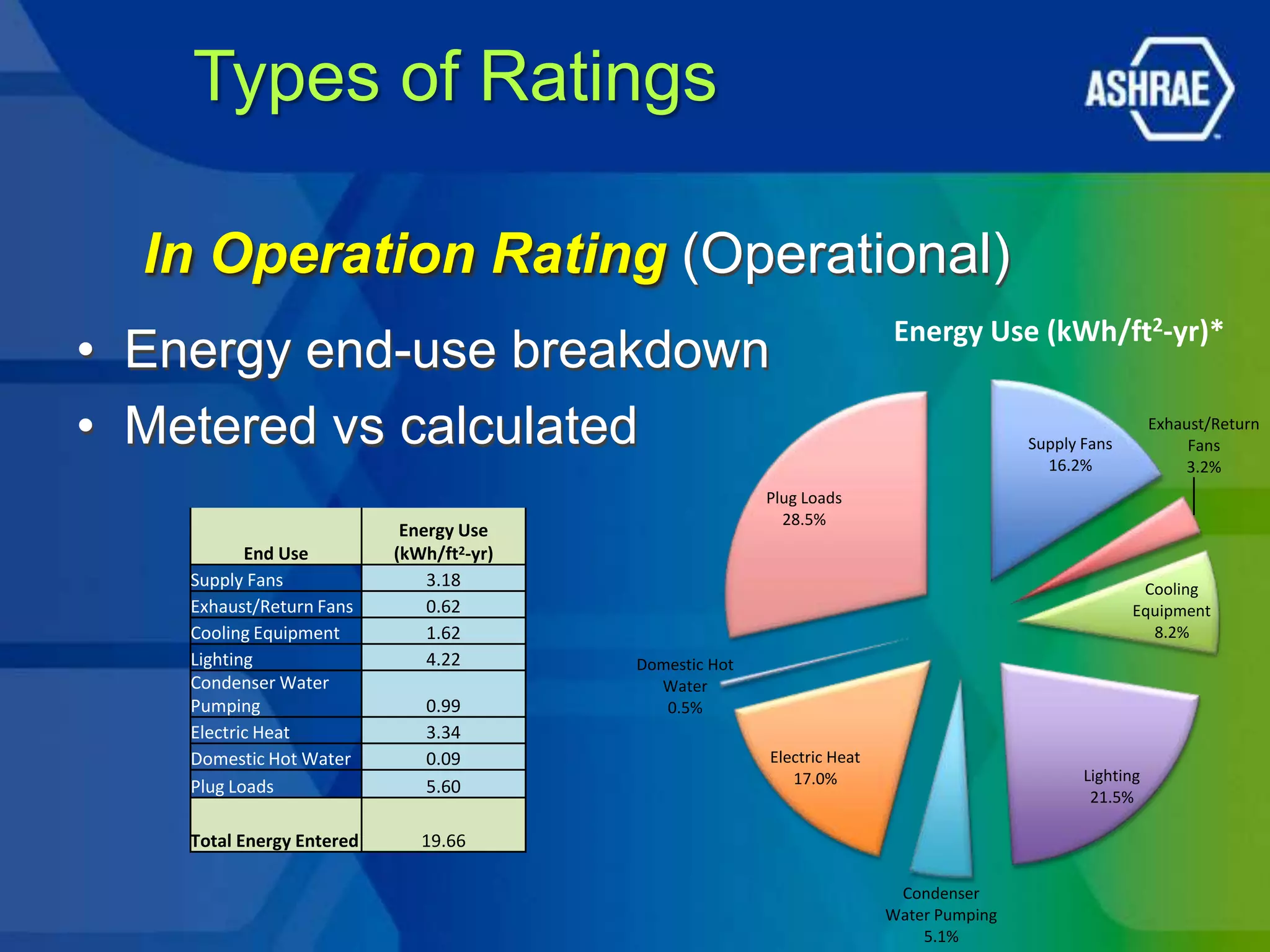
                                                                         Energy Use (kWh/ft2-yr)*
• Energy end-use breakdown
• Metered vs calculated                                                                  Supply Fans
                                                                                                           Exhaust/Return
                                                                                                                Fans
                                                                                           16.2%               3.2%
                                                         Plug Loads
                                                           28.5%
                            Energy Use
           End Use         (kWh/ft2-yr)
    Supply Fans                3.18                                                                     Cooling
    Exhaust/Return Fans        0.62                                                                    Equipment
    Cooling Equipment          1.62                                                                      8.2%
    Lighting                   4.22       Domestic Hot
    Condenser Water                         Water
    Pumping                   0.99           0.5%
    Electric Heat             3.34
    Domestic Hot Water        0.09                       Electric Heat
                                                            17.0%                               Lighting
    Plug Loads                5.60
                                                                                                 21.5%

    Total Energy Entered      19.66

                                                                          Condenser
                                                                         Water Pumping
                                                                             5.1%
Types of Ratings

  In Operation Rating (Operational)
• Listing of possible energy efficiency
  measures (EEMs) for the building
• ASHRAE Level 1 effort for rigor of
  evaluation – focus on energy
  savings, not necessarily cost savings
• Source energy comparison
Types of Ratings
      In Operation Rating (Operational)
• Building characteristics
• Energy calculations
• IEQ certification
   • Thermal comfort
   • Lighting quality
   • Indoor air quality
   • Surveys
   • Measurements
• Energy end-use breakdown
Types of Ratings

        As Designed Rating (Asset)
• Assessment of the building based on design
  components:
  mechanical, envelope, orientation, and
  lighting.
• Based on results of a building energy model
• Applicable to both new and existing buildings
• Can be used to make choices between
  potential building designs
Features of bEQ Program:
• Potential side-by-side comparison of As
  Designed (asset) and In Operation (operational)
  Ratings
• Building assessment identifies both
  peak demand reduction and energy
  management opportunities
• Recognizes energy use from on-site renewables
• Includes measurement-based Indoor
  Environmental Quality (IEQ) indicators to assure
  levels of service are maintained
Relationship to Other Programs
• Europe
   – Directive 2002/91/EC on the energy performance of
     buildings
   – Standard EN 15217 Energy performance of
     buildings—methods for expressing energy
     performance and for energy certification of buildings
     (2007)
   – Explicit effort to learn from EU experience


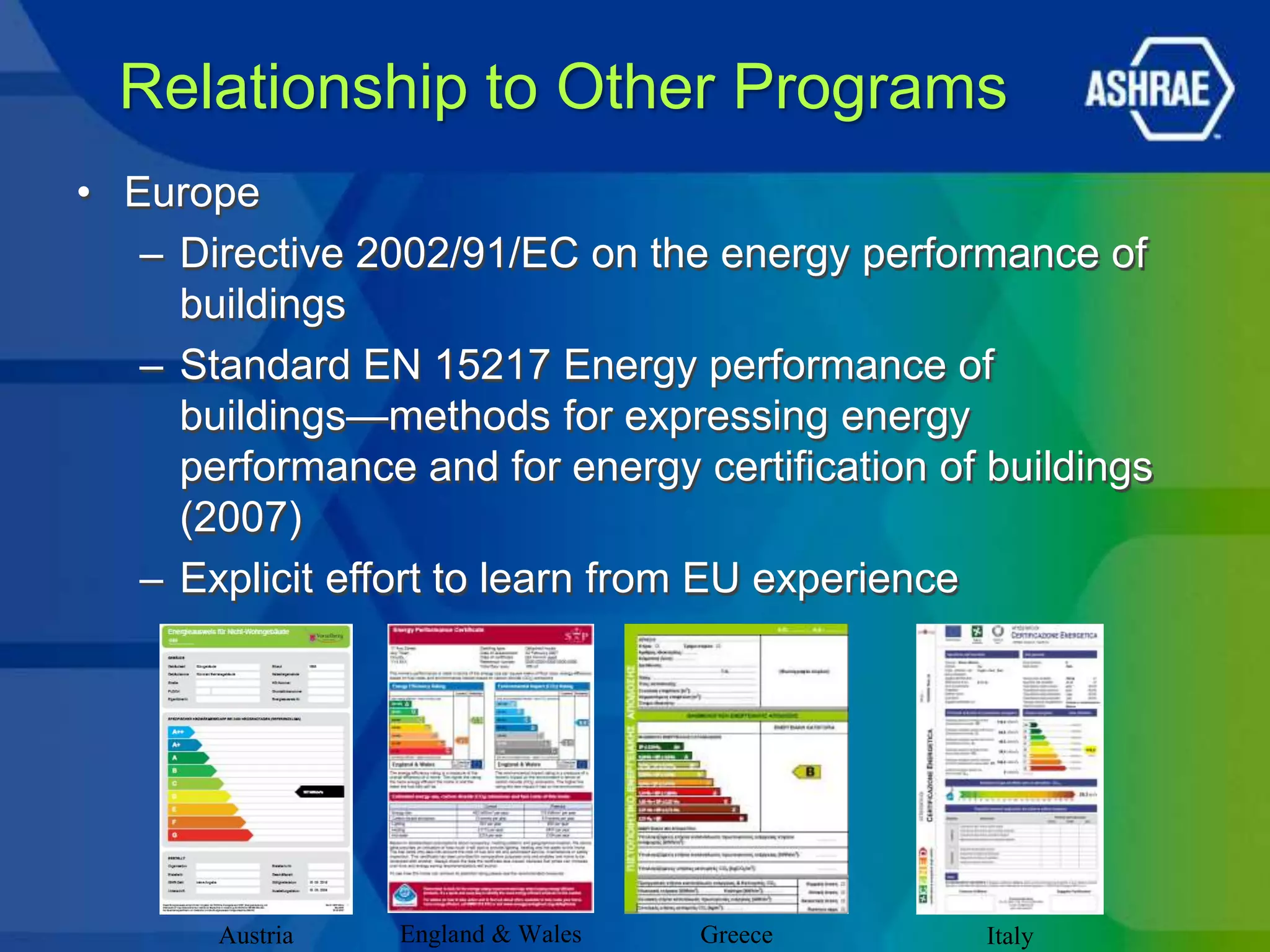
       Austria   England & Wales   Greece        Italy
bEQ and Existing ―Green‖ Programs
     like LEED or GreenGlobes?

• Focuses on a building’s energy use while
  also ensuring adequate building IEQ
• Helps identify opportunities for
  improving energy performance
bEQ and EPA’s Energy Star Program?

• Greater differentiation for high performing
  buildings
• Emphasis on top performers and net zero
  energy operation.
• Required site visit to validate information
  and IEQ
• Applies to all building types
• Measures IEQ performance
• Expanded information provided for how to
  improve energy performance
Visible Products of bEQ

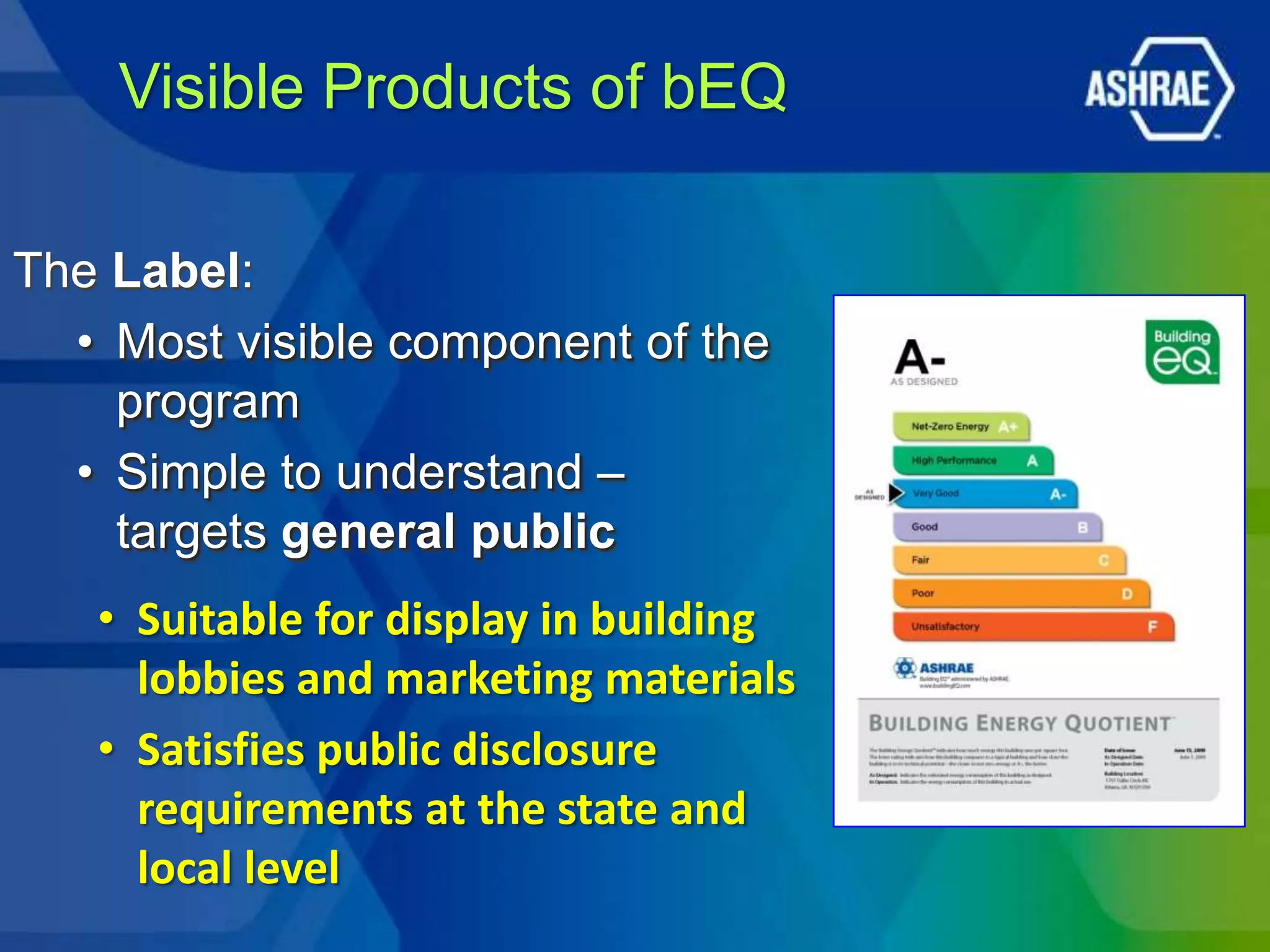
The Label:
  • Most visible component of the
    program
  • Simple to understand –
    targets general public
   • Suitable for display in building
     lobbies and marketing materials
   • Satisfies public disclosure
     requirements at the state and
     local level
Visible Products of bEQ
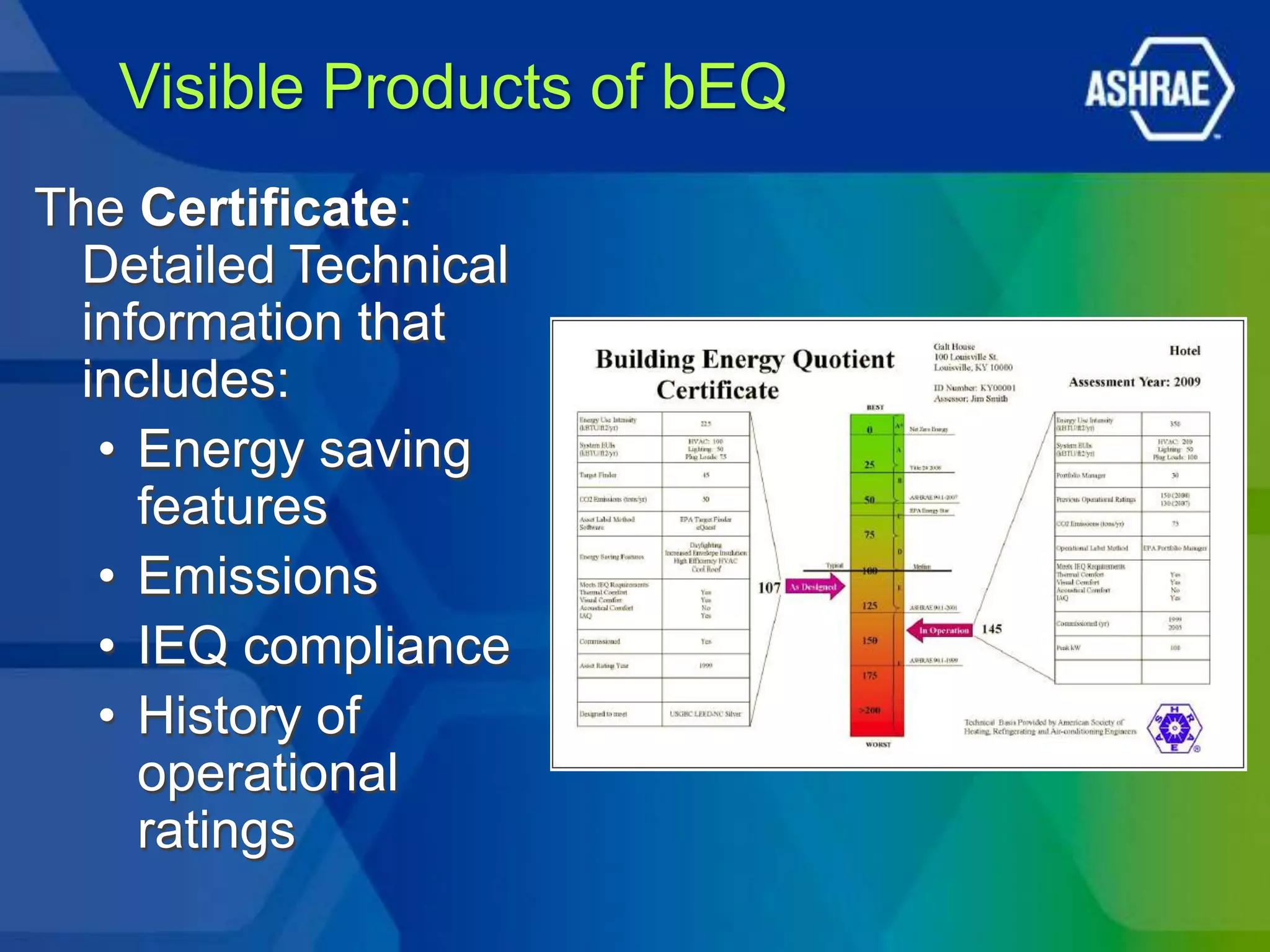
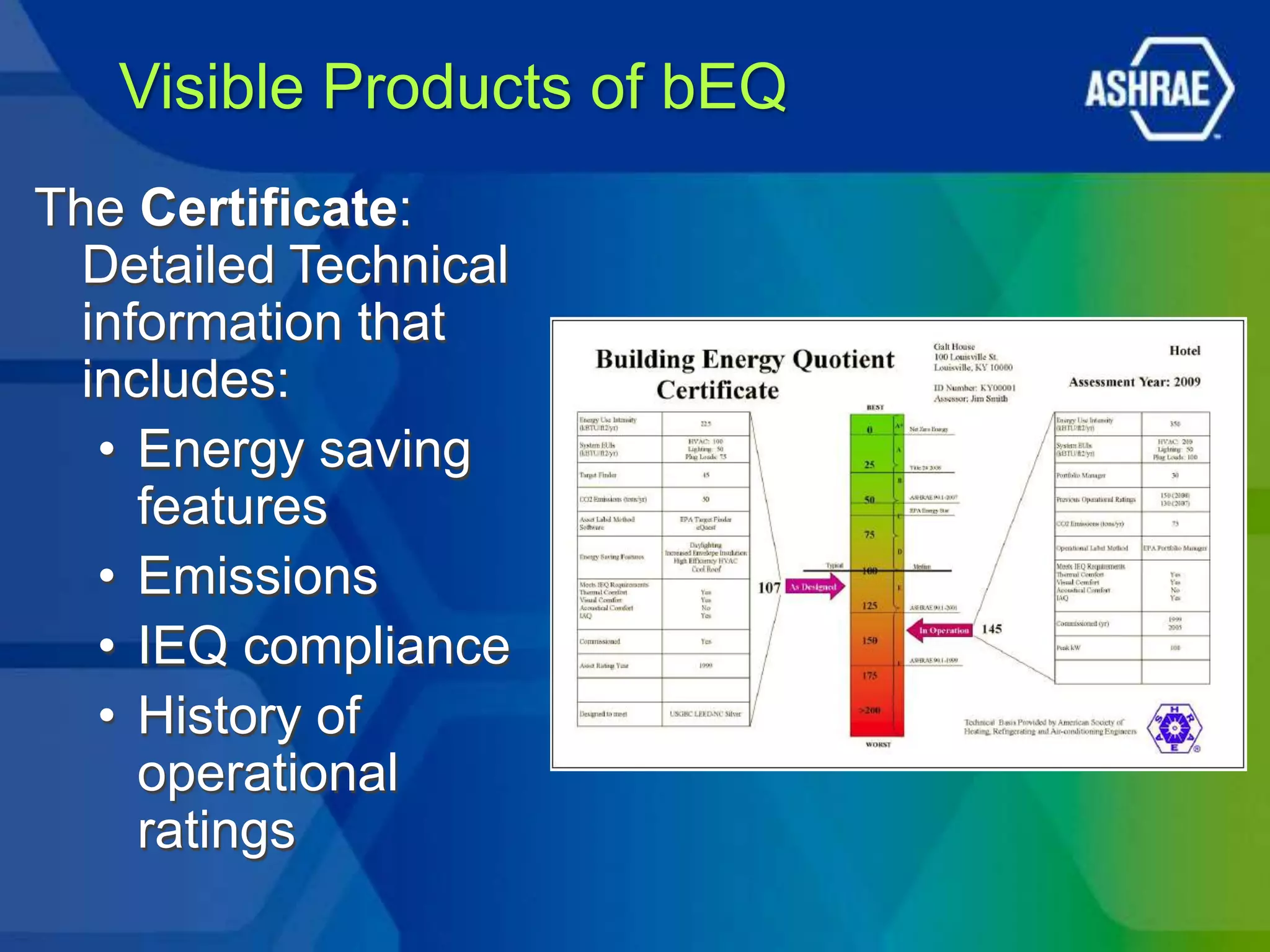
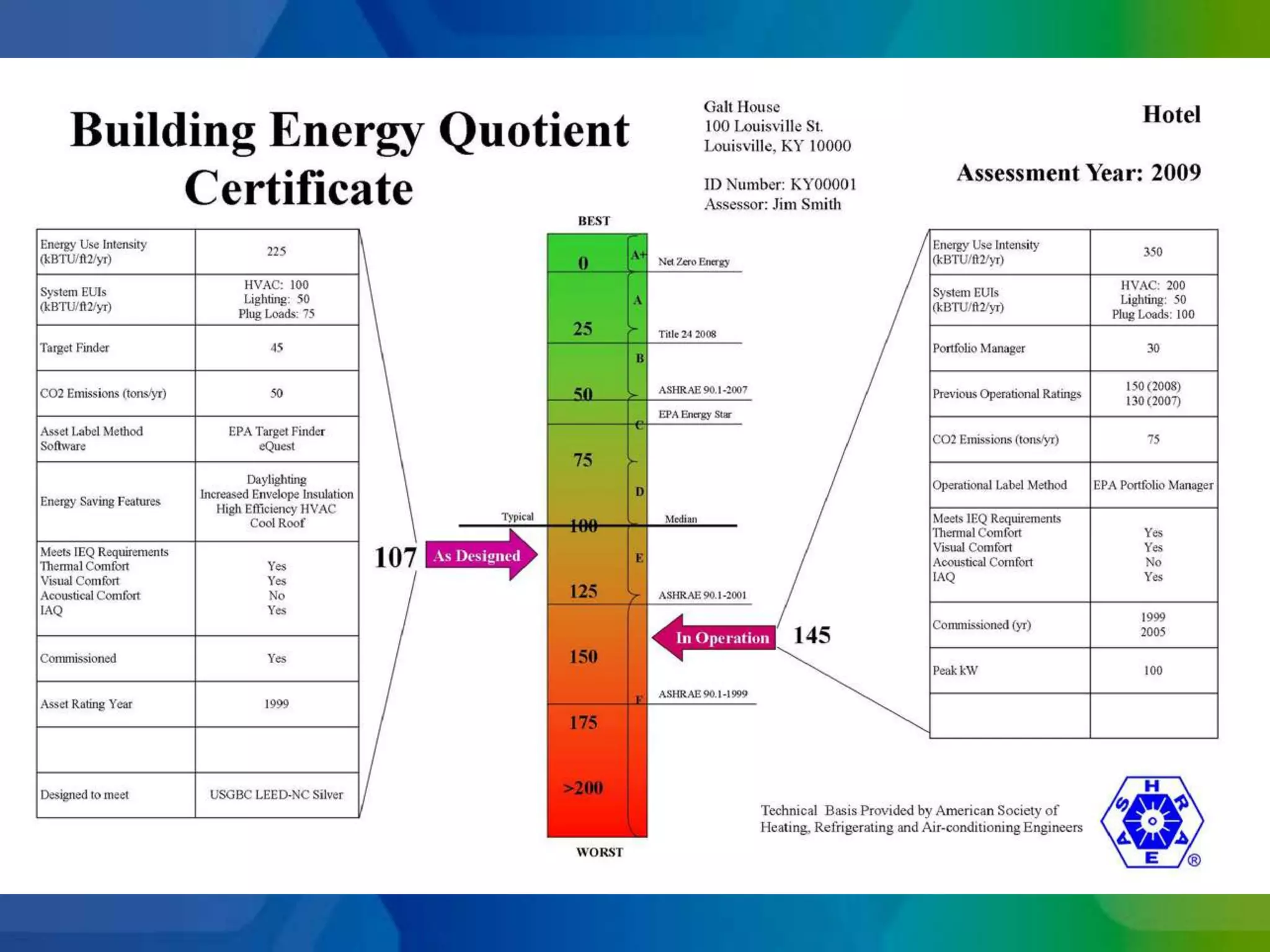
The Certificate:
  Detailed Technical
  information that
  includes:
   • Energy saving
     features
   • Emissions
   • IEQ compliance
   • History of
     operational
     ratings
Visible Products of bEQ
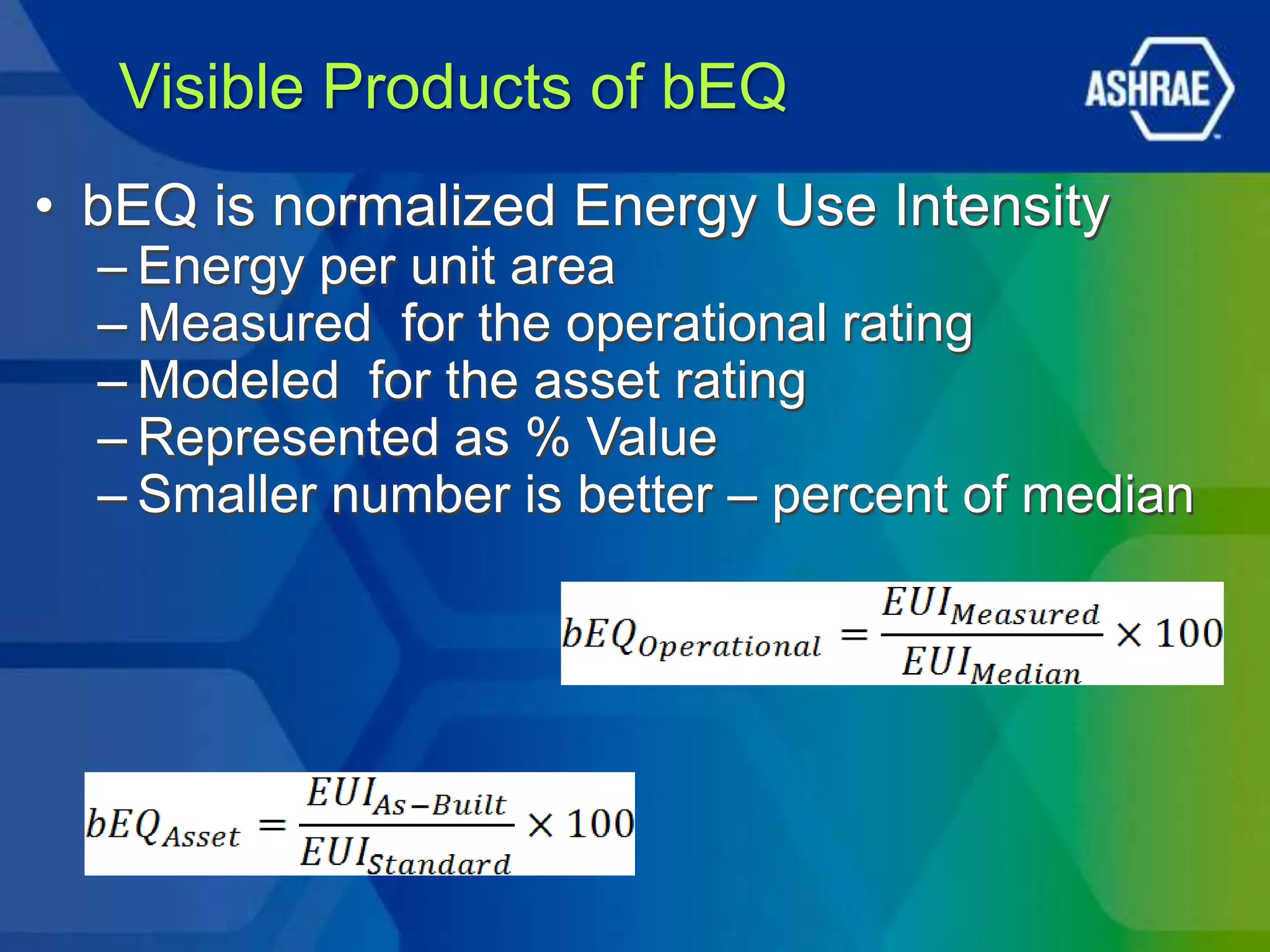
• bEQ is normalized Energy Use Intensity
  – Energy per unit area
  – Measured for the operational rating
  – Modeled for the asset rating
  – Represented as % Value
  – Smaller number is better – percent of median
Visible Products of bEQ
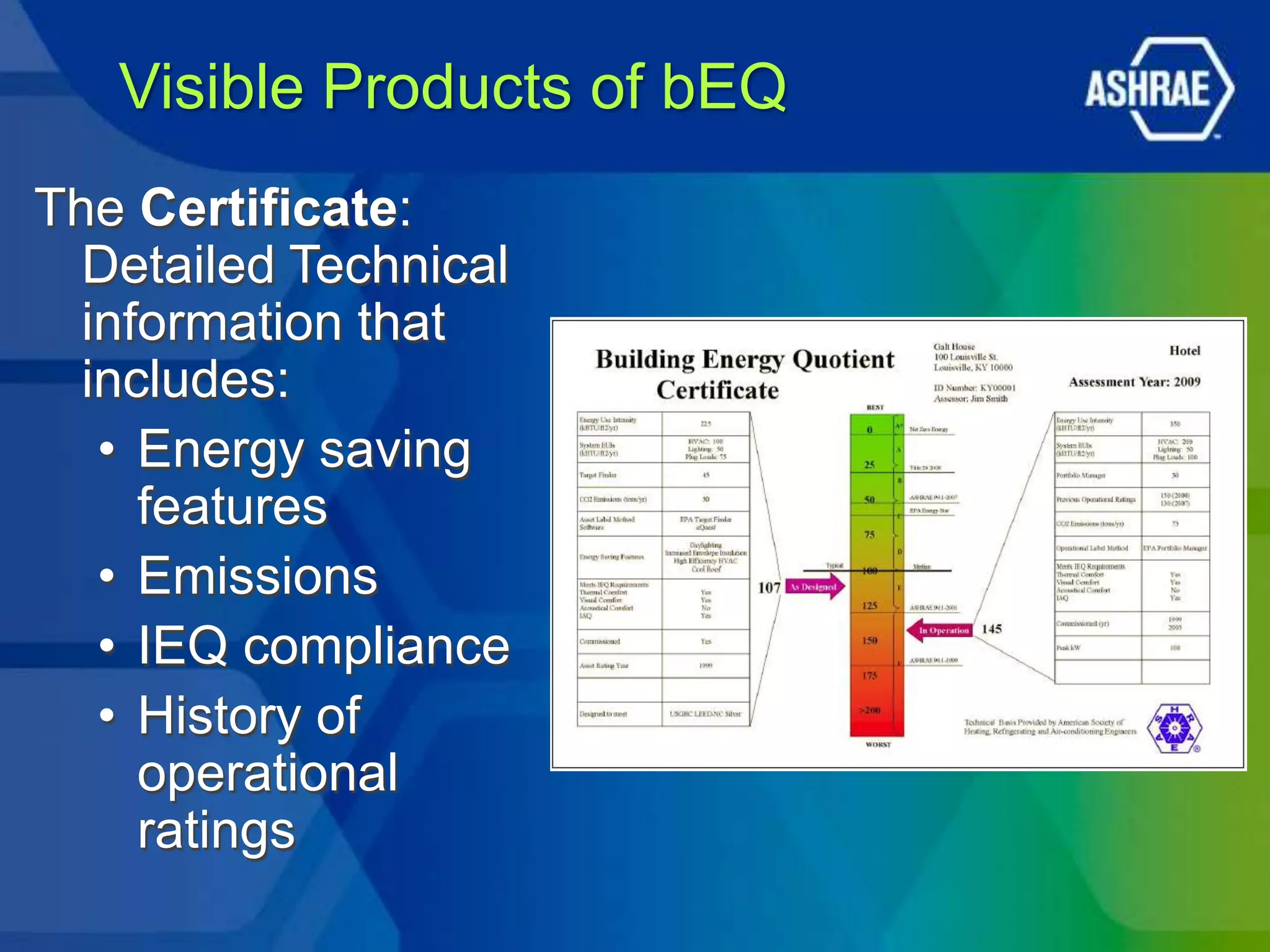
The Certificate:
  Detailed Technical
  information that
  includes:
   • Energy saving
     features
   • Emissions
   • IEQ compliance
   • History of
     operational
     ratings
Visible Products of bEQ
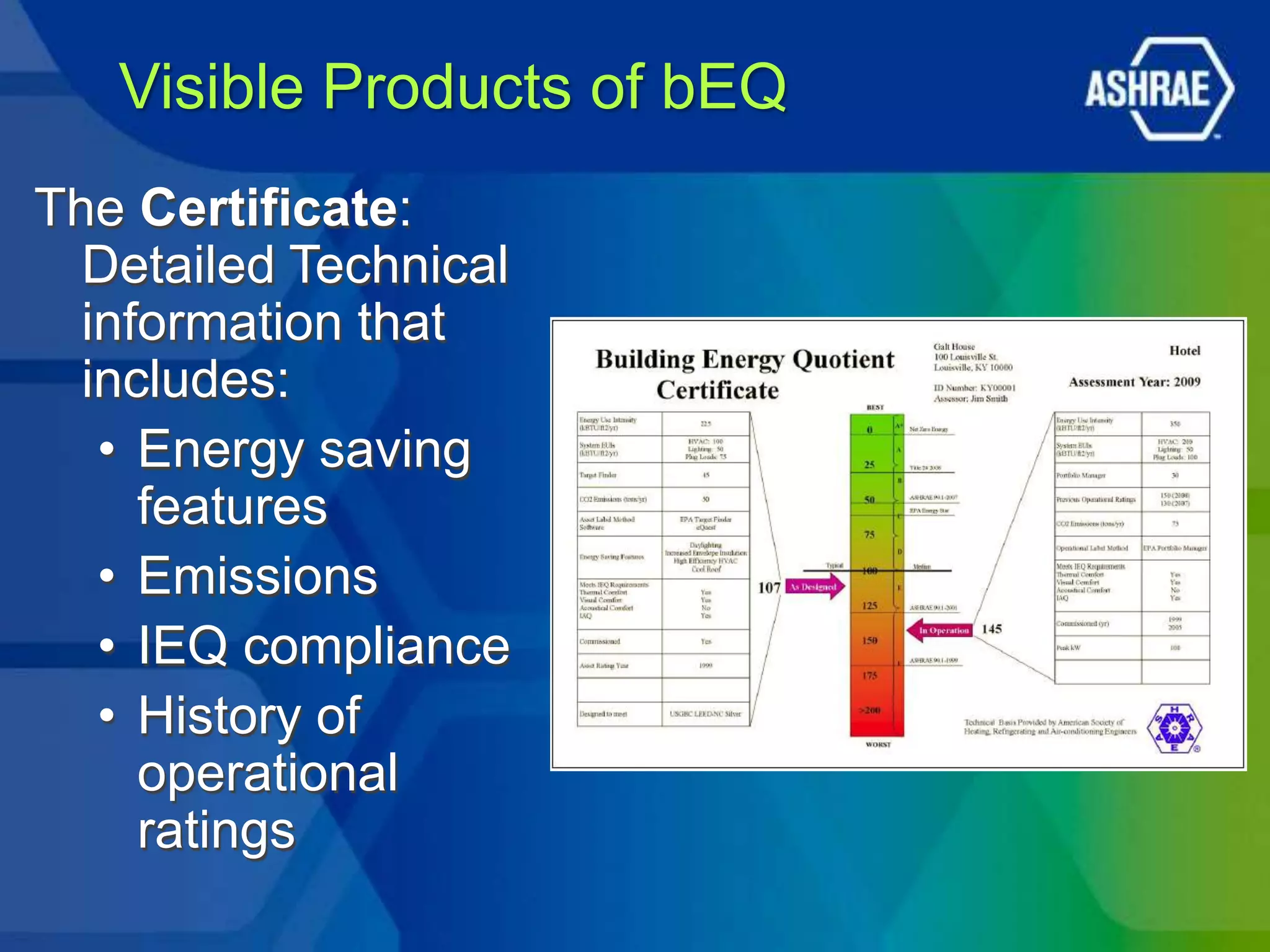
The Certificate:
  Detailed Technical
  information that
  includes:
   • Energy saving
     features
   • Emissions
   • IEQ compliance
   • History of
     operational
     ratings
Visible Products of bEQ
The Certificate:
  Detailed Technical
  information that
  includes:
   • Energy saving
     features
   • Emissions
   • IEQ compliance
   • History of
     operational
     ratings
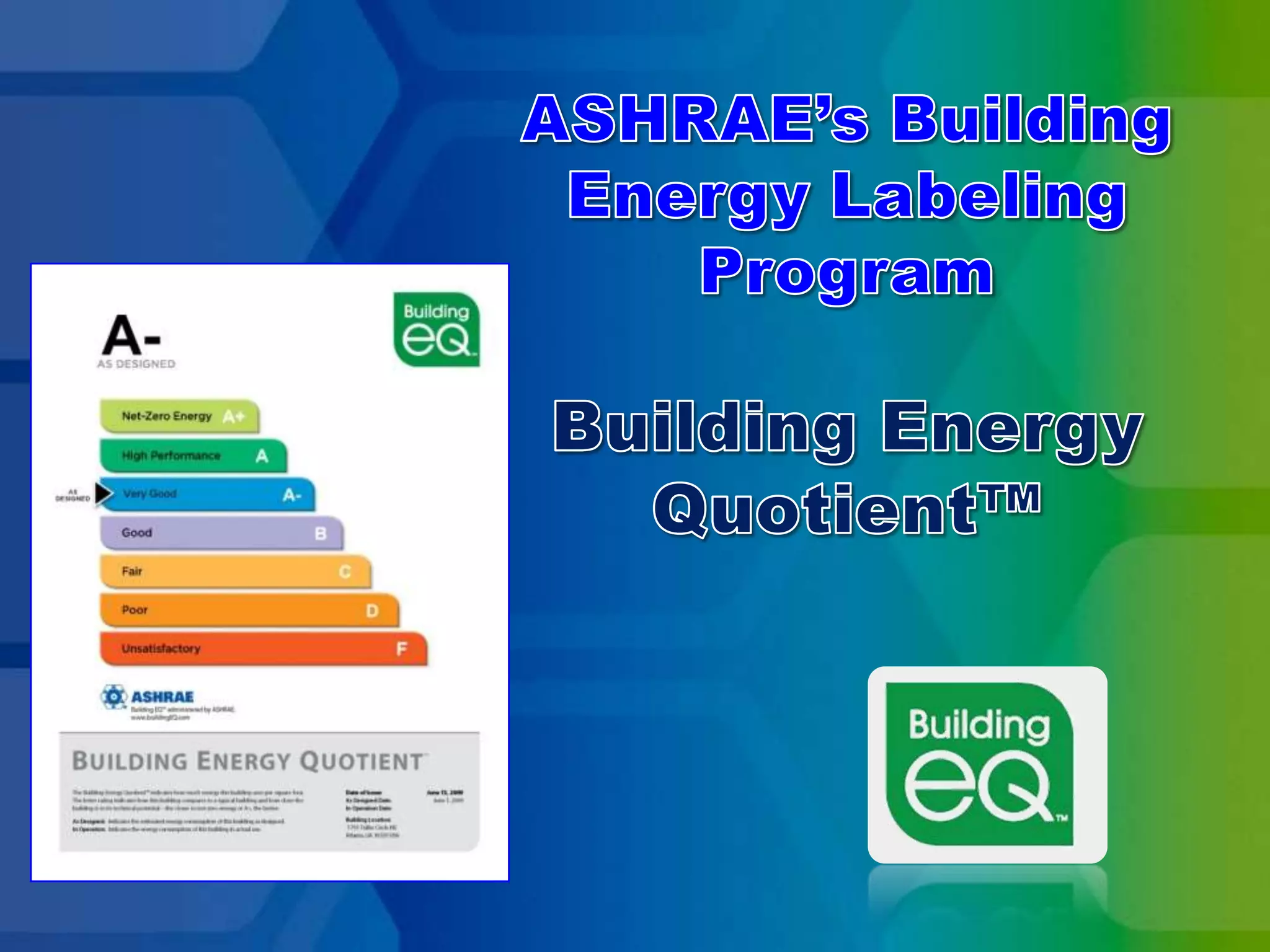
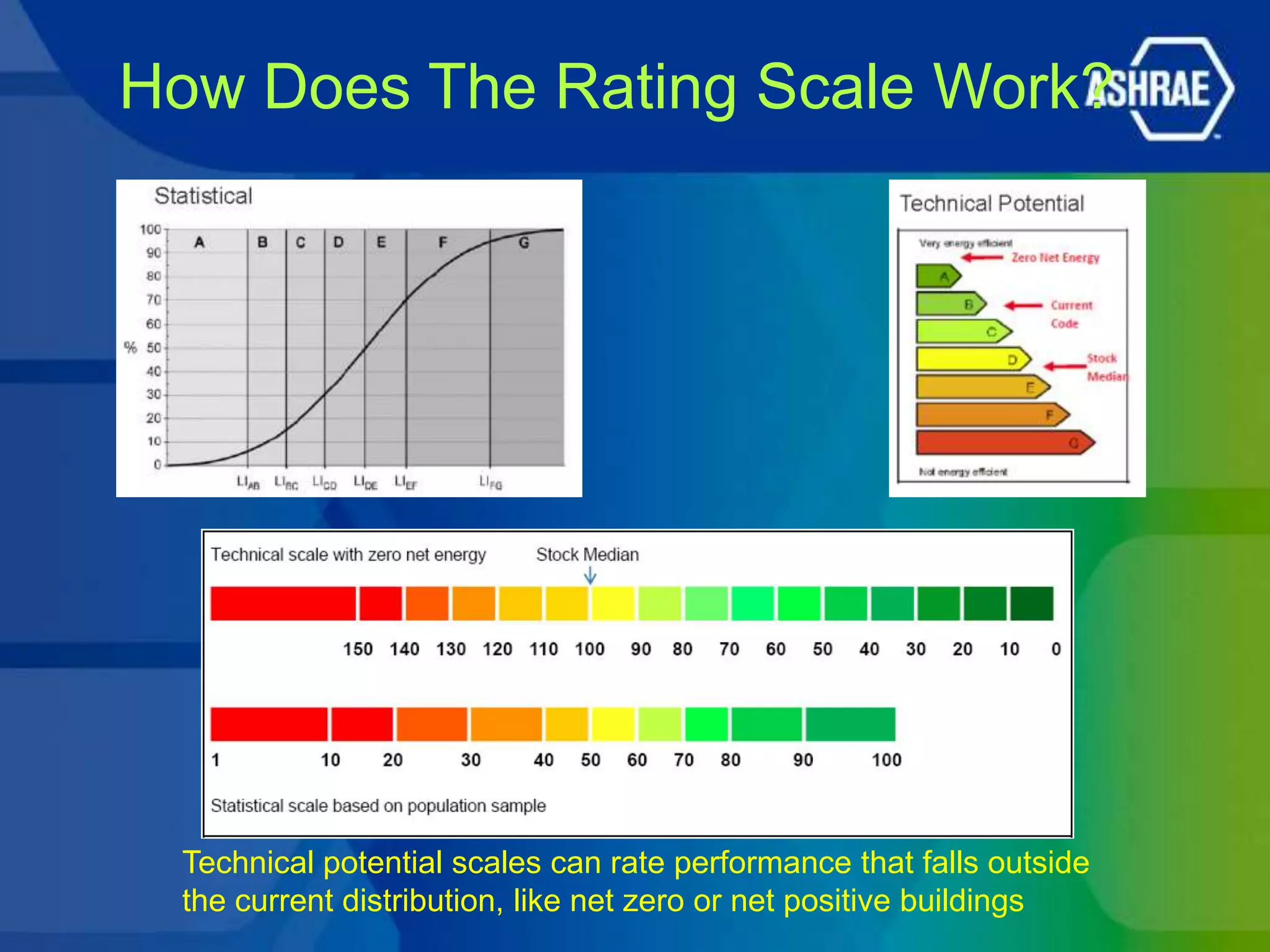
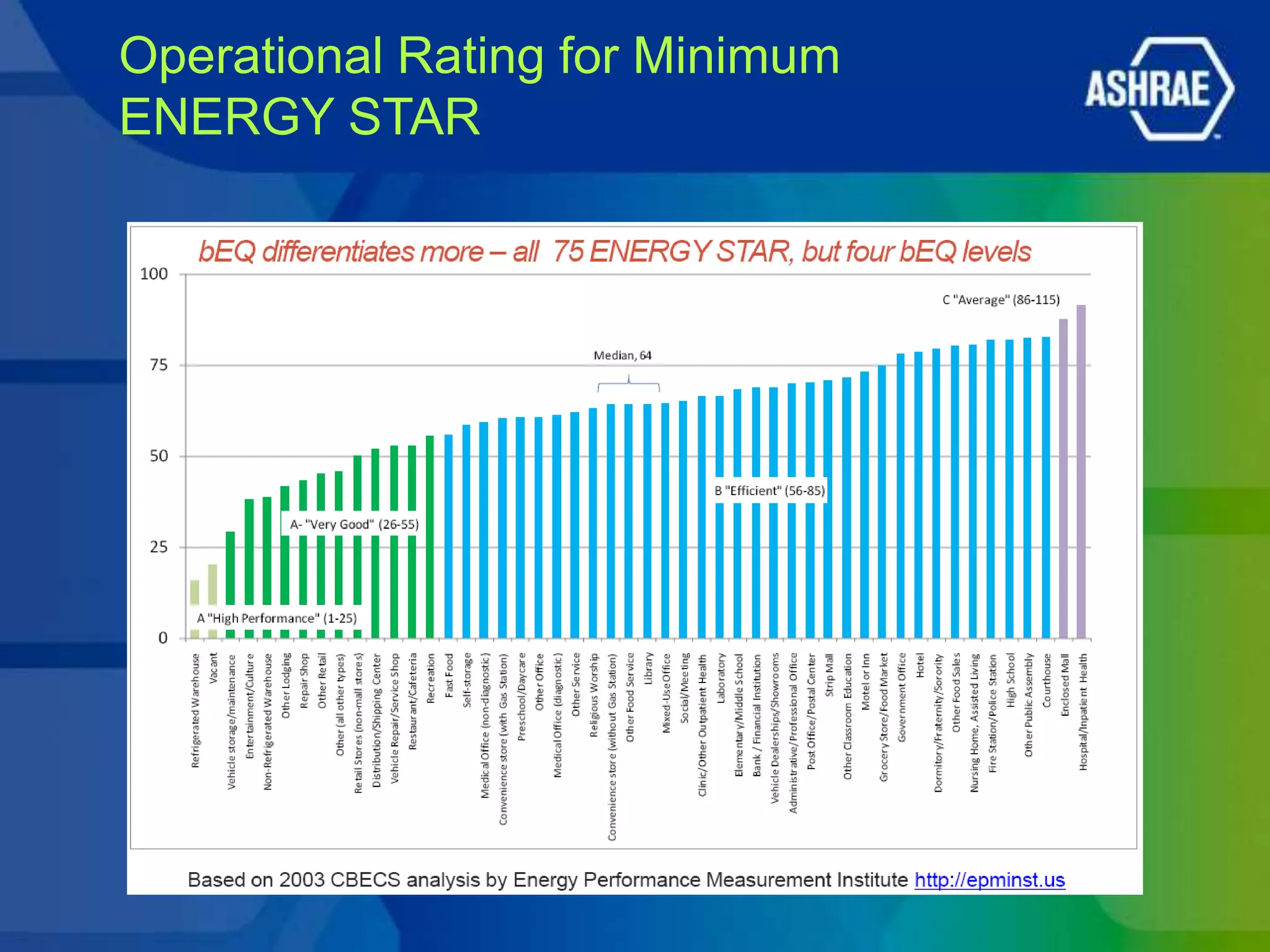
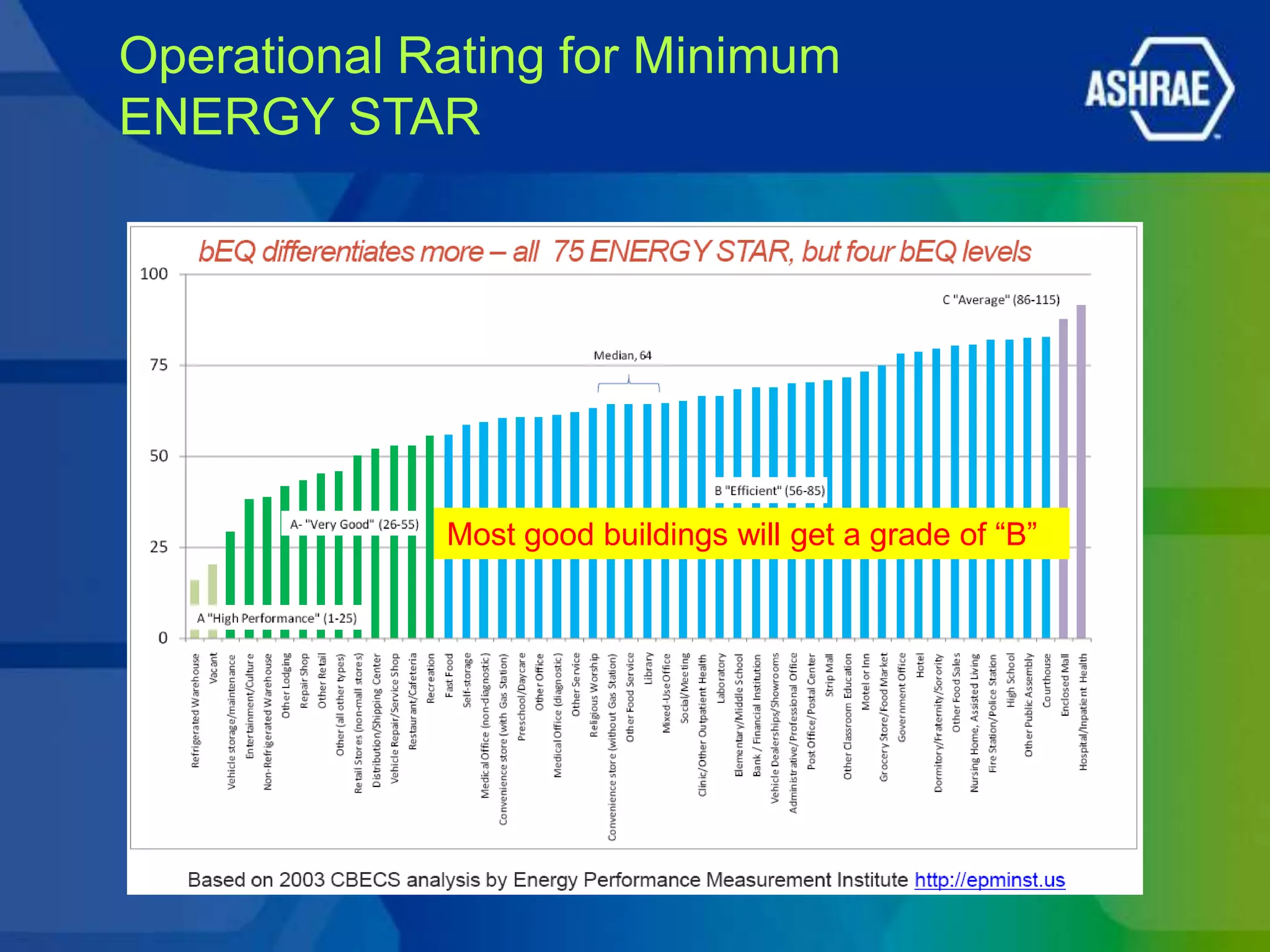
How Does The Rating Scale Work?


 Technical potential scales can rate performance that falls outside
 the current distribution, like net zero or net positive buildings
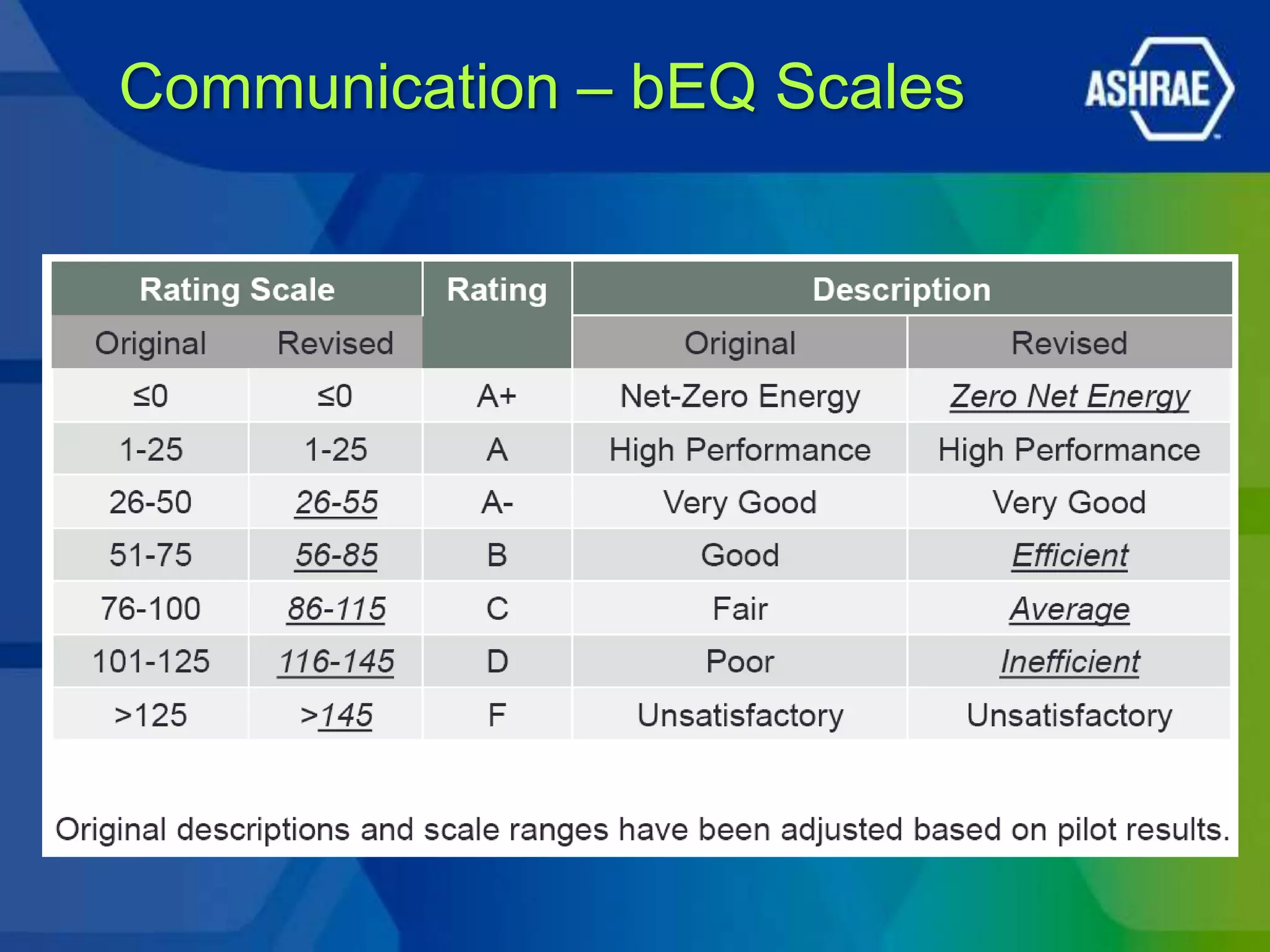
Communication – bEQ Scales
Operational Rating for Minimum
ENERGY STAR
Operational Rating for Minimum
ENERGY STAR


             Most good buildings will get a grade of ―B‖
bEQ and Professional Certification

        Building Certification Requires Certified
                     Professionals

• In Operation rating – Building Energy Assessment
  Professional (BEAP)
• As Designed rating – Building Energy Modeling
  Professional (BEMP)

• ASHRAE Certification information web page
http://www.ashrae.org/education--certification/certification
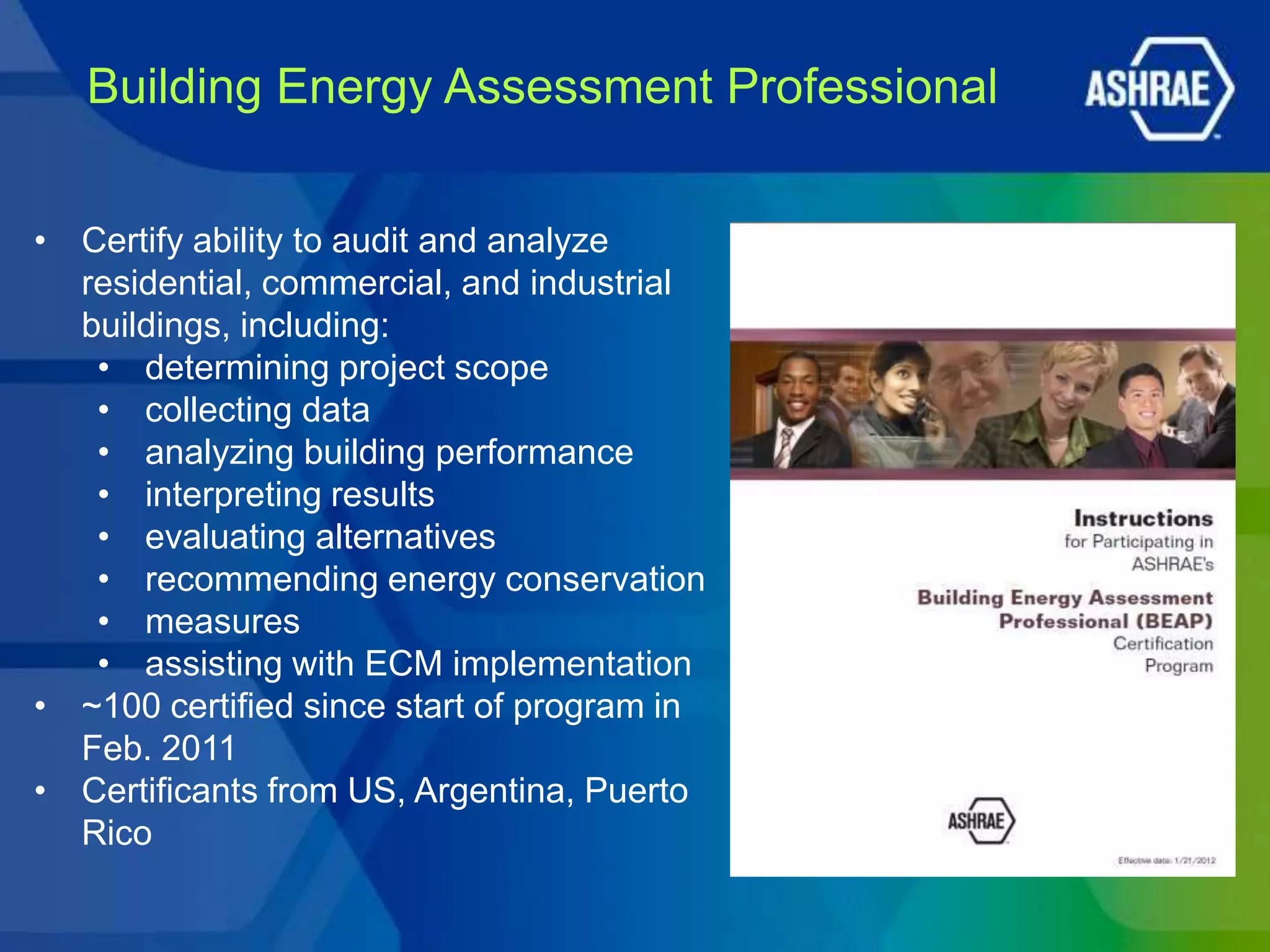
Building Energy Assessment Professional


• Certify ability to audit and analyze
  residential, commercial, and industrial
  buildings, including:
   • determining project scope
   • collecting data
   • analyzing building performance
   • interpreting results
   • evaluating alternatives
   • recommending energy conservation
   • measures
   • assisting with ECM implementation
• ~100 certified since start of program in
  Feb. 2011
• Certificants from US, Argentina, Puerto
  Rico
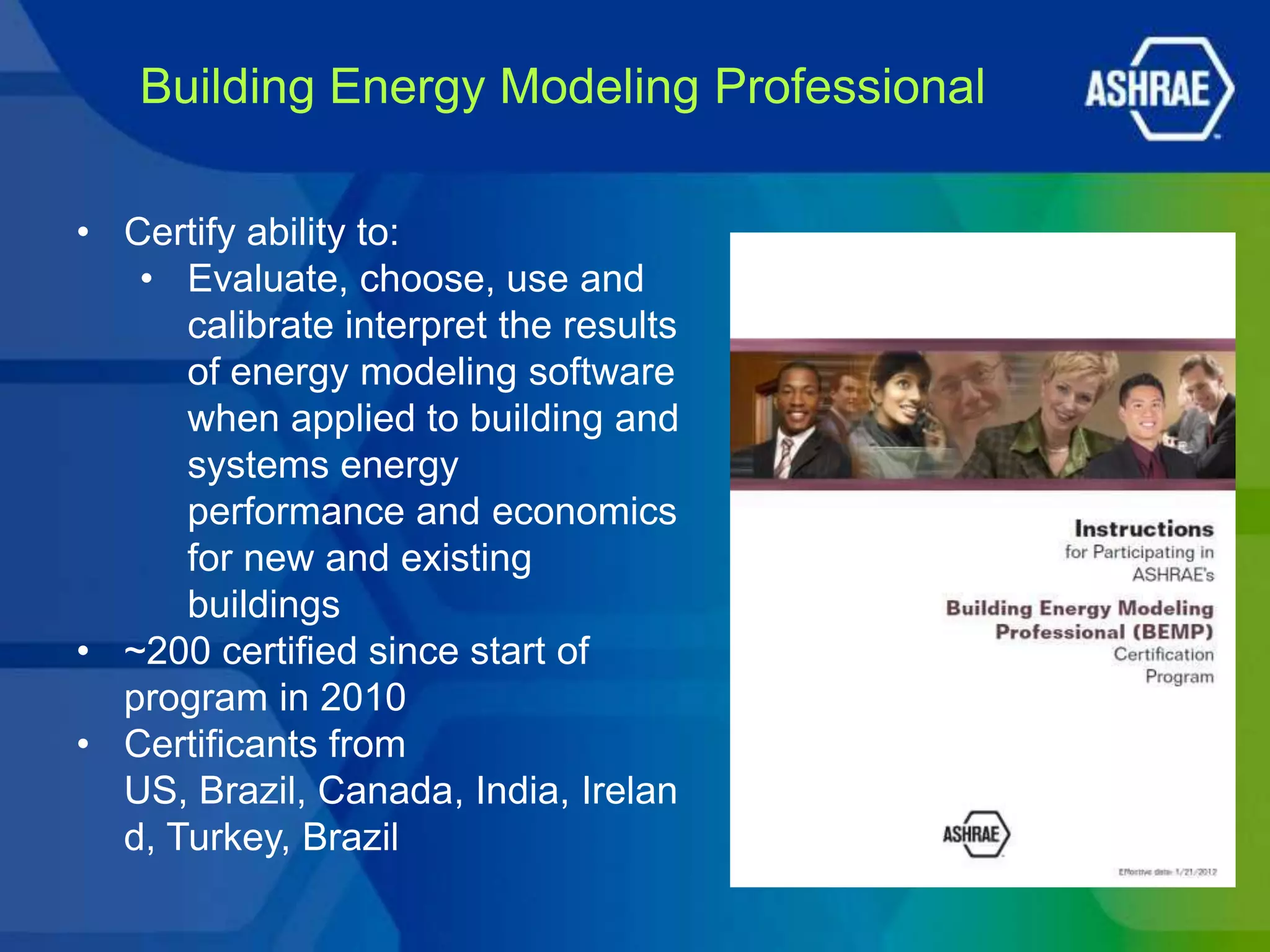
Building Energy Modeling Professional

• Certify ability to:
   • Evaluate, choose, use and
      calibrate interpret the results
      of energy modeling software
      when applied to building and
      systems energy
      performance and economics
      for new and existing
      buildings
• ~200 certified since start of
  program in 2010
• Certificants from
  US, Brazil, Canada, India, Irelan
  d, Turkey, Brazil
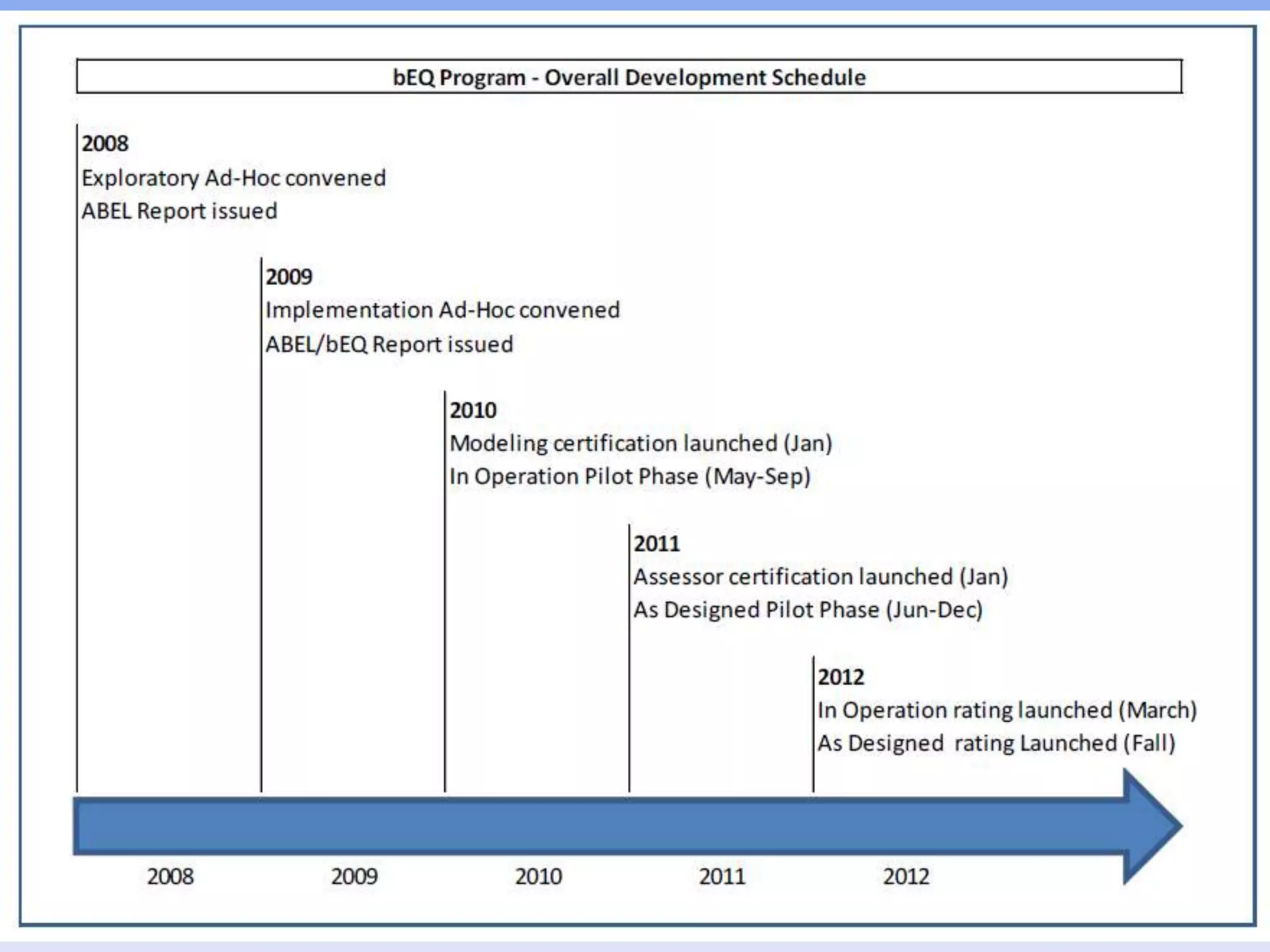
Timeline for bEQ
About the Operational Pilot
     Participation of Prominent Building
             Owners/Developers
Participants:
What Tools?

Portable Equipment:
  • Temperature, humidity, CO2, velocity, airflow
Utility usage data – spreadsheets!
Monitored energy end-use from meters/BAS
Standard Forms!
   • Complete the standard forms (coming soon…)
   • Components of a Level 1 Assessment
   • Monitored energy end-use
Energy Modelers Report for Duty

The Asset Rating:
  • An evaluation of the ―As-Designed‖ efficiency
  • Can be applied to new and existing buildings
  • Common set of assumptions –
    COMNET, Appendix G


   • Suitable for display in building
     lobbies and marketing materials
   • What is level of effort?
Energy Modelers Report for Duty

The Asset Rating:
  • Current status – two pilot buildings
  • Each being assessed by three BEMP consultants
  • Will assessments agree?

   • One of these is ASHRAE HQ
   • LEED Platinum, advanced IAQ
     systems
For More Information:
• Visit the ASHRAE bEQ web site:
   http://www.buildingeq.com/

• Illinois ASHRAE Chapter Members
       David Eldridge – dse@grummanbutkus.com
       Benny Skelton – bskelton@bmgsc.com

• Contact ASHRAE staff:
   Lilas Pratt – Manager, Special Projects
       Phone: 678-539-1193
       Email: lpratt@ashrae.org

•   ASHRAE bEQ Committee Chair, 2011-12
    Thomas Phoenix
             Phone: 336-373-9800
             Email: thphoenix@mmpa.com
Questions?


www.buildingEQ.com
Level of Effort for bEQ


    • Estimated at roughly 35 to 40 hours
    • Not intended to be a cursory review
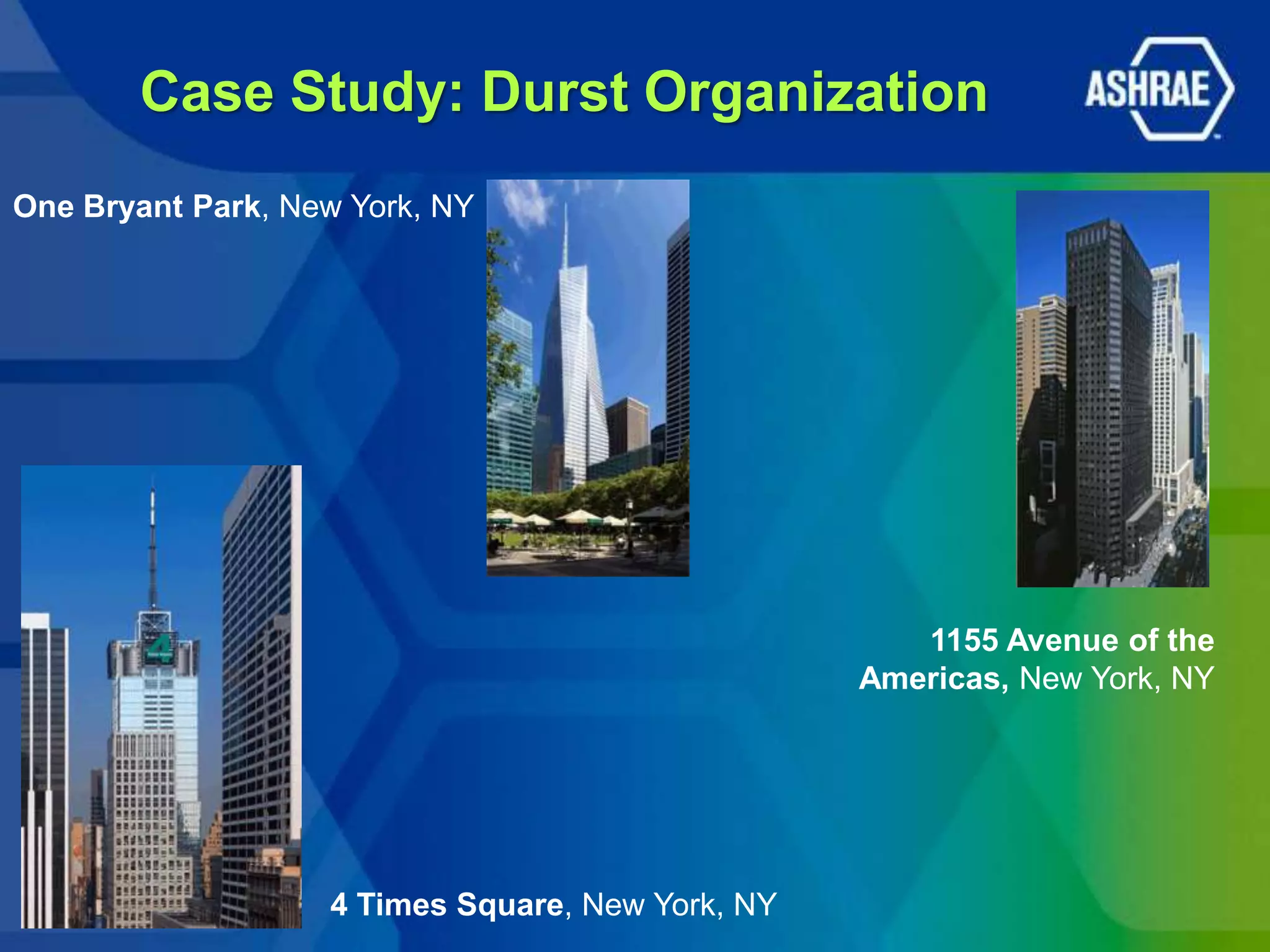
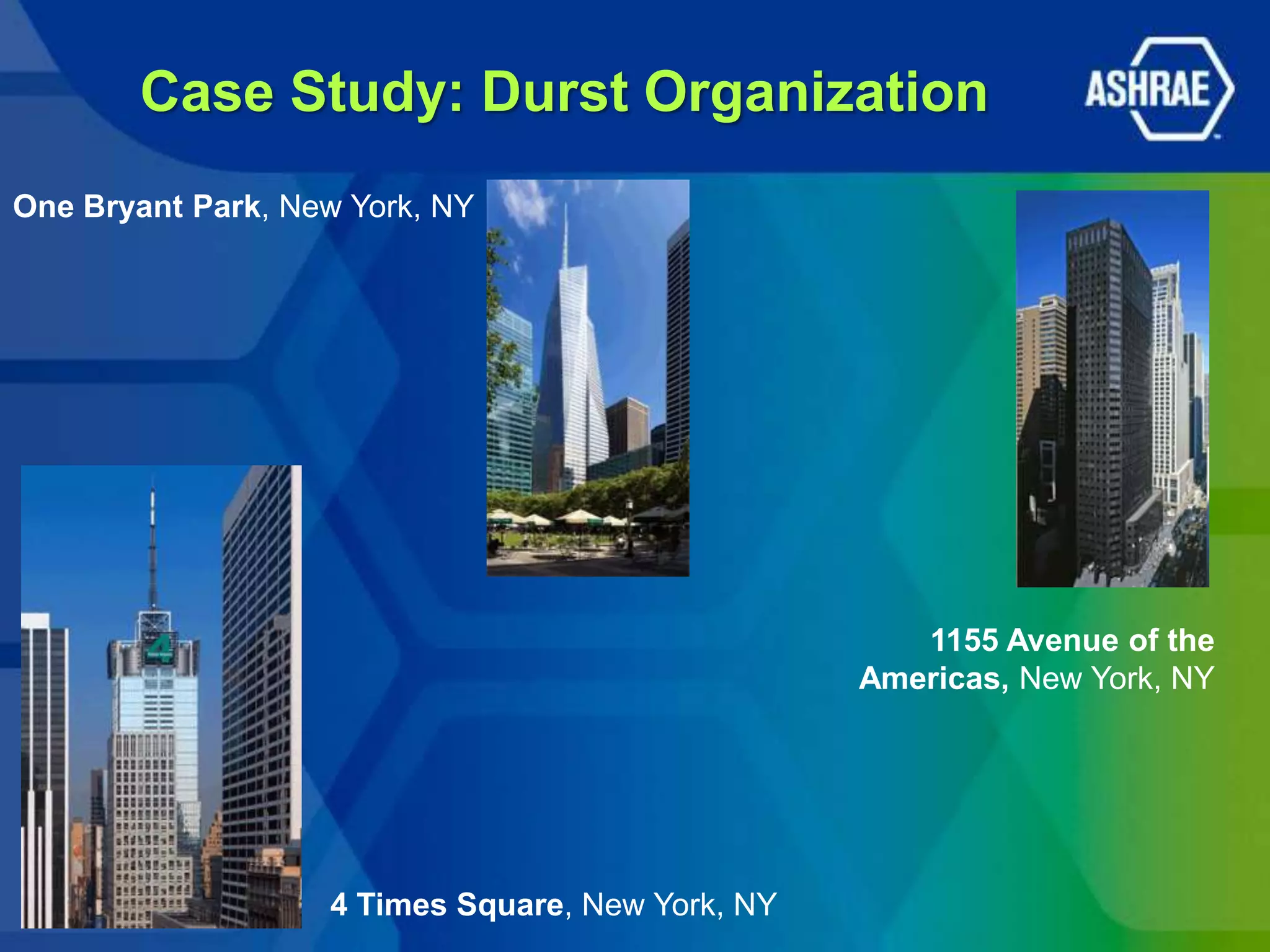
Case Study: Durst Organization
One Bryant Park, New York, NY


                                                     1155 Avenue of the
                                                  Americas, New York, NY


                   4 Times Square, New York, NY
Case Study: Durst Organization
One Bryant Park, New York, NY


                                                     1155 Avenue of the
                                                  Americas, New York, NY


                   4 Times Square, New York, NY
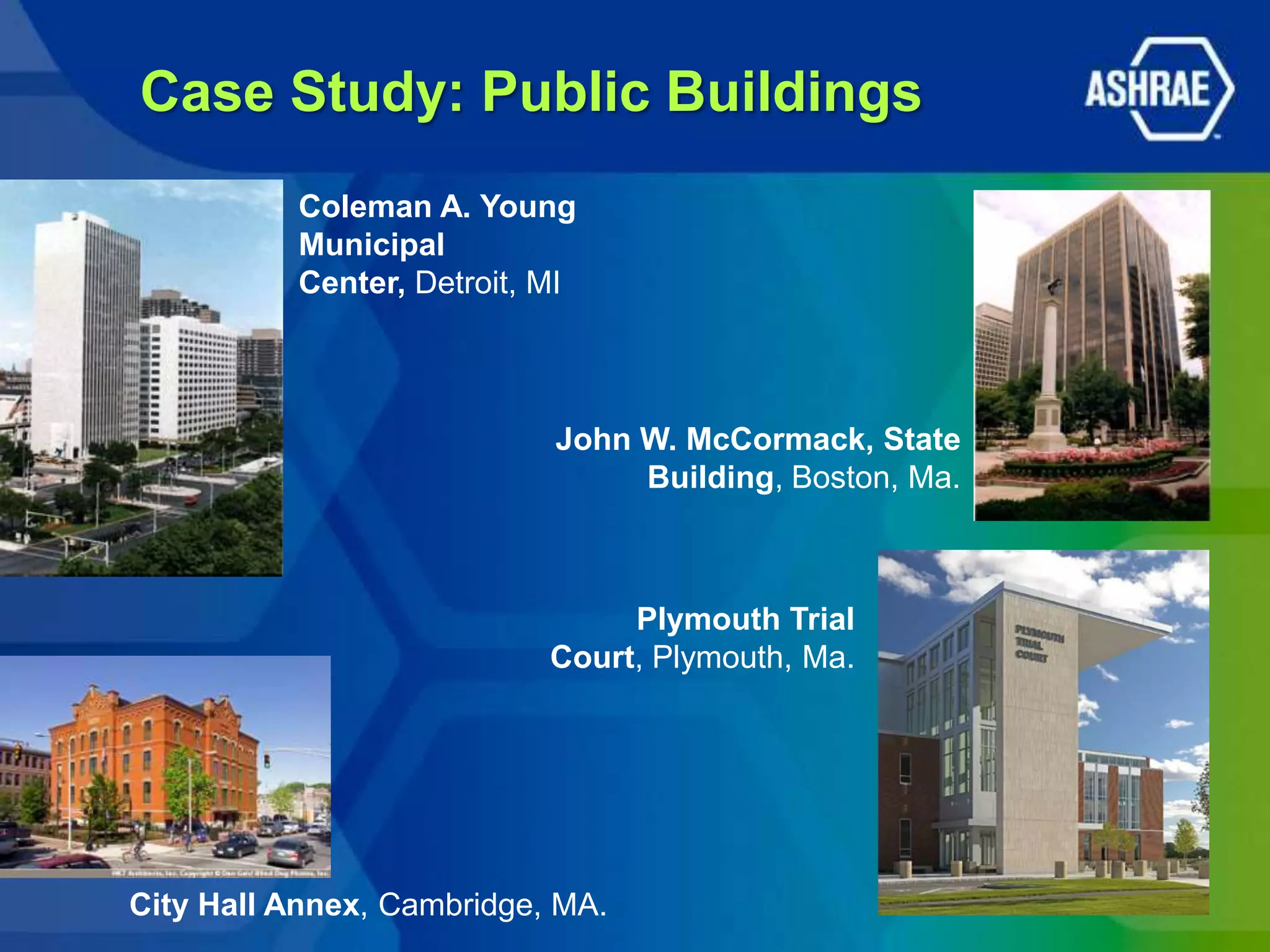
Case Study: Public Buildings
          Coleman A. Young
          Municipal
          Center, Detroit, MI


                           John W. McCormack, State
                                Building, Boston, Ma.


                                Plymouth Trial
                           Court, Plymouth, Ma.


City Hall Annex, Cambridge, MA.
Case Study: Research Buildings

           Sarofim Research Building, University
           of Texas Health Science
           Center, Houston, TX


Omega Center for Sustainable
Living, Rhinebeck, NY
Case Study: Research Buildings


  IRS Kansas City Service
  Center, Kansas City, MO
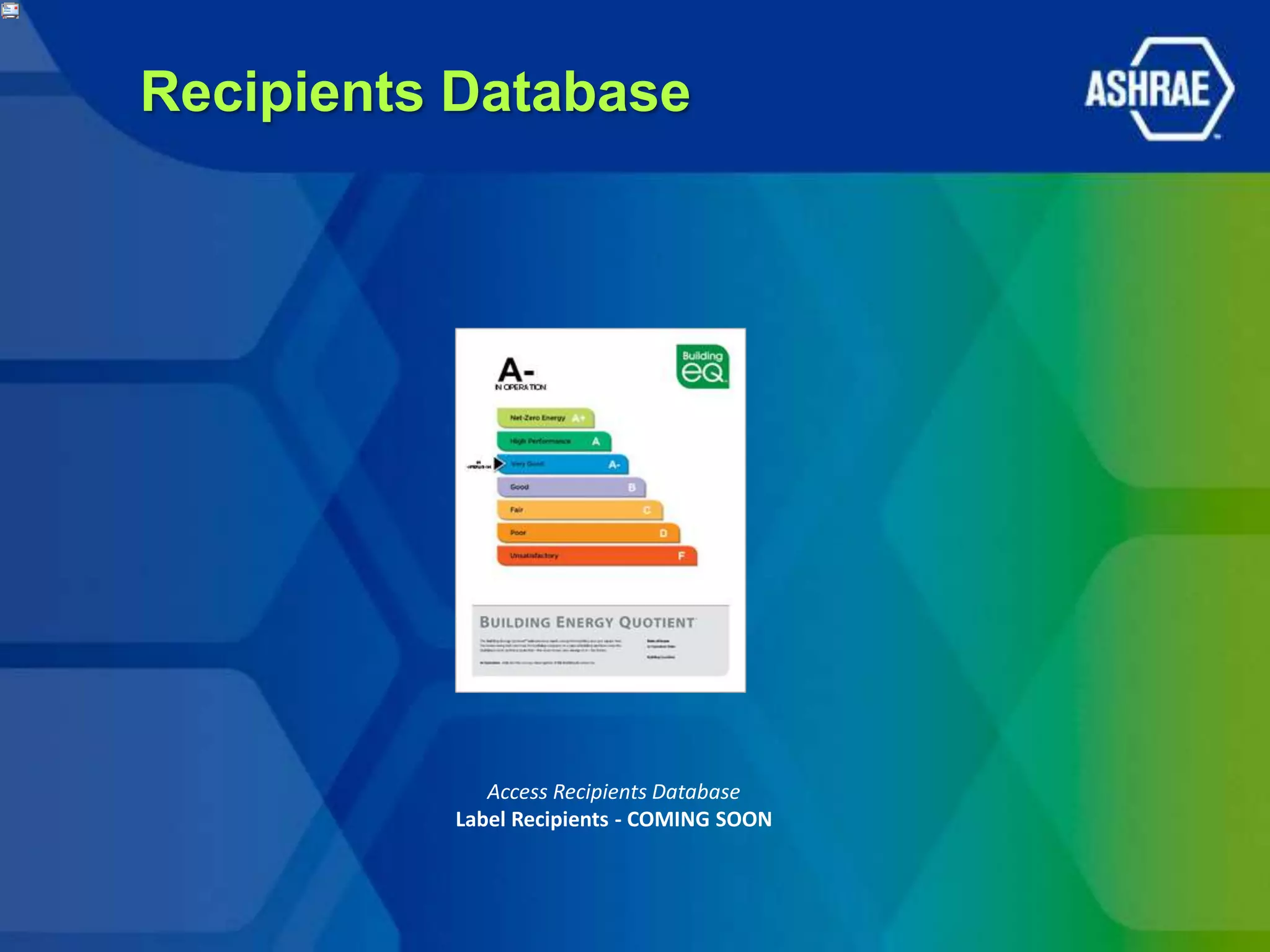
Recipients Database


             Access Recipients Database
          Label Recipients - COMING SOON
Recipients Database
Next Steps for ASRHAE bEQ

The Asset Rating:
  • Current status – two pilot buildings
  • Each being assessed by three BEMP consultants
  • Will assessments agree?
  • Does modeling produce EUIs in-line with operational
    rating?

Operational Rating
  • Develop marketing plan
  • Issue forms to public
  • Additional normalizations for building types

Building EQ

  • 1.
    Presentation to: Chicago EnergyModeling Conference February 14, 2012
  • 2.
  • 4.
    Information for Consumersto Allow Educated Choices is Not New Restaurant Sanitation Ratings Car Fuel Economy Estimates Nutrition Facts Label
  • 5.
    Building Energy Labels.. . Promote the value of energy efficiency in the marketplace Differentiate buildings with good performance for potential tenants/buyers Enhance building owner’s ability to identify energy efficiency measures to help improve operations
  • 6.
    Building Energy Labels.. . Provide clear communication of energy performance to the public Contribute to building performance databases – potential and actual energy use Highlight the drive toward Net Zero Energy Buildings
  • 7.
    Current “Building Label”Efforts in the US: – Energy Star – DOE – LEED Certifications – Green Globes – BOMA 360 All of these Programs are Voluntary
  • 8.
    Mandatory labeling requirements: – European Union – Canada – California – Washington, DC
  • 9.
    Why Should Professionals& Owners Care? • Professionals – An additional service for consulting firms and others – Required certifications demonstrate competency • Owners – Benchmarking – Recognition for participation can enhance a company’s image and reputation – Economic benefit of improving design and operation – Potential for mandatory labeling and related requirements in future
  • 11.
    Why ASHRAE? • Over100 years of experience in the building sciences • Strong technical expertise across all aspects of building design and operation • Historic focus on developing consensus- based, non-commercial documents • Respect and credibility within the building community • Proven history working with DOE and other professional organizations
  • 12.
    What is bEQ? • A voluntary certification program • A technical method that draws on successful features of other US and European building certifications • Complements other green building rating systems and energy certification programs • Can be a tool to stimulate adoption of high performance building techniques
  • 13.
    Developing bEQ • bEQDevelopment Committee – International team of experts – Representatives from the Energy Star and EU labeling programs – Building energy modeling experts – Representatives from utilities, government, and advocacy community • Technically sound and widely applicable program • Validate and enhance the program using ASHRAE’s broad technical resource network
  • 14.
    Types of Ratings In Operation Rating (Operational) • Actual measured energy use of a building • Based on combination of structure and features of the building and how it is operated • Applicable for existing buildings • Applicable for new buildings after 12-18 months of operation
  • 15.
    Types of Ratings In Operation Rating (Operational) • Building characteristics • Design goals (if applicable) • Other certifications • Conditioned area, floors, age, contact • Building HVAC and envelope systems • Energy calculations • Normalized EUI compared to median value • Raw utility usage
  • 16.
    Types of Ratings In Operation Rating (Operational) • IEQ certification • Thermal comfort – temperature and humidity, air velocity, temperature asymmetry • Lighting quality – horizontal / vertical fc, ballast types, daylight • Indoor air quality –OA calculations from design / measured rates • Surveys – occupant survey from CBE • Measurements to back up evaluation!
  • 17.
    Types of Ratings In Operation Rating (Operational) Energy Use (kWh/ft2-yr)* • Energy end-use breakdown • Metered vs calculated Supply Fans Exhaust/Return Fans 16.2% 3.2% Plug Loads 28.5% Energy Use End Use (kWh/ft2-yr) Supply Fans 3.18 Cooling Exhaust/Return Fans 0.62 Equipment Cooling Equipment 1.62 8.2% Lighting 4.22 Domestic Hot Condenser Water Water Pumping 0.99 0.5% Electric Heat 3.34 Domestic Hot Water 0.09 Electric Heat 17.0% Lighting Plug Loads 5.60 21.5% Total Energy Entered 19.66 Condenser Water Pumping 5.1%
  • 18.
    Types of Ratings In Operation Rating (Operational) • Listing of possible energy efficiency measures (EEMs) for the building • ASHRAE Level 1 effort for rigor of evaluation – focus on energy savings, not necessarily cost savings • Source energy comparison
  • 19.
    Types of Ratings In Operation Rating (Operational) • Building characteristics • Energy calculations • IEQ certification • Thermal comfort • Lighting quality • Indoor air quality • Surveys • Measurements • Energy end-use breakdown
  • 20.
    Types of Ratings As Designed Rating (Asset) • Assessment of the building based on design components: mechanical, envelope, orientation, and lighting. • Based on results of a building energy model • Applicable to both new and existing buildings • Can be used to make choices between potential building designs
  • 21.
    Features of bEQProgram: • Potential side-by-side comparison of As Designed (asset) and In Operation (operational) Ratings • Building assessment identifies both peak demand reduction and energy management opportunities • Recognizes energy use from on-site renewables • Includes measurement-based Indoor Environmental Quality (IEQ) indicators to assure levels of service are maintained
  • 22.
    Relationship to OtherPrograms • Europe – Directive 2002/91/EC on the energy performance of buildings – Standard EN 15217 Energy performance of buildings—methods for expressing energy performance and for energy certification of buildings (2007) – Explicit effort to learn from EU experience Austria England & Wales Greece Italy
  • 23.
    bEQ and Existing―Green‖ Programs like LEED or GreenGlobes? • Focuses on a building’s energy use while also ensuring adequate building IEQ • Helps identify opportunities for improving energy performance
  • 24.
    bEQ and EPA’sEnergy Star Program? • Greater differentiation for high performing buildings • Emphasis on top performers and net zero energy operation. • Required site visit to validate information and IEQ • Applies to all building types • Measures IEQ performance • Expanded information provided for how to improve energy performance
  • 25.
    Visible Products ofbEQ The Label: • Most visible component of the program • Simple to understand – targets general public • Suitable for display in building lobbies and marketing materials • Satisfies public disclosure requirements at the state and local level
  • 26.
    Visible Products ofbEQ The Certificate: Detailed Technical information that includes: • Energy saving features • Emissions • IEQ compliance • History of operational ratings
  • 27.
    Visible Products ofbEQ • bEQ is normalized Energy Use Intensity – Energy per unit area – Measured for the operational rating – Modeled for the asset rating – Represented as % Value – Smaller number is better – percent of median
  • 28.
    Visible Products ofbEQ The Certificate: Detailed Technical information that includes: • Energy saving features • Emissions • IEQ compliance • History of operational ratings
  • 29.
    Visible Products ofbEQ The Certificate: Detailed Technical information that includes: • Energy saving features • Emissions • IEQ compliance • History of operational ratings
  • 30.
    Visible Products ofbEQ The Certificate: Detailed Technical information that includes: • Energy saving features • Emissions • IEQ compliance • History of operational ratings
  • 31.
    How Does TheRating Scale Work? Technical potential scales can rate performance that falls outside the current distribution, like net zero or net positive buildings
  • 32.
  • 34.
    Operational Rating forMinimum ENERGY STAR
  • 35.
    Operational Rating forMinimum ENERGY STAR Most good buildings will get a grade of ―B‖
  • 36.
    bEQ and ProfessionalCertification Building Certification Requires Certified Professionals • In Operation rating – Building Energy Assessment Professional (BEAP) • As Designed rating – Building Energy Modeling Professional (BEMP) • ASHRAE Certification information web page http://www.ashrae.org/education--certification/certification
  • 37.
    Building Energy AssessmentProfessional • Certify ability to audit and analyze residential, commercial, and industrial buildings, including: • determining project scope • collecting data • analyzing building performance • interpreting results • evaluating alternatives • recommending energy conservation • measures • assisting with ECM implementation • ~100 certified since start of program in Feb. 2011 • Certificants from US, Argentina, Puerto Rico
  • 38.
    Building Energy ModelingProfessional • Certify ability to: • Evaluate, choose, use and calibrate interpret the results of energy modeling software when applied to building and systems energy performance and economics for new and existing buildings • ~200 certified since start of program in 2010 • Certificants from US, Brazil, Canada, India, Irelan d, Turkey, Brazil
  • 39.
  • 41.
    About the OperationalPilot Participation of Prominent Building Owners/Developers Participants:
  • 42.
    What Tools? Portable Equipment: • Temperature, humidity, CO2, velocity, airflow Utility usage data – spreadsheets! Monitored energy end-use from meters/BAS Standard Forms! • Complete the standard forms (coming soon…) • Components of a Level 1 Assessment • Monitored energy end-use
  • 43.
    Energy Modelers Reportfor Duty The Asset Rating: • An evaluation of the ―As-Designed‖ efficiency • Can be applied to new and existing buildings • Common set of assumptions – COMNET, Appendix G • Suitable for display in building lobbies and marketing materials • What is level of effort?
  • 44.
    Energy Modelers Reportfor Duty The Asset Rating: • Current status – two pilot buildings • Each being assessed by three BEMP consultants • Will assessments agree? • One of these is ASHRAE HQ • LEED Platinum, advanced IAQ systems
  • 45.
    For More Information: •Visit the ASHRAE bEQ web site: http://www.buildingeq.com/ • Illinois ASHRAE Chapter Members David Eldridge – dse@grummanbutkus.com Benny Skelton – bskelton@bmgsc.com • Contact ASHRAE staff: Lilas Pratt – Manager, Special Projects Phone: 678-539-1193 Email: lpratt@ashrae.org • ASHRAE bEQ Committee Chair, 2011-12 Thomas Phoenix Phone: 336-373-9800 Email: thphoenix@mmpa.com
  • 46.
  • 49.
    Level of Effortfor bEQ • Estimated at roughly 35 to 40 hours • Not intended to be a cursory review
  • 50.
    Case Study: DurstOrganization One Bryant Park, New York, NY 1155 Avenue of the Americas, New York, NY 4 Times Square, New York, NY
  • 51.
    Case Study: DurstOrganization One Bryant Park, New York, NY 1155 Avenue of the Americas, New York, NY 4 Times Square, New York, NY
  • 52.
    Case Study: PublicBuildings Coleman A. Young Municipal Center, Detroit, MI John W. McCormack, State Building, Boston, Ma. Plymouth Trial Court, Plymouth, Ma. City Hall Annex, Cambridge, MA.
  • 53.
    Case Study: ResearchBuildings Sarofim Research Building, University of Texas Health Science Center, Houston, TX Omega Center for Sustainable Living, Rhinebeck, NY
  • 54.
    Case Study: ResearchBuildings IRS Kansas City Service Center, Kansas City, MO
  • 55.
    Recipients Database Access Recipients Database Label Recipients - COMING SOON
  • 56.
  • 57.
    Next Steps forASRHAE bEQ The Asset Rating: • Current status – two pilot buildings • Each being assessed by three BEMP consultants • Will assessments agree? • Does modeling produce EUIs in-line with operational rating? Operational Rating • Develop marketing plan • Issue forms to public • Additional normalizations for building types

Editor's Notes

  • #2 How do you spell it? It is shown both as “bEQ” and “BeQ”
  • #4 Building Energy Labeling: What's the Point? A building energy labeling program provides information on the potential and actual energy use of buildings.Beyond the benefit received by individual building owners and managers, the increased availability of building data will be a valuable research tool for the building community.Building owners and operators can see how their building compares to peer buildings to establish a measure of their potential for energy performance improvement. Building owners can use the information provided to differentiate their building from others to secure potential buyers or tenants. Potential buyers or tenants can gain insight into the value and potential long-term cost of a building. Operations and maintenance staff can use the results to inform their decisions on maintenance activities and influence building owners and managers to pursue equipment upgrades and demonstrate the return on investment for energy efficiency projects.
  • #5 You can’t change what you can’t measure.Informed decisions by purchasers and renters of property.Differentiation between peer group of high-performing buildings.
  • #9 Current Efforts Related to Labeling• Significant efforts in the international community - European Union, Singapore, Canada and others• U.S. efforts include various rating systems:• EPA ENERGY STAR – Energy rating with baseline IEQ criteria• USGBC LEED – Sustainability rating• GBI Green Globes – Sustainability rating• BOMA 360 – Energy is one of six O&M-focused criteria• State programs– California, New York, DC, Massachusettes• ASHRAE is working with ENERGY STAR, DOE Energy Efficient Building Hub in U.S. and CIBSE internationally
  • #29 EUIAs-Built: Source energy use of actual building design computed using standard occupancy and operational schedules, Site-source conversion based on typical conversion factorsEUIStandard: Representative middle-of-distribution performance
  • #34 Communication scale for bEQOther scales – ENERGY STAR is a statistical scale
  • #35 System EUIs – the need to compare this data is specialized – repeated here
  • #54 The Coleman A. Young Municipal Center is a government office building in Downtown Detroit. The international style, high-rise building was constructed in 1951 and completed in 1954. It is 20 floors high, with one basement floor, for a total of 21. The building is used as a library, a court-house, a county government facility and as a city hall, replacing the now-demolished Detroit City Hall. McCormack:Built in the mid 1970s, the 21-story building is located directly across from Massachusetts State House and houses many state executive branches and state agencies. The building was designed as an open floor office building with minimal enclosed offices and a dedicated main frame information technology system. In addition, it was designed to provide comfort through a municipal steam fed mechanical system. Throughout the years, the building has experienced many changes, including change in the mechanical system, the floor spaces where individual offices and the main frame has been replaced by servers, desktop PCs and printers. City Hall Annex is a 4 story office building encompassing approximately 32,000 square feet. It is a LEED Gold rated building that was gutted and renovated about 6 years ago. The building has a ground source heat pump/forced air system, with no conventional backup. There is also a 26.5 kW solar PV system on the roof. City Hall Annex is located at 344 Broadway in Cambridge, MA.