Standard 100  Energy Efficiency in Existing Buildings  Revision Presentation Created by: Glenn Friedman, PE Principal, Taylor Engineering &  Secretary ASHRAE SPC-100 [email_address]   Slides presented to Illinois Chapter by:  Michael P. Kuk Technical Director, Sieben Energy Associates [email_address] Illinois Chapter ASHRAE Seminar May 10, 2011 Copyright ASHRAE® 10-20-2010
ANSI/IESNA/ASHRAE Standard 100-2006
ANSI/IESNA/ASHRAE Standard 90.1-2007
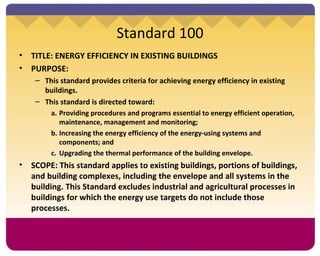
Standard 100 TITLE: ENERGY EFFICIENCY IN EXISTING BUILDINGS PURPOSE: This standard provides criteria for achieving energy efficiency in existing buildings. This standard is directed toward: Providing procedures and programs essential to energy efficient operation, maintenance, management and monitoring; Increasing the energy efficiency of the energy-using systems and components; and Upgrading the thermal performance of the building envelope. SCOPE: This standard applies to existing buildings, portions of buildings, and building complexes, including the envelope and all systems in the building. This Standard excludes industrial and agricultural processes in buildings for which the energy use targets do not include those processes.
Standard 90.1 TITLE: ENERGY STANDARD for BUILDINGS EXCEPT LOW-RISE RESIDENTIAL BUILDINGS PURPOSE The purpose of this standard is to provide minimum requirements for the energy-efficient design of buildings except low-rise residential buildings.  SCOPE 2.1 This standard provides  minimum energy-efficient requirements for the design and construction of New buildings and their systems New portions of buildings and their systems and New systems and equipment in existing buildings and Criteria for determining compliance with these requirements [Standard 90.2 covers energy standards for low-rise residential buildings]
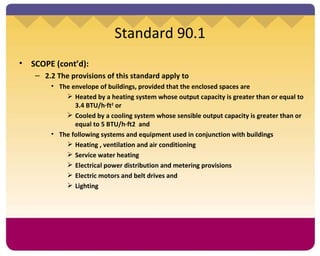
Standard 90.1 SCOPE (cont’d):  2.2 The provisions of this standard apply to The envelope of buildings, provided that the enclosed spaces are Heated by a heating system whose output capacity is greater than or equal to 3.4 BTU/h·ft 2  or Cooled by a cooling system whose sensible output capacity is greater than or equal to 5 BTU/h·ft2  and The following systems and equipment used in conjunction with buildings Heating , ventilation and air conditioning Service water heating Electrical power distribution and metering provisions Electric motors and belt drives and  Lighting
Standard 90.1 SCOPE (cont’d):  2.3 The provisions of this standard do not apply to: Single-family houses, multi-family structures of three stories or fewer above grade, manufactured houses (mobile homes) and manufactured houses (modular) Buildings that do not use either electricity or fossil fuel, or Equipment and portions of building systems that use energy primarily to provide for industrial, manufacturing, or commercial processes.  2.4 Where specifically noted in this standard, certain other buildings or elements of buildings shall be exempt. 2.5 This standard shall not be used to circumvent any safety, health or environmental requirements.  [Standard 90.2 covers energy standards for low-rise residential buildings]
TITLE: ENERGY-EFFICIENT DESIGN OF LOW-RISE RESIDENTIAL BUILDINGS PURPOSE: The purpose of this standard is to provide minimum requirements for the energy-efficient design of residential buildings.  SCOPE:  2.1 This standard provides minimum energy-efficiency requirements for the design and construction of: New residential dwelling units and their systems and Where explicitly specified New portions of residential dwelling units and their systems and New systems and equipment in existing dwelling units Note: for the purpose of this std “residential dwelling units” include single family houses, multi-family structures (of three stories or fewer above grade) and modular houses.  Note: Does not include “transient” housing such as hotels, motels, nursing homes, jails, barracks or manufactured housing.  Standard 90.2
Status of Standards 90.1, 90.2 and 100  Standard 90.1-2007 in continuous maintenance Standard 90.2 New committee to revise starting January 2010 Standard 100 New committee to revise started June 2009,  the revision is written in code language
ANSI/IESNA/ASHRAE Standard 100 Revision Outline Title Purpose Scope Definitions Compliance Energy Management Program O&M Targets Audits Implementation References and Annex
Section 4 Compliance Requirements
Section 4 Compliance Requirements Compliance Process Flowchart Timeline Forms Energy Management Program Operation and Maintenance Building Energy Use Buildings  with Energy Targets Buildings  without Energy Targets
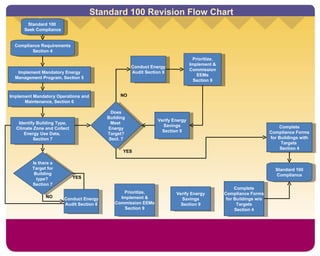
Standard 100 Revision Flow Chart Compliance Requirements Section 4 Standard 100 Compliance Does Building Meet  Energy Target? Sect. 7 NO YES Is there a Target for Building type?  Section 7 YES NO Standard 100  Seek Compliance Implement Mandatory Operations and Maintenance, Section 6 Complete Compliance Forms for Buildings with Targets  Section 4 Complete Compliance Forms for Buildings w/o Targets Section 4 Verify Energy Savings Section 9 Prioritize, Implement & Commission EEMs Section 9 Verify Energy Savings Section 9 Prioritize, Implement & Commission EEMs Section 9 Conduct Energy Audit Section 8 Conduct Energy Audit Section 8 Identify Building Type, Climate Zone and Collect Energy Use Data,  Section 7 Implement Mandatory Energy Management Program, Section 5
Section 5 Energy Management Program
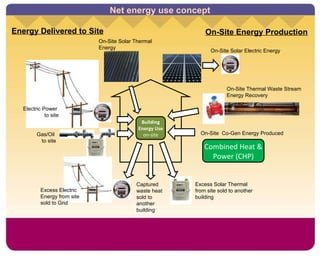
Section 5 Energy Management Program Annual building net energy use shall be monitored and recorded as an EUI, Energy Use Intensity Onsite energy production is included in net energy calc’s Energy conversion factors are defined, all energy expressed in BTU per year Equipment replacement minimum standards are equal to ASHRAE Std. 90.1,  Energy Standard for Buildings, Except Low-Rise Residential Buildings,  and ASHRAE Std. 90.2,  Energy Standard for Residential Buildings , as applicable
Section 6 Operations and Maintenance Requirements
Context of Revision to Operations & Maintenance Requirements For compliance – Meeting O & M requirements is mandatory The standard defines minimum O&M standards Requirements are targeted to be Feasible for buildings of all sizes and occupancies Practical for the average owner Achieve energy efficiency
Options for Stringency Leading edge best practice  - optimum for energy efficiency, but not reasonable for a minimum code Best practice  - suitable for a Guideline, but demanding for a minimum code Good practice  – minimum that should be required Minimum existing practice  – not acceptable
Goal for Revision – Good Practice Good Practice in all aspects of operations and maintenance Focus on actions that will impact energy efficiency
Building Systems Included Building Envelope Domestic Hot Water, including solar thermal HVAC –covering a range of HVAC systems Boiler & chiller hydronic systems Packaged HVAC systems Airside systems Heat recovery Evaporative cooling
Building Systems Included (cont’d) Refrigeration –display cases, walk-ins, secondary systems Lighting – interior, exterior, daylighting Controls – pneumatic, analog, DDC Power Generation and Distribution Systems -  Generation limited to on-site – e.g. wind, PV, etc.
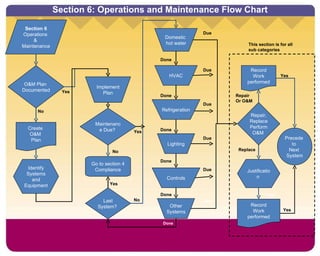
Create  O&M  Plan Identify Systems and Equipment Section 6 Operations  &  Maintenance O&M Plan  Documented  Yes No Section 6: Operations and Maintenance Flow Chart Maintenance Due?  Go to section 4 Compliance Domestic  hot water Refrigeration Controls HVAC Lighting Other Systems No Implement Plan Yes Due Last System?  Yes No Done Done Done Due Due Due Record Work performed Repair, Replace Perform O&M  Repair  Or O&M  Justification  Replace This section is for all sub categories  Record Work performed Yes Precede  to  Next  System Yes Yes Done Done Done Due Due
Section 7 Energy Use Analysis and Target Requirements
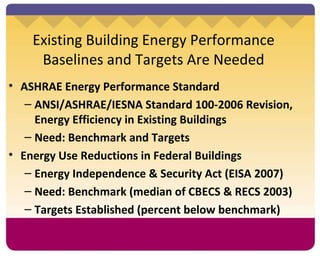
Existing Building Energy Performance Baselines and Targets Are Needed ASHRAE Energy Performance Standard ANSI/ASHRAE/IESNA Standard 100-2006 Revision, Energy Efficiency in Existing Buildings Need: Benchmark and Targets Energy Use Reductions in Federal Buildings Energy Independence & Security Act (EISA 2007) Need: Benchmark (median of CBECS & RECS 2003) Targets Established (percent below benchmark)
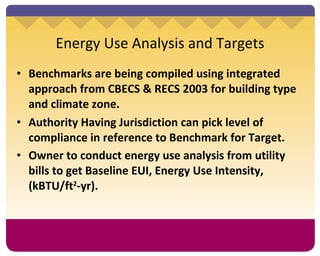
Energy Use Analysis and Targets Benchmarks are being compiled using integrated approach from CBECS & RECS 2003 for building type and climate zone.  Authority Having Jurisdiction can pick level of compliance in reference to Benchmark for Target. Owner to conduct energy use analysis from utility bills to get Baseline EUI, Energy Use Intensity, (kBTU/ft 2 -yr).
On-Site Energy Production On-Site Solar Electric Energy On-Site Solar Thermal Energy On-Site   Thermal Waste Stream Energy Recovery Energy Delivered to Site Electric Power  to site Gas/Oil  to site Combined Heat & Power (CHP) Building Energy Use  on-site On-Site  Co-Gen Energy Produced Net energy use concept Excess Solar Thermal from site sold to another building Captured waste heat sold to another building Excess Electric Energy from site sold to Grid
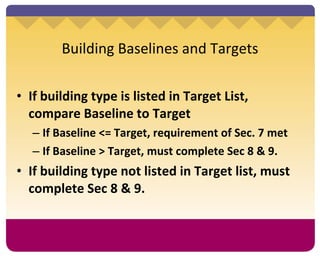
Building Baselines and Targets If building type is listed in Target List, compare Baseline to Target If Baseline <= Target, requirement of Sec. 7 met If Baseline > Target, must complete Sec 8 & 9. If building type not listed in Target list, must complete Sec 8 & 9.
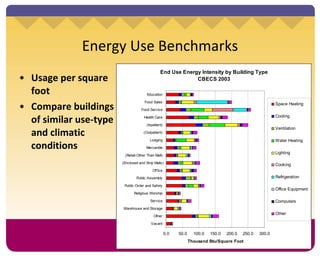
Energy Use Benchmarks Usage per square foot Compare buildings of similar use-type and climatic conditions
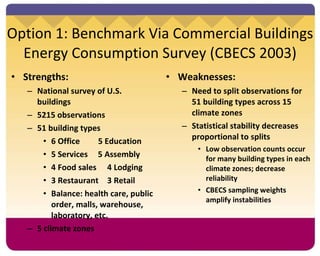
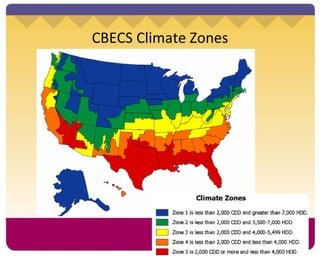
Option 1: Benchmark Via Commercial Buildings Energy Consumption Survey (CBECS 2003) Strengths: National survey of U.S. buildings 5215 observations 51 building types 6 Office  5 Education 5 Services  5 Assembly 4 Food sales 4 Lodging 3 Restaurant 3 Retail Balance: health care, public order, malls, warehouse, laboratory, etc.  5 climate zones Weaknesses: Need to split observations for 51 building types across 15 climate zones Statistical stability decreases proportional to splits Low observation counts occur for many building types in each climate zones; decrease reliability CBECS sampling weights amplify instabilities
CBECS Climate Zones
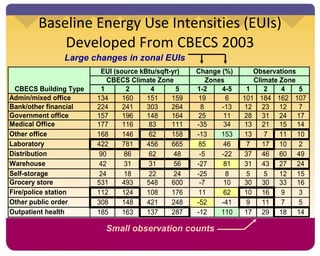
Baseline Energy Use Intensities (EUIs) Developed From CBECS 2003 Large changes in zonal EUIs Small observation counts
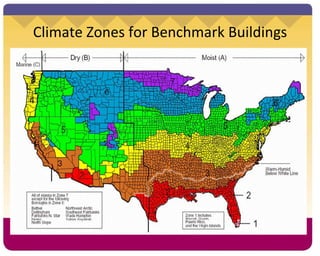
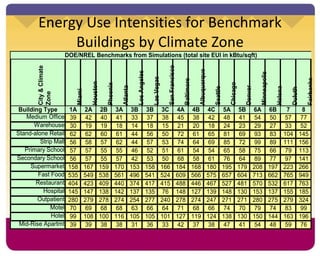
Option 2: Benchmark Via Simulation Results From Dept. of Energy Benchmark Buildings Strengths: Results readily available Proto-typical buildings of different types Modeling performed across ASHRAE’s 15 U.S. climate zones (ASHRAE Standard 90.1-2007) Building models well accepted for R&D purposes Weaknesses: One building represents population One city represents a climate zone Limited building types Simulated values = real building values?
Climate Zones for Benchmark Buildings
Energy Use Intensities for Benchmark Buildings by Climate Zone
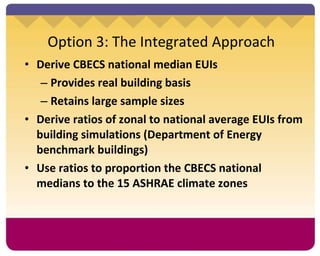
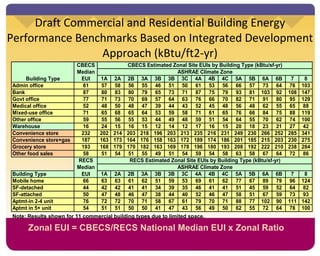
Option 3: The Integrated Approach Derive CBECS national median EUIs Provides real building basis Retains large sample sizes Derive ratios of zonal to national average EUIs from building simulations (Department of Energy benchmark buildings) Use ratios to proportion the CBECS national medians to the 15 ASHRAE climate zones
Draft Commercial and Residential Building Energy Performance Benchmarks Based on Integrated Development Approach (kBtu/ft2-yr) Note: Results shown for 11 commercial building types due to limited space. Zonal EUI = CBECS/RECS National Median EUI x Zonal Ratio
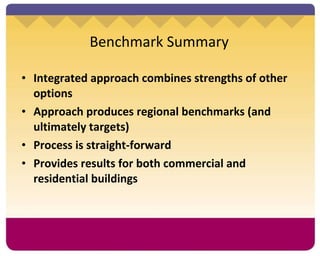
Benchmark Summary Integrated approach combines strengths of other options Approach produces regional benchmarks (and ultimately targets) Process is straight-forward Provides results for both commercial and residential buildings
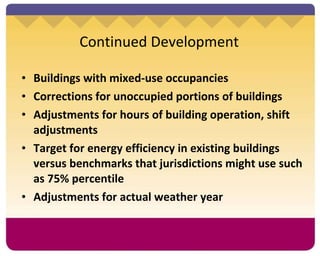
Continued Development Buildings with mixed-use occupancies Corrections for unoccupied portions of buildings Adjustments for hours of building operation, shift adjustments Target for energy efficiency in existing buildings versus benchmarks that jurisdictions might use such as 75% percentile Adjustments for actual weather year
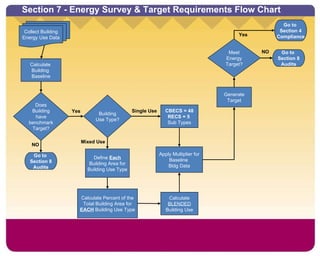
Collect Building Energy Use Data Meet Energy Target? Go to  Section 4 Compliance Generate Target Building Use Type? CBECS = 48 RECS = 5  Sub Types Apply Multiplier for Baseline  Bldg Data Section 7 - Energy Survey & Target Requirements Flow Chart NO Yes Go to  Section 8 Audits Calculate Percent of the Total Building Area for  EACH  Building Use Type Calculate  BLENDED  Building Use Mixed Use Define  Each  Building Area for Building Use Type Single Use Does Building have benchmark Target? NO Go to  Section 8 Audits Yes Calculate  Building  Baseline
Sections 8 Energy Audit Requirements
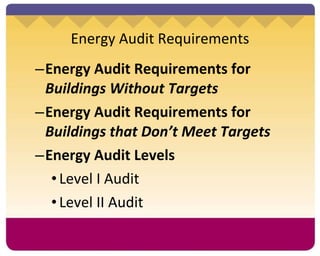
Energy Audit Requirements Energy Audit Requirements for  Buildings Without Targets Energy Audit Requirements for  Buildings that Don’t Meet Targets  Energy Audit Levels Level I Audit Level II Audit
Energy Audit Requirements (continued) Building Audit Report  Audit Results  Measure Order Interactive Effects Optimized Bundling Financial Analysis Energy Balance Baseline
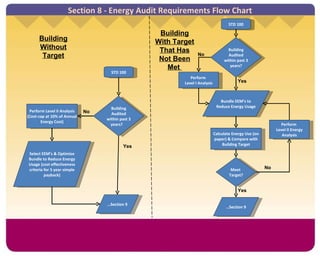
Section 8 - Energy Audit Requirements Flow Chart Building With Target That Has Not Been Met  Building Without Target Perform Level II Analysis (Cost-cap at 10% of Annual Energy Cost) Building Audited within past 3 years?  … Section 9 No Yes STD 100 Select EEM’s & Optimize Bundle to Reduce Energy Usage (cost effectiveness criteria for 5 year simple payback) STD 100 Perform  Level I Analysis Bundle EEM’s to Reduce Energy Usage Meet  Target? Perform  Level II Energy Analysis … Section 9 No Yes Building Audited within past 3 years? No Yes Calculate Energy Use (on paper) & Compare with Building Target
Sections 9  Implementation and Verification Requirements
Implementation and Verification Requirements Developing/Implementing an Energy Efficiency Plan   Goals Capital Improvement Plan Energy Efficiency Priorities As required to meet EUI of  buildings with targets Optimized bundle of EEMs with simple payback  less than or equal to 5 years for  buildings without targets Implement EEMs Training of Building Staff Multiple Buildings
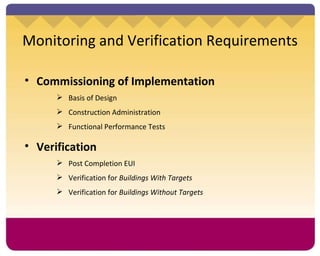
Monitoring and Verification Requirements Commissioning of Implementation  Basis of Design Construction Administration Functional Performance Tests Verification  Post Completion EUI Verification for  Buildings With Targets Verification for  Buildings Without Targets
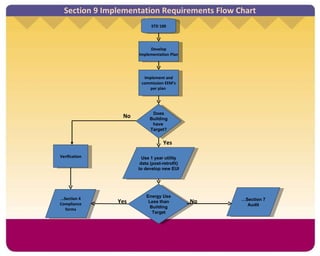
Section 9 Implementation Requirements Flow Chart STD 100 Develop Implementation Plan Use 1 year utility data (post-retrofit) to develop new EUI Energy Use Less than Building Target … Section 4 Compliance forms No   No Yes Implement and commission EEM’s per plan  Yes Verification Does Building have  Target? … Section 7 Audit
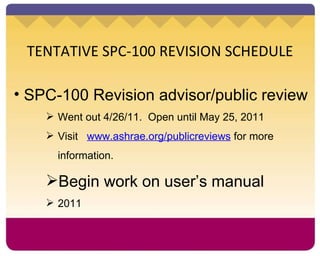
TENTATIVE SPC-100 REVISION SCHEDULE SPC-100 Revision advisor/public review Went out 4/26/11.  Open until May 25, 2011 Visit  www.ashrae.org/publicreviews  for more information. Begin work on user’s manual 2011
Questions?

ASHRAE Standard 100

  • 1.
    Standard 100 Energy Efficiency in Existing Buildings Revision Presentation Created by: Glenn Friedman, PE Principal, Taylor Engineering & Secretary ASHRAE SPC-100 [email_address] Slides presented to Illinois Chapter by: Michael P. Kuk Technical Director, Sieben Energy Associates [email_address] Illinois Chapter ASHRAE Seminar May 10, 2011 Copyright ASHRAE® 10-20-2010
  • 2.
  • 3.
  • 4.
    Standard 100 TITLE:ENERGY EFFICIENCY IN EXISTING BUILDINGS PURPOSE: This standard provides criteria for achieving energy efficiency in existing buildings. This standard is directed toward: Providing procedures and programs essential to energy efficient operation, maintenance, management and monitoring; Increasing the energy efficiency of the energy-using systems and components; and Upgrading the thermal performance of the building envelope. SCOPE: This standard applies to existing buildings, portions of buildings, and building complexes, including the envelope and all systems in the building. This Standard excludes industrial and agricultural processes in buildings for which the energy use targets do not include those processes.
  • 5.
    Standard 90.1 TITLE:ENERGY STANDARD for BUILDINGS EXCEPT LOW-RISE RESIDENTIAL BUILDINGS PURPOSE The purpose of this standard is to provide minimum requirements for the energy-efficient design of buildings except low-rise residential buildings. SCOPE 2.1 This standard provides minimum energy-efficient requirements for the design and construction of New buildings and their systems New portions of buildings and their systems and New systems and equipment in existing buildings and Criteria for determining compliance with these requirements [Standard 90.2 covers energy standards for low-rise residential buildings]
  • 6.
    Standard 90.1 SCOPE(cont’d): 2.2 The provisions of this standard apply to The envelope of buildings, provided that the enclosed spaces are Heated by a heating system whose output capacity is greater than or equal to 3.4 BTU/h·ft 2 or Cooled by a cooling system whose sensible output capacity is greater than or equal to 5 BTU/h·ft2 and The following systems and equipment used in conjunction with buildings Heating , ventilation and air conditioning Service water heating Electrical power distribution and metering provisions Electric motors and belt drives and Lighting
  • 7.
    Standard 90.1 SCOPE(cont’d): 2.3 The provisions of this standard do not apply to: Single-family houses, multi-family structures of three stories or fewer above grade, manufactured houses (mobile homes) and manufactured houses (modular) Buildings that do not use either electricity or fossil fuel, or Equipment and portions of building systems that use energy primarily to provide for industrial, manufacturing, or commercial processes. 2.4 Where specifically noted in this standard, certain other buildings or elements of buildings shall be exempt. 2.5 This standard shall not be used to circumvent any safety, health or environmental requirements. [Standard 90.2 covers energy standards for low-rise residential buildings]
  • 8.
    TITLE: ENERGY-EFFICIENT DESIGNOF LOW-RISE RESIDENTIAL BUILDINGS PURPOSE: The purpose of this standard is to provide minimum requirements for the energy-efficient design of residential buildings. SCOPE: 2.1 This standard provides minimum energy-efficiency requirements for the design and construction of: New residential dwelling units and their systems and Where explicitly specified New portions of residential dwelling units and their systems and New systems and equipment in existing dwelling units Note: for the purpose of this std “residential dwelling units” include single family houses, multi-family structures (of three stories or fewer above grade) and modular houses. Note: Does not include “transient” housing such as hotels, motels, nursing homes, jails, barracks or manufactured housing. Standard 90.2
  • 9.
    Status of Standards90.1, 90.2 and 100 Standard 90.1-2007 in continuous maintenance Standard 90.2 New committee to revise starting January 2010 Standard 100 New committee to revise started June 2009, the revision is written in code language
  • 10.
    ANSI/IESNA/ASHRAE Standard 100Revision Outline Title Purpose Scope Definitions Compliance Energy Management Program O&M Targets Audits Implementation References and Annex
  • 11.
  • 12.
    Section 4 ComplianceRequirements Compliance Process Flowchart Timeline Forms Energy Management Program Operation and Maintenance Building Energy Use Buildings with Energy Targets Buildings without Energy Targets
  • 13.
    Standard 100 RevisionFlow Chart Compliance Requirements Section 4 Standard 100 Compliance Does Building Meet Energy Target? Sect. 7 NO YES Is there a Target for Building type? Section 7 YES NO Standard 100 Seek Compliance Implement Mandatory Operations and Maintenance, Section 6 Complete Compliance Forms for Buildings with Targets Section 4 Complete Compliance Forms for Buildings w/o Targets Section 4 Verify Energy Savings Section 9 Prioritize, Implement & Commission EEMs Section 9 Verify Energy Savings Section 9 Prioritize, Implement & Commission EEMs Section 9 Conduct Energy Audit Section 8 Conduct Energy Audit Section 8 Identify Building Type, Climate Zone and Collect Energy Use Data, Section 7 Implement Mandatory Energy Management Program, Section 5
  • 14.
    Section 5 EnergyManagement Program
  • 15.
    Section 5 EnergyManagement Program Annual building net energy use shall be monitored and recorded as an EUI, Energy Use Intensity Onsite energy production is included in net energy calc’s Energy conversion factors are defined, all energy expressed in BTU per year Equipment replacement minimum standards are equal to ASHRAE Std. 90.1, Energy Standard for Buildings, Except Low-Rise Residential Buildings, and ASHRAE Std. 90.2, Energy Standard for Residential Buildings , as applicable
  • 16.
    Section 6 Operationsand Maintenance Requirements
  • 17.
    Context of Revisionto Operations & Maintenance Requirements For compliance – Meeting O & M requirements is mandatory The standard defines minimum O&M standards Requirements are targeted to be Feasible for buildings of all sizes and occupancies Practical for the average owner Achieve energy efficiency
  • 18.
    Options for StringencyLeading edge best practice - optimum for energy efficiency, but not reasonable for a minimum code Best practice - suitable for a Guideline, but demanding for a minimum code Good practice – minimum that should be required Minimum existing practice – not acceptable
  • 19.
    Goal for Revision– Good Practice Good Practice in all aspects of operations and maintenance Focus on actions that will impact energy efficiency
  • 20.
    Building Systems IncludedBuilding Envelope Domestic Hot Water, including solar thermal HVAC –covering a range of HVAC systems Boiler & chiller hydronic systems Packaged HVAC systems Airside systems Heat recovery Evaporative cooling
  • 21.
    Building Systems Included(cont’d) Refrigeration –display cases, walk-ins, secondary systems Lighting – interior, exterior, daylighting Controls – pneumatic, analog, DDC Power Generation and Distribution Systems - Generation limited to on-site – e.g. wind, PV, etc.
  • 22.
    Create O&M Plan Identify Systems and Equipment Section 6 Operations & Maintenance O&M Plan Documented Yes No Section 6: Operations and Maintenance Flow Chart Maintenance Due? Go to section 4 Compliance Domestic hot water Refrigeration Controls HVAC Lighting Other Systems No Implement Plan Yes Due Last System? Yes No Done Done Done Due Due Due Record Work performed Repair, Replace Perform O&M Repair Or O&M Justification Replace This section is for all sub categories Record Work performed Yes Precede to Next System Yes Yes Done Done Done Due Due
  • 23.
    Section 7 EnergyUse Analysis and Target Requirements
  • 24.
    Existing Building EnergyPerformance Baselines and Targets Are Needed ASHRAE Energy Performance Standard ANSI/ASHRAE/IESNA Standard 100-2006 Revision, Energy Efficiency in Existing Buildings Need: Benchmark and Targets Energy Use Reductions in Federal Buildings Energy Independence & Security Act (EISA 2007) Need: Benchmark (median of CBECS & RECS 2003) Targets Established (percent below benchmark)
  • 25.
    Energy Use Analysisand Targets Benchmarks are being compiled using integrated approach from CBECS & RECS 2003 for building type and climate zone. Authority Having Jurisdiction can pick level of compliance in reference to Benchmark for Target. Owner to conduct energy use analysis from utility bills to get Baseline EUI, Energy Use Intensity, (kBTU/ft 2 -yr).
  • 26.
    On-Site Energy ProductionOn-Site Solar Electric Energy On-Site Solar Thermal Energy On-Site Thermal Waste Stream Energy Recovery Energy Delivered to Site Electric Power to site Gas/Oil to site Combined Heat & Power (CHP) Building Energy Use on-site On-Site Co-Gen Energy Produced Net energy use concept Excess Solar Thermal from site sold to another building Captured waste heat sold to another building Excess Electric Energy from site sold to Grid
  • 27.
    Building Baselines andTargets If building type is listed in Target List, compare Baseline to Target If Baseline <= Target, requirement of Sec. 7 met If Baseline > Target, must complete Sec 8 & 9. If building type not listed in Target list, must complete Sec 8 & 9.
  • 28.
    Energy Use BenchmarksUsage per square foot Compare buildings of similar use-type and climatic conditions
  • 29.
    Option 1: BenchmarkVia Commercial Buildings Energy Consumption Survey (CBECS 2003) Strengths: National survey of U.S. buildings 5215 observations 51 building types 6 Office 5 Education 5 Services 5 Assembly 4 Food sales 4 Lodging 3 Restaurant 3 Retail Balance: health care, public order, malls, warehouse, laboratory, etc. 5 climate zones Weaknesses: Need to split observations for 51 building types across 15 climate zones Statistical stability decreases proportional to splits Low observation counts occur for many building types in each climate zones; decrease reliability CBECS sampling weights amplify instabilities
  • 30.
  • 31.
    Baseline Energy UseIntensities (EUIs) Developed From CBECS 2003 Large changes in zonal EUIs Small observation counts
  • 32.
    Option 2: BenchmarkVia Simulation Results From Dept. of Energy Benchmark Buildings Strengths: Results readily available Proto-typical buildings of different types Modeling performed across ASHRAE’s 15 U.S. climate zones (ASHRAE Standard 90.1-2007) Building models well accepted for R&D purposes Weaknesses: One building represents population One city represents a climate zone Limited building types Simulated values = real building values?
  • 33.
    Climate Zones forBenchmark Buildings
  • 34.
    Energy Use Intensitiesfor Benchmark Buildings by Climate Zone
  • 35.
    Option 3: TheIntegrated Approach Derive CBECS national median EUIs Provides real building basis Retains large sample sizes Derive ratios of zonal to national average EUIs from building simulations (Department of Energy benchmark buildings) Use ratios to proportion the CBECS national medians to the 15 ASHRAE climate zones
  • 36.
    Draft Commercial andResidential Building Energy Performance Benchmarks Based on Integrated Development Approach (kBtu/ft2-yr) Note: Results shown for 11 commercial building types due to limited space. Zonal EUI = CBECS/RECS National Median EUI x Zonal Ratio
  • 37.
    Benchmark Summary Integratedapproach combines strengths of other options Approach produces regional benchmarks (and ultimately targets) Process is straight-forward Provides results for both commercial and residential buildings
  • 38.
    Continued Development Buildingswith mixed-use occupancies Corrections for unoccupied portions of buildings Adjustments for hours of building operation, shift adjustments Target for energy efficiency in existing buildings versus benchmarks that jurisdictions might use such as 75% percentile Adjustments for actual weather year
  • 39.
    Collect Building EnergyUse Data Meet Energy Target? Go to Section 4 Compliance Generate Target Building Use Type? CBECS = 48 RECS = 5 Sub Types Apply Multiplier for Baseline Bldg Data Section 7 - Energy Survey & Target Requirements Flow Chart NO Yes Go to Section 8 Audits Calculate Percent of the Total Building Area for EACH Building Use Type Calculate BLENDED Building Use Mixed Use Define Each Building Area for Building Use Type Single Use Does Building have benchmark Target? NO Go to Section 8 Audits Yes Calculate Building Baseline
  • 40.
    Sections 8 EnergyAudit Requirements
  • 41.
    Energy Audit RequirementsEnergy Audit Requirements for Buildings Without Targets Energy Audit Requirements for Buildings that Don’t Meet Targets Energy Audit Levels Level I Audit Level II Audit
  • 42.
    Energy Audit Requirements(continued) Building Audit Report Audit Results Measure Order Interactive Effects Optimized Bundling Financial Analysis Energy Balance Baseline
  • 43.
    Section 8 -Energy Audit Requirements Flow Chart Building With Target That Has Not Been Met Building Without Target Perform Level II Analysis (Cost-cap at 10% of Annual Energy Cost) Building Audited within past 3 years? … Section 9 No Yes STD 100 Select EEM’s & Optimize Bundle to Reduce Energy Usage (cost effectiveness criteria for 5 year simple payback) STD 100 Perform Level I Analysis Bundle EEM’s to Reduce Energy Usage Meet Target? Perform Level II Energy Analysis … Section 9 No Yes Building Audited within past 3 years? No Yes Calculate Energy Use (on paper) & Compare with Building Target
  • 44.
    Sections 9 Implementation and Verification Requirements
  • 45.
    Implementation and VerificationRequirements Developing/Implementing an Energy Efficiency Plan Goals Capital Improvement Plan Energy Efficiency Priorities As required to meet EUI of buildings with targets Optimized bundle of EEMs with simple payback less than or equal to 5 years for buildings without targets Implement EEMs Training of Building Staff Multiple Buildings
  • 46.
    Monitoring and VerificationRequirements Commissioning of Implementation Basis of Design Construction Administration Functional Performance Tests Verification Post Completion EUI Verification for Buildings With Targets Verification for Buildings Without Targets
  • 47.
    Section 9 ImplementationRequirements Flow Chart STD 100 Develop Implementation Plan Use 1 year utility data (post-retrofit) to develop new EUI Energy Use Less than Building Target … Section 4 Compliance forms No No Yes Implement and commission EEM’s per plan Yes Verification Does Building have Target? … Section 7 Audit
  • 48.
    TENTATIVE SPC-100 REVISIONSCHEDULE SPC-100 Revision advisor/public review Went out 4/26/11. Open until May 25, 2011 Visit www.ashrae.org/publicreviews for more information. Begin work on user’s manual 2011
  • 49.

Editor's Notes

  • #11 -purpose and scope is the same Big expansion in the definitions Compliance: some apparent enhancements Added and Energy Management Program -Modified O&amp;M -Added Targets Enhanced Energy Audit requirements -Added implementation requirements
  • #13 -Timeline…could be extended since need to monitor, verify , and potentially re-audit and retest -Compliance Process- flow chart provided, and timeline, and forms Must create an energy management program and O&amp;M plan -Must benchmark and meet or beat benchmark
  • #19 -just note that appears following good practice
  • #23 -review this
  • #25 -note the sources and challenges
  • #30 -fly over next few slides
  • #36 -they appear to have chosen option 3, which was a blend with some modeling
  • #46 -multiple buildings must have a plan for coordinating such measures and an EIU on a campus basis
  • #47 - The question of commissioning is being proposed in the new standard, but was not shown in detail in the public review draft -With Targets: EUI’s shall be monitored for one full years data results (bldgs with targets) - W/O targets: Same, but auditor shall review results and ensure package of ECM’s meets 75% of projected savings.