Retro-commissioning
 Program Overview
Agenda

 Energy Efficiency Portfolio

 Business Case for Energy Efficiency

 RCx Program Overview

 Measurement & Verification

 Questions
ComEd Smart Ideas for Your Business
Energy Efficiency Portfolio
      1.   Prescriptive Program
      2.   Custom Program
      3.   New Construction Program
      4.   Technical Assistance Service
      5.   ComEd RCx program – service is the incentive
      6.   Compressed Air Program
      7.   Residential Program
      8.   Load Response Program
      9.   Others
            Measures implemented in RCx do not qualify for or overlap with additional
             incentives through other ComEd programs
A Business Case for Energy Efficiency:
The Triple Bottom Line
 People (human capital):
   • Industry leadership among peers
   • Employee satisfaction
   • Attract forward thinking tenants/customers
   • Competitive edge among similar facilities

 Planet (natural capital):
   • Reducing CO2 emissions produced by electricity & gas reduces
      the greenhouse effect

 Profit (economic value):
   • Real estate benefit, higher building value, tenant rates
   • Lower operational costs, extends equipment life
   • Reduced electric & gas bill
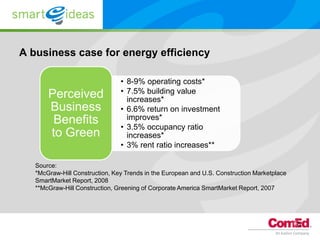
A business case for energy efficiency

                                • 8-9% operating costs*
                                • 7.5% building value
       Perceived                  increases*
       Business                 • 6.6% return on investment
        Benefits                  improves*
                                • 3.5% occupancy ratio
       to Green                   increases*
                                • 3% rent ratio increases**

   Source:
   *McGraw-Hill Construction, Key Trends in the European and U.S. Construction Marketplace
   SmartMarket Report, 2008
   **McGraw-Hill Construction, Greening of Corporate America SmartMarket Report, 2007


                                                                                             5
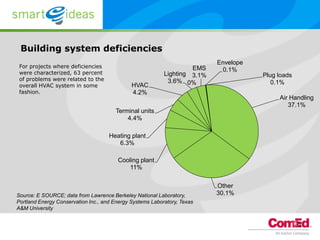
Building system deficiencies
                                                                           Envelope
 For projects where deficiencies                                    EMS
 were characterized, 63 percent
                                                                            0.1%
                                                           Lighting 3.1%              Plug loads
 of problems were related to the                            3.6% 0%
 overall HVAC system in some                  HVAC                                       0.1%
 fashion.                                     4.2%
                                                                                           Air Handling
                                                                                              37.1%
                                       Terminal units
                                           4.4%

                                     Heating plant
                                        6.3%

                                        Cooling plant
                                            11%

                                                                           Other
Source: E SOURCE; data from Lawrence Berkeley National Laboratory,         30.1%
Portland Energy Conservation Inc., and Energy Systems Laboratory, Texas
A&M University


                                                                                                   6
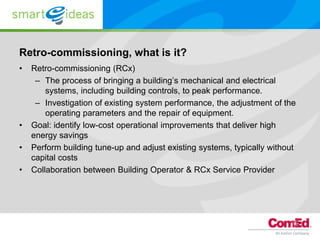
Retro-commissioning, what is it?
•   Retro-commissioning (RCx)
     – The process of bringing a building’s mechanical and electrical
        systems, including building controls, to peak performance.
     – Investigation of existing system performance, the adjustment of the
        operating parameters and the repair of equipment.
•   Goal: identify low-cost operational improvements that deliver high
    energy savings
•   Perform building tune-up and adjust existing systems, typically without
    capital costs
•   Collaboration between Building Operator & RCx Service Provider


                                                                              7
Common Misunderstandings RCx:
•   RCx is not an energy audit.
•   RCx is not a facility evaluation.
•   RCx is not a feasibility study.
•   RCx is not a study to determine technical feasibility of capital-
    investment type energy efficiency projects (co-generation unit)


                                                                        8
Benefits to RCx, energy and non-energy
•   Reduce building operating costs (energy, maintenance, premature
    equipment replacement).
•   Extend equipment service lifetime.
•   Improve building performance and system integration.
•   Increase asset value of the property.
•   Reduce comfort complaints.
•   Identify potential indoor environmental quality issues.
•   Ensure building operations meet owner’s requirements.
•   Can increase occupant productivity and safety.
•   Provide building operator training.


                                                                      9
Lawrence Berkeley National Laboratory study
•   Median RCx costs (332 projects) were $0.30/ft2
•   Median cost savings were $0.29/ft2 -per year
•   Median electrical demand savings from baseline consumption is 5%
•   Median electrical annual energy savings from baseline is 9%
•   Median total annual energy savings from baseline is 16%


        The source of this information is Building Commissioning: A Golden Opportunity for
        Reducing Energy Costs and Greenhouse Gas Emissions, Evan Mills, Ph.D., Lawrence
        Berkeley National Laboratory, July 21, 2009, http://cx.lbl.gov/documents/2009-
        assessment/LBNL-Cx-Cost-Benefit.pdf


                                                                                             10
Natural Gas
 Joint Electric & Natural Gas Energy Efficiency program
   • Nicor
   • Peoples Gas
   • North Shore Gas

 Retro-commissioning:
   • Electric and Natural Gas combined into program
   • Pilot program last year
   • Year 2 starting on June 1, 2011
RCx Program Overview
Program Overview
   Application Phase: Screening, set goals

   Planning Phase: Identify measures, operational adjustments

   Investigation Phase: Baseline data

   Implementation Phase: Customer installations

   Verification Phase: Report final data to ComEd
Customer Commitments
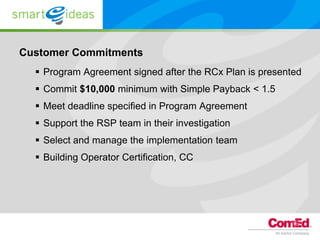
   Program Agreement signed after the RCx Plan is presented
   Commit $10,000 minimum with Simple Payback < 1.5
   Meet deadline specified in Program Agreement
   Support the RSP team in their investigation
   Select and manage the implementation team
   Building Operator Certification, CC
Application Phase
   Screening process for selecting successful projects

   To help ensure program cost-effectiveness, an energy savings
    target is set, average PY3 is 600,000 kWh / year
Planning Phase
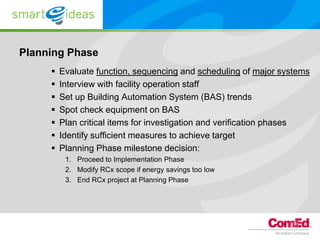
        Evaluate function, sequencing and scheduling of major systems
        Interview with facility operation staff
        Set up Building Automation System (BAS) trends
        Spot check equipment on BAS
        Plan critical items for investigation and verification phases
        Identify sufficient measures to achieve target
        Planning Phase milestone decision:
          1. Proceed to Implementation Phase
          2. Modify RCx scope if energy savings too low
          3. End RCx project at Planning Phase
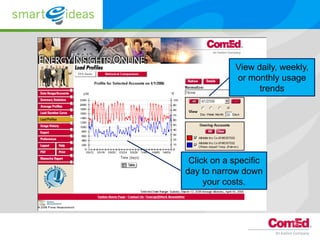
View daily, weekly,
            or monthly usage
                  trends


 Click on a specific
day to narrow down
     your costs.
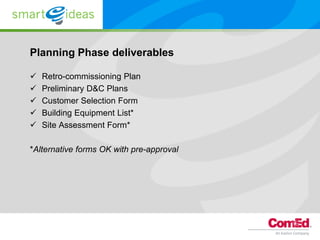
Planning Phase deliverables

   Retro-commissioning Plan
   Preliminary D&C Plans
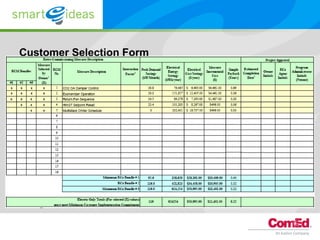
   Customer Selection Form
   Building Equipment List*
   Site Assessment Form*

*Alternative forms OK with pre-approval
Customer Selection Form
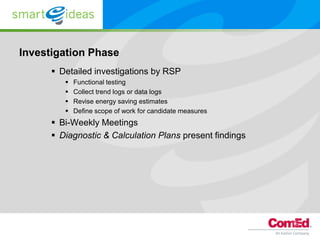
Investigation Phase
       Detailed investigations by RSP
            Functional testing
            Collect trend logs or data logs
            Revise energy saving estimates
            Define scope of work for candidate measures
       Bi-Weekly Meetings
       Diagnostic & Calculation Plans present findings
Investigation Phase deliverables

   Investigation Report
   D&C Plans
   Customer Selection Form
   Standard RCx Procedure Forms
   Building Equipment List
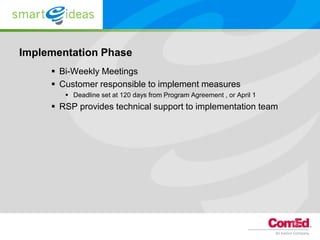
Implementation Phase
      Bi-Weekly Meetings
      Customer responsible to implement measures
         Deadline set at 120 days from Program Agreement , or April 1
      RSP provides technical support to implementation team
Verification Phase
       Inspect RCMs for installed equipment and controls modifications
       Execute measurement & verification (M&V) Plan from Diagnostic
        and Calculation Plan
       Set up trends depending on measure (one to four weeks)
       Conduct functional test depending on measure
       Perform spot measurements
       Revise calculations as necessary
Verification Phase deliverables

   Customer Selection Form for completion of RCMs
   Verification Report
   D&C Plans
Common RCx Measures
•   Fixing ventilation dampers that are open when they should be closed (or vice versa).
•   Adjusting chiller operation to better match building load conditions.
•   Aligning zone temperature set-points to match the building's actual occupancy
•   Reducing ventilation in over-ventilated areas.
•   Eliminating simultaneous heating and cooling.
•   Reducing supply air static pressure set points.
•   Focus on cost-effective operation and maintenance improvements (education to staff
    on continuous building performance, digital controls with schedules, etc.)
•   Properly tune equipment for maximum efficiency.
•   Sustainability in optimum performance schedules (eliminate manual controls where
    human interference is more accessible)
•   Optimize building systems as a whole, functioning together
•   Free energy – use outside air and lighting when available
•   Demand savings – operate equipment as needed or when occupied


                                                                                      25
Measurement & Verification
       Overview
Calculation and M&V Guidelines
•   Adherence eases QC process for RSP and Nexant
•   Adherence improves evaluation results
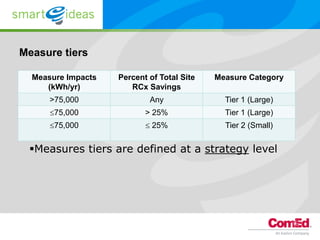
Measure tiers

  Measure Impacts   Percent of Total Site   Measure Category
     (kWh/yr)          RCx Savings
      >75,000               Any               Tier 1 (Large)
       75,000              > 25%              Tier 1 (Large)
       75,000                25%              Tier 2 (Small)


 Measures tiers are defined at a strategy level
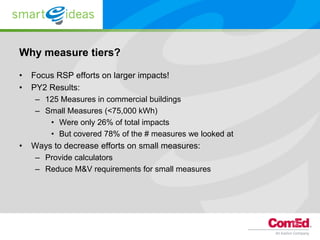
Why measure tiers?

•   Focus RSP efforts on larger impacts!
•   PY2 Results:
     – 125 Measures in commercial buildings
     – Small Measures (<75,000 kWh)
        • Were only 26% of total impacts
        • But covered 78% of the # measures we looked at
•   Ways to decrease efforts on small measures:
     – Provide calculators
     – Reduce M&V requirements for small measures
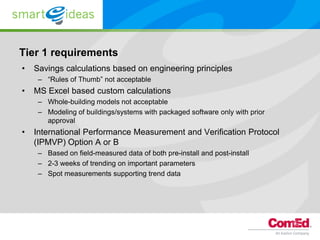
Tier 1 requirements
•   Savings calculations based on engineering principles
     – “Rules of Thumb” not acceptable
•   MS Excel based custom calculations
     – Whole-building models not acceptable
     – Modeling of buildings/systems with packaged software only with prior
       approval
•   International Performance Measurement and Verification Protocol
    (IPMVP) Option A or B
     – Based on field-measured data of both pre-install and post-install
     – 2-3 weeks of trending on important parameters
     – Spot measurements supporting trend data
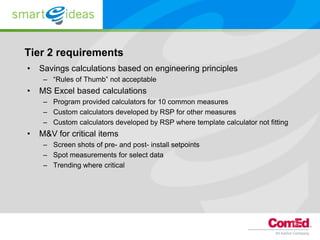
Tier 2 requirements
•   Savings calculations based on engineering principles
     – “Rules of Thumb” not acceptable
•   MS Excel based calculations
     – Program provided calculators for 10 common measures
     – Custom calculators developed by RSP for other measures
     – Custom calculators developed by RSP where template calculator not fitting
•   M&V for critical items
     – Screen shots of pre- and post- install setpoints
     – Spot measurements for select data
     – Trending where critical
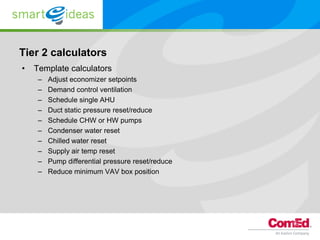
Tier 2 calculators
•   Template calculators
     –   Adjust economizer setpoints
     –   Demand control ventilation
     –   Schedule single AHU
     –   Duct static pressure reset/reduce
     –   Schedule CHW or HW pumps
     –   Condenser water reset
     –   Chilled water reset
     –   Supply air temp reset
     –   Pump differential pressure reset/reduce
     –   Reduce minimum VAV box position
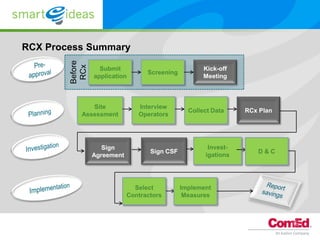
RCX Process Summary

        Before
         RCx
                   Submit                             Kick-off
                                   Screening
                 application                          Meeting


               Site             Interview
                                                 Collect Data    RCx Plan
            Assessment          Operators


                    Sign                               Invest-
                                    Sign CSF                        D&C
                 Agreement                            igations


                               Select          Implement
                             Contractors        Measures
Thank you…
Questions?

ComEd Retro-Commissioning Program

  • 1.
  • 2.
    Agenda  Energy EfficiencyPortfolio  Business Case for Energy Efficiency  RCx Program Overview  Measurement & Verification  Questions
  • 3.
    ComEd Smart Ideasfor Your Business Energy Efficiency Portfolio 1. Prescriptive Program 2. Custom Program 3. New Construction Program 4. Technical Assistance Service 5. ComEd RCx program – service is the incentive 6. Compressed Air Program 7. Residential Program 8. Load Response Program 9. Others  Measures implemented in RCx do not qualify for or overlap with additional incentives through other ComEd programs
  • 4.
    A Business Casefor Energy Efficiency: The Triple Bottom Line  People (human capital): • Industry leadership among peers • Employee satisfaction • Attract forward thinking tenants/customers • Competitive edge among similar facilities  Planet (natural capital): • Reducing CO2 emissions produced by electricity & gas reduces the greenhouse effect  Profit (economic value): • Real estate benefit, higher building value, tenant rates • Lower operational costs, extends equipment life • Reduced electric & gas bill
  • 5.
    A business casefor energy efficiency • 8-9% operating costs* • 7.5% building value Perceived increases* Business • 6.6% return on investment Benefits improves* • 3.5% occupancy ratio to Green increases* • 3% rent ratio increases** Source: *McGraw-Hill Construction, Key Trends in the European and U.S. Construction Marketplace SmartMarket Report, 2008 **McGraw-Hill Construction, Greening of Corporate America SmartMarket Report, 2007 5
  • 6.
    Building system deficiencies Envelope For projects where deficiencies EMS were characterized, 63 percent 0.1% Lighting 3.1% Plug loads of problems were related to the 3.6% 0% overall HVAC system in some HVAC 0.1% fashion. 4.2% Air Handling 37.1% Terminal units 4.4% Heating plant 6.3% Cooling plant 11% Other Source: E SOURCE; data from Lawrence Berkeley National Laboratory, 30.1% Portland Energy Conservation Inc., and Energy Systems Laboratory, Texas A&M University 6
  • 7.
    Retro-commissioning, what isit? • Retro-commissioning (RCx) – The process of bringing a building’s mechanical and electrical systems, including building controls, to peak performance. – Investigation of existing system performance, the adjustment of the operating parameters and the repair of equipment. • Goal: identify low-cost operational improvements that deliver high energy savings • Perform building tune-up and adjust existing systems, typically without capital costs • Collaboration between Building Operator & RCx Service Provider 7
  • 8.
    Common Misunderstandings RCx: • RCx is not an energy audit. • RCx is not a facility evaluation. • RCx is not a feasibility study. • RCx is not a study to determine technical feasibility of capital- investment type energy efficiency projects (co-generation unit) 8
  • 9.
    Benefits to RCx,energy and non-energy • Reduce building operating costs (energy, maintenance, premature equipment replacement). • Extend equipment service lifetime. • Improve building performance and system integration. • Increase asset value of the property. • Reduce comfort complaints. • Identify potential indoor environmental quality issues. • Ensure building operations meet owner’s requirements. • Can increase occupant productivity and safety. • Provide building operator training. 9
  • 10.
    Lawrence Berkeley NationalLaboratory study • Median RCx costs (332 projects) were $0.30/ft2 • Median cost savings were $0.29/ft2 -per year • Median electrical demand savings from baseline consumption is 5% • Median electrical annual energy savings from baseline is 9% • Median total annual energy savings from baseline is 16% The source of this information is Building Commissioning: A Golden Opportunity for Reducing Energy Costs and Greenhouse Gas Emissions, Evan Mills, Ph.D., Lawrence Berkeley National Laboratory, July 21, 2009, http://cx.lbl.gov/documents/2009- assessment/LBNL-Cx-Cost-Benefit.pdf 10
  • 11.
    Natural Gas  JointElectric & Natural Gas Energy Efficiency program • Nicor • Peoples Gas • North Shore Gas  Retro-commissioning: • Electric and Natural Gas combined into program • Pilot program last year • Year 2 starting on June 1, 2011
  • 12.
  • 13.
    Program Overview  Application Phase: Screening, set goals  Planning Phase: Identify measures, operational adjustments  Investigation Phase: Baseline data  Implementation Phase: Customer installations  Verification Phase: Report final data to ComEd
  • 14.
    Customer Commitments  Program Agreement signed after the RCx Plan is presented  Commit $10,000 minimum with Simple Payback < 1.5  Meet deadline specified in Program Agreement  Support the RSP team in their investigation  Select and manage the implementation team  Building Operator Certification, CC
  • 15.
    Application Phase  Screening process for selecting successful projects  To help ensure program cost-effectiveness, an energy savings target is set, average PY3 is 600,000 kWh / year
  • 16.
    Planning Phase  Evaluate function, sequencing and scheduling of major systems  Interview with facility operation staff  Set up Building Automation System (BAS) trends  Spot check equipment on BAS  Plan critical items for investigation and verification phases  Identify sufficient measures to achieve target  Planning Phase milestone decision: 1. Proceed to Implementation Phase 2. Modify RCx scope if energy savings too low 3. End RCx project at Planning Phase
  • 17.
    View daily, weekly, or monthly usage trends Click on a specific day to narrow down your costs.
  • 18.
    Planning Phase deliverables  Retro-commissioning Plan  Preliminary D&C Plans  Customer Selection Form  Building Equipment List*  Site Assessment Form* *Alternative forms OK with pre-approval
  • 19.
  • 20.
    Investigation Phase  Detailed investigations by RSP  Functional testing  Collect trend logs or data logs  Revise energy saving estimates  Define scope of work for candidate measures  Bi-Weekly Meetings  Diagnostic & Calculation Plans present findings
  • 21.
    Investigation Phase deliverables  Investigation Report  D&C Plans  Customer Selection Form  Standard RCx Procedure Forms  Building Equipment List
  • 22.
    Implementation Phase  Bi-Weekly Meetings  Customer responsible to implement measures  Deadline set at 120 days from Program Agreement , or April 1  RSP provides technical support to implementation team
  • 23.
    Verification Phase  Inspect RCMs for installed equipment and controls modifications  Execute measurement & verification (M&V) Plan from Diagnostic and Calculation Plan  Set up trends depending on measure (one to four weeks)  Conduct functional test depending on measure  Perform spot measurements  Revise calculations as necessary
  • 24.
    Verification Phase deliverables  Customer Selection Form for completion of RCMs  Verification Report  D&C Plans
  • 25.
    Common RCx Measures • Fixing ventilation dampers that are open when they should be closed (or vice versa). • Adjusting chiller operation to better match building load conditions. • Aligning zone temperature set-points to match the building's actual occupancy • Reducing ventilation in over-ventilated areas. • Eliminating simultaneous heating and cooling. • Reducing supply air static pressure set points. • Focus on cost-effective operation and maintenance improvements (education to staff on continuous building performance, digital controls with schedules, etc.) • Properly tune equipment for maximum efficiency. • Sustainability in optimum performance schedules (eliminate manual controls where human interference is more accessible) • Optimize building systems as a whole, functioning together • Free energy – use outside air and lighting when available • Demand savings – operate equipment as needed or when occupied 25
  • 26.
  • 27.
    Calculation and M&VGuidelines • Adherence eases QC process for RSP and Nexant • Adherence improves evaluation results
  • 28.
    Measure tiers Measure Impacts Percent of Total Site Measure Category (kWh/yr) RCx Savings >75,000 Any Tier 1 (Large) 75,000 > 25% Tier 1 (Large) 75,000 25% Tier 2 (Small) Measures tiers are defined at a strategy level
  • 29.
    Why measure tiers? • Focus RSP efforts on larger impacts! • PY2 Results: – 125 Measures in commercial buildings – Small Measures (<75,000 kWh) • Were only 26% of total impacts • But covered 78% of the # measures we looked at • Ways to decrease efforts on small measures: – Provide calculators – Reduce M&V requirements for small measures
  • 30.
    Tier 1 requirements • Savings calculations based on engineering principles – “Rules of Thumb” not acceptable • MS Excel based custom calculations – Whole-building models not acceptable – Modeling of buildings/systems with packaged software only with prior approval • International Performance Measurement and Verification Protocol (IPMVP) Option A or B – Based on field-measured data of both pre-install and post-install – 2-3 weeks of trending on important parameters – Spot measurements supporting trend data
  • 31.
    Tier 2 requirements • Savings calculations based on engineering principles – “Rules of Thumb” not acceptable • MS Excel based calculations – Program provided calculators for 10 common measures – Custom calculators developed by RSP for other measures – Custom calculators developed by RSP where template calculator not fitting • M&V for critical items – Screen shots of pre- and post- install setpoints – Spot measurements for select data – Trending where critical
  • 32.
    Tier 2 calculators • Template calculators – Adjust economizer setpoints – Demand control ventilation – Schedule single AHU – Duct static pressure reset/reduce – Schedule CHW or HW pumps – Condenser water reset – Chilled water reset – Supply air temp reset – Pump differential pressure reset/reduce – Reduce minimum VAV box position
  • 33.
    RCX Process Summary Before RCx Submit Kick-off Screening application Meeting Site Interview Collect Data RCx Plan Assessment Operators Sign Invest- Sign CSF D&C Agreement igations Select Implement Contractors Measures
  • 34.