ASHRAE Standard 90.1-
       2010
  Hugh Crowther P. Eng
    Director at Large
Agenda
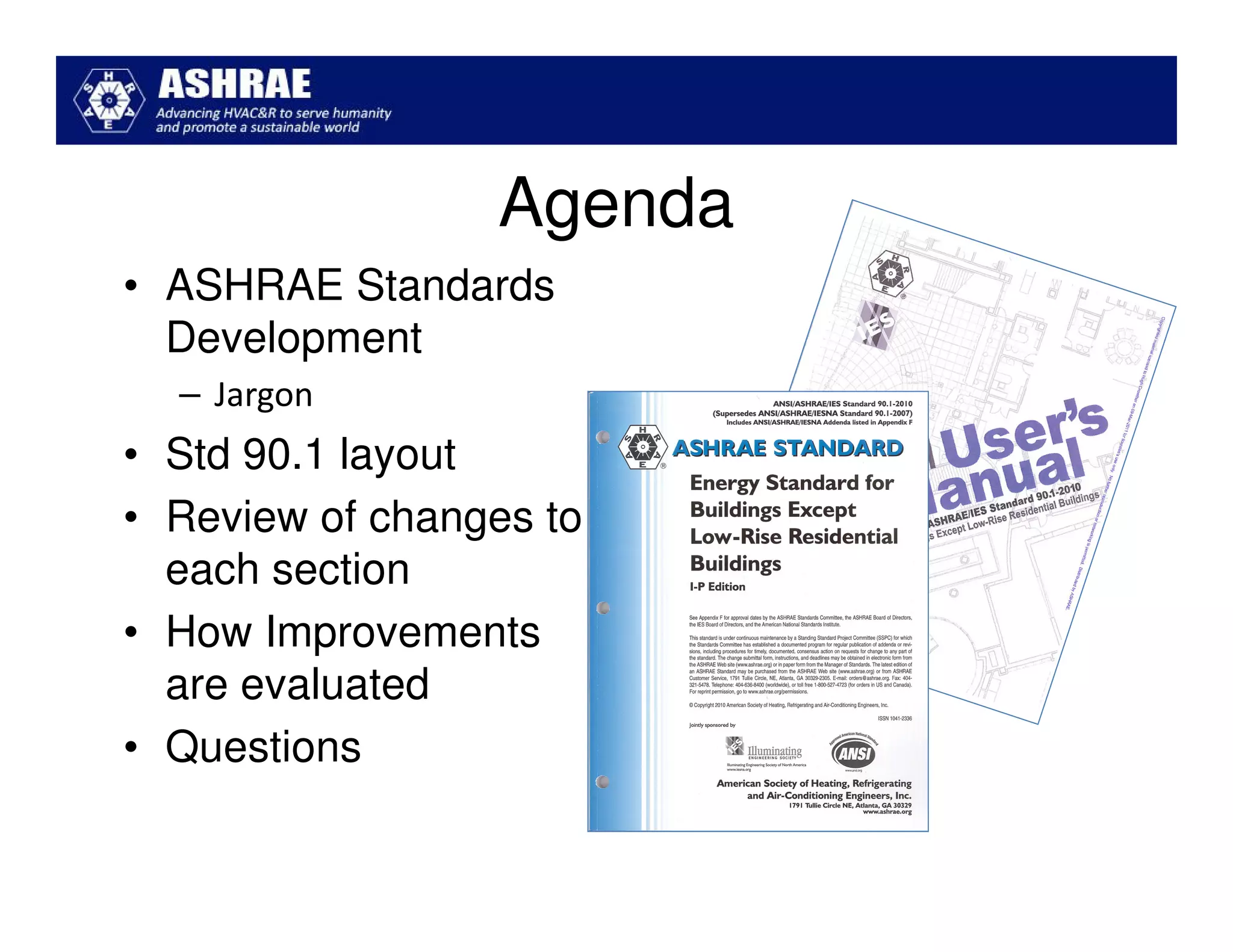
• ASHRAE Standards
  Development
  – Jargon
• Std 90.1 layout
• Review of changes to
  each section
• How Improvements
  are evaluated
• Questions
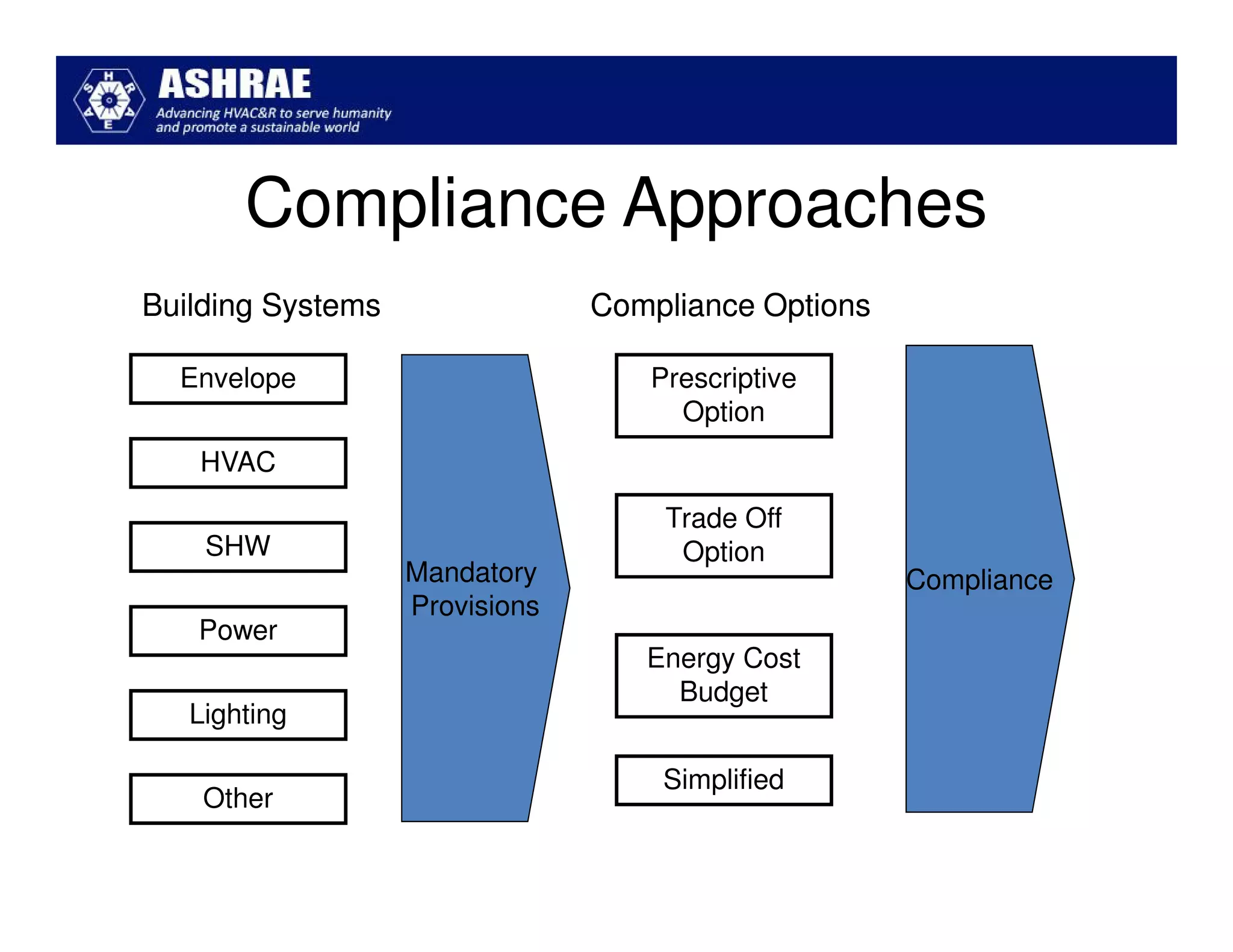
Compliance Approaches
Building Systems                Compliance Options

  Envelope                         Prescriptive
                                     Option
   HVAC

                                    Trade Off
    SHW                              Option
                   Mandatory                         Compliance
                   Provisions
   Power
                                   Energy Cost
                                     Budget
   Lighting

                                    Simplified
    Other
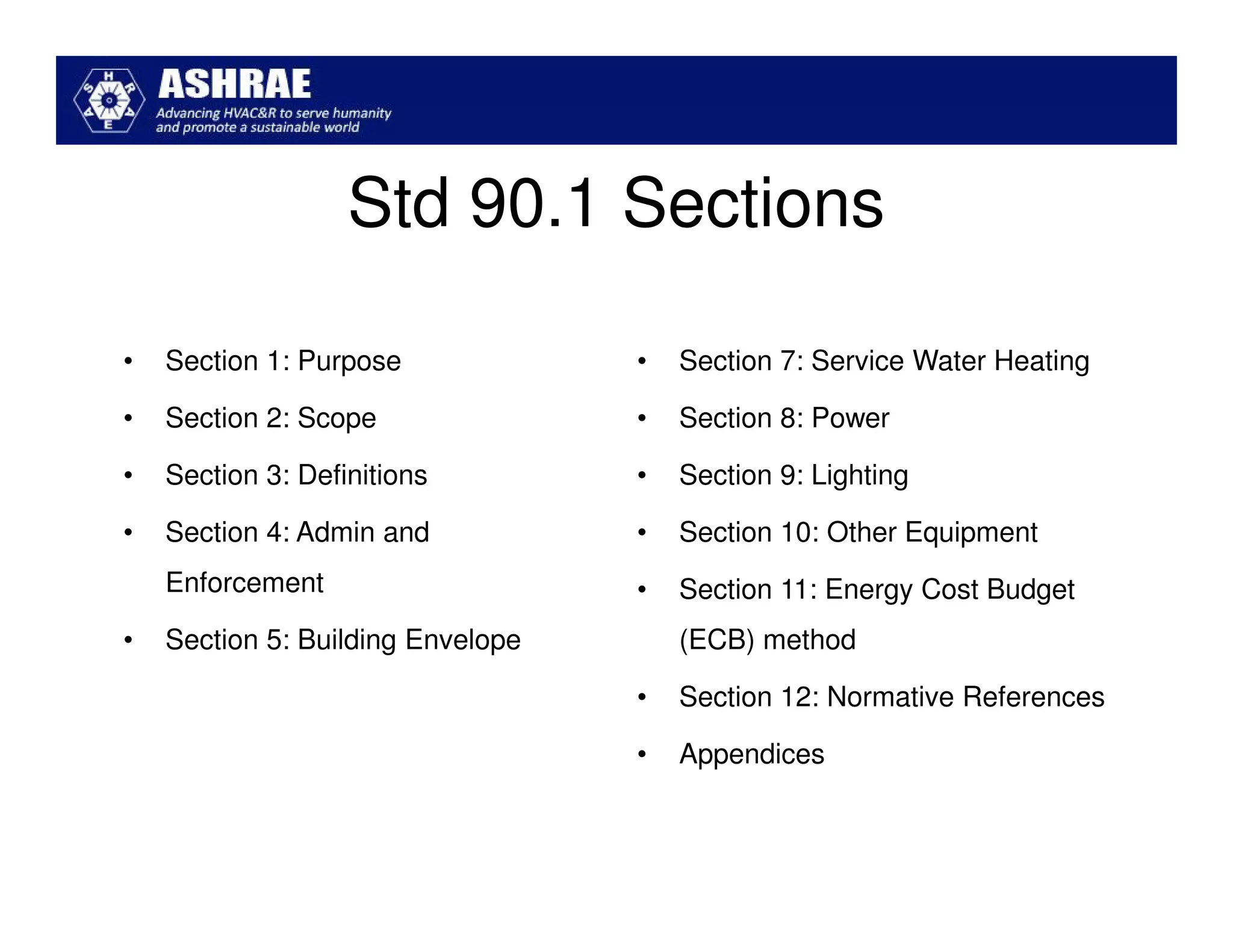
Std 90.1 Sections

•   Section 1: Purpose             •   Section 7: Service Water Heating

•   Section 2: Scope               •   Section 8: Power

•   Section 3: Definitions         •   Section 9: Lighting

•   Section 4: Admin and           •   Section 10: Other Equipment
    Enforcement                    •   Section 11: Energy Cost Budget
•   Section 5: Building Envelope       (ECB) method

                                   •   Section 12: Normative References

                                   •   Appendices
Std 90.1 -2010
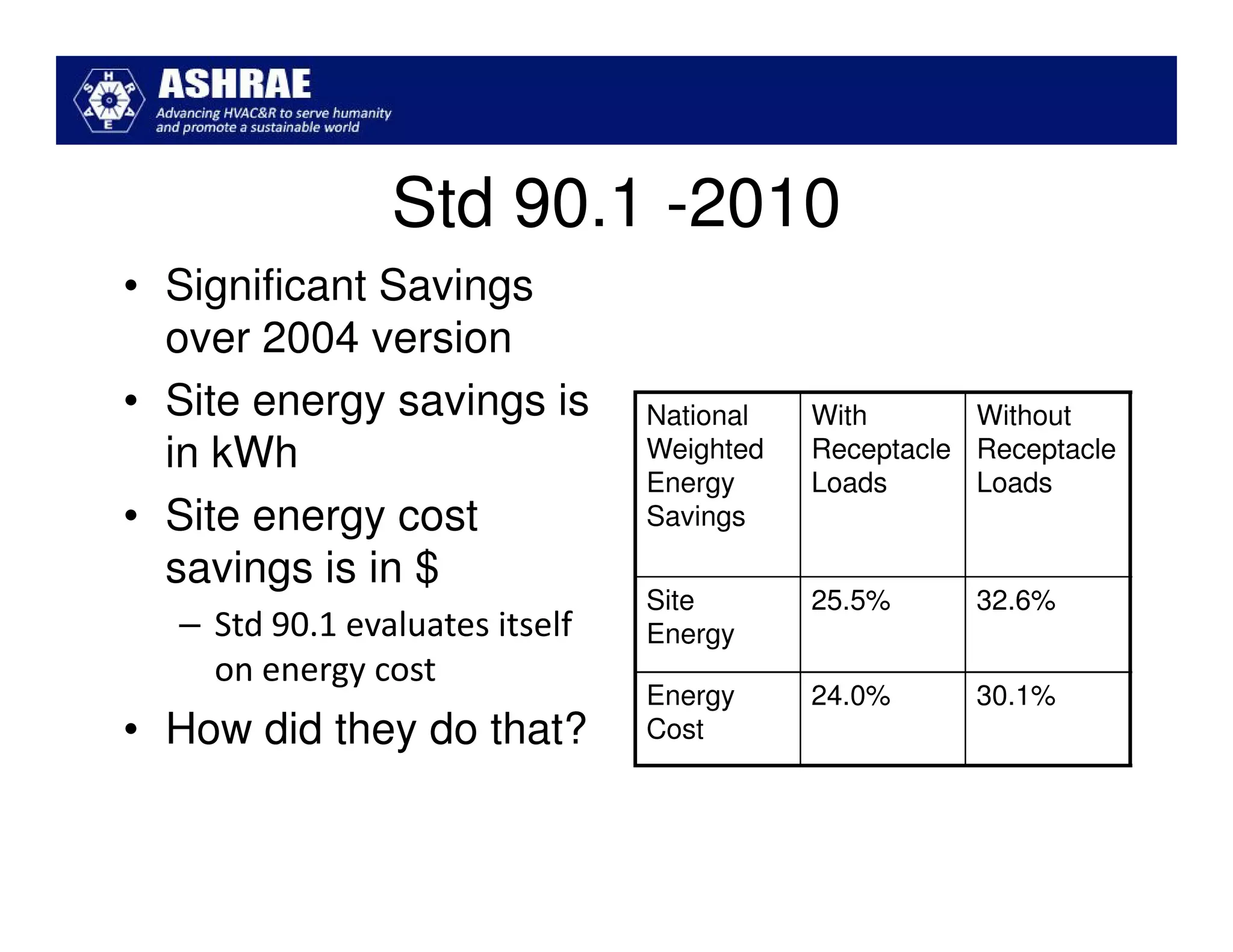
• Significant Savings
  over 2004 version
• Site energy savings is        National   With       Without
  in kWh                        Weighted   Receptacle Receptacle
                                Energy     Loads      Loads
• Site energy cost              Savings

  savings is in $
                                Site       25.5%      32.6%
  – Std 90.1 evaluates itself   Energy
    on energy cost
                                Energy     24.0%      30.1%
• How did they do that?         Cost
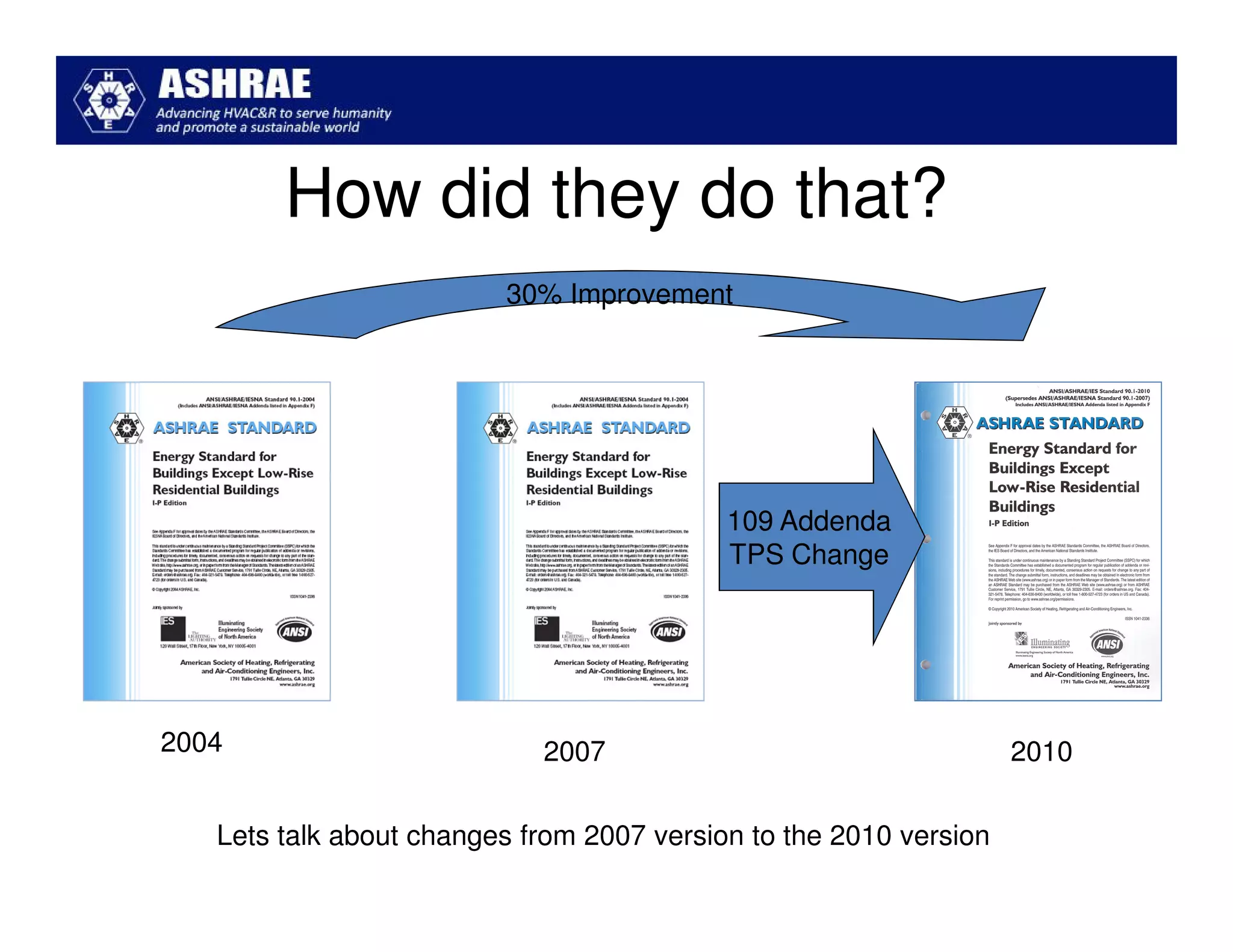
How did they do that?
                         30% Improvement


                                           109 Addenda
                                           TPS Change


2004                        2007                                   2010


   Lets talk about changes from 2007 version to the 2010 version
Section 2
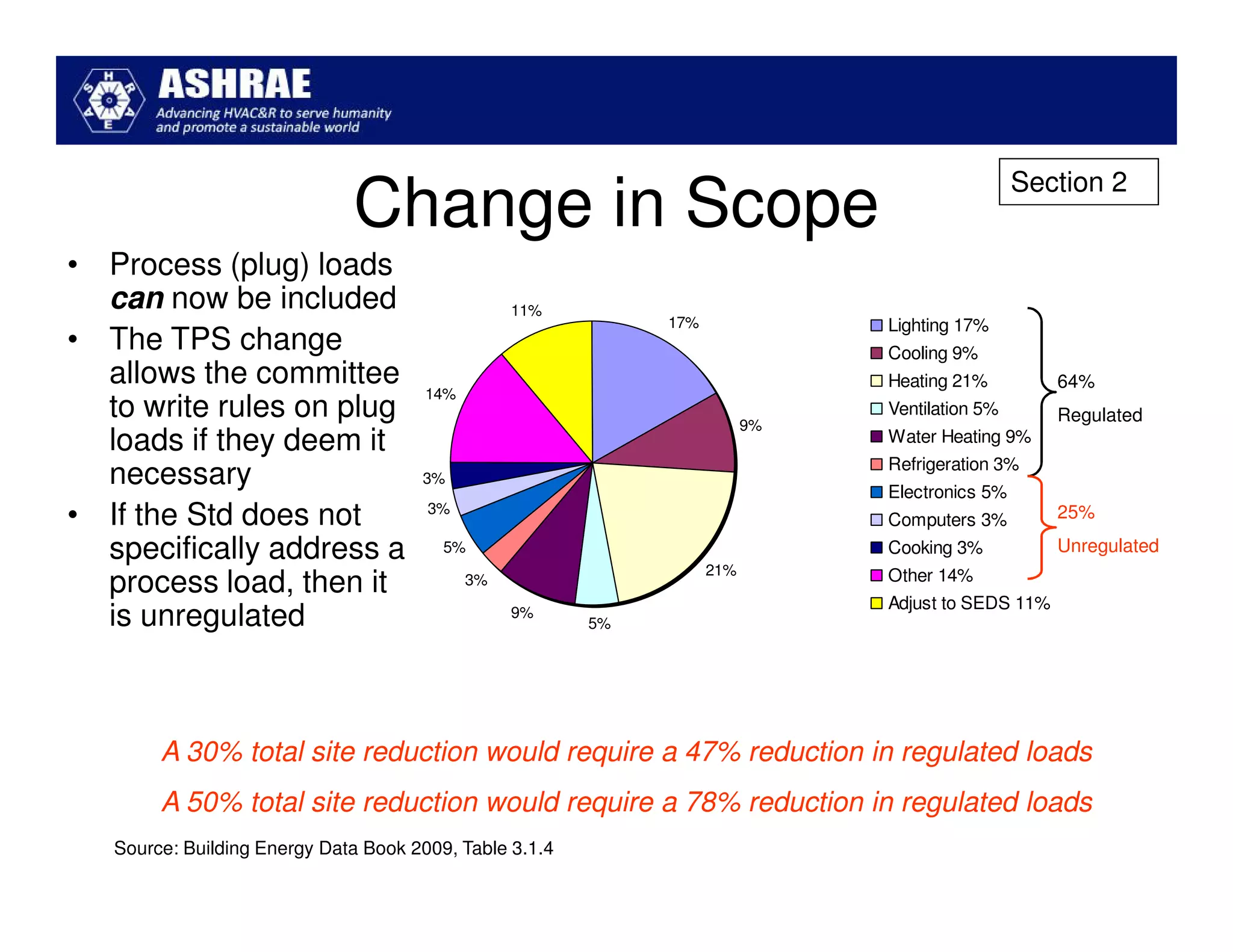
                              Change in Scope
• Process (plug) loads
  can now be included                             11%
                                                              17%              Lighting 17%
• The TPS change                                                               Cooling 9%
  allows the committee                                                         Heating 21%          64%
                                       14%
  to write rules on plug                                                  9%
                                                                               Ventilation 5%       Regulated
  loads if they deem it                                                        Water Heating 9%
                                                                               Refrigeration 3%
  necessary                           3%
                                                                               Electronics 5%
• If the Std does not                  3%
                                                                               Computers 3%         25%

  specifically address a                 5%                                    Cooking 3%           Unregulated
                                                                    21%        Other 14%
  process load, then it                      3%
                                                                               Adjust to SEDS 11%
  is unregulated                                  9%
                                                         5%


        A 30% total site reduction would require a 47% reduction in regulated loads
        A 50% total site reduction would require a 78% reduction in regulated loads
   Source: Building Energy Data Book 2009, Table 3.1.4
Section 5
          Building Envelope
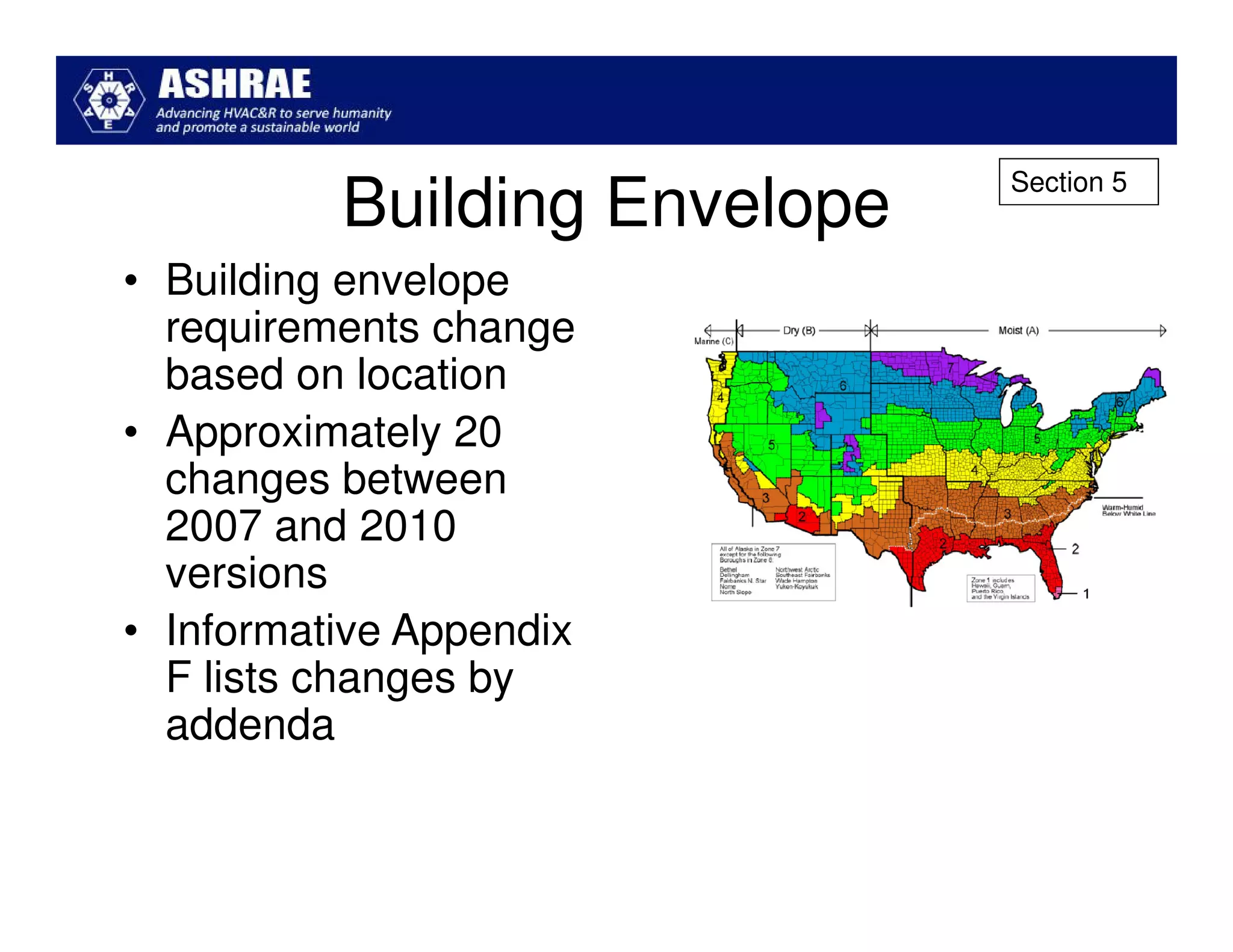
• Building envelope
  requirements change
  based on location
• Approximately 20
  changes between
  2007 and 2010
  versions
• Informative Appendix
  F lists changes by
  addenda
Section 5
            Building Envelope
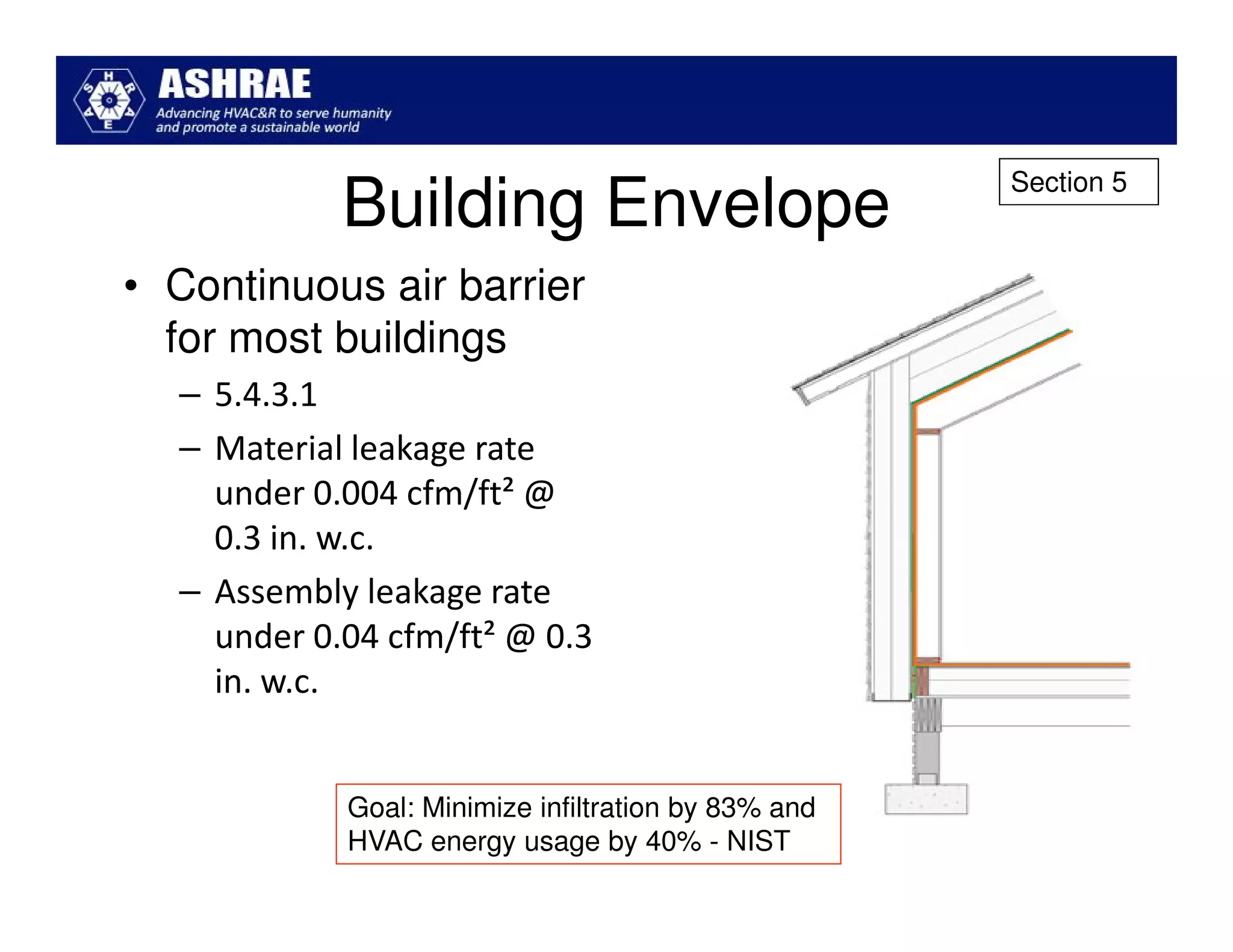
• Continuous air barrier
  for most buildings
  – 5.4.3.1
  – Material leakage rate
    under 0.004 cfm/ft² @
    0.3 in. w.c.
  – Assembly leakage rate
    under 0.04 cfm/ft² @ 0.3
    in. w.c.


            Goal: Minimize infiltration by 83% and
            HVAC energy usage by 40% - NIST
Section 5
            Building Envelope
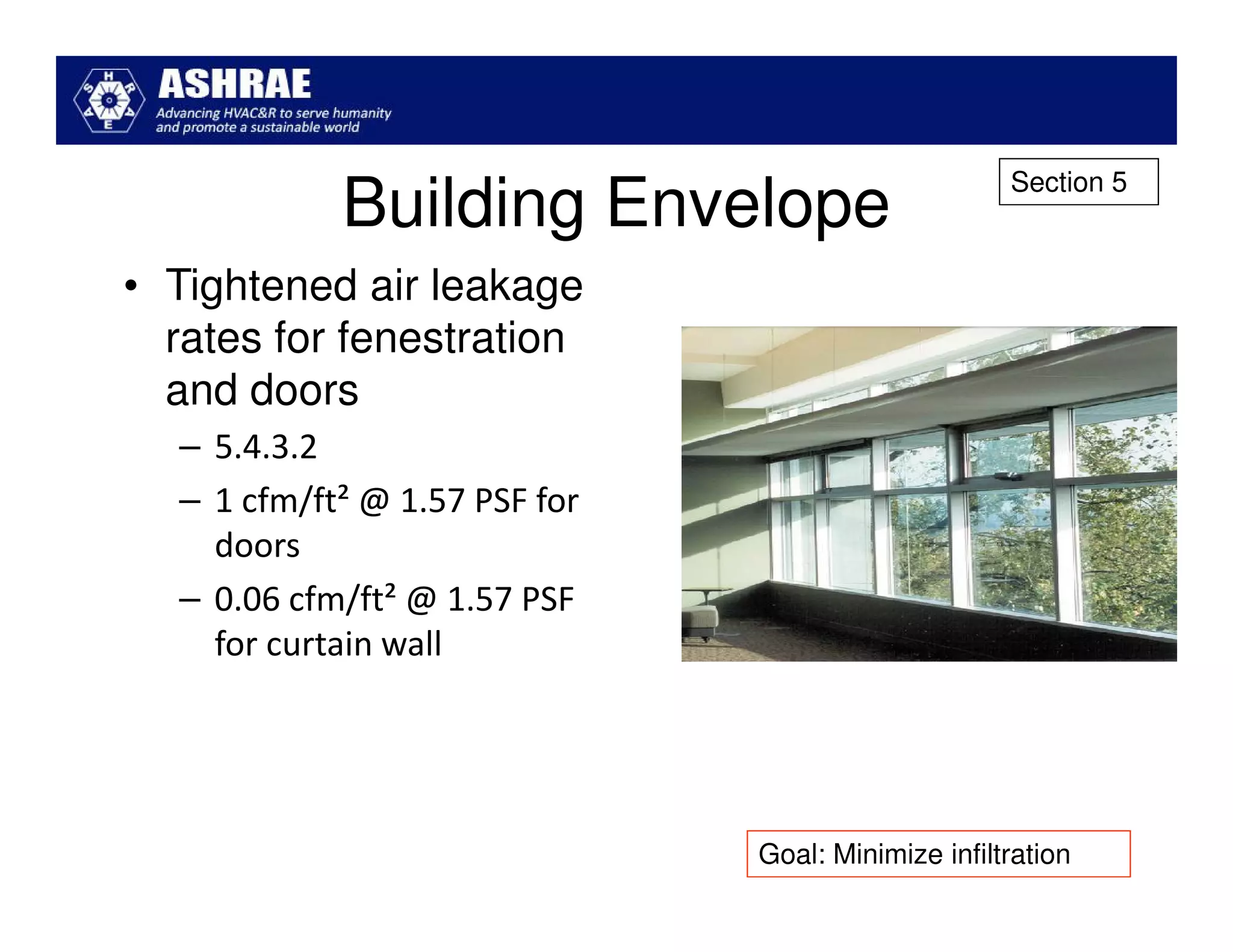
• Tightened air leakage
  rates for fenestration
  and doors
  – 5.4.3.2
  – 1 cfm/ft² @ 1.57 PSF for
    doors
  – 0.06 cfm/ft² @ 1.57 PSF
    for curtain wall


                               Goal: Minimize infiltration
Section 5
              Building Envelope
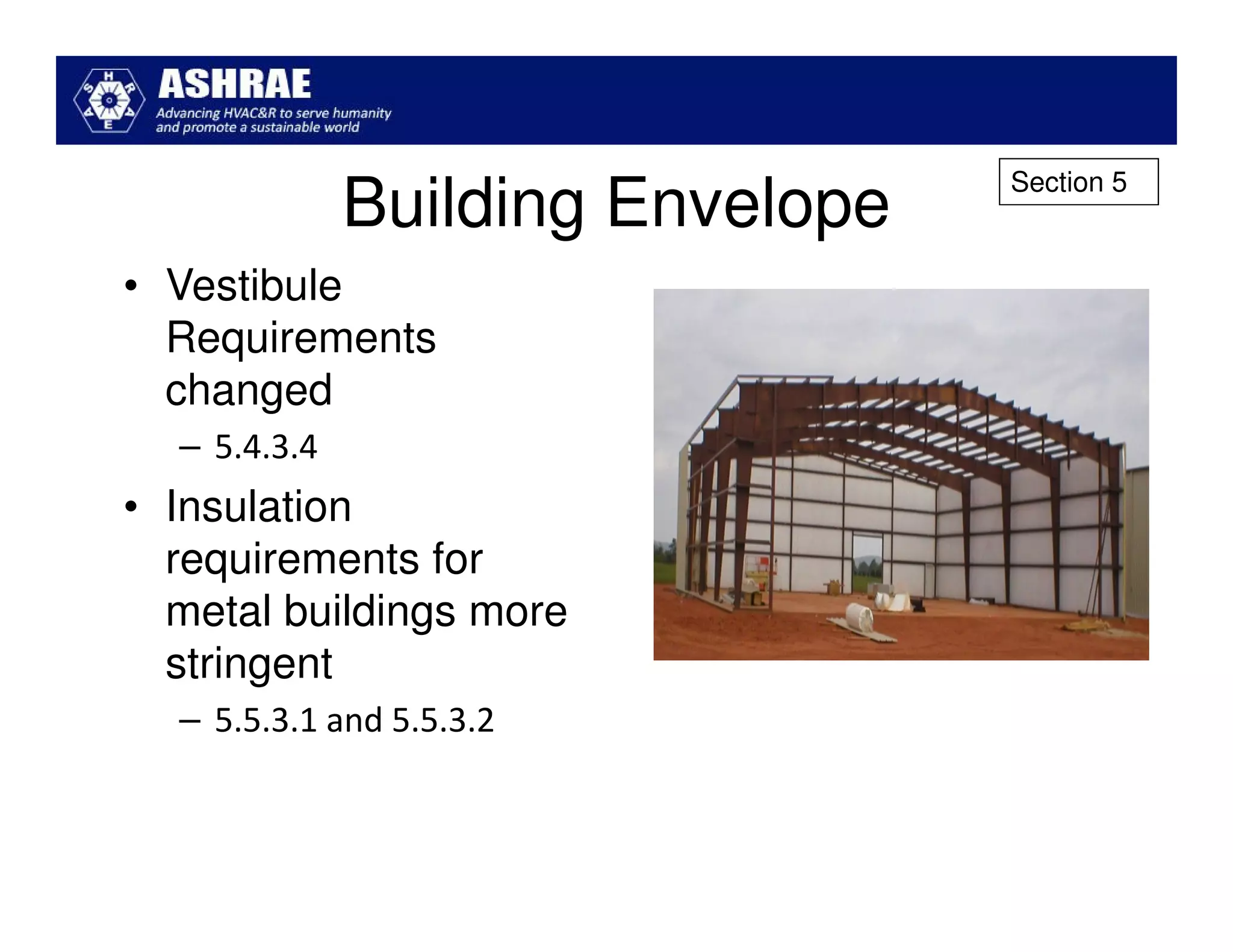
• Vestibule
  Requirements
  changed
  – 5.4.3.4
• Insulation
  requirements for
  metal buildings more
  stringent
  – 5.5.3.1 and 5.5.3.2
Section 5
              Building Envelope
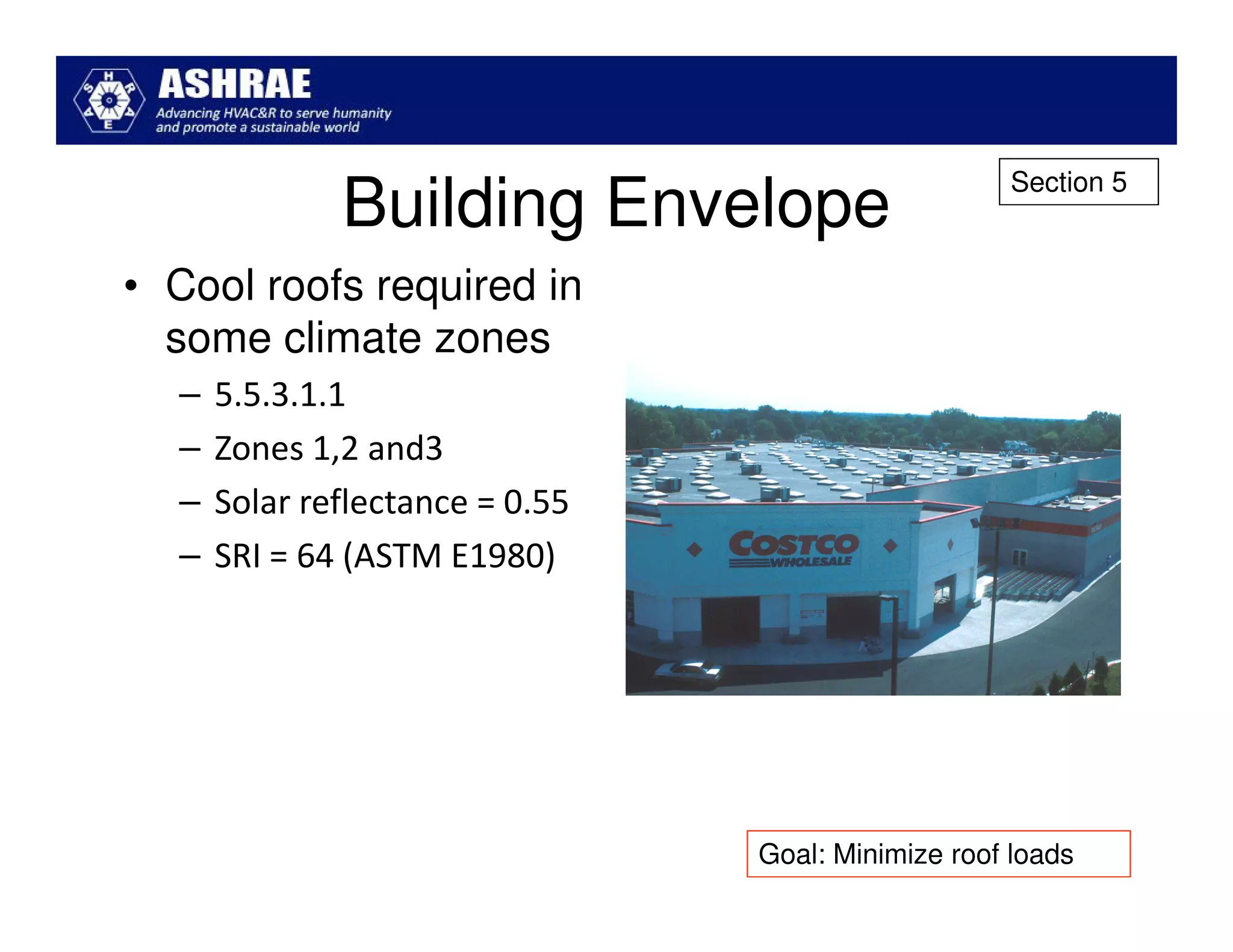
• Cool roofs required in
  some climate zones
  –   5.5.3.1.1
  –   Zones 1,2 and3
  –   Solar reflectance = 0.55
  –   SRI = 64 (ASTM E1980)


                                 Goal: Minimize roof loads
Section 5
                 Building Envelope
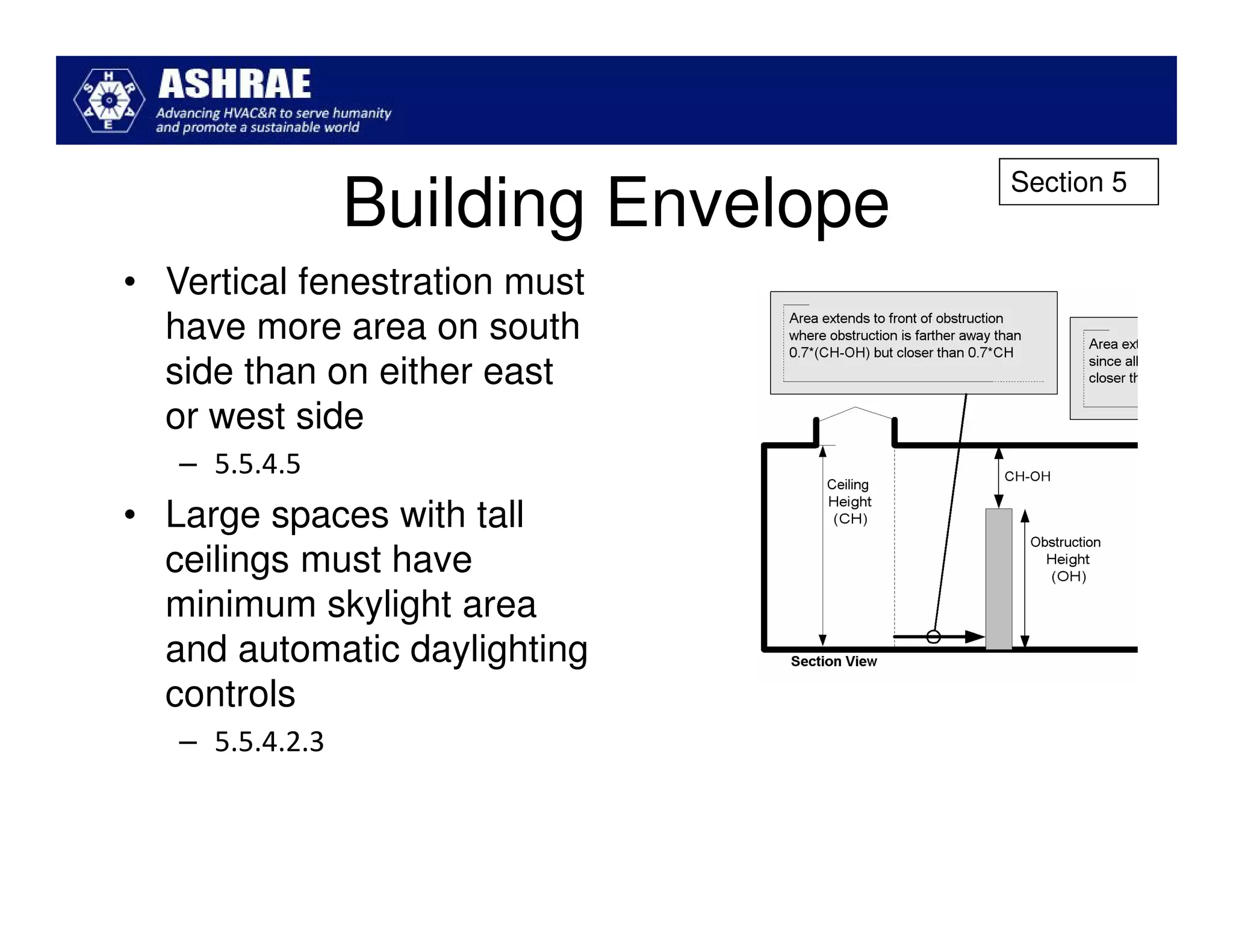
• Vertical fenestration must
  have more area on south
  side than on either east
  or west side
   – 5.5.4.5
• Large spaces with tall
  ceilings must have
  minimum skylight area
  and automatic daylighting
  controls
   – 5.5.4.2.3
Section 5
            Building Envelope
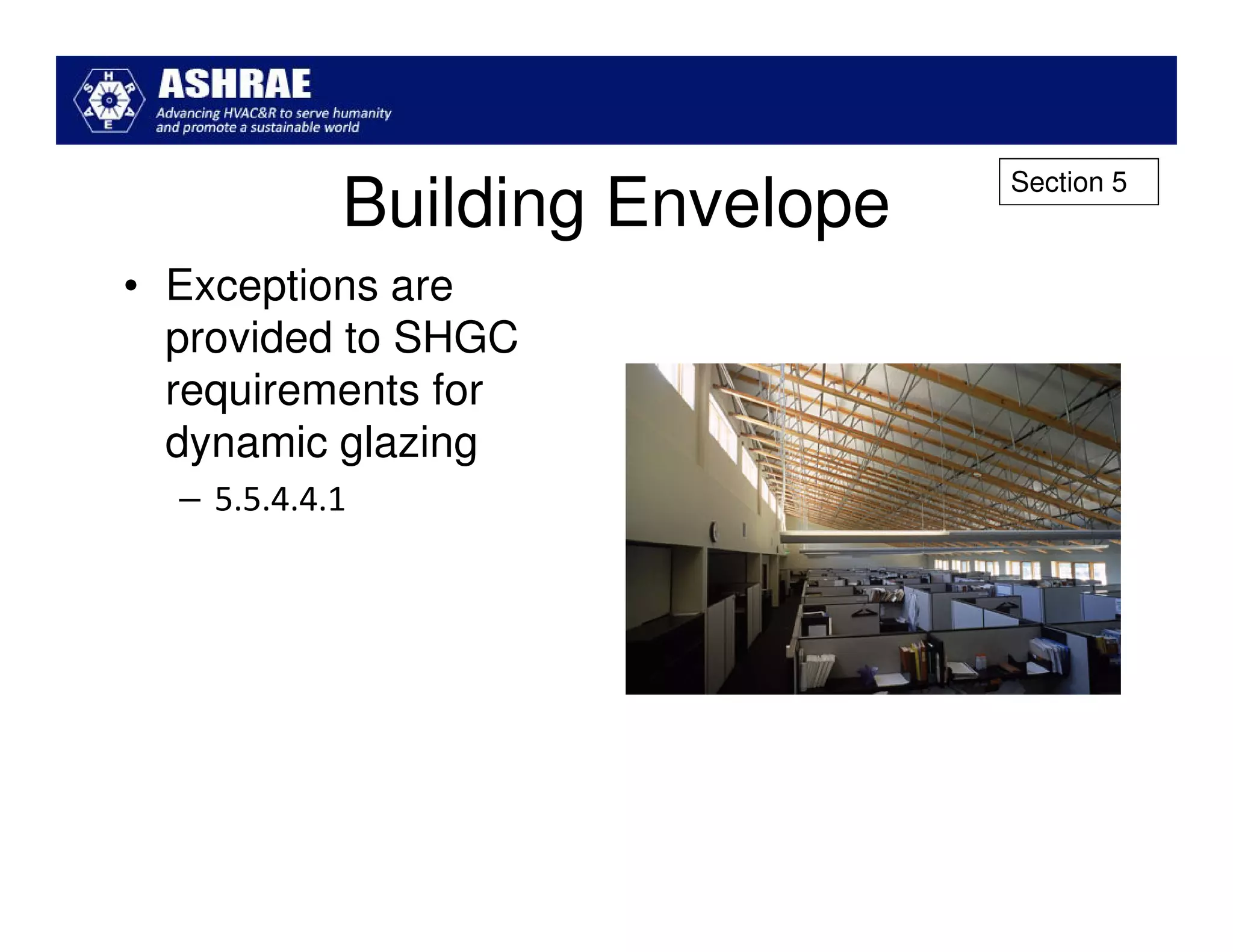
• Exceptions are
  provided to SHGC
  requirements for
  dynamic glazing
  – 5.5.4.4.1
Section 6
                    HVAC Systems
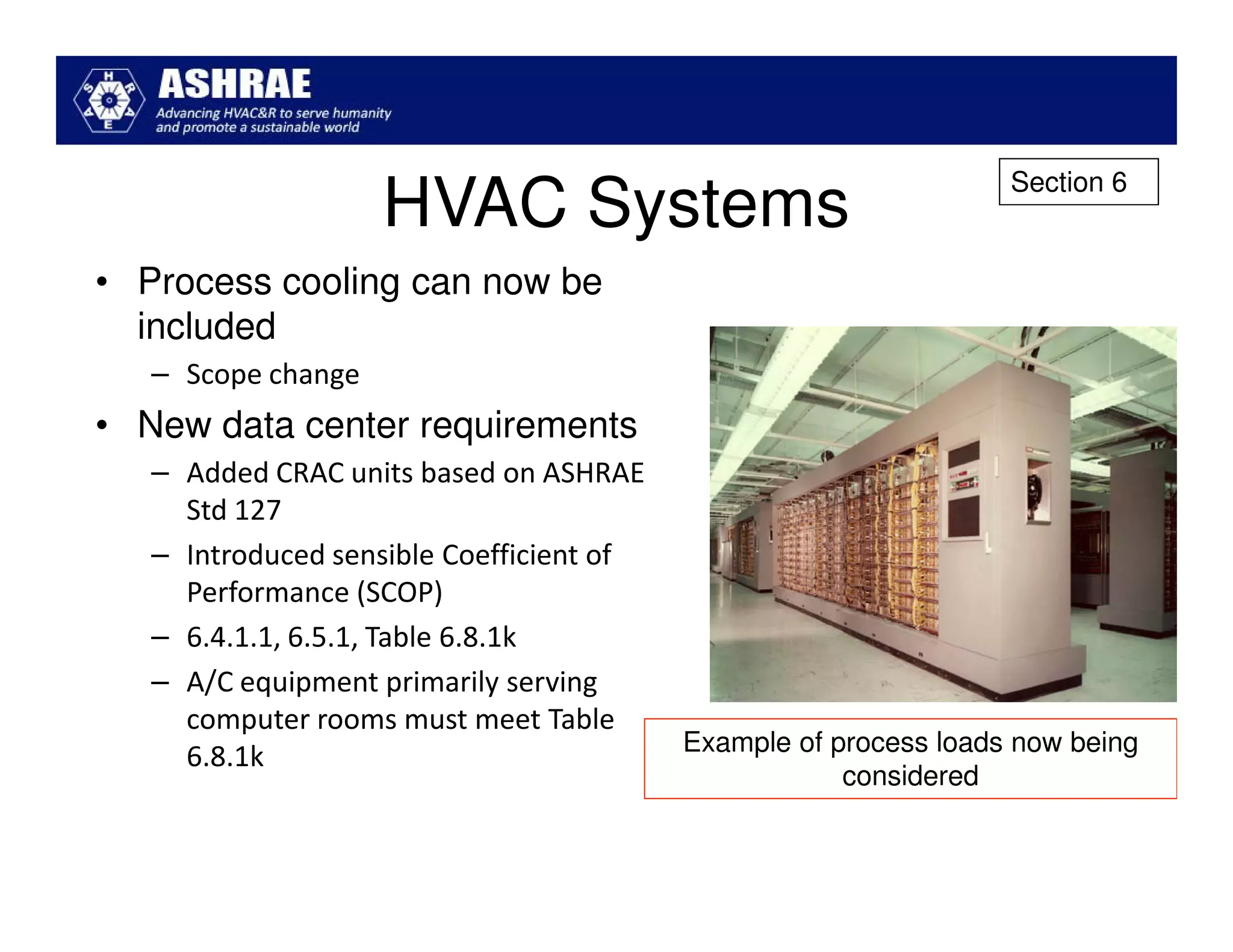
• Process cooling can now be
  included
   – Scope change
• New data center requirements
   – Added CRAC units based on ASHRAE
     Std 127
   – Introduced sensible Coefficient of
     Performance (SCOP)
   – 6.4.1.1, 6.5.1, Table 6.8.1k
   – A/C equipment primarily serving
     computer rooms must meet Table
                                          Example of process loads now being
     6.8.1k
                                                      considered
Section 6
               HVAC Systems
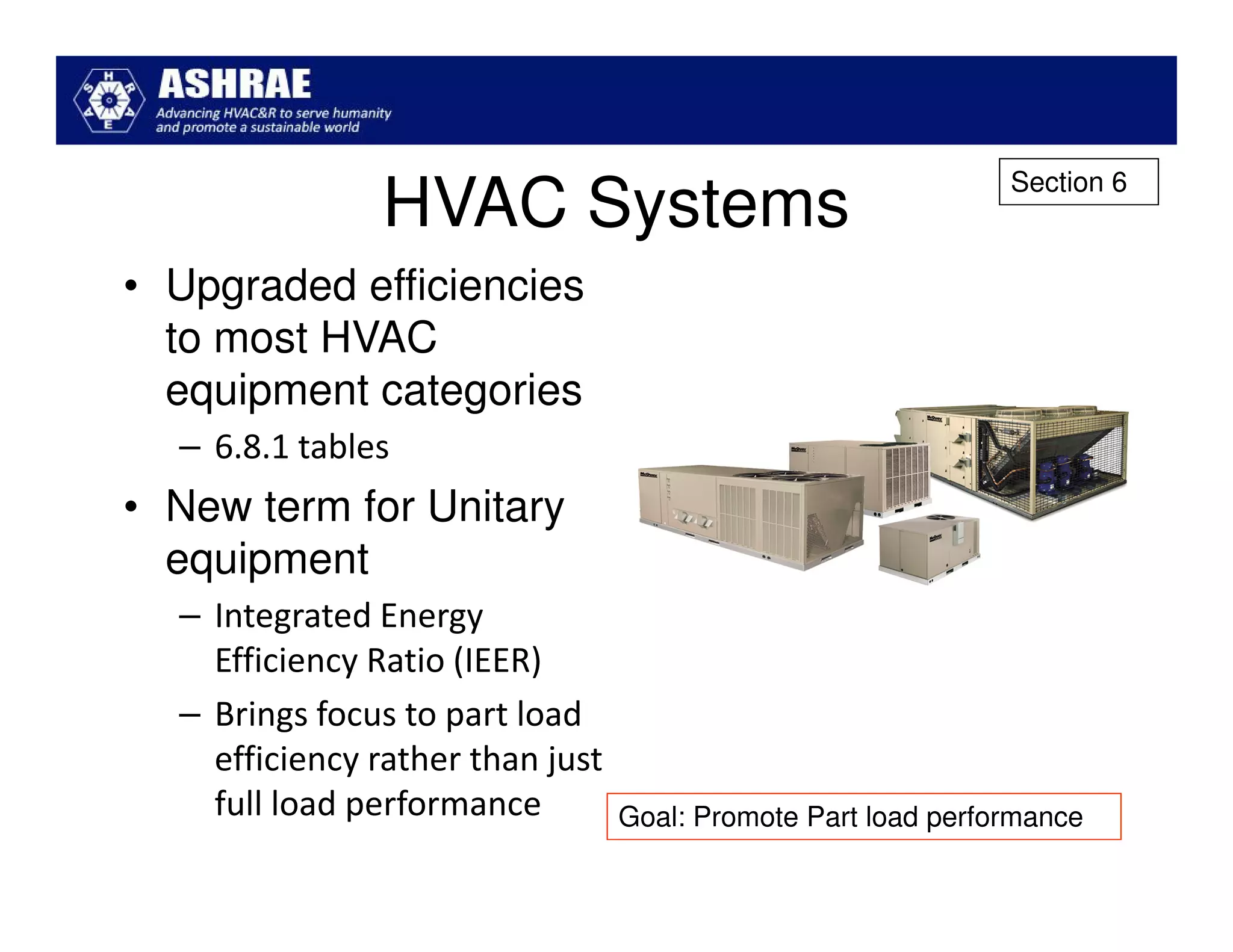
• Upgraded efficiencies
  to most HVAC
  equipment categories
  – 6.8.1 tables
• New term for Unitary
  equipment
  – Integrated Energy
    Efficiency Ratio (IEER)
  – Brings focus to part load
    efficiency rather than just
    full load performance         Goal: Promote Part load performance
Section 6
                HVAC Systems
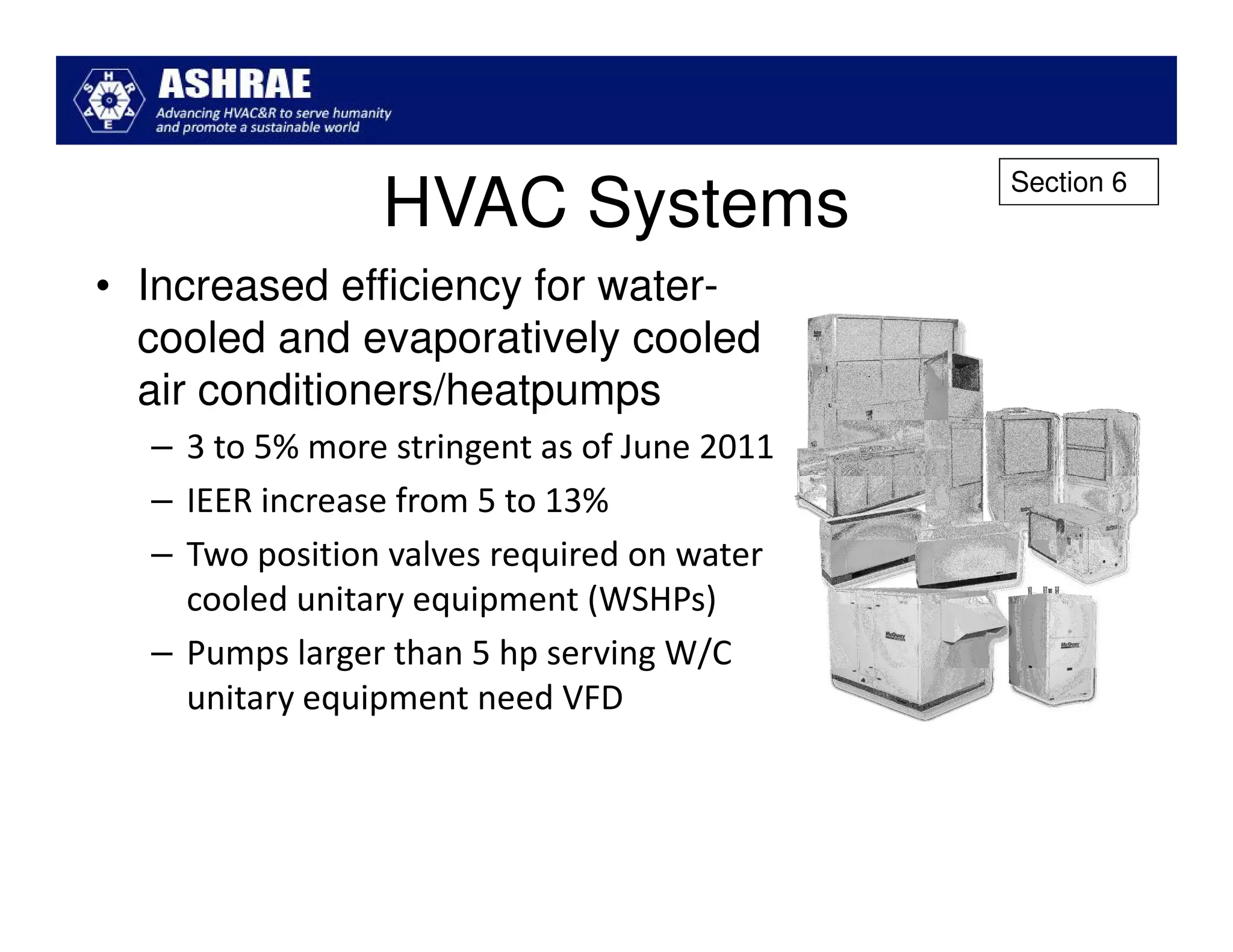
• Increased efficiency for water-
  cooled and evaporatively cooled
  air conditioners/heatpumps
  – 3 to 5% more stringent as of June 2011
  – IEER increase from 5 to 13%
  – Two position valves required on water
    cooled unitary equipment (WSHPs)
  – Pumps larger than 5 hp serving W/C
    unitary equipment need VFD
Section 6
                HVAC Systems
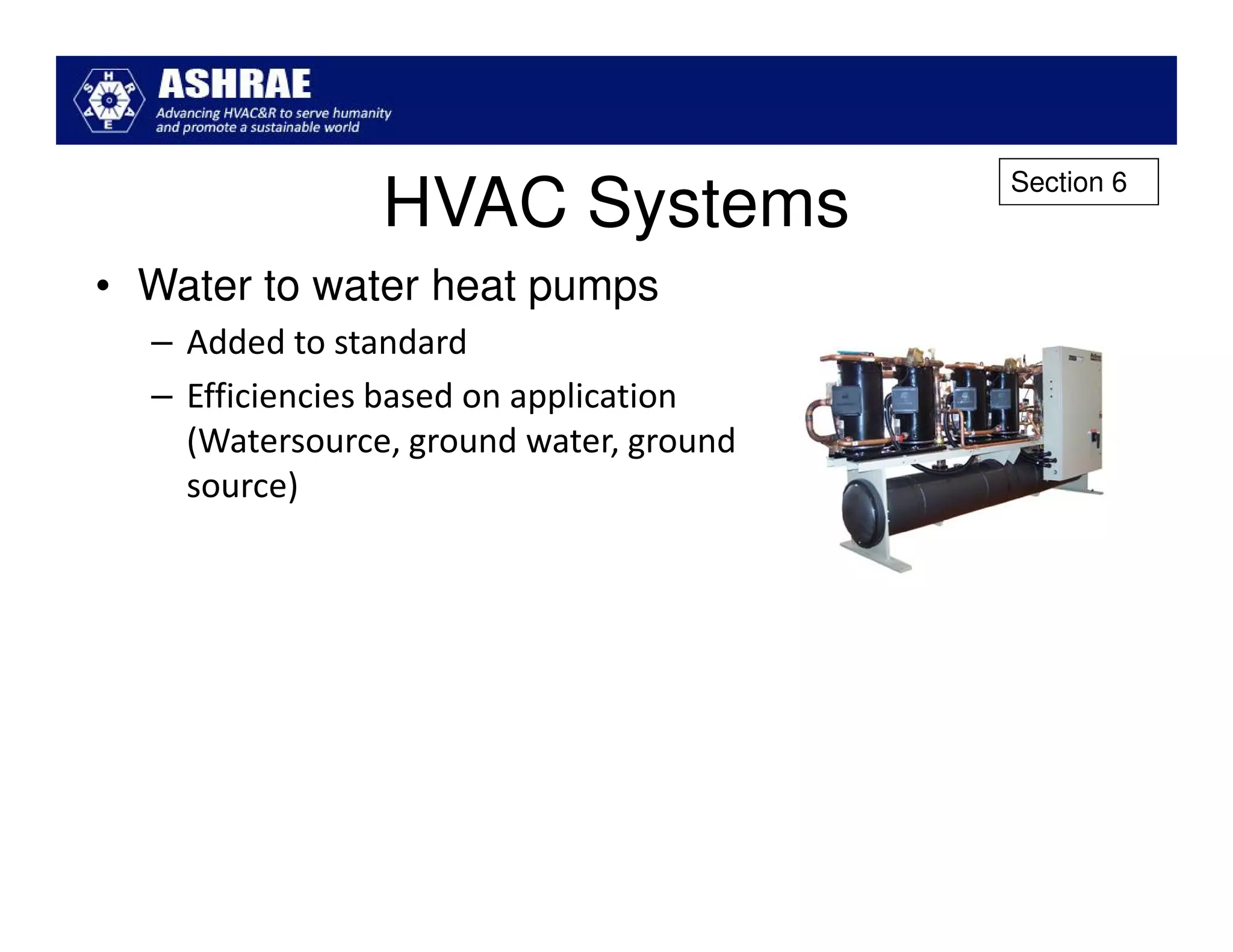
• Water to water heat pumps
  – Added to standard
  – Efficiencies based on application
    (Watersource, ground water, ground
    source)
Section 6
                 HVAC Systems
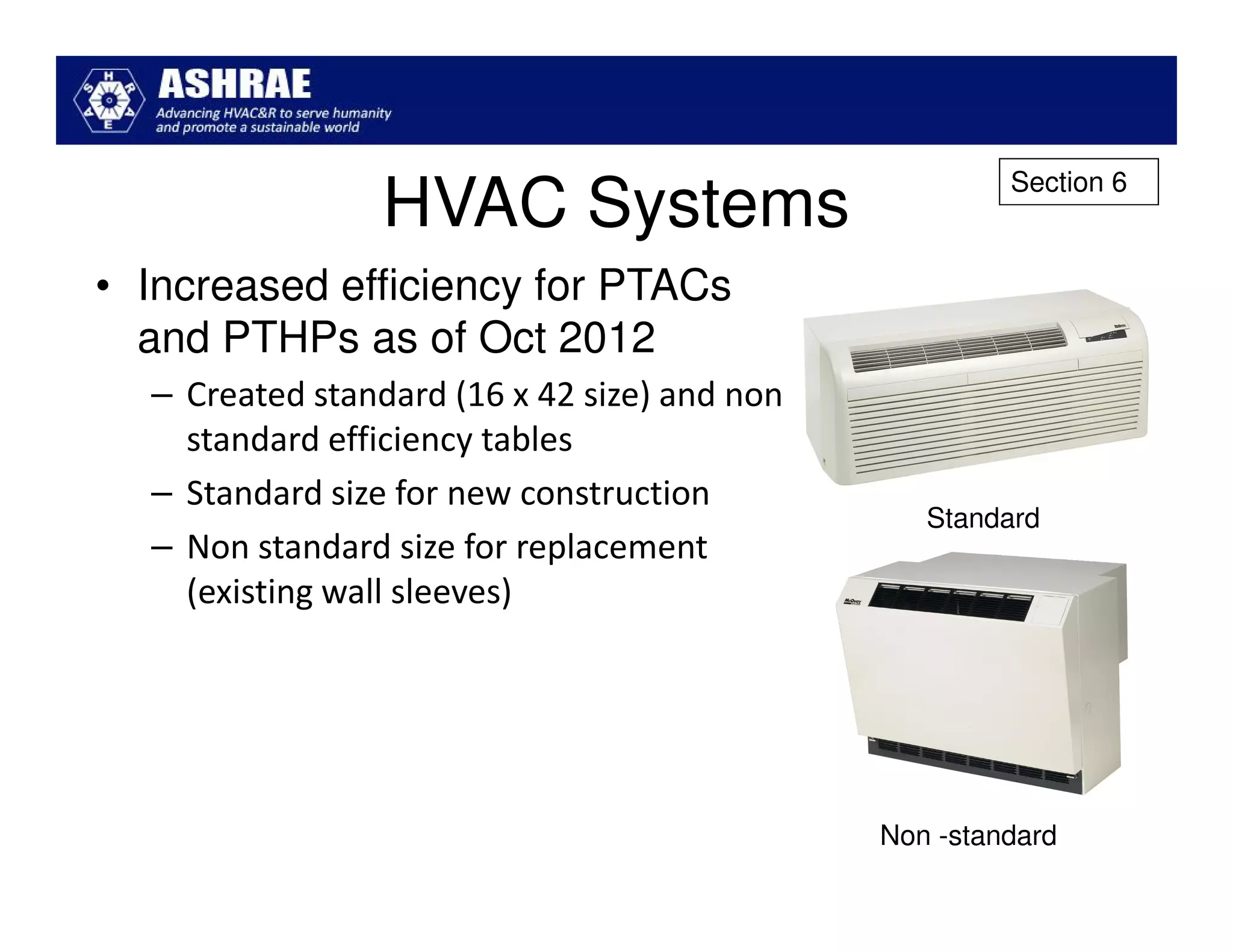
• Increased efficiency for PTACs
  and PTHPs as of Oct 2012
  – Created standard (16 x 42 size) and non
    standard efficiency tables
  – Standard size for new construction
                                                 Standard
  – Non standard size for replacement
    (existing wall sleeves)


                                              Non -standard
Section 6
                HVAC Systems
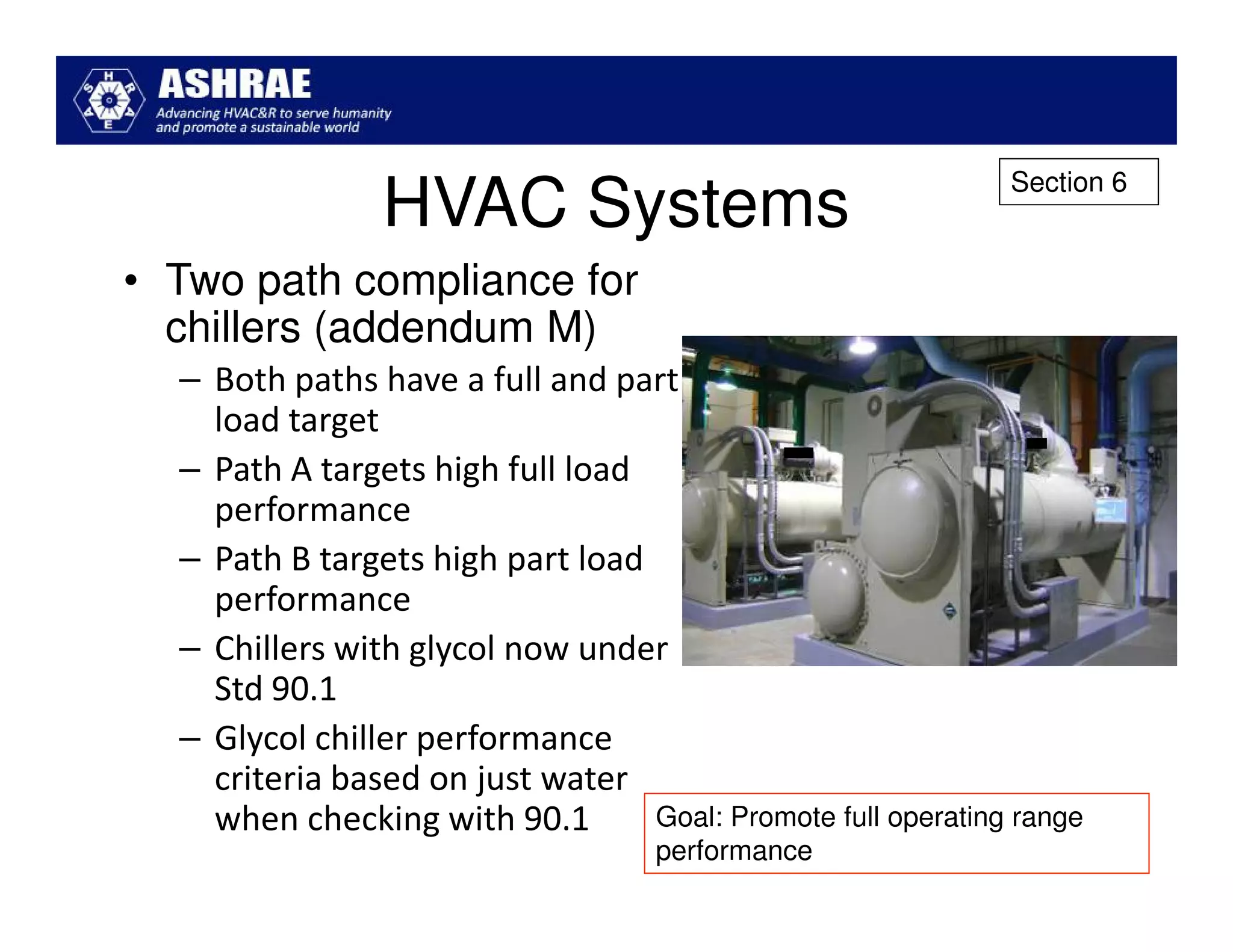
• Two path compliance for
  chillers (addendum M)
  – Both paths have a full and part
    load target
  – Path A targets high full load
    performance
  – Path B targets high part load
    performance
  – Chillers with glycol now under
    Std 90.1
  – Glycol chiller performance
    criteria based on just water
    when checking with 90.1       Goal: Promote full operating range
                                    performance
Section 6
                  HVAC Systems
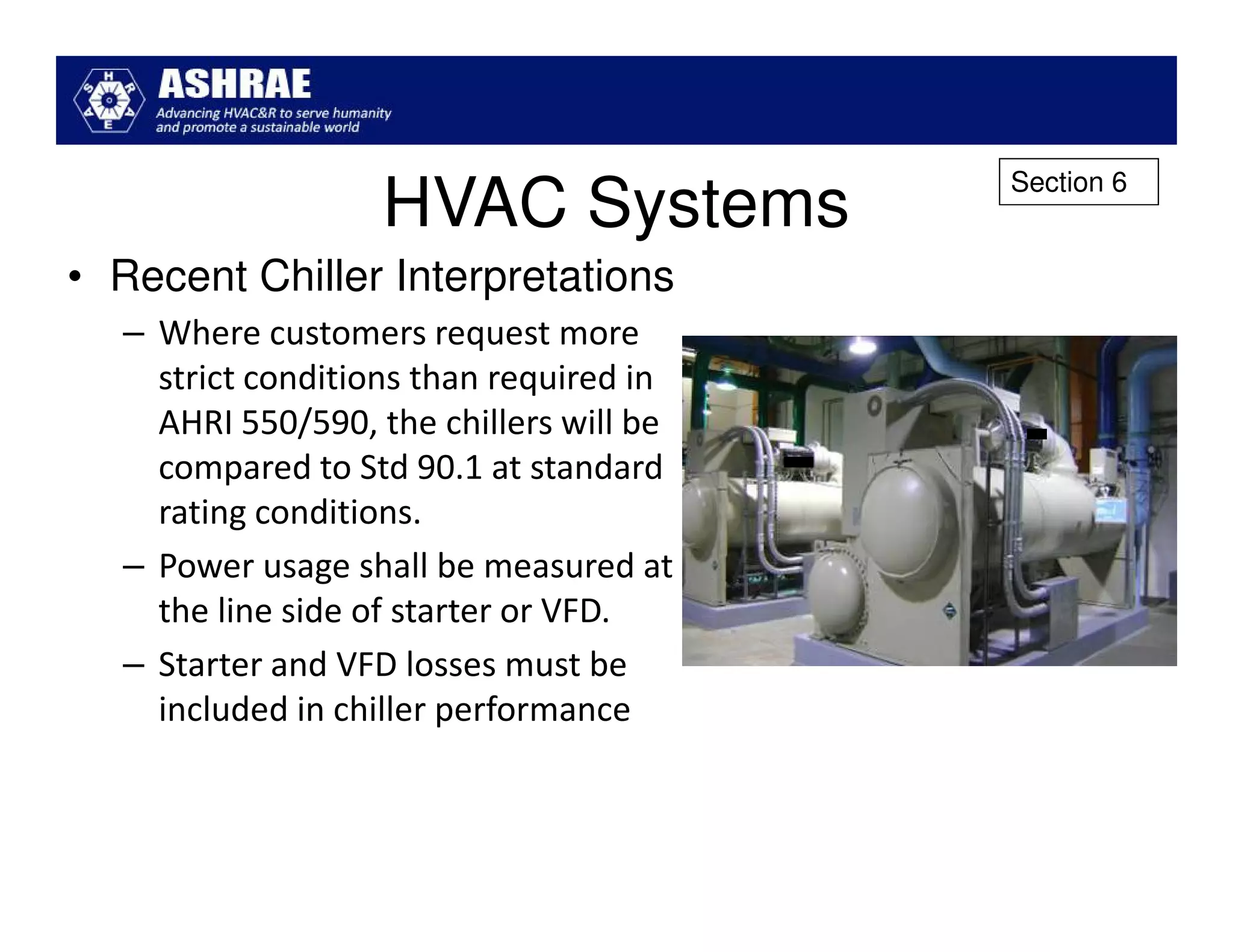
• Recent Chiller Interpretations
  – Where customers request more
    strict conditions than required in
    AHRI 550/590, the chillers will be
    compared to Std 90.1 at standard
    rating conditions.
  – Power usage shall be measured at
    the line side of starter or VFD.
  – Starter and VFD losses must be
    included in chiller performance
Section 6
                    HVAC Systems
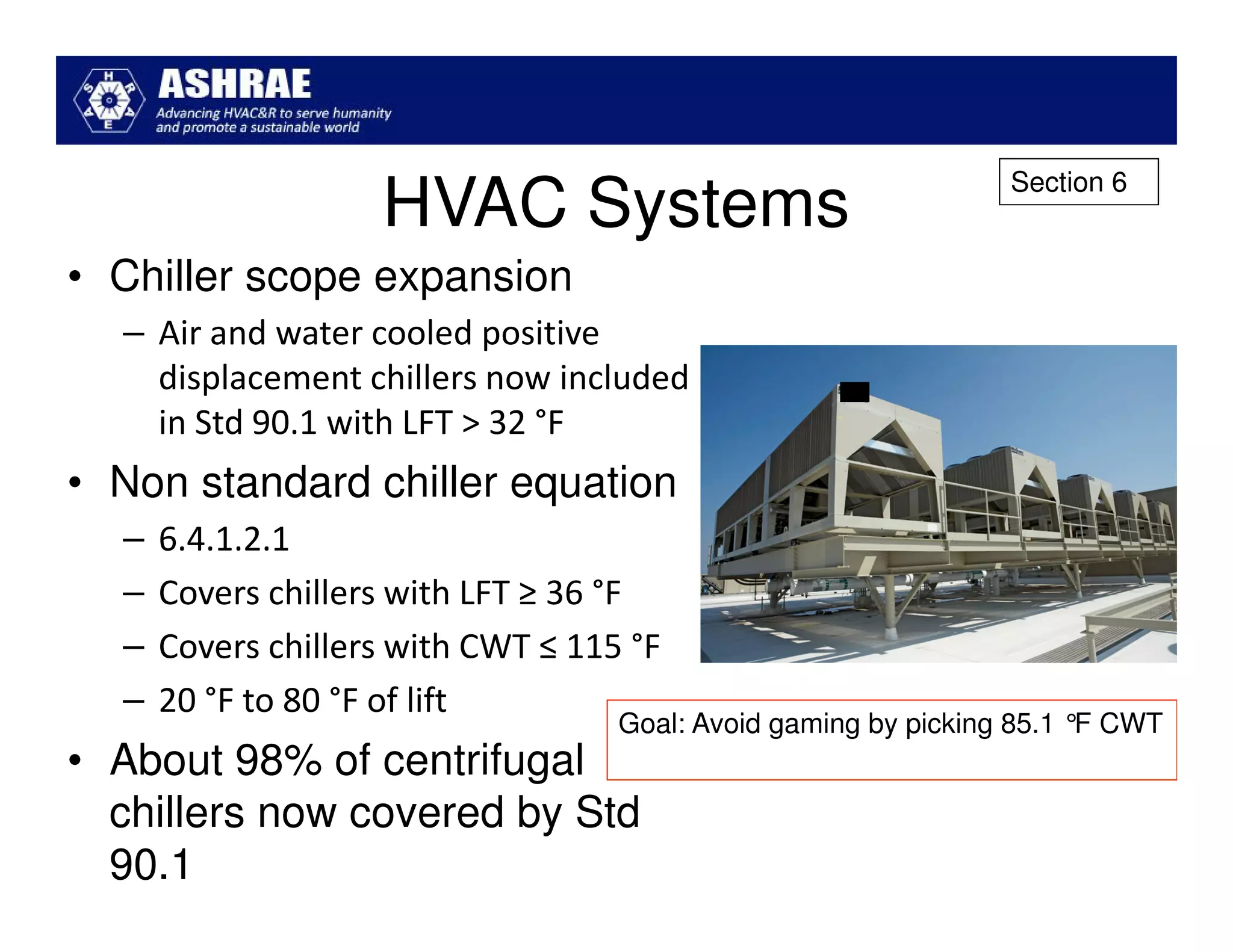
• Chiller scope expansion
  – Air and water cooled positive
    displacement chillers now included
    in Std 90.1 with LFT > 32 °F
• Non standard chiller equation
  –   6.4.1.2.1
  –   Covers chillers with LFT ≥ 36 °F
  –   Covers chillers with CWT ≤ 115 °F
  –   20 °F to 80 °F of lift
                                    Goal: Avoid gaming by picking 85.1 °F CWT
• About 98% of centrifugal
  chillers now covered by Std
  90.1
Section 6
               HVAC Systems
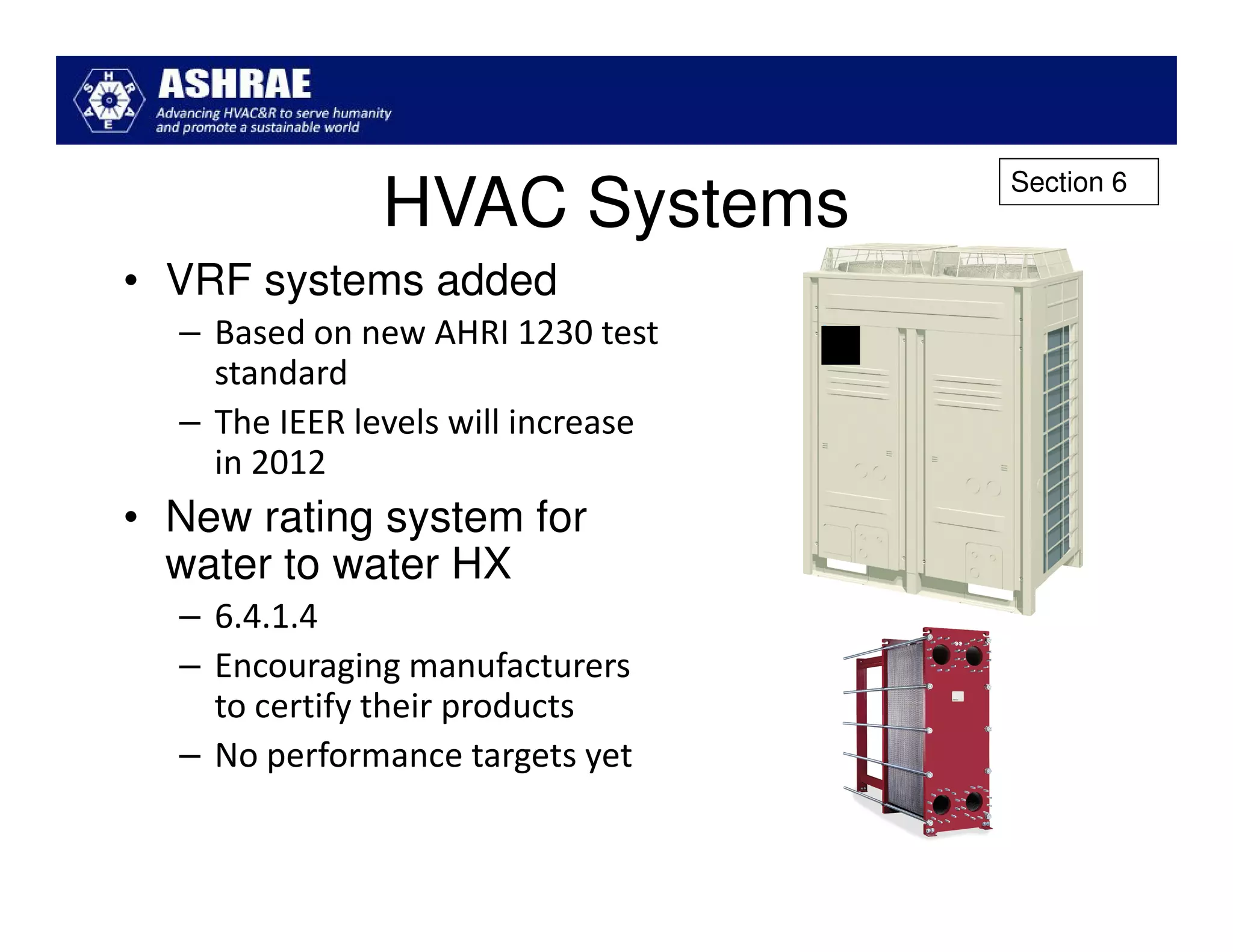
• VRF systems added
  – Based on new AHRI 1230 test
    standard
  – The IEER levels will increase
    in 2012
• New rating system for
  water to water HX
  – 6.4.1.4
  – Encouraging manufacturers
    to certify their products
  – No performance targets yet
Section 6
               HVAC Systems
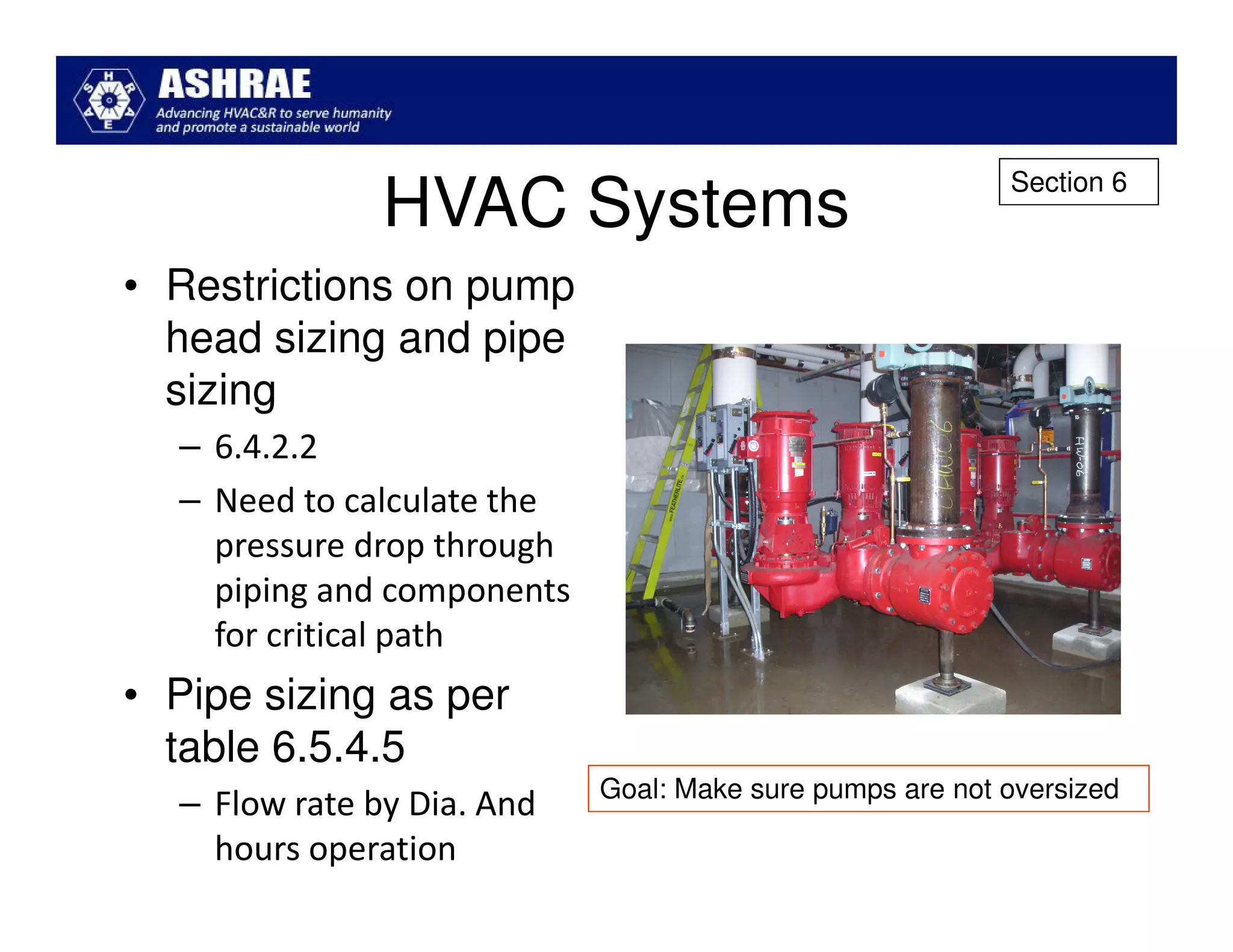
• Restrictions on pump
  head sizing and pipe
  sizing
  – 6.4.2.2
  – Need to calculate the
    pressure drop through
    piping and components
    for critical path
• Pipe sizing as per
  table 6.5.4.5
                            Goal: Make sure pumps are not oversized
  – Flow rate by Dia. And
    hours operation
Section 6
              HVAC Systems
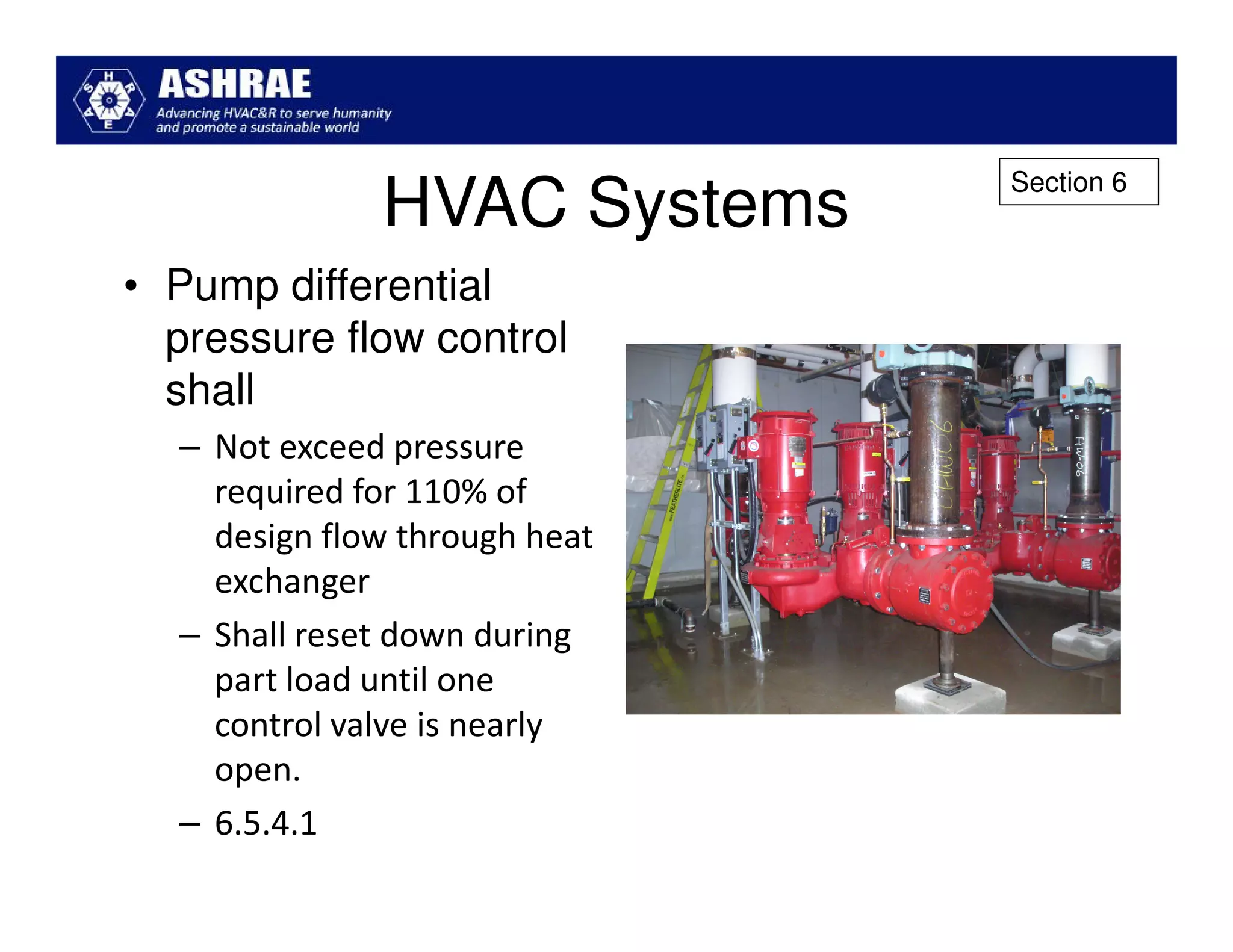
• Pump differential
  pressure flow control
  shall
  – Not exceed pressure
    required for 110% of
    design flow through heat
    exchanger
  – Shall reset down during
    part load until one
    control valve is nearly
    open.
  – 6.5.4.1
Section 6
              HVAC Systems
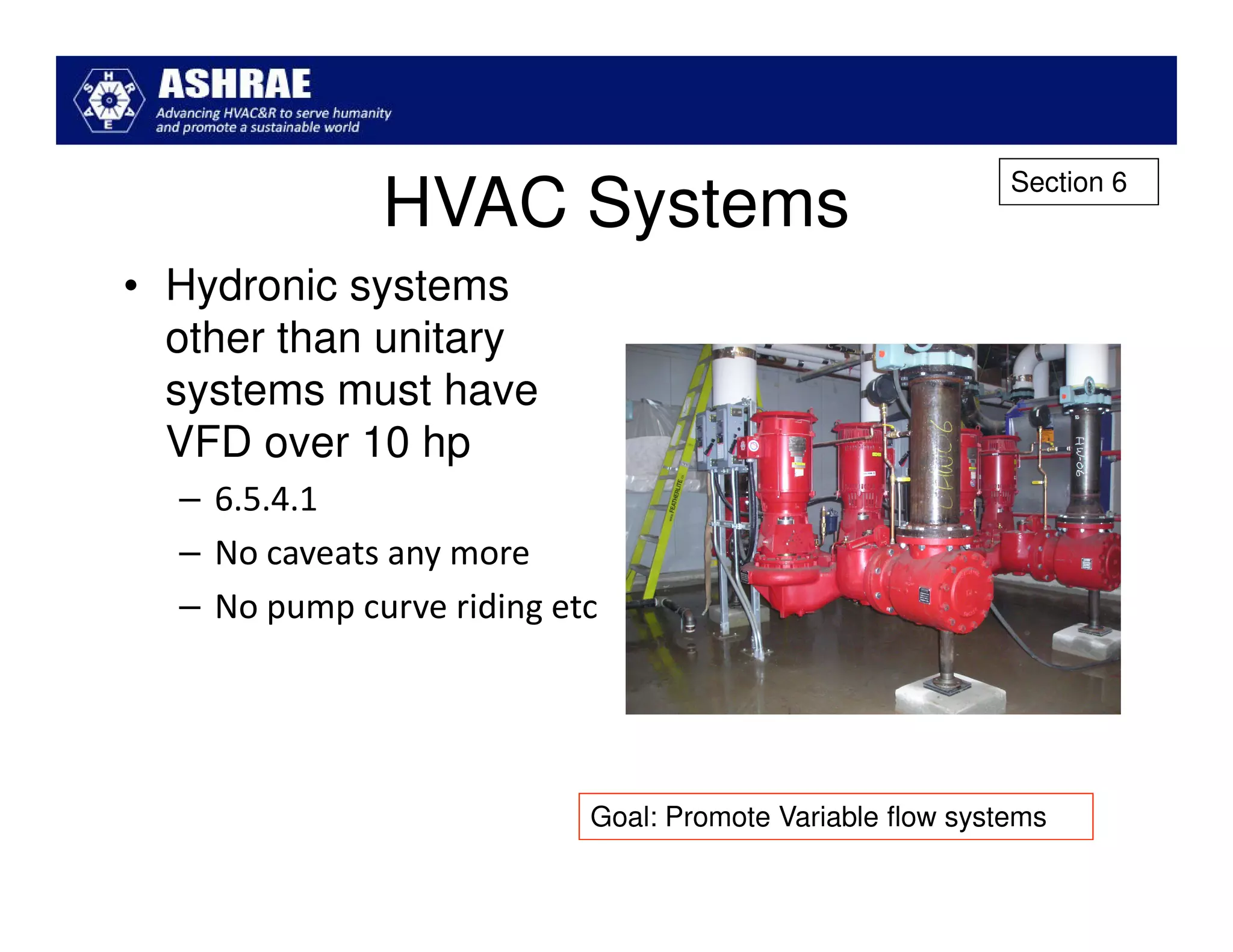
• Hydronic systems
  other than unitary
  systems must have
  VFD over 10 hp
  – 6.5.4.1
  – No caveats any more
  – No pump curve riding etc


                           Goal: Promote Variable flow systems
Section 6
                  HVAC Systems
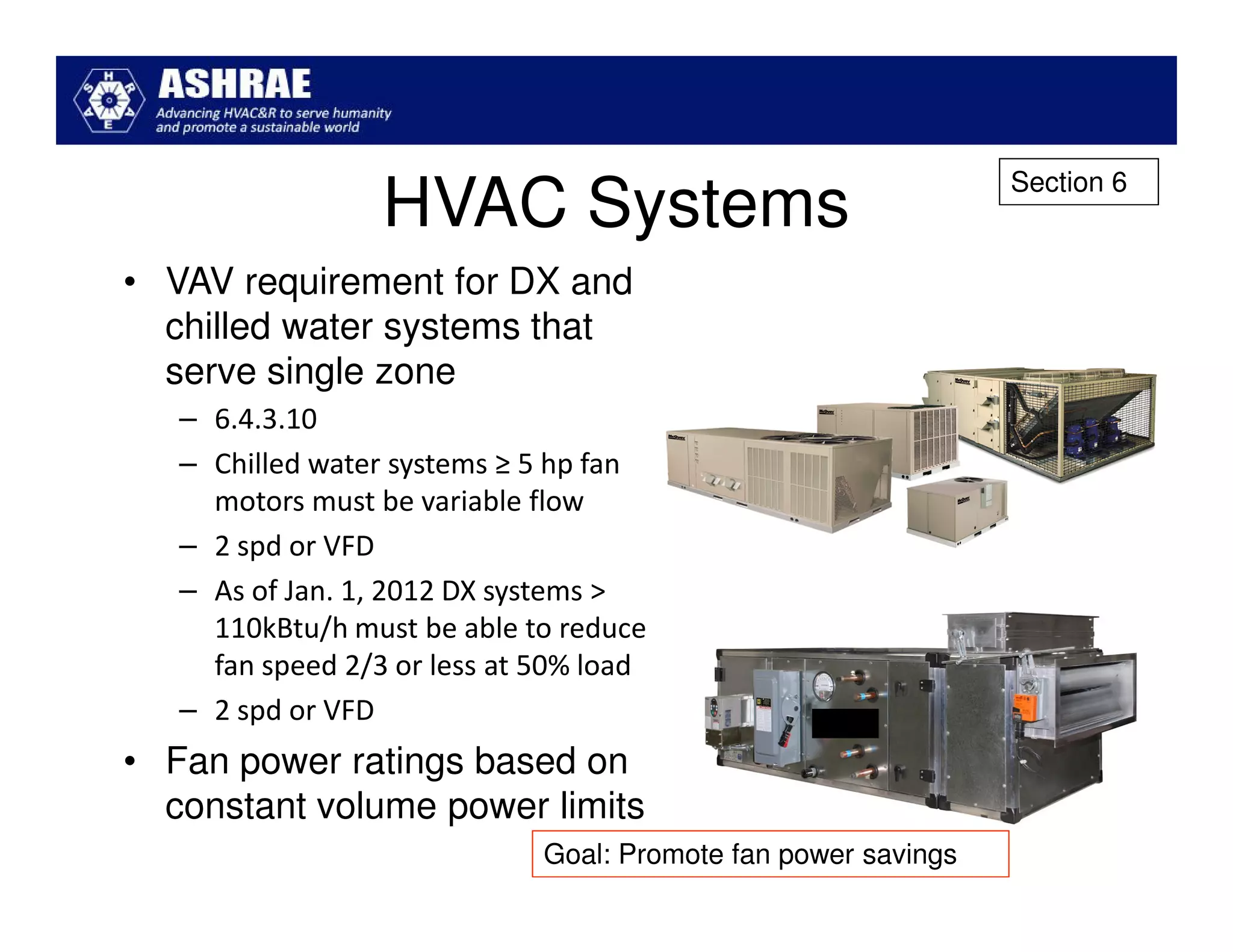
• VAV requirement for DX and
  chilled water systems that
  serve single zone
   – 6.4.3.10
   – Chilled water systems ≥ 5 hp fan
     motors must be variable flow
   – 2 spd or VFD
   – As of Jan. 1, 2012 DX systems >
     110kBtu/h must be able to reduce
     fan speed 2/3 or less at 50% load
   – 2 spd or VFD
• Fan power ratings based on
  constant volume power limits
                              Goal: Promote fan power savings
Section 6
               HVAC Systems
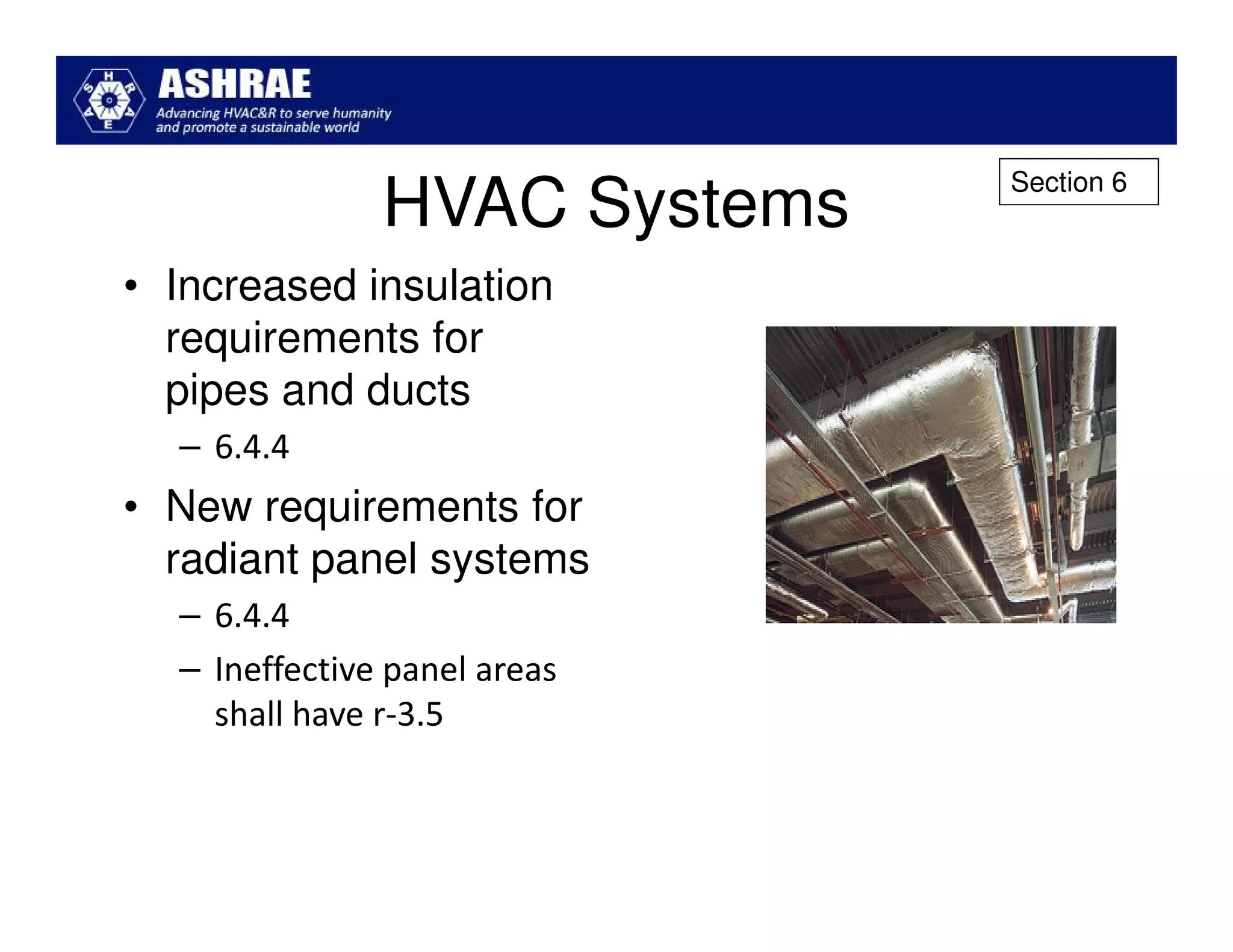
• Increased insulation
  requirements for
  pipes and ducts
  – 6.4.4
• New requirements for
  radiant panel systems
  – 6.4.4
  – Ineffective panel areas
    shall have r-3.5
Section 6
               HVAC Systems
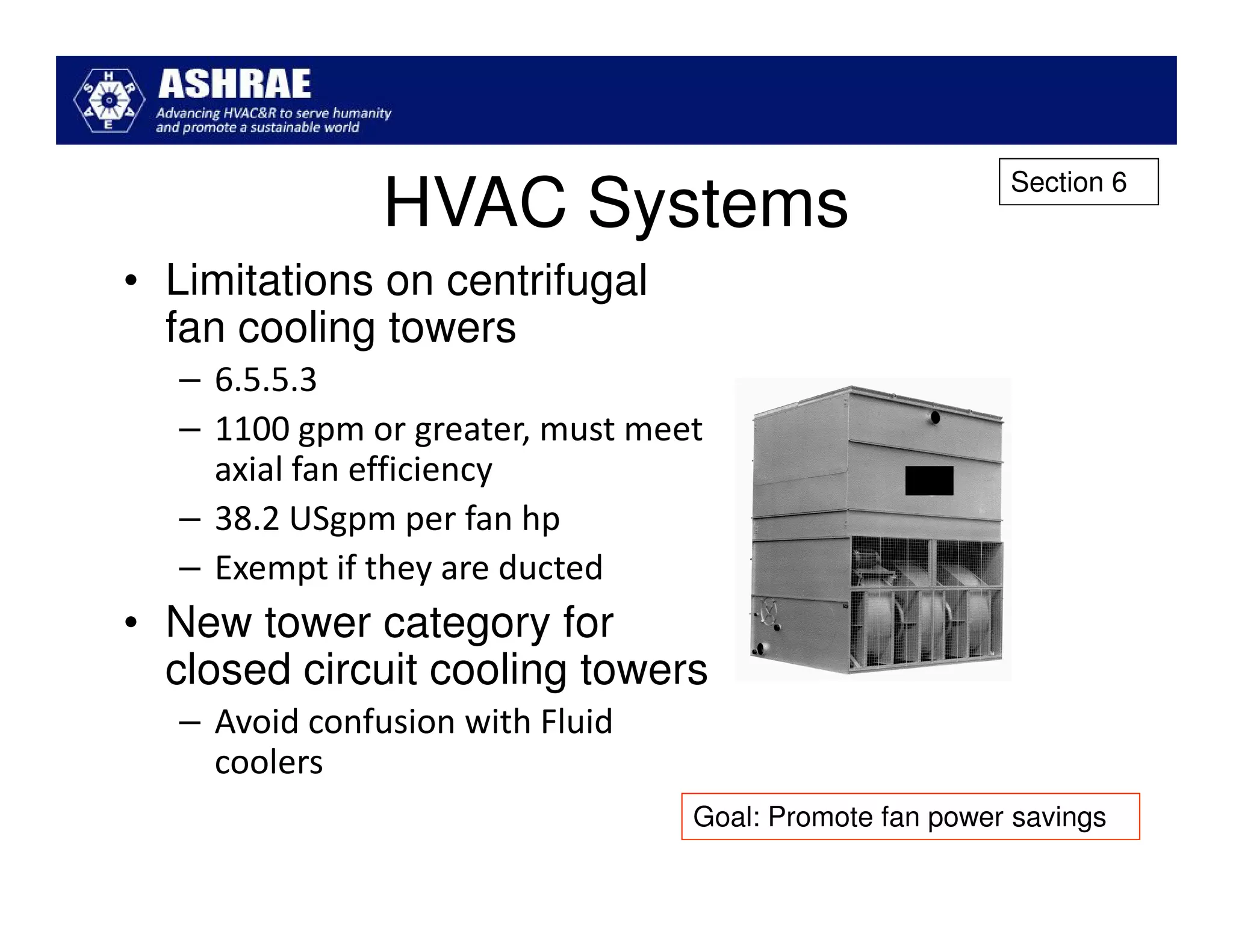
• Limitations on centrifugal
  fan cooling towers
  – 6.5.5.3
  – 1100 gpm or greater, must meet
    axial fan efficiency
  – 38.2 USgpm per fan hp
  – Exempt if they are ducted
• New tower category for
  closed circuit cooling towers
  – Avoid confusion with Fluid
    coolers
                                 Goal: Promote fan power savings
Section 6
                HVAC Systems
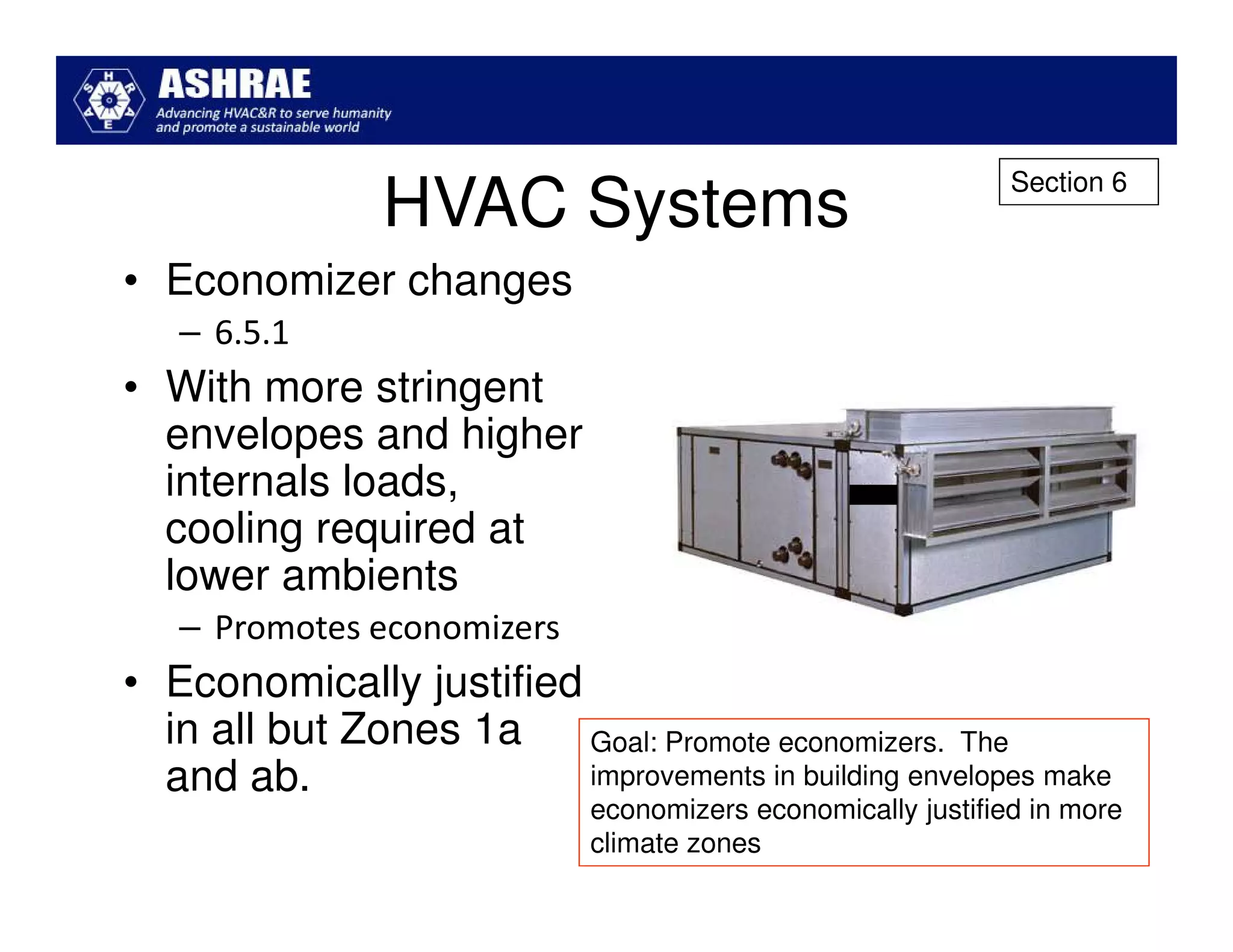
• Economizer changes
   – 6.5.1
• With more stringent
  envelopes and higher
  internals loads,
  cooling required at
  lower ambients
   – Promotes economizers
• Economically justified
  in all but Zones 1a    Goal: Promote economizers. The
  and ab.                improvements in building envelopes make
                              economizers economically justified in more
                              climate zones
Section 6
               HVAC Systems
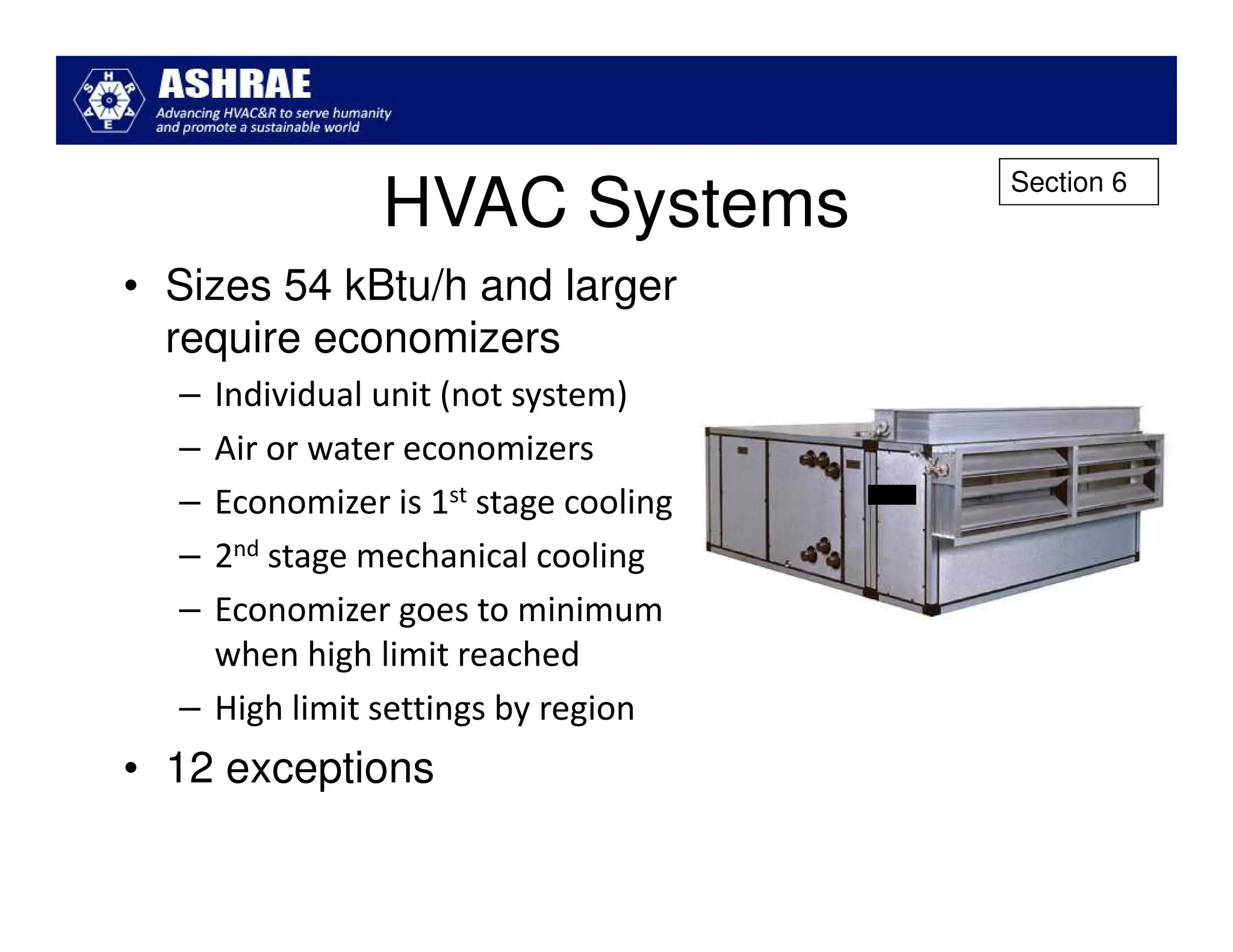
• Sizes 54 kBtu/h and larger
  require economizers
  – Individual unit (not system)
  – Air or water economizers
  – Economizer is 1st stage cooling
  – 2nd stage mechanical cooling
  – Economizer goes to minimum
    when high limit reached
  – High limit settings by region
• 12 exceptions
Section 6
              HVAC Systems
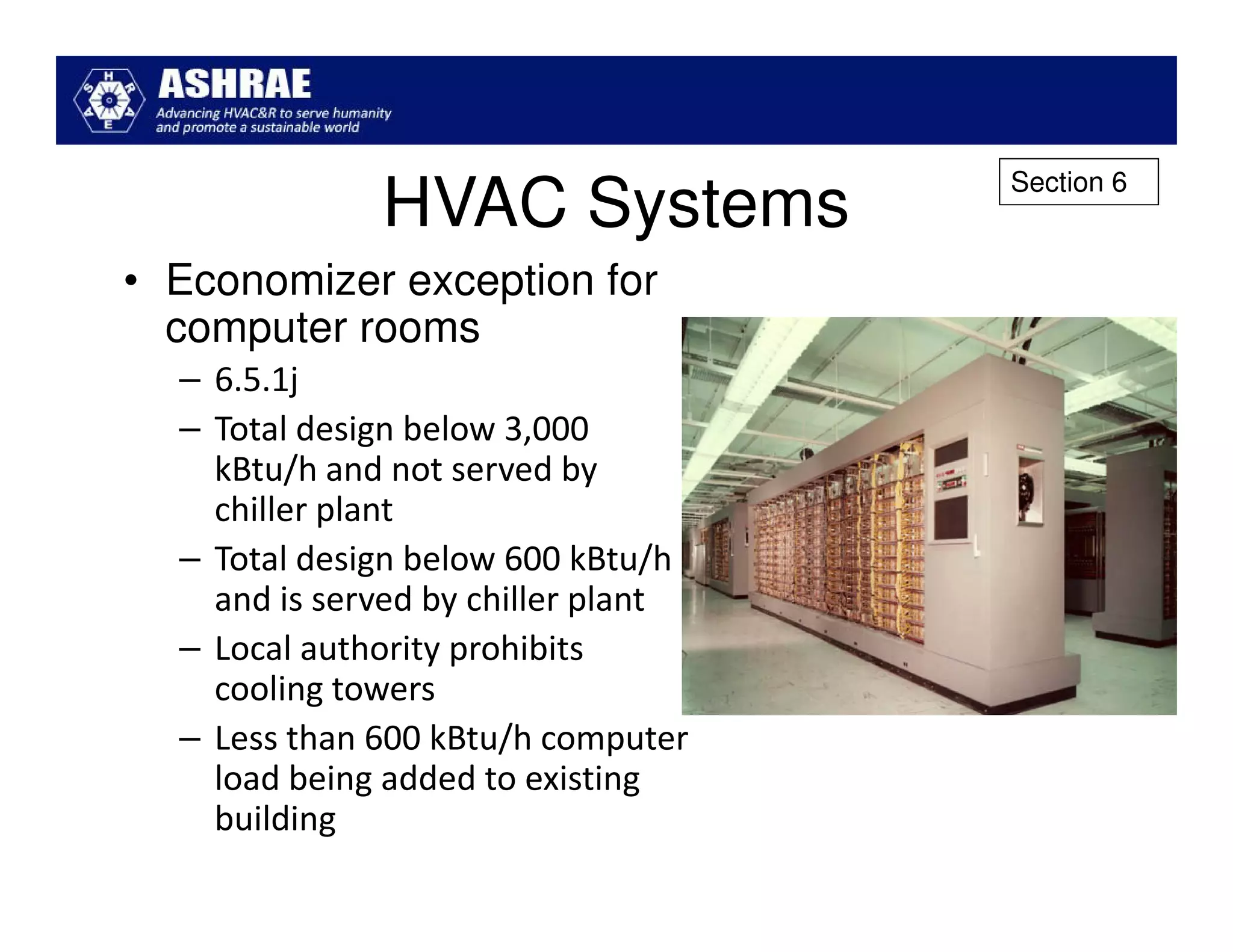
• Economizer exception for
  computer rooms
  – 6.5.1j
  – Total design below 3,000
    kBtu/h and not served by
    chiller plant
  – Total design below 600 kBtu/h
    and is served by chiller plant
  – Local authority prohibits
    cooling towers
  – Less than 600 kBtu/h computer
    load being added to existing
    building
Section 6
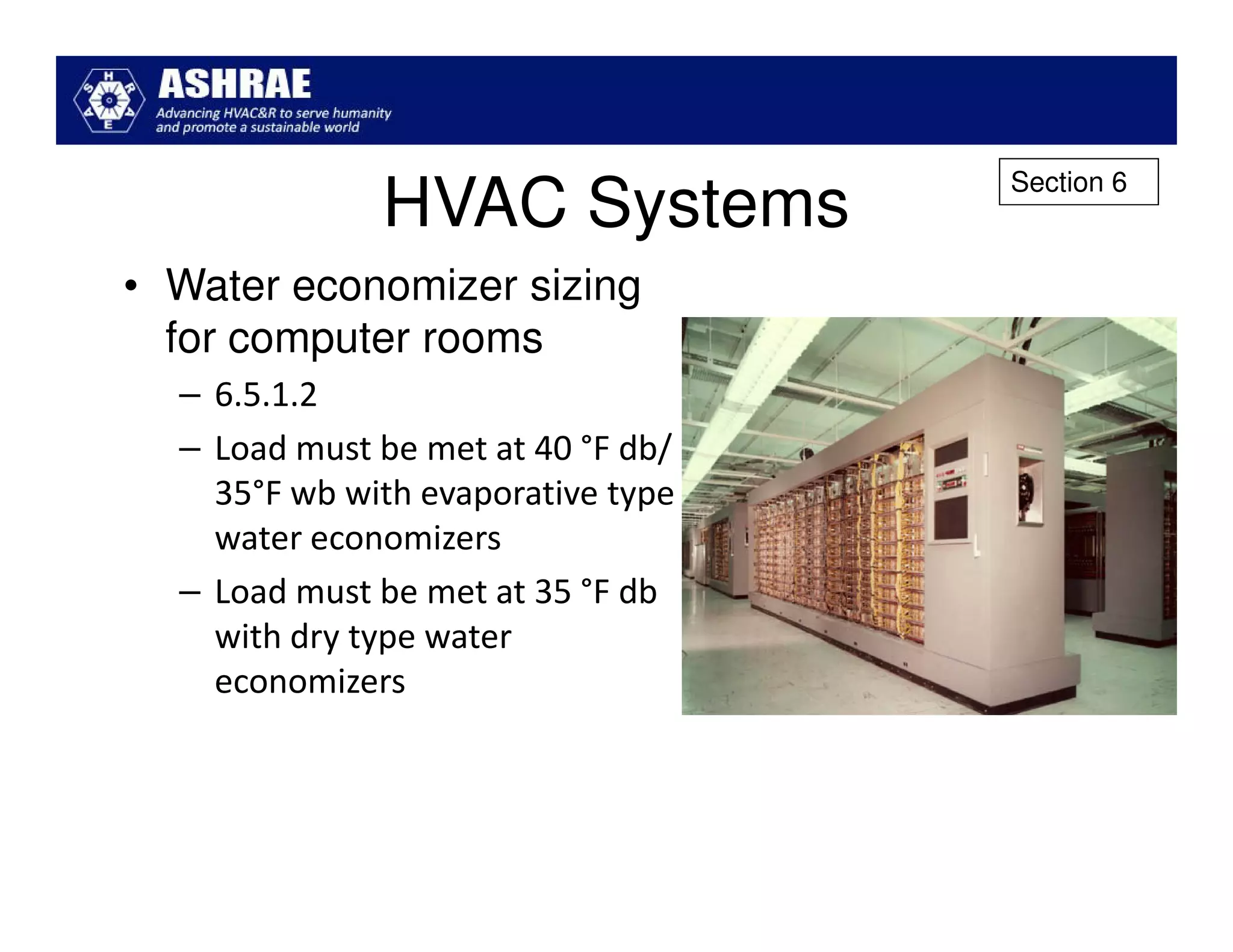
              HVAC Systems
• Water economizer sizing
  for computer rooms
  – 6.5.1.2
  – Load must be met at 40 °F db/
    35°F wb with evaporative type
    water economizers
  – Load must be met at 35 °F db
    with dry type water
    economizers
Section 6
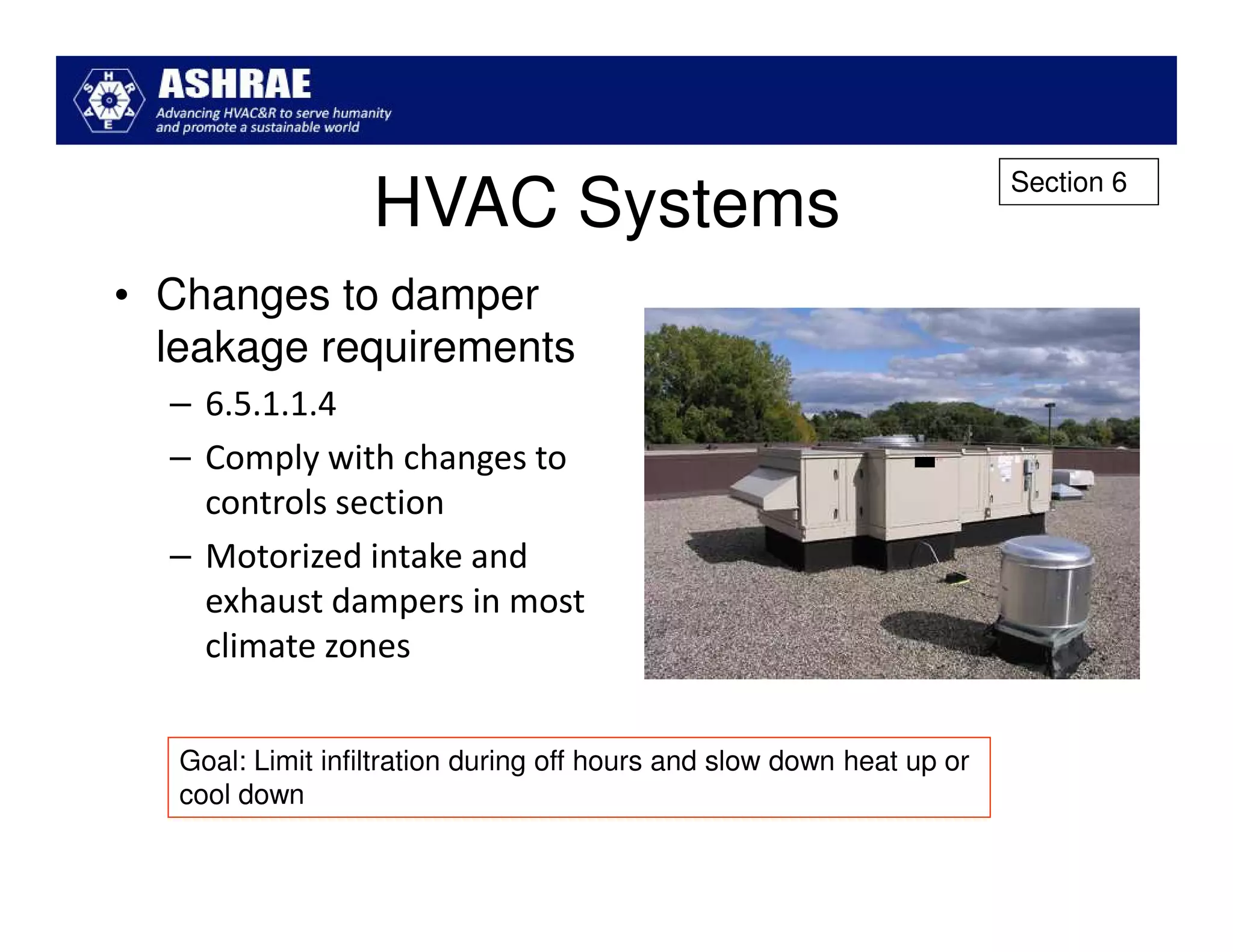
                   HVAC Systems
• Changes to damper
  leakage requirements
  – 6.5.1.1.4
  – Comply with changes to
    controls section
  – Motorized intake and
    exhaust dampers in most
    climate zones


   Goal: Limit infiltration during off hours and slow down heat up or
   cool down
Section 6
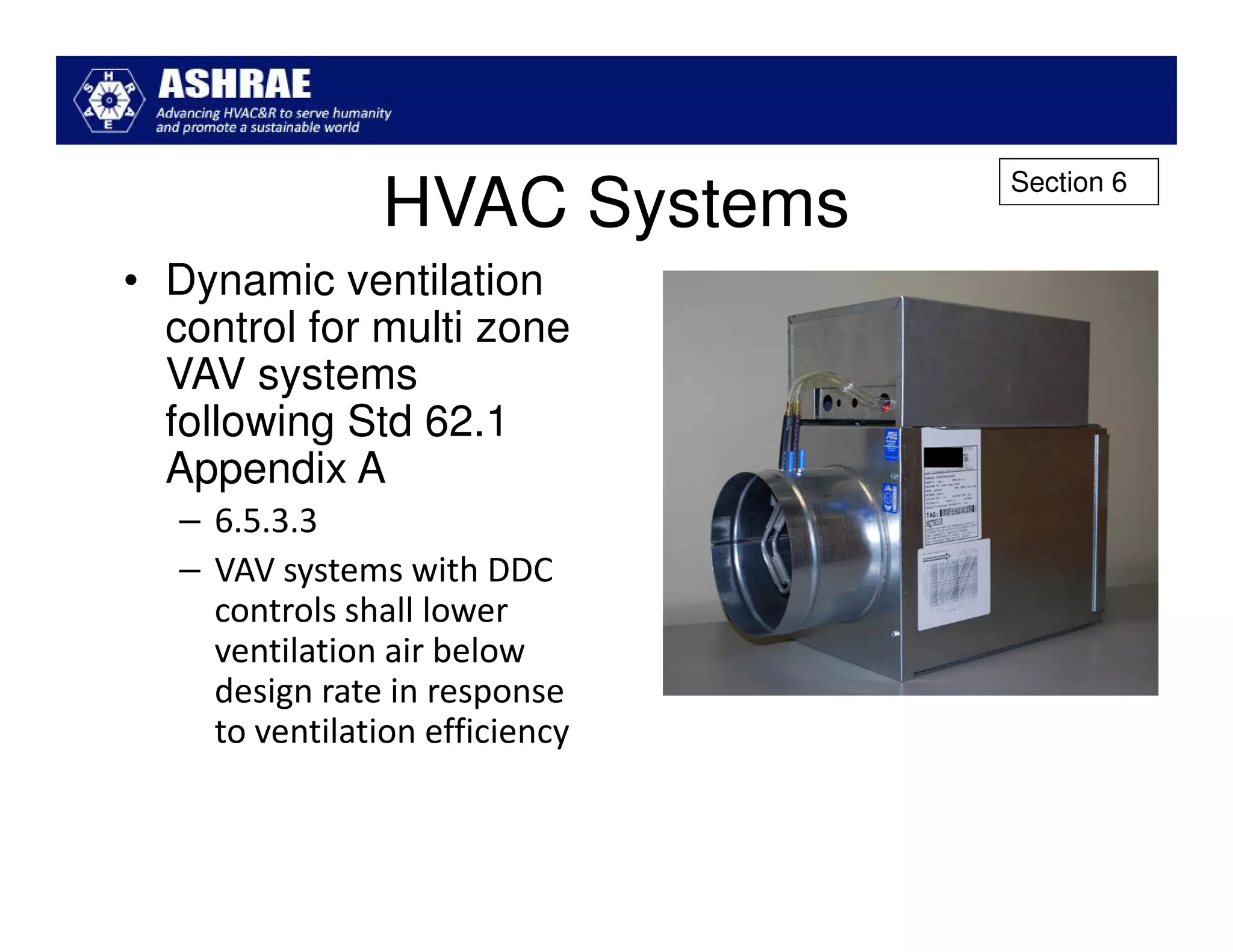
                 HVAC Systems
• Dynamic ventilation
  control for multi zone
  VAV systems
  following Std 62.1
  Appendix A
   – 6.5.3.3
   – VAV systems with DDC
     controls shall lower
     ventilation air below
     design rate in response
     to ventilation efficiency
Section 6
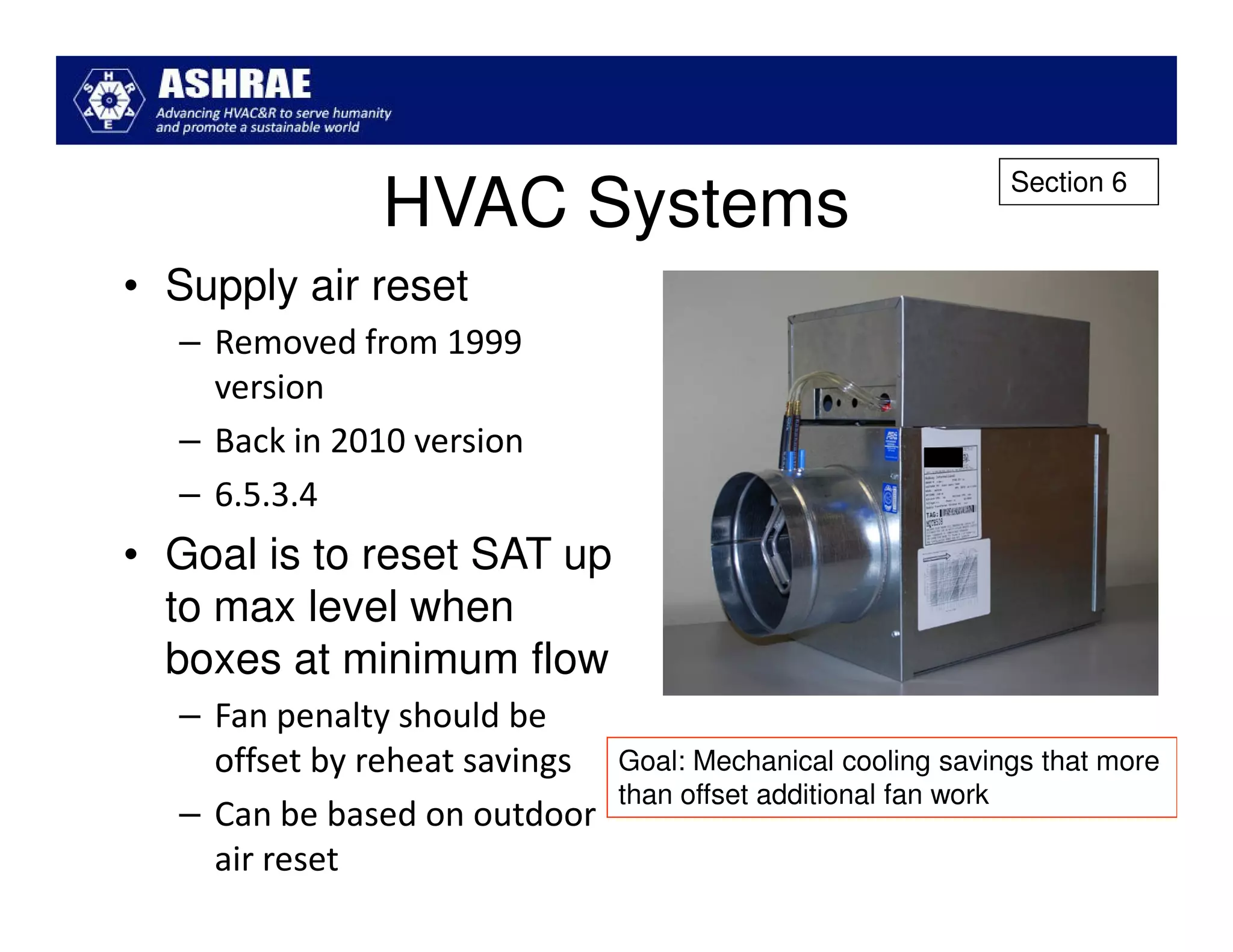
              HVAC Systems
• Supply air reset
  – Removed from 1999
    version
  – Back in 2010 version
  – 6.5.3.4
• Goal is to reset SAT up
  to max level when
  boxes at minimum flow
  – Fan penalty should be
    offset by reheat savings   Goal: Mechanical cooling savings that more
                               than offset additional fan work
  – Can be based on outdoor
    air reset
Section 6
              HVAC Systems
• SAT Reset exceptions
  – Climate zones 1a, 2a,3a
  – Systems that prevent
    reheating, re-cooling or
    mixing
  – Systems where 75% of
    reheat comes from recovery
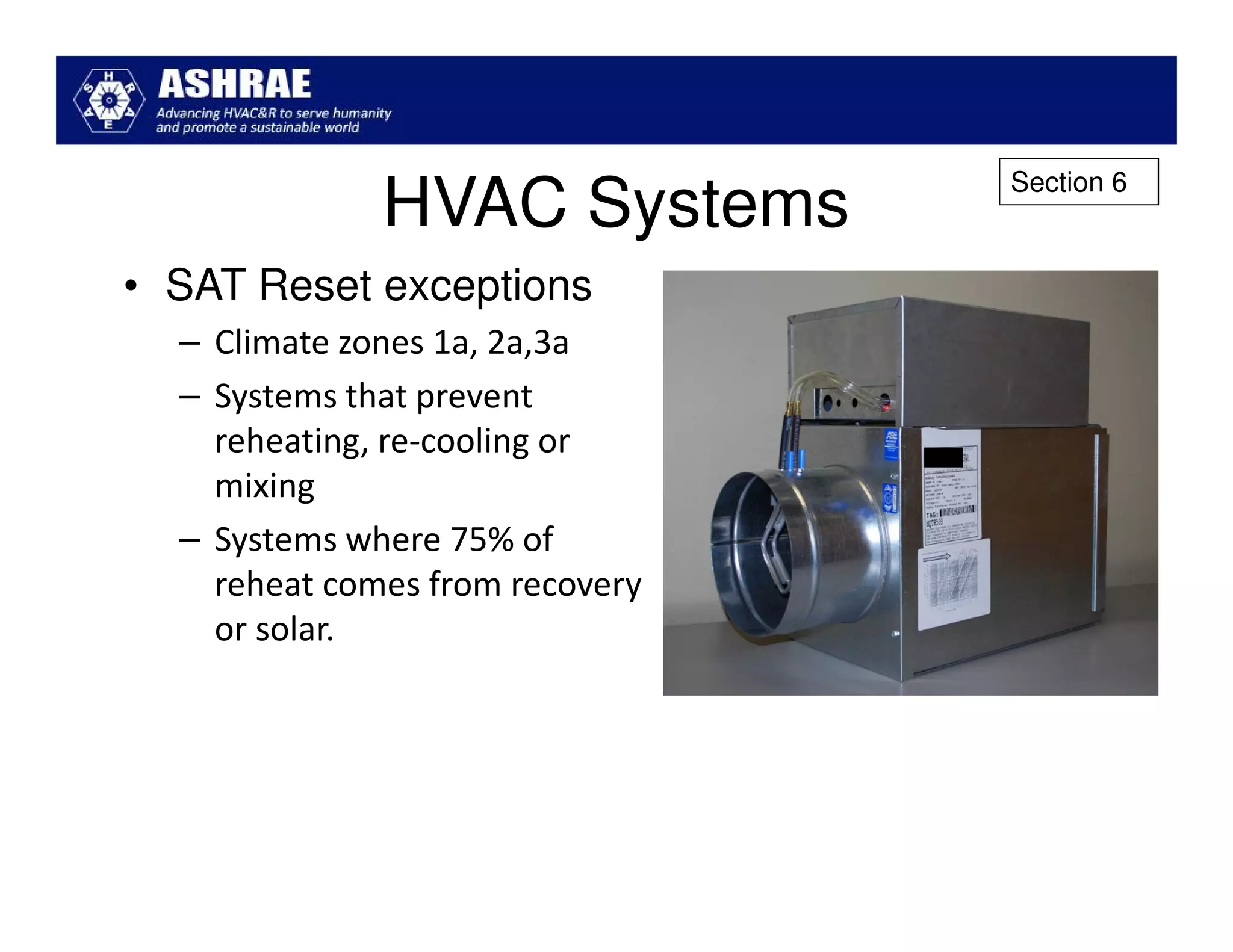
    or solar.
Section 6
               HVAC Systems
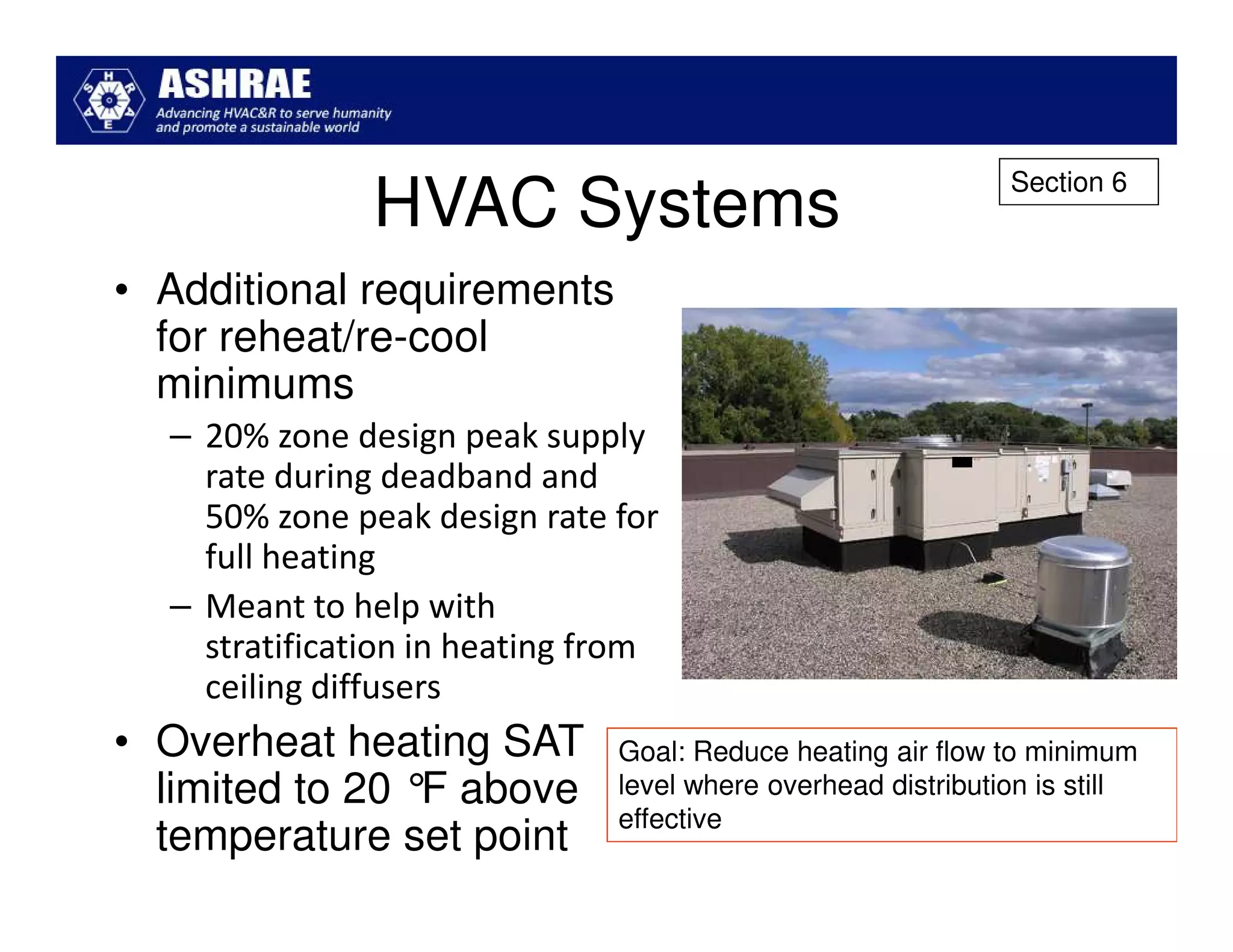
• Additional requirements
  for reheat/re-cool
  minimums
  – 20% zone design peak supply
    rate during deadband and
    50% zone peak design rate for
    full heating
  – Meant to help with
    stratification in heating from
    ceiling diffusers
• Overheat heating SAT         Goal: Reduce heating air flow to minimum
  limited to 20 ° above
                 F             level where overhead distribution is still
                               effective
  temperature set point
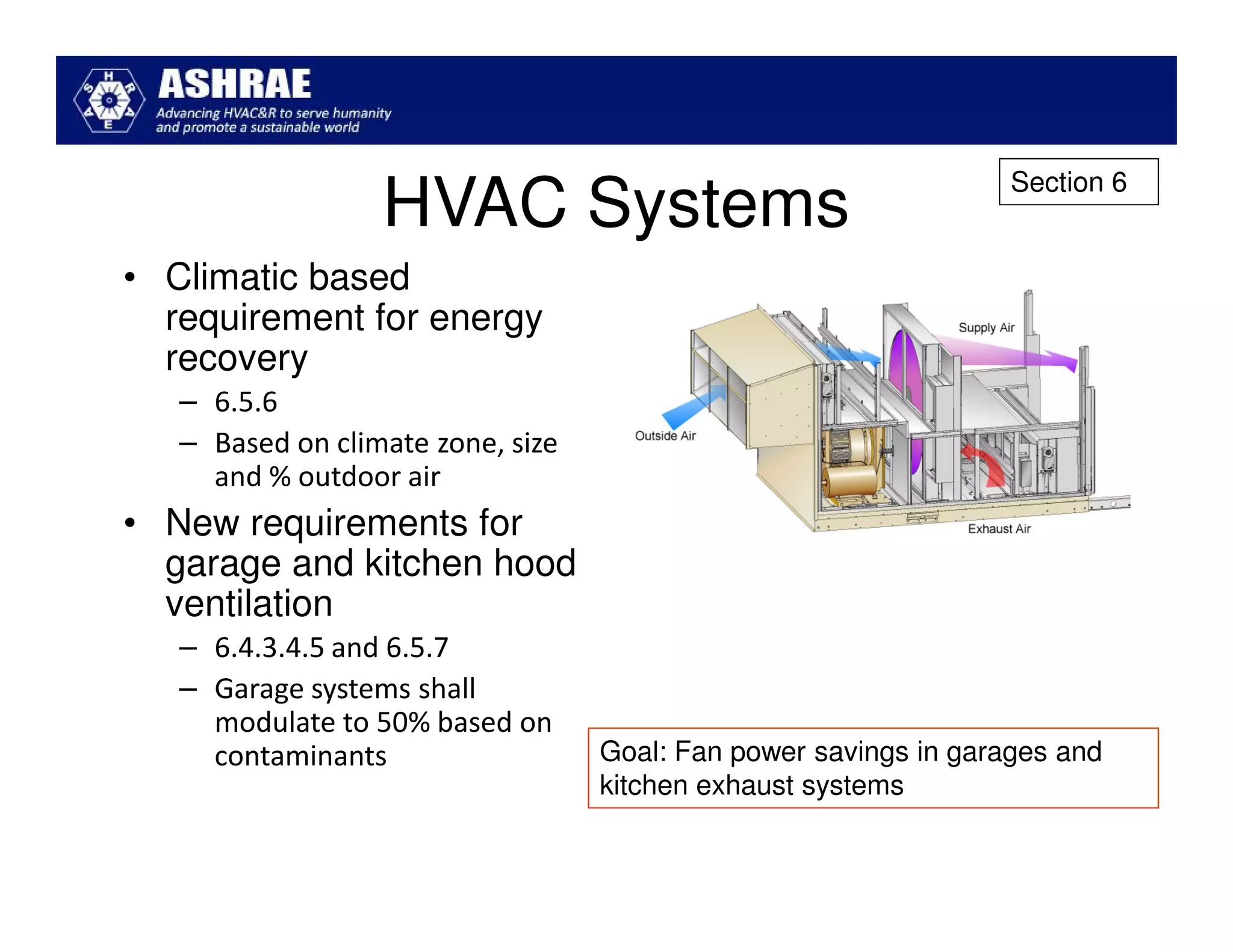
Section 6
                  HVAC Systems
• Climatic based
  requirement for energy
  recovery
   – 6.5.6
   – Based on climate zone, size
     and % outdoor air
• New requirements for
  garage and kitchen hood
  ventilation
   – 6.4.3.4.5 and 6.5.7
   – Garage systems shall
     modulate to 50% based on
     contaminants                  Goal: Fan power savings in garages and
                                   kitchen exhaust systems
Section 6
              HVAC Systems
• New requirements for
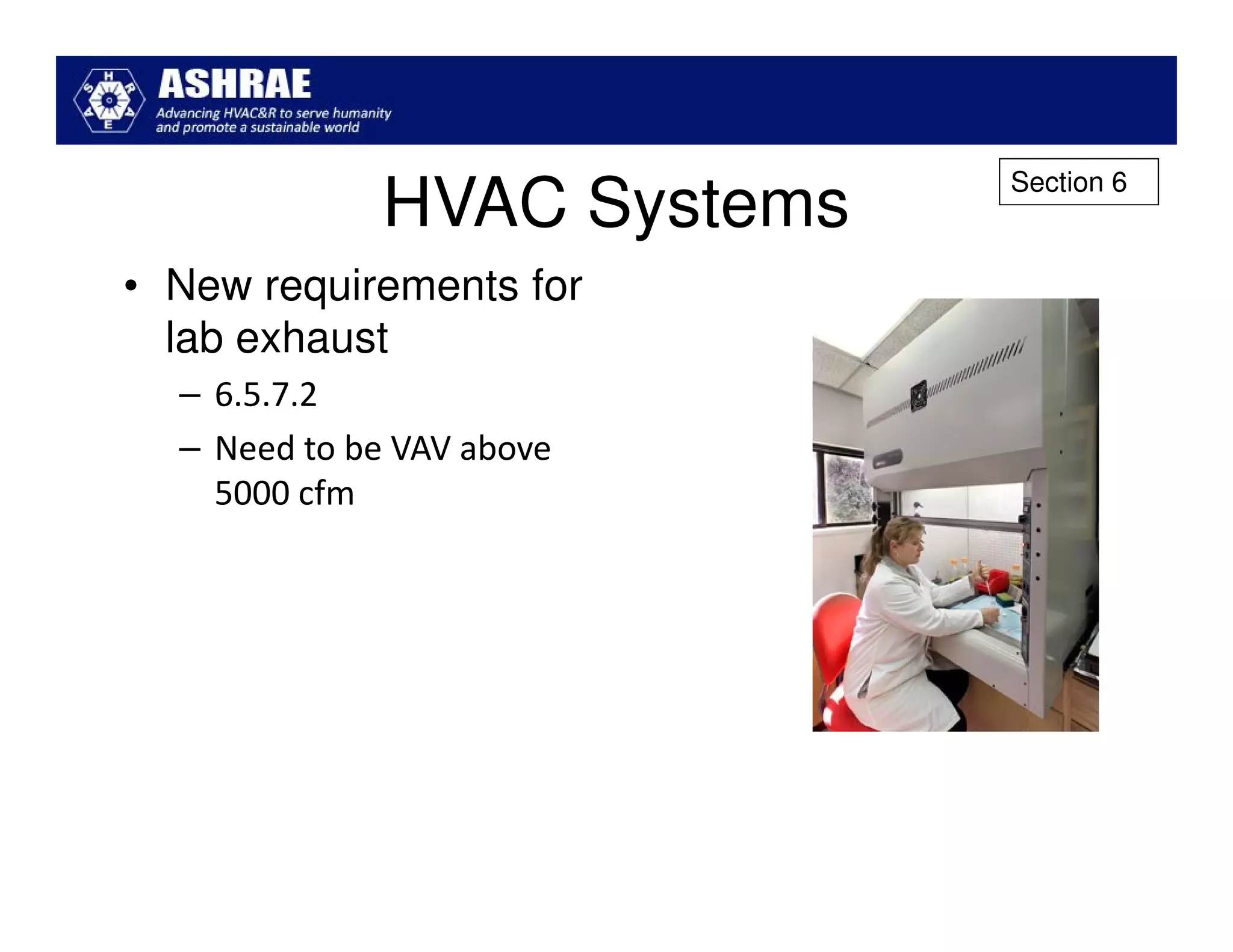
  lab exhaust
  – 6.5.7.2
  – Need to be VAV above
    5000 cfm
Section 7
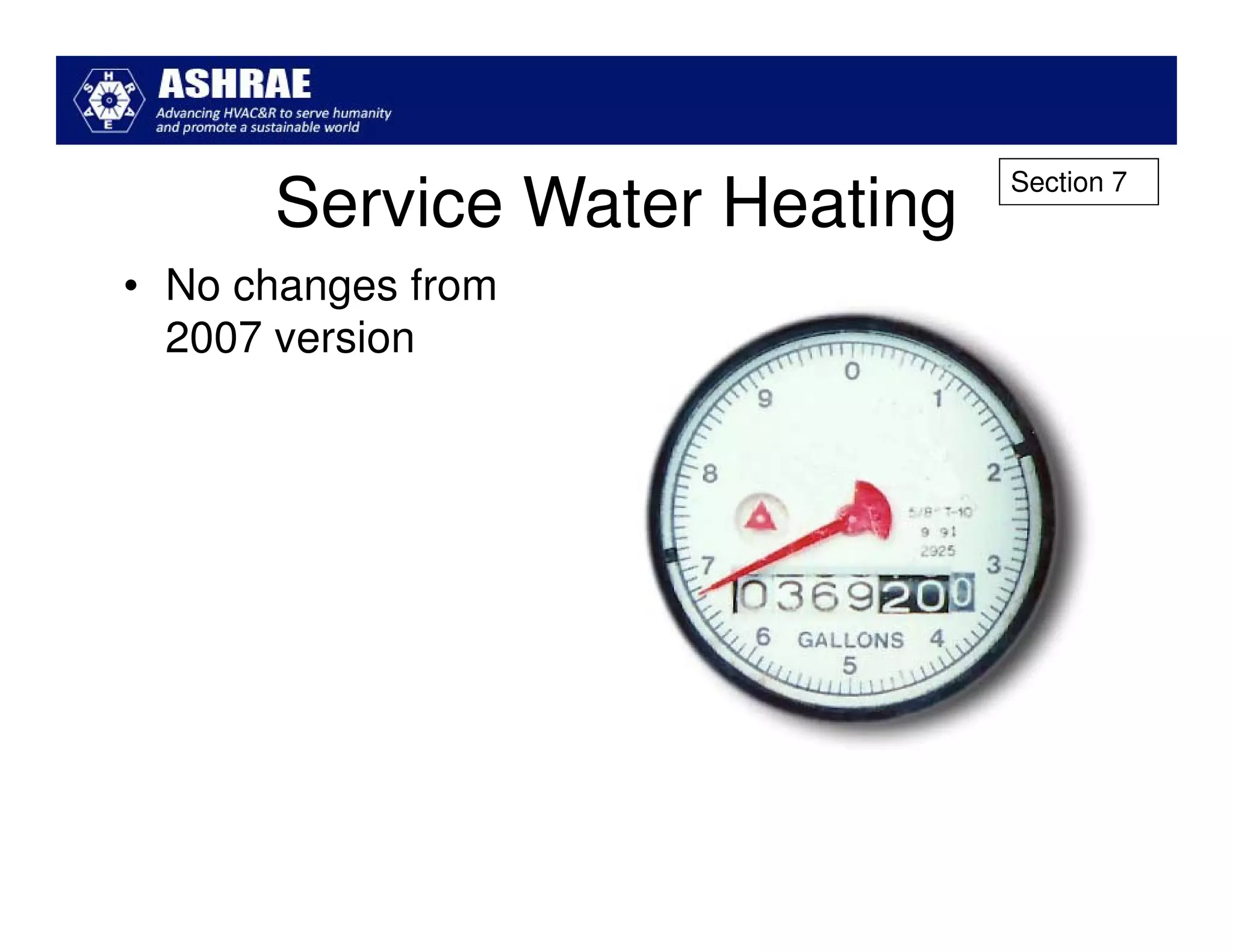
      Service Water Heating
• No changes from
  2007 version
Section 8
                       Power
• Half of all convenience
  power outlets shall be
  controlled such that power
  is turned off when space is
  not occupied
  – 8.4.2
• Efficiency requirements
  added for dry type
  transformers
  – 8.1.2
  – Reflect 2005 Federal
    requirements           Goal: Std 90.1 in line with Federal codes
Section 9
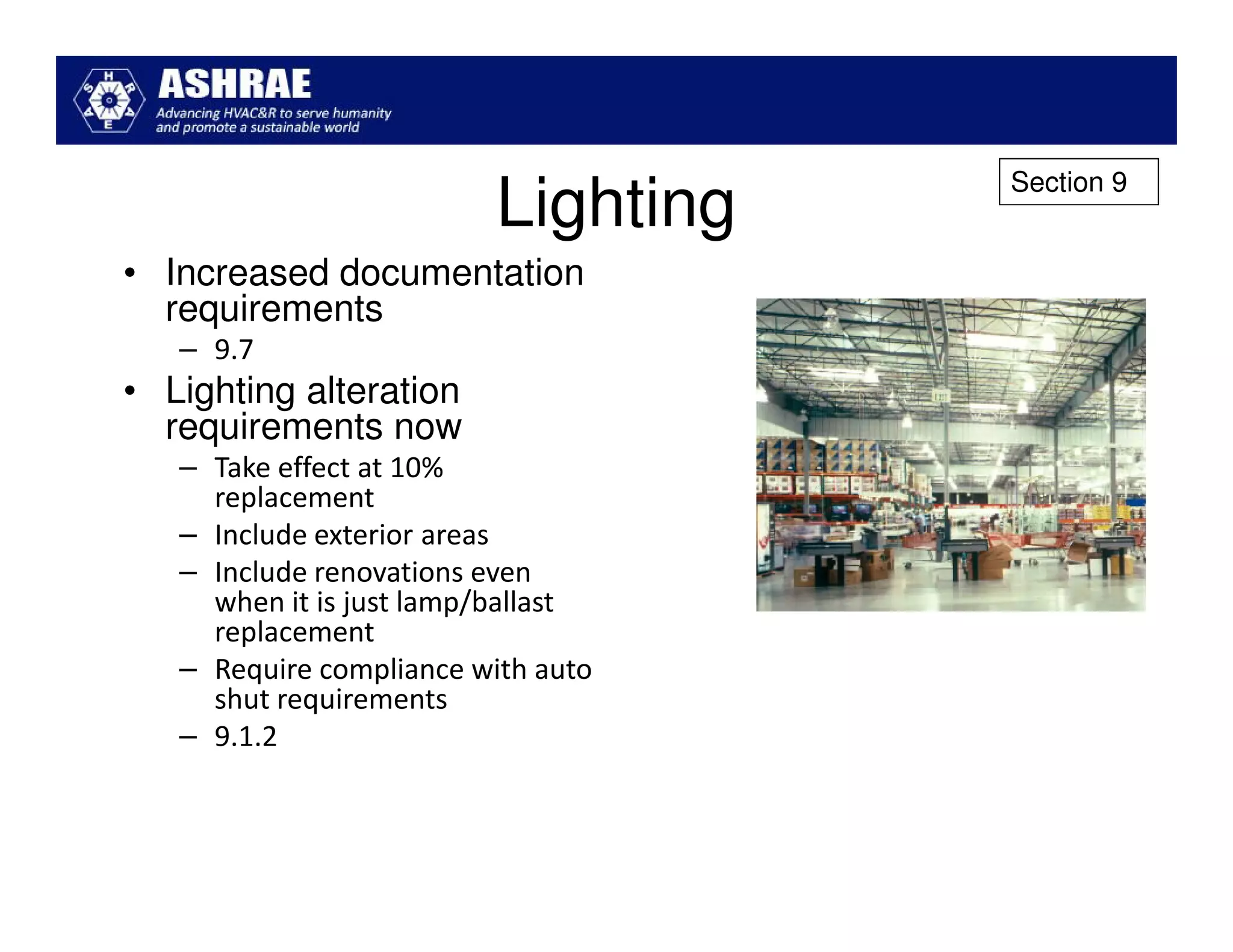
                          Lighting
• Increased documentation
  requirements
   – 9.7
• Lighting alteration
  requirements now
   – Take effect at 10%
     replacement
   – Include exterior areas
   – Include renovations even
     when it is just lamp/ballast
     replacement
   – Require compliance with auto
     shut requirements
   – 9.1.2
Section 9
                              Lighting
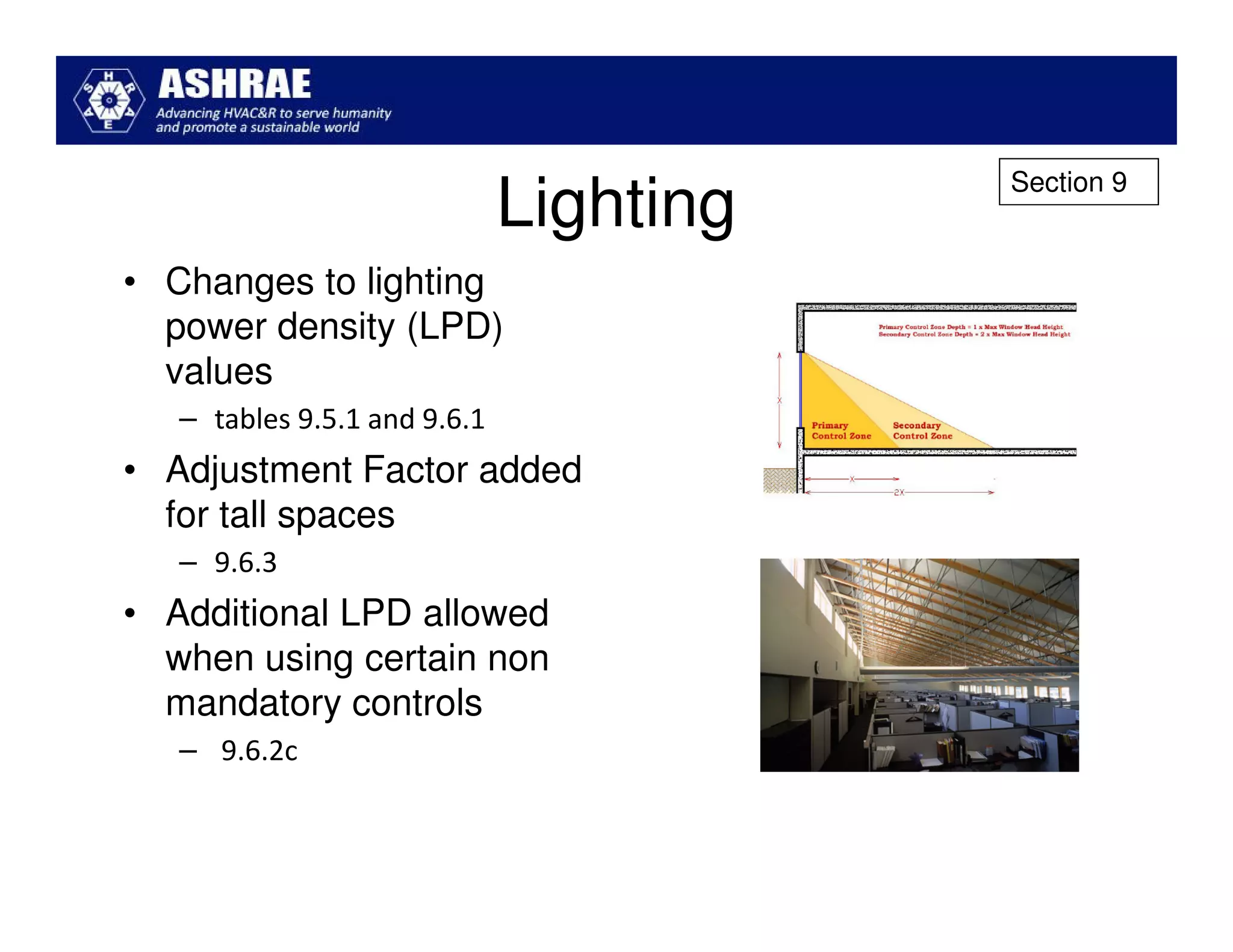
• Changes to lighting
  power density (LPD)
  values
   – tables 9.5.1 and 9.6.1
• Adjustment Factor added
  for tall spaces
   – 9.6.3
• Additional LPD allowed
  when using certain non
  mandatory controls
   – 9.6.2c
Section 9
                   Lighting
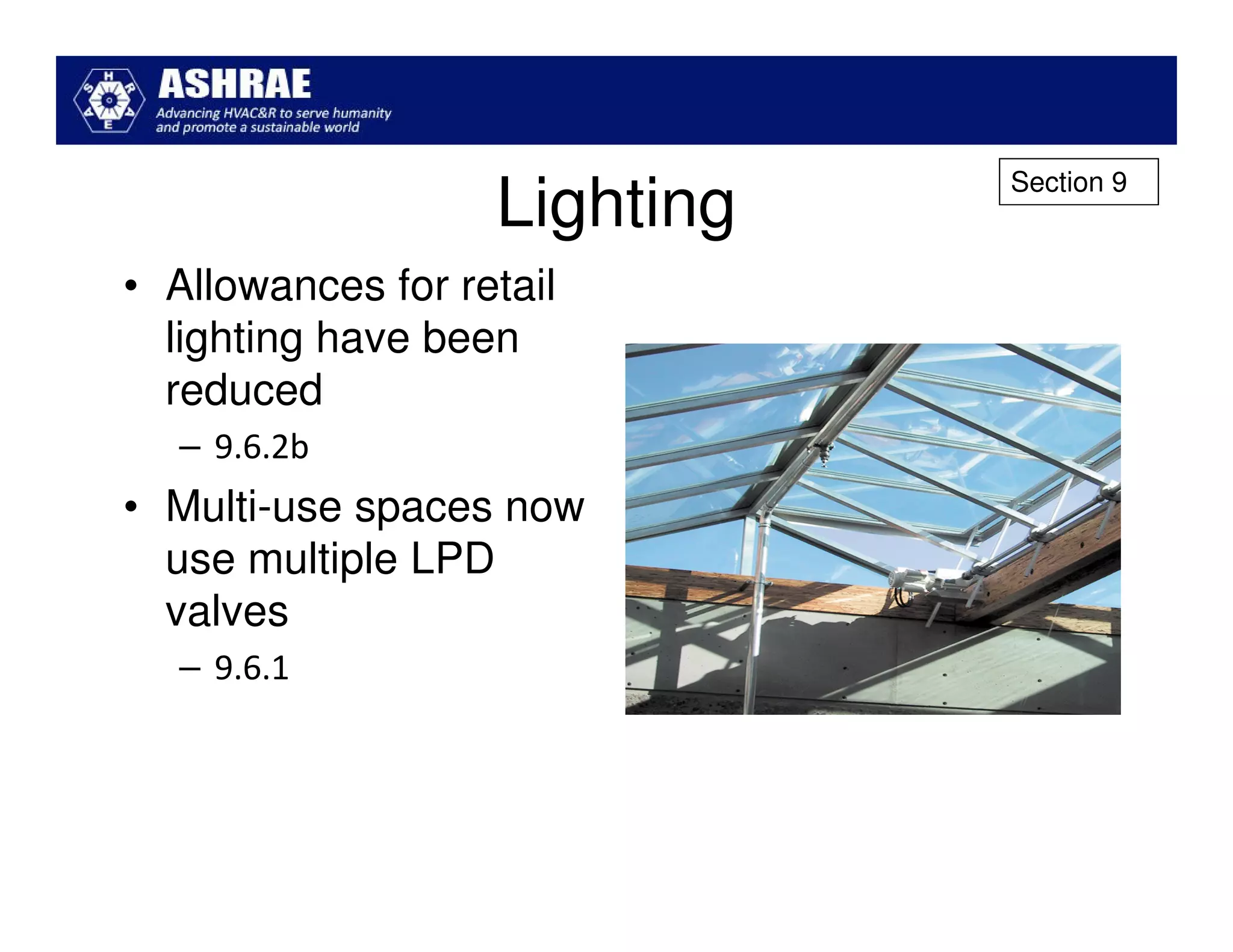
• Allowances for retail
  lighting have been
  reduced
  – 9.6.2b
• Multi-use spaces now
  use multiple LPD
  valves
  – 9.6.1
Section 9
                    Lighting
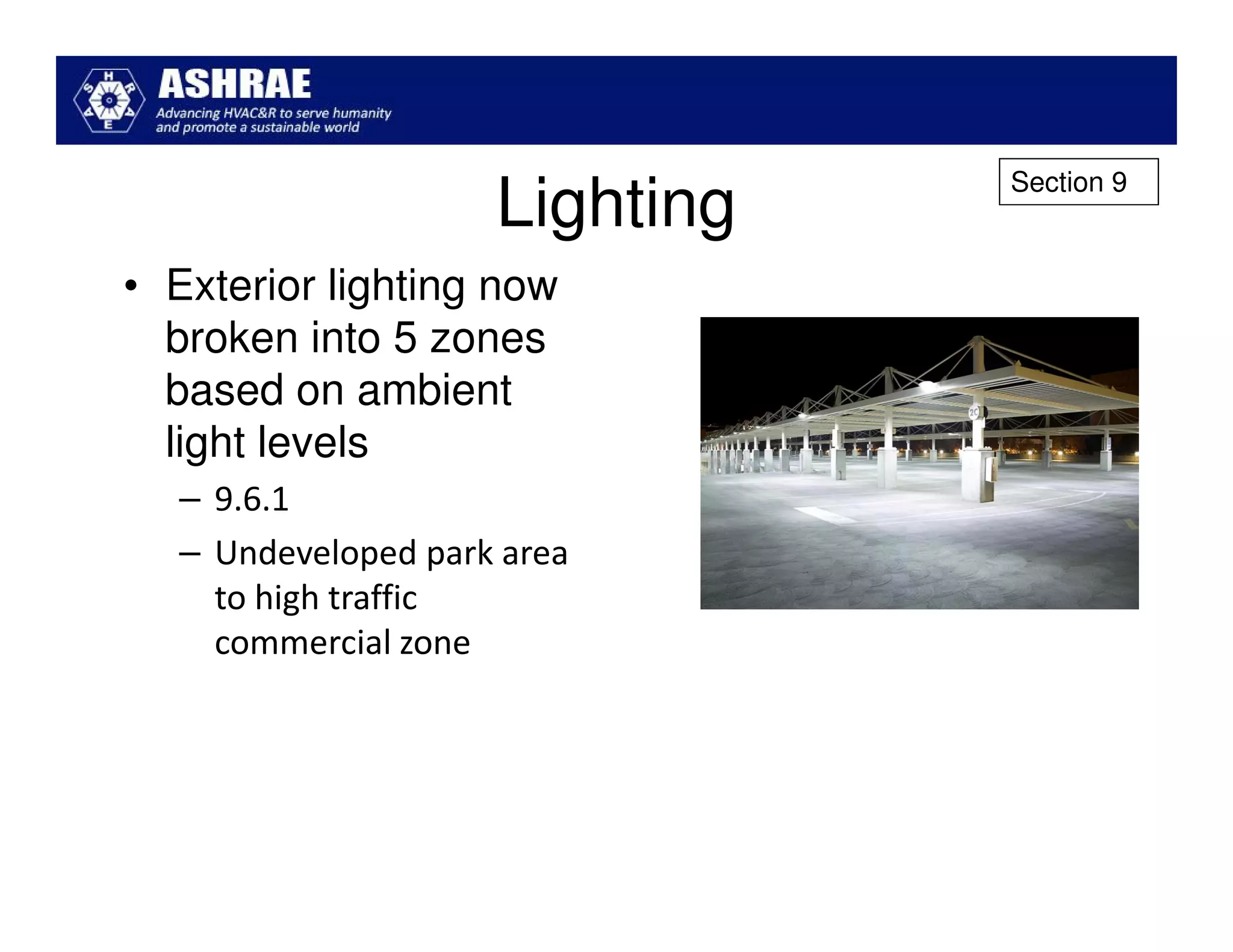
• Exterior lighting now
  broken into 5 zones
  based on ambient
  light levels
  – 9.6.1
  – Undeveloped park area
    to high traffic
    commercial zone
Section 9
                           Lighting
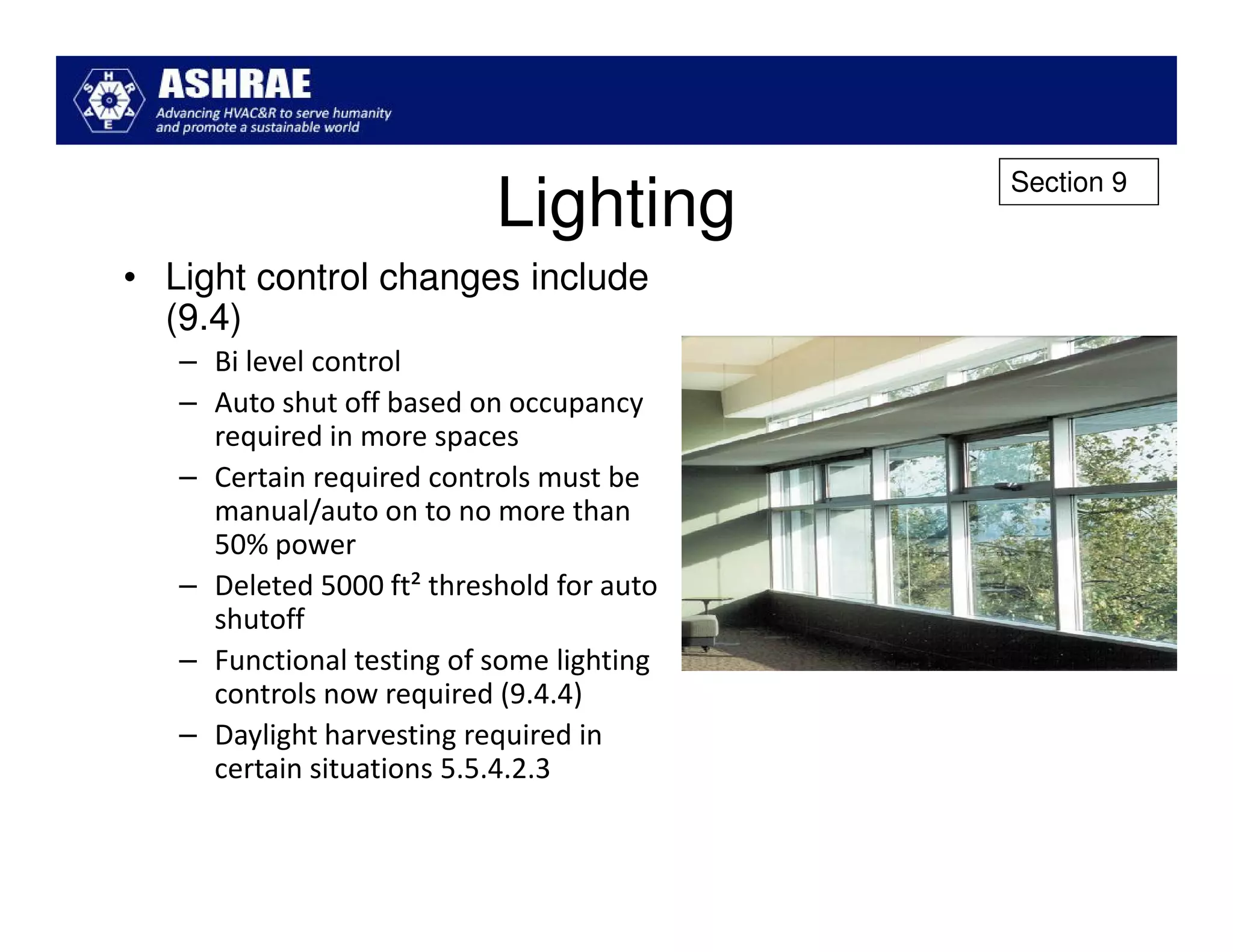
• Light control changes include
  (9.4)
   – Bi level control
   – Auto shut off based on occupancy
     required in more spaces
   – Certain required controls must be
     manual/auto on to no more than
     50% power
   – Deleted 5000 ft² threshold for auto
     shutoff
   – Functional testing of some lighting
     controls now required (9.4.4)
   – Daylight harvesting required in
     certain situations 5.5.4.2.3
Section 10
                 Other Equipment
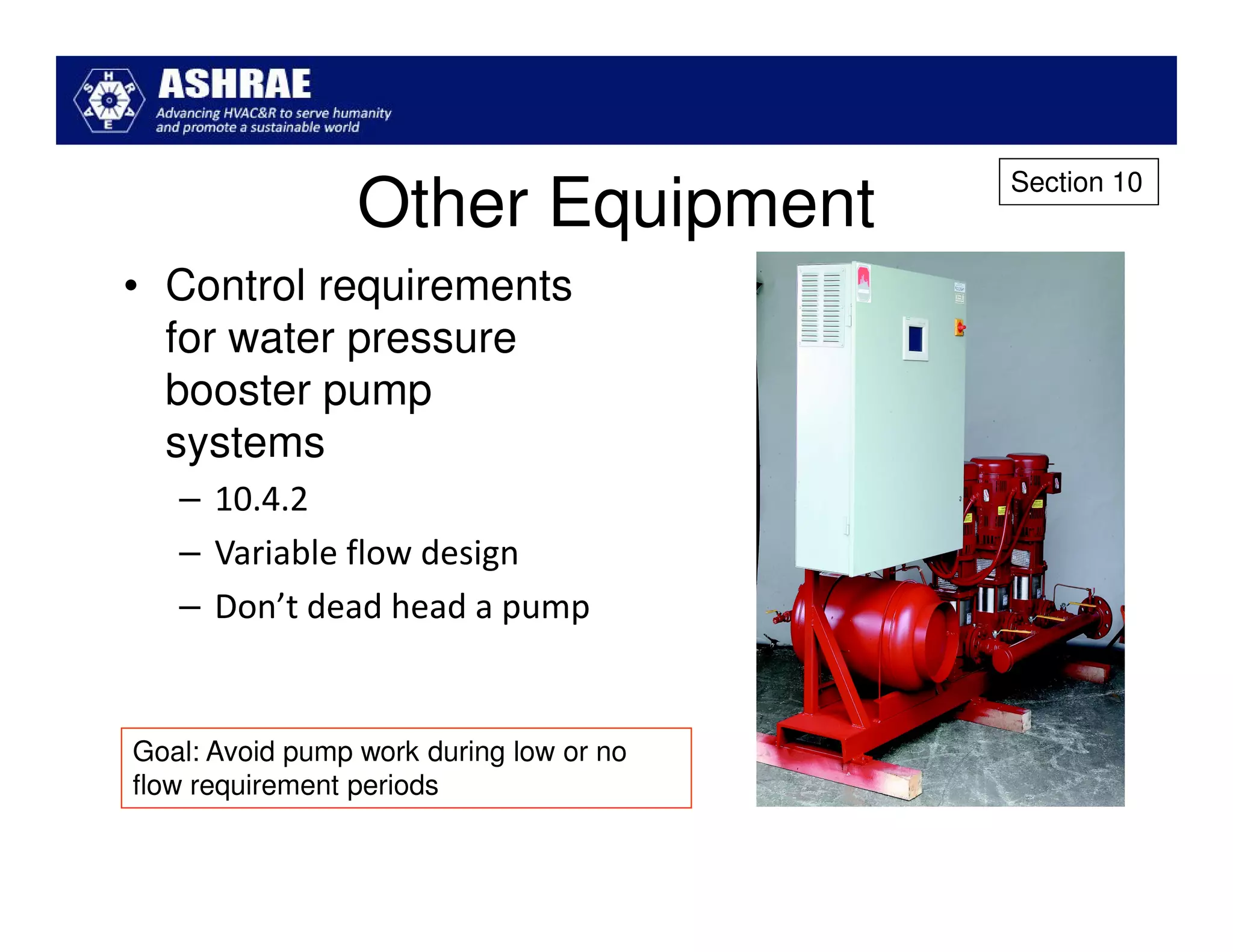
• Control requirements
  for water pressure
  booster pump
  systems
   – 10.4.2
   – Variable flow design
   – Don’t dead head a pump


Goal: Avoid pump work during low or no
flow requirement periods
Section 10
             Other Equipment
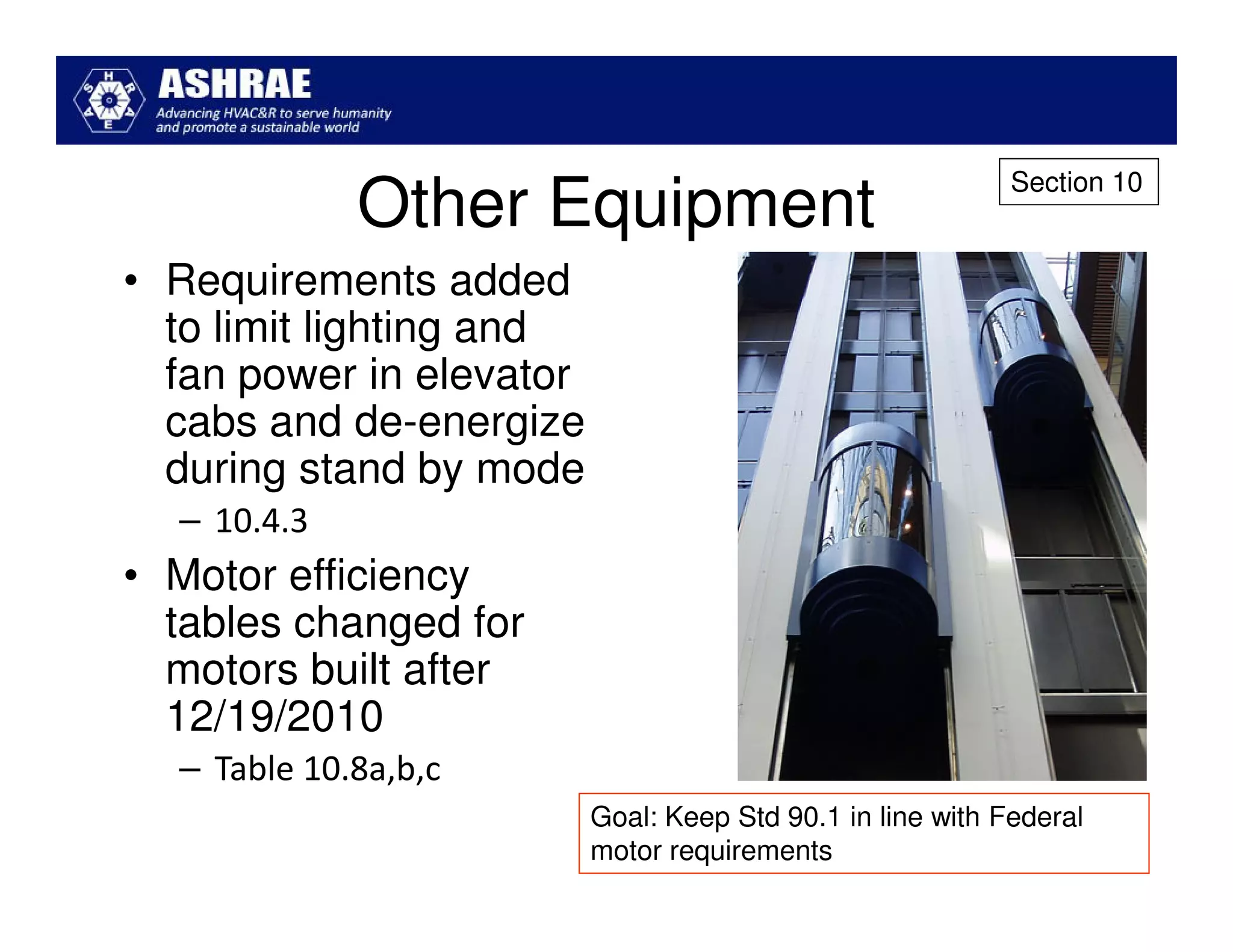
• Requirements added
  to limit lighting and
  fan power in elevator
  cabs and de-energize
  during stand by mode
  – 10.4.3
• Motor efficiency
  tables changed for
  motors built after
  12/19/2010
  – Table 10.8a,b,c
                          Goal: Keep Std 90.1 in line with Federal
                          motor requirements
Section 11
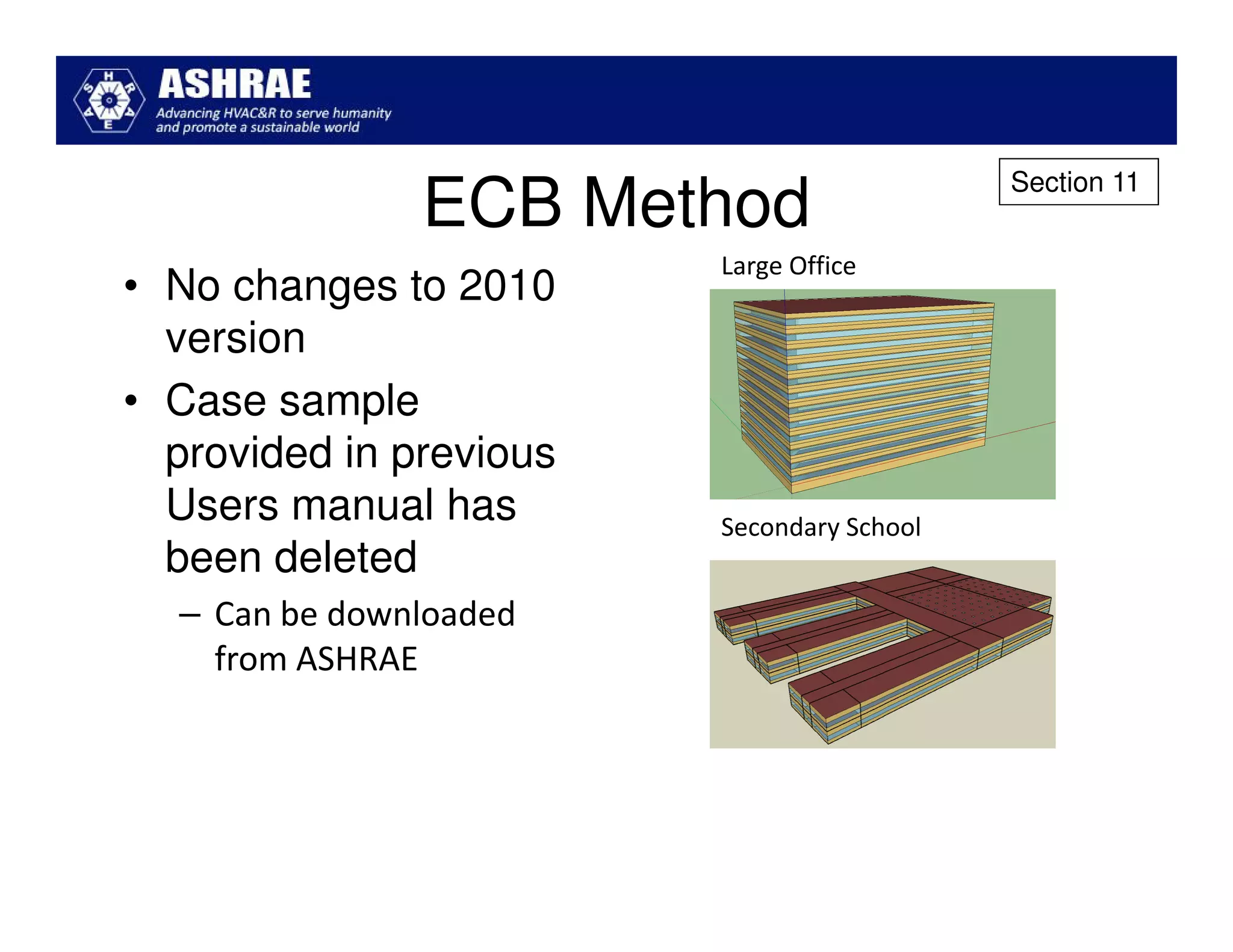
               ECB Method
                         Large Office
• No changes to 2010
  version
• Case sample
  provided in previous
  Users manual has       Secondary School
  been deleted
  – Can be downloaded
    from ASHRAE
Appendix G
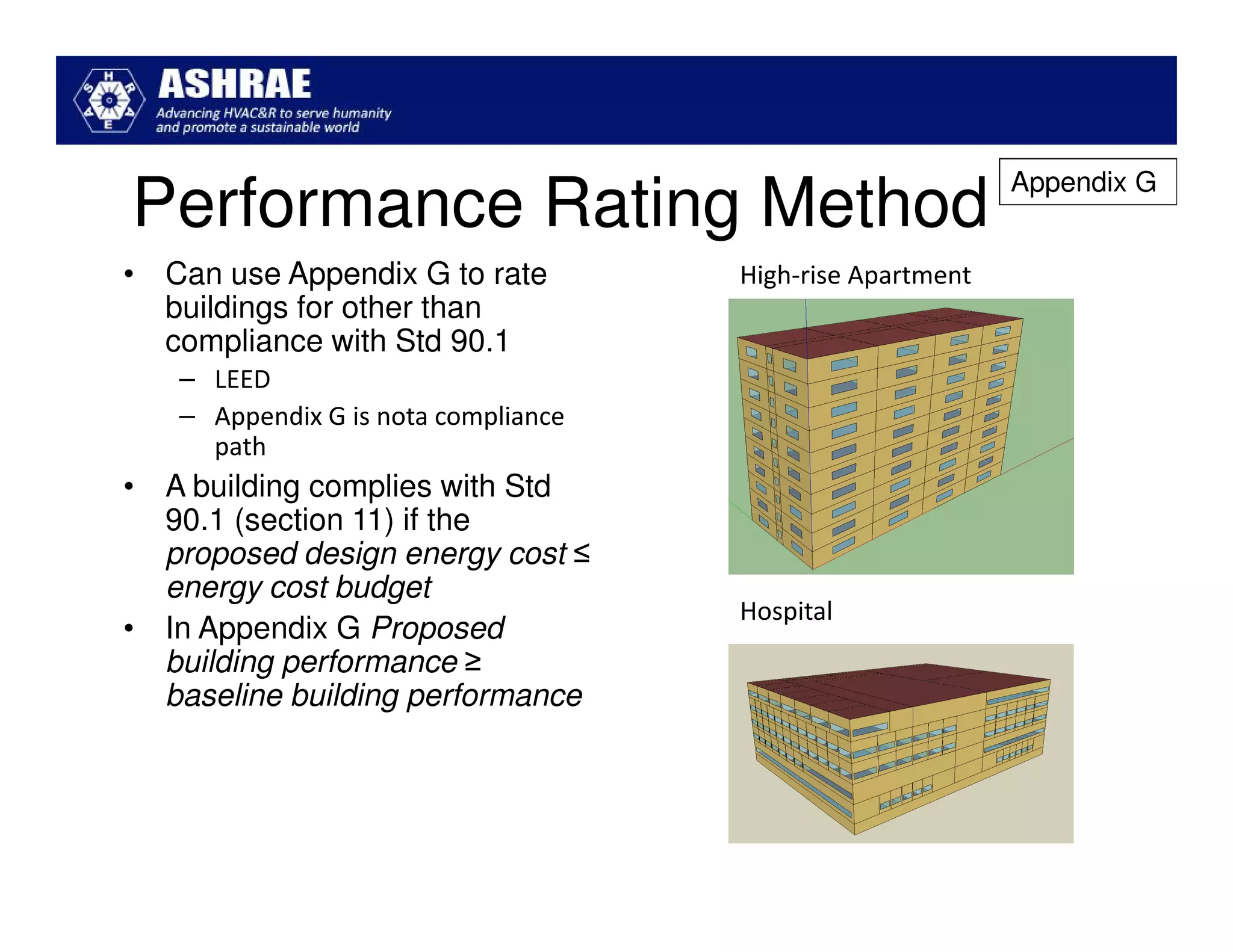
Performance Rating Method
• Can use Appendix G to rate         High-rise Apartment
  buildings for other than
  compliance with Std 90.1
   – LEED
   – Appendix G is nota compliance
     path
• A building complies with Std
  90.1 (section 11) if the
  proposed design energy cost ≤
  energy cost budget
                                     Hospital
• In Appendix G Proposed
  building performance ≥
  baseline building performance
Appendix G
Performance Rating Method
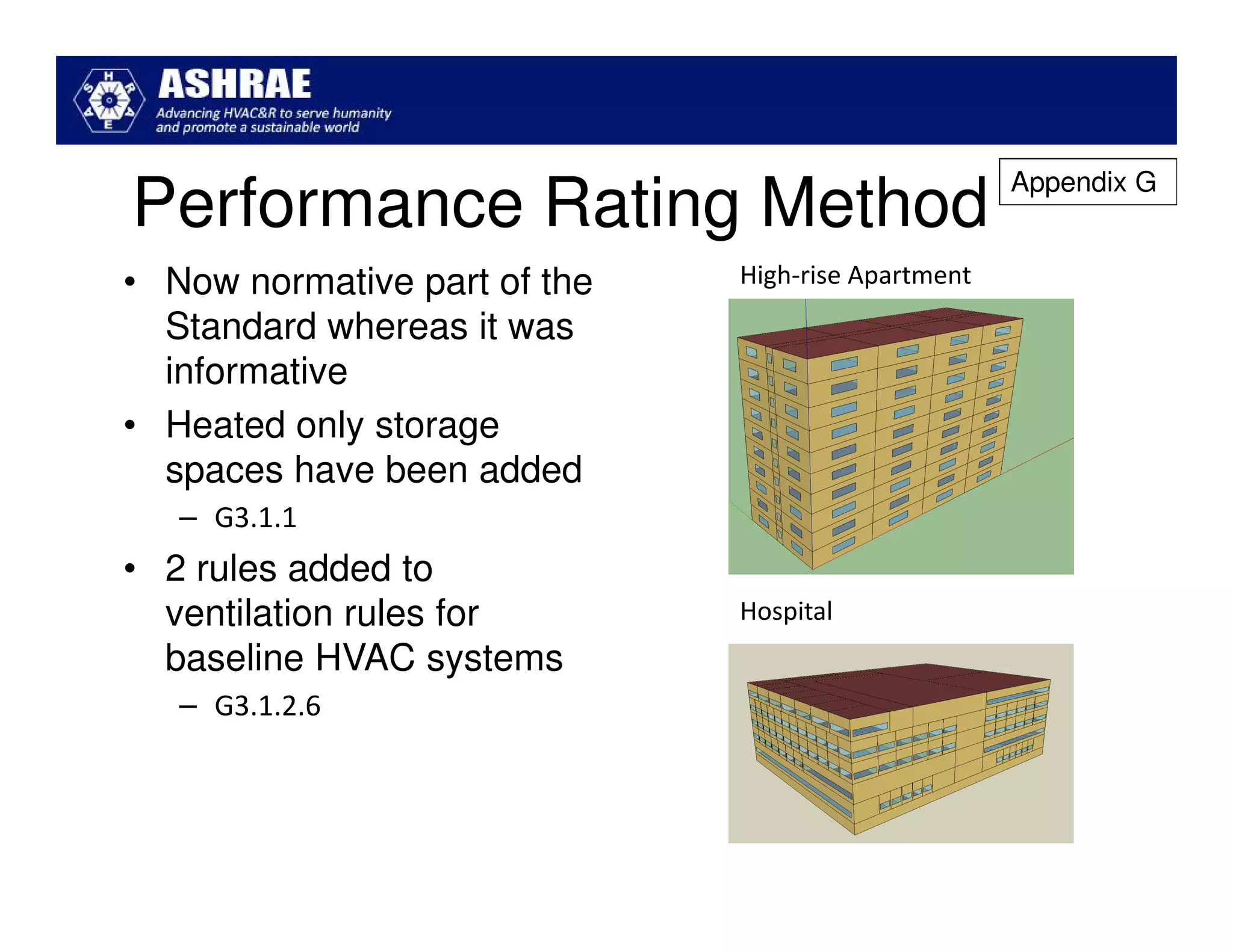
• Now normative part of the   High-rise Apartment
  Standard whereas it was
  informative
• Heated only storage
  spaces have been added
   – G3.1.1
• 2 rules added to
  ventilation rules for       Hospital
  baseline HVAC systems
   – G3.1.2.6
Questions?

Standard 90.1-2010 Update

  • 1.
    ASHRAE Standard 90.1- 2010 Hugh Crowther P. Eng Director at Large
  • 2.
    Agenda • ASHRAE Standards Development – Jargon • Std 90.1 layout • Review of changes to each section • How Improvements are evaluated • Questions
  • 3.
    Compliance Approaches Building Systems Compliance Options Envelope Prescriptive Option HVAC Trade Off SHW Option Mandatory Compliance Provisions Power Energy Cost Budget Lighting Simplified Other
  • 4.
    Std 90.1 Sections • Section 1: Purpose • Section 7: Service Water Heating • Section 2: Scope • Section 8: Power • Section 3: Definitions • Section 9: Lighting • Section 4: Admin and • Section 10: Other Equipment Enforcement • Section 11: Energy Cost Budget • Section 5: Building Envelope (ECB) method • Section 12: Normative References • Appendices
  • 5.
    Std 90.1 -2010 •Significant Savings over 2004 version • Site energy savings is National With Without in kWh Weighted Receptacle Receptacle Energy Loads Loads • Site energy cost Savings savings is in $ Site 25.5% 32.6% – Std 90.1 evaluates itself Energy on energy cost Energy 24.0% 30.1% • How did they do that? Cost
  • 6.
    How did theydo that? 30% Improvement 109 Addenda TPS Change 2004 2007 2010 Lets talk about changes from 2007 version to the 2010 version
  • 7.
    Section 2 Change in Scope • Process (plug) loads can now be included 11% 17% Lighting 17% • The TPS change Cooling 9% allows the committee Heating 21% 64% 14% to write rules on plug 9% Ventilation 5% Regulated loads if they deem it Water Heating 9% Refrigeration 3% necessary 3% Electronics 5% • If the Std does not 3% Computers 3% 25% specifically address a 5% Cooking 3% Unregulated 21% Other 14% process load, then it 3% Adjust to SEDS 11% is unregulated 9% 5% A 30% total site reduction would require a 47% reduction in regulated loads A 50% total site reduction would require a 78% reduction in regulated loads Source: Building Energy Data Book 2009, Table 3.1.4
  • 8.
    Section 5 Building Envelope • Building envelope requirements change based on location • Approximately 20 changes between 2007 and 2010 versions • Informative Appendix F lists changes by addenda
  • 9.
    Section 5 Building Envelope • Continuous air barrier for most buildings – 5.4.3.1 – Material leakage rate under 0.004 cfm/ft² @ 0.3 in. w.c. – Assembly leakage rate under 0.04 cfm/ft² @ 0.3 in. w.c. Goal: Minimize infiltration by 83% and HVAC energy usage by 40% - NIST
  • 10.
    Section 5 Building Envelope • Tightened air leakage rates for fenestration and doors – 5.4.3.2 – 1 cfm/ft² @ 1.57 PSF for doors – 0.06 cfm/ft² @ 1.57 PSF for curtain wall Goal: Minimize infiltration
  • 11.
    Section 5 Building Envelope • Vestibule Requirements changed – 5.4.3.4 • Insulation requirements for metal buildings more stringent – 5.5.3.1 and 5.5.3.2
  • 12.
    Section 5 Building Envelope • Cool roofs required in some climate zones – 5.5.3.1.1 – Zones 1,2 and3 – Solar reflectance = 0.55 – SRI = 64 (ASTM E1980) Goal: Minimize roof loads
  • 13.
    Section 5 Building Envelope • Vertical fenestration must have more area on south side than on either east or west side – 5.5.4.5 • Large spaces with tall ceilings must have minimum skylight area and automatic daylighting controls – 5.5.4.2.3
  • 14.
    Section 5 Building Envelope • Exceptions are provided to SHGC requirements for dynamic glazing – 5.5.4.4.1
  • 15.
    Section 6 HVAC Systems • Process cooling can now be included – Scope change • New data center requirements – Added CRAC units based on ASHRAE Std 127 – Introduced sensible Coefficient of Performance (SCOP) – 6.4.1.1, 6.5.1, Table 6.8.1k – A/C equipment primarily serving computer rooms must meet Table Example of process loads now being 6.8.1k considered
  • 16.
    Section 6 HVAC Systems • Upgraded efficiencies to most HVAC equipment categories – 6.8.1 tables • New term for Unitary equipment – Integrated Energy Efficiency Ratio (IEER) – Brings focus to part load efficiency rather than just full load performance Goal: Promote Part load performance
  • 17.
    Section 6 HVAC Systems • Increased efficiency for water- cooled and evaporatively cooled air conditioners/heatpumps – 3 to 5% more stringent as of June 2011 – IEER increase from 5 to 13% – Two position valves required on water cooled unitary equipment (WSHPs) – Pumps larger than 5 hp serving W/C unitary equipment need VFD
  • 18.
    Section 6 HVAC Systems • Water to water heat pumps – Added to standard – Efficiencies based on application (Watersource, ground water, ground source)
  • 19.
    Section 6 HVAC Systems • Increased efficiency for PTACs and PTHPs as of Oct 2012 – Created standard (16 x 42 size) and non standard efficiency tables – Standard size for new construction Standard – Non standard size for replacement (existing wall sleeves) Non -standard
  • 20.
    Section 6 HVAC Systems • Two path compliance for chillers (addendum M) – Both paths have a full and part load target – Path A targets high full load performance – Path B targets high part load performance – Chillers with glycol now under Std 90.1 – Glycol chiller performance criteria based on just water when checking with 90.1 Goal: Promote full operating range performance
  • 21.
    Section 6 HVAC Systems • Recent Chiller Interpretations – Where customers request more strict conditions than required in AHRI 550/590, the chillers will be compared to Std 90.1 at standard rating conditions. – Power usage shall be measured at the line side of starter or VFD. – Starter and VFD losses must be included in chiller performance
  • 22.
    Section 6 HVAC Systems • Chiller scope expansion – Air and water cooled positive displacement chillers now included in Std 90.1 with LFT > 32 °F • Non standard chiller equation – 6.4.1.2.1 – Covers chillers with LFT ≥ 36 °F – Covers chillers with CWT ≤ 115 °F – 20 °F to 80 °F of lift Goal: Avoid gaming by picking 85.1 °F CWT • About 98% of centrifugal chillers now covered by Std 90.1
  • 23.
    Section 6 HVAC Systems • VRF systems added – Based on new AHRI 1230 test standard – The IEER levels will increase in 2012 • New rating system for water to water HX – 6.4.1.4 – Encouraging manufacturers to certify their products – No performance targets yet
  • 24.
    Section 6 HVAC Systems • Restrictions on pump head sizing and pipe sizing – 6.4.2.2 – Need to calculate the pressure drop through piping and components for critical path • Pipe sizing as per table 6.5.4.5 Goal: Make sure pumps are not oversized – Flow rate by Dia. And hours operation
  • 25.
    Section 6 HVAC Systems • Pump differential pressure flow control shall – Not exceed pressure required for 110% of design flow through heat exchanger – Shall reset down during part load until one control valve is nearly open. – 6.5.4.1
  • 26.
    Section 6 HVAC Systems • Hydronic systems other than unitary systems must have VFD over 10 hp – 6.5.4.1 – No caveats any more – No pump curve riding etc Goal: Promote Variable flow systems
  • 27.
    Section 6 HVAC Systems • VAV requirement for DX and chilled water systems that serve single zone – 6.4.3.10 – Chilled water systems ≥ 5 hp fan motors must be variable flow – 2 spd or VFD – As of Jan. 1, 2012 DX systems > 110kBtu/h must be able to reduce fan speed 2/3 or less at 50% load – 2 spd or VFD • Fan power ratings based on constant volume power limits Goal: Promote fan power savings
  • 28.
    Section 6 HVAC Systems • Increased insulation requirements for pipes and ducts – 6.4.4 • New requirements for radiant panel systems – 6.4.4 – Ineffective panel areas shall have r-3.5
  • 29.
    Section 6 HVAC Systems • Limitations on centrifugal fan cooling towers – 6.5.5.3 – 1100 gpm or greater, must meet axial fan efficiency – 38.2 USgpm per fan hp – Exempt if they are ducted • New tower category for closed circuit cooling towers – Avoid confusion with Fluid coolers Goal: Promote fan power savings
  • 30.
    Section 6 HVAC Systems • Economizer changes – 6.5.1 • With more stringent envelopes and higher internals loads, cooling required at lower ambients – Promotes economizers • Economically justified in all but Zones 1a Goal: Promote economizers. The and ab. improvements in building envelopes make economizers economically justified in more climate zones
  • 31.
    Section 6 HVAC Systems • Sizes 54 kBtu/h and larger require economizers – Individual unit (not system) – Air or water economizers – Economizer is 1st stage cooling – 2nd stage mechanical cooling – Economizer goes to minimum when high limit reached – High limit settings by region • 12 exceptions
  • 32.
    Section 6 HVAC Systems • Economizer exception for computer rooms – 6.5.1j – Total design below 3,000 kBtu/h and not served by chiller plant – Total design below 600 kBtu/h and is served by chiller plant – Local authority prohibits cooling towers – Less than 600 kBtu/h computer load being added to existing building
  • 33.
    Section 6 HVAC Systems • Water economizer sizing for computer rooms – 6.5.1.2 – Load must be met at 40 °F db/ 35°F wb with evaporative type water economizers – Load must be met at 35 °F db with dry type water economizers
  • 34.
    Section 6 HVAC Systems • Changes to damper leakage requirements – 6.5.1.1.4 – Comply with changes to controls section – Motorized intake and exhaust dampers in most climate zones Goal: Limit infiltration during off hours and slow down heat up or cool down
  • 35.
    Section 6 HVAC Systems • Dynamic ventilation control for multi zone VAV systems following Std 62.1 Appendix A – 6.5.3.3 – VAV systems with DDC controls shall lower ventilation air below design rate in response to ventilation efficiency
  • 36.
    Section 6 HVAC Systems • Supply air reset – Removed from 1999 version – Back in 2010 version – 6.5.3.4 • Goal is to reset SAT up to max level when boxes at minimum flow – Fan penalty should be offset by reheat savings Goal: Mechanical cooling savings that more than offset additional fan work – Can be based on outdoor air reset
  • 37.
    Section 6 HVAC Systems • SAT Reset exceptions – Climate zones 1a, 2a,3a – Systems that prevent reheating, re-cooling or mixing – Systems where 75% of reheat comes from recovery or solar.
  • 38.
    Section 6 HVAC Systems • Additional requirements for reheat/re-cool minimums – 20% zone design peak supply rate during deadband and 50% zone peak design rate for full heating – Meant to help with stratification in heating from ceiling diffusers • Overheat heating SAT Goal: Reduce heating air flow to minimum limited to 20 ° above F level where overhead distribution is still effective temperature set point
  • 39.
    Section 6 HVAC Systems • Climatic based requirement for energy recovery – 6.5.6 – Based on climate zone, size and % outdoor air • New requirements for garage and kitchen hood ventilation – 6.4.3.4.5 and 6.5.7 – Garage systems shall modulate to 50% based on contaminants Goal: Fan power savings in garages and kitchen exhaust systems
  • 40.
    Section 6 HVAC Systems • New requirements for lab exhaust – 6.5.7.2 – Need to be VAV above 5000 cfm
  • 41.
    Section 7 Service Water Heating • No changes from 2007 version
  • 42.
    Section 8 Power • Half of all convenience power outlets shall be controlled such that power is turned off when space is not occupied – 8.4.2 • Efficiency requirements added for dry type transformers – 8.1.2 – Reflect 2005 Federal requirements Goal: Std 90.1 in line with Federal codes
  • 43.
    Section 9 Lighting • Increased documentation requirements – 9.7 • Lighting alteration requirements now – Take effect at 10% replacement – Include exterior areas – Include renovations even when it is just lamp/ballast replacement – Require compliance with auto shut requirements – 9.1.2
  • 44.
    Section 9 Lighting • Changes to lighting power density (LPD) values – tables 9.5.1 and 9.6.1 • Adjustment Factor added for tall spaces – 9.6.3 • Additional LPD allowed when using certain non mandatory controls – 9.6.2c
  • 45.
    Section 9 Lighting • Allowances for retail lighting have been reduced – 9.6.2b • Multi-use spaces now use multiple LPD valves – 9.6.1
  • 46.
    Section 9 Lighting • Exterior lighting now broken into 5 zones based on ambient light levels – 9.6.1 – Undeveloped park area to high traffic commercial zone
  • 47.
    Section 9 Lighting • Light control changes include (9.4) – Bi level control – Auto shut off based on occupancy required in more spaces – Certain required controls must be manual/auto on to no more than 50% power – Deleted 5000 ft² threshold for auto shutoff – Functional testing of some lighting controls now required (9.4.4) – Daylight harvesting required in certain situations 5.5.4.2.3
  • 48.
    Section 10 Other Equipment • Control requirements for water pressure booster pump systems – 10.4.2 – Variable flow design – Don’t dead head a pump Goal: Avoid pump work during low or no flow requirement periods
  • 49.
    Section 10 Other Equipment • Requirements added to limit lighting and fan power in elevator cabs and de-energize during stand by mode – 10.4.3 • Motor efficiency tables changed for motors built after 12/19/2010 – Table 10.8a,b,c Goal: Keep Std 90.1 in line with Federal motor requirements
  • 50.
    Section 11 ECB Method Large Office • No changes to 2010 version • Case sample provided in previous Users manual has Secondary School been deleted – Can be downloaded from ASHRAE
  • 51.
    Appendix G Performance RatingMethod • Can use Appendix G to rate High-rise Apartment buildings for other than compliance with Std 90.1 – LEED – Appendix G is nota compliance path • A building complies with Std 90.1 (section 11) if the proposed design energy cost ≤ energy cost budget Hospital • In Appendix G Proposed building performance ≥ baseline building performance
  • 52.
    Appendix G Performance RatingMethod • Now normative part of the High-rise Apartment Standard whereas it was informative • Heated only storage spaces have been added – G3.1.1 • 2 rules added to ventilation rules for Hospital baseline HVAC systems – G3.1.2.6
  • 53.