Booster System Basics:
Pressure Booster Systems
• WHAT IS A BOOSTER SYSTEM?
• BOOSTER SIZING REQUIREMENTS
• BOOSTER SYSTEM CONTROL
• ENERGY SAVING STRATEGIES
• DRAWDOWN TANKS
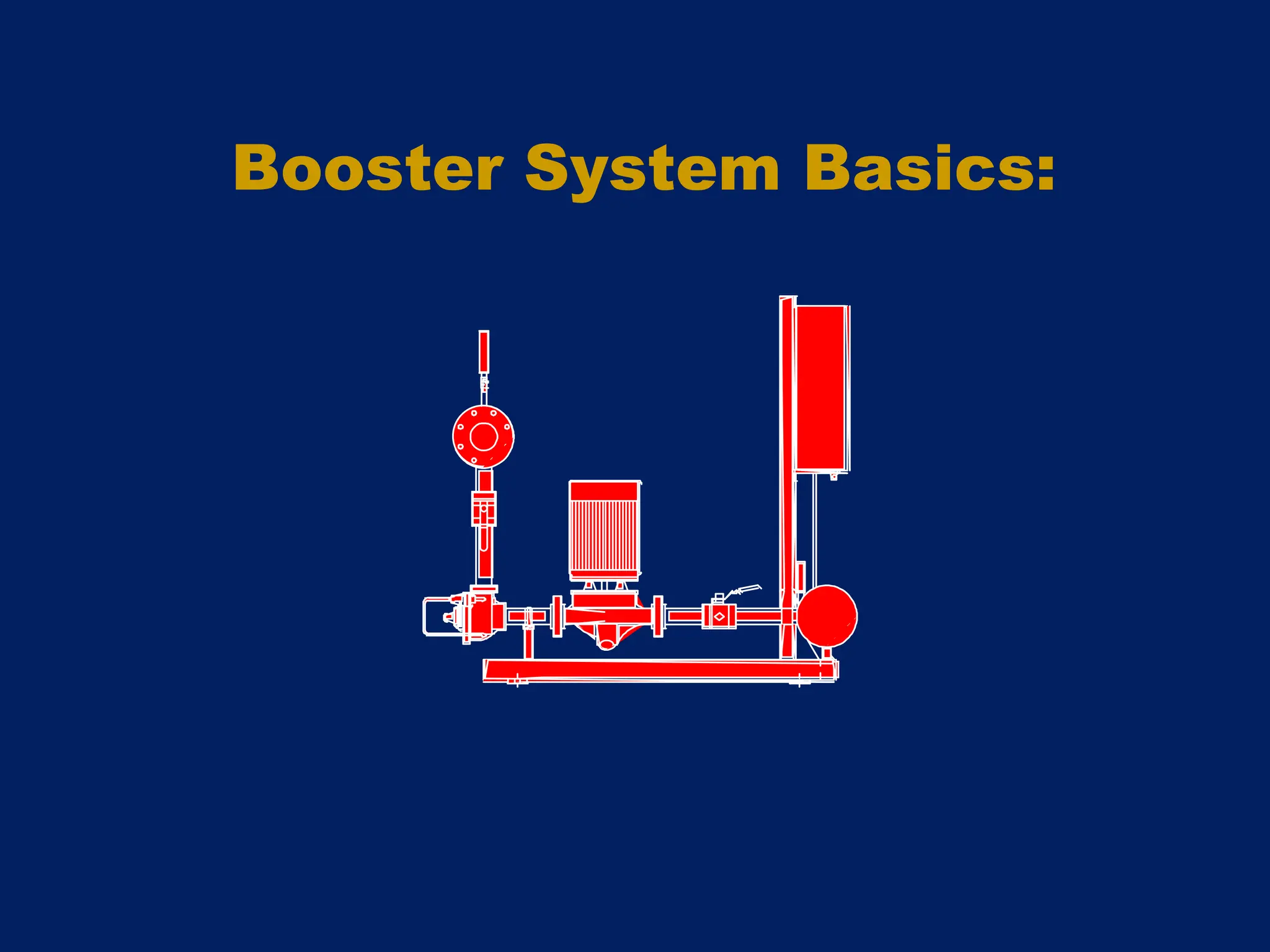
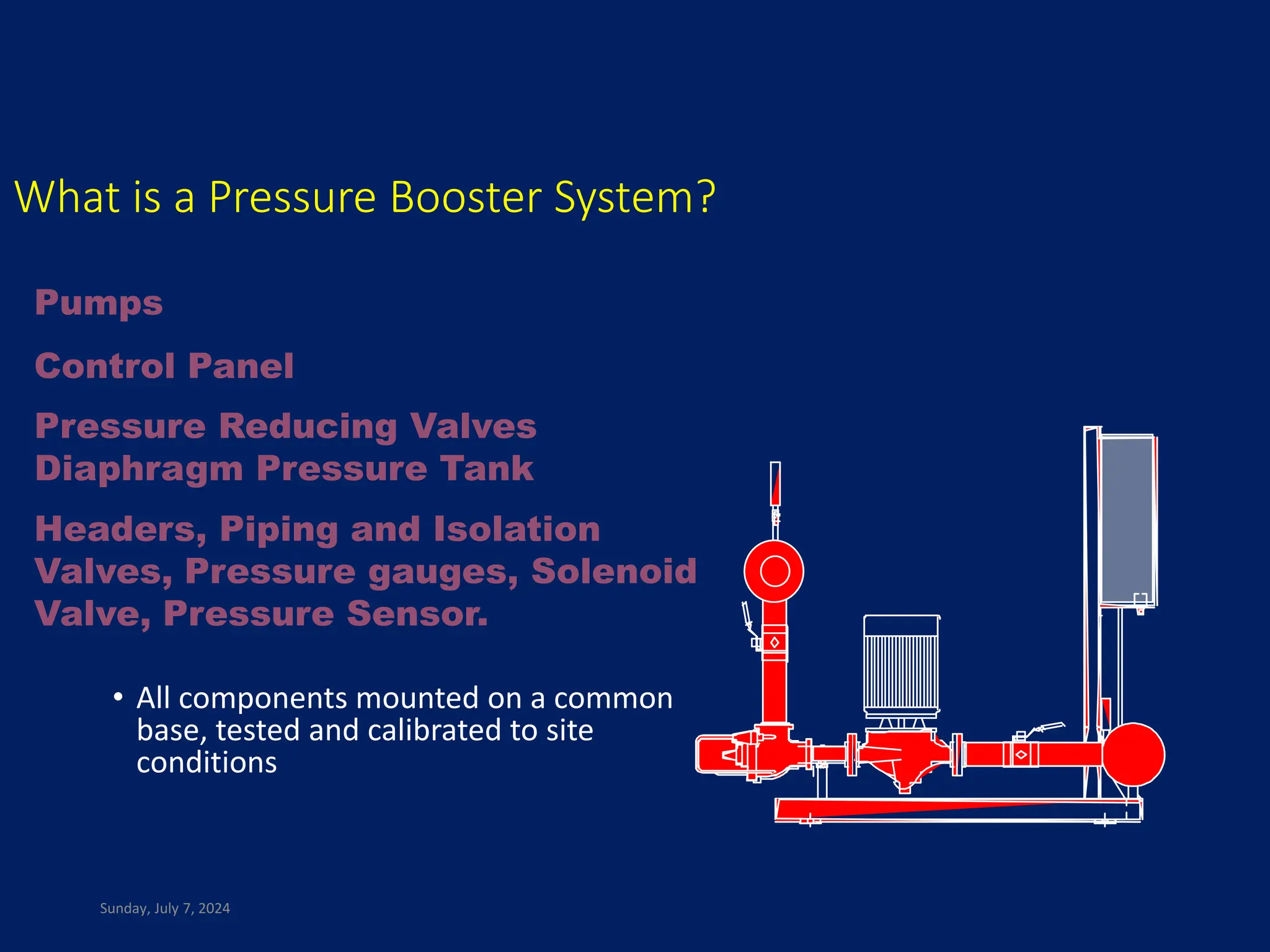
What is a Pressure Booster System?
• All components mounted on a common
base, tested and calibrated to site
conditions
Sunday, July 7, 2024
Pumps
Control Panel
Headers, Piping and Isolation
Valves, Pressure gauges, Solenoid
Valve, Pressure Sensor.
Pressure Reducing Valves
Diaphragm Pressure Tank
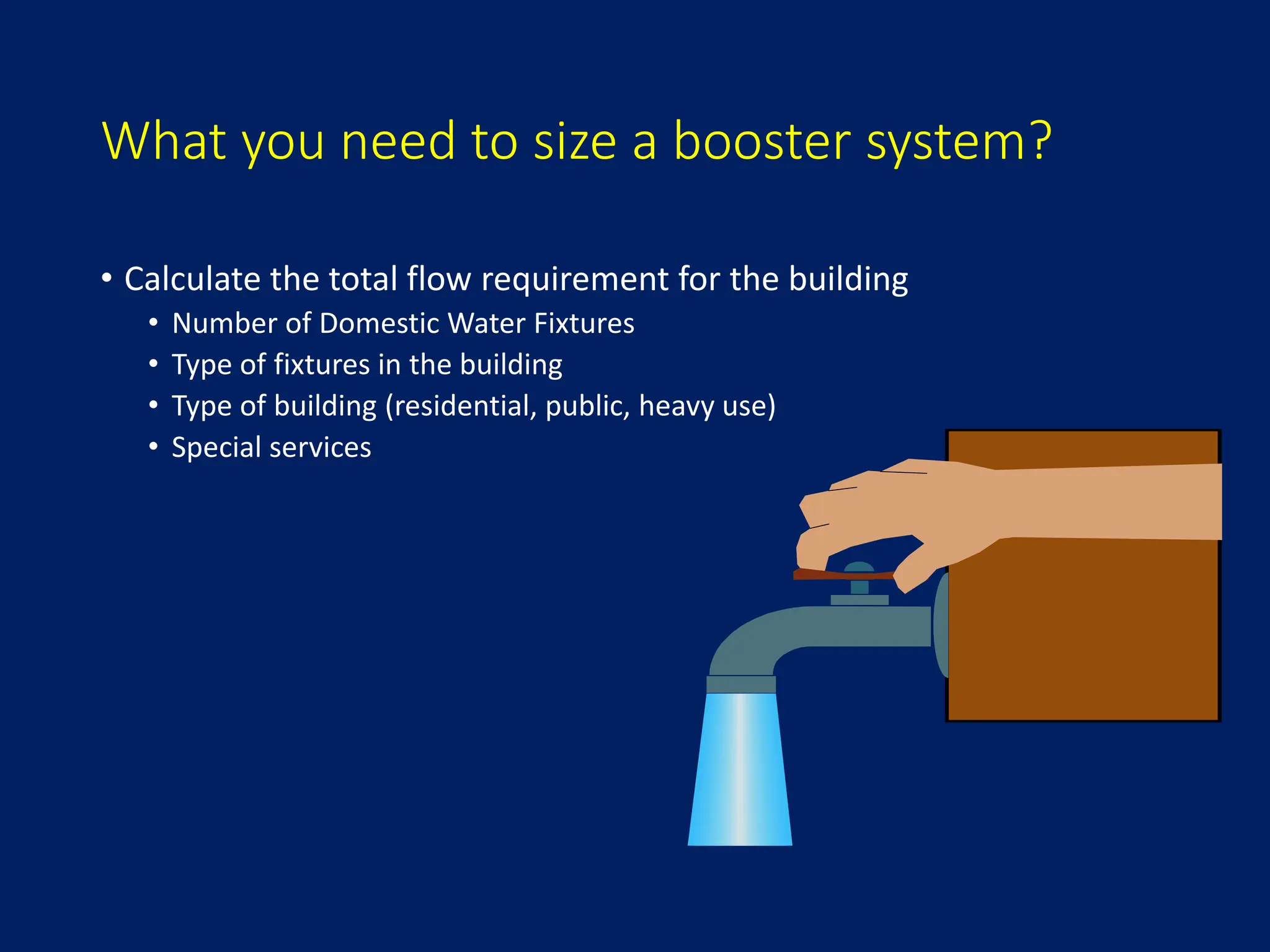
What you need to size a booster system?
• Calculate the total flow requirement for the building
• Number of Domestic Water Fixtures
• Type of fixtures in the building
• Type of building (residential, public, heavy use)
• Special services
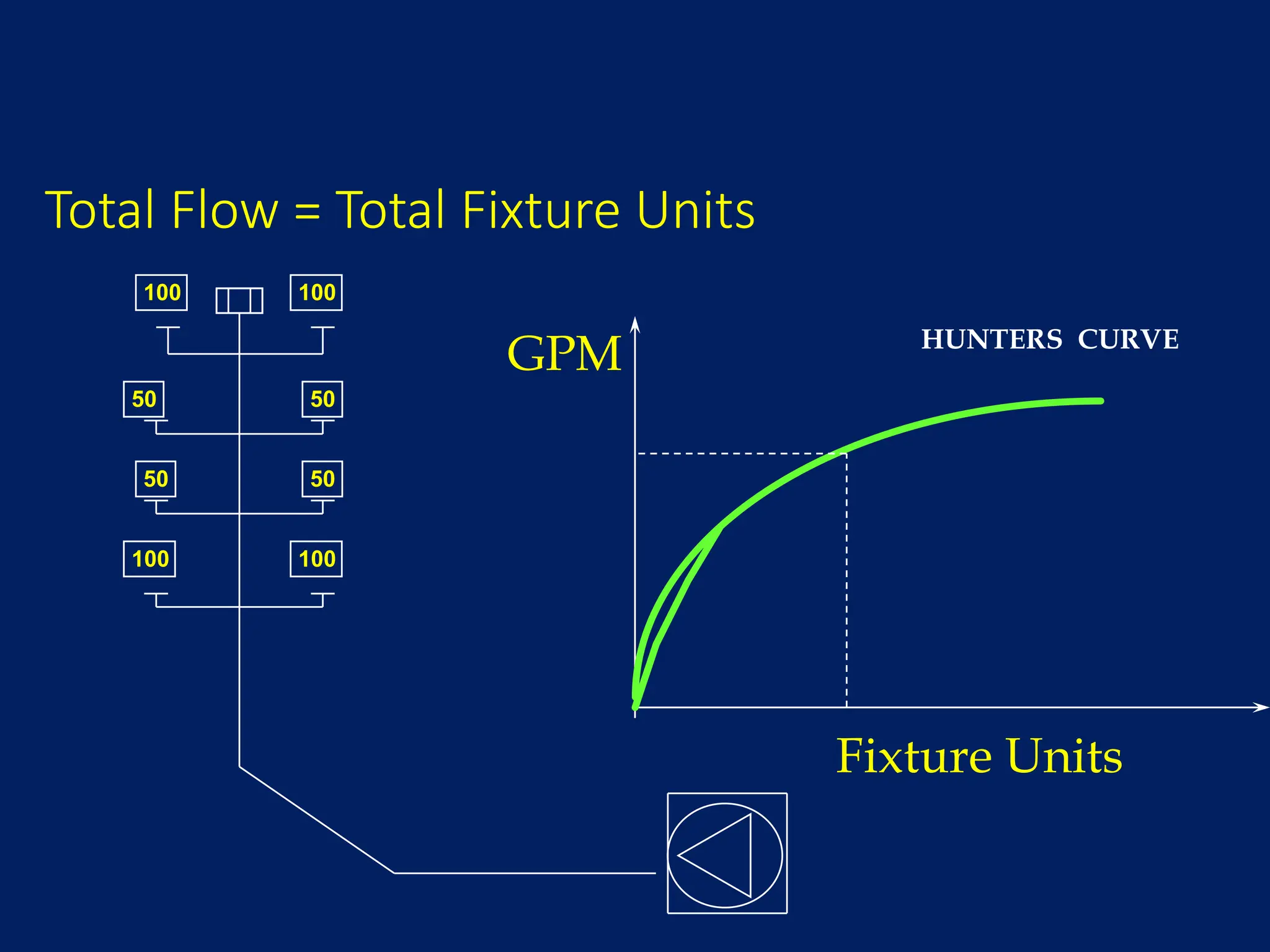
Total Flow = Total Fixture Units
100
100
100 100
50 50
50 50
Fixture Units
GPM HUNTERS CURVE
What you need to size a booster system?
• Calculate the total flow requirement for the building
• Calculate the total pressure required for the building
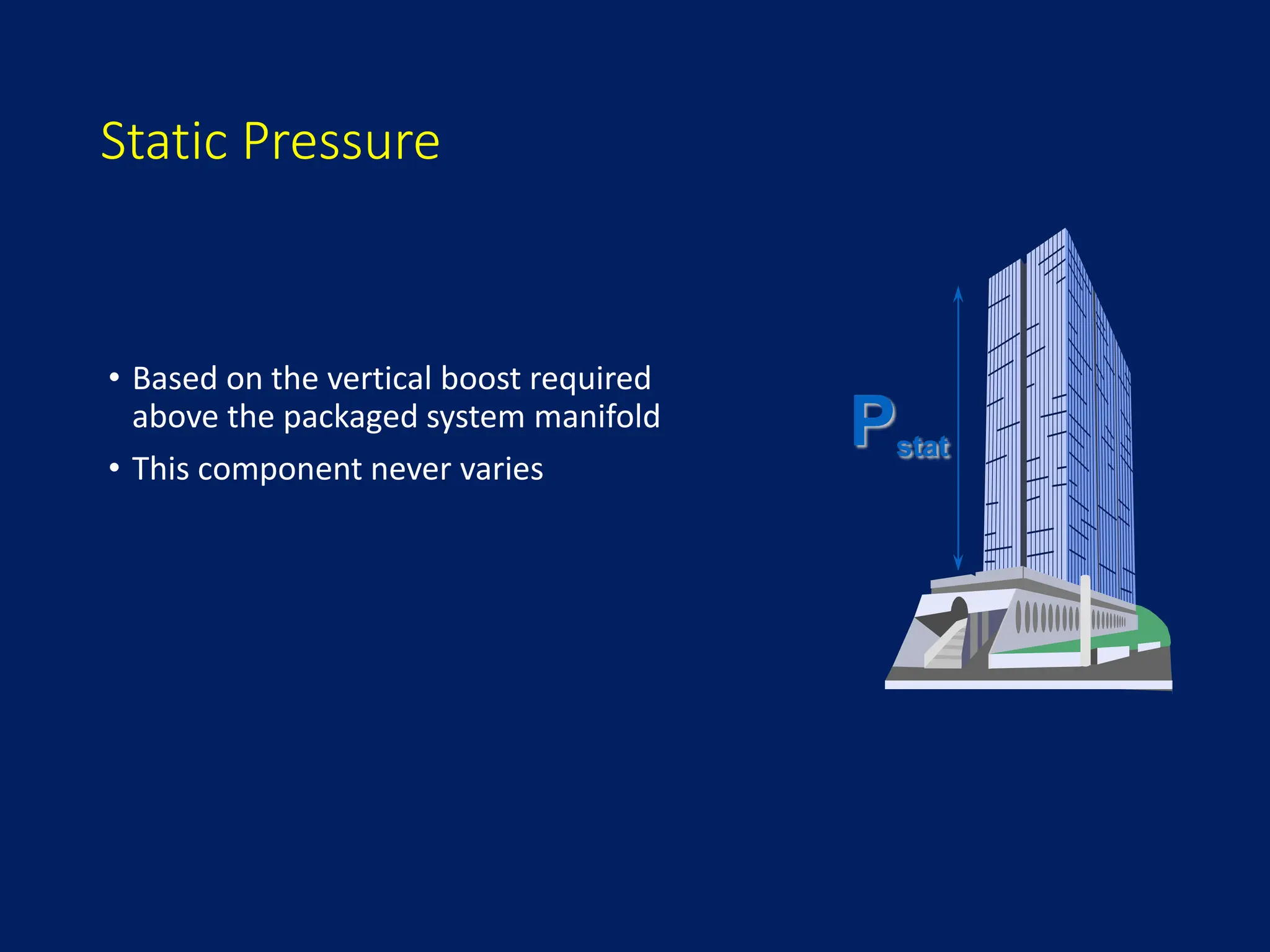
Static Pressure
• Based on the vertical boost required
above the packaged system manifold
• This component never varies
Pstat
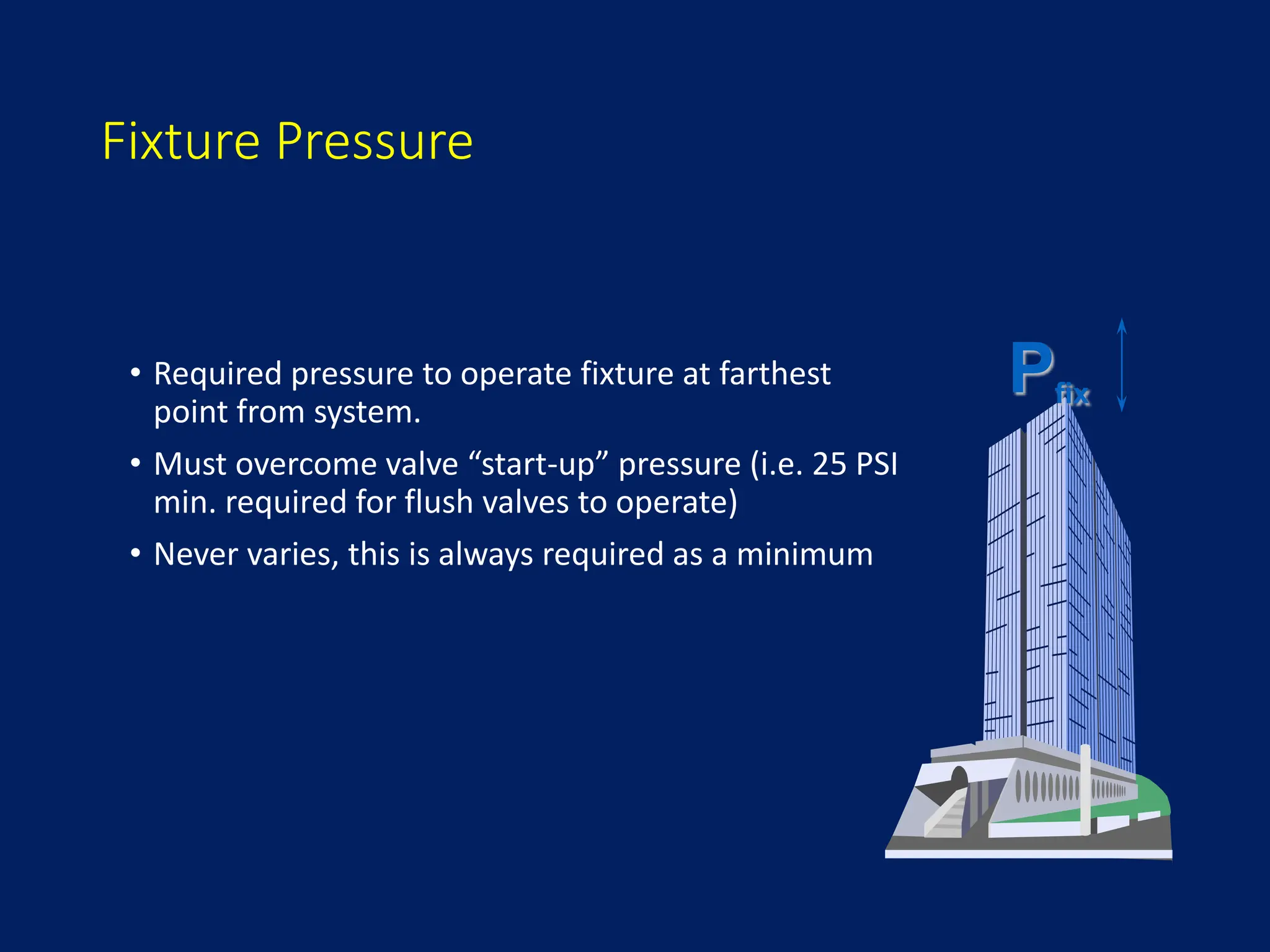
Fixture Pressure
• Required pressure to operate fixture at farthest
point from system.
• Must overcome valve “start-up” pressure (i.e. 25 PSI
min. required for flush valves to operate)
• Never varies, this is always required as a minimum
Pfix
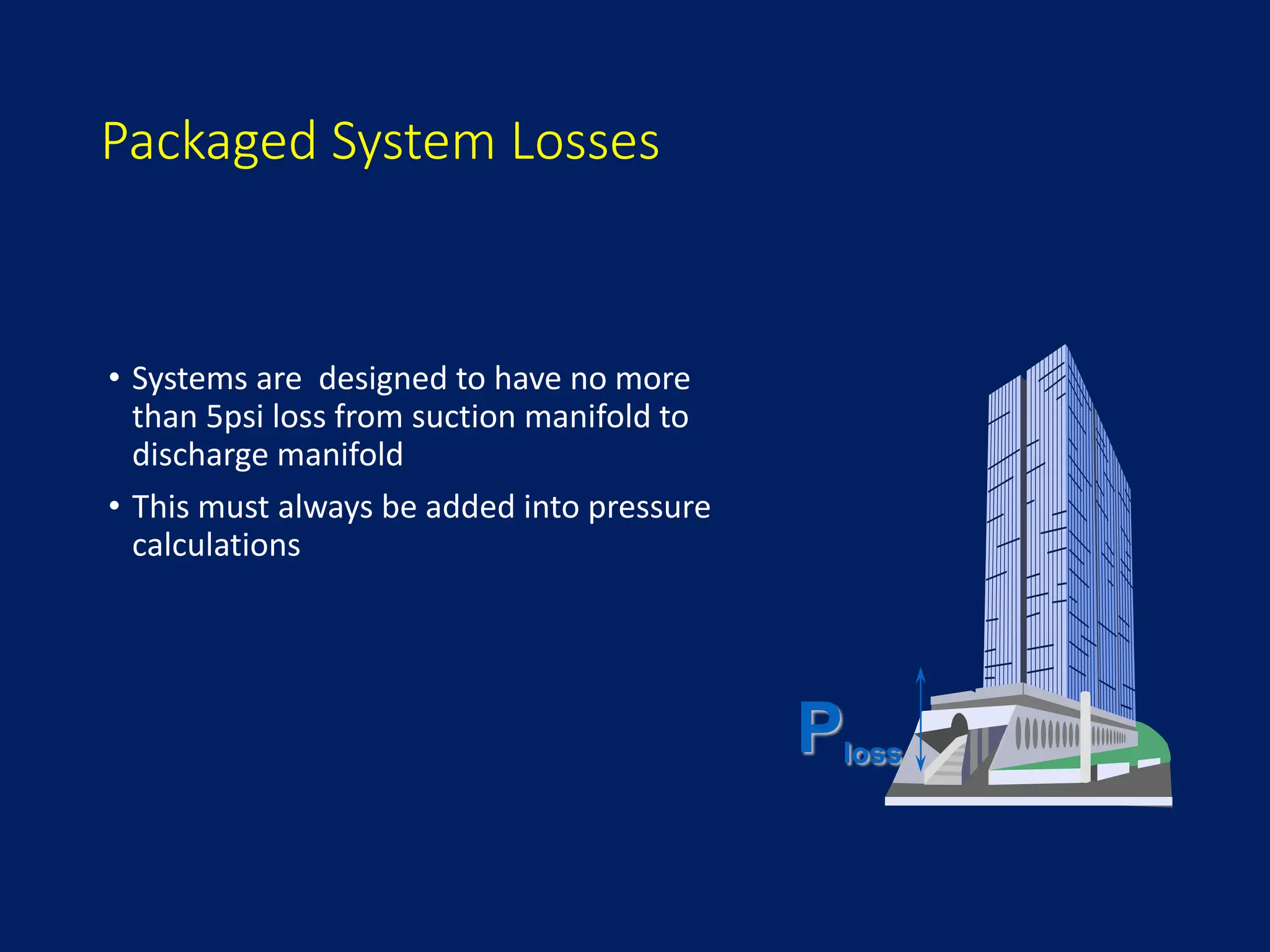
Packaged System Losses
• Systems are designed to have no more
than 5psi loss from suction manifold to
discharge manifold
• This must always be added into pressure
calculations
Ploss
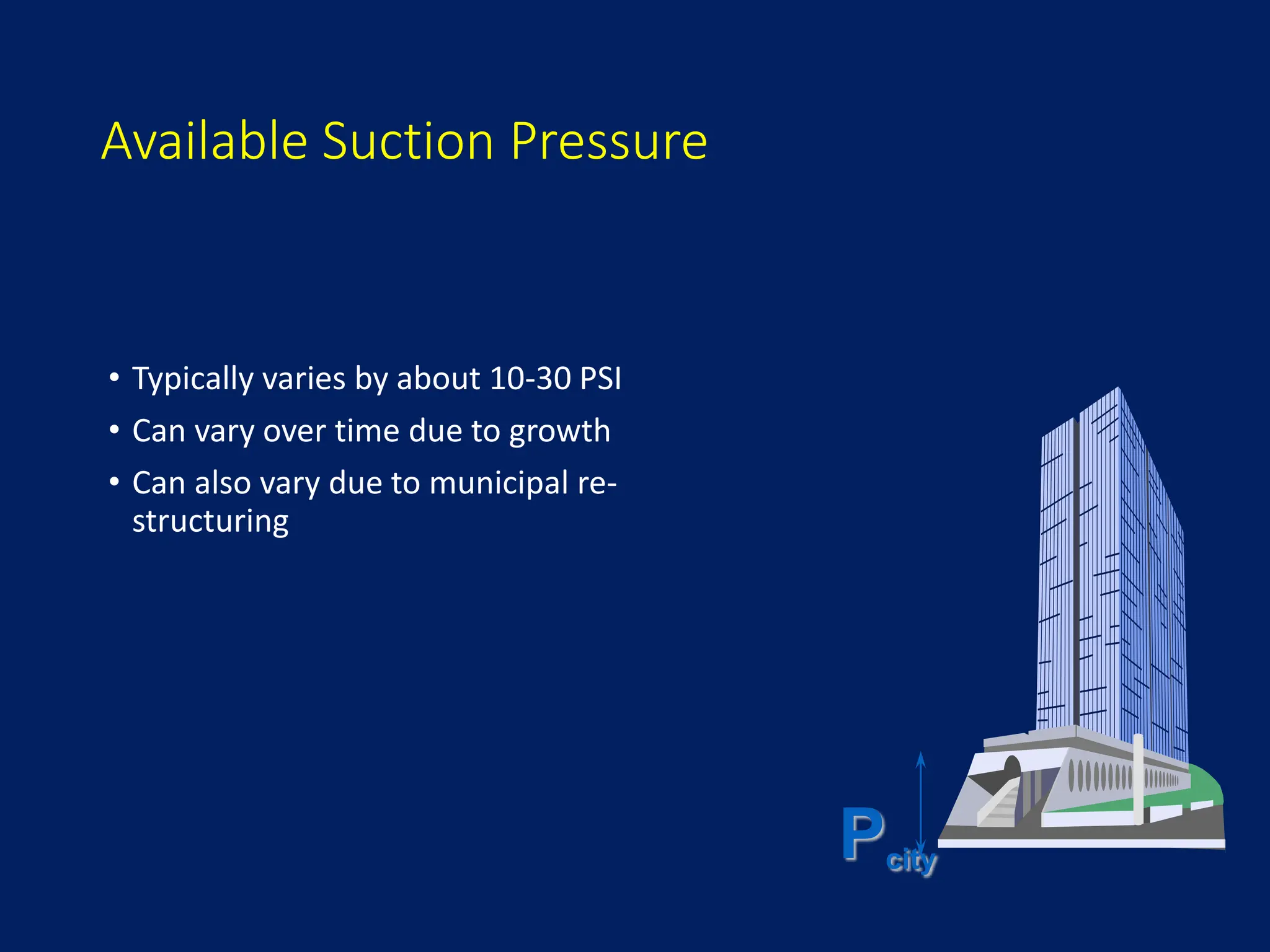
Available Suction Pressure
• Typically varies by about 10-30 PSI
• Can vary over time due to growth
• Can also vary due to municipal re-
structuring
Pcity
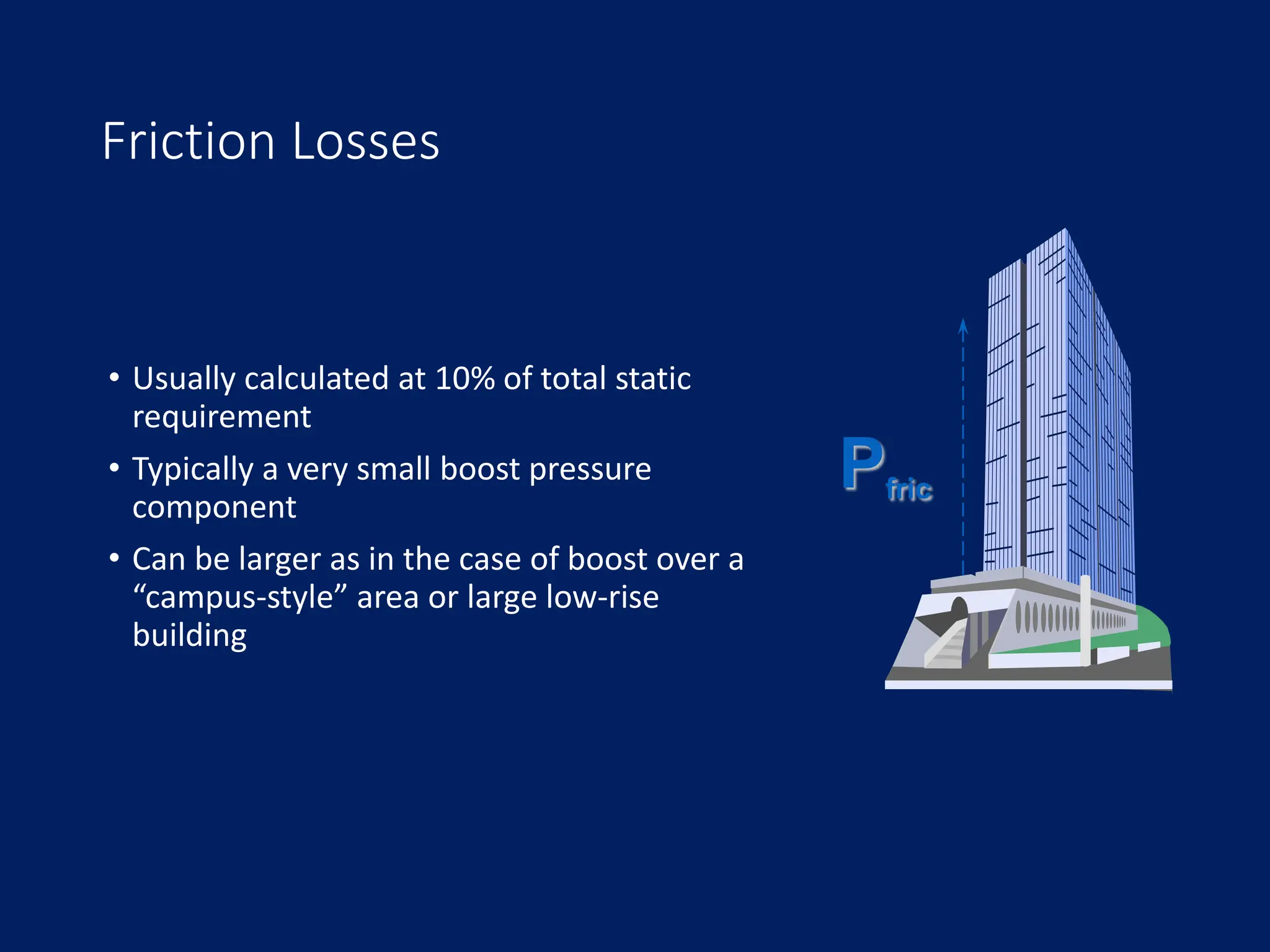
Friction Losses
• Usually calculated at 10% of total static
requirement
• Typically a very small boost pressure
component
• Can be larger as in the case of boost over a
“campus-style” area or large low-rise
building
Pfric
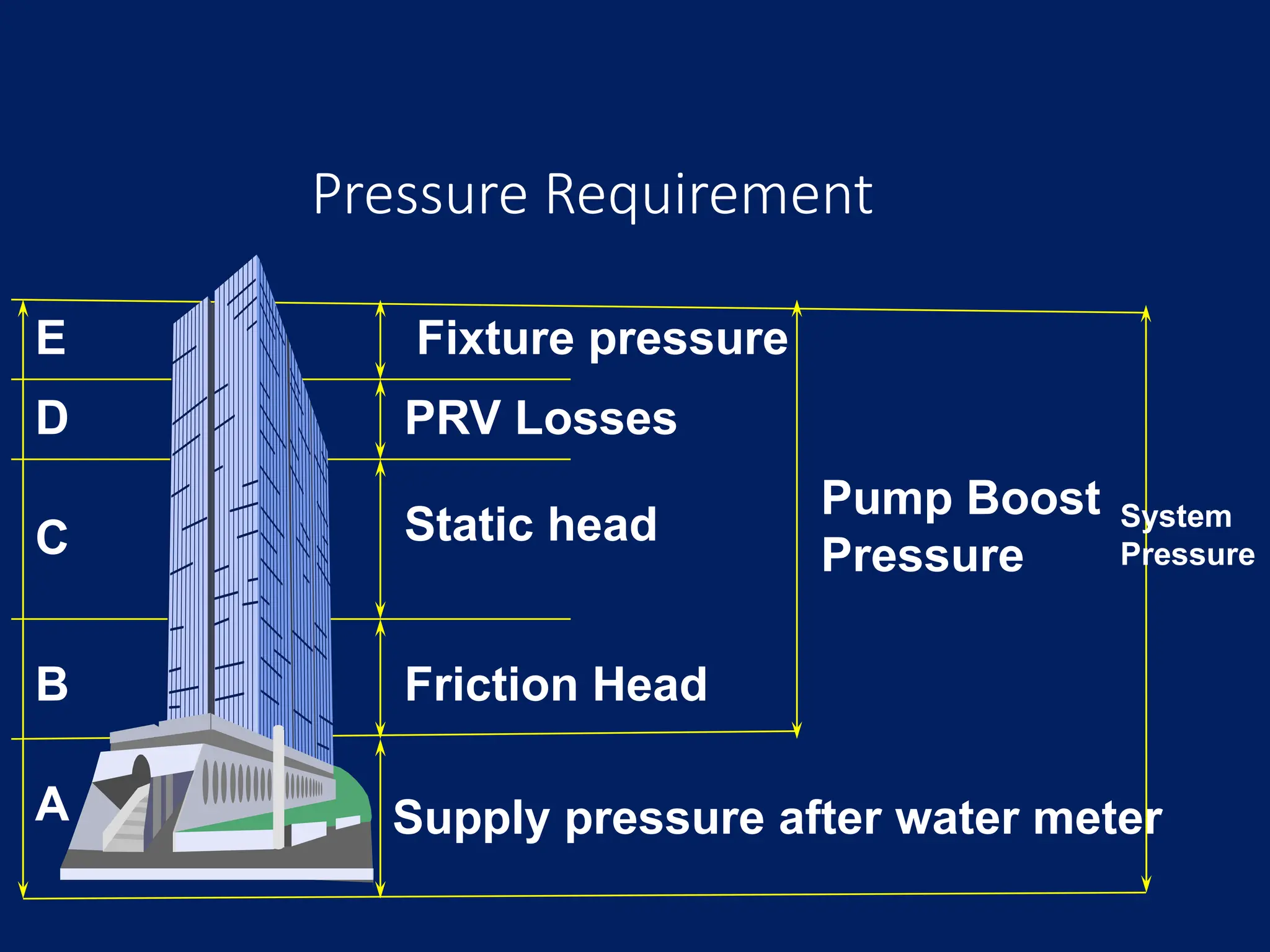
Pressure Requirement
Supply pressure after water meter
Friction Head
Static head
PRV Losses
Fixture pressure
Pump Boost
Pressure
E
D
C
B
A
System
Pressure
Pressure Requirement
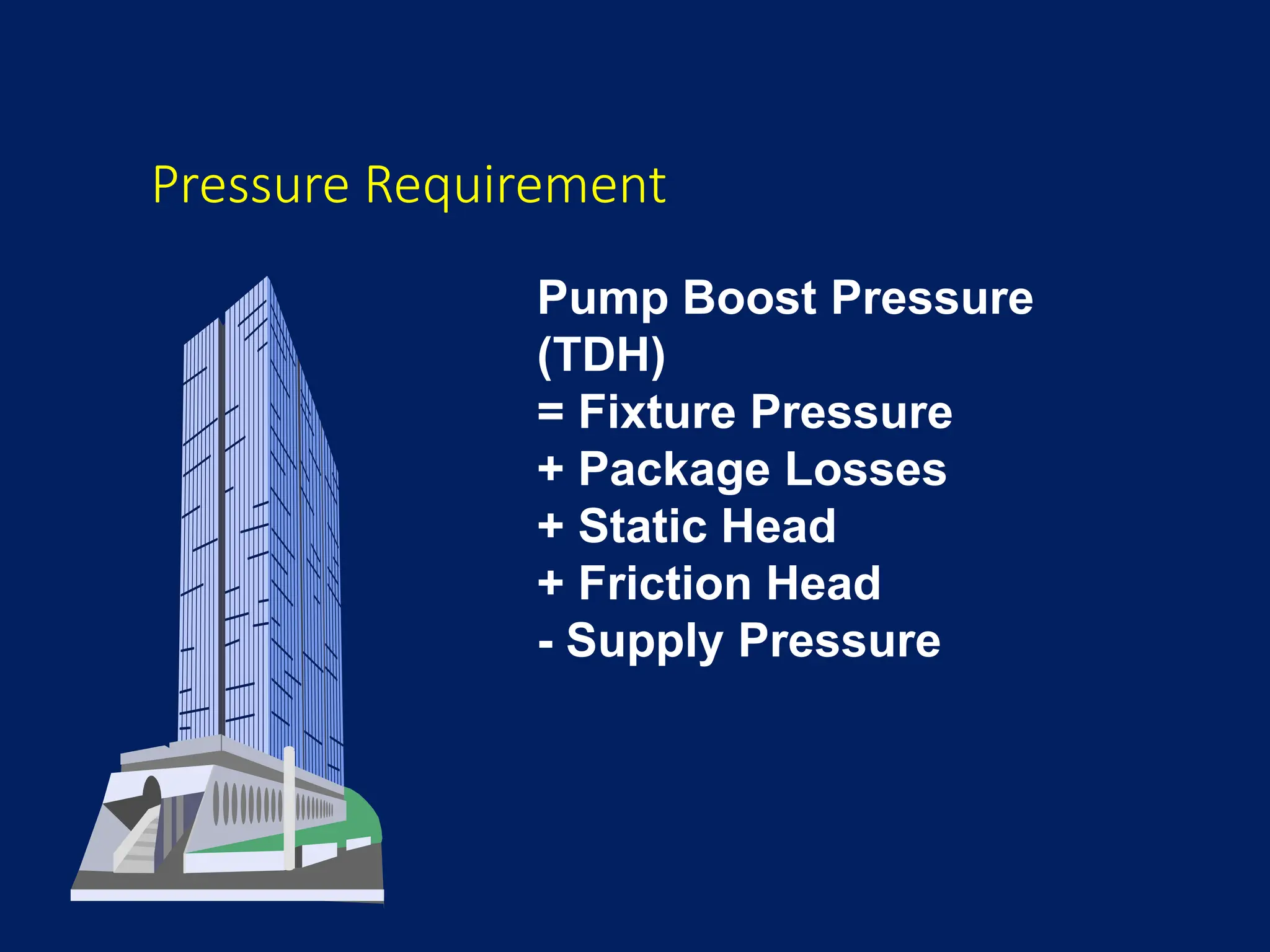
Pump Boost Pressure
(TDH)
= Fixture Pressure
+ Package Losses
+ Static Head
+ Friction Head
- Supply Pressure
Pressure Requirement
Boost Pressure
= System Pressure - Supply Pressure
Significance of System Flow in Booster
Systems
• Flow impacts system demand, not pressure - as demand increases,
flow must increase at a constant output pressure
• Flow governs pump actuation - therefore, flow should govern pump
sequencing and actuation
• System capacity matched to system flow requirement is most efficient
and cost effective for domestic water pressure boosting
What are the most popular methods of booster pump
control ?
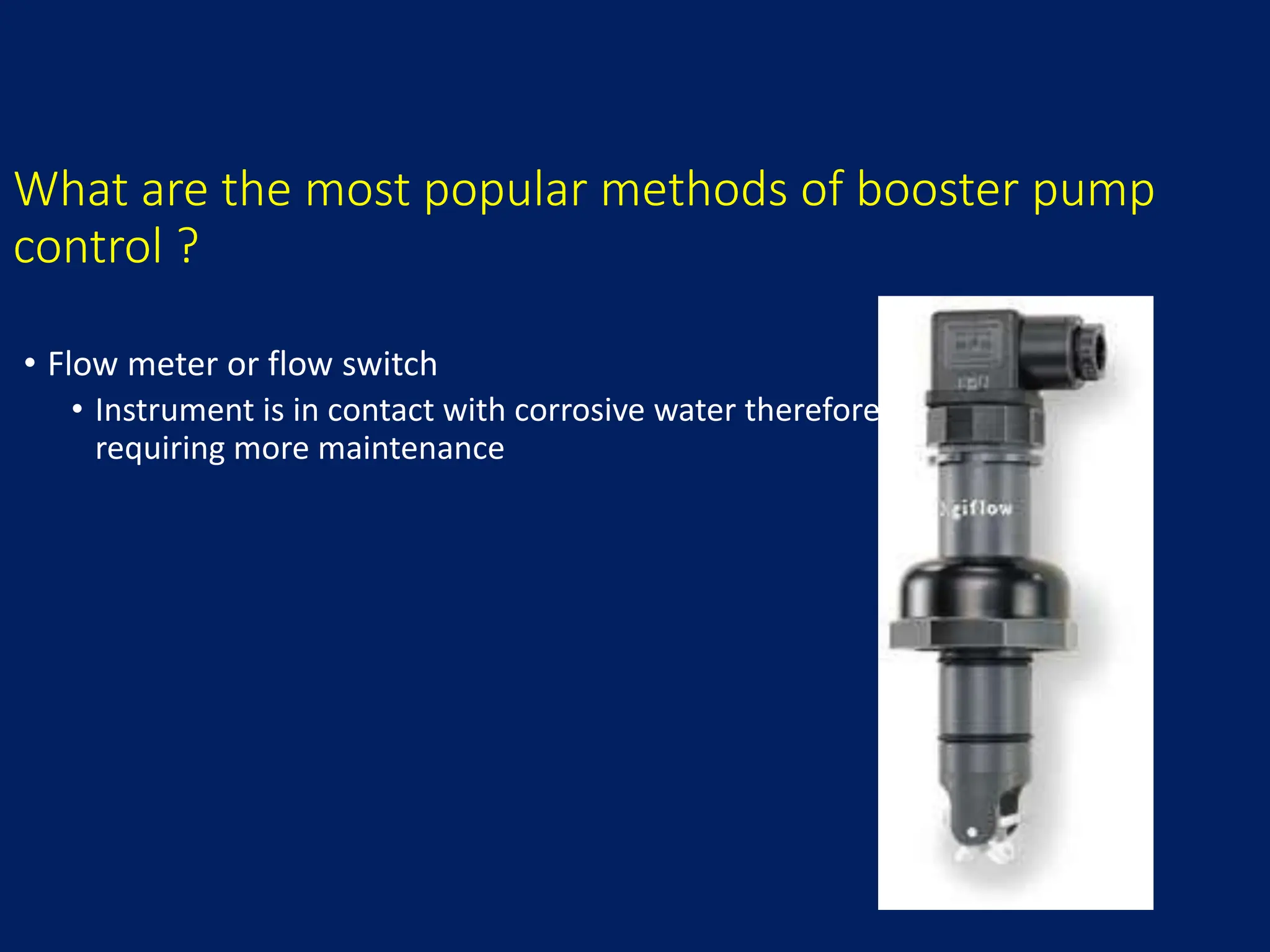
• Flow meter or flow switch
• Instrument is in contact with corrosive water therefore
requiring more maintenance
What are the most popular methods of booster pump
control ?
• Flow meter or flow switch
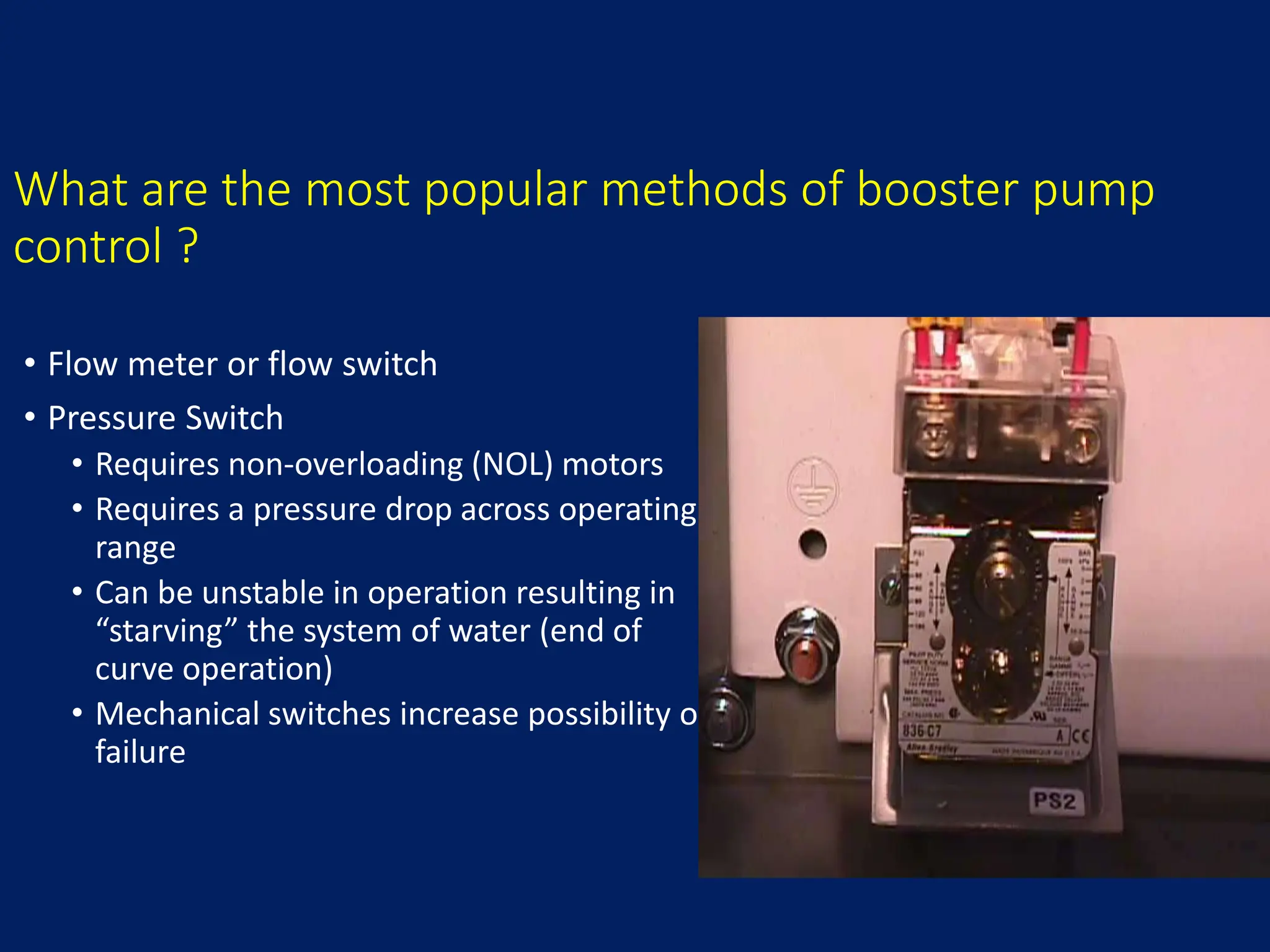
• Pressure Switch
• Requires non-overloading (NOL) motors
• Requires a pressure drop across operating
range
• Can be unstable in operation resulting in
“starving” the system of water (end of
curve operation)
• Mechanical switches increase possibility of
failure
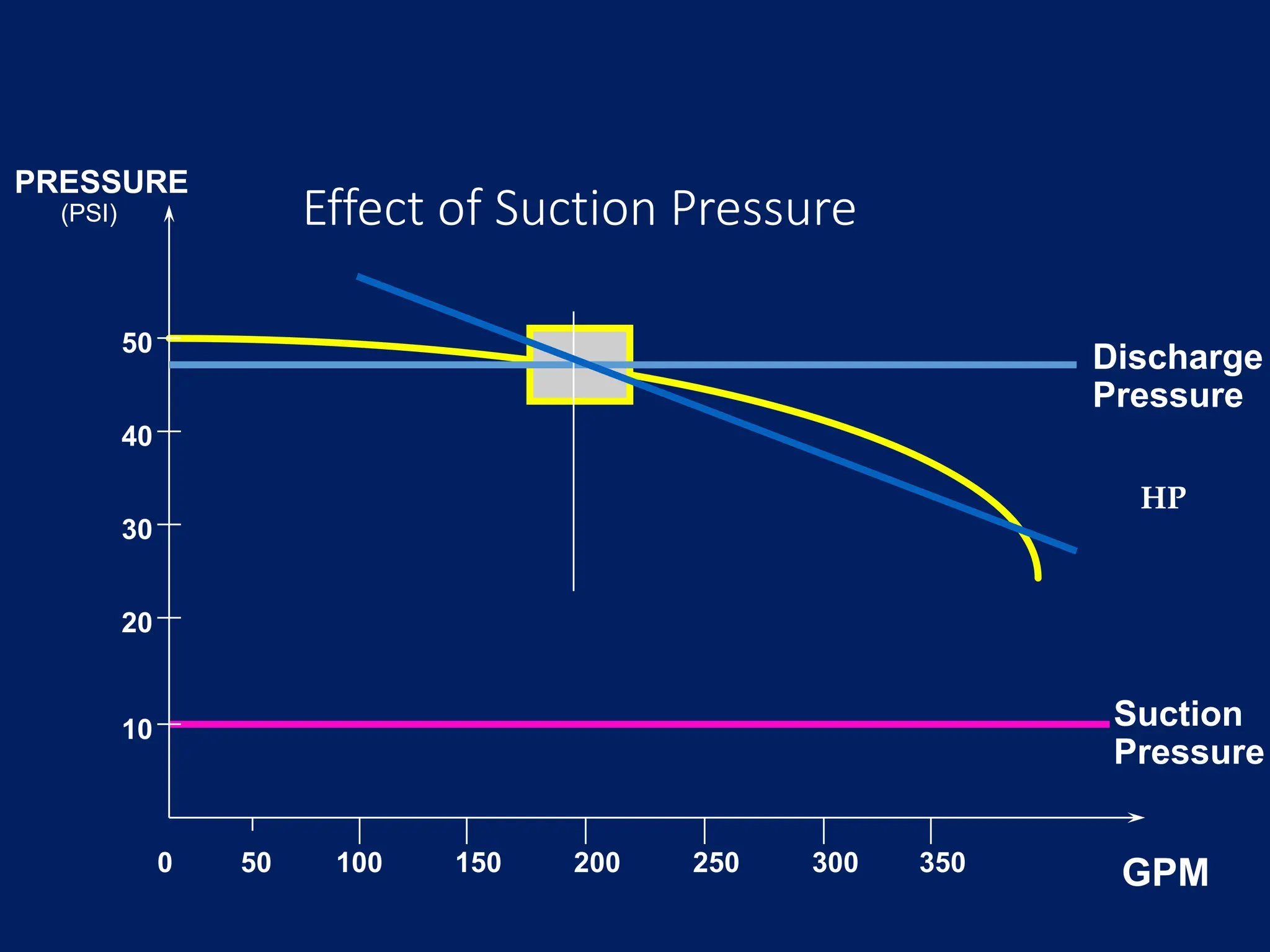
Effect of Suction Pressure
PRESSURE
10
20
30
40
50
50 100 150 200 250 300 350 GPM
Suction
Pressure
Discharge
Pressure
0
(PSI)
HP
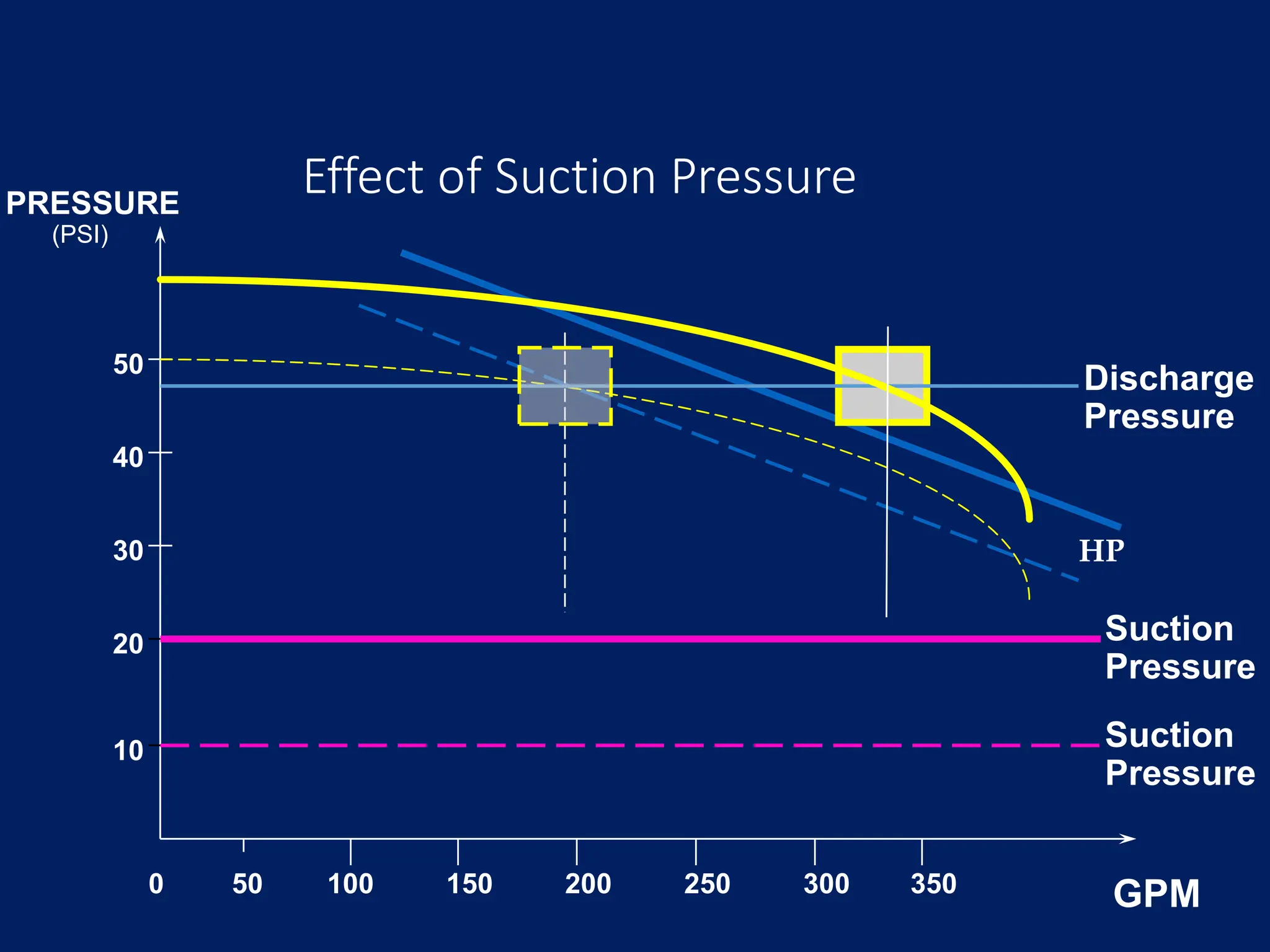
Effect of Suction Pressure
50
PRESSURE
10
20
30
40
50 100 150 200 250 300 350 GPM
Suction
Pressure
Suction
Pressure
Discharge
Pressure
0
(PSI)
HP
What are the most popular methods of booster pump
control ?
• Flow meter or flow switch
• Pressure Switch
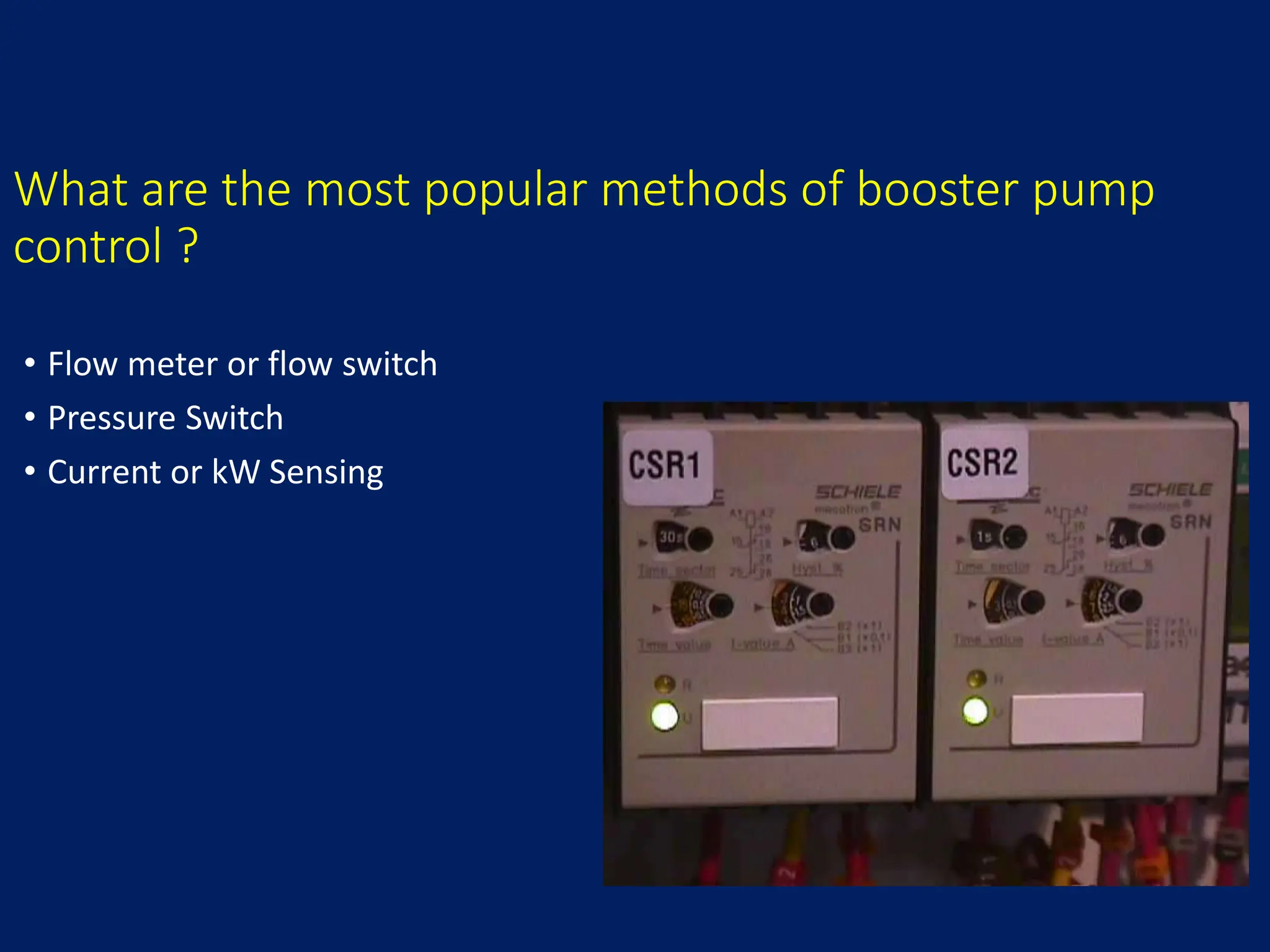
• Current or kW Sensing
Current Sensing
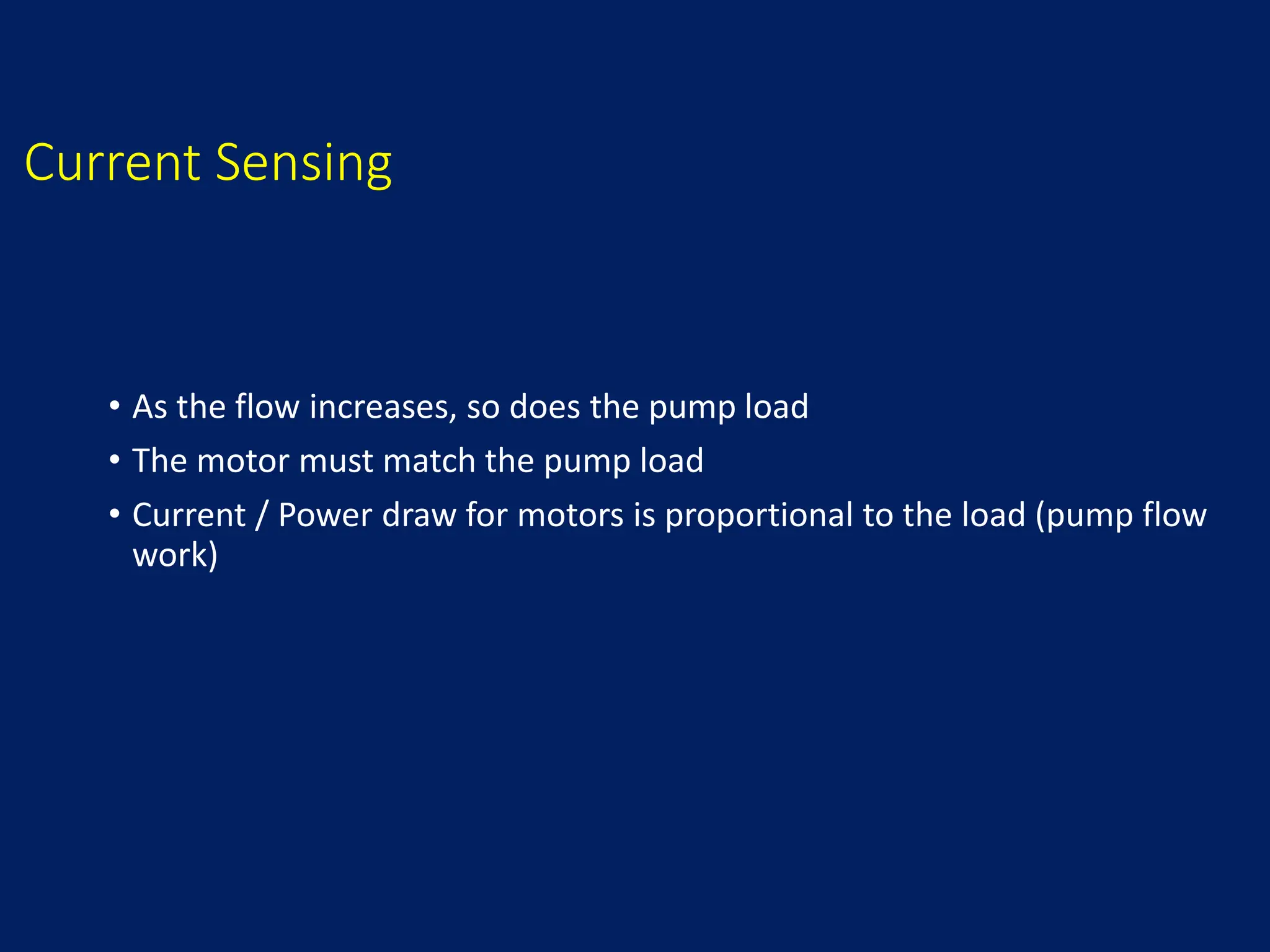
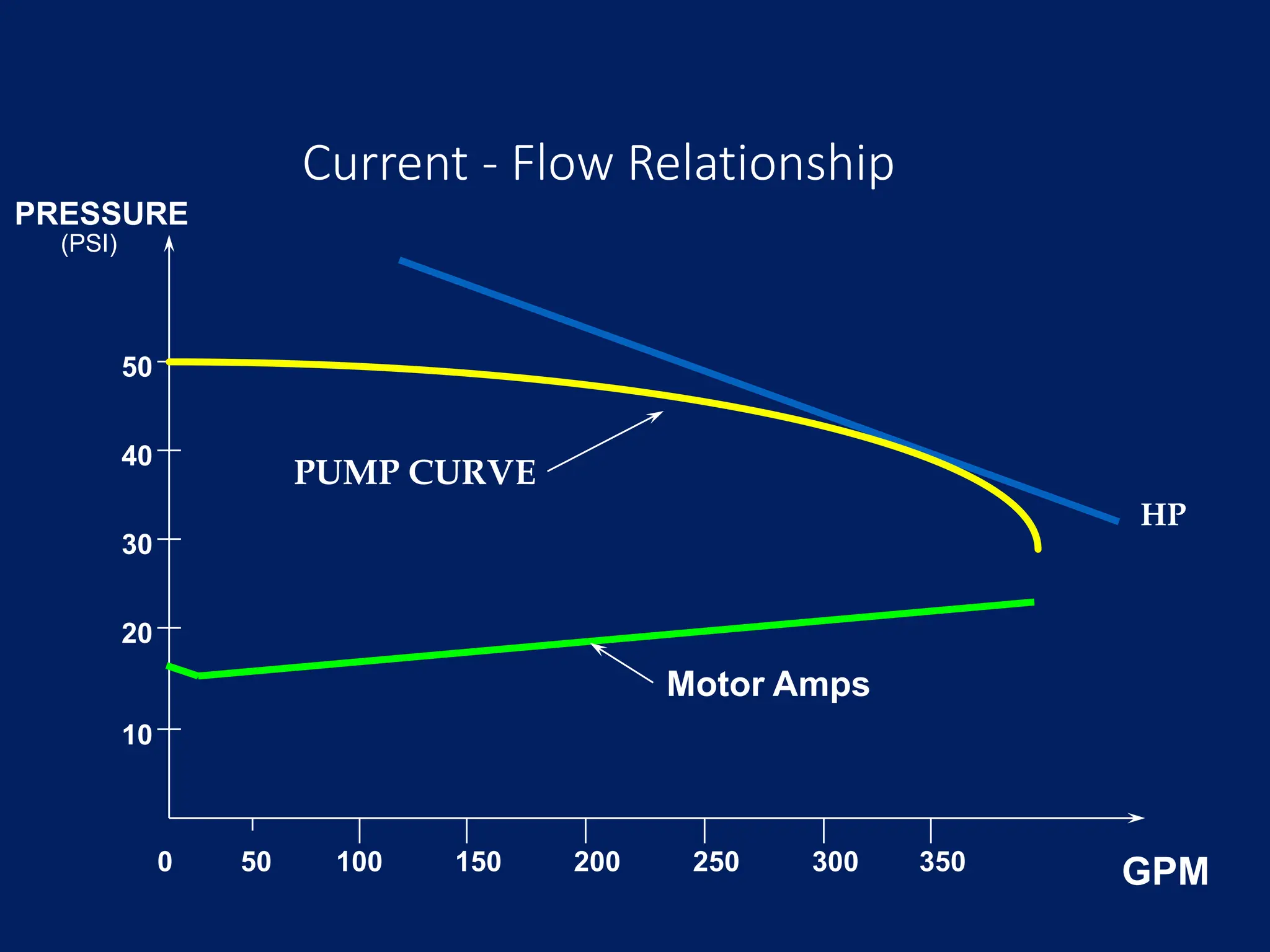
• As the flow increases, so does the pump load
• The motor must match the pump load
• Current / Power draw for motors is proportional to the load (pump flow
work)
Current - Flow Relationship
PRESSURE
10
20
30
40
50
50 100 150 200 250 300 350 GPM
Motor Amps
0
(PSI)
HP
PUMP CURVE
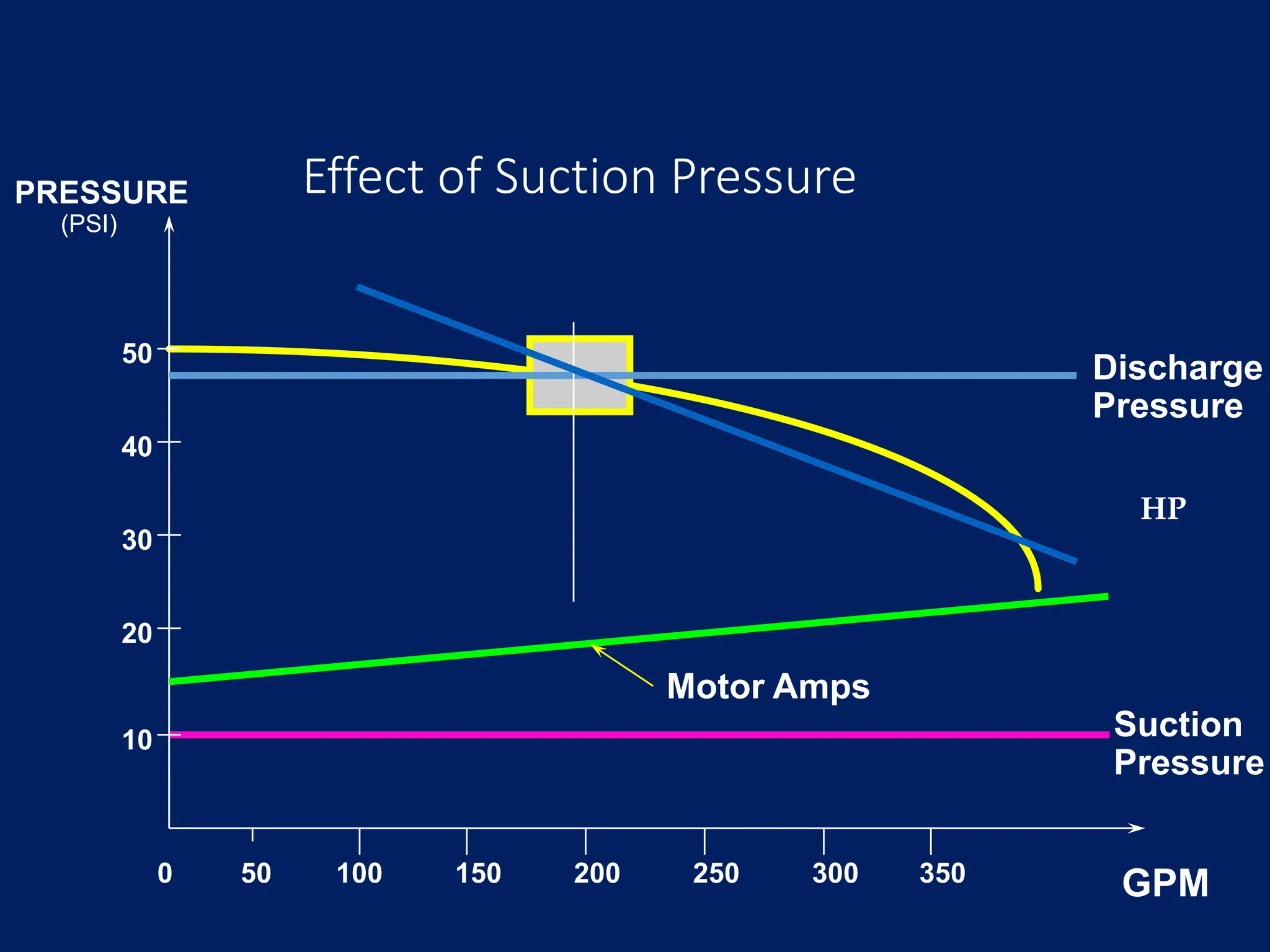
Effect of Suction Pressure
PRESSURE
10
20
30
40
50
50 100 150 200 250 300 350 GPM
Suction
Pressure
Discharge
Pressure
Motor Amps
0
(PSI)
HP
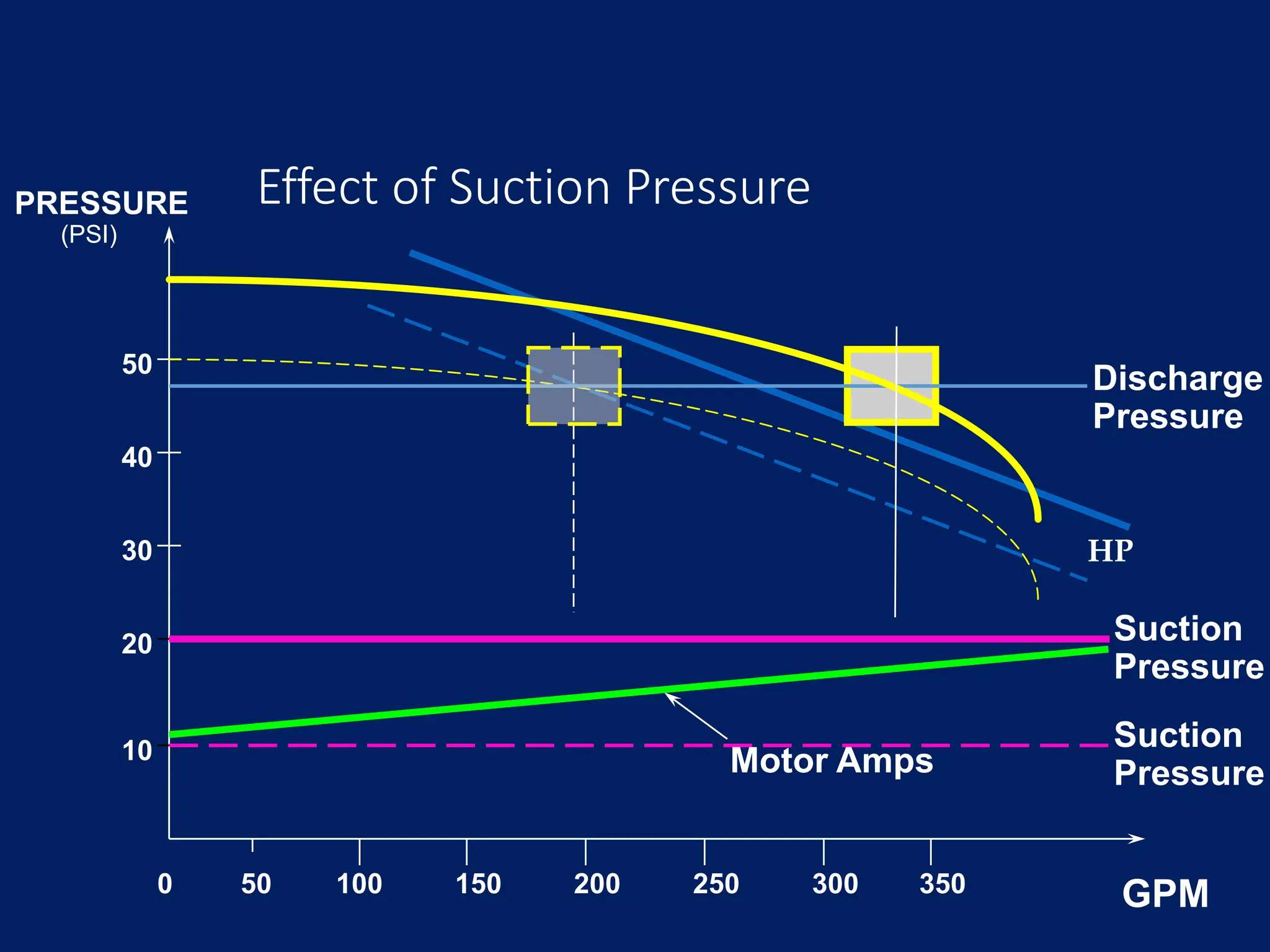
Effect of Suction Pressure
50
PRESSURE
10
20
30
40
50 100 150 200 250 300 350 GPM
Suction
Pressure
Suction
Pressure
Discharge
Pressure
Motor Amps
0
(PSI)
HP
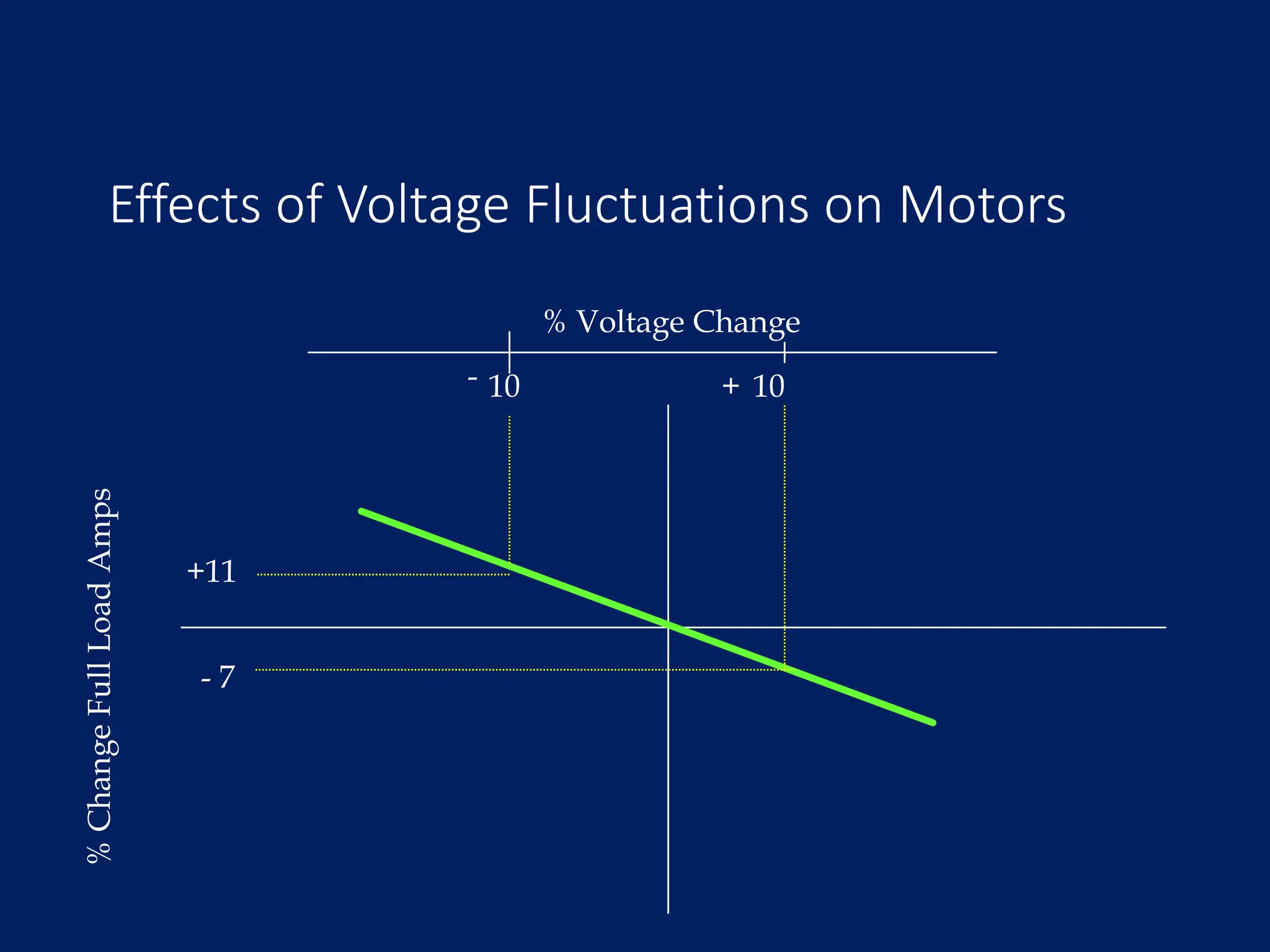
Effects of Voltage Fluctuations on Motors
% Voltage Change
10
+
10
-
%
Change
Full
Load
Amps
- 7
+11
Current Sensing
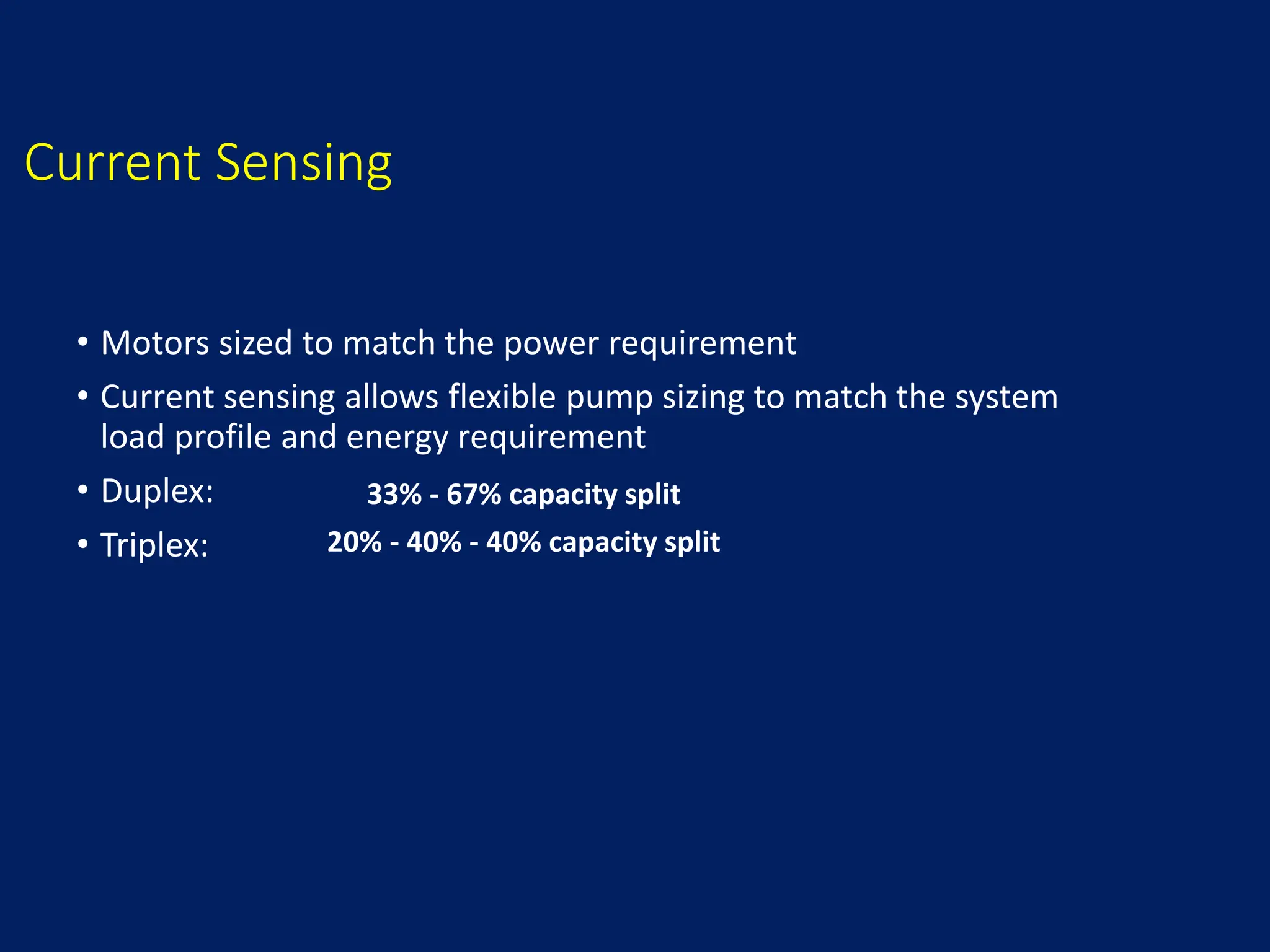
• Motors sized to match the power requirement
• Current sensing allows flexible pump sizing to match the system
load profile and energy requirement
• Duplex:
• Triplex:
33% - 67% capacity split
20% - 40% - 40% capacity split
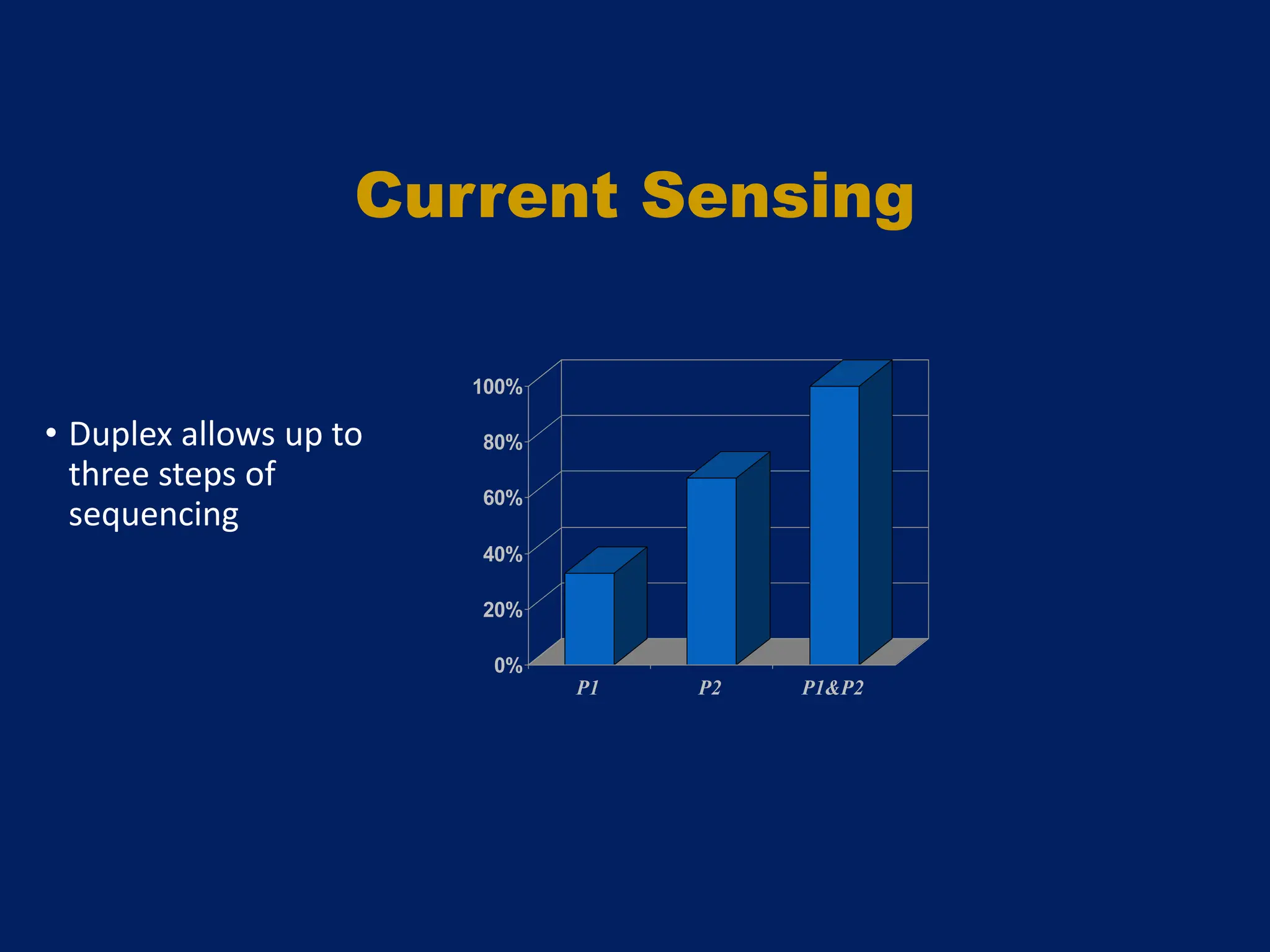
• Duplex allows up to
three steps of
sequencing
0%
20%
40%
60%
80%
100%
P1 P2 P1&P2
Current Sensing
Current Sensing
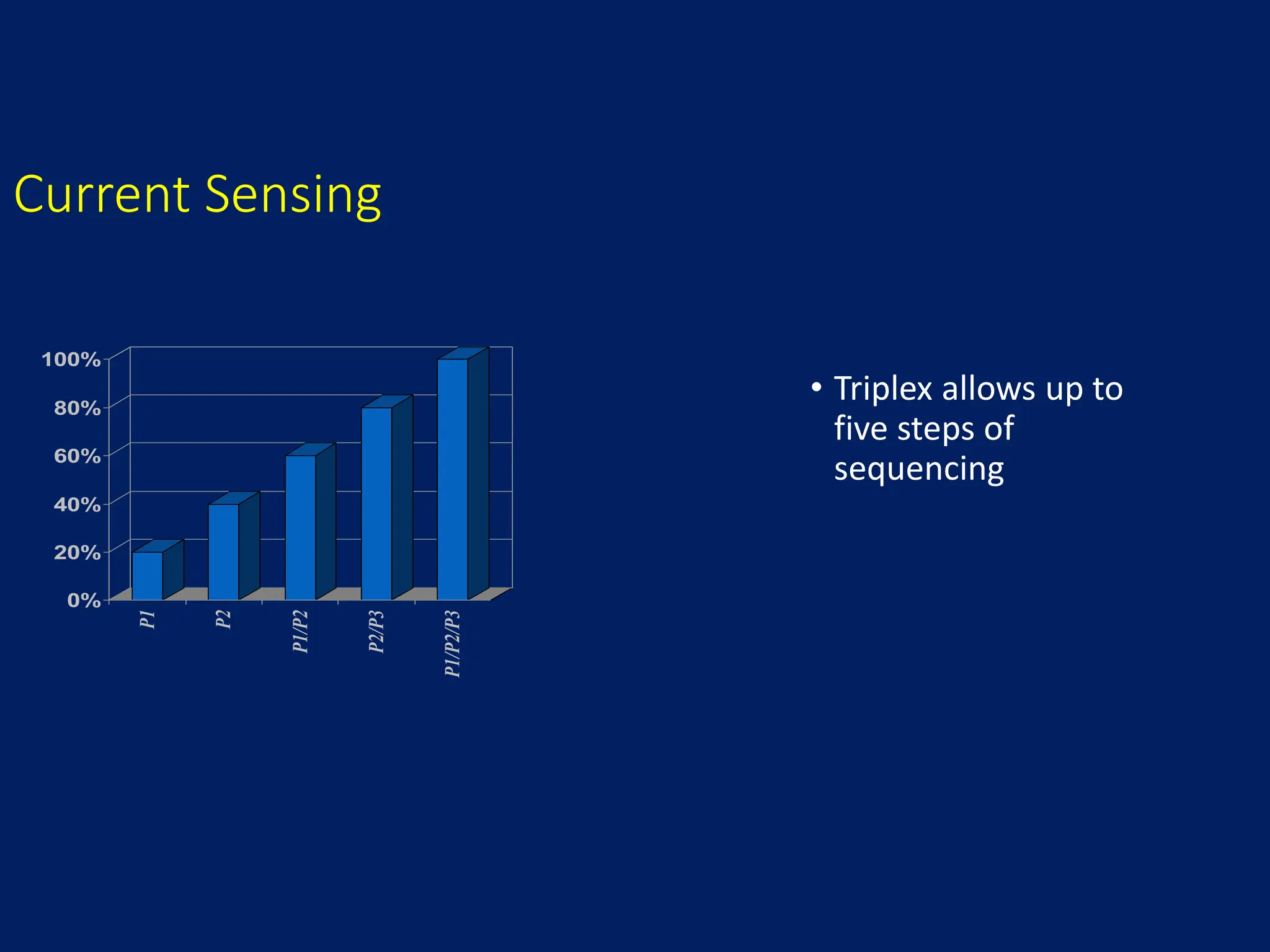
• Triplex allows up to
five steps of
sequencing
0%
20%
40%
60%
80%
100%
P1
P2
P1/P2
P2/P3
P1/P2/P3
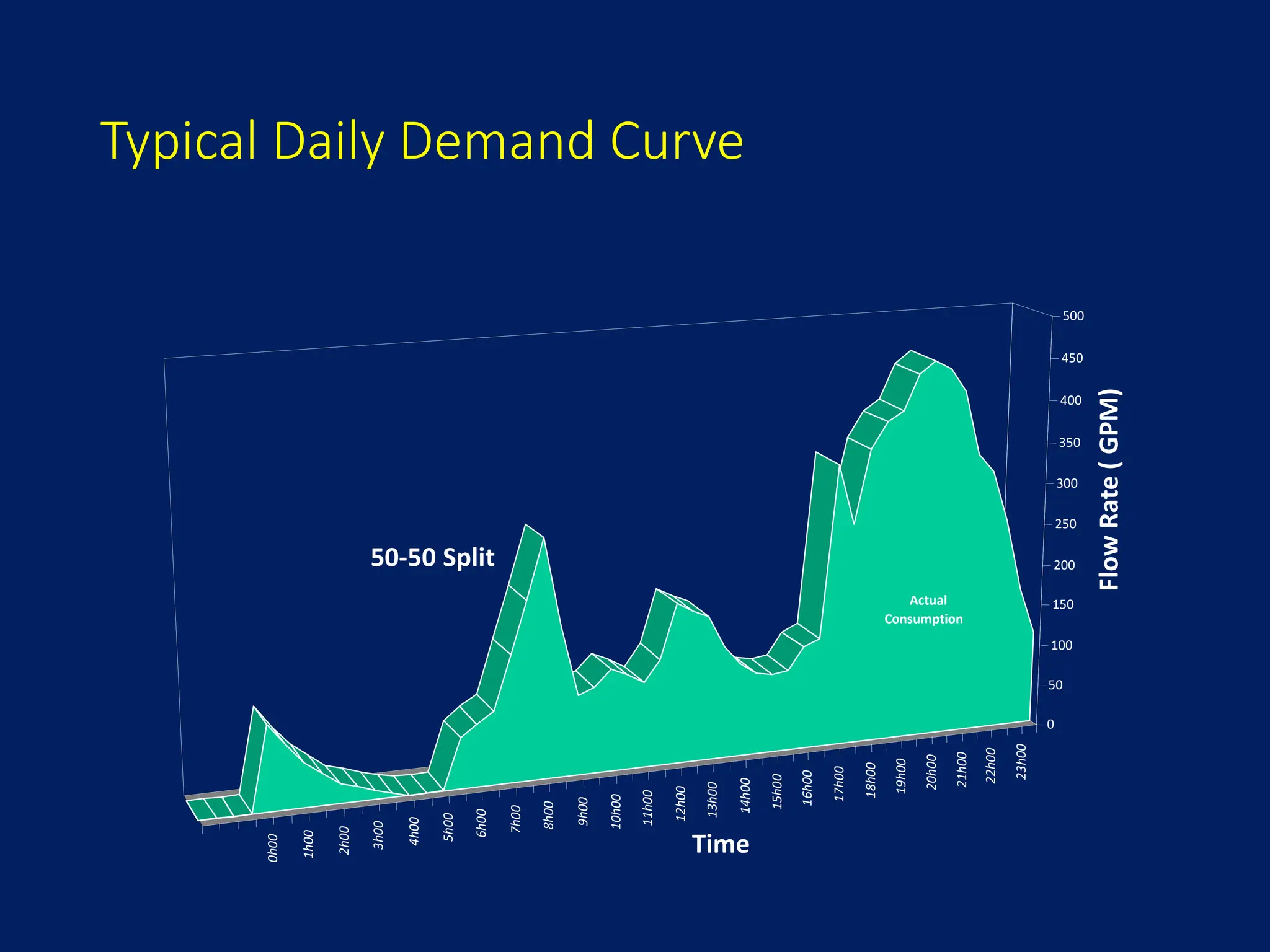
Typical Daily Demand Curve
0h00
1h00
2h00
3h00
4h00
5h00
6h00
7h00
8h00
9h00
10h00
11h00
12h00
13h00
14h00
15h00
16h00
17h00
18h00
19h00
20h00
21h00
22h00
23h00
0
50
100
150
200
250
300
350
400
450
500
Flow
Rate
(
GPM)
Time
Actual
Consumption
50-50 Split
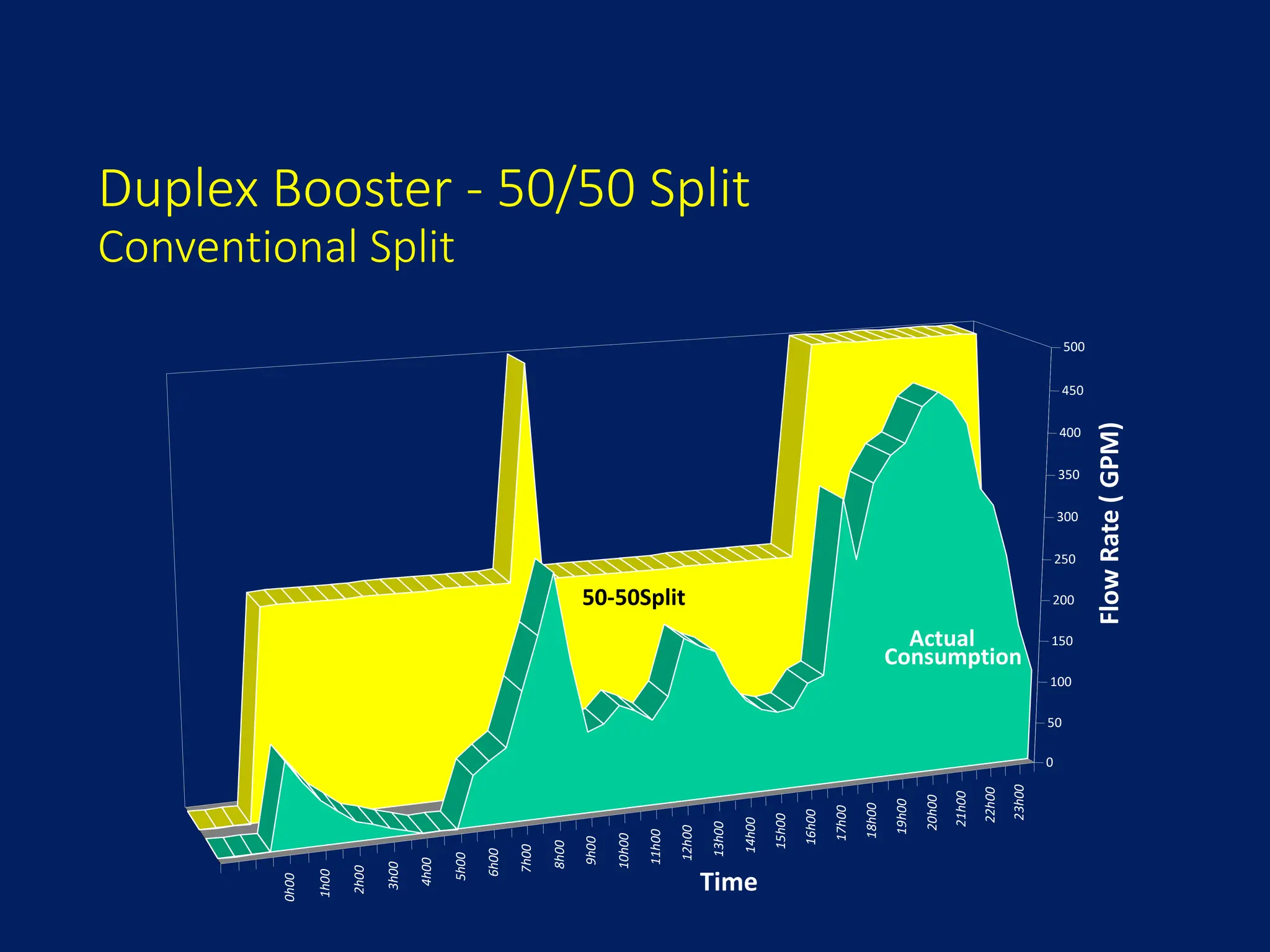
Duplex Booster - 50/50 Split
Conventional Split
0h00
1h00
2h00
3h00
4h00
5h00
6h00
7h00
8h00
9h00
10h00
11h00
12h00
13h00
14h00
15h00
16h00
17h00
18h00
19h00
20h00
21h00
22h00
23h00
0
50
100
150
200
250
300
350
400
450
500
Flow
Rate
(
GPM)
Time
Actual
Consumption
50-50Split
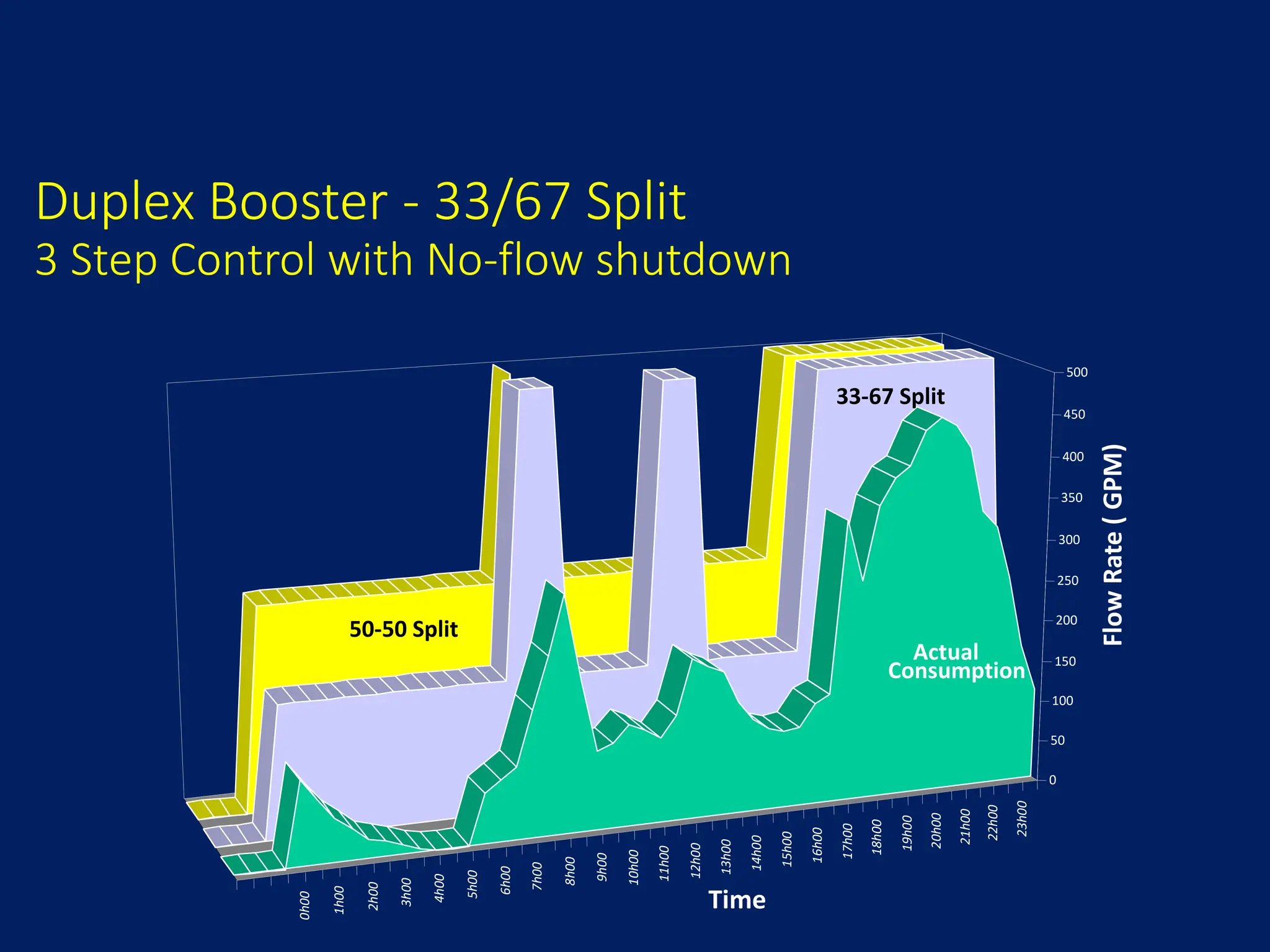
Duplex Booster - 33/67 Split
3 Step Control with No-flow shutdown
0h00
1h00
2h00
3h00
4h00
5h00
6h00
7h00
8h00
9h00
10h00
11h00
12h00
13h00
14h00
15h00
16h00
17h00
18h00
19h00
20h00
21h00
22h00
23h00
0
50
100
150
200
250
300
350
400
450
500
Flow
Rate
(
GPM)
Time
Actual
Consumption
33-67 Split
50-50 Split
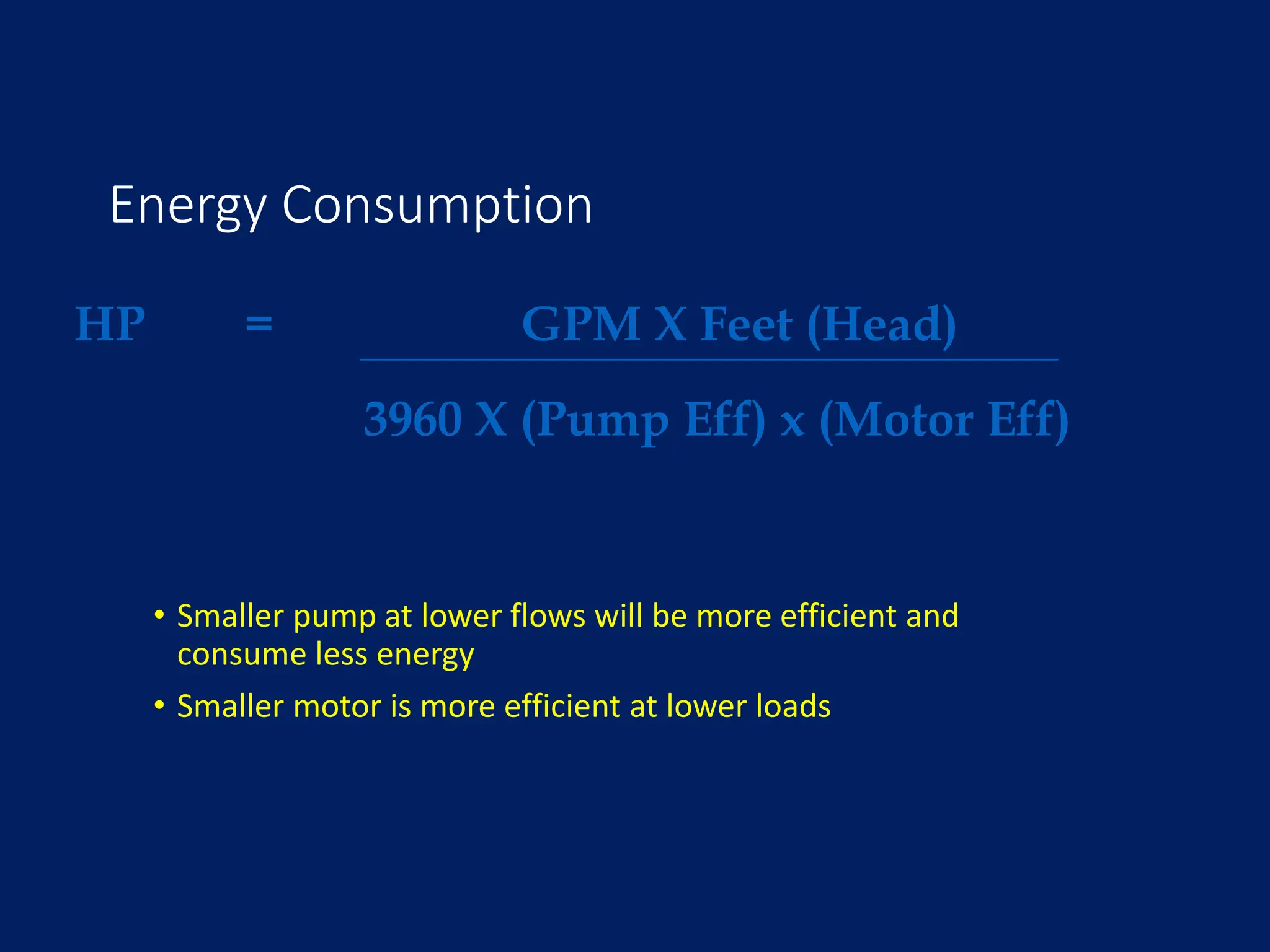
Energy Consumption
• Smaller pump at lower flows will be more efficient and
consume less energy
• Smaller motor is more efficient at lower loads
HP = GPM X Feet (Head)
3960 X (Pump Eff) x (Motor Eff)
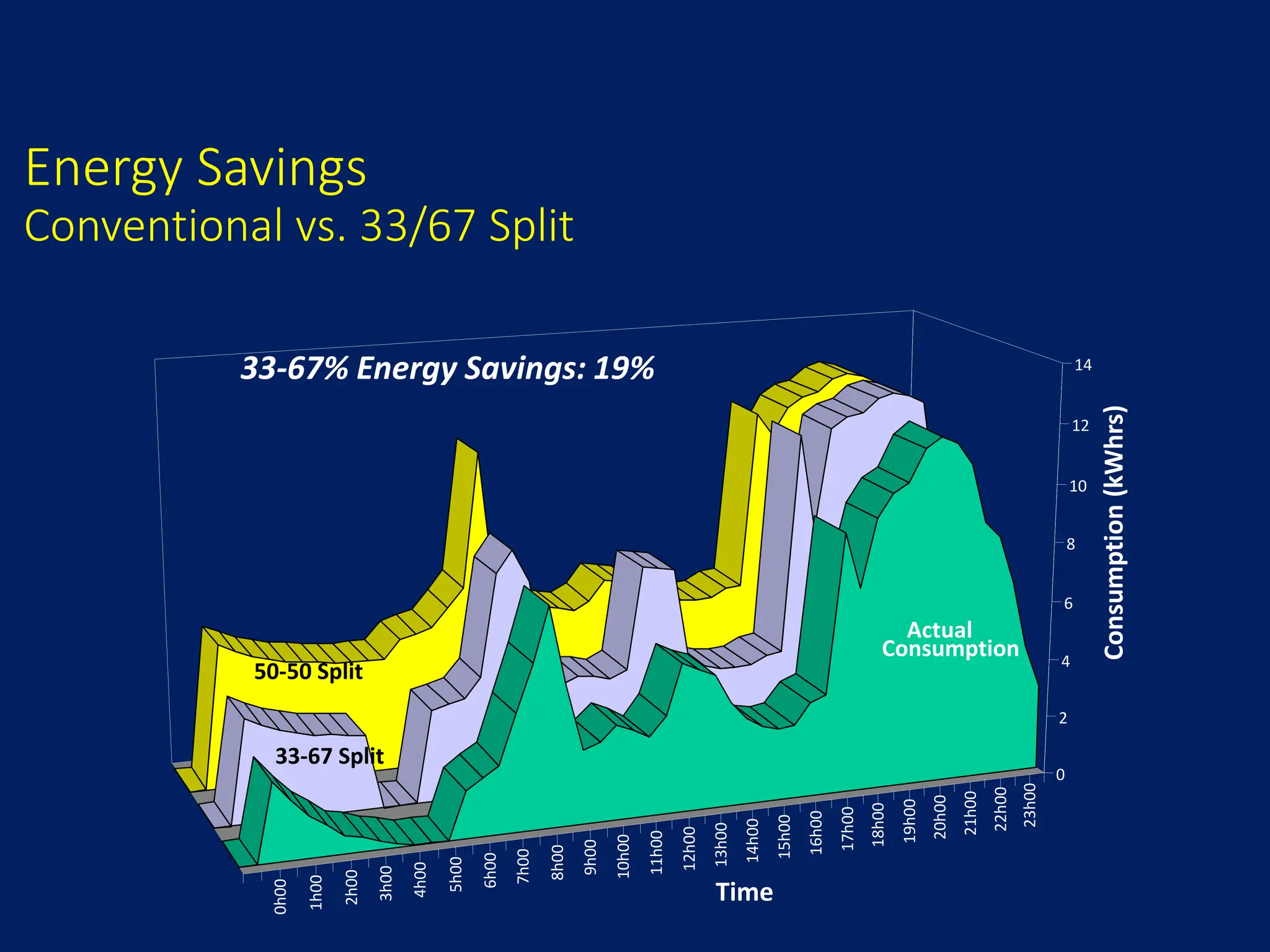
Energy Savings
Conventional vs. 33/67 Split
0h00
1h00
2h00
3h00
4h00
5h00
6h00
7h00
8h00
9h00
10h00
11h00
12h00
13h00
14h00
15h00
16h00
17h00
18h00
19h00
20h00
21h00
22h00
23h00
0
2
4
6
8
10
12
14
Consumption
(kWhrs)
Time
Actual
Consumption
33-67 Split
50-50 Split
33-67% Energy Savings: 19%
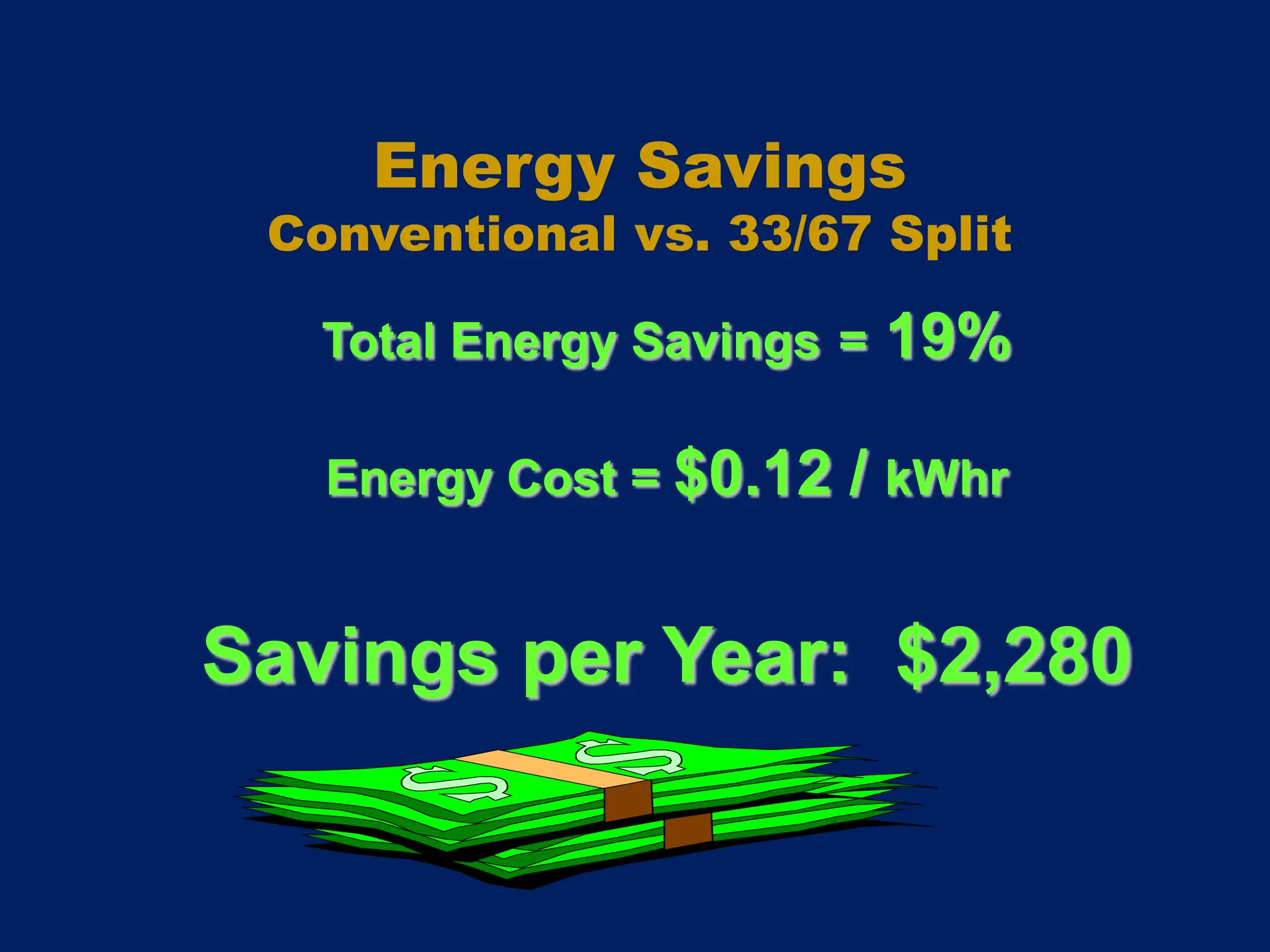
Total Energy Savings = 19%
Energy Cost = $0.12 / kWhr
Savings per Year: $2,280
Energy Savings
Conventional vs. 33/67 Split
What are the most popular methods of booster pump
control ?
• Flow meter or flow switch
• Pressure Switch
• Current or kW Sensing
• VFD with pressure transducers
No-Flow Shutdown and Tank Sizing
When do you use it? Where should you install it? What size should
it be?
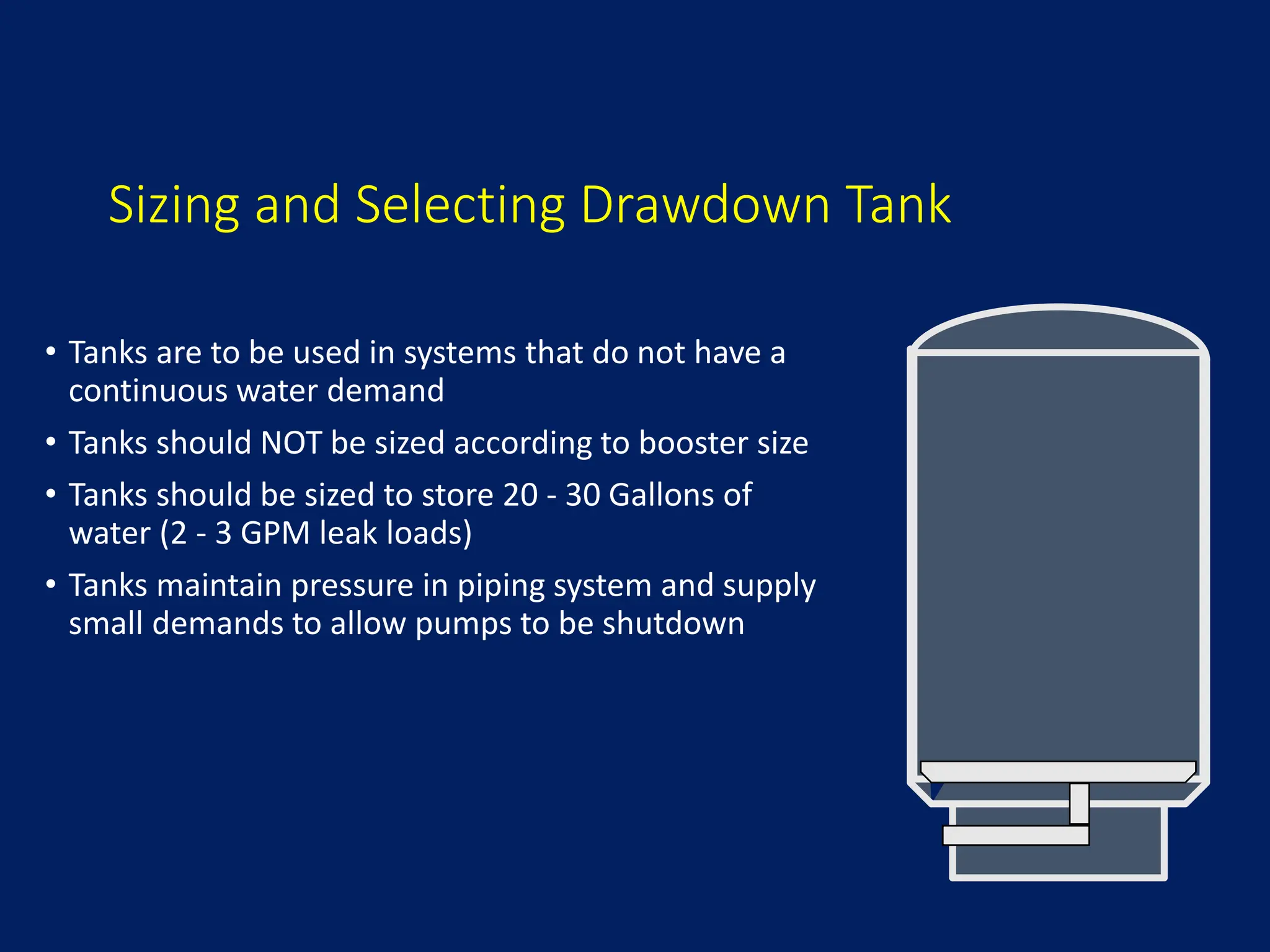
Sizing and Selecting Drawdown Tank
• Tanks are to be used in systems that do not have a
continuous water demand
• Tanks should NOT be sized according to booster size
• Tanks should be sized to store 20 - 30 Gallons of
water (2 - 3 GPM leak loads)
• Tanks maintain pressure in piping system and supply
small demands to allow pumps to be shutdown
Sizing and Selecting Drawdown Tank
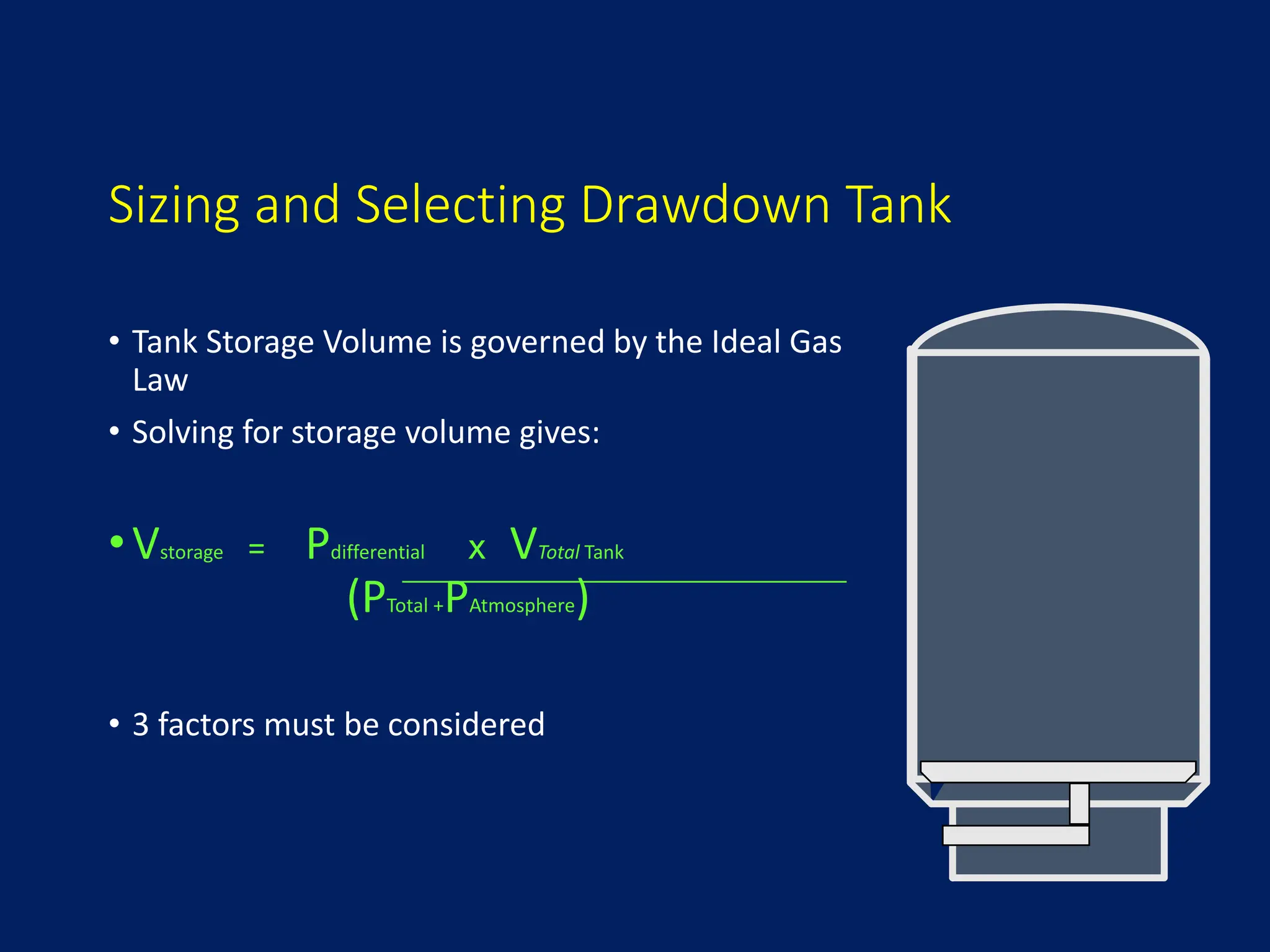
• Tank Storage Volume is governed by the Ideal Gas
Law
• Solving for storage volume gives:
•Vstorage = Pdifferential x VTotal Tank
(PTotal +PAtmosphere)
• 3 factors must be considered
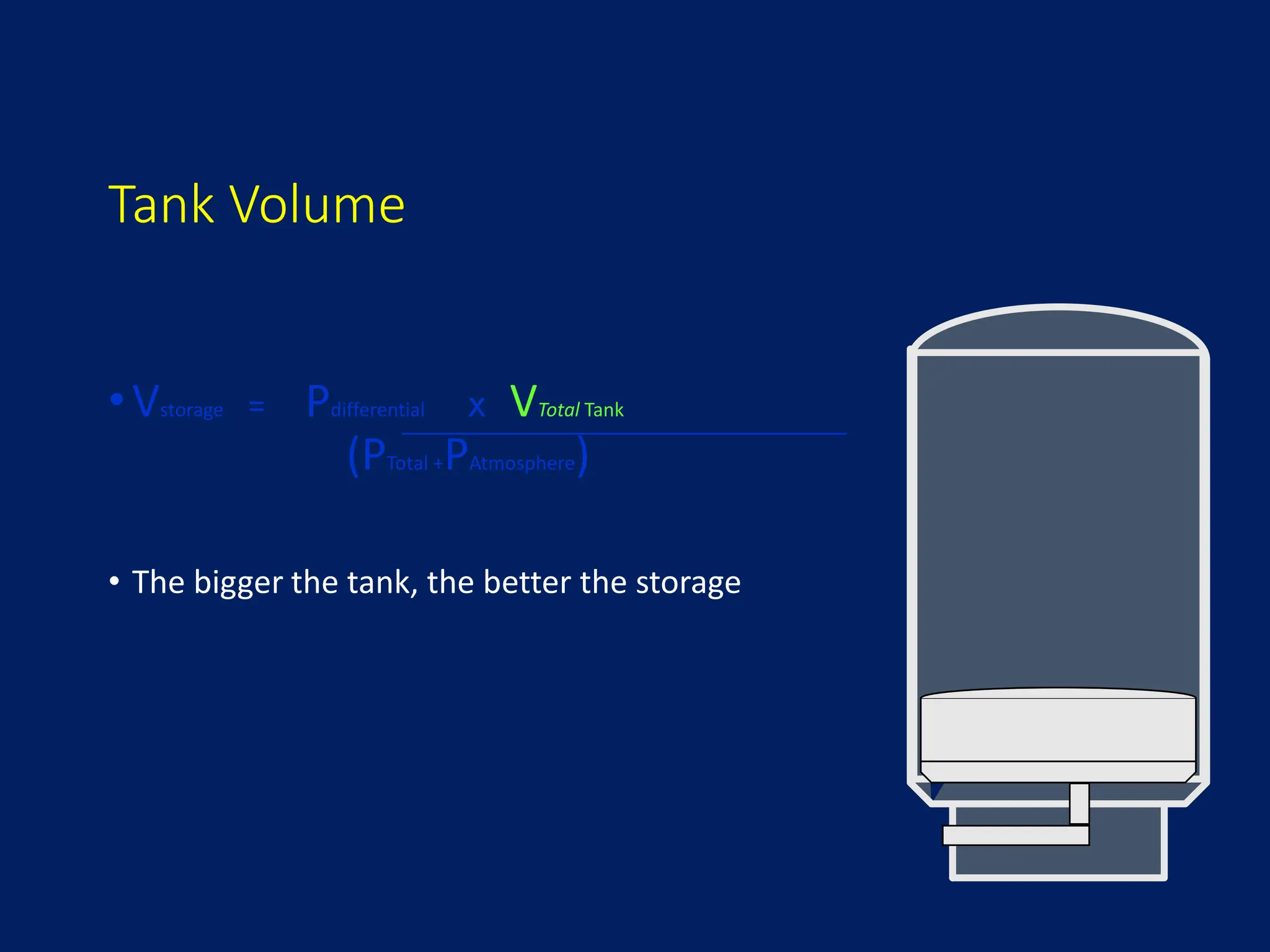
Tank Volume
•Vstorage = Pdifferential x VTotal Tank
(PTotal +PAtmosphere)
• The bigger the tank, the better the storage
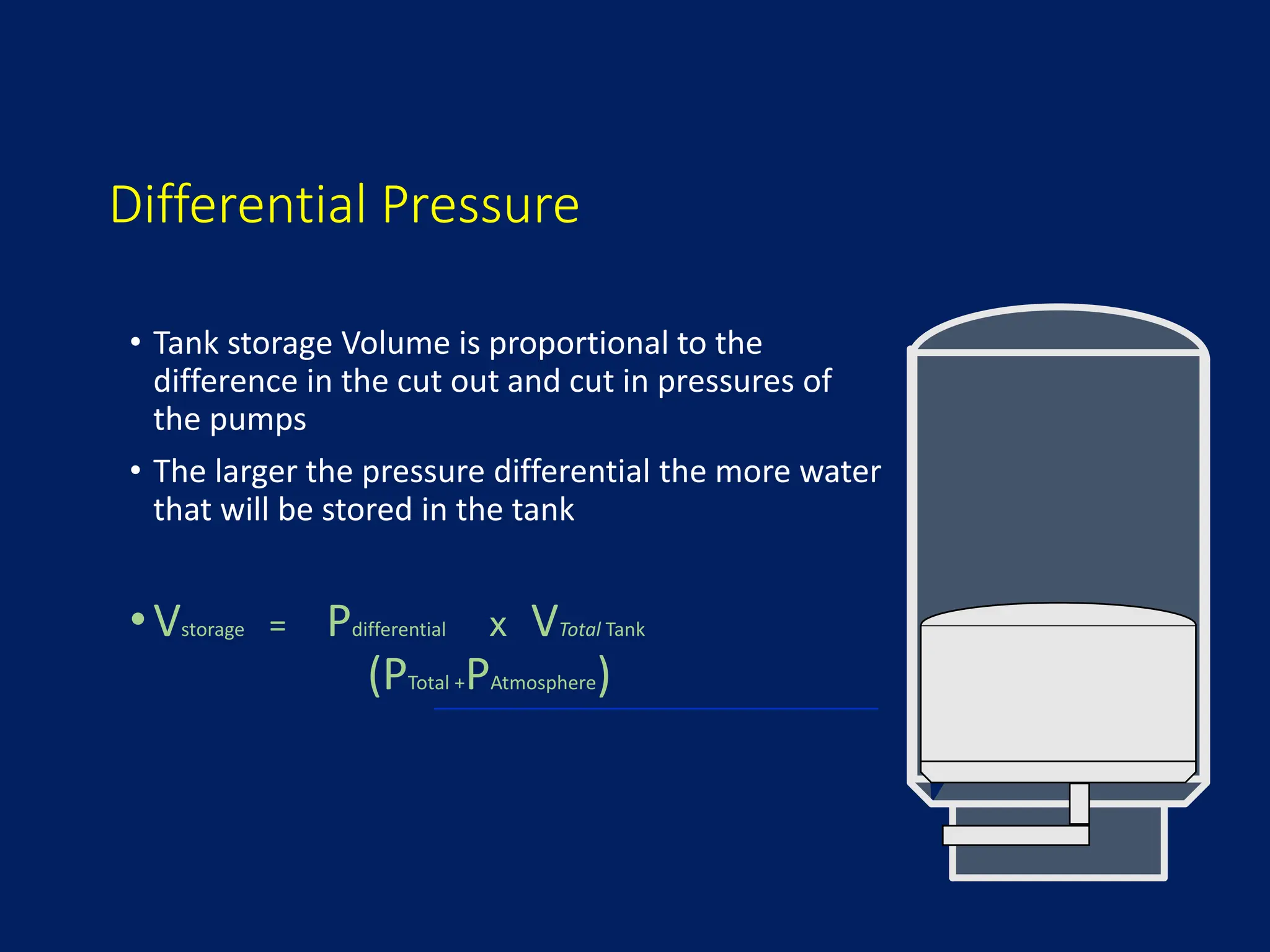
Differential Pressure
• Tank storage Volume is proportional to the
difference in the cut out and cut in pressures of
the pumps
• The larger the pressure differential the more water
that will be stored in the tank
•Vstorage = Pdifferential x VTotal Tank
(PTotal +PAtmosphere)
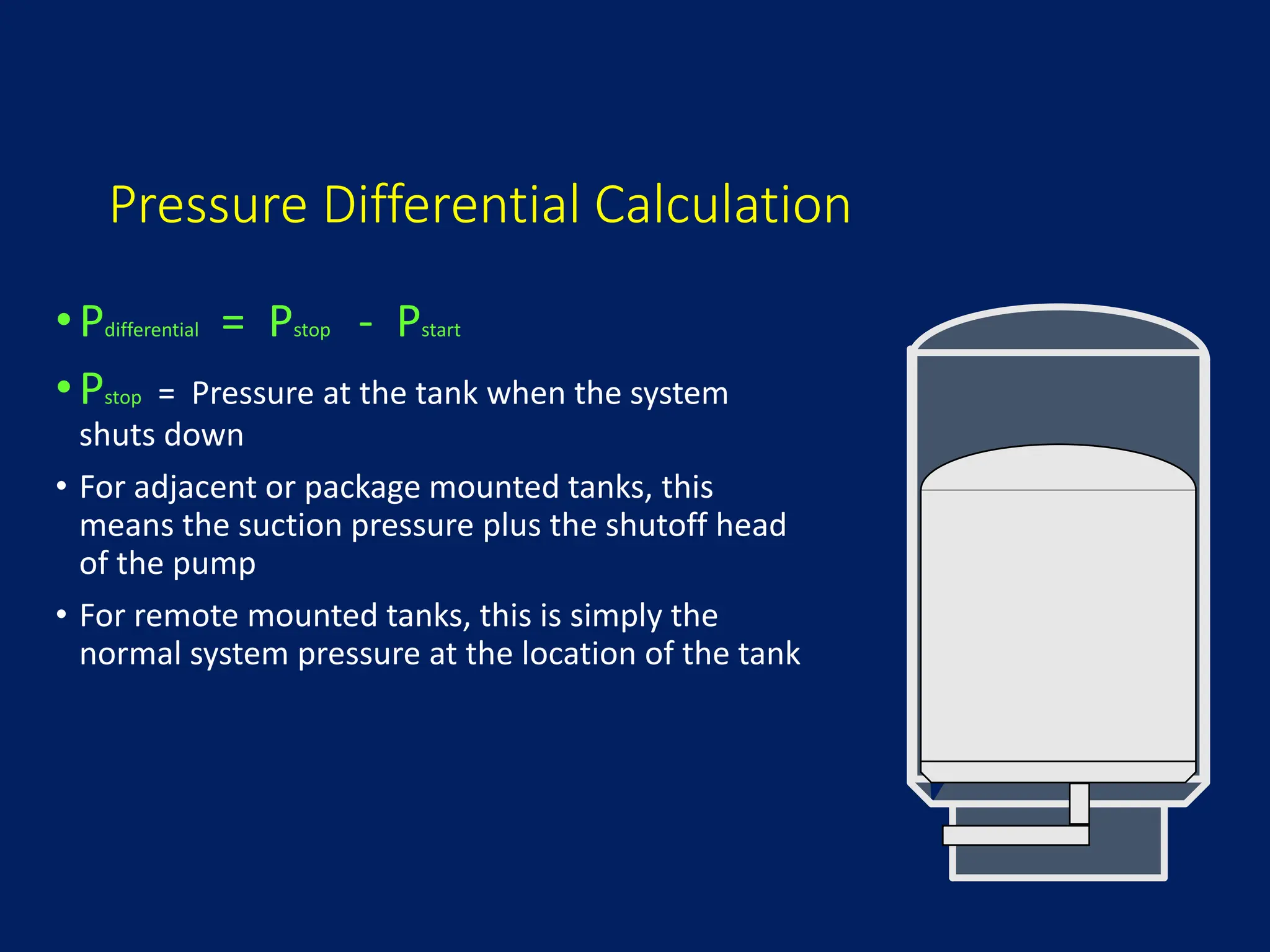
Pressure Differential Calculation
•Pdifferential = Pstop - Pstart
•Pstop = Pressure at the tank when the system
shuts down
• For adjacent or package mounted tanks, this
means the suction pressure plus the shutoff head
of the pump
• For remote mounted tanks, this is simply the
normal system pressure at the location of the tank
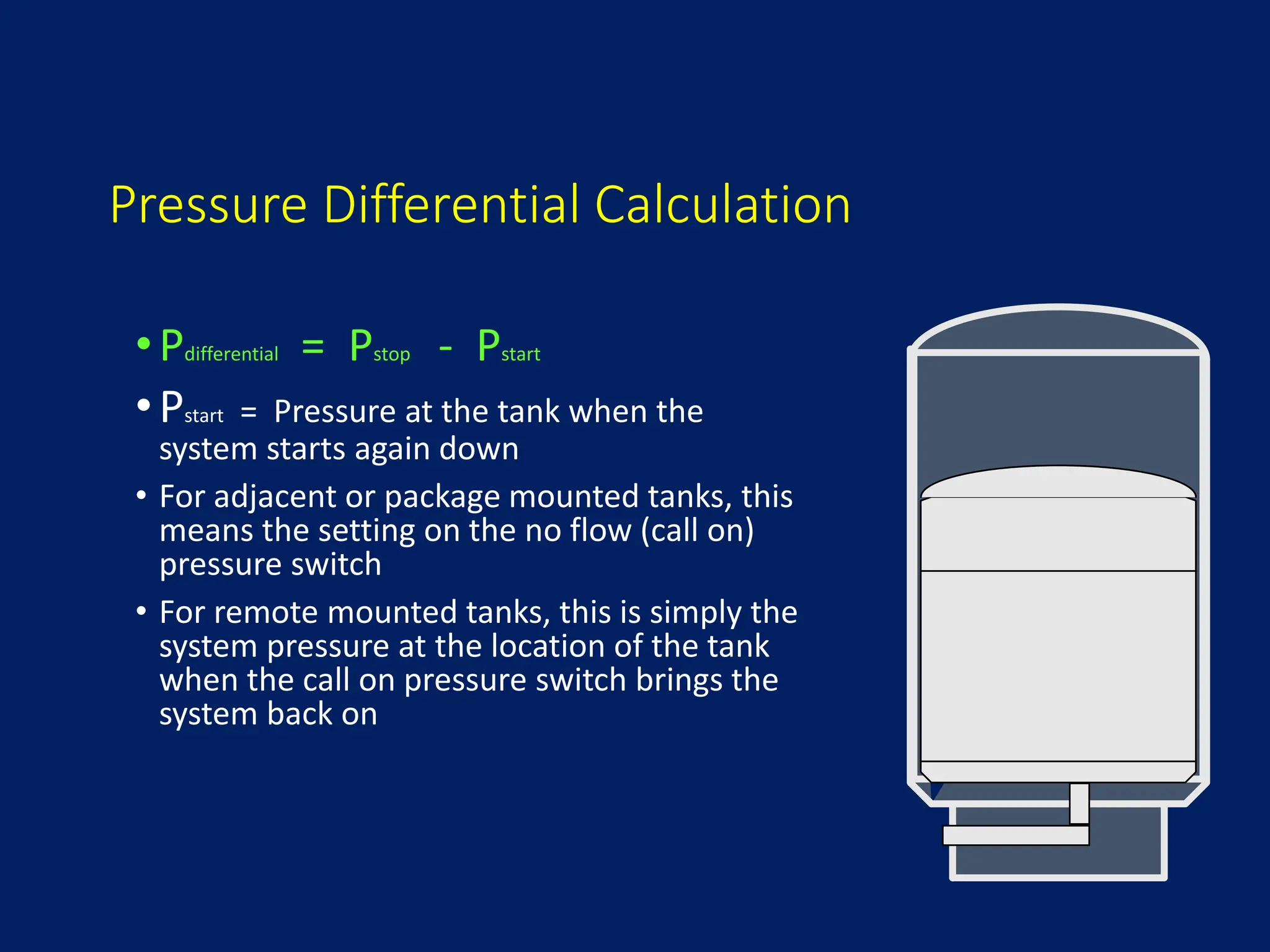
Pressure Differential Calculation
•Pdifferential = Pstop - Pstart
•Pstart = Pressure at the tank when the
system starts again down
• For adjacent or package mounted tanks, this
means the setting on the no flow (call on)
pressure switch
• For remote mounted tanks, this is simply the
system pressure at the location of the tank
when the call on pressure switch brings the
system back on
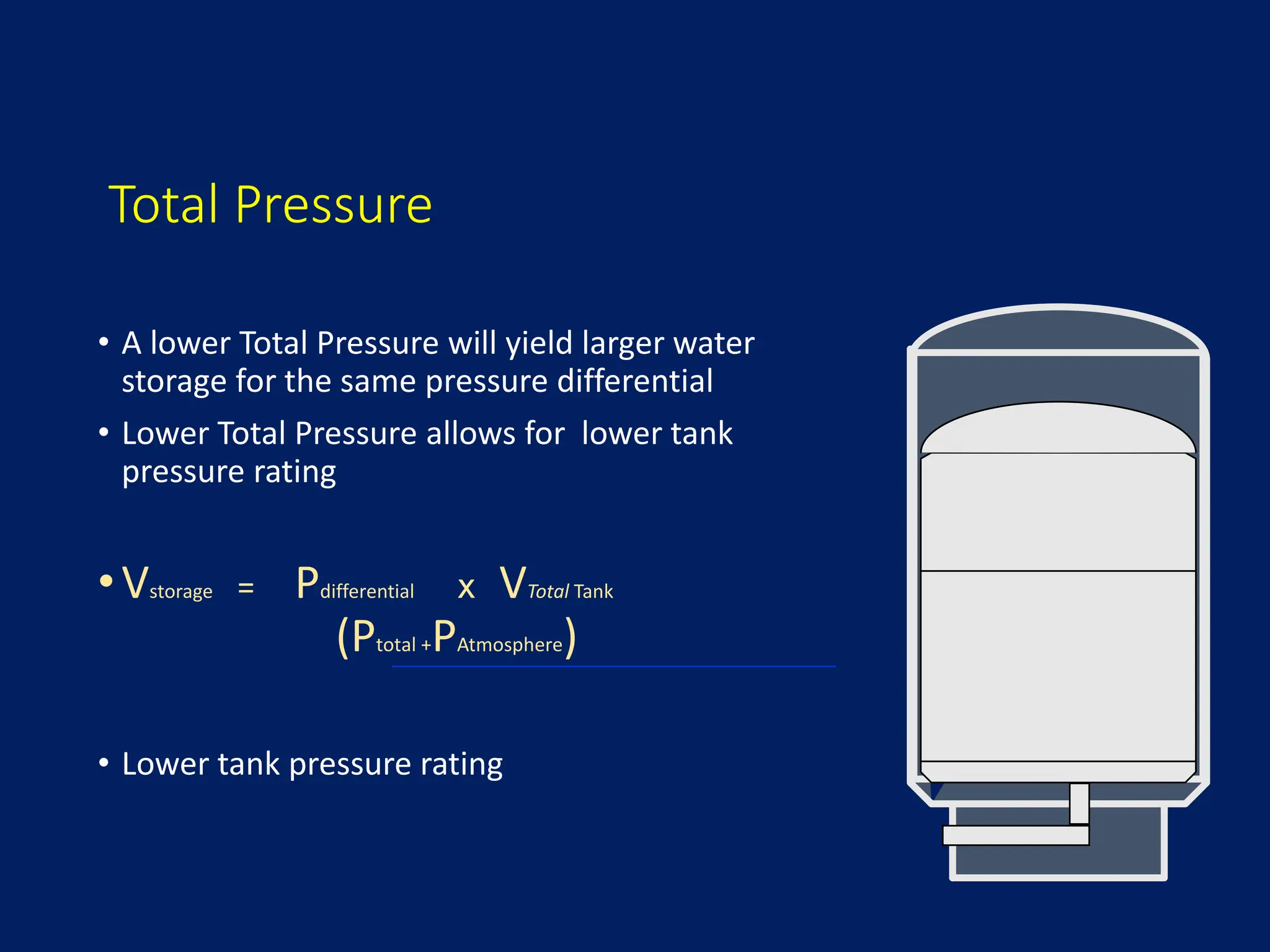
Total Pressure
• A lower Total Pressure will yield larger water
storage for the same pressure differential
• Lower Total Pressure allows for lower tank
pressure rating
•Vstorage = Pdifferential x VTotal Tank
(Ptotal +PAtmosphere)
• Lower tank pressure rating
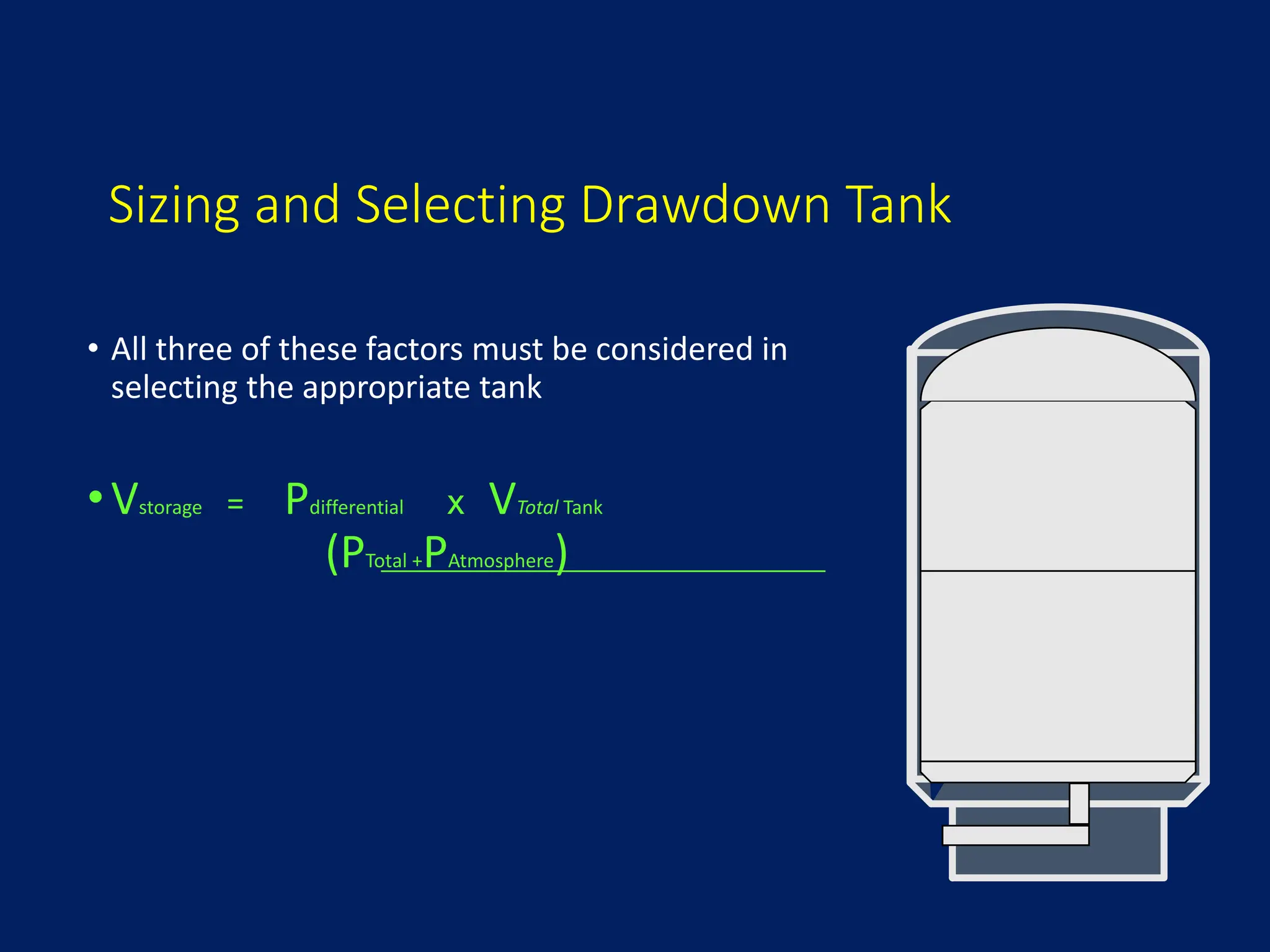
Sizing and Selecting Drawdown Tank
• All three of these factors must be considered in
selecting the appropriate tank
•Vstorage = Pdifferential x VTotal Tank
(PTotal +PAtmosphere)
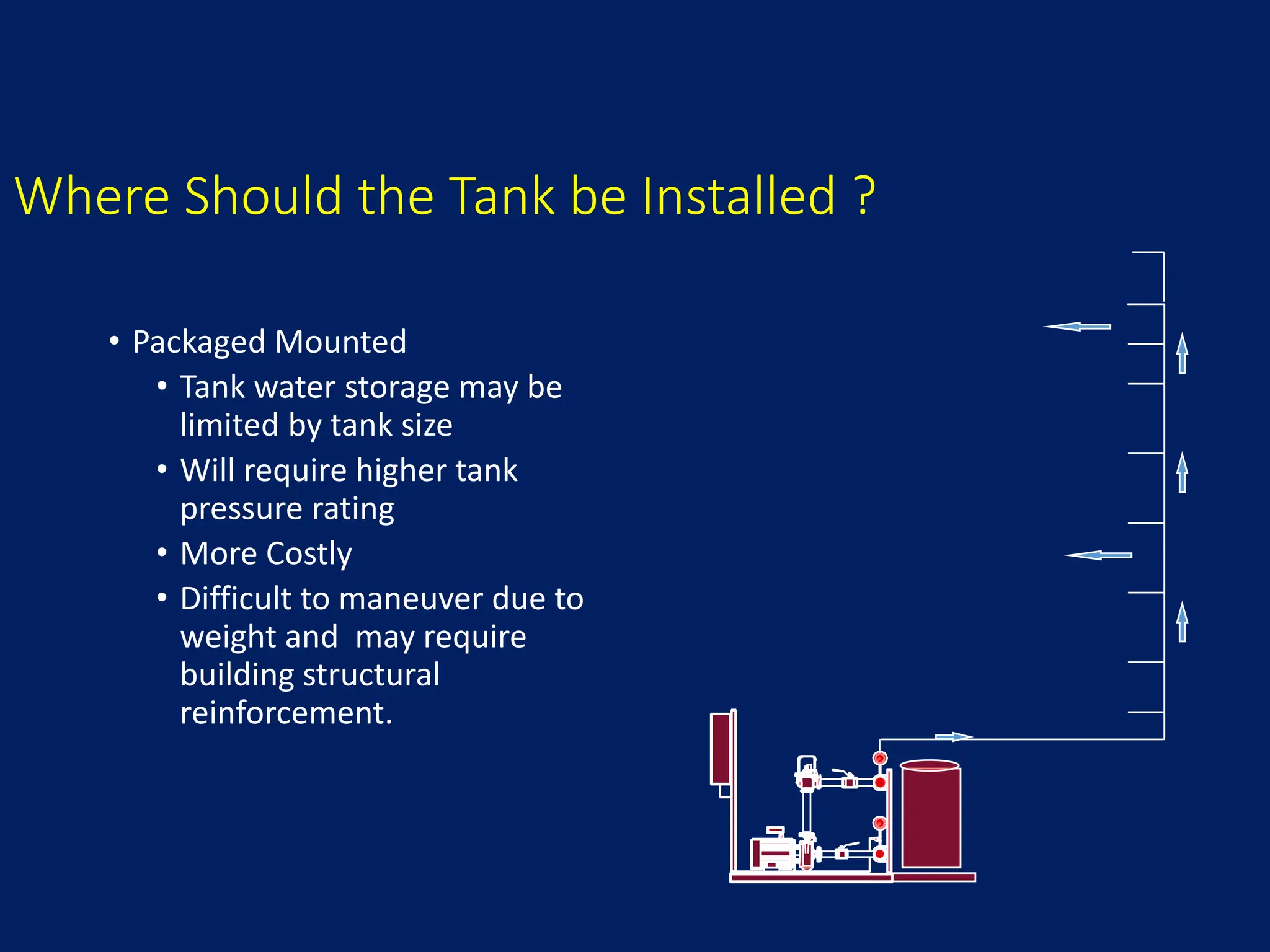
Where Should the Tank be Installed ?
• Packaged Mounted
• Tank water storage may be
limited by tank size
• Will require higher tank
pressure rating
• More Costly
• Difficult to maneuver due to
weight and may require
building structural
reinforcement.
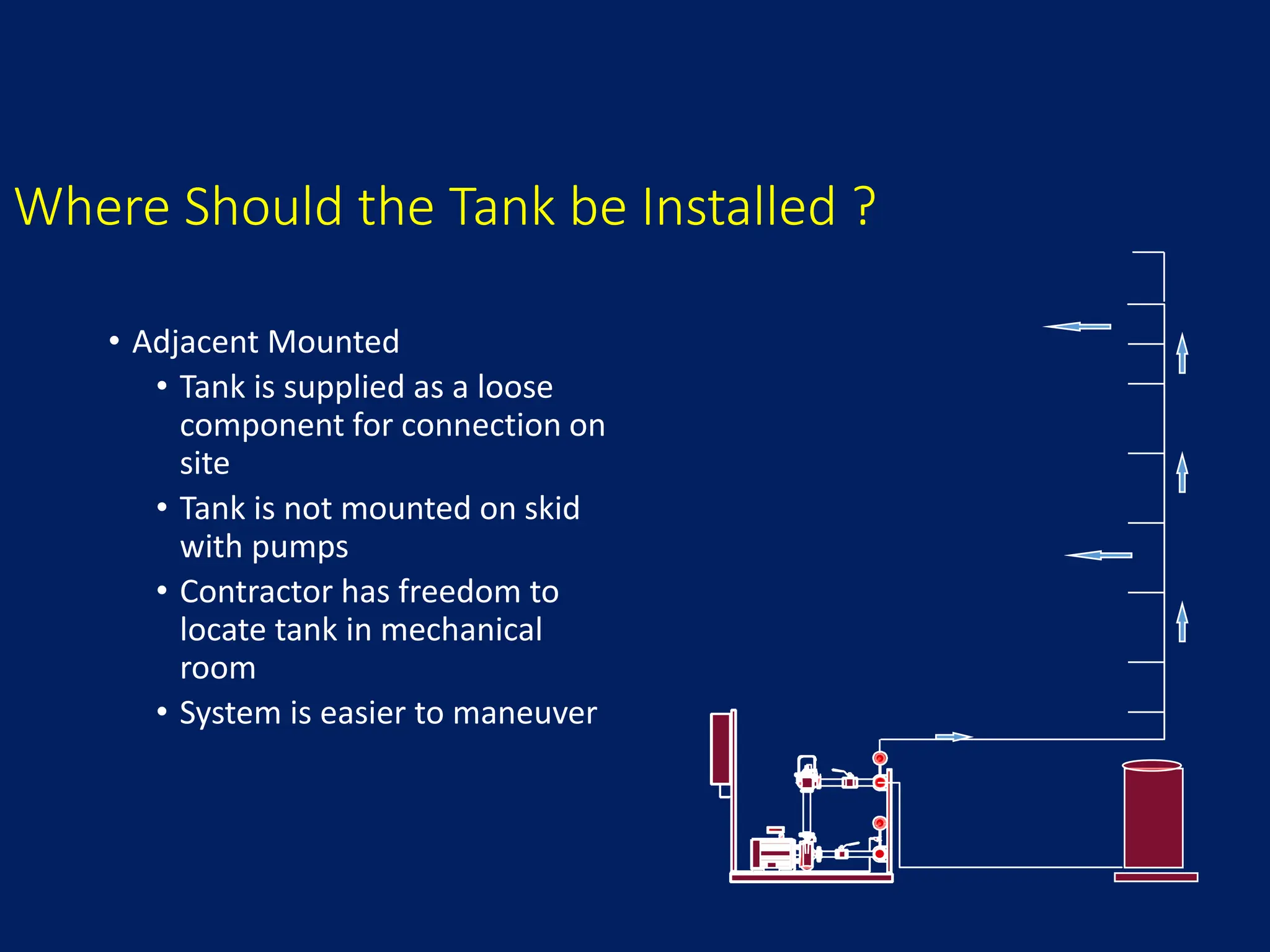
Where Should the Tank be Installed ?
• Adjacent Mounted
• Tank is supplied as a loose
component for connection on
site
• Tank is not mounted on skid
with pumps
• Contractor has freedom to
locate tank in mechanical
room
• System is easier to maneuver
Where Should the Tank be Installed?
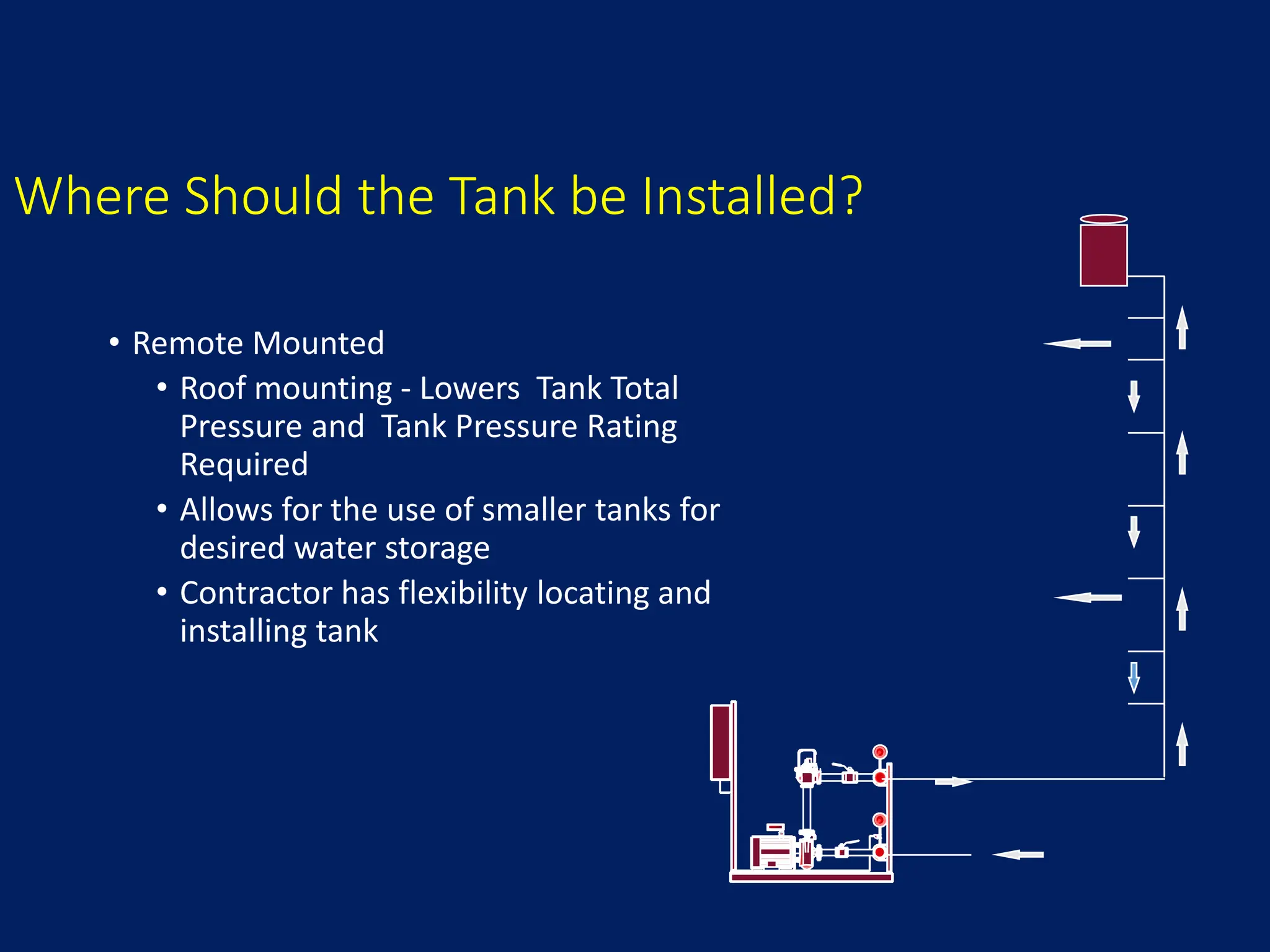
• Remote Mounted
• Roof mounting - Lowers Tank Total
Pressure and Tank Pressure Rating
Required
• Allows for the use of smaller tanks for
desired water storage
• Contractor has flexibility locating and
installing tank
Questions
&
Answers
Thank You

278294153-Booster-Basics-Presentation-ppt - Copy.ppt

  • 1.
  • 2.
    Pressure Booster Systems •WHAT IS A BOOSTER SYSTEM? • BOOSTER SIZING REQUIREMENTS • BOOSTER SYSTEM CONTROL • ENERGY SAVING STRATEGIES • DRAWDOWN TANKS
  • 3.
    What is aPressure Booster System? • All components mounted on a common base, tested and calibrated to site conditions Sunday, July 7, 2024 Pumps Control Panel Headers, Piping and Isolation Valves, Pressure gauges, Solenoid Valve, Pressure Sensor. Pressure Reducing Valves Diaphragm Pressure Tank
  • 4.
    What you needto size a booster system? • Calculate the total flow requirement for the building • Number of Domestic Water Fixtures • Type of fixtures in the building • Type of building (residential, public, heavy use) • Special services
  • 5.
    Total Flow =Total Fixture Units 100 100 100 100 50 50 50 50 Fixture Units GPM HUNTERS CURVE
  • 6.
    What you needto size a booster system? • Calculate the total flow requirement for the building • Calculate the total pressure required for the building
  • 7.
    Static Pressure • Basedon the vertical boost required above the packaged system manifold • This component never varies Pstat
  • 8.
    Fixture Pressure • Requiredpressure to operate fixture at farthest point from system. • Must overcome valve “start-up” pressure (i.e. 25 PSI min. required for flush valves to operate) • Never varies, this is always required as a minimum Pfix
  • 9.
    Packaged System Losses •Systems are designed to have no more than 5psi loss from suction manifold to discharge manifold • This must always be added into pressure calculations Ploss
  • 10.
    Available Suction Pressure •Typically varies by about 10-30 PSI • Can vary over time due to growth • Can also vary due to municipal re- structuring Pcity
  • 11.
    Friction Losses • Usuallycalculated at 10% of total static requirement • Typically a very small boost pressure component • Can be larger as in the case of boost over a “campus-style” area or large low-rise building Pfric
  • 12.
    Pressure Requirement Supply pressureafter water meter Friction Head Static head PRV Losses Fixture pressure Pump Boost Pressure E D C B A System Pressure
  • 13.
    Pressure Requirement Pump BoostPressure (TDH) = Fixture Pressure + Package Losses + Static Head + Friction Head - Supply Pressure
  • 14.
    Pressure Requirement Boost Pressure =System Pressure - Supply Pressure
  • 15.
    Significance of SystemFlow in Booster Systems • Flow impacts system demand, not pressure - as demand increases, flow must increase at a constant output pressure • Flow governs pump actuation - therefore, flow should govern pump sequencing and actuation • System capacity matched to system flow requirement is most efficient and cost effective for domestic water pressure boosting
  • 16.
    What are themost popular methods of booster pump control ? • Flow meter or flow switch • Instrument is in contact with corrosive water therefore requiring more maintenance
  • 17.
    What are themost popular methods of booster pump control ? • Flow meter or flow switch • Pressure Switch • Requires non-overloading (NOL) motors • Requires a pressure drop across operating range • Can be unstable in operation resulting in “starving” the system of water (end of curve operation) • Mechanical switches increase possibility of failure
  • 18.
    Effect of SuctionPressure PRESSURE 10 20 30 40 50 50 100 150 200 250 300 350 GPM Suction Pressure Discharge Pressure 0 (PSI) HP
  • 19.
    Effect of SuctionPressure 50 PRESSURE 10 20 30 40 50 100 150 200 250 300 350 GPM Suction Pressure Suction Pressure Discharge Pressure 0 (PSI) HP
  • 20.
    What are themost popular methods of booster pump control ? • Flow meter or flow switch • Pressure Switch • Current or kW Sensing
  • 21.
    Current Sensing • Asthe flow increases, so does the pump load • The motor must match the pump load • Current / Power draw for motors is proportional to the load (pump flow work)
  • 22.
    Current - FlowRelationship PRESSURE 10 20 30 40 50 50 100 150 200 250 300 350 GPM Motor Amps 0 (PSI) HP PUMP CURVE
  • 23.
    Effect of SuctionPressure PRESSURE 10 20 30 40 50 50 100 150 200 250 300 350 GPM Suction Pressure Discharge Pressure Motor Amps 0 (PSI) HP
  • 24.
    Effect of SuctionPressure 50 PRESSURE 10 20 30 40 50 100 150 200 250 300 350 GPM Suction Pressure Suction Pressure Discharge Pressure Motor Amps 0 (PSI) HP
  • 25.
    Effects of VoltageFluctuations on Motors % Voltage Change 10 + 10 - % Change Full Load Amps - 7 +11
  • 26.
    Current Sensing • Motorssized to match the power requirement • Current sensing allows flexible pump sizing to match the system load profile and energy requirement • Duplex: • Triplex: 33% - 67% capacity split 20% - 40% - 40% capacity split
  • 27.
    • Duplex allowsup to three steps of sequencing 0% 20% 40% 60% 80% 100% P1 P2 P1&P2 Current Sensing
  • 28.
    Current Sensing • Triplexallows up to five steps of sequencing 0% 20% 40% 60% 80% 100% P1 P2 P1/P2 P2/P3 P1/P2/P3
  • 29.
    Typical Daily DemandCurve 0h00 1h00 2h00 3h00 4h00 5h00 6h00 7h00 8h00 9h00 10h00 11h00 12h00 13h00 14h00 15h00 16h00 17h00 18h00 19h00 20h00 21h00 22h00 23h00 0 50 100 150 200 250 300 350 400 450 500 Flow Rate ( GPM) Time Actual Consumption 50-50 Split
  • 30.
    Duplex Booster -50/50 Split Conventional Split 0h00 1h00 2h00 3h00 4h00 5h00 6h00 7h00 8h00 9h00 10h00 11h00 12h00 13h00 14h00 15h00 16h00 17h00 18h00 19h00 20h00 21h00 22h00 23h00 0 50 100 150 200 250 300 350 400 450 500 Flow Rate ( GPM) Time Actual Consumption 50-50Split
  • 31.
    Duplex Booster -33/67 Split 3 Step Control with No-flow shutdown 0h00 1h00 2h00 3h00 4h00 5h00 6h00 7h00 8h00 9h00 10h00 11h00 12h00 13h00 14h00 15h00 16h00 17h00 18h00 19h00 20h00 21h00 22h00 23h00 0 50 100 150 200 250 300 350 400 450 500 Flow Rate ( GPM) Time Actual Consumption 33-67 Split 50-50 Split
  • 32.
    Energy Consumption • Smallerpump at lower flows will be more efficient and consume less energy • Smaller motor is more efficient at lower loads HP = GPM X Feet (Head) 3960 X (Pump Eff) x (Motor Eff)
  • 33.
    Energy Savings Conventional vs.33/67 Split 0h00 1h00 2h00 3h00 4h00 5h00 6h00 7h00 8h00 9h00 10h00 11h00 12h00 13h00 14h00 15h00 16h00 17h00 18h00 19h00 20h00 21h00 22h00 23h00 0 2 4 6 8 10 12 14 Consumption (kWhrs) Time Actual Consumption 33-67 Split 50-50 Split 33-67% Energy Savings: 19%
  • 34.
    Total Energy Savings= 19% Energy Cost = $0.12 / kWhr Savings per Year: $2,280 Energy Savings Conventional vs. 33/67 Split
  • 35.
    What are themost popular methods of booster pump control ? • Flow meter or flow switch • Pressure Switch • Current or kW Sensing • VFD with pressure transducers
  • 36.
    No-Flow Shutdown andTank Sizing When do you use it? Where should you install it? What size should it be?
  • 37.
    Sizing and SelectingDrawdown Tank • Tanks are to be used in systems that do not have a continuous water demand • Tanks should NOT be sized according to booster size • Tanks should be sized to store 20 - 30 Gallons of water (2 - 3 GPM leak loads) • Tanks maintain pressure in piping system and supply small demands to allow pumps to be shutdown
  • 38.
    Sizing and SelectingDrawdown Tank • Tank Storage Volume is governed by the Ideal Gas Law • Solving for storage volume gives: •Vstorage = Pdifferential x VTotal Tank (PTotal +PAtmosphere) • 3 factors must be considered
  • 39.
    Tank Volume •Vstorage =Pdifferential x VTotal Tank (PTotal +PAtmosphere) • The bigger the tank, the better the storage
  • 40.
    Differential Pressure • Tankstorage Volume is proportional to the difference in the cut out and cut in pressures of the pumps • The larger the pressure differential the more water that will be stored in the tank •Vstorage = Pdifferential x VTotal Tank (PTotal +PAtmosphere)
  • 41.
    Pressure Differential Calculation •Pdifferential= Pstop - Pstart •Pstop = Pressure at the tank when the system shuts down • For adjacent or package mounted tanks, this means the suction pressure plus the shutoff head of the pump • For remote mounted tanks, this is simply the normal system pressure at the location of the tank
  • 42.
    Pressure Differential Calculation •Pdifferential= Pstop - Pstart •Pstart = Pressure at the tank when the system starts again down • For adjacent or package mounted tanks, this means the setting on the no flow (call on) pressure switch • For remote mounted tanks, this is simply the system pressure at the location of the tank when the call on pressure switch brings the system back on
  • 43.
    Total Pressure • Alower Total Pressure will yield larger water storage for the same pressure differential • Lower Total Pressure allows for lower tank pressure rating •Vstorage = Pdifferential x VTotal Tank (Ptotal +PAtmosphere) • Lower tank pressure rating
  • 44.
    Sizing and SelectingDrawdown Tank • All three of these factors must be considered in selecting the appropriate tank •Vstorage = Pdifferential x VTotal Tank (PTotal +PAtmosphere)
  • 45.
    Where Should theTank be Installed ? • Packaged Mounted • Tank water storage may be limited by tank size • Will require higher tank pressure rating • More Costly • Difficult to maneuver due to weight and may require building structural reinforcement.
  • 46.
    Where Should theTank be Installed ? • Adjacent Mounted • Tank is supplied as a loose component for connection on site • Tank is not mounted on skid with pumps • Contractor has freedom to locate tank in mechanical room • System is easier to maneuver
  • 47.
    Where Should theTank be Installed? • Remote Mounted • Roof mounting - Lowers Tank Total Pressure and Tank Pressure Rating Required • Allows for the use of smaller tanks for desired water storage • Contractor has flexibility locating and installing tank
  • 48.
  • 49.