SEMINAR ON
IR SPECTROSCOPY : THEORY
PRESENTED BY:
CHIRANJIBI ADHIKARI
1st
Year M.PHARM.(Pharmaceutics)
MALLIGE COLLEGE OF PHARMACY
INTRODUCTION OF IR SPECTROSCOPY
Infrared spectroscopy is an important analytical technique for
determining the structure of both inorganic & organic
compounds. It is also known as vibrational spectroscopy
IR radiations lies in the wavelength range of 0.7 - 400 µm.
IR spectroscopy is based upon selective absorption of IR
radiations by the molecule which induces vibration of the
molecules of the compound.
IR instruments are of 2 types namely, dispersive instruments
(spectrophotometers) and Fourier transform IR instrument.
The radiation sources used are incandescent lamp, Nernst
glower etc., and the detectors used are thermal and photon
detectors.
APPLICATIONS OF IR SPECTROSCOPY
Identification of functional groups & structure elucidation of
organic compounds.
Quantitative analysis of a number of organic compounds.
Study of covalent bonds in molecules.
Studying the progress of reactions.
Detection of impurities in a compound.
Ratio of cis-trans isomers in a mixture of compounds.
Shape of symmetry of an inorganic molecule.
Study the presence of water in a sample.
Measurement of paints and varnishes.
LIMITATIONS OF IR SPECTROSCOPY
Cannot determine the molecular weight of the compound.
Does not give information about the relative position of
different functional groups in a molecule.
From the single IR spectrum of an unknown substance, it is not
possible to know whether it is pure compound or a mixture of
compound.
 Sample cells are made of halaogen salts which are susceptible to
moisture.
Gas samples cannot be analyzed as they lack sensitivity.
 IR spectrum is a graph of band intensities on ordinate versus position
of band on abscissa.
 Band intensities can be given in terms of transmittance(T) or
absorbance(A).
 Position of band can be expressed in terms of wave number (n) or
wavelength(λ).
 In IR spectra, wave numbers (n) are used instead of wavelength (λ)
for mentioning the characteristic peak as this unit has advantage of
being linear with energy of radiation (E) .
E = h c/ λ or, E= h c n
[ n = 1/λ, c= velocity of light, h= Planck’s constant ]
NATURE OF IR SPECTRA
TRANSMISSION vs. ABSORPTION
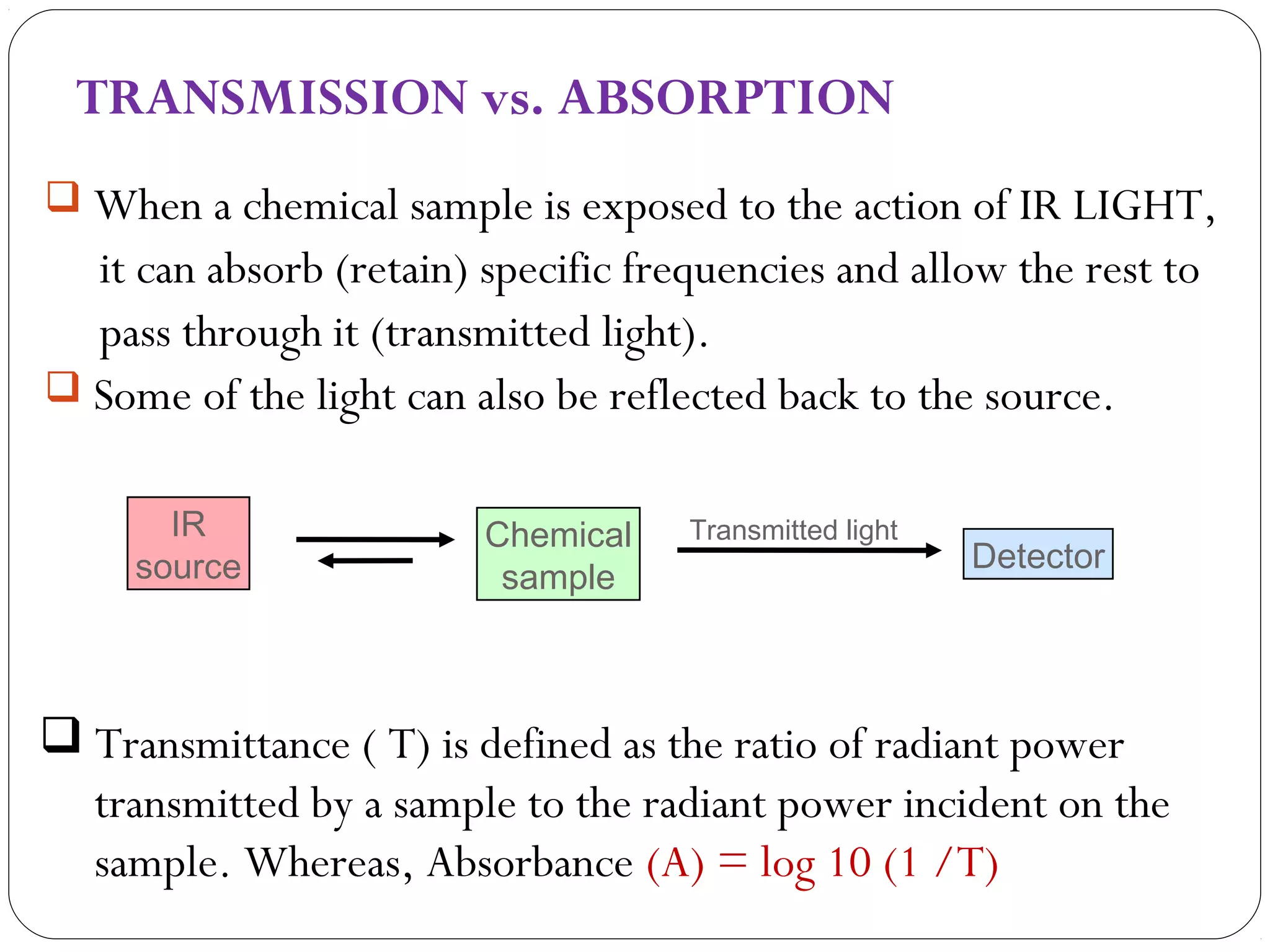
 When a chemical sample is exposed to the action of IR LIGHT,
it can absorb (retain) specific frequencies and allow the rest to
pass through it (transmitted light).
 Some of the light can also be reflected back to the source.
Chemical
sample
IR
source
Transmitted light
Detector
 Transmittance ( T) is defined as the ratio of radiant power
transmitted by a sample to the radiant power incident on the
sample. Whereas, Absorbance (A) = log 10 (1 /T)
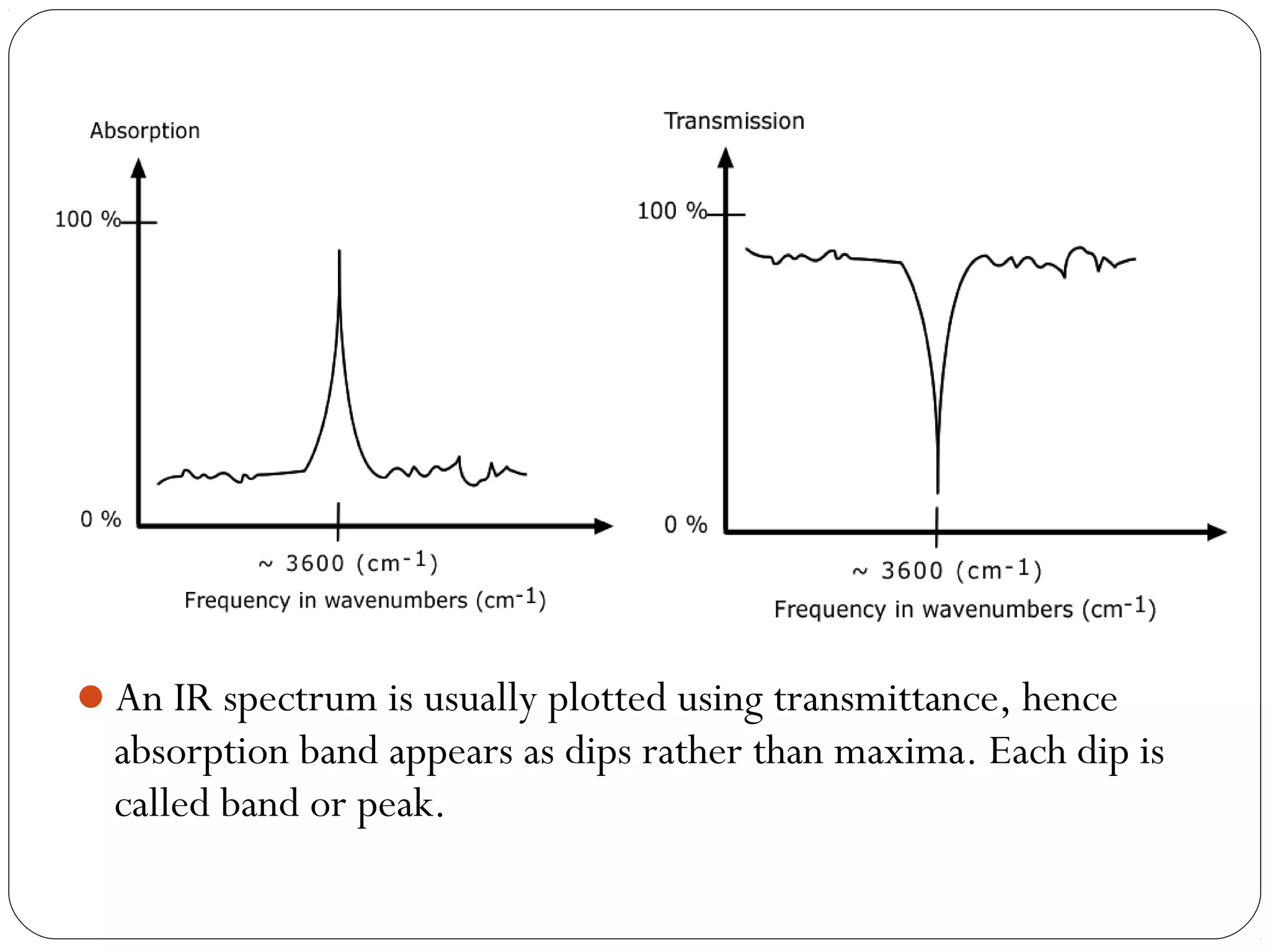
An IR spectrum is usually plotted using transmittance, hence
absorption band appears as dips rather than maxima. Each dip is
called band or peak.
CLASSIFICATION OF IR BANDS
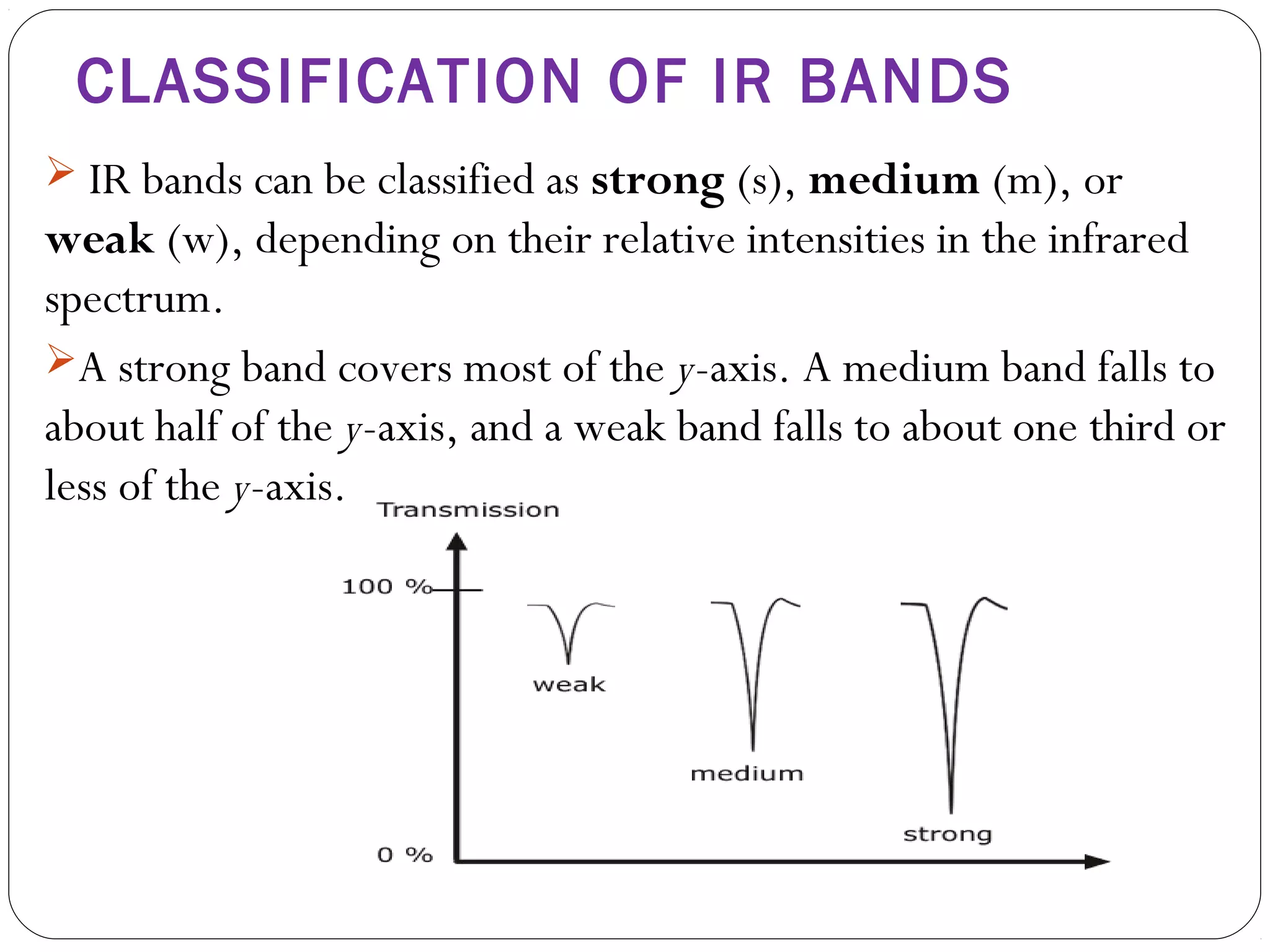
 IR bands can be classified as strong (s), medium (m), or
weak (w), depending on their relative intensities in the infrared
spectrum.
A strong band covers most of the y-axis. A medium band falls to
about half of the y-axis, and a weak band falls to about one third or
less of the y-axis.
REGIONS OF IR RADIATION
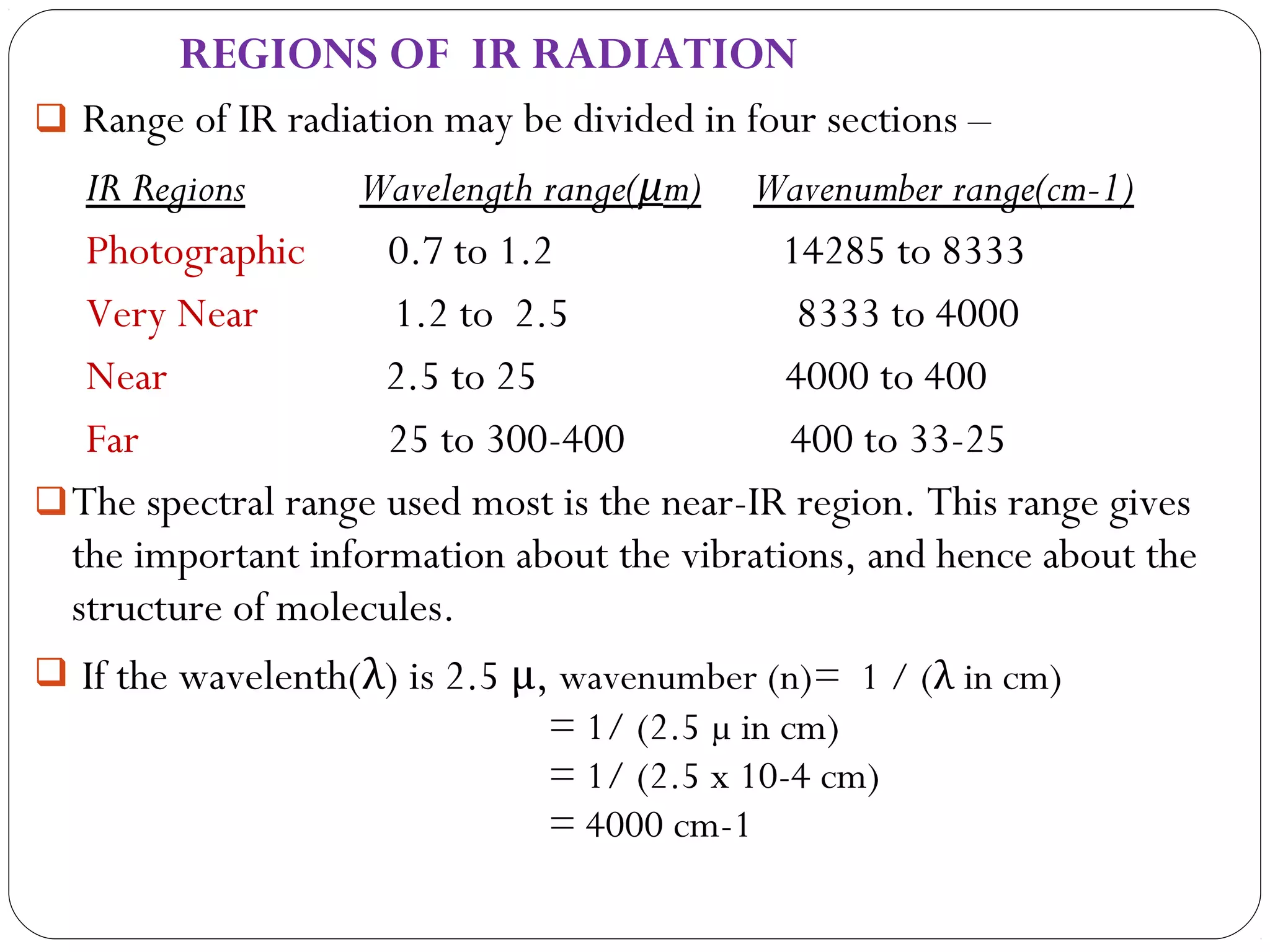
 Range of IR radiation may be divided in four sections –
IR Regions Wavelength range(μm) Wavenumber range(cm-1)
Photographic 0.7 to 1.2 14285 to 8333
Very Near 1.2 to 2.5 8333 to 4000
Near 2.5 to 25 4000 to 400
Far 25 to 300-400 400 to 33-25
The spectral range used most is the near-IR region. This range gives
the important information about the vibrations, and hence about the
structure of molecules.
 If the wavelenth(λ) is 2.5 μ, wavenumber (n)= 1 / (λ in cm)
= 1/ (2.5 µ in cm)
= 1/ (2.5 x 10⁻⁴ cm)
= 4000 cm-1
PRINCIPLE OF IR SPECTROSCOPY
When the energy in the form of IR is applied and if the
applied IR frequency = Natural frequency of vibration, the
absorption of IR takes place and a peak is observed.
Molecules are excited to the higher energy state from the
ground state when they absorb IR radiation.
When a compound is exposed to IR radiation, it selectively
absorbs the radiations resulting in vibration of the molecules of
the compound, giving rise to closely packed absorption bands,
called as IR absorption spectrum.
The bands correspond to the characteristic functional groups
and the bonds present in a chemical substance. Thus, an IR
spectrum of a compound is considered as the fingerprint for its
chemical identification.
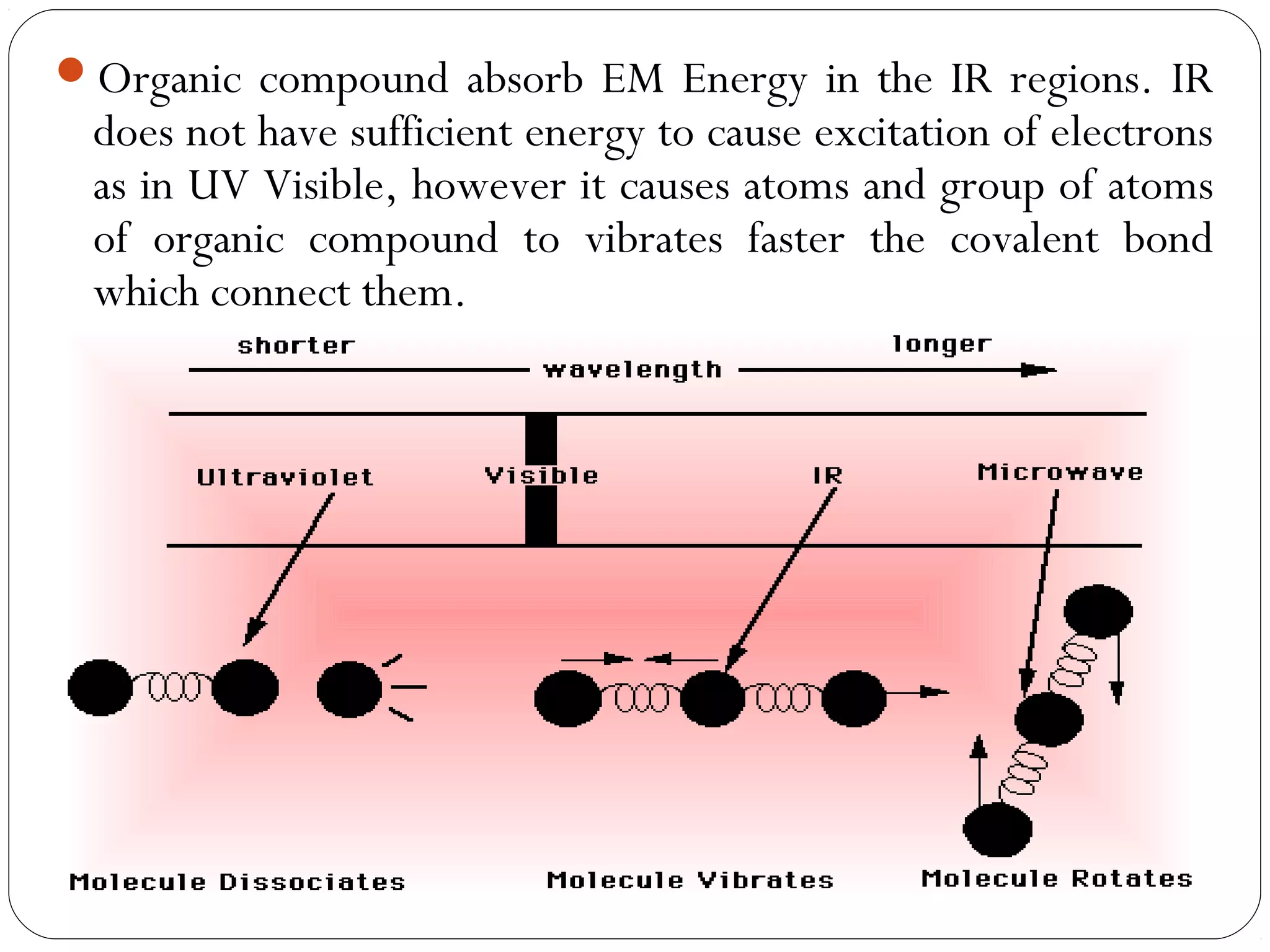
Organic compound absorb EM Energy in the IR regions. IR
does not have sufficient energy to cause excitation of electrons
as in UV Visible, however it causes atoms and group of atoms
of organic compound to vibrates faster the covalent bond
which connect them.
A molecule in its ground state posses 3 energy levels,
Electronic, Vibrational and Rotational energy level.
• Absorption in the IR regions is due to the changes in the
vibrational and rotational levels.
• When an electron absorbs less energy, rotational transitions
takes place. The spectrum observed is called rotational spectrum
observed in far IR region (25 to 300-400 µ).
• When the electrons absorbs still higher energy, vibrational
transitions take place which is accompanied with rotational
transitions. The spectrum observed is called vibrational-
rotational spectrum obtained in near IR region (2.5 to 25 µ).
• Electronic transitions take place at higher energies, these are
not seen in IR.
CRITERIA FOR A COMPOUND TO ABSORB
IR RADIATION
1. Correct wave length of incident radiation
 A molecules absorbs radiation only when the frequency of the
incident radiation is equivalent to the natural frequency of
vibration of the part of the molecule.
 After absorption of the correct wave length of radiations, the
molecule vibrates at increased amplitude due to absorbed
IR energy.
 Example: HCl has natural vibrational frequency of
8.7×10¹³/s ( 2890 cm-1). When HCl sample is exposed to
IR radiations, only the radiations of frequency 8.7×10¹³/s
are absorbed and remaining are transmitted.
2. Dipole Moment and symmetry of molecule
The bonds in a molecule can absorb IR radiation only when
there is a change in dipole moment due to electric field of
IR radiation.
The electric charges +ve and –ve on the atoms of molecule
experiences forces in opposite directions, as a result, spacing
between the charged atoms( electric dipole) of the molecule
also decrease.
These charged atoms when vibrated, absorbs IR radiation.
If the rate of vibration in charge atoms is fast, they exhibit
intense absorption of radiation & vice versa.
Vibrational transition of C=O, N-H, O-H, etc occur to change
in dipole movements thus absorbs IR radiations.
Symmetrical diatomic molecules (O2, N2, etc.) do not posses electric
dipole and hence cannot absorb IR radiations.
Even though symmetrical compounds such as ethylene –C=C–
exhibits dipoles, they do not show any change in the dipole moment,
upon C=C stretching.
If the symmetry of the compound is destroyed, it exhibits change in
dipole moment and strong IR absorption takes place. Examples –
Ethylene and Bromoethylene.
Substitution of bromine for hydrogen of ethylene destroys the
symmetry and stretching of the double bond exhibits change in
dipole moment.
When the polar molecule is exposed to IR radiations, stretching
vibrations along the internuclear axis of the polar bond are seen.
Hence, electron distribution changes and a change in dipole moment
is seen.
CHARACTER OF VIBRATION
Fundamental modes of molecular vibrations can be classified
into two types: Stretching and Bending vibrations.
1. STRETCHING VIBRATIONS
They involve movement of atom within the same bond axis
such that the bond length changes without any change in bond
angle in regular interval.
Symmetrical molecules like O=C=O are not IR active because
no change in dipole moment is observed upon stretching
vibrations.
Non- cyclic systems show (n-1) stretching vibrations because
these vibrations describes one directional motion.
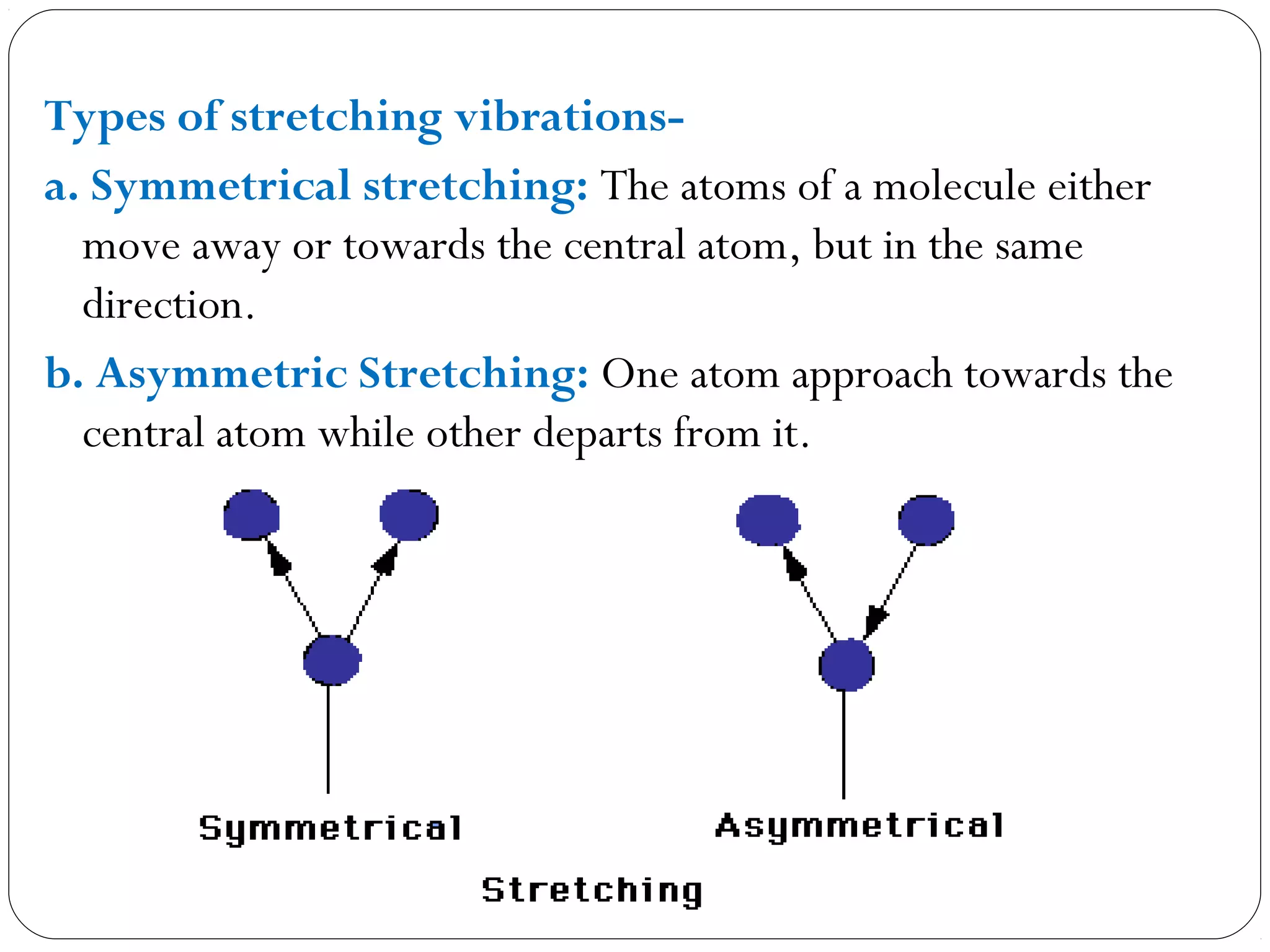
Types of stretching vibrations-
a. Symmetrical stretching: The atoms of a molecule either
move away or towards the central atom, but in the same
direction.
b. Asymmetric Stretching: One atom approach towards the
central atom while other departs from it.
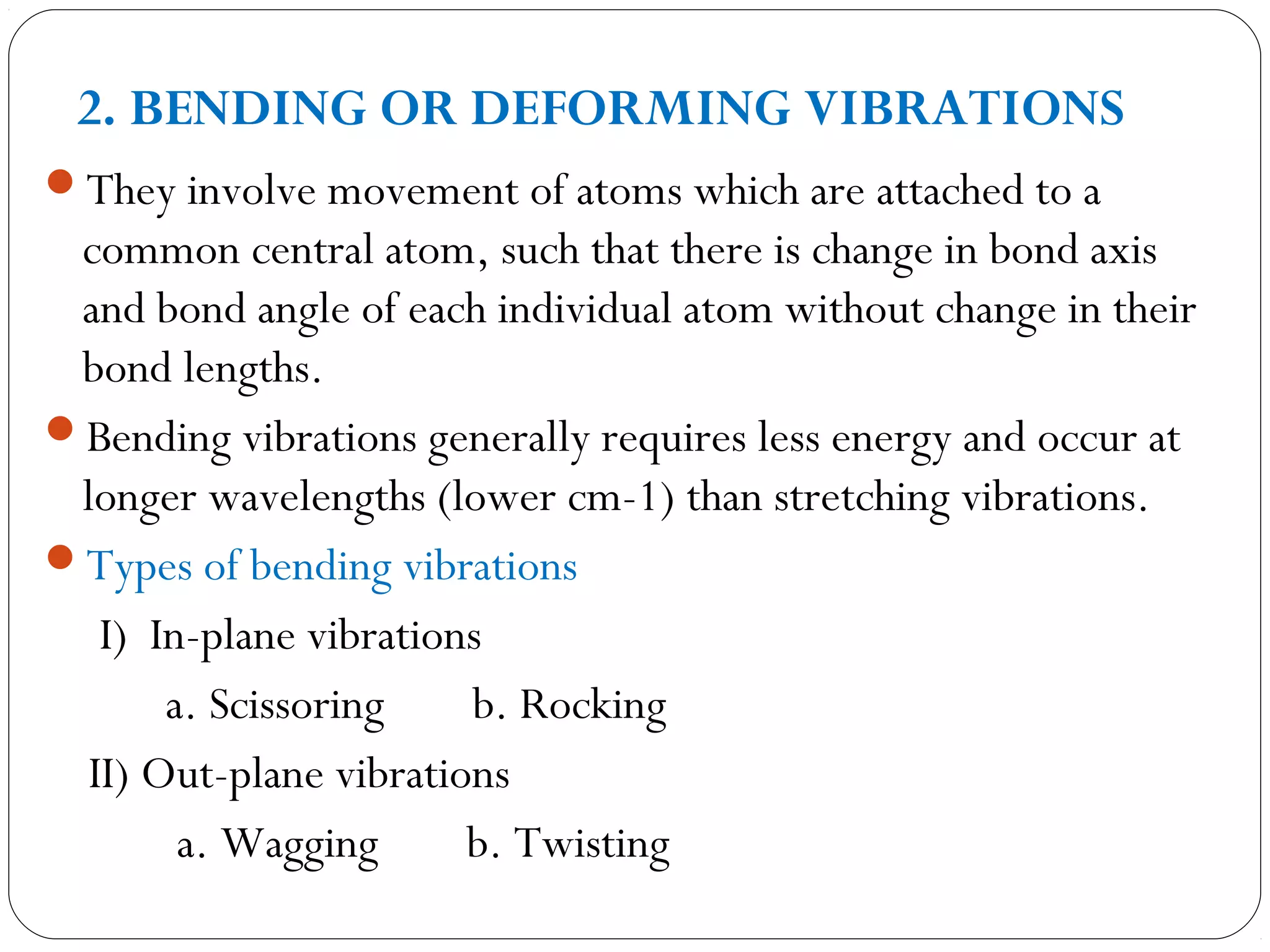
2. BENDING OR DEFORMING VIBRATIONS
They involve movement of atoms which are attached to a
common central atom, such that there is change in bond axis
and bond angle of each individual atom without change in their
bond lengths.
Bending vibrations generally requires less energy and occur at
longer wavelengths (lower cm-1) than stretching vibrations.
Types of bending vibrations
I) In-plane vibrations
a. Scissoring b. Rocking
II) Out-plane vibrations
a. Wagging b. Twisting
I) In plane vibration
a) Rocking: In-plane bending of atoms occurs wherein they
swing back and forth with respect to the central atom.
a) Scissoring: In-plane bending of atoms occur wherein
they move back and forth. i.e., they approach to each
other.
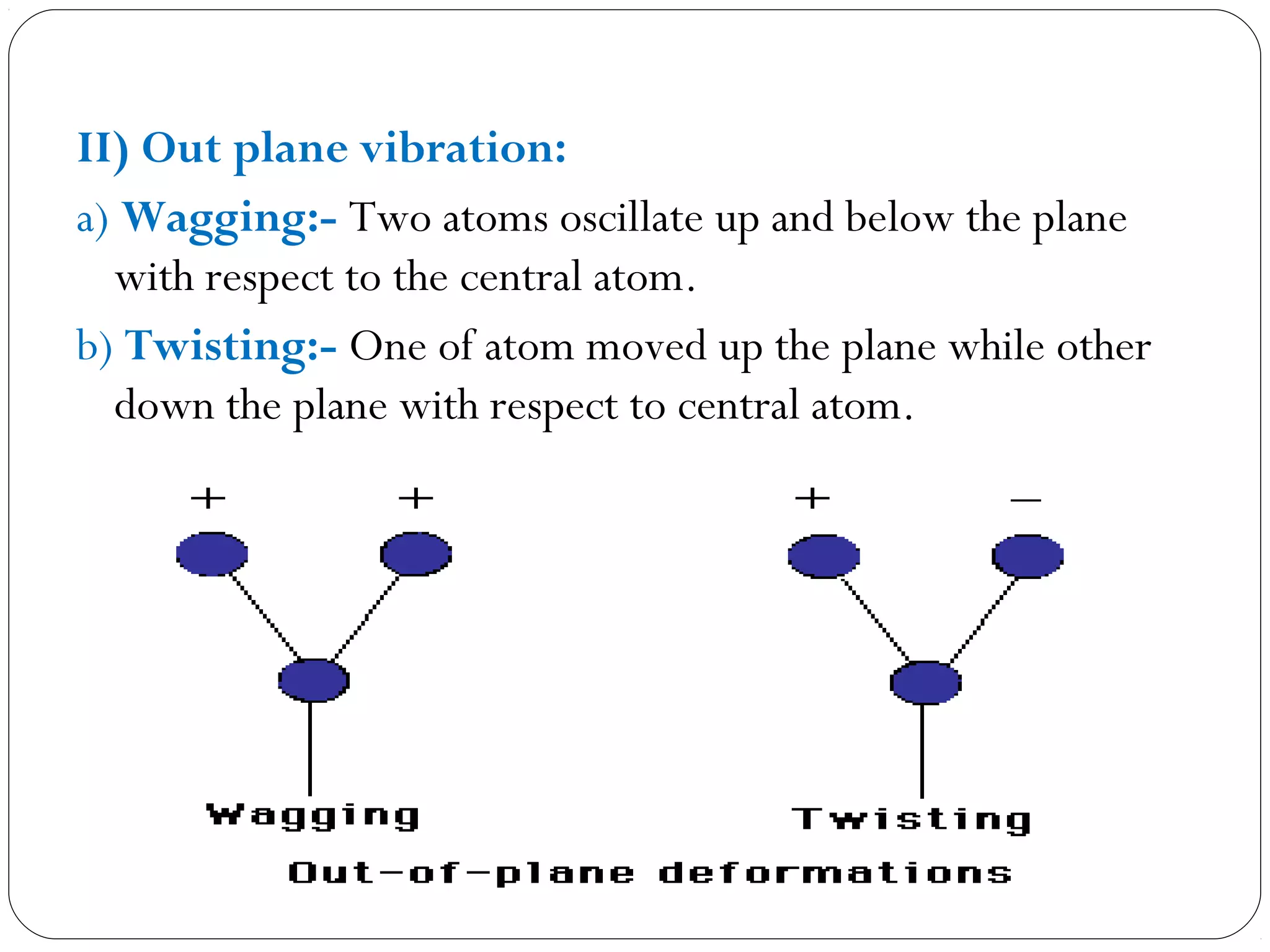
II) Out plane vibration:
a) Wagging:- Two atoms oscillate up and below the plane
with respect to the central atom.
b) Twisting:- One of atom moved up the plane while other
down the plane with respect to central atom.
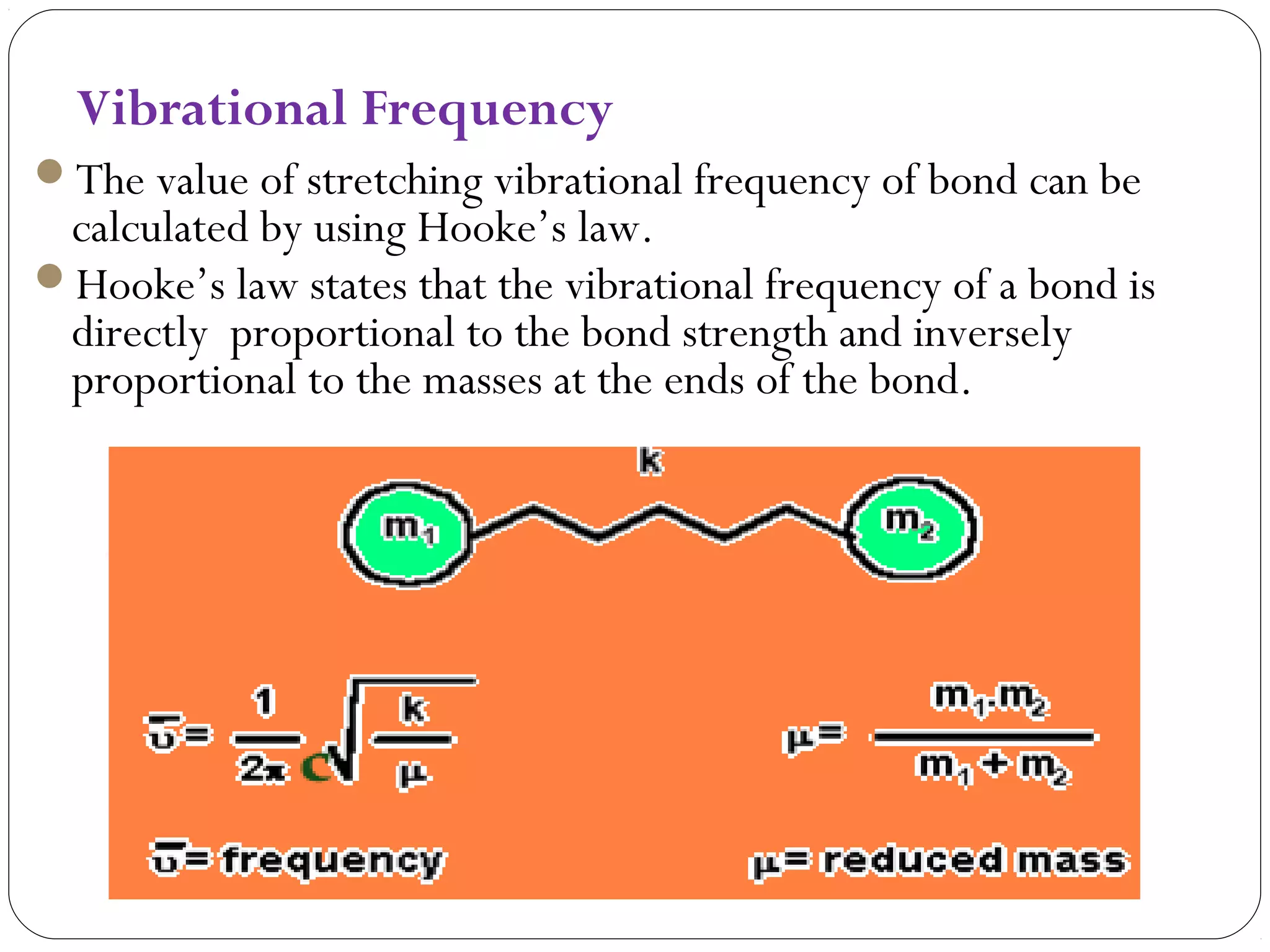
Vibrational Frequency
The value of stretching vibrational frequency of bond can be
calculated by using Hooke’s law.
Hooke’s law states that the vibrational frequency of a bond is
directly proportional to the bond strength and inversely
proportional to the masses at the ends of the bond.
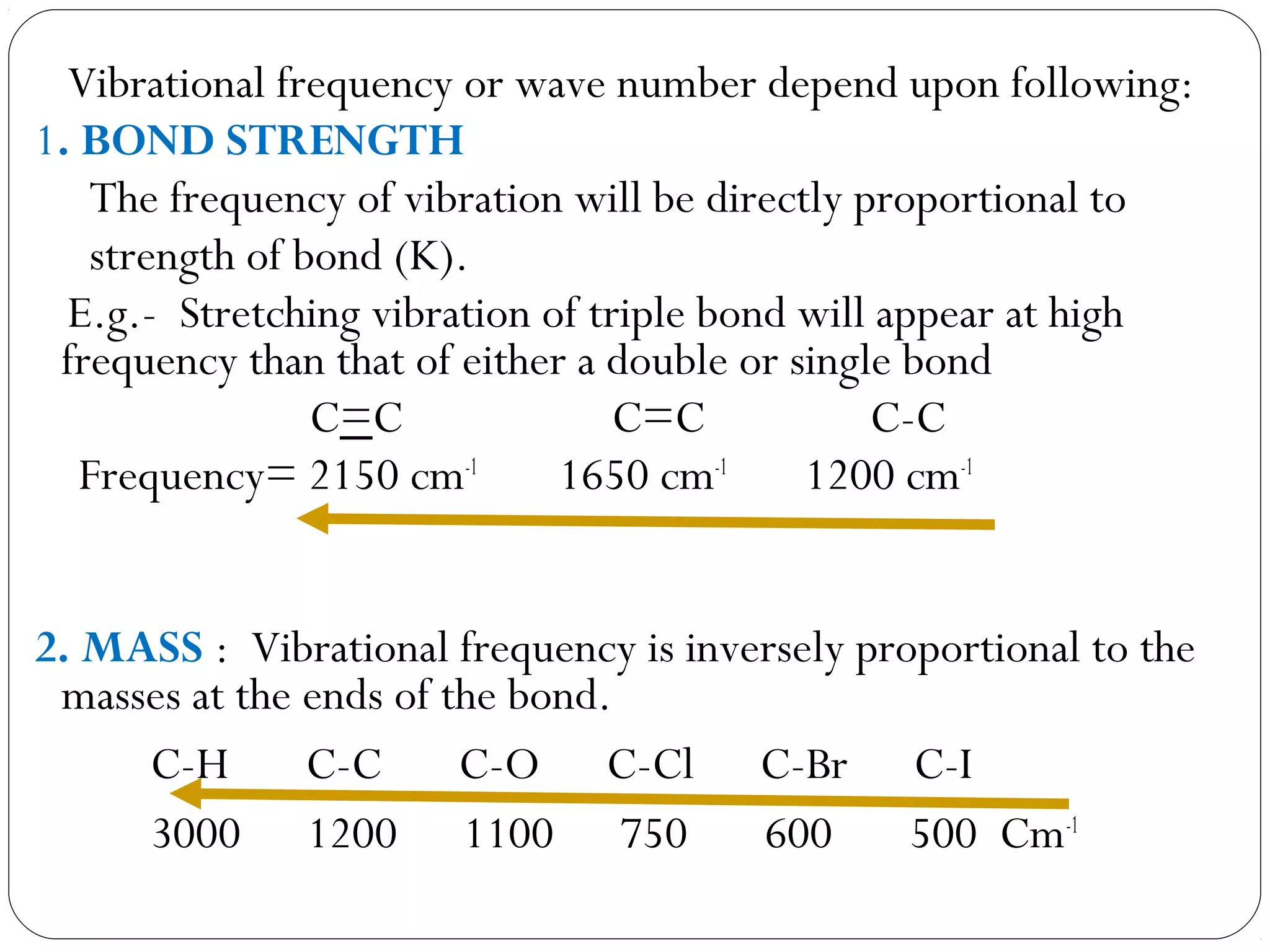
Vibrational frequency or wave number depend upon following:
1. BOND STRENGTH
The frequency of vibration will be directly proportional to
strength of bond (K).
E.g.- Stretching vibration of triple bond will appear at high
frequency than that of either a double or single bond
C=C C=C C-C
Frequency= 2150 cm-1
1650 cm-1
1200 cm-1
2. MASS : Vibrational frequency is inversely proportional to the
masses at the ends of the bond.
C-H C-C C-O C-Cl C-Br C-I
3000 1200 1100 750 600 500 Cm-1
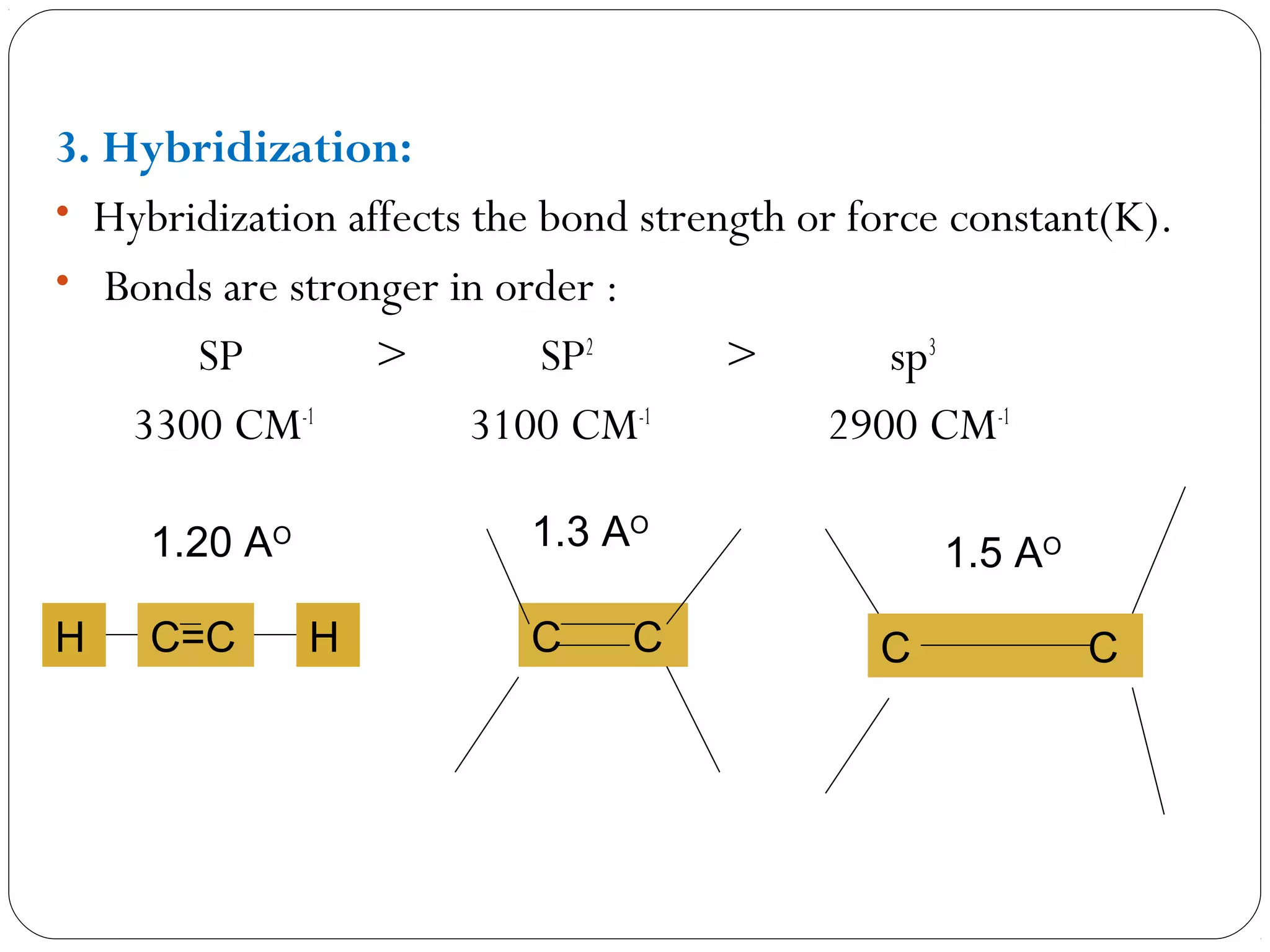
3. Hybridization:
• Hybridization affects the bond strength or force constant(K).
• Bonds are stronger in order :
SP > SP2
> sp3
3300 CM-1
3100 CM-1
2900 CM-1
C=C C C C CH H
1.5 AO1.20 AO 1.3 AO
Factor affecting vibrational frequency
1. Coupling interaction.
2. Fermi resonance.
3. Hydrogen bonding.
4. Electronic displacement effects.
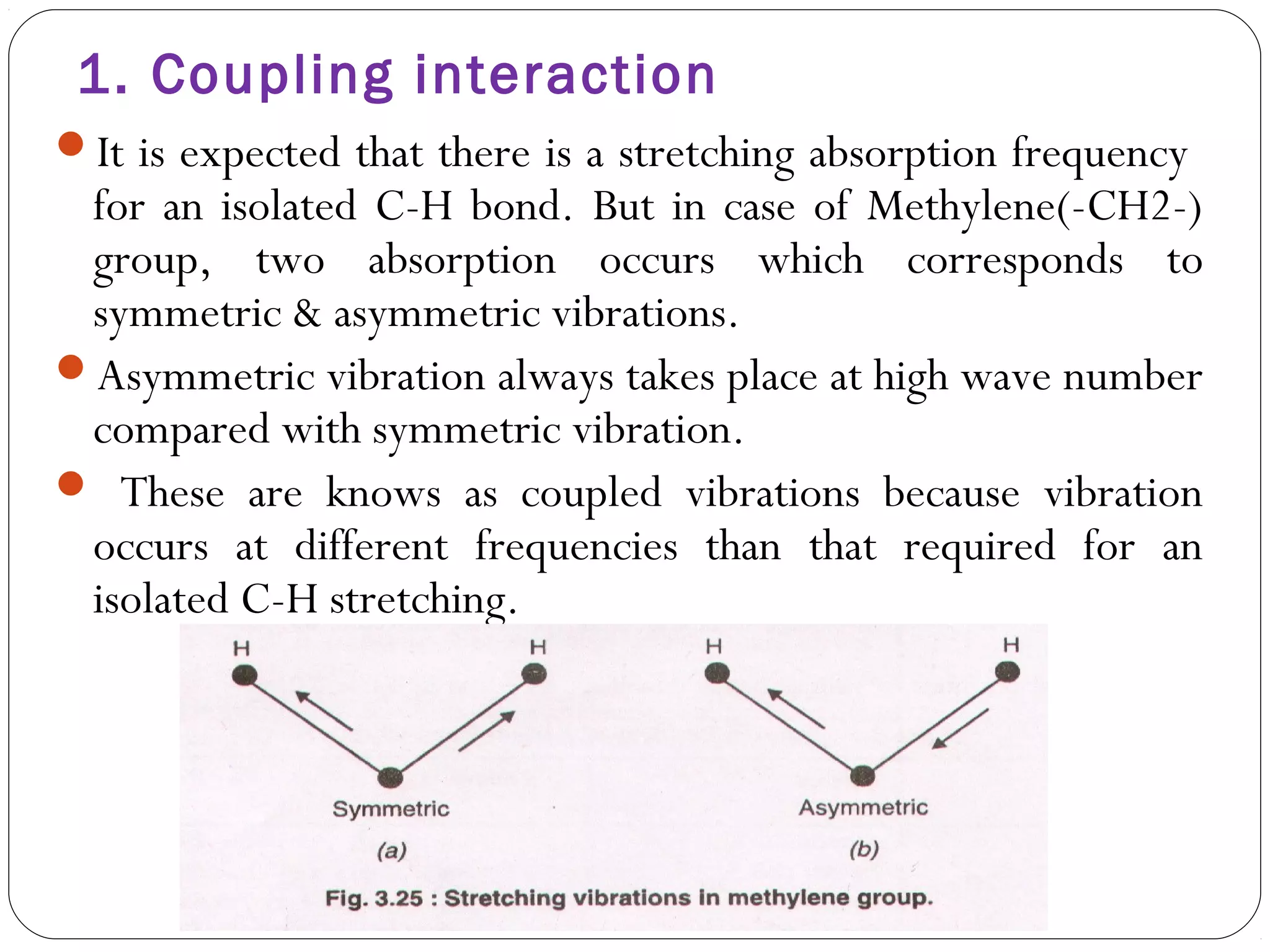
1. Coupling interaction
It is expected that there is a stretching absorption frequency
for an isolated C-H bond. But in case of Methylene(-CH2-)
group, two absorption occurs which corresponds to
symmetric & asymmetric vibrations.
Asymmetric vibration always takes place at high wave number
compared with symmetric vibration.
 These are knows as coupled vibrations because vibration
occurs at different frequencies than that required for an
isolated C-H stretching.
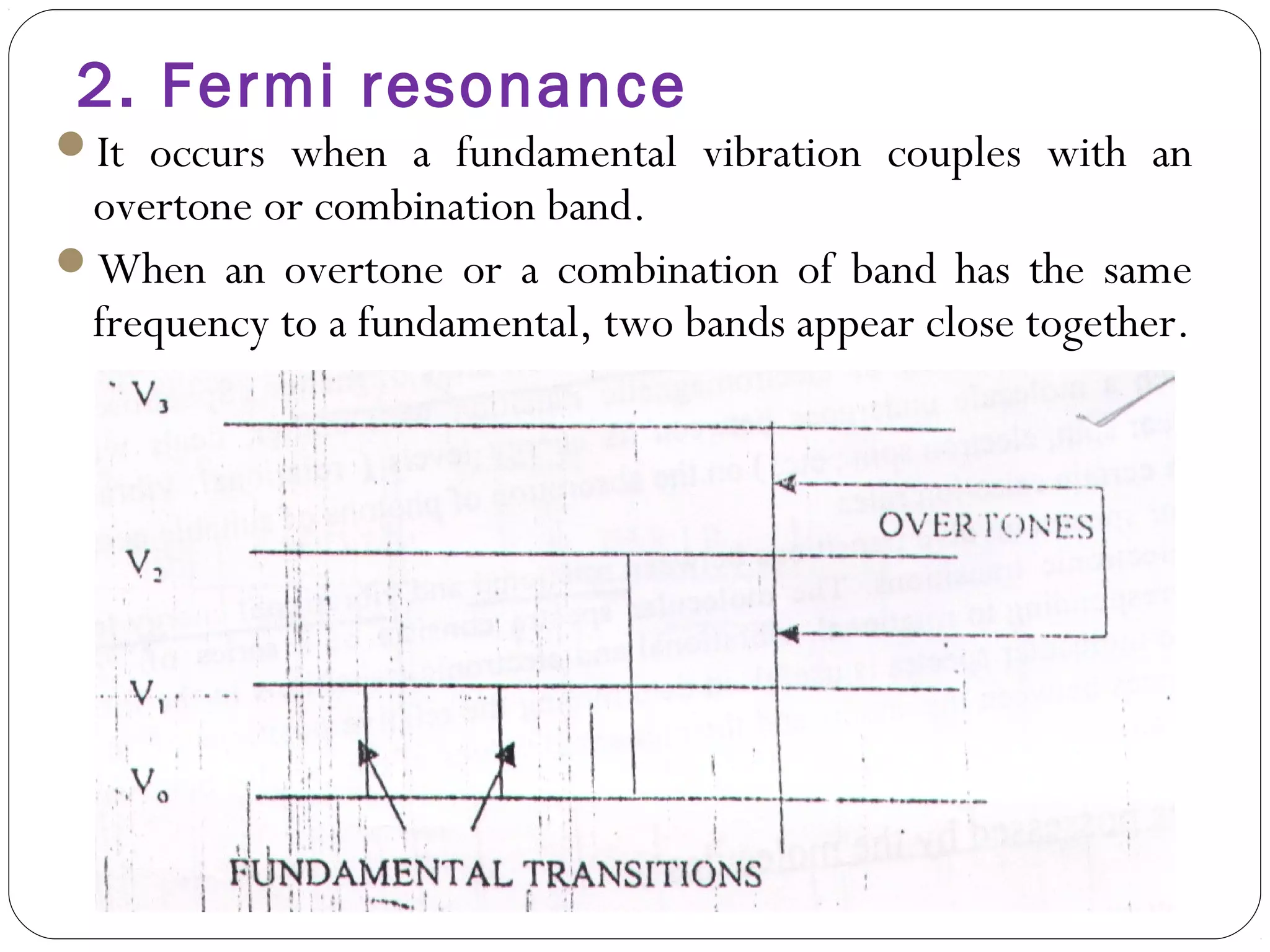
2. Fermi resonance
It occurs when a fundamental vibration couples with an
overtone or combination band.
When an overtone or a combination of band has the same
frequency to a fundamental, two bands appear close together.
The effect is greatest when the frequencies match, and the
two bands are referred to as a Fermi doublet.
When two bonds share a common atom as in the case of a
linear tri-atomic molecule CO2, consisting of two CO bonds
(O=C=O), two fundamental stretching vibrations:
symmetric and asymmetric takes place.
As the symmetric stretching vibration produces no change in
the dipole movement of the molecules, it is inactive in the IR
spectra.
In the asymmetric vibration, one oxygen approach the
carbon atom as other may be away. Asymmetric stretching
vibration appears in the IR region 2330 cm-1
3. Hydrogen bonding
Hydrogen bonding gives rise to downward frequency shifts.
Stronger the bonding, greater the absorption shift towards
lower wave number from normal value.
Generally, intermolecular hydrogen bonds are sharp and
well
defined.
 Intermolecular hydrogen bonds are concentration
dependent. On dilution, intensities of such bands decreases
and finally disappears.
OH
COOCH3
OH
OMeO
O OMe
OH
O
O
OMe
H
P- hydroxy methyl benzoate
Intermolccular hydrogen bonding
Intramolecular
hydrogen bonding
Stretching 1740-1780 cm-1
Stretching 1710cm-1
Stretching 1680 cm-1
4. Electronic Displacement Effect
The frequency shifts from normal position of absorption
occur because of electronic effects which include:
Inductive effect, mesomeric effect, configuration effect or
field effect .
Under the influence of these effects, the force constant (K)
or the bond strength changes and its absorption frequency
shifts from the normal value.
The introduction of alkyl group in an alpha- position of
C=O group exerts inductive effect which results in
shortening or strengthening of the bond. Consequently the
force constant increases and so the frequency or the wave
number of absorption also increases.
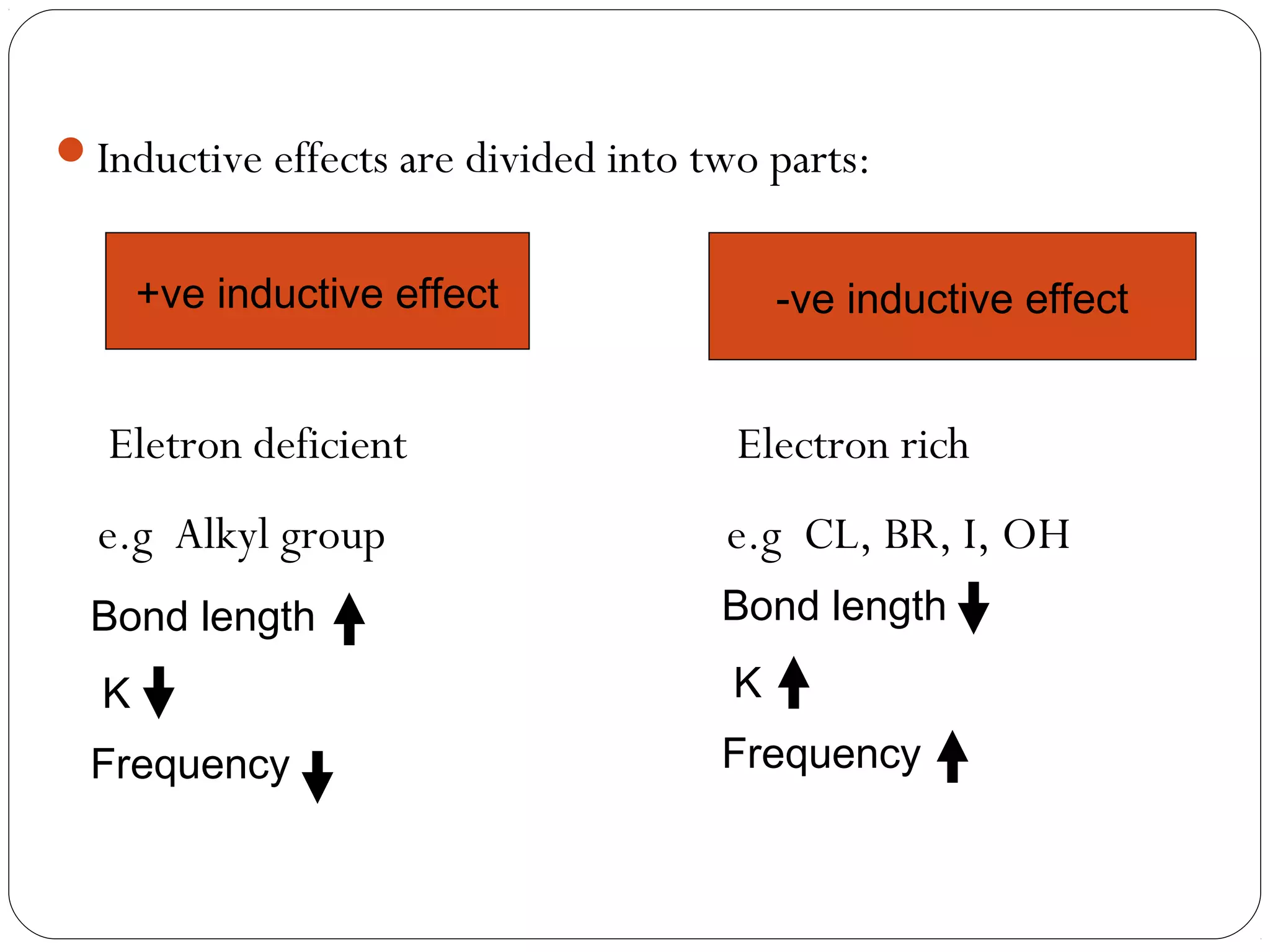
Inductive effects are divided into two parts:
+ve inductive effect -ve inductive effect
Eletron deficient Electron rich
e.g Alkyl group e.g CL, BR, I, OH
Bond length
K
Frequency
Bond length
K
Frequency
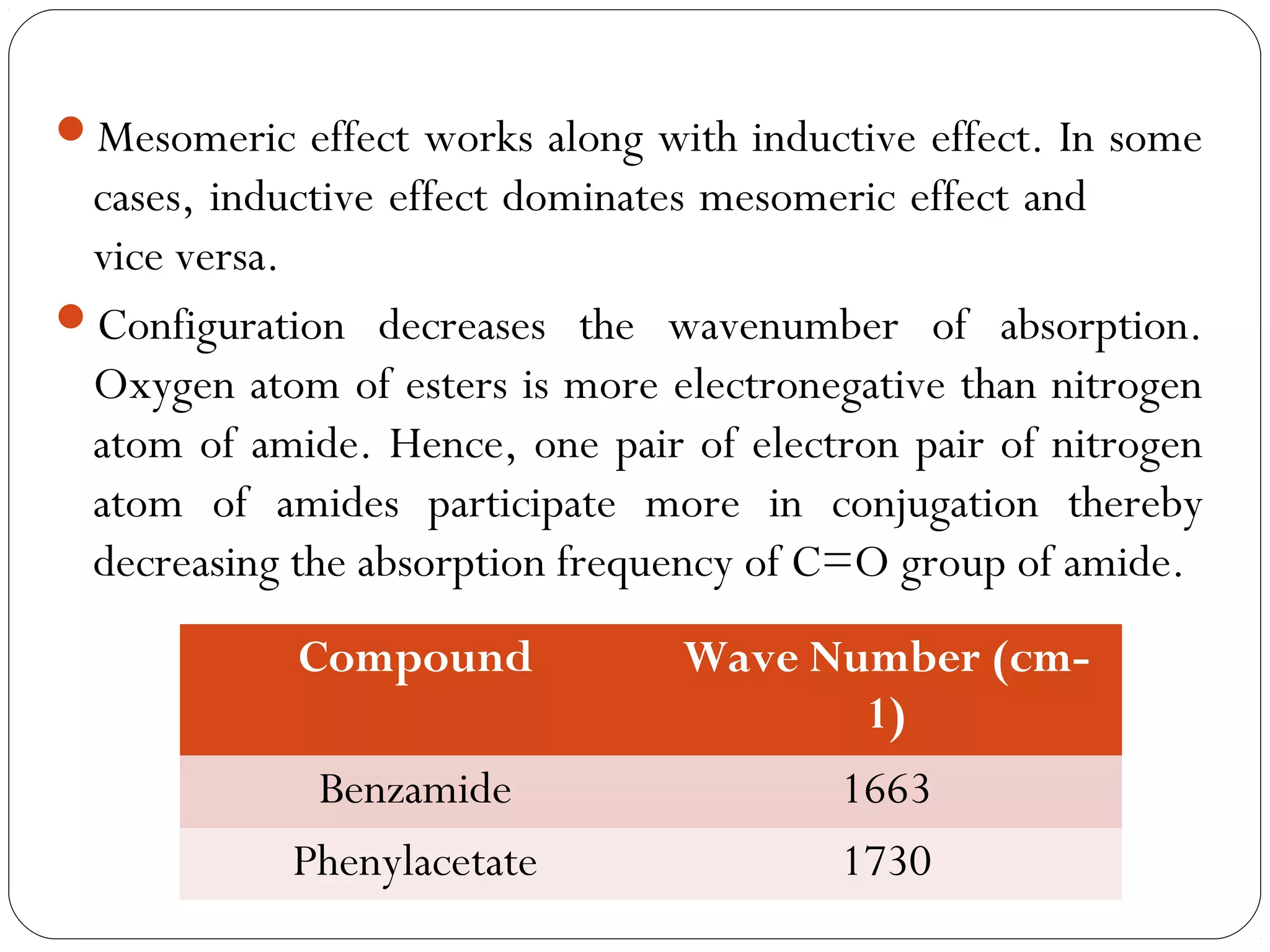
Mesomeric effect works along with inductive effect. In some
cases, inductive effect dominates mesomeric effect and
vice versa.
Configuration decreases the wavenumber of absorption.
Oxygen atom of esters is more electronegative than nitrogen
atom of amide. Hence, one pair of electron pair of nitrogen
atom of amides participate more in conjugation thereby
decreasing the absorption frequency of C=O group of amide.
Compound Wave Number (cm-
1)
Benzamide 1663
Phenylacetate 1730
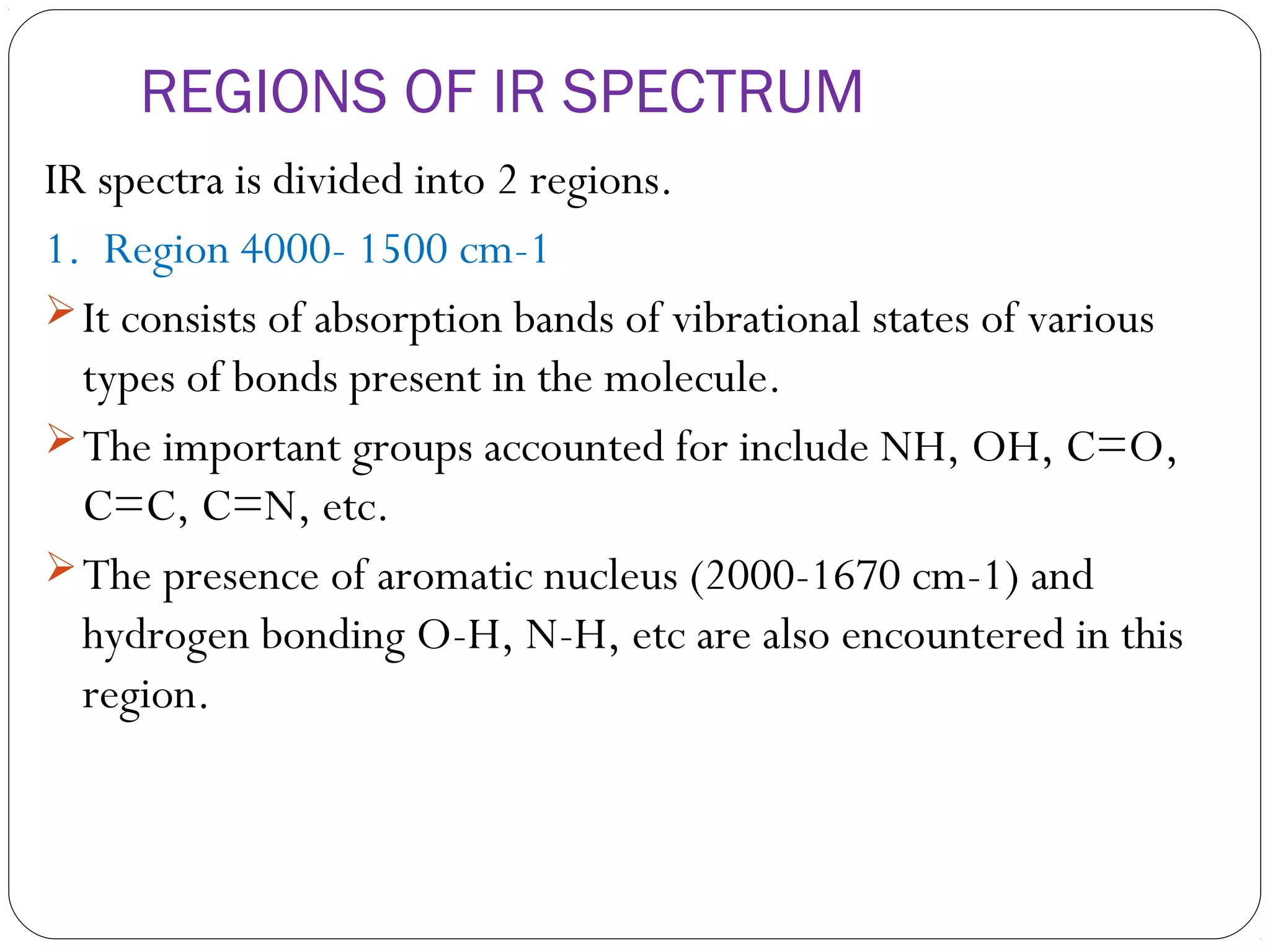
REGIONS OF IR SPECTRUM
IR spectra is divided into 2 regions.
1. Region 4000- 1500 cm-1
It consists of absorption bands of vibrational states of various
types of bonds present in the molecule.
The important groups accounted for include NH, OH, C=O,
C=C, C=N, etc.
The presence of aromatic nucleus (2000-1670 cm-1) and
hydrogen bonding O-H, N-H, etc are also encountered in this
region.
The graph shows the regions of the spectrum where the
following types of bonds normally absorb.
For example, a sharp band around 2200-2400 cm-1
would
indicate the possible presence of a C-N or a C-C triple bond.
Graphics source: Wade, Jr., L.G. Organic Chemistry, 5th ed. Pearson Education Inc., 2003
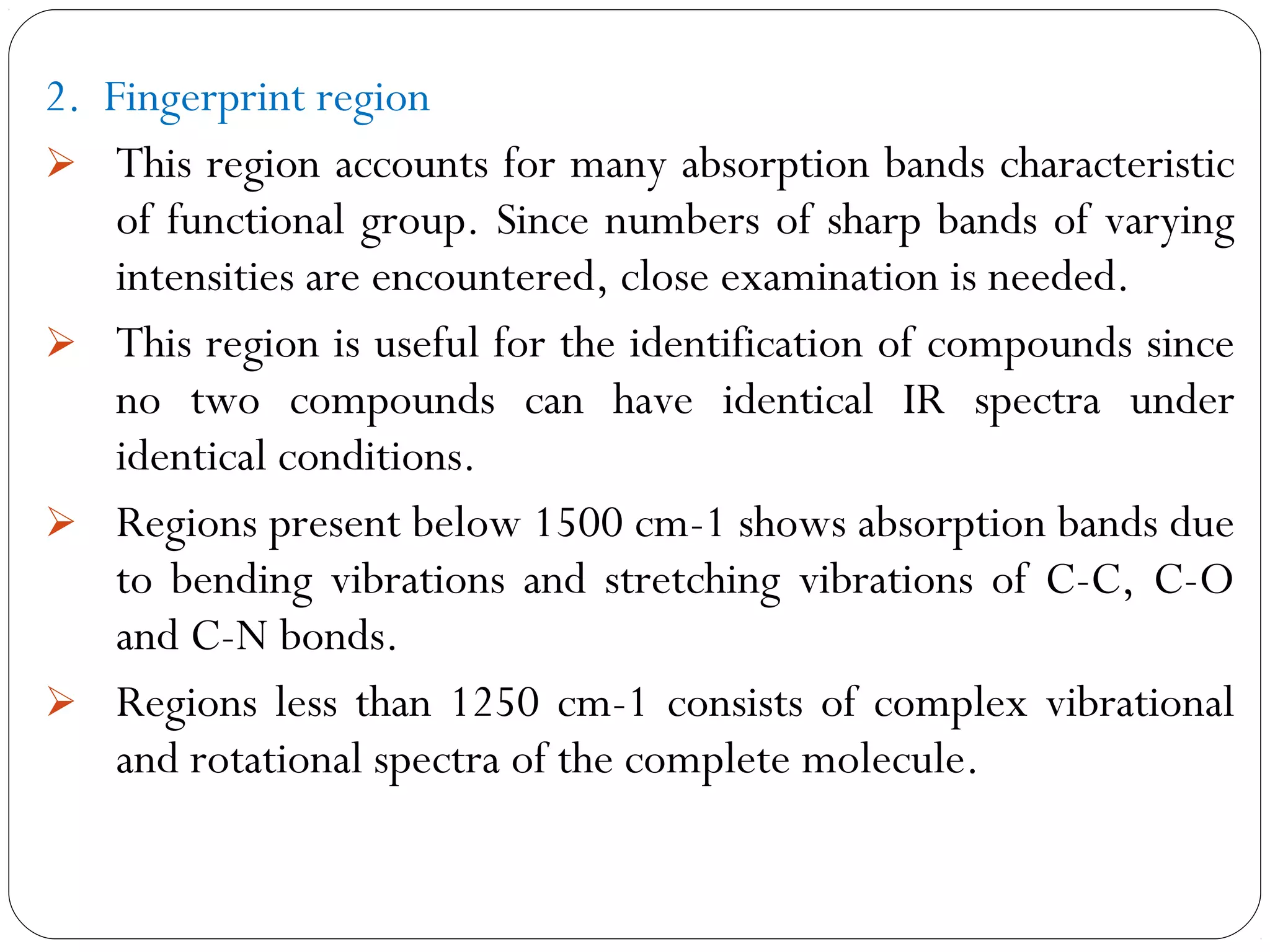
2. Fingerprint region
 This region accounts for many absorption bands characteristic
of functional group. Since numbers of sharp bands of varying
intensities are encountered, close examination is needed.
 This region is useful for the identification of compounds since
no two compounds can have identical IR spectra under
identical conditions.
 Regions present below 1500 cm-1 shows absorption bands due
to bending vibrations and stretching vibrations of C-C, C-O
and C-N bonds.
 Regions less than 1250 cm-1 consists of complex vibrational
and rotational spectra of the complete molecule.
Fingerprint region is further divided into three regions.
i. Region 1500- 1350 cm-1
 The presence of double peaks near 1380 cm-1 and 1365 cm-1
indicates presence of tertiary butyl group in the compound.
ii. Regions 1350-1000 cm-1
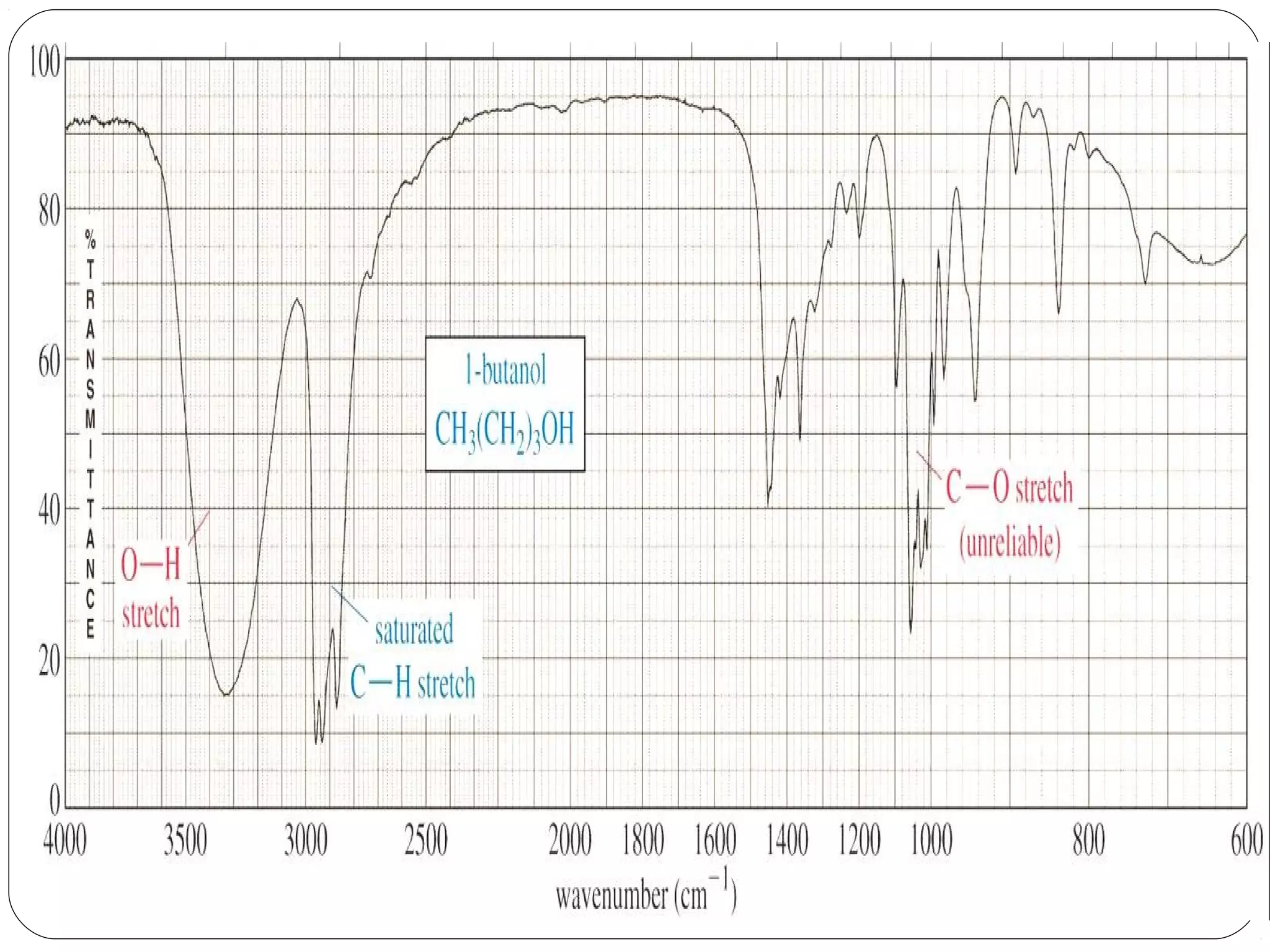
 Characteristic strong bands due to C-O stretching are present.
Compound IR region
Ethers 1150- 1070 cm-1
Primary alcohols 1350- 1260 cm-1 and
Near 1050 cm-1
Esters 1380- 1050 cm-1
Phenols Near 1200 cm-1
iii. Less than 1000 cm-1
 Absorption band in the region 750- 700 cm-1 indicates the
presence of mono substituted benzenes.
 Geometrical isomers of olefins can be distinguished in the
region 970 – 700 cm-1.
 Cis- isomer shows strong intensity absorption band at
700 cm-1 and trans- isomer at 970-960 cm-1.
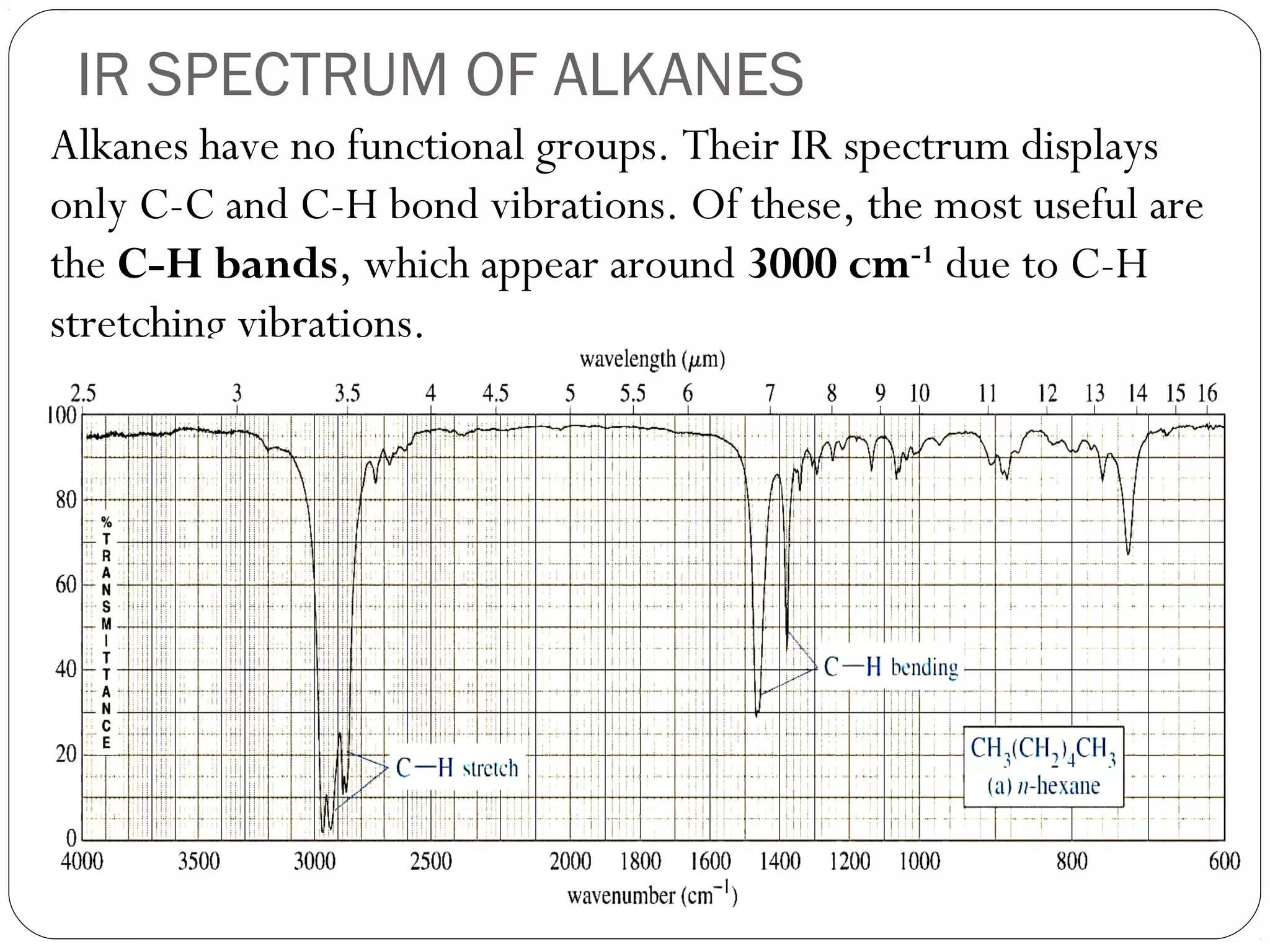
IR SPECTRUM OF ALKANES
Alkanes have no functional groups. Their IR spectrum displays
only C-C and C-H bond vibrations. Of these, the most useful are
the C-H bands, which appear around 3000 cm-1
due to C-H
stretching vibrations.
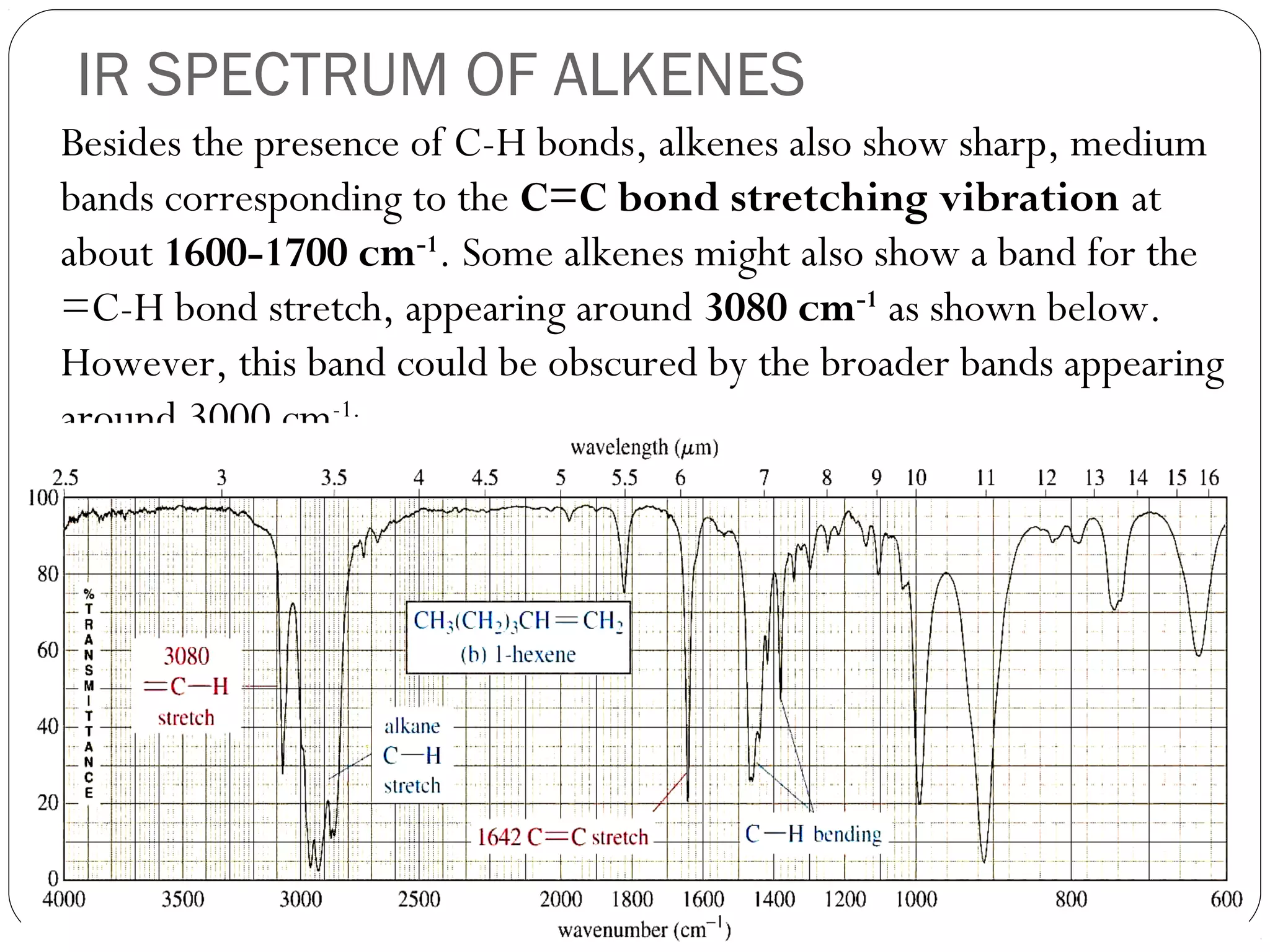
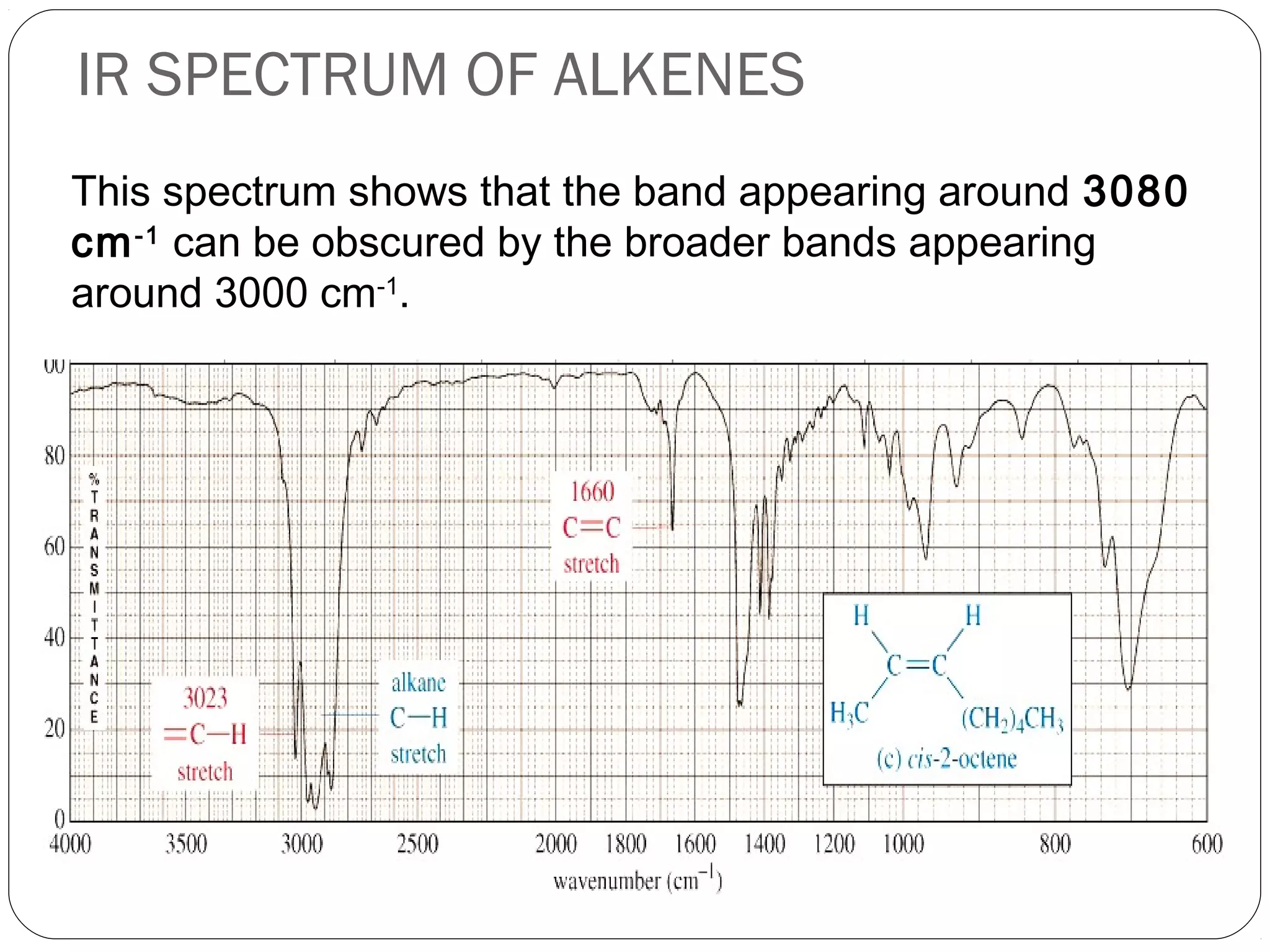
IR SPECTRUM OF ALKENES
Besides the presence of C-H bonds, alkenes also show sharp, medium
bands corresponding to the C=C bond stretching vibration at
about 1600-1700 cm-1
. Some alkenes might also show a band for the
=C-H bond stretch, appearing around 3080 cm-1
as shown below.
However, this band could be obscured by the broader bands appearing
around 3000 cm-1.
IR SPECTRUM OF ALKENES
This spectrum shows that the band appearing around 3080
cm-1
can be obscured by the broader bands appearing
around 3000 cm-1
.
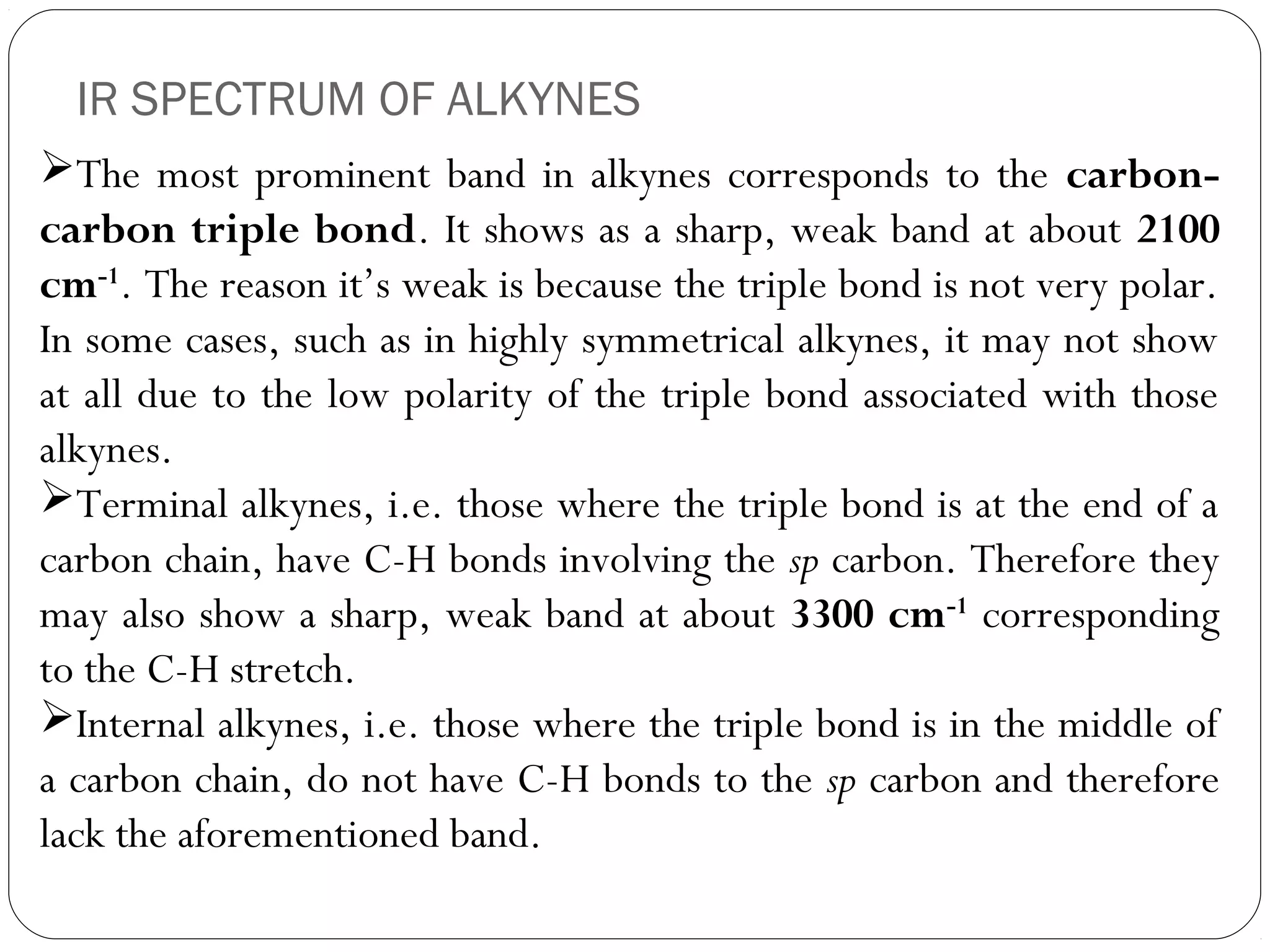
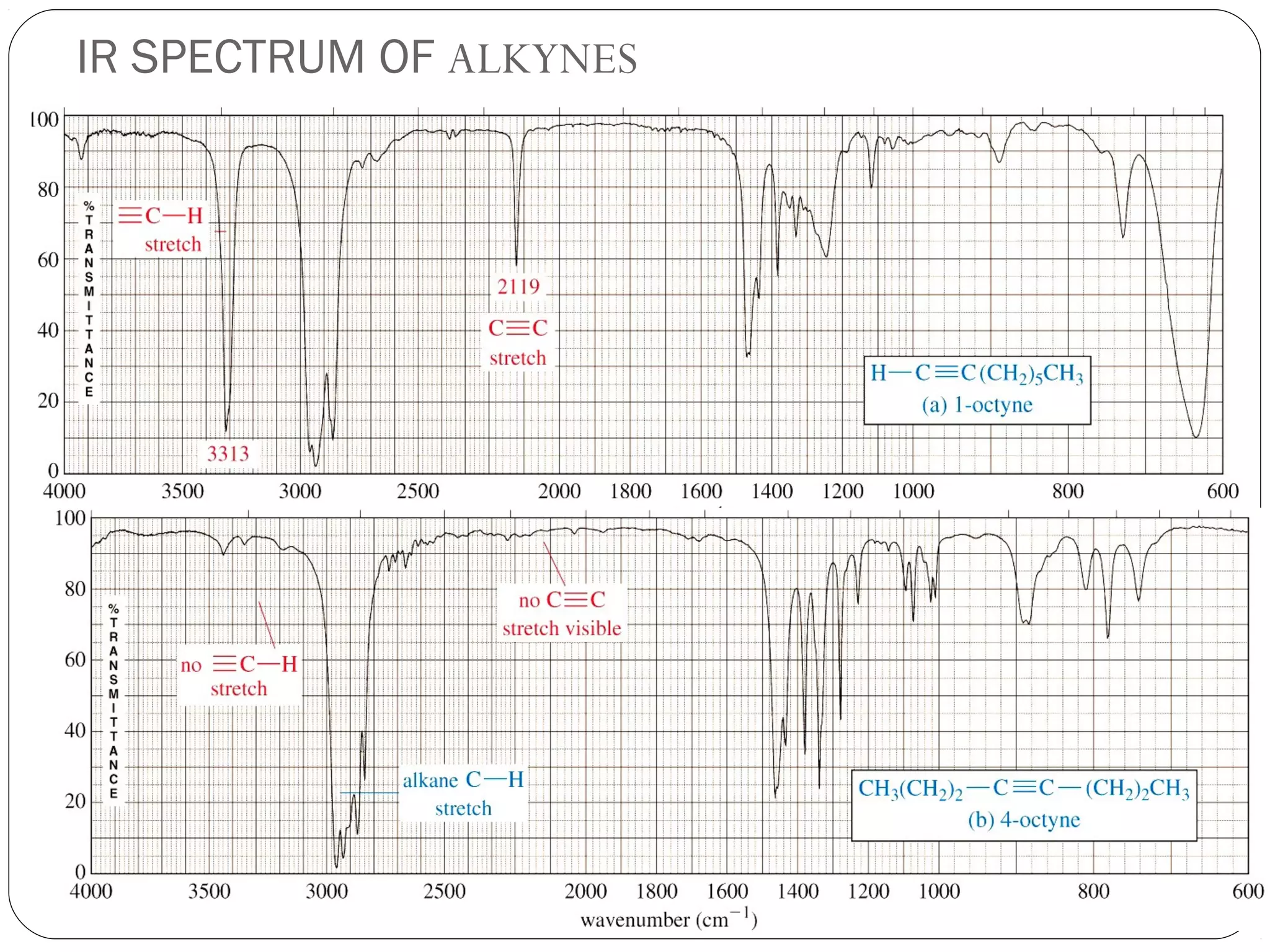
IR SPECTRUM OF ALKYNES
The most prominent band in alkynes corresponds to the carbon-
carbon triple bond. It shows as a sharp, weak band at about 2100
cm-1
. The reason it’s weak is because the triple bond is not very polar.
In some cases, such as in highly symmetrical alkynes, it may not show
at all due to the low polarity of the triple bond associated with those
alkynes.
Terminal alkynes, i.e. those where the triple bond is at the end of a
carbon chain, have C-H bonds involving the sp carbon. Therefore they
may also show a sharp, weak band at about 3300 cm-1
corresponding
to the C-H stretch.
Internal alkynes, i.e. those where the triple bond is in the middle of
a carbon chain, do not have C-H bonds to the sp carbon and therefore
lack the aforementioned band.
IR SPECTRUM OF ALKYNES
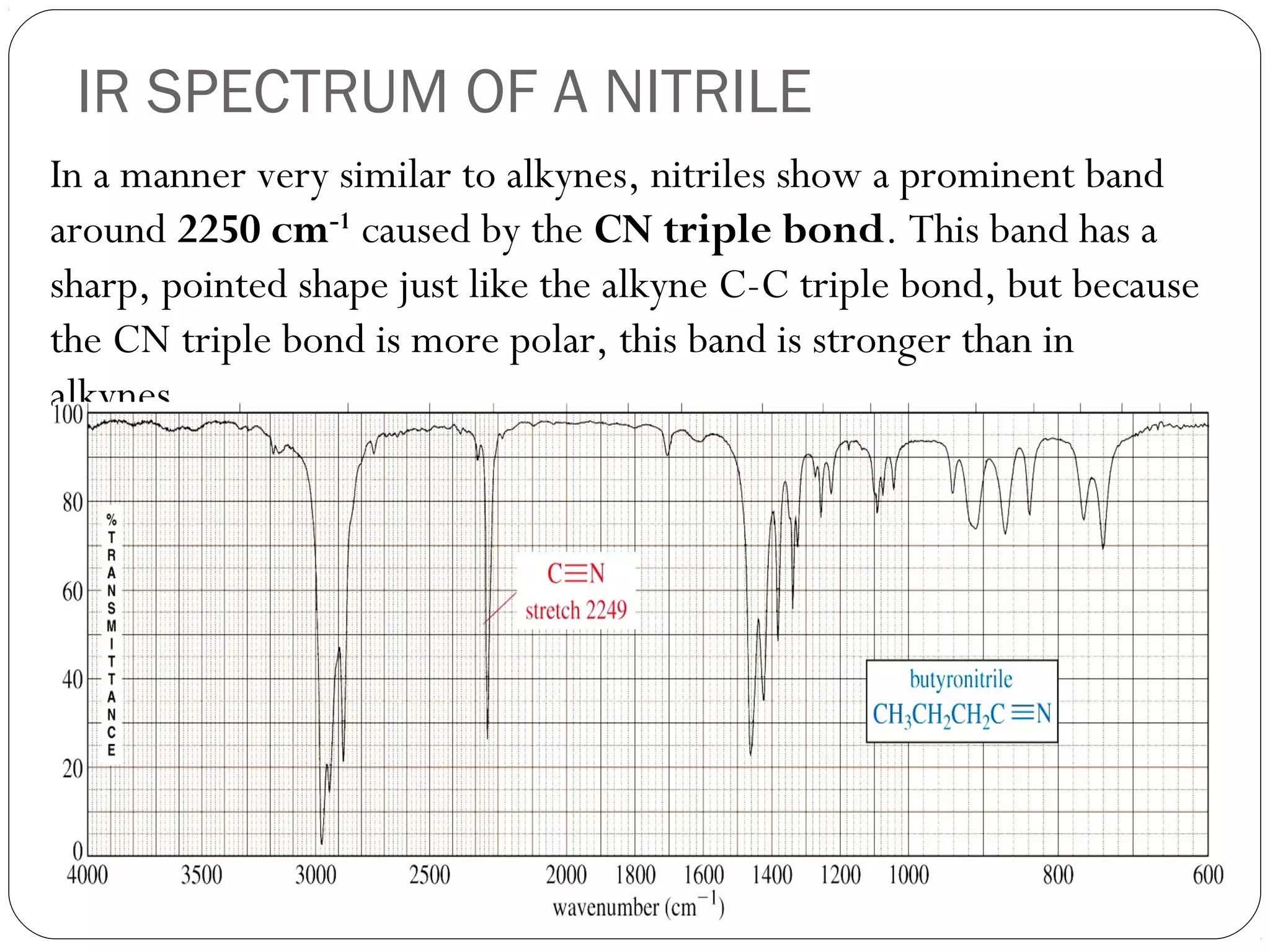
IR SPECTRUM OF A NITRILE
In a manner very similar to alkynes, nitriles show a prominent band
around 2250 cm-1
caused by the CN triple bond. This band has a
sharp, pointed shape just like the alkyne C-C triple bond, but because
the CN triple bond is more polar, this band is stronger than in
alkynes.
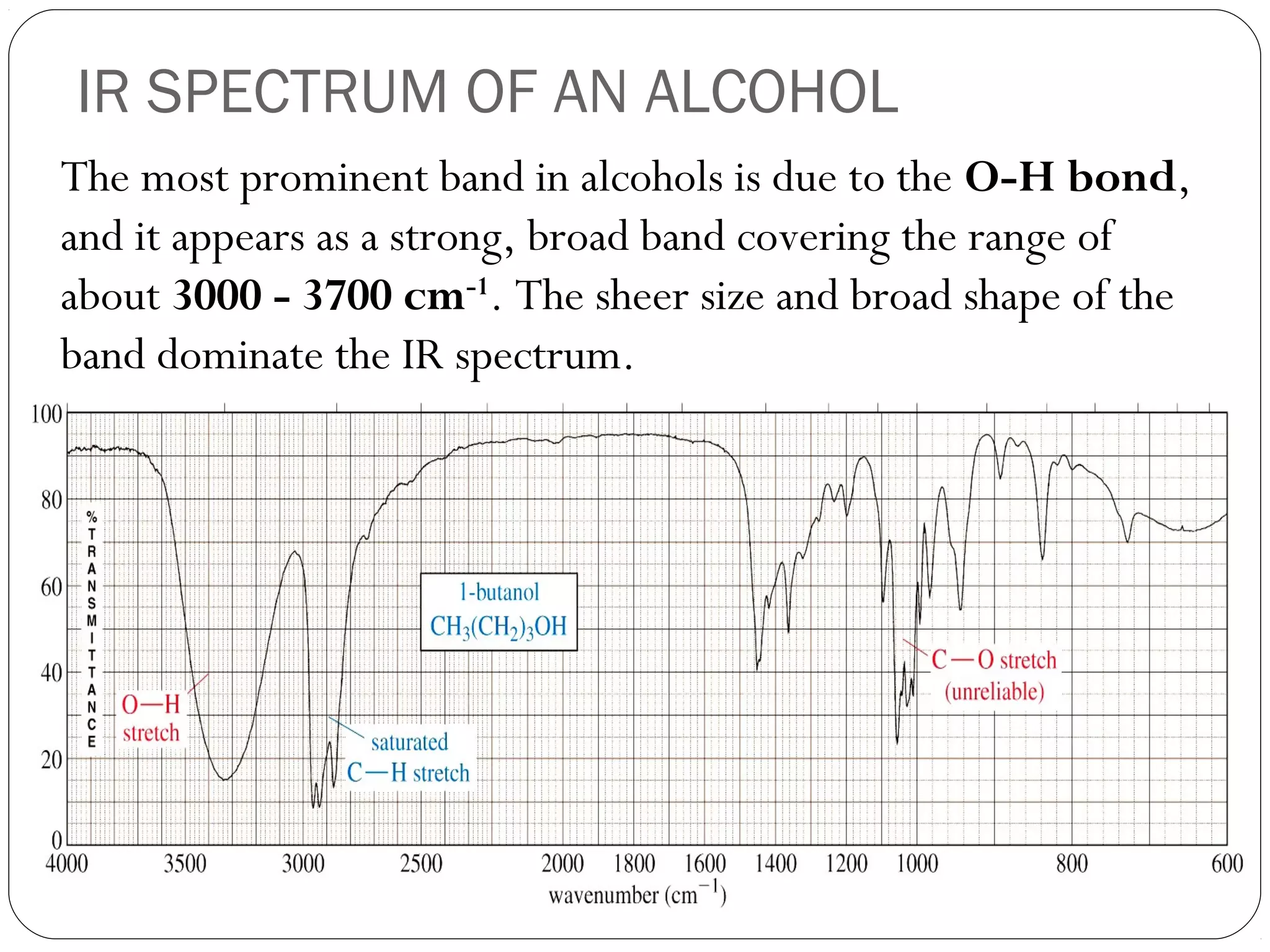
IR SPECTRUM OF AN ALCOHOL
The most prominent band in alcohols is due to the O-H bond,
and it appears as a strong, broad band covering the range of
about 3000 - 3700 cm-1
. The sheer size and broad shape of the
band dominate the IR spectrum.
IR SPECTRUM OF ALDEHYDES AND
KETONES
In aldehydes, C=O functional group is at the end of a carbon
chain, whereas in ketones it’s in the middle of the chain. As a result,
the carbon in the C=O bond of aldehydes is also bonded to another
carbon and a hydrogen, whereas the same carbon in a ketone is
bonded to two other carbons.
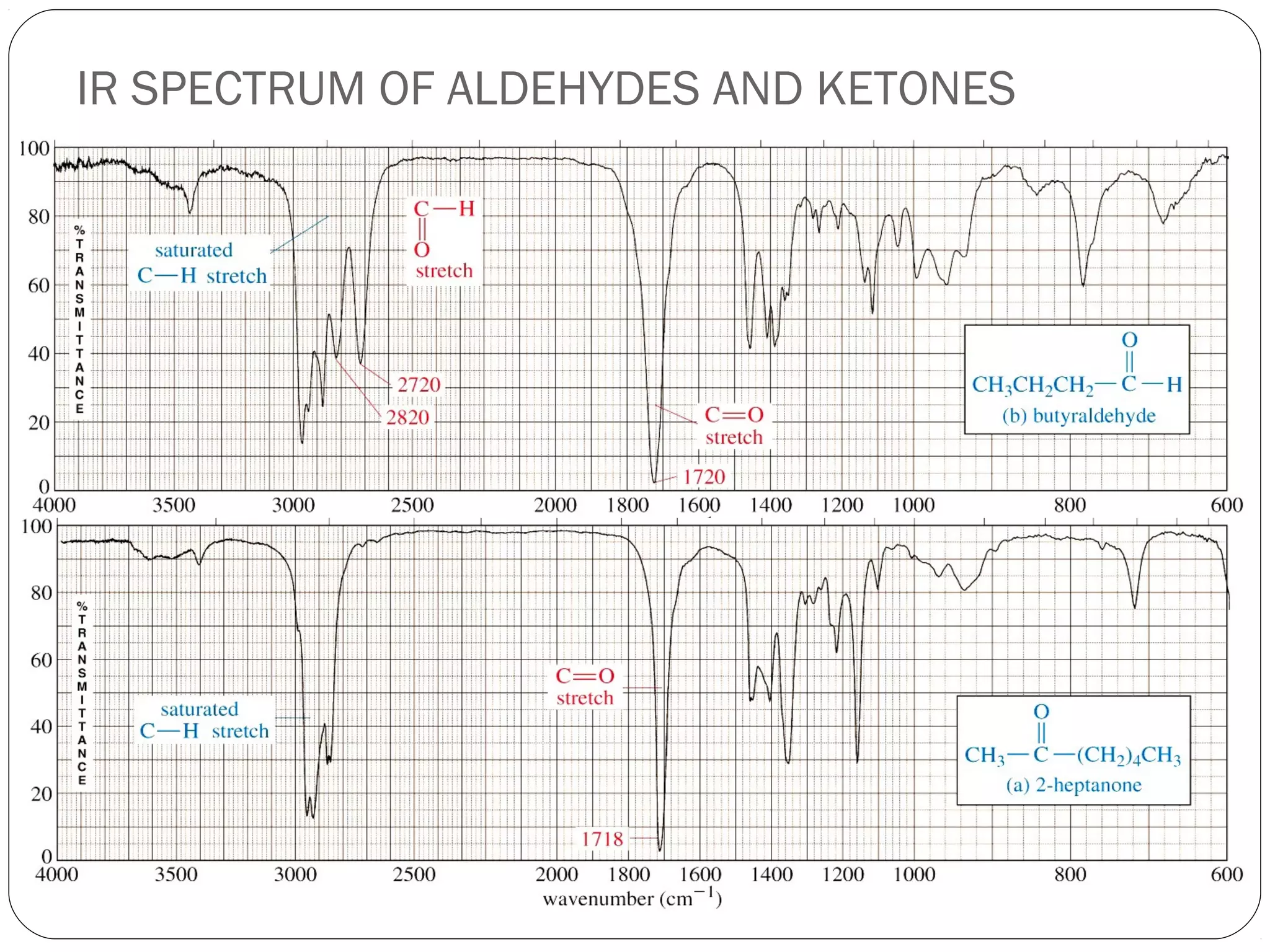
Aldehydes and ketones show a strong, prominent, stake-shaped
band around 1710 - 1720 cm-1
. This band is due to the highly polar
C=O bond.
Because aldehydes also contain a C-H bond to the sp2
carbon of the
C=O bond, they also show a pair of medium strength bands
positioned about 2700 and 2800 cm-1
. These bands are missing in the
spectrum of a ketone because the sp2
carbon of the ketone lacks the C-
H bond.
IR SPECTRUM OF ALDEHYDES AND KETONES
IR SPECTRUM OF A CARBOXYLIC ACID
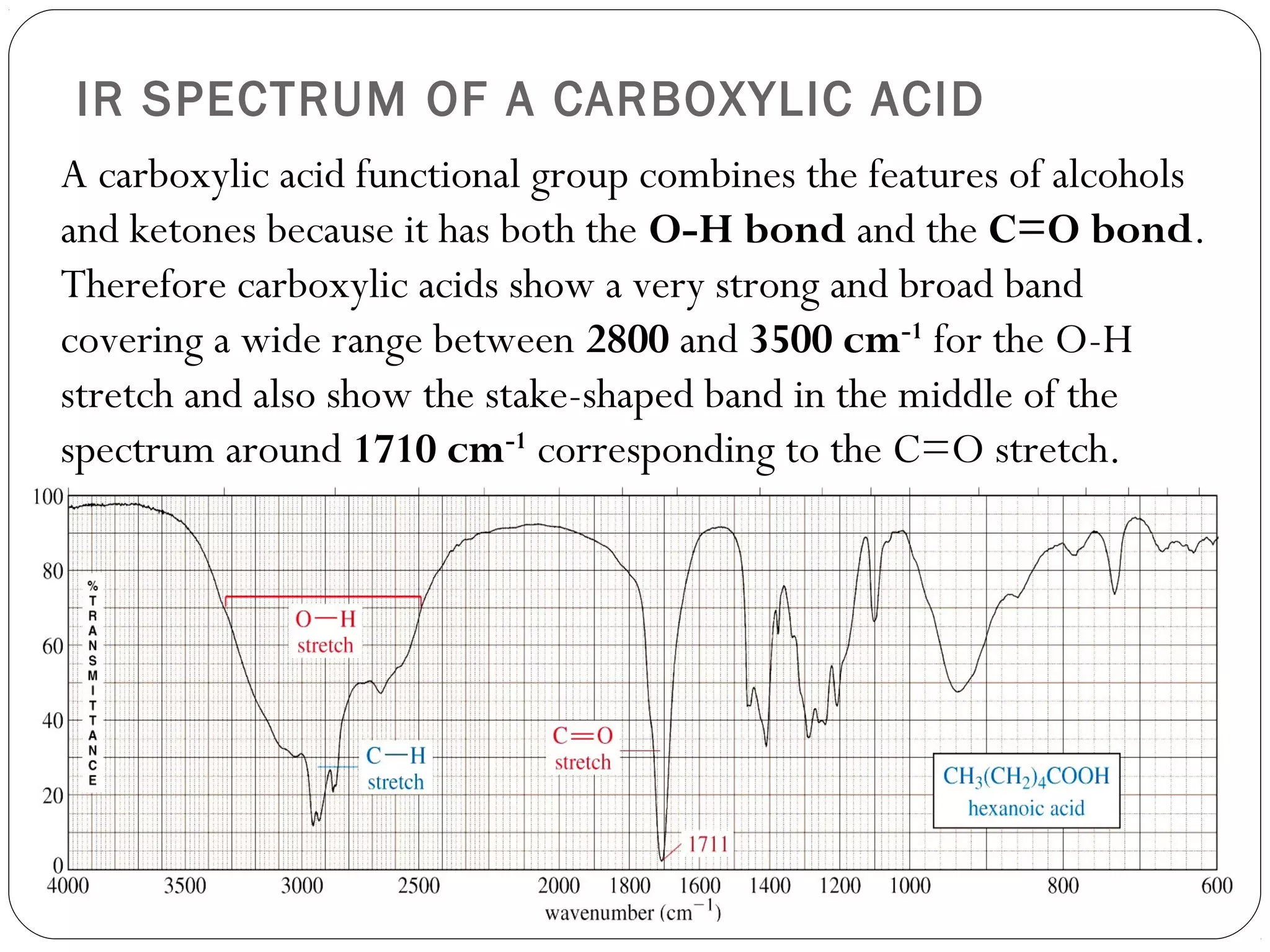
A carboxylic acid functional group combines the features of alcohols
and ketones because it has both the O-H bond and the C=O bond.
Therefore carboxylic acids show a very strong and broad band
covering a wide range between 2800 and 3500 cm-1
for the O-H
stretch and also show the stake-shaped band in the middle of the
spectrum around 1710 cm-1
corresponding to the C=O stretch.
IR SPECTRA OF AMINES
The most characteristic band in amines is due to the N-H bond
stretch, and it appears as a weak to medium, somewhat broad band.
This band is positioned in the range of about 3200 - 3600 cm-1
.
Primary amines have two N-H bonds, therefore they typically show
two spikes. Secondary amines have only one N-H bond. Finally,
tertiary amines have no N-H bonds, and therefore this band is absent
from the IR spectrum altogether.
The spectrum below shows a secondary amine.
IR SPECTRUM OF AMIDES
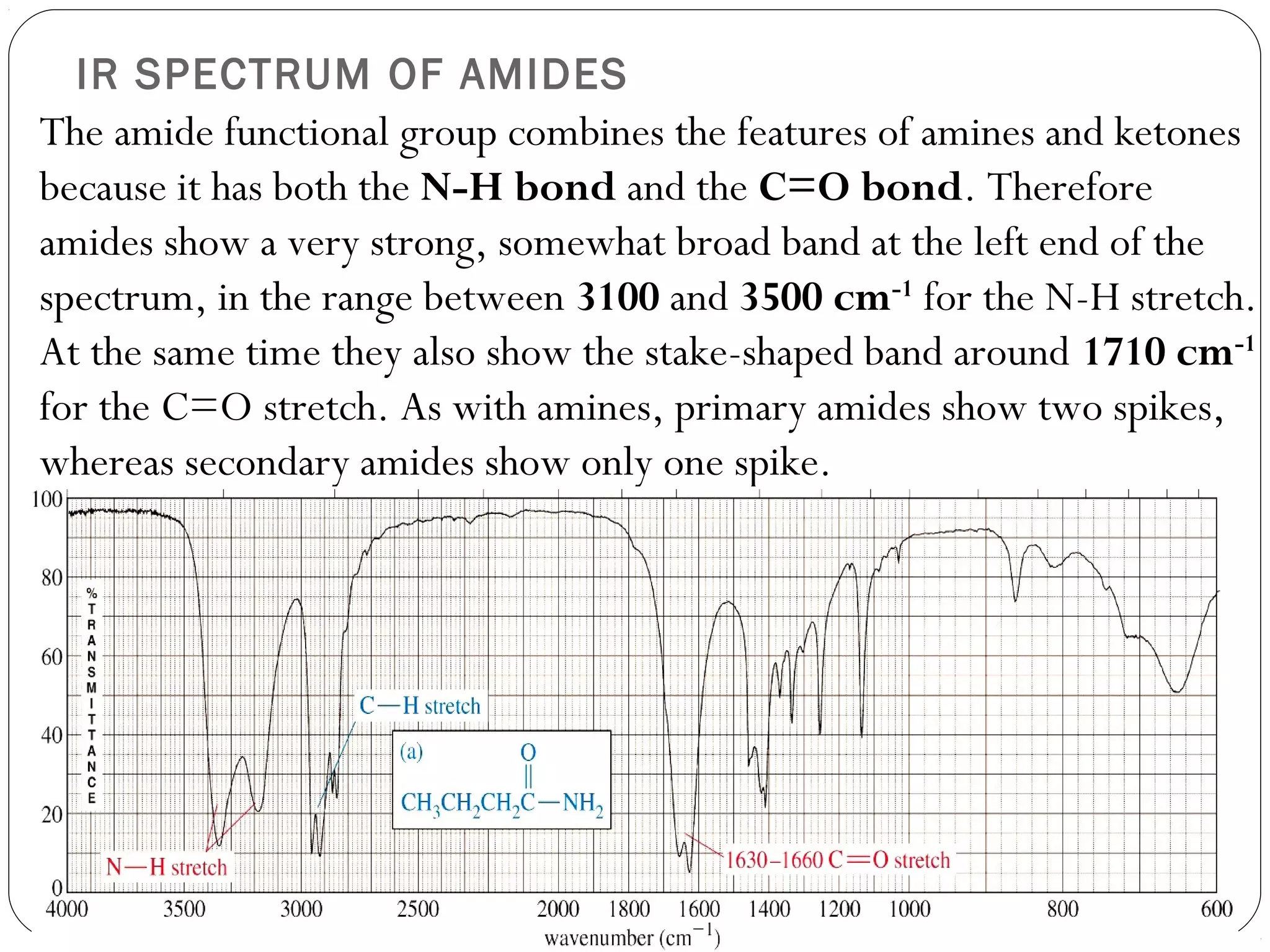
The amide functional group combines the features of amines and ketones
because it has both the N-H bond and the C=O bond. Therefore
amides show a very strong, somewhat broad band at the left end of the
spectrum, in the range between 3100 and 3500 cm-1
for the N-H stretch.
At the same time they also show the stake-shaped band around 1710 cm-1
for the C=O stretch. As with amines, primary amides show two spikes,
whereas secondary amides show only one spike.

Theory of IR spectroscopy

  • 1.
    SEMINAR ON IR SPECTROSCOPY: THEORY PRESENTED BY: CHIRANJIBI ADHIKARI 1st Year M.PHARM.(Pharmaceutics) MALLIGE COLLEGE OF PHARMACY
  • 2.
    INTRODUCTION OF IRSPECTROSCOPY Infrared spectroscopy is an important analytical technique for determining the structure of both inorganic & organic compounds. It is also known as vibrational spectroscopy IR radiations lies in the wavelength range of 0.7 - 400 µm. IR spectroscopy is based upon selective absorption of IR radiations by the molecule which induces vibration of the molecules of the compound. IR instruments are of 2 types namely, dispersive instruments (spectrophotometers) and Fourier transform IR instrument. The radiation sources used are incandescent lamp, Nernst glower etc., and the detectors used are thermal and photon detectors.
  • 3.
    APPLICATIONS OF IRSPECTROSCOPY Identification of functional groups & structure elucidation of organic compounds. Quantitative analysis of a number of organic compounds. Study of covalent bonds in molecules. Studying the progress of reactions. Detection of impurities in a compound. Ratio of cis-trans isomers in a mixture of compounds. Shape of symmetry of an inorganic molecule. Study the presence of water in a sample. Measurement of paints and varnishes.
  • 4.
    LIMITATIONS OF IRSPECTROSCOPY Cannot determine the molecular weight of the compound. Does not give information about the relative position of different functional groups in a molecule. From the single IR spectrum of an unknown substance, it is not possible to know whether it is pure compound or a mixture of compound.  Sample cells are made of halaogen salts which are susceptible to moisture. Gas samples cannot be analyzed as they lack sensitivity.
  • 5.
     IR spectrumis a graph of band intensities on ordinate versus position of band on abscissa.  Band intensities can be given in terms of transmittance(T) or absorbance(A).  Position of band can be expressed in terms of wave number (n) or wavelength(λ).  In IR spectra, wave numbers (n) are used instead of wavelength (λ) for mentioning the characteristic peak as this unit has advantage of being linear with energy of radiation (E) . E = h c/ λ or, E= h c n [ n = 1/λ, c= velocity of light, h= Planck’s constant ] NATURE OF IR SPECTRA
  • 6.
    TRANSMISSION vs. ABSORPTION When a chemical sample is exposed to the action of IR LIGHT, it can absorb (retain) specific frequencies and allow the rest to pass through it (transmitted light).  Some of the light can also be reflected back to the source. Chemical sample IR source Transmitted light Detector  Transmittance ( T) is defined as the ratio of radiant power transmitted by a sample to the radiant power incident on the sample. Whereas, Absorbance (A) = log 10 (1 /T)
  • 7.
    An IR spectrumis usually plotted using transmittance, hence absorption band appears as dips rather than maxima. Each dip is called band or peak.
  • 8.
    CLASSIFICATION OF IRBANDS  IR bands can be classified as strong (s), medium (m), or weak (w), depending on their relative intensities in the infrared spectrum. A strong band covers most of the y-axis. A medium band falls to about half of the y-axis, and a weak band falls to about one third or less of the y-axis.
  • 9.
    REGIONS OF IRRADIATION  Range of IR radiation may be divided in four sections – IR Regions Wavelength range(μm) Wavenumber range(cm-1) Photographic 0.7 to 1.2 14285 to 8333 Very Near 1.2 to 2.5 8333 to 4000 Near 2.5 to 25 4000 to 400 Far 25 to 300-400 400 to 33-25 The spectral range used most is the near-IR region. This range gives the important information about the vibrations, and hence about the structure of molecules.  If the wavelenth(λ) is 2.5 μ, wavenumber (n)= 1 / (λ in cm) = 1/ (2.5 µ in cm) = 1/ (2.5 x 10⁻⁴ cm) = 4000 cm-1
  • 10.
    PRINCIPLE OF IRSPECTROSCOPY When the energy in the form of IR is applied and if the applied IR frequency = Natural frequency of vibration, the absorption of IR takes place and a peak is observed. Molecules are excited to the higher energy state from the ground state when they absorb IR radiation. When a compound is exposed to IR radiation, it selectively absorbs the radiations resulting in vibration of the molecules of the compound, giving rise to closely packed absorption bands, called as IR absorption spectrum. The bands correspond to the characteristic functional groups and the bonds present in a chemical substance. Thus, an IR spectrum of a compound is considered as the fingerprint for its chemical identification.
  • 11.
    Organic compound absorbEM Energy in the IR regions. IR does not have sufficient energy to cause excitation of electrons as in UV Visible, however it causes atoms and group of atoms of organic compound to vibrates faster the covalent bond which connect them.
  • 12.
    A molecule inits ground state posses 3 energy levels, Electronic, Vibrational and Rotational energy level. • Absorption in the IR regions is due to the changes in the vibrational and rotational levels. • When an electron absorbs less energy, rotational transitions takes place. The spectrum observed is called rotational spectrum observed in far IR region (25 to 300-400 µ). • When the electrons absorbs still higher energy, vibrational transitions take place which is accompanied with rotational transitions. The spectrum observed is called vibrational- rotational spectrum obtained in near IR region (2.5 to 25 µ). • Electronic transitions take place at higher energies, these are not seen in IR.
  • 13.
    CRITERIA FOR ACOMPOUND TO ABSORB IR RADIATION 1. Correct wave length of incident radiation  A molecules absorbs radiation only when the frequency of the incident radiation is equivalent to the natural frequency of vibration of the part of the molecule.  After absorption of the correct wave length of radiations, the molecule vibrates at increased amplitude due to absorbed IR energy.  Example: HCl has natural vibrational frequency of 8.7×10¹³/s ( 2890 cm-1). When HCl sample is exposed to IR radiations, only the radiations of frequency 8.7×10¹³/s are absorbed and remaining are transmitted.
  • 14.
    2. Dipole Momentand symmetry of molecule The bonds in a molecule can absorb IR radiation only when there is a change in dipole moment due to electric field of IR radiation. The electric charges +ve and –ve on the atoms of molecule experiences forces in opposite directions, as a result, spacing between the charged atoms( electric dipole) of the molecule also decrease. These charged atoms when vibrated, absorbs IR radiation. If the rate of vibration in charge atoms is fast, they exhibit intense absorption of radiation & vice versa. Vibrational transition of C=O, N-H, O-H, etc occur to change in dipole movements thus absorbs IR radiations.
  • 15.
    Symmetrical diatomic molecules(O2, N2, etc.) do not posses electric dipole and hence cannot absorb IR radiations. Even though symmetrical compounds such as ethylene –C=C– exhibits dipoles, they do not show any change in the dipole moment, upon C=C stretching. If the symmetry of the compound is destroyed, it exhibits change in dipole moment and strong IR absorption takes place. Examples – Ethylene and Bromoethylene. Substitution of bromine for hydrogen of ethylene destroys the symmetry and stretching of the double bond exhibits change in dipole moment. When the polar molecule is exposed to IR radiations, stretching vibrations along the internuclear axis of the polar bond are seen. Hence, electron distribution changes and a change in dipole moment is seen.
  • 16.
    CHARACTER OF VIBRATION Fundamentalmodes of molecular vibrations can be classified into two types: Stretching and Bending vibrations. 1. STRETCHING VIBRATIONS They involve movement of atom within the same bond axis such that the bond length changes without any change in bond angle in regular interval. Symmetrical molecules like O=C=O are not IR active because no change in dipole moment is observed upon stretching vibrations. Non- cyclic systems show (n-1) stretching vibrations because these vibrations describes one directional motion.
  • 17.
    Types of stretchingvibrations- a. Symmetrical stretching: The atoms of a molecule either move away or towards the central atom, but in the same direction. b. Asymmetric Stretching: One atom approach towards the central atom while other departs from it.
  • 18.
    2. BENDING ORDEFORMING VIBRATIONS They involve movement of atoms which are attached to a common central atom, such that there is change in bond axis and bond angle of each individual atom without change in their bond lengths. Bending vibrations generally requires less energy and occur at longer wavelengths (lower cm-1) than stretching vibrations. Types of bending vibrations I) In-plane vibrations a. Scissoring b. Rocking II) Out-plane vibrations a. Wagging b. Twisting
  • 19.
    I) In planevibration a) Rocking: In-plane bending of atoms occurs wherein they swing back and forth with respect to the central atom. a) Scissoring: In-plane bending of atoms occur wherein they move back and forth. i.e., they approach to each other.
  • 20.
    II) Out planevibration: a) Wagging:- Two atoms oscillate up and below the plane with respect to the central atom. b) Twisting:- One of atom moved up the plane while other down the plane with respect to central atom.
  • 21.
    Vibrational Frequency The valueof stretching vibrational frequency of bond can be calculated by using Hooke’s law. Hooke’s law states that the vibrational frequency of a bond is directly proportional to the bond strength and inversely proportional to the masses at the ends of the bond.
  • 22.
    Vibrational frequency orwave number depend upon following: 1. BOND STRENGTH The frequency of vibration will be directly proportional to strength of bond (K). E.g.- Stretching vibration of triple bond will appear at high frequency than that of either a double or single bond C=C C=C C-C Frequency= 2150 cm-1 1650 cm-1 1200 cm-1 2. MASS : Vibrational frequency is inversely proportional to the masses at the ends of the bond. C-H C-C C-O C-Cl C-Br C-I 3000 1200 1100 750 600 500 Cm-1
  • 23.
    3. Hybridization: • Hybridizationaffects the bond strength or force constant(K). • Bonds are stronger in order : SP > SP2 > sp3 3300 CM-1 3100 CM-1 2900 CM-1 C=C C C C CH H 1.5 AO1.20 AO 1.3 AO
  • 24.
    Factor affecting vibrationalfrequency 1. Coupling interaction. 2. Fermi resonance. 3. Hydrogen bonding. 4. Electronic displacement effects.
  • 25.
    1. Coupling interaction Itis expected that there is a stretching absorption frequency for an isolated C-H bond. But in case of Methylene(-CH2-) group, two absorption occurs which corresponds to symmetric & asymmetric vibrations. Asymmetric vibration always takes place at high wave number compared with symmetric vibration.  These are knows as coupled vibrations because vibration occurs at different frequencies than that required for an isolated C-H stretching.
  • 26.
    2. Fermi resonance Itoccurs when a fundamental vibration couples with an overtone or combination band. When an overtone or a combination of band has the same frequency to a fundamental, two bands appear close together.
  • 27.
    The effect isgreatest when the frequencies match, and the two bands are referred to as a Fermi doublet. When two bonds share a common atom as in the case of a linear tri-atomic molecule CO2, consisting of two CO bonds (O=C=O), two fundamental stretching vibrations: symmetric and asymmetric takes place. As the symmetric stretching vibration produces no change in the dipole movement of the molecules, it is inactive in the IR spectra. In the asymmetric vibration, one oxygen approach the carbon atom as other may be away. Asymmetric stretching vibration appears in the IR region 2330 cm-1
  • 28.
    3. Hydrogen bonding Hydrogenbonding gives rise to downward frequency shifts. Stronger the bonding, greater the absorption shift towards lower wave number from normal value. Generally, intermolecular hydrogen bonds are sharp and well defined.  Intermolecular hydrogen bonds are concentration dependent. On dilution, intensities of such bands decreases and finally disappears.
  • 29.
    OH COOCH3 OH OMeO O OMe OH O O OMe H P- hydroxymethyl benzoate Intermolccular hydrogen bonding Intramolecular hydrogen bonding Stretching 1740-1780 cm-1 Stretching 1710cm-1 Stretching 1680 cm-1
  • 30.
    4. Electronic DisplacementEffect The frequency shifts from normal position of absorption occur because of electronic effects which include: Inductive effect, mesomeric effect, configuration effect or field effect . Under the influence of these effects, the force constant (K) or the bond strength changes and its absorption frequency shifts from the normal value. The introduction of alkyl group in an alpha- position of C=O group exerts inductive effect which results in shortening or strengthening of the bond. Consequently the force constant increases and so the frequency or the wave number of absorption also increases.
  • 31.
    Inductive effects aredivided into two parts: +ve inductive effect -ve inductive effect Eletron deficient Electron rich e.g Alkyl group e.g CL, BR, I, OH Bond length K Frequency Bond length K Frequency
  • 32.
    Mesomeric effect worksalong with inductive effect. In some cases, inductive effect dominates mesomeric effect and vice versa. Configuration decreases the wavenumber of absorption. Oxygen atom of esters is more electronegative than nitrogen atom of amide. Hence, one pair of electron pair of nitrogen atom of amides participate more in conjugation thereby decreasing the absorption frequency of C=O group of amide. Compound Wave Number (cm- 1) Benzamide 1663 Phenylacetate 1730
  • 33.
    REGIONS OF IRSPECTRUM IR spectra is divided into 2 regions. 1. Region 4000- 1500 cm-1 It consists of absorption bands of vibrational states of various types of bonds present in the molecule. The important groups accounted for include NH, OH, C=O, C=C, C=N, etc. The presence of aromatic nucleus (2000-1670 cm-1) and hydrogen bonding O-H, N-H, etc are also encountered in this region.
  • 34.
    The graph showsthe regions of the spectrum where the following types of bonds normally absorb. For example, a sharp band around 2200-2400 cm-1 would indicate the possible presence of a C-N or a C-C triple bond. Graphics source: Wade, Jr., L.G. Organic Chemistry, 5th ed. Pearson Education Inc., 2003
  • 35.
    2. Fingerprint region This region accounts for many absorption bands characteristic of functional group. Since numbers of sharp bands of varying intensities are encountered, close examination is needed.  This region is useful for the identification of compounds since no two compounds can have identical IR spectra under identical conditions.  Regions present below 1500 cm-1 shows absorption bands due to bending vibrations and stretching vibrations of C-C, C-O and C-N bonds.  Regions less than 1250 cm-1 consists of complex vibrational and rotational spectra of the complete molecule.
  • 36.
    Fingerprint region isfurther divided into three regions. i. Region 1500- 1350 cm-1  The presence of double peaks near 1380 cm-1 and 1365 cm-1 indicates presence of tertiary butyl group in the compound. ii. Regions 1350-1000 cm-1  Characteristic strong bands due to C-O stretching are present. Compound IR region Ethers 1150- 1070 cm-1 Primary alcohols 1350- 1260 cm-1 and Near 1050 cm-1 Esters 1380- 1050 cm-1 Phenols Near 1200 cm-1
  • 37.
    iii. Less than1000 cm-1  Absorption band in the region 750- 700 cm-1 indicates the presence of mono substituted benzenes.  Geometrical isomers of olefins can be distinguished in the region 970 – 700 cm-1.  Cis- isomer shows strong intensity absorption band at 700 cm-1 and trans- isomer at 970-960 cm-1.
  • 39.
    IR SPECTRUM OFALKANES Alkanes have no functional groups. Their IR spectrum displays only C-C and C-H bond vibrations. Of these, the most useful are the C-H bands, which appear around 3000 cm-1 due to C-H stretching vibrations.
  • 40.
    IR SPECTRUM OFALKENES Besides the presence of C-H bonds, alkenes also show sharp, medium bands corresponding to the C=C bond stretching vibration at about 1600-1700 cm-1 . Some alkenes might also show a band for the =C-H bond stretch, appearing around 3080 cm-1 as shown below. However, this band could be obscured by the broader bands appearing around 3000 cm-1.
  • 41.
    IR SPECTRUM OFALKENES This spectrum shows that the band appearing around 3080 cm-1 can be obscured by the broader bands appearing around 3000 cm-1 .
  • 42.
    IR SPECTRUM OFALKYNES The most prominent band in alkynes corresponds to the carbon- carbon triple bond. It shows as a sharp, weak band at about 2100 cm-1 . The reason it’s weak is because the triple bond is not very polar. In some cases, such as in highly symmetrical alkynes, it may not show at all due to the low polarity of the triple bond associated with those alkynes. Terminal alkynes, i.e. those where the triple bond is at the end of a carbon chain, have C-H bonds involving the sp carbon. Therefore they may also show a sharp, weak band at about 3300 cm-1 corresponding to the C-H stretch. Internal alkynes, i.e. those where the triple bond is in the middle of a carbon chain, do not have C-H bonds to the sp carbon and therefore lack the aforementioned band.
  • 43.
  • 44.
    IR SPECTRUM OFA NITRILE In a manner very similar to alkynes, nitriles show a prominent band around 2250 cm-1 caused by the CN triple bond. This band has a sharp, pointed shape just like the alkyne C-C triple bond, but because the CN triple bond is more polar, this band is stronger than in alkynes.
  • 45.
    IR SPECTRUM OFAN ALCOHOL The most prominent band in alcohols is due to the O-H bond, and it appears as a strong, broad band covering the range of about 3000 - 3700 cm-1 . The sheer size and broad shape of the band dominate the IR spectrum.
  • 46.
    IR SPECTRUM OFALDEHYDES AND KETONES In aldehydes, C=O functional group is at the end of a carbon chain, whereas in ketones it’s in the middle of the chain. As a result, the carbon in the C=O bond of aldehydes is also bonded to another carbon and a hydrogen, whereas the same carbon in a ketone is bonded to two other carbons. Aldehydes and ketones show a strong, prominent, stake-shaped band around 1710 - 1720 cm-1 . This band is due to the highly polar C=O bond. Because aldehydes also contain a C-H bond to the sp2 carbon of the C=O bond, they also show a pair of medium strength bands positioned about 2700 and 2800 cm-1 . These bands are missing in the spectrum of a ketone because the sp2 carbon of the ketone lacks the C- H bond.
  • 47.
    IR SPECTRUM OFALDEHYDES AND KETONES
  • 48.
    IR SPECTRUM OFA CARBOXYLIC ACID A carboxylic acid functional group combines the features of alcohols and ketones because it has both the O-H bond and the C=O bond. Therefore carboxylic acids show a very strong and broad band covering a wide range between 2800 and 3500 cm-1 for the O-H stretch and also show the stake-shaped band in the middle of the spectrum around 1710 cm-1 corresponding to the C=O stretch.
  • 49.
    IR SPECTRA OFAMINES The most characteristic band in amines is due to the N-H bond stretch, and it appears as a weak to medium, somewhat broad band. This band is positioned in the range of about 3200 - 3600 cm-1 . Primary amines have two N-H bonds, therefore they typically show two spikes. Secondary amines have only one N-H bond. Finally, tertiary amines have no N-H bonds, and therefore this band is absent from the IR spectrum altogether. The spectrum below shows a secondary amine.
  • 50.
    IR SPECTRUM OFAMIDES The amide functional group combines the features of amines and ketones because it has both the N-H bond and the C=O bond. Therefore amides show a very strong, somewhat broad band at the left end of the spectrum, in the range between 3100 and 3500 cm-1 for the N-H stretch. At the same time they also show the stake-shaped band around 1710 cm-1 for the C=O stretch. As with amines, primary amides show two spikes, whereas secondary amides show only one spike.

Editor's Notes

  • #22 Where, m1 & m2 = masses of two atoms in gram in a particular bond. K= force constant of bond and is related to the strength of bond. C= velocity of the light.
  • #27 V= vibrational energy level, V0= initial or ground level
  • #39 Graphics source: Wade, Jr., L.G. Organic Chemistry, 6th ed. Pearson Prentice Hall Inc., 2006
  • #40 Graphics source: Wade, Jr., L.G. Organic Chemistry, 5th ed. Pearson Education Inc., 2003
  • #41 Graphics source: Wade, Jr., L.G. Organic Chemistry, 5th ed. Pearson Education Inc., 2003
  • #42 Graphics source: Wade, Jr., L.G. Organic Chemistry, 6th ed. Pearson Prentice Hall Inc., 2006
  • #44 Comparison between an unsymmetrical terminal alkyne (1-octyne) and a symmetrical internal alkyne (4-octyne). Graphics source: Wade, Jr., L.G. Organic Chemistry, 6th ed. Pearson Prentice Hall Inc., 2006
  • #45 Graphics source: Wade, Jr., L.G. Organic Chemistry, 6th ed. Pearson Prentice Hall Inc., 2006
  • #46 Graphics source: Wade, Jr., L.G. Organic Chemistry, 6th ed. Pearson Prentice Hall Inc., 2006
  • #48 Graphics source: Wade, Jr., L.G. Organic Chemistry, 6th ed. Pearson Prentice Hall Inc., 2006
  • #49 Graphics source: Wade, Jr., L.G. Organic Chemistry, 6th ed. Pearson Prentice Hall Inc., 2006
  • #50 Graphics source: Wade, Jr., L.G. Organic Chemistry, 6th ed. Pearson Prentice Hall Inc., 2006
  • #51 Graphics source: Wade, Jr., L.G. Organic Chemistry, 6th ed. Pearson Prentice Hall Inc., 2006