PRESENTED BY
Chiranjibi Adhikari M. Pharm. 1
st
year
SUBMITTED TO
Dr. Gururaj S Kulkarni M. Pharm., Ph. D.,
Professor and HOD,
Department of Pharmaceutics,
Mallige College of Pharmacy.
#71, SILVEPURA, BANGALORE: 560 090
MAJOR BODIES REGULATING
INDIAN PHARMACEUTICAL
SECTOR, CDSCO
SEMINAR
ON
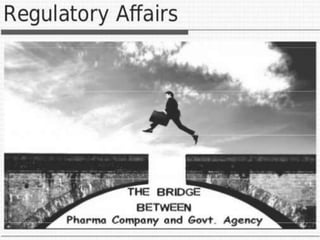
 “To regulate means to control something so that it
functions properly.”
 Drug Regulatory Affair is a function which
regulates the pharmaceutical science in order to
facilitate trade / business in and outside the
country of origin for public interest.
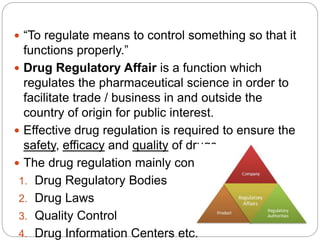
 Effective drug regulation is required to ensure the
safety, efficacy and quality of drugs.
 The drug regulation mainly consists of:
1. Drug Regulatory Bodies
2. Drug Laws
3. Quality Control
4. Drug Information Centers etc.
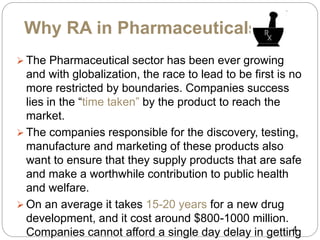
Why RA in Pharmaceuticals??
 The Pharmaceutical sector has been ever growing
and with globalization, the race to lead to be first is no
more restricted by boundaries. Companies success
lies in the “time taken” by the product to reach the
market.
 The companies responsible for the discovery, testing,
manufacture and marketing of these products also
want to ensure that they supply products that are safe
and make a worthwhile contribution to public health
and welfare.
 On an average it takes 15-20 years for a new drug
development, and it cost around $800-1000 million.
Companies cannot afford a single day delay in getting4
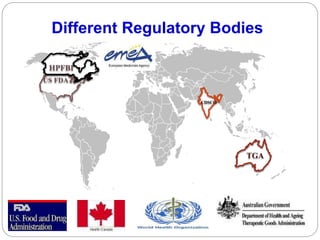
US FDA
TGA
HPFBI
CDSCO
Different Regulatory Bodies
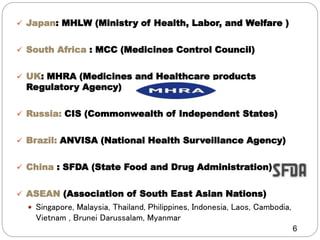
 Japan: MHLW (Ministry of Health, Labor, and Welfare )
 South Africa : MCC (Medicines Control Council)
 UK: MHRA (Medicines and Healthcare products
Regulatory Agency)
 Russia: CIS (Commonwealth of Independent States)
 Brazil: ANVISA (National Health Surveillance Agency)
 China : SFDA (State Food and Drug Administration)
 ASEAN (Association of South East Asian Nations)
 Singapore, Malaysia, Thailand, Philippines, Indonesia, Laos, Cambodia,
Vietnam , Brunei Darussalam, Myanmar
6
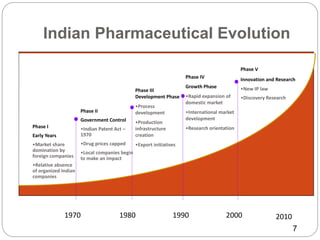
Indian Pharmaceutical Evolution
Phase II
Government Control
•Indian Patent Act –
1970
•Drug prices capped
•Local companies begin
to make an impact
Phase III
Development Phase
•Process
development
•Production
infrastructure
creation
•Export initiatives
Phase IV
Growth Phase
•Rapid expansion of
domestic market
•International market
development
•Research orientation
Phase V
Innovation and Research
•New IP law
•Discovery Research
1970 1980 1990 2000 2010
Phase I
Early Years
•Market share
domination by
foreign companies
•Relative absence
of organized Indian
companies
7
 Fastest growing industry in India with CAGR of about 30%
 India pharma market size $19 billion crore on the basis of
sales.
 India is the world’s 4th largest producer of pharmaceuticals
by volume. (accounting for around 8% of global production)
 Indian company meets 95% of domestic sales.
 270 large R&D based pharmaceutical companies in India
and their share is around 70%.
 India produces 22% of world generics.
 Per capita consumption of drugs is very low $93 as
compared to $412(Japan), $222(Germany), $191(US).
 India among top 5 bulk drug producers in world.
 Ranbaxy is 7th world’s largest generic manufacture.
Current Scenario of
Indian Pharmaceutical Industry
8
Drug Regulatory Bodies in
India
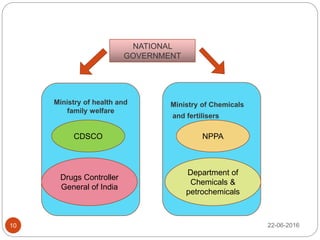
 Drug policies in India are formulated by:
The Ministry of Chemicals and Fertilizers and
 The Ministry of Health and Family Welfare.
 The former takes the decision on pricing of drugs
and the latter looks into quality, manufacture,
sales and distribution of drugs.
 The Department of Chemicals and
Petrochemicals also oversees policy, planning,
development and regulation pertaining to the
pharmaceutical sector.
 There are also 35 state-level Food and Drug
Administrations.
22-06-2016
NATIONAL
GOVERNMENT
Ministry of Chemicals
and fertilisers
Ministry of health and
family welfare
CDSCO NPPA
Department of
Chemicals &
petrochemicals
Drugs Controller
General of India
22-06-201610
Central Drug Standards and
Control Organization(CDSCO)
It is the principal national drug authority based in
New Delhi, established under the Drugs and
Cosmetics Act 1940.
 CDSCO is headed by the Drugs Controller
General of India (DCGI), presently Dr. G.N.
Singh.
Vision - to protect and promote public health in
India.
Mission- to safeguard and enhance public health
by assuring safety, efficacy and quality of drugs,
cosmetics and medical devices.
22-06-2016
11
 CENTRAL AUTHORITIES-
1. Approves pre-clinical and clinical trials,
2. Approves licences to manufacture the drugs by acting as
Central License Approving Authority(CLAA).
3. The market authorization of new drugs,
4. Supervision of quality of imported drug imports and
5. Guidance on technical matters.
 STATE AUTHORITIES-
 licensing a drug maker’s research and manufacturing
facilities.
 Monitor quality control.
 Distribution and sale of drugs.
22-06-201612
Functions of the CDSCO
 Laying down standards of drugs, cosmetics,
diagnostics and devices
 Laying down regulatory measures, amendments to
Acts and Rules.
 To grant marketing authorization of new drugs.
 To regulate clinical trials in India.
 To approve licenses to manufacture certain categories
of drugs as Central License Approving Authority i.e. for
Blood Banks, Medical Devices, r-DNA drugs, Large
Volume Parenterals and Vaccines & Sera.
 To regulate the standards of imported drugs.
 Work relating to the Drugs Technical Advisory Board
(DTAB) and Drugs Consultative Committee (DCC).
 Pharmacovigillance program of India.
 Coordinating activities of the State Drugs Control
Organizations to achieve uniform administration of the
Act and providing policy guidance.
 Guidance on technical matters
 Monitoring adverse drug reactions (ADR).
 Participation in the WHO GMP certification scheme.
 Conducting training programs for regulatory officials
and Government Analysts.
22-06-201615
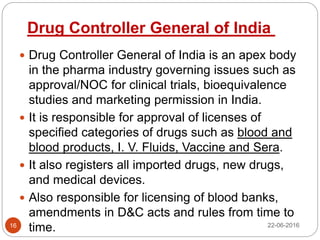
 Drug Controller General of India is an apex body
in the pharma industry governing issues such as
approval/NOC for clinical trials, bioequivalence
studies and marketing permission in India.
 It is responsible for approval of licenses of
specified categories of drugs such as blood and
blood products, I. V. Fluids, Vaccine and Sera.
 It also registers all imported drugs, new drugs,
and medical devices.
 Also responsible for licensing of blood banks,
amendments in D&C acts and rules from time to
time. 22-06-201616
Drug Controller General of India
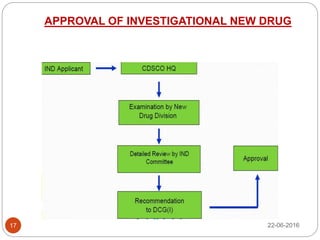
APPROVAL OF INVESTIGATIONAL NEW DRUG
22-06-201617
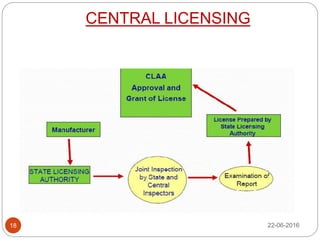
CENTRAL LICENSING
22-06-201618
NATIONAL PHARMACEUTICAL
PRICING AUTHORITY(NPPA)
NPPA was established, to fix/ revise the prices of
controlled bulk drugs and formulations and to
enforce prices and availability of the medicines in
the country, under the Drugs Prices Control
Order(DPCO), 1995.
In order to streamline the procedure of pricing and
to bring transparency, NPPA was constituted with
the powers to fix prices and notify the changes
therein, if any, of bulk drugs and formulations from
time to time.
Pricing policy and industry regulation constitutes
the key responsibility of the NPPA.
22-06-201619
 NPPA is entrusted with the task of recovering
amounts overcharged by manufacturers for the
controlled drugs from the consumers.
Drug prices in India are among the lowest in the
world and imports are therefore negligible.
Drugs with high sales and a market share of more
than 50% are subjected to price regulation.
Price control is exempted for the following:
New drugs discovered in India.
Bulk drugs produced from the basic stages by a
new process discovered in India.
Drugs manufactured by small-scale industries and
sold under their own brand names.
DEFICIENCIES & LIMITATIONS OF DRUG
REGULATORY SYSTEM
 Lack of transparency in licensing procedures.
 Inadequate regulatory expertise and testing
facilities to implement uniform standards.
 Need for greater coordination and transparency in
functioning among different ministries concerned
with drug regulation.
 Proliferation of spurious and substandard drugs in
the Indian market.
 Only one- tenth of drug market is price controlled.
22-06-201621
Recent regulatory initiatives:
 Move to establish National Drug Authority so that
quality regulation and price control is performed
by the same agency.
 Establishment of pharmacovigilance centres at
national, zonal and regional levels to monitor
adverse drug reactions.
 Move to bring nearly 374 bulk drugs under price
control.
 Monitoring clinical trials by setting up of the
Clinical Trials Registry of India (CTRI).
22-06-201622
REFERENCES:
1. Sarda Rohit R et al. The Indian pharmaceutical
Industry; evolution of regulatory system and
present scenario. IRJP 2012; 3(6).
2. Hasumati Rahalkar. Historical overview of
pharmaceutical industry and drug regulatory
affairs. Kurz Pharmaceut Reg Affairs 2012,
S11-002.
3. www. cdsco.nic.in
4. www.slideshare.net
5. www.wikipedia.org
THANK YOU
FOR YOUR ATTENTION!
24

Bodies regulating indian pharmaceutical sector, cdsco

  • 1.
    PRESENTED BY Chiranjibi AdhikariM. Pharm. 1 st year SUBMITTED TO Dr. Gururaj S Kulkarni M. Pharm., Ph. D., Professor and HOD, Department of Pharmaceutics, Mallige College of Pharmacy. #71, SILVEPURA, BANGALORE: 560 090 MAJOR BODIES REGULATING INDIAN PHARMACEUTICAL SECTOR, CDSCO SEMINAR ON
  • 3.
     “To regulatemeans to control something so that it functions properly.”  Drug Regulatory Affair is a function which regulates the pharmaceutical science in order to facilitate trade / business in and outside the country of origin for public interest.  Effective drug regulation is required to ensure the safety, efficacy and quality of drugs.  The drug regulation mainly consists of: 1. Drug Regulatory Bodies 2. Drug Laws 3. Quality Control 4. Drug Information Centers etc.
  • 4.
    Why RA inPharmaceuticals??  The Pharmaceutical sector has been ever growing and with globalization, the race to lead to be first is no more restricted by boundaries. Companies success lies in the “time taken” by the product to reach the market.  The companies responsible for the discovery, testing, manufacture and marketing of these products also want to ensure that they supply products that are safe and make a worthwhile contribution to public health and welfare.  On an average it takes 15-20 years for a new drug development, and it cost around $800-1000 million. Companies cannot afford a single day delay in getting4
  • 5.
  • 6.
     Japan: MHLW(Ministry of Health, Labor, and Welfare )  South Africa : MCC (Medicines Control Council)  UK: MHRA (Medicines and Healthcare products Regulatory Agency)  Russia: CIS (Commonwealth of Independent States)  Brazil: ANVISA (National Health Surveillance Agency)  China : SFDA (State Food and Drug Administration)  ASEAN (Association of South East Asian Nations)  Singapore, Malaysia, Thailand, Philippines, Indonesia, Laos, Cambodia, Vietnam , Brunei Darussalam, Myanmar 6
  • 7.
    Indian Pharmaceutical Evolution PhaseII Government Control •Indian Patent Act – 1970 •Drug prices capped •Local companies begin to make an impact Phase III Development Phase •Process development •Production infrastructure creation •Export initiatives Phase IV Growth Phase •Rapid expansion of domestic market •International market development •Research orientation Phase V Innovation and Research •New IP law •Discovery Research 1970 1980 1990 2000 2010 Phase I Early Years •Market share domination by foreign companies •Relative absence of organized Indian companies 7
  • 8.
     Fastest growingindustry in India with CAGR of about 30%  India pharma market size $19 billion crore on the basis of sales.  India is the world’s 4th largest producer of pharmaceuticals by volume. (accounting for around 8% of global production)  Indian company meets 95% of domestic sales.  270 large R&D based pharmaceutical companies in India and their share is around 70%.  India produces 22% of world generics.  Per capita consumption of drugs is very low $93 as compared to $412(Japan), $222(Germany), $191(US).  India among top 5 bulk drug producers in world.  Ranbaxy is 7th world’s largest generic manufacture. Current Scenario of Indian Pharmaceutical Industry 8
  • 9.
    Drug Regulatory Bodiesin India  Drug policies in India are formulated by: The Ministry of Chemicals and Fertilizers and  The Ministry of Health and Family Welfare.  The former takes the decision on pricing of drugs and the latter looks into quality, manufacture, sales and distribution of drugs.  The Department of Chemicals and Petrochemicals also oversees policy, planning, development and regulation pertaining to the pharmaceutical sector.  There are also 35 state-level Food and Drug Administrations. 22-06-2016
  • 10.
    NATIONAL GOVERNMENT Ministry of Chemicals andfertilisers Ministry of health and family welfare CDSCO NPPA Department of Chemicals & petrochemicals Drugs Controller General of India 22-06-201610
  • 11.
    Central Drug Standardsand Control Organization(CDSCO) It is the principal national drug authority based in New Delhi, established under the Drugs and Cosmetics Act 1940.  CDSCO is headed by the Drugs Controller General of India (DCGI), presently Dr. G.N. Singh. Vision - to protect and promote public health in India. Mission- to safeguard and enhance public health by assuring safety, efficacy and quality of drugs, cosmetics and medical devices. 22-06-2016 11
  • 12.
     CENTRAL AUTHORITIES- 1.Approves pre-clinical and clinical trials, 2. Approves licences to manufacture the drugs by acting as Central License Approving Authority(CLAA). 3. The market authorization of new drugs, 4. Supervision of quality of imported drug imports and 5. Guidance on technical matters.  STATE AUTHORITIES-  licensing a drug maker’s research and manufacturing facilities.  Monitor quality control.  Distribution and sale of drugs. 22-06-201612
  • 13.
    Functions of theCDSCO  Laying down standards of drugs, cosmetics, diagnostics and devices  Laying down regulatory measures, amendments to Acts and Rules.  To grant marketing authorization of new drugs.  To regulate clinical trials in India.  To approve licenses to manufacture certain categories of drugs as Central License Approving Authority i.e. for Blood Banks, Medical Devices, r-DNA drugs, Large Volume Parenterals and Vaccines & Sera.  To regulate the standards of imported drugs.
  • 14.
     Work relatingto the Drugs Technical Advisory Board (DTAB) and Drugs Consultative Committee (DCC).  Pharmacovigillance program of India.  Coordinating activities of the State Drugs Control Organizations to achieve uniform administration of the Act and providing policy guidance.  Guidance on technical matters  Monitoring adverse drug reactions (ADR).  Participation in the WHO GMP certification scheme.  Conducting training programs for regulatory officials and Government Analysts.
  • 15.
  • 16.
     Drug ControllerGeneral of India is an apex body in the pharma industry governing issues such as approval/NOC for clinical trials, bioequivalence studies and marketing permission in India.  It is responsible for approval of licenses of specified categories of drugs such as blood and blood products, I. V. Fluids, Vaccine and Sera.  It also registers all imported drugs, new drugs, and medical devices.  Also responsible for licensing of blood banks, amendments in D&C acts and rules from time to time. 22-06-201616 Drug Controller General of India
  • 17.
    APPROVAL OF INVESTIGATIONALNEW DRUG 22-06-201617
  • 18.
  • 19.
    NATIONAL PHARMACEUTICAL PRICING AUTHORITY(NPPA) NPPAwas established, to fix/ revise the prices of controlled bulk drugs and formulations and to enforce prices and availability of the medicines in the country, under the Drugs Prices Control Order(DPCO), 1995. In order to streamline the procedure of pricing and to bring transparency, NPPA was constituted with the powers to fix prices and notify the changes therein, if any, of bulk drugs and formulations from time to time. Pricing policy and industry regulation constitutes the key responsibility of the NPPA. 22-06-201619
  • 20.
     NPPA isentrusted with the task of recovering amounts overcharged by manufacturers for the controlled drugs from the consumers. Drug prices in India are among the lowest in the world and imports are therefore negligible. Drugs with high sales and a market share of more than 50% are subjected to price regulation. Price control is exempted for the following: New drugs discovered in India. Bulk drugs produced from the basic stages by a new process discovered in India. Drugs manufactured by small-scale industries and sold under their own brand names.
  • 21.
    DEFICIENCIES & LIMITATIONSOF DRUG REGULATORY SYSTEM  Lack of transparency in licensing procedures.  Inadequate regulatory expertise and testing facilities to implement uniform standards.  Need for greater coordination and transparency in functioning among different ministries concerned with drug regulation.  Proliferation of spurious and substandard drugs in the Indian market.  Only one- tenth of drug market is price controlled. 22-06-201621
  • 22.
    Recent regulatory initiatives: Move to establish National Drug Authority so that quality regulation and price control is performed by the same agency.  Establishment of pharmacovigilance centres at national, zonal and regional levels to monitor adverse drug reactions.  Move to bring nearly 374 bulk drugs under price control.  Monitoring clinical trials by setting up of the Clinical Trials Registry of India (CTRI). 22-06-201622
  • 23.
    REFERENCES: 1. Sarda RohitR et al. The Indian pharmaceutical Industry; evolution of regulatory system and present scenario. IRJP 2012; 3(6). 2. Hasumati Rahalkar. Historical overview of pharmaceutical industry and drug regulatory affairs. Kurz Pharmaceut Reg Affairs 2012, S11-002. 3. www. cdsco.nic.in 4. www.slideshare.net 5. www.wikipedia.org
  • 24.
    THANK YOU FOR YOURATTENTION! 24